What is being done to stop organised immigration crime?
Published 26 November 2026

© Crown copyright 2026
This publication is licensed under the terms of the Open Government Licence v3.0 except where otherwise stated. To view this licence, visit nationalarchives.gov.uk/doc/open-government-licence/version/3 or write to the Information Policy Team, The National Archives, Kew, London TW9 4DU, or email: psi@nationalarchives.gov.uk.
Where we have identified any third party copyright information you will need to obtain permission from the copyright holders concerned.
This publication is available at https://www.gov.uk/government/statistics/immigration-system-statistics-year-ending-september-2026/what-is-being-done-to-stop-organised-immigration-crime
Back to ‘Immigration system statistics, year ending September 2026’ contents page
This release goes up to the year ending (YE) September 2026. The “year ending” period includes the 12 months up to and including the YE month. For example, YE September 2026 includes the 12 months between 1 October 2025 and 30 September 2026.
Additional information is provided in the ‘About the statistics’ section and in the user guide.
1. Organised immigration crime
Organised immigration crime (OIC) includes, but is not limited to, offences which have the effect of exploiting vulnerable migrants by smuggling them across borders for profit, including offences committed by organised criminal groups (OCGs).
OCGs are comprised of individuals, working together, with the intent and capability to commit serious crime on a continuing basis, which includes elements of planning, control, coordination, structure and group decision-making.
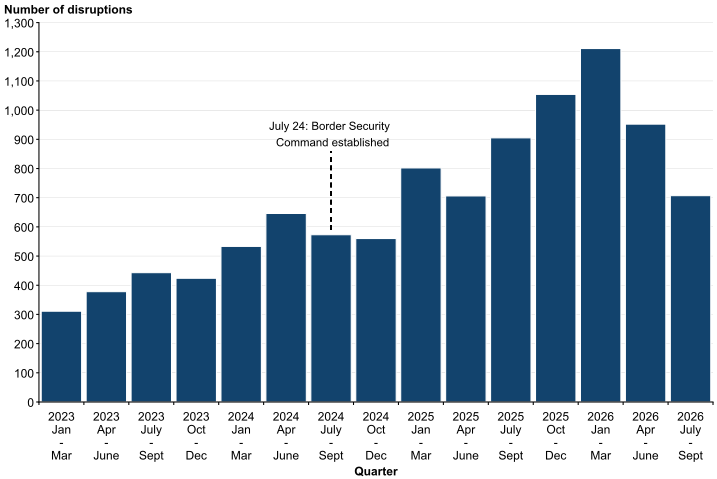
The Border Security Command (BSC), established in July 2024, provides cross-system strategic leadership across partners in the border security system to tackle the facilitators of OIC and wider border security threats. The BSC unites efforts across the National Crime Agency (NCA), intelligence agencies, police, Immigration Enforcement and Border Force, to strengthen border protection and target smuggling gangs facilitating entry to the UK, including small boat crossings. More details on the BSC and its priorities can be found at Delivering Border Security.
The Border Security, Asylum and Immigration Act 2025 received Royal Assent on 2 December 2025. This is a crucial part of the Government’s plans to secure the border and to intercept, disrupt and prevent organised criminality. Targeted new offences tackle the business model of those smuggling individuals into the UK, whilst broader powers to collect data on individuals will enhance the intelligence picture for law enforcement agencies seeking to prosecute organised crime.
1.1 Organised immigration crime disruptions
A disruption is when an agency takes proactive or reactive action in response to a threat, where it can evidence an impact upon an OCG or individual involved in serious organised crime (SOC), intended to prevent them being able to operate at their previous level of criminality. Disruptions may include various forms of law enforcement action such as asset seizures, equipment seizures, revocation of licenses, arrests, convictions or sentences.
OIC disruption data is sourced from a live operational system and is subject to revision as additional cases are retrospectively recorded. Data for the most recent periods will therefore initially undercount the number of disruptions and are expected to be revised upwards in subsequent releases. Further information on revisions to OIC data is available in Section 2.8 of the user guide.
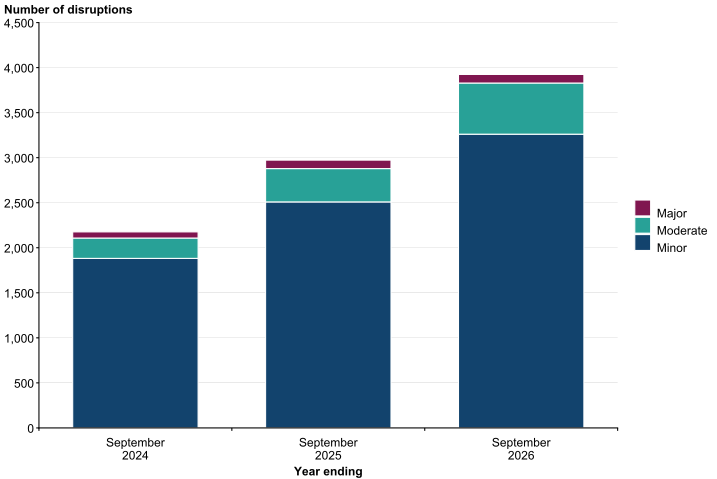
OIC disruptions have increased by almost one-third in the YE September 2026 compared to the previous year.
In the YE September 2026, there were 3,924 disruptions of OIC recorded, 32% more than in the previous year (2,973). This is a continuation of increased enforcement activity from 2023.
OIC disruptions are categorised by operational agencies in 3 groups reflecting the level of impact. These are defined as major, moderate and minor as follows:
Major disruptions include activity with a significant and/or long-term impact in the context of the threat; for example, prison sentence(s) given to key member(s) of the OCG, dismantling the group long term.
Moderate disruptions include activity with a notable and/or medium-term impact in the context of the threat; for example, arrest of OCG members and seizure of significant amounts of cash, disrupting criminality temporarily as the OCG cannot purchase more commodity.
Minor disruptions include activity with a minimal and/or short-term impact in the context of the threat; for example, arrest of lower-level members of the OCG whilst transporting criminal commodity, reducing the volume and frequency of the OCGs criminality.
Further details of the categorisations being used are provided in the user guide.
The increase in OIC disruptions is largely attributable to an increase in minor disruptions, with moderate disruptions also rising and major disruptions remaining consistent with the previous year.
There were 95 major OIC disruptions recorded in the YE September 2026, similar to the previous year. There were 568 moderate disruptions and 3,261 minor disruptions, up 54% and up 30% from the previous year respectively.
Examples of recent disruptions conducted by the NCA can be found at Organised immigration crime - National Crime Agency.
Figure 1: Disruptions of OIC, by impact level, year ending September 2024 to year ending September 2026
Source: Organised immigration crime summary tables, year ending September 2026 - OIC_01
The rise in OIC disruptions in the latest year is a continuation of increased enforcement activity from 2023, with an average of 389 disruptions per quarter in 2023 compared to 981 per quarter in the latest year (see Figure 2).
Figure 2: Disruptions of OIC, January 2023 to September 2026
Source: Organised immigration crime summary tables, year ending September 2026 - OIC_01
2. About the statistics
The underlying data collection and methodology for these statistics were refined to improve accuracy and consistency. As part of this process, figures published in previous editions of the Immigration system statistics release were revised in July 2026. The Home Office continues to work with law enforcement agencies to improve data recording and quality and is reviewing the revised methodology to determine whether any further changes are needed. While changes have not had a notable impact on the trends in disruptions, the number of disruptions reported are lower than releases prior to July 2026
OIC statistics were first published in November 2025 as ‘Official Statistics’, and from July 2026 were labelled as ‘Official Statistics in Development’ while this improvement work is ongoing. Additional information is provided in Sections 8.4 and 8.5 of the user guide.
While we undertake this work we will continue to review the status of the statistics in line with the Code of Practice for Statistics, ensuring they continue to meet user needs.
The statistics in this chapter are based on information provided to the Home Office by the NCA and gathered from the Immigration Enforcement Criminal and Financial Investigations (CFI) team and Home Office Intelligence. They refer to the number of events where OIC disruptions have been conducted across different government and law enforcement agencies.
These figures represent the majority of OIC disruptions in the UK. However, data from agencies not currently captured in our reporting is not included.
Reporting agencies include the NCA, Home Office, NPCC, Police Service of Scotland and Police Service of Northern Ireland. Further information on agencies included in this reporting is available in Section 8.2 of the user guide.
Data provided is a count of ‘lead disruptions’, excluding ‘support disruptions’ to avoid double counting.
The BSC uses OIC disruption activity along with other data provided by the NCA and Home Office to assess its performance and impact on border security threats. The Border Security Commander’s Annual Report was published on 16 July 2026 and assesses the delivery and impact of the UK’s border security system to tackle OIC. An ad hoc release of supplementary data was published alongside this report, including details of arrests linked to OIC.
Data is taken from a live operational system and as a result, subject to revision as more information on the disruption is provided onto the systems and moderated. Data for more recent periods will initially undercount the total number of disruptions and figures will increase as additional cases are retrospectively recorded and cases are updated following moderation. Comparisons over time should be made with caution.
This data represents UK-led disruptions only and does not include where UK Law Enforcement has supported international upstream disruptions.
Data reported by individual law enforcement agencies (LEAs) may differ from this release dependent on the time of publication and data definitions used.
Due to fewer mandatory reporting requirements across different LEAs, in particular the National Police Chiefs’ Council (NPCC) police forces, data prior to 2023 will not be directly comparable to future years and therefore has been excluded from this release.
Quality of the data is dependent on the recording and quality assurance by the respective agencies.
Trends in OIC enforcement activity may reflect both underlying offending levels and operational factors, including enforcement approaches and resource levels.
Data on asset recovery, using Proceeds of Crime Act Powers, is reported in Asset recovery statistics. Data on OIC asset recovery is published as a distinct subset of data, where the main related criminal offence type is OIC.
Data on the use of out of court disposals, defendants prosecuted, offenders convicted, remand and sentencing decisions in England and Wales is reported in the Ministry of Justice’s quarterly Criminal justice statistics. Data on outcomes of offences which involve OIC can be found in the outcomes by offence tool.
3. Data tables
Data referred to here can be found in the following tables:
We welcome your feedback
If you have any comments or suggestions for the development of this report, please provide feedback by emailing MigrationStatsEnquiries@homeoffice.gov.uk. Please include the words ‘PUBLICATION FEEDBACK’ in the subject of your email.
We’re always looking to improve the accessibility of our documents. If you find any problems or have any feedback relating to accessibility, please email us.
See Section 6 of the ‘About this release’ section for more details.