How many people have their age assessed?
Updated 16 July 2026

© Crown copyright 2026
This publication is licensed under the terms of the Open Government Licence v3.0 except where otherwise stated. To view this licence, visit nationalarchives.gov.uk/doc/open-government-licence/version/3 or write to the Information Policy Team, The National Archives, Kew, London TW9 4DU, or email: psi@nationalarchives.gov.uk.
Where we have identified any third party copyright information you will need to obtain permission from the copyright holders concerned.
This publication is available at https://www.gov.uk/government/statistics/immigration-system-statistics-year-ending-march-2026/how-many-people-have-their-age-assessed
Back to ‘Immigration system statistics, year ending March 2026’ contents page
This chapter is a one-off report to accompany new tables on age assessments within the asylum system. It provides additional explanation and context to help users understand the new data and how to use it. In future releases, where relevant, narrative on age assessments will be included in the other asylum chapters.
This release goes up to the year ending (YE) March 2026. The “year ending” period includes the 12 months up to and including the YE month. For example, YE March 2026 includes the 12 months between 1 April 2025 and 31 March 2026.
Wider statistics on the asylum system are available in other chapters of this report - ‘How many people claim asylum in the UK?’, ‘How many people are granted asylum in the UK?’ and ‘How many people are in the UK asylum system?’.
1. Introduction
1.1 What is an age assessment?
An age assessment is a process used to determine the age of a person, where they do not have credible and clear documentary evidence to demonstrate their claimed age.
Age assessments occur when a person’s claim to be a child or an adult is doubted, by the Home Office (HO) or a local authority (LA) who are responsible for the care of that person.
In the majority of cases, the person is claiming to be a child (aged 17 and under); however, there may be occasions where a person claims to be an adult but is a child.
Age assessments are used to ensure that individuals are treated age-appropriately, that they receive the necessary services and support, and so that children are safeguarded in the UK care system.
These statistics relate to individuals who have claimed asylum and are subject to age assessments. There are a small number of age assessment cases where the individual has not claimed asylum (these individuals may have been granted a form of ‘non protection’ leave in the UK, for example, visa entry for the purposes of family reunion, or may have entered the UK via the use of fraudulent documentation) – these non-asylum cases are excluded from the statistics.
Age assessments can vary in duration, methods and which organisation conducts them (see table below). For simplicity, we refer to all of these as ‘assessments’ in this release.
Table 1: Types of age assessments1
| Assessment type | Details |
|---|---|
| Initial Age Decision (IAD) | Upon arrival, where an individual claims to be a child without clear and credible documentary evidence of age, and where there is reason to doubt their claimed age, immigration officials make an initial age decision. This is to determine whether the individual should be treated as a child or an adult based on their physical appearance and demeanour, or whether further consideration of their age is required. Further consideration of their age will usually entail an age assessment conducted by a local authority or the National Age Assessment Board (NAAB). |
| Local Authority Age Assessment (LAAA) | Conducted by local authority (LA) or Health and Social Care Trust social workers. Depending on the level of enquiry required in each case to determine age, these assessments can range from an abbreviated age assessment (‘brief enquiry’) which takes a matter of hours to a full assessment which can take on average of up to 6 to 8 weeks. These age assessments are required to be compliant with the principles set out in Merton case law. |
| National Age Assessment Board (NAAB) | The NAAB is a body comprising of social workers who conduct age assessments on referral from LAs or the Home Office (under sections 50 and 51 of the Nationality and Borders Act 2022 (NABA)). Depending on the level of enquiry required in each case to determine age, these assessments can range from an abbreviated age assessment which takes a matter of hours to a full assessment which take, on average, around 4 weeks to complete. These age assessments are required to be compliant with the principles set out in Merton case law. |
Notes:
- Age assessments conducted by LAs or the NAAB should be ‘Merton-compliant’ – that is, following the principles set out in R(B) v London Borough of Merton [2003] EWHC 1689 (Admin), and subsequent case law.
1.2 What is the outcome of an age assessment?
The outcome of an age assessment will determine whether a person is considered to be a child or an adult, or the need for further assessment (by an LA or the NAAB).
Possible age assessment outcomes are:
- child: the claimed age is accepted, or the person has been assessed to be aged 17 and under
- adult (outcome for LA and NAAB assessments only): the person is considered 18 or older and will be treated as an adult
- adult – admitted (outcome for IADs only): the person admits to being 18 or over and have signed the relevant statement of age form
- adult – assessed (outcome for IADs only): the person’s physical appearance and demeanour very strongly suggest they are significantly over 18 (also known as ‘SO18’)
- treat as a child (outcome for IADs only): the person is treated as a child until a further assessment has been completed by an LA or the NAAB
With the exception of ‘Treat as child’, the above outcomes are known as ‘substantive’ outcomes. ‘Treat as child’ is consider a ‘non-substantive’ outcome as it is not a decision on the person’s age. Age assessments may be closed with other non-substantive outcomes, such as ‘Withdrawn’ or ‘Referred to NAAB’ (for LA assessments).
1.3 Can a person have more than one age assessment?
There is currently no single assessment technique, or combination of techniques, able to determine age with precision. Therefore, an individual may undergo more than one age assessment (usually conducted by different bodies). If an individual submits ‘significant new evidence of age’ after an assessment has already taken place, the assessing body will be required to consider that evidence and may conduct a further age assessment, if deemed necessary.
An age dispute can be raised at any point, although an IAD usually takes place on arrival/encounter so is often the first type to occur if the individual initially claims to be a child. IADs are an important first step to prevent individuals who are clearly an adult or child from being subjected unnecessarily to a more substantive age assessment and ensure individuals are routed to the correct adult or child process.
LA or NAAB age assessments may be the first assessments that a person undergoes. For example, this may occur if the individual claimed to be an adult on arrival/encounter but later approached an LA claiming to be a child. Age assessments are also used as a method to reconsider individuals who have already been age assessed. Such further assessments may be in relation to:
- borderline cases – such as where the individual is given the benefit of the doubt at IAD (the “treat as a child” outcome)
- individuals that have self-referred or been referred by an accommodation provider/legal representative/third sector organisation to an LA for an age assessment by claiming to be a child – where they have had a ‘significantly over 18’ (SO18) or ‘age admitted’ outcome at IAD
The LA then have an obligation under the relevant children’s legislation to decide whether the individual is a child and to take the individual into their care, either by accepting the individual’s claimed age without conducting an age assessment, conducting an age assessment themselves, or referring the case to the NAAB to conduct an age assessment on their behalf.
1.4 Can an age assessment outcome be challenged or overturned?
Substantive outcomes of age assessments may be overturned by subsequent age assessments. As IADs are typically the first type of assessment to happen, these types of assessments are more likely to be ‘overturned’ (or reaffirmed) by a subsequent age assessment conducted by a LA or the NAAB. See section 5 for more information.
Non-substantive outcomes (including the IAD outcome ‘Treat as a child’) would not be considered as ‘overturned’ by a subsequent assessment, as those outcomes are not formal decisions on the individual’s age.
The statistics presented in the section ‘How many age assessments are overturned?’ show whether individuals had multiple age assessments, and the difference between the first and latest assessment outcomes.
However, the latest age assessment outcomes may not represent the final decision on age. This is because:
- as time passes, there may be further age assessments conducted for that individual
- certain outcomes may not be accepted by, or be binding on, other bodies
- the age assessment outcome may be legally challenged through a Judicial Review (JR), where the court can overturn the assessment and make their own decision on age
These statistics do not include data on JRs. This data is currently unavailable due to the transition to a new caseworking system. The availability of this data will be kept under review.
2. How many people are age assessed?
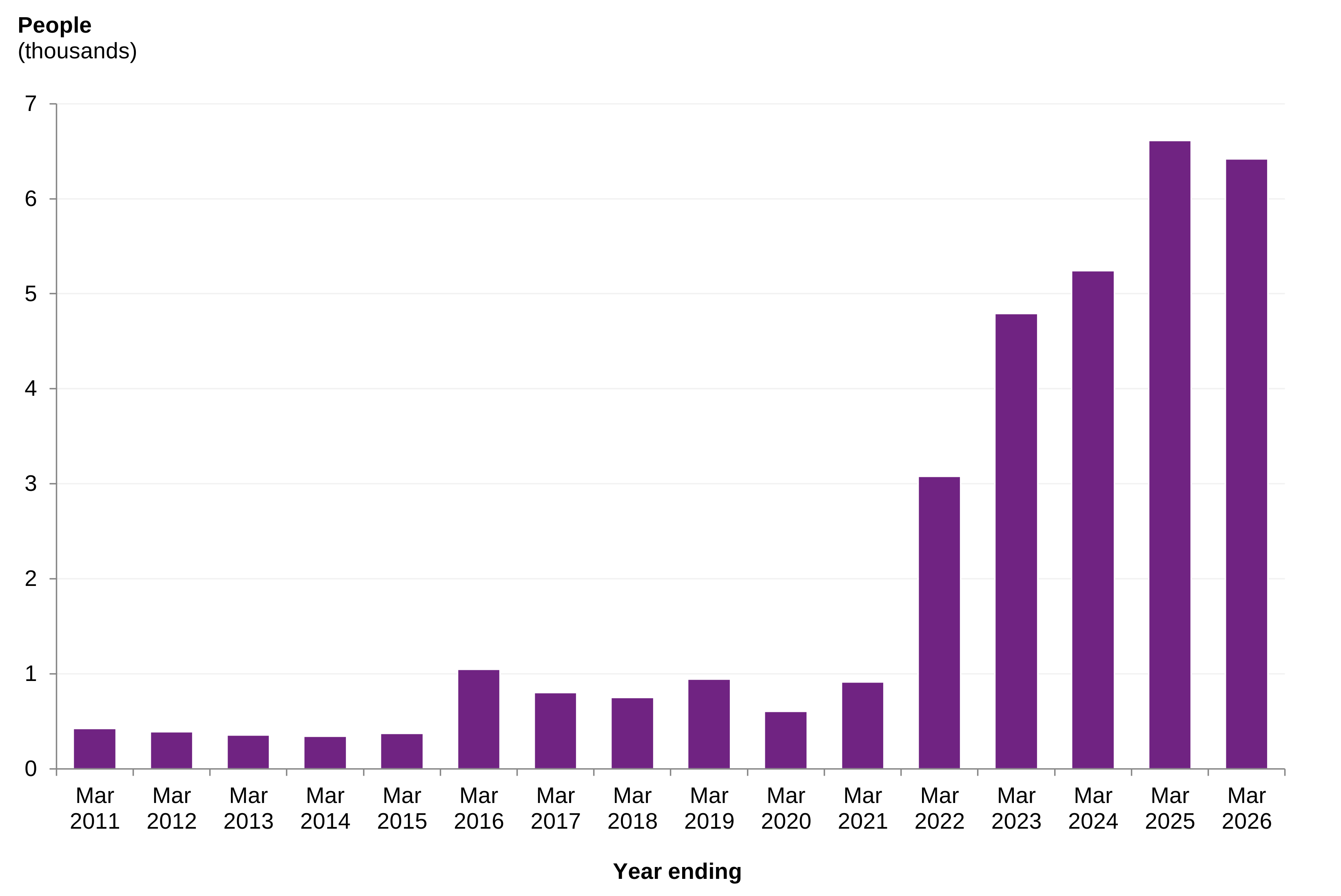
The number of people age assessed has increased in recent years, to over 6,000 people per year.
In the YE March 2026, 6,420 people were age assessed for the first time, 3% less than the previous year.
The number of individuals in the asylum system being age assessed has increased since 2020. Between 2010 and 2020, there were 300 to 1,200 age assessments per year. This rose to 4,700 to 7,100 age assessments each year ending from 2023 to the YE March 2026.
The increase in age assessments reflects the increase in people claiming asylum, which rose from 22,000 to 46,000 people claiming per year from 2010 to 2020, to 87,000 to 111,000 people per year from 2023 to the YE March 2026.
In the YE March 2026, 7% of asylum claimants were subject to an age assessment, compared to 1% to 3% per year before 2020. This reflects the increase in the proportion of asylum seekers arriving on small boats (42% of asylum claims in the YE March 2026 were from small boat arrivals, up from 5% in the YE March 2020) who are less likely to hold documentation to prove their identity and age. All arrivals who claim to be aged 17 and under but do not have any credible and clear documentary evidence of age, and where there is reason to doubt their claimed age, should undergo an Initial Age Decision in line with the Home Office’s Assessing Age policy.
Figure 1: Individuals being age assessed, YE March 2011 to YE March 20261
Source: People subject to age assessments – Age_D01
Notes:
- This chart shows the number of people, not assessments. For people who had multiple age assessments, only their first is shown.
3. How many people are found to be adults?
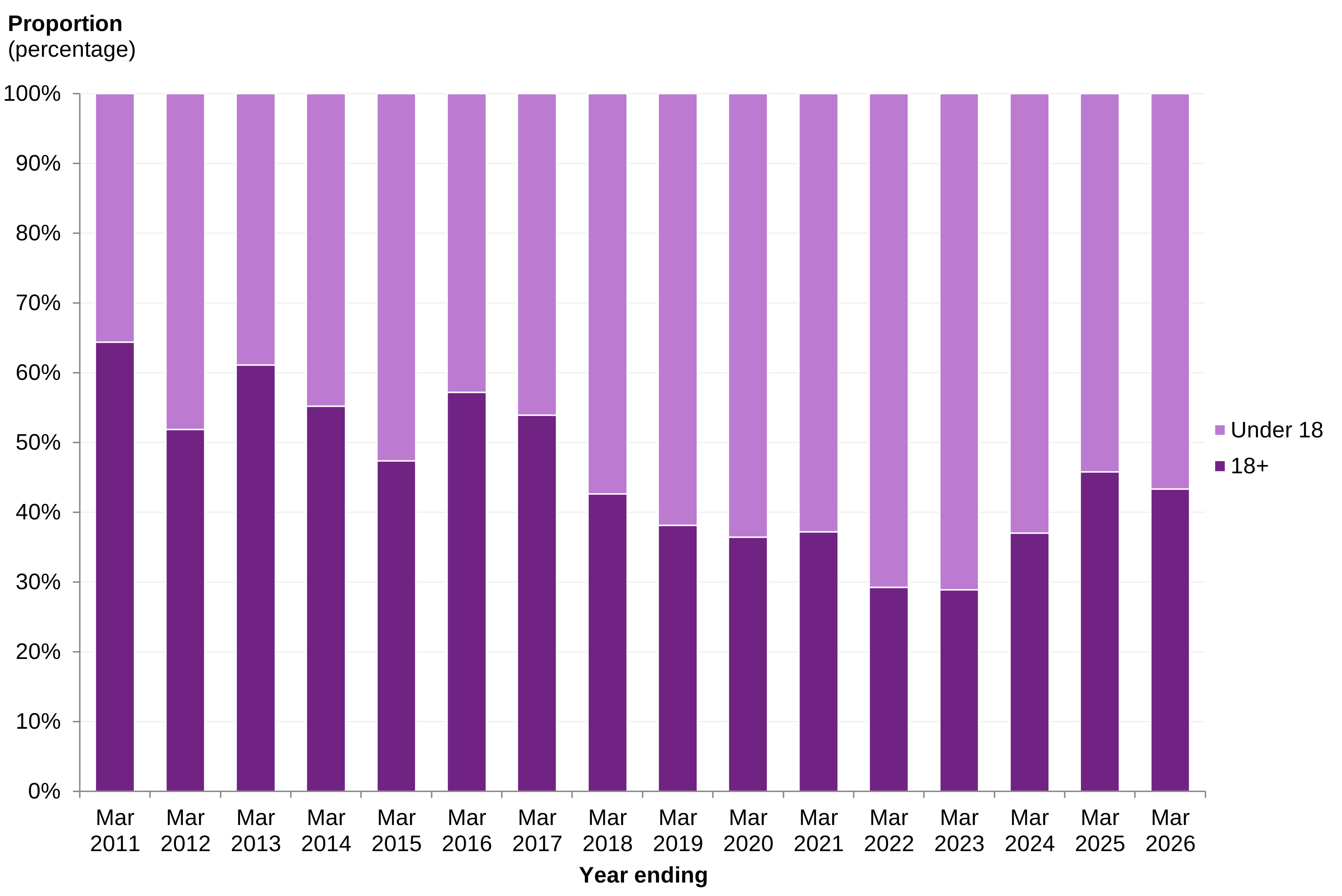
Over 4 in 10 people first age assessed in the YE March 2026 were found to be adults.
In the YE March 2026, 43% of people first subject to age assessments (of any type) were found to be adults.
The proportion of people found to be adults each year has varied, ranging from 26% (in the YE June 2022) to 64% (in the YE March 2011). Across the whole time series (January 2010 to March 2026), 40% of people subject to age assessment have been assessed to be adults.
Figure 2: Assessed ages of individuals, YE March 2011 to YE March 20261, 2
Source: People subject to age assessments – Age_D01
Notes:
- The date shown is the date the individual was first age disputed, even if the person had further age assessments in later periods. Following an assessment, an individual’s date of birth should be updated on the caseworking system. The age shown is based on the latest recorded date of birth.
- Age outcomes are subject to change following challenge / subsequent age assessment.
4. What types of age assessments are done?
There are different types of age assessments: IADs, LA and NAAB assessments. Assessments vary in duration, methods and which organisation conducts them. For simplicity, we refer to all of these as ‘assessments’ in this release. For more information on the distinction between types of age assessment, see the ‘Introduction’ section of this release.
The majority of assessments are conducted by Home Office immigration officials, upon arrival to the UK or first encounter.
From July 2025 to March 2026, there were 4,320 IADs, 3,102 LA assessments and 288 NAAB assessments.
Table 2: Age assessments by type and outcome, July 2025 to March 20261, 2, 3
| Outcome | Initial Age Decision (Proportion of IAD outcomes) |
Local Authority Age Assessment (Proportion of LAAA outcomes) |
National Age Assessment Board (Proportion of NAAB outcomes) |
|---|---|---|---|
| Total age assessments | 4,320 | 3,102 | 288 |
| Pending an outcome | 11 | 968 | 132 |
| Found to be an adult | 2,179 (51%) |
484 (28%) |
53 (58%) |
| Of which, admitted their age | 274 (6%) |
Not applicable | Not applicable |
| Of which, assessed to be significantly over 18 |
1,905 (44%) |
Not applicable | Not applicable |
| Found to be a child | 1,363 (32%) |
1,198 (68%) |
38 (42%) |
| Further assessment needed | 767 (18%) |
74 (4%) |
Not applicable |
| Withdrawal / Administrative Outcome | Not applicable | 378 | 65 |
Source: Age assessments by type and outcome – Age_D02
Notes:
- Data is a count of age assessments, not people. If a person has 2 age assessments, both assessments will be counted.
- Percentages relate to the proportion of substantive outcomes and further assessments needed, that is, they exclude cases where an outcome is pending, where the case was withdrawn or where the case was closed for administrative reasons.
- Further assessment needed refers to ‘Treat as a child’ (when the claimant is treated as a child until a further consideration of their age has been completed by an LA or the NAAB) for IADs and ‘Referred to NAAB’ for LA assessments.
Of the IADs, 51% resulted in the person being assessed to be an adult. This differs to the 28% of LA assessments resulting in the person being assessed as an adult.
The difference between these outcome rates (that is, IADs determining a higher proportion of cases to be adults) is partly due to the circumstances and timing of the different assessments. Cases where the person is clearly an adult are likely to only require one age assessment, and that assessment is most likely to be an IAD, as IADs are usually the first assessment to be undertaken, at the border when the person first arrives in the UK.
In addition, IADs are typically made at pace, often with limited or incomplete information, and are based solely on physical appearance and demeanour. In contrast, social workers in LAs and the NAAB usually have the time and expertise to consider a broader range of information as part of their age assessment, such as social history, developmental stages, the manner in which the person interacts with the assessing social worker, educational history and self-care skills. For this reason, IADs should not be directly compared to LA and NAAB (Merton-compliant) age assessments as they are fundamentally different in scope, methodology, evidential standards and, usually, the circumstances they are conducted.
5. How many age assessments are overturned?
Age assessments of all types (IADs, LA or NAAB) can be challenged, so the final outcome (that is, whether a person is considered an adult or child) is subject to change.
Data on overturned age assessments is subject to change as more time elapses (allowing for any subsequent age assessments to be completed). As a result, data for more recent periods is more likely to be subject to future revision, so caution should be taken when comparing figures over time.
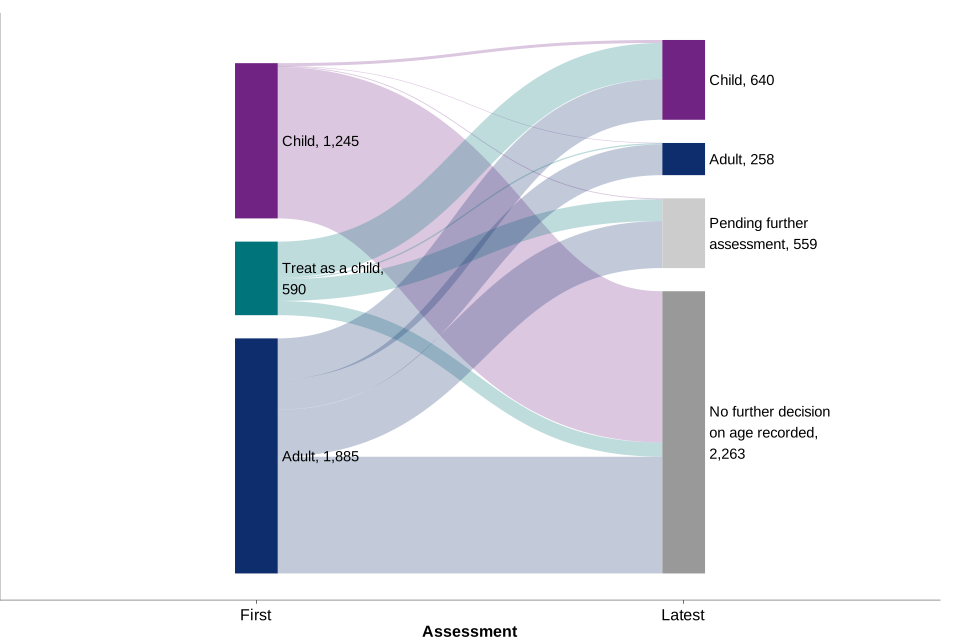
Of those deemed to be adults on their first age assessment, 17% were later found to be children.
Some individuals will only undergo one age assessment, after which there will be no further decisions. Others are subject to more than one assessment. Of the 3,720 people first assessed in July to December 2025, 24% have received a further decision on age and 15% are awaiting an outcome for their latest age assessment (as of April 2026).
Of the 1,885 individuals first assessed to be adults at their first age assessment in July to December 2025, 949 had a subsequent age assessment. Of these, 377 are pending a decision and 326 (17% of the 1,885) have later been assessed to be a child. This percentage may change over time as further age assessments are completed.
Figure 3: First and latest decisions on age, July to December 20251, 2, 3
Source: First and latest outcomes of age assessments – Age_D03
Notes:
- Data is subject to change, as over time further age assessments are completed. This data should be taken as provisional and trends may change as more age assessments are conducted.
- The time period July to December 2025 relates to when the first age assessment was raised. First and latest assessment outcomes may have occurred at any point between July 2025 and the point of data extraction in April 2026.
- ‘No further decision on age recorded’ relates to cases where no further age assessment has been raised, cases where further age assessments are due to take place but have not been recorded on caseworking systems yet, and cases with further age assessments with withdrawn or administrative outcomes only. At the point where subsequent age assessments are raised on the system (but an outcome not yet recorded), these are shown in the ‘Pending’ category.
6. About these statistics
6.1 Data source
Data on age assessments is sourced from 2 Home Office caseworking systems: CID (for data from 2010 to 2025) and Atlas (for data from 2025 onwards).
There was a period of dual running, where both caseworking systems were in use. Data has been matched between the 2 systems and de-duplicated, to avoid double counting individuals whose details were recorded on both systems.
6.2 Recording lags and revisions
The data on age assessments is taken from a live operational system. It is therefore subject to revision as further case information is recorded on the system.
Data on LA age assessments is reported to the Home Office by LAs. There may be a time lag between an age assessment being conducted by an LA and the outcome being reported to the Home Office. Therefore, users should be aware that the volumes of LA assessments in recent time periods may be an undercount and that outcomes in recent time periods are subject to revision.
A person can have multiple age assessments. Reporting on the final outcome for an assessed individual is therefore subject to change, as the recorded age of the person may change as more time elapses and allows for any challenges and subsequent age assessments. Data for more recent periods is more likely to be subject to future revision, so caution should be taken when comparing figures over time.
The data in the published tables will be revised each time the published tables are updated – these revisions will be applied to the entire time series in each table, to ensure all assessments are updated with the latest outcomes.
6.3 Methodology change – counting people versus assessments
The full time series (back to 2010) now provides a count of people (rather than a count of assessments).
Until June 2024, data on age assessments since 2010 was published in the quarterly Immigration system statistics, in table Asy_D05.
The data was sourced from CID, the Home Office’s caseworking system at that time. The data published related to the number of assessments conducted, and the age of the individual based on the most recently recorded date of birth (which should be updated following an age assessment to reflect the latest age decision).
The release of this data was paused after June 2024, due to concerns around methodology and accuracy. Due to the transition from CID to a new caseworking system (Atlas), there had been changes to the dataset underlying the publication. This had resulted in only one age assessment per person being counted in the statistics – which was different to the rest of the time series (which measured all age assessments).
Following a review of the methodology and underlying data recording systems, the entire time series of statistics have been revised. The revised statistics now count the number of people subject to age assessments, since 2010, and provide their most recently recorded age – this is provided in table Age_D01.
This methodology change (counting people rather than assessments) allows for a more accurate calculation of the proportion of people whose age was assessed who were found to be adults – a commonly requested metric by users of the statistics.
Additional data tables (Age_D02 and Age_D03) provide a count of assessments, from July 2025 onwards. Further information on these tables can be found below.
6.4 New data – age assessment types and outcomes
This statistics release includes new detail on the type and outcome of age assessments.
The transition to the new caseworking system, Atlas, has allowed for the Home Office to record more detail on each age assessment, including specific outcomes and which body conducted the assessment.
This newly collected data is now included in the Immigration system statistics release, in tables Age_D02 (which provides the number of age assessments by body and outcome) and Age_D03 (which provides data on whether age assessments are overturned by a later assessment).
The new tables include data from 2025 quarter 3 (July to September) onwards. This is because a gradual transition from the old to the new caseworking system and ways of recording means that 2025 quarter 3 is the earliest time period where all the newly collected data was recorded on the new system.
6.5 Data tables
There are 3 data tables that accompany this release, available on the data tables page.
Age_D01: people subject to age assessments
Contents: Number of individuals subject to age assessments, and the person’s assessed age (grouped into 18 and over / 17 and under). Data is a count of people, not assessments.
Date range: 2010 onwards.
Frequency: published on a quarterly basis.
Table Age_D01 can be used to answer these questions:
- How many people have been age assessed?
- How many people were found to be adults / children?
Age_D02: age assessments by type and outcome
Contents: Number of age assessments, by type (IAD, LA, NAAB) and outcome (Child, Adult, Treat as a child).
Date range: 2025 quarter 3 (July to September) onwards (newly collected data).
Frequency: published for the first time in May 2026, and thereafter on a quarterly basis
Table Age_D02 can be used to answer these questions:
- How many age assessments have happened?
- What are the outcomes of age assessments?
- How many age assessments are awaiting an outcome?
- How many age assessments have the Home Office / LAs / NAAB conducted, and what are the outcomes?
Age_D03: First and latest outcomes of age assessments
Contents: Outcomes of individuals first and latest age assessments, by type (IAD, LA, NAAB) and outcome (Child, Adult, Treat as a child).
Date range: 2025 quarter 3 (July to September) onwards (newly collected data).
Frequency: published for the first time in May 2026, and thereafter annually each August (due to the time lag required for first assessments to be challenged and subsequent age assessments to be completed).
Table Age_D03 can be used to answer these questions:
- How many age assessment decisions are challenged / go unchallenged?
- Which types of age assessments are overturned and what are the latest outcomes?
The previously published data table, Asy_D05, which was paused in June 2024 due to methodological concerns, has been archived and should not be used. Users should refer to Age_D01 as the authoritative time series on age assessments.
7. Data tables and further links
Data referred to here can be found in the following tables:
Further links:
- Statistics on asylum claims, year ending March 2026
- Statistics on asylum outcomes, year ending March 2026
- Statistics on the UK asylum system, year ending March 2026
- Illegal entry routes statistics, year ending March 2026
- Statistics on asylum claims from small boat arrivals, 2025
- Migration transparency data
- Migrant journey: 2025 report
- Eurostat asylum statistics
We welcome your feedback
If you have any comments or suggestions for the development of this report, please provide feedback by emailing MigrationStatsEnquiries@homeoffice.gov.uk. Please include the words ‘PUBLICATION FEEDBACK’ in the subject of your email.
We’re always looking to improve the accessibility of our documents. If you find any problems or have any feedback relating to accessibility, please email us.
See Section 6 of the ‘About this release’ section for more details.