Extent and condition of priority habitats
Updated 25 February 2026
Applies to England

© Crown copyright 2026
This publication is licensed under the terms of the Open Government Licence v3.0 except where otherwise stated. To view this licence, visit nationalarchives.gov.uk/doc/open-government-licence/version/3 or write to the Information Policy Team, The National Archives, Kew, London TW9 4DU, or email: psi@nationalarchives.gov.uk.
Where we have identified any third party copyright information you will need to obtain permission from the copyright holders concerned.
This publication is available at https://www.gov.uk/government/statistics/england-biodiversity-indicators/2a-extent-and-condition-of-priority-habitats
Last updated: 2025
Latest data available: 2025
Note
Since the previous update to this indicator, the Rural Payments Agency (RPA) has provided updated historical data which has impacted the estimate of the proportion of priority habitat under appropriate management across the entire time series. All data has now been revised back to 2015.
Introduction
There are 56 priority habitats recognised as being of ‘principal importance’ for the conservation of biological diversity in England under section 41 of the Natural Environment and Rural Communities Act 2006. Priority habitats are a focus for conservation action in England.
The first part of this indicator (Part A) shows the extent of 27 priority terrestrial and coastal habitat types across England in 2025.
The second part of this indicator (Part B) shows the condition of 27 priority habitats. The measure outlines the percentage area of priority habitats in favourable condition (including those under Environmental Stewardship ‘Higher level’ or Countryside Stewardship agreements and those falling within Forestry Commission ‘Managed woodland’); unfavourable recovering condition; unfavourable, no change or declining condition; and those that are neither SSSI nor under alternative agreements or management, and therefore their condition is unknown. Detail on how condition is assessed on SSSIs is given in the Guidance note: Sites of special scientific interest: managing your land: SSSI condition and assessment.
Data for this indicator can be found in the published datafile.
Type of indicator
Part A: Extent of priority habitats - State indicator
Part B: Condition of priority habitats - State indicator
Type of official statistics
Official statistic
Assessment of change
Assessment of change in extent and condition of priority habitats:
| Measure | Assessment | Time period | Result |
|---|---|---|---|
| Part B - Condition of priority habitats | Long term | 2015 to 2025 | Little or no overall change |
| Part B - Condition of priority habitats | Short term | 2020 to 2025 | Little or no overall change |
Notes on the indicator assessment
The measure for extent (Part A) cannot be assessed. The priority habitats’ inventories do not allow for assessing changes to the extent of habitats, as changes to the inventories itself would represent improvements in current knowledge of the extent of priority habitats, rather than actual changes in the extent of those habitats.
The assessment is based on priority habitats which are in SSSIs and are in a favourable or unfavourable recovering condition or they fall outside of SSSIs but are in favourable management.
Both the long-term and short-term assessments of the condition measure are based on a 3% rule of thumb. The base year for this assessment uses a 3-year average. See document on assessing indicators.
Key results
A) Extent of priority habitats
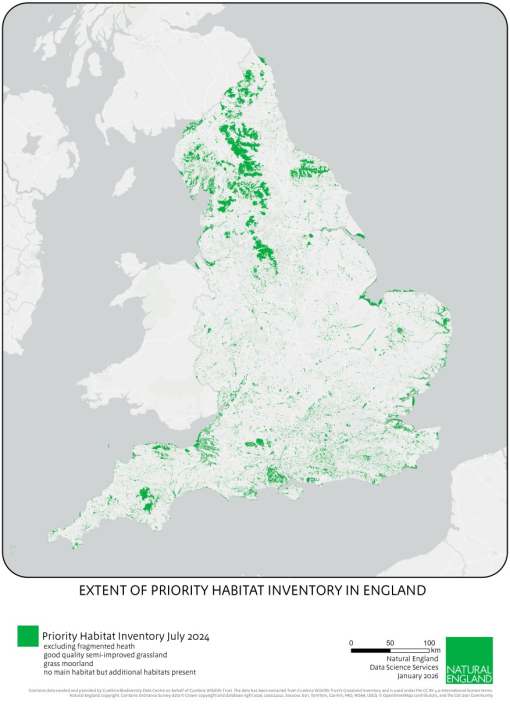
There are 1.86 million hectares of terrestrial and coastal priority habitats recorded in Priority Habitat Inventory July 2024 for England (see condition of priority habitat for an explanation of how this figure is calculated). These habitats represent around 14% of the total land area of the country (Figure 1) but it is not currently possible to assess the extent to which this area changes from year to year (see the technical annex below for further details).
For the 27 main habitat types, deciduous woodland accounts for around 41% of the total priority habitats resource in England. Blanket bog and upland heathland each account for around 13%, while coastal and floodplain grazing marsh make up around 12%. Rarer habitats, such as traditional orchards, ponds, and limestone pavements, together constitute 1% of the total resource.
Priority habitats can be designated as protected areas within SSSIs. Those which fall outside of SSSIs may be managed appropriately under Environmental Stewardship Scheme (ESS) ‘Higher level’ or Countryside Stewardship Scheme (CSS) agreements or fall within Forestry Commission (FC) ‘Managed woodland’. Some priority habitats, however, fall outside of the protection of all these schemes. The designated site network of SSSIs makes up 39% of the total priority habitat area in England (see indicator ‘Extent and condition of protected areas’ for further details).
Figure 1: Distribution of terrestrial and coastal priority habitats (in green) in England, 2024
Source: Natural England
Note about Figure 1
- Green on the map denotes the extent of priority habitat in England for the Priority Habitat Inventory (PHI) July 2024.
B) Condition of priority habitats
When we refer to ‘appropriate management’, we mean land that is either: (1) within SSSIs and in a favourable condition, (2) within SSSIs and in an unfavourable but recovering condition, or (3) outside of SSSIs but under favourable management (under Environmental Stewardship Scheme (ESS) ‘Higher level’ or Countryside Stewardship Scheme (CSS) agreements or fall within Forestry Commission (FC) ‘Managed woodland’).
As of 1 April 2025, almost 1.15 million hectares of priority habitats were in ‘appropriate management’. This equates to 62% of all priority habitats in ‘appropriate management’ (Figure 2).
Around a third (32%) of all priority habitats in SSSIs were in a favourable or unfavourable recovering condition. Nearly a third (30%) of all priority habitats are outside of SSSIs but in favourable management (that is, they are under ESS higher level or CSS agreements or fall within FC managed woodland). 30% of priority habitat fell outside of SSSIs and are not under ESS higher level or CSS agreements or within FC managed woodland (Figure 2). Since 2015, there has been a 0.5% decrease in the area of priority habitat in favourable or unfavourable recovering condition (from 1.16 million hectares in 2015 to 1.15 million hectares in 2025). In the short term, the area of priority habitats in favourable or unfavourable recovering condition has decreased by 2.8% from a figure of 1.19 million hectares in 2020 to 1.15 million hectares in 2025.
Out of the 27 main habitat types for 2025, there were 3 main habitat types which were assessed as 80% or more in ‘appropriate management’: lakes at 87%, upland calcareous grassland at 85% and upland heathland at 83%. Upland heathland contributes to 13% of the total priority habitat area, whereas lakes and upland calcareous grassland are small in terms of the area contributing to total priority habitats.
In addition to upland heathland, the main habitat types contributing to the total priority habitat area are blanket bog, deciduous woodland, and coastal and floodplain grazing marsh. The percentages of these habitat types in ‘appropriate management’ were blanket bog at 78%, deciduous woodland at 53%, and coastal and floodplain grazing marsh at 44%.
For further detail on all priority habitat types see the accompanying datafile.
Figure 2: Condition of priority habitat as a percentage of total area, in England, 2015 to 2025

Source: Natural England
Note about Figure 2
- Appropriate management relates to categories ‘SSSI favourable’, SSSI unfavourable recovering’, and ‘Outside SSSI but in favourable management’.
Further Detail
For further details about the extent and condition of priority habitats, see the Technical Annex below.
Relevance
There are 56 habitats recognised as of ‘principal importance’ for the conservation of biological diversity in England under section 41 of the Natural Environment and Rural Communities Act 2006.
Habitat designations are used by Defra and conservation agencies to help target efforts and actions aimed at enhancing biodiversity and restoring nature.
Web links for further information
- The National Forestry Inventory on the Forest Research website
- UK Priority Habitats on the JNCC website
- Common Standards Monitoring Programme on the JNCC website
- Common Standards Monitoring Guidance on the JNCC website
- Natural England’s website on Habitats of ‘principal importance’ for the conservation of biological diversity in England
- River and lake information and maps on Natural England’s website
Acknowledgements
Thank you to the many people who have contributed by providing data and to the many colleagues who have helped produce this indicator.
Technical Annex
Background to extent of priority habitats
In order to create the annual priority habitats datasets; scheme data (that is ESS ‘higher level’, CSS, and FC ‘managed woodland), data for the PHI, and SSSI condition data are brought together and processed. During this process, where there are overlaps which would cause double-counting, these are removed. Where there are overlapping SSSI units with different SSSI condition, these will be double-counted. These overlaps occur where there are overlapping SSSI units that do not have the same condition assessment and equates to around 500 to 800 hectares of overlaps.
Table 1: Versions of priority habitats inventories used between 2015 and 2025 for England
| Year | Priority habitat inventory | Area of phi hectares | Number of phi habitats |
|---|---|---|---|
| 2015 | PHIv2_0_December_2014 | 1771142 | 25 |
| 2016 | PHIv2_1_December_2015 | 1772670 | 25 |
| 2017 | PHIv2_1_December_2015 | 1772670 | 25 |
| 2018 | PHIv2_1_December_2015 | 1772670 | 25 |
| 2019 | PHIv2_1_December_2015 | 1772670 | 25 |
| 2020 | PHIv2_2_July_2019 | 1788378 | 25 |
| 2021 | PHIv2_3_October_2020 | 1791992 | 25 |
| 2022 | PHIv2_3_October_2020 | 1791992 | 25 |
| 2023 | PHIv2_3_October_2020 | 1791992 | 25 |
| 2024 | PHIv3_December_2023 | 1858653 | 66 |
| 2025 | PHI_July_2024 | 1863332 | 66 |
Source: Natural England
Background to condition of priority habitats
This indicator focuses on the condition of priority habitats and their individual contributions. The second part of the outcome on SSSIs is presented separately as part of the extent and condition of protected areas indicator ‘Extent and condition of protected areas’.
This indicator excludes four non-priority habitat types: ‘fragmented heath’, ‘good quality semi-improved grassland’, ‘grass moorland’, and ‘no main habitat but additional habitats present’. These are also excluded from the counts in Table 1 above.
Changes to the priority habitat inventory will be identified by the date of release rather than a minor version number. Version 3 introduced two new main habitats (Lakes and Ponds) and coincident habitat types, where more than one main priority habitat type exists at the same location. As of December 2023 and July 2024, these include 27 main habitats and 39 coincident habitats.
Due to the changes between older versions of the PHI and the latest two PHI versions, direct comparisons between individual habitats are not straightforward. Coincident habitat types in Version 3 and the July 2024 release do not have a dominant type and therefore cannot be disaggregated into the same habitat groups as those in pre‑Version 2 datasets.
Currently, there are only two situations where the method is habitat-dependent:
-
Where management type is Forestry Commission ‘Managed Woodland’ the analysis accounts for Deciduous Woodland and coincident habitats with Deciduous Woodland as the priority habitat type.
-
If a main habitat occurs with a non-priority habitat type as part of a coincident habitat group, that group is included in the analysis. An example is Good quality semi-improved grassland and Traditional Orchard.
Natural England publishes the PHI, which is expected to be updated annually. Priority Habitats Inventory (England), Natural England Open Data Geoportal.
Management types
Three management types are used in the analysis for this indicator to assess the condition of Priority Habitat.
- Agri-environment schemes
The revised indicator timeseries can only go back to 2015 as Rural Payments Agency have no Environmental Stewardship Scheme (ESS) data before this time. Countryside Stewardship Scheme (CSS) was introduced in 2016 and is first used in the indicator analysis for 2016.
For ESS only “higher” type scheme data is used. For CSS all scheme types are used.
Data was provided by the Rural Payments Agency to cover the periods 2015 to 2025. Natural England have split this data into schemes active at Financial Year end for the time period.
Rural Payments Agency publish the current ESS and CSS scheme data. Environmental Stewardship Scheme Agreements (England) Countryside Stewardship Scheme 2016 Management Areas (England)
- Forestry Commission Managed Woodland
The analysis uses the following data: Sustainably Managed Woodland England (2023 to 2025), Managed Woodland Headline Performance Indicator England (2015 to 2021).
Although the name of this data has changed, it is part of the same time series. From 2023 the data is split by Managed Public and Managed Private but has always accounted for both. Forestry Commission England publish this data annually as one of their Key Performance Indicators. Managed Woodland is only used to assess the condition of Deciduous Woodland priority habitat. There is a gap in the data for 2018 and 2022, where the previous years data has been used in this analysis.
- SSSI unit condition
This data covers the full time period 2015 to 2025. Natural England publish the current SSSI unit condition Sites of Special Scientific Interest Units (England).
Development plan
Since our previous publication we have adapted the language and visualisations used in this indicator. We are keen to hear from our users about these changes, as well as our published development plan, please email us.