Indicator assessment summary
Updated 25 February 2026
Applies to England

© Crown copyright 2026
This publication is licensed under the terms of the Open Government Licence v3.0 except where otherwise stated. To view this licence, visit nationalarchives.gov.uk/doc/open-government-licence/version/3 or write to the Information Policy Team, The National Archives, Kew, London TW9 4DU, or email: psi@nationalarchives.gov.uk.
Where we have identified any third party copyright information you will need to obtain permission from the copyright holders concerned.
This publication is available at https://www.gov.uk/government/statistics/england-biodiversity-indicators/assessing-indicators
Key messages
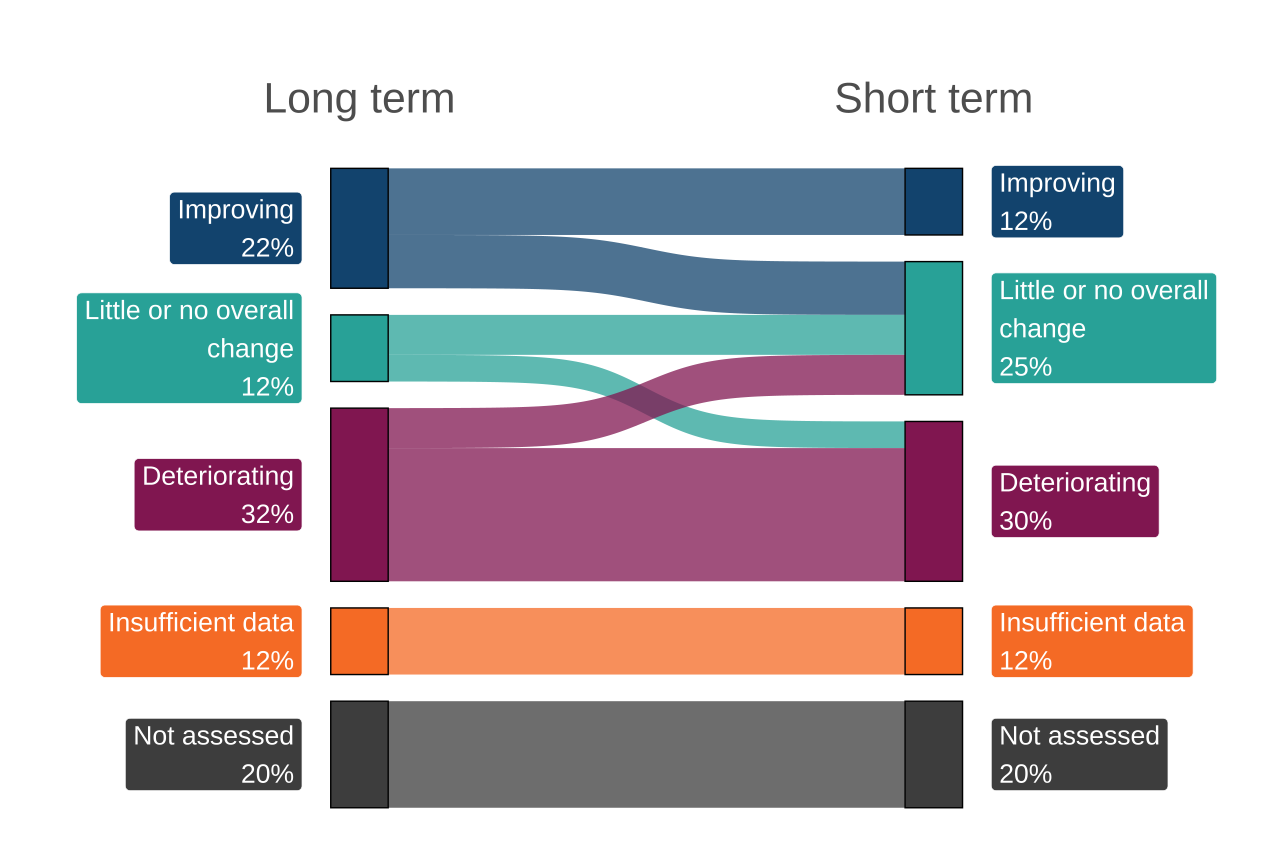
Overall, more indicators are deteriorating or showing no change than improving, over both the long and short term (Figure 1).
- Over the long term, many indicators have shown improvement, reflecting sustained positive changes in some aspects of biodiversity. However, many have also deteriorated, reflecting ongoing pressures on ecosystems. A smaller group of indicators has remained broadly stable over time.
- No indicators which are deteriorating in the long term, are showing improvement in the short term, suggesting that we are yet to reverse the negative trend in many aspects of biodiversity. However, some have stopped deteriorating in the short term, suggesting that some long term negative trends have stabilised.
- Many indicators already showing improvement in the long term continue to improve in the short term. However, some progress has stalled in the short term.
Figure 1: A summary of long-term and short-term indicator assessments, 2025
Notes about Figure 1
- Figure 1 shows how the assessment of indicators changes depending on the time frame assessed. Left hand bars represent the long term assessment results, while right hand bars represent the short term assessment results. The relationships between long term and short term results are highlighted in the shaded flows.
- Some indicators don’t have enough data to perform a long term (10 years of data) or a short term (5 years of data) assessment of change, and so are categorised as “insufficient data”. Others might still be in development or be otherwise inappropriate for an assessments of change and are classed as “not assessed”.
Assessment methods
Each indicator is composed of one or more measures which will show trends over time. Many indicators have only a single measure, but where it does not make sense to combine data, the indicator will have more than one measure. Each measure is summarised or assessed separately and grouped into one of four categories.
These categories communicate how the measures are changing over time. They do not show whether the measure has reached any published or implied targets, or indeed whether the status is ‘good’ or ‘bad’, although where targets have been set, these are identified in the indicator text.
The assessment categories are determined by identifying the period over which the change is to be assessed and comparing the value of the measure in the base or start year with the value in the end year. The four categories are:
- Improving
- Little or no overall change
- Deteriorating
- Insufficient or no comparable data
Where possible, the assessment has been made by evaluating trends using statistical analysis techniques. The assessment may be made by Defra statisticians in collaboration with the data providers, or undertaken by the data providers themselves.
An assessment result of ‘Improving’ or ‘Deteriorating’ is made only when there is sufficient confidence that the change is statistically significant and not simply a product of random fluctuations. When there is insufficient confidence that a change has taken place the ‘Little or no overall change’ assessment result is used.
For some indicators, it is not possible to formally determine statistical significance and in such cases the assessment has been made by comparing the difference between the value of the measure in the base or start year and the value in the end year against a ‘rule of thumb’ threshold. Where the data allow it, a 3-year average is used to calculate the starting value; this reduces the likelihood of any unusual years unduly influencing the assessment. Usually, the starting value is calculated from an average of the first three years of data for the long term assessment, or the three years centred around the beginning of the short term time period for the short term assessment. The standard threshold used is 3%, unless noted otherwise.
Where an indicator value has changed by less than the threshold of 3%, the ‘Little or no overall change’ assessment result is used. The choice of 3% as the threshold is arbitrary but is used across other government indicators and is deemed to be a suitable proxy for meaningful change. The use of this approach is kept under review.
Where there is insufficient data to make an assessment, for example, when the time series is too short, or where there is no data available to compare, this is indicated by the ‘Insufficient or no comparable data’ category. It is inappropriate to do an assessment of change on some indicators, for instance some are undergoing methodological development, such as Official Statistics in Development, and results are likely to change from year to year due to those developments. For others evolving data collection methods make comparisons over time inappropriate. These indicators are not assessed.
The assessment results only reflect the overall change in the measure from the starting value to latest year and do not reflect fluctuations during the intervening years.
Where sufficient data are available, 2 assessment periods have been used:
- Long term – an assessment of change since the earliest date for which data are available, although if the time series is less than 10 years a long-term assessment is not made.
- Short term – an assessment of change over the latest 5 years. In some indicators, for example butterflies, which are particularly variable 10 years of data are used.
For both long-term and short-term assessments, the years over which the assessment is undertaken are stated in the assessment table and/or accompanying notes.
Where the data allow, some indicators also have a third marker showing the direction of change in the latest year. This period is too short to make any meaningful assessment. However, when the change exceeds a 1% threshold, the direction is given simply as an acknowledgement of very recent trends and as a possible early indication of emerging trends. This is not done for indicators which are too variable from year to year or where it might otherwise be deemed statistically inappropriate.
Assessment of change: all measures
There are 40 individual measures that make up 23 indicators. Of those 40 measures, some are unsuitable for a formal assessment of change (for instance they may have insufficient data or are in development). In 2025, 27 are suitable for assessment.
In the long term:
- 9 measures (22%) show an improvement
- 5 measures (12%) show little or no overall change
- 13 measures (32%) show a deterioration
There are insufficient data to make long-term assessments for 5 measures (12%), and 8 measures (20%) are not assessed.
In the short term:
- 5 measures (12%) show an improvement
- 10 measures (25%) show little or no overall change
- 12 measures (30%) show a deterioration
There are insufficient data to make short-term assessments for 5 measures (12%), and 8 measures (20%) are not assessed.
Tables 1 to 4 at the bottom of this page show the assessment results of all the measures when separated into “pressure”, “state” and “benefit” categories of the Natural Capital Framework.
Assessment of change using a Natural Capital Framework
Natural capital is defined as the elements of the environment which provide valuable goods and services to people such as clean air, clean water, food, and recreation. A natural capital approach is advocated as it accounts for all the different ways the environment benefits society and so can inform better decision making. A natural capital framework sets out the need to:
- reduce pressures on natural capital (for example, pollution or plant disease)
- improve the state of natural assets (including air, water, land and seas)
- increase the benefits that we get from those assets
The Biodiversity Indicators can be considered as either a measure of (a) the extent or condition (i.e. state) of natural capital assets, (b) pressures on natural capital assets, or (c) the benefits associated with natural capital assets. This classification is not always straightforward since the condition of one natural capital asset (for example, water quality) may place a pressure on another (for example, wildlife habitat).
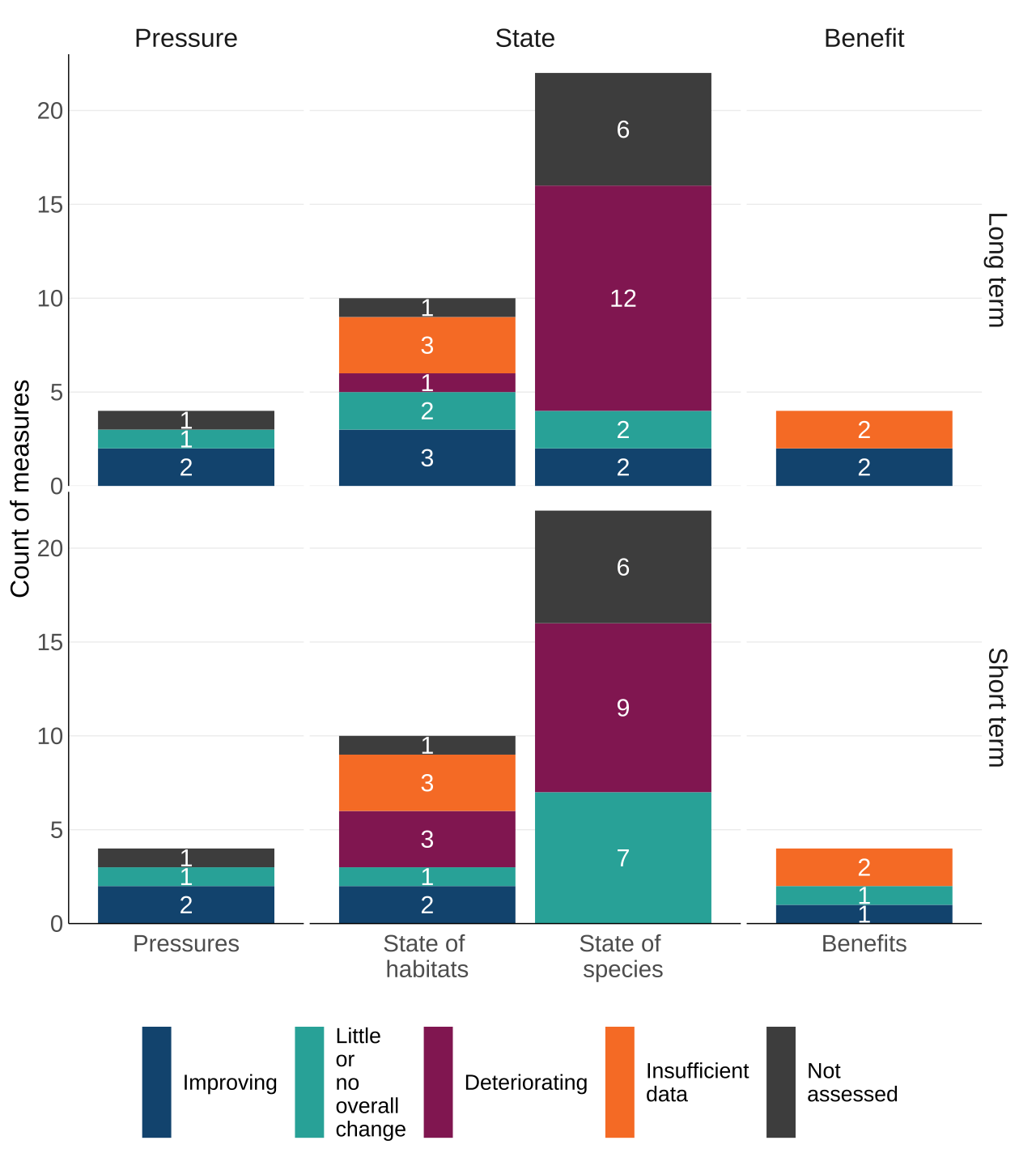
Figure 2 summarises the results for all measures across these categories.
Figure 2: Long-term and short-term indicator assessments by Natural Capital Framework Status, all measures, 2025
Notes about Figure 2
- Based on 40 measures, which make up 23 indicators.
- Some indicators don’t have enough data to perform a long term (10 years of data) or a short term (5 years of data) assessment of change, and so are categorised as “insufficient data”. Others might still be in development or be otherwise inappropriate for an assessments of change and are classed as “not assessed”.
Assessment of change in extent or condition (state) of natural capital assets
The England Biodiversity Indicators contain 16 indicators made up of 32 measures which relate to the extent or condition of biodiversity related natural assets. Of these, 22 measures have sufficient data for an assessment of change in either the long or short term.
Tables 1 and 2 shows the assessment results for all those indicators which relate to the extent or condition of biodiversity related natural assets.
In 2025, of those 22 measures which relate to the state of natural capital assets and can be assessed, 13 are deteriorating in the long term, whilst only 5 are improving in the long term. Of those relating to the state of species, only 2 are improving in the long term, and none in the short term.
There are some signs of positive change across these indicators. Of those 13 indicators which have been deteriorating in the long term, 3 have stabilised in the short term, suggesting a possible possible halting of the historical decline in the state of the assets these indicators measure. These measures are:
- Relative abundance of all-species
- Relative abundance of priority species
- Relative abundance of all-species of butterfly
There are also some less positive trends in the indicators. Of those 5 indicators which have been improving in the long term, 3 have shown no change in the short term, suggesting that historical improvements in the assets these indicators measure might have slowed down or stalled more recently. These measures are:
- Relative abundance of wintering waterbirds
- Extent of protected areas on land
- Relative abundance of bat populations
Of those 13 indicators which have been deteriorating in the long term, 10 are also deteriorating in the short term, suggesting that we are yet to impact the state of the natural assets which these indicators measure. These measures are:
- Relative abundance of all breeding birds
- Relative abundance of breeding birds on farmland
- Relative abundance of breeding birds in woodland
- Relative abundance of breeding wetland birds
- Relative abundance of breeding upland birds
- Relative abundance of habitat specialist butterflies
- Relative abundance of farmland specialist butterflies
- Relative abundance of woodland specialist butterflies
- Percentage of habitats of European importance in favourable or improving conservation status
- Percentage of species of European importance in favourable or improving conservation status
Two indicators are improving in both the long and short term:
- Area of land under higher-level or targeted agri-environment schemes
- Extent of protected areas at sea
Assessment of change in pressures on natural capital assets
The England Biodiversity Indicators contain 3 indicators made up of 4 measures which relate to the pressures on biodiversity related natural assets. Of these, 3 have sufficient data for an assessment of change in either the long or short term.
Table 3 shows the assessment results for all those indicators which relate to the pressures on biodiversity related natural assets.
In 2025, of those 3 measures which relate to the state of natural capital assets and can be assessed, 2 are improving, 1 is showing little change and none are deteriorating in the long term.
There are some signs of positive change across these indicators. The 2 indicators which have been improving in the long term are also improving in the short term, suggesting that we have maintained positive progress for:
- Public sector expenditure on biodiversity
- Air pollution - area affected by acidity
The 1 indicator which has been showing no change in the long term is also showing no change in the short term, suggesting that we are yet to reduce the pressure this indicator measures:
- Air pollution area affected by nutrient nitrogen deposition
Assessment of change in the benefits associated with natural capital assets
The England Biodiversity Indicators contain 4 indicators made up of 4 measures which relate to the benefits associated with natural capital assets. Of these, 2 have sufficient data for an assessment of change in either the long or short term.
Table 4 shows the assessment results for all those indicators which relate to the benefits associated with biodiversity related natural assets.
In 2025, of those 2 measures which relate to the benefits associated with natural capital assets and can be assessed, 2 are improving in the long term. One of these remain improving in the short term, suggesting we have maintained positive progress in the areas of:
- Cumulative net removal of greenhouse gases by forests
One indicator is improving in the long term, but showing no change in the short term:
- Volunteer time spent in conservation
Assessment results tables
Table 1. Assessment of change in extent or condition (state) of natural capital assets - species
| Indicator | Measure | Long term period | Long term | Short term period | Short term |
|---|---|---|---|---|---|
| Birds of the wider countryside and at sea | All breeding birds | 1970 to 2024 | Deteriorating | 2019 to 2024 | Deteriorating |
| Birds of the wider countryside and at sea | Breeding birds on farmland | 1970 to 2024 | Deteriorating | 2019 to 2024 | Deteriorating |
| Birds of the wider countryside and at sea | Breeding birds in woodland | 1970 to 2024 | Deteriorating | 2019 to 2024 | Deteriorating |
| Birds of the wider countryside and at sea | Breeding wetland birds | 1975 to 2024 | Deteriorating | 2019 to 2024 | Deteriorating |
| Birds of the wider countryside and at sea | Breeding seabirds | 1986 to 2024 | Little or no overall change | 2019 to 2024 | Little or no overall change |
| Birds of the wider countryside and at sea | Wintering waterbirds | 1975/76 to 2023/24 | Improving | 2018/2019 to 2023/2024 | Little or no overall change |
| Birds of the wider countryside and at sea | Breeding upland birds | 1994 to 2024 | Deteriorating | 2019 to 2024 | Deteriorating |
| Insects of the wider countryside butterflies | All-species of butterfly | 1976 to 2024 | Deteriorating | 2014 to 2024 | Little or no overall change |
| Insects of the wider countryside butterflies | Habitat specialist butterflies | 1990 to 2024 | Deteriorating | 2014 to 2024 | Deteriorating |
| Insects of the wider countryside butterflies | Generalist butterflies | 1990 to 2024 | Little or no overall change | 2014 to 2024 | Little or no overall change |
| Insects of the wider countryside butterflies | Farmland specialist butterflies | 1990 to 2024 | Deteriorating | 2014 to 2024 | Deteriorating |
| Insects of the wider countryside butterflies | Woodland specialist butterflies | 1990 to 2024 | Deteriorating | 2014 to 2024 | Deteriorating |
| Mammals of the wider countryside (bats) | Bat populations | 1999 to 2023 | Improving | 2018 to 2023 | Little or no overall change |
| Plants of the wider countryside | Arable field margins | Not assessed | Not assessed | ||
| Plants of the wider countryside | Bog and wet heath | Not assessed | Not assessed | ||
| Plants of the wider countryside | Broadleaved woodland and hedges | Not assessed | Not assessed | ||
| Plants of the wider countryside | Lowland grassland | Not assessed | Not assessed | ||
| Status of all species: relative abundance | Relative abundance of all-species | 1970 to 2023 | Deteriorating | 2018 to 2023 | Little or no overall change |
| Status of all species: distribution | Distribution of all-species | Not assessed | Not assessed | ||
| Status of priority species: distribution | Distribution of priority species | Not assessed | Not assessed | ||
| Status of priority species: relative abundance | Relative abundance of priority species | 1970 to 2023 | Deteriorating | 2018 to 2023 | Little or no overall change |
| Status of threatened species: species of European importance | Percentage of species of European importance in favourable or improving conservation status | 2007 to 2019 | Deteriorating | 2013 to 2019 | Deteriorating |
Table 2. Assessment of change in extent or condition (state) of natural capital assets - habitats
| Indicator | Measure | Long term period | Long term | Short term period | Short term |
|---|---|---|---|---|---|
| Area of forestry land under certified sustainable management schemes | Percentage of woodland certified as sustainably managed | 2001 to 2025 | Little or no overall change | 2020 to 2025 | Deteriorating |
| Area of land in agri-environment schemes | Area of land under higher-level or targeted agri-environment schemes | 1987 to 2022 | Improving | 2017 to 2022 | Improving |
| Extent and condition of priority habitats | Extent of priority habitats | Insufficient data | Insufficient data | ||
| Extent and condition of priority habitats | Condition of priority habitats | Not assessed | Not assessed | ||
| Extent and condition of protected areas | Extent of protected areas on land | 2005 to 2025 | Improving | 2020 to 2025 | Little or no overall change |
| Extent and condition of protected areas | Extent of protected areas at sea | 2005 to 2025 | Improving | 2020 to 2025 | Improving |
| Extent and condition of protected areas | Condition of Sites of Special Scientific Interest | Insufficient data | Insufficient data | ||
| Integrating biodiversity considerations into local decision making | Local sites under positive conservation management | 2008/9 to 2023/2024 | Little or no overall change | 2018/19 to 2023/24 | Deteriorating |
| Status of threatened habitats: habitats of European importance | Percentage of habitats of European importance in favourable or improving conservation status | 2007 to 2019 | Deteriorating | 2013 to 2019 | Deteriorating |
| Surface water status | Percentage of surface water bodies in High or Good ecological status | Insufficient data | Insufficient data |
Table 3. Assessment of change in pressures on natural capital assets
| Indicator | Measure | Long term period | Long term | Short term period | Short term |
|---|---|---|---|---|---|
| Funding for biodiversity | Public sector expenditure on biodiversity | 2000/2001 to 2023/2024 | Improving | 2018/2019 to 2023/2024 | Improving |
| Pressures on biodiversity: air pollution | Air pollution: area affected by acidity | 2003 to 2021 | Improving | 2016 to 2021 | Improving |
| Pressures on biodiversity: air pollution | Air pollution: area affected by nutrient nitrogen deposition | 2003 to 2021 | Little or no overall change | 2016 to 2021 | Little or no overall change |
| Spring index | Timing of biological events: Spring Index | Not assessed | Not assessed |
Table 4. Assessment of change in the benefits associated with natural capital assets
| Indicator | Measure | Long term period | Long term | Short term period | Short term |
|---|---|---|---|---|---|
| Biodiversity and ecosystem services: greenhouse gas removal by forests | Cumulative net removal of greenhouse gases by forests | 1990 to 2023 | Improving | 2018 to 2023 | Improving |
| Public awareness, understanding and support for conservation | Proportion of people highly engaged with the issue of biodiversity loss | Insufficient data | Insufficient data | ||
| Taking action for the environment: households encouraging wildlife in their garden | Wildlife gardening | Insufficient data | Insufficient data | ||
| Taking action for the environment: volunteer time spent in conservation | Conservation volunteering | Improving | Little or no overall change |