Public electric vehicle charging infrastructure statistics: 1 April 2026
Published 21 May 2026

© Crown copyright 2026
This publication is licensed under the terms of the Open Government Licence v3.0 except where otherwise stated. To view this licence, visit nationalarchives.gov.uk/doc/open-government-licence/version/3 or write to the Information Policy Team, The National Archives, Kew, London TW9 4DU, or email: psi@nationalarchives.gov.uk.
Where we have identified any third party copyright information you will need to obtain permission from the copyright holders concerned.
This publication is available at https://www.gov.uk/government/statistics/electric-vehicle-charging-infrastructure-statistics-1-april-2026/public-electric-vehicle-charging-infrastructure-statistics-1-april-2026
Visit the electric vehicle charging infrastructure statistics collection page to browse the latest available statistics for electric vehicle charging in the United Kingdom.
About this release
This release presents statistics on publicly available electric vehicle charging infrastructure in the United Kingdom.
Data is provided by individual charge point operators (CPOs) as set out in the Public Charge Point Regulations 2023 guidance and collated by Zapmap for use by the Department for Transport (DfT). The data presented in this release is correct as of 1 April 2026.
Further information can be found in the about these statistics section.
The next quarterly report is scheduled for release in August 2026.
Headline figures
As of 1 April 2026 there were 119,080 public EV chargers in the United Kingdom including 27,372 rated rapid or above (50kW+).
As of 1 January 2026, this statistical series focuses on publicly available ‘EV chargers’ (EVSE) in the United Kingdom, replacing the previous measure of ‘charging devices’. More information about the introduction of EV charger statistics can be found in the frequently asked questions document.
Chart 1: Number of public EV chargers from January 2023 and public charging devices from 2019: United Kingdom (EVCI9001)

Chart 1 is a line chart presenting the number of public EV chargers in each quarter since January 2025, and annual industry estimates since January 2023, compared to the number of public charging devices in each quarter since October 2019.
The chart shows that as of 1 April 2026:
-
there were 119,080 public EV chargers compared to 92,141 public charging devices
-
the growth rate of EV chargers over time has been comparable to the growth rate of charging devices
Chart 2: Cumulative growth of the public EV charger network per calendar year: United Kingdom, 2025 to present (EVCI0101)
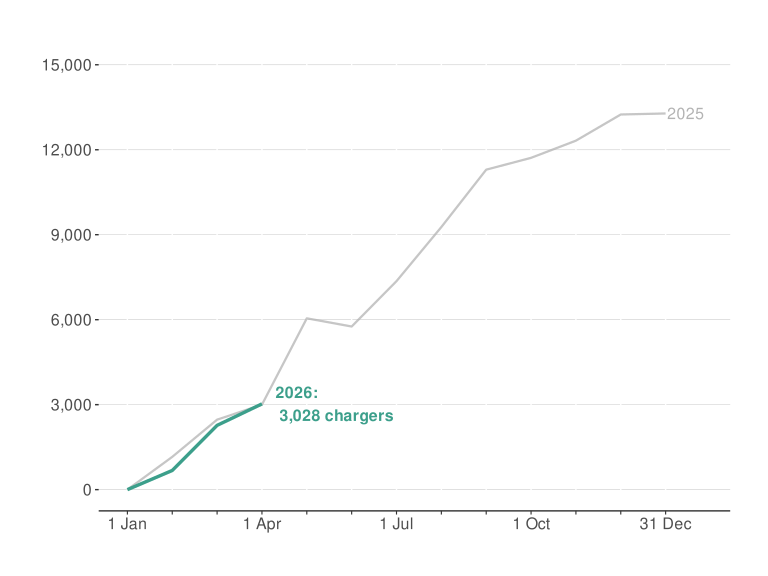
Chart 2 is a line chart showing the cumulative growth of the number of public EV chargers during each calendar year since 1 January 2025.
The chart shows that, as of 1 April 2026:
-
3,028 EV chargers were added to the public network in the first quarter of 2026
-
13,281 were added to the public network in 2025
-
the increase in the number of public EV chargers in the first quarter of 2026 was similar to the equivalent period in 2025
Industry estimates provided by Zapmap indicate that:
-
24,557 EV chargers were added to the public network in 2024
-
20,662 were added to the public network in 2023
These estimates fall outside the scope of official statistics and do not appear in tables published on the EVCI data tables page.
EV chargers by power rating
EV chargers are organised into power bands that reflect their typical use‑cases and the different charging needs often required at different public locations.
EV chargers in higher power bands can charge vehicles more quickly.
Further information about power bands can be found in the frequently asked questions document.
In the January 2026 edition of this series, DfT introduced descriptive labels for each EV charger power band to facilitate user understanding and ease of reference.
The established kilowatt (kW) power bands have not changed from previous DfT statistical releases.
The power bands and their newly associated labels as used in these statistics are:
-
3kW to less than 8kW: standard
-
8kW to less than 50kW: standard plus
-
50kW to less than 150kW: rapid
-
150kW and above: ultra-rapid
Different power bands and descriptive labels may be used across the EV charging industry.
Chart 3: Public EV chargers by power band: United Kingdom, 1 April 2026 (EVCI0201)

Chart 3 is a doughnut chart presenting the percentage of public EV chargers in each power banding.
It shows that as of 1 April 2026:
-
50% of EV chargers were rated standard (3kW to less than 8kW)
-
27% were rated standard plus (8kW to less than 50kW)
-
12% were rated rapid (50kW to less than 150kW)
-
11% were rated ultra-rapid (150kW and above)
Geographical distribution of EV chargers
Chart 4: Total and 50kW and above (rapid or above) public EV chargers per 100,000 of the resident population, by country and region: United Kingdom, 1 April 2026 (EVCI0101)

Chart 4 is a nested bar chart comparing EV chargers per 100,000 of the resident population across United Kingdom countries and regions for both total and rapid or above EV chargers.
It shows that as of 1 April 2026:
-
regional variation is lower for rapid and above chargers than for total chargers
-
London has many more public chargers per capita than the rest of the United Kingdom, yet the second‑lowest per capita rated rapid or above, as much of its public charging infrastructure comprises standard on‑street chargers
The regional distribution of EV chargers is similar to that of charging devices. Data for both metrics can be found on the EVCI data tables page.
The figures used in chart 4 can be found in Annex A.
Chart 5: Public EV chargers by rural urban classification: England and Wales, 1 April 2026 (EVCI0104)

Chart 5 is a doughnut chart comparing the percentage of EV chargers in rural and urban areas of England and Wales according to the ONS 2021 rural urban classification.
It shows that as of 1 April 2026:
-
17.2% of EV chargers were in rural areas, similar to the proportion of the population of England and Wales that live in rural areas (17.5%)
-
82.8% of EV chargers were in urban areas, similar to the proportion of the population of England and Wales that live in urban areas (82.5%)
The rural and urban distribution of EV chargers is similar to that of charging devices. Data for both metrics can be found on the EVCI data tables page.
EV chargers available for different journey types
EV chargers are grouped into location classifications that reflect the service they provide for various charging needs and journey types.
‘Destination’ EV chargers are located at the end of a journey or where a driver may stop for an extended period. This includes chargers in car parks and standard or standard plus chargers at hospitality premises.
‘On street’ EV chargers are typically located on residential streets and provide local public charging infrastructure.
‘En-route’ EV chargers provide charging to continue journeys. This includes chargers at motorway service areas and rapid or above chargers at hospitality premises.
‘Other’ charging devices are semi-public with some level of access restrictions such as workplace car parks and dealership forecourts.
Chart 6: Public EV chargers by location classification: United Kingdom, 1 April 2026 (EVCI0301)

Chart 6 is a doughnut chart presenting the percentage of public EV chargers in each location classification.
It shows that as of 1 April 2026:
-
52% were classed as destination EV chargers
-
32% were classed as on-street EV chargers
-
11% were classed as en-route EV chargers
-
4% were classed as other EV chargers
The proportion of EV chargers in some location classes are slightly different to the proportions for charging devices. This is because the EV charger metric allows more precise measurements of charging capability at these location classifications. Data for both metrics can be found on the EVCI data tables page.
Parliamentary constituencies
Statistics on EV chargers for each parliamentary constituency can be found on the EVCI data tables page.
About these statistics
These statistics are released under the official statistics in development label. Official statistics in development are official statistics that are temporarily undergoing a development and are being tested with users, in line with the standards of trustworthiness, quality, and value in the Code of Practice for Statistics.
Please note that percentages may not always sum to 100 due to rounding.
Further information about these statistics can be found on the electric vehicle charging infrastructure statistics information page.
Annex
Annex A: Total and 50kW and above (rapid or above) public EV chargers per 100,000 of the resident population, by country and region: United Kingdom, 1 April 2026 (EVCI0101)
| Region | EV chargers per 100,000 population | 50kW and above (rapid or above) EV chargers per 100,000 population |
|---|---|---|
| United Kingdom | 171.9 | 39.5 |
| North East | 144.4 | 34.4 |
| North West | 108.3 | 37.9 |
| Yorkshire and the Humber | 110.2 | 34.7 |
| East Midlands | 123.7 | 44.2 |
| West Midlands | 162.6 | 43.3 |
| East of England | 150.3 | 46.2 |
| London | 340.0 | 27.0 |
| South East | 153.0 | 37.3 |
| South West | 153.9 | 46.4 |
| Wales | 179.3 | 39.6 |
| Scotland | 228.5 | 57.2 |
| Northern Ireland | 59.4 | 18.4 |