Electric vehicle charging infrastructure statistics: frequently asked questions
Updated 21 May 2026

© Crown copyright 2026
This publication is licensed under the terms of the Open Government Licence v3.0 except where otherwise stated. To view this licence, visit nationalarchives.gov.uk/doc/open-government-licence/version/3 or write to the Information Policy Team, The National Archives, Kew, London TW9 4DU, or email: psi@nationalarchives.gov.uk.
Where we have identified any third party copyright information you will need to obtain permission from the copyright holders concerned.
This publication is available at https://www.gov.uk/government/publications/electric-vehicle-charging-device-statistics-information/electric-vehicle-charging-infrastructure-statistics-frequently-asked-questions
This document provides answers to frequently asked questions relating to electric vehicle charging infrastructure statistics for the United Kingdom, published by the Department for Transport (DfT).
Information about the introduction of EV charger (EVSE) statistics to this series can be found in the section: Use of EV charger (EVSE) as a public EV charging infrastructure metric.
Terminology used for EV charging infrastructure
What does EV charger (EVSE) mean?
EVSE stands for electric vehicle supply equipment. This is an independent part of a charging device which controls the charge session, enabling one electric vehicle (EV) to charge at a time. EVSE are referred to as ‘EV chargers’ for user-friendliness throughout all DfT electric vehicle charging infrastructure statistics products.
What names are used for different components of EV charging infrastructure in this statistical collection?
| Name | Description |
|---|---|
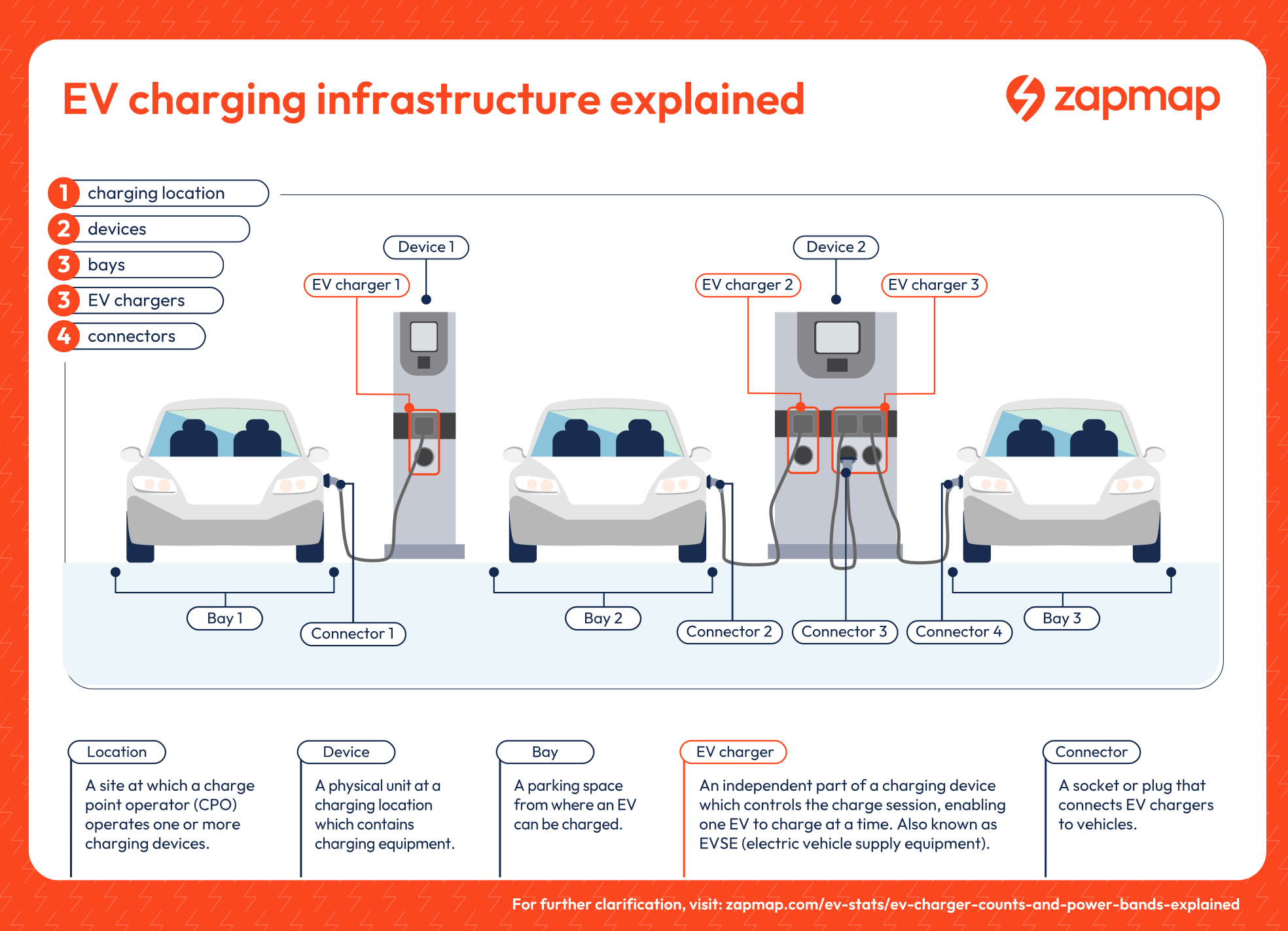
| Charging location | A site at which a charge point operator (CPO) operates one or more charging devices. |
| Charging device | A physical unit at a charging location which contains charging equipment. A charging device can contain one or more EV chargers (EVSE). Prior to 2026, charging devices were the DfT’s baseline metric for measuring the size of the United Kingdom’s public EV charging infrastructure. |
| EV charger | An independent part of a charging device which controls the charge session, enabling one EV to charge at a time. Also known as EVSE (electric vehicle supply equipment). From 2026 onwards, EV chargers are the DfT’s baseline metric for measuring the size of the United Kingdom’s public EV charging infrastructure. |
| Connector | A socket or plug that connects EV chargers to vehicles. |
Figure 1: Diagram designed by industry partners Zapmap, showing how the components of EV charging infrastructure interact
Why is the term “charge point” not used in these published statistics?
The term “charge point” (or “chargepoint”) is in common usage, both formally and informally, to mean many different things. Each of the components defined in the image above can be, and have been, described as a “charge point” by users depending on their use case.
Counting any of these components provides a different total, meaning that any count of the number of “charge points” would be misleading to some users. To provide clarity and avoid ambiguity, the term “charge point” is not used in these statistics to quantify charging infrastructure.
General use of the term “charge point” is not discouraged. Both charge point and EVSE are defined in legislation. Using these legal definitions, the term “charge point” refers to the number of charging devices, not the number of EV chargers.
Are other organisations expected to adopt the same terminology used in these published statistics to describe EV charging infrastructure?
No. The terminology used in these published statistics, such as descriptive terms to describe infrastructure and power bands, has been chosen for clarity in statistical reporting and consistency with United Kingdom legislation. The government does not mandate that other public or private organisations use the same terminology for statistical or non-statistical purposes, but they are welcome to do so to support consistent terminology across the industry.
Why do the published statistics on grant schemes for electric vehicle charging infrastructure refer to the number of “sockets” installed instead of the number of “EV chargers”?
Sockets and EV chargers are not interchangeable terms and each serve a different purpose in these published statistics.
The term socket is used in published guidance for electric vehicle chargepoint grants as a standard term which ensures a shared understanding between applicants, installers, and OZEV of the amount of grant funding available to install charging infrastructure. As such, published statistics on grant schemes for electric vehicle charging infrastructure present the number of sockets installed.
Use of EV charger (EVSE) as a public EV charging infrastructure metric
Why are EV chargers (EVSE) used as the baseline metric for measuring public EV charging infrastructure?
The number of EV chargers is the metric most representative of vehicle charging capacity and provides the best estimate of the size of the United Kingdom’s public EV charging infrastructure. Typically, one EV charger can charge one EV.
Measuring public charging availability by the number of EV chargers is consistent with wider international practice for quantifying public EV charging infrastructure.
The Public Charge Point Regulations 2023 mandate the provision of open data for each public EV charger. There is no equivalent mandate for other categories of charging infrastructure, so the quality of other metrics is less robust.
Other available metrics under or over-represent how many vehicles can be charged. For example:
- the number of charging devices under-represents the availability of charging as there are charging devices which can charge multiple vehicles at the same time
- the number of connectors over-represents the availability of charging as EV chargers with multiple connectors can only charge via one connector at a time
Why did previous releases from this statistical collection measure the number of charging devices, instead of the number of EV chargers (EVSE)?
Prior to 2026, the number of charging devices was used as the baseline metric to measure public EV charging infrastructure by the DfT and OZEV. This was due to the lack of a robust mechanism to collect quality EV charger data. The open data requirements set out in the Public Charge Point Regulations 2023 guidance have made EV charger data openly available and provided the mechanism for quality and consistent reporting by CPOs.
A comparison of trends for the published number of published charging devices and EV chargers in the United Kingdom is provided in the Electric vehicle public charging infrastructure statistics: January 2026 report.
What if I still need to use the charging device metric?
The DfT continues to update charging device data in the historic table EVCI9001.
Why do published EV charger (EVSE) figures only start from 2025?
The open data requirement set out in the Public Charge Point Regulations 2023 guidance came into force on 24 November 2024 and marks the earliest point at which EV charger level data could be sourced following common reporting guidelines. It is possible to make estimates of the number of EV chargers before this date but these should be considered as indicative only and fall outside the scope of official statistics.
Will all government analysis related to public EV charging start using the EV charger (EVSE) metric?
EV charger data has only recently become available and official statistics published in this series are the first use case for this data. The department is reviewing other analytical products to determine which could benefit from the use of EV charger data, and when this may be appropriate.
Charging device data continues to be valuable for established analytical work which requires continuity of measurements. Data for charging devices has a longer back series than data for EV chargers, which adds value to analytical work which relies on robust measures of growth over time.
Is the number of public EV chargers (EVSE) at a location the same as the number of EVs which can be charged simultaneously at that location?
Typically yes, one EV charger can charge one EV. The number of EV chargers at a location is usually how many EVs can be charged at that location. This is the reason why the number of EV chargers is the metric most representative of the availability of public charging.
There are circumstances that can reduce the number of EVs that are able to charge simultaneously at a given location, including:
- EV charger downtime, where a charger is inoperative or out of order
- limited availability of parking bays, such as when a vehicle is occupying a designated charging space without actively using the charger
- charging devices where two EV chargers cannot be used simultaneously, which can occur, for example, for some devices with both CHAdeMO and CCS connectors
How does the introduction of EV charger (EVSE) statistics impact the estimated demand for public charging by 2030?
An estimate of potential future demand for public charge points was originally published in the 2022 Taking charge: the electric vehicle infrastructure strategy and ranged from 280,000 to 720,000 in 2030. This has often been simplified to a minimum demand estimate of around 300,000 charge points in 2030. This figure is not a government target, despite occasionally being misquoted as one. It is generally recommended to use a range in this area given the uncertainties around the future. The published number of charging devices has previously been used to measure progress against this demand estimate, as it was the only robust measure of public charging infrastructure available prior to this update.
The public charging infrastructure landscape is evolving at pace, as such DfT regularly monitors EV infrastructure market developments and new evidence. The most recent official update, completed in 2024, resulted in an estimated charging demand range of 250,000 to 550,000 in 2030. When comparing this updated demand estimate to real-world rollout of public charging infrastructure, it is recommended to use the number of public EV chargers (EVSE). These statistics align most closely with the outputs of the analysis, which is based on estimated charging events by charging type. The analysis is under ongoing review and estimates are subject to change.
Further information about the modelling methodology can be found in Annex 5 of Taking charge: the electric vehicle infrastructure strategy (2022).
Use of power bands in published EV charging statistics
What do the different power bands for EV charging mean?
| Power band (kW) | 3 kW to less than 8 kW |
8 kW to less than 50 kW |
50 kW to less than 150 kW |
150 kW and above |
|---|---|---|---|---|
| Power band descriptor | Standard | Standard plus | Rapid | Ultra-rapid |
| Pre-2026 power band descriptor | Slow | Fast | Rapid | Ultra-rapid |
| Typical location type [footnote 1] | On-street | Destination or on-street | Destination or en-route | En-route |
| Typical usage [footnote 1] | Long stay - during the day or overnight | Medium stay - during a shopping or leisure trip | Short stay - during a shopping or leisure trip | Short stay - main purpose of stop is to charge |
| Typical location categories [footnote 1] | Residential areas, public car parks, and accommodation | Public car parks, residential areas, accommodation and leisure destinations | Public or retail car parks and leisure destinations | On or near the strategic road network or city centre parking hubs |
| Typical time to charge a battery from 20% to 80% [footnote 2] | 6 to 12 hours | 2 to 6 hours | 30 to 75 minutes | 20 to 30 minutes |
Why are the terms “slow” and “fast” no longer used in these published statistics to describe under 50kW charging?
Different charging power bands are useful for different purposes, as outlined in the table above. What has previously been referred to as “slow” charging can be the most appropriate level of power delivery (for example, overnight on-street charging) but the term “slow” can be interpreted to mean inferior. There has also been long term agreement among government and industry that “fast” is a particularly misleading term given the increasing potential of charging power over time.
The terms “standard” and “rapid” are reflective of the needs and expectations of charging power for different purposes. Splitting these into further subcategories (standard and standard plus, rapid and ultra-rapid) allows for a finer understanding of the availability of public charging to meet specific needs.
Does the power band of an EV charger (EVSE) guarantee the amount of power delivered to an EV?
No. In these published statistics, the power band of an EV charger is defined as the maximum potential power delivered by its highest power connector. An EV charger could deliver lower power than the lower limit of the power band for several reasons including, but not limited to:
- the electric vehicle having maximum AC or DC charging lower than the advertised power of the EV charger
- the electric vehicle battery management system limiting power input to manage battery health
- use of ‘load management’ reducing the power delivered when multiple EVs are charging from a single power source
- insufficient grid power available at the location
Presentation of published EV charging infrastructure statistics
Why do published public EV charging statistics refer to the number of EV chargers (EVSE) “added to the network” and not the number “installed”?
The public EV charging statistics published in this collection represent a snapshot of the number of active EV chargers reported by CPOs as of the start of each month. The change in the number of EV chargers between two months reflects the net increase (installations minus decommissions), not the total number of installations in this period.
Accuracy of public EV charging statistics
Do the published statistics provide the exact number of installed public EV chargers (EVSE) in the United Kingdom?
No. Published public EV charging statistics are based on an industry source (Zapmap) which is collated from the main networks and operators in the public EV charging space in the United Kingdom. It is estimated that this data source has over 95% network coverage.
Data is provided by individual CPOs as set out in the Public Charge Point Regulations 2023 guidance and collated by Zapmap for use by the DfT. There can be reporting delays following the installation or decommission of EV chargers which may not be reflected in the data source until a later month. The DfT works with industry partners to consistently improve the quality of supplied data.
The published statistics provide the DfT’s best estimate of the number of public EV chargers in the United Kingdom, with long-term trends being indicative of the growth of EV charging infrastructure in the United Kingdom.
What does it mean if the published number of public EV chargers (EVSE) in an area goes down?
There are instances where the published number of public EV chargers in a local authority goes down from one statistical publication to the next, or where a local increase is followed shortly by a decrease of a similar magnitude. This can be caused by quality revisions from an individual CPO and does not necessarily represent a real reduction in the availability of public EV charging infrastructure in the area. This can also happen if a CPO installs new chargers to replace old chargers which are decommissioned gradually over time.
Development plans for published EV charging infrastructure statistics
What developments are planned for public electric vehicle charging infrastructure statistics?
Following the introduction of EV charger statistics, the department will be conducting exploratory analysis into further areas including:
- public charging on the strategic road network and at motorway service areas
- summary statistics for the number of EVs per public EV charger
- public EV charger utilisation statistics
What developments are planned for electric vehicle charging infrastructure grant scheme statistics?
Developments for EV charging grant scheme statistics aim to prioritise the exhaustive publication of summary statistics for all government funded EV charging grant schemes. Statistics for the following grant schemes are not currently published but are in development with expected publication in 2026:
- Depot Charging Grant
- Local Electric Vehicle Infrastructure (LEVI) Fund
Note that chargers installed with LEVI funding are included in the published public electric vehicle charging infrastructure statistics.
Other questions
Does the Department for Transport produce a map showing the location and availability of individual EV chargers?
No. Industry providers, including Zapmap, produce these tools and the DfT does not currently intend to reproduce this provision.
-
Typical locations and uses cases for each power band are given as examples, power bands are not limited to typical locations and use cases. ↩ ↩2 ↩3
-
Typical time to charge a battery from 20% to 80% is calculated by Zapmap. Assumed EVs with battery size 70-80 kWh, 3.5 miles/kWh efficiency (including charging losses). ↩