Benefit Combinations: Official Statistics to August 2025
Updated 9 March 2026

© Crown copyright 2026
This publication is licensed under the terms of the Open Government Licence v3.0 except where otherwise stated. To view this licence, visit nationalarchives.gov.uk/doc/open-government-licence/version/3 or write to the Information Policy Team, The National Archives, Kew, London TW9 4DU, or email: psi@nationalarchives.gov.uk.
Where we have identified any third party copyright information you will need to obtain permission from the copyright holders concerned.
This publication is available at https://www.gov.uk/government/statistics/dwp-benefit-statistics-february-2026/benefit-combinations-official-statistics-to-august-2025
A person in Great Britain may be eligible to claim several benefits, administered by or on behalf of the Department for Work and Pensions, at the same time. The Benefit Combination statistics offer a picture of the number of individuals claiming at least one benefit as well as the number of claimants for each combination of benefits, as at the end of each quarter, for the period February 2013 – August 2025. Figures are presented separately for England and Wales and for Scotland due to the devolution of certain benefits to the Scottish Government. For detailed commentary on individual benefits see the DWP Benefits Statistics.
The Benefit Combination statistics cover:
- Attendance Allowance (AA)
- Bereavement Benefit (BB)
- Bereavement Support Payment (BSP)
- Carer’s Allowance (CA)
- Disability Living Allowance (DLA) for both adults and children
- Employment and Support Allowance (ESA)
- Housing Benefit (HB)
- Incapacity Benefit (IB)
- Income Support (IS)
- Industrial Injuries Disablement Benefit (IIDB)
- Jobseeker’s Allowance (JSA)
- Pension Credit (PC)
- Personal Independence Payment (PIP)
- Severe Disablement Allowance (SDA)
- State Pension (SP)
- Universal Credit (UC)
- Widow’s Benefit (WB)
For the period May 2019 – August 2025, these statistics also contain the following additional details:
- ESA payment type
- ESA phase of claim
- PIP, DLA & AA daily living award
- PIP, DLA & AA mobility award
- UC conditionality regime
- UC health journey
Within the statistics, certain benefits are grouped together, where more than one benefit could be claimed to meet a particular need. The groupings used are:
- ESA/IB/SDA (labelled INCAP on Stat-Xplore), which comprises ESA, IB and SDA (and IS where IB is claimed at the same time), to help with living costs if a claimant is unable to work due to a disability or health condition
- PIP/DLA (including AA for those over State Pension Age) for help with some of the extra costs caused by long-term disability, ill-health or when approaching the end of life due to a progressive disease.
Please note that for consistency, all of the figures in the Benefit Combinations release are aligned to a common time point: August 2025. More up-to-date figures have been published for:
1. Total benefit claimants
24.3 million people claimed some combination of DWP benefits in August 2025 (of the 17 benefits included in these statistics). Of these:
- 13.4 million were of State Pension Age (including those in receipt of their State Pension)
- 10.0 million were of Working Age
- 860,000 were under 16 (and in receipt of DLA as a child)
In England and Wales there were 22.4 million people (this includes unknown and abroad cases):
- 12.3 million were of State Pension Age (including those in receipt of their State Pension), 30% of whom were claiming more than one benefit
- 9.3 million were of Working Age, 36% of whom were claiming more than one benefit
- 860,000 were under the age of 16 (and in receipt of DLA as a child)
In Scotland there were 1.8 million people:
- 1.1 million were of State Pension Age (including those in receipt of their State Pension), 25% of whom were claiming more than one benefit
- 750,000 were of Working Age, 12% of whom were claiming more than one benefit
- Around 100 were under the age of 16 (and in receipt of DLA as a child) – this figure is low because Social Security Scotland has now completed the transfer process for children and young people who were in receipt of DLA in Scotland on to Child Disability Payment (CDP) – for more details see section 5 of this release. The only remaining cases are for children who have moved to Scotland from England and Wales while in receipt of DLA and are in the process of having their benefit transferred.
Between February 2013 and February 2020, the number of benefit claimants in Great Britain remained stable at around 20.0 to 21.0 million. The economic disruption caused by the COVID-19 pandemic led to a sharp rise, with the number of claimants peaking at 23.0 million in February 2021. Although this figure initially fell to 22.4 million by February 2022, it has gradually increased since reaching 24.3 million in August 2025, the highest level since the series began in 2013.
2. Working Age combinations in England and Wales
DWP Benefit Combinations, Working Age, August 2025
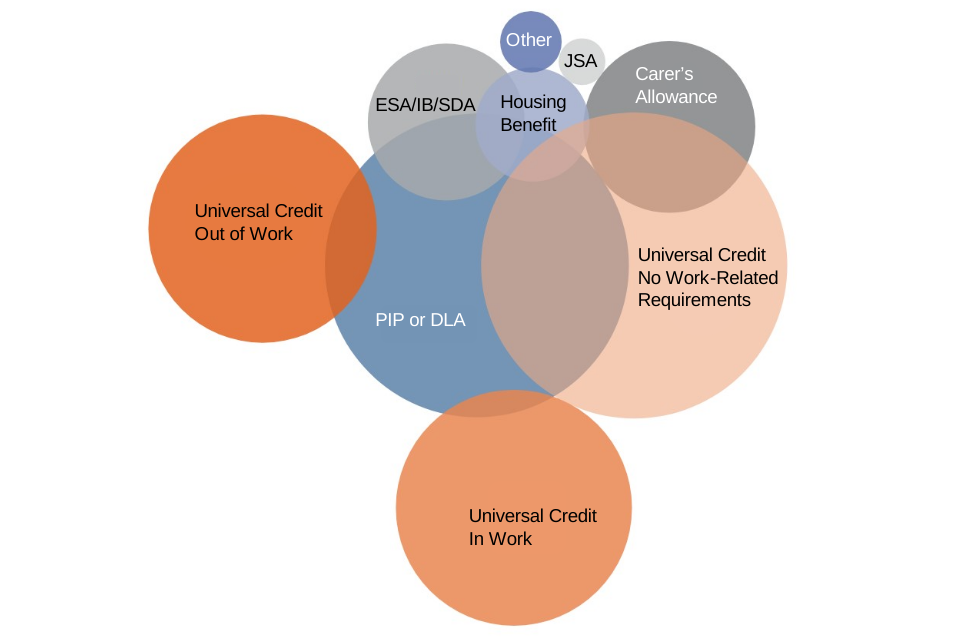
Note: This illustration uses overlapping circles, where larger circles and overlaps show more people claiming a particular combination of benefits. It is included to demonstrate the complexity of the situation for many claimants. Only the most common combinations are shown and other combinations do occur. It is not always possible for the areas to be exactly proportional to the number of cases for each combination.
Source: Benefit Combination Statistics to August 2025, Stat-Xplore
The most common benefit or combination of benefits claimed by Working Age (WA) individuals in England and Wales is Universal Credit (UC) on its own. Of all WA claimants in August 2025:
- 49% claimed UC and no other benefit
- 30% claimed UC in combination with some other benefit(s)
WA individuals may claim PIP or DLA if they need help with some of the extra costs caused by long-term disability, ill-health or when approaching the end of life due to a progressive disease. Of all WA claimants in August 2025:
- 9% claimed PIP or DLA and no other benefit
- 27% claimed PIP or DLA in combination with some other benefit(s)
WA individuals may claim Carer’s Allowance if they spend at least 35 hours per week caring for somebody and meet the required eligibility criteria. Of all WA claimants in August 2025:
- 3% claimed Carer’s Allowance and no other benefit
- 8% claimed Carer’s Allowance in combination with some other benefit(s)
The combinations of benefit that people claim are varied. Nearly one in eight WA claimants (12% in August 2025) claim some combination other than the top 10 most common possibilities. This can include benefits that appear in the top 10, but in combination with other benefits at the same time. For example, somebody claiming UC No Work requirements, PIP/DLA and Carer’s Allowance fall into the 11th most common combination (1% of all WA claimants in August 2025) whilst somebody claiming UC No Work Requirements and PIP/DLA would be in the 3rd most common combination (13% of all WA claimants in August 2025).
Top 10 Working Age benefit combinations, England and Wales, August 2025
| Benefits Claimed | Thousands | Percentage |
|---|---|---|
| UC In Work only | 1,895 | 20% |
| UC Out of Work only | 1,515 | 16% |
| UC No Work Requirements & PIP/DLA | 1,191 | 13% |
| UC No Work Requirements only | 1,104 | 12% |
| PIP/DLA only | 842 | 9% |
| UC No Work Requirements & Carer’s Allowance | 540 | 6% |
| ESA/IB/SDA & PIP/DLA | 302 | 3% |
| Carer’s Allowance only | 292 | 3% |
| UC Out of Work & PIP/DLA | 232 | 3% |
| UC No Work Requirements, PIP/DLA, & ESA/IB/SDA | 220 | 2% |
| Any other combination | 1,129 | 12% |
Source: Benefit Combination Statistics to August 2025, Stat-Xplore
Further combinations of benefits, and breakdowns by age, gender, geography, and individual benefits are available from Stat-Xplore.
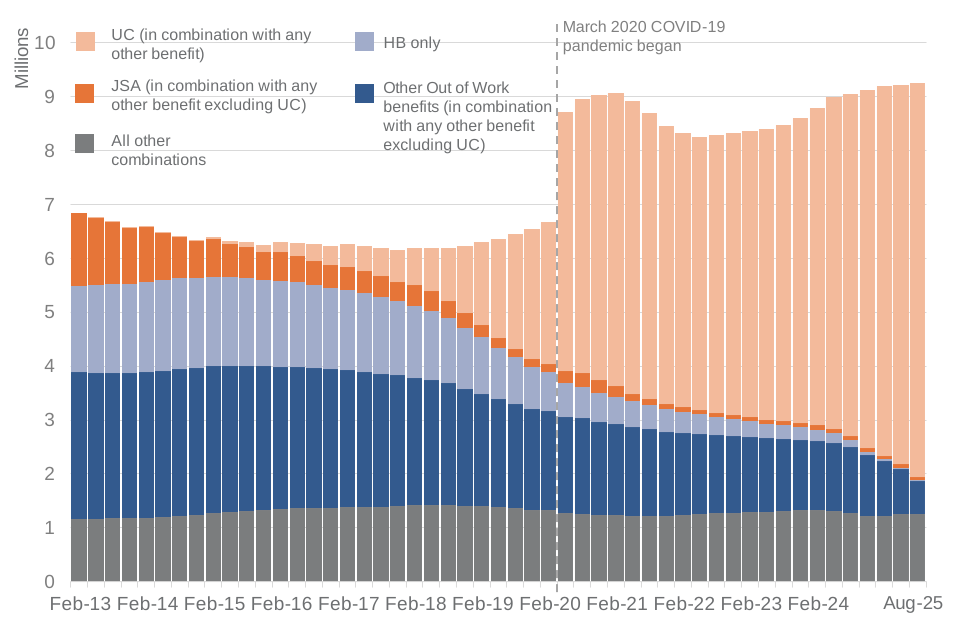
Working Age DWP Benefit Claimants, England and Wales, February 2013 to August 2025
Source: Benefit Combination Statistics to August 2025, Stat-Xplore
Since the introduction of Universal Credit in 2013 the picture of who claims which combination of benefits has been gradually changing, with more people claiming UC and fewer people claiming other benefits. In particular, there have been reductions in the numbers claiming JSA and the other “Out of Work” legacy benefits which comprise ESA, IB, SDA, IS (where CA not also in payment) or PC (where CA not also in payment), as well as reductions in HB. Trends in Out of Work benefit claimants are explored in more detail in section 6 of this release.
The economic disruption of the coronavirus (COVID 19) pandemic led to a rapid increase in UC caseloads. The number of people claiming UC doubled from 2.7 million in February 2020 to 5.4 million in February 2021. UC caseloads then declined slightly to 5.1 million by February 2022 before rising again to 7.3 million by August 2025. Over the same period, the remainder of the WA benefit claiming population fell by 52%, from 4.0 million in February 2020 to 2.0 million in August 2025. This reduction is partly due to people who were receiving other benefits but not UC at the start of the pandemic subsequently starting new UC claims by August 2025.
The total WA benefit claimant population reached 9.3 million in August 2025, surpassing previous peak levels last seen during the coronavirus (COVID-19) pandemic (9.1 million in February 2021).
3. Incapacity and disability Working Age benefit combinations
Working Age Claimants of Incapacity or Disability Benefits, England and Wales, August 2025
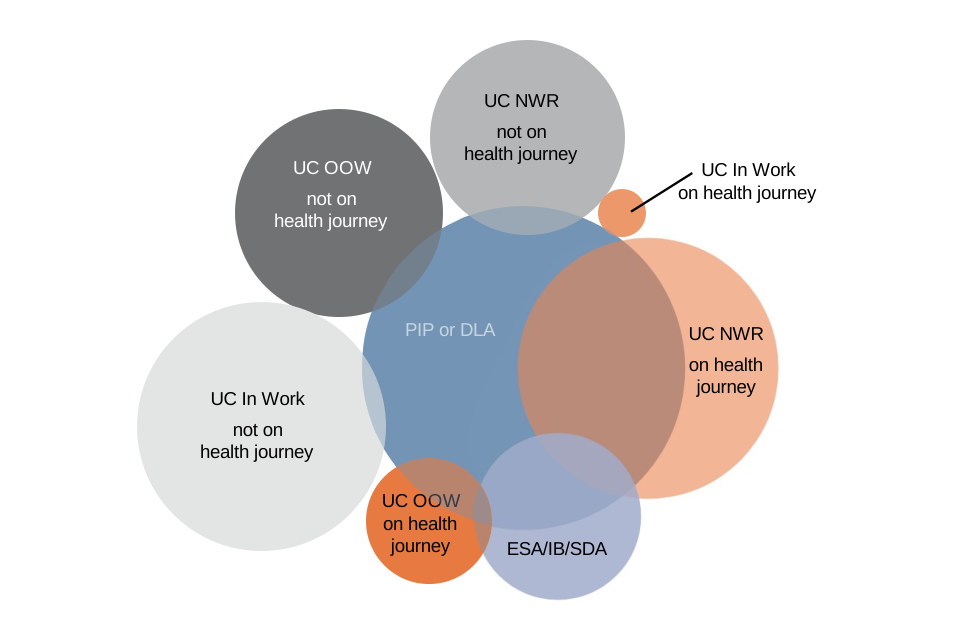
Note: This illustration uses overlapping circles, where larger circles and overlaps show more people claiming a particular combination of benefits. It is included to demonstrate the complexity of the situation for many claimants. Only the most common combinations are shown and other combinations do occur. It is not always possible for the areas to be exactly proportional to the number of cases for each combination.
Source: Benefit Combination Statistics to August 2025, Stat-Xplore
4.5 million people in England and Wales claimed an incapacity or disability benefit in August 2025, an increase of 7% from August 2024. This benefit grouping comprises PIP/DLA, ESA/IB/SDA, and those on the UC health journey:
-
PIP/DLA are claimed to help with some of the extra costs caused by long-term disability, ill-health or where approaching the end of life due to a progressive disease.
-
ESA is a benefit that pays to people who have limited capability to work because they are disabled or ill. There are two main types of ESA: a contribution-based strand, which is based on National Insurance contributions; and a means-tested strand. Income-related ESA can be paid on its own or as a top-up to contribution-based ESA. ESA replaced older benefits like Incapacity Benefit (IB) and Severe Disablement Allowance (SDA). Within the Benefit Combination statistics, these are grouped together (also including IS where IB is claimed at the same time) and labelled ESA/IB/SDA (within this commentary) or INCAP (on Stat-Xplore)
-
those claiming UC and reporting that they have a mental/physical health condition or a disability which prevents, or limits, their ability to work may get an extra amount of benefit if they have a health condition or disability that limits how much work they can do. This is referred to as “UC Health” or being on the “UC Health journey”.
UC and ESA/IB/SDA have varying eligibility criteria including household income and savings levels and are claimed by individuals on a low income to support living costs. Those claiming PIP/DLA may be able to work or may have other means of financial support, and as such may not require or be eligible for UC or ESA/IB/SDA. Those claiming UC or ESA/IB/SDA may not meet the specific eligibility criteria for PIP/DLA depending on their daily living or mobility needs or if their condition is not long term.
- 2.2 million people claim both PIP/DLA and ESA/IB/SDA or UC on Health Journey
- 1.2 million people claim ESA/IB/SDA or UC on Health Journey but not PIP/DLA
- 1.2 million people claim PIP/DLA but not ESA/IB/SDA or UC on Health Journey. Of these 24% do claim UC but are not categorised as being on the UC health journey.
- Under some circumstances an individual may claim new style ESA (also known as ESA (C) or “ESA Contributory”) at the same time as UC. 11% of those on the UC Health Journey in August 2025 had a concurrent ESA claim, an increase from 5% in May 2019.
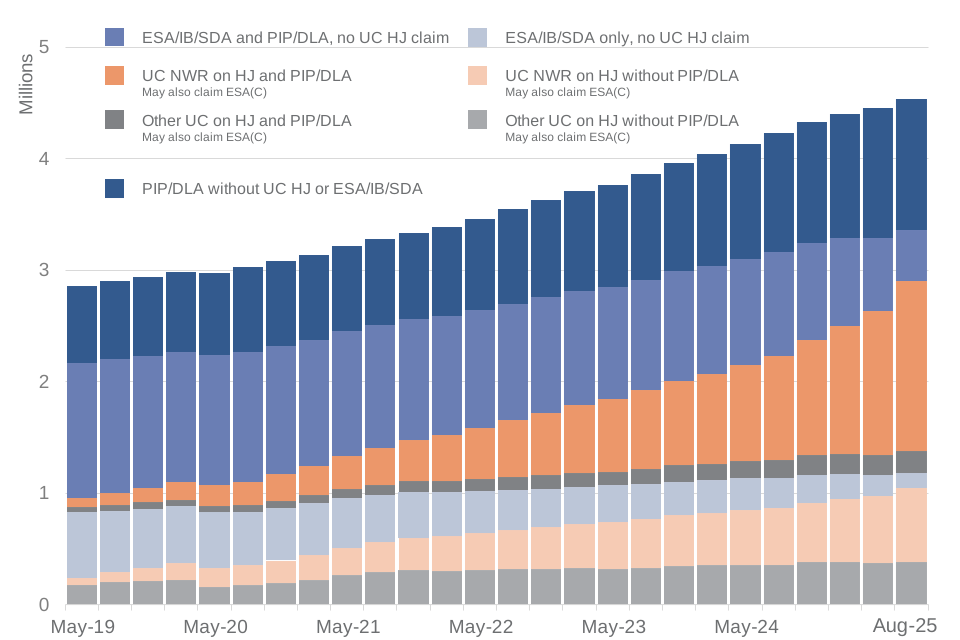
Working Age Claimants of Incapacity or Disability Benefits, England and Wales, August 2025
Source: Benefit Combination Statistics to August 2025, Stat-Xplore
Over time, the number of working age people claiming an incapacity or disability benefit in England & Wales has increased from 2.9 million in May 2019 to 4.5 million in August 2025.
During this period, Universal Credit has replaced a range of existing means-tested benefits and tax credits (“legacy benefits”) for working-age households. This has contributed to the increase in the total count of those on incapacity or disability benefits, since claims for legacy benefits other than ESA/IB/SDA were not included in the count but may now receive UC Health if their situation meets the eligibility criteria
Full-scale managed migration started in April 2023, expanding gradually to different areas of Great Britain. This means that there has been a gradual replacement of Income-related ESA by UC health. This occurs where:
- New claimants with health conditions from 2018 onwards make a claim to UC, whereas their equivalents before that date would have been likely to claim ESA
- Natural migrations where those on legacy benefits report a change of circumstance triggering their transfer to UC
- Managed migration via the Move to UC programme where legacy benefit claimants were asked to make a claim to UC.
Whilst the number of people on the UC Health Journey has increased from 370,000 in May 2019 to 2.8 million in August 2025, the number claiming ESA/IB/SDA without a concurrent UC Health Journey claim has reduced from 1.8 million to 600,000 over the same period.
The number of Working Age PIP/DLA claimants in England & Wales has also increased from 2.0 million in May 2019 to 3.3 million in August 2025. The proportion of these claimants who also claim UC on the Health Journey or ESA/IB/SDA has not changed significantly during this time, remaining at around two thirds (65% in August 2025). Furthermore, 25% of all those on PIP/DLA in August 2025 claimed no other benefit at all whilst 10% also claimed other benefits that are not classified as ill health or disability benefits, such as some combination of UC (not on the Health Journey), Carer’s Allowance or Housing Benefit.
Additional details are available on Stat-Xplore for some ill health and disability related benefits, including:
-
UC Health Journey: Work Capability Assessment outcomes
-
ESA: Work Capability Assessment outcomes
-
PIP, DLA and AA: Daily Living and Mobility Awards
4. State Pension Age combinations in England and Wales
DWP Benefit Combinations, State Pension Age, August 2025
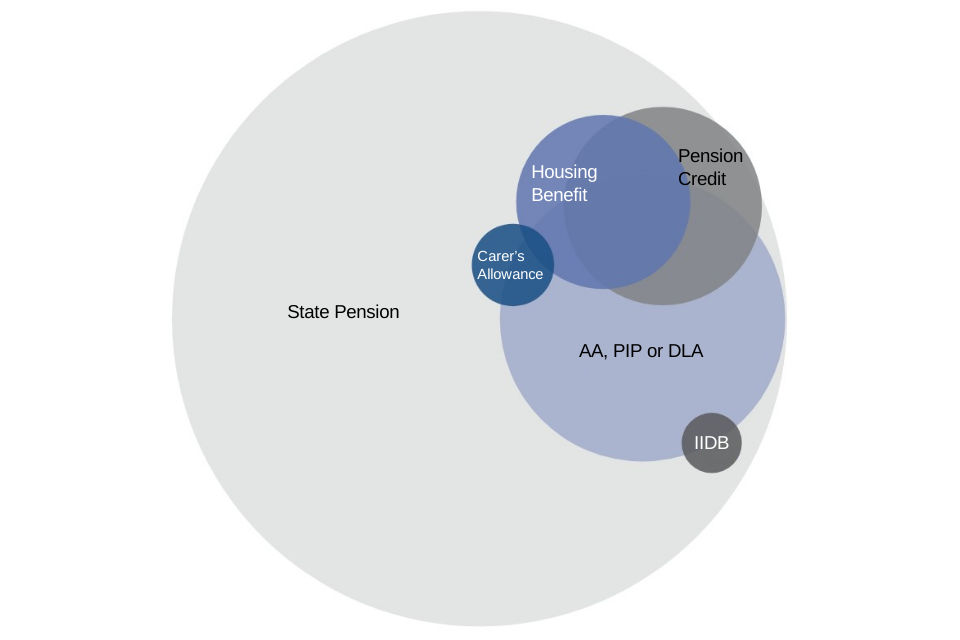
Note: This illustration uses overlapping circles, where larger circles and overlaps show more people claiming a particular combination of benefits. It is included to demonstrate the complexity of the situation for many claimants. Only the most common combinations are shown and other combinations do occur. It is not always possible for the areas to be exactly proportional to the number of cases for each combination.
Source: Benefit Combination Statistics to August 2025, Stat-Xplore
The most common benefit or combination of benefits claimed by State Pension Age (SPA) individuals in England and Wales is State Pension (SP) on its own. Of all SPA claimants in August 2025:
- 69% claimed their State Pension and no other benefit
- 29% claimed their State Pension in combination with some other benefit(s)
SPA individuals may claim AA, PIP or DLA if they need help with some of the extra costs caused by long-term disability, ill-health or when approaching the end of life due to a progressive disease. Of all SPA claimants in August 2025:
- 13% claimed AA, PIP or DLA and their State Pension but no other benefit
- 9% claimed AA, PIP or DLA in any other combination
SPA individuals may claim Pension Credit and/or Housing Benefit (via their own or a partner’s claim) if they have a low income and need help with living or accommodation costs. Of all SPA claimants in August 2025:
- 5% claimed one or both of Pension Credit and Housing Benefit, as well as their State Pension, but no other benefit
- 9% claimed one or both of Pension Credit and Housing Benefit, in any other combination
Top 10 State Pension Age benefit combinations, England and Wales, August 2025
| Benefits Claimed | Thousands | Percentage |
|---|---|---|
| State Pension (SP) only | 8,544 | 69% |
| AA/PIP/DLA & SP | 1,626 | 13% |
| AA/PIP/DLA, Pension Credit, & Housing Benefit & SP | 384 | 3% |
| Pension Credit, AA/PIP/DLA & SP | 300 | 2% |
| Pension Credit & SP | 240 | 2% |
| Pension Credit, Housing Benefit & SP | 231 | 2% |
| Housing Benefit & SP | 199 | 2% |
| AA/PIP/DLA, Housing Benefit & SP | 145 | 1% |
| Carer’s Allowance & SP | 126 | 1% |
| IIDB & SP | 58 | 0% |
| Any other combination | 460 | 4% |
Source: Benefit Combination Statistics to August 2025, Stat-Xplore
State Pension Age DWP Benefit Claimants, England and Wales, February 2013 to August 2025
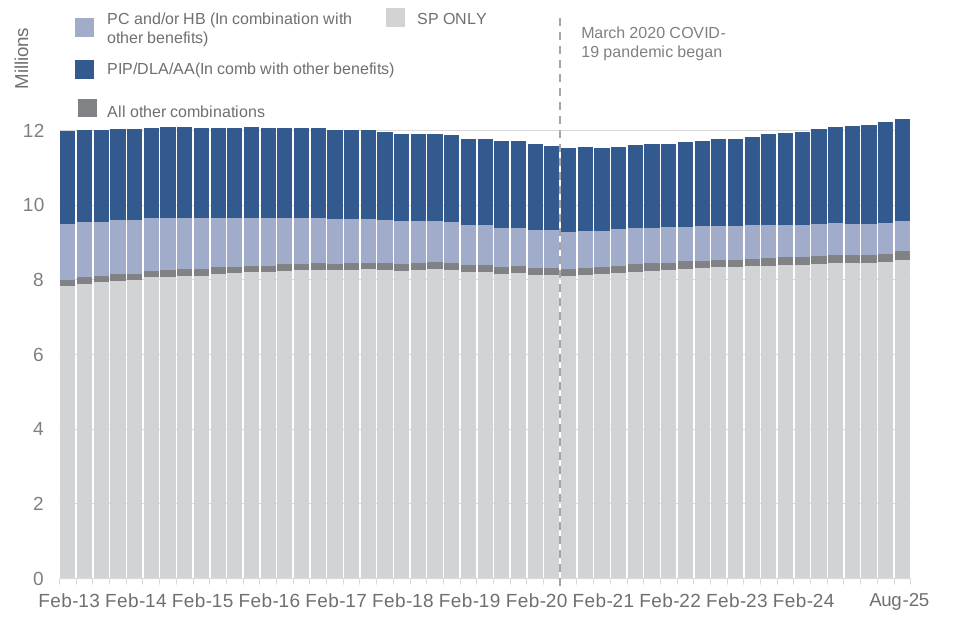
Source: Benefit Combination Statistics to August 2025, Stat-Xplore
Since 2013, the trends in benefit claims amongst those of State Pension age have remained relatively stable, aside from a gradual reduction in Pension Credit claims (due to the introduction of the New State Pension in April 2016, among other factors). Whilst the retirement age has risen (a gradual increase for women from 60 in April 2010 to 65 in November 2018, and for both men and women to 66 by October 2020) the England and Wales population has also aged.
Further explanation and commentary on the statistics for State Pension and Pension Credit can be found in the benefits statistics summary release. Note that Benefit Combinations statistics do not include Winter Fuel Payment or Cold Weather Payments since these are bespoke payments made to qualifying individuals or households at a single point in time rather than a regular benefit paid over a longer period. Separate publications give Official Statistics on Winter Fuel Payment statistics and Social Fund Cold Weather Payments.
5. Benefit Combinations in Scotland
The Scotland Act 2016 devolved a significant suite of social security powers to the Scottish Parliament. This included powers to provide disability and carer assistances which had previously been reserved to the UK Government.
Administrative responsibility (competence) transferred to the Scottish Government for Carer’s Allowance (CA) in September 2018 followed by Disability Living Allowance (DLA), Personal Independence Payment (PIP), Attendance Allowance (AA), Severe Disablement Allowance (SDA) and Industrial Injuries Scheme benefits (IIS) in April 2020.
From these dates, the Scottish Government became fully responsible for these benefits in Scotland. However, as the Scottish Government was not in a position to deliver these benefits itself at this time, Scottish Ministers requested that DWP continue to administer claims on their behalf under interim Agency Agreements while the Scottish Government and Social Security Scotland developed their capacity to deliver their new offer and transfer existing customers from DWP
Since 2021, Social Security Scotland has introduced the following benefits to replace existing disability and carer provision in Scotland:
- Child Disability Payment (CDP) to replace DLA for those aged under 16
- Adult Disability Payment (ADP) to replace PIP and DLA for those aged between 16 and state pension age.
- Scottish Adult Disability Living Allowance (Scottish Adult DLA) to replace Adult DLA for those over 18 in some cases
- Carer Support Payment (CSP) to replace CA
- Pension Age Disability Payment (PADP) to replace AA
- Employment Injury Assistance (EIA) to replace IIDB
These benefits are – and have been since their introduction - wholly administered by Social Security Scotland, the executive social security agency of the Scottish Government. Following the introduction of each new benefit, DWP and Social Security Scotland have worked together to transfer existing Scottish customers of CA, DLA, PIP and AA from DWP following which Social Security Scotland put the above benefits into payment for these customers.
The following benefits continue to be administered by DWP on behalf of Scottish Ministers under Agency Agreements.
- Industrial Injuries Scheme benefits
- Severe Disablement Allowance
The Scotland Act 2016 also conferred on the Scottish Parliament powers to top up reserved payments and create new benefits in areas of devolved responsibility. In 2018 the Scottish Government introduced Carer’s Allowance Supplement (CAS), a twice-yearly paid top up to CSP to bring the amount in line with Jobseeker’s Allowance for which recipients of CA and CSP who are resident in Scotland are eligible.
From March 2026, amongst other changes to CSP, the Scottish Government will introduce a Carer Additional Person Payment (CAPP) (an additional payment to someone caring for more than one person in receipt of a qualifying benefit) and will replace CAS with Scottish Carer Supplement (SCS). Both CAPP and Scottish Carer Supplement will be paid alongside CSP.
Scottish Disability Benefits: Introduction and Case Transfer
| Scottish Benefit | DWP Benefit to replace | First introduced (pilot) | Full Scottish roll out began | Managed case transfer from DWP to Social Security Scotland completed |
| CDP | DLA(child) | July 2021 | November 2021 | Summer 2023 |
| ADP | PIP & DLA (WA) | March 2022 | August 2022 | Summer 2025 for PIP |
| Scottish Adult DLA | DLA (WA & SPA) | - | March 2025 | Winter 2025 for DLA |
| CSP | CA | November 2023 | November 2024 | Autumn 2025 |
| PADP | AA | October 2024 | April 2025 | Winter 2025 |
| EIA | IIDB | - | - | - |
Within DWP benefit statistics, some Scottish cases may continue to appear for people who move to Scotland from England and Wales while in receipt of a DWP administered benefit and are in the process of having their benefit transferred.
Benefit Combination statistics in this release do not include data on devolved Scottish benefits CDP, ADP, Scottish Adult DLA, CSP, CAS or PADP. There are no plans to incorporate these statistics into this release, although they can be found as part of the Social Security Scotland statistics publications collection published by the Scottish Government.
For Benefit Combinations under DWP administration, this means:
-
the caseload for those under the age of 16 (and in receipt of DLA as a child) in Scotland has reduced to just over 100 cases between August 2021 and August 2025 and will remain at a low level due to cases where a claimant is in the process of transferring following a recent move to Scotland.
-
the caseload for Working Age adults in Scotland claiming PIP or DLA has reduced by 95% to 15,000 between August 2022 and August 2025 and will continue to fall in future releases, which will in turn affect the volumes for any combination of benefits including PIP or DLA for individuals living in Scotland.
-
the caseload for all adults in Scotland claiming CA has reduced by 99% to 1,200 between February 2024 and August 2025 and will continue to fall in future releases, which will in turn affect the volumes for any combination of benefits including CA for individuals living in Scotland.
-
the caseload for individuals of State Pension Age claiming PIP, DLA or AA living in Scotland has reduced by 53% from 250,000 in August 2022 to 120,000 in August 2025 and will continue to fall in future releases, which will in turn affect the volumes for any combination of benefits including PIP, DLA or AA for individuals living in Scotland.
Top 10 Working Age combinations of benefits administered by DWP, Scotland, August 2025
| Benefits Claimed | Thousands | Percentage |
|---|---|---|
| UC No Work Requirements only | 309 | 41% |
| UC In Work Only | 148 | 20% |
| UC Out of Work Only | 136 | 18% |
| ESA/IB/SDA Only | 48 | 6% |
| UC No Work Requirements & ESA/IB/SDA | 35 | 5% |
| ESA/IB/SDA & Housing Benefit | 18 | 2% |
| UC No Work Requirements & Housing Benefit | 8 | 1% |
| UC Out of Work & Housing Benefit | 7 | 1% |
| Job Seeker’s Allowance only | 5 | 1% |
| Industrial Injuries Disablement Benefit Only | 4 | 1% |
| Any other combination | 34 | 4% |
Source: Benefit Combination Statistics to August 2025, Stat-Xplore
The most common benefit or combination of benefits administered by DWP claimed by Working Age (WA) individuals in Scotland is Universal Credit (UC) on its own. Of all WA claimants in August 2025:
-
79% claimed UC and no other benefit
-
9% claimed UC in combination with some other benefit(s)
Working Age DWP Benefit Claimants, Scotland, February 2013 to August 2025
Source: Benefit Combination Statistics to August 2025, Stat-Xplore
Since the introduction of Universal Credit (UC) in 2013 and the transfer of responsibility for administering disability benefits in Scotland to the Scottish Parliament from November 2021, the landscape of DWP administered benefit receipt in Scotland has continued to evolve.
Trends between 2013 and 2021 in benefit claims among those of Working age in Scotland broadly followed the same patterns as those in England and Wales. For more details see Section 2.
Due to the movement of claimants onto the new Scottish benefits ADP, Scottish Adult DLA and CSP, any Working Age benefit combinations involving PIP, DLA and CA have seen a steady decline from early 2022 onwards. This predominantly affects the benefits which are not classified as “Out of Work” (a grouping which covers UC, JSA, ESA, IB, SDA, IS and PC).This means that while Out of Work benefit claims in Scotland have seen increases similar in scale to those in England and Wales over the period since the end of 2019, the total number of DWP benefit claimants has not grown as much, since any change in claim volumes for benefits administered by the Scottish Government are not accounted for.
Top 10 State Pension Age combinations of benefits administered by DWP, Scotland, August 2025
| Benefits Claimed | Thousands | Percentage |
|---|---|---|
| State Pension (SP) only | 803 | 75% |
| AA/PIP/DLA & SP | 71 | 7% |
| Pension Credit, Housing Benefit & SP | 57 | 5% |
| Pension Credit & SP | 37 | 3% |
| Housing Benefit & SP | 34 | 3% |
| AA/PIP/DLA, Pension Credit, Housing Benefit & SP | 19 | 2% |
| Pension Credit, AA/PIP/DLA & SP | 16 | 2% |
| IIDB & SP | 10 | 1% |
| AA/PIP/DLA, Housing Benefit & SP | 6 | 1% |
| SP & UC No Work Requirements | 3 | 0% |
| Any other combination | 15 | 1% |
Source: Benefit Combination Statistics to August 2025, Stat-Xplore
The most common benefit or combination of benefits claimed by State Pension Age (SPA) individuals in Scotland is State Pension (SP) on its own. Of all SPA claimants in August 2025:
-
75% claimed their State Pension and no other benefit
-
24% claimed their State Pension in combination with some other benefit(s)
State Pension Age DWP Benefit Claimants, Scotland, February 2013 to August 2025
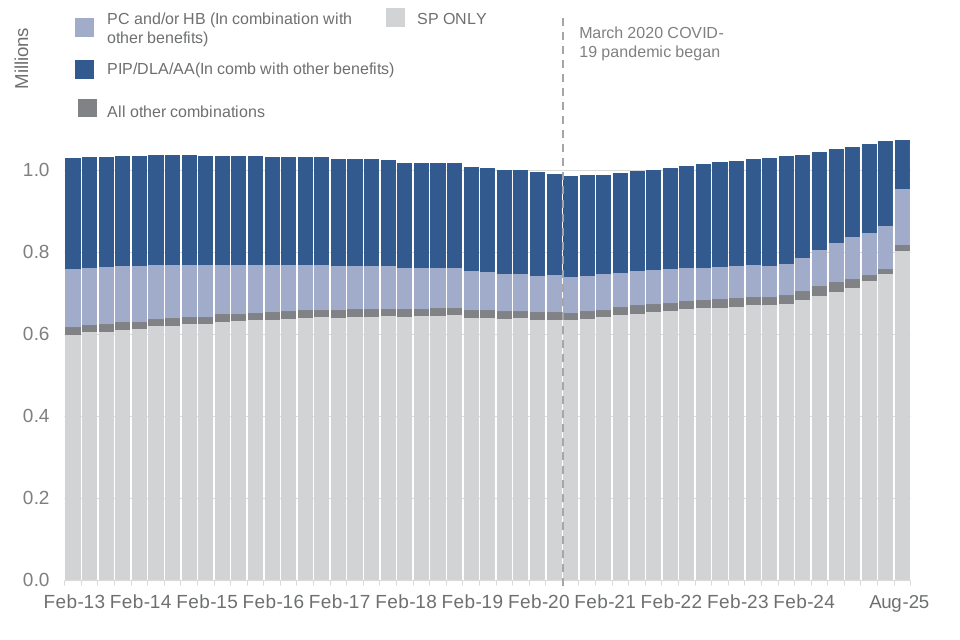
Source: Benefit Combination Statistics to August 2025, Stat-Xplore
Between 2013 and 2022, trends in benefit claims among those in State Pension age in Scotland has broadly followed the same patterns is those in England and Wales. For more details see Section 4.
The picture has shifted more noticeably following the devolution of disability and carer benefits to the Scottish parliament. The number of people receiving State Pension (SP) alongside PIP or DLA has fallen by 86% from 135,000 in August 2022 to 71,000 in August 2025. Similarly, those receiving State Pension with Carer’s Allowance have also declined by 97%, from 13,000 to around 300 over the same period. These reductions mainly result from claimants moving from DWP administered benefits to their devolved Scottish counterparts. People who previously appeared in combination categories (such as SP & PIP/DLA or SP & CA) now appear as SP only claimants in DWP statistics. This has contributed to the steady rise in the SP only group, meaning overall trends in State Pension age benefit receipt remain broadly unchanged despite reductions in individual claim combinations.
Further explanation and commentary on the statistics for State Pension, Pension Credit and Social Security Scotland administered benefits can be found in the benefits statistics summary and Latest publications - Social Security Scotland releases.
6. Out of Work, Working Age benefit combinations
Some benefits can be classified as “Out of Work” benefits meaning that these are benefits claimed by Working Age people who are not working and are in need of financial support. Out of Work benefits may be claimed for a number of reasons including unemployment, ill health or disability, or caring responsibilities for a young child. People in receipt of Carer’s Allowance are not counted as “Out of Work” since they may or may not also be in paid employment in addition to their caring responsibilities. Some State Pension Age claimants can be claiming “Out of Work” benefits, such as UC, but for the purpose of these statistics they have been excluded from this section.
The following benefits are counted as “Out of Work” benefits for the purposes of benefit combinations statistics:
-
Jobseeker’s Allowance (JSA)
-
Employment and Support Allowance (ESA) – included in ESA/IB/SDA group
-
Incapacity Benefit (IB) – included in ESA/IB/SDA group
-
Severe Disablement Allowance (SDA) – included in ESA/IB/SDA group
-
Income Support (IS) where Carer’s Allowance (CA) not also in payment
-
Pension Credit (PC) where Carer’s Allowance (CA) not also in payment
-
Universal Credit Out of Work (UC OOW) where conditionality regime is one of Searching for Work, Preparing for Work or Planning for Work
-
Universal Credit No Work Requirements (UC NWR) where conditionality regime is No Work Requirements
If an individual claims JSA or Universal Credit with one of the Out of Work conditionality regimes, they are generally expected to take steps towards securing work in the future as part of their benefit claim and may be sanctioned if they do not comply.
Under other circumstances the individual will not be expected to look for work – generally because they are too sick to work or because they are the main carer for a very young child.
None of the Out of Work benefits on the above list are affected by Scottish Devolution and statistics in this section are shown for Great Britain to aid understanding of the situation for the whole country. Separate figures for England & Wales and for Scotland can be obtained from Stat-Xplore.
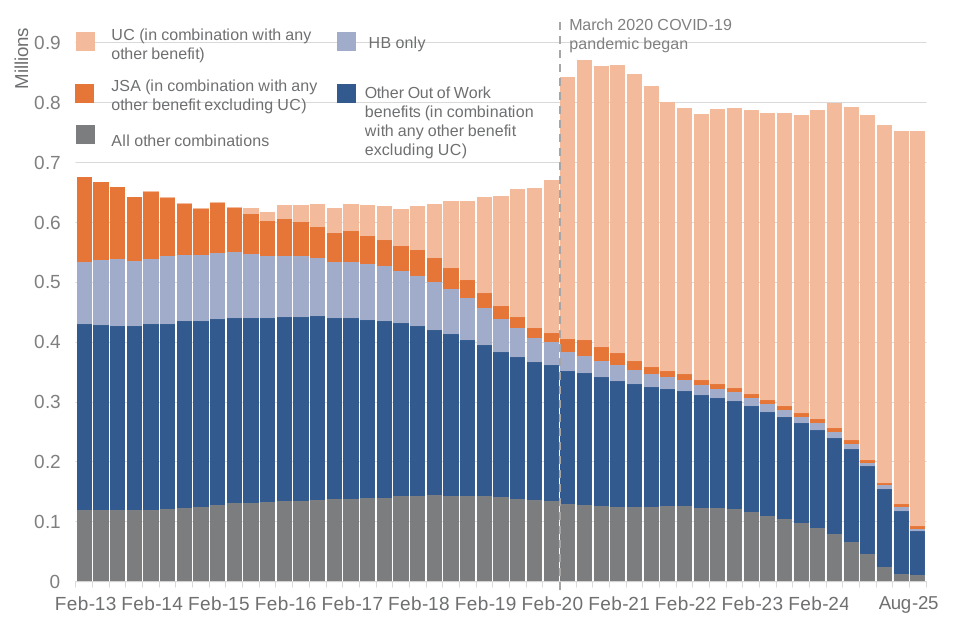
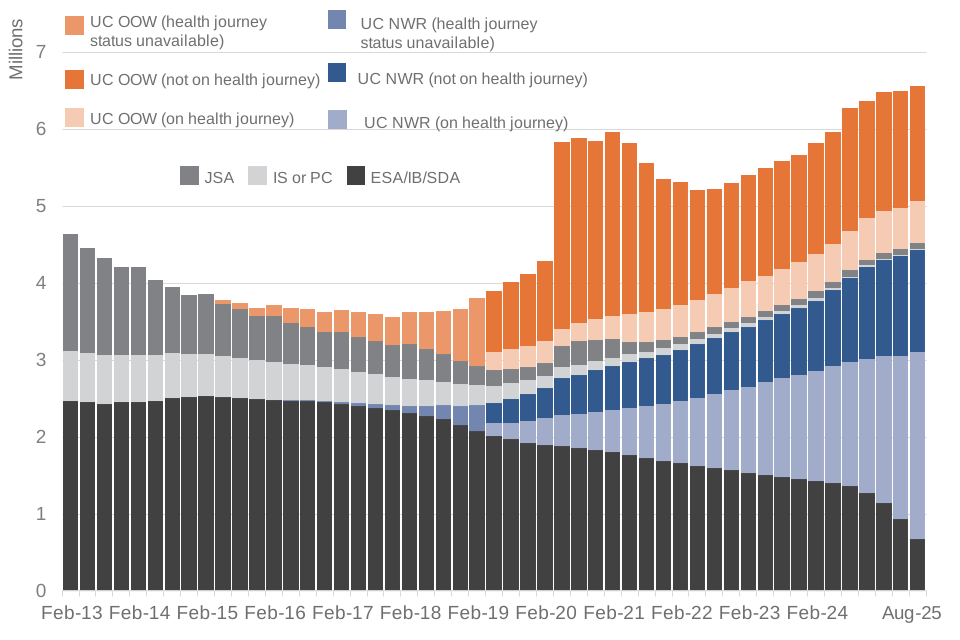
Out of Work, Working Age, DWP Benefit Claimants, Great Britain, February 2013 to August 2025
Source: Benefit Combination Statistics to August 2025, Stat-Xplore
Caution should be taken when making comparisons in the Out of Work benefits caseload over long periods of time. This is because:
-
changes in the state pension age in 2010 and 2018 mean that women aged 59-65 and men aged 65 are now eligible to be included in the Out of Work benefit series when previously they would have been counted in the State Pension Age group. The use of age filters can be applied to remove this effect.
-
policy changes have also broadened the scope of people that can be included in the Out of Work benefits. Universal Credit applies to a broader range of people. Increases to the administrative earnings threshold (AET) mean a greater number of people in work are included in the UC Out of Work group.
-
data up to and including February 2015 excludes UC claims from the count of Out of Work benefits due to data on UC conditionality regime being unavailable prior to this point. However, total UC caseload in February 2015 was 38,000, which means that any undercount up to and including this date is less than 1% of the Out of Work caseload.
Nevertheless, since February 2013 there have been:
-
increases in the total number of Out of Work benefit claimants, which as at August 2025 sees the highest point in the time series since February 2013
- reductions in the numbers claiming “legacy” Out of Work benefits (JSA, ESA, IB, SDA or PC)
-
corresponding increases in UC claims
- higher claims during the period directly affected by the COVID-19 pandemic
Out of Work DWP Benefit Claimants, Great Britain, August 2025
6.6 million people claimed some combination of Out of Work benefits in Great Britain in August 2025. They may claim other benefits in addition to the Out of Work benefits (such as PIP, DLA or HB).
| No Work Requirements | Thousands | Percentage of all OOW benefit claimants |
|---|---|---|
| ESA/IB/SDA | 700 | 10% |
| UC NWR, on Health Journey | 2,400 | 37% |
| UC NWR, not on Health Journey | 1,300 | 20% |
| Pension Credit | 13 | 0% |
| Total with No Work Requirements | 4,400 | 68% |
| Some Work Requirements | Thousands | Percentage of all OOW benefit claimants |
|---|---|---|
| JSA | 80 | 1% |
| UC OOW, on Health Journey | 600 | 8% |
| UC OOW, not on Health Journey | 1,500 | 23% |
| Total with Some Work Requirements | 2,100 | 32% |
Source: Benefit Combination Statistics to August 2025, Stat-Xplore
Note that from May 2025 onwards, benefit combination statistics do not include Income Support (IS), since all IS claims are within scope of Move to Universal Credit and no claims will remain on IS. As the caseload has fallen very low and will not rise again, IS statistics will no longer be updated in the DWP Benefit Statistics publication for future quarters. From February 2026 onwards, IS statistics will not be reported in the statistical summary and will not be updated in the supplementary data tables on Stat-Xplore. All previously published IS data will remain available.
7. About these statistics
Changes in this release:
A new section titled ‘Incapacity and Disability: Working Age Benefit Combinations’ has been introduced in this bulletin. This section provides additional insight into how incapacity‑ and disability‑related benefits are received in combination by working‑age claimants in England and Wales. To support this, a new time‑series chart has been included, offering users a clearer view of how volumes have changed over time.
From May 2025 onwards, benefit combination statistics do not include Income Support (IS), since all IS claims are within scope of Move to Universal Credit and no claims will remain on IS. As the caseload has fallen very low and will not rise again, IS statistics will no longer be updated in the DWP Benefit Statistics publication for future quarters. From February 2026 onwards, IS statistics will not be reported in the statistical summary and will not be updated in the supplementary data tables on Stat-Xplore. All previously published IS data will remain available.
Methodology:
There are methodological differences between individual benefit series and the combined benefit series, which in some cases give rise to differences in the figures themselves. Further information on methodology, and detail on uses and limitations of the series can be found in the background methodology note. For official statistics on each individual benefit please see the DWP Benefits Statistics collection.
Data Quality Statement:
Our statistical practice is regulated by the Office for Statistics Regulation (OSR). OSR sets the standards of trustworthiness, quality and value in the Code of Practice for Official Statistics that all producers of official statistics should adhere to. You are welcome to contact us directly with any comments about how we meet these standards at cm.analysis.research@dwp.gov.uk. Alternatively, you can contact OSR by emailing regulation@statistics.gov.uk or via the OSR website.
Known Issues
-
From May 2025 onwards, benefit combination statistics do not include Income Support (IS), since all IS claims are within scope of Move to Universal Credit and no claims will remain on IS. As the caseload has fallen very low and will not rise again, IS statistics will no longer be updated in the DWP Benefit Statistics publication for future quarters. From February 2026 onwards, IS statistics will not be reported in the statistical summary and will not be updated in the supplementary data tables on Stat-Xplore. All previously published IS data will remain available.
-
DWP Statisticians have identified that a subset of inactive Jobseekers Allowance (JSA) claims have been contributing to the caseload. Whilst Benefit Combination statistics include these Nil and Unknown payment cases, a methodological improvement has been applied to the JSA statistics which form part of the Benefit Statistics release for August 2025 data onwards to remove these inactive cases. Since these changes have not yet been applied to the Benefit Combination publication, users should expect the JSA caseload in Benefit Combination statistics to differ from the figures in the JSA Benefit Statistics.
-
In recent years, HB data has been impacted by a number of interruptions to data supply for specific areas and in each case the return from an affected council has been derived from earlier data until normal data supply resumes. This issue affected Na h-Eileanan Siar (Western Isles) from October 2023 until December 2024, Gloucester City Council from December 2021 to July 2023, and Hackney Borough Council from November 2020 to July 2021.
-
During 2019, a new DWP computer system called “Get Your State Pension” (GYSP) came online to handle new State Pension claims. Temporary State Pension caseload figures were published between August 2021 and August 2023 which included an estimate of GYSP created using payment data. These figures have been withdrawn and replaced by a revised Stat-Xplore State Pension series which includes a new GYSP data feed. From February 2024, Benefit Combination State Pension data has also been revised to match State Pension Official Statistics series, using the new GYSP data
-
Due to data quality issues, State Pension Age statistics for the Shetland Islands from August 2023 to November 2024 have been mapped into the ‘Unknown’ category, which is included within the England and Wales data series, along with the Abroad category. Overall caseload totals for Great Britain are not impacted, and from February 2025 onwards cases have been placed back in the Shetland Islands category.
-
The source IIDB data used for Benefit Combination statistics shows IIDB claimants at a point five months previous to the last day of the Benefit Combinations calendar month. To adjust for this lag, data from the Customer Information System (CIS) has been used to remove cases for individuals known to have died between the IIDB time point and the Benefit Combinations time point, giving an estimate of the IIDB caseload at the Benefit Combinations time point
-
Prior to December 2022, payments for abroad cases of IIDB were managed on a separate system which was not linked to published statistics. All abroad cases were migrated to the payment system that handles the rest of the IIDB caseload in November 2022. The official IIDB caseload statistics from December 2022 published on Stat-Xplore include a complete breakdown for abroad cases. The February 2023 Benefit Combination statistics (published in August 2023) use September 2022 IIDB data and hence do not contain all abroad cases. A direct comparison therefore cannot be carried out between the official IIDB statistics and IIDB within the Benefit Combinations statistics at this time point. From May 2023 (published in November 2023), Benefit Combinations source IIDB data includes the complete breakdown for abroad cases and matches the official IIDB caseload statistics.
-
When historical data is recreated, the entire Benefit Combinations dataseries needs to be updated to ensure combinations remain correct. Whilst most individual benefit datasets are frozen, some are continually refreshed, which can lead to some retrospection. This means that data which were not directly impacted by a re-run may change by small amounts
The background methodology note gives detail and impact for known issues and changes.
Benefits not included in this Benefit Combinations release:
- Maternity Allowance is not currently included in the series. A new operational system to record Maternity Allowance cases is currently being developed. As such, Maternity Allowance statistics were suspended from the quarterly statistics release on 13 August 2024 until data can be extracted from the new system.
- current Benefit Combinations statistics do not include the HMRC administered benefits (Child Tax Credit, Working Tax Credit and Child Benefit). Since the introduction of Universal Credit in 2013, most Tax Credits are being gradually replaced by Universal Credit and so individuals who would formerly have claimed tax credits and not appeared in these statistics are now more likely to appear as Universal Credit claimants. DWP and HMRC analysts are working towards a joint annual publication of benefit combination statistics that would include Tax Credits and Child Benefit, and this is intended to be published at some point in the future.
- current Benefit Combinations statistics also do not include Scottish benefits (Child Disability Payment, Adult Disability Payment, Carer Support Payment, Carer’s Allowance Supplement or Pension Age Disability Payment)
Expected future changes:
At some point in the future, further devolution will affect claims from people residing in Scotland for AA, SDA and IIDB. Caseloads for these benefits (and combinations including them) will reduce when they are replaced by new Scottish benefits.
Where to find out more:
Read a background methodology note for more detail on derivation of Benefit Combination statistics.
Build your own data tables using Stat-Xplore.