Country policy and information note: humanitarian situation, Ukraine, October 2026 (accessible)
Updated 14 October 2026

© Crown copyright 2026
This publication is licensed under the terms of the Open Government Licence v3.0 except where otherwise stated. To view this licence, visit nationalarchives.gov.uk/doc/open-government-licence/version/3 or write to the Information Policy Team, The National Archives, Kew, London TW9 4DU, or email: psi@nationalarchives.gov.uk.
Where we have identified any third party copyright information you will need to obtain permission from the copyright holders concerned.
This publication is available at https://www.gov.uk/government/publications/ukraine-country-policy-and-information-notes/country-policy-and-information-note-humanitarian-situation-ukraine-october-2026-accessible
Version 2.0, October 2026
Executive summary
Ukraine continues to face significant humanitarian challenges arising from Russia’s full-scale invasion in February 2022. Humanitarian needs remain concentrated in frontline and conflict-affected areas in the east, southeast and northeast of the country, while conditions are generally better in central and western Ukraine. Despite ongoing attacks, displacement and damage to infrastructure, state institutions, public services and humanitarian assistance programmes continue to operate across much of the country.
This note does not consider risk arising from a Refugee Convention reason. It considers whether the humanitarian situation in Ukraine is such that a person would face a real risk of serious harm contrary to Article 3 of the European Convention on Human Rights (ECHR).
Despite the ongoing war, Ukraine’s economy, public services and humanitarian assistance programmes continue to function across much of the country. As such, the general humanitarian situation in Ukraine is not so severe that there are substantial grounds for believing that there is a real risk of serious harm because conditions amount to torture or inhuman or degrading treatment within the meaning of Article 3 ECHR. Whilst approximately 10.8 million people require humanitarian assistance, needs are primarily concentrated in frontline and Russian-occupied areas; particularly in Donetsk, Kherson, Zaporizhzhia, Kharkiv and Sumy oblasts and among populations living close to the frontline. Access to food, water, sanitation, healthcare, education, accommodation and other essential services remains available for most people, although conditions vary by location and individual circumstances.
The state is not able to provide protection against a breach of Article 3 arising from general humanitarian conditions if this occurs in individual cases.
In general, internal relocation is likely to be available. There are parts of Ukraine, particularly in central and western regions, where conflict-related damage, humanitarian need and disruption to services are less severe than in frontline and border areas. The reasonableness of internal relocation must be assessed on the facts of each case, taking account of the person’s individual circumstances.
Each case must be considered on its individual facts. The onus is on the person to demonstrate they face serious harm.
Ukraine is listed as a designated state under section 94 of the Nationality, Immigration and Asylum Act 2002. However, due to the ongoing conflict, where a claim is refused, it is unlikely to be certifiable as ‘clearly unfounded.’
Assessment
Section updated: 25 September 2026
About the assessment
This section considers relevant evidence – including country information, refugee and human rights law and policy, and case law – to assess whether, in general:
- the humanitarian situation is so severe that there are substantial grounds for believing that there is a real risk of serious harm because conditions amount to inhuman or degrading treatment as within paragraphs 339C and 339CA(iii) of the Immigration Rules/Article 3 of the European Convention on Human Rights
- the state (or quasi state bodies) can provide effective protection
- internal relocation is possible to avoid persecution or serious harm
- if refused, a claim is likely or not to be certified as ‘clearly unfounded’ under section 94 of the Nationality, Immigration and Asylum Act 2002.
Each case must be considered on its individual facts.
For details on how CPIT makes its assessments, and information on disclaimers (including the use of Artificial Intelligence (AI) in developing CPINs), see About country policy and information notes.
1. Material facts, credibility and other checks
1.1.1 Decision makers must:
- assess credibility (see the Asylum Instruction on Assessing Credibility and Refugee Status).
- check if there has been a previous application for a UK visa or another form of leave. Asylum applications matched to visas should be investigated prior to the asylum interview (see the Asylum Instruction on Visa Matches, Asylum Claims from UK Visa Applicants).
- consider making an international biometric data-sharing check, when one has not already been undertaken (see Biometric data-sharing process (Migration 5 biometric data-sharing process)).
- consider language analysis testing, where available, in cases where there are doubts surrounding a person’s claimed place of origin (see the Asylum Instruction on Language Analysis).
Official – sensitive: Not for disclosure – Start of section
The information in this section has been removed as it is restricted for internal Home Office use.
Official – sensitive: Not for disclosure – End of section
2. Exclusion
2.1.1 Decision makers must consider whether there are serious reasons to apply one (or more) of the exclusion clauses. Each case must be considered on its individual facts.
2.1.2 If the person is excluded from the Refugee Convention, they will also be excluded from a grant of humanitarian protection, which has a wider range of exclusions than refugee status.
2.1.3 For guidance on exclusion and restricted leave, see the Asylum Instruction on Exclusion under Articles 1F and 33(2) of the Refugee Convention, Humanitarian Protection and the instruction on Restricted Leave.
Official – sensitive: Not for disclosure – Start of section
The information in this section has been removed as it is restricted for internal Home Office use.
Official – sensitive: Not for disclosure – End of section
3. Convention reason(s)
3.1.1 A severe humanitarian situation does not of itself give rise to a well-founded fear of persecution for a Refugee Convention reason.
3.1.2 In the absence of a link to one of the 5 Refugee Convention grounds necessary to be recognised as a refugee, the question to address is whether the person will face a real risk of serious harm in order to qualify for Humanitarian Protection (HP).
3.1.3 However, before considering whether a person requires protection because of the general humanitarian situation, decision makers must consider if the person faces persecution for a Refugee Convention reason. Where the person qualifies for protection under the Refugee Convention, decision makers do not need to consider if there are substantial grounds for believing the person faces a real risk of serious harm meriting a grant of HP.
3.1.4 For further guidance on the 5 Refugee Convention grounds, see the Asylum Instruction, Assessing Credibility and Refugee Status.
4. Risk
4.1.1 The general humanitarian situation in Ukraine is not so severe that there are substantial grounds for believing that there is a real risk of serious harm because conditions amount to torture or inhuman or degrading treatment as defined in paragraphs 339C and 339CA(iii) of the Immigration Rules/Article 3 of the European Convention on Human Rights (ECHR).
4.1.2 Even where there is not in general a real risk of serious harm because of the general humanitarian situation, a person may still face a real risk of serious harm because of their specific circumstances. Each case must be considered on its individual facts.
4.1.3 Whilst not country-specific to Ukraine, decision makers should note the Upper Tribunal (UT)’s findings and general approach to assessing humanitarian conditions in OA (Somalia) (CG) [2022] UKUT 33 (IAC) (2 February 2022):
‘In an Article 3 “living conditions” case, there must be a causal link between the Secretary of State’s removal decision and any “intense suffering” feared by the returnee. This includes a requirement for temporal proximity between the removal decision and any “intense suffering” of which the returnee claims to be at real risk. This reflects the requirement in Paposhvili [2017] Imm AR 867 for intense suffering to be “serious, rapid and irreversible” in order to engage the returning State’s obligations under Article 3 ECHR. A returnee fearing “intense suffering” on account of their prospective living conditions at some unknown point in the future is unlikely to be able to attribute responsibility for those living conditions to the Secretary of State, for to do so would be speculative.’ (Headnote 1)
4.1.4 At the time of writing, active hostilities are concentrated in the eastern, southeastern and northeastern parts of the country, particularly in frontline and border areas. However, the situation remains fluid as the conflict is ongoing. Decision makers should consult sources and tools such as ACLED’s Ukraine Conflict Monitor for ongoing and near real-time information when considering cases.
4.1.5 Humanitarian conditions across the country vary. The estimated number of people requiring humanitarian assistance decreased from 12.7 million in 2025 to 10.8 million (approximately 27.3% of the population) in 2026. However, OCHA noted that the figures are not directly comparable due to changes in methodology and prioritisation. Nevertheless, sources consistently place the greatest concentration and severity of need in the frontline and Russian-occupied areas, particularly in Donetsk, Kherson, Zaporizhzhia, Kharkiv and Sumy oblasts and among populations living close to the frontline. A majority of the 3.5 million people living within 50 kilometres of the frontline require assistance, including more than 90% of people within 20 kilometres of the frontline or northern border. Levels of need across Kyiv, central Ukraine and the western oblasts are lower (see People in Need (PIN), Population, Poverty).
4.1.6 The national poverty rate was reportedly 37% in 2025, meaning that just over one third of the population was living in poverty. Vulnerabilities, such as age, gender, or disability may compound the risks associated with humanitarian issues, as groups like women, children, the elderly and disabled individuals can face increased challenges in accessing assistance, protection, and essential services. However, overall, basic requirements for food, water, hygiene, shelter and heating are generally being met for most people and the state continues to provide support, with 71% of respondents to a 2025 UNHCR survey reporting receipt of a state social protection payment and 13% reporting they received at least one state social service (see People in Need (PIN), Poverty and Employment).
4.1.7 Despite the substantial cost of reconstruction and recovery, Ukraine’s economy has remained resilient and continues to function. Economic growth remains positive, although attacks on energy infrastructure, inflation and labour shortages due to outward migration constrain growth, increase living costs and impacts industries, particularly healthcare, education and transport. According to the IOM, around 69% of surveyed working-age adults are employed or self-employed, although IDPs, women, rural residents and people with vulnerabilities experience poorer employment outcomes. Banks remain operational and Ukrainians retain access to funds and banking services (see Economic situation).
4.1.8 Ukraine hosts an estimated 3.7 million internally displaced persons (IDPs), with nearly three quarters displaced for over two years. Up to 504,000 people are projected to be newly displaced in 2026 and approximately one third of IDPs reside in frontline areas where there is an ongoing risk of secondary displacement. Dnipropetrovska and Kharkivska hosted the largest numbers of IDPs, followed by Kyiv City and Kyivska (see Internally Displaced Persons (IDPs)).
4.1.9 Housing damage and shelter needs remain significant with more than 300,000 residential properties reportedly damaged or destroyed since the full-scale invasion. Most people in government-controlled Ukraine have access to accommodation, although housing conditions are more difficult for IDPs, returnees and people living in conflict-affected areas. An estimated 5.6 million people (14% of the population) reportedly require shelter and non-food item (SNFI) assistance in 2026, with the most severe unmet shelter needs in frontline oblasts, particularly Donetska and Khersonska. Other frontline oblasts reported shortages of clothing, heating fuel, hygiene products and household items. Nevertheless, substantial assistance programmes continue to operate. Around 66,000 damaged homes have reportedly been restored, while the government’s eVidnovuvannya (e-Restoration) programme has enabled more than 121,000 people to receive compensation for repairs, housing purchase certificates, or payments to rebuild on their own land. Government compensation programmes and international assistance have also supported repairs, reconstruction and temporary accommodation. Multiple national housing schemes are available for displaced persons and returnees, and humanitarian organisations continue to provide rental support, shelter repairs and accommodation assistance (see Shelter and non-food items (SNFI)).
4.1.10 Energy infrastructure continues to be affected by Russian attacks, resulting in periodic disruption to electricity, heating and related services, particularly during winter and in areas closest to the frontline. Household surveys in frontline oblasts found electricity supply problems affected between one-third and two-thirds of respondents (with IDPs and those with specific needs being more affected), with the highest levels reported in Khersonska and Donetska oblasts. Despite disruptions, Ukraine’s energy system continues to function and efforts to improve resilience remain significant. The state and international partners have invested in generators, transformers, energy storage and infrastructure protection, and programmes such as ‘Points of Invincibility’ and emergency heating facilities continue to reduce the impact of outages on civilians (see Energy).
4.1.11 Food insecurity remains concentrated in frontline areas but is not widespread nationally. An estimated 2 million people (5% of the population) reportedly require food security assistance in 2026, particularly households with children, older people or persons living with disabilities. REACH found that around 90% or more of surveyed households in most frontline oblasts reported acceptable food consumption, although food insecurity remained notably higher in Donetska and Khersonska oblasts. WFP reported that approximately one-quarter of households in frontline areas were food insecure and that conditions were generally more severe within 20 kilometres of the frontline and for rural households. Humanitarian food assistance, cash transfers and school meal programmes continue to support vulnerable households (see Food security and nutrition.
4.1.12 Access to water, sanitation and hygiene (WASH) services continues to be affected by infrastructure damage and energy disruptions with an estimated 6.4 million people (16% of the population) requiring WASH assistance in 2026, particularly vulnerable groups. Needs are most severe in frontline oblasts due to infrastructure damage and attacks on energy systems. Despite this, WASH services continue to function across much of the country and extensive humanitarian support remains available. UNICEF reported supporting more than 4 million people with WASH services in 2025 and humanitarian organisations continue to provide emergency repairs, water supplies and hygiene assistance. Although access remains most difficult near active hostilities, the evidence does not indicate a nationwide collapse of water and sanitation services (see Water, sanitation and hygiene (WASH)).
4.1.13 Ukraine’s healthcare system continues to operate despite damage to facilities, and in the case of some frontline communities, shortages of medical personnel, medicines and specialist services. While the cost of medicines is a commonly reported barrier to healthcare access, this varied by area. The highest proportion was recorded in Dnipropetrovska Oblast, where 32% of surveyed households cited medicine costs as a barrier, whilst lower proportions were reported in Kharkivska (22%) and Zaporizka (21%) oblasts. Insecurity can also affect access in some frontline areas, particularly in Khersonska Oblast, where 36% of households reported security concerns when travelling to, or attending, healthcare facilities. Nevertheless, healthcare services remain accessible for most of the population. Surveys in several frontline oblasts found that around 80% to 92% of households could reach a functioning healthcare facility within 1 hour, though challenges remained for those with mobility constraints. Ukraine retains a universal state-funded healthcare system, damaged facilities continue to be restored, and humanitarian organisations continue to support healthcare infrastructure, mental health services and emergency medical provision (see Healthcare).
4.1.14 The conflict and energy disruptions continue to affect education, particularly in areas close to the frontline. Educational facilities have been damaged or destroyed, insecurity has disrupted in-person learning and electricity outages have affected both schools and remote education. However, most students continue to access education through a combination of face-to-face, blended and remote learning arrangements. Government initiatives, online learning platforms and international assistance programmes continue to support educational provision and learning continuity for both displaced and non-displaced children (see Education).
4.1.15 Whilst funding reductions have reduced the overall operational footprint of the humanitarian response, assistance continues to be provided across Ukraine by humanitarian organisations and NGOs, including the Office of the United Nations High Commissioner for Refugees (UNHCR), the United Nations Children’s Fund (UNICEF), the World Food Programme (WFP), the International Organization for Migration (IOM) and the International Committee of the Red Cross (ICRC), in coordination with the Ukrainian authorities. As of October 2025, the United Nations Office for the Coordination of Humanitarian Affairs (OCHA) reported 427 active humanitarian partners operating in Ukraine with the largest operational presence in frontline areas where needs are greatest (see Humanitarian aid).
5. Protection
5.1.1 The state is not able to provide protection against a breach of Article 3 because of general humanitarian conditions if this occurs in individual cases.
5.1.2 For further guidance on assessing state protection, see the Asylum Instruction on Assessing Credibility and Refugee Status.
6. Internal relocation
6.1.1 Ukraine is the second largest country in Europe with an estimated population of 39 million. It has 24 oblasts (regions), and one Autonomous Republic (Crimea) (see Geography and demography).
6.1.2 A person is likely to be able to internally relocate because in general, there are parts of Ukraine, such as in central and western Ukraine, where conflict-related damage and service disruption are less severe and offer more access to essential services and humanitarian support. Each case must be considered on its facts, including the individual’s specific vulnerabilities, available resources, and the security situation (see Country Policy and Information Note on Ukraine: Security situation).
6.1.3 For further guidance on internal relocation and factors to consider, see the Asylum Instruction on Assessing Credibility and Refugee Status.
7. Certification
7.1.1 Where a claim is refused, it must be considered for certification under section 94(3) of the Nationality, Immigration and Asylum Act 2002 as Ukraine is listed as a designated state. Such a claim must be certified under section 94(3) if you are satisfied it is clearly unfounded.
7.1.3 However, due to the ongoing conflict, where a claim is refused, it is unlikely to be certifiable as ‘clearly unfounded’.
7.1.4 Each case must be considered on its individual facts.
7.1.5 For further guidance on certification, see Certification of Protection and Human Rights claims under section 94 of the Nationality, Immigration and Asylum Act 2002 (clearly unfounded claims).
Country information
About the country information
The COI provides the basis for the assessment and the executive summary. Decision makers must use relevant COI as the evidential basis for decisions.
The cut-off date for COI included in this note is 26 June 2026.
For details on how CPIT gathers and presents country information, its research methodology and disclaimers and explainers on coverage, source selection, maps, translations and the use of Artificial Intelligence (AI) in developing CPIT products, see About country policy and information notes.
Ukrainian Hryvnia to British pound currency conversions throughout this note have been based on the exchange rate of 1 UAH = 0.010 GBP, and US dollars at an exchange rate of 1 USD= 0.75 GBP, with the exchange rate provided by Xe currency converter on 29 July 2026.
8. Context
8.1 Russian invasion of Ukraine
8.1.1 The current conflict in Ukraine began on 24 February 2022 when Russian military forces entered the country from Belarus, Russia and Crimea.[footnote 1]
8.1.2 For a timeline of events between 2014 and 2022, see the House of Commons Library Research Briefing: Conflict in Ukraine: A timeline (2014 – eve of 2022 invasion)[footnote 2], published 22 August 2023. For a timeline of events on the current conflict from 2022, see the House of Commons Library Research Briefing: Conflict in Ukraine: A timeline (current conflict, 2022 – present) which includes events up until the briefing was published on 28 November 2025.[footnote 3]
8.1.3 See also the Home Office Country Policy and Information Note on Ukraine: Security situation.
9. Geography and demography
9.1 Location and size
9.1.1 Ukraine is the second largest country in Europe[footnote 4], with a total area of 603,550 square km² (land: 579,290 square km and water: 24,260 square km), including areas occupied by Russia.[footnote 5]
9.1.2 Below is a United Nations (UN) map of Ukraine indicating the country’s 24 oblasts and the Autonomous Republic of Crimea:[footnote 6]
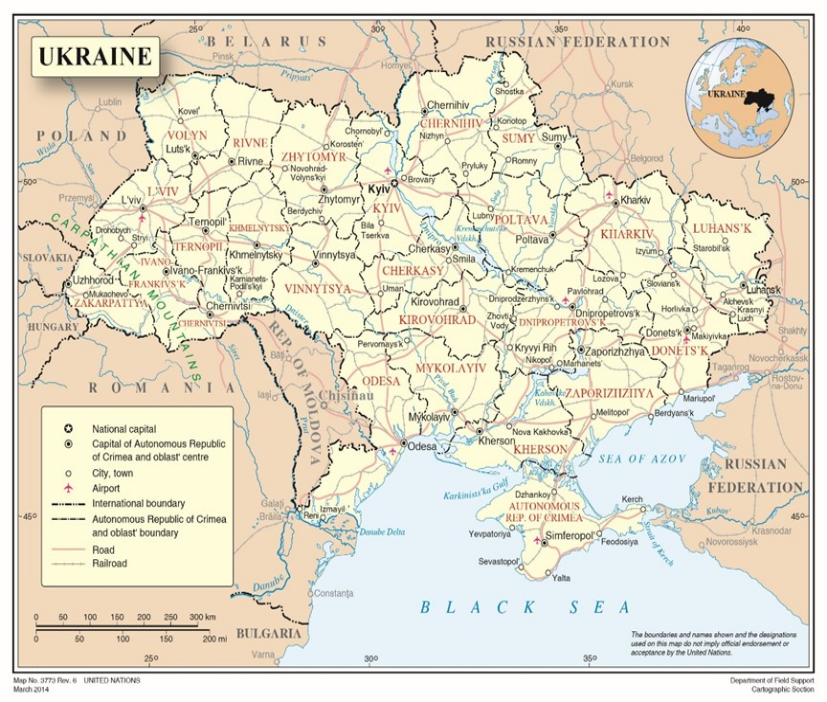
NOTE: The map in this section is not intended to reflect the UK Government’s views of any boundaries.
9.2 Regions
9.2.1 A UK Ministry of Defence fact file paper, produced by the Permanent Committee on Geographical Names (PCGN), noted that Ukraine was divided into 27 administrative divisions, consisting of 24 oblasts (regions), one Autonomous Republic (Crimea), and 2 cities with special status (Misto Kyiv and Misto Sevastopol). The table below shows anglicised names for the administrative divisions:[footnote 7]
| Region (Romanised Ukrainian) | Anglicised name |
|---|---|
| Avtonomna Respublika Krym | Crimea |
| Cherkaska oblast | Cherkasy |
| Chernihivska oblast | Chernihiv |
| Chernivetska oblast | Chernivtsi |
| Dnipropetrovska oblast | Dnipropetrovsk |
| Donetska oblast | Donetsk |
| Ivano-Frankivska oblast | Ivano-Frankivsk |
| Kharkivska oblast | Kharkiv |
| Khersonska oblast | Kherson |
| Khmelnytska oblast | Khmelnytskyi |
| Kirovohradska oblast | Kirovohrad |
| Kyivska oblast | Kyiv |
| Luhanska oblast | Luhansk |
| Lvivska oblast | Lviv |
| Misto Kyiv | Kyiv City |
| Misto Sevastopol | Sevastopol City |
| Mykolaivska oblast | Mykolaiv |
| Odeska oblast | Odesa |
| Poltavska oblast | Poltava |
| Rivnenska oblast | Rivne |
| Sumska oblast | Sumy |
| Ternopilska oblast | Ternopil |
| Vinnytska oblast | Vinnytsia |
| Volynska oblast | Volyn |
| Zakarpatska oblast | Zakapattia |
| Zaporizka oblast | Zaporizhzhia |
| Zhytomyrska oblast | Zhytomyr |
9.2.2 In August 2025, the House of Commons Research briefing ‘Ukraine Conflict; An Overview’ stated:
‘At the end of September 2022, Russian-backed authorities in Donetsk, Luhansk, Kherson and Zaporizhzhia called urgent referendums on joining Russia, even though those regions were not totally under Russian control.
‘According to the Kremlin the four occupied regions voted overwhelmingly in support of accession to the Russian Federation. In a speech on 30 September 2022, President Putin announced Russia’s intention to annex those regions and recognise, and defend, them as part of the Russian Federation.
‘Those treaties of accession were signed into Russian law in early October 2022.
‘Despite Russian attempts at annexation, all four regions are still not entirely under Russian control.’[footnote 9]
9.2.3 The below is a screenshot of the Institute for the Study of War (ISW) interactive map which shows areas of Ukraine under Russian military control as of 28 July 2026:
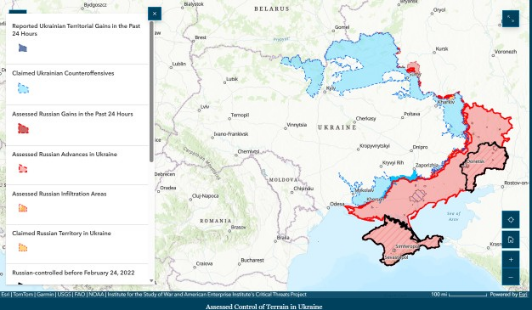
NOTE: The map in this section is not intended to reflect the UK Government’s views of any boundaries.
9.3 Population
9.3.1 As of 1 January 2026, World Population Review estimated the population of Ukraine to be 39,535,849, and the population density to be 68.2 people per square km based on projections of the latest UN data from 2024.[footnote 11]
9.3.2 World Population Review estimated Ukraine’s population at 39.0 million in 2025, compared with 37.9 million in 2024, 37.7 million in 2023, 41.0 million in 2022 and 44.3 million in 2021.[footnote 12]
9.3.3 See Ukraine Population 2026 by Oblast – Live Clock for real-time population estimates by oblast in Ukraine.
9.3.4 In August 2026, the UN International Organization for Migration (IOM) published round 24 of their ‘General Population Survey’ specifically focusing on population by oblast. IOM noted ‘The Oblast Profiles present findings from Round 24 of the General Population Survey (GPS), conducted between 23 April and 30 June 2026. The report provides key figures for 12 oblasts and Kyiv City.’[footnote 13] Using data from the IOM survey, CPIT has compiled the below table showing estimated populations per oblast:[footnote 14]
| Oblast | Estimated total population |
|---|---|
| Cherkaska | 1,129,000 |
| Dnipropetrovska | 3,329,000 |
| Kharkivska | 2,444,000 |
| Kirovohradska | 908,000 |
| Kyiv City | 3,317,000 |
| Kyivska | 2,354,000 |
| Lvivska | 1,776,000 |
| Mykolaivska | 1,182,000 |
| Odeska | 2,010,000 |
| Poltavska | 1,336,000 |
| Sumska | 979,000 |
| Vinnytska | 1,242,000 |
| Zaporizka | — |
9.3.5 IOM noted ‘The results presented are representative at a minimum at a confidence level of 90 per cent and with a margin of error of 10 per cent. Any results with a higher margin of error were excluded (denoted as ‘-’)’[footnote 15]
9.3.6 See General Population Survey – Oblast profiles, Round 24, August 2026 for further details, including the percentage of internally displaced persons (IDPs), returnees, and non-displaced persons by oblast. See previous iterations of the General Population Survey for estimated populations of other oblasts not listed in round 24.
10. Areas of conflict
10.1.1 See the Country Policy and Information Note, Ukraine: Security situation.
11. Economic situation
11.1 Economic overview
11.1.1 In June 2025, the Organisation for Economic Co-operation and Development (OECD), an international organisation promoting economic growth, stability, and improved living standards around the world[footnote 16], published volume one of their Economic Outlook reports, which stated:
‘GDP grew by 2.9% in 2024. Growth slowed in the second half of 2024 and early 2025, due to ongoing labour shortages and sustained Russian attacks on energy infrastructure. Despite this, business sentiment improved sharply between January and March 2025. Strong consumer demand, reflecting rising real wages, increased defence-related production and construction activity, and a more consistent supply of energy contributed to the improved expectations of businesses across all sectors. At the same time, inflationary pressures are high. CPI inflation reached 15.1% in the year to April 2025, reflecting higher domestic food and energy prices, while core inflation was 12.1%. Labour supply increased in the first quarter of 2025 as younger and older adults as well as women were drawn into the workforce, but labour shortages continue to be the main constraint facing businesses.’[footnote 17]
See Employment for more information on the labour force.
11.1.2 In April 2026, the Bertelsmann Stiftung’s Transformation Index (BTI) published a country report covering the year 2025 (BTI 2026 report) which stated that ‘The economic toll has been severe. Despite moderate GDP growth of 5.3% in 2023 and 3.4% in 2024, total infrastructure losses reached $155 billion [£113 billion] by the end of 2024. The National Bank of Ukraine has managed to balance exchange rate stability and inflation control – keeping inflation near 12% – while financing a large budget deficit.’[footnote 18]
11.1.3 The same source stated that ‘Pressure on prices resulting from wage rises, energy and food shortages as well as high public debts among others, have led to an increase in the inflation rate, from below 3% in 2020 to 20% in 2022. As a result of the macroeconomic stabilization, inflation fell to 13% in 2023. In September 2024 the National Bank of Ukraine set an inflation target of 5% over a three-year horizon.’[footnote 19]
11.1.4 The International Monetary Fund (IMF) ‘Ukraine and the IMF’ webpage showed April 2026 projections of 2.0% real GDP growth and a 6.1% increase in consumer prices in Ukraine in 2026.[footnote 20]
11.1.5 Further considering GDP and economic growth, on 13 August 2026, the Centre for Economic Strategy (CES), a Ukrainian NGO[footnote 21], noted on their Economy Tracker webpage, that:
‘After a 28.8% decline in 2022, Ukraine’s economy began to recover, although growth has gradually slowed. Following 5.5% growth in 2023, real GDP grew by 2.9% in 2024 and by 1.8% in 2025. Weaker economic performance largely reflected the impact of Russian attacks on energy infrastructure and other wartime challenges. … According to the NBU [National Bank of Ukraine] forecast, the economy will grow by 1.8% in 2026.’[footnote 22]
11.1.6 In May 2026, the National Bank of Ukraine (NBU) published an article summarising the findings of the quarterly Inflation report (NBU article May 2026) which stated that: ‘Between June 2025 and January 2026, inflation was falling, but in recent months it’s begun picking up again. The main reasons were Russian strikes this winter against Ukrainian energy facilities … As a result, power, oil, and gas got much more expensive, making businesses raise prices for their goods and services … In April, a regular consumer basket of goods and services cost 8.6% more than a year ago on average. …’
11.1.7 The same source noted that ‘The European Union has finally approved EUR 90 billion in assistance for Ukraine under the Ukraine Support Loan. Our state budget will soon start getting these funds. This money will help the government support the economy more actively through reconstruction projects, defense investments, and social security programs. …’[footnote 23]
11.1.8 Considering estimated recovery and reconstructions costs, in February 2026, the United Nations country website for Ukraine published a press release entitled ‘Updated Ukraine Recovery and Reconstruction Needs Assessment Released’. The press release summarises the Rapid Damage and Needs Assessment (RDNA5) undertaken jointly by the World Bank, the Government of Ukraine, the European Commission and the United Nations. The assessment estimated the damage and losses in Ukraine along with recovery and reconstruction needs for 10 years. The press release stated:
‘Four years into Russia’s invasion of Ukraine, an updated joint Rapid Damage and Needs Assessment (RDNA5) released today by the Government of Ukraine, the World Bank Group, the European Commission, and the United Nations currently estimates that as of 31 December 2025, the total cost of reconstruction and recovery in Ukraine is almost $588 billion [£442 billion] over the next decade, which is nearly 3 times the estimated nominal GDP of Ukraine for 2025.
‘The latest update … finds that direct damage in Ukraine has now reached over $195 billion [£147 billion], up from $176 billion [£132 billion] in the RDNA4 of February 2025, with housing, transport, and energy sectors being most affected.
‘Damage, losses, and needs remain concentrated in frontline oblasts and major metropolitan area.
‘Of the total long-term needs, reconstruction and recovery needs are the highest in the transport sector (over $96 billion [£72 billion]). This is followed by the energy sector (nearly $91 billion [£68 billion]), the housing sector (almost $90 billion [£67 billion]), commerce and industry sector (over $63 billion [£47 billion]), and agriculture sector (over $55 billion [£41 billion]).’[footnote 24]
11.2 Employment
11.2.1 In May 2026, the World Food Program (WFP) published the report entitled ‘Ukraine Food Security Assessment: Acute Food Insecurity in the Frontline’ (WFP 2026 report) which ‘provides an overall picture of the food security situation across Ukraine, but places particular emphasis on households living within 50 km of the frontline’.[footnote 25] It combines two surveys: a Multisectoral Needs Assessment (MSNA) led by Reach, a humanitarian data collection initiative[footnote 26] conducted between July and August 2025 covering 2,813 households across Ukraine (excluding Russian occupied areas); and the Frontline Food Security Assessment (FFSA) conducted by WFP in August-September 2025 on households receiving WFP assistance within 30km of the frontline and resulting in a total number of 4,886 households surveyed.[footnote 27] It stated:
‘Employment patterns reveal that households in the 0–20 km zone face the greatest labour constraints: 36% of households there have no working-age members, compared with 32% in the 20–50 km band and 27% in areas beyond 50 km.
‘… Households where every adult aged 18 60 without disability or chronic illness is not engaged in any form of employment is distributed relatively evenly across distance zones, with around 12% of households in the 0–20 km area falling into this category.
‘… 38% of households in the 0–20 km zone identify the absence of job opportunities as the main barrier, compared with 25% elsewhere.’[footnote 28]
11.2.2 In October 2025, the IOM published a report entitled ‘Resilience at Work: Displacement and Integration in Ukraine’s Labour Market’ (IOM employment report 2025). The report was based on data collected as part of Round 21 of the IOM’s General Population Survey (GPS), conducted between 21 July and 1 October 2025. Data were collected through telephone interviews and included 40,002 randomly selected respondents, supplemented by interviews with 1,447 internally displaced persons (IDPs), 1,196 returnees and 1,800 non-displaced residents. The survey reported a margin of error of 0.49% at the 95% confidence level.[footnote 29] The report stated:
‘Nationally, 69 per cent of adults aged 18-60 were either employed (58%) or self-employed (11%). A further 12 per cent reported housework or care duties, and eight per cent were unemployed.
‘… Nationally, 83 per cent of employed respondents reported holding a permanent job, 13 per cent - informal work (with no contract) and 4 per cent short-term or casual one.’[footnote 30]
11.2.3 Considering employment trends for different demographics, the same source stated:
‘Overall, employment among working age adults appeared relatively high but uneven across groups: urban, higher-income and individuals in non-vulnerable households were more often engaged in formal work, while IDPs, women, rural residents and those in lower income or households with members with health condition were more likely to report unemployment, caregiving or inactivity.
‘… IDPs of working age were slightly less likely to report being employees (50%) and more likely to report unemployment (12%) and housework or caregiving (19%). On the other hand, returnees were more likely to report being employees (61%) as well as self-employment or running a family business (13%).’[footnote 31]
11.2.4 The IOM employment report 2025 further stated:
‘Among those who reported actively looking for a job, most were already employed and searching for alternative work, rather than unemployed and trying to enter or re-enter the labour market. Nationally, 61 per cent of active jobseekers were employed (including self-employed) and looking to change jobs, while 37 per cent were unemployed and searching. This pattern held for returnees and the non-displaced, but it was different for IDPs: just under half of IDP jobseekers were employed and looking for a change (45%), while over half were unemployed and trying to (re-)enter work. In rural areas, about half (50%) of jobseekers were unemployed and searching, compared to about one-third (33%) in large cities.
‘… At the national level, when asked why they were not actively looking for work, nearly half of all respondents (48%) reported being satisfied with their current job. Health and life-stage factors were also common: 14 per cent cited being retired or pensioners, and another 14 per cent mentioned sickness. Nine per cent cited childcare or eldercare responsibilities, while disabilities accounted for 4 per cent of responses. Only 3 per cent reported that there were no suitable jobs available in their area, while other barriers such as skills mismatch, low salaries, discrimination, or lack of information and technology access were each reported by less than 1 per cent.
‘… At the national level, among respondents who were unemployed at the time of data collection, 61 per cent reported being out of work for 12 months or longer.’[footnote 32]
11.2.5 Considering unemployment lengths, the same source stated:
‘Among returnees, 52 per cent reported being unemployed long-term, and 15 and 16 per cent, respectively, for one to three months. Among the non-displaced population, 67 per cent reported long-term unemployment, and only 6 and 9 per cent, respectively, for less than one to three months.
‘Respondents in rural areas most often reported long-term unemployment (71%).
‘[R]espondents [sic] who were actively looking for work reported being unemployed for a shorter period of time, with 10 per cent unemployed for less than one month, 18 per cent for one to three months, 12 per cent for three to six months, and 8 per cent for six to less than twelve months.’[footnote 33]
11.2.6 The IOM employment report 2025 also considered barriers to employment: ‘The main challenges in finding employment included salaries being perceived as too low (24%), lack of jobs in the area (20%), and discrimination by age (17%); jobseekers in rural areas more often cited no local jobs (31%). The most frequently reported support needs included skills or new qualifications training (32%), job application support (24%), and language learning (20%).’[footnote 34]
11.2.7 In December 2025, the United Nations High Commissioner for Refugees (UNHCR), published a survey of 4,522 households across government-held Ukraine (see their methodology), (UNHCR 2025 survey) which stated:
‘48% of respondents are of working age. Of those, 25% reported to be employed (19% full-time, 3% part-time, 3% self employed) while 19% reported to be without a job with the majority of 82% not registered with the state employment service … Key informants across 50 hromadas [communities[footnote 35]] note that employment is the second most important challenge in their hromada when hosting and integrating IDPs.
‘… IDPs and returnees are more often without a job (20% each) than non-displaced respondents (11%). In addition, among IDPs with a job, they have a lower full employment rate (17%) compared to returnees (20%) and non-displaced respondents (40%). Returnees have the lowest registration rate with the employment service (91% are reportedly not registered).
‘… Female returnee households with a specific need prevalence have the highest risk of unemployment, with over 27% reporting to be without a job at present. For female returnees with a disability, this risk is exacerbated with over 33% reporting to be currently unemployed.
‘Female IDPs in general also face higher risks of being unemployed, with over 22% reporting to be currently without a job.
‘… In terms of barriers to employment, 46% says that there are simply no jobs available. 17% said they don’t have the needed work experience and skillset for the available jobs.
‘… For nearly 29% of respondents, it is difficult to find a job that provides needed flexibility to accommodate caretaking responsibilities.
‘… 4% of respondents report exclusion and discrimination and 1% face legal barriers to find a job. Only IDPs report to exclusion and discrimination as barriers to finding a job.’[footnote 36]
11.2.8 In March 2026, the OECD published a report entitled ‘Ukraine’s Strategic Response to the Displacement Crisis’ (OECD 2026 report), which stated that ‘Returnees are faring better than the non-displaced and IDPs in terms of employment, though this is likely due to the early returnees’ ability to resume their previous jobs. Despite this, returnees are at a higher risk of informal or temporary employment compared to the non-displaced, and similarly to IDPs.’[footnote 37]
11.2.9 The same source stated:
‘Ukraine has introduced many programmes to support the employment of IDPs, including incentives for employers to hire IDPs, employment of IDPs on public works, granting targeted vouchers for retraining, providing direct training, providing targeted grants for self-employment and business creation, and some specific programmes targeting IDP women.
‘… Numerous targeted programmes for employment and reskilling of women in Ukraine during the war have already shown their value in allowing women to gain access to employment generally, but also in what was considered as traditionally male-dominated professions.’[footnote 38]
11.2.10 The same source stated that ‘Several initiatives have targeted IDP women specifically. These include regional Diia.Business offline centre training programmes such as “Entrepreneurship from Scratch for IDP Women”, “Women in Business”, “Preparing Women for Entrepreneurship in Wartime”, and Zrostaj (“Grow”).’[footnote 39]
11.2.11 The BTI 2026 report stated:
‘Unemployment fell from 20.6% in 2022 to 14.3% in 2024 and wages rose 21.5% in 2024; however, the latter reflects shortages in the labor market due to mass outward migration and mobilization rather than productivity gains.
‘… The exodus of 6.8 million Ukrainians since the beginning of the full-scale invasion and wartime mobilization has put enormous pressure on the labor market and exacerbated the existing demographic crisis. Thus, while wages rose roughly 10 percentage points faster than inflation (21.5%) in 2024, this reflected labor shortages rather than productivity gains. The persistence of high unemployment further suggests a mismatch between vacancies and the skill profile of workers, although unemployment fell from 20.6% in 2022 to 14.3% in 2024.’[footnote 40]
11.2.12 In April 2026, People in Need (PIN), an international non-governmental, non-profit organisation founded in Czechia[footnote 41], published the 4th round of their Protection Monitoring report (PIN 2026 report), which stated:
‘A persistent structural barrier to employment remains the need for women to balance paid work with childcare and household responsibilities, reflecting the continued influence of traditional gender roles. The need for children to stay home due to the security situation and destruction of schools and kindergartens, a lack of flexible employment opportunities and workplaces which are not adapted for parents with children, unpaid care responsibilities, alongside a shortage of jobs linked to business relocation and increased labour market competition further exacerbate the economic vulnerability of women, who are often the primary caregivers and income earners in their households.’[footnote 42]
11.2.13 The same source published findings related to 48 interviews with key informants conducted from October to December 2025 across five oblasts: 9 in Mykolaiv, 10 in Kharkiv, 13 in Dnipropetrovsk, 9 in Donetsk, and 7 in Zaporizhzhia, which stated:
‘In the fourth monitoring round, the situation regarding employment has deteriorated. According to key informants, overall employment opportunities were mostly rated as “poor” (46%) or “moderate” (38%), indicating persistent challenges in accessing livelihoods. Mykolaiv oblast appears to be the most affected, with 56% of informants reporting that employment opportunities are poor, and 22% that they are “very poor”. This issue is particularly pressing given that some IDPs are returning from other regions and require stable income to sustain their livelihoods. The second most critical situation remains in Donetsk oblast, where 78% of key informants described employment conditions in their hromadas [communities[footnote 43]] as “poor” … This is likely linked to security constraints, population displacement, and the relocation of businesses.
‘… Regarding available programmes aimed at improving access to employment, the most frequently mentioned were employment centres or job-matching services (54%), vocational training programmes (38%), and support for small businesses/start-ups (33%). At the same time, 23% of key informants reported that they were not aware of any active initiatives, while 13% indicated that such programmes were absent in their area.
‘… According to many key informants, individuals from temporarily occupied territories or those holding Russian passports or permanent residence permits face particular difficulties in this regard. Key informants reported that some individuals, as a result, are unable to access formal employment and are forced to work informally.’[footnote 44]
11.2.14 The NBU article May 2026 stated:
‘Labor market conditions have been getting better. Although businesses are still complaining about a lack of workers, more and more people are looking for jobs. Data from employment sites shows the number of resumes has been rising faster than vacancies in recent months. One reason is that migration from Ukraine has come to a halt. State Border Service data shows that in the first quarter, more people entered the country than left it.
‘But overall there are still not enough job candidates to be found, especially for blue-collar jobs. And so businesses are competing hard for workers by raising wages. State-owned companies were also hiking wages earlier in the year both because the minimum wage had been raised and because some pay grades had been revised, particularly for educators.
‘The NBU is expecting that overall in 2026, the average real wage (nominal wage minus inflation) will rise by almost 12%, and in the years ahead, by 6%–7%.’[footnote 45]
11.2.15 In July 2026, the National Bank of Ukraine (NBU) published a report which stated:
‘In June, the labor supply continued to grow at a faster pace than demand.
‘… Employment in the manufacturing sector rose (+6.7% yoy [year on year]), primarily due to the development of the defense-industrial complex. Specifically, in the transportation equipment manufacturing sector, growth reached 24.8% yoy. Staffing also continued to expand in IT (+26%yoy), construction (+9.5%yoy), and transportation (+3%yoy). At the same time, the workforce shrank in agriculture(-27.9%yoy), arts and entertainment (-3.5%yoy), and finance (-2.1%yoy).
‘… According to the SSSU [State Statistics Service of Ukraine[footnote 46]], in May 2026, the average [monthly] salary was nearly 31,000 UAH [£514 GBP]. Its nominal growth accelerated to 22.6% yoy (21.3% in April), while real growth rose to 13.3% yoy (11.7% in April). These trends were driven primarily by significant labor shortage, which forced employers to continue raising wages.’[footnote 47]
The source calculated average monthly salary using the data provided on the SSSU Data bank.
11.3 Banking system
11.3.1 Data provided on the National Bank of Ukraine’s (NBU) statistics page states that as of June 2026 there are 58 licensed banks in Ukraine.[footnote 48]
11.3.2 In May 2026, the NBU published an annual report covering developments in Ukraine’s economy, financial sector and monetary policy during the year of 2025. It stated that ‘The banking sector remains robust and effective and, even in wartime, is developing responsibly … Even after russia’s massive strikes on our energy grid and despite extreme weather conditions, the banks remained operational, and citizens retained uninterrupted access to their funds and banking services.’[footnote 49]
11.3.3 The same source stated that ‘In 2025, two small banks ceased operations in Ukraine … Given that these financial institutions accounted for a combined 0.05% of solvent banks’ assets, their exit from the market had no effect on the banking sector … The banks’ network of structural units let go of 167 branches in a contraction that primarily affected state-owned banks. The network of POS terminals and self service devices expanded significantly.’[footnote 50]
11.3.4 In July 2026 the UNHCR published the report entitled ‘Ukraine Protection Survey #3’ (UNHR Protection Survey 3). The survey was based on data collected from 13,000 interviews between April 2025 and April 2026. In its methodology section it stated: ‘Of all respondents, 34% are currently residing in the East, 18% in the West, 17% in the North, 14% in the Centre, 13% in the South, and almost 5% in Kyiv.’[footnote 51] The report stated that ‘Overall, over 91% of respondents have access to financial services, such as through banks, post services or online channels, while 6% don’t.’[footnote 52]
12. Displaced persons
12.1 Cross border displacement
12.1.1 In January 2026, the UNHCR published the report entitled ‘Ukraine situation UNHCR’s 2026 plans and financial requirements’ (UNHCR January 2026 report), which stated:
‘An estimated 5.86 million refugees remain displaced outside Ukraine, including 5.3 million across Europe. The refugee population is predominantly composed of women and children, with comparatively fewer men due to restrictions on men of military age leaving Ukraine. Most families are headed by women, often accompanied by school-age children or younger, while many older persons have also fled, particularly those requiring regular medical care or family support.
‘… In the European Union, Temporary Protection status has been extended until March 2027, with several other countries implementing similar arrangements.’[footnote 53]
12.1.2 The OECD 2026 report stated:
‘Most externally displaced Ukrainians continue to express an intention to return to Ukraine in the future, although the share of such individuals has declined over time.
‘… Return intentions differ considerably across profiles, circumstances, and places of origin. They tend to be stronger among older persons, single-parent or female-headed households, those with dependants, and individuals maintaining strong links with Ukraine.
‘Security and family unity remain the strongest determinants of both intentions and actually taken decisions to return.’[footnote 54]
12.1.3 The BTI 2026 report stated that ‘Russia’s full-scale invasion of 2022 led 6.8 million people to leave Ukraine and caused 4 million to become Internally Displaced Persons, alongside a host of other economic and social catastrophes. According to polls, the share of Ukrainians who definitely plan or rather plan to return fell from 64% to 53% from November 2022 to January 2024, yet even these intentions are strongly linked to a future cessation of hostilities.’[footnote 55]
12.2 Internally Displaced Persons (IDPs)
a) Number of IDPs
12.2.1 In February 2026, Human Rights Watch published their annual report on the human rights situation, covering the year 2025 (HRW 2025 report) which stated that ‘At least 3.8 million Ukrainians were registered as IDPs as of April [2025], with most struggling with loss of income and housing. Older people, single parents, and people with disabilities relied heavily on state and humanitarian aid, which was reduced following a decrease in US funding.’[footnote 56]
12.2.2 In January 2026, the United Nations Office for the Coordination of Humanitarian Affairs (OCHA) published the Humanitarian Needs and Response Plan (HNRP 2026), which stated that ‘Government data indicates that approximately 130,000 people were evacuated between June and October 2025 with support from authorities and humanitarian partners, while many more fled on their own. Based on the 2025 displacement and evacuation trends, up to 504,000 people are projected to be newly displaced in 2026, including through new evacuations.’[footnote 57]
12.2.3 In January 2026 the International Rescue Committee (IRC), an international NGO responding to humanitarian crises[footnote 58], published a protection analysis report covering the period July-September 2025 (IRC January 2026 report). The IRC’s report applied the Protection Analysis Framework (PAF) to identify key protection risks, affected groups and gaps in response. The assessment was based on 610 household surveys and 78 key informant interviews conducted by the IRC and partner organisations, alongside secondary sources and programme data. Monitoring covered Sumy, Kharkiv, Dnipropetrovsk, Zaporizhzhia, Odesa, Donetsk, Mykolaiv and Kherson oblasts.[footnote 59] The report stated that ‘According to IOM data, by the end of September 2025, the country hosts an estimated 3.7 million de facto internally displaced persons (IDPs) and 4.5 million returnees in government-controlled areas. The nature of this crisis is overwhelmingly protracted, with nearly three-fourths (73%) of IDPs having been displaced for over two years.’[footnote 60]
12.2.4 The OECD 2026 report stated:
‘Ukraine has a well-developed administrative system for registering IDPs (the Unified Information Database on IDPs). It allows tracking the number of persons with legal IDP status, provides information on their main demographic characteristics, and information on some of their vulnerabilities. This system, however, currently does not allow tracking individuals who have returned to their habitual place of residence or settled elsewhere; progress towards integration or reintegration; or the identification of IDPs who have overcome their displacement-related vulnerabilities.
‘There are several surveys covering IDPs and returnees, their characteristics, needs and outcomes. These surveys are largely managed by international organisations or private initiatives rather than by the State of Ukraine and often rely on differing definitions and methodologies.’[footnote 61]
12.2.5 The same source stated that ‘Ukraine already operates the e-government portal Diia, which integrates citizen consultation features, and includes information, services and reporting on conditions of IDPs.’[footnote 62]
12.2.6 See Annex A for the laws regulating IDP support, return, reintegration and diaspora engagement published by the OECD in March 2026.
12.2.7 The IOM survey round 23 stated that ‘The IDP share of the population remains at 12.5 per cent, with 69 per cent displaced for more than two years and a median displacement duration exceeding three years. New displacement continues at a comparable rate to previous rounds, with 164,0001 individuals displaced in the three months prior to data collection.’[footnote 63]
12.2.8 The same source, in a graph, showed that internal displacement declined during the first 2 years following the full-scale invasion before stabilising at around 12% of the population by March 2026. In contrast, the proportion of returnees rose rapidly during 2022 and has since remained relatively stable at around 13% to 15% of the population.[footnote 64]
12.2.9 The same source stated:
‘Three and a half years after the full-scale invasion, most IDPs in Ukraine have been living in displacement for extended periods. Around 16 per cent of IDPs have been displaced for up to one year. By contrast, about 83 per cent of IDPs (approximately 3.2 million individuals) have been displaced for one year or longer, including a large share displaced for several years. The share of IDPs displaced for over two years was highest in Vinnytska (83%) and Khmelnytska (82%), followed by Kyiv City (80%) and Kyivska, Mykolaivska, and Ivano-Frankivska Oblasts (79%). Other oblasts showed lower shares, including Lvivska and Odeska (77%), Cherkaska, Kharkivska, and Zaporizka (69%), and Poltavska Oblasts (65%). The lowest proportions were observed in Dnipropetrovska (55%), Kirovohradska (51%), and Sumska Oblasts (42%). IDPs who had been displaced for longer periods were more likely to live in households with working-age members (aged 18 to 59), with such households accounting for 67 per cent among IDPs displaced for over a year, compared to 63 per cent among those displaced for up to a year.’[footnote 65]
b) Locations and origins
12.2.10 The IOM survey round 23 noted that 58%, or an estimated 2.25 million IDPs, originated from raions [2nd level administrative districts[footnote 66]] under full or partial occupation and published the following graph and table:
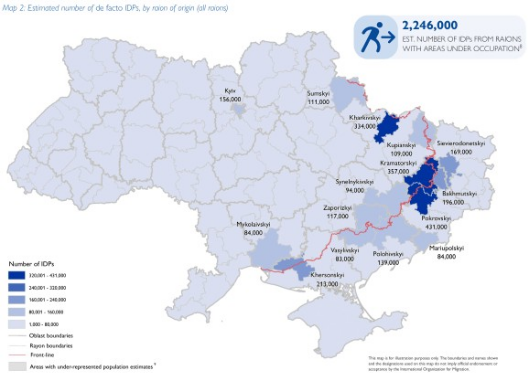
Table 1: Top 5 oblasts of origin of IDPs (% of IDPs)
| Oblast | % of total IDPs |
|---|---|
| Donetska | 31% |
| Kharkivska | 16% |
| Zaporizka | 11% |
| Khersonska | 11% |
| Luhanska | 6% |
| Other oblasts | 25% |
c) Location of displacement
12.2.11 The IRC January 2026 report stated:
‘This persistent risk of forced movement is further highlighted by the considerable number of IDPs currently residing in high-risk areas. As of the most recent assessment, one-third of all internally displaced persons, amounting to 1,274,000 individuals (34%), currently reside in frontline raions. The largest overall concentrations of the total IDP population—many of whom are likely located in proximity to these risk zones—reside in Dnipropetrovska (15% or 557,000 IDPs) and Kharkivska (11% or 415,000 IDPs) Oblasts. The vulnerability of these large host communities, especially those near the frontline, to potential secondary displacement or exposure to hostilities underscores the urgent requirement for protective measures and access to durable solutions.’[footnote 69]
12.2.12 The IOM survey round 23, published May 2026, stated:
‘In the longer term, 37 per cent of IDPs report intentions to integrate in their current location, while 42 per cent express a preference to return. Of those who intend to return, the vast majority would do so only after hostilities cease (78%). At the same time, 26 per cent remain uncertain about their mid-term intentions. Integration intentions increase with displacement duration, while recently displaced IDPs show higher onward movement intent.
‘… At the oblast level, the largest estimated numbers of IDPs were in Dnipropetrovska Oblast (611,000; 16%) and Kharkivska Oblast (469,000; 12%), while Kyiv City (341,000; 9%) and the surrounding Kyivska Oblast (315,000; 8%) accounted for the third and fourth largest estimated IDP populations, respectively. Approximately one-third (35%; 1,367,000 persons) of all IDPs are estimated to reside in front-line raions.’[footnote 70]
12.2.13 The same source stated that ‘The majority of IDPs in IDP-only households resided in large cities (46%) or their suburbs (7%). One-fourth (25%) lived in small towns, while 22 per cent were in rural areas or villages.’[footnote 71]
12.2.14 The same source published the following map of estimated IDP presence by oblast of displacement. The oblasts hosting the highest number of IDPs are Dniprpetrovska (611,000 IDPs or 16%) and Kharkivska (469,000 or 12%) as well as the capital city of Kyiv and Kyivska oblast (341,000 and 315,000 respectively):
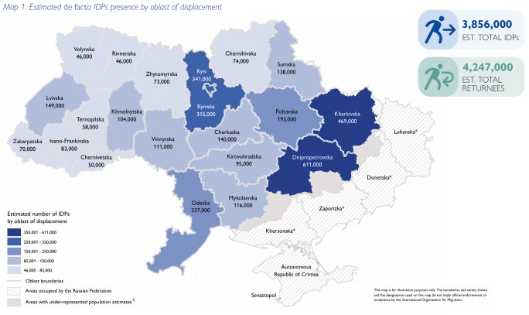
Table 2: Top 5 IDP-hosting oblasts (% of IDPs)
| Oblasts | % of total IDPs |
|---|---|
| Dnipropetrovska | 16% |
| Kharkivska | 12% |
| Kyiv | 9% |
| Kyivska | 8% |
| Odeska | 6% |
| Other oblasts | 49% |
d) Returning IDPs
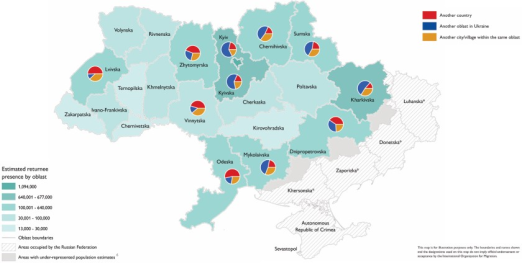
12.2.15 In January 2026, the IOM published a survey entitled ‘Ukraine returns report’. The map below shows the estimated number of returnees by oblast and the location from which they returned. Kyivska, Kyiv City and Kharkivska recorded the highest numbers of returnees. Most returns to Kyivska and Kharkivska were from elsewhere in Ukraine, while a greater proportion of returnees to Lvivska, Vinnytska, Odeska, Zhytomyrska and Dnipropetrovska had returned from abroad:[footnote 74]
12.2.16 The UNHCR January 2026 report stated that ‘By September 2025, it is estimated that over 1.4 million refugees from Ukraine had returned to their places of origin and remained in Ukraine for at least three months.’[footnote 76]
12.2.17 The OECD 2026 report stated that ‘[B]y 2025, between 4.1 and 5.8 million Ukrainians had already returned, including a quarter from displacement abroad … Most of the returns took place in mid-2022, in a voluntary and spontaneous manner, largely independent of any specific return policies of the Ukrainian state. Since then, returns have declined and shown a certain seasonality.’[footnote 77]
12.2.18 The same source stated:
‘For those who have already returned from internal displacement, returns were most likely to happen to safer areas, from displacement within the same (typically non-frontline) oblast, among older individuals, among those with higher educational attainment, and among the self-employed. For other situations and profiles, returns remain limited. In some cases, returns were possible because enabling factors such as housing and employment were present. Too often, however, returns from internal displacement were also driven by the lack of housing and employment options in the regions of displacement, or by the need to care for family members or other individuals who could not move.’[footnote 78]
12.2.19 In May 2026 the IOM published the Internal Displacement Report which included a survey of approximately 40,000 randomly selected respondents from government-held Ukraine between January and March 2026 (IOM survey round 23). The report stated that for the first quarter of 2025, 413,000 or 11% IDPs returned to Ukraine from abroad but remained in displacement.[footnote 79]
12.2.20 The same source stated that ‘The largest shares of IDPs who had previously been abroad resided in Kyiv City (12%), Dnipropetrovska and Odeska oblasts (9% each), Kyivska and Kharkivska (8% each) Oblasts. Half of these IDPs originated from Donetska (21%), Kharkivska (16%), and Khersonska (15%) Oblasts.’[footnote 80]
e) Demography of IDPs
12.2.21 The UNHCR 2025 survey stated that ‘14% of respondents are returnees. Of those, the majority returned within Ukraine, while 10% returned from abroad. 66% of returnee respondents are females, and 34% are males. The average age of returnees is 55 years. Just below one third, 59%, of returnees report a specific need prevalence in their household, 9% above the overall response (50%).’[footnote 81]
12.2.2 In February 2026, the United Nations International Children’s Emergency Fund (UNICEF), published an article on displaced children, which stated that ‘More than a third of Ukraine’s children – 2,589,900 – remain displaced as the war in Ukraine enters its fifth year. This includes more than 791,000 children inside Ukraine …’[footnote 82]
12.2.3 The IOM survey round 23 published the following population pyramid of IDPs by sex and age:
| Age group | Male (%) | Male (estimated number) | Female (%) | Female (estimated number) |
|---|---|---|---|---|
| Older people (60+) | 28% | 375,000 | 32% | 611,000 |
| Adults 50-59 | 14% | 185,000 | 14% | 263,000 |
| Adults 40-49 | 12% | 164,000 | 14% | 279,000 |
| Adults 30-39 | 10% | 137,000 | 13% | 242,000 |
| Adults 18-29 | 9% | 126,000 | 9% | 178,000 |
| 10-17 years old | 14% | 193,000 | 10% | 196,000 |
| 5-9 years old | 8% | 110,000 | 5% | 90,000 |
| 1-4 years old | 5% | 63,000 | 3% | 50,000 |
| Infants (<1 year old) | 0% | 7,000 | 0% | 12,000 |
13. Humanitarian situation
13.1 People in Need (PIN)
13.1.1 The HNRP 2026 stated:
‘In 2026, 10.8 million people will be in need of humanitarian assistance, compared to 12.7 million in 2025. This includes around 1 million people in the territories occupied by the Russian Federation.
‘This reduction does not signal an improvement in conditions. Rather, it reflects a more vulnerability-driven analysis centred around four key issues and increasingly focused on the most vulnerable groups. It also takes into account shrinking humanitarian funding and recognizes that some evolving needs are no longer humanitarian in nature but instead fall within the remit of longer-term recovery and development systems.
‘… Approximately 3.5 million people living within 0–50 km of the front line are affected, with an estimated 3.1 million people requiring humanitarian assistance in 2026. Over 90 per cent of affected people within 0-20 km of the front line and northern border—nearly 1.3 million—are in need of assistance. In the 20-50 km zone, this proportion remains high, at around 87 per cent of affected people, about 1.7 million people.’[footnote 84]
13.1.2 As of 1 January 2026, World Population Review estimated the population of Ukraine to be 39,535,849. The HNRP estimated that in 2026, 10.8 million people are in need of humanitarian assistance, which equates to approximately 27.3% of the population. The HNRP also found that approximately 3.1 million people living within 0–50 km of the frontline require humanitarian assistance, representing the majority of the population living in those areas.
13.1.3 It should also be noted that OCHA reprioritised its analysis of People in Need (PiN) compared to the previous year assessment and stated that the reduction in the estimated number of people in need does not necessarily reflect an improvement in conditions. Rather, the figures reflect a more vulnerability-driven assessment focused on those with the greatest humanitarian needs.[footnote 85]
13.1.4 The same source published the following map of the severity of needs by oblast:
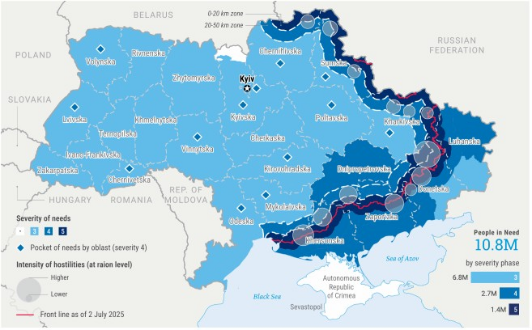
13.1.5 The HNRP uses the Joint Intersectoral Analysis Framework (JIAF) 2.0, which provides a ‘methodology to generate the estimations of humanitarian needs that inform the Humanitarian Programme Cycle’[footnote 87], to assess the scale and severity of humanitarian needs. The JIAF 2.0 Technical Manual defines ‘People in Need’ as follows: ‘People in Need are a sub-set of the affected population whose physical security, basic rights, dignity and living conditions are threatened or have been disrupted, and whose current levels of access to basic services, goods and social protection is inadequate to re-establish normal living conditions with their accustomed means in a timely manner without additional assistance.’64 The manual also defines the 5 ‘severity levels’ on a scale designed to assess the overall, intersectoral severity of needs in an area. The following table provides these definitions:
| Categorisation | Description |
|---|---|
| 1 – Minimal | Area has: Essential basic services and ability to meet basic needs for survival, protection and dignity |
| 2 – Stressed | Area has: Deterioration of physical or mental wellbeing; Sporadic threats to human rights and/or use of stress coping strategy; Stressed basic services and borderline inability to meet basic sectoral needs |
| 3 – Severe | Area has: Elevated and increasing deterioration of physical or mental wellbeing and human rights, AND Regular threats to human rights and/or accelerated erosion of strategies and/or assets, AND Moderate strain on basic services and moderate inability to meet basic needs for survival, protection, and dignity. |
| 4 – Extreme | Area has: Elevated mortality or risk of death, AND Widespread violations of human rights and/or unsustainable reliance on negative coping strategies, AND High strain on basic services and/or extreme inability to meet basic needs for survival, protection, and dignity |
| 5 – Catastrophic | Area has: Widespread mortality or risk of death, AND Widespread and systemic violations of human rights and/or exhaustion of coping options and mechanisms, AND Collapse of basic services and/or total inability to meet basic needs for survival, protection, and dignity. |
Further information on the HNRP methodology can be provided upon request.
13.1.6 It should be noted that JIAF severity classifications are based on a range of indicators, including conflict-related security impacts and civilian casualties, rather than humanitarian conditions alone. Therefore, higher JIAF severity categories do not necessarily indicate that humanitarian conditions by themselves reach the threshold for serious harm.
13.1.7 For information on the security situation see the Country Policy and Information Note, Ukraine: Security situation.
13.1.8 The PIN 2026 report stated that ‘[A]round 70% of key informants stated that basic needs in their communities are being met only at a moderate level, suggesting that the ability to satisfy essential needs remains limited. Vulnerable groups, including PwD [Persons with Disabilities], older persons, ex-combatants and IDPs, are reported to be affected more than others.’[footnote 88]
13.1.9 The same report stated:
‘For IDPs, access to essential services is constrained by higher levels of vulnerability linked to their displacement. Having lost their coping capacities and support systems, IDPs may face difficulties adapting to new environments and frequently lack information on where and how to seek assistance, which limits their access to available services and protection mechanisms. These challenges are more pronounced in larger cities, where navigating complex service systems and identifying responsible institutions can be particularly difficult. The situation is further compounded for IDPs with additional vulnerabilities, including persons with disabilities, older persons, and those with caregiving responsibilities.
‘…[K]ey informants increasingly referred to a digital barrier affecting older persons. As access to many public services becomes increasingly digitalized, the use of smartphones and internet access is often required to access pension, healthcare, and banking services. However, many older persons do not have access to such devices as well as the relevant digital skills.’[footnote 89]
13.1.10 The IOM survey round 23 stated:
‘Overall, the most severe pressure is concentrated among households with persons with disabilities (33%), single-parent households (30%), and those recently displaced from occupied raions (33%), all relying on emergency-level coping strategies. Nearly half of IDP households (47%) depend on humanitarian assistance, and 14 per cent have moved to poorer-quality housing — both significantly higher than among non-displaced households — highlighting persistent housing insecurity and protection risks compounded by the 2025–2026 winter.’[footnote 90]
13.1.11 In May 2026 the UNHCR published the 10th protection response update covering the period January-March 2026 (UNHCR protection update 2026), which stated:
‘The protection response by UNHCR and our partners provides tailored support to those most in need.
‘… In the first quarter of 2026, UNHCR’s protection response reached 126,240 people. Of those, 71 per cent are females, 32 per cent are older people above the age of 60 years, while 21 per cent are children. Over 15,200 people supported are living with a disability.’[footnote 91]
13.2 Shelter and non-food items (SNFI)
13.2.1 In March 2026 REACH, a humanitarian data collection initiative[footnote 92], published the findings of their ‘Multi-Sector Needs Assessment (MSNA)’. The survey was conducted on 2,813 households between 22 July and 18 August 2025 across Ukraine (excluding Russian occupied areas). In its key findings report (REACH 2025 key findings report) it presented data analysis on 8 front line Oblasts:
‘[In Chernihivska Oblast] [h]ouseholds reported missing shelter non-food items (NFIs), with 12% completely lacking sufficient or adequate clothing, fuel for heating, and bedding and towels, respectively.
‘… Although the region does not have an active frontline, 19% of households reported conflict-related damage to their current shelter since 2022. Of such households, 30% reported that the current damage had not been repaired.
‘… [In Dnipropetrovska Oblast] [a]ffordability constraints were likewise reflected in NFI gaps, with households reporting a lack of adequate clothing (20%), household cleaning products (15%), hygiene products (15%),
‘… [In Donetska Oblast] [s]helter needs were widespread, with 57% of households reporting unmet shelter needs linked to both damage and lack of essential NFIs. Around 60% lacked at least one essential NFI, including adequate clothing and hygiene products, while 18% lacked heating fuel. A staggering half of households (49%) reported damage to their shelter since 2022, and among these, 57% said repairs had not been completed, largely due to economic and protection constraints.
‘… In terms of shelter needs, households in Khersonska reported the worst shelter damage among the surveyed regions. Three in five (61%) households surveyed reported experiencing damage to their shelter since 2022, of whom 57% said the damage had not been repaired.
‘… [in Mykolaivska Oblast] 8% reported lacking sufficient and appropriate clothing and fuel for heating, respectively. One in three households (33%) experiencing damage to their current shelter since 2022 reported that the damage had not been repaired, mostly due to affordability constraints on labour and materials.
‘… [in Sumska Oblast] [h]ouseholds nonetheless frequently reported unmet shelter and NFI needs, particularly adequate clothing (9%), hygiene products (9%), cleaning products (8%), and fuel for heating (8%).
‘… [in Zaporizka Oblast] [d]espite the comparatively higher median income, households still reported notable NFI gaps, particularly household cleaning products (11%), hygiene products (10%), adequate clothing (8%).’[footnote 93]
13.2.2 The WFP 2026 report stated that 36% of 4,886 households surveyed living within 20km of the frontline reported needing non-food items[footnote 94] as of July-August 2025.
13.2.3 In September 2025, The National Agency for Territorial Development of Ukraine, published the article entitled ‘Housing for IDPs: Ministry of Development and UNHCR sign memorandum of cooperation’ which stated:
‘The Ministry of Community and Territorial Development of Ukraine and the Office of the United Nations High Commissioner for Refugees in Ukraine (UNHCR) have signed a memorandum that will expand cooperation in providing internally displaced persons with affordable housing and compensation for property damaged as a result of hostilities.
‘… More than 300,000 residential properties have been damaged or destroyed as a result of Russian aggression, and around 66,000 have been restored. Ukraine has a programme called eVidnovuvannya [e-Restoration], which has enabled more than 121,000 people to receive compensation for repairs, certificates for the purchase of housing and payments for reconstruction on their own land.’[footnote 95]
13.2.4 In September 2025, the Global Shelter Cluster (GSC), an Inter-Agency Standing Committee (IASC) coordination mechanism that supports people affected by disasters[footnote 96], published a fact sheet that stated:
‘Needs assessment found about 456,000 households in frontline areas (0–20 km belt) require solid fuel support for winter.
‘The OCHA-led Winter Response Plan launched, appealing for $277.7 million [£203 million] to assist 1.7 million people; Shelter and CCCM Clusters aim to reach 942,755 at a cost of $230 million [£168 million].
‘The UHF 2025 First Reserve Allocation approved 21 winter projects ($50.5 million [£37 million]) to assist 134,389 people with fuel, heating, NFIs, insulation, and CCCM support, prioritizing national/international NGOs.
‘Shelter Cluster maintained mapping of partner capacity and coverage, showing ability to assist around 330,000 individuals (35% of those in need).’[footnote 97]
13.2.5 The UNHCR 2025 survey stated: ‘The overwhelming majority of respondents living in host arrangements, rented accommodation or collective sites say their tenure situation is secure or sufficiently secure, with only a minimal uncertainty (85%). For 12%, their tenure security is uncertain or even precarious as they are at risk of eviction.’[footnote 98]
13.2.6 The same source stated:
‘Housing rights are most severely impacted for internally displaced Ukrainians. Over 62% report their homes as fully or partially destroyed or occupied. An additional 15% do not know the condition of their home.
‘… Only 4% of IDPs reportedly received full or partial compensation for damaged or destroyed housing. They also face heightened barriers to accessing compensation with 34% reporting a lack of required documents and 23% are unaware of the procedure.’[footnote 99]
13.2.7 The HNRP 2026 stated that 5.6 million people out of 40.3 million[footnote 100] (14% of the population) are in need of Shelter and Non-Food items.[footnote 101]
13.2.8 The same source stated that ‘Shelter and non-food item needs are severe, affecting one in four households.’[footnote 102]
13.2.9 The same report stated that ‘Women in front-line areas reported significant shortages of clothing, hygiene supplies, cleaning products and heating fuel.’[footnote 103]
13.2.10 Considering SNFI specifically for IDPs in Ukraine, the IRC January 2026 report stated:
‘[T]ransit centres [along the evacuation routes] are expected to function as short term safe havens and staging points—but current conditions frequently fall short of that role. Many centres are not adapted to the needs of older people or individuals with limited mobility; security procedures and 24/7 protection are underdeveloped; and there are no dedicated spaces for isolation or quarantine to prevent the spread of infectious diseases.
‘… [C]ollective centres—often does not meet basic humanitarian standards. Inadequate infrastructure, the absence of safety zones, and limited privacy expose residents to health and protection risks and erode dignity over time. There is no coherent strategy for identifying and preparing new collective sites, meaning that when displacement spikes, authorities and humanitarian actors have few options beyond already overstretched facilities. For older persons living alone and people with limited mobility, especially those who are bedridden, specialised transport is scarce and the number of institutions capable of receiving them is limited.’[footnote 104]
13.2.11 The same source stated of the 610 households surveyed in Sumska, Kharkivska, Dnipropetrovska, Zaporizka, Odeska, Donetska, Mykolaivska, and Khersonska oblasts:
‘Data for the current quarter reveals that while the majority of residents (approximately 56.5%) report no housing concerns, a significant segment of the sample (37%) is grappling with substandard living conditions. The primary challenges are rooted in basic amenities and habitability: the lack of sufficient hot water (6.7%) and the inability to cook or store food properly (5.4%) are the leading complaints. … acute legal threats like eviction remain statistically low (1.6%).’[footnote 105]
13.2.12 The same source stated that ‘Shelters cannot accommodate people requiring constant care due to lack of medical staff. Older persons and those with disabilities often remain in unsuitable settings or rely on religious groups for temporary placement.’[footnote 106]
13.2.13 The OECD 2026 report stated:
‘Returnees are typically homeowners, particularly in contrast to IDPs, who are more likely to rent their current dwellings. Meanwhile, returnees from internal displacement are more likely to live in damaged housing compared to returnees from abroad, current IDPs, and the non-displaced. Some returnees, similarly to IDPs, face difficulties in proving their current housing arrangements with legally recognised documents. While there is generally good awareness of state programmes to address housing issues, applications can be difficult, especially for women returning from abroad.’[footnote 107]
13.2.14 The same source stated:
‘IDPs often face particularly acute barriers to securing decent housing compared with non-displaced persons in the areas to which they arrive and compared to those who have returned to their original settlements. Beyond destroyed and damaged housing stock, other housing-related challenges include limited rental options, a largely unregulated rental market that weakens tenants’ rights, discrimination, limited protection against eviction, and insufficient affordable housing. These issues not only prevent many displaced families from integrating into their new communities but also push them to return to insecure areas or leave Ukraine.’[footnote 108]
13.2.15 The same source stated:
‘The Ukrainian state has established several national programmes to assist with the housing situation of the population (eRecovery (eVidnovlennya)/HOME), including programmes that target IDPs (Shelter (Prykhystok); eOselya; housing credits; rental subsidies; direct housing acquisition)
‘… Moreover, to address the growing housing challenges, Ukraine has begun developing a nationwide housing strategy as part of the Ukraine Facility and the national reform plan. In July 2025, the Law “On the Main Principles of Housing Policy” was approved in its first parliamentary reading. If adopted, it will launch a comprehensive housing reform.’[footnote 109]
13.2.15 The PIN 2026 report stated that ‘According to key informants, many hromadas [communities[footnote 110]] lack sufficient capacity to accommodate displaced persons in temporary accommodation. Stable housing solutions for people in need of care are particularly challenging. In some cases, older persons and persons with disabilities remained in healthcare facilities following evacuation due to the absence of alternative housing options.’[footnote 111]
13.2.16 The same source stated:
‘The results of this monitoring round show that more than half of key informants reported that part of the population in their hromadas continued to reside in damaged, unfinished, or otherwise uninhabitable buildings, which remained a major concern.
‘… Access to air-raid shelters also remains a major concern. Around 70% of key informants reported challenges related to access to shelters in their hromadas, indicating significant gaps in protective infrastructure. The most severe situation was reported in hromadas of Mykolaiv and Kharkiv oblasts, where 89% and 80% of key informants stated that shelters are not available.’[footnote 112]
13.2.17 In April 2026, the UNHCR published a fact sheet entitled ‘Emergency shelter & housing assistance’, which listed its key achievements since February 2022:
- ‘599,355 people assisted with emergency shelter kits and materials immediately after attacks
- 57,800 war-damaged homes repaired
- 318 pre-fabricated core homes installed
- More than 7,500 households have been able to access Government compensation through UNHCR-supported common-space repairs in more than 100 multi-storey buildings
- Temporary IDP/social housing completed for 464 households
- 2,985 IDP families assisted with a six-month rental package as part of the Rental Market Initiative
- 248 collective sites refurbished directly by UNHCR or through partners
- 2,121 abandoned or newly purchased houses rehabilitated and made liveable for IDPs.’[footnote 113]
13.2.18 The same source stated:
‘In 2026, UNHCR, through its partners, supported 18,857 households (31,981 people) with emergency shelter kits and materials. Additionally, 274 civilian infrastructure facilities were supported around Ukraine (educational, medical, administrative and heritage). The support was provided in 20 oblasts, with most of the assistance going to people in Donetska (22,7%), Zaporizka (12,6%), Dnipropetrovska (4,4%), Kharkivska (4,4%), and Sumska (1,8%) oblasts.
‘… Since the start of 2026, 526 households (1,105 individuals) have gained access to the Government’s eVidnovlennia compensation programme, following the repair of common spaces their buildings by UNHCR. Completed and ongoing works are located in Chernihivska, Dnipropetrovska, Kharkivska, Mykolaivska, Odeska, Sumska, and Zaporizka oblasts.
‘… In 2026, refurbishment interventions will primarily target public buildings already used as collective sites and aim to improve the quality of accommodation. Small-scale refurbishments of collective sites will focus on improving accessibility, WASH conditions, safety, and on increasing sleeping spaces. Through partners, UNHCR plans to assist 10 collective sites in 2026 and is currently identifying which sites will be refurbished.
‘… In Q1 2026, UNHCR completed repairs in 162 houses, benefiting 484 people.
‘… In 2026, UNHCR, with NGO partners, is implementing RMI [Rental Market Initiative] in seven oblasts across eastern, central, and southern Ukraine, supporting 194 households (506 individuals) in Q1 2026.
‘…UNHCR supported 40,000 families hosting IDPs under the Prykhystok programme in 2022. In 2024, UNHCR allocated USD 15 million under this government programme, providing financial support to 82,000 host families accommodating approximately 187,000 IDPs.’[footnote 114]
13.2.20 The Danish Refugee Council (DRC), a private humanitarian NGO[footnote 115], published its quarterly protection monitoring report for the period January to March 2026 (DRC quarterly report 2026), which stated:
‘In Donetsk, Dnipropetrovsk and Zaporizhzhia oblasts, limited access to compensation and slow recovery processes reduce housing availability, particularly in urban centres such as Dnipro and Zaporizhzhia cities, increasing competition for accommodation and exacerbating tensions. In Sumy Oblast, negative attitudes towards IDPs and inflated rental prices further strain relations between host communities and displaced populations. In Kharkiv Oblast, communities continue to absorb displaced populations through temporary and uneven arrangements, including the use of vacant housing when compensation is unavailable.
‘… Many households remain in damaged, unsafe or inadequate housing due to inability to access compensation, complete administrative procedures, or afford alternative accommodation. In Kharkiv Oblast, a majority of households reported concerns related to safety, housing condition, and risk of eviction, with many living in partially damaged housing and lacking access to durable solutions.
‘… For displaced households, insecure tenure and lack of housing options lead to dependence on collective sites or informal arrangements, often with substandard conditions, overcrowding, and limited privacy.’[footnote 116]
13.2.21 The IOM survey round 23 stated that ‘45% of single-parent IDP households reported insufficient access to clothing and NFIs, compared to 28 per cent among non-single parent households.’[footnote 117]
13.2.22 In July 2026 the UNHCR published the report entitled ‘Ukraine Protection Survey #3’ (UNHR Protection Survey 3). On the availability of appropriate shelter, the UNHCR Protection Survey 3 stated:
‘The home of 31% of respondents is reported to be intact. 38% report that their home is fully or partially destroyed and an additional 8% cannot access their home due to the temporary occupation of parts of Ukraine. 11% of respondents note that their home is damaged but habitable.
‘… Of the respondents with damaged or destroyed property (38%), nearly 11% report that they received either full or partial compensation, while 28% have reportedly applied for compensation but are yet to receive any payment.
‘50% report barriers to accessing compensation, either because of lack of needed documentation or due to lack of awareness of the compensation procedure.
‘… While only 5% of IDPs report having received either full or partial compensation, 34% of returnees and 39% of war-affected respondents have received compensation at least in part.
‘… The overwhelming majority of respondents living in host arrangements, rented accommodation or collective sites say their tenure situation is secure or sufficiently secure, with only minimal uncertainty (84%). For 14%, their tenure security is uncertain or even precarious as they are at risk of eviction. In round 3 of the Survey, the highest level of tenure insecurity was recorded thus far at 16% compared to 14% in round 1 and 12% in round 2. IDPs and other war-affected respondents report slightly higher levels of tenure insecurity at 15-16% compared to returnees (4%).
‘… Across the three Protection Survey rounds, nearly 20% of the 13,000 respondents were staying in collective sites, representing 25% of all respondents in internal displacement participating in one of the three surveys.’[footnote 118]
See also Humanitarian aid for more information on how agencies and organisations are supporting Ukraine.
13.3 Energy
a) Energy situation
13.3.1 The REACH 2025 key findings report stated:
‘[In Chernihivska Oblast] households often reported issues with the supply and strength of electricity (43%) and internet interruptions (19%) during the 2025 summer season.
‘… [In Dnipropetrovska Oblast] [h]ouseholds also reported notable utility disruptions, including problems with electricity’s supply and strength (47%)
‘… [In Donetska Oblast] [s]ervice disruptions were already severe in summer 2025, when 64% of households reported electricity supply problems.
‘… [In Kharkivska Oblast] [m]ore than one-third of households (36%) faced issues with the supply or strength of electricity, while interruptions to the … internet were less frequent, reported by …10% of households.
‘… households in Khersonska reported the most severe utility disruptions, with 71% facing electricity supply problems
‘… [In Mykolaivska Oblast] [h]ouseholds frequently reported issues with the supply and strength of electricity (33%)
‘… [In Sumska Oblast] [i]nfrastructure challenges were widespread, with more than half of households (51%) reporting issues with the reliability or strength of the electricity supply, and 7% reporting no electricity at all. Disruptions to utilities affected water supply (17%) and internet connectivity (10%)
‘… [In Zaporizka Oblast] [t]wo in five households reported experiencing issues with the supply or strength of electricity, while interruptions to other utilities, such water supply (12%) and internet (7%) were less frequent.’[footnote 119]
13.3.2 The WFP 2026 report stated reporting on data from July-August 2025
‘Nearly one-third (30%) of surveyed households overall reported electricity cuts or low voltage, but this share increases to 57% in areas within 20 km of the frontline, where 6% reported having no electricity at all.
‘… As of summer 2025, only 28% of households had access to any backup power source, leaving many unable to cope with prolonged outages.’[footnote 120]
13.3.3 The UNHCR 2025 survey stated that ‘Overall, a majority of respondents report good or fair access to energy during the past 3 months (June, July, August [2025]), with only a small percentage of respondents reporting difficulties or insufficient access.’[footnote 121]
13.3.4 The BTI 2026 report stated that ‘Before the war, 100% of the population of Ukraine had access to electricity. However, after attacks on the energy infrastructure, electricity shortages became a serious problem, especially in winter. Initially, a significant reduction in energy supplies was predicted, but thanks to energy imports and business adaptation, the shortfall was reduced to 5% by 2024.’[footnote 122]
13.3.5 In February 2026, Krysztof Janowski, an OHCHR spokesperson, published the press release entitled ‘Energy attacks amid an unusually harsh winter are exposing Ukraine’s civilians to extreme hardship UN human rights monitors say’ on the UN Ukraine website, which stated:
‘Kyiv, 13 February 2026 – Systematic and repeated attacks by the Russian Federation on Ukraine’s energy infrastructure in January created extreme hardship for the civilian population.
‘… “The scale and persistence of these attacks underscore a grave disregard for the lives and well-being of civilians,” said Danielle Bell, Head of HRMMU. “When power, heating, and water are repeatedly knocked out in the dead of winter, basic survival becomes a daily struggle.”
‘… In Kyiv city, for example, missiles and drones struck two combined heat and power plants several times, disrupting central heating to nearly 6,000 multi-story buildings each time. The damage was ultimately so extensive that authorities announced that they would not be able to restore central heating to more than 1,100 multi-story buildings this winter.
‘… Certain groups of people were particularly affected by the extended suspension of basic services, HRMMU said. Electricity outages confined persons with limited or no mobility to their homes during outages when elevators did not operate. Some people had to be relocated to institutions. Families with young children faced particular challenges when apartments got cold and they could not cook because of lack of electricity.’[footnote 123]
13.3.6 The IOM survey round 23 stated that ‘Across sectors, IDPs continued to report higher unmet needs than the non-displaced population and were less likely to report having no pressing needs (13% versus 20%), reflecting more widespread, multi sectoral deprivation. Together, these patterns point to the combined effects of winter infrastructure shocks and longer-term housing pressures.’[footnote 124]
13.3.7 The DRC quarterly report 2026 stated:
‘Attacks on critical infrastructure generate cascading effects that extend far beyond immediate physical damage, with power outages emerging as a key factor shaping the protective environment. Disruptions to electricity affect heating, water supply, communication, and access to information, as reflected by one respondent in Synelnykivskyi raion, Dnipropetrovsk Oblast, who explained, “When there is no electricity, there is no heating, no water, and everything stops.” At the community level, these disruptions reduce access to essential services, including healthcare, transport, and communication, while also weakening economic activity and increasing reliance on uneven and often informal coping mechanisms. These have heightened dependence on resources such as generators and charging stations, which are not equally accessible for low-income households.’[footnote 125]
13.3.8 The OCHA Humanitarian Situation snapshot, primarily covering the period March to May 2026 stated:
‘Further from the front line, attacks in densely populated areas caused extensive damage to civilian infrastructure, with longer-term consequences expected for the most vulnerable people. Between October 2025 and March 2026, over 420 attacks on electricity generation, transmission and distribution facilities and more than 70 strikes on heating infrastructure were recorded, according to the HRMMU. Despite efforts to repair the damage, the impact of the attacks has further strained public service delivery and will affect the provision of basic services during the next cold season.’[footnote 126]
13.3.9 In June 2026 OHCHR published the report entitled ‘Attacks against Ukraine’s Energy Infrastructure and Update on the human rights situation in Ukraine: 1 December 2025 to 31 May 2026’ (OHCHR Energy report June 2026) which stated:
‘Many residents in Kyiv reported that temperatures in their apartments fell to between 6 and 15°C due to heating and electricity outages, with nightly outside temperatures on multiple occasions below -20°C. One woman showed OHCHR a photo of a thermometer in her apartment indicating a temperature of 0.5°C, well below the minimum indoor temperature of 18°C which the World Health Organization recommends to protect the health of the population during cold seasons.’[footnote 127]
13.3.10 The UNHCR Protection Survey 3 stated:
‘The most significant deterioration concerns access to energy with 44% reporting only medium level access in round 3 as compared to 13% and 16% in the previous two rounds, and an alarming 19% reported difficult, unsteady or insufficient access to energy – an increase by 17% compared to prior survey intervals.
‘… While no significant gender- or age-based differences were observed in round 3, the prevalence of specific needs matters. 24% of respondents with specific needs report difficult energy access, 8% more than those without such needs. Single-headed households stand out with 30% reporting such difficulties.’[footnote 128]
b) Programs to remedy energy insecurity
13.3.11 In September 2025, the European Commission published the news article entitled ‘EU releases €40 million to shield Ukraine’s civilians from the winter cold’ which stated that ‘The EU has channelled over 156,000 tonnes of relief supplies through its Civil Protection Mechanism. In response to the widespread destruction of Ukraine’s energy infrastructure, this support includes energy equipment such as 9,342 power generators, 6,917 transformers and millions of energy-saving LED bulbs.’[footnote 129]
13.3.12 In April 2026 the United Nations Development Programme (UNDP) published the article entitled ‘Ukraine Annual Report 2025: Resilient Recovery and Inclusive Development’ which stated:
‘In 2025, with support from international partners, UNDP helped restore and maintain energy services for over 6.6 million people by delivering critical equipment, including cogeneration units, autotransformers, and gas‑boosting compressors. Ongoing attacks on the energy system delayed the commissioning of several units, but the deployed assets significantly strengthened the resilience of essential services. Decentralized generation has proved to be vital in reducing system vulnerability and limiting the impact of strikes, helping to create more stable operating conditions for communities and businesses.
‘UNDP facilitated 30 ESCO‑based solar contracts across 22 cities, deploying around 5.1 MW of solar and strengthening access to clean, resilient energy for approximately 541,000 people, while simultaneously generating more than 5.7 million kWh in energy savings. By easing pressure on damaged grids, distributed renewables helped communities keep services running through attacks and outages.
‘… The United Nations Development Programme (UNDP) in Ukraine, with support from the Government of Sweden, has provided the Department of Environmental Policy of the Dnipro City Council with equipment for processing wood waste and producing fuel briquettes. The provided tools will reduce the burden on landfills and contribute to the development of a sustainable energy system.’[footnote 130]
13.3.13 The same source stated:
‘In 2025, UNDP delivered one of its strongest recovery portfolios in Ukraine, made possible through the collective commitment of a broad and diverse community of partners. Together, we mobilized and delivered over US$ 200 million [£14 million] in support for Ukraine’s recovery … This joint effort produced impactful programming across energy resilience … UNDP also provided technical assistance that allowed the Government of Ukraine to access EUR 976 million [£834 million] in EIB financing for recovery and energy efficiency.’[footnote 131]
13.3.14 The OHCHR energy report June 2026 stated:
‘With support from the international community, the Government of Ukraine introduced several mitigation measures: expanding and improving “Points of Invincibility” [A “Point of Invincibility” is a building, tent or vehicle set up by Ukrainian authorities where people can warm up, charge electronic devices, and receive other support] (including mobile heating points and overnight support points in Kyiv), designating some unheated residential buildings as critical infrastructure to avoid scheduled outages, and launching programs to provide energy solutions and targeted assistance to groups in a situation of vulnerability.’[footnote 132]
13.3.15 In July 2026, the Razumkov centre, a Ukrainian non-governmental think tank researching public policy[footnote 133], published the report entitled ‘Ukraine’s energy sector in May 2026’, which stated:
‘Preparations for the 2026/2027 heating season are progressing positively, although implementation of resilience plans remains uneven across regions.
‘… The government has identified the protection of energy infrastructure, accelerated procurement of equipment and repair materials, development of distributed generation, a large-scale maintenance campaign, and gas stock accumulation as the key priorities for preparations for the 2026-2027 heating season.
‘As part of these efforts, the government reported the delivery of 3,209 pieces of energy equipment to Ukraine, including 2,357 generators, 55 transformers, and 153 modular boiler units and cogeneration units. The Ministry of Energy also expects the delivery of a further 1,465 generators, 419 transformers and 153 additional units of equipment.
‘The first phase of protective works at critical infrastructure facilities was completed on 1 June 2026. A total of UAH 22.2 billion has been allocated for these measures, of which UAH 8.9 billion has already been spent. Engineering and technical protection measures have been completed at 42 energy infrastructure facilities, while work at more than 100 additional sites remains under way.’[footnote 134]
13.3.16 The same source stated:
‘Implementation of resilience plans across most regions remains uneven despite recent progress. The absence of a clear long-term financing mechanism is likely to force local councils to reallocate funds from other budget items, particularly education and healthcare, potentially increasing social tensions.
‘…On 1 June 2026, a targeted support programme was launched for projects involving gas-fired, gas turbine and cogeneration units, as well as biomass, biogas and energy storage facilities … Priority will be given to projects in energy-deficient regions, particularly frontline areas.
… As of 29 May 2026, businesses had received 404 interest-free loans for the purchase of energy equipment worth a total of UAH 629 million. Under the Affordable Loans 5-7-9 programme, 155 entrepreneurs obtained UAH 2.6 billion to build new generation capacity. In addition, 1,953 apartment buildings received support totalling UAH 493 million under the SvitloDIM programme.
‘According to the NBU [National Bank of Ukraine], 20 Ukrainian banks have financed energy infrastructure restoration projects in 21 regions. Since 1 June 2024, businesses have received 4,000 loans worth UAH 42.9 billion, while households have obtained 16,500 loans worth UAH 3.0 billion. These loans have supported the development of generation and energy storage projects with a combined capacity of 1.6 GW and 0.7 GW, respectively.’[footnote 135]
13.4 Food security and nutrition
a) The food security and nutrition situation
13.4.1 The REACH 2025 key findings report stated:
‘[In Chernihivska Oblast] [h]ouseholds were largely food secure: nine out of ten households reportedly had acceptable food consumption, and three-quarters adopted low levels of coping strategies to maintain food intake.
‘… [In] Dnipropetrovska Oblast] 91% of households had acceptable food
‘… Donetska Oblast showed the highest proportion of moderately and severely food insecure households among frontline regions: 16% displayed borderline and poor food consumption, representing double the national figure 8%
‘… [In Kharkivska Oblast] [t]he great majority of households in the region were food secure, consuming adequate diets (94%)
‘… Alongside Donetska, Khersonska Oblast recorded some of the highest food insecurity levels relative to national figures: 12% of households experienced borderline or poor food consumption
‘… [In Mykolaivska Oblast] [f]ood insecurity was minimal in the region, with 94% of households reporting acceptable food consumption and dietary diversity
‘… Compared to the other assessed frontline regions, households within 50 kilometres in Sumska reported one of the highest levels of food security, with high rates of acceptable food consumption (93%)
‘… [In Zaporizka Oblast] … 90% of households had an acceptable level of food consumption.’[footnote 136]
13.4.2 The WFP 2026 report stated, reporting on data from July-August 2025:
‘Approximately 2 million war-affected people in Ukraine are identified as high-priority cases for humanitarian food assistance … a nationwide analysis show that the overall number of food insecure people in Ukraine continues to rise, with an additional 1.5 million people now requiring food assistance across the country, compared to 2024.
‘Household-level analysis shows that at least one in four households at the frontlines are food insecure. This is more prevalence [sic] in the 20km zone in eastern and southern region where more than 30% of the households are food insecure. Rural households tend to experience higher levels of food insecurity than urban households, although the magnitude of this gap varies by proximity to the frontline. Within the 0-20 km zone, 27% of rural households are food insecure compared to 22% of urban households. In the 20–50 km zone, food insecurity levels are nearly identical between rural and urban households (both around 21%).’[footnote 137]
13.4.3 The REACH report defines food insecurity using the World Food Programs’ CARI (Consolidated Approach for Reporting Indicators of Food Security) guidelines. The CARI guidelines splits food insecurity into four parameters:
- ‘Food availability: The level of food production, stock levels and net trade…including food aid.
- ‘Food access: Individuals should have adequate resources for acquiring appropriate foods for a nutritious diet. This includes … incomes, expenditure, markets and prices.
- ‘Utilization: [clean] food preparation, diversity of the diet and intra-household distribution of food. [C]ombined with…clean water, sanitation.
- ‘Stability: hindered access to food on a periodic basis, risking their nutritional status. Adverse weather conditions, political instability, or economic factors (unemployment, rising food prices) may have an impact on the food security status.’[footnote 138]
For more information on the methodology see WFP CARI Technical Guidance.
13.4.4 The UNHCR 2025 survey stated:
‘Overall, a majority of respondents report good or fair access to …food … during the past 3 months (June, July, August [2025]), with only a small percentage of respondents reporting difficulties or insufficient access.
‘… Respondents above 60 years have greater difficulty in accessing food than average at 15%.
‘… Access challenges to basic needs are heightened among respondents in the south, with 10% reporting challenges in accessing food …. In addition, access to food is also more challenging in the East and Kyiv at 9% each.’[footnote 139]
13.4.5 The HNRP 2026 stated that 2 million people out of 40.3 million[footnote 140] (5% of the population) are in need of food or have issues with food security.[footnote 141]
13.4.6 The same source stated that ‘Food insecurity is intensifying as attacks destroy markets, supply chains and productive assets, undermining individuals’ and families’ access to food and agricultural livelihoods.’[footnote 142]
13.4.7 In April the World Food Program (WFP) published a briefing for Ukraine. For the March 2026 period it stated:
‘In March [2026], WFP provided food boxes to over 146,000 people in seven frontline regions.
‘… WFP transferred the third advance payment to the Ministry of Education and Science for onward distribution to community and school accounts. The funds will support child nutrition and provide meals to 276,000 primary school students in April – June 2026.’[footnote 143]
13.4.8 The PIN 2026 report stated that ‘In this monitoring round, a higher number of key informants also referred to the need for in kind humanitarian assistance and humanitarian services aimed at covering basic needs (27%). This includes the provision of food and essential items, particularly for the most vulnerable groups, such as households with children, older persons and persons with disabilities who are more likely to face financial constraints due to lack of support.’[footnote 144]
13.4.9 The same source published the following graph of prevalence of people in need of food by oblast for the years 2024 and 2025. The graph shows that food insecurity overall has increased from 2024, with the oblasts of Lvivska, Zhytomyrska and Kyiv experiencing the largest increases. Conversely, food insecurity in the oblasts of Khersonska, Poltavska and Vinnytska has reduced since 2024. CPIT was unable to find data for 2026 in the sources consulted (see Bibliography).
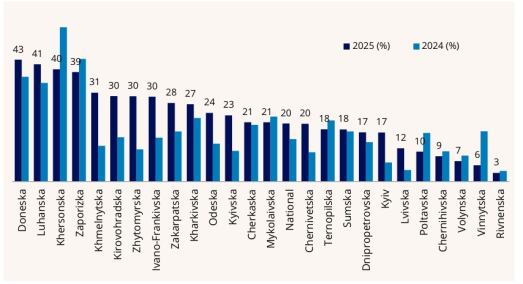
13.4.10 The UNHCR Protection Survey 3 stated:
‘Access to food … also deteriorated with a growing share of people reporting medium-level access rising by 15% for food.
‘… Older people with specific needs report a higher level of difficulties in accessing food at 13%, 5% above the overall response rate in round 3 of the survey. This elevates to 16% for those with a chronic illness and even to 22% for those living alone. Females among older respondents with specific needs report food access difficulties more often (16%) than males of this profile (10%).
‘… Affordability is by far the most relevant barrier to people’s access to food at 93% without major difference in the three survey rounds. Affordability challenges have risen though by 4% for older respondents with specific needs in round 3 of the survey. 10% report availability challenges, steadily reported in the year in review. Physical access challenges are limited (4%), with a slight increase by 1% only observed in round 3 of the survey.’[footnote 146]
b) Programs to remedy food insecurity
14.4.11 On their undated webpage for Ukraine, the World Food Program stated:
‘WFP delivers 30-day food kits and ready-to-eat food rations, primarily in hard-to-reach and frontline areas where commercial supply lines are disrupted and access to food is unreliable, as well as to evacuees passing through transit centres. Food kits typically comprise wheat flour, pasta, buckwheat, oats, canned beans or meat, sunflower oil, sugar and salt. WFP buys nearly all of this food inside Ukraine.
‘WFP distributes cash assistance in frontline regions where banks are functioning and food is accessible, as well as in response to emergencies such as evacuations and air strikes. Cash assistance gives people the freedom to meet their essential needs as they choose, and stimulates local economies.
‘WFP works with the Ministry of Education to provide school meals to 275,000 primary school children in eight frontline regions. Many of these children study underground to stay safe from drones and missiles. WFP also supports schools by providing energy-efficient kitchen equipment such as ovens and dishwashers, as well as fuel for generators to keep school kitchens operating during winter and energy blackouts.’[footnote 147]
13.4.12 The WFP 2026 report stated:
‘Food assistance, provided both as in‑kind and cash transfers, has been central to alleviating immediate food gaps for vulnerable households in the frontline. WFP assistance is targeted toward households with the lowest economic capacity, and analysis shows that it translates into a measurable and meaningful reduction in food insecurity, reducing the probability of low economic capacity among assisted households by close to 20 percentage points. But with humanitarian funding declining and needs continuing to rise, many vulnerable households may soon be unable to access the food assistance they depend on.’[footnote 148]
13.4.13 The same source stated:
‘In 2025, the number of vulnerable people assisted in Ukraine with food assistance by a cluster of humanitarian partners averaged around 1 million per month, with in‑kind distributions accounting for approximately 65% of all food assistance delivered. Despite these efforts, the scale of support remains small relative to the size of the population and the number of people that need food assistance. Overall, the food assistance provided reaches only about 5% of all Ukrainians and covers around 23% of the total population assessed as food insecure. Even when compared against the ultra‑prioritized 2 million individuals identified in the HNRP, partners collectively reached only about 76% of that priority caseload.
‘… Consequently, food assistance is highly concentrated geographically, with 70% of all distributions in December 2025 delivered within the 0-50 km zone. This prioritization reflects both the increased severity of needs in the frontline areas as shown in this report and the limited capacity to maintain adequate coverage in whole of Ukraine.’[footnote 149]
13.4.14 In June 2026 the WFP published the country brief for Ukraine covering the reporting period of May 2026, which stated that 599,070 people were assisted in May 2026. The country brief also noted the following occurred during the reporting period:
- ‘Intensified attacks on humanitarian actors limit support to the affected populations, causing mission delays or cancelations.
- WFP-contracted warehouse was directly hit by a ballistic missile, and a WFP convoy was attacked by a first-person-view (FPV) drone.
- WFP signed an agreement with the Ministry of Education and Science to implement the School Meals for 200,000 in children in 2026-2027 academic year.’[footnote 150]
13.4.15 The same source stated:
‘WFP continues to provide emergency in-kind food assistance in frontline areas where markets are non-functional due to the deteriorating security situation. In May, nearly 164,400 people received food boxes in seven frontline regions.
‘In addition, over 141,600 people in areas with functioning markets also received cash assistance, totaling almost USD 6.0 million.
‘Over 1,260 evacuees and people affected by strikes received one-off transfers of UAH 12,300 (USD 280) per person for three months.
‘.. Under the French Initiative for Food Security and Nutrition (FIFSAN), nearly USD 296,000 was disbursed to 470 households (approximately 1,222 people) in Kherson and Zaporizhzhia regions, while 75 farmers received over USD 110,000 in microgrants. • In Mykolaiv and Kherson regions, 140 farmers from the drought-prone war-affected areas applied to the “Agro-Shield” crop protection programme.’[footnote 151]
13.5 Water, sanitation and hygiene (WASH)
a) WASH situation
13.5.1 In 2025 the United Nations Children’s Fund (UNICEF) published the report entitled ‘Climate Resilience and WASH Solutions’, which stated:
‘Ukraine’s water, sanitation and hygiene (WASH) sector faces a critical situation with 70%-90% infrastructure deteriorated and severe disparities in access: only 26.2% of rural areas have centralized water supply, leaving 18,000 rural settlements without access. Approximately 10 million people (including 1.7 million children) lack safely managed water services across the country, while 15 million (2.6 million children) lack wastewater treatment facilities. This presents critical health risks for children, with 30% of distributed water failing to meet national quality standards.
‘… Since 2022, war-related direct damages to the sector have totaled over $4.6 billion [£3.3 billion]— primarily affecting large surface infrastructure, with wastewater plants (28%), wastewater networks (21%), and drinking water networks (23%) the most impacted.
‘… Major dams have been destroyed, including the Kakhovka Dam in 2023, causing catastrophic environmental and humanitarian consequences. Climate change compound these challenges, with projections suggesting Ukraine may need to import drinking water by 2050. Southern and eastern regions face increased water stress by 2030, while Ukrainian rivers show toxic compound concentrations 30-40 times above permissible standards.’[footnote 152]
13.5.2 The REACH 2025 key findings report stated:
‘[In Chernihivska Oblast] WASH needs were also limited overall, with only a minority of households (8%) reporting unacceptable drinking water quality and almost all households reporting sufficient access to drinking water for domestic purposes.
‘… [In Dnipropetrovska Oblast] 16% of the households reported that the quality of the water from their main drinking source was unacceptable, and 19% reported not being able to access sufficient water for domestic purposes at least three days per month.
‘… [In Donetska Oblast] WASH needs were equally severe, with 47% of households facing unmet needs: 20% reported unacceptable water quality, while 26% reported lacking water for non-drinking purposes between 3 to 10 days (17%) or more than 11 days (9%) per month…32% reported interruptions to cold water.
‘… [In Kharkivska Oblast’] WASH conditions were also better than in many other frontline oblasts, with relatively few households reporting issues with water quality (10%), access to drinking water (2%), or access to water for domestic purposes (3%). The near totality of households in both rural and urban areas relied on improved drinking water sources and toilet facilities… interruptions to the cold water supply … were less frequent, reported by 12% … of households
‘… [In Khersonska Oblast] WASH needs were also notable, with 39% of households facing needs driven by issues with drinking water quality, domestic water quantity, and missing key WASH NFIs: 14% reported lacking hygiene products, and 11% water treatment products. … and 33% cold water interruptions, further compounding WASH needs.
‘… [In Mykolaivska Oblast] WASH needs were mainly linked to water quality and supply stability. Overall, 14% of households considered the quality of their main drinking water source unacceptable. Urban households more often relied on bottled water (25%) and water kiosks (23%), reflecting in higher monthly expenditures in water (47 UAH) compared to other regions. Rural households often relied on tap water (51%) … Households often lacked essential WASH NFIs: 12% reported lacking cleaning products, and 10% hygiene products … and cold water interruptions (28%), contributing to reports of insufficient access to water for domestic purposes (13%).
‘… [In Sumska Oblast] 27% of the households were classified in need in WASH. While 11% reported that the water quality was not acceptable, households rarely reported lacking sufficient water quantity for drinking (2%) and domestic activities (3%). Most urban households relied on tap water for drinking, while rural households equally relied on tap water or other improved sources not located on their premises.
‘… [In Zaporizka Oblast] WASH needs were less acute overall: while 20% of households reported that the water quality was not acceptable, they rarely reported lacking sufficient water quantity for drinking and domestic activities.’[footnote 153]
13.5.3 In August 2025 the World Health Organisation (WHO) health cluster Ukraine published a public health situation analysis (WHO situation analysis 2025) which stated:
‘Armed conflict activities heavily impact water bodies, polluting aquifers, rivers, seas, and groundwater with heavy metals, oil, and hazardous waste. Damage to dams, sewage systems, and other infrastructure, along with excessive water use for firefighting, intensifies scarcity. Contamination with chemical, radioactive, and biological substances further degrades water quality, posing serious risks to human health and aquatic ecosystems.
‘The Ukrainian Parliament Commissioner for Human Rights reports that 76% of the population has experienced water supply interruptions under martial law, only 53% retain access during power outages, and 69% avoid tap water without prior purification, highlighting critical deficiencies in the national water system.’[footnote 154]
These statistics were based on the Special Report by the Commissioner for Human Rights on the state of observance of citizens’ rights to clean and accessible water under the legal regime of martial law, published April 2025. The survey covered 13,673 respondents from all regions of Ukraine (translation available upon request)
13.5.4 The same source stated:
‘According to the REACH’s Humanitarian Situation Monitoring conducted between December 2024 and May 2025 in Government-controlled areas within 50 km of the front line, approximately one quarter (24–27%) of the settlements remain in severe or higher (extreme or catastrophic) WASH needs, with a deterioration observed in Zaporizka and Donetska oblasts. As a major challenge, a notable share of settlements (15-19%) reported that at least one-quarter of residents could not access drinking water in the 30 days prior to data collection.’[footnote 155]
This data was taken from the REACH data dashboard. REACH uses the WASH severity classification system on the dimensions of ‘(i) availability of sufficient quantity of drinking water, (ii) drinking water quality, (iii) issues sanitation and excreta [sic] management, (iv) ability to perform hygiene, (v) missing WASH NFIs, (vi) access to water for domestic purposes.’[footnote 156]
13.5.5 The UNHCR 2025 survey stated:
‘Overall, a majority of respondents report good or fair access to … water during the past 3 months (June, July, August [2025]), with only a small percentage of respondents reporting difficulties or insufficient access.
‘… Access challenges to basic needs are heightened among respondents in the south, with 8% [reporting challenges] in accessing water.’[footnote 157]
13.5.6 The HNRP 2026 stated that 6.43 million people out of 40.3 million[footnote 158] (16% of the population) are in need of WASH facilities.[footnote 159]
13.5.7 The HNRP 2026 report stated in its Annex for Water, Sanitation & Hygiene provided on the Humanitarian Action website:
- ‘In 2026, an estimated 6.4 million people in Ukraine will require humanitarian assistance related to water, sanitation, hygiene, and district heating (WASH) services. WASH-related vulnerabilities are anticipated to be the most severe near active front lines, leading to further displacement of internally displaced persons (IDPs). Concurrently, the escalation of attacks on energy infrastructure is projected to impact WASH service delivery across the entire country.
- ‘In frontline areas of Chernihivska, Dnipropetrovska, Donetska, Kharkivska, Khersonska, Mykolaivska, Sumska, and Zaporizka oblasts, humanitarian needs for WASH are critically high due to service degradation and active hostilities. Millions require immediate aid within the 0 to 50 km zone. Needs vary geographically. Urban centers face vulnerability from targeted attacks on centralized heating, water, and electricity, creating acute public health risks and forcing reliance on unstable alternatives, especially within 0 to 20 km of the front line where infrastructure is heavily damaged. Rural communities have deeper structural gaps with limited-service coverage, relying heavily on smaller water systems and wells … vulnerable groups, including older persons and people with disabilities who often remain in frontline areas, face physical barriers accessing alternative water points or hygiene items …’[footnote 160]
13.5.8 The HRW 2025 report stated that ‘In 2025, water shortages worsened in occupied areas, especially in Donetska region, due to the previous damage to water supply infrastructure. Donetsk residents, who had tap water only a few hours every three days, were forced to queue at water trucks, prompting locals to describe the situation as a “humanitarian and ecological catastrophe.’[footnote 161]
13.5.9 The Amnesty International 2025 report stated:
‘Donetsk, Mariupol, Makiivka and other occupied towns faced a worsening water crisis. Pre-war water infrastructure cutting across the front line, including the Siverskyi Donets-Donbas canal, remained in ruins; reservoirs dried up; and the occupying authorities failed to develop reliable alternative supply sources. By year’s end, water reportedly reached some locations by pipes for only three to four hours once every three days; its poor quality made it unsafe for drinking. Makeshift supplies, including water deliveries by truck, were sparse and unreliable, leading to long queues and incidents of violence. Monitors described the situation as a humanitarian emergency.’[footnote 162]
13.5.10 The PIN 2026 report stated that ‘In Mykolaiv oblast, WASH needs continued to be reported, primarily linked to infrastructure damage since 2022 as well as recent disruptions in electricity supply, which heavily affect water provision in the region.’[footnote 163]
13.5.11 The BTI 2026 report stated that ‘Large-scale targeted Russian air attacks on residential areas and civilian infrastructure have damaged water supply and sewage systems, especially in eastern and southern Ukraine, leaving many settlements without access to drinking water. Approximately 11 million Ukrainians had problems with access to water and sanitation due to the destruction of infrastructure. The situation continues to deteriorate due to the armed conflict.’[footnote 164]
13.5.12 The source did not specify the level or duration of access issues effecting 11 million Ukrainians.
13.5.13 In March 2026 the United Nations Office for the Coordination of Humanitarian Affairs (OCHA) published the report ‘Ukraine: Humanitarian situation snapshot’ (OCHA March 2026 snapshot) covering January to February 2026 which stated that ‘Nearly daily attacks on Ukraine’s energy systems left hundreds of thousands of families without electricity, heating and water—sometimes for weeks—when temperatures dropped to –20°C … Attacks also disrupted people’s access to water, sanitation and hygiene (WASH) services, while in Russian-occupied territories these systems continue to deteriorate due to years of under-maintenance and restricted access for repairs.’[footnote 165]
13.5.14 In June 2026 the Ukraine WASH cluster published the frontline WASH flash update (WASH flash update June 2026), stated that 120,000 people in northern Donetska Oblast were at imminent risk of losing safe water access; and more than 1.1. million people in Odesa agglomeration are dependent on a single water system with no alternative source and less than 24 hours of reserve supply.[footnote 166]
13.5.15 The same source stated:
‘Water failure is a proven displacement trigger. Communities that have endured years of bombardment will leave when water disappears. Those who cannot leave, the elderly, persons with disabilities, the poorest, are abandoned without any means to meet their most basic survival need.
‘… Loss of chlorinated piped water increases the risk of waterborne disease outbreaks, diarrhoea, hepatitis A, disproportionately affecting children under five and older persons. Hospitals without functioning WASH jeopardize infection prevention and control measures.
‘… Water collection becomes a daily security risk. Displacement and reduced service coverage increase exposure to protection risks, particularly for women, girls, and children.’[footnote 167]
13.5.16 The OHCHR energy report June 2026 stated:
‘Residents of multi-story apartment buildings lost access to water when electricity cuts disabled pumps required for water to reach the upper floors. Residents of a 16-story building in Odesa, for example, said that when electricity outages stopped elevators for a week in December 2025, those on upper floors had to purchase water in stores, and carry it up the stairs.
‘… The situation was further exacerbated by extreme cold weather in January and February 2026, when lack of heating caused water in pipes and sewers to freeze and burst across Kyiv and other cities. This affected not only drinking water but also sanitation. Households reported limiting bathing, dishwashing and handwashing, as well as sewer blockages and wastewater flooding due to water, electricity and heating outages.’[footnote 168]
13.5.17 The UNHCR Protection Survey 3 stated:
‘Access to … water also deteriorated with a growing share of people reporting medium-level access rising … by 18% for water.
‘… Availability of water is the greatest access barrier for people at 59%, followed by affordability challenges for 18% and accessibility constraints for 13% with steady reporting during the year in review. Affordability is a greater challenge for older people with specific needs with 24% reporting this barrier. In addition, an overall 27% report poor water quality as a barrier to their access to safe water.’[footnote 169]
b) Efforts to remedy the WASH situation
13.5.18 The UNICEF year end Humanitarian Situation report covering the year 2025 stated in relation to the provision of sanitised water:
‘In 2025, UNICEF enabled 4,297,768 people, including 710,109 children, to access safe and equitable water and sanitation services out of the annual target of 4.3 million people. Assistance was provided to 98 water utilities, including support for emergency repairs and the supply of critical equipment, maintenance tools and water treatment chemicals. Third-party monitoring conducted in September across 81 water utilities in 17 regions and Kyiv confirmed that UNICEF’s support was systematic and sustained rather than one-off. Utilities rated the quality, usefulness and timeliness of assistance high, with average scores close to 10 out of 10.
‘… UNICEF delivered critical WASH supplies including bottled water, hygiene items, water trucking services and hygiene vouchers to 1,421,600 people across 17 regions, including 235,357 children, achieving 93 per cent of the annual target of 1,530,000 people. Assistance prioritized frontline communities where water systems were damaged or destroyed. Post distribution monitoring of family hygiene kit distribution in Kharkiv (August 2025) showed high levels of satisfaction with the kits, with all key indicators for necessity, timeliness and appropriateness exceeding 9.9 out of 10.
‘… More than 8 million litres of safe drinking water was delivered in Kharkiv, Donetsk and Kherson regions reaching 25,205 people. Independent monitoring of water trucking services in Kherson confirmed that water distribution meets sanitary standards and is easily accessible, despite ongoing shelling and limited availability of shelters at distribution points. Beneficiaries reported full satisfaction.’[footnote 170]
13.5.19 The same source stated in relation to the provision of hygiene items:
‘UNICEF also piloted hygiene vouchers in 2025 with 15,662 vouchers distributed covering 43,105 people in Kherson and Mykolaiv regions. Each voucher, valued at UAH 2,500, enabled households to purchase essential hygiene items through local retailers, enhancing choice and dignity while responding to household-specific needs. Third-party monitoring indicated high levels of satisfaction, with 98.8 per cent of recipients reporting they were satisfied or very satisfied with the assistance.’[footnote 171]
13.5.20 The same source stated in relation to the provision of WASH services:
‘As of November 2025, 161 hospitals, education facilities and collective centres (95 per cent of the annual target) have been supported with inclusive, gender-sensitive and child-friendly WASH services, reaching more than 800,000 people. As per recent monitoring feedback, there were high levels of satisfaction regarding the functionality and aesthetic design.
‘In 2025, the WASH Cluster delivered humanitarian WASH support to 3.7 million people across 11 regions under the HNRP, achieving 90 per cent of the 4.1 million target compared to only 23 per cent of funding received, as per the OCHA Financial Tracking System Key achievements include 1.84 million people reached through emergency support to water utilities (112 per cent of target), 1.42 million people supported through operations and maintenance support to water utilities (345 per cent of target; driven by intensified efforts to avert widespread collapse of critical water utilities amid escalating power disruptions), 1.32 million reached with emergency water supplies (62 per cent of target), and 1.01 million people through interventions at institutional level, such as schools, hospitals, transit centres and collective sites (103 per cent of target).’[footnote 172]
13.5.21 The HNRP 2026 report stated in its WASH annex:
‘In areas near the frontline and in the immediate aftermath of strikes, the cluster generally focuses on emergency provision of safe water and distribution of hygiene kits in urban settings where infrastructure is destroyed and markets are unfunctional, while emergency repairs of water systems may be more opportune than using water trucks if targeted by drones. Further from the frontline (e.g., 21-50 km) and for medium-term interventions after strikes, the potential phased approach involves supporting vodokanals, hospitals, schools, and social centers with critical WASH needs, and district heating in preparedness or during the winter season. In support of evacuees, the cluster will ensure that transit centers and evacuation routes have adequate safe water, sanitation facilities and hygiene supplies, mitigating public health risks during displacement. ensuring dignified living conditions and preventing the spread of disease among vulnerable populations.’[footnote 173]
13.5.22 The WASH flash update June 2026 stated that:
‘What is being done:
- Emergency water trucking and bottled water distribution are active in Sloviansk, Kramatorsk, and Vasylkivka, providing immediate life-saving access for the most vulnerable.
- Alternative water intake development is underway in Sloviansk (Myrne intake, expected 50 per cent supply by end of July); 100 boreholes are operational, 56 additional committed across Sloviansk and Kramatorsk.
- In Odesa, preparedness measures include 500+ water storage tanks for schools, emergency trucking arrangements, hospital borehole rehabilitation assessments, and stockpiling of hygiene supplies.
- Generator pre-positioned for Vasylkivska; temporary power solutions bridging the immediate gap pending security reassessment by local authorities.
- Multi-cluster coordination initiated: Protection, Child Protection, Shelter/NFIs, and WASH actors aligned on a shared response framework for Donetska water crisis scenarios.
‘Critical gaps:
- Emergency trucking covers only 30–40 per cent of minimum water needs in Donetska, the gap cannot be filled through trucking alone and represents a sustained protection failure for those left behind
- Borehole drilling commitments cover only 50 per cent of assessed need in Donetska (56 of 111 requested); districts of Sloviansk including Khimik and Cherevkovka remain without any planned alternative supply
- Emergency water storage and alternative supply points remain as top priority, leaving facilities with no resilience against possible attacks on the oblast’s single water and energy systems.
- Odesa backup power remains the critical structural gap: no solution at the scale required (~20MW for the Dniester intake) exists or is funded, this is beyond humanitarian capacity and requires government and development engagement at the highest level
- Access constraints in Nikopolskyi Raion and near-frontline areas of Donetska prevent verification of coverage gaps and timely delivery to populations at greatest risk.’[footnote 174]
13.6 Poverty
a) Poverty situation
13.6.1 The REACH 2025 key findings report provided data on household income among survey respondents in the frontline oblasts of Chernihivska, Dnipropetrovska, Donetska, Kharkivska, Khersonska, Mykolaivska, Sumska and Zaporizka. The report recorded median monthly per capita income and the proportion of households with a per capita income below (i) the subsistence minimum of 8,422 UAH [£138 GBP] and (ii) the average cost of a food basket of 4,794 UAH [£78 GBP], based on June 2025 prices defined by the Ministry of Social Policy of Ukraine:[footnote 175]
| Oblast | Median monthly income per capita | Median per capita income per household below the subsistence minimum. | Median per capita income per household below the cost of the food basket |
|---|---|---|---|
| Chernihivska | 7,500 UAH | 61% | 22% |
| Dnipropetrovska | 6,300 | 67% | 41% |
| Donetska | 5,000 | 83% | 48% |
| Kharkivska | 8,500 | 51% | 20% |
| Khersonska | 6,500 | 72% | 36% |
| Mykolaivska | 9,250 | 48% | 23% |
| Sumska | 7,667 | 55% | 22% |
| Zaporizka | 9,538 | 47% | 22% |
13.6.2 The UNICEF 2025 report stated:
‘The war has significantly deepened child poverty and material deprivation; the share of households with children living below the actual subsistence minimum rose sharply with child poverty increasing from 20.6 per cent in 2021 to 35.5 per cent in 2023, while extreme child poverty increased nearly sevenfold, reaching 8.8 per cent. Poverty levels are highest among large families, single-parent households, families with young children, and households affected by disability or unemployment.’[footnote 176]
13.6.3 The WFP 2026 report stated, reporting on data from July-August 2025:
‘In 2025, humanitarian actors under the Cash Working Group launched the Unified Cash Transfer in Ukraine. The Unified Cash Transfer for people living in frontline areas aims to address the specific humanitarian pressures associated with frontline living … was set at UAH 8,422 [£140 GBP] per person per month as of June 2025. Recognizing the higher cost of living in frontline areas, estimated at +8.33%, an adjusted MEB [Minimum Expenditure Basket] of UAH 9,124 [£151 GBP] per person per month was applied.’[footnote 177]
13.6.4 The same source stated:
‘Livelihood vulnerability continues to rise as unemployment, low income and humanitarian dependency increases as households get closer to the frontline. Employment patterns reveal that households in the 0–20 km zone face the greatest labour constraints: 36% of households there have no working-age members, compared with 32% in the 20–50 km band and 27% in areas beyond 50 km.
‘… Income sources follow a similar pattern of vulnerability, with households closer to the frontline far more dependent on external support and far less able to rely on their own economic activity. Almost half of households living within 0–50 km of the frontline depends solely on social benefits, humanitarian assistance, or family support.
‘… In practical terms, this means that nearly 78% of households in the 0–20 km zone and 73% of those in the 20–50 km zone receives some form of external assistance, from the government, humanitarian organisations, or social transfers, to meet their basic needs.
‘… [O]nly 17% of households within 20 km [of the frontline] earns more than 9,500 UAH [£155] per capita [per person per month], compared with 30% in the 20–50 km band and 38% in the 50+ km zone.’[footnote 178]
13.6.5 The HNRP 2026 stated
‘Economic strain dominates nationwide, with nearly one in three households identifying insufficient income as their most urgent challenge… These pressures are most severe for people close to the front line, where 35 per cent of households report that they cannot meet their basic needs.
‘… To cope with mounting pressures, households reduce spending, cut food quality and deplete savings, while displaced households resort to severe coping strategies at nearly twice the rate of non-displaced families.’[footnote 179]
13.6.6 The IRC January 2026 report stated that: ‘The protracted conflict has systematically eroded the financial resources needed by IDPs to access essential goods and services. This financial strain is compounded by difficulties accessing housing and employment. As assistance availability declines, the proportion of IDPs reporting that they have exhausted humanitarian assistance as a coping strategy has increased, rising from 15 per cent in October 2024 to 19 per cent in October 2025.’[footnote 180]
13.6.7 The same source stated:
‘Recent monitoring indicates that returns to frontline and frontline-adjacent areas are increasingly “induced” by the exhaustion of coping capacities in displacement rather than improved safety in areas of origin. … households are undertaking self-organized, often information-poor movements when they perceive no viable options in host communities. This trend is precipitated by a convergence of economic drivers: with only ~20% of surveyed households relying on employment and nearly 37% dependent primarily on social transfers, displaced families lack the financial resilience to absorb rising living costs. As constrained funding and the reprioritized 2025 HNRP reduce coverage in lower-risk areas, the erosion of this safety net—evidenced by 30.8% of respondents reporting no financial support—is leaving households with an impossible choice: facing economic destitution and homelessness in displacement or returning to physical danger at home.’[footnote 181]
13.6.8 In April the World Food Program (WFP) published a briefing for Ukraine. For the March 2026 period it stated:
‘In March [2026], WFP … where markets function, over 119,000 people received approximately USD 3.2 million [£2.3 million GBP] in cash assistance.
‘… WFP continues to register evacuees at transit centres in Kharkiv, Dnipro and Mykolaiv regions to assist them with cash assistance to cover basic needs, including food. In March [2026], over 900 evacuees received a one-off payment of UAH 10,800 [£180 GBP].’[footnote 182]
13.6.9 The BTI 2026 report stated that ‘the share of Ukrainians living below the subsistence minimum has risen by 15%.’[footnote 183]
13.6.10 In April 2026 the World Bank Group published a results brief entitled ‘Investing in Tomorrow: Strengthening Human Development and Resilience in Ukraine’ (World Bank April 2026 briefing), which stated that ‘The World Bank estimated the 2025 poverty rate at nearly 37 percent, up from 20 percent in 2021. As the invasion continues, poverty rates rise further, leaving approximately 9 million people in urgent need of support.’[footnote 184]
13.6.11 The PIN 2026 report stated that ‘Economic vulnerability among older persons remains high. Many older individuals particularly older women face difficulties covering basic expenses, including hygiene materials, medication, and utility payments, due to limited financial resources, low pensions and social isolation.’[footnote 185]
13.6.12 The IOM survey round 23 stated:
‘More than one-third of IDP households relied on humanitarian assistance to meet basic needs (34% used this strategy in the past month, while 13% reported that they could no longer rely on it), while one in five accepted lower-skilled or low-paid employment (20% used this strategy in the past month, and 8% reported having exhausted it). A smaller proportion resorted to credit-based coping mechanisms, with 12 per cent purchasing food on credit or borrowing food.
‘… IDPs displaced from occupied raions [2nd level administrative district[footnote 186]] in the past year were particularly affected, with 14 per cent reporting exhaustion of productive assets or means of transport, compared to seven per cent among those displaced for over one year and originated from temporarily occupied raions.’[footnote 187]
b) Welfare system
13.6.13 The UNHCR 2025 survey stated:
‘71% of respondents currently receive some form of social protection payment (benefit or pension) from the state, while 13% of respondents receive at least one state social service. This finding reflects the imbalance between cash and care-based social protection inherent in the state protection system. Compared to round 1 of the Protection Survey, this suggests an increase in reliance on the social protection system by 8% for social protection payments and 3% for social services.
‘… Respondents in central and western regions report highest levels of reliance on the state social protection system – both payments and services.
‘… Of the 71% of respondents who receive social payments, the main three types of assistance are IDP allowance (65%), old-age pension (62%) and disability pension (22%).
‘… 75% of IDPs respondents currently receive social protection payments (+4%). In contrast, 60% of returnees report receiving such payments, and 56% of those non-displaced.
‘… Of those not receiving state social protection support, 13% of respondents face barriers to access the state social protection system … These barriers differ depending on displacement situation, age, gender and the prevalence of specific needs.
‘… IDPs with specific needs exhibit significant barriers to accessing social payments at 21%. This further rises by 10% among female respondents of average age 44 years that are single households at 31%. These are typically single female care givers.
13.6.14 ‘IDPs with specific needs also face more significant barriers to accessing social services at 4%. This further rises to 5% for those with a disability and to 9% for single-headed households among them.’[footnote 188]
13.6.15 The BTI 2026 report stated that ‘The state’s fragile welfare system has struggled to support more than 4 million internally displaced persons, prompting greater reliance on NGOs and community-based initiatives.’[footnote 189]
13.6.16 The Amnesty International 2025 report stated:
‘Universal pensions for people of retirement age left older people below the real subsistence minimum of UAH 7,461 [£125] per month, with 62% of pensioners receiving less than UAH 5,000 [£83] per month.
‘… While Ukraine provides universal pensions to all people of retirement age, Amnesty International found that pensions often fall short of the levels needed for older people to fulfil their rights … Since Russia’s full-scale invasion, inflation has increased rapidly, but pensions have not kept up: the real subsistence minimum as of December 2024 was 7,461 hryvnia [£125] per month, but 62% of pensioners receive less than 5,000 hryvnia [£83] per month.’[footnote 190]
13.7 Healthcare
a) Access and barriers to healthcare
13.7.1 The REACH 2025 key findings report stated:
‘[In Chernihivska Oblast] households reported accessibility and affordability issues impacting access to healthcare. 17% of the households reported needing more than one hour to reach the nearest functional health facility. Additionally, 17% reported the cost of medicine, 15% the cost of treatment, and 8% transport challenges as key barriers limiting access. Mental health and psychosocial support (MHPSS) needs were widespread, with three out of five households (62%) reporting that they felt emotionally unwell. In the face of widespread challenges, only 22% of those affected reported receiving MHPSS support or services.
‘… [In Dnipropetrovska Oblast] [l]ivelihoods’ challenges also affected healthcare access, with the cost of medicines (32%) and treatment (15%) reported as the main barriers. Additional physical access barriers included transport needed (12%) and long time required to access the services (9%), with 13% of the households needing more than one hour to reach the nearest functioning health facility.
‘… [In Donetska Oblast] [h]ouseholds also faced distinct challenges in accessing healthcare, with 28% of households reporting being unable to obtain care when needed. They experienced significant accessibility and security barriers: 19% needed at least 1 hour to reach the nearest functional health facility, and 14% cited security concerns as a key barrier. Further, the region presented the worst outcomes in terms of MHPSS, with 84% of households feeling emotionally unwell vis a-vis only 17% being reached with MHPSS support.
‘… [In Kharkivska Oblast] [r]egarding healthcare, the majority of households (92%) were able to access healthcare services within a 1-hour commute. However, households frequently reported affordability barriers to accessing medicine (22%) and treatment (16%),
‘… [In Khersonska Oblast] [h]ealthcare access was also severely constrained: a quarter (24%) of households reported being unable to obtain all the healthcare they needed. More than one-third of the households (36%) cited security concerns while travelling to or at medical facilities as the main challenge to accessing healthcare. Additionally, due to the extent of damage to health facilities, 19% of households needed at least 1 hour to reach the nearest functional health facility, and 11% report transport issues as a barrier.
‘… [In Mykolaivska Oblast] … the great majority of the households (91%) were able to reach the nearest functional health facility within one hour, with most needing 20 minutes. Households, however, experienced barriers related to the cost of medicine (19%) and treatment (10%), and issues related to the unavailability of needed services or medicines (6%).
‘… [In Sumska Oblast] [h]ealthcare access was comparatively better, with only 8% of households requiring more than one hour to reach the nearest operational health facility and 12% reporting being unable to obtain needed healthcare. The most common barriers were financial, particularly the cost of medicines (18%) and treatment (8%), followed by security concerns (11%).
‘… [In Zaporizka Oblast] only a minority of households (8%) reported needing more than one hour to reach the nearest functioning health facility. 16% of the households were unable to obtain the healthcare needed, with the most reported barriers preventing access being related to the cost of medicines (21%) and treatment (12%), while households also reported security concerns traveling to and at the hospital (11%).’[footnote 191]
13.7.2 The WHO situation analysis 2025 stated:
‘People with disabilities, the elderly, IDPs, and other vulnerable populations face disproportionate challenges due to mobility constraints, lack of home-based care, and limited access to rehabilitation and MHPSS [Mental Health and Psychosocial Support] services. Stigma and logistical barriers further reduce uptake of mental health and psychosocial support. Men of conscription age often self-confine due to military mobilization fears, limiting their access to healthcare, legal aid, and livelihoods, which exacerbates household vulnerability. Roma communities and some IDPs report exclusion from services and unclear communication regarding entitlements, limiting their access to healthcare, social support, and other essential services.’[footnote 192]
13.7.3 The UNHCR 2025 survey stated that ‘Of the 7% of respondents with difficult or insufficient access to health care, barriers relate to affordability, accessibility and availability of needed services. Specific accessibility barriers include lack of transport, unaffordability of transport or lack of needed documentation.’[footnote 193]
13.7.4 The HRW 2025 report stated that ‘Throughout the year, the World Health Organization (WHO) had verified 577 attacks on healthcare, an increase compared to the previous year. At least 2,665 health facilities and personnel have been affected since February 2022.’[footnote 194]
13.7.5 The HNRP 2026 stated that 4.47million people out of 40.3 million[footnote 195] (11% of the population) are in need of Healthcare.[footnote 196]
13.7.6 The BTI 2026 report stated that ‘Despite numerous attacks on hospitals, the Ukrainian health care system continues to function. As of 2024, in total, 1,971 medical institutions have been damaged, of which 300 were completely destroyed. However, their restoration is a priority for the state, and at the moment 963 medical facilities have been restored, 593 fully and 370 partially. This ensures citizens’ access to medical services even in the regions that suffered the most destruction.’[footnote 197]
13.7.7 The PIN 2026 report stated
‘Kis [Key Informants] reported shortages of medical personnel, including specialized doctors, and limited access to emergency medical services due to the lack of ambulances in some hromadas [communities[footnote 198]]. In several regions, particularly in frontline locations, KIs also referred to the absence of pharmacies, logistical challenges affecting the delivery of medicines, and the limited presence of organizations able to provide medication support.
‘… Frequent shelling and ongoing insecurity contribute to increased anxiety, sleep disturbances, and psychological exhaustion. These challenges are often compounded by limited awareness of available psychosocial support services and stigma associated with seeking mental health support.’[footnote 199]
13.7.8 The IOM survey round 23 stated that ‘55% of IDPs in households with at least one person with a disability reported insufficient access to medicines, compared to 34 per cent in households without persons with disabilities.’[footnote 200]
13.7.9 The OHCHR energy report June 2026 stated:
‘Emergency electricity outages affected healthcare facilities across Ukraine, including in Kyiv, Zaporizhzhia and Odesa, despite measures to shield medical facilities from scheduled electricity cuts.
‘In Kyiv, emergency outages disrupted both primary and specialized health care: certain services requiring electricity, such as X-rays and ultrasounds, were suspended; and appointments and surgical procedures were rescheduled.
‘… For example, a specialized facility in Kyiv conducting cardiac surgeries experienced three electricity and water outages of up to seven hours in January 2026. Backup generators provided electricity to the intensive care unit, blood bank, and operating rooms, but could not meet the facility’s full needs, requiring the rescheduling of appointments and procedures, including heart surgeries.’[footnote 201]
13.7.10 The UNHCR Protection Survey 3 stated:
‘41% of respondents report mental health and psycho-social safety concerns (MHPSS concerns), including stress, anxiety, and depression. A slight downward trend in reported MHPSS concerns can be observed across the three surveys.
‘… MHPSS concerns are highest among respondents in the southern macro-region with 48% sharing such concerns, followed by respondents in Kyiv (46%). The negative impact of the mental health toll on day-to-day lives is also reported to be highest in the south and Kyiv at 32%.’[footnote 202]
13.7.11 The same source stated:
‘Overall, respondents report good to fair access to … health services during the past three months … 6% … report difficult to insufficient access to these basic services. Access to … basic services deteriorated during the year in review, with more respondents reporting medium-level access compared to before.
‘Among the overall respondents, those war-affected report higher difficulties in accessing healthcare compared to IDPs and returnees, with 10% reporting difficult, unsteady or insufficient access to healthcare.
‘Access to healthcare is more challenging for respondents over 60 years with a specific need reported at 11%. For them, access challenges are highest in Kyiv reported at 22% followed by respondents in the northern (13%) and southern macro regions (13%).
‘Of the 6% of respondents with difficult or insufficient access to health care, barriers relate to affordability, accessibility and availability of services needed. Specific accessibility barriers include lack of transport, unaffordability of transport or lack of needed documentation.
‘… [R]espondents (34%) report non-functional health care services in their area as the main barrier – an increase from 19% in round 1 and 21% in round 2 – and rising to 50% of respondents reporting this barrier in the northern macro-region.’[footnote 203]
b) Healthcare provisions
13.7.12 The UNICEF 2025 report stated:
‘UNICEF supported 326 Resilience Centres operating across 305 communities, which provide mental health and psychosocial support interventions, with a coverage capacity of 2.5 million people. The network of centers employs more than 1,500 trained specialists and collaborates with local partners. UNICEF strengthened capacity building across the social sector, with 3,782 professionals from 200 communities trained on information and service provision, 1,344 people (representing 858 families) from 18 regions trained on adoption and family based care forms, 178 people trained as patronage carers, and 1,905 parents and caregivers receiving psychological consultations.’[footnote 204]
13.7.13 The WHO situation analysis 2025 stated:
‘While access to healthcare remains relatively stable in non-conflict-affected oblasts, it is severely compromised in frontline regions.
‘… Immunization coverage for vaccine-preventable diseases continues to vary significantly across regions. While some oblasts meet the ≥95% threshold required for herd immunity, others fall short due to access barriers and local perceptions. The resurgence of measles (nearly ninefold in western oblasts) underscores the urgent need to strengthen vaccine delivery and public awareness to improve coverage.
‘… Mental health needs remain pervasive, affecting the population at large, with heightened impact in frontline oblasts and among specific subgroups. A 2025 survey found that 83% of adults reported experiencing stress and nervous tension. Access to mental health services remains limited, with outpatient care available in only 13% of facilities and inpatient specialist care in less than 1%.’[footnote 205]
13.7.14 The same source stated:
‘Psychological first aid was available in 52% of health facilities, mainly in PHCs [Private Health Clinics] and multi-profile hospitals, with key barriers including lack of training, staff shortages, and financial constraints. Outpatient mental health care was provided by only 13% of facilities, concentrated in multi-profile hospitals, and hampered by staff, training, and supply gaps. Inpatient specialist care was extremely limited (<1%), primarily offered in mono- and multi-profile hospitals, with severe staff shortages as the main barrier. Access was comparatively better in Kyivska, Lvivska, Kharkivska, and Dnipropetrovska oblasts, while severely restricted in Donetska, Zaporizka, Khersonska, and Luhanska oblasts.’[footnote 206]
13.7.15 The BTI 2026 report stated:
‘Ukraine has a universal, state-funded health care system. Since 2018, Ukraine has been undertaking a reform aimed at moving from the Semashko model of health care financing to a “money follows the patient” approach. Ukrainians can now choose their general practitioner, and a list of treatments covered by the state system has been drawn up, reducing the space for corruption. There are also a large number of private health care providers, as well as corporate health insurance schemes.
‘… In 2020 public health expenditure increased as dramatically as a percentage of GDP from 0.97% to 2.98% due to the COVID-19 pandemic. However, public health expenditure decreased by 14% from 2022 to 2023 due to budget constraints caused by Russia’s invasion, while at the same time the war increased the need for health care and targeted as well as indiscriminate Russian air attacks damaged a larger number of health facilities.’[footnote 207]
13.7.16 The World Bank April 2026 briefing stated that ‘Vaccine-preventable childhood diseases have resurfaced and chronic illnesses have skyrocketed, with 36 percent of cases affecting working-age people. Hypertension cases rose by 58 percent, heart attacks by 28 percent, and strokes by 78 percent. The Ministry of Health reported over 100,000 amputations by mid-2024. A 2025 survey found that over 80 percent of adults have experienced mental health issues.’[footnote 208]
13.8 Education
a) Access and barriers to education
13.8.1 In June 2025 the Council of Europe, an international organisation promoting democracy, human rights and the rule of law in Europe[footnote 209], published the report entitled ‘Human rights situation in the territories of Ukraine temporarily controlled or occupied by the Russian Federation’ (Council of Europe 2025 report), which stated
‘Ukraine’s education system has suffered severe damage due to widespread destruction and damage. OHCHR documented at least 1 614 armed attacks on educational facilities since Russia’s full-scale military invasion of Ukraine. 71% of attacks affected those in territory controlled by the Government of Ukraine, 24% in the territories temporarily occupied by the Russian Federation, and 5% in areas of active combat. Besides infrastructure damage, related disruptions and limited access to education could lead to long-term consequences for children’s development.
‘… Ukrainian authorities undertook efforts to ensure access of schoolchildren in the territories of Ukraine temporarily occupied by the Russian Federation to the Ukrainian education system through targeted online programmes which seek also to ensure links with their Ukrainian teachers in the Ukrainian government-controlled territory.’[footnote 210]
13.8.2 The UNHCR 2025 survey stated that ‘Overall, respondents report good to fair access to education … during the past three months. 4% … report difficult to insufficient access to these basic services.’[footnote 211]
13.8.3 The HNRP 2026 stated that 0.85 million people out of 40.3 million[footnote 212] (2% of the population) are in need of education provision.[footnote 213]
13.8.4 The OCHA Humanitarian Situation snapshot covering the period January to February 2026 stated that ‘Power and heating disruptions undermined the continuity of learning and affected the well-being of children and teachers, exacerbating the distress caused by the war. According to a joint analysis by the Education Cluster, NGO Save the Children and UNICEF, outages impacted nearly 2 million children and resulted in an average loss of 16.5 learning days—nearly double the losses from air alerts during the same period last year.’[footnote 214]
13.8.5 The BTI report stated:
‘Education spending decreased to approximately 3.53% of GDP in 2023, compared to 4.25% in 2022.
‘… Russia’s full-scale invasion has impacted Ukrainians’ access to education at all levels. Many schools, colleges and universities continue to operate entirely online since the COVID-19 pandemic due to proximity to conflict zones and a lack of appropriate air-raid shelters. Nineteen higher education institutions have relocated from occupied territories or areas near the frontline. The number of school entrants was 13.5% lower in 2024 than in 2023, and 30.5% lower than 2021, before the Russian invasion.’[footnote 215]
13.8.6 The PIN 2026 report stated that ‘[K]ey informants also reported an increase in concerns related to accessing online education (71% compared to 42% in round 3) and the quality of online learning (67% compared to 33% in the previous round). Due to the worsening security situation in many regions and the absence of shelters in some schools, educational institutions are often forced to switch to online learning formats.’[footnote 216]
13.8.7 The World Bank April 2026 briefing stated that ‘Education has also suffered, as war-induced trauma led to significant learning losses. Average Programme for International Student Assessment (PISA) scores dropped by 38 points between 2018 and 2022, the equivalent of losing two years of schooling.’[footnote 217]
13.8.8 The OCHA Humanitarian Situation snapshot covering the period March to May 2026 stated:
‘Disruptions to education are severe in front‑line areas, where insecurity prevents the resumption of in‑person learning. A localized study in Donetska Oblast illustrates the scale of the impact: over 80 per cent of the pre-war educational facilities in the areas under review have been destroyed or damaged there, and the number of students has dropped by more than 40 per cent, highlighting the need for distance learning support and psychosocial assistance.’ [footnote 218]
13.8.9 The UNICEF 2025 report stated:
‘As of October 2025, 1,786 general secondary education institutions have been damaged and 222 destroyed, while 1,353 early childhood education institutions have been damaged and 132 destroyed.
‘… Despite mitigation efforts, access remains uneven: around 3.6 million children are enrolled in general secondary education, including approximately 280,000 internally displaced students. Learning modalities reflect ongoing security constraints (though a significant improvement compared to previous years).
‘As of October 2025, 71.5 per cent of students attend school face to face, while 18.9 per cent follow blended modalities and 9.6 per cent rely exclusively on remote learning, particularly in frontline areas (MoES [Ministry of Education and Science]). PISA 2022 results show learning losses equivalent to nearly two years of schooling since 2018, with pronounced gender, socio-economic, and rural–urban disparities. Preschool enrolment declined to an estimated 51 per cent in 2025, leaving around 320,000 young children without access to ECE [Early Childhood Education].’[footnote 219]
13.8.10 The OECD 2026 report stated:
‘Under Order No. 850 of 2024, the Ministry of Education and Science announced that, starting from the 2025 academic year, in-person schooling at the place of residence will become mandatory for IDP children. As a result, an estimated 300 000 internally displaced children were expected to return to offline education. While this measure aims to improve learning outcomes and support children’s socialisation, it has raised public concerns, particularly in areas where schools lack available places and adequate shelter facilities.’[footnote 220]
13.8.11 The OHCHR Energy report June 2026 stated that ‘Widespread electricity and heating outages during extreme winter temperatures forced schools across Ukraine to extend winter holiday periods or switch to distance learning. Electricity outages also meant many students could not participate in live-streamed classes and had to watch the recorded lessons later.’[footnote 221]
13.8.12 The UNHCR Protection Survey 3 stated: ‘Overall, respondents report good to fair access to education and health services during the past three months. 5% and 6% respectively report difficult to insufficient access to these basic services. Access to both basic services deteriorated during the year in review, with more respondents reporting medium-level access compared to before.’[footnote 222]
b) Educational provisions
13.8.13 The UNICEF 2025 report stated:
‘In 2025, 7 million people including 2.5 million children, were reached with humanitarian support by UNICEF and its partners, with an increasing focus on delivering aid with and through local authorities.
‘… Beyond the 20km zone, UNICEF focused on scaling up services including catch-up education … In addition, 121,134 children were reached via Mobile Safety Classes, and digital behavior communication outreach covered 7 million people, including 1.3 million adolescents
‘… Emergency education interventions reached 433,585 children (221,128 girls), representing 52 per cent of the national humanitarian target for the sector. Continuity of learning was ensured through the delivery of mobile early childhood education services and the operationalization of 374 remedial education learning spaces in frontline areas, as well as the provision of supplies and infrastructure for schools facing energy shortages. UNICEF’s technical support to the All Ukrainian School Online platform further enabled 811,792 students and 225,215 teachers to draw on quality-controlled curriculum materials. In partnership with the Ministry of Digital Transformation and the Ministry of Education and Science, UNICEF launched the establishment of a Centre of Excellence which is testing and scaling digital solutions in support of children’s learning recovery.
‘… UNICEF provided critical support for children returning to Ukraine. During 2025, 630 children returned to Ukraine, with UNICEF providing immediate reintegration support to 528 children (84%) through case management, legal aid, accommodation, cash and in-kind assistance, education, health and mental health and psychosocial support. Medium- and longer-term reintegration support reached 246 children from 141 families, while individual assessments were conducted for 1,653 children abroad. Notably, 225 children returning from institutions were supported, resulting in 97% placement in family-based care following a major return from Türkiye.’[footnote 223]
13.8.14 The OECD 2026 report stated:
‘In view of the massive displacement of children, Ukraine undertook several measures to preserve their learning, including developing the All-Ukrainian Online School, and a special curriculum for children displaced abroad known as the Ukrainian Studies Component. All children who were forced to relocate and study abroad retain the right to re-enrol in Ukrainian schools upon their return. To determine the appropriate grade level, Ukrainian schools are advised, through the methodological recommendations developed by the Ministry of Education and Science, to consider academic results from host country schools, provided the student presents an official certificate of attendance and achievement. Children who studied abroad but did not take subjects included in the Ukrainian educational curriculum, or who are unable to present documentation confirming their studies, may undergo an annual assessment before the start of the new school year, or in some cases, during the school year.’[footnote 224]
13.8.15 The BTI report stated:
‘Ukrainian schools adapted to the war by switching between different formats of education. Whereas in the summer of 2022, 95% of schools switched to distance education, in the 2023/2024 academic year, the majority of educational institutions (53%) returned to full-time education, 28% operated in a blended format, and 19% in distance learning. Despite the significant destruction of educational buildings, which caused direct damage of $6.8 billion [£4.9 billion], education continued in various formats in order to minimize interruptions to the educational process.’[footnote 225]
13.9 Civil documentation, citizenship and personal status
13.9.1 Diia is the GoU Ministry of Digital Transformation documentation platform. It keeps a person’s documentation all in one place on a mobile app. Diia acts as a unified access point for a wide range of government services, such as applying for social assistance, renewing driver’s licenses, and paying taxes, among other services.[footnote 226]
13.9.2 In May 2026 Finway, a financial news portal based in Ukraine[footnote 227], published the article entitled ‘Over 24 million Ukrainians use digital public services through Diia in 2026’ which stated:
‘The number of users of the Diia mobile application has already exceeded 24 million, and nearly 7 million citizens actively use the government portal to access various services.
‘… Among the most in-demand digital services in 2026 was online vehicle re-registration.
‘… An important service remains the comprehensive service “eMaljatko.” Thanks to it, parents can obtain a birth certificate, tax number, unique registration number, and apply for state assistance with a single online application.’[footnote 228]
13.9.3 In April 2025 the Presidential Office of Ukraine published a press release entitled ‘Presidential Office Develops Policy Changes to Simplify Passport Issuance for Ukrainians Abroad’ which stated:
‘The Cabinet of Ministers approved amendments to Resolution No. 932, “On the Implementation of the Experimental Project for the Automatic Verification and Validation of Data on Conscripts, Persons Liable for Military Service, and Reservists.”
‘This decision simplifies the registration process for men abroad. From now on, they will be able to obtain passports and other documents while outside Ukraine – without needing to visit a Territorial Recruitment Center or undergo a military medical commission.’[footnote 229]
13.9.4 The UNHCR 2025 survey stated that ‘With regards to access to civil and identity documentation, the survey confirms that respondents in government-controlled areas of Ukraine do not face significant barriers to documentation. Documentation challenges are severe for Ukrainians resident in the temporarily occupied territories as well as among newly displaced, including those evacuated.’[footnote 230]
13.9.5 The HRW 2025 report stated that ‘In March [2025], Russian authorities reported having issued 3,5 million passports to residents in Russian-occupied eastern Ukraine since the mass “passportisation” process began. Research from civil society groups suggests that Russian forces used threats, the deprivation of social benefits, and restrictions on access to health care, education, freedom of movement, employment, and property rights to coerce residents into accepting Russian passports.’[footnote 231]
13.9.6 The Amnesty International 2025 report stated:
‘In March [2025], Russia enacted legislation that obliged Ukrainian nationals without the formal right to reside in the Russian Federation to leave or “regularize their legal status” by 10 September. If they failed to do this they would face “forcible removal”. For the residents of the occupied territories in particular, compliance meant obtaining Russian passports or residence permits as “foreigners” to avoid deportation.
‘… Russia continued to take forward legislation to deprive the residents of the territories it unlawfully annexed in 2022 of their property and other rights if they refused to take up Russian citizenship, in manifest violation of the laws of war.’[footnote 232]
13.9.7 The PIN 2026 report stated:
‘The inability to obtain or renew personal documents may lead to negative consequences and the emergence of additional protection risks. According to many key informants, individuals from temporarily occupied territories or those holding Russian passports or permanent residence permits face particular difficulties in this regard.’[footnote 233]
13.9.8 The UNHCR protection update 2026 stated:
‘UNHCR in cooperation with its partner R2P and the Office of the Ombudsman launched a monitoring initiative in Rivne and Volyn oblasts proactively identifying people at risk of statelessness. During the two-months pilot period, 46 individuals facing documentation barriers were identified, including Roma community members, holders of USSR passports, and other insufficiently or undocumented people requiring identity verification, often through judicial procedures. Given the relevance of the initiative, it is expanded to other Oblasts to further reduce statelessness risks in Ukraine.’[footnote 234]
14.1.4 The same source published a map of the access constraints and number of aid partners in each raion [2nd level administrative district[footnote 235]]. Relatively few aid organisations operate in Russian held areas. There is a greater number of aid organisations in front line areas compared to the rest of Ukraine and these organisations experience the most difficulty in terms of access:
14. Humanitarian aid
14.1 Number and presence of aid agencies
14.1.1 For more information on humanitarian aid provided in relation to specific needs, see relevant subsections in section 13: Humanitarian situation.
14.1.2 The HRW 2025 report stated that ‘As a result of the United States administration’s January executive order pausing “foreign development assistance,” civil society groups in Ukraine lost an estimated 75 percent of their funding and had to suspend crucial human rights programs …’[footnote 235]
14.1.3 The HNRP 2026 published the following graphic of the number of humanitarian partners active in Ukraine from September to November 2025. It should be noted that this information is 9 months old. CPIT has been unable to find more up to date information in the sources consulted (see Bibliography).
Humanitarian partners active from September to November 2025[footnote 236]
| Cluster | Number of partners |
|---|---|
| Education | 87 |
| Food Security & Livelihoods | 93 |
| Health | 103 |
| Protection | 296 |
| Shelter & Non-Food Items | 98 |
| Water, Sanitation & Hygiene | 92 |
| Delivering Unified Cash | 68 |
14.1.4 The same source published a map of the access constraints and number of aid partners in each raion [2nd level administrative district[footnote 237]]. Relatively few aid organisations operate in Russian held areas. There is a greater number of aid organisations in front line areas compared to the rest of Ukraine and these organisations experience the most difficulty in terms of access:
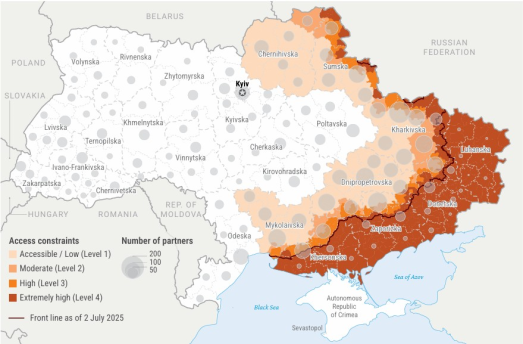
14.1.5 The same source stated that ‘In 2025, a sharp contraction in funding reduced the overall operational footprint from 468 operational organizations at the end of 2024 to 427 partners as of October 2025, and a similar level is expected to continue in 2026. National NGOs, including women-led and women’s rights organizations, have been disproportionately affected.’[footnote 239]
14.1.6 OCHA published the following map on the Humanitarian Data exchange portal. It shows the number of humanitarian aid operators in each oblast. Further details can be found on the online map. The data is from OCHA’s ‘Who does What Where’ data on aid organisations.
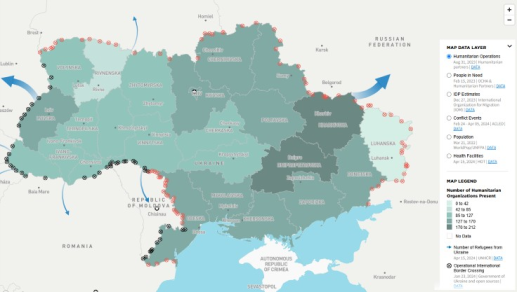
14.1.7 In April 2026 the Disasters Emergency Committee (DEC), a UK based umbrella organisation made up humanitarian charities in order to coordinate response[footnote 241], published the report entitled ‘Final programme report’ which stated:
‘The DEC launched the Ukraine Humanitarian Appeal on 3 March 2022. Thirteen DEC charities were responding to the crisis and worked closely with a wide network of local partners to deliver emergency cash support, food, water, shelter and much more to newly displaced families in Ukraine and neighbouring countries.
‘… As the conflict wore on, DEC charities and their partners also focussed on longer term support, restoring children’s access to education, rebuilding community spaces and providing small business grants to help people regain their independence.
‘… By the time fundraising closed in January 2025, an astonishing £446.3 million had been raised, making it one of the largest appeals in the DEC’s history. The total includes £25 million from the UK Government as part of its UK Aid Match scheme.’[footnote 242]
14.2 Aid provided
14.2.1 For more information on humanitarian aid provided in relation to specific needs, see relevant subsections in section 13: Humanitarian situation.
14.2.2 In June 2026, the UNHCR published their year-end report covering the year 2025 which stated:
‘Inside Ukraine, UNHCR and partners reached nearly 594,000 internally displaced people (IDPs), returnees and war-affected people with legal aid, social services and psychosocial support. The most common legal needs related to housing, land and property rights, access to social protection and personal documentation.
‘… Through support to community-based organizations – 57% of which were women-led – UNHCR reached more than 200,000 people with resilience-building and social cohesion activities.
‘… UNHCR provided cash assistance to over 333,000 war-affected people, including multi purpose cash assistance to over 125,000 people and winter cash assistance to 178,000 people, including 25,000 with disabilities, to help cover heating and essential energy needs. More than 203,000 people received emergency shelter and housing support, and since July 2022 UNHCR and partners have repaired over 55,000 war-damaged homes, enabling families to return to or remain in their communities. Nearly 100,000 people were supported with essential relief items. In collaboration with the Ministry of Social Policy, UNHCR piloted a social adaptation service for vulnerable IDPs, supporting over 80 individuals, and jointly developed a digital IDP Pathway to facilitate earlier access to solutions-oriented support.’[footnote 243]
UNHCR provides further data on their Operational Data Portal.
14.2.3 The UNICEF year end Humanitarian Situation report covering the year 2025 stated:
‘UNICEF, together with government and NGO partners, reached 7 million people including 2.5 million children with humanitarian assistance in 2025. This includes 4.3 million people reached with safe water and sanitation; 425,000 people supported to access health services; 547,000 people accessed mental health and psychosocial support; 311,000 children who participated in formal or non-formal education; and 217,000 people including 98,000 children provided with cash assistance.’[footnote 244]
14.2.4 The IRC January 2026 report stated:
‘Community-based and mobile [Mental Health and Psychosocial Support] MHPSS services, together with hotlines and safe spaces, continue to reach large numbers each month and can help stabilize households considering movement decision. Legal/HLP assistance and case management—where present—support documentation, tenancy, and compensation navigation, while EO [Explosive Ordinance] risk education and movement counselling provide practical, life-saving information for those who still choose to travel. Livelihoods and cash support, including seasonal and winterization assistance, can reduce economic pressures that otherwise contribute to premature returns. Coverage of these services, however, varies by oblast and is influenced by funding and access, identifying and addressing these geographic gaps remains important for reducing induced movement.’[footnote 245]
14.2.5 The OECD 2026 report stated:
‘Between 2022 and 2025, international organisations, including the United Nations High Commissioner for Refugees (UNHCR), the International Organisation for Migration (IOM), the International Committee of the Red Cross (ICRC) and others, played a major role in addressing the humanitarian displacement crisis in Ukraine. Their co-ordinated efforts ensured the delivery of critical assistance, including food, medical care, and shelter, to millions of IDPs and Ukrainians fleeing the country. These efforts were conducted in close co-operation with the Ukrainian Government to ensure that services were effectively delivered to those in need.’[footnote 246]
14.2.6 The World Bank April 2026 briefing stated:
‘[T]he Government of Ukraine (GoU) has continued —despite the war— not only to provide essential services but also to reform the education, health, and social protection systems. The World Bank has supported the GoU in these efforts through a comprehensive, multi-sectoral response across the three sectors, with a total lending of $3.2 billion [£2.4 billion] equivalent. This financing has helped sustain the delivery of health, education, and social protection services for people affected by the war, and supported investments in infrastructure including school shelters, health facility renovations, equipment, and solar power stations to improve energy security of social infrastructure and to strengthen systems’ resilience and accelerate modernization.’[footnote 247]
14.2.7 The UNHCR protection update 2026 stated:
‘UNHCR’s goal is to support and strengthen the national system protecting internally displaced and other war-affected people, returnees, asylum seekers, refugees as well as stateless people. To attain this goal, we work closely with Government counterparts at central and local levels and strengthen the role of communities who have stepped up since the onset of the war as first-line responders. Our work in support of a national system that protects contributes to the localization and greater sustainability of our protection response.
‘In 2026, the main Government counterparts of UNHCR’s protection programme are the Ministry of Social Policy, Family and Unity, its regional Departments of Social Protection and Centres for Social Service Provision, and the Pension Fund, the Ministry of Development of Communities and Territories, the Ministry of Justice and its Free Legal Aid Centres and Civil Registries, the Ministry of Foreign Affairs and its consular services, the State Migration Service and the State Border Guard Service of the Ministry of Interior as well as the National MHPSS Coordination Centre established under the auspices of the First Lady. In addition, UNHCR works in concert with the Office of Ombudsman of the Verkhovna Rada on common strategic priorities.
‘… War and displacement have disrupted families and social support networks causing risks, hardship, despair and loneliness for many. This is where social facilitators step in to support notably older people and people with disabilities in displacement or otherwise affected by the war … In 2026, this network is growing to some 190 social facilitators providing support in 16 Oblasts.’[footnote 248]
14.3 Accessing aid
14.3.1 The DRC quarterly report May 2026, stated:
‘Compared to the previous reporting period, the risk [of discrimination and stigmatisation, denial of resources, opportunities, services
and/or humanitarian access] remains consistently present across assessed locations, with a reported increase in Donetsk Oblast, particularly in frontline and displacement affected communities. In Dnipropetrovsk, Zaporizhzhia, Mykolaiv, Kherson and Sumy oblasts, the risk remains largely stable but continues to manifest through both direct stigma and structural exclusion. The risk is most severe in areas hosting high numbers of IDPs, frontline and near-frontline communities where insecurity limits service delivery, remote settlements with reduced outreach, and locations where humanitarian resources are limited and targeting criteria are poorly understood.
‘… In remote parts of Zaporizkyi raion, reduced presence of humanitarian actors and weak local information channels further limit access for households that are not connected to community networks.
‘… Direct stigma against IDPs was most clearly reported in Sumy, Mykolaiv, and Kherson oblasts, according to participants. IDPs described experiencing stigma, housing discrimination, and resentment linked to perceived competition for assistance. In Sumy Oblast, IDPs described negative attitudes from host communities, including perceptions that they receive disproportionate support or place pressure on local resources.
‘… The root causes of this risk include limited humanitarian resources, high levels of need, insecurity, social stereotypes, complex administrative procedures and insufficient inclusive outreach. These factors interact to create both actual and perceived exclusion.’[footnote 249]
15. Freedom of movement
15.1 Freedom of movement in government-held Ukraine
15.1.1 The UNHCR 2025 survey stated:
‘Nearly 79% of respondents can enjoy their freedom of movement in Ukraine (areas under temporary occupation are excluded), while over 18% report some limitations to their freedom of movement.
‘… The main reported obstacles to freedom of movement are (a) security-related, such as air attacks, mobilization or checkpoints, (b) relate to the lack of accessibility of public infrastructure and transport, including affordability challenges, and limitations to the ability to move, notably due to lack of needed assistive devices, and (c) documentation challenges.’[footnote 250]
15.1.2 The Freedom House 2026 report stated that ‘In August 2025, the Ukraine government announced that men aged 18 to 22 would be permitted to cross the country’s borders freely. Previously, men aged 18 to 60 were barred under martial law from leaving the country.’[footnote 251]
15.1.3 The PIN 2026 report stated:
‘Transportation challenges were reported across all monitored oblasts and continue to limit access to essential services, including healthcare, administrative and social services, employment and education. Transportation-related challenges were most frequently reported in Mykolaiv oblast (67%). Key informants reported that public transport connections between hromadas [communities[footnote 252]] and raion [2nd level administrative district[footnote 253]] centres are often partially or fully unavailable. This was linked to the low financial viability of routes for public transportation, particularly on weekdays, and to driver shortages related to mobilization. As a result, residents often rely on private transportation to access services, which is reportedly costly and unaffordable for many households. Key informants also noted the absence or poor condition of road surfaces in some hromadas especially in Kharkiv oblast.’[footnote 254]
15.1.4 The UNHCR Protection Survey 3 stated that ‘80% of respondents can enjoy their freedom of movement in Ukraine (areas under temporary occupation are excluded), while 17% report some limitations to their freedom of movement. Compared to the first survey round a year ago, a slight deterioration in people’s ability to move freely by 3% was observed in the second and third round.’[footnote 255]
15.2 Freedom of movement in Russian occupied Ukraine and the frontlines
15.2.1 The Council of Europe 2025 report stated:
‘Russian authorities continued to restrict entry to the Russian Federation to Ukrainian citizens, thus impeding them from returning to their places of residence in the temporarily occupied territories of Ukraine and reuniting with their families. Currently, Ukrainian nationals travelling by air transport are allowed to enter the Russian Federation only via the Sheremetyevo International Airport, in Moscow, while the Ludonka crossing point, in the Pskov region serves as the only point of entry for those using land transport. According to public statements of the Russian border authorities, as of April 2025, over 135 000 Ukrainian citizens arrived in the Sheremetyevo airport from 16 October 2023. Approximately 30 000 were refused entry although the pushback rate is believed to be closer to 50%. Alleged “links with foreign intelligence” and public activities entailing “discreditation of Russian leadership and armed forces” revealed during “filtration” served as motives for such decisions. Rejections usually led to the issuance of an entry ban. In one case reported to the delegation, a family was split as the Russian authorities refused entry to one of the spouses but also prevented the other from crossing back.’[footnote 256]
15.2.2 The IRC January 2026 report stated:
‘Humanitarian organisations and local authorities have developed evacuation routes, assembled teams of drivers and volunteers, and established transit and collective centres that provide at least a basic safety net for those who have no other options. These structures make it possible for many civilians— especially those without private transport or social networks elsewhere—to move away from areas of active hostilities and to access temporary shelter. Staff in transit centres work to manage arrivals, organise short-term accommodation, and maintain a minimum level of order under often difficult conditions.’[footnote 257]
15.2.3 The BTI 2026 report stated that ‘Public transport continues to operate, although schedules and available modes of transport have to be adjusted depending on the security and energy supply situation. The Ukrainian transport system has demonstrated a remarkable adaptability, confirming its ability to function effectively even in wartime.’[footnote 258]
Annex A: Laws regulating IDP support, return, reintegration, and diaspora engagement
In March 2026, the Organisation for Economic Co-operation and Development (OECD) published a report entitled ‘Ukraine’s Strategic Response to the Displacement Crisis Return, Reintegrate, Reconnect’ in which the following table was published detailing the laws regulating IDP support, return, reintegration and diaspora engagement:[footnote 259]
| Name of the legal act | Status | Main provisions |
|---|---|---|
| Law on the Rehabilitation of Victims of Repressions of the Communist Totalitarian Regime of 1917–1991 | Adopted on 17.04.1991; active with amendments (last on 19.11.2024) | Guarantees the right of return to Ukraine for its citizens who were victims of forced displacement and deportations outside Ukrainian territory during the totalitarian regime. |
| Law on Ukrainian Citizenship | Adopted on 18.01.2001; active with amendments (last on 20.08.2024); replaces the Law on Citizenship of 1991 | Regulates matters of citizenship, including procedures for acquiring and terminating Ukrainian citizenship. Facilitates citizenship acquisition for Ukrainians with Ukrainian descent or kinship, based on the territorial principle. |
| Law on the Procedure for Leaving Ukraine and Entering Ukraine for Citizens of Ukraine (1994) | Adopted on 21.01.1994; active with amendments (last on 10.10.2024) | Guarantees the freedom of leaving the country and returning to Ukraine. |
| Law on the Right to Freedom of Movement and the Choice of Place of Residence in Ukraine | Adopted on 11.12.2003; active with amendments (last on 23.08.2023) | Guarantees freedom of movement and the right to freely choose a place of residence within the territory of Ukraine. |
| Law on Foreign Ukrainians | Adopted on 04.03.2004; active with amendments (last on 10.10.2024) | Defines a “foreign Ukrainian” as a person holding citizenship of another country, or stateless, who has Ukrainian ethnic origin or territorial origin from Ukraine. Defines terms for obtaining this legal status, and special rights including for entry, work, and obtaining citizenship of Ukraine for this person and his/her relatives. |
| Law on Ensuring the Rights and Freedoms of Internally Displaced Persons | Adopted on 20.10.2014; active with amendments (last on 10.10.2024) | Key guiding legal document on IDPs. Provides a definition of IDPs, guarantees protection of their rights, creation of conditions for voluntary return, and integration in a new place of living. |
| Law on External Labour Migration | Adopted on 05.11.2015; active with amendments (last on 20.03.2023) | Defines the legal and organisational framework for state regulation of external labour migration and social protection of Ukrainian labour migrants and their families abroad. Defines responding to national, cultural and language needs of Ukrainians abroad, supporting civil organisations of Ukrainians abroad, and creating conditions for return and reintegration as key directions of migration policy. |
| Law on the Principles of Domestic and Foreign Policy | Adopted on 01.07.2010; active with amendments (last on 13.12.2022). Amendment to include the question of return of Ukrainians: 07.11.2017 | Ensuring protection of the rights of Ukrainian citizens working abroad and facilitating their return is proclaimed as one of the main principles of domestic policy in the social sphere. |
| Law on Amendments to Certain Laws of Ukraine Regarding Ensuring the Exercise of the Right to Acquire and Retain Ukrainian Citizenship | Adopted on 18.06.2025 | Introduces the concept of “multiple citizenship”; allows Ukrainians to hold citizenship of other states from a list defined by the Cabinet of Ministers (excluding aggressor states, notably the Russian Federation, and countries that do not recognise Ukraine’s territorial integrity); establishes simplified procedures for certain categories (e.g. foreign Ukrainians); specifies mandatory exams for acquiring citizenship. |
Terms of Reference
The ‘Terms of Reference’ are the main topics and issues relevant to the scope of this note and provides the framework for the country information. In this note, they were:
- Geography and demography
- Economic situation
- IDPs
- persons in need of aid
- Supplies of Aid
- Aid delivered so far and number of persons reached
- WASH
- Food security
- Shelter
- Medical treatment
- Electricity
- Education
- Financial aid
- Freedom of Movement
Bibliography
Sources cited
Assessment Capabilities Project (ACAPS), Ukraine: September–December 2025 Humanitarian Access Update, 3 February 2026
Amnesty International, The State of the Worlds Human Rights: Ukraine 2025, 1 April 2026. Accessed: 16 May 2026
Bertelsmann Stiftung’s Transformation Index (BTI), Ukraine Country report 2026,1 April 2026. Accessed: 19 May 2026
Centre for Economic Strategy (CES):
-
About, no date. Accessed: 3 August 2026
-
Ukraine War Economy Tracker, last updated 13 August 2026. Accessed: 27 August 2026
Council of Europe:
-
About, no date. Accessed: 2 June 2026
-
Human rights situation in the territories of Ukraine temporarily controlled or occupied by the Russian Federation, 30 June 2025. Accessed: 2 June 2026
Danish Refugee Council (DRC):
-
About, no date. Accessed: 21 May 2026
-
Quarterly Protection monitoring report: January-March 2026, 13 May 2026. Accessed: 21 May 2026
Disasters Emergency Committee (DEC):
-
About, no date. Accessed: 3 September 2026
-
Final programme report, April 2026. Accessed: 3 September 2026
European Commission, EU releases €40 million to shield Ukraine’s civilians from the winter cold, 12 September 2025. Accessed: 25 August 2026
Finway:
-
About, no date. Accessed: 21 August 2026
-
Over 24 million Ukrainians use digital public services through Diia in 2026, 25 May 2026. Accessed: 21 August 2026
Freedom House, Freedom in the World 2026, 1 January 2026. Accessed: 20 May 2026
Global Shelter Cluster GSC:
-
2025-09 Factsheet – Ukraine, September 2025. Accessed: 21 August 2026
-
About, no date. Accessed: 21 August 2026
Human Rights Watch (HRW), Annual report on the human rights situation in 2025, 4 February 2026. Accessed: 22 May 2026
House of Commons (HoC) Library:
-
Conflict in Ukraine: A timeline (2014 - eve of 2022 invasion), 22 August 2023 Accessed: 29 May 2026
-
Conflict in Ukraine: A timeline (current conflict, 2022 - present) , 16 September 2024 Accessed: 29 May 2026
-
Ukraine conflict: An overview, 22 August 2025 Accessed: 29 May 2026
Humanitarian Action, HNRP 4.2.6 Water, Sanitation & Hygiene, 9 January 2026. Accessed: 3 August 2026
ISW, Interactive Map: Russia’s Invasion of Ukraine, 28 July 2026. Accessed: 29 May 2026
International Monetary Fund (IMF):
-
Country Report no.25/156, June 2025. Accessed: 29 May 2026
-
Ukraine, April 2026. Accessed: 29 May 2026
International Organization for Migration (IOM):
-
General population survey – Oblast profiles, August 2026. Accessed 10 August 2026
-
Resilience at Work: Displacement and Integration in Ukraine’s Labour Market, October 2025. Accessed: 3 August 2026
-
Ukraine returns report, January 2026. Accessed: 29 May 2026
-
Ukraine — Internal Displacement Report — General Population Survey Round 23, 5 May. Accessed: 29 May 2026
International Rescue Committee (IRC):
-
About, no date. Accessed: 27 May 2026
-
July-September 2025 Protection Monitoring report, 29 January 2026. Accessed: 27 May 2026
National Agency for Territorial Development of Ukraine, Housing for IDPs: Ministry of Development and UNHCR sign memorandum of cooperation, 4 September 2025. Accessed: 27 August 2026
National Bank of Ukraine (NBU):
-
Annual Report 2025, 1 May 2026. Accessed: 3 August 2026
-
Economy Explained: What NBU Is Forecasting, 21 May 2026. Accessed: 3 August 2026
-
Macroeconomic and Monetary Review, July 2026. Accessed: 3 August 2026
-
Supervisory Data, no date. Accessed: 3 August 2026
Organisation for Economic Co-operation and Development (OECD):
-
About, no date. Accessed: 4 June 2026
-
OECD Economic Outlook, Volume 2025 Issue 1: Ukraine, 3 June 2025. Accessed: 4 June 2026
-
Ukraine’s Strategic Response to the Displacement Crisis, 20 March 2026. Accessed: 4 June 2026
Permanent Committee on Geographic Names (PCGN), Toponymic factfiles, Ukraine, updated October 2025
People in Need (PIN):
-
About, no date. Accessed: 4 June 2026
-
Protection Monitoring report- Round 4, 2 April 2026. Accessed: 4 June 2026
Presidential office of Ukraine, Presidential Office Develops Policy Changes to Simplify Passport Issuance for Ukrainians Abroad, 1 April 2025. Accessed: 3 August 2026
Razumkov centre, Ukraine’s energy sector in May 2026, 1 July 2026. Accessed: 3 August 2026
REACH:
-
About, no date. Accessed: 24 August 2026
-
Methodological overview to the contextualized composite Indicator Analysis (CCIA), December 2025. Accessed: 25 August 2026
-
Multi-Sector Needs Assessment (MSNA) 2025 Key Findings from Prioritised Frontline Oblasts, March 2026. Accessed: 24 August 2026
United Nations Children’s Fund (UNICEF):
-
Climate Resilience and WASH Solutions, 2025. Accessed: 3 August 2026
-
Global Report 2025 – Situation overview: Ukraine, June 2026. Accessed 27 August 2026
-
More than a third of Ukraine’s children remain displaced four years into war, 17 February 2026. Accessed: 20 May 2026
-
Ukraine: Humanitarian situation report no.59, February 2026. Accessed: 3 August 2026
United Nations Development Program (UNDP), Ukraine Annual Report 2025: Resilient Recovery and Inclusive Development, 22 April 2026
United Nations High Commissioner for Refugees (UNHCR):
-
Emergency shelter & housing assistance, 27 April 2026. Accessed: 20 May 2026
-
Protection response update #10 Annual update 2025, 15 May 2026. Accessed: 20 May 2026
-
Ukraine Protection survey #2, 12 December 2025. Accessed: 5 June 2026
-
Protection Survey #3, 3 July 2026
-
Ukraine situation, June 2026. Accessed 27 August 2026
-
Ukraine situation UNHCR’s 2026 plans and financial requirements, 26 January 2026. Accessed: 20 May 2026
United Nations Office for the Coordination of Humanitarian Affairs (OCHA):
-
Humanitarian Needs and Response Plan 2026, 13 January 2026. Accessed: 4 June 2026
-
Humanitarian situation snapshot, 26 March 2026. Accessed: 3 August 2026
-
Humanitarian Situation Snapshot, 10 July 2026. Accessed: 3 August 2026
-
Joint and Intersectoral Analysis Framework (JIAF) 2 Technical Manual, 31 July 2024. Accessed: 25 August 2026
-
Who does What Where, July 2026. Accessed 27 August 2026
UN Office of the High Commissioner for Human Rights (OHCHR), Attacks against Ukraine’s Energy Infrastructure and Update on the human rights situation in Ukraine: 1 December 2025 to 31 May 2026, 29 June 2026. Accessed: 3 August 2026
WASH cluster Ukraine, WASH Cluster Flash Update-Frontline Water Access, June 2026. Accessed: 3 August 2026
World Bank Group:
-
Investing in Tomorrow: Strengthening Human Development and Resilience in Ukraine, 6 April 2026. Accessed: 20 May 2026
-
Updated Ukraine Recovery and Reconstruction Needs Assessment Released, 25 February 2025. Accessed: 20 May 2026
WorldData.info, Ukraine, no date. Accessed: 3 September 2026
World Food Program (WFP):
-
Technical Guidance for WFP Consolidated Approach for Reporting Indicators of Food Security (CARI), December 2021. Accessed: 25 August 2026
-
Ukraine Country Brief for March 2026, 1 April 2026. Accessed: 19 May 2026
-
Ukraine Food Security Assessment: Acute Food Insecurity in the Frontline 31 May 2026. Accessed 3 August 2026
World Health Organisation (WHO), Public Health Situation Analysis, 1 August 2025. Accessed: 27 May 2026
Worldometer, Ukraine Population, as of 26 August 2026
Sources consulted but not cited
Unless otherwise stated, all sources were accessed between 20 May and 27 August 2026
Amnesty International, ‘The right to social protection and the right to work of older persons’: Submission to the UN Independent Expert on the enjoyment of all human rights by older persons, 10 March 2025
House of Commons Library, Ukraine: UK aid and humanitarian situation 2022-2026, 24 July 2026
Institute for the Study of War (ISW), Russian Occupation Update, 21 May 2026
International Monetary Fund (IMF), Seventh review under the extended arrangement under the extended fund facility, requests for modification of a performance criterion, rephasing of access, and financing assurances review—press release; staff report; and statement by the alternate executive director for Ukraine. March 2025
International Organization for Migration (IOM), Protracted Displacement and Precarious Housing: Access to Adequate and Affordable Accommodation in Ukraine, October 2025
Leander Analysen, Nr. 330: 17.04.2026 Ukraine-Analysen, 17 April 2026
UN Office of the High Commissioner for Human Rights (OHCHR):
-
Report on the Human Rights Situation in Ukraine, 1 June–30 November 2025 (43rd Periodic Report), 9 December 2025
-
Ukraine: Protection of Civilians in Armed Conflict – April 2026 Update, 13 May 2026
-
Ukraine: Protection of Civilians in Armed Conflict – February 2025 Update, 11 March 2025
-
Ukraine: Protection of Civilians in Armed Conflict – January 2026 Update, 13 February 2026
-
Ukraine: Protection of Civilians in Armed Conflict – June 2025 Update, 10 July 2025
UN Women, Over 8 million women and girls in Ukraine will need humanitarian assistance in 2024, 22 February 2024
U.S. Department of Labor (USDOL), 2024 Findings on the Worst Forms of Child Labor: Ukraine, 2025
Watchlist on Children and Armed Conflict, “A Credible List”: Recommendations for the Secretary-General’s 2026 Annual Report on Children and Armed Conflict, April 2026
World Health Organisation (WHO), Surveillance system for attacks on Health care (SSA), no date
ZMINA, “Від державної соціальної допомоги залежать 63% внутрішньо переміщених осіб – дослідження” (“63% of Internally Displaced Persons Depend on State Social Assistance – Study”), 6 August 2025
Version control and feedback
Clearance
Below is information on when this note was cleared:
- version 2.0
- valid from 8 October 2026
Official – sensitive: Not for disclosure – Start of section
The information in this section has been removed as it is restricted for internal Home Office use.
Official – sensitive: Not for disclosure – End of section
Changes from last version of this note
An update of the humanitarian situation in Ukraine since January 2025.
Feedback to the Home Office
We welcome feedback on how to improve our products. If you would like to comment on this note, please email the Country Policy and Information Team.
Independent Advisory Group on Country Information
The Independent Advisory Group on Country Information (IAGCI) was set up in March 2009 by the Independent Chief Inspector of Borders and Immigration to support them in reviewing the efficiency, effectiveness and consistency of approach of COI produced by the Home Office.
The IAGCI welcomes feedback on the Home Office’s COI material. It is not the function of the IAGCI to endorse any Home Office material, procedures or policy. The IAGCI may be contacted at:
Independent Advisory Group on Country Information
Independent Chief Inspector of Borders and Immigration
3rd Floor
28 Kirby Street
London
EC1N 8TE
Email: chiefinspector@icibi.gov.uk
Information about the IAGCI’s work and a list of the documents which have been reviewed by the IAGCI can be found on the Independent Chief Inspector’s pages of the GOV.UK website.
-
HoC Library, Ukraine conflict: An overview, 22 August 2025 ↩
-
HoC Library, Conflict in Ukraine: A timeline (2014 - eve of 2022 invasion), 22 August 2023 ↩
-
HoC Library, Conflict in Ukraine: A timeline (current conflict, 2022 - present), 16 September 2024 ↩
-
World Population Review, Largest Countries in Europe 2026, 2026 ↩
-
PCGN, Toponymic factfiles, Ukraine, updated October 2025 ↩
-
PCGN, Toponymic factfiles, Ukraine, updated October 2025 ↩
-
HoC Library, Ukraine conflict: An overview , 22 August 2025 ↩
-
ISW, Interactive Map: Russia’s Invasion of Ukraine, 28 July 2026 ↩
-
UN World Population Review, Ukraine Population 2026, 1 January 2026 ↩
-
UN World Population Review, Ukraine Population 2026, 1 January 2026 ↩
-
IOM, General population survey – Oblast profiles, August 2026 ↩
-
IOM, General population survey – Oblast profiles, August 2026 ↩
-
IOM, General population survey – Oblast profiles, January 2025 ↩
-
OECD, OECD Economic Outlook, Volume 2025 Issue 1: Ukraine, 3 June 2025 ↩
-
BTI, Ukraine Country report 2026 (page 3), 1 April 2026 ↩
-
BTI, Ukraine Country report 2026 (page 27), 1 April 2026 ↩
-
CES, Ukraine War Economy Tracker, last updated 13 August 2026 ↩
-
NBU, Economy Explained: What NBU Is Forecasting, 21 May 2026 ↩
-
UN, Updated Ukraine Recovery and Reconstruction Needs Assessment…, 23 February 2026 ↩
-
WFP, Ukraine Food Security Assessment: Acute Food Insecurity… (page 11), 31 May 2026 ↩
-
WFP, Ukraine Food Security Assessment: Acute Food Insecurity… (page 12), 31 May 2026 ↩
-
WFP, Ukraine Food Security Assessment: Acute Food Insecurity… (page 28), 31 May 2026 ↩
-
IOM, Resilience at Work: Displacement and Integration in Ukraine’s… (page 16), October 2025 ↩
-
IOM, Resilience at Work: Displacement and Integration in Ukraine’s… (page 3), October 2025 ↩
-
IOM, Resilience at Work: Displacement and Integration in Ukraine’s… (page 5), October 2025 ↩
-
IOM, Resilience at Work: Displacement and Integration in Ukraine’s… (page 7-8), October 2025 ↩
-
IOM, Resilience at Work: Displacement and Integration in Ukraine’s… (page 9), October 2025 ↩
-
IOM, Resilience at Work: Displacement and Integration in Ukraine’s… (page 4), October 2025 ↩
-
UNHCR, Ukraine Protection survey #2 (page 31-32), 12 December 2025 ↩
-
OECD, Ukraine’s Strategic Response to the Displacement Crisis (page 12), 20 March 2026 ↩
-
OECD, Ukraine’s Strategic Response to the Displacement Crisis (page 30-31), 20 March 2026 ↩
-
OECD, Ukraine’s Strategic Response to the Displacement Crisis (page 96), 20 March 2026 ↩
-
BTI, Ukraine Country report 2026 (page 18), 1 April 2026 ↩
-
PIN, Protection Monitoring Report- Round 4 (page 14), 2 April 2026 ↩
-
PIN, Protection Monitoring report- Round 4 (page 23-25), 2 April 2026 ↩
-
NBU, Economy Explained: What NBU Is Forecasting, 21 May 2026 ↩
-
NBU, Macroeconomic and Monetary Review (page 19-21), July 2026 ↩
-
NBU, Supervisory Data, no date ↩
-
NBU, Annual Report 2025 (page 2), 1 May 2026 ↩
-
NBU, Annual Report 2025 (page 42), 1 May 2026 ↩
-
UNHCR, Protection Survey #3 (page 7-8), 3 July 2026 ↩
-
UNHCR, Protection Survey #3 (page 15), 3 July 2026 ↩
-
UNHCR, Ukraine situation UNHCR’s 2026 plans and financial… (page 11), 26 January 2026 ↩
-
OECD, Ukraine’s Strategic Response to the Displacement Crisis (page 18), 20 March 2026 ↩
-
BTI, Ukraine Country report 2026 (page 18), 1 April 2026 ↩
-
HRW, Annual report on the human rights situation in 2025, 4 February 2026 ↩
-
OCHA, Humanitarian Needs and Response Plan 2026 (page 12), 13 January 2026 ↩
-
IRC, July-September 2025 Protection Monitoring report (page 5), 29 January 2026 ↩
-
IRC, July-September 2025 Protection Monitoring report (page 4), 29 January 2026 ↩
-
OECD, Ukraine’s Strategic Response to the Displacement Crisis (page 22), 20 March 2026 ↩
-
OECD, Ukraine’s Strategic Response to the Displacement Crisis (page 26), 20 March 2026 ↩
-
IOM, Ukraine — Internal Displacement Report — General Population… (page 2), 5 May 2026 ↩
-
IOM, Ukraine — Internal Displacement Report — General Population… (page 2), 5 May 2026 ↩
-
IOM, Ukraine — Internal Displacement Report — General Population… (page 2), 6 May 2026 ↩
-
PCGN, Toponymic factfiles, Ukraine, updated October 2025 ↩
-
IOM, Ukraine — Internal Displacement Report — General Population… (page 2-3), 5 May 2026 ↩
-
IOM, Ukraine — Internal Displacement Report — General Population… (page 5), 5 May 2026 ↩
-
IRC, July-September 2025 Protection Monitoring report (page 7), 29 January 2026 ↩
-
IOM, Ukraine — Internal Displacement Report — General Population… (page 2-3), 5 May 2026 ↩
-
IOM, Ukraine — Internal Displacement Report — General Population… (page 8), 5 May 2026 ↩
-
IOM, Ukraine — Internal Displacement Report — General Population… (page 3), 5 May 2026 ↩
-
IOM, Ukraine — Internal Displacement Report — General Population… (page 4), 5 May 2026 ↩
-
IOM, Ukraine returns report (page 4), January 2026 ↩
-
IOM, Ukraine returns report (page 4), January 2026 ↩
-
UNHCR, Ukraine situation UNHCR’s 2026 plans and financial… (page 13), 26 January 2026 ↩
-
OECD, Ukraine’s Strategic Response to the Displacement Crisis (page 12), 20 March 2026 ↩
-
OECD, Ukraine’s Strategic Response to the Displacement Crisis (page 18), 20 March 2026 ↩
-
IOM, Ukraine — Internal Displacement Report — General Population… (page 14), 5 May 2026 ↩
-
IOM, Ukraine — Internal Displacement Report — General Population… (page 6), 5 May 2026 ↩
-
UNHCR, Ukraine Protection survey #2 (page 14), 12 December 2025 ↩
-
UNICEF, More than a third of Ukraine’s children remain displaced four years…, 17 February 2026 ↩
-
IOM, Ukraine — Internal Displacement Report — General Population… (page 8), 5 May 2026 ↩
-
OCHA, Humanitarian Needs and Response Plan 2026 (page 11-12), 13 January 2026 ↩
-
OCHA, Humanitarian Needs and Response Plan 2026 (page 11), 13 January 2026 ↩
-
OCHA, Humanitarian Needs and Response Plan 2026 (page 2), 13 January 2026 ↩
-
OCHA, Joint and Intersectoral Analysis Framework… (page 5), 31 July 2024 ↩
-
PIN, Protection Monitoring report- Round 4 (page 24), 2 April 2026 ↩
-
PIN, Protection Monitoring report- Round 4 (page 11-12), 2 April 2026 ↩
-
IOM, Ukraine — Internal Displacement Report — General Population… (page 6), 5 May 2026 ↩
-
UNHCR, Protection response update #10 Annual update 2025, 15 May 2026 ↩
-
REACH, Multi-Sector Needs Assessment (MSNA) 2025 Key Findings…, March 2026 ↩
-
WFP, Ukraine Food Security Assessment: Acute Food Insecurity… (page 6-7), 31 May 2026 ↩
-
National Agency for Territorial Development of Ukraine, Housing for IDPs…, 4 September 2025 ↩
-
GSC, 2025-09 Factsheet – Ukraine, September 2025 ↩
-
UNHCR, Ukraine Protection survey #2 (page 25), 12 December 2025 ↩
-
UNHCR, Ukraine Protection survey #2 (page 2), 12 December 2025 ↩
-
Worldometer, Ukraine Population, 26 August 2026 ↩
-
OCHA, Humanitarian Needs and Response Plan 2026 (page 3), 13 January 2026 ↩
-
OCHA, Humanitarian Needs and Response Plan 2026 (page 9), 13 January 2026 ↩
-
OCHA, Humanitarian Needs and Response Plan 2026 (page 13), 13 January 2026 ↩
-
IRC, July-September 2025 Protection Monitoring report (page 7), 29 January 2026 ↩
-
IRC, July-September 2025 Protection Monitoring report (page 9), 29 January 2026 ↩
-
IRC, July-September 2025 Protection Monitoring report (page 3), 29 January 2026 ↩
-
OECD, Ukraine’s Strategic Response to the Displacement Crisis (page 12), 20 March 2026 ↩
-
OECD, Ukraine’s Strategic Response to the Displacement Crisis (page 16), 20 March 2026 ↩
-
OECD, Ukraine’s Strategic Response to the Displacement Crisis (page 28-29), 20 March 2026 ↩
-
PIN, Protection Monitoring report- Round 4 (page 10), 2 April 2026 ↩
-
PIN, Protection Monitoring report- Round 4 (page 26-29), 2 April 2026 ↩
-
UNHCR, Emergency shelter & housing assistance, 27 April 2026 ↩
-
UNHCR, Emergency shelter & housing assistance, 27 April 2026 ↩
-
DRC, Quarterly Protection monitoring report: January-March 2026 (page 17-18), 13 May 2026 ↩
-
IOM, Ukraine — Internal Displacement Report — General Population… (page 2), 5 May 2026 ↩
-
UNHCR, Protection Survey #3 (page 18-22), 3 July 2026 ↩
-
REACH, Multi-Sector Needs Assessment (MSNA) 2025 Key Findings…, March 2026 ↩
-
WFP, Ukraine Food Security Assessment: Acute Food Insecurity… (page 28), 31 May 2026 ↩
-
UNHCR, Ukraine Protection survey #2 (page 26), 12 December 2025 ↩
-
BTI, Ukraine Country report 2026 (page 8), 1 April 2026 ↩
-
UN Ukraine, Energy attacks amid an unusually harsh winter are exposing…, 13 February 2026 ↩
-
IOM, Ukraine — Internal Displacement Report — General Population… (page 9), 5 May 2026 ↩
-
DRC, Quarterly Protection monitoring report: January-March 2026 (page 8), 13 May 2026 ↩
-
OCHA, Humanitarian Situation Snapshot, 10 July 2026 ↩
-
OHCHR, Attacks against Ukraine’s Energy Infrastructure and Update… (page 7), 29 June 2026 ↩
-
UNHCR, Protection Survey #3 (page 23), 3 July 2026 ↩
-
European Commission, EU releases €40 million to shield Ukraine’s civilians…, 12 September 2025 ↩
-
UNDP, Ukraine Annual Report 2025: Resilient Recovery and Inclusive… (page 12), 22 April 2026 ↩
-
UNDP, Ukraine Annual Report 2025: Resilient Recovery and Inclusive… (page 16), 22 April 2026 ↩
-
OHCHR, Attacks against Ukraine’s Energy Infrastructure and Update… (page 7), 29 June 2026 ↩
-
Razumkov centre, Ukraine’s energy sector in May 2026 (page 3), 1 July 2026 ↩
-
Razumkov centre, Ukraine’s energy sector in May 2026 (page 4-5), 1 July 2026 ↩
-
REACH, Multi-Sector Needs Assessment (MSNA) 2025 Key Findings…, March 2026 ↩
-
WFP, Ukraine Food Security Assessment: Acute Food Insecurity… (page 6-7), 31 May 2026 ↩
-
WFP, Technical Guidance for WFP Consolidated Approach… (page 6-7), December 2021 ↩
-
UNHCR, Ukraine Protection survey #2 (page 26), 12 December 2025 ↩
-
Worldometer, Ukraine Population, 26 August 2026 ↩
-
OCHA, Humanitarian Needs and Response Plan 2026 (page 3), 13 January 2026 ↩
-
OCHA, Humanitarian Needs and Response Plan 2026 (page 9), 13 January 2026 ↩
-
WFP, Ukraine Country Brief for March 2026, 1 April 2026 ↩
-
PIN, Protection Monitoring report- Round 4 (page 9), 2 April 2026 ↩
-
PIN, Protection Monitoring report- Round 4 (page 9), 2 April 2026 ↩
-
UNHCR, Protection Survey #3 (page 23), 3 July 2026 ↩
-
WFP, What the World Food Programme is doing in Ukraine, no date ↩
-
WFP, Ukraine Food Security Assessment: Acute Food Insecurity… (page 6-7), 31 May 2026 ↩
-
WFP, Ukraine Food Security Assessment: Acute Food Insecurity… (page 35), 31 May 2026 ↩
-
WFP, Ukraine Country Brief, June 2026 ↩
-
WFP, Ukraine Country Brief, June 2026 ↩
-
UNICEF, Climate Resilience and WASH Solutions, 2025 ↩
-
REACH, Multi-Sector Needs Assessment (MSNA) 2025 Key Findings…, March 2026 ↩
-
WHO, Public Health Situation Analysis (page 24-25), 1 August 2025 ↩
-
WHO, Public Health Situation Analysis (page 24-25), 1 August 2025 ↩
-
REACH, Methodological overview to the contextualized composite… (page 32), December 2025 ↩
-
UNHCR, Ukraine Protection survey #2 (page 26), 12 December 2025 ↩
-
Worldometer, Ukraine Population, 26 August 2026 ↩
-
OCHA, Humanitarian Needs and Response Plan 2026 (page 3), 13 January 2026 ↩
-
Humanitarian Action, HNRP 4.2.6 Water, Sanitation & Hygiene, 9 January 2026 ↩
-
HRW, Annual report on the human rights situation in 2025, 4 February 2026 ↩
-
Amnesty International, The State of the Worlds Human Rights: Ukraine 2025, 1 April 2026 ↩
-
PIN, Protection Monitoring report- Round 4 (page 10), 2 April 2026 ↩
-
BTI, Ukraine Country report 2026 (page 8), 1 April 2026 ↩
-
OCHA, Ukraine: Humanitarian situation snapshot, 26 March 2026 ↩
-
WASH cluster Ukraine, WASH Cluster Flash Update-Frontline Water Access (page 1), June 2026 ↩
-
WASH cluster Ukraine, WASH Cluster Flash Update-Frontline Water Access (page 2), June 2026 ↩
-
OHCHR, Attacks against Ukraine’s Energy Infrastructure and Update… (page 8), 29 June 2026 ↩
-
UNHCR, Protection Survey #3 (page 23), 3 July 2026 ↩
-
UNICEF, Ukraine: Humanitarian situation report no.59 (page 1), February 2026 ↩
-
UNICEF, Ukraine: Humanitarian situation report no.59 (page 1), February 2026 ↩
-
UNICEF, Ukraine: Humanitarian situation report no.59 (page 1), February 2026 ↩
-
Humanitarian Action, HNRP 4.2.6 Water, Sanitation & Hygiene, 9 January 2026 ↩
-
WASH Cluster Ukraine, WASH Cluster Flash Update-Frontline Water Access (page 2), June 2026 ↩
-
REACH, Multi-Sector Needs Assessment (MSNA) 2025 Key Findings…, March 2026 ↩
-
UNICEF, Global Report 2025 – Situation overview: Ukraine (page 4), June 2026 ↩
-
WFP, Ukraine Food Security Assessment: Acute Food Insecurity… (page 26), 31 May 2026 ↩
-
WFP, Ukraine Food Security Assessment: Acute Food Insecurity… (page 29-30), 31 May 2026 ↩
-
OCHA, Humanitarian Needs and Response Plan 2026 (page 13), 13 January 2026 ↩
-
IRC, July-September 2025 Protection Monitoring report (page 4), 29 January 2026 ↩
-
IRC, July-September 2025 Protection Monitoring report (page 11), 29 January 2026 ↩
-
WFP, Ukraine Country Brief for March 2026, 1 April 2026 ↩
-
BTI, Ukraine Country report 2026 (page 3), 1 April 2026 ↩
-
World Bank Group, Investing in Tomorrow: Strengthening Human Development…, 6 April 2026 ↩
-
PIN, Protection Monitoring report- Round 4 (page 28), 2 April 2026 ↩
-
PCGN, Toponymic factfiles, Ukraine, updated October 2025 ↩
-
IOM, Ukraine — Internal Displacement Report — General Population… (page 11), 5 May 2026 ↩
-
UNHCR, Ukraine Protection survey #2 (page 28-29), 12 December 2025 ↩
-
BTI, Ukraine Country report 2026 (page 3), 1 April 2026 ↩
-
Amnesty International, The State of the Worlds Human Rights: Ukraine 2025, 1 April 2026 ↩
-
REACH, Multi-Sector Needs Assessment (MSNA) 2025 Key Findings…, March 2026 ↩
-
WHO, Public Health Situation Analysis, 1 August 2025 ↩
-
UNHCR, Ukraine Protection survey #2 (page 26), 12 December 2025 ↩
-
HRW, Annual report on the human rights situation in 2025, 4 February 2026 ↩
-
Worldometer, Ukraine Population, 26 August 2026 ↩
-
OCHA, Humanitarian Needs and Response Plan 2026 (page 3), 13 January 2026 ↩
-
BTI, Ukraine Country report 2026 (page 26), 1 April 2026 ↩
-
PIN, Protection Monitoring report- Round 4 (page 12), 2 April 2026 ↩
-
IOM, Ukraine — Internal Displacement Report — General Population… (page 10), 5 May 2026 ↩
-
OHCHR, Attacks against Ukraine’s Energy Infrastructure and Update… (page 7), 29 June 2026 ↩
-
UNHCR, Protection Survey #3 (page 15), 3 July 2026 ↩
-
UNHCR, Protection Survey #3 (page 24), 3 July 2026 ↩
-
UNICEF, Global Report 2025 – Situation overview: Ukraine (page 9), June 2026 ↩
-
WHO, Public Health Situation Analysis (page 4), 1 August 2025 ↩
-
WHO, Public Health Situation Analysis (page 21), 1 August 2025 ↩
-
BTI, Ukraine Country report 2026 (page 26), 1 April 2026 ↩
-
World Bank Group, Investing in Tomorrow: Strengthening Human Development…, 6 April 2026 ↩
-
Council of Europe, Human rights situation in the territories of Ukraine… (page 16), 30 June 2025 ↩
-
UNHCR, Ukraine Protection survey #2 (page 26), 12 December 2025 ↩
-
Worldometer, Ukraine Population, 26 August 2026 ↩
-
OCHA, Humanitarian Needs and Response Plan 2026 (page 3), 13 January 2026 ↩
-
OCHA, Humanitarian Situation Snapshot, 26 March 2026 ↩
-
BTI, Ukraine Country report 2026 (page 29), 1 April 2026 ↩
-
PIN, Protection Monitoring report- Round 4 (page 16), 2 April 2026 ↩
-
World Bank Group, Investing in Tomorrow: Strengthening Human Development…, 6 April 2026 ↩
-
OCHA, Humanitarian Situation Snapshot, 10 July 2026 ↩
-
UNICEF, Global Report 2025 – Situation overview: Ukraine (page 4), June 2026 ↩
-
OECD, Ukraine’s Strategic Response to the Displacement Crisis (page 99), 20 March 2026 ↩
-
OHCHR, Attacks against Ukraine’s Energy Infrastructure and Update… (page 9), 29 June 2026 ↩
-
UNHCR, Protection Survey #3 (page 24), 3 July 2026 ↩
-
UNICEF, Global Report 2025 – Situation overview: Ukraine (page 6-9), June 2026 ↩
-
OECD, Ukraine’s Strategic Response to the Displacement Crisis (page 33), 20 March 2026 ↩
-
BTI, Ukraine Country report 2026 (page 29), 1 April 2026 ↩
-
Consultative Group to Assis the Poor (CGAP), Ukraine’s Diia: A Digital Lifeline…, 24 October 2024 ↩
-
Finway, Over 24 million Ukrainians use digital public services through Diia in 2026, 25 May 2026 ↩
-
Presidential office of Ukraine, Presidential Office Develops Policy Changes…, 1 April 2025 ↩
-
UNHCR, Ukraine Protection survey #2 (page 23), 12 December 2025 ↩
-
HRW, Annual report on the human rights situation in 2025, 4 February 2026 ↩
-
Amnesty International, The State of the Worlds Human Rights: Ukraine 2025, 1 April 2026 ↩
-
PIN, Protection Monitoring report- Round 4 (page 22), 2 April 2026 ↩
-
UNHCR, Protection response update #10 Annual update 2025, 15 May 2026 ↩
-
HRW, Annual report on the human rights situation in 2025, 4 February 2026 ↩ ↩2
-
OCHA, Humanitarian Needs and Response Plan 2026 (page 18), 13 January 2026 ↩
-
PCGN, Toponymic factfiles, Ukraine, updated October 2025 ↩
-
OCHA, Humanitarian Needs and Response Plan 2026 (page 18), 13 January 2026 ↩
-
OCHA, Humanitarian Needs and Response Plan 2026 (page 18, 13 January 2026 ↩
-
OCHA, Who does What Where, July 2026 ↩
-
DEC, Final programme report, April 2026 ↩
-
UNHCR, Ukraine situation, June 2026 ↩
-
UNICEF, Ukraine: Humanitarian situation report no.59 (page 1), February 2026 ↩
-
IRC, July-September 2025 Protection Monitoring report (page 18), 29 January 2026 ↩
-
OECD, Ukraine’s Strategic Response to the Displacement Crisis (page 18), 20 March 2026 ↩
-
World Bank Group, Investing in Tomorrow: Strengthening Human Development…, 6 April 2026 ↩
-
UNHCR, Protection response update #10 Annual update 2025, 15 May 2026 ↩
-
DRC, Quarterly Protection monitoring report: January-March 2026 (page 11), 13 May 2026 ↩
-
UNHCR, Ukraine Protection survey #2 (page 22), 12 December 2025 ↩
-
Freedom House, Freedom in the World 2026 (section g1), 1 January 2026 ↩
-
PCGN, Toponymic factfiles, Ukraine, updated October 2025 ↩
-
PIN, Protection Monitoring report- Round 4 (page 9), 2 April 2026 ↩
-
UNHCR, Protection Survey #3 (page 17), 3 July 2026 ↩
-
Council of Europe, Human rights situation in the territories of Ukraine…, 30 June 2025 ↩
-
IRC, July-September 2025 Protection Monitoring report (page 7-8), 29 January 2026 ↩
-
BTI, Ukraine Country report 2026 (page 6,8), 1 April 2026 ↩
-
OECD, Ukraine’s Strategic Response to the Displacement Crisis Return, Reintegrate, Reconnect (page 77), 19 March 2026 ↩