Country policy and information note: children, Syria, March 2026 (accessible)
Updated 24 July 2026

© Crown copyright 2026
This publication is licensed under the terms of the Open Government Licence v3.0 except where otherwise stated. To view this licence, visit nationalarchives.gov.uk/doc/open-government-licence/version/3 or write to the Information Policy Team, The National Archives, Kew, London TW9 4DU, or email: psi@nationalarchives.gov.uk.
Where we have identified any third party copyright information you will need to obtain permission from the copyright holders concerned.
This publication is available at https://www.gov.uk/government/publications/syria-country-policy-and-information-notes/country-policy-and-information-note-children-syria-march-2026-accessible
Version 1.0, March 2026
Executive summary
There are no official figures on the number of children in Syria, but one source estimated in 2025 there were 10.6 million aged between 0-19 years. Syria ratified the Convention on the Rights of the Child (CRC) in 1993.
Not all children fall within the scope of the Refugee Convention as a particular social group (PSG). However, lone/orphaned children and girls both form a PSG.
Children in Syria experience multiple, intersecting vulnerabilities linked to most fourteen years of conflict. This includes injury and disability, family separation, orphanhood, widespread poverty, and food insecurity. These factors are associated with increased risks of child labour, trafficking, sexual violence, early and forced marriage, and other forms of exploitation.
There are significant limitations in legal protections, service provision, and access to education, health and nutritional care, and social support, particularly for children with disabilities.
Simply being a child from Syria does not of itself give rise to a well-founded fear of persecution for a Convention reason.
In cases involving unaccompanied (lone) children, decision makers must assess the risk of persecution or serious harm using the hypothetical scenario that the unaccompanied child will return to Syria at the time of the decision, considering that return of the child would only take place where:
- family contact is established and ongoing
- adequate reception arrangements are in place
- it is in the best interests of the child, as a primary consideration, to leave the UK, return to their home country and reunite with their family members and
- it is safe and practical return arrangements are confirmed
Each case must be considered on its facts with the onus on the person to demonstrate that they would be at real risk on return.
Protection is unlikely to be available to unaccompanied (lone) children in Syria and internal relocation is unlikely to be reasonable for those without family to return to.
Where a claim is refused, it is unlikely to be certifiable as ‘clearly unfounded’ under section 94 of the Nationality, Immigration and Asylum Act 2002.
All cases must be considered on their individual facts, with the onus on the person to demonstrate they face persecution or serious harm.
Assessment
Section updated: 25 March 2026
About the assessment
This section considers the evidence relevant to this note – that is the country information, refugee/human rights laws and policies, and applicable caselaw – and provides an assessment of whether, in general:
- a child faces a real risk of persecution/serious harm by non-state actors due to their vulnerability as an unaccompanied child
- the state (or quasi state bodies) can provide effective protection
- internal relocation is possible to avoid persecution/serious harm
- a claim, if refused, is likely or not to be certified as ‘clearly unfounded’ under section 94 of the Nationality, Immigration and Asylum Act 2002.
Decision makers must, however, consider all claims on an individual basis, taking into account each case’s specific facts.
This CPIN has been developed with assistance from Artificial Intelligence (AI). Where AI has been used, it has been reviewed by a human editor.
Points to note:
This CPIN focuses on the situation of children in Syria rather than their immigration status in the United Kingdom. The term lone or unaccompanied child has been used throughout this assessment. For a definition of the term Unaccompanied Asylum-Seeking Child (UASC) see the Asylum Instruction on Processing children’s asylum claims.
At the time of writing there is limited information on the situation for children since the fall of the Al-Assad regime. Decision makers are advised to consult the most recent information available when considering claims of this type.
1. Material facts, credibility and other checks/referrals
1.1 Credibility
1.1.1 For information on assessing credibility, see the instruction on Assessing Credibility and Refugee Status.
1.1.2 Decision makers must also check if there has been a previous application for a UK visa or another form of leave. Asylum applications matched to visas should be investigated prior to the asylum interview (see the Asylum Instruction on Visa Matches, Asylum Claims from UK Visa Applicants).
1.1.3 Decision makers must also consider making an international biometric data-sharing check, when one has not already been undertaken (see Biometric data-sharing process (Migration 5 biometric data-sharing process)).
1.1.4 In cases where there are doubts surrounding a person’s claimed place of origin, decision makers should also consider language analysis testing, where available (see the Asylum Instruction on Language Analysis).
Official – sensitive: Not for disclosure – Start of section
The information in this section has been removed as it is restricted for internal Home Office use only.
Official – sensitive: Not for disclosure – End of section
1.2 Exclusion
1.2.1 Under the Al-Assad regime, human rights violations were systematic and widespread. Civilians also suffered human rights abuses at the hands of other parties to the conflict.
1.2.2 Decision makers must consider whether there are serious reasons to apply one (or more) of the exclusion clauses. Each case must be considered on its individual facts.
1.2.3 If the person is excluded from the Refugee Convention, they will also be excluded from a grant of humanitarian protection (which has a wider range of exclusions than refugee status).
1.2.4 For guidance on exclusion and restricted leave, see the Asylum Instruction on Exclusion under Articles 1F and 33(2) of the Refugee Convention, Humanitarian Protection and the instruction on Restricted Leave.
Official – sensitive: Not for disclosure – Start of section
The information in this section has been removed as it is restricted for internal Home Office use only.
Official – sensitive: Not for disclosure – End of section
2. Convention reason(s)
2.1.1 Not all children fall within the scope of the Refugee Convention as a particular social group (PSG). However, lone/orphaned children and girls both form a PSG because they share an innate characteristic or a common background that cannot be changed (their age) and have a distinct identity in Syria because they are perceived as being different by the surrounding society (see also the Country Policy and Information Note Syria: Women).
2.1.2 Although lone/orphaned children and girls in Syria form a PSG, establishing such membership is not sufficient to be recognised as a refugee. The question to be addressed in each case is whether the child has a well-founded fear of persecution on return on account of their membership of such a group.
2.1.3 For further guidance on the 5 Refugee Convention grounds, see the Asylum Instruction, Assessing Credibility and Refugee Status and the Asylum Instruction on Processing children’s asylum claims.
3. Risk
3.1 Risk on the basis of being a child
3.1.1 Simply being a child from Syria does not of itself give rise to a well-founded fear of persecution for a Convention reason.
3.1.2 The Court of Appeal considered unaccompanied children in HK (Afghanistan) & Ors v Secretary of State for the Home Department [2012] EWCA Civ 315, and held, as a general principle, that ‘The onus is on the asylum seeker to make good the asylum claim, and that applies to children as it does to adults’ (para 34).
3.1.3 In LQ (Age: immutable characteristic) Afghanistan [2008] UKAIT 00005, the Tribunal held that ‘At the date when the appellant’s status has to be assessed he is a child and although, assuming he survives, he will in due course cease to be a child, he is immutably a child at the time of assessment. (That is not, of course, to say that he would be entitled indefinitely to refugee status acquired while, and because of, his minority. He would be a refugee only whilst the risk to him as a child remained)’ (paragraph 6 – emphasis added).
3.1.4 In the case of ST (Child asylum seekers) Sri Lanka [2013] UKUT 292 (IAC) (25 June 2013), heard 30 April 2013 and promulgated on 25 June 2013, the Tribunal found that risk on return must be assessed at date of decision. However, the Tribunal also held that ‘It is clear that the grant of the status of refugee cannot be evaded by the respondent in effect saying that although there is a risk of ill-treatment today, the Secretary of State proposes to grant discretionary leave to remain until the risk has diminished. Where an asylum claim is determined substantive and the criteria for the status are met, there is a right to the status…’ (paragraph 27).
3.1.5 Equally, the Court of Appeal held in EU (Afghanistan) & Ors v Secretary of State for the Home Department [2013] EWCA Civ 32 (31 January 2013), heard 17 December 2012, that ‘… to grant leave [as a refugee] to remain to someone who has no risk on return, whose Convention rights will not be infringed by his return, and who has no other independent claim to remain here… is to use the power to grant leave to remain for a purpose other than that for which it is conferred’ (paragraph 6).
3.1.6 ST held that any risk of serious harm that might happen to a child in his or her country of origin does not necessarily make that child a refugee (paragraph 22).
3.1.7 In the case of KA (Afghanistan) & Ors v Secretary of State for the Home Department [2012] EWCA Civ 1014 (25 July 2012), heard 27/28 March 2012, the Court of Appeal considered ‘the eighteenth birthday point’:
‘Although the duty to endeavour to trace does not endure beyond the date when an applicant reaches that age [18], it cannot be the case that the assessment of risk on return is subject to such a bright line rule. The relevance of this relates to the definition of a “particular social group” for asylum purposes. In DS (Afghanistan) v Secretary of State for the Home Department [2011] EWCA Civ 305, Lloyd LJ considered LQ […] in which the AIT held that “for these purposes age is immutable”, in the sense that, although one’s age is constantly changing, one is powerless to change it oneself. Lloyd LJ said (at para 54):
‘“that leaves a degree of uncertainty as to the definition of a particular social group. Does membership cease on the day of the person’s eighteenth birthday? It is not easy to see that risks of the relevant kind to who as a child would continue until the eve of that birthday and cease at once the next day.”
‘Given that the kinds of risk in issue include the forced recruitment or the sexual exploitation of vulnerable young males, persecution is not respectful of birthdays – apparent or assumed age is more important than chronological age. Indeed, as submissions developed there seemed to be a degree of common ground derived from the observation of Lloyd LJ.’ (para 18).
3.1.8 In the case of ZH (Afghanistan) v Secretary of State for the Home Department [2009] EWCA Civ 470 (07 April 2009), on eligibility for UASC Discretionary Leave, the Court of Appeal held that:
‘The mere fact that a child applicant for asylum falls within the [unaccompanied minor] policy of the Secretary of State is not in my judgment of itself sufficient to discharge the burden on the child applicant to demonstrate that he is at real risk, or there is a serious possibility that he will be persecuted if returned. The threshold for what amounts to persecution is relatively high, the policy sidesteps that difficulty by being broader in scope. The unaccompanied child does not have to demonstrate that he would be at real risk of persecution if returned to fall within the Secretary of State’s policy. All he has to demonstrate is that he is unaccompanied, that his parents cannot be traced and that adequate reception arrangements cannot be made for him. Thus, the policy is plainly broader in scope for perfectly understandable policy reasons than the narrower definition of what amounts to refugee status. Thus, it does not follow automatically, simply from the fact that a child falls within the Secretary of State’s broader policy, that there is a real risk or a serious possibility that that particular child’s basic human rights will be so severely violated that he will suffer what amounts to persecution’ (paragraph 10).
3.1.9 For guidance on the UASC leave policy see the Asylum Instruction on Processing children’s asylum claims.
3.1.10 For further guidance on assessing risk, see the Asylum Instruction on Assessing Credibility and Refugee Status.
3.2 Risk on the basis of being an unaccompanied (lone) child in Syria
3.2.1 In cases involving unaccompanied (lone) children, decision makers must assess the risk of persecution or serious harm using the hypothetical scenario that the unaccompanied child will return to Syria at the time of the decision, considering that return of the child would only take place where:
- family contact is established and ongoing
- adequate reception arrangements are in place
- it is in the best interests of the child, as a primary consideration, to leave the UK, return to their home country and reunite with their family members
- safe and practical return arrangements are confirmed.
3.2.2 Each case must be considered on its facts with the onus on the person to demonstrate that they would be at real risk on return.
3.2.3 For a general overview of ‘at risk groups’, which assesses those likely or unlikely to be at risk, see the Country Policy and Information Notes on Syria.
3.2.4 Legislation defines a child as below the age of 18, although exceptions include the age of criminal responsibility, which is 10 years old, and some civil laws. There are no official figures on the total number of children in Syria, but sources noted that were roughly 7 million aged between 0-14 years. The United States Census Bureau reported that as of July 2025, 42% of the population (10.6 million) were aged between 0-19 years of age (see Definition of a child and Population).
3.2.5 The education system in Syria faces severe challenges due to conflict. Children have been displaced, and schools have been destroyed or damaged, leaving millions of children out of school or, if they do attend, at risk of dropping out due to lack of teachers and learning resources. Education is compulsory, and penalties can apply if children do not attend school however it is not clear if this is enforced. Although organisations such as UNICEF and international non-government organisations continue to support education, including improved access to learning for more than 2.17 million children in 2025, many children remain without access to learning opportunities (see Education).
3.2.6 The United Nations Development Programme noted that about 28% of Syrians, including many children, have permanent disabilities, many of whom cannot be supported or adequately cared for due to the conflict’s impact on health services. There is no further evidence on what is currently happening to those affected. Children with disabilities - especially those who are unaccompanied or separated - can face violence, neglect and exploitation. Barriers such as inaccessible buildings, a lack of specialised support, social stigma and non‑inclusive school environments contribute to low school enrolment among children with disabilities, particularly after age 14. Some families keep children with disabilities confined at home (see Children with disabilities).
3.2.7 There are an estimated 1.2 million orphans, many of whom have lost parents due to natural disasters and conflict. Syrian cultural norms emphasise duty, solidarity and mutual support among relatives, and these expectations extend to the care of children. Unaccompanied and separated children are often cared for in the community by extended family members or friends although many live with siblings, other children or alone. Lone children are vulnerable to exploitation, including child labour and early marriage. Child-headed households can experience stigma, discrimination and societal exclusion. Adolescent boys often face family separation because cultural norms require them to leave their households or care arrangements once they reach puberty. This can leave them without support and vulnerable to situations of exploitation and forced recruitment. Adolescent girls are at increased risk of gender-based violence, including child marriage and sexual abuse, especially when lacking adult support (see Orphaned/abandoned/lone children).
3.2.8 UNICEF reported in March 2025 that 70% of Syrian children experience food poverty, with more than 500,000 children under five facing severe malnutrition and another 2 million at risk of becoming malnourished. Food insecurity has affected children’s physical growth and learning. Many families have taken steps such as reducing meals, sending children to work, or arranging early marriages for daughters to help manage household costs (see Child poverty). For more information see the Country Policy and Information Note on Syria: Humanitarian situation.
3.2.9 Reports indicate that some children were abused by former Al-Assad regime officials targeting families of political dissidents. Sexual violence is believed to be underreported due to societal stigma and lack of protective measures, with no sustainable actions taken by conflict parties to prevent or address such violence (see Child abuse, including corporal punishment and sexual violence). For more information on sexual violence against women and girls see the Country Policy and Information Note Syria: Women.
3.2.10 Under the Al-Assad regime, the legal marriage age was 18 for men and 17 for women, but exceptions allowed younger marriages with judicial and familial consent. Conflict-related deaths, worsening living conditions, absence of caregivers, financial insecurity and pre-existing social and cultural norms have increased child marriage rates. Unaccompanied or separated girls are particularly vulnerable to forced marriage to gain financial security and protection. According to the US State Department report covering events prior to the fall of the Al-Assad regime, early and forced marriages occurred with members of the former regime and opposition forces, including groups such as ISIS, where forced marriages could lead to sexual slavery and domestic servitude (see Early and forced marriage).
3.2.11 Decree No. 3 of 2010 criminalises certain forms of sex and labour trafficking but does not clearly define human trafficking, and its penalties for sex trafficking are lower than those for other serious offences. During the Al-Assad regime, NGOs reported that government forces and affiliated armed groups subjected detained children to sexual slavery, and that the authorities did not investigate or prosecute officials involved in trafficking. Reports also indicate that the Al-Assad regime penalised trafficking victims for offences linked to their exploitation and arrested or executed children for alleged association with political opponents and armed groups, without checking for trafficking indicators (see Trafficking and Juvenile detention).
3.2.12 Child labour in Syria is prohibited for children under 15 except in family businesses. Protections exist on work type, hours and conditions for minors aged 15 and above. Despite legal restrictions child labour remains widespread, exposing children to hazardous work and exploitation. Children work in agriculture, construction, metalwork, street vending, and domestic work, often in dangerous conditions. Unaccompanied and separated children are particularly vulnerable to labour exploitation, including by those caring for them. Employers violating child labour laws face fines, and the law mandates penalties for violations, though enforcement details are unclear (see Child labour).
3.2.13 For information on child soldiers decision makers should refer to the Country Policy and Information Note Syria: Kurds and Kurdish areas.
3.2.14 For further guidance on assessing state protection, see the Asylum Instructions Assessing Credibility and Refugee Status and Processing children’s asylum claims.
3.3 Return and reception arrangements
3.3.1 In HK (Afghanistan) [2012], the EWCA held that it would not, in all cases, be appropriate to draw an adverse inference that the child would be safely received merely from the failure of the child to try to make contact with his or her family (paragraph 35). Conversely, nor did it necessarily follow that a child with no family to receive them in Afghanistan could not safely be returned (paragraph 36).
3.3.2 In the case of ST (Child asylum seekers) Sri Lanka [2013] UKUT 292 (IAC) (25 June 2013), heard 30 April 2013 and promulgated on 25 June 2013, the Tribunal confirmed that an assessment of risk (of conditions on return) is required on the hypothesis that the child will be removed at the time of decision (paragraph 29).
3.3.3 Therefore, decision makers must assess the risk of persecution or serious harm using the hypothetical scenario that the unaccompanied child will return to Syria at the time of the decision, considering that return of the child would only take place where:
- family contact, including with the wider family, is established and ongoing
- adequate reception arrangements are in place
- it is in the best interests of the child, as a primary consideration, to leave the UK, return to their home country and reunite with their family members
- safe and practical return arrangements are confirmed.
3.3.4 In the case of Ravichandran [1995] EWCA Civ 16, the Tribunal held that ‘… in asylum cases the appellate structure … is to be regarded as an extension of the decision-making process’. Thus, applying the general principle that the tribunal must consider asylum cases on the basis of the latest evidence when considering return, including any which postdates the original decision. It must also take into account the hypothetical scenario, utilised in ST [2013], that return and reception arrangements are in place.
3.3.5 If adequate and sustainable reception arrangements with family members cannot be made, and there is no current prospect of them being made, and but for this it would be reasonable for the child to return, decision makers must consider granting UASC leave under paragraphs 352ZC to 352ZF of the Immigration Rules.
3.3.6 The Court of Appeal held in EU (Afghanistan) & Ors v Secretary of State for the Home Department [2013] EWCA Civ 32 (31 January 2013), heard 17 December 2012, that ‘… to grant leave to remain to someone who has no risk on return, whose Convention rights will not be infringed by his return, and who has no other independent claim to remain here … is to use the power to grant leave to remain for a purpose other than that for which it is conferred’ (para 6).
3.3.7 For further guidance on reception arrangements for the return of unaccompanied children, see the Asylum Instruction on Processing children’s asylum claims.
4. Protection
4.1.1 An unaccompanied (lone) child who has a well-founded fear of persecution or serious harm from a rogue state actor and/or a non-state actor, is unlikely to obtain protection from the state.
4.1.2 Although the law confirms every child has the right to state protection, there are significant obstacles to the state providing, and children seeking and obtaining effective protection due to the conflict and its aftereffects. Information on protection services under the Syrian government after the end of the Al-Assad regime in December 2024 is limited, but in the sources consulted there are no examples whereby the state has investigated or prosecuted perpetrators for crimes committed against children (see Childcare and protection).
4.1.3 The Penal Code defines offences involving minors, including sexual acts with children under 15, abuse of minors aged 15–18 by relatives or authority figures, and the use of force for indecent acts involving children under 15. Penalties vary depending on the offender’s position and the seriousness of the offence. The Penal Code also covers physical abuse crimes affecting children, such as kidnapping. The law criminalises children who are living on the streets or are found begging. The law requires the state to protect children from family neglect, defined as harmful actions or failures to act however it allows parents to use customary disciplinary practices, including physical discipline (see Child abuse, including corporal punishment and sexual violence).
4.1.4 Enforcement of the law on sexual violence against girls and boys is weak. Crimes are likely underreported due to stigma, lack of care and support services, and fear of reprisals. In August 2025 the UN Security Council noted that the parties to the conflict, including the state have not taken effective or sustained measures to prevent sexual violence against children or to ensure accountability for perpetrators (see Child abuse, including corporal punishment and sexual violence).
4.1.5 Despite child labour regulations prohibiting employment of children under 15 child labour remains widespread. Those violating regulations face penalties, but enforcement details are unclear (see Child labour).
4.1.6 Child protection systems are fragmented, and provision and quality vary across Syria, with a lack of standard practices and mistrust between authorities and NGOs, hindering service delivery. Recent political changes in North-East Syria in early 2026 have temporarily suspended all child protection service provision by NGOs. However, during the first half of 2024, UNHCR reported that 207 child-protection community based structures - such as children’s clubs and child welfare committees – were available to identify, prevent, and respond to child protection risks by promoting children’s rights, raising awareness, and providing support to at‑risk children (see Childcare and protection).
4.1.7 Care arrangements for lone/separated children lack systematic oversight, exposing children to risks such as abuse and neglect. Islamic law does not allow adoption in the way it is typically understood in Western countries. World Vision noted in August 2024 that very little is known about the availability of institutional care such as orphanages, the number of children present, and their quality of care. Child-headed households face exclusion from cash transfer programs and limited humanitarian aid. As a result, a growing number of children and adolescents are left without any support (see Childcare and protection).
4.1.8 The Al-Assad regime reportedly manipulated NGO centres intended to support orphaned children, child victims of crime, and victims of trafficking. However, observers reported poor conditions in these facilities, and they were not adequately equipped to provide appropriate assistance to trafficking victims. Some orphanages were also reported to have been used to conceal children whose parents had been detained by the Al-Assad regime. There was no available information on the current status of these centres and orphanages or on efforts by the Syrian government to protect victims of trafficking (see Childcare and protection).
4.1.9 For further guidance on assessing state protection, see the Asylum Instructions Assessing Credibility and Refugee Status and Processing children’s asylum claims.
5. Internal relocation
5.1.1 Internal relocation is unlikely to be reasonable for unaccompanied (lone) children without family to return to.
5.1.2 Children who have family in Syria may be able to internally relocate, depending on the family’s individual circumstances and the proposed return location. Each case must be considered on its facts.
5.1.3 See also the Country Policy and Information Note Syria: Internal Relocation.
5.1.4 For further guidance on assessing state protection, see the Asylum Instructions Assessing Credibility and Refugee Status and Processing children’s asylum claims.
6. Certification
6.1.1 Where a claim is refused, it is unlikely to be certifiable as ‘clearly unfounded’ under section 94 of the Nationality, Immigration and Asylum Act 2002.
6.1.2 For further guidance on certification, see Certification of Protection and Human Rights claims under section 94 of the Nationality, Immigration and Asylum Act 2002 (clearly unfounded claims).
Country information
About the country information
This section contains publicly available or disclosable country of origin information (COI) which has been gathered, collated and analysed in line with the research methodology. It provides the evidence base for the assessment which, as stated in the About the assessment, is the guide to the current objective conditions.
The structure and content follow a terms of reference which sets out the general and specific topics relevant to the scope of this note.
This document is intended to be comprehensive but not exhaustive. If a particular event, person or organisation is not mentioned this does not mean that the event did or did not take place or that the person or organisation does or does not exist.
The COI included was published or made publicly available on or before 25 March 2026. Any event taking place or report published after this date will not be included.
There is limited information on the situation for children since the fall of the Al-Assad regime. Most sources in this document describe the situation during the conflict. Where there is no available recent information, CPIT has highlighted this.
Decision makers must use relevant COI as the evidential basis for decisions.
7. Demography
7.1 Population
7.1.1 The population figure for Syria differs according to sources and there has been no population census since 2004.[footnote 1] The UN Populations Fund (UNFPA) estimates the current population to be 25.6 million.[footnote 2]
7.1.2 In the sources consulted (see Bibliography) there was no estimate on the total number of children in Syria. A number of sources give a breakdown of the population by age group but the parameters for those age groups differ by source. The UN Populations Fund (UNFPA) noted on its 2025 dashboard that 28% (7.1 million) of the 25.6 million population were aged between 0-14 years and 20% (5.1 million) were aged between 10-19 years.[footnote 3] The United States Census Bureau noted that 42% (10.6 million) of the 24.3 million population were aged between 0-19 years.[footnote 4]
7.2 Family structure
7.2.1 Researcher and academic, Nina Evason, writing for Cultural Atlas, which ‘aims to inform and educate the public in cross-cultural attitudes, practices, norms, behaviours and communications ‘[footnote 5], noted in 2016 regarding family dynamics in Syria, that:
‘The family is the most important aspect of life to Syrians. It is thought to encompass not only the nuclear family unit but also grandparents, aunts, uncles and cousins. Connections with one’s extended family are deeply valued and act as a crucial support system emotionally, financially and socially. The current Syrian home structure cannot be generalised as many families have been fragmented by conflict and war. Many households are also currently sustained by relatives that work in other countries and send money back. However, whenever possible, several generations will usually live together.’[footnote 6]
7.2.2 The same source noted that:
‘The family dynamic is patriarchal; the father or oldest male has the most authority in the household and is expected to be financially responsible for the family. His opinion typically prevails in an argument; in divorce proceedings, it will be presumed that the children automatically belong to him. Although older men are the family decision makers, women and younger men engage in a great deal of negotiation and non-confrontational actions to achieve their own goals. Families are also patrilineal with descent carried down through the male line. Specific circumstances may vary depending on the religion of a family, but generally only men can inherit assets or pass on the family name.’[footnote 7]
7.2.3 World Vision, an international Christian humanitarian nonprofit, focused on working with children, families, and communities[footnote 8], in its report titled ‘Lost and Alone - Addressing the Crisis of Unaccompanied and Separated Children in Post-Earthquakes Northwest Syria and Southern Türkiye’ published on 8 August 2024 (the World Vision August 2024 report) noted that: ‘More than a decade of conflict and displacement has severely affected family composition and led to losses or separations of parents or carers, a breakdown of care structures, and an increase in child-headed families.’[footnote 9]
7.2.4 Lena-Maria Möller, a Research Assistant Professor at Qatar University[footnote 10], in a research paper entitled ‘Syria: The Role of Family and Social Networks for Returning Syrian Refugees’ for the Austrian Federal Office for Immigration and Asylum, published 21 October 2025 and citing various sources, noted:
‘Syrian households are typically extended and multigenerational, often including parents, children, grandparents, and sometimes cousins or in-laws living together under one roof or in close proximity (Becker et al 2023, Xiong et al 4/8/2021). Kinship is reinforced through cultural norms that emphasise duty to parents, respect for elders, and solidarity with siblings and cousins. In everyday practice, kinship manifests in the pooling of resources, collective child-rearing, and the sharing of income (Becker et al 2023, Chandler et al 10/2020). It is common for individuals working abroad, for example in the Gulf Cooperation Council (GCC) states, to remit funds to parents, siblings, and even more distant relatives (Dincer et al 2025, Stevens 26/4/2016), or for older family members to mediate conflicts and facilitate employment opportunities for younger kin (Becker et al 2023).’[footnote 11]
8. Legal context
8.1 Constitution
8.1.1 In March 2025 Syria’s interim President Ahmed al-Sharaa signed a constitutional declaration covering a five-year transitional period.[footnote 12] Article 51 of the declaration noted: ‘Legislation already in force shall remain in effect unless amended or repealed.’[footnote 13]
8.1.2 The Norwegian Refugee Council (NRC), ‘an independent humanitarian organisation helping people forced to flee’[footnote 14], noted in a 2023 report that:
‘The right to family life is confirmed in various provisions of the Syrian Constitution and the Child Rights Law. The Constitution notes that the family is the “nucleus of society” whilst the State shall “protect and encourage marriage … protect maternity and childhood, take care of young children and youth and provide the suitable conditions for the development of their talents.” The Child Rights Law contains a chapter on Family Rights, noting that the family is the natural place for the child and that “every child has the right of custody, protection, education and care from parents, society and the State”.’[footnote 15]
8.2 Definition of a child
8.2.1The NRC, in its Guide to Children’s Rights in Syria, July 2023, noted:
‘Most, but not all, Syrian legislation uses a definition of the child which is consistent with the definition adopted in the [Convention on the Rights of the Child] CRC. Article 1 of the CRC defines a child as: “every human being below the age of eighteen years unless, under the law applicable to the child, majority is attained earlier”.
‘The Child Rights Law, Personal Status Law, Penal Code, Juvenile Delinquent Law, and Military Service Law all define a child as anyone under the age of eighteen. The terms “child” (الطفل: tifil), “minor” (القاصر: qasser) and “juvenile” (حدث: hadath) are all used throughout Syrian legislation to refer to persons under the age of eighteen, although different laws set different levels of legal capacity or criminal responsibility for children based on the age of the child. [A footnote in the report notes that: ‘For example, the Penal Code sets the age of criminal responsibility at ten (10) (Decree No. 52 of 2003) whilst under the Civil Code minors have legal capacity to enter into contracts, subject to the provisions of other laws, at the age of 15 (Article 44 of Civil Code).]
‘The term “child” is the most common, whilst the term “minor” is often used in the Personal Status law. The term “juvenile” is normally used in relation to matters of juvenile justice or criminal proceedings involving minors or labour law.’[footnote 16]
8.3 International law
8.3.1 Syria is signatory to the Convention on the Rights of the Child (CRC), the Optional Protocol to the Convention on the Rights of the Child on the involvement of children in armed conflict (CRC-OP-AC) and the Optional Protocol to the Convention on the Rights of the Child on the sale of children child prostitution and child pornography (CRC-OP-SC).[footnote 17]
8.3.2 The NRC, in its Guide to Children’s Rights in Syria, July 2023, noted:
‘Syria has legislation relevant to the rights of children throughout a range of laws, legislative decrees, orders and decisions … The Child Rights Law (Law No 21 of 2021) is a law of particular relevance for the rights of children. It introduces a wide range of legislative protections for children, many of which reflect relevant provisions and State obligations in the CRC. It also expressly prioritises acting in the best interests of the child in all decisions and procedures relating to the child, regardless of who makes those decisions.’[footnote 18] The NRC Guide provides a list of laws most relevant for child rights in Syria (see pages 7-9).
The UN Office of the Special Representative of the Secretary-General for Children and Armed Conflict noted in November 2025 that whilst the situation remains volatile, they ‘further welcome[s] the recommitment of the interim authorities to Syria’s international obligations for the protection of children, including by acknowledging the definition of a child as anyone under the age of 18, its responsibilities under the UN Convention on the Rights of the Child and its optional protocol on the involvement of Children and Armed Conflict. She calls on the authorities to ensure their full implementation.’[footnote 19]
8.4 Domestic law
8.4.1 Humanium, an international child sponsorship NGO dedicated to stopping violations of children’s rights[footnote 20], noted on its undated website: ‘According to Syrian domestic law, it is illegal to employ minors before they either complete their basic education or reach the age of 15 years of age - whichever comes first.’[footnote 21]
8.4.2 Lena-Maria Möller, in a research paper entitled ‘Legal reform for Syria’s war-affected children: adoption, fostering, and state responsibility in transition’ published on 17 October 2025 noted:
‘Although the Syrian Code of Personal Status does not explicitly address the issue, it is widely accepted that full adoption (tabannī), as understood in Western legal systems, for example, is prohibited under principles of Islamic jurisprudence. In contrast, most Christian personal status laws currently in force in Syria include provisions on adoption, reflecting its general recognition within the Christian legal tradition.
‘These diverging views theoretically offer distinct legal avenues for members of Syria’s various religious communities to care for orphans or children without permanent caretakers and integrate them into their families. In practice, however, Syrian Christians have limited ability to invoke their sect’s provisions on adoption. The restriction of applying sect-based adoption laws stems from Article 308 of the Syrian Code of Personal Status, which only grants religious minorities autonomous jurisdiction in certain, specified areas that do not include filiation or adoption.
‘With Christian rules on adoption inapplicable, Syrians, regardless of their religious affiliation, are subject to the specialized legislation governing the care of foundlings and children of unknown filiation currently in force. This legislation was previously limited to foundlings only, until 2023, when the government under Bashar Al-Assad issued a more comprehensive statute to regulate the care of all children of unknown filiation (but not orphans, per se).[footnote 22]
9. Social and economic rights
9.1 Health and welfare
9.1.1 For information on general access to healthcare, see the Country Policy and Information Note on Syria: Humanitarian situation.
9.2 Education
9.2.1 The NRC, in its Guide to Children’s Rights in Syria, July 2023, noted: ‘Legal guardians who do not permit their child to continue compulsory education will lose their guardianship and parents who do not enroll their children in school are subject to penalties. Parents who neglect to support or educate their child may also face imprisonment of a term between one (1) and six (6) months and a fine of SYP100 [£0.01[footnote 23]].’[footnote 24]
9.2.2 Bertelsmann Stiftung (BTI), a German private foundation which ‘stimulates debate and provides impetus for social change’[footnote 25], noted in their 2024 Syria country report (covering the period between 1 February 2021 and 31 January 2023[footnote 26] and the most recent report at the time of writing):
‘While there has been a slight increase in school enrollment in Syria, two million children aged between six and 17 are not enrolled in schools – along with noteworthy disparities. In five governorates, fewer than 10% of children attend school, and the educational experiences of children who have experienced multiple displacements have suffered particularly hard. Not only is this a tragic situation on a personal level, but it also presents significant disadvantages for Syria’s future.
‘… Children also face other barriers to education, such as limited access for disabled or vulnerable children, as well as gendered social norms. These norms result in early marriage for girls and boys being withdrawn from school once they reach working age…
‘Displacement and the deliberate targeting of education infrastructure have created gaps in the education of millions of children. Many of those who live in harsh conditions as IDPs and refugees have been out of school for many years.’[footnote 27]
9.2.3 UNICEF’s undated page on education in Syria noted:
‘The crisis in Syria has taken a devastating toll on education; leaving over 7,000 schools damaged or destroyed and about 2 million children out of school. Many of these children are the most vulnerable, including those recently displaced by insecurity.
- There is increasingly a generation of children that have never enrolled in school and will face difficulties in enrolling and adjusting in formal schooling as they grow older, impacting their longer-term development and opportunities.
- The combination of displacement, lack of learning spaces, economic hardship and protection concerns remain obstacles and barriers for the fulfillment of the right to education for children in Syria.
- Those who are attending school face daily challenges of over-crowded classrooms, the psychological scars of traumatic experiences, possible curricula and language problems; inadequate quality of teaching and a lack of essential learning materials. These factors place children at the increased risk of dropping out. Almost one-third of those enrolled do not make it to the end of primary school.
- Syria continues to be a complex operational context with significant challenges; especially delays in clearances for delivery of supplies and in lack of public transportation for teachers from the locations/shelters they were displaced to the schools where they will be teaching.
- Delivery of services by UNICEF has also been significantly impacted by changing authorities leading to loss of partners and limitations of operational partners capacity on the ground which hinders the response whilst finding new partners to operate.’[footnote 28]
9.2.4 The UN Office for the Coordination of Humanitarian Affairs (UNOCHA) 2024 Humanitarian Needs Overview, published in March 2024 noted:
‘There are more than 2.45 million Out of School Children (OoSC) (46 per cent girls, 54 per cent boys) and over a million who are at risk of dropping out. The governorates with the highest percentages of OoSC include Idleb (69 per cent), Ar-Raqqa (48 per cent), Damascus (46 per cent), Rural Damascus (40 per cent), and Aleppo (38 per cent) governorates. OoSC are exposed to a broad range of gender protection risks. The longer children remain out of school, the less likely they are ever to return.’[footnote 29]
9.2.5 The United Nations Development Programme (UNDP) report ‘The impact of the conflict in Syria: a devastated economy, pervasive poverty and a challenging road ahead to social and economic recovery’ published in February 2025, noted:
‘The crisis is reflected in staggering dropout rates: as of 2024, an estimated 2.5 million children are out of school, with another one million at constant risk of dropping out. This means 3.5 million children - 40% to 50% of those aged 6 to 15 - are missing out on education, significantly limiting their future earning potential. Primary education gaps are particularly alarming, while in secondary education, only one-third of enrolled students complete their studies.’[footnote 30]
9.2.6 The European Union Agency for Asylum (EUAA) Syria Country Focus Report published in July 2025 noted:
‘Damaged infrastructure and displacement severely disrupted access to education. Over half of Syria’s education and healthcare facilities were no longer functional, while those still operating faced acute funding shortages. School infrastructure remained critically insufficient for local communities, with overcrowded classrooms, poor sanitation and unsafe learning environments discouraging school attendance. Increasing dropout rates among returnee students were reported. They also faced educational challenges such as curriculum gaps, language barriers and integration challenges, particularly affecting girls and children with disabilities.
‘… An article by Enab Baladi in March 2025 also noted that schools were affected by a shortage of qualified teachers, overcrowded classrooms and lack of teaching aids. These conditions had led some parents to enrol their children in private schools, despite the high tuition fees, reportedly around 10 million SYP (approximately USD 1000) [£674[footnote 31]] per year. The [Global Protection Cluster[footnote 32]] GPC indicated that access to education remained limited in war-damaged areas.
‘… As of 15 December 2024, schools is Syria, including in Damascus, officially reopened. A rapid need assessment conducted by UNOCHA indicated that among the main reasons of children being out of school in Damascus is work, psychological distress and lack of adequate materials and sanitation. … In the capital, 5% of key respondents reported no access to primary education and 10% reported no access to secondary education, according to an [International Organization for Migration] IOM assessment conducted between March and April 2025. While a higher number of universities was functioning in cities such as Damascus, Aleppo and Latakia, these institutions were reported to rely on outdated curricula.’[footnote 33]
9.2.7 UNICEF’s Syrian Arab Republic Humanitarian Situation Report No. 15, published on 30 September 2025 stated: ‘In September 2025, UNICEF supported access to education for 95,923 children, including 48,031 girls, across Syria. Working closely with stakeholders, UNICEF continues to mobilise efforts to ensure dignified, inclusive, and safe learning opportunities for all children.’[footnote 34]
9.2.8 In September 2025, Enab Baladi, an independent Syrian nonprofit media organisation[footnote 35] highlighted challenges in reintegrating returning children into Syria’s education system.
‘Currently, about 4.2 million children are enrolled inside Syria, while the return of 1.5 million students from abroad is expected, posing additional challenges for the ministry in terms of providing classrooms and appropriate integration plans.
‘Additional difficulties include the varying legal statuses of teachers, the multiplicity of curricula, and the difficulty of integrating returning students from countries such as Turkey and Germany.
‘Reforming the education sector requires massive funds unavailable to the government, while UN fundraising efforts have stalled, securing only $25.1 million of the $133.9 million [£99.8 million[footnote 36]] needed this year, leaving a funding gap of $108.7 million [£81 million[footnote 37]].
‘The new school year begins as Syrian families struggle to cover basic daily needs, due to low wages, a collapsing exchange rate, layoffs, and salary delays in many public and private sectors caused by a liquidity crisis.
‘Despite the Education Ministry’s attempts to launch emergency plans and initiatives to rebuild schools, unify curricula, and provide teaching staff, the challenges exceed the capacity of official measures alone.
‘The emergency plan includes building at least one school in every destroyed area, alongside broad investments and joint efforts with international organizations to rebuild educational infrastructure.
‘On July 22, the ministry also announced a plan to restore 279 schools across Syria, targeting those with moderate to severe damage.’[footnote 38]
9.2.9 UNICEF’s report ‘Bringing schools back to life, one classroom at a time’ published in November 2025 noted: ‘Since the beginning of 2025, UNICEF rehabilitated of 24 schools across Syria, giving more than 16,400 children the chance to learn in safe and inclusive environments.’[footnote 39]
9.2.10 On 3 February 2026, UNOCHA published an overview of humanitarian support that was provided in 2025. It stated that there was ‘… improved access to learning for more than 2.17 million children across Syria in 2025 through formal and non‑formal education support.’[footnote 40]
9.2.11 The same source stated that:
‘Sector partners enabled 706,563 students to sit national exams and provided 3.3 million learners with textbooks and basic materials, while expanding early childhood education to nearly 30,000 children. Access for out‑of‑school children improved through non‑formal programmes reaching 429,972 children, alongside 71,346 adolescents who accessed skills and Technical and Vocational Education and Training (TVET). Learning environments were upgraded for hundreds of thousands of students through maintenance, rehabilitation, provision of furniture, and upgrading of [water, sanitation and hygiene] WASH facilities. Additionally, 744,000 children benefited from recreational materials and child‑friendly spaces in schools. Psychosocial well-being was strengthened for 352,184 students, and over 64,000 teachers received training, incentives, or resource kits to improve teaching quality and learning outcomes.’[footnote 41]
9.3 Children with disabilities
9.3.1 Syrian Justice and Accountability Centre, a Syrian human rights organisation[footnote 42], reported in November 2023 that:
‘Children with disabilities are also uniquely vulnerable - since the beginning of the Syrian conflict there has been an increase in a practice called “shackling,” wherein children with disabilities are chained in a separate room by their families - an example of how disabled Syrian children face social exclusion that is only exacerbated by the conflict. Furthermore, Syrian children with disabilities face greater exclusion from educational opportunities which will greatly impact Syrian society now and after the conflict has ended.
‘… Studies show that Syrian children with disabilities are seen as a burden by their families, leading to the aforementioned practice of “shackling,” and increasing the likelihood that children with disabilities are kept indoors, thereby limiting their social interaction and educational opportunities.’[footnote 43] The source did not provide any further information regarding the prevalence of the practice.
9.3.2 The UNOCHA 2024 Humanitarian Needs Overview, published in March 2024 noted:
‘For children with disabilities, barriers to education arise from the physical inaccessibility of schools, lack of school facilities, lack of specialized teaching and learning opportunities and a non-inclusive culture in schools and communities that prevents them from enjoying their fundamental right to education. According to the United Nations Children’s Emergency Fund (UNICEF), in 2022 in Syria, for example, it was found that 60 per cent of school-age children with severe mental or physical disabilities have never attended school or any other form of education. Similarly, in 2023, the [Multi-Sector Needs Assessment] MSNA in northern Syria shows that the percentage of children with disabilities not enrolled in school stands at 72 per cent, compared to 40 per cent for children without disabilities. The data also shows that enrolment rates for children with disabilities drop by about 10 percentage points after the age of 14, reaching 81 per cent for children aged 15-17.
‘… Approximately 153,000 children under five in Syria live with disabilities, facing heightened risks of malnutrition.’[footnote 44]
9.3.3 Syrians for Truth & Justice (STJ), an independent, non-profit non-governmental human rights organisation[footnote 45], noted in an article from December 2024 that:
‘… some schools offer inclusion programs for children with disabilities, although these efforts often rely on individual initiatives rather than a comprehensive educational plan. … In education, while the law recognized the right of children with disabilities to schooling, it failed to mandate mechanisms for inclusive education. This gap led to their continued marginalization within the educational system. Furthermore, the absence of provisions supporting independent living entrenched a culture of dependence, contradicting international standards that emphasize autonomy and self-determination.’[footnote 46]
9.3.4 Handicap International, ‘a non-profit organization for emergency relief and development cooperation that is active in around 60 countries’[footnote 47], noted in February 2025 that:
‘Challenges to education for children with disabilities are multifaceted, including the physical inaccessibility of schools, a lack of specialized teaching resources, and deeply ingrained societal stigma. The absence of inclusive education policies and practices not only denies children with disabilities their right to education but also limits their potential for future independence and economic participation.
‘… Children … with disabilities in Syria face alarming levels of violence, neglect, and exploitation, exacerbated by the prolonged conflict and its devastating consequences. Over 6 million children, including those with disabilities, are in urgent need of child protection services. However, the ability of organizations inside Syria to respond to these needs remains gravely limited. A lack of training, specialized resources, and comprehensive understanding of non-physical disabilities significantly undermines their capacity to provide adequate care and protection. This gap leaves children with developmental, intellectual, or sensory disabilities particularly vulnerable, as their needs are often overlooked or misunderstood in the broader humanitarian response. The challenges are even more severe for … girls with disabilities, who face intersecting layers of vulnerability. Discrimination, cultural stigmas, and systemic barriers amplify their risks of gender-based violence. The sense of insecurity among … girls with disabilities is compounded by the physical and structural inaccessibility of shelters and protection services. This leaves them with limited or no recourse when they face abuse or neglect.’[footnote 48]
9.3.5 The UNDP February 2025 report noted:
‘Almost six million Syrians (28% of the population), many of them children, have been left with permanent disabilities and with proper care often not available to them as a result of the impact of the conflict on health services. This means that about one in six citizens faces some form of impairment, limiting their ability to earn a livelihood and fully participate in reconstruction efforts. At the same time, the demand for psychological, medical, and financial support has risen sharply, placing additional strain on already dwindling government resources.’[footnote 49]
9.3.6 Welthungerhilfe (WHH)[footnote 50] and its partners the Social Association for Relief and Development (SARD)[footnote 51] and the International Humanitarian Relief Association (IYD)[footnote 52] published a Joint Multi Sectorial Needs Assessment (JMSNA) in December 2025 (the Syria Joint Multi Sectoral Needs Assessment Report). The report presents the findings of a study undertaken across the governorates of Aleppo, Idleb, Dara’a, Hama and Homs and the information was collected between 16th November and 30th November 2025. According to their methodology the study was conducted using: ‘… quantitative data was collected using a household questionnaire administered to sampled households, while qualitative data was collected using key informant interviews, focus group discussions with community representatives, and a review of the existing reports. A total of 3,061 individuals (95.0% confidence interval and 4.0% error margin) were interviewed through random selection in all governorates.’[footnote 53]
9.3.7 The report noted:
‘Across the assessment, children with disabilities were most commonly perceived to face service-related barriers, with lack of assistance 61.09% and lack of specialized services 60.11% reported most frequently, followed by neglect and abandonment 39.82%, inaccessibility physical 30.38%, and loss of assistance devices 29.40%; and only 7.71% selected “don’t know”. Patterns differed by governorate: Idleb showed the highest reporting of lack of assistance 73.86% and lack of specialized services 69.77% (with neglect and abandonment 39.05%), while Dara’a also remained high on lack of specialized services 67.52% and lack of assistance 60.77%. Hama stood out for the highest inaccessibility physical 43.11%, showing stronger accessibility constraints, whereas Homs recorded the highest uncertainty at don’t know 15.49%, despite still reporting substantial gaps in lack of specialized services 46.95% and lack of assistance 50.91%.
‘By population group, [Internally Displaced People] IDPs consistently reported elevated constraints, particularly lack of assistance 63.59% and lack of specialized services 58.42%, alongside neglect and abandonment 39.13% and inaccessibility physical 28.53%. Returnees reported very similar service gaps at scale, with lack of assistance 62.90% and lack of specialized services 62.32%, and comparatively higher inaccessibility physical 34.01%. Residents households also reported large needs but at slightly lower levels for some items, including lack of assistance 58.47% and lack of specialized services 58.24%. Gender differences were present but modest: males reported higher lack of assistance 63.03% than females 58.34%, while females reported slightly higher lack of specialized services 61.03 % than males 59.47%; reporting of inaccessibility physical was nearly identical (female 30.75%, male 30.12%). Overall, the results point to a system-wide gap in inclusive assistance and specialized disability services, with the sharpest pressures appearing in Idleb and among displaced and returning populations, while physical accessibility constraints are particularly pronounced in Hama.’[footnote 54]
9.3.8 The Lebanese American University (LAU) School of Arts and Sciences (SOAS) reported in July 2025 that: ‘The war’s long-term impact also includes the marginalization of children with disabilities… Families overwhelmed by hardship sometimes isolate disabled children or subject them to neglect, severely limiting their development and social inclusion. For orphaned disabled children, these challenges are even greater, as they often lack advocates to secure medical care, education, or specialized support.’[footnote 55]
9.4 Orphaned/abandoned/lone children
9.4.1 The UNOCHA 2024 Humanitarian Needs Overview, published in March 2024 noted: ‘There is an increase in children in street situations, leading to exposure to violence, sexual abuse, and exploitation, with a high number of children in contact with the law for petty and grave crimes.’[footnote 56]
9.4.2 The US State Department’s 2023 International Religious Freedom report published in June 2024 noted that: ‘On January 14 [2023], the [Al-Assad] regime issued Legislative Decree No. 2 to regulate the affairs and welfare of the 1.2 million orphans in the country. According to Syrians for Truth and Justice (STJ), the decree stated that a child of unknown parentage is a “Muslim unless proven otherwise” and that a foster family can apply to foster a child only “if the couple and the child share the same religion.”’[footnote 57]
9.4.3 The World Vision August 2024 report, citing various sources, noted:
‘In 2021, almost 60% of unaccompanied and separated children are cared for by extended family, typically grandparents, aunts and uncles, or friends. As many as 34% were living without adult care or supervision, some with their siblings (18%), with other children (10%), or alone (5%).
‘… While adolescent boys and girls face heightened risks of family separation, boys are more likely to be forcibly separated from their parents or carers. This is because cultural norms dictate that older boys (although some as young as 10) may be separated from their families or pushed out of alternative care structures (e.g. residential or institutional facilities) and widow camps once they reach puberty. They are then left to survive without education or work, making them especially vulnerable to exploitation, child labour, forced recruitment, trafficking, and kidnapping. In addition, if a widow remarries, it is very common for her new husband to force any adolescent boys to leave the home.
‘Unaccompanied and separated adolescent girls are more likely to experience [Gender Based Violence] GBV, including child marriage, when living with extended family and friends. They are also at increased risk of sexual violence, especially when living alone or with no adult support. In addition, they face sexual abuse and exploitation, including when trying to access aid.’[footnote 58]
The source does not offer specific case examples or evidence detailing individual incidents, nor does it provide any data to illustrate the scale or prevalence of these risks.
9.4.4 The Lebanese American University (LAU) School of Arts and Sciences (SOAS) reported in July 2025 that:
‘War has also torn families apart, leaving hundreds of thousands of children orphaned or separated from their caregivers. Many lack official documentation, which hinders access to education, healthcare, and legal protections. The psychological impact is equally profound. Nearly 90 percent of Syrian children require mental health support due to exposure to violence, displacement, and the loss of loved ones. Many orphaned and unaccompanied children experience severe trauma, anxiety, and depression. Without stable family structures, they are vulnerable to exploitation, including child labor, early marriage, and recruitment into armed groups.’[footnote 59]
9.5 Child poverty
9.1.1 UNICEF noted in a report from March 2025 that: ‘More than 500,000 children under five are suffering from life-threatening malnutrition, while 2 million more on the verge of becoming malnourished.’[footnote 60] In October 2025 UNICEF continued to state that 2 million children are at risk of malnutrition.[footnote 61]
9.1.2 UNICEF additionally reported in August 2025 that 70% of children in Syria are affected by child food poverty.[footnote 62]
9.1.3 In relation to the food poverty the UNDP February 2025 report noted:
‘… Among the most alarming effects of food insecurity is its impact on children’s health and education. Between 2021 and 2022 alone, acute malnutrition among Syrian children rose by 48%, severely affecting their physical and cognitive development. Malnourished children struggle with learning difficulties and poor academic performance, which will limit their future opportunities and economic potential.
‘To cope with worsening food insecurity, Syrian families have adopted survival strategies, including reducing daily meals, relying on cheaper, less nutritious food, sending children to work or (worse) to fight for pay in armed conflict, and marrying off young girls to ease financial burdens. While these measures offer short-term relief to families, they have long-term consequences for individual health, child development, and Syria’s ability to recover and rebuild in the future.’[footnote 63]
9.5.4 See also the Country Policy and Information Note Syria: Humanitarian situation.
10. Juvenile justice
10.1 Judicial and penal rights
10.1.1 The NRC Guide to Children’s Rights in Syria, July 2023, noted:
‘Cases of street children may be brought to the attention of juvenile courts. The court may impose care measures on juveniles who are street children, those who are found begging and do not have a means of subsistence as well as those who [are] working in places or conducting acts considered to be contrary to public morals.
‘… The Penal Code criminalises the conduct of children who are living on the street or begging. [Article 600]
‘The Juvenile Court hears cases of neglected children. Guardians of juveniles convicted of crimes may have to pay a fine between SYP100 and SYP500 [£0.01- £0.03[footnote 64]] if they are found to have not cared for or neglected the juvenile.
‘… Juveniles as of the age of ten can be charged with criminal offences under the Penal Code. The Juvenile Delinquents Law sets out special procedures for the investigation and prosecution of juveniles for criminal offences.
‘It puts in place safeguards to ensure that juveniles understand their rights, have access to parents/legal guardians during the process and that their rights and identity are protected during the process. Cases against juveniles are heard in special courts designated as “juvenile courts”. Juvenile offenders also receive support from social service officers and probation officers.
‘The Child Rights Law provides further protections for juveniles during criminal proceedings and the focus of both the Juvenile Delinquents and Child Rights Law is on processes for reform and rehabilitation of juvenile offenders rather than punishment.
‘The age of criminal responsibility for children is ten (10) years from the time of the commission of the criminal act. When considering the level of criminal responsibility for children aged between 10-18, authorities are required to take account of the best interests of the child.
‘In accordance with the Child Rights Law, juvenile offenders are subject to correctional justice which aims to respect their rights as children whilst providing opportunities for support and rehabilitation.
‘… The procedures for investigation, prosecution and trial of juvenile offenders are set out in the Juvenile Delinquents Act.366 Juveniles are prosecuted before special courts known as “juvenile courts”, which in Damascus and Aleppo are supported by a social service office established by the Ministry of Justice.’[footnote 65]
10.2 Juvenile detention
10.2.1 The NRC Guide to Children’s Rights in Syria, July 2023, noted:
‘Detention of juveniles is possible in certain limited circumstances, both as a penalty or “reform” measure and as a preventative detention measure. Juveniles between the ages of ten (10) to fourteen (14) can be sent to juvenile reform institutes or placed in preventative detention however only juveniles over fifteen (15) can be sentenced to imprisonment and only if convicted of felony offences
‘… Penalties for juveniles over the age of 15 who commit felonies, are follows:
six (6) to twelve (12) years of imprisonment with labour if the offence constitutes a felony punishable by death;
five (5) to ten (10) years of imprisonment with labour if the offence constitutes a felony punishable by hard labour for life or life imprisonment; and
one (1) to five (5) years of imprisonment with labour if the offence constitutes a felony punishable by a term of hard labour or temporary detention.’[footnote 66]
10.2.2 The UN Security Council report of the Secretary General on Children and Armed Conflict in the Syrian Arab Republic, covering the reporting period of 1 October 2022 to 31 December 2024 (the most recent report at the time of writing), published in August 2025 noted:
‘A total of 13 boys were verified to have been deprived of liberty on national security-related charges and for alleged association with opposing parties by [Syrian Democratic Forces] SDF (10) and government forces (3) in the Governorates of Dayr al-Zawr (11), Rif Dimashq (1) and Homs (1). The United Nations conducted late verification of the detention of one child by [Kurdish People’s Protection Units and Women’s Protection Units] YPG/YPJ in Dayr al-Zawr Governorate.
‘As at the end of 2024, approximately 1,000 children, including foreign children, remained deprived of liberty without a legal basis and in poor conditions for their alleged association with armed groups, mainly Da’esh. In addition, approximately 25,500 children with suspected family ties to Da’esh continued to be held in Hawl and Rawj camps in the north-east of the Syrian Arab Republic, where the lack of coordinated and full access to detention facilities by the United Nations continued to significantly hinder documentation and the provision of services, including legal assistance. Children and their families in those camps had limited contact with the outside world, because they were held in military prisons, rehabilitation centres and other detention centres and camps run by SDF and the self-administration in the northern and eastern Syrian Arab Republic, with restricted freedom of movement. A total of 4,235 Iraqi children (2,124 girls and 2,111 boys) were repatriated from the north-eastern Syrian Arab Republic to Iraq during the period under review.’[footnote 67]
10.2.3 In a report published on 21 November 2025, the Syrian Network for Human Rights (SNHR), an independent human rights organisation who monitor and document human rights violations in Syria[footnote 68], stated:
‘… at least 5,359 children remain subjected to arbitrary arrest or enforced in Syria from March 2011 to November 20, 2025. These children are distributed as follows:
‘A. Detention centers formerly under the control of the Bashar Al-Assad regime: 3,736 children, including 3,258 boys and 478 girls.
‘B. Detention centers formerly under the control of other parties to the conflict in Syria: 1,623 children, including 1,054 boys and 569 girls.
‘Data from the Syrian Network for Human Rights shows that Bashar al-Assad’s regime forces bear the greatest responsibility for cases of enforced disappearance of children, representing about 70% of the total documented child victims from March 2011 to November 20, 2025.’[footnote 69]
10.2.4 See the full SNHR report for more information.
10.2.5 In February 2026, the UN Office of the Special Representative of the Secretary-General for children and armed conflict, published an article stating: ‘Challenges remain, including the deprivation of liberty of children for their or their parents’ alleged association with armed groups in camps and other places of detention in the north-east. She expressed concerns about the situation of children deprived of their liberty in Northeast Syria, including those whose whereabouts are unknown following the recent developments in the area.’[footnote 70]
11. Child soldiers
11.1.1 See the Country Policy and Information Note Syria: Kurds and Kurdish areas.
12. Violence against children
12.1 Killing and maiming
12.1.1 NOTE: The maps in this section are not intended to reflect the UK Government’s views of any boundaries.
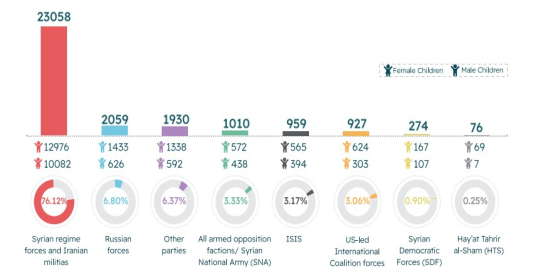
12.1.2 The Syrian Network for Human Rights (SNHR) report ‘On Worlds Children’s Day:13th Annual Report on Violations Against Children in Syria, published on 20 November 2024 noted that during the Al-Assad regime, between March 2011 and 20 November 2024 30,293 children have been killed in Syria.[footnote 71] The report produced the following graphic which documents the parties to the conflict who were reported to be responsible for the deaths.[footnote 72]
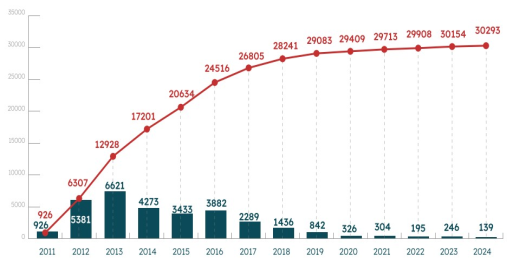
12.1.3 The SNHR report of November 2024 produced the below graph which shows the distribution of child deaths reported to have been caused by parties to the conflict and controlling forces, from 2011 to 2024.[footnote 73]
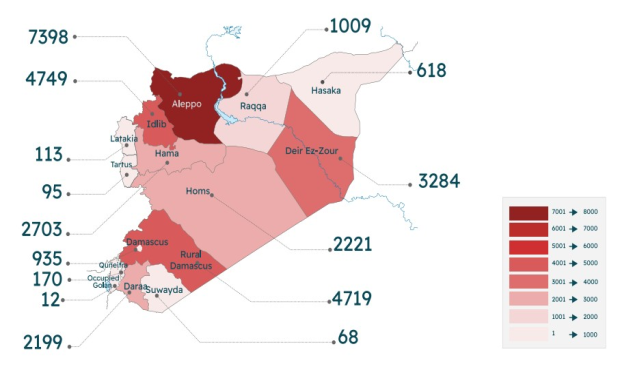
12.1.4 The SNHR report of November 2024 produced the below map which shows the distribution of child deaths, from March 2011 to November 2024, across the Syrian governorates, with the highest rates being concentrated in Aleppo (7398), Idib (4749) and Rural Damascus (4719).[footnote 74]
12.1.5 The August 2025 UN report on Children and Armed Conflict in Syria, covering the reporting period of 1 October 2022 to 31 December 2024 noted:
‘The United Nations verified the killing (498) and maiming (725) of 1,223 children (755 boys, 340 girls, 128 sex unknown) aged from a few months to 17 years in the final quarter of 2022 (75), in 2023 (476) and in 2024 (672). The number of child casualties decreased by 35 per cent during the reporting period when compared with the previous reporting period (1,891) [1 July 2020 to 30 September 2022[footnote 75]]. Casualties attributed to government forces and pro-government forces increased by 33 per cent compared with the previous reporting period (524). Child casualties accounted for 37 per cent of all verified violations during the reporting period.
‘Perpetrators of child casualties included government forces, pro-government forces and pro-government militias (699, or 62 per cent) (pro-government forces (413), pro-government air forces (218), pro-government militias (40) and Syrian government forces (28)), followed by unidentified perpetrators (400), SDF (66) (YPG/YPJ (58), Internal Security Forces (1) and other components of SDF (7)), the opposition [Syrian National Army] SNA (23) (unidentified factions (22) and Jaysh al-Izzah (1)), the Turkish Armed Forces (18), Israeli armed forces (11), Da’esh (5) and Hay’at Tahrir al-Sham (1). The north-western Governorates of Idlib (614) and Aleppo (287) remained the most affected, followed by Dayr al-Zawr (114), Dar‘a (65), Hasakah (44), Hama (31), Raqqah (22), Damascus (16), Qunaytirah in the occupied Syrian Golan (12), Homs (7), Rif Dimashq (5), Suwayda’ (3), Ladhiqiyah (2) and Tartus (1). Children were verified as having been killed (12) and reported as having been maimed (30) by rocket fire in the occupied Syrian Golan.
‘Ground-based shelling was the primary cause of child casualties, affecting 515 children (42 per cent), mainly in the Governorates of Idlib, Aleppo, Dayr al-Zawr and Hama. Explosive ordnance was the second leading cause (317 children, or 26 per cent), mainly in the Governorates of Dayr al-Zawr, Aleppo, Dar‘a, Idlib and Hasakah. The third leading cause of child casualties was air strikes (268 children or 23 per cent). The remaining child casualties were the result of gunshots (47), improvised explosive devices and vehicle-borne improvised explosive devices (40), drone attacks (32), knife attacks (2) and being run over by military vehicles (2). For example, in October 2023, an unidentified perpetrator launched a drone strike against a military college in Homs during a graduation ceremony, killing and injuring more than 280 persons, including 3 girls.’[footnote 76]
12.1.6 The Syrian Observatory for Human Rights (SOHR), an independent and impartial UK-based human rights organisation[footnote 77], noted on 8 November 2025 that 487 children had been killed since the fall of the Al-Assad regime. The source reported that the leading causes of child fatalities were explosions of old ordnance (185), infighting and indiscriminate gunfire (81) and murder (46).[footnote 78]
12.1.7 ITV News reported in December 2025 that: ‘Many returning families have found their homes badly damaged, and the mines littering the land are doing dreadful harm. 1400 children have been killed in the 12 months since Assad left, mainly because they went home unaware of the dreadful legacy left behind.’[footnote 79] ITV News did not provide any additional information regarding the report that 1,400 children had been killed since the fall of the Al-Assad regime and CPIT was unable to find any other sources that corroborate this figure.
12.1.8 In December 2025, the Danish Immigration Service (DIS) published a report entitled ‘Syria: Security Situation, Return and Documents’. The report is based on ‘… written sources, as well as data collected through online and in-person meetings with interlocutors in Europe, Damascus (Syria), and Beirut (Lebanon).’[footnote 80] The report stated: ‘The Syrian Observatory for Human Rights (SOHR) reported in September 2025 that between 8 December 2024 and 6 September 2025, 10,672 people were killed in Syria due to violence and human rights abuses, including 8,180 civilians—with 438 children and 620 women among them.’[footnote 81]
12.1.9 The same report stated: ‘Landmines and UXO continue to endanger civilian lives, hinder recovery efforts, and pose particular risks to children due to their distictive, brightly colored appearance and the children’s lack of awareness of risk as well as their natural curiosity.’[footnote 82]
12.1.10 A UNICEF report in January 2026 stated: ‘Explosive ordinance (EO) remains a significant threat to children, with 892 incidents recorded since December 2024, resulting in the deaths of 171 and injuring 436 children.’[footnote 83]
12.1.11 In January 2026, SNHR reported on the number of extrajudicial killings in 2025. It stated: ‘In 2025, SNHR documented the killing of 3,666 civilians, including 328 children… at the hands of the parties to the conflict and the controlling forces in Syria.’[footnote 84]
12.2 Child abuse, including corporal punishment and sexual violence
12.2.1 The NRC, in its Guide to Children’s Rights in Syria, July 2023, noted:
‘In addition to the general crimes of sexual abuse contained in the Penal Code, the Code lists specific crimes of sexual abuse against children, or which may be particularly applicable for children.
‘These include the following:
Sexual intercourse with a victim under the age of 15 without their consent, whether by violence or threat. [Article 489]
Sexual assault of minors aged between 15 and 18 by relatives or guardians. [Article 492(1)] The offence also applies to sexual abuse committed by civil servants, clerics, directors and employees who commit the offence by abusing his or her authority or by abusing the facilities at his or her disposal by virtue of his or her office. [Article 492(2)]
Use of force to compel a minor under the age of 15 to submit to or engage in an indecent act. [Article 493(2)]
Commission of an indecent act against a minor under 15 or inducing a minor to commit such an act. [Article 495(1)] Penalties for this offence are increased if the person is in a position of authority. [Article 496(1)]
Abduction of a minor under 15, irrespective of whether it is done by deception or violence, for the purpose of committing an indecent act. If the act is committed, the penalty is substantially increased. [Article 501]
Inappropriately touching or fondling a minor under the age of 15 or a woman over fifteen (15) without their consent. [Article 505]
Encouraging minors below 15 to commit indecent acts or addressing them in an indecent way. [Article 506]
Engaging in intercourse with someone who is unable to resist due to physical or psychological deficiency. [Article 491]
‘… Crimes for physical abuse or violence listed in the Penal Code also apply to children. These include the crimes of assault, rape, murder and other felonies. Specific offences relevant to children include kidnaping or hiding a child under the age of seven, replacing a child with another, or attributing to a woman a child who did not give birth to him or her. The penalties applicable under the Penal Code for the abuse of children depends on the severity of the harm inflicted upon the victim and also the length of time the person cannot work as a result of the injury. However, there is an exception given to parents. The Penal Code permits parents to use disciplinary forms established by common custom, including physical abuse.
‘… The state guarantees the protection of a child from family neglect which is defined as any act or lack of action resulting in harm to the child.’[footnote 85]
12.2.2 The US State Department 2024 Country Report on Human Rights Practices (the 2024 USSD report) published on 12 August 2025 noted: ‘There were reports of abuse of children by the [Al-Assad] regime. Officials reportedly targeted and tortured children because of their familial relationships, real or assumed, with political dissidents, members of the armed groups opposed to the Assad regime, and activist groups, and to compel family members to surrender.’[footnote 86]
12.2.3 The August 2025 UN Security Council report, covering events between 1 October 2022 to 31 December 2024, noted:
‘The United Nations verified cases of sexual violence against four girls attributed to Da’esh (3) and the opposition SNA (unidentified faction) (1) in Hasakah (3) and Aleppo (1) Governorates. Sexual violence stemming from deep-rooted social norms and affecting girls and boys is believed to be underreported owing to fear of stigmatization, the risk of reprisals, weak rule of law and prevailing impunity, as well as a lack of relevant support services and the safety concerns of the survivors. In addition, no sustainable measures have been taken by the parties to the conflict to end and prevent sexual violence against children and hold perpetrators accountable.’[footnote 87]
12.3 Early and forced marriage
12.3.1 The 2024 USSD report noted that:
‘Under the Assad regime the legal age for marriage was 18 for men and 17 for women. A boy as young as 15 or a girl as young as 13 could marry if a judge deemed both parties willing and “physically mature” and if the fathers or grandfathers of both parties consented. Many families reportedly arranged marriages for girls, including at younger ages than typically occurred prior to the start of the conflict, believing it would protect them and ease the financial burden on the family. Deteriorating economic conditions and the death or disappearance of men heads of household at the hands of the regime and other armed groups negatively affected children, for example by increasing rates of child labor and child marriage and limiting access to education. Most recent data reported that 13 percent of Syrian girls married before age 18.
‘…There were instances of early and forced marriage of girls to members of regime forces, proregime forces, and armed forces opposed to the Assad regime.
‘Early and forced marriages were reportedly also prevalent in areas under the control of armed groups, and citizens often failed to register their marriages officially due to fear of detention or conscription at regime checkpoints.’[footnote 88]
12.3.2 The USSD 2025 Trafficking in Persons (TiP) report published on 29 September 2025 gave an assessment of the situation during the Al-Assad regime. The report noted that: ‘All references to the Assad regime refer to events prior to December 8, 2024. References to the Syrian Interim Authorities reflect events between December 8, 2024 – March 31, 2025. On May 13, 2025, the United States recognized the Syrian Interim Authorities as the Government of Syria. This report only assesses the Assad regime and all references to the “government” or “Government of Syria” below are made in reference to the Assad regime’.[footnote 89] The report went on to note that:
‘Syrian children are reportedly vulnerable to forced and early marriages, including to members of terrorist groups such as [Islamic State of Iraq and Syria] ISIS – which can lead to sexual slavery and forced labor …
‘… ISIS forcibly held Syrian … women in “guesthouses,” where they were subjected to abuse until they agreed to marry ISIS fighters; some of these women reported further sexual exploitation and domestic servitude in the context of these forced marriages.’[footnote 90]
12.3.3 The Syria Joint Multi Sectoral Needs Assessment Report published in December 2025 noted:
‘Child marriage emerged as a common child protection concern, with 27.58% of respondents reporting that they have heard or observed children being exposed to this risk. Reported exposure was higher among female respondents 31.15% than male respondents 25.06 %, suggesting that women may be more likely to notice, discuss, or be approached about child marriage risks in their communities. Clear differences also appear by population group: IDPs reported the highest level 32.07%, followed by returnees 30.62%, while residents’ households reported a lower level 23.07%. Within population groups, the highest reporting was among returnee females 36.49% and IDP females 33.33%, compared with returnee males 26.53% and IDP males 30.85%, reinforcing that both displacement context and gender shape perceived child marriage risks.’[footnote 91]
12.3.4 See also the Country Policy and Information Note on Syria: Women.
12.4 Trafficking
12.4.1 The USSD 2025 TiP report noted:
‘The Assad regime did not report any anti-trafficking law enforcement efforts.
‘Decree No.3 of 2010 appeared to criminalize some forms of sex trafficking and labor trafficking, but it did not include a clear definition of human trafficking. This decree prescribed a minimum punishment of seven years’ imprisonment and a fine, a penalty that was sufficiently stringent but, with respect to sex trafficking, not commensurate with those prescribed for other grave crimes, such as rape.
‘An NGO reported the Assad regime and regime-aligned armed groups subjected … children in detention to conditions amounting to sexual slavery.
‘… The regime did not report investigating, prosecuting, or convicting government employees complicit in human trafficking, including some child soldiering crimes. The regime did not provide anti-trafficking training for law enforcement officials.
‘No information was available on the Syrian Interim Authorities’ anti-trafficking law enforcement efforts during the reporting period [1 April 2024 to 31 March 2025].
‘… The regime continued to severely punish victims, such as … sex trafficking victims, for unlawful acts committed as a direct result of being trafficked, such as … “prostitution.” The regime routinely arrested, detained, raped, tortured, and executed children for alleged association with political opponents, armed groups, and terrorist organizations and made no effort to screen for trafficking indicators or offer these children protection services. Isolated reports continued of the regime detaining … children – including unaccompanied children – across Syria for suspected family ties to foreign ISIS fighters; some of these individuals were unidentified trafficking victims.
‘No information was available on the Syrian Interim Authorities’ efforts to identify and protect trafficking victims.’[footnote 92]
13. Child labour
13.1 Law
13.1.1 The NRC, in its Guide to Children’s Rights in Syria, July 2023, noted:
‘Children as of the age of 15 are entitled to work in Syria, subject to certain restrictions, whilst child labour under the age of 15 is prohibited and punishable by law. Special protections are in place for working-age children which include limits on the type of work permitted, working hours and working conditions. The primary laws regulating working rights, conditions and entitlements for children are the Labour Law, the Minors’ Labour Regulations and the Child Rights Act. The Agricultural Relations Law governs the rights and entitlements of persons working in agriculture.
‘Employment of children under 15 constitutes child labour and is prohibited. However the age restriction does not apply if the minors are working in family businesses or domestic family industries restricted to family members, under the supervision of the father, mother, brother or uncle. Employers and their agents are responsible for verifying the ages of minors, obtaining a health certificate confirming their fitness for work and for obtaining the written consent from their parents or guardians.
‘…Employers who breach the provisions in relation to the employment of minors are subject to fines ranging from 25,000 to 50,000 SYP [£1.68- £3.37[footnote 93]]. Penalties for violations are also contained in the Child Rights Law.’[footnote 94]
13.2 Types, causes and prevalence
13.2.1 Humanium noted on its undated website:
‘Child labour was an issue in Syria prior to the war, but the humanitarian crisis that ensued has exacerbated the problem. Whether in Syria or in neighbouring countries, children are now forced to work in conditions that are mentally, physically, and socially dangerous environments.
‘In Syria, children may be sent away from their families to other parts of the country or to neighbouring countries to generate income, avoid being recruited, or avoid being injured in the conflict. Families that struggle to meet their basic needs are sometimes forced to put their children out to work, … Children work in agriculture, metal work, carpentry, restaurants, as well as sell items on the street, wash cars, collect trash, or even beg.’[footnote 95]
13.2.2 The NRC, in its Guide to Children’s Rights in Syria, July 2023, noted:
‘The Minors Labour Regulations sets out a detailed list of the industries in which minors are prohibited from working. These include underground work, mines or quarries, extractive industries, furnaces, industries subject to harmful radiation, gas factories, gas stations, power plants, abbatoirs, bleaching and dying fabrics, work involving high pressure machinery, medical and chemical labs, painting, garbage collection, driving, public toilets, forestry and timber work, work at dangerous latitudes, manufacture of explosives, cement, tin, glass, batteries, rubber, glue, sugar, soap, fertilisers and pesticides, chemical and oil industries, tanning, tobacco and alcoholic beverages, blacksmithing, electricity and welding. Conversely, minors can work in handicrafts and professions that do not affect their physical, emotional and psychological growth. For agricultural work, minors can only perform light work and should not undertake tiring types of work which do not suit their age.’[footnote 96]
13.2.3 The 2024 USSD Report noted:
‘Laws enforced by the Assad regime provided for the protection of children from exploitation in the workplace and prohibited all the worst forms of child labor, including limitations on working hours, occupational safety, and health restrictions for children. Restrictions on child labor did not apply to those who worked in family businesses and did not receive a salary.
‘Child labor, including its worst forms, occurred in the country in both formal and informal sectors, including begging, domestic work, and agriculture. Organized begging rings continued to subject children displaced within the country to labor trafficking. Conflict-related work such as serving as lookouts, spies, and informants subjected children to significant dangers of retaliation and violence. Various forces, particularly terrorist groups and regime-aligned groups, continued to recruit or use child soldiers.
‘Under the Assad regime the minimum age for most types of non-agricultural labor was 15 or the completion of elementary schooling, whichever occurred first, and the minimum age for employment in industries with heavy work was 17. Parental permission was required for children younger than 16 to work. Children younger than 18 could work no more than six hours a day and could not work overtime or during night shifts, weekends, or on official holidays.
‘The law specified that authorities were to apply “appropriate penalties” to violators; however, it was unclear whether such penalties were commensurate with those for analogous serious crimes, such as kidnapping. There was little publicly available information on enforcement of the child labor law against violators.’[footnote 97]
13.2.4 The Syria Joint Multi Sectoral Needs Assessment Report published in December 2025 noted:
‘Child labour emerged as the most frequently reported child protection risk in this assessment. Overall, respondents selected child labour in 59.75% of responses, indicating that it is widely observed or heard across communities. By gender, reporting was very similar, with 60.71% among female respondents and 59.08% among male respondents, suggesting that concern about child labour is broadly shared and not strongly gender differentiated.
‘Clear differences appear by population group. Child labour was reported most often among returnees at 63.04%, followed by IDPs at 60.87%, while host community households reported a lower but still substantial 55.94%. When combining gender and population status, returnee women reported the highest level at 64.04%, followed by returnee men at 62.35%; among IDPs, reporting was 60.00% for women and 61.70% for men; and among the host community it was 57.28% for women and 55.06% for men.’[footnote 98]
14. Childcare and protection
14.1 State support and shelters
14.1.1 There is limited available information regarding the support provided by the Syrian government. While some non‑governmental organisations may operate shelters and orphanages, it was not possible to clearly distinguish which facilities are state‑run and which are operated by non‑state actors. Accordingly, all available information pertaining to shelters has been included within this subsection. Information relating to the previous Al-Assad regime has also been included for completeness.
14.1.2 The NRC, in its Guide to Children’s Rights in Syria, July 2023, noted: ‘Care institutes shall provide care, education, vocational training and a proper job, as well as providing the necessary advice and guidance for juveniles. If care institutions are not available the court may find a juvenile work in an industrial, commercial or agricultural business under the supervision of a probation officer.’[footnote 99]
14.1.3 The World Vision August 2024 report, citing various sources, noted:
‘… Child-headed households who often face stigma, discrimination and social exclusion, cannot benefit from cash transfer programmes which exclude children under 18 as direct recipients, and only have limited access to humanitarian assistance (e.g. shelter, food) as they are not systematically included.
‘As a result, a growing number of children and adolescents are left without any support and are at the mercy of people who prey on acute emotional, psychological and socio-economic vulnerability.
‘… Child protection systems in the country are fragmented. There are no common standards of practice and the gap in capacity and resources is compounded by mistrust between the local authorities and non-governmental actors. In addition, while there have been attempts to “standardise” the delivery of specialised child protection services for [unaccompanied and separated children] UASC, the emphasis has been on supporting children after separation, with little priority given to preventing family separation.’[footnote 100]
14.1.4 The same source additionally stated:
‘As kinship-care arrangements disintegrated due to the war and multiple shocks, institutional or residential (e.g. orphanages) care emerged over the past few years. However very little is known about the availability and supply of institutions, the number of children present, and their quality of care. In fact, it is incredibly challenging to trace and therefore support children once they have left institutional care, due to the absence of reporting or oversight systems.
‘More generally, all types of alternative care – formal or informal – lack critical systematic checks, registration, regular monitoring and safeguarding systems (there is no monitoring system for kindship care), exposing children to a wide range of protection risk, including physical and emotional violence, abuse, neglect and exploitation. Unaccompanied and separated children in Northwest Syria are invisible: they are not recorded, accounted for, and their situation is largely unknown.
‘… Residential care is provided in non-family-based group settings such as orphanages, where children live and receive care and are placed by order of a competent authority. Residential care facilities can be operated by a government agency or by a private entity, including civil social organisations.’[footnote 101]
14.1.5 The following list details the orphanages in Syria. This is not an exhaustive list and although the websites were available at the time of writing, it is not possible to ascertain the current status of the orphanages listed.
- Heroic Hearts Syria Orphanage located in Idlib.
- Salesian Missions, provide support to 2 orphanages in Aleppo.
- Syrian Kids Orphanage Foundation provide ‘Community-based homes with trained caregivers, keeping siblings together whenever possible.’[footnote 102]
- Amal Al-Umma orphan center, based in northern Syria.
- SOS Children’s Villages, an international charity headquartered in Austria[footnote 103], run an orphanage located in Damascus. Several sources reported that SOS Children’s Villages orphanages were involved in hiding children in their orphanages, whose parents had been detained by the Al Assad regime.[footnote 104] [footnote 105] [footnote 106] [footnote 107]
14.1.6 BBC Eye Investigations documentary on Syria’s Stolen Children, published on 11 September 2025 noted: ‘At least 320 children of political detainees were taken by the Syrian intelligence and held in orphanages to extort their families between 2011- 2024. Among them were 14 newborns and more than 70 children under 3 years old.’[footnote 108]
14.1.7 The same source noted: ‘The intelligence leaks in our database reveal that many of the children were systematically held in orphanages, by the [Al Assad] regime, for the stated purpose of using them in prisoner exchange negotiations.’[footnote 109]
14.1.8 The USSD 2025 TiP report noted:
‘The [Assad] regime reportedly operated centers to assist orphaned children, child victims of crimes, including trafficking, and juvenile criminal offenders; however, observers reported poor conditions in these centers, which were not adequately equipped to provide specialized assistance to trafficking victims. In addition, the regime did not report assisting any child trafficking victims at these centers.
‘… No information was available on the Syrian Interim Authorities’ efforts to identify and protect trafficking victims.’[footnote 110]
14.2 Non-state support
14.2.1 The UN High Commissioner for Refugees (UNHCR), in its ‘Fact Sheet: Child Protection in Syria, January-June 2024’, published 14 January 2025, noted:
‘The establishment of child protection community-based structures is an important first step in enabling the community to protect and support its children. During the first half of 2024, 207 structures were maintained and supported including children’s clubs and child welfare committees, as part of enhancing community engagement and ownership of child protection.
‘Children’s clubs bring together children (6-18 years) of the community and they play an active role in child protection within schools and communities. The clubs advocate for children’s rights, identify and report on child protection concerns in the communities, share information with children on how to access child protection services, provide peer support to the children within their schools and communities, and raise awareness among the children on issues related to their rights through debates and role playing.
‘Child welfare committees are composed of members of the communities (such as teachers, social workers, and community leaders) who are responsible for identifying specific child protection issues and trends within the communities. They also advocate for, and provide appropriate support to, children facing risks through community engagement. In addition, they raise awareness on children’s rights, child protection issues, and services available for children.’[footnote 111]
14.2.2 UNICEF in their Syrian Arab Republic Humanitarian Situation Report No. 15, published in September 2025 noted:
‘In September [2025], UNICEF and partners reached 78,840 individuals through child protection interventions, including 54,197 children (29,098 girls) … A total of 1,710 children (869 girls) received case management support, enabling timely identification and response to protection concerns. Mental health and psychosocial support (MHPSS) services reached 11,162 children (6,185 girls), helping to reduce distress and strengthen coping mechanisms. Psychological first aid (PFA) was provided to 3,864 individuals, including 1,875 children and 1,989 caregivers, enhancing their emotional resilience in crisis situations. Parenting sessions equipped 5,439 caregivers (4,894 women) with positive parenting skills to support children’s development and protection. Explosive ordnance risk education (EORE) sessions increased awareness and safety for 42,363 individuals, including 31,521 children, in areas affected by explosive remnants of war.’[footnote 112]
14.2.3 The Child Protection Area of Responsibility (CP AoR) in Syria, led by UNICEF, coordinates the efforts of national and international humanitarian actors to ensure a coherent and effective child protection response. The CP AoR works to safeguard children from abuse, neglect, exploitation, and violence, supporting both prevention and response activities across the humanitarian system.[footnote 113] [footnote 114] The February 2026 UNOCHA report stated that between January and November 2025:
‘The Child Protection AoR reached 1.7 million people, including more than 1.3 million children, with specialized case management, mental health and psychosocial support, parenting programmes, and prevention initiatives addressing harmful social norms and high-risk behaviors. UNICEF supported strategic coordination through the development and rollout of key frameworks, including the Syria Child Protection AoR Strategy, the capacity-building and localization strategies, and the National Prevention Toolkit. By December, 12,478 frontline child protection staff from national NGOs and government counterparts had been trained, strengthening national capacities to deliver quality child protection services aligned with global standards.’[footnote 115]
14.2.4 In April 2025, the UNHCR launched Syria is Home, a website that offers refugees and internally displaced Syrians information and guidance on how to access support and services available in Syria.[footnote 116]
14.2.5 In January 2026 the Al-Hol camp in northeastern Syria, which had been home to about 24,000 people more than half of them children, closed after an increase in violence in the region. Save the Children noted that: ‘It remains unclear how residents left the camp or where many have gone.’[footnote 117]
14.2.6 The Services Advisor Syria available on the Syria is Home website provides a list of services available across Syria.
14.2.7 UNICEF have provided lists of free available services across governorates in Syria. The services include child protection and education UNICEF Programme Service Mapping in Syria.
14.2.8 UNHCR have a list of supported Community Centres across Syrian governorates (in Arabic only).
14.3 Prosecutions of crimes against children
14.3.1 Atlantic Council, a nonpartisan organisation that promotes constructive leadership and engagement in international affairs[footnote 118], noted in an article from December 2025 that:
‘Syria has begun building out its national architecture of transitional justice. In May [2025], transitional President Ahmad al-Sharaa issued Decree No. 20, establishing the National Commission for Transitional Justice with “financial and administrative independence.” Commissioners were appointed three months later, and they have begun meeting with civil society organizations, Syrians across the country and in the diaspora, and representatives from foreign governments, international bodies, and other post-conflict societies. However, the commission’s structure and internal regulations remain unclear, without a statute or terms of reference, and its scope of work is limited to Assad regime violations, excluding violations by other actors and those committed after December 8, 2024.
‘… Syria’s Ministry of Justice has also begun investigating and building cases on Assad regime violations. The Ministry of Justice is investigating judges from the Assad-era Counter Terrorism Court and requesting complaints from citizens.
‘Finally, Syria has made progress addressing violations since December 8, 2024. The government established national committees to investigate two episodes of mass sectarian violence: in Alawite-majority coastal areas in March this year and in Druze-majority Sweida in July. The coastal committee was criticized for not releasing its report publicly and failing to acknowledge the government’s responsibility for the crimes. Nevertheless, the committee’s efforts have led to Syria’s first public trial in decades, of fourteen suspects in the March violence in coastal Syria.’[footnote 119]
14.3.2 There is no available information regarding the prosecution of crimes against children in the sources consulted (see Bibliography).
15. Documentation
15.1 Citizenship
15.1.1 The Syrian Nationality Law was enacted in 1969, through Legislative Decree 276.
15.1.2 Article 3 of the Legislative Decree stated:
‘The following shall be considered as Syrian Arabs ipso facto:
a. Anyone born inside or outside the country to a Syrian Arab father.
b. Anyone born in the country to a Syrian Arab mother and whose legal family relationship to his father has not been established.
c. Anyone born in the country to unknown parents of unknown nationality or without one. A foundling in the country shall be considered born in it, at the place in which he is found unless proved otherwise.
d. Anyone born in the country and was not, at the time of his birth, entitled to acquire a foreign nationality by virtue of his parentage.
e. Anyone with Syrian origin but has not acquired another nationality and has not applied for the Syrian nationality within the deadlines stipulated in the past decision and regulations. The provisions of this Article shall apply even if the date of birth was before this Legislative Decree entered into force.’[footnote 120]
15.2 Birth registration and certificates
15.2.1 The NRC, in its Guide to Children’s Rights in Syria, July 2023, noted:
‘The father has primary responsibility for registration of the births of children of the marriage, and in his absence the mother or adult relatives are responsible. Births must be registered with the Civil Status Department within three months of the child’s birth or nine months if the birth takes place outside of Syria. Fines are applicable if the birth is registered outside of the time limits.
‘Children can only be registered if the parents are legally married. If the marriage is not registered or the child is born out of wedlock, the child can still be registered but without the name of the mother or father on the birth certificate unless they expressly consent or unless there is a court decision authorizing this. Children of unknown parentage will be registered in the Civil Registry after the government agency responsible for such children, namely the Melody of Life Homes, chooses a name, including parental names and a family name, for the child. The Melody of Life Homes are also responsible for issuing a birth attestation and registering the child with the Civil Registry.
‘… Birth certificates for Syrian children born abroad must be obtained in accordance with the laws and procedures for the countries in which they are born. The birth certificates must then be registered with the closest Syrian Embassy or Consulate who will transfer the information to the Ministry of Foreign Affairs for entry in the records of the General Directorate for Civil Affairs in Syria. Conversely, if it is difficult to access the Embassy or Consulate a certified copy of the birth certificate may be presented directly to the Civil Registry in Syria. In practice many thousands of Syrian children born outside of Syria have not been registered with Syrian Embassies or Consulates.
‘If a child is not registered by the age of 18, they can only be registered following a decision issued by a subcommittee that is formed by decision of the governor at the center/municipality of the governorate. Births of children of unregistered fathers or mother, who follow the nationality of the mother, can only be recorded following a decision issued by a central committee, formed under a ministerial decision.’[footnote 121]
15.2.2 According to HM Passport Office Syria: Knowledge Base profile published on 18 September 2025:
‘All births in Syria must be registered within 30 days of the birth at the Civil Registry department where:
- the father’s civil records are kept; or,
- where the birth took place in Syria
‘A birth certificate is issued at the time of registration.
‘Late registration is allowed. If a birth is registered more than 1 year after the date of birth, a police report will be submitted when the birth is registered and a fine will be applied.
‘When a birth is registered in Syria, the parents are issued with a civil status registration document.’[footnote 122]
15.2.3 The same source also noted that: ‘Since the fall of the Assad regime in December 2024, Syria has suspended civil status registrations indefinitely. This includes: births …’[footnote 123]
15.3 ID Cards
15.3.1 UNHCR in an undated document on Civil Documentation and Registration in the Syrian Arab Republic noted: ‘Every Syrian citizen (male and female) who reaches 14 years of age must obtain an ID card from the civil registry at which his/her records are kept; this must be done within one year from the date of reaching the age of 14. It is the responsibility of a minor’s parents/guardian to apply for the ID card either for the first time or for a replacement later on.’[footnote 124]
15.3.2 The Global Protection Cluster, a network of nongovernmental organisations, report published in December 2024 noted: ‘Children under 5 years old (20%) and adolescents (13%) are the highest population group without civil documentation.’[footnote 125]
15.3.3 The UNHCR Syria is Home website stated (at the time of writing) that ‘Services related to the issuance of ID cards are currently suspended until further notice but temporarily you can obtain a civil record extract reflecting your BIO data.’[footnote 126] For more information regarding civil record extracts see the Country Policy and Information Note on Syria: Internal Relocation.
16. Return and reintegration
16.1 Returnees
16.1.1 The UNHCR Syria is Home website noted that:
‘The interim authorities in Syria require that all children entering Syria have a birth certificate and are accompanied by a parent or legal guardian.
‘If your children were born outside Syria and have not been registered in Syrian records through diplomatic missions abroad or through civil affairs offices in Syria, they will need a birth certificate issued by the country of birth.
‘Birth notifications from medical institutions, such as hospitals, may exceptionally be accepted for unregistered children when entering Syria.
‘… Children under 18 years returning to Syria need to be accompanied by an adult parent, relative, or guardian. Alternatively, a travel authorization issued by the parents abroad needs to be presented.’[footnote 127]
16.1.2 The Danish Immigration Service December 2025 report stated:
‘The Syrian authorities at the borders are particularly facilitative in cases involving children who have not been registered with the Syrian authorities. Such children are allowed to enter Syria if they can provide documentation proving their familial link to at least one parent with Syrian citizenship. For example, a birth notification from the hospital abroad where the child was born is considered sufficient documentation for entry into Syria, provided that the child is accompanied by his or her Syrian parent. Accepted foreign birth notifications include uncertified documents (i.e. without official stamps) issued by hospitals, midwives, or doctors. In some cases, a child may be allowed to enter the country without a birth notification, simply by presenting documents proving that the parents are married (e.g. a family booklet) or the parents’ Syrian citizenship (e.g. a copy of a passport).
‘Contrary to the above-mentioned information, SNHR stated that children without Syrian documents are permitted entry if they are accompanied by a father with valid Syrian documents; in such cases, foreign-issued documents confirming the parent-child relationship are accepted as sufficient proof for entry.’[footnote 128]
16.2 Reintegration
16.2.1 Lena-Maria Möller in a research paper on Syria: The Role of Family and Social Networks for Returning Syrian Refugees for the Austrian Federal Office for Immigration and Asylum published on 21 October 2025 noted:
‘Family remains the primary source of support for Syrians returning from abroad. However, not all returnees can draw on kinship networks. Some have lost relatives during the conflict, others are estranged, and many return to places where family is no longer present. In such circumstances, the question arises as to what alternatives are available to help returnees rebuild their lives. Research indicates that religious institutions, NGOs, and community associations may offer important forms of assistance, yet such support does not always match the depth, durability, and reciprocity provided by kinship ties.
‘Mosques and churches have long been central to social life in Syria. Beyond their religious role, they function as hubs of charity and community solidarity. For returnees without family support, religious charities may provide temporary shelter or distribute food. In this way, religious institutions partially substitute for kinship networks, offering both material and emotional support. Yet such assistance is usually limited in scope and duration; unlike family, religious institutions rarely provide long-term housing or sustained financial support.
‘Non-governmental organisations (NGOs) and international humanitarian agencies also play a role in filling the gap left by absent family networks. The Syria is Home platform outlines the forms of assistance and financial support available to Syrian refugees, with particular focus on those returning from regional host states such as Jordan, Lebanon, Egypt, Iraq, and Türkiye. The provision of such support reflects both humanitarian imperatives and broader efforts to facilitate reintegration in a context marked by protracted displacement and widespread material deprivation. The type and scale of assistance are shaped by vulnerability assessments, registration status, and the geographical area of return, with eligibility determined through UNHCR criteria and the operational capacities of implementing partners.’[footnote 129]
16.2.2 The UNHCR Syria is Home website noted that cash assistance was available for those who had returned permanently to Syria. Families may be eligible for a one-off cash grant of $600 [£452[footnote 130]] from the UNHCR Syria to help return and reintegration. Only one grant is provided per family and the source does not give information on whether child-headed households are eligible for this assistance.[footnote 131]
16.2.3 Handicap International noted in February 2025:
‘Returning families often find their homes, roads, and agricultural lands unsafe, with little to no clearance efforts completed in many areas. In the month of December 2024 alone, the number of casualties from [Explosive Ordinance] EO tripled from previous months, with children accounting for about 50 per cent of casualties… This vulnerability is further compounded by the destruction of infrastructure, limited access to healthcare, and a lack of awareness about the risks posed by EO… The situation is further aggravated in displacement settings, where overcrowding, lack of privacy, and poor living conditions expose women and children with disabilities to even greater risks.’[footnote 132]
16.3 Family reunion
16.3.1 UNHCR reported that: ‘The International Committee of the Red Cross (ICRC) helps families reconnect with missing loved ones who have lost contact because of armed conflict, migration, and disaster. In Syria, ICRC works in coordination with the Syrian Arab Red Crescent (SARC).’[footnote 133]
16.3.2 The British Red Cross in an April 2023 interview with Mohamad, a Syrian volunteer in the Restoring Family Links team, reported that:
‘The International Family Tracing team Mohamad volunteers for sits within our Restoring Family Links service. This is a Red Cross and Red Crescent Movement programme which helps to connect people with missing family members and reunite those separated. It is a free and confidential service delivered by volunteers, and is run from locations all over the country.
‘Around the world, more than 145,000 people have been reported as missing by their families to the Red Cross and Red Crescent network. This is unfortunately just a fraction of those who have disappeared.
‘To help families reconnect with missing loved ones, we also have Trace the Face, an online photo gallery of people looking for lost relatives. Since 2013, Trace the Face has helped to reunite hundreds of people. For more information on our Restoring Family Links work, go to our homepage, or read more about Trace the Face.’[footnote 134]
16.3.3 Save the Children noted: ‘Through our family tracing and reunification work, we help reunite children that have been separated from their families.’[footnote 135]
16.3.4 The UNHCR Syria is Home website provided advice on how to trace family in Syria the FAQ’s and noted:
‘If you lost contact with a family member due to conflict, migration, or disaster, the International Committee of the Red Cross (ICRC) in coordination with the Syrian Arab Red Crescent (SARC), provides family tracing services to help families reconnect with missing loved ones.
‘Family tracing is not a guarantee that a lost family member will be found, and tracing can sometimes take months or years.
‘However, ICRC will collect information that may help clarify the fate and whereabouts of missing family. When tracing is successful, ICRC will inform families of the whereabouts of their loved ones and, when possible, help to reunite those families.
‘Families can also contact ICRC offices in Damascus and Rural Damascus, Aleppo or Homs directly with the usual Protection of Family Links phone number … The helplines are working from Sunday to Thursday, from 8:30 a.m. to 5:00 p.m., except on official holidays.’[footnote 136]
16.3.5 The International Commission on Missing Persons (ICMP): ‘… maintains a centralized, secure data repository that, to date, has collected data from almost 60,000 family members who have reported almost 23,000 relatives who have gone missing in the Syrian context. The repository is growing steadily as more and more families provide information.’[footnote 137]
16.3.6 The International Red Cross provide a free and confidential services to help find missing relatives.
Research methodology
The country of origin information (COI) in this note has been carefully selected in accordance with the general principles of COI research as set out in the Common EU [European Union] Guidelines for Processing Country of Origin Information (COI), April 2008, and the Austrian Centre for Country of Origin and Asylum Research and Documentation’s (ACCORD), Researching Country Origin Information – Training Manual, 2024. Namely, taking into account the COI’s relevance, reliability, accuracy, balance, currency, transparency and traceability.
Sources and the information they provide are carefully considered before inclusion. Factors relevant to the assessment of the reliability of sources and information include:
- the motivation, purpose, knowledge and experience of the source
- how the information was obtained, including specific methodologies used
- the currency and detail of information
- whether the COI is consistent with and/or corroborated by other sources
Commentary may be provided on source(s) and information to help readers understand the meaning and limits of the COI.
Wherever possible, multiple sourcing is used and the COI compared to ensure that it is accurate and balanced, and provides a comprehensive and up-to-date picture of the issues relevant to this note at the time of publication.
The inclusion of a source is not, however, an endorsement of it or any view(s) expressed.
Each piece of information is referenced in a footnote.
Full details of all sources cited and consulted in compiling the note are listed alphabetically in the bibliography.
Terms of reference
The ‘Terms of Reference’ (ToR) provides a broad outline of the issues relevant to the scope of this note and forms the basis for the country information.
The following topics were identified prior to drafting as relevant and on which research was undertaken:
- Demography
- Population
- Family structure
- Legal context
- Definition of a child
- International law
- Social and economic rights
- Education
- Health and welfare
- Children with disabilities
- Street children
- Orphaned/abandoned children
- Child poverty
- Humanitarian situation
- Juvenile justice
- Judicial and penal rights
- Juvenile detention
- Child soldiers
- Forced recruitment
- Violence against children
- Killing and maiming
- Child abuse, including corporal punishment and sexual violence
- Early and forced marriage
- Trafficking
- Child labour
- Prevalence
- Types of child labour
- Childcare and protection
- Government support and protection
- Government shelters
- NGO support and shelters
- Orphanages
- Documentation
- Citizenship
- Birth registration and certificates
- Other documentation
- Return and reintegration
- Returnees
- Reintegration
- Family reunion
Bibliography
Sources cited
Al-Jumhuriya, The Orphanage That Hid Us, 31 October 2025. Accessed: 12 January 2026
Atlantic Council:
-
About the Atlantic Council, no date. Accessed: 11 February 2026
-
One year after Assad’s fall, here’s what’s needed to advance justice for Syrians, 7 December 2025. Accessed: 11 February 2026
BBC:
-
Syria gets temporary constitution for five-year transition, 14 March 2025. Accessed: 10 February 2026
-
Eye Investigations - Syria’s Stolen Children, 11 September 2025. Accessed: 23 December 2025
-
Mothers and staff tell of global charity’s role in child disappearances under Assad regime, 11 September 2025. Accessed: 12 January 2026
Bertelsmann Stiftung, Transformation Index (BTI):
-
About the BTI, no date. Accessed: 16 December 2025
-
At a glance, no date. Accessed: 16 December 2025
-
BTI 2024 Syria Country Report, 19 March 2024. Accessed: 16 December 2025
British Red Cross, Syrian people search for their missing relatives, 25 April 2023. Accessed: 10 December 2025
Cultural Atlas, About, no date. Accessed: 3 December 2025
Danish Immigration Service, Syria: Security situation, Return and Documents, 9 December 2025. Accessed: 16 December 2025
Enab Baladi:
-
About us, no date. Accessed: 11 March 2026
-
Destroyed Schools and Multiple Curricula: A new school year in Syria rises from the rubble, 16 September 2025. Accessed: 11 March 2026
European Union Agency for Asylum (EUAA), Country Guidance: Syria, April 2024. Accessed: 22 December 2025
Evason, N, Cultural Atlas, Syrian Culture, 2016. Accessed: 3 December 2025
Global Protection Cluster (GPC):
-
About, no date. Accessed: 6 February 2026
-
Child Protection, no date. Accessed: 6 February 2026
-
Escalation of Hostilities. Flash Report #2; December 4 2024, 4 December 2024. Accessed: 22 December 2025
Handicap International:
-
About us, no date. Accessed: 23 December 2025
-
Advocacy Factsheet- Leaving No One Behind: Persons with Disabilities in the Syrian Humanitarian Response, February 2025. Accessed: 22 December 2025
HM Passport Office, Syria: Knowledge Base profile, 18 September 2025. Accessed: 17 December 2025
Humanium:
-
Who we are, no date. Accessed: 10 December 2025
-
Children of Syria, no date. Accessed: 10 December 2025
International Commission on Missing Persons (ICMP), Syria, no date. Accessed: 22 December 2025
International Household Survey Network (IHSN), Syria, no date. Accessed: 10 February 2026
International Humanitarian Relief Association (IYD), About us, no date. Accessed: 11 February 2026
ITV News, One year after Assad fall Syria’s displaced children dream of going home, 12 December 2025. Accessed: 20 January 2026
Lebanese American University (LAU) School of Arts and Sciences (SOAS), Children at a Crossroads: Hope and Hardship in Post-Assad Syria, 21 July 2025. Accessed: 20 January 2026
Lighthouse Reports, Syria’s Stolen Children, 11 September 2025. Accessed: 12 January 2026
Möller, Lena-Maria:
-
Legal reform for Syria’s war-affected children: adoption, fostering, and state responsibility in transition, 17 October 2025. Accessed: 11 February 2026
-
Staatendokumentation Research Paper; Syria: The Role of Family and Social Networks for Returning Syrian Refugees; from the COI-CMS, 21 October 2025. Accessed: 9 December 2025
Norwegian Refugee Council (NRC):
-
About us, no date. Accessed: 8 December 2025
-
Guide to Children’s Rights in Syria, July 2023. Accessed: 8 December 2025
The Observer, How a western charity helped the Syrian regime abduct children, 11 September 2025. Accessed: 12 January 2026
Office of the Special Representative of the Secretary General for Children and Armed Conflict (SRSG CAAC), Syria: Children Continue to be Affected by Years of Conflict, While the Political Transition Brings Hope for Children, 4 November 2025. Accessed: 10 February 2026
Office of the United Nations High Commissioner for Human Rights (OHCHR), Ratification Status for Syrian Arab Republic, no date. Accessed: 8 December 2025
Qatar University, Lena-Maria Möller, no date. Accessed: 9 December 2025
ReliefWeb, Syria Child Protection AoR, no date. Accessed: 6 February 2026
Save the Children:
-
Syria, Our Work, no date. Accessed: 10 December 2025
-
Closure of Syria’s Al-Hol camp Leaves Thousands of Children at Risk and Facing Uncertain Futures, 19 February 2026. Accessed: 18 March 2026
-
Social Association for Relief and Development (SARD), Our Core, no date. Accessed: 11 February 2026
SOS Children’s Villages:
-
Who we are, no date. Accessed: 12 January 2025
-
Our commitment to truth and family tracing support in Syria, 16 December 2024. Accessed: 22 December 2025
Syrian Arab Republic:
-
Legislative Decree 276 - Nationality Law, 24 November 1969. Accessed: 17 December 2025
-
Constitutional declaration, 13 March 2025. Accessed: 10 February 2026
The Syrian Observatory for Human Rights:
-
About Us, no date. Accessed: 10 February 2026
-
Including 8,654 civilians, 11,226 people killed in Syria since fall of Al-Assad regime, 8 November 2025. Accessed: 20 January 2026
Syrian Justice and Accountability Centre:
-
About, no date. Accessed: 22 December 2025
-
Forgotten in Transitional Justice: Syrians with Disabilities,16 November 2023. Accessed: 22 December 2025
Syrian Network For Human Rights (SNHR):
-
About Us, no date. Accessed: 12 January 2026
-
On World Children’s Day: SNHR’s 13th Annual Report on Violations Against Children in Syria, 20 November 2024. Accessed: 8 December 2025
-
Strengthening the Child Protection System in Syria: Addressing the Legacy of Fifteen Years of Systematic Violations and Ensuring a Safe Future for Generations, 21 November 2025. Accessed: 23 December 2025
-
Monthly Report for Victims of Extrajudicial Killing in Syria, 1 January 2026. Accessed: 11 March 2026
Syrian Orphanage Foundation, Our Mission, no date. Accessed: 12 January 2026
Syrians for Truth & Justice (STJ):
-
About STJ, no date. Accessed: 22 December 2025
-
Rights of Persons with Disabilities in Syria: Untapped Legislation and Enduring Challenges, 3 December 2024. Accessed: 22 December 2025
UNICEF:
-
Education, no date. Accessed: 8 December 2025
-
Humanitarian Situation Report No.12, 1 August 2025. Accessed: 10 December 2025
-
Syrian Arab Republic Humanitarian Situation Report No. 15, 30 September 2025. Accessed: 3 December 2025
* Bringing schools back to life, one classroom at a time, 5 November 2025. Accessed: 8 December 2025
-
As Syria’s children step out of the shadows of war, securing their future is more critical than ever, 25 March 2025. Accessed: 22 December 2025
-
Delivering impactful results for every child and young person in Syria 2025-2026, October 2025. Accessed: 25 March 2026
-
Humanitarian Situation Report No. 18, 28 January 2026. Accessed: 11 March 2026
United Nations Development Programme (UNDP), The impact of the conflict in Syria: a devastated economy, pervasive poverty and a challenging road ahead to social and economic recovery, 20 February 2025. Accessed: 14 January 2026
United Nations High Commissioner for Refugees (UNHCR):
-
Civil Documentation and Registration in the Syrian Arab Republic, no date. Accessed: 17 December 2025
-
Fact Sheet: Child Protection in Syria, January - June 2024, 14 January 2025. Accessed: 9 December 2025
-
Family Tracing Syria, no date. Accessed: 10 December 2025
-
Frequently Asked Questions, no date. Accessed: 10 December 2025
-
Services Advisor Syria, no date. Accessed: 10 December 2025
-
Syria is Home, no date. Accessed: 10 December 2025
-
Assistance and financial support, no date. Accessed: 16 March 2026
United Nations Office for the Coordination of Humanitarian Affairs (UNOCHA):
-
Syrian Arab Republic: 2024 Humanitarian Needs Overview, 3 March 2024. Accessed: 22 December 2025
-
Syrian Arab Republic: Humanitarian Overview Issue No. 3 - December 2025 - A Year in Review, 3 February 2026. Accessed: 5 February 2026
United Nations Population Fund (UNFPA), World Population Dashboard, 2025. Accessed: 2 December 2025
United Nations Security Council:
-
Children and armed conflict in the Syrian Arab Republic, 27 October 2023. Accessed: 3 December 2025
-
Children and armed conflict in the Syrian Arab Republic, 28 August 2025. Accessed: 3 December 2025
UN Office of the Special Representative of the Secretary-General for children and armed conflict, Looking Forward: a New Window of Hope for Children in Syria, 19 February 2026. Accessed: 5 March 2026
United States Census Bureau, Population Clock: Syria, 1 July 2025. Accessed: 19 January 2026
US State Department (USSD):
-
2023 Report on International Religious Freedom, 26 June 2024. Accessed: 9 December 2025
-
2024 Country Report on Human Rights Practices, 12 August 2025. Accessed: 3 December 2025
-
2025 Trafficking in Persons Report, 29 September 2025, Accessed: 3 December 2025
Welthungerhilfe (WHH), About us, no date. Accessed: 11 February 2026
Welthungerhilfe (WHH), Social Association for Relief and Development (SARD), International Humanitarian Relief Association (IYD), Syria Joint Multi-Sectoral Needs Assessment, 31 December 2025. Accessed: 11 February 2026
World Vision International:
-
Our vision and values, no date. Accessed: 12 January 2026
-
Lost and Alone - Addressing the Crisis of Unaccompanied and Separated Children in Post-Earthquakes Northwest Syria and Southern Türkiye, 8 August 2024. Accessed: 12 January 2026
Xe.com:
-
Syrian Pounds to British Pounds Exchange Rate, 16 December 2025. Accessed: 16 December 2025
-
US Dollars to British Pounds Exchange Rate, 14 January 2026. Accessed: 14 January 2026
-
US Dollars to British Pounds Exchange, 11 March 2026. Accessed: 11 March 2026
-
US Dollars to British Pounds Exchange, 16 March 2026. Accessed: 16 March 2026
Sources consulted but not cited
ABC News, Recruitment of children by armed groups in Syria is on the rise, even as fighting subsides, 28 June 2023. Accessed: 16 December 2025
Anadolu Agency, Syria’s Idlib hosts some 1.2M orphans, 12 May 2021. Accessed: 20 January 2026
BBC News, Fathers from Omagh and Syria forge friendship through shared trauma, 21 October 2025. Accessed: 10 December 2025
The Borgen Project:
-
The Socioeconomic Situation of Children in Syria, 18 June 2024. Accessed: 20 January 2026
-
A Nation in Poverty: An Analysis of Being Poor in Syria, 6 September 2025. Accessed: 10 February 2026
Daraj, Syria’s Forcibly Disappeared Children: What Is the Responsibility of International Organizations for Children?, 23 December 2024. Accessed: 12 January 2026
Defence for Children International, Returning Syrian children and families- Premature and irresponsible discussions, 6 January 2025. Accessed: 17 December 2025
DW, Disabilities in Syria: A ‘hidden’ crisis, 8 May 2023. Accessed: 22 December 2025
Freedom House, Freedom in the World 2025, 26 February 2025. Accessed: 16 December 2025
Humanity & Inclusion UK, Generation of Syrians left with trauma and disabilities, 17 December 2024. Accessed: 22 December 2025
Human Rights Watch (HRW):
-
“It Was Really Hard to Protect Myself”: Impact of the Armed Conflict in Syria on Children with Disabilities, 8 September 2022. Accessed: 5 January 2026
-
World Report 2025, 16 January 2025. Accessed: 16 December 2025
No Lost Generation, Child Protection, no date. Accessed: 20 January 2026
North Press Agency, War leaves Syrian children to bear brunt of disabilities, death, 20 November 2023. Accessed: 22 December 2025
NPR, Syria’s missing children: Hidden in orphanages under Assad, where are they now? : Goats and Soda, 16 March 2025. Accessed: 12 January 2026
Save the Children International, Over 400,000 children in Syria at risk of malnutrition following aid cuts, 16 April 2025. Accessed: 23 December 2025
SOS Children’s Villages, Our commitment to truth and family tracing support in Syria, 16 December 2024. Accessed: 23 December 2025
The Tahrir Institute for Middle East Policy, Northwest Syria’s Children Erased: The Impacts of Statelessness, 14 February 2024. Accessed: 20 January 2026
UNFPA, Voices from Syria 2024, 2024. Accessed: 5 January 2026
UNICEF, Paving the road to a hopeful and inclusive future in Syria, free from violence and hardship, 23 January 2025. Accessed: 20 January 2026
UN News, ‘We all have someone missing’: Families of the thousands of Syrians ‘disappeared’ by Assad regime share stories of loss, 10 February 2025. Accessed: 10 December 2025
Worldometer, Syria Population (2025), no date. Accessed: 19 January 2026
World Vision International:
-
After 14 years of crisis, Syrian children face unprecedented challenges, 12 March 2025. Accessed: 8 December 2025
-
Unaccompanied Syrian children in need of mental health support, 11 December 2024. Accessed: 7 January 2026
-
Lost and Alone - Addressing the Crisis of Unaccompanied and Separated Children in Post-Earthquakes Northwest Syria and Southern Türkiye, 8 August 2024. Accessed: 12 January 2026
Version control and feedback
Clearance
Below is information on when this note was cleared:
- version 1.0
- valid from 25 March 2026
Official – sensitive: Not for disclosure – Start of section
The information in this section has been removed as it is restricted for internal Home Office use only.
Official – sensitive: Not for disclosure – End of section
Changes from last version of this note
New CPIN on this topic.
Feedback to the Home Office
Our goal is to provide accurate, reliable and up-to-date COI and clear guidance. We welcome feedback on how to improve our products. If you would like to comment on this note, please email the Country Policy and Information Team.
Independent Advisory Group on Country Information
The Independent Advisory Group on Country Information (IAGCI) was set up in March 2009 by the Independent Chief Inspector of Borders and Immigration to support them in reviewing the efficiency, effectiveness and consistency of approach of COI produced by the Home Office.
The IAGCI welcomes feedback on the Home Office’s COI material. It is not the function of the IAGCI to endorse any Home Office material, procedures or policy. The IAGCI may be contacted at:
Independent Advisory Group on Country Information
Independent Chief Inspector of Borders and Immigration
3rd Floor
28 Kirby Street
London
EC1N 8TE
Email: chiefinspector@icibi.gov.uk
Information about the IAGCI’s work and a list of the documents which have been reviewed by the IAGCI can be found on the Independent Chief Inspector’s pages of the GOV.UK website.
-
UNFPA, World Population Dashboard, 2025 ↩
-
UNFPA, World Population Dashboard, 2025 ↩
-
United States Census Bureau, Population Clock: Syria, 1 July 2025 ↩
-
Evason, N, Cultural Atlas, Syrian Culture (Family), 2016 ↩
-
Evason, N, Cultural Atlas, Syrian Culture (Family), 2016 ↩
-
World Vision, Our vision and values, no date ↩
-
World Vision, Lost and Alone - Addressing the Crisis of Unaccompanied and …, 8 August 2024 ↩
-
Qatar University, Lena-Maria Möller, no date ↩
-
Möller, Lena-Maria, Staatendokumentation Research Paper; Syria: The Role of…, 21 October 2025 ↩
-
BBC News, Syria gets temporary constitution for five-year transition, 14 March 2025 ↩
-
Syrian Arab Republic, Constitutional declaration, 13 March 2025 ↩
-
NRC, Guide to Children’s Rights in Syria (page 19), July 2023 ↩
-
NRC, Guide to Children’s Rights in Syria (pages 40, 41), July 2023 ↩
-
OHCHR, Ratification Status for Syrian Arab Republic, no date ↩
-
NRC, Guide to Children’s Rights in Syria (pages 7,9), July 2023 ↩
-
SRSG CAAC, Syria: Children Continue to be Affected by Years of Conflict …, 4 November 2025 ↩
-
Humanium, Who we are, no date ↩
-
Humanium, Children of Syria, no date ↩
-
Lena-Maria Möller, Legal reform for Syria’s war-affected children: adoption, …, 17 October 2025 ↩
-
XE.com, 100 SYP to GBP, 6 January 2026 ↩
-
NRC, Guide to Children’s Rights in Syria (page 41), July 2023 ↩
-
Bertelsmann Stiftung, At a glance, no date ↩
-
BTI, About the BTI, no date ↩
-
BTI, BTI 2024 Syria Country Report, 19 March 2024 ↩
-
UNICEF, Education, no date ↩
-
UNOCHA, Syrian Arab Republic: 2024 Humanitarian Needs Overview …, 3 March 2024 ↩
-
UNDP, The impact of the conflict in Syria: a devastated economy, pervasive …, 20 February 2025 ↩
-
Xe.com, Syrian Pounds to British Pounds Exchange Rate, 16 December 2025 ↩
-
EUAA, Country of Origin Information: Syria: Country Focus, (pages 63-64 and 75) July 2025 ↩
-
UNICEF, Syrian Arab Republic Humanitarian Situation Report No. 15, 30 September 2025 ↩
-
Xe.com, USD to GBP, 11 March 2026 ↩
-
Xe.com, USD to GBP, 11 March 2026 ↩
-
Enab Baladi, Destroyed Schools and Multiple Curricula: A new school year …, 16 September 2025 ↩
-
UNICEF, Bringing schools back to life, one classroom at a time, 5 November 2025 ↩
-
UNOCHA, Syrian Arab Republic: Humanitarian Overview Issue No. 3 …, 3 February 2026 ↩
-
UNOCHA, Syrian Arab Republic: Humanitarian Overview Issue No. 3 …, 3 February 2026 ↩
-
Syrian Justice and Accountability Centre, Forgotten in Transitional Justice…,16 November 2023 ↩
-
UNOCHA, Syrian Arab Republic: 2024 Humanitarian Needs Overview …, 3 March 2024 ↩
-
STJ, Rights of Persons with Disabilities in Syria: Untapped Legislation and …, 3 December 2024 ↩
-
Handicap International, Advocacy Factsheet- Leaving No One Behind: Persons …, February 2025 ↩
-
UNDP, The impact of the conflict in Syria: a devastated economy, pervasive …, 20 February 2025 ↩
-
WHH, SARD, IYD, Syria Joint Multi Sectoral Needs Assessment Report (page 4), December 2025 ↩
-
WHH, SARD, IYD, Syria Joint Multi Sectoral Needs Assessment … (page 87), December 2025 ↩
-
LAU SOAS, Children at a Crossroads: Hope and Hardship in Post-Assad Syria, 21 July 2025 ↩
-
UNOCHA, Syrian Arab Republic: 2024 Humanitarian Needs Overview …, 3 March 2024 ↩
-
USSD, 2023 Report on International Religious Freedom, 26 June 2024 ↩
-
World Vision, Lost and Alone - Addressing the Crisis of Unaccompanied and …, 8 August 2024 ↩
-
LAU SOAS, Children at a Crossroads: Hope and Hardship in Post-Assad Syria, 21 July 2025 ↩
-
UNICEF, As Syria’s children step out of the shadows of war, securing their …, 25 March 2025 ↩
-
UNICEF, Delivering impactful results for every child and young person in Syria …, October 2025 ↩
-
UNICEF, Humanitarian Situation Report No.12, 1 August 2025 ↩
-
UNDP, The impact of the conflict in Syria: a devastated economy, pervasive …, 20 February 2025 ↩
-
Xe.com, Syrian Pounds to British Pounds Exchange Rate, 16 December 2025 ↩
-
NRC, Guide to Children’s Rights in Syria (pages 41, 44, 45), July 2023 ↩
-
NRC, Guide to Children’s Rights in Syria (pages 44-45, 47-48), July 2023 ↩
-
UN Security Council, Children and armed conflict in the Syrian Arab Republic, 28 August 2025 ↩
-
SNHR, Strengthening the Child Protection System in Syria: Addressing the …, 21 November 2025 ↩
-
UN SRSG-CAAC, Looking Forward: a New Window of Hope for Children in…, 19 February 2026 ↩
-
SNHR, On World Children’s Day: SNHR’s 13th Annual Report on Violations …, 20 November 2024 ↩
-
SNHR, On World Children’s Day: SNHR’s 13th Annual Report on … (page 6), 20 November 2024 ↩
-
SNHR, On World Children’s Day: SNHR’s 13th Annual Report on … (page 6), 20 November 2024 ↩
-
SNHR, On World Children’s Day: SNHR’s 13th Annual Report on … (page 6), 20 November 2024 ↩
-
UN Security Council, Children and armed conflict in the Syrian Arab Republic, 27 October 2023 ↩
-
UN Security Council, Children and armed conflict in the Syrian Arab Republic, 28 August 2025 ↩
-
SOHR, Including 8,654 civilians, 11,226 people killed in Syria since fall of …, 8 November 2025 ↩
-
ITV News, One year after Assad fall Syria’s displaced children dream of …, 12 December 2025 ↩
-
DIS, Syria: Security situation, Return and Documents, 9 December 2025 ↩
-
DIS, Syria: Security situation, Return and Documents, 9 December 2025 ↩
-
DIS, Syria: Security situation, Return and Documents, 9 December 2025 ↩
-
UNICEF, Humanitarian Situation Report No. 18, 28 January 2026 ↩
-
SNHR, Monthly Report for Victims of Extrajudicial Killing in Syria, 1 January 2026 ↩
-
NRC, Guide to Children’s Rights in Syria (page 39 and 40), July 2023 ↩
-
USSD, 2024 Country Report on Human Rights Practices, 12 August 2025 ↩
-
UN Security Council, Children and armed conflict in the Syrian Arab Republic, 28 August 2025 ↩
-
USSD, 2024 Country Report on Human Rights Practices, 12 August 2025 ↩
-
USSD, 2025 Trafficking in Persons Report, 29 September 2025 ↩
-
USSD, 2025 Trafficking in Persons Report, 29 September 2025 ↩
-
WHH, SARD, IYD, Syria Joint Multi Sectoral Needs Assessment … (page 86), December 2025 ↩
-
USSD, 2025 Trafficking in Persons Report, 29 September 2025 ↩
-
Xe.com, Syrian Pounds to British Pounds Exchange Rate, 16 December 2025 ↩
-
NRC, Guide to Children’s Rights in Syria (page 35, 38), July 2023 ↩
-
Humanium, Children of Syria, no date ↩
-
NRC, Guide to Children’s Rights in Syria (page 36), July 2023 ↩
-
USSD, 2024 Country Report on Human Rights Practices, 12 August 2025 ↩
-
WHH, SARD, IYD, Syria Joint Multi Sectoral Needs Assessment … (page 86), December 2025 ↩
-
NRC, Guide to Children’s Rights in Syria (pages 40, 41), July 2023 ↩
-
World Vision, Lost and Alone - Addressing the Crisis of Unaccompanied and …, 8 August 2024 ↩
-
World Vision, Lost and Alone - Addressing the Crisis of Unaccompanied and …, 8 August 2024 ↩
-
Syrian Orphanage Foundation, Our Mission, no date ↩
-
SOS Children’s Villages, Who we are, no date ↩
-
Lighthouse Reports, Syria’s Stolen Children, 11 September 2025 ↩
-
BBC News, Mothers and staff tell of global charity’s role in child …, 11 September 2025 ↩
-
The Observer, How a western charity helped the Syrian regime abduct …, 11 September 2025 ↩
-
Al-Jumhuriya, The Orphanage That Hid Us, 31 October 2025 ↩
-
BBC, Eye Investigations - Syria’s Stolen Children (10.52 minutes), 11 September 2025 ↩
-
BBC, Eye Investigations - Syria’s Stolen Children (12.44 minutes), 11 September 2025 ↩
-
USSD, 2025 Trafficking in Persons Report, 29 September 2025 ↩
-
UNHCR, Fact Sheet: Child Protection in Syria, January - June 2024 (pages 2, 3), 14 January 2025 ↩
-
UNICEF, Syrian Arab Republic Humanitarian Situation Report No. 15, 30 September 2025 ↩
-
ReliefWeb, Syria Child Protection AoR, no date ↩
-
Global Protection Cluster, Child Protection, no date ↩
-
UNOCHA, Syrian Arab Republic: Humanitarian Overview Issue No. 3 …, 3 February 2026 ↩
-
UNHCR, Syria is Home, no date ↩
-
Save the Children International, Closure of Syria’s Al-Hol camp Leaves Thousands of Children at Risk and Facing Uncertain Futures, 19 February 2026 ↩
-
Atlantic Council, About the Atlantic Council, no date ↩
-
Atlantic Council, One year after Assad’s fall, here’s what’s needed …, 7 December 2025 ↩
-
Syrian Arab Republic, Legislative Decree 276 - Nationality Law, 24 November 1969 ↩
-
NRC, Guide to Children’s Rights in Syria (pages 12-14), July 2023 ↩
-
HM Passport Office, Syria: Knowledge Base profile, 18 September 2025 ↩
-
HM Passport Office, Syria: Knowledge Base profile, 18 September 2025 ↩
-
UNHCR, Civil Documentation and Registration in the Syrian Arab Republic, no date ↩
-
GPC, Escalation of Hostilities. Flash Report #2; December 4 2024, 4 December 2024 ↩
-
UNHCR, Syria is Home - Frequently Asked Questions, no date ↩
-
UNHCR, Syria is Home - Frequently Asked Questions, no date ↩
-
DIS, Syria: Security situation, Return and Documents, 9 December 2025 ↩
-
Möller, Lena-Maria, Staatendokumentation Research Paper; Syria …, 21 October 2025 ↩
-
Xe.com, 600 USD to GBP, 16 March 2026 ↩
-
UNHCR, Assistance and financial support, no date ↩
-
Handicap International, Advocacy Factsheet- Leaving No One Behind: Persons …, February 2025 ↩
-
UNHCR, Family Tracing Syria, no date ↩
-
British Red Cross, Syrian people search for their missing relatives, 25 April 2023 ↩
-
Save the Children, Syria, Our Work, no date ↩
-
UNHCR, Syria is Home - Frequently Asked Questions, no date ↩