Country policy and information note: security situation, Sudan, July 2026 (accessible)
Updated 7 September 2026

© Crown copyright 2026
This publication is licensed under the terms of the Open Government Licence v3.0 except where otherwise stated. To view this licence, visit nationalarchives.gov.uk/doc/open-government-licence/version/3 or write to the Information Policy Team, The National Archives, Kew, London TW9 4DU, or email: psi@nationalarchives.gov.uk.
Where we have identified any third party copyright information you will need to obtain permission from the copyright holders concerned.
This publication is available at https://www.gov.uk/government/publications/sudan-country-policy-and-information-notes/country-policy-and-information-note-security-situation-sudan-july-2026-accessible
Version 3.0, July 2026
Executive summary
The current conflict in Sudan between the Sudan Armed Forces (SAF) and the Rapid Support Forces (RSF), a paramilitary force, commenced on 15 April 2023. Attempts to broker ceasefires and end the conflict have all failed.
Fighting has affected all of Sudan’s 18 states, althogh the nature and severity vary across states. Following the SAF’s recapture of Al Jazirah and Khartoum and the RSF’s capture of El Fasher (North Darfur), the fighting shifted to the Kordofan region and expanded into Blue Nile. Darfur continues to be impacted by the fighting. Khartoum and Sennar have seen a significant fall in violence while Gedaref, Kassala, Northern, Red Sea and River Nile continue to be the least affected. The RSF and SAF maintain control over distinct regions with the former holding the western part of the country and the latter controlling the east. The SAF controls slightly over half of the country.
Conflict and obstruction of access have made reliable casualty reporting in Sudan difficult, resulting in widely varying estimates of conflict-related deaths. Fatality figures range widely from 20,000 to 150,000. The Armed Conflict Location & Event (ACLED) recorded 52,904 combined civilian and combatant fatalities as of June 2026. Between January 2024 and June 2026 ACLED recorded 18,766 civilian fatalities. The UN reported 11,300 civilian deaths in 2025. Fatality figures are indicative and have been assessed by the sources as undercounts. As of March 2026, the International Office for Migration reported an estimated 8.9 million internally displaced people, 4.5 million externally displaced persons and 4.0 million returned primarily due to improved security. In general, at present:
- the security situation in the Darfur region, the Kordofan region and Blue Nile is such that there are substantial grounds for believing there is a real risk of serious harm because there exists a serious and individual threat to a civilian’s life or person by reason of indiscriminate violence in a situation of international or internal armed conflict, as defined in paragraphs 339C and 339CA(iv) of the Immigration Rules
- a person in Kassala, Red Sea, Northern, Gedaref, River Nile, White Nile, Sennar, Al Jazirah or Khartoum is unlikely to face a real risk of serious harm as defined in paragraphs 339C and 339CA(iv). However, there is no evidence to depart from the country guidance case in relation to Non-Arab Darfuris.
The situation in Sudan remains volatile, and the intensity and spread of the conflict are prone to change. Even where there is not in general a real risk of serious harm due to indiscriminate violence, a person may still face a real risk of serious harm.
Internal relocation to areas not affected by ongoing violence and where security has been restored may be possible in some circumstances. Return by air to Port Sudan is viable. There are domestic flights to Khartoum, Kassala and Northern state. Road transport within Sudan continues to face serious problems, especially in areas of conflict.
Each case must be considered on its individual facts with the onus on the person to demonstrate they face persecution or serious harm.
Where a claim is refused, it is unlikely to be certifiable as ‘clearly unfounded’ under section 94 of the Nationality, Immigration and Asylum Act 2002.
Assessment
Section updated: 8 May 2026
About the assessment
This section considers relevant evidence – including country information, refugee and human rights law and policy, and caselaw – to assess whether, in general:
- there are substantial grounds for believing there is a real risk of serious harm because there exists a serious and individual threat to a civilian’s life or person by reason of indiscriminate violence in a situation of international or internal armed conflict as within paragraphs 339C and 339CA(iv) of the Immigration Rules
- internal relocation is possible to avoid persecution or serious harm
- if refused, a claim is likely or not to be certified as ‘clearly unfounded’ under section 94 of the Nationality, Immigration and Asylum Act 2002.
Each case must be considered on its individual facts.
For details on how CPIT makes its assessments, gathers and presents country information, its research methodology and disclaimers and explainers on coverage, source selection, maps, translations and the use of Artificial Intelligence (AI) in developing CPIT products, see About country policy and information notes.
1. Material facts, credibility and other checks/referrals
1.1 Decision makers must:
- assess credibility (see the Asylum Instruction on Assessing Credibility and Refugee Status).
- check if there has been a previous application for a UK visa or another form of leave. Asylum applications matched to visas should be investigated prior to the asylum interview (see the Asylum Instruction on Visa Matches, Asylum Claims from UK Visa Applicants).
- consider making an international biometric data-sharing check, when one has not already been undertaken (see Biometric data-sharing process (Migration 5 biometric data-sharing process).
- consider language analysis testing, where available in cases where there are doubts surrounding a person’s claimed place of origin (see the Asylum Instruction on Language Analysis).
Official – sensitive: Not for disclosure – Start of section
The information in this section has been removed as it is restricted for internal Home Office use.
Official – sensitive: Not for disclosure – End of section
2. Exclusion
2.1.1 The two main conflict parties, the Sudanese Armed Forces (SAF) and the Rapid Support Forces (RSF), and their allies have been responsible for serious human rights abuses (see Civilian targeting, Extrajudicial killings).
2.1.2 Decision makers must consider whether there are serious reasons to apply one (or more) of the exclusion clauses. Each case must be considered on its individual facts.
2.1.3 If the person is excluded from the Refugee Convention, they will also be excluded from a grant of humanitarian protection, which has a wider range of exclusions than refugee status.
2.1.4 For guidance on exclusion and restricted leave, see the Asylum Instruction on Exclusion under Articles 1F and 33(2) of the Refugee Convention, Humanitarian Protection and the instruction on Restricted Leave.
Official – sensitive: Not for disclosure – Start of section
The information in this section has been removed as it is restricted for internal Home Office use.
Official – sensitive: Not for disclosure – End of section
3. Convention reason(s)
3.1.1 A state of civil instability and/or where law and order has broken down, which might exist in some places outside of government control, do not of themselves give rise to a well-founded fear of persecution for a Refugee Convention reason.
3.1.2 In the absence of a link to one of the 5 Refugee Convention grounds necessary to be recognised as a refugee, the question to address is whether the person will face a real risk of serious harm in order to qualify for Humanitarian Protection (HP).
3.1.3 However, before considering whether a person requires protection because of the general security situation, decision makers must consider if the person faces persecution for a Refugee Convention reason. Where the person qualifies for protection under the Refugee Convention, decision makers do not need to consider if there are substantial grounds for believing the person faces a real risk of serious harm meriting a grant of HP.
3.1.4 For further guidance on the 5 Refugee Convention grounds, see the Asylum Instruction, Assessing Credibility and Refugee Status.
4. Risk
4.1.1 In general, at present:
- the security situation in the Darfur region, the Kordofan region and Blue Nile is such that there are substantial grounds for believing there is a real risk of serious harm because there exists a serious and individual threat to a civilian’s life or person by reason of indiscriminate violence in a situation of international or internal armed conflict, as defined in paragraphs 339C and 339CA(iv) of the Immigration Rules
- a person in Kassala, Red Sea, Northern, Gedaref, River Nile, White Nile, Sennar, Al Jazirah or Khartoum is unlikely to face such a risk.
4.1.2 Paragraphs 339C and 339CA(iv) of the Immigration Rules only apply to civilians who must be non-combatants. This could include former combatants who have genuinely and permanently renounced armed activity.
4.1.3 Even where there is not in general a real risk of serious harm by reason of indiscriminate violence in a situation of armed conflict, a person may still face a real risk of serious harm if they are able to show there are specific reasons over and above simply being a civilian affected by indiscriminate violence. Each case must be considered on its individual facts.
4.1.4 The armed conflict between the Sudanese Armed Forces (SAF) and the paramilitary Rapid Support Forces (RSF), which began on 15 April 2023, continues across Sudan but the level of violence varies significantly by region and within regions. The RSF has extensive control across western Sudan and some parts of central and southwest Sudan, while the SAF controls most of northern, eastern and central Sudan.
4.1.5 Even where there is not in general a real risk of serious harm by reason of indiscriminate violence in a situation of armed conflict, decision makers must consider whether there are particular factors relevant to the person’s circumstances which might nevertheless place them at risk. The more a person is able to show that they are specifically affected by factors particular to their personal circumstances, the lower the level of indiscriminate violence required for them to be at a real risk of serious harm.
4.1.6 On 15 April 2023, longstanding tensions between the Sudanese Armed Forces (SAF), commanded by General Abdel Fattah al-Burhan, and the Rapid Support Forces (RSF), led by former Janjaweed leader Lieutenant General Mohamed Hamdan Dagalo, also known as Hemedti, escalated into armed conflict. Fighting started in Khartoum before quickly becoming a nationwide, multi‑front war. The conflict has evolved, shifting from Khartoum and central Sudan in early 2025 towards the Kordofan and Darfur regions by mid‑year. By May 2025, the SAF had recaptured Khartoum and Al Jazirah. Major hostilities were concentrated around El Fasher (North Darfur) under a prolonged RSF siege until its fall in October 2025, and across the Kordofan region. By late 2025 and early 2026, fighting expanded into Blue Nile with growing use of artillery, drones and siege tactics (see Outbreak of conflict: April 2023 and Geographic scope of the conflict).
4.1.7 During 2025, violence was most heavily concentrated in North Darfur, Khartoum, North and West Kordofan, and South Darfur. Together these accounted for nearly two‑thirds of all recorded organised political violence events in 2025. However, fighting declined in some areas and expanded in others over the course of 2025. A notable decline in organised political violence occurred in Khartoum, Al Jazirah and Sennar but it increased across the Kordofan and Darfur regions and Blue Nile (see Geographic scope of the conflict).
4.1.8 Repeated attempts to broker ceasefires have failed and hostilities continue (see Peace talks).
4.1.9 Territorial control is divided between the SAF, RSF and other militias and armed groups, but is shifting as combatants battle for outright dominance. In broad terms, as of June 2026:
- the RSF controls western Sudan, central and southern Sudan including the Darfur region, nearly the whole of West Kordofan, key positions in North and South Kordofan and territory along Sudan’s border with Libya and Egypt
- the SAF controls most of northern, eastern and central Sudan, including the states of River Nile, Northern, Kassala, Gedaref, Red Sea, Khartoum and Al Jazirah
- Control of Blue Nile remains contested and subject to change
- the Sudanese People’s Liberation Army-North (SPLA-N), a rebel group allied to the RSF, controls large parts of the Nuba Mountains region in South Kordofan and holds pockets of territory further south along the border with South Sudan, including areas east of the Heglig oilfields
- the Sudan Liberation Army (SLA-AW), a rebel group not aligned with either the RSF or SAF, controls territory in the Jebel Marra massif, in Central Darfur (see Territorial control by armed groups).
4.1.10 The RSF and to a lesser extent the SAF are not coherent and do not exercise full control over their forces, often relying on allied militias. The motives of the armed groups may vary (see Protagonists).
4.1.11 Both claim to have formed civilian governments – the SAF in Port Sudan and the RSF in Nyala, the capital of South Darfur. The RSF have established state institutions including a parallel central bank and currency. Neither administration is democratic, and both represent power-sharing arrangements among armed groups (see Establishment of parallel governments).
4.1.12 Both the SAF and RSF have used explosive weapons in civilian areas across Sudan, including indiscriminate shelling of civilian neighbourhoods and infrastructure. Additionally, civilians have been caught in the crossfire of battles (see Civilian targeting events, Civilian fatalities, Damage to civilian infrastructure, and Sexual violence).
4.1.13 Accurate and reliable information about the scale and extent of violence, and the number of casualties, is limited due to restrictions on reporting by media or other organisations, while existing information about, for example, the size and location of populations, is often of poor quality. Despite these obstacles, several sources have documented incidences of violent events and their effects on civilians. Between 1 January 2024 and 30 April 2026, ACLED recorded a total of 10,749 organised political violence events in Sudan (excluding Abyei) which resulted in 42,346 combined civilian and combatant fatalities. During the same period ACLED recorded 4,311 civilian targeting events and 14,563 fatalities. Civilian targeting refers to events in which civilians are the only or main target of an event. The number of civilian targeting fatalities increased by 14% between 2024 and 2025. ACLED noted that its fatality figures are conservative estimates and are liable to change when new and reliable data becomes available. ACLED does not count fatalities where reports do not provide a number (see Organised violence events and fatalities, Civilian targeting and Civilian fatalities and injuries).
4.1.14 In respect of civilians, the Office of the High Commissioner for Human Rights (OHCHR) reported at least 11,359 civilian fatalities between November 2024 and November 2025, a figure it considered a significant underestimate. Of these, 5,359 deaths were verified with over 6,000 civilians killed in the first days of the RSF takeover of El Fasher (October 2025) yet to be verified. A UN Fact-Finding Mission subsequently found the killings in El Fasher bore the hallmarks of genocide against non-Arab communities, with tens of thousands feared dead. The OHCHR also reported over 1,000 civilians killed by drone strikes from January to May 2026 (see Civilian targeting and Civilian fatalities and injuries).
4.1.15 However, the extent and intensity of violence vary from state to state:
- Gedaref, Kassala, Red Sea and Northern consistently recorded low levels of violence in 2024, 2025 as well as the first quarter of 2026
- Sennar, Al Jazirah, Khartoum and Blue Nile recorded a significant fall in organised political violence from 2024 to 2025. However, Blue Nile saw a sharp increase in the first quarter of 2026
- North Darfur, West Darfur and the 3 Kordofan states saw a rise in violence from 2024 to 2025 and further into the first quarter of 2026
- In 2025:
- Khartoum, Al Jazirah, White Nile, and South Darfur recorded a significant reduction in violence between the first and fourth quarters of 2025
- West Kordofan, South Kordofan, North Kordofan and West Darfur saw a significant increase
- In the first quarter of 2026:
- North Darfur and North Kordofan saw a fall in violence compared to the previous quarter, but the absolute level remained high in terms of events and fatalities
- Blue Nile, South Kordofan, West Kordofan and central Darfur saw a rise in violence from the previous quarter (see Civilian targeting and Civilian fatalities and injuries)
4.1.16 Conflict-related sexual violence against women and girls is reportedly widespread, including ethnically motivated attacks in Darfur against non-Arab Darfuris. Men and boys are also affected. Incidents, however, are likely to be underreported due to insecurity, lack of access to services, communication blackouts, stigma, mistrust in justice systems and fear of retaliation. Although the RSF are the main perpetrators of sexual violence, the SAF and other armed actors have also been implicated. OHCHR has described the scale, prevalence and brutality of conflict-related sexual violence as unprecedented and a defining feature of the war, used as a weapon to terrorise the civilian population. Covering the period from 15 April 2023 to mid-April 2026, OHCHR verified 546 incidents of conflict-related sexual violence affecting at least 838 victims across 16 of Sudan’s 18 states, while noting these verified figures are ‘just the tip of the iceberg’. Documented violations included gang rape, sexual slavery, abductions and trafficking, sexual torture in detention, and pregnancies resulting from rape, committed during attacks on villages, in and around IDP camps, during house-to-house searches, at checkpoints and along displacement routes (see Civilian targeting, Civilian fatalities and Sexual violence).
4.1.17 Both parties have reportedly targeted civilians. Mass executions are carried out without trial or legal proceedings, are often ethnically motivated and target persons accused of collaborating with the opposition in that area. In January 2026 the International Criminal Court reported civilians in Darfur were subjected to collective torture and mass executions. The OHCHR documented the unlawful killing of at least 1,659 civilians outside the scope of direct hostilities, including 460 in the Darfur region, 332 in Khartoum state and 321 in the Kordofan region (see Criminality, Rule of law, Administration of justice and Extrajudicial killings).
4.1.18 The rule of law has largely broken down in conflict-affected areas with lawlessness including looting, carjackings and gender-based violence reported. Global indices indicate weak rule of law amongst high levels of criminality, with The World Justice Project (WJP) Rule of Law Index ranking Sudan 137 out of 143 globally (see Criminality and Rule of law).
4.1.19 The conflict has led to the shutdown of justice institutions in some areas and, overall, the domestic justice system lacks the capacity to function effectively. Arbitrary large-scale detention of civilians has occurred, particularly following changes in territorial control. The SAF systematically targets individuals accused of affiliation or collaboration with the RSF, including through ethnic and geographic profiling, with harsh judicial sentencing including the death penalty or life imprisonment. RSF-controlled areas have no operational formal justice system although there are emergency courts directly linked to RSF security forces. International standards for fair trial and due process are not met (see Administration of justice, Criminality and Rule of law).
4.1.20 The conflict has caused damage to civilian infrastructure including schools, health facilities, electricity, water and homes. The conflict has destroyed an estimated 70% of healthcare facilities and triggered and worsened water scarcity. One third of the schools have been damaged or destroyed with nearly 6,400 closed nationwide (see Damage to civilian infrastructure).
4.1.21 The conflict has led to significant population displacement. The International Organization for Migration (IOM) estimated that as of March 2026, around 8.9 million people were internally displaced, a 23% decrease from the January 2025 peak of 11.6 million. In addition, an estimated 4.6 million people had crossed borders into neighbouring countries. Displacement affected all 18 states; however, most internally displaced persons (IDPs) were concentrated in the Darfur region. In addition, an estimated 4 million displaced people returned to their areas of origin across Sudan. Most returns were reportedly due to improved security at the return destination or place of origin. All returnee households in Aj Jazirah, and at least 90% of those in Blue Nile, River Nile, Sennar and South Darfur, along with 89% in Khartoum, were attributed to improved security. However, in North Darfur all households returned due to depletion of resources in the areas of displacement (see Population displacement and Returns).
4.1.22 For guidance on considering serious harm where there is a situation of indiscriminate violence in an armed conflict, including consideration of enhanced risk factors, see the Asylum Instruction, Humanitarian Protection.
4.1.23 For further guidance on assessing risk, see the Asylum Instruction on Assessing Credibility and Refugee Status.
5. Protection
5.1.1 The state is not able to provide protection against a breach of Article 3 ECHR because of indiscriminate violence in a situation of armed conflict if this occurs in individual cases.
5.1.2 For further guidance on assessing state protection, see the Asylum Instruction on Assessing Credibility and Refugee Status.
6. Internal relocation
6.1.1 A person may be able to return to areas in eastern Sudan, such as Port Sudan in Red Sea state, which are largely controlled by the SAF, where there is not a general risk of indiscriminate violence. This, however, does not apply to Non-Arab Darfuris. There is no cogent evidence to depart from the current guidance (see CPIN Non-Arab Darfuris October 2024).
6.1.2 The level of violence in Khartoum and Al Jazirah has significantly reduced. By the end of 2025 an estimated 1.4 million and 1.1 million displaced persons returned to Khartoum state and Al Jazirah, respectively. An estimated 90% of the returnees cited improved security as the main reason for return. Nevertheless, whether internal relocation is possible will depend on the person’s individual circumstances, including any affiliation with armed groups in opposition to the SAF and ethnic origin (see Geographic scope of the conflict and Territorial control by armed groups).
6.1.3 Port Sudan remains under SAF control but is heavily securitised, subject to identity checks and movement controls, and faces high living costs, housing shortages and limited livelihood opportunities. Internal relocation there may be feasible for some individuals, particularly those with identity documents, financial resources and support networks.
6.1.4 However, internal relocation may be constrained by restrictions on freedom of movement. Movement within and between areas is frequently affected by conflict, road insecurity, looting, unexploded ordnance and checkpoints. Persons travelling between areas controlled by different parties may face questioning, detention, ill-treatment, extortion or accusations of supporting an opposing side. Overland travel from, into, or across areas where there is ongoing conflict and in which there is a general risk of serious harm, namely Darfur, Kordofan, and Blue Nile, is unlikely to be safe. Khartoum International Airport has started to operate limited domestic flights. Port Sudan remains the only functional civilian airport operating international flights to 9 countries and two destinations domestically (see Freedom of movement).
6.1.5 Each case must be considered on its individual facts, considering the person’s background and living conditions in the area of relocation.
6.1.6 For information and guidance on whether, in general, living conditions amount to a breach of Article 3 of the European Convention on Human Rights, see the CPIN Sudan: Humanitarian situation.
6.1.7 For further guidance on internal relocation and factors to consider, see the Asylum Instruction on Assessing Credibility and Refugee Status.
7. Certification
7.1.1 Where a claim is refused, it is unlikely to be certifiable as ‘clearly unfounded’ under section 94 of the Nationality, Immigration and Asylum Act 2002.
7.1.2 For further guidance on certification, see Certification of Protection and Human Rights claims under section 94 of the Nationality, Immigration and Asylum Act 2002 (clearly unfounded claims).
Country information
About the country information
The COI provides the basis for the assessment and the executive summary. Decision makers must use relevant COI as the evidential basis for decisions.
The cut-off date for COI included in this note is 30 June 2026.
For details on how CPIT gathers and presents country information, its research methodology and disclaimers and explainers on coverage, source selection, maps, translations and the use of Artificial Intelligence (AI) in developing CPIT products, see About country policy and information notes.
8. Geographic context
8.1 Map of Sudan as of May 2023
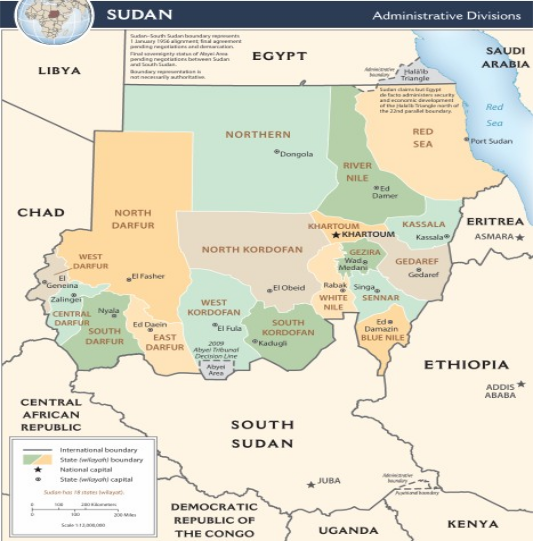
8.1.1 For information on Sudan’s location, size and administrative divisions, see the archived Country Policy and Information Notes (CPINs) Sudan: Security situation, January 2025 and Sudan: Humanitarian situation, February 2024.
8.2 Demography
8.2.1 The UN Office for the Coordination of Humanitarian Affairs Humanitarian Data Exchange (OCHA HDX), an open platform for sharing data across crises and organisations, estimated the population of Sudan to be 47.5 million in 2024.[footnote 2] The table below, based on OCHA HDX data[footnote 3], shows the population breakdown by state:
| State | Total | As % of total |
|---|---|---|
| Al Jazirah | 5,124,749 | 11% |
| Blue Nile | 813,930 | 2% |
| Central Darfur | 943,721 | 2% |
| East Darfur | 2,390,080 | 5% |
| Gedaref | 3,091,393 | 7% |
| Kassala | 2,718,540 | 6% |
| Khartoum | 5,941,286 | 13% |
| North Darfur | 3,461,818 | 7% |
| North Kordofan | 3,444,769 | 7% |
| Northern | 1,446,861 | 3% |
| Red Sea | 2,035,582 | 4% |
| River Nile | 1,862,303 | 4% |
| Sennar | 2,532,326 | 5% |
| South Darfur | 3,895,007 | 8% |
| South Kordofan | 1,156,469 | 2% |
| West Darfur | 618,178 | 1% |
| West Kordofan | 2,612,654 | 6% |
| White Nile | 3,392,274 | 7% |
| Total | 47,481,940 | 100% |
9. Political context
9.1 Ouster of President Omar el Bashir, Transitional Sovereign Council, Juba Peace Agreement and the October 2021 coup
9.1.1 For information on the political context including the ousting of President Omar el Bashir, the Transitional Sovereign Council, the Juba Peace Agreement and the October 2021 coup and previous peace talks, see the CPINs Sudan: Security Situation and Sudan: Non-Arab Darfuris.
9.2 Peace talks
9.2.1 According to a 29 July 2025 report by Dabanga, an independent Sudanese radio and digital news service[footnote 4], numerous mediation efforts have failed to produce a lasting ceasefire in Sudan. This is due to deep mistrust between the Sudanese Armed Forces (SAF) and the Rapid Support Forces (RSF), fragmented mediation efforts, repeated truce violations, unresolved political issues, and foreign interference.[footnote 5] A November 2025 Reuters report also stated that although both the RSF and the SAF had agreed to multiple ceasefire initiatives over the course of the conflict, none of these had held.[footnote 6]
9.2.2 The 29 July 2025 Dabanga report contains the below table showing a timeline of major negotiation efforts between 2023 and 2025[footnote 7]:
| Period | Procedure | Result |
|---|---|---|
| April–May 2023 | Eid El Fitr truce attempt | Quickly collapsed |
| May 2023 | First Jeddah negotiations | One-week truce + 5-day extension, then collapse |
| May 30–June 1, 2023 | Army withdrawal from talks | Due to RSF violations and mutual failure to comply |
| Oct–Dec 2023 | Jeddah and Juba negotiations | Only humanitarian corridor agreed, no truce |
| Dec 2023 | Second Jeddah round | Talks permanently suspended |
| July 2024 | Geneva meeting under UN envoy Lamamra | Army refused participation before RSF withdrawal |
| 2024–2025 | British-led confidential talks with RSF | Suspended after political backlash |
9.2.3 In September 2025, the foreign ministers of the Quad (Egypt, Saudi Arabia, the United Arab Emirates, and the United States) proposed a 3-month humanitarian truce to facilitate aid leading to a permanent ceasefire and a 9-month transition towards a civilian-led government.[footnote 8] On 7 November 2025, Reuters reported that the RSF had indicated that it accepted the humanitarian ceasefire proposal and was open to discussions on a broader cessation of hostilities.[footnote 9]
9.2.4 The Security Council Report (SCR), an independent, non‑profit organisation that provides impartial, high‑quality analysis on the work of the UN Security Council[footnote 10], stated in its February 2026 Sudan monthly forecast (SCR February 2026 forecast):
‘At the Council’s 22 December 2025 meeting, Sudan’s Transitional Prime Minister, Kamil El-Tayeb Idris, presented a proposal calling for an immediate ceasefire in Sudan, to be monitored by the UN, the African Union (AU) and the League of Arab States (LAS). The proposal included the RSF’s complete withdrawal from areas under its control and the reintegration into society of RSF fighters not accused of war crimes. Idris also committed to holding free elections following a transitional period. The RSF, which controls much of Darfur and parts of Kordofan, rejected the plan.’[footnote 11]
9.2.5 In mid-January 2026, Egypt hosted meetings in Cairo under the UN‑led Sudan Consultative Mechanism, involving the United Nations, Egypt, the United States and other regional and international partners. These discussions focused on coordinating mediation efforts and securing a nationwide humanitarian truce.[footnote 12] The January Cairo meeting was followed by the Third International Sudan Conference in Berlin in April 2026, which reiterated that there was no military solution to the conflict and called for an immediate humanitarian truce followed by an inclusive, civilian‑led political process.[footnote 13]
9.2.6 The June 2026 SCR Sudan monthly forecast noted:
‘Efforts by regional and international interlocutors to identify avenues for de-escalation and bring an end to the conflict have continued; however, prospects for a breakthrough remain remote at present. Following his appointment in February, the Personal Envoy of the Secretary-General for Sudan, Pekka Haavisto, visited Khartoum, Addis Ababa, and Nairobi as part of a regional tour aimed at engaging with Sudanese stakeholders and regional actors on options for resolving the conflict.
‘From 4 to 11 May, Haavisto visited Doha, Abu Dhabi, and Riyadh, where he met with government officials, Sudanese civilian stakeholders, and members of the diplomatic community. At a 13 May press briefing, Deputy Spokesperson for the Secretary-General Farhan Haq said that Haavisto had underscored the urgent need for immediate de-escalation, including through confidence-building measures in support of ongoing peace efforts. He also called on relevant actors to use their influence to reduce violence, curb the flow of arms, and support a truce, while emphasising the importance of sustained coordination among key stakeholders in advancing a Sudanese-led political process.
‘Meanwhile, SAF leader General Abdel Fattah al-Burhan travelled to Jeddah on 20 April to meet with Saudi Crown Prince Mohammed bin Salman amid reports of renewed Saudi-US efforts to revive talks between the warring parties. According to media reports, discussions focused on proposals to establish humanitarian corridors, advance localised truces, and secure maritime corridors. On 21 April, Burhan visited Muscat, where he held discussions with Oman’s Sultan Haitham bin Tarik. Subsequently, on 13 May, Burhan travelled to Manama and met Bahrain’s King Hamad bin Isa Al Khalifa, amid media reports of possible efforts to facilitate a rapprochement between Sudan and the UAE.’[footnote 14]
9.3 Establishment of parallel governments
9.3.1 On 16 April 2025, the BBC reported that the RSF had announced the formation of a rival government to the SAF-backed administration. RSF leader Mohamed Hamdan Dagalo (‘Hemedti’) stated that the proposed administration would be based on the rule of law, national unity and an inclusive Sudanese identity. He also said that it would seek to provide essential services, including education and healthcare, both in RSF-controlled areas and across Sudan.[footnote 15]
9.3.2 On 26 July 2025, Al Jazeera reported that the Sudan Founding Alliance (TASIS), a coalition led by the RSF, had announced the establishment of an alternative government. RSF leader Mohamed Hamdan Dagalo (‘Hemedti’) was appointed chair of its 15-member presidential council, which included regional governors, while Mohammed Hassan Osman al-Ta’ishi was appointed prime minister. TASIS stated that it aimed to establish an inclusive, secular, democratic and decentralised Sudan based on freedom, justice and equality.[footnote 16]
9.3.3 A 24 October 2025 UN Human Rights Council conference paper on ‘the findings of the independent international fact-finding mission for the Sudan on accountability for international crimes committed since the outbreak of the conflict (HRC October 2025 report) noted:
‘The Rapid Support Forces have reportedly continued to set up its own civilian administrations in areas under its effective control, including West and South Kordofan, Blue Nile, Khartoum and the Darfur States. On 15 April 2025, it further announced the establishment of a parallel “Government of Peace and Unity” also called founding coalition for Sudan or Ta’sis alliance to be headed by General Mohamed Hamdan Dagalo (“Hemedti”). The announcement was accompanied by the publication of its own constitution founded in “freedom, equality and justice” …
‘Members of the United Nations Security Council rejected the announcement of the establishment of a parallel governing authority by the Rapid Support Forces, expressing grave concerns about inter alia fragmentation of the country and worsening an already dire humanitarian situation. The African Union also strongly condemned and rejected the announcement of the so-called “parallel government” …’[footnote 17]
9.3.4 On 11 December 2025, the Armed Conflict Location & Event Data (ACLED), ‘an independent, impartial global monitor that collects, analyses, and maps data on conflict and protest’[footnote 18] reported: ‘The SAF re-established a government in Port Sudan in the east of the country … while the RSF formed a government based in Nyala, the capital of South Darfur, led by Mohamed Hamdan Dagalo … Though claiming to be civilian governments, both are power-sharing arrangements among armed groups.’[footnote 19]
9.3.5 On 6 May 2026, Darfur24, an independent electronic newspaper[footnote 20], reported that Prime Minister Mohammed Hassan al-Ta’ishi had issued decrees appointing ministers, undersecretaries and other senior officials, including directors-general of the police, taxation and civil service. The report stated that the appointments were intended to consolidate the parallel administrative structures operating outside the authority of the army-led government. The Ta’sis alliance had also appointed a Chief Justice and established a 24-member Council of Regions to represent Sudan’s eight regions.[footnote 21]
9.3.6 On 3 June 2026, Sudan Tribune, a Paris-based online news portal reporting on Sudan[footnote 22] reported:
‘The RSF-controlled “Tasis” government has appointed former Sudan Central Bank governor Hussein Yahya Jangoul as governor of its parallel central bank in Nyala, triggering a debate among economists and banking specialists about the implications for Sudan’s monetary system amid an already fragile wartime economy.
‘Tasis Prime Minister Mohamed Hassan al-Taayishi issued a decree on 11 May 2026 establishing a “Transitional Currency Council” tasked with monetary stabilisation and banking regulation, with Jangoul formally appointed on 21 May. The council is charged with overseeing currency circulation, implementing a currency exchange programme, and issuing banking licences in coordination with the central bank governor.’[footnote 23]
10. Protagonists
10.1 SAF and RSF
10.1.1 The two main armed actors are the SAF and the RSF. The two have forged alliances with armed groups within Sudan as well as with countries within and outside the region. For further information on their leadership and size, see Sudan: Security Situation, January 2025.
10.2 SAF and RSF allied militias and other armed actors
10.2.1 An April 2025 ACLED report that examined the shifts in the conflict that led to SAF’s advances against the RSF (ACLED 15 April 2025 report) noted:
‘The Darfur Joint Forces … has played a key role in central Sudan and Darfur. When the battle for the capital of North Darfur, El Fasher, erupted in April 2024, the SAF’s Sixth Infantry Division found a strategic ally in the Darfur Joint Forces. Under its ranks, the Zaghawa native administration mobilized troops, declared war against the RSF, and offered a cut-off date for fellow Zaghawa members of the RSF to seek amnesty …
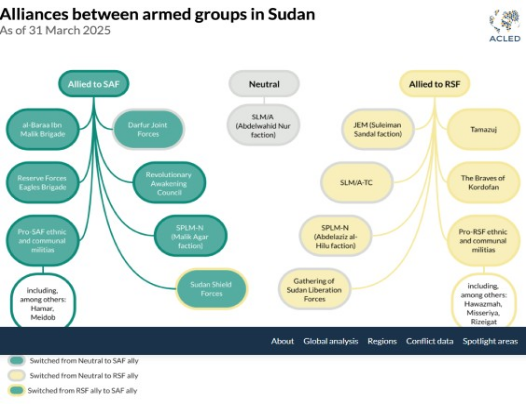
‘The Darfur Joint Forces is a coalition of five former rebel groups — namely the Sudan Liberation Movement/Army (SLM/A) led by Minni Minawi, the Justice and Equality Movement (JEM) led by Jibril Ibrahim, the Sudanese Alliance, the Sudan Liberation Movement/Army – Transitional Council (SLM/A-TC), and the Gathering of Sudan Liberation Forces (GSLF) — that were active in Darfur between 2003 and 2020 and were appointed to the transitional government as a result of the Juba Peace Agreement in 2020. Four members of the coalition — JEM led by Jibril Ibrahim, the SLM/A Minni Minawi faction, the SLM/A Mustafa Tambour faction, and a faction of the GSLF — announced their support of the SAF in November 2023 …’[footnote 24]
10.2.2 The same source contains the chart below showing various armed groups and their alliances at the end of March 2025[footnote 25] :
10.2.3 On 25 January 2025, Al Jazeera reported that the SAF relied on several allied militias, including the Sudan Shield Forces and the al-Baraa bin Malik Battalion, during the recapture of Wad Madani, the capital of Gezira State, in January 2025. The Sudan Shield Forces were led by Abu Aqla (Abuagla) Keikal, a former Rapid Support Forces (RSF) commander who defected to the SAF in October 2024. Al Jazeera described the al-Baraa bin Malik Battalion as a militia linked to Sudan’s Islamic Movement, which formed a central part of the state apparatus under former President Omar el-Bashir.[footnote 26] The same source reported on 23 July 2025 that the SAF maintained alliances with other armed groups, including the Justice and Equality Movement (JEM) and the Sudan Liberation Army-Minni Minawi (SLA-MM). In addition, Mohamed “al-Jakomi” Seid Ahmed, an army-aligned commander from northern Sudan, announced plans to train 50,000 fighters in Eritrea to protect Northern state against potential RSF incursions. Conversely, the RSF established alliances with several smaller factions and with the Sudan People’s Liberation Movement-North (SPLM-N) led by Abdel Aziz al-Hilu, which controls significant territory in South Kordofan and Blue Nile.[footnote 27]
10.3 International and regional actors
10.3.1 The European Union Institute for Security Studies (EUISS), the EU’s foreign and security policy think tank[footnote 28], noted in a November 2025 report that numerous international actors including countries in the Horn of Africa have vested interests in Sudan’s conflict. According to the report, Egypt, Saudi Arabia, Russia, Iran, Eritrea and Tigrayan fighters sided with SAF. The United Arab Emirates (UAE) has denied allegations of providing direct support to the RSF in exchange for access to gold resources. Chad also reportedly supported the RSF.[footnote 29]
10.3.2 On 11 December 2025, ACLED reported that foreign involvement continued to sustain the conflict. The report stated that the UAE provided direct material support to the RSF which also drew on a wider international network extending across the Central African Republic, Chad, Kenya, Libya, South Sudan and Uganda. Saudi Arabia aligned with the SAF, which was also supported by Egypt, Iran, Pakistan and Turkey. ACLED noted that the UAE and Saudi Arabia were involved in mediation efforts while also supporting opposing parties to the conflict.[footnote 30]
10.3.3 The UN Security Council Panel of Experts on Libya reported in March 2026 that Colombian mercenaries transited through Libya to support the RSF in Sudan and that Libya also served as an operational, logistical and tactical base to transport fighters, fuel, arms and related materiel to the RSF.[footnote 31]
10.3.4 On 18 May 2026, ACLED reported that the defection of two senior RSF commanders, Ali Rizq-Allah (‘Saffana’) and Al-Nour al-Goba, to the Sudanese Armed Forces (SAF) indicated growing internal divisions within the RSF. Both commanders belonged to the Mahamid-Rizeigat clan, part of the RSF’s core Arab constituency. ACLED assessed that the SAF was likely to exploit these divisions in new offensives in North Darfur, while continued foreign support and local grievances risked broadening the conflict across borders.[footnote 32]
11. Geographic scope of the conflict
11.1.1 On 13 January 2026 the Office of the High Commissioner for Human Rights (OHCHR) published a report on the human rights situation in Sudan covering 16 November 2024 to 15 November 2025 (OHCHR January 2026 report). The report observed:
‘The conflict in the Sudan, now almost ending its third year, has evolved into a deeply fragmented and ethnically charged war. The mobilization of civilians along tribal and ethnic lines, coupled with the flow of weapons into the country, has significantly escalated hostilities, deepened societal divisions and undermined prospects for peace.
‘During the reporting period, intense fighting persisted, amid the expansion of the conflict to new areas …
‘On 11 January 2025 the Sudanese Armed Forces recaptured the city of Wad Madani in Al-Gazira State, and on 20 May 2025 they recaptured Khartoum State.
‘The Kordofan region remained volatile and a focus of hostilities, particularly since May 2025, as the parties continued to vie for control of strategic locations in the region. Following an offensive by the Rapid Support Forces on the city of Bara in North Kordofan, they recaptured the city on 25 October 2025.
‘As hostilities shifted from central Sudan to the west and the south, heavy fighting continued in El Fasher, resulting in the Rapid Support Forces capturing the city on 27 October 2025 after an 18-month siege …
‘The proliferation of advanced military equipment, in particular unmanned aerial vehicles (drones), has empowered parties to the conflict and enhanced their military capabilities, prolonging the hostilities and deepening the crisis.’[footnote 33]
11.1.2 A 26 January 2026 ACLED report noted:
‘On 25 January [2026], the … RSF and the Sudan People’s Liberation Movement-North faction led by Abdelaziz al-Hilu (SPLM-N Hilu) clashed with the … SAF in several locations of Blue Nile state’s Bau locality … This fighting is the first on-the-ground confrontation between the two groups …
‘The SAF, RSF, and allied groups have increased deployments in the Blue Nile since at least mid-December 2025 … The latest campaign in Blue Nile, though, began in earnest on 11 January [2026], when the SAF carried out airstrikes on a convoy in Yabus …
‘Previously peripheral to the war, Blue Nile state is becoming a focal point in Sudan’s conflict … Since December 2025, air- and drone strikes in South Kordofan … have quadrupled, while the fight for control of North Kordofan persisted. Since the beginning of this year, the SAF has regained control of at least a dozen locations in South and North Kordofan. At the same time, since February 2025, the RSF and Hilu’s faction have besieged two main cities in South Kordofan, Kadugli — the state capital — and the second biggest city, Dilling …’[footnote 34]
11.1.3 In a briefing to the Security Council on 19 February 2026, the director of OCHA’s Crisis Response Division reported a marked escalation in drone attacks across the Kordofan region since the start of 2026 with intense fighting continuing in North Kordofan particularly around El Obeid and South Kordofan notably in and around Kadugli and Dilling. Additionally, Blue Nile saw renewed hostilities, including airstrikes targeting the Yabus area.[footnote 35] In March 2026, OCHA reported that hostilities persisted throughout the Kordofan region and across North, South, and West Darfur.[footnote 36]
11.1.4 The June 2026 SCR Sudan monthly forecast noted that the conflict had increasingly taken on the characteristics of a war of attrition, with territorial control broadly divided between the SAF and the RSF and fighting intensifying in several areas, particularly in Kordofan and Darfur. The report noted that both parties increasingly employed drones and other advanced weaponry, with the RSF conducting drone strikes against SAF-controlled areas, including Khartoum and Omdurman, and the SAF carrying out drone attacks against RSF-held positions in Nyala, South Darfur. Kordofan remained the principal theatre of military operations as the parties contested strategic locations and supply routes. The security situation in Blue Nile State also remained volatile, with ongoing clashes involving the SAF, RSF and SPLM-N.[footnote 37]
12. Territorial control by armed groups
12.1 SAF
12.1.1 On 13 November 2025, the BBC reported that the SAF retained control over most of northern and eastern Sudan with Port Sudan, on the Red Sea coast, serving as the headquarters of the UN‑recognised government. The report also stated that SAF recaptured Khartoum and regained near‑total control of Al Jazira.[footnote 38]
12.1.2 A December 2025 article by Christopher Tounsel, an associate professor of history, University of Washington published by the Conversation, an independent media platform that publishes analysis and commentary written by academics and researchers, supported by professional editorial oversight[footnote 39] (Tousel December 2025 article) noted that as of December 2025 the SAF controlled slightly more than half of Sudan’s territory. The source stated that the SAF maintained control of Khartoum and Port Sudan, located on the Red Sea coast in eastern Sudan, and controlled approximately three-quarters of Sudan’s border with Egypt in the north. The article noted that Sudanese researcher Jihad Mashamoun estimated that as of November 2025, the SAF controlled 60% of the country.[footnote 40] Similarly, ACLED reported in December 2025 that the SAF and allied forces had consolidated control across central and eastern Sudan following the recapture of Khartoum.[footnote 41]
12.1.3 On 6 March 2026, Sudans Post, an independent grass-roots news media organisation reporting on Sudan, South Sudan and East Africa[footnote 42], reported that on 5 March 2026, the SAF captured the strategic town of Bara in North Kordofan which enabled it partially secure the main highway linking Khartoum State and central Sudan with Darfur. In addition, SAF controlled central Sudan and large areas of the north, east and southeast.[footnote 43]
12.1.4 On 22 June 2026, Sudans Post stated: ‘Sudan’s territorial control remains largely unchanged compared to previous months, with the Sudanese Armed Forces (SAF) maintaining control of most of northern, eastern and central Sudan…’[footnote 44]
12.2 RSF areas of control
12.2.1 On 13 November 2025, the BBC reported that, in early June 2025, the RSF secured control over territory along Sudan’s borders with Libya and Egypt and in late October 2025 captured El Fasher, resulting in the group controlling almost all of Darfur and large parts of neighbouring Kordofan.[footnote 45]
12.2.2 Tousel December 2025 article stated that the RSF had consolidated control over much of Darfur after it took control of El Fasher in October 2025. The same source further reported that, outside Darfur, the RSF controlled most of Sudan’s oil fields, many gold mining areas in central and south-western Sudan, and shared control of significant grazing lands with the SAF.[footnote 46] Similarly, ACLED reported that the RSF control of El Fasher strengthened its dominance in Darfur, including access to gold‑producing areas and key supply routes to Libya and Chad.[footnote 47]
12.2.3 On 6 March 2026, Sudans Post reported the RSF continued to control Jabra El‑Sheikh locality, located close to Khartoum, and had seized Bardab village, west of the Kadugli–Dilling road enabling it to restore the siege of both Kadugli and Dilling. The RSF and its ally SPLM‑N held some territory in the southern Blue Nile region near the Ethiopian and South Sudanese borders.[footnote 48]
12.3 Map of Sudan showing territorial control by various groups
On 22 June 2026, Sudans Post published the map below showing areas controlled by the SAF, the RSF and allied groups as of 21 June 2026.[footnote 49]
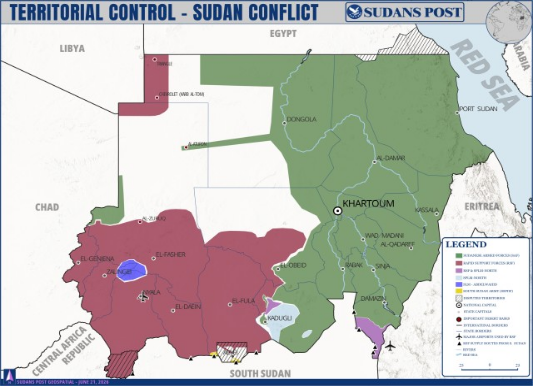
12.3.2 The map showed areas controlled by:
- the SAF in green
- the RSF and SPLM‑N in light pink
- the SPLM‑N in purple
- the SLM‑AW in blue
- the South Sudan People’s Defence Forces (SSPDF) in yellow
- disputed territories (Abyei) indicated by black diagonal lines.
13. Scale of violence
13.1 ACLED data
13.1.1 According to ACLED:
‘ACLED collects and records reported information on political violence, demonstrations (rioting and protesting), and other select non-violent, politically important events. It aims to capture the modes, frequency, and intensity of political violence and demonstrations.
‘The fundamental unit of observation in ACLED is the event. Events involve designated actors — e.g., a named rebel group, a militia, or state forces.3 They occur at a specific named location (identified by name and geographic coordinates) and on a specific day … ACLED currently records six event types and 25 sub-event types, both violent and non-violent. Sub-event types are also categorized by three overarching disorder types to facilitate analysis: Political violence, Demonstrations, and Strategic developments.’[footnote 50]
13.1.2 ACLED’s 6 event types and brief definitions are provided below. More detail, including examples of the types of events recorded in each category, is provided in ACLED’s codebook.
-
Battles: ‘a violent interaction between two organized armed groups’[footnote 51]
- Protests: ‘an in-person public demonstration of three or more participants in which the participants do not engage in violence, though violence may be used against them’[footnote 52]
- Riots: ‘violent events where demonstrators or mobs of three or more engage in violent or destructive acts, including but not limited to physical fights, rock throwing, property destruction, etc’[footnote 53]
- Explosions/remote violence: ‘incidents in which one side uses weapon types that, by their nature, are at range and widely destructive’[footnote 54]
- Violence against civilians: ‘violent events where an organized armed group inflicts violence upon unarmed non-combatants’[footnote 55]
- Strategic developments: ‘captures contextually important information regarding incidents and activities of groups…. [that] may trigger future events or contribute to political dynamics within and across states’.[footnote 56]
13.1.43 ACLED has grouped battles, explosions/remote violence, violence against civilians and protests into political violence disorder type defined as ‘the use of force by a group with a political purpose or motivation, or with distinct political effects.’[footnote 57]
13.1.4 ACLED further stated:
‘Events that result in fatalities have the relevant information recorded in the Fatalities column. Events recorded by ACLED do not have to meet a minimum fatality number for inclusion. ACLED only records estimated fatalities when reported by the source material. When and where possible, ACLED researchers seek out information to triangulate the fatality numbers reported by sources, but ACLED does not independently verify reported fatality estimates. Additionally, ACLED is a living dataset, so all fatality figures are revised and corrected — upward or downward — if new or better information becomes available (which, in some cases, can be months or years after an event has taken place). Fatality data are typically the most biased and least accurate component of conflict reporting. They are particularly prone to manipulation by armed groups, and occasionally the media, which may overstate or underreport fatalities for political purposes. These figures should therefore be understood as indicative estimates of reported fatalities, rather than definitive fatality counts.
‘If the source material differs or a vague estimate is provided, the lowest number of reported fatalities is recorded in the Fatalities column until a more reliable or corroborated estimate becomes available. If reports mention “several,” “many,” “few,” or plural “fatalities,” yet the exact number is unknown, either 3 or 10 is recorded as the total, depending on the scale and context of the attack … If a report mentions “dozens,” this is recorded as 12 reported fatalities. If a report mentions “hundreds,” this is recorded as 100 reported fatalities. If there is no reference made to fatalities in the source material, or if it is unclear whether fatalities occurred at all (for example, when only “casualties” are mentioned, which — by definition — means injuries and/or fatalities), 0 reported fatalities are recorded.’[footnote 58]
13.2 Number of violence events
13.2.1 Between 1 January 2024 and 30 April 2026, ACLED recorded 11,199 organised political violence events. By event type, explosions and remote violence account for the largest share of activity (37.5%), followed by battles (32.1%) and violence against civilians (30.5%). However, battles are responsible for the highest proportion of fatalities (46.2%), while violence against civilians contributes 23.6% of deaths despite representing less than one-third of events.[footnote 59]
The graph below based on ACLED data shows trends in organised political violence events from January 2024 to June 2026 by quarter.
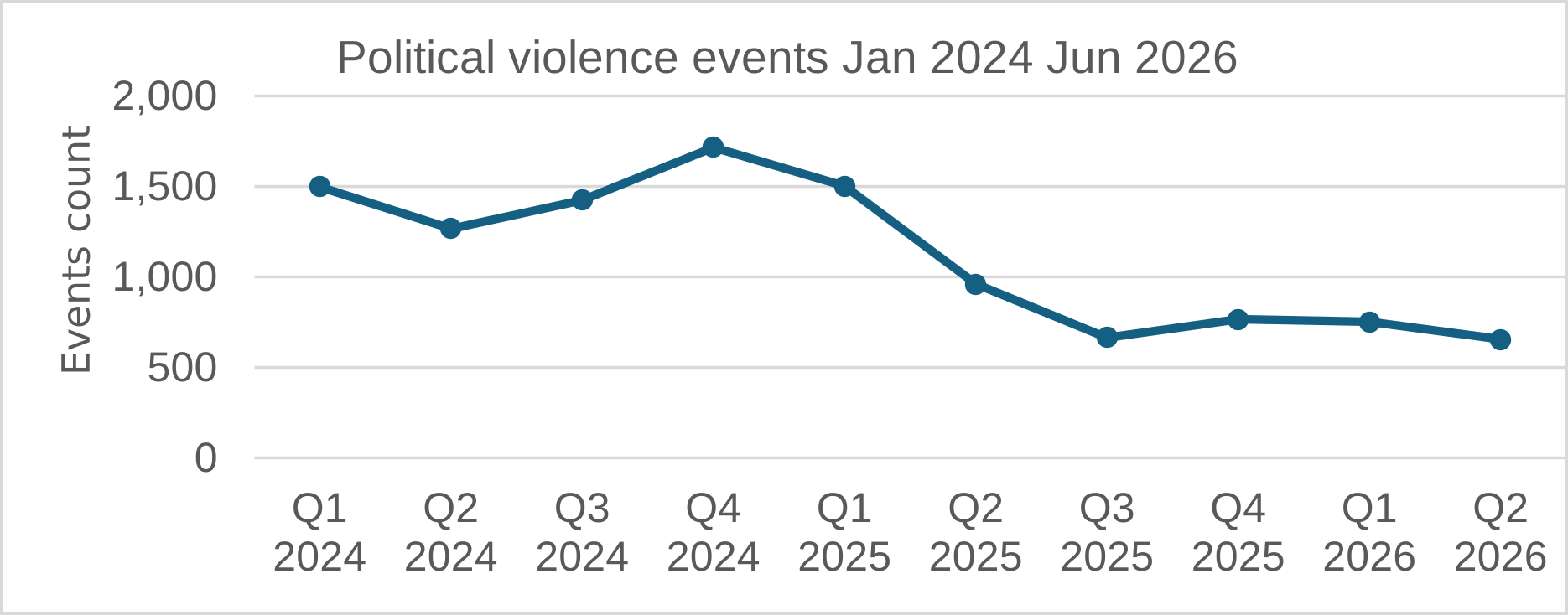
13.2.2 The graph shows events increased through 2024, peaking in Q4 2024 (1,715 events), before declining through 2025 and into 2026. Activity remained high in Q1 2025 (1,500 events) before declining steadily through 2025 to 666 in Q3. Although there was a slight uptick in Q4 2025 (764 events), levels remained below the 2024 peaks. This downward trend continued into Q2 2026 (654 events).
13.2.3 The table below, based on ACLED data, shows the geographic distribution of organised political violence events in Sudan by quarter from January 2024 to June 2026 and the percentage changes recorded from 2024 to 2025[footnote 61]:
| State | Q1 2024 | Q2 2024 | Q3 2024 | Q4 2024 | Q1 2025 | Q2 2025 | Q3 2025 | Q4 2025 | Q1 2026 | Q2 2026 | Total 2024 | Total 2025 | Real change 2024 to 2025 | % Change 2024 to 2025 |
|---|---|---|---|---|---|---|---|---|---|---|---|---|---|---|
| Al Jazirah | 324 | 268 | 189 | 406 | 226 | 10 | 5 | 6 | 14 | 6 | 1187 | 247 | -940 | -79.19 |
| Blue Nile | 1 | 1 | 7 | 21 | 24 | 12 | 2 | 12 | 63 | 50 | 30 | 50 | 20 | 66.67 |
| Central Darfur | 8 | 10 | 20 | 18 | 16 | 20 | 18 | 13 | 22 | 20 | 56 | 67 | 11 | 1964 |
| East Darfur | 10 | 5 | 21 | 20 | 25 | 23 | 17 | 13 | 18 | 14 | 56 | 78 | 22 | 39.29 |
| Gedaref | 10 | 16 | 6 | 6 | 2 | 0 | 6 | 1 | 1 | 3 | 38 | 9 | -29 | -76.32 |
| Kassala | 2 | 0 | 2 | 1 | 6 | 13 | 0 | 1 | 3 | 3 | 5 | 20 | 15 | 300 |
| Khartoum | 830 | 409 | 625 | 510 | 439 | 118 | 18 | 24 | 11 | 29 | 2374 | 599 | -1775 | -74.77 |
| North Darfur | 64 | 281 | 216 | 407 | 331 | 207 | 199 | 149 | 73 | 74 | 968 | 886 | -82 | -8.47 |
| North Kordofan | 44 | 76 | 40 | 37 | 127 | 136 | 186 | 137 | 110 | 116 | 197 | 586 | 389 | 197.46 |
| Northern | 1 | 3 | 1 | 5 | 13 | 29 | 12 | 14 | 7 | 2 | 10 | 68 | 58 | 580 |
| Red Sea | 1 | 1 | 1 | 3 | 1 | 19 | 5 | 1 | 1 | 7 | 6 | 26 | 20 | 333.33 |
| River Nile | 7 | 9 | 26 | 10 | 15 | 10 | 2 | 9 | 2 | 2 | 52 | 36 | -16 | -30.77 |
| Sennar | 25 | 45 | 142 | 76 | 7 | 3 | 0 | 3 | 5 | 1 | 288 | 13 | -275 | -96.49 |
| South Darfur | 13 | 35 | 38 | 70 | 91 | 86 | 60 | 94 | 91 | 97 | 156 | 331 | 175 | 112.18 |
| South Kordofan | 76 | 28 | 19 | 10 | 45 | 93 | 28 | 115 | 162 | 115 | 133 | 281 | 148 | 111.28 |
| West Darfur | 8 | 3 | 10 | 45 | 18 | 8 | 7 | 20 | 34 | 22 | 66 | 53 | -13 | -19.70 |
| West Kordofan | 56 | 46 | 24 | 23 | 16 | 132 | 95 | 143 | 110 | 67 | 149 | 386 | 237 | 159.06 |
| White Nile | 19 | 30 | 37 | 47 | 98 | 41 | 6 | 9 | 24 | 26 | 133 | 154 | 21 | 15.79 |
| Total | 1499 | 1266 | 1424 | 1715 | 1500 | 960 | 666 | 764 | 751 | 654 | 5904 | 3890 | -2014 | -34.11 |
13.2.4 CPIT analysis of the table indicates that organised political violence events were unevenly distributed, with a high degree of geographic concentration in a limited number of states.
- an overall reduction in organised violence activity by 18% between 2024 and compared to 2024 (from 4,717 to 3,890)
- in 2024 Khartoum Al Jazirah, North Darfur and North Kordofan recorded highest of events
- in 2025, the overall number of events declined. Significant reductions occurred in Al Jazira (-79%), Khartoum (-75%), and Sennar (-96%). North Darfur recorded a 9% fall, but real figures remained high
- Darfur and Kordofan states, remained persistently affected or saw an increase in events. Notable increases occurred in North Kordofan (197%), West Kordofan (159%), South Kordofan (111%), and South Darfur (112%)
- Increases also occurred in Blue Nile by 66% and the White Nile by 16%
- in 2026 (by Q2), most events were recorded Kordofan states, parts of Darfur and Blue Nile. Meanwhile, Khartoum, Al Jazirah and Sennar remained at comparatively low levels
- throughout the period, eastern and northern states such as Kassala, River Nile, Northern and Red Sea and Gedaref remained consistently low-activity areas.
13.3 Conflict fatalities
13.3.1 On 26 February 2025, Science, a peer-reviewed multidisciplinary journal[footnote 62], published an article by Leslie Robert, a former editor, which noted that reliable mortality data for Sudan were unavailable because of continuing fighting, restrictions on access, disrupted services, and the death or displacement of many of those who might otherwise record fatalities. According to the article, estimated deaths from violence and other conflict-related causes ranged from 20,000 to 150,000. It noted that ACLED had recorded at least 28,700 deaths from intentional injuries by December 2024, including 7,500 civilians. A separate modelling study estimated that, in Khartoum State alone, between April 2023 and June 2024 there were more than 26,000 deaths from intentional injuries and over 61,000 deaths from all causes. Another study, using an estimated ratio of indirect to direct deaths, placed the nationwide death toll at approximately 62,000 by October 2024, although the article noted that estimates based on such multipliers were uncertain.[footnote 63]
13.3.2 According to a 1 September 2025 New York Times op-ed, Tom Perriello, former US Special Envoy for Sudan, estimated the death toll in excess of 400,000.[footnote 64] ACLED recorded 52,904 combined civilian and combatant fatalities from direct violence from the outbreak of the conflict to June 2026 in Sudan’s 18 states.[footnote 65]
13.3.3 Between 1 January 2024 and June 2026, ACLED recorded 38,557 combined civilian and combatant fatalities. Fatalities were primarily driven by battles (46%), followed by explosions/remote violence (30%) and violence against civilians (24%).[footnote 66] The graph below shows recorded fatalities per quarter during this period[footnote 67]:
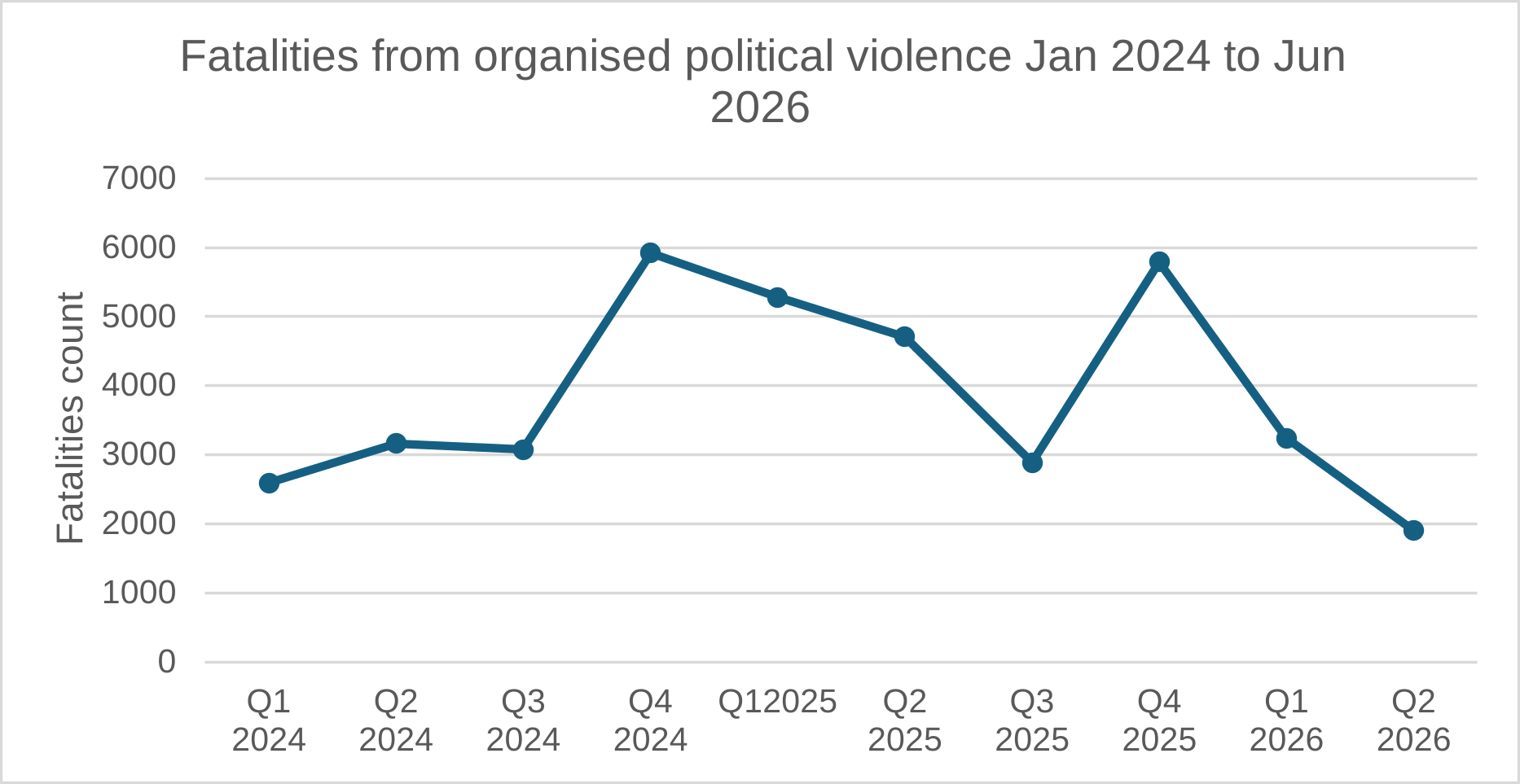
13.3.4 The graph indicated a clear pattern of escalation, fluctuation, and decline in fatalities over the period. Fatalities increased sharply through 2024, rising from 2,592 in Q1 to a peak of 5,921 in Q4, before remaining high in 2025 Q1 (5,278). This was followed by a temporary reduction in mid-2025 (2,887 in Q3), then a second major spike in 2025 Q4 (5,789), despite lower event volumes (see Number of violence events), indicating increased lethality per incident. Fatalities subsequently declined through 2026 Q1 (3,239) and Q2 (1,901). The peaks in Q4 2024 were driven by large-scale battles and attacks on civilians by the RSF in Al Jazirah while the peak in Q4 2025 is associated with the RSF offensive on El Fasher in October.
13.3.5 The table below, based on ACLED data, presents quarterly and annual fatalities recorded across various states from January 2024 to June 2026[footnote 68]:
| State | Q1 2024 | Q2 2024 | Q3 2024 | Q4 2024 | Q1 2025 | Q2 2025 | Q3 2025 | Q4 2025 | Q1 2026 | Q2 2026 | Total 2024 | Total 2025 | Real change 2024 to 2025 | % Change 2024 to 2025 |
|---|---|---|---|---|---|---|---|---|---|---|---|---|---|---|
| Al Jazirah | 474 | 708 | 396 | 1534 | 537 | 15 | 5 | 2 | 13 | 8 | 3112 | 559 | -2553 | -82.04 |
| Blue Nile | 0 | 1 | 29 | 165 | 32 | 45 | 5 | 0 | 352 | 260 | 195 | 82 | -113 | -57.95 |
| Central Darfur | 7 | 9 | 18 | 14 | 9 | 35 | 7 | 41 | 83 | 55 | 48 | 92 | 44 | 91.67 |
| East Darfur | 28 | 6 | 38 | 29 | 20 | 11 | 7 | 8 | 167 | 41 | 101 | 46 | -55 | -54.46 |
| Gedaref | 21 | 17 | 4 | 34 | 0 | 0 | 5 | 0 | 1 | 1 | 76 | 5 | -71 | -93.42 |
| Kassala | 0 | 0 | 1 | 0 | 1 | 11 | 0 | 0 | 0 | 6 | 1 | 12 | 11 | 1100 |
| Khartoum | 908 | 441 | 844 | 668 | 936 | 367 | 17 | 29 | 7 | 36 | 2861 | 1349 | -1512 | -52.85 |
| North Darfur | 181 | 1163 | 927 | 2191 | 2471 | 1684 | 1075 | 2968 | 584 | 245 | 4462 | 8198 | 3736 | 83.73 |
| North Kordofan | 181 | 300 | 115 | 173 | 458 | 507 | 1141 | 1063 | 435 | 363 | 769 | 3169 | 2400 | 312.09 |
| Northern | 0 | 1 | 0 | 5 | 1 | 36 | 11 | 31 | 10 | 2 | 6 | 79 | 73 | 1216.67 |
| Red Sea | 0 | 0 | 6 | 0 | 0 | 3 | 0 | 1 | 9 | 32 | 6 | 4 | -2 | -33.33 |
| River Nile | 29 | 20 | 35 | 16 | 10 | 15 | 0 | 16 | 2 | 0 | 100 | 41 | -59 | -59.00 |
| Sennar | 121 | 111 | 361 | 452 | 9 | 47 | 0 | 0 | 14 | 7 | 1045 | 56 | -989 | -94.64 |
| South Darfur | 39 | 60 | 35 | 270 | 243 | 231 | 195 | 240 | 89 | 226 | 404 | 909 | 505 | 125 |
| South Kordofan | 339 | 149 | 40 | 31 | 110 | 511 | 51 | 626 | 679 | 336 | 559 | 1298 | 739 | 132.20 |
| West Darfur | 13 | 0 | 29 | 114 | 33 | 4 | 3 | 128 | 153 | 47 | 156 | 168 | 12 | 7.69 |
| West Kordofan | 236 | 128 | 138 | 112 | 42 | 1047 | 363 | 631 | 620 | 181 | 614 | 2083 | 1469 | 239.25 |
| White Nile | 15 | 50 | 61 | 113 | 366 | 140 | 2 | 5 | 21 | 55 | 239 | 513 | 274 | 114.64 |
| Total | 2592 | 3164 | 3077 | 5921 | 5278 | 4709 | 2887 | 5789 | 3239 | 1901 | 14754 | 18663 | 3909 | 25.50 |
13.4 Relationship between organised political violence events and fatalities
13.4.1 The graph below shows the relationship between events and fatalities[footnote 70]:
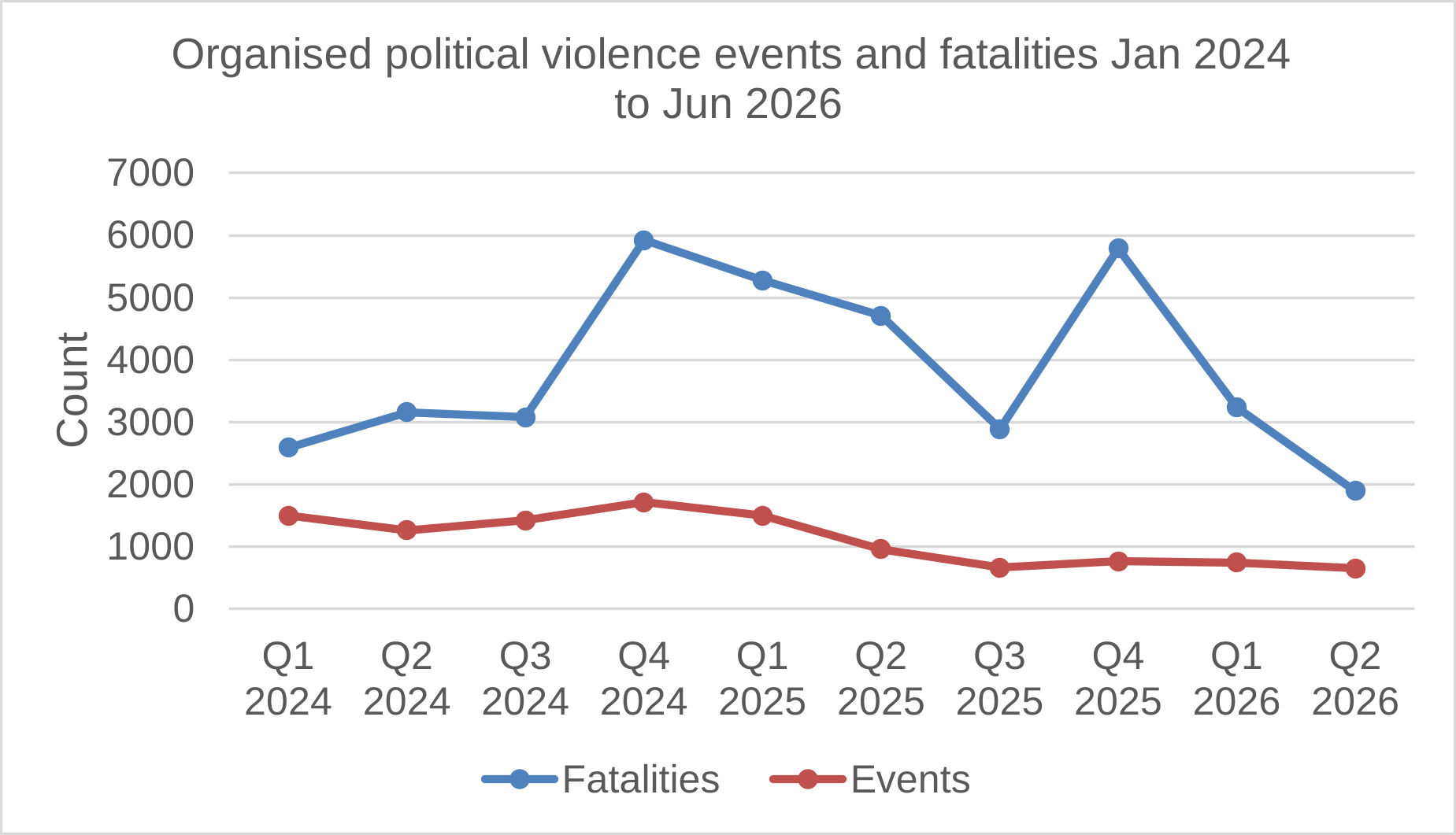
13.4.2 The graph shows that event frequency and fatalities do not move in parallel. While the number of events peaked in late 2024 and declined through 2025–2026, fatalities remained high and showed distinct spikes, particularly in 2024 Q4 and 2025 Q4. This suggests that fewer but more lethal incidents occurred over time, with an increase in fatalities per event. In 2024, higher event volumes were associated with widespread fighting across multiple fronts, whereas by late 2025, similar or higher fatality levels were recorded despite lower event counts, indicating a shift toward more intense and higher-impact violence.
13.5 Civilian fatalities and injuries
13.5.1 In an April 2024 report, the International Rescue Committee (IRC), an international humanitarian non‑governmental organisation which operates in conflict affected and humanitarian crisis settings including Sudan, noted that ‘The conflict has directly killed at least 14,700 people and injured almost 30,000 more.’[footnote 71]
13.5.2 The OHCHR reported in January 2026 that it documented at least 5,359 civilian deaths between 16 November 2024 and 15 November 2025 with the highest numbers recorded in the Darfur region (2,437 including 2,208 in North Darfur) and the Kordofan region (1,253 casualties).[footnote 72]
13.5.3 A February 2026 OHCHR report noted:
‘During the course of the final offensive on El Fasher, the scale of killings increased dramatically. Based on interviews with survivors and witnesses conducted by OHCHR, over 6,000 people were killed between 25 and 27 October – a period of just 3 days – with a peak in killings on 26 and 27 October. Of this total, at least 4,400 people were killed within El Fasher and at least 1,600 while attempting to flee along exit routes. These figures are drawn from the testimonies of survivors and witnesses documented by OHCHR and are consistent with independent analysis of contemporaneous satellite imagery and video footage. The actual scale of the death toll during the period of the final offensive is undoubtedly significantly higher.’[footnote 73]
13.5.4 On 10 April 2026, citing OHCHR, UN News reported that 11,300 civilians were killed in 2025 while many thousands remained missing or unidentified.[footnote 74]
13.5.5 In June 2026, the OHCHR reported that the conflict in Sudan had intensified and expanded, with a significant increase in the use of armed drones. Between January and May 2026, OHCHR documented at least 16 drone strikes on health facilities and 33 attacks on markets. It reported that more than 1,000 civilians had been killed in drone strikes during that period and stated that drone strikes accounted for approximately 80% of all conflict-related civilian deaths recorded during the period.[footnote 75]
13.6 ACLED data on civilian targeting
13.6.1 ACLED records information that is specific to civilian targeting which it defined as: ‘events in which civilians were the main or only target of an event.’[footnote 76] ACLED explained:
‘Besides events coded under the ‘Violence against civilians’ event type, civilians may also be the main or only target of violence in events coded under the ‘Explosions/Remote violence’ event type (e.g. a landmine killing a farmer), ‘Riots’ event type (e.g. a village mob assaulting another villager over a land dispute), and ‘Excessive force against protesters’ sub-event type (e.g. state forces using lethal force to disperse peaceful protesters). Events in which civilians were incidentally harmed are not included in this category.’[footnote 77]
13.6.2 Between 15 April 2023 and 30 June 2026, ACLED recorded 5,784 civilian targeting events that resulted in 18,766 civilian fatalities. Attacks accounted for approximately 54% of events and 53% of fatalities, air/drone strikes about 11% of events and 24% of fatalities, and shelling/artillery about 13% of events and 15% of fatalities. Other sub-event types, including abductions and sexual violence, represented a notable share of events but contributed a relatively small proportion of deaths.[footnote 78]
13.6.3 The RSF accounted for approximately 67% of events and 65% of fatalities, while the SAF were responsible for around 12% of events and 24% of fatalities. Other actors including communal militias and unidentified armed groups accounted for roughly 20% of events but less than 10% of fatalities.[footnote 79]
13.6.4 The table below, based on ACLED data, shows civilian targeting events and fatalities during the period under review[footnote 80]:
| Sub-event | Events | Events share | Fatalities | Fatalities share |
|---|---|---|---|---|
| Attack | 3,112 | 53.8% | 10,008 | 53.3% |
| Air/drone strike | 625 | 10.8% | 4,548 | 24.2% |
| Shelling/artillery | 750 | 13.0% | 2,881 | 15.4% |
| Sexual violence | 310 | 5.4% | 1,043 | 5.6% |
| Abduction/forced disappearance | 881 | 15.2% | 0 | 0.0% |
| Remote explosive/IED | 77 | 1.3% | 247 | 1.3% |
| Grenade | 15 | 0.3% | 25 | 0.1% |
| Excessive force/ mob violence | 13 | 0.2% | 14 | 0.1% |
| Chemical weapon | 1 | 0.0% | 0 | 0.0% |
| TOTAL | 5,784 | 100.0% | 18,766 | 100.0% |
13.6.5 From January 2024 to June 2026 ACLED recorded 4,539 civilian targeting events and 15,168 civilian fatalities. Attacks accounted for more than half of all events and fatalities, followed by air/drone strikes and shelling/artillery, which together contributed a further substantial proportion of deaths despite representing a smaller share of total events. Other sub-event types, including abductions and sexual violence, occur regularly but contribute relatively less to overall fatality figures.[footnote 81]
13.6.6 The table below shows number of civilian targeting events and fatalities by sub-event[footnote 82]:
| Sub-event type | Events | Share of events | Fatalities | Share of fatalities |
|---|---|---|---|---|
| Attack | 2,570 | 57% | 8,280 | 54.6% |
| Air/drone strike | 538 | 12% | 3,909 | 25.8% |
| Shelling/artillery | 503 | 11% | 2,004 | 13.2% |
| Sexual violence | 162 | 4% | 790 | 5.2% |
| Others | 766 | 17% | 185 | 1.2% |
| Total | 4,539 | 100% | 15,168 | 100.0% |
13.6.7 According to the ACLED data, the RSF accounted for 70% (3,184) of the events and 65% (9,873) of the fatalities, the SAF were responsible for 14% (627) of the events and 27% (4,137) of the fatalities and all other actors, including communal militias and unidentified armed groups accounted for 16% (728) of the events and 8% (1,158) of the fatalities.[footnote 83]
13.6.8 The table below shows the geographic distribution of civilian targeting events between January 2024 and June 2026 by quarter and state[footnote 84]:
| State | Q1 2024 | Q2 2024 | Q3 2024 | Q4 2024 | Q1 2025 | Q2 2025 | Q3 2025 | Q4 2025 | Q1 2026 | Q2 2026 | Total |
|---|---|---|---|---|---|---|---|---|---|---|---|
| Al Jazirah | 240 | 188 | 124 | 301 | 149 | 8 | 5 | 3 | 8 | 1 | 1027 |
| Central Darfur | 8 | 6 | 18 | 17 | 14 | 17 | 15 | 11 | 15 | 14 | 135 |
| Gedaref | 3 | 6 | 2 | 3 | 0 | 0 | 6 | 0 | 1 | 1 | 22 |
| Khartoum | 92 | 96 | 154 | 130 | 156 | 48 | 13 | 7 | 8 | 7 | 711 |
| North Kordofan | 22 | 38 | 14 | 14 | 56 | 53 | 30 | 31 | 33 | 32 | 323 |
| Red Sea | 1 | 1 | 0 | 2 | 0 | 1 | 3 | 1 | 0 | 5 | 14 |
| Sennar | 10 | 10 | 59 | 29 | 3 | 3 | 0 | 0 | 4 | 0 | 118 |
| South Kordofan | 34 | 16 | 13 | 9 | 4 | 30 | 15 | 31 | 47 | 33 | 232 |
| West Kordofan | 10 | 19 | 9 | 10 | 5 | 50 | 37 | 45 | 58 | 33 | 276 |
| Total | 463 | 521 | 526 | 855 | 696 | 391 | 263 | 282 | 298 | 244 | 4539 |
13.6.9 CPIT analysis of the table indicates:
- Civilian targeting events declined by 16% (from 2,365 to 1,632) between 2024 and 2025
- Khartoum recorded the highest number of events in both years but experienced a substantial decline of approximately 34% between 2024 and 2025
- Al Jazirah showed a reduction of around 19%, while North and South Kordofan and Darfur states generally recorded declines ranging from approximately 20% to 40%
- Sennar showed the most pronounced declines, with reductions of approximately 70% or more
- Blue Nile and Central Darfur showed moderate increases (approximately 15 to 25%), while River Nile and Kassala recorded smaller rises from a low base
- Red Sea, Northern, Kassala and Gedaref recorded only minimal levels of activity throughout the period, typically single-digit or very low double-digit event totals. River Nile and White Nile also remained comparatively less affected. These states showed no significant escalation between 2024 and 2025, with only small fluctuations from a low base.
13.6.10 The table below shows the geographic distribution of civilian targeting fatalities between January 2024 and June 2026[footnote 85]:
| State | Q1 2024 | Q2 2024 | Q3 2024 | Q4 2024 | Q1 2025 | Q2 2025 | Q3 2025 | Q4 2025 | Q1 2026 | Q2 2026 | Total |
|---|---|---|---|---|---|---|---|---|---|---|---|
| Al Jazirah | 405 | 414 | 247 | 827 | 450 | 3 | 2 | 2 | 7 | 1 | 2358 |
| Central Darfur | 7 | 5 | 14 | 12 | 6 | 27 | 3 | 27 | 9 | 32 | 142 |
| Gedaref | 1 | 1 | 3 | 11 | 0 | 0 | 5 | 0 | 1 | 1 | 23 |
| Khartoum | 167 | 240 | 412 | 417 | 464 | 288 | 10 | 2 | 3 | 6 | 2009 |
| North Kordofan | 96 | 114 | 16 | 87 | 247 | 169 | 121 | 543 | 173 | 89 | 1655 |
| Red Sea | 0 | 0 | 0 | 0 | 0 | 2 | 0 | 1 | 0 | 30 | 33 |
| Sennar | 60 | 30 | 248 | 381 | 3 | 47 | 0 | 0 | 3 | 0 | 772 |
| South Kordofan | 150 | 32 | 29 | 28 | 14 | 102 | 27 | 206 | 314 | 117 | 1019 |
| West Kordofan | 41 | 25 | 33 | 38 | 7 | 202 | 162 | 37 | 237 | 74 | 856 |
| Total | 1,006 | 1,145 | 1,134 | 3,005 | 2,126 | 1,480 | 668 | 2,902 | 1,083 | 619 | 15168 |
13.6.11 CPIT analysis of the table indicates:
- civilian targeting fatalities increased between 2024 and 2025 by approximately 14% (6,290 to 7,176)
- Al Jazirah, Khartoum, North Darfur, North Kordofan and South Kordofan recorded the highest number of civilian fatalities in both 2024 and 2025
- In 2025, Khartoum recorded a slight increase in fatalities despite fewer events, while Al Jazirah remained broadly stable at a high level. Central Darfur and Blue Nile recorded notable increases in fatalities,
- West Darfur, South Darfur, and Sennar showed significant reductions in fatalities (generally between 40% and 60%), consistent with declining event volumes
- Red Sea, Gedaref, Kassala, East Darfur, Northern and River Nile recorded the least number of civilian fatalities in both 2024 and 2025.
13.7 Conflict exposure
13.7.1 ACLED and WorldPop, based at the University of Southampton, which maps populations across the globe[footnote 86], have developed the conflict exposure tool to measure how people are affected by conflict. ACLED has defined conflict exposure as:
‘[A] measure of the number of people living within 1 kilometer, 2 km, and 5 km of each conflict incident or demonstration.
‘To be exposed to conflict means that the population is living in an area of active disorder or unrest. People are harmed by this exposure in different ways: they may be directly injured; they may find themselves in active conflict; they and their group may be targeted; or they may be affected by the destruction of their village, neighborhood, or town.’[footnote 87]
13.7.2 In a blog post on 14 August 2024, ACCORD, the Austrian Centre for Country of Origin and Asylum Research and Documentation[footnote 88] considered the methodology, including its limitations, used in the conflict exposure tool. It concluded:
‘… we consider the new measure of conflict exposure is a valuable addition to the ACLED figures on the number of incidents, the targeting of civilians, and general (not only civilian) fatalities. Particularly in the context of quantitative descriptions of the security situation, conflict exposure can provide a useful add-on to [country of origin information] COI reports on security-related issues, as it allows a better understanding of the varying effects of different conflict types and actors on civilian populations.
‘In the context of COI research, we, however, encourage to keep in mind the limitations of the measure. These include … the lack of accounting for dynamic population movements, the implications of efforts to avoid double-counting, and the risk of over- or underestimation due to the varying levels of geographic precision in conflict event data. When incorporating the conflict exposure measure into COI products, we propose that comparing equivalent time periods for the same location/area is the most suitable approach.’[footnote 89]
According to ACLED’s conflict exposure tool, 18,977,686 people (44% of the population) were exposed to organised political violence between June 2025 and June 2026 compared to 29,208,755 (64% of the population) between June 2024 and June 2025. The table below shows the estimated population exposed to organised violence events within 1, 2 and 5 kilometres in each state. The best column represents best estimate of exposed populations based on event type and intensity as calculated by ACLED conflict exposure calculator tool.[footnote 90] [footnote 91]
| State | 1km | 2km | 5km | Best | Total Events |
|---|---|---|---|---|---|
| Abyei | 14,383 | 24,385 | 36,083 | 35,963 | 28 |
| Al Jazirah | 330,050 | 678,003 | 1,265,408 | 1,118,397 | 32 |
| Blue Nile | 151,240 | 300,037 | 658,618 | 658,618 | 134 |
| Central Darfur | 175,222 | 340,043 | 404,286 | 381,239 | 82 |
| East Darfur | 123,090 | 299,529 | 534,241 | 425,160 | 72 |
| Gedaref | 115,289 | 362,461 | 993,734 | 616,428 | 11 |
| Kassala | 27,461 | 124,699 | 616,911 | 339,516 | 8 |
| Khartoum | 1,190,531 | 2,757,927 | 4,977,072 | 4,442,363 | 87 |
| North Darfur | 321,656 | 713,468 | 1,404,674 | 1,357,922 | 554 |
| Northern | 45,607 | 107,663 | 267,558 | 267,558 | 44 |
| Red Sea | 33,405 | 129,096 | 513,051 | 185,881 | 14 |
| River Nile | 100,979 | 283,656 | 651,697 | 651,697 | 16 |
| Sennar | 158,882 | 326,949 | 479,876 | 478,260 | 9 |
| South Darfur | 563,520 | 1,255,681 | 2,995,590 | 2,915,368 | 386 |
| South Kordofan | 228,671 | 492,486 | 805,095 | 794,310 | 448 |
| West Darfur | 195,811 | 594,793 | 840,363 | 819,959 | 86 |
| West Kordofan | 300,666 | 660,477 | 908,105 | 872,566 | 477 |
| White Nile | 252,230 | 615,797 | 1,516,222 | 1,516,222 | 65 |
14. Impact of the conflict
14.1 Damage to civilian infrastructure
14.1.1 The Sudan Global Protection Cluster reported on 13 January 2026:
‘The conduct of hostilities, such as indiscriminate shelling, air and drone strikes, sniper fire, and the use of explosive weapons with wide-range effects, has devastated urban centres such as El Fasher, Nyala, El Geneina, El Obeid, Kadugli, Khartoum and parts of Greater Khartoum. In 2025 an increase was observed in the deployment of drones—particularly in attacks on civilian objects … Civilian infrastructure—including hospitals, markets, schools, water networks, power stations, and transport hubs—was repeatedly struck, triggering cascading service collapse across conflict-affected states.’[footnote 92]
14.1.2 The OHCHR January 2026 report noted:
‘The parties to the conflict continued to attack civilian objects, including indispensable civilian infrastructure, in contravention of international humanitarian law.
‘Markets were frequent targets …
‘OHCHR documented 33 attacks against schools and educational personnel, including those sheltering displaced persons … In addition, military use of schools was reported …
‘Healthcare facilities were targeted consistently. During the reporting period, the World Health Organization documented 71 attacks on healthcare …
‘Religious facilities, including churches and mosques, were also attacked …
OHCHR documented at least 19 attacks on humanitarian operations, with attacks against humanitarian aid convoys continuing …
‘Intentionally directing attacks against civilians, including humanitarian personnel, or against civilian and other protected objects, constitutes a war crime.’[footnote 93]
14.1.3 In its September 2025 update, UNICEF reported that Sudan’s health system was on the verge of complete collapse, with 70% of medical facilities no longer operational. Additionally, one in three individuals lacked access to safe water, resulting in a WASH crisis which affected 28 million people and contributed to recurrent outbreaks of cholera and diarrhoea.[footnote 94]
14.1.4 In January 2026, WHO reported that Sudan’s health system continued to be significantly affected by the ongoing conflict. According to the report, fighting, attacks on healthcare facilities, population displacement, shortages of essential medicines and medical supplies, and limited availability of health personnel and funding had reduced the capacity of the health sector. WHO stated that 37% of health facilities remained non-functional, limiting access to essential and life-saving healthcare for millions of people.[footnote 95]
14.1.5 On 10 April 2026 UN News reported that Sudan’s health sector had been severely affected by the conflict, with the WHO representative in Sudan stating that essential health services had been significantly disrupted. According to WHO more than 40% of the population required urgent health assistance, hospitals were facing high patient demand, and disease outbreaks were widespread. The report further noted that attacks on healthcare facilities had reduced the availability of functional hospitals. WHO stated that it had verified more than 200 attacks on healthcare facilities during the conflict, which reportedly resulted in 2,052 deaths. The organisation also reported that health workers had been killed, injured, detained and subjected to ill-treatment.[footnote 96]
14.1.6 In respect of schools, UNICEF reported that, as of November 2025, 13,005 of Sudan’s 19,395 schools (approximately 67%) were operational nationwide. However, the organisation noted that around 10% of schools were being used as shelters for internally displaced persons (IDPs) or occupied by armed groups.[footnote 97] Save the Children reported in January 2026 that schools and educational institutions remained closed across many conflict-affected areas, with numerous facilities reported to be damaged, closed, or repurposed as displacement shelters. The report identified North Darfur as the most affected state, with only 3% of more than 1,100 schools operational. Low levels of school functionality were also reported in West Kordofan (15%), South Darfur (13%), and West Darfur (27%).[footnote 98]
14.1.7 In January 2026 UNICEF reported that the ongoing sieges of El‑Diling and Kadugli (Kordofan) severely restricted movement, access to services and humanitarian assistance, further disrupting livelihoods and deepening humanitarian needs.[footnote 99] In March 2026 OCHA reported: ‘In South Kordofan, the sieges of Dilling and Kadugli were broken in late January and early February [2026] respectively. However, insecurity along the main supply routes has persisted.’[footnote 100]
14.1.8 A February 2026 OHCHR report documented widespread attacks on housing and civilian infrastructure across several regions, including Khartoum, Darfur, Kordofan, Blue Nile, and Kassala. According to the report, the SAF and RSF used explosive weapons in populated areas resulting in civilian casualties, destruction of housing and significant displacement. In addition, residential areas, hospitals, markets, and public facilities were repurposed for military use. The RSF engaged in systematic looting, destruction, and occupation of civilian and public property.[footnote 101]
14.1.9 For more on the impact of the conflict on livelihoods, humanitarian access and population displacement see the CPIN Sudan: Humanitarian situation.
14.2 Population displacement
14.2.1 In April 2026 the International Organization for Migration Displacement Tracking Matrix (IOM DTM), which collects and analyses data on population movements and displacement to inform humanitarian response and planning[footnote 102], published a snapshot on displacement and return in Sudan based on data collected between 9 March and 31 March 2026 (IOM April 2026 report). It observed:
‘As of 29 March 2026, DTM recorded an estimated 8,936,175 internally displaced persons (IDPs) … IDPs were originally displaced from all 18 states in Sudan to locations in 185 localities, across 18 states. The total IDP population has decreased by 23 per cent compared to the highest population of 11,585,384 IDPs [recorded in January 2025). Compared to the previous month, the number of IDPs decreased across 14 states and increased across the other four states.
‘In particular, the number of IDPs in Blue Nile increased by three percent (10,031 IDPs) compared to the previous month. By the end of March 2026, an estimated 28,020 IDPs were displaced from locations across Blue Nile state following the escalation beginning in mid-January 2026. The number of IDPs also increased across South Kordofan (<1%increase) and West Darfur (<1% increase) during March 2026.
‘Returned households were recorded across 2,822 locations in 73 localities across nine states. The vast majority of returned individuals moved back to their habitual residence (92%). A minority returned to other locations near their locations of origin. The majority of returns were recorded in Khartoum (1,835,397 returnees) and Aj Jazirah (1,130,260 returnees). The majority (83%) returned from internal displacement, while 17 per cent reportedly returned from abroad.
‘The number of returnees increased by four per cent compared to the previous month.’[footnote 103]
14.2.2 The same source noted:
‘Since the outbreak of the conflict on 15 April 2023, an estimated 4,564,640 individuals crossed borders into neighbouring countries. The majority reportedly crossed into Egypt (33%), South Sudan (30%), and Chad (29%). Of the individuals who crossed borders, 69 per cent were reportedly Sudanese nationals, while 31 per cent were non-Sudanese nationals. The vast majority (99%) of those who crossed to Egypt were Sudanese, compared to only 32 per cent of those who crossed into South Sudan.
‘These figures represent cumulative estimates for the total individuals who reportedly crossed borders from Sudan since April 2023 and do not account for return movements.’[footnote 104]
14.3 Returns
14.3.1 The IOM April 2026 report noted that as of 29 March 2026, an estimated 3,994,019 individuals returned across Sudan.[footnote 105] The report stated:
‘Of the total recorded returns in Sudan, approximately 3,330,680 individuals returned from internal displacement. This represents 29 per cent of the highest-ever recorded IDP population across Sudan. … Khartoum represents the top state of potential return: An estimated 3,770,161 IDPs were originally displaced from Khartoum. Of the total recorded returned individuals in Khartoum, 1,683,891 individuals moved back from internal displacement. These returns therefore represent approximately 45 per cent of the IDP population originally displaced from Khartoum. An additional 2,086,270 individuals may therefore return to Khartoum, depending on security and humanitarian conditions, in addition to hundreds of thousands who were displaced abroad.’[footnote 106]
14.3.2 IOM also noted:
‘The vast majority of households (87%) returned due to improved security at the return destination or place of origin. Others reportedly returned due to lack of resources in areas of displacement (8%), family reunification (3%), the availability of services in areas of origin (1%), the availability of humanitarian assistance (<1%), or other reasons (<1%). The reason for return among households varied across each state: all households in Aj Jazirah (100%), and majority of households in Blue Nile (98%), River Nile (95%), Sennar (95%), South Darfur (90%), and Khartoum (89%) returned due to improved security conditions. However, all returnee households (100%) in North Darfur reportedly returned due to the depletion of resources in areas of displacement.’[footnote 107]
14.3.3 For more information on the humanitarian situation in Sudan, see the CPIN Sudan: Humanitarian situation.
15. Criminality, rule of law and administration of justice
15.1 Criminality
15.1.1 OCHA’s March 2025 humanitarian access snapshot report noted:
‘NGOs reported a surge in criminal activity by local armed elements in and around Nyala, state capital of South Darfur. On 26 March, an INGO vehicle was carjacked at the Derej IDP camp, where the driver was threatened at gunpoint but managed to escape. Other incidents included the looting of local NGO offices, where armed individuals stole valuable assets, nutrition supplies and a Starlink device.
‘Attacks on aid workers continue unabated, and the arbitrary detention of humanitarian personnel in Darfur remains a serious concern. In Ad Du’ayn, East Darfur, a local doctor was abducted by an unidentified armed group, with a $25,000 ransom demanded. In Nyala, an attempted abduction of a national staff member from an INGO was also reported. Meanwhile, another INGO staff member remained detained by the Rapid Support Forces (RSF) in Zalingei for over two weeks, with efforts to ensure their release proving unsuccessful during the reporting period.’[footnote 108]
15.1.2 The Global Organised Crime Index ‘is a multi-dimensional tool that measures both the level of countries’ criminality and their resilience to organised crime. The Index draws from both quantitative and qualitative sources and is underpinned by hundreds of expert assessments.’[footnote 109] Criminality and resilience for each country are measured on a scale of 1 to 10. A higher criminality score indicates a greater presence and impact of organized crime, while a higher resilience score indicates a stronger state response and capacity to counter it.[footnote 110] The 2025 Global Index scored Sudan 6.63 out of 10 on criminality and 2.23 out of 10 on resilience.[footnote 111]
15.1.3 The OHCHR January 2026 report noted abductions for ransom were reported after the RSF capture of El Fasher, including over 200 kidnappings in January 2025. It also reported cases of torture, ill-treatment, deaths in custody and forced disappearances with 336 missing persons documented.[footnote 112]
15.1.4 In January 2026, UN News reported:
‘Briefing ambassadors, [International Criminal Court] ICC Deputy Prosecutor Nazhat Shameem Khan said the situation in Darfur had “darkened even further,” with civilians subjected to what she described as collective torture amid a widening war between Sudan’s rival military forces.
‘“The picture that is emerging is appalling: organised, widespread, mass criminality including mass executions,” Ms. Khan said. “Atrocities are used as a tool to assert control.”
‘She said the fall of North Darfur’s regional capital El Fasher to the RSF had been followed by a “calculated campaign of the most profound suffering,” particularly targeting non-Arab communities.
‘The crimes, she said, include rape, arbitrary detention, executions and the creation of mass graves, often filmed and celebrated by perpetrators.’[footnote 113]
15.1.5 On 18 May 2026 ACLED reported: ‘In West Kordofan and South Darfur, traders are consistently targeted and kidnapped for ransoms, which acts as an alternative source of income for local militias.’[footnote 114]
15.1.6 In June 2026, OHCHR reported that the Mission:
‘… has also documented a pattern of detention followed by coercion and extortion by the RSF in which families are instructed to pay substantial sums of money – in some cases as much as 25 million Sudanese pounds or around 40,000 US dollars - in exchange for the release of detained relatives.
‘The wider impact on civilian life has been profound. Traders whose livelihoods depend on crossing front lines face acute risks of abduction, further undermining already fragile local economies and exacerbating food insecurity in areas such as El Fasher, El Obeid, Dilling and Kadugli.
‘These practices have imposed devastating economic and psychological burdens on families already struggling under the effects of conflict and displacement, feeding into an illicit war economy, and amounting to the crime of hostage taking.’[footnote 115]
15.2 Rule of law
15.2.1 On 23 October 2024 the Independent International Fact-Finding Mission for Sudan published a report on violations committed since the conflict began in April 2023. The report was based on interviews with victims, civil society, experts, and international actors conducted between January and June 2024 (HRC October 2024 report). The report observed:
‘The Fact-Finding Mission is gravely concerned over the breakdown of the rule of law as demonstrated by the destruction caused by the ongoing conflict to the legal infrastructure and justice system of the Sudan against the backdrop of pre-existing gaps in the domestic legislation … It is particularly concerned about disruption to the functioning of national institutions, including the police, prosecution and judiciary, as well as the targeting of lawyers and other professionals involved in promoting and protecting human rights by both sides to the conflict, including arrest, detention, death threats, sexual violence and torture, and the severe impact this has and will continue to have on the functioning of the rule of law in the Sudan and consequently on victims and survivors of violations, including of rape and other forms of sexual violence. The looting and destruction of court records, citizens and land registries and similar files undermine not only state institutions, but also individual rights.’[footnote 116]
15.2.2 The World Justice Project (WJP), which produces independent rule of law data based on expert and household surveys[footnote 117], reported in its 2025 Rule of Law Index that Sudan ranked 137th out of 143 countries globally and last in Sub-Saharan Africa (34/34) with an overall score of 0.34 out of 1 (on a scale of 0-1 where higher scores indicate stronger adherence to the rule of law), representing a 4.4% decrease compared with the previous year. The index further recorded scores of 0.32 for criminal justice, 0.50 for order and security, 0.27 for the effectiveness of the correctional system in reducing criminal behaviour, and 0.33 for regulatory enforcement.[footnote 118] The source assessed that these low scores collectively highlighted significant deficiencies in Sudan’s criminal justice system.[footnote 119]
15.2.3 The 2025 Global Organized Crime Index Sudan profile reported political interference in the judiciary, inconsistent enforcement of criminal penalties, arbitrary dismissal of judges, and the absence of specialist judicial units.[footnote 120]
15.2.4 The HRC October 2024 report stated that a state of emergency was declared in Khartoum and several other regions following the outbreak of conflict.[footnote 121] The OHCHR stated in January 2026 that, as of 15 November 2025, at least 217 emergency orders and security measures remained in force across Sudan since April 2023.[footnote 122] Under the state of emergency, joint security forces, including the Sudanese Armed Forces (SAF), military intelligence, military police and regular police, were granted powers to carry out law enforcement functions, including arrest and detention.[footnote 123] The measures also enabled the imposition of curfews and restrictions on movement, as well as limitations on freedom of expression, opinion and peaceful assembly.[footnote 124]
15.2.5 An April 2025 report by the International Service for Human Rights (ISHR), an independent, non-governmental organisation dedicated to promoting and protecting human rights worldwide[footnote 125], stated:
‘At least 25 women are imprisoned within Sudanese Armed Forces’ (SAF) controlled areas on accusations of ‘collaboration with the Rapid Support Forces (RSF). Some of these women have received execution sentences … As the SAF advance in several states, increasing numbers of civilians are being detained, prosecuted, and killed on accusations of ‘collaboration with RSF.’ The term ‘collaboration’ is translated into charges under Articles 50 and 51 of the Sudanese Criminal Law, referring to crimes of ‘undermining the State and treason.’ Women and girls were mostly accused based on messages, photos, and posts on social media.’[footnote 126]
15.2.6 The OHCHR January 2026 report observed:
‘The reporting period [16 November 2024 to 15 November] saw a sharp increase in arbitrary arrest and detention, with OHCHR documenting the detention of 825 individuals.
‘Arbitrary detentions by parties to the conflict took place notably following the capture of contested territory. Detainees were subjected to torture and other forms of ill-treatment, and held in inhumane conditions characterized by extreme overcrowding, poor ventilation, lack of food and water, and insufficient sanitation, leading to a significant number of deaths in custody.
‘The most pronounced trend was the large-scale detention of civilians by the party taking control of an area, targeting alleged collaborators or supporters of the opposing force.’[footnote 127]
15.2.7 In June 2026, OHCHR stated: ‘The Mission has documented a systematic pattern of mass and arbitrary detention by both the SAF and the RSF targeting individuals perceived to be affiliated with, or sympathetic to, the opposing side. Individuals are routinely detained by both parties on allegations of collaboration, often under harsh conditions, and without legal basis, due process guarantees, or judicial oversight.’[footnote 128]
15.3 Administration of justice
15.3.1 A January 2025 report by the Sudanese Alliance for Human Rights, a nationwide network of human rights advocates and humanitarian actors dedicated to the promotion and protection of human rights[footnote 129] (SAR 2025 report) noted that Sudan held military trials which targeted civilians accused of collaborating with the RSF. The trials were characterised by tribal and regional biases, were often used for politically motivated trials and lacked transparency, fairness, and adherence to due process. They also denied detainees adequate legal representation and defence lawyers faced harassment, threats and arrest. The same report noted that entrenched collusion between judicial and security institutions significantly undermined judicial independence.[footnote 130]
15.3.2 The OHCHR September 2025 report observed:
‘Administrative measures were implemented, including the redeployment of prosecutors, reactivation of prosecution offices, and re-opening of police stations in conflict-affected areas regained by SAF, particularly in Al Jazirah, Khartoum, and North Kordofan. However, these developments were overshadowed by widespread due process concerns, reports of torture and ill-treatment, arbitrary detention, and summary executions by both RSF and SAF, and their allied armed movements. Conditions in SAF-controlled prisons—especially in Wad Madani—remained dire, amidst overcrowding, disease outbreaks and overall neglect contrary to [International Human Rights Law] IHRL.’[footnote 131]
15.3.3 The UN FFM October 2025 report observed:
‘Following the onset of the conflict, the Sudanese authorities set up investigative mechanisms and urged civilians to report crimes by the Rapid Support Forces and its collaborators. By June 2025, the authorities reported that 120,594 individual cases had been registered with the National Committee for the Investigation of Crimes and Violations of National and International Humanitarian Law. Of those, 3,997 had been referred to regular courts and 1,093 verdicts had been issued. By September 2025, the total number according to the authorities rose to 131,706 registered cases, of which 4,985 had been referred to courts and 1,988 verdicts reached. 647 cases had been dropped during the investigation phase. The National Committee also made requests to six States for the extradition of 17 suspects in undisclosed cases.
‘Various Sudanese officials praised the work of the National Committee, referring to the Rapid Support Forces and their alleged collaborators in public statements as “remnants,” “filth” and “cancer”, calling for “cleansing”, “elimination” and “purification operations”, and stating the “hour of retribution would come.
‘Information and evidence of violations and related crimes committed by the Sudanese Armed Forces and allies were largely denied in public statements without the initiation of credible investigations …’[footnote 132]
15.3.4 The same source further stated:
‘The Fact-Finding Mission further received credible information indicating that lawyers who remain in the Sudan are facing difficulties in exercising their functions, due to continued harassment, monitoring, targeting, and scrutiny by security actors. They also face challenges in providing adequate legal defense to the complex criminal cases brought forward by the authorities … in SAF controlled areas since the start of the conflict. Lawyers providing legal assistance to civilians in such cases may reportedly face arrest over alleged affiliation or support to the RSF.’[footnote 133]
15.3.5 The same source further noted that RSF established investigative bodies and courts in areas under their control, including Zalingei, El Geneina, and around El Fasher to address serious incidents. According to the report, witnesses confirmed the existence of RSF-run courts but stated that they did not conduct any investigations, even when complaints were lodged.[footnote 134]
15.3.6 According to the OHCHR January 2026 report:
‘The administration of justice in areas controlled by the Sudanese Armed Forces was systematically targeted at individuals accused of affiliation or collaboration with the Rapid Support Forces. OHCHR monitoring indicated a pattern of harsh judicial sentencing, including the death penalty or life imprisonment, accompanied by ethnic and geographic profiling. Trials often lacked transparency, used coerced evidence, and involved intimidation of defence lawyers, violating international standards for fair trial and due process.
‘During the reporting period, OHCHR documented 321 sentences of capital punishment and 228 sentences of life imprisonment or long prison terms, imposed by criminal and anti-terrorism courts. The death sentences were issued in numerous states, demonstrating a nationwide pattern, including Al-Gazira (129), Khartoum (97) and River Nile (38).
‘OHCHR documented violations of fair trial and due process guarantees against women and children, for alleged association with the Rapid Support Forces. At least eight women were sentenced to death, three to life imprisonment and four to long-term sentences, while five minors were sentenced to social supervision measures or imprisonment …
‘During March 2025, Wad Madani Criminal Court reportedly initiated proceedings against 950 individuals accused of collaborating with the Rapid Support Forces. The lack of public access and transparency raised concerns about the potential for mass convictions, potentially resulting in collective punishment.
‘Individuals from Darfur and Kordofan were disproportionately targeted for alleged affiliation with the Rapid Support Forces, which may constitute discrimination, including on ethnic origin grounds …
‘With regard to accountability, on 25 August 2025, El-Obeid Criminal Court sentenced two Sudanese Armed Forces soldiers to life imprisonment for raping a woman.’[footnote 135]
15.3.7 The same source added: ‘In Rapid Support Forces-controlled areas, no formal justice system was operational. OHCHR observed the establishment of emergency courts directly linked to security forces. In August 2025, an emergency court, established in West Kordofan, was composed of “the public prosecutor”, the legal adviser of the Rapid Support Forces and the director of the Military Police, undermining the principles of judicial independence and impartiality.’[footnote 136]
15.3.8 A 13 February 2026 report by the African Centre for Justice and Peace Studies (ACJPS), a non-profit, NGO working to monitor and promote respect for human rights and legal reform in Sudan[footnote 137], noted:
‘On December 16, 2025, the Alhaj Yousef Criminal Court in East Nile, Khartoum State, sentenced a 32-year-old mother of nine to death by stoning following her conviction under Article 146 of the Sudanese Penal Code 1991 for adultery. The case was initiated by her husband, who accused her of bearing a child not biologically his. She was allegedly pressured to confess and was not informed of her rights, despite the seriousness of the charges. Furthermore, the court based its conviction solely on her confession, which was the only piece of evidence.
In a separate case, Ms. Fatima (a pseudonym), the mother of an eight-year-old girl, was sentenced to stoning by the Alrouirs Court in the Blue Nile Region following a conviction for adultery. The case was initiated by her husband, who had abandoned her in 2019 after she gave birth.
‘It is worth noting that the second defendant in both cases was sentenced to 100 lashes before being released.’[footnote 138]
15.3.9 Same source observed in a report on 25 February 2026:
‘Several days after the original publication, General Abdel Fattah Al‑Burhan reportedly requested that the Judiciary review the sentences imposed on the two women. This development marked a notable shift in the trajectory of the cases and raised renewed attention to the legal and procedural issues involved.
‘According to the appeal submissions, the accused withdrew her earlier confession, stating that she had reconciled with her husband and that the child referenced in the proceedings was his. Under Sudanese evidence law, such circumstances can invalidate a confession and undermine the evidentiary basis for a conviction. The Court of Appeal therefore remanded the matter to the trial court for retrial. Should the prosecution fail to present sufficient admissible evidence, the case is expected to be dismissed.’[footnote 139]
15.4 Sexual violence
15.4.1 A November 2025 report by ACAPS, an independent, non-profit humanitarian analysis organisation that provides evidence-based analysis of humanitarian crises, including assessments of needs, displacement, protection risks, humanitarian access, and crisis severity, drawing on information from a range of humanitarian and public sources[footnote 140] observed:
‘There are widespread reports of women and girls being exposed to conflict-related sexual violence (CRSV) when attempting to flee Al Fasher, including rape and gang rape. For instance, at least 25 women were gang-raped at gunpoint at a displacement shelter near Al Fasher University … Since the start of the conflict, the involved parties – most notably RSF – have used CRSV to humiliate, dominate, and forcibly displace communities. This has been in the form of rape, gang rape, or sexual slavery, predominantly affecting women and girls, particularly those from targeted ethnic and Indigenous groups.’[footnote 141]
15.4.2 The Human Rights Watch (HRW) 2026 world report covering events in 2025 observed in respect of Sudan:
‘Sexual violence has been routinely perpetrated primarily against women and girls by combatants on both sides of the conflict. Evidence of rape, gang rape, and sexual slavery indicate that these acts are numerous and often widespread. In May [2025], UN experts said at least 330 cases of conflict-related sexual violence have been documented. But with severe restrictions on access to services, attacks on medical personnel, survivors facing deep stigma, and ongoing restrictions on independent monitoring, the documented cases are likely a small proportion of the actual number.’[footnote 142]
15.4.3 The OHCHR January 2026 report stated:
‘During the reporting period [16 November 2024 to 15 November 2025], OHCHR documented 337 incidents of conflict-related sexual violence involving rape, gang rape, attempted rape, sexual slavery and torture, and other forms of sexual violence, affecting at least 452 victims (244 women, 200 girls, three men and five boys). Of the 337 incidents, 147 had occurred during the reporting period, affecting 230 victims (140 women, 86 girls, one man and three boys). This brings the total number of documented incidents since the onset of the conflict to 464, affecting 663 victims.
‘Most of the incidents were documented in North Darfur (154), South Darfur (79), West Darfur (36) and Khartoum (26). The Rapid Support Forces and their allied militias were implicated in the majority of these incidents (231), followed by the armed Arab militias (73), while five incidents were attributed to the Sudanese Armed Forces, three to the Sudanese Armed Forces-allied Joint Forces, and one to the police.’[footnote 143]
15.4.4 On 23 June 2026, OHCHR published a report on Sexual Violence in Sudan covering the period from 15 April 2023, when the current conflict began, to 15 April 2026. The report is based on human rights monitoring undertaken by OHCHR including through field missions inside and outside Sudan and remote monitoring to interview victims, witnesses and responders[footnote 144] (OHCHR June 2026 report). The report noted: ‘Conflict-related sexual violence (CRSV) in Sudan is unprecedented in terms of the scale, prevalence and brutality of its widespread use as a weapon of war … A longstanding environment of impunity for serious violations of international law, including sexual violence, has exacerbated the situation.’[footnote 145]
15.4.5 The same source reported the following findings:
‘From 15 April 2023 to mid-April 2026, OHCHR has verified 546 incidents of CRSV related to the current conflict, that affected at least 838 victims (539 women, 284 girls, eight men and seven boys) in 16 of the 18 states of Sudan. In addition, OHCHR has received reports of a further 320 incidents, including in the remaining states, that the Office is still working to verify; further information continues to be received and verified as victims reach safety or are able to report. These figures represent the tip of the iceberg of the actual magnitude of incidents and victims of CRSV, as severe and persistent underreporting and verification challenges continue to constrain the ability to capture the full scale and reality of sexual violence. Major reasons include stigma, insecurity, lack of medical services and protection mechanisms, disruption to internet and telecommunication networks, fear of retaliation, and mistrust and non-functioning of the justice system.
‘Documented forms of sexual violence include rape, gang rape, attempted rape, sexual slavery, forced marriage, forced prostitution, sexual torture, forced nudity, sexual assault, trafficking for the purpose of sexual violence, and incidents involving combinations of multiple forms. An analysis of prevalence over three years of the conflict illustrates how reports of sexual violence have accompanied the geographic spread of the conflict and patterns of displacement. OHCHR has documented the coordinated use of sexual violence in the context of conflict, and recurrent and systematic patterns of its use as a weapon of war. Sexual violence has been perpetrated as retaliatory attacks targeting victims based on perceived affiliation with specific parties to the conflict. OHCHR has also documented numerous incidents of ethnically motivated targeting of victims based on perceived identity, frequently accompanied by hateful and derogatory language. Sexual violence has been used consistently as part of apparent tactics to terrorize and traumatize civilian populations as targets of attacks. There has also been a diversification of perpetrators over three years, which span all parties and armed actors involved in the conflict. The majority of verified incidents were attributed to men in Rapid Support Forces (RSF) uniforms, its affiliates and Arab militias in RSF controlled areas (around 87 per cent); verified incidents have also been attributed to the Sudanese Armed Forces (SAF), affiliated security actors, Joint Forces, other armed movements and armed militias (around four per cent).’[footnote 146]
15.4.6 The same source further reported:
‘In 2024, OHCHR documented a significant increase in incidents of CRSV in South Darfur (80), followed by North Darfur (61), Al Jazirah (29), and West Darfur (18). Incidents were also reported in Khartoum, West Kordofan, North Kordofan, Gedaref, Sennar, Kassala, River Nile and White Nile states … This escalation occurred amid sustained clashes between the SAF and RSF and large-scale displacement.
‘From late 2024 to the first half of 2025, as the SAF regained control over parts of Al Jazirah and Khartoum states, OHCHR documented incidents of sexual violence attributed to the SAF and allied militias …
‘The majority of incidents in 2025 (112 of 177) were reported from North Darfur, largely in the context of the RSF’s sustained military presence around El Fasher …
‘OHCHR verified incidents involving 114 victims (84 women, 27 girls and three boys) – many from the Zaghawa tribe – who were subjected to rape, gang rape, sexual slavery, attempted rape and sexual assault between mid-April and mid-May 2025, in the context of RSF offensive in and around in and around Zamzam IDP camp, and along exit routes …’[footnote 147]
15.5 Extrajudicial killings
15.5.1 The SAR 2025 report noted: ‘Extrajudicial killings and deaths in custody have emerged as a troubling pattern in Sudan, reflecting the government’s blatant disregard for justice and human rights. Mass executions … are carried out without trial or legal proceedings, often targeting individuals accused of collaborating with the Rapid Support Forces (RSF). These actions are frequently ethnically motivated, exacerbating existing tribal and regional tensions.’[footnote 148]
15.5.2 The HRC September 2025 report observed: ‘From 11 to 13 April 2025, the Rapid Support Forces and allies launched a large-scale ground offensive on the [Zamzam displacement] camp. A large military convoy entered the camp, firing randomly, killing and injuring many. Members or perceived associates of the Sudanese Armed Forces and the Joint Forces were summarily executed. Estimates of the number of persons killed range from 300 to 1,500, with over 157 wounded, the majority women and children …’[footnote 149]
15.5.3 The OHCHR January 2026 report which covered the situation in Sudan from 16 November 2024 to 15 November 2025 noted that OHCHR documented the unlawful killing of at least 1,659 civilians (including 460 in Darfur region, 332 in Khartoum State and 321 in the Kordofan region) outside the scope of direct hostilities. In Kordofan, the SAF, the RSF and allied militias, carried out summary killings and attacked villages suspected of supporting rivals. In North Darfur, OHCHR observed a persistent pattern of RSF summary executions targeting civilians in and around El Fasher as well as large-scale, ethnically motivated attacks against Zaghawa. Incidents of unlawful killings were also documented in Al Jazirah.[footnote 150]
15.5.4 A joint submission to the UN Special Rapporteur by the Committee for Justice (CFJ), a Geneva based independent association dedicated to the defence of human rights[footnote 151] and AWAFY Sudanese, a youth-led, non-governmental organisation focused on community empowerment, humanitarian aid, and human rights[footnote 152] stated that there were widespread summary executions, extrajudicial killings, torture-related deaths in detention, and ethnically targeted attacks across Sudan.[footnote 153]
16. Freedom of movement
16.1 Internal travel
16.1.1 The March 2025 OCHA humanitarian access snapshot report stated: ‘In Kordofan, all main roads leading to Kadugli in South Kordofan and Al Fula in West Kordofan remain inaccessible, with civilian movement severely restricted due to the high risk of looting and violence.’[footnote 154]
16.1.2 The Freedom House Freedom in the World 2026 report covering events in 2025 noted: ‘The 2019 interim constitution affirms freedom of movement and the right to travel—including overseas—for all citizens. These rights are still impeded in practice by state security forces and other armed groups across the country. The civil war has severely limited individuals’ movement since 2023. Although many have been able to flee combat zones, their options are largely dependent on security conditions imposed by armed groups.’[footnote 155]
16.1.3 The EUAA February 2025 report, drawing on various sources, observed:
‘Port Sudan is under the control of the Sudan Armed Forces (SAF). In an interview with EUAA, Elbagir Ahmed Abdullah indicated that there is a 11 p.m. curfew and the city is heavily guarded as it is the seat of the current government and where high-ranking officers live. The same source also indicated that ‘everyone arriving in Port Sudan is thoroughly checked and need an ID to enter and move around the city. To leave the city, journalists, for example, need a permit from the Intelligence Services. A permit is also required to leave Omdurman.
‘A human rights analyst with deep knowledge of the country, who was interviewed by EUAA, provided the following information on Port Sudan:
‘“it is very difficult to travel to Port Sudan. The main reason is money because housing is unaffordable, and it is a very expensive city. Even if people have money, they get looted in [sic] the way to Port Sudan by either the RSF or the SAF or both, because people must pay at checkpoints. There are no jobs or sources of income or humanitarian presence, and the city is overrun. People from the middle class and with connections with the military can move around or settle in Port Sudan easier… There is lots of security in Port Sudan as well, and strangers are easily noticed; it is very tricky for people who fled from RSF areas”.’[footnote 156]
16.1.4 An October 2025 IOM report stated: ‘Within Tawila [North Darfur], over three-quarters of households (76%) reported facing movement restrictions, primarily due to insecurity (99%), checkpoints (55%) and the presence of mines (53%). An estimated 73 per cent of households also reported concerns about unexploded ordnance contamination. These factors reportedly limited the ability of households to move within Tawila locality or to other localities.’[footnote 157]
16.1.5 The OHCHR reported in February 2026:
‘By mid-2024, the Rapid Support Forces had established positions along key southern and eastern corridors, effectively tightening the siege with devastating results. Evidence collected confirmed that, months before the takeover, the Rapid Support Forces constructed earthen berms with trenches encircling El-Fasher. Survivors described these berms as approximately 2 meters wide and over 2.5 meters deep. The Yale University Lab identified over 31 km of earthen walls surrounding the city since May 2025, enabling the Rapid Support Forces to control and prevent movements.
‘Survivors consistently reported that, as the siege tightened, residents were largely unable to flee. Multiple checkpoints manned by the Rapid Support Forces, exposed residents, particularly men, to significant risks of being captured, robbed, detained and/or killed … These restrictions effectively trapped civilians inside El-Fasher without adequate water and food, medical care, or protection.’[footnote 158]
16.1.6 In June 2026, OHCHR stated: ‘Individuals attempting to travel between areas controlled by different parties face risks. Many are detained at checkpoints, ill-treated, or accused of supporting the opposing side.’[footnote 159]
16.2 Travel by air
16.2.1 According to a 21 October 2025 news report by the Middle East News Monitor (MEMO), a not‑for‑profit UK‑based media monitoring and lobbying organisation, primarily focused on coverage and analysis of the Israeli‑Palestinian conflict and wider Middle East issues[footnote 160], the Sudanese Civil Aviation Authority announced the reopening of Khartoum International Airport for domestic flights, after it had been closed for 30 months due to the ongoing conflict.[footnote 161]
16.2.2 On 22 October 2025, AP reported that a domestic passenger flight landed at Khartoum International Airport for the first time since the war began over two years earlier. This event, confirmed by Sudan’s media and culture ministry, involved a Badr Airlines flight arriving from Port Sudan and signalled a possible gradual reopening of air traffic.[footnote 162]
16.2.3 On 2 February 2026, the Independent reported that a commercial flight, operated by the national flag carrier SUDANAIR, landed at Khartoum International Airport, marking the second such arrival since the outbreak of the conflict.[footnote 163]
16.2.4 A July 2026 update by Aero Corner, an independent aviation information platform[footnote 164], noted Port Sudan International Airport (PZU) remained Sudan’s principal international aviation hub, handling an average of 9 flights per day to 14 destinations, comprising 14 international and 2 domestic routes. The airport provided international connections to Ethiopia (Addis Ababa), Eritrea (Asmara), Saudi Arabia (Jeddah, Riyadh, Abha, Dammam and Medina), Qatar (Doha), South Sudan (Juba), Turkey (Istanbul), Uganda (Kampala) and Egypt (Cairo). Domestic services operated to Kassala and Dongola. The airport was served by six airlines, including Tarco Aviation, Euroairlines, Ethiopian Airlines, SalamAir, Qatar Airways and Turkish Airlines.[footnote 165]
Terms of Reference
The ‘Terms of Reference’ (ToR) provides a broad outline of the issues relevant to the scope of this note and forms the basis for the country information.
The following topics were identified prior to drafting as relevant and on which research was undertaken:
- Geographic context
- Location, size and administrative divisions
- Demography
- Political context
- Political developments before the conflict including the overthrow of President Omer al Bashir and establishment of the transitional civilian, Juba Agreement and October 2021 coup
- What has happened and where, who controls the territory?
- outbreak of conflict
- geographic scope of the conflict
- scale of the violence, including attacks and fatalities
- territorial control
- Impact of the conflict including targeting of civilians and civilian infrastructure, livelihoods, population displacement
- Rule of law and criminality
- Freedom of movement including by land and air
Bibliography
Sources cited
ACAPS, Sudan: Escalation of violence in Al Fasher, 19 November 2025. Accessed 17 March 2026
Aero Corner:
-
Aviation Explained Through Aircraft, Airports, and Data, no date. Accessed 17 March 2026
-
Port Sudan Airport (PZU), updated 27 January 2026. Accessed 17 March 2026
Africa Centre for Justice and Peace Studies (ACJPS):
-
Sudanese courts sentence two women to death by stoning for adultery despite international obligations, 13 February 2026. Accessed 17 March 2026
-
Update: Sudanese courts sentence two women to death by stoning, 25 February 2026. Accessed 17 March 2026
Al Jazeera:
-
RSF paramilitary-led coalition forms parallel government in war-torn Sudan, 26 July 2025. Accessed 17 March 2026
-
Sudan army says two-year RSF siege of key town broken, 26 January 2026. Accessed 17 March 2026
-
Sudan’s competing authorities are beholden to militia leaders, say analysts, 23 July 2025. Accessed 17 March 2026
Armed Conflict Location & Event Data Project (ACLED):
-
Codebook, no date. Accessed 17 March 2026
-
Press toolkit, no date. Accessed 8 May 2026
-
Fighting moves to Kordofan as Sudan’s east–west divide solidifies, 11 December 2025. Accessed 17 March 2026
-
Two years of war in Sudan: How the SAF is gaining the upper hand, 15 April 2025. Accessed 17 March 2026.
-
Blue Nile: From peripheral front to central battleground in the Sudan conflict, 26 January 2026. Accessed 17 March 2026
-
How is RSF infighting reshaping the war in Sudan?, 18 May 2026. Accessed 19 June 2026
-
Export tool data, downloaded on 1 June 2026. Accessed 1 June 2026
Associated Press (AP):
-
Discussions to end Sudan war resume in Cairo as it nears the 3-year mark, 14 January 2026. Accessed 17 March 2026
-
First domestic flight lands in Sudan’s capital Khartoum since war began, 22 October 2025. Accessed 17 March 2026
BBC News:
-
A simple guide to what is happening in Sudan, updated 13 November 2025. Accessed 17 March 2026
-
Fear of mass killings as thousands trapped in besieged Sudan city taken by militia group, 28 October 2025. Accessed 17 March 2026
-
Paramilitaries declare rival government in Sudan, 16 April 2025. Accessed 17 March 2026
-
The devastating conflict where both sides have reasons to keep fighting, 5 March 2025. Accessed 17 March 2026
-
Fear of mass killings as thousands trapped in besieged Sudan city taken by militia group, 28 October 2025. Accessed 17 March 2026
-
Sudan death toll far higher than previously reported – study, 14 November 2024. Accessed 17 March 2026
Committee for Justice (CFJ), CFJ and AWAFY Sudanese organisation, CFJ and AWAFY Highlight Patterns of Extrajudicial Killings, Torture, Ethnically Targeted Executions in Joint Submission to UN Special Rapporteur, 6 March 2026. Accessed 17 March 2026
Dabanga, Explainer: Sudan peace talks timeline marked by repeated failures and deadlock, 29 July 2025. Accessed 17 March 2026
Darfur24, RSF-Backed Founding Government Expands Parallel Cabinet in Nyala, 6 May 2026. Accessed 19 June 2026
European Union Asylum Agency (EUAA), COI Report -Sudan: Country Focus, February 2025. Accessed 17 March 2026
European Union Institute for Security Studies (EUISS), The fall of El-Fasher: Sudan’s war outpaces truce plan, 4 November 2025. Accessed 17 March 2026
Freedom House (FH):
-
Freedom in the World 2025 Sudan, August 2025. Accessed 17 March 2026
-
Freedom in the World 2026 Sudan, 19 March 2026. Accessed 21 March 2026
Global Organised Crime Index, Sudan, 2025. Accessed 17 March 2026
Guardian (The), Sudan’s brutal civil war – what has happened in El Fasher?, 31 October 2025. Accessed 17 March 2026
Human Rights Watch (HRW), World Report 2026; Sudan, 4 February 2026. Accessed 17 March 2026
Independent (UK), Commercial flights resume to war-torn capital after nearly three years, 2 February 2026. Accessed 17 March 2026
Insecurity Insight:
-
The Sudan Crisis: How over a year of violence and humanitarian access restrictions have produced famine conditions, January 2025. Accessed 17 March 2026
-
Attacks on health care in Sudan, 18 February -03 March 2026, 13 March 2026. Accessed 17 March 2026
International Federation for Human Rights FIDH, Sudan: Urgent international action required to protect civilians and prevent further atrocities in El Fasher, 31 October 2025. Accessed 17 March 2026
International Service for Human Rights (ISHR), Sudan: Over 25 women face charges that could lead to execution, 14 April 2025. Accessed 17 March 2026
Kristof, N. No Debate About Genocide in Sudan— and No Response Either 1September 2025. Accessed 17 March 2026
International Organization for Migration (IOM):
-
DTM Sudan Displacement and return snapshot 4 , 12 April 2026. Accessed 19 June 2026
-
‘DTM Sudan displacement and humanitarian needs snapshot: Tawila, 29 October 2025. Accessed 17 March 2026
Map Action, Sudan State boundaries (Administrative level 1), 2023. Accessed 17 March 2026
Middle East Monitor (MEM), Khartoum airport to resume domestic flights on Wednesday, 21 October 2025. Accessed 17 March 2026
New Arab (The) Sudan’s army ends RSF’s siege on southern town of Dilling. What’s next?, 30 January 2026. Accessed 17 March 2026
New York Times, No debate about genocide in Sudan— and no response either, 30 September 2025. Accessed 17 March 2026
Rescue, Sudan a Year in Crisis, April 2024. Accessed 17 March 2026
Reuters, Sudan’s RSF agrees to US proposal for humanitarian ceasefire, 7 November 2025. Accessed 17 March 2026
Roberts, L, Science, How many have died in Sudan’s civil war? Satellite images and models offer clues, 26 February 2025. Accessed 17 March 2026
Save the Children, Sudan: Children have lost about 500 days of learning due to war in one of the world’s longest school closures, 22 January 2026. Accessed 17 March 2026
Security Council Report (SCR):
-
February 2026 Monthly Forecast Sudan, 1 February 2026. Accessed 17 March 2026
-
June 2026 Monthly Forecast Sudan. 1 June 2026. Accessed 19 June 2026
Sudan Protection Cluster, Humanitarian Needs and Response Plan 2026, January 2026. Accessed 17 March 2026
Sudan Tribune:
-
Stoning sentences spark alarm over rising extremism in Sudan, 17 February 2026. Accessed 17 March 2026
-
Sudanese army breaks RSF siege of Dilling in South Kordofan state 26 January 2026. Accessed 17 March 2026
-
UN reports civilian deaths and malnutrition crisis in Sudan as fighting escalates, 14 January 2026. Accessed 17 March 2026
-
RSF appoints former Sudan central bank governor in Nyala, fuelling parallel currency fears 3 June 2026. Accessed 19 June 2026
Sudans Post:
-
Overview of territorial control in Sudan conflict – March 6, 2026, 6 March 2026. Accessed 17 March 2026
-
Territorial Control Map – Sudan Conflict (as of June 21, 2026), 22 June 2026. Accessed 24 June 2026
Sudanese alliance for Rights (SAR), Systematic Persecution in Sudan: Arrests, Trials, and Human Rights Violations, 28 January 2025. Accessed 17 March 2026
Tousel, C, The Conversation, Sudan’s civil war: A visual guide to the brutal conflict 18 December 2025. Accessed 17 March 2026
UN Human Rights Council (HRC):
-
Paths to justice: accountability for atrocities in the Sudan Independent international fact-finding mission for the Sudan 24 October 2025. Accessed 17 March 2026
-
Findings of the investigations conducted by the Independent International Fact-Finding Mission for the Sudan into violations of international human rights law and international humanitarian law, and related crimes, committed in the Sudan in the context of the conflict that erupted in mid-April 2023, 23 October 2024. Accessed 17 March 2026
-
Sudan: A War of Atrocities Report of the Independent International Fact-Finding Mission for the Sudan, 5 September 2025. Accessed 17 March 2026
UN News:
-
Reported massacre at hospital in Sudan’s El Fasher leaves 460 dead, 29 October 2025. Accessed 17 March 2026
-
Sudan: Atrocities ‘repeated town by town’, ICC prosecutor tells UN Security Council, 19 January 2026. Accessed 17 March 2026
-
Sudan: Intensifying hostilities bring new displacement, more casualties, 16 December 2025. Accessed 17 March 2026
-
Sudan: 14 million displaced; hunger and attacks on health continue as war enters fourth year, 10 April 2026. Accessed 19 June 2026.
UN Office for the Coordination of Humanitarian Affairs (OCHA):
-
Briefing to the Security Council on the humanitarian situation in Sudan by Ms. Edem Wosornu, Director, Crisis Response Division, OCHA, on behalf of Tom Fletcher, USG and Emergency Relief Coordinator, 19 February 2026. Accessed 17 March 2026
-
Sudan Humanitarian update (January - February 2026), 13 March 2026. Accessed 17 March 2026
-
Sudan: Displacement from Zamzam camp, North Darfur state - Flash Update No. 01 15 April 2025). Accessed 17 March 2026
-
Sudan humanitarian update (January - February 2026), 23 March 2026. Accessed 17 March 2026
-
Sudan key facts and figures as of 31 December 2025 27 January 2026. Accessed 17 March 2026
-
Sudan: Cholera Operational Update, 3 July 2025. Accessed 17 March 2026
-
Sudan Humanitarian access snapshot, July 2025. Accessed 17 March 2026
UN Office of the High Commissioner for Human Rights (OHCHR):
-
“Three days of terror with no safe refuge”: RSF offensive on Zamzam IDP camp, El Fasher (11-13 April 2025), December 2025. Accessed 17 March 2026
-
A war of atrocities:” Sudan civilians deliberately targeted, UN Fact-Finding Mission reports international crimes on large-scale, 5 September 2025. Accessed 17 March 2026
-
Sudan: Hallmarks of Genocide in El-Fasher Report of the independent international fact-finding mission for the Sudan, 17 February 2026. Accessed 17 March 2026
-
They were shooting us like animals”: RSF final offensive and capture of besieged El Fasher (24-30 October 2025), 13 February 2026. Accessed 17 March 2026
-
Situation of human rights in the Sudan - Report of the United Nations High Commissioner for Human Rights, 13 January 2026. Accessed 17 March 2026
-
Press release Sudan: Türk outraged after RSF kills at least 57 civilians in El Fasher and Abu Shouk IDP camp, 13 August 2025. Accessed 17 March 2026
-
Press Release Sudan: RSF violations in capture of El Fasher amount to war crimes 13 February 2026. Accessed 17 March 2026
-
Press Release Sudan: UN experts condemn campaign of violence against civilians amid rising displacement, 5 November 2024. Accessed 17 March 2026
-
Sudan: Sharp increase in civilian deaths as a result of growing drone warfare, 24 March 2026. Accessed 17 March 2026
-
Domicide: Mass destruction of housing and civilian infrastructure in Gaza, Myanmar, Sudan and Ukraine (paragraphs 77), 26 February 2026. Accessed 17 March 2026
-
Türk says ultimate trajectory for human rights is larger freedom, 15 June 202. Accessed 19 June 2026
-
Sudan: Arbitrary detention, torture and enforced disappearances fuelling civilian protection crisis, UN Fact-Finding Mission says,15 June 2026. Accessed 19 June 2026
Trend analysis report: Three Years Too Long: Analysis of Trends and the Devastating Human Rights Impacts of Conflict-Related Sexual Violence in Sudan from 15 April 2023 to 15 April 2026, 23 June 2026. Accessed 15 July 2026
Deputy High Commissioner Dabo: Sudan cannot be forgotten, 15 June 2026. Accessed 15 July 20926
UN Security Council, Final report of the Panel of Experts established pursuant to resolution 1973 (2011) concerning Libya, 24 March 2026
UNICEF:
-
Humanitarian situation report No. 37, 7 January 2026. Accessed 17 March 2026
-
Sudan flash update (Al Fasher, Kordofan Crisis), 08 January 2026, 9 January 2026. Accessed 17 March 2026
-
Sudan, December 2025. Accessed 17 March 2026
US Central Intelligence Agency (US CIA) Sudan Administrative 2021. Accessed 17 March 2026
US Department of State (USSD), Joint Statement on Restoring Peace and Security in Sudan, 12 September 2025. Accessed 17 March 2026
World Health Organization (WHO), Sudan: 1000 days of war deepen the world’s worst health and humanitarian crisis, 9 January 2026. Accessed 17 March 2026
World Justice Project (WJP):
-
Global Scores & Rankings, no date. Accessed 17 March 2026
-
Sudan 28 October 2025. Accessed 17 March 2026
Yale Humanitarian Research Lab (HRL), El-Fasher Falls to RSF: Evidence of Mass Killing, 27 October 2025. Accessed 17 March 2026
Version control and feedback
Clearance
Below is information on when this note was cleared:
- version 3.0
- valid from 22 July 2026
Official – sensitive: Not for disclosure – Start of section
The information in this section has been removed as it is restricted for internal Home Office use.
Official – sensitive: Not for disclosure – End of section
Changes from last version of this note
Updated COI, changed assessment on areas that are now relatively secure and where internal relocation might be viable.
“15c” generally met in …
| State | previous CPIN | current CPIN |
|---|---|---|
| Al Jazirah | Yes | No |
| Blue Nile | No | Yes |
| Central Darfur | Yes | Yes |
| East Darfur | Yes | Yes |
| Gedaref | No | No |
| Kassala | No | No |
| Khartoum | Yes | No |
| North Darfur | Yes | Yes |
| North Kordofan | Yes | Yes |
| Northern | No | No |
| Red Sea | No | No |
| River Nile | No | No |
| Sennar | Yes | No |
| South Darfur | Yes | Yes |
| South Kordofan | Yes | Yes |
| West Darfur | Yes | Yes |
| West Kordofan | Yes | Yes |
| White Nile | Yes | No |
Feedback to the Home Office
We welcome feedback on how to improve our products. If you would like to comment on this note, please email the Country Policy and Information Team.
Independent Advisory Group on Country Information
The Independent Advisory Group on Country Information (IAGCI) was set up in March 2009 by the Independent Chief Inspector of Borders and Immigration to support them in reviewing the efficiency, effectiveness and consistency of approach of COI produced by the Home Office.
The IAGCI welcomes feedback on the Home Office’s COI material. It is not the function of the IAGCI to endorse any Home Office material, procedures or policy. The IAGCI may be contacted at:
Independent Advisory Group on Country Information
Independent Chief Inspector of Borders and Immigration
3rd Floor
28 Kirby Street
London
EC1N 8TE
Email: chiefinspector@icibi.gov.uk
Information about the IAGCI’s work and a list of the documents which have been reviewed by the IAGCI can be found on the Independent Chief Inspector’s pages of the GOV.UK website.
-
US CIA, Sudan Administrative, 2021 ↩
-
OCHA HDX, Sudan - Subnational Population Statistics, December 2025 ↩
-
OCHA HDX, Sudan - Subnational Population Statistics, December 2025 ↩
-
Dabanga, Explainer: Sudan peace talks timeline marked by repeated failures and …, 29 July 2025 ↩
-
Reuters, Sudan’s RSF agrees to US proposal for humanitarian ceasefire, 7 November 2025. ↩
-
Dabanga, Explainer: Sudan peace talks timeline marked by repeated failures and …, 29 July 2025 ↩
-
USSD, Joint statement on restoring peace and security in Sudan, 12 September 2025 ↩
-
Reuters, Sudan’s RSF agrees to US proposal for humanitarian ceasefire, 7 November 2025 ↩
-
SCR, About Security Council Report, no date ↩
-
SCR, February 2026 Monthly Forecast Sudan, 1 February 2026 ↩
-
AP, Discussions to end Sudan war resume in Cairo as it nears the 3-year mark,14 January 2026 ↩
-
FCDO (UK), Third International Sudan Conference 2026: Berlin Principles for Sudan, 30 April 2026 ↩
-
SCR, June 2026 Monthly Forecast Sudan, 1 June 2026 ↩
-
BBC, Paramilitaries declare rival government in Sudan, 16 April 2025 ↩
-
Al Jazeera, RSF paramilitary-led coalition forms parallel government in war-torn …, 26 July 2025 ↩
-
HRC, Paths to justice: accountability for atrocities in the … (paragraphs 29 to 30), 24 October 2025 ↩
-
ACLED, About ACLED, no date ↩
-
ACLED, Fighting moves to Kordofan as Sudan’s east–west divide solidifies, 11 December 2025 ↩
-
Darfur24, RSF-Backed Founding Government Expands Parallel Cabinet in Nyala, 6 May 2026 ↩
-
Sudan Tribune, RSF appoints former Sudan central bank governor in Nyala …, 3 June 2026 ↩
-
ACLED, Two years of war in Sudan: How the SAF is gaining the upper hand, 15 April 2025 ↩
-
ACLED, Two years of war in Sudan: How the SAF is gaining the upper hand, 15 April 2025 ↩
-
Al Jazeera, Sudan’s army carries out ethnic killings in Gezira state, 25 January 2025 ↩
-
Al Jazeera, Sudan’s competing authorities are beholden to militia leaders, say …, 23 July 2025 ↩
-
EUISS, The fall of El-Fasher: Sudan’s war outpaces truce plan, 4 November 2025 ↩
-
ACLED, Fighting moves to Kordofan as Sudan’s east–west divide solidifies, 11 December 2025 ↩
-
UN Security Council, Final report of the Panel of Experts… (paragraph 3(a)), 24 March 2026 ↩
-
ACLED, How is RSF infighting reshaping the war in Sudan?, 18 May 2026 ↩
-
OHCHR, Situation of human rights in the Sudan Report … (paragraphs 8 to 13), 13 January 2026 ↩
-
ACLED, Blue Nile: From peripheral front to central battleground in the …, 26 January 2026 ↩
-
OCHA, Briefing to the Security Council on the humanitarian situation in Su … , 19 February 2026 ↩
-
OCHA, Sudan humanitarian update (January - February 2026), 13 March 2026 ↩
-
SCR, June 2026 Monthly Forecast Sudan, 1 June 2026 ↩
-
BBC News A simple guide to what is happening in Sudan, updated 13 November 2025 ↩
-
The Conversation, Who we are, no date ↩
-
Tousel, C, Sudan’s civil war: A visual guide to the brutal conflict,18 December 2025 ↩
-
ACLED, Fighting moves to Kordofan as Sudan’s east–west divide solidifies, 11 December 2025 ↩
-
Sudans Post, Overview of territorial control in Sudan conflict – March 6, 2026, 6 March 2026 ↩
-
Sudans post, Territorial Control Map – Sudan Conflict (as of June 21, 2026), 22 June 2026 ↩
-
BBC News A simple guide to what is happening in Sudan, updated 13 November 2025 ↩
-
Tousel, Sudan’s civil war: A visual guide to the brutal conflict,18 December 2025 ↩
-
ACLED, Fighting moves to Kordofan as Sudan’s east–west divide solidifies, 11 December 2025 ↩
-
Sudans Post, Overview of territorial control in Sudan conflict – March 6, 2026, 6 March 2026 ↩
-
Sudans post, Territorial Control Map – Sudan Conflict (as of June 21, 2026), 22 June 2026 ↩
-
ACLED, Export tool data, downloaded on 16 July 2026 ↩
-
ACLED, Export tool data, downloaded on 16 July 2026 ↩
-
ACLED, Export tool data, downloaded on 16 July 2026 ↩
-
About Science & AAAS, no date ↩
-
Roberts, L, How many have died in Sudan’s civil war? Satellite images and …, 26 February 2025 ↩
-
Kristof, Nicholas, No Debate About Genocide in Sudan— and No Response…, 1 September 2025 ↩
-
ACLED, Export tool data, downloaded on 16 July 2026 ↩
-
ACLED, Export tool data, downloaded on 16 July 2026 ↩
-
ACLED, Export tool data, downloaded on 16 July 2026 ↩
-
ACLED, ACLED Export Tool, download 16 July 2026 ↩
-
ACLED, ACLED Export Tool, download 16 July 2026 ↩
-
ACLED, Export tool data, downloaded on 16 July 2026 ↩
-
IRC, Sudan Crisis Report: One year of Conflict (page 2), April 2024 ↩
-
OHCHR, Situation of human rights in the Sudan Report of the … (paragraph 9), 13 January 2026 ↩
-
OHCHR, They were shooting us like animals”: RSF … (paragraph 40), 13 February 2026 ↩
-
UN News, Sudan: 14 million displaced; hunger and attacks on health continue…, 10 April 2026 ↩
-
OHCHR, Deputy High Commissioner Dabo: Sudan cannot be forgotten, 15 June 2026 ↩
-
ACLED, Export tool data, downloaded on 1 July 2026 ↩
-
ACLED, Export tool data, downloaded on 1 July 2026 ↩
-
ACLED, Export tool data, downloaded on 1 June 2026 ↩
-
ACLED, Export tool data, downloaded on 1 July 2026 ↩
-
ACLED, Export tool data, downloaded on 1 June 2026 ↩
-
ACLED, Export tool data, downloaded on 1 June 2026 ↩
-
ACLED, Export tool data, downloaded on 17 July 2026 ↩
-
ACLED, Export tool data, downloaded on 16 July 2026 ↩
-
ACLED ‘Conflict exposure: A new measure of the impact of conflict on civilians’ (overview), no date ↩
-
ACCORD, ‘About ACCORD’, no date ↩
-
ACCORD, ACLED’s Conflict Exposure – One Measure to Describe a Conflict, 14 August 2024 ↩
-
ACLED, Conflict Exposure Calculator, 12 May 2026 ↩
-
ACLED, Conflict Exposure Calculator, 16 July 2026 ↩
-
Sudan Protection Cluster, Humanitarian needs and response Plan 2026, 13 January 2026 ↩
-
OHCHR, Situation of human rights in the Sudan … (paragraphs 31 to 38), 13 January 2026 ↩
-
WHO, Sudan: 1000 days of war deepen the world’s worst health and …, 9 January 2026 ↩
-
UN News, 14 million displaced; hunger and attacks on health continue as war …, 10 April 2026 ↩
-
UNICEF, Humanitarian situation report No. 37, 7 January 2026 ↩
-
Save the Children, Sudan: Children have lost about 500 days of learning due …, 22 January 2026 ↩
-
UNICEF, Sudan flash update (Al Fasher, Kordofan Crisis), 08 January 2026, 9 January 2026 ↩
-
OCHA, Sudan humanitarian update (January - February 2026), 23 March 2026 ↩
-
OHCHR, Domicide: Mass destruction of housing and … (paragraphs 74 to 81), 26 February 2026 ↩
-
IOM DTM Sudan Displacement and return snapshot 4 (page 2), 12 April 2026 ↩
-
IOM DTM Sudan Displacement and return snapshot 4 (page 30), 12 April 2026 ↩
-
IOM DTM Sudan Displacement and return snapshot 4 (page 2), 12 April 2026 ↩
-
IOM DTM Sudan Displacement and return snapshot 4 (page 31), 12 April 2026 ↩
-
IOM DTM Sudan Displacement and return snapshot 4 (page 10), 12 April 2026 ↩
-
OCHA, Sudan Humanitarian access snapshot, March 2025 ↩
-
Global Organized Crime Index, About the Index, no date ↩
-
Global Organized Crime Index, Score Index composition, no date ↩
-
OHCHR, Situation of human rights in the Sudan … (paragraphs 20, 54 to 55, 71), 13 January 2026 ↩
-
UN News, Sudan: Atrocities ‘repeated town by town’, ICC prosecutor tells UN …, 19 January 2026 ↩
-
ACLED, How is RSF infighting reshaping the war in Sudan?, 18 May 2026 ↩
-
OHCHR, Sudan: Arbitrary detention, torture and enforced disappearances…, 15 June 2026 ↩
-
HRC, Findings of the investigations conducted by the… (paragraphs 314 to 315), 23 October 2024 ↩
-
HCR, Findings of the investigations conducted by the … (paragraph 51), 23 October 2024 ↩
-
OHCHR, Situation of human rights in the Sudan … (paragraph 20), 13 January 2026 ↩
-
HCR, Findings of the investigations conducted by the … (paragraph 51), 23 October 2024 ↩
-
OHCHR, Situation of human rights in the Sudan … (paragraphs 20), 13 January 2026 ↩
-
ISHR, What we do, no date ↩
-
ISHR, Sudan: Over 25 women face charges that could lead to execution, 14 April 2025 ↩
-
OHCHR, Situation of human rights in the Sudan … (paragraphs 63 to 105), 13 January 2026 ↩
-
OHCHR, Sudan: Arbitrary detention, torture and enforced disappearances…, 15 June 2026 ↩
-
SAR, Systematic persecution in Sudan: Arrests, trials, and human rights…, 28 January 2025 ↩
-
OHCHR, Human Rights Situation in the Sudan … (paragraph 56) 19 September 2025 ↩
-
HRC, Paths to justice: accountability for atrocities in the … (paragraphs 7, 9, 12), 24 October 2025 ↩
-
HRC, Findings of the investigations conducted by the… (paragraphs 314 to 315), 23 October 2024 ↩
-
HRC, Paths to justice: accountability for atrocities in the … (paragraphs 35 to 36) 24 October 2025 ↩
-
OHCHR, Situation of human rights in the Sudan … (paragraphs 94 to 99), 13 January 2026 ↩
-
OHCHR, Situation of human rights in the Sudan Report … (paragraph 101), 13 January 2026 ↩
-
ACJPS, Sudanese courts sentence two women to death by stoning for…, 13 February 2026 ↩
-
ACJPS, update: Sudanese courts sentence two women to death by stoning, 25 February 2026 ↩
-
ACAPS, Who we are, no date ↩
-
ACAPS, Sudan: Escalation of violence in Al Fasher (page 2), 19 November 2025 ↩
-
HRW, World Report 2026; Sudan, 4 February 2026 ↩
-
OHCHR, Situation of human rights in the Sudan … (paragraphs 54 to 55), 13 January 2026 ↩
-
OHCHR, Three Years Too Long: Analysis of Trends and the … (paragraph 5), 23 June 2026 ↩
-
OHCHR, Three Years Too Long: Analysis of Trends and … (paragraphs 1 to 2), 23 June 2026 ↩
-
OHCHR, Three Years Too Long: Analysis of Trends and … (paragraphs 11 to 12), 23 June 2026 ↩
-
OHCHR, Three Years Too Long: Analysis of Trends … (paragraphs 16, 23, 24, 26), 23 June 2026 ↩
-
SAR, Systematic persecution in Sudan: Arrests, trials, and human rights …, 28 January 2025 ↩
-
OHCRH, A War of atrocities -Report of the Independent … (paragraph 28), 5 September 2025 ↩
-
OHCHR, Situation of human rights in the Sudan … (paragraphs 44, 45 to 51), 13 January 2026 ↩
-
CFJ, Who we are, no date ↩
-
AWAFY, About AWAFY, no date ↩
-
CFJ, CFJ and AWAFY Highlight Patterns of extrajudicial killings, torture …, 6 March 2026 ↩
-
OCHA, Sudan: Humanitarian Access Snapshot, March 2025 ↩
-
FH, Freedom in the World 2025 Sudan, 19 March 2026 ↩
-
EUAA, COI Report -Sudan: Country Focus (page 75), February 2025 ↩
-
IOM ‘DTM displacement and humanitarian needs snapshot: Tawila (page 4), 29 October 2025 ↩
-
OHCHR, Sudan: Hallmarks of genocide in El-Fasher … (paragraphs 29 to 30), 17 February 2026 ↩
-
OHCHR, Sudan: Arbitrary detention, torture and enforced disappearances…, 15 June 2026 ↩
-
MEMO, Khartoum airport to resume domestic flights on Wednesday, 21 October 2025 ↩
-
AP, First domestic flight lands in Sudan’s capital Khartoum since war began, 22 October 2025 ↩
-
Independent, Commercial flights resume to war-torn capital after nearly three …, 2 February 2026 ↩
-
Aero Corner, Port Sudan Airport (PZU), July 2026 ↩