Notified cases of Salmonella Enteritidis (t5.9411 and related clusters) in England: data to week 36
Updated 22 October 2026
Applies to England

© Crown copyright 2026
This publication is licensed under the terms of the Open Government Licence v3.0 except where otherwise stated. To view this licence, visit nationalarchives.gov.uk/doc/open-government-licence/version/3 or write to the Information Policy Team, The National Archives, Kew, London TW9 4DU, or email: psi@nationalarchives.gov.uk.
Where we have identified any third party copyright information you will need to obtain permission from the copyright holders concerned.
This publication is available at https://www.gov.uk/government/publications/salmonella-statistical-releases/notified-cases-of-salmonella-enteritidis-t59411-and-related-clusters-in-england-data-to-week-36
Published 10 September 2026
This release provides an up-to-date count of confirmed notified cases of Salmonella Enteritidis t5.9411, t0.24068 and t5.9765 in England (as of 10am on 7 September 2026) and will be updated weekly.
Case number updates will be published at 9:30am on Thursdays and refer to data at 10am on Tuesday, unless otherwise specified.
Overview
Since 2014, the Gastrointestinal Infections, Food Safety and One Health (GIFSOH) division at the UK Health Security Agency (UKHSA) routinely undertakes surveillance of salmonellosis in England using whole genome sequencing (WGS). All Salmonella cultured from patients presenting to hospitals or primary care undergo WGS in England. Therefore, England undertakes more WGS than many other countries in the EU, enabling rapid detection of the emergence and investigation of new outbreaks. Given this robust surveillance system and large-scale WGS capability at UKHSA, it is likely that this contributes to higher case reporting in England compared to many other countries rather than an indication of a greater true prevalence. Despite the robust surveillance and WGS capability in UKHSA, the true number of Salmonella cases in England is likely to be greater than the numbers reported in surveillance systems given under-ascertainment in cases who may not seek healthcare due to milder symptoms.
In 2025, there were 10,406 laboratory reports of Salmonella, of which 3,104 (29.8%) were Salmonella Enteritidis (SE), making SE the most frequently reported Salmonella serovar (1). Whilst some cases of SE can be attributed to outbreaks, many cases are acquired through travel, and others are sporadic cases which do not form large outbreaks.
On 26 May 2026, UKHSA identified an increase in the number of cases of SE caused by a single strain using WGS (UKHSA designation SE t5.9411). UKHSA initiated an outbreak investigation, working with public health and food safety agencies in the UK and Devolved Administrations, and the Animal and Plant Health Agency (APHA) to identify additional cases, and consider potential sources of the outbreak to enable control measures to be implemented. In June and July 2026, there was an increase in case reporting which led to intensified investigations. Further information on the t5.9411 cluster can be found in the published UKHSA Health Protection Report (2).
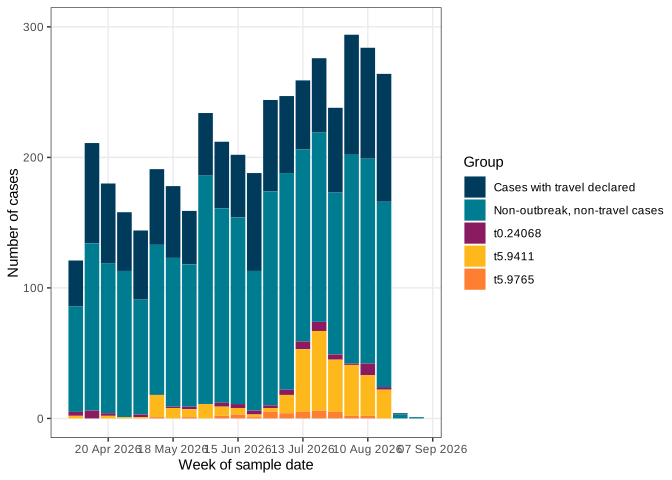
Since initiating the investigation into the SE t5.9411 cluster, UKHSA has also identified an increase in 2 other SE clusters (t0.24068 and t5.9765). These 2 additional clusters are genetically distinct to the t5.9411 cluster but are part of the wider family of SE which have seen increased case reporting from June 2026. The genetic relatedness of these clusters, alongside the epidemiological and food exposure information known to date, suggests that these outbreaks could all be associated with imported eggs and are therefore being investigated in parallel. The t0.24068 cluster was first investigated in 2025 and has re-emerged, with an increase in case reporting from June 2026. Further information on the t0.24068 cluster can be found in the published UKHSA Health Protection Report (3). Figure 1 shows cases in the 3 outbreak clusters (t5.9411, t0.24068 and t5.9765) over time against the background rate of all Salmonella in England.
Figure 1. Confirmed cases of SE t5.9411, t0.24068 and t5.9765 by week of sample date in 2026, against all Salmonella reported since 6 April 2026, England
The European Centre for Disease Prevention and Control (ECDC) has also reported an ongoing multi-country outbreak of SE, with the United Kingdom (UK) accounting for 61% of the 341 confirmed cases reported between May 2025 and August 2026 from SE t5.9411 (4). Cases linked to the outbreak strain have also been identified in Austria, Belgium, Denmark, France, Germany and the Netherlands, with the Netherlands reporting 31% of the 341 confirmed cases. New infections were reported in early August 2026, indicating that the outbreak remains ongoing in the EU.
Confirmed case definitions
t5.9411
A case of SE resident in England belonging to the UKHSA designation 1.2.3.18.5849.9411 reported by UKHSA’s GBRU since 11 August 2025 (earliest sample date for a case in this cluster).
t0.24068
A case of SE resident in England belonging to the UKHSA designation 1.2.3.18.180.180.24068 or within an absolute genetic distance of 5 Single Nucleotide Polymorphisms reported by UKHSA’s GBRU since 27 May 2025 (earliest sample date for a case in this cluster).
t5.9765
A case of SE resident in England belonging to the UKHSA designation 1.2.3.18.4050.9765 reported by UKHSA’s GBRU since 27 January 2026 (earliest sample date for a case in this cluster).
Caveat
There is an expected lag time of 1 to 2 weeks between the case sample date and the case being confirmed to be included in this data. Previous weeks’ data may be revised as samples are received and cases are confirmed. Overall, it typically takes 3 to 4 weeks to confirm whether an individual case is linked to an outbreak. The incubation period for Salmonella is on average 7 days. It would take someone a few days to see a health professional after having symptoms, testing and confirming their sample in an NHS laboratory where it is then sent to a UKHSA laboratory for confirmation and whole genome sequencing.
Notified cases
The increase seen in these 3 clusters of SE is part of a wider context of Salmonella transmission. Between 1 September 2026 and 8 September 2026, 414 non-typhoidal Salmonella isolates were identified at UKHSA’s GBRU, 206 (49.8%) of these isolates were identified as SE and 26 (6.3%) are part of these 3 outbreak clusters. The remaining cases of SE that are not associated with these 3 outbreak clusters are either associated with travel, are part of other clusters, or are sporadic cases.
t5.9411
As of 10am on 7 September 2026, UKHSA has been notified of a total of 322 cases (an increase of 17 cases since last week’s report) in the t5.9411 cluster in England. The sample dates of cases range from 11 August 2025 to 21 August 2026. In the past 4 weeks (11 August 2026 to 8 September 2026), 135 cases have been reported in England.
Figure 2. Confirmed cases of SE t5.9411 by week of sample date, England (n=306)[note 1]
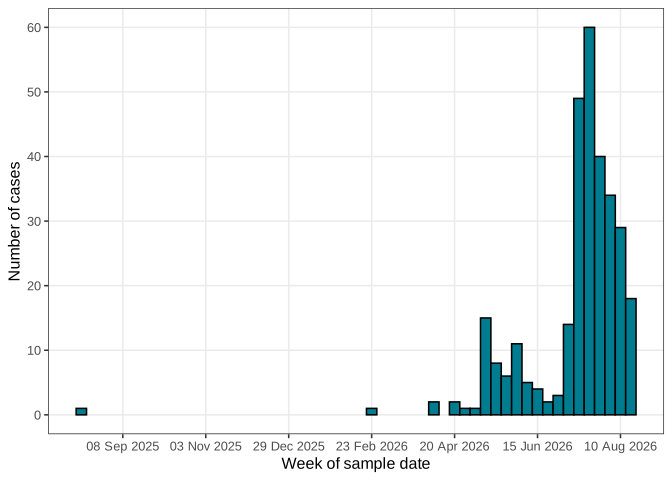
Note 1: sample dates are not known for the remaining 16 cases.
Cases distributed across all 9 regions in England are shown in Table 1.
Table 1. Rate of cases of SE t5.9411 per 100,000 population by region of residence, England since 11 August 2025
| Region | Rate per 100,000 population |
|---|---|
| North East | 1.75 |
| North West | 0.21 |
| Yorkshire and Humber | 0.97 |
| East Midlands | 0.18 |
| West Midlands | 0.10 |
| East of England | 0.86 |
| London | 0.97 |
| South East | 0.49 |
| South West | 0.05 |
Cases range in age from 0 years to 90 years (median 29.5 years) and 51.9% of cases are male.
Of the cases with information available (n=171), 42 cases (26.3%) have been admitted to hospital and there has been one death associated with this outbreak cluster.
t0.24068
As of 10am on 7 September 2026, UKHSA has been notified of a total of 186 cases (an increase of 4 cases since last week’s report) in the t0.24068 cluster in England. The sample dates of cases range from 27 May 2025 to 18 August 2026. In the past 4 weeks (11 August 2026 to 8 September 2026), 15 cases have been reported in England.
Figure 3. Confirmed cases of SE t0.24068 by week of sample date, England (n=184)[note 2]
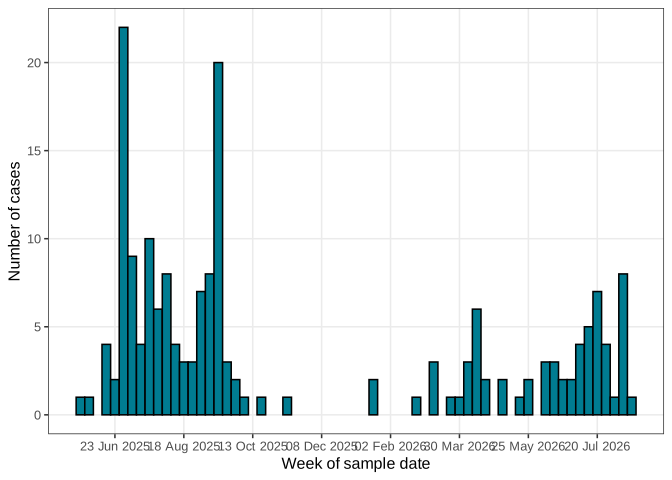
Note 2: sample dates are not known for the remaining 2 cases.
Cases distributed across 8 of the 9 regions in England are shown in Table 2.
Table 2. Rate of cases of SE t0.24068 per 100,000 population by region of residence, England since 27 May 2025
| Region | Rate per 100,000 population |
|---|---|
| North East | 0.19 |
| North West | 0.03 |
| Yorkshire and Humber | 0.07 |
| East Midlands | 0.04 |
| West Midlands | 0 |
| East of England | 0.64 |
| London | 1.06 |
| South East | 0.38 |
| South West | 0.03 |
Cases range in age from 0 years to 92 years (median 29 years) and 51.6% of cases are female.
Of the cases with information available (n=48), 22 cases (45.8%) have been admitted to hospital.
t5.9765
As of 10am on 7 September 2026, UKHSA has been notified of a total of 41 cases (no increase in cases since last week’s report) in the t5.9765 cluster in England. The sample dates of cases range from 27 January 2026 to 11 August 2026. In the past 4 weeks (11 August 2026 to 8 September 2026), 11 cases have been reported in England.
Figure 4. Confirmed cases of SE t5.9765 by week of sample date (where available), England (n=38)[note 3]
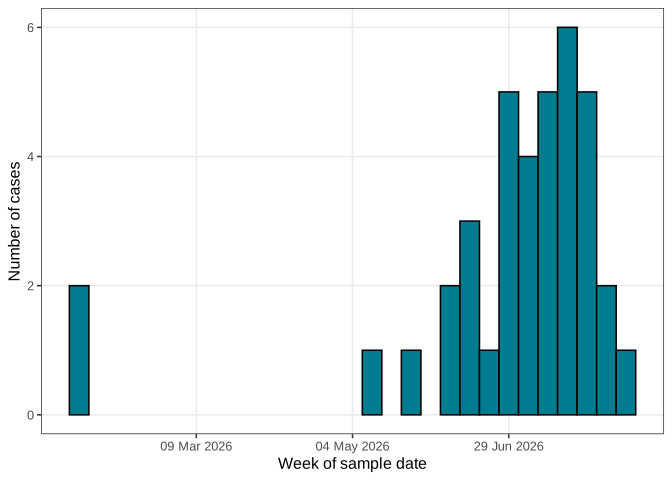
Note 3: sample dates are not known for the remaining 3 cases.
Cases distributed across 8 of the 9 regions in England are shown in Table 3.
Table 3. Rate of cases of SE t5.9765 per 100,000 population by region of residence, England since 27 January 2026
| Region | Rate per 100,000 population |
|---|---|
| North East | 0.30 |
| North West | 0.08 |
| Yorkshire and Humber | 0.02 |
| East Midlands | 0.02 |
| West Midlands | 0.02 |
| East of England | 0.09 |
| London | 0.15 |
| South East | 0.05 |
| South West | 0 |
Cases range in age from 0 years to 87 years (median 35 years) and 56.1% are male.
Of the cases with information available (n=20), 7 cases (35%) have been admitted to hospital and there has been one death associated with this outbreak cluster.
Data quality assurance
Data quality was assured through automation, where possible, and via a manual checking process undertaken by a second person.
More information and advice
More information about Salmonella can be found on:
- the NHS website
- the UKHSA website
References
1. Non-typhoidal Salmonella data 2016 to 2025
2. HPR volume 20 issue 8: news (18 August 2026)
3. HPR volume 19 issue 11: news (4 December 2025)
4. Communicable disease threats report, 15 to 21 August 2026, week 34