Patterns of education, social care and youth offending: Education and social care background
Published 14 May 2026

© Crown copyright 2026
This publication is licensed under the terms of the Open Government Licence v3.0 except where otherwise stated. To view this licence, visit nationalarchives.gov.uk/doc/open-government-licence/version/3 or write to the Information Policy Team, The National Archives, Kew, London TW9 4DU, or email: psi@nationalarchives.gov.uk.
Where we have identified any third party copyright information you will need to obtain permission from the copyright holders concerned.
This publication is available at https://www.gov.uk/government/publications/patterns-of-education-social-care-and-youth-offending/patterns-of-education-social-care-and-youth-offending-education-and-social-care-background
1. Key Findings
| Offending was rare amongst children and young people, driven mainly by ASB and acquisitive offences. VAWG and knife offences were much less common | Five per cent of all pupils in the cohort were cautioned or sentenced to any offence. Amongst those, half (51%) had been cautioned or sentenced for an ASB and acquisitive offence, 5% for a VAWG offence and 1.5% for a knife offence. |
| Most children and young people were cautioned or sentenced for their first offence between the ages of 15 to 19 years. Knife offences were on average committed later and peaked between the ages of 16 and 17 years | 62% of children and young people committed their first ASB and acquisitive offence and 59% of children and young people committed their first VAWG offence between 15 and 19. 12% of knife offences occurred between the ages of 10 to 14 in comparison to 26-29% for the other offence groups. Over half (53%) of children and young people cautioned or sentenced for a knife offence committed their first knife offence between the ages of 15 and 17, and 81% had done so before the age of 19. |
| Children cautioned or sentenced for any offence disproportionately had Special Educational Needs (SEN) | Between 72% and 87% across offence groups recorded were recorded as having SEN, compared with 42% of the overall pupil cohort. |
| Educational attainment outcomes varied across the offending groups | Educational attainment outcomes for children and young people cautioned or sentenced for a knife offence were consistently lower at both key stages (KS) 2 and 4 compared with those cautioned or sentenced for any offence. Whilst those cautioned or sentenced for an ASB and acquisitive offence had KS2 attainment at broadly similar levels to those cautioned or sentenced for any offence, this was lower by KS4. The opposite pattern was found with children and young people cautioned or sentenced for a VAWG offence, who had lower attainment outcomes at KS2 but increased to similar levels to those cautioned or sentenced for any offence at KS4. Educational outcomes at both KS2 and KS4 for children and young people cautioned or sentenced for any offence were lower than the overall pupil cohort. |
| High proportions of children and young people cautioned or sentenced for a knife offence and an ASB and acquisitive offence were suspended | Among children and young people who had been cautioned or sentenced for any offence, 65% had been suspended from school. This was higher for those cautioned or sentenced for a knife offence (87%) and an ASB and acquisitive offence (73%). Those cautioned or sentenced for a VAWG offence were broadly in line with any offence (64%). This compares with only 15% of the overall pupil cohort had been suspended from school. |
| A high proportion of children who had been permanently excluded were cautioned or sentenced for an offence | Over half (53%) of children and young people who had been permanently excluded had been cautioned or sentenced for any offence. Of all children who were excluded, over a third (35%) were cautioned or sentenced for an ASB and acquisitive offence, while much smaller proportions were for VAWG (3%) or knife offences (2%). |
| High proportions of the offending groups were persistently absent. However, most children that were persistently absent were not in the offending groups | Persistent absence was common among children and young people cautioned or sentenced any offence, with almost three-quarters (74%) having been persistently absent, compared with 45% of all pupils. However, among children who had ever been persistently absent, 8% were cautioned or sentenced for any offence. Of these, 4.6% were for an ASB and acquisitive offence, 0.4% for a VAWG offence and 0.1% for a knife offence. |
| Children in the offending groups were more likely to have been known to children’s social care than the overall population | For those in the KS4 academic year of 2018/19, almost 4 in 10 (38%) of children and young people cautioned or sentenced for any offence had been recorded as a child in need (CIN) compared with one in 10 of the overall pupil population. This was higher across all specific offence groups: 63% for knife offences, 51% for VAWG offences and 47% for ASB and acquisitive offences. |
| Regional variation in several educational factors was more notable for knife offences than for other offences | There was greater regional variation in the proportion of those cautioned or sentenced for a knife offence who had been permanently excluded (from 13% in Yorkshire and the Humber to 26% in the West Midlands), who had been registered at an Alternative Provision (AP) education setting (from 27% in Yorkshire and the Humber to 50% in London), and who had achieved any pass at GCSE or equivalent (from 59% in the North West to 74% in the East Midlands). |
2. Introduction
This report has been produced by the Ministry of Justice (MoJ) Data First programme, funded by Administrative Data Research UK (ADR UK). It forms part of a suite of reports which present new insights into the education and social care background of children and young people who have been cautioned or sentenced for any offence, with a focus on knife offences, anti-social behaviour (ASB) and acquisitive offences, and violence against women and girls (VAWG) offences. These offences are key areas of focus within the Government’s Safer Streets mission.[footnote 1][footnote 2] The analysis draws on linked Ministry of Justice (MoJ) and Department for Education (DfE) data, using data from the Police National Computer (PNC) and the National Pupil Database, from a data share completed in 2026.
The analysis is descriptive. It is intended to deepen understanding of the education and social care backgrounds of children and young people who had been cautioned or sentenced for these offences, including attainment outcomes and characteristics.
The analysis does not imply a causal link between these factors. Improving the evidence base on these associations is critical for identifying patterns of risk, informing early intervention policy, targeting support more effectively, and preventing escalation into more serious and persistent offending. This is a descriptive statistics publication of census data[footnote 3] and does not include any tests for statistical significance.
This paper includes a high-level analysis of demographic factors as well as several key education and children’s social care variables, including:
- Gender
- Age
- Ethnicity
- Free school meal eligibility
- Attainment at key stage 2 and key stage 4
- School absences
- Suspensions and permanent exclusion
- Alternative provision
- Special Educational Needs (SEN)
- Children known to children’s social care
Analysis is primarily presented for England, with additional analyses by region[footnote 4] for some breakdowns to provide insights on whether demographic, education or social care factors of offending groups vary across different geographical areas.
Visual maps by region are provided where regional variations in education or social care factors by offending sub-group are noted, to aid interpretation. Regional variation may have several different causes, including wider population demographics, local policy and availability of support and provisions. Possible drivers of this variation are not explored in this report.
For more detail on the data share that this analysis is based on, refer to the separate Technical Guide. The data used in this analysis are presented in the accompanying tables, with the source table referenced in this paper, where relevant.
3. Defining the study population
3.1 Defining the all-pupil cohort
This analysis includes children and young people who finished key stage 2 (KS2) and were aged 10 at the start of the academic years from 2008/09 to 2013/14. This cohort therefore has key stage 4 (KS4) academic years of 2013/14, 2014/15, 2015/16, 2016/17, 2017/18 or 2018/19. The cohort comprises approximately 3.13 million pupils. All available records from school Year 1 to Year 13 (or equivalent) are included. Pupils without a KS4 record are excluded (Figure 1).
The cohorts were selected to maximise data coverage and balance data availability across each of the datasets in the share. Pupils who attended an independent primary or secondary school have been excluded as information on their characteristics are not recorded.
Children that appeared on a school census at the end of KS2 and KS4 have been included. Those that have moved ahead or been kept behind by one or more academic years were excluded.
Figure 1: Year group breakdown for the all-pupil cohort
| Academic Year | KS4 Academic Year 2018/19 | KS4 Academic Year 2017/18 | KS4 Academic Year 2016/17 | KS4 Academic Year 2015/16 | KS4 Academic Year 2014/15 | KS4 Academic Year 2013/14 |
|---|---|---|---|---|---|---|
| 2020/21 | Year 13 | |||||
| 2019/20 | Year 12 | Year 13 | ||||
| 2018/19 | Year 11 | Year 12 | Year 13 | |||
| 2017/18 | Year 10 | Year 11 | Year 12 | Year 13 | ||
| 2016/17 | Year 9 | Year 10 | Year 11 | Year 12 | Year 13 | |
| 2015/16 | Year 8 | Year 9 | Year 10 | Year11 | Year 12 | Year 13 |
| 2014/15 | Year 7 | Year 8 | Year 9 | Year 10 | Year 11 | Year 12 |
| 2013/14 | Year 6 | Year 7 | Year 8 | Year 9 | Year 10 | Year 11 |
| 2012/13 | Year 5 | Year 6 | Year 7 | Year 8 | Year 9 | Year 10 |
| 2011/12 | Year 4 | Year 5 | Year 6 | Year 7 | Year 8 | Year 9 |
| 2010/11 | Year 3 | Year 4 | Year 5 | Year 6 | Year 7 | Year 8 |
| 2009/10 | Year 2 | Year 3 | Year 4 | Year 5 | Year 6 | Year 7 |
| 2008/09 | Year 1 | Year 2 | Year 3 | Year 4 | Year 5 | Year 6 |
| 2007/08 | Year 1 | Year 2 | Year 3 | Year 4 | Year 5 | |
| 2006/07 | Year 1 | Year 2 | Year 3 | Year 4 | ||
| 2005/06 | Year 1 | Year 2 | Year 3 | |||
| 2004/05 | Year 1 | Year 2 | ||||
| 2003/04 | Year 1 |
Findings are provided for the all-pupil cohort (including all children and young people who had been cautioned or sentenced for any offence) for comparison purposes.[footnote 5]
The findings presented are the combined results of all six year groups, except for findings on children known to social care, as full children in need (CIN) data is only available from 2012/13.[footnote 6] This means each KS4 cohort has a different length of time in which CIN involvement can be observed (earlier KS4 cohorts have fewer years of CIN data available, while later cohorts have more). To maximise coverage of the CIN data and avoid skewed results, analysis of children known to social care is based on children matched to the KS4 academic year 2018/19. The figures for individual academic years can be found in the accompanying tables.
3.2 Defining the offending groups
‘Children and young people who had been cautioned or sentenced for any offence’ relates to all children and young people in the linked data who were in the KS4 academic years 2013/14 to 2018/19, and who had been cautioned or sentenced for any offence recorded on the PNC over the coverage period.[footnote 7] All cohorts in this analysis are limited to ages 10-21. This is to ensure that each individual had the same amount of time to offend.
The analysis identified approximately 157,900 children and young people who had been cautioned or sentenced for any offence, representing 5% of the all-pupil cohort.
In addition to this overall offending group, the analysis examined children and young people who had been cautioned or sentenced classified into the following three offending sub-groups:
1.A knife offence (approximately 2,400 children and young people) which is based on a proxy measure, defining knife offences as:
-
A knife possession or threatening offence is recorded (e.g. having an article with a blade or point, possession of offensive weapon), and
-
An offence type that can be flagged as ‘knife-enabled’ in Police Recorded Crime (PRC) data occurs on the same day.
A knife possession or threatening offence includes possession or threatening with offensive weapons, as possession of some knifes (e.g. zombie knives) will be recorded as offensive weapons. In this analysis, only the seven offence types that can be flagged as ‘knife-enabled’ in the PNC data will be considered. [footnote 8]
2.An ASB and acquisitive offence (approximately 80,300 children and young people) which includes:
- Categories used in the Crime Survey England and Wales (offences that cause distress or alarm, including littering, loud noises, vandalism, intimidation and drug possession), and
- Crimes disproportionately affecting town centres and high streets, i.e. retail and street crime which includes shop theft, robbery and theft from the person, and ASB which includes littering, nuisance noise, vandalism and drug possession
- Other theft offences, such as vehicle crime.
This category reflects only a subset of ASB and acquisitive offence types. This category includes individuals who had been cautioned or sentenced for either ASB or acquisitive offences, or for both of these offence groups.
3.A VAWG offence (approximately 7,700 children and young people) which is based on offences that are known to disproportionately impact women and girls and are identifiable within the PNC data. The definition includes but is not limited to:
- Sexual offences: Rape, sexual assault, sexual activity with minors, exploitation, grooming
- Non-Sexual offences: Harassment, stalking, coercive control, exploitation of prostitution, forced marriage, Female Genital Mutilation (FGM)
This offence list is not an exhaustive list of behaviours captured by the Government’s VAWG definition, and some behaviours will not be included. Additionally, not all offence codes specify victim gender or age. Male victim offences are included for comprehensive analysis, as outlined in the Government’s VAWG strategy.[footnote 9]
Refer to the Technical Guide for further detail on the offence sub-groups.
3.3 Key points on the analysis: limitations and caveats
The following should be considered when interpreting the findings in this report:
- Children and young people who had been cautioned or sentenced for a knife offence, ASB and acquisitive offence or VAWG offence represent a small group of young people. The results should not be assumed to be representative of all children and young people who have been cautioned or sentenced for any offence or children and young people more generally.
-
The analysis considers children and young people cautioned or sentenced for any offence, and separately for knife, ASB and acquisitive, and VAWG offences. These offence‑specific groups are analysed independently and are treated as subsets of the overall offending group. As individuals may fall into more than one offence category, findings across groups are not additive.
- These are descriptive statistics only. The findings do not imply a causal link between the educational or social care characteristics and being cautioned or sentenced for an offence.
-
This analysis shows that while a high proportion of children cautioned or sentenced for knife offences have certain characteristics such as having ever been eligible for free school meals (FSM), this does not imply a causal relationship. For example, although around 78% of those cautioned or sentenced for a knife offence had been eligible for FSM, these individuals represent only 0.2% of all pupils ever eligible for FSM, meaning most FSM‑eligible children are not involved in knife offences. This pattern emerges throughout this analysis, and causal conclusions cannot be drawn because many other unobserved influences such as health characteristics are not captured in the data used.
- The education variables included in this paper have generally been analysed independently of each other. Therefore, potential interrelationships between these variables, as well as other factors not captured in the data, have not been accounted for.
- This analysis will not be directly comparable with other published government statistics. Unless otherwise specified, when referencing whether a child has “ever” had a certain characteristic, the analysis considers all periods up to the end of KS4. This methodology may differ from that of other published statistics where, for example, only the previous six years are considered. For this reason, figures discussed here may appear higher than those available in other publications.
4. Findings
4.1 Gender
Males were overrepresented in this cohort and made up 80% of children and young people cautioned or sentenced for any offence. In comparison, 51% of the pupil cohort was male (Table 1.1.1).
Figure 2: The gender breakdown of offending and pupil group, for pupils matched to KS4 academic years 2013/14 to 2018/19 (Source: Table 1.1.1)
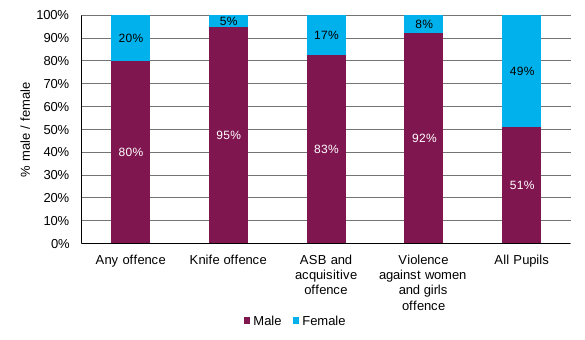
This gender disparity was more evident amongst children and young people cautioned or sentenced for a knife offence (95% male) and VAWG offences (92% male). This was consistent across England, with males representing between 89% and 97% of children cautioned or sentenced for knife and VAWG offences across all regions.
Males also made up a large majority of children and young people cautioned or sentenced for ASB and acquisitive offences, accounting for 83% of these offences. This pattern was reflected across all regions, ranging from 78% in the South West to 87% in London (Table 1.1.3). The gender patterns observed for ASB and acquisitive offences are broadly consistent with the proportions observed among children and young people cautioned or sentenced for any offence, which may partly be driven by those cautioned or sentences for ASB and acquisitive offences comprising a substantial proportion of this wider cohort.[footnote 10]
4.2 Age
The age profiles, as measured by the age at first offence, are based on children and young people who were cautioned or sentenced for any offence between the ages of 10 and 21 years.
Most (61%) children and young people committed their first offence between the ages of 15 and 19. (Table 1.2.1)
Figure 3: The proportion of children relative to their age at first offence by offending group, for pupils matched to KS4 academic years 2013/14 to 2018/19 (Source: Table 1.2.1)[footnote 11]
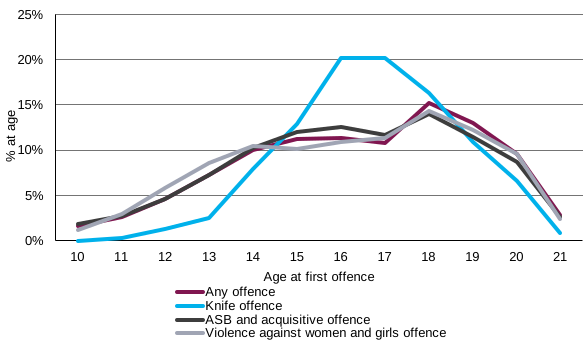
This pattern is consistent for children cautioned or sentenced for ASB and acquisitive offences and VAWG offences: 62% committed their first ASB and acquisitive offence and 59% committed their first VAWG offence between 15 and 19.
There was some regional variation in the age at first ASB and acquisitive offence: the proportion of those who had been cautioned or sentenced by age 14 ranged from 19% in London to 38% in the North East (Table 1.2.3). Patterns for age of first VAWG offence were largely consistent across regions.
Knife offences were on average committed later and peaked between the ages of 16 and 17 years. 12% occurred between the ages of 10 to 14 in comparison to 26-29% for the other offence groups. Over half (53%) of children and young people cautioned or sentenced for a knife offence committed their first knife offence between the ages of 15 and 17, and 81% had done so before the age of 19.
Reflecting national figures, first knife offences peaked between the ages of 15 and 17 across eight of the nine regions in England, with around half or more committing their first knife offence between these ages (ranging from 47% in Yorkshire and the Humber to 60% in the West Midlands). In the North East, the age of first knife offence was typically older than other regions, with only 39% committing their first knife offence between age 15 and 17, and this being the only region in which over half (52%) committed their first knife offence at age 18 or older.
4.3 Ethnicity
Children and young people from White backgrounds (including White minorities) made up the majority of children and young people cautioned or sentenced for a knife offence (54%). They were underrepresented relative to the overall pupil population (79%) and the White offending population (77%).
Figure 4: The proportion of all pupils split by ethnic group, offending and pupil group, for pupils matched to KS4 academic years 2013/14 to 2018/19 (Source: Table 1.3.1)[footnote 12]
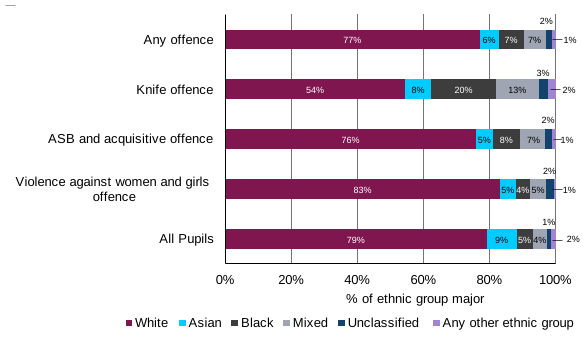
Children and young people from Black and mixed ethnic backgrounds were disproportionately represented among those cautioned or sentenced for knife offences. While they made up just under one in ten (9%) of the overall pupil population, they accounted for around a third (33%) of children and young people who received a caution or sentence for a knife offence.[footnote 13]
Almost three quarters (72%) of children and young people cautioned or sentenced for an ASB and acquisitive offence were from a White British background, a slight underrepresentation relative to their share of the overall pupil population (75%). Children and young people from Black and Mixed ethnic backgrounds were slightly overrepresented, making up 8% and 7% of those cautioned or sentenced for an ASB and acquisitive offence while accounting for 5% and 4% of the pupil population respectively. Children and young people from Asian backgrounds made up 5% of children and young people cautioned or sentenced for an ASB and acquisitive offence, an underrepresentation compared to 9% of the pupil population.
Around four in five (83%) children and young people cautioned or sentenced for a VAWG offence were from White backgrounds. This indicates a slight overrepresentation from the overall pupil population. Children and young people from Asian backgrounds were underrepresented, making up 9% of pupils but around 5% of those cautioned or sentenced for a VAWG offence. Representation among children and young people from Black and mixed ethnic backgrounds was broadly in line with their share of the overall pupil population.
While ethnic backgrounds of the pupil cohort varied considerably across regions, patterns of ethnicities within the different offending groups, when accounting for these differences, were broadly similar across regions (Table 1.3.3).
4.4 Free school meals
Free school meal (FSM) eligibility is often used as an indicator of socio‑economic disadvantage. Within the cohort, FSM eligibility during primary or secondary school[footnote 14] was more common among children and young people cautioned or sentenced for any offence (63%) compared to all pupils (35%).
Figure 5: The proportion of all pupils eligible for free school meals by offending and pupil group, for pupils matched to KS4 academic years 2013/14 to 2018/19 (Source: Table 1.4.1)
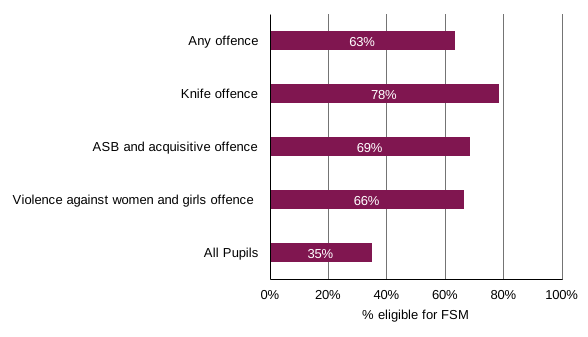
Of the offence sub-groups, FSM eligibility was highest for children and young people cautioned or sentenced for a knife offence (78%) and lowest for VAWG offences (66%), while 69% of children cautioned or sentenced for an ASB and acquisitive offence were eligible (Table 1.4.1).
While rates of FSM eligibility for all pupils varied across regions, from 26% in the South East to 49% in London, for all regions the majority of children and young people cautioned or sentenced for any offence were eligible for FSM (from 55% in the South East to 74% in London; Table 1.4.3). This was consistent across all offence groups.
However, whilst most children and young people cautioned or sentenced had ever been eligible for FSM, only 9% of children or young people eligible for FSM were cautioned or sentenced for any offence (ranging from 0.2% for knife offences, 0.5% VAWG offences and 5% ASB and acquisitive offences).
4.5 Persistent absence
For this analysis, a child is defined as persistently absent (PA) if they have missed 10% or more of the sessions (most sessions represent a half-day) they could have attended in an academic year.[footnote 15] PA can include various reasons for absence, including due to being suspended or permanently excluded. It includes both authorised and unauthorised absences.[footnote 16] The absence reason ‘persistent absence unauthorised other’ (PAUO) is used as a proxy for truancy.
Among children and young people cautioned or sentenced for any offence, almost three-quarters (74%) were persistently absent for any reason (compared to 45% of all pupils), and 32% were recorded as PAUO (compared to 8% for all pupils).
Persistent absence due to exclusion with no alternative education provision affected 12% of children and young people cautioned or sentenced for any offence but only 1% of all pupils (Table 1.5.1). Similar patterns of persistent absence for any reason were reflected for all regions (Table 1.5.3).
Figure 6: The proportion of all pupils persistently absent by offending and pupil group, for pupils matched to KS4 academic years 2013/14 to 2018/19 (Source: Table 1.5.1)
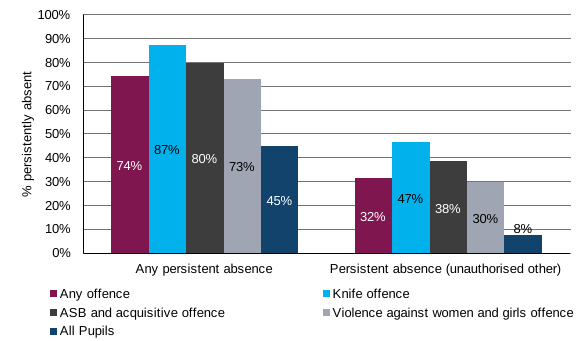
Eighty-seven per cent of children and young people cautioned or sentenced for a knife offence were recorded as persistently absent for any reason, with 47% classed as PAUO. In addition, a quarter (25%) were persistently absent due to exclusion with no alternative provision.
A large majority of children and young people cautioned or sentenced for an ASB and acquisitive offence were also persistently absent: 80% were persistently absent for any reason and 38% were recorded as PAUO. Additionally, 16% were persistently absent due to exclusion without alternative provision.
Children and young people cautioned or sentenced for a VAWG offence were more closely aligned with those cautioned or sentenced of any offence (73% were persistently absent for any reason and 30% were recorded as PAUO). 14% were persistently absent due to exclusion without alternative provision.
Of those who had ever been persistently absent, 8% were cautioned or sentenced for any offence. Within this group, 4.6% were for an ASB and acquisitive offence, 0.4% for a VAWG offence and 0.1% for a knife offence. However, most children (92%) that were persistently absent were not in the offending groups.
4.6 Suspensions and permanent exclusion
A suspension is where a pupil has been temporarily removed from the school,[footnote 17] whilst a permanent exclusion is when a pupil is no longer allowed to attend a school.[footnote 18] The analysis does not account for the point at which the suspension or exclusion took place, so may have occurred before or after offences were committed.
Figure 7: The proportion of all pupils who had a record of being suspended or permanently excluded by offending and pupil group, for pupils matched to KS4 academic years 2013/14 to 2018/19 (Source: Table 1.6.1)
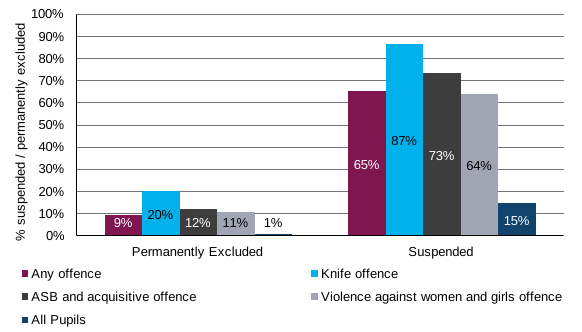
Among children and young people cautioned or sentenced for any offence, 65% had been suspended and 9% permanently excluded (compared with 15% and 1% of all pupils respectively).
Among the offence sub-groups, suspensions and exclusions were highest for those who were cautioned or sentenced for a knife offence, where almost nine in ten (87%) had ever received a suspension, and a fifth (20%) had been permanently excluded.
Figure 8 represents regional differences in the proportions of children and young people who were permanently excluded across the offence groups. Overall, the proportions who had been permanently excluded were higher and more varied across regions for knife offences than for ASB and acquisitive offences and VAWG offences. Higher regional variation for knife offences may, to some extent, be explained by the cohort including fewer children and young people cautioned or sentenced for a knife offence than for the other sub-groups, which may lead to proportions for knife offences being more variable.
Figure 8: The proportion of all pupils who had a record of being permanently excluded by offending group and region, for pupils matched to KS4 academic years 2013/14 to 2018/19 (Source: Table 1.6.3)

Permanent exclusions for those cautioned or sentenced for a knife offence varied by region, from 13% in Yorkshire and the Humber to 26% in the West Midlands. Some of this variation may be accounted for by regional differences in permanent exclusions: for the all pupil cohort, Yorkshire and the Humber, the East of England and the South East had the lowest rates of permanent exclusion (0.7%) and the North East, the North West and the West Midlands had the highest (1.1%). The proportion of pupils suspended was more consistent across regions for the all-pupil cohort and across all offence sub-groups.
For children and young people cautioned or sentenced for an ASB and acquisitive offence, 73% were suspended, while 12% were permanently excluded. Regionally, permanent exclusions for those cautioned or sentenced for an ASB and acquisitive offence ranged from 9% in Yorkshire and the Humber and the East of England to 15% in the West Midlands.
For VAWG offences, the rates were similar to all children and young people cautioned or sentenced to any offence (64% suspended and 11% excluded). Permanent exclusions for VAWG offences ranged from 8% in the East of England and the South East to 13% in the North West and the West Midlands.
Around 15% of all pupils had been suspended, and of these, 22% of suspended pupils had ever been cautioned or sentenced for any offence. This was 13% for ASB and acquisitive offences, 1% for VAWG offences and 0.5% for knife offences. This indicates that, whilst most children and young people cautioned or sentenced for offences had also been suspended, it is not the case that most suspended pupils were cautioned or sentenced for offences.
Over half (53%) of all children and young people who had been permanently excluded had been cautioned or sentenced for any offence. Of all children who were excluded, 35% had been cautioned for an ASB and acquisitive offence, 3% for a VAWG offence and 2% for a knife offence.
4.7 Alternative Provision
Alternative provision (AP) is suitable full or part-time education for children of compulsory school age arranged by local authorities and schools for children who would not otherwise receive suitable education. This may be due to exclusion, illness, suspension or the need to improve behaviour outside of school. Most AP takes place at a pupil referral unit (PRU), or in AP academies, which include free schools.[footnote 19]
Figure 9: The proportion of all pupils who had ever attended alternative provision by offending and pupil group, for pupils matched to KS4 academic years 2013/14 to 2018/19 (Source: Table 1.7.1)
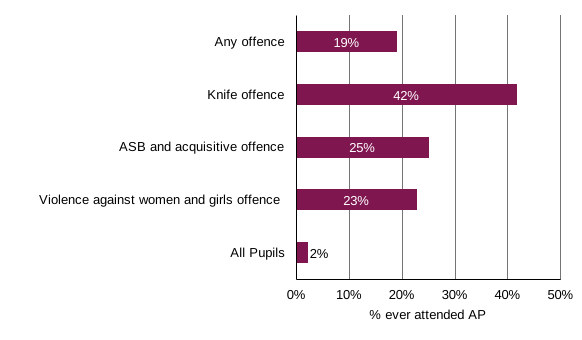
Almost a fifth (19%) of all children and young people who had been cautioned or sentenced for any offence had ever attended an AP setting. This proportion was higher for all specific offence sub-groups: highest for knife offences (42%); 25% for ASB and acquisitive offences and 23% for VAWG offences. This compares to only 2% of the total pupil cohort.
Figure 10 represents regional differences in the proportions of children and young people across the offence groups who had ever attended an AP setting. Overall, a higher and more regionally varied proportion of those with knife offences had ever been registered at an AP setting than for ASB and acquisitive offences and VAWG offences.
Figure 10: Proportion of all pupils who had ever attended alternative provision by offending group and region, for pupils matched to KS4 academic years 2013/14 to 2018/19 (Source: Table 1.7.3)

Across regions, the proportion of those cautioned or sentenced of a knife offence who had ever attended an AP setting showed notable variation, ranging from just over a quarter (27%) in Yorkshire and the Humber to half (50%) in London. Some of this variation may be accounted for by regional differences in how many children attended an AP setting in the all-pupil cohort. In the all-pupil cohort this ranged from 1.7% in the East Midlands to 3.3% in London.
Of the pupil cohort which had ever attended an AP setting, 42% had ever been cautioned or sentenced for any offence. The rates for the other offending groups were lower, particularly for children and you people cautioned or sentenced for knife and VAWG offences: 1% of children and young people at an AP setting had ever been cautioned or sentenced for a knife offence, 2% for a VAWG offence, and 28% for an ASB and acquisitive offence.
4.8 Special Educational Needs (SEN)
A child or young person has Special Educational needs (SEN) [footnote 20] if they have a learning difficulty or disability which calls for special educational provision to be made for them.[footnote 21]
Most children with SEN will have their needs met by their education setting with no additional funding from the local authority (‘SEN support’)[footnote 22], whilst others may undergo a formal assessment resulting in an Education, Health and Care plan (EHC)[footnote 23] if they are assessed as having a complex need that requires additional provision. This analysis only covers children who have identified SEN. Some children will have unidentified needs and therefore relevant support will not have been put in place.
A higher proportion of children and young people cautioned or sentenced for any offence were recorded as having SEN (both with SEN support and with an EHC plan) than the all-pupil cohort (Table 1.8.1), a pattern reflected across all regions (Table 1.8.5). This difference was more pronounced for children and young people cautioned or sentenced for knife, ASB and acquisitive or VAWG offences compared to those cautioned or sentenced for any offence.
Figure 11: The proportion of all pupils split by Special Educational Needs, offending and pupil group, for pupils matched to KS4 academic years 2013/14 to 2018/19 (Source: Table 1.8.1)
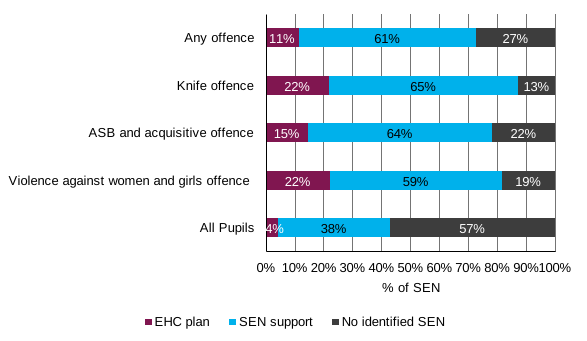
Of all children and young people who had been cautioned or sentenced for any offence, 61% had ever had SEN support, compared with 38% of the overall pupil population. This compares with 65% of those cautioned or sentenced for a knife offence, 64% for an ASB and acquisitive offence and 59% for a VAWG offence.
Of those who had been cautioned or sentenced for any offence, 11% had ever had an EHC plan (compared with 4% of the all-pupil cohort). This compares with 22% of children and young people who had been cautioned or sentenced for a knife offence and 15% for an ASB and acquisitive offence. Over a fifth of children and young people who had been cautioned or sentenced for a VAWG offence (22%) had an EHC plan, which is the largest divergence between those cautioned or sentenced for a VAWG offence relative to any offence for all educational and social factors reported in this paper.
Types of Special Educational Needs
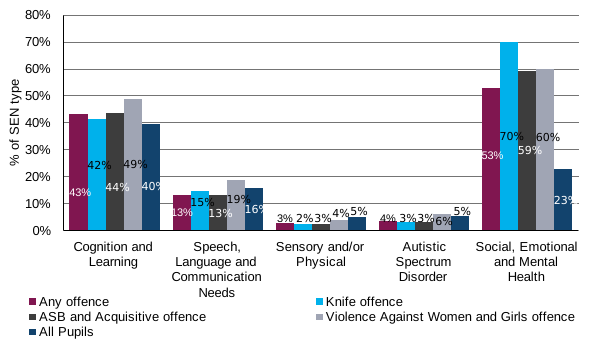
The most prevalent type of SEN among all offending groups was social, emotional and mental health needs (SEMH)[footnote 24]or prior to 2014/15, behaviour, emotional and social difficulties (BESD). Among children and young people who had ever had SEN and had been cautioned or sentenced for any offence, 53% were recorded with SEMH/BESD (compared with 23% of all pupils). This was higher for knife offences (70%) but slightly lower for VAWG offences (60%) and ASB and acquisitive offences (59%).
Cognitive and Learning needs were the next most prevalent recorded SEN type among children and young people cautioned or sentenced for any offence, recorded for 43% of those who had ever had SEN (compared with 40% of all pupils). This was slightly higher for VAWG offences (49%), but similar for ASB and acquisitive offences (44%) and knife offences (42%).
Figure 12: The proportion of SEN types for all pupils with SEN, by offending and pupil group, for pupils matched to KS4 academic years 2013/14 to 2018/19 (Source: Table 1.8.3)
4.9 Children known to social care
This section explores the proportion of children and young people that were recorded as being children in need (CIN) or children looked after (CLA), [footnote 25][footnote 26] as defined by the Children Act 1989, on 31 March in any given year. Full CIN data is available from 2012/13.[footnote 27] This means KS4 cohorts differ in the length of time over which CIN involvement can be observed: earlier cohorts have fewer years of CIN data available, while later cohorts have more.[footnote 28] To maximise coverage of the CIN data and avoid skewed results, analysis of children known to social care is therefore based on children matched to the 2018/19 KS4 academic year. Figures for individual academic years can be found in the accompanying tables.
The introduction of the Legal Aid, Sentencing and Punishment of Offenders Act 2012 (LASPO) meant that, from December 2012, children up to the age of 18 who are remanded to youth detention accommodation as a result of being charged with or convicted of any offence will be ‘looked after’ by the designated local authority.[footnote 29]Therefore, caution should be taken when considering the findings related to CLA and offending, as the child may have become CLA due to the offending.
Figure 13: The proportion of all pupils who had been cautioned or sentenced that are CLA or CIN, for pupils matched to KS4 academic year 2018/19 (Source: Table 1.9.1)
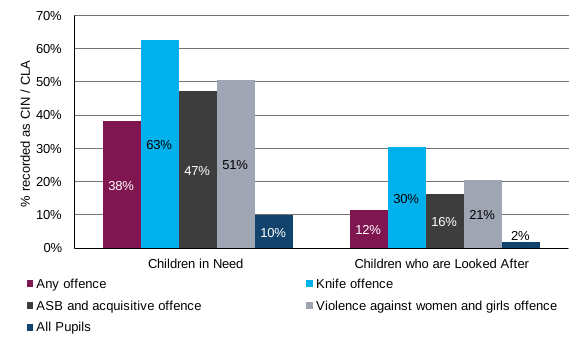
A higher proportion of children and young people cautioned or sentenced for any offence were recorded as CLA compared with pupils in the general population (12% and 2% respectively). The proportion was highest for knife offences (30%); followed by VAWG (21%) and then ASB and acquisitive offences (16%) (Table 1.9.1).
CIN refers to children who are designated under a number of different social care classifications: children on a child in need plan; children on a child protection plan (CPP); and children who are looked after. As such, CLA figures are included in the figures for CIN. Since the CIN and CLA data cover different time periods, and CIN includes CLA for some of the same period, comparisons of CIN to CLA should be made with caution.
A higher proportion of children and young people cautioned or sentenced for a knife offence, ASB and acquisitive offence or VAWG offence were recorded as a CIN compared with the overall pupil population, as well as those children cautioned or sentenced for any offence. Around two thirds (63%) of those cautioned or sentenced for knife offences, over half (51%) for VAWG offences and 47% of ASB and acquisitive offences were ever recorded as CIN (Table 1.9.1). One in ten children in the all-pupil population were ever recorded as CIN compared with 38% of those cautioned or sentenced for any offence.
There was notable variation in the proportions of children ever recorded as CIN and CLA across regions for all offending groups (Table 1.9.2). The proportion of children and young people cautioned or sentenced for a knife offence who were ever recorded as CIN, varied from 50% in the East Midlands to 71% in the East of England (Figure 14). For ASB and acquisitive offences this varied from 38% in the East of England to 57% in the North East; and for VAWG offences, this varied from 40% in the East of England to 58% in the North East, South East and South West.
For the all pupils cohort, there was mostly minimal variation in the proportion ever recorded as CIN - eight of the nine regions ranged from 10% to 12% of pupils having ever been recorded as CIN. However, there was a notably lower proportion ever recorded as CIN in the East of England, at 7%.
Figure 14: Proportion of all pupils who were ever recorded as CIN by offending group and region, for pupils matched to KS4 academic year 2018/19 (Source: Table 1.9.2)*

*Note: Striped areas indicate regions where figures have been suppressed to prevent the disclosure of personal information.
4.10 Attainment at key stage 2 and key stage 4
Key stage 2
Children and young people cautioned or sentenced for an ASB and acquisitive offence had broadly similar KS2 [footnote 30] attainment to children and young people cautioned or sentenced for any offence. 63% achieved Level 4 in English and 69% in Maths, compared with 66% and 71% respectively. This was lower than the overall pupil population with 83% and 84% pass rates in English and Maths respectively. This pattern was observed across all regions (Table 1.10.3).
Figure 15: The proportion of all pupils who achieved level 4 or above in English and Mathematics at key stage 2 by offending and pupil group, for pupils matched to KS4 academic years 2013/14 to 2018/19 (Source: Table 1.10.1)
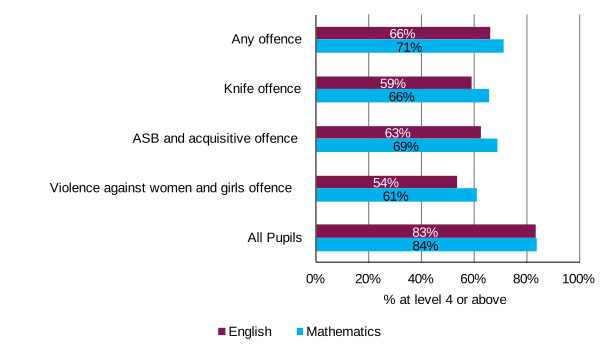
Children and young people cautioned or sentenced for a knife offence achieved lower attainment at KS2 than those cautioned or sentenced for any offence, where 59% reached Level 4 in English, and 66% did so in Maths. This pattern of lower Level 4 attainment for knife offences was reflected across all regions (Table 1.10.3). However, for the London region, the proportions of those cautioned or sentenced for knife crime who achieved Level 4 in English (69%) and Maths (71%) were broadly similar to those cautioned or sentenced for any offence (70% for English and 74% for Maths). For the South East, there was a similar pattern for Maths: 67% of those cautioned or sentenced for knife crime achieved level 4, compared to 70% of those cautioned or sentenced for any offence.
Among children and young people cautioned or sentenced for a VAWG offence, their KS2 outcomes were lower than those cautioned or sentenced for any offence, with 54% achieving Level 4 in English and 61% in Maths (Table 1.10.1). This pattern was observed across all regions (Table 1.10.3).
Key stage 4
Despite achieving similar attainment at KS2, by KS4 children and young people cautioned or sentenced for an ASB and acquisitive offence achieved lower outcomes overall than those cautioned or sentenced for any offence. Eight in 10 (80%) achieved any pass at GCSE, compared with 86% among the offending group (and 97% of the all-pupil cohort). Pass rates for this offending group were broadly consistent across all regions.
Figure 16: The proportion of all pupils who achieved various key stage 4 (KS4) benchmarks by offending and pupil group, for pupils matched to KS4 academic years 2013/14 to 2018/19 (Source: Table 1.11.1)
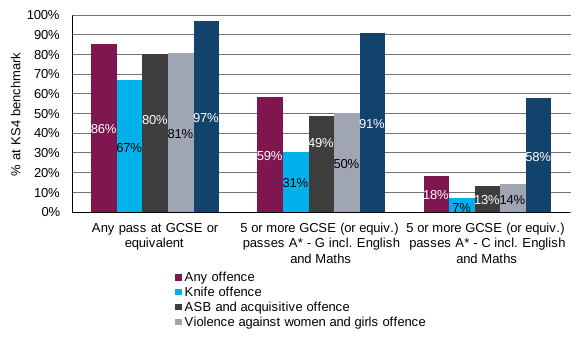
As with KS2, children and young people cautioned or sentenced for knife crime offences continued to show noticeably lower attainment at KS4; 67% achieved any pass at GCSE (compared with 86% of those cautioned or sentenced for any offence) (Table 1.11.1).
While KS4 attainment was largely consistent across regions for the all-pupil cohort, there was some regional variation for those cautioned or sentenced for knife offences. Proportions of those cautioned or sentenced for knife offences achieving any pass at GCSE ranged from 59% in the North West to 74% in the East Midlands (Figure 17).
Children and young people cautioned or sentenced for a VAWG offence had improved outcomes at KS4 and were broadly in line with children and young people cautioned or sentenced for any offence (81% achieved any GCSE pass). Pass rates for this offending group were broadly consistent across all regions.
Figure 17: The proportion of all pupils who achieved any pass at GCSE or equivalent key stage 4 by offending group and region, for pupils matched to KS4 academic years 2013/14 to 2018/19 (Source: Table 1.11.3)

5. Contact details and feedback
These statistics have been produced by Ministry of Justice: Data First - GOV.UK.
Any enquiries and feedback on these statistics can be sent to Ministry of Justice at datafirst@justice.gov.uk
5.1 Media contacts
Press enquiries should be directed to the Ministry of Justice press office: 020 3334 3536
-
Freedom from violence and abuse: a cross-government strategy - GOV.UK ↩
-
This is not a sample taken from the study population, but is a census of the whole study population ↩
-
There are nine regions across England: North East, North West, Yorkshire and The Humber, East Midlands, West Midlands, East of England, London, South East, South West. ↩
-
Numbers of those cautioned or sentenced and pupil population figures quoted in this analysis may differ when analysing different education variables, since the information on these variables may not be recorded for all those cautioned or sentenced and pupils. ↩
-
The CIN census was introduced in 2008/09 and initially covered a reduced 6-month period. A full year collection was introduced in 2009 – 2010, however a number of local authorities were unable to provide a complete, clean children in need return for that year. Reviews were carried out on the CIN census and resulted in some data items being removed from the 2010 – 2011 collection onward. ↩
-
The analysis covers offences in the period 2000 – 2024. However, to reduce the skew of the data, the offence may have been committed at any point over a defined coverage period related to the offending group’s academic year. The coverage period for the offending group with a KS2 academic year of 2008/09 is 2000 - 31 August 2019, a KS2 academic year of 2009/10 is 2000 - 31 August 2020, a KS2 academic year of 2010/11 is 2000 - 31 August 2021, a KS2 academic year of 2011/12 is 2000 - 31 August 2022, a KS2 academic year of 2012/13 is 2000 - 31 August 2023 and a KS2 academic year of 2013/14 is 2000 - 31 August 2024. ↩
-
Findings in this report are not comparable to those in Police National Computer proxy for knife-enabled offenders - GOV.UK as they use a different methodology. ↩
-
Freedom from violence and abuse: a cross-government strategy - GOV.UK ↩
-
See figure 4 in the Technical Guide for the proportion of children and young people who were cautioned or sentenced for an offence and the proportion of these pupils that were cautioned or sentenced for a knife offence, an ASB or acquisitive offence or a VAWG offence. ↩
-
Some figures have been suppressed to prevent the disclosure of personal information. ↩
-
Chinese and any other ethnic group have been grouped together due to suppression. ↩
-
As recording of knife possession offences is influenced by police activity such as Stop and Search, which is known to be used disproportionately for certain demographic groups (Home Office Police powers and procedures statistics), using knife possession offences as a proxy flag for knife-enabled crime may also bias the demographics in this analytical approach; for example, higher proportions of people from ethnic minority groups. ↩
-
The metric for FSM used in this analysis is FSM eligibility. Children are FSM eligible if a claim has been made by them, or on their behalf, and eligibility has been confirmed. ↩
-
For more information on the definition of pupil absences see (Pupil absence statistics: methodology, Methodology – Explore education statistics – GOV.UK (explore-education-statistics.service.gov.uk)). This was changed from 15% to 10% in September 2015. ↩
-
The definition of persistent absence includes all possible reasons for absence, including children whose absence was unauthorised, but the school was still provided with a reason for that absence (for example, an unagreed family holiday). The analysis has included this additional metric of absence (PAUO), as a way of differentiating those whose absence was not authorised and were unable to provide a valid reason for that absence, from those not attending school for any reason. ↩
-
Prior to 2019/20, suspensions were referred to as fixed term exclusions. ↩
-
Note, suspensions data can include lunchtime suspensions, but suspensions during lunchtime have not been included in this analysis. Please see full definition here: Pupil exclusion statistics: methodology, Methodology – Explore education statistics – GOV.UK (explore-education-statistics.service.gov.uk). ↩
-
Other environments where it can take place include settings such as hospital schools, colleges, one-to-one tuition, or unregistered education settings, these are known as the ‘independent AP’ sector. These are not included in this analysis. ↩
-
The Children and Families Act 2014 and the SEND Code of Practice (2015) covers children and young people with Special Educational Needs and Disabilities (SEND). A child or young person has SEN if they have a learning difficulty or disability which calls for special educational provision to be made for them. Children and young people have a disability if they have a physical or mental impairment which has a long-term and substantial adverse effect on their ability to carry out normal day-to-day activities. Children and young people with a disability do not necessarily have SEN, or vice-versa, but there is a significant overlap between disabled children and young people and those with SEN. Data collected and published by Department for Education only records children and young people identified with SEN. ↩
-
SEND code of practice: 0 to 25 years - GOV.UK (www.gov.uk) ↩
-
Prior to 2014, this category was School Action or School Action Plus. The term ‘SEN Support’ describes the actions taken to support children in mainstream settings who have been identified as having Special Educational Needs (SEN), but who do not have an Education, Health and Care plan (EHC plan). These children receive support and provision from resources already available within the school. Should a child require additional resources that the existing schools SEN support system does not include, then they can apply for a more detailed EHC plan, which outlines the educational, health and social needs of the individual and the specific provisions in place to support them. ↩
-
From 2014 Education, Health and Care plans were introduced. Under previous legislation pupils could be eligible for Statements of SEN. The period for local authorities to transfer children and young people with Statements of SEN to EHC plans started in September 2014 and ended on 31 March 2018. For the purposes of this analysis, ‘EHC plan’ will be used to describe both Statements of SEN and EHC plans unless stated otherwise in the particular context. ↩
-
There were changes to the classification of type of need in 2015 when the previous code of ‘Behaviour, emotional and social difficulties (BESD)’ was removed, and a new code ‘Social, emotional and mental health (SEMH)’ was introduced. However, those with a primary need of BESD in 2014 were not all expected to move to SEMH in 2015. The analysis combined results for the two SEN types, whilst understanding that SEMH was not intended to be a direct replacement for BESD. Results for types of SEN prior to 2014/15 will include BESD rather than SEMH. ↩
-
Using this measure, the analysis takes no account of how long the children were in need, or in care, and does not count those who were in need, or looked after, during the period specified but were not in need, or looked after specifically on 31 March. As such, the figures stated will be an under-estimate of the true proportion of children in need and children who are looked after ↩
-
Children are included in this CLA analysis if they have been recorded as a child being looked after on the 31 March in any period between the ages of 6 - 16. Those matched to earlier years in the KS4 attainment data will as a result have less coverage than those matched to later years. ↩
-
The CIN census was introduced in 2008/09 and initially covered a reduced 6-month period. A full year collection was introduced in 2009 – 2010, however a number of local authorities were unable to provide a complete, clean children in need return for that year. Reviews were carried out on the CIN census and resulted in some data items being removed from the 2010 – 2011 collection onward. ↩
-
This diverges from the definition of Ever CIN used in the CIN Review, which looks at whether the child was recorded as so in the previous 6 years. Please see here for further details: Children in need of help and protection: data and analysis - GOV.UK (www.gov.uk) ↩
-
Please see here for more information: Children looked after return: guide to submitting data - GOV.UK ↩
-
The figures discussed here are the combined results of all six year groups, of whom reached the end of KS2 in 2008/09, 2009/10, 2010/11, 2011/12, 2012/13 and 2013/14. Based on the metrics used in this analysis, only a very small number of results for the 2009/10 cohort were withheld, in light of the boycott of the delivery of end of KS2 National Curriculum tests. It was determined that a sufficient volume of results were available for this cohort, and that the results of all three cohorts could be combined. Please see here for more information regarding the 2009/10 KS2 National Curriculum tests results: National curriculum assessments: KS2 and KS3, 2010 (provisional) - GOV.UK (www.gov.uk) ↩