Annexe A: detailed information, guidance and resources for healthcare professionals
Updated 10 July 2026

© Crown copyright 2026
This publication is licensed under the terms of the Open Government Licence v3.0 except where otherwise stated. To view this licence, visit nationalarchives.gov.uk/doc/open-government-licence/version/3 or write to the Information Policy Team, The National Archives, Kew, London TW9 4DU, or email: psi@nationalarchives.gov.uk.
Where we have identified any third party copyright information you will need to obtain permission from the copyright holders concerned.
This publication is available at https://www.gov.uk/government/publications/meningococcal-b-menb-time-limited-vaccination-offer-letter/annex-a-detailed-information-guidance-and-resources-for-healthcare-professionals
This annexe sets out clinical guidance and wider advice supporting delivery of Meningococcal B (MenB) vaccination to the relevant cohorts as set out in the letter. It should be viewed alongside clinical information provided in the Green Book chapter on meningococcal disease (chapter 22).
Background to and rationale for the temporary offer
The outbreak in Canterbury, Kent was the fastest growing and largest cluster of MenB we have seen in the UK to date. Genomic analysis of the bacteria that caused the Canterbury outbreak showed changes from previous strains seen in England. The significance of this is not yet known but may be a reason why this incident was so much larger and grew much more rapidly than previous outbreaks.
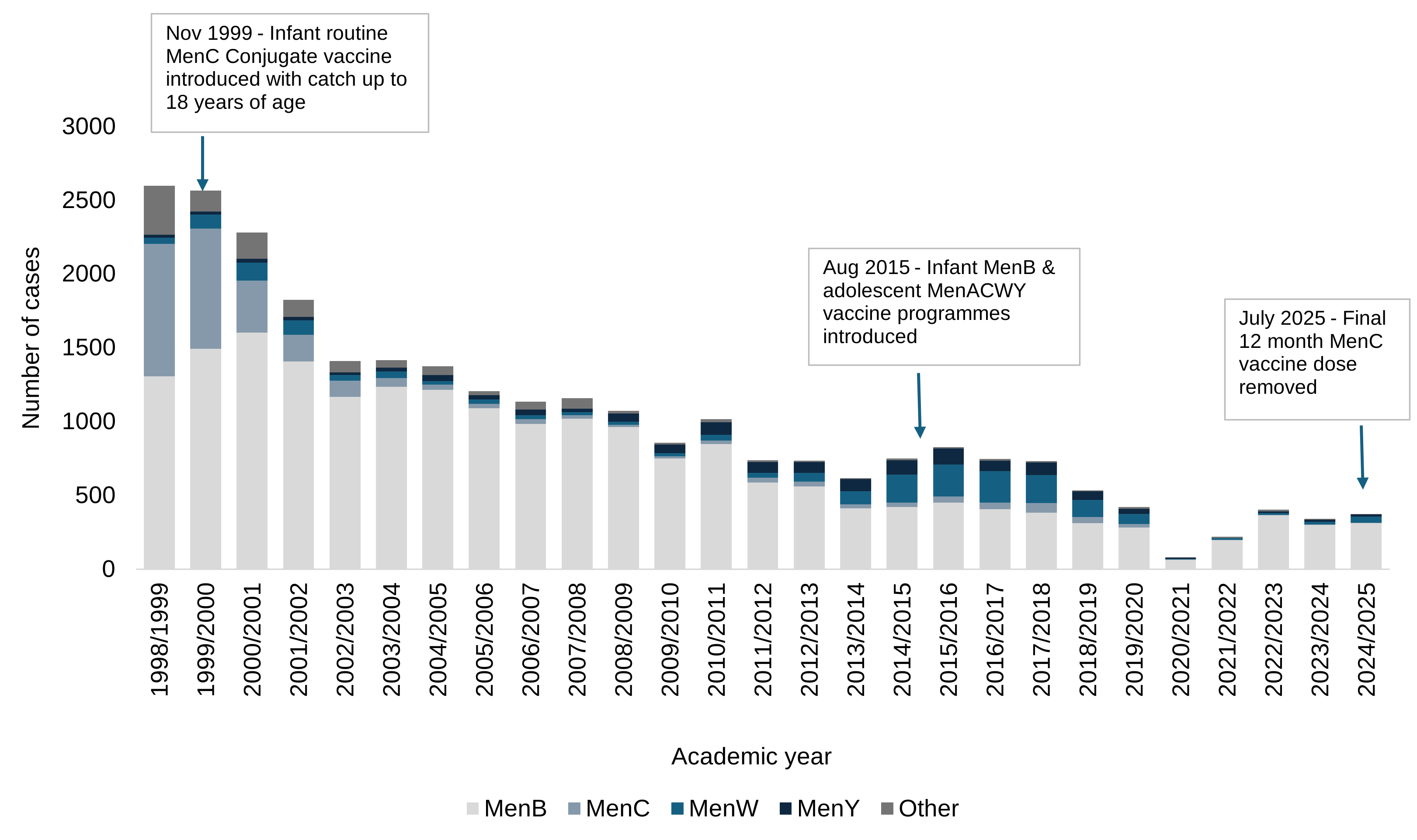
MenB cases in England dipped due to COVID-19 control measures (see Figure 1), in line with other infections transmitted by the respiratory route. This may have reduced population exposure (and thus immunity) to these bacteria, leaving greater numbers of young people at risk of disease.
In recent years there have been 300 to 400 cases of invasive meningococcal disease (IMD) annually. MenB has accounted for over 85% of cases over this period (with a mortality rate of approximately 6%). Research in children shows that nearly 1 in 10 MenB cases suffers major disabilities including amputations. There have been around 5 to 10 clusters of 2 or more cases per year in recent years with 1 or 2 clusters of 3 or more cases. So far in the 2025/26 season there have been 7 clusters of 3 or more cases, including the recent Canterbury, Weymouth and Reading clusters, which have all occurred outside the usual highest period of meningococcal activity between September and January.
Figure 1. All laboratory confirmed invasive meningococcal disease cases in England by academic year (September one year to August the following year) and capsular group
In this context, Ministers have decided to make available a one-off, time-limited offer of MenB vaccination for those in the school year group immediately prior to attending undergraduate higher education or living in further education accommodation or halls of residence for the first time in autumn 2026 (hereafter referred to as ‘HERFE entrants’), and others aged under 25 entering HERFE for the first time – with eligibility as outlined below. Evidence shows that the relative risk of invasive MenB disease is substantially greater in young people in their first year attending university than in their peers who are not attending higher education.
Timing
The time-limited programme will start as soon as practicably possible in participating community pharmacies from 20 July 2026. It will end for first doses on 31 December 2026 and for second doses on 31 March 2027. However, giving the vaccination in July and August is advised in order to optimise protection ahead of the start of term given the potential for close mixing with new people at this time.
Vaccine supply
The deployment model used for this activity will utilise the NHSE Supply Chain and will require providers to order using the Federated Data Platform (FDP). All Providers will be familiar with this methodology (due to the use of FDP for COVID).
The MenB vaccine Bexsero® is provided in packs of 10 doses with no needles. Providers will need to source their own needles.
Providers are asked to make sure that local stocks of vaccine are rotated in fridges so that wastage is minimised. It is recommended that providers hold no more than 2 to 4 weeks’ worth of stock.
Contracting and funding arrangements
Further details will be available in the published service specification, which will be shared with providers.
Confirmation of eligibility
Young people eligible by age will be identified by date of birth as documented in their clinical records. To be eligible, they will need to fall within the relevant cohort by date of birth (born between 1 September 2007 and 31 August 2008).
To be eligible as HERFE entrants, they will need to:
- fall within the relevant age group by date of birth (those born on or after 21 July 2001)
and
-
present acceptable evidence at their vaccination appointment that they are due to attend HERFE for the first time in the academic year 2026 to 2027, as follows:
- official email confirmation of their offer of a place at their chosen university or college from either the higher education (HE) institution (usually a @ac.uk email address) or the Universities and Colleges Admissions Service (UCAS)
- a letter (hard copy or email) confirming they have received an offer of a place for the 2026/2027 academic year at their chosen university or college
- screenshot of their offer of a place at their chosen university or college from the UCAS Hub
The relevant evidence should include the name of the university or college that they are due to attend, the course code and/or title of the course of study, and confirmation of the offer of a place (either conditional or unconditional).
Eligible military personnel attending military further education settings (known as ‘basic training’) that are included in the programme should have evidence in the form of a hard copy or email official joining letter, or similar correspondence from the Armed Forces Careers Office. Some recruits may have a temporary or permanent Ministry of Defence (MOD) ID card.
Those working in clinical settings should, in addition, consult a list of residential further education settings from which students in England are eligible, to inform a decision as to whether or not to administer MenB vaccination. This list can be accessed from MenB vaccination: eligible residential further education settings. Further details of eligibility in other nations in the UK can be found in Annexe B to this letter.
Accessing vaccination
Those eligible by age (i.e. in the year 13 equivalent group) will receive an invitation to book their first dose vaccination appointment on the National Booking Service (NBS). They will in addition receive a reminder to book their second dose via the NBS.
Those eligible as HERFE entrants will be able to use the NHS website to identify a pharmacy to which to self-refer.
Recommendations for the administration of MenB vaccination
Administration
Bexsero® is administered intramuscularly into the deltoid muscle of the upper arm. Further information about immunisation procedures, including injection technique, can be found in chapter 4 of the Green Book.
Co-administration
Meningococcal vaccines can be given at the same time as any other vaccines required but should be given at a different site, and preferably into a different limb. Please refer to the Meningococcal chapter of Immunisation Against Infectious Disease (the Green Book) for more information.
Dosage
Bexsero® vaccine is supplied as a white opalescent liquid suspension (0.5mL) in a pre-filled syringe (10-dose pack) for injection. One dose (0.5mL) contains 50 micrograms each of NHBA, NadA and fHbp and 25 micrograms of OMV. Further information can be found in the Summary of Product Characteristics (SPC).
Contraindications
There are very few individuals who cannot receive meningococcal vaccine. The vaccines should not be given to those who have had:
- a confirmed anaphylactic reaction to a previous dose of the vaccine
or
- a confirmed anaphylactic reaction to any component or residue from the manufacturing process
Please see chapter 22 of the Green Book and SPC for more information.
Vaccination of individuals with unknown or incomplete vaccination status
Vaccination courses delivered to young people as part of the Canterbury, Weymouth and Reading MenB responses, or as part of the gonorrhoea vaccination programme, may mean that some individuals present to clinics having already received at least one dose of MenB (Bexsero®) vaccination. It is also likely that a proportion of the eligible cohort will have taken up at least one dose via the private market and international students may have received a dose or course of vaccination outside of the UK.
Proof of receipt of prior vaccination will be assessed based on:
- relevant entries in the GP record
- presentation of a MenB vaccination record card
- presentation of a written or virtual (for example, app) record of dose(s) delivered via a private provider
The table below summarises recommendations regarding administration of vaccination to individuals with incomplete vaccination status, depending on the number of prior doses received, and of which specific vaccine product. Further detail on whether the course is considered complete with respect to dosing intervals is set out in the Information for healthcare practitioners document for MenB vaccination.
| Scenario | Outcome | Definition |
|---|---|---|
| 1 dose Bexsero® (irrespective of timing of that prior dose) | 1 dose of Bexsero® now | Where individuals have received one prior dose of Bexsero®, a further dose should be given, a minimum of 28 days after the first dose, to complete the full course of 2 Bexsero® doses. |
| 2 doses of Bexsero® less than 5 years ago | No further doses now | Where individuals have previously completed a 2-dose course of Bexsero® within the last 5 years, no further vaccination is required. |
| 2 doses of Bexsero® 5 or more years ago | 1 dose Bexsero® now | Where individuals have previously completed a 2-dose course of Bexsero® 5 or more years ago then a single dose should be offered. |
| 2 or 3 doses of Trumenba® (complete course) less than 5 years ago | No further doses now | Where individuals have previously completed a course of Trumenba® within the last 5 years, no further vaccination is required. 2 doses at least 6 months apart are considered equivalent to receipt of 3 doses. |
| 2 or 3 doses Trumenba® (complete course) 5 or more years ago | Full, 2-dose course of Bexsero®, starting now | 2 doses at least 6 months apart are considered equivalent to receipt of 3 doses. Trumenba® and Bexsero® MenB vaccines are not interchangeable. Where individuals have previously completed a course of Trumenba® 5 or more years ago, they should be offered to restart a 2-dose course with Bexsero®. |
| 1 dose of Trumenba®, or 2 doses delivered less than 6 months apart (partial course) | Start Bexsero® now, 2 doses (or they can choose to complete the Trumenba® schedule but not via the national programme) | Where individuals have had a partial course of Trumenba® (defined as one prior dose, or 2 doses delivered less than 6 months apart), they may complete their vaccination course of that vaccination. Alternatively, they can be offered a 2-dose course of Bexsero®. There is no specific information on the best interval between Trumenba® and Bexsero®, however from first principles an interval of at least 4 weeks is advised. |
Where an eligible individual is uncertain about their vaccination history and is unable to produce any evidence of prior vaccination when they present, a 2-dose course of Bexsero® should commence rather than risk leaving them unprotected. In clinical trials, no increase in the incidence or severity of the adverse reactions to Bexsero® vaccination (commonly pain at the injection site, malaise and headache) was seen with the administration of further doses.
Inadvertent early administration of the second dose
The recommended schedule for Bexsero® vaccine is 2 doses, with the second dose given a minimum of 28 days after the first dose. Vaccinators should adhere to the recommended 28-day interval. If the second dose is inadvertently given from 21 days after the first dose, this will count as a valid dose. However, if the second dose is inadvertently given earlier than 21 days after the first dose, this dose should be discounted as this may lead to a reduced immune response. The dose should be repeated, ensuring an interval of at least 28 days from the dose that was inadvertently given early. Note: 21 days is off-label.
Consent
Guidance on informed consent can be found in chapter 2 of the Green Book.
Pregnancy and breastfeeding
Meningococcal vaccines may be given to pregnant women when clinically indicated. There is in addition no evidence of risk from vaccinating pregnant women or those who are breastfeeding.
Side effects
For Bexsero®, the most common local and systemic adverse reactions observed in adolescents and adults are pain at the injection site, malaise, and headache. Most symptoms resolve within 1 to 2 days but can also be managed with paracetamol where needed.
All clinical staff administering vaccinations should be able to recognise the symptoms or signs of an allergic reaction and specifically anaphylaxis, to call for help and to start treatment. In every location where vaccines are being given, an anaphylaxis pack should be immediately available.
Packs should be checked regularly to ensure the contents are within their expiry dates.
Vaccinators should also ensure that it is possible to easily get the patient into the recovery position and/or a suitable position for performing resuscitation, and that the floorspace in the premises is suitable if a patient faints or collapses.
There should be sufficient space in the clinical area to ensure that resuscitation can be carried out should it be required. Ideally, there should also be access to an oxygen supply, with face masks suitable for children and adults, and tubing. Further details can be found in chapter 8 of the Green Book.
Vaccine coverage data collection
Individual level data on MenB vaccination for this cohort via Community Pharmacy will be collected via Record A Vaccination Service (RAVS). Vaccination events recorded in RAVS will flow to GP records.
The UK Health Security Agency (UKHSA) will estimate vaccine uptake using Immunisation Information System (IIS) collected data. This will be done by:
- calculating the proportion of individuals born between 1 September 2007 and 31 August 2008 and registered with a GP practice who have received a MenB vaccination via participating community pharmacies
- estimating crude uptake for the eligible cohort outside the year 13 equivalent date of birth range ( September 2007 to 31 August 2008) using Higher Education Student Statistics for an estimated denominator
Patient Group Direction (PGD)
A MenB PGD template for the one-off, time-limited offer will be produced by UKHSA for NHS England areas to authorise for their commissioned services.
Information and guidance for healthcare practitioners
Detailed clinical guidance is contained in the Meningococcal chapter of the Green Book.
To support vaccinators to deliver the programme, a training slide set and information for healthcare practitioners about this MenB vaccination programme will be available on GOV.UK.
Leaflets, posters and resources
Patient information materials can be ordered free of charge from Find public health resources. Users need to register to receive deliveries. If you register as a health professional, you can order 500 to 1,000 copies on the website. For larger quantities, please call 0300 123 1002.
| Resource | Title and ordering link | Product code |
|---|---|---|
| Leaflet | A guide to the Meningococcal B vaccines that help to protect against meningitis and septicaemia | 13347EN001 |
| Poster | MenB vaccination poster - under 25 | 13349EN001 |
| Vaccination record card | MenB vaccination record card | 13348EN001 |
| Consent form | MenB programme consent form | 1334AEN001 |
| Digital graphic for display screens | The signs and symptoms of meningitis and septicaemia - digital screens | IM23DISP1 |
| Poster for healthcare settings | Don’t ignore the signs and symptoms posters | IM23DISP1 |
Patient information materials are also available on GOV.UK.
Reporting suspected adverse reactions
Healthcare professionals and those vaccinated are asked to report suspected adverse reactions through the online Yellow Card scheme, by downloading the Yellow Card app or by calling the Yellow Card scheme on 0800 731 6789, 9am to 5pm Monday to Friday.