Determining if a clinical investigations is required
Updated 23 July 2026
Applies to England, Scotland and Wales

© Crown copyright 2026
This publication is licensed under the terms of the Open Government Licence v3.0 except where otherwise stated. To view this licence, visit nationalarchives.gov.uk/doc/open-government-licence/version/3 or write to the Information Policy Team, The National Archives, Kew, London TW9 4DU, or email: psi@nationalarchives.gov.uk.
Where we have identified any third party copyright information you will need to obtain permission from the copyright holders concerned.
This publication is available at https://www.gov.uk/government/publications/medical-devices-that-need-a-clinical-investigation/determining-if-a-clinical-investigations-is-required
This guidance provides an explanation of the accompanying flow chart and we recommend viewing the flow chart before reading this explanatory guide.

This guidance applies to general medical devices and active implantable medical devices only.
We have guidance for manufacturers of in vitro diagnostic (IVD) devices.
We also have guidance on how to determine whether your device is a medical device, active implantable or IVD.
This document applies to studies conducted in Great Britain only, under UK Medical Devices Regulations 2002 (SI 2002 No 618, as amended) (UK MDR 2002).
If your study has a site in Northern Ireland, or is conducted either whole or in part in Northern Ireland, different regulations apply. In this case, you should instead refer to MHRA’s Northern Ireland flow chart and accompanying guidance to determine if you need to submit an application to the MHRA.
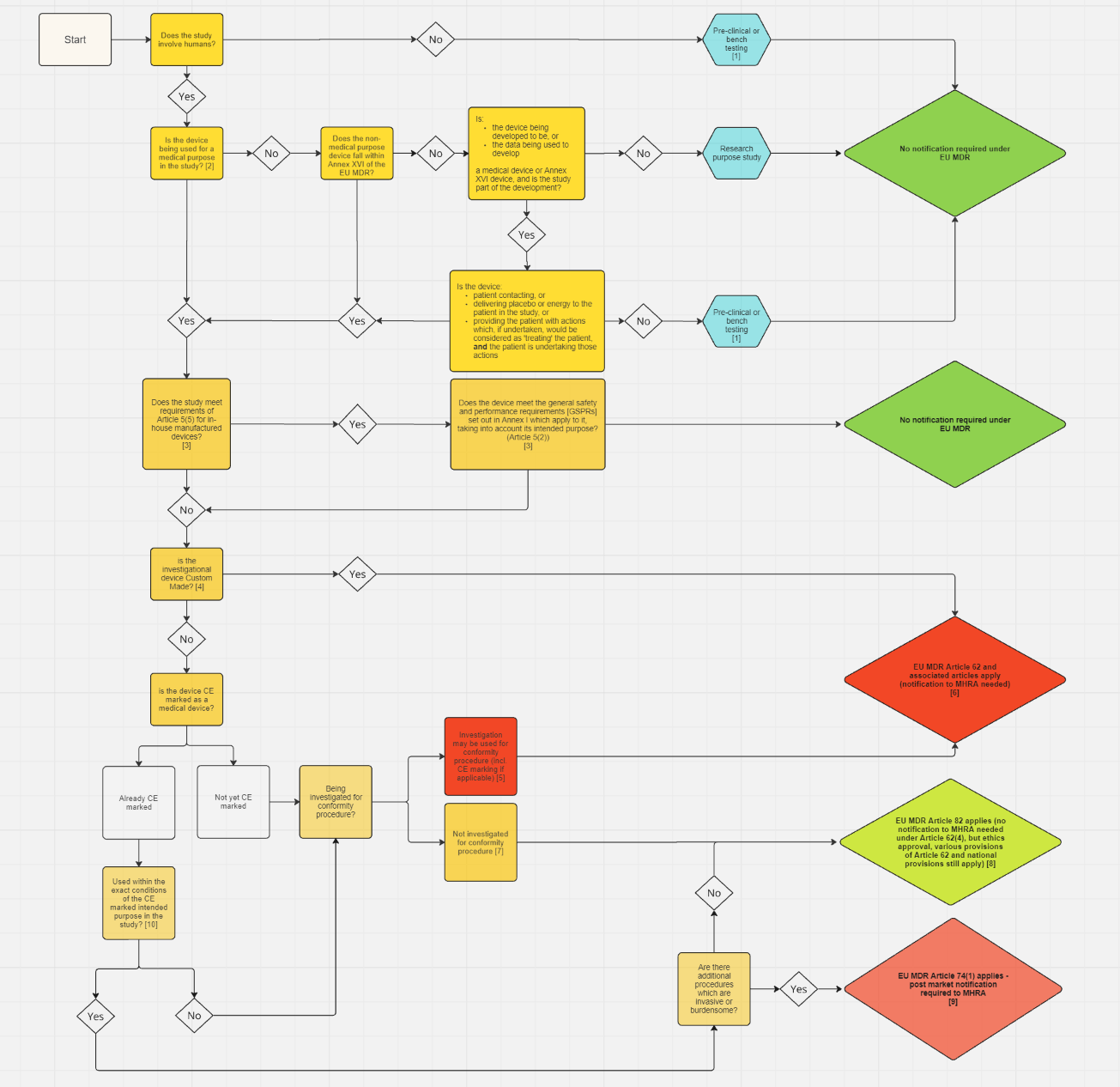
A PDF version of this guidance is available, but will not be updated going forward and will eventually be removed.
Note 1 – Pre-clinical or bench testing
Studies not involving humans are likely to be considered pre-clinical or bench testing and will not fall within the remit of UK MDR 2002. You do not need to notify the MHRA of studies of this nature (see note 6).
Examples of this kind of study include retrospective clinical studies and non-interventional software or AI studies which provide performance data of a medical device using existing data with no safety implications for participants. This data could support the conformity assessment of a device but may not fit the definition of clinical investigation if they are not performed on humans (such as software tested using existing patient data, with no patient interaction in the study, and not informing patient management decisions in study).
You do not need to notify the MHRA of studies of this nature.
However, once retrospective data is used to inform patient management then you should select ‘Yes’ at the ‘study involving human participants’ decision step of the flow chart. Examples of this include studies of AI devices trained on compiled retrospective data, which will then influence the triaging, processing or care pathway of present or future patients.
Note 2 – Post-Market studies, including Post Market Clinical Follow Up (PMCF)
UK MDR 2002 Regulations 16 and 29 exempt studies of medical devices and active implantables that have a valid UKCA or CE mark and are used within their marked indication.
For studies of this category in Great Britain, no clinical investigation application to the MHRA is required.
Some post-market studies in Northern Ireland do require notification to the MHRA.
PMCF studies
Part II of the UK MDR 2002, Annexes VIII and X (general medical devices) and Part III, Annexes 6 and 7 (active implantable devices) (as modified by Schedule 2A to the UK MDR 2002) require manufacturers to actively update their clinical evaluation with data obtained from post-market surveillance.
When a UKCA or CE marked device is further assessed, for safety or performance within the intended purpose, this may be done as part of the manufacturer’s PMCF activities.
You do not need to notify the MHRA of studies of this nature, but the device must be used according to the exact conditions of the UKCA or CE mark.
If a UKCA or CE marked device is being used outside of its intended purpose, the study must not be considered a post-market study for that device.
Note 3 – Medical Purpose
This note should be read in conjunction with note 4 regarding research tools.
Under the UK MDR 2002 Regulation 2 definition of a medical device, a medical purpose is considered as a device that performs any of the following functions:
- the diagnosis, prevention, monitoring, treatment or alleviation of disease (i in the regulation)
- the diagnosis, monitoring, treatment, alleviation of or compensation for an injury or handicap (ii in the regulation)
- the investigation, replacement or modification of the anatomy or of a physiological process (iii in the regulation)
- the control of conception (iv in the regulation)
For the purposes of clinical investigations, there are borderlines that must be drawn with respect to some aspects of these purposes.
Where a device is being used for one or more medical purposes, you should select ‘Yes’ for this decision step in the flow chart.
A medical purpose does not take into consideration (and may be established regardless of) whether the device outputs are subsequently used as part of a participant’s clinical pathway.
Generally, a device will be being used for a medical purpose where its mechanism of action in practice achieves said purpose, regardless of the aims or objectives of the study.
For example, comparator studies, where participant data is input into or measured on the device and the outputs are compared against standard of care (for example, clinician decision-making, state-of-the-art UKCA or CE marked devices in a diagnostic context) but the outputs are not acted on in any way. In these instances, the device is still considered to have a medical purpose at this decision step.
Research purposes
In certain instances, where it is unclear whether a device is achieving a medical purpose, the context of the study should inform this determination.
It is the MHRA’s general opinion that a device being used on humans for research purposes could be a research tool, rather than a device being used for a medical purpose.
This is particularly relevant when determining whether investigation of a physiological process should be considered a medical or research purpose.
Investigation of a physiological process
Examples of these research studies may include using a device which aims to produce a better understanding about a particular aspect of the human body.
Further, the investigation of a physiological process will only be a medical purpose where it is intended for a medical use.
For an applied comparison, one study using a device to examine participants’ heart rate for the purpose of identifying a pathological abnormality (such as an arrythmia) is clearly both seeking to diagnose a medical condition and investigating a physiological process with the intention of a medical use.
By contrast, a sports study using the same device, examining participants’ heart rates to identify optimum heart rate for exercising or heart rate trends in different demographics, would not be considered either diagnosis of a medical condition or investigation of a physiological process with the intention of a medical use.
Multiple purposes
Where a device achieves multiple purposes in a study, some of which are considered medical purposes and some of which are considered research purposes, the medical purposes take precedence and you should select ‘Yes’ at this decision step in the flow chart.
Claims
Where a device is being used for a research purpose, no explicit or implicit claims to a medical purpose should be made by the study documentation. For example, the study information should not imply that a participant’s disease diagnosis will be updated, or that their disease state will be improved, by participation in the study. Studies explicitly or implicitly making these claims are studies of devices being used for a medical purpose, per the paragraphs above.
Where the device is being used for a medical purpose in the study, then you should select ‘Yes’ at this decision step in the flow chart.
Software
There are cases where standalone software, including apps, which appear to have a medical purpose are considered not to fit the definition of a medical device, and are therefore not required to be UKCA or CE marked as a medical device and regulated by the MHRA.
In general, monitors for fitness or wellbeing are unlikely to be considered a medical device. The monitoring of general fitness, general health and general wellbeing is not usually considered to be a medical purpose.
Software is unlikely to be a device if the software only:
- reproduces a paper document in digital format and it is down to the health care professional to make the decisions based on the data displayed - however, if the software provides some form of summarisation, it may be a medical device
- follows the path of a procedure or treatment - there are no decisions - may provide information
- offers lifestyle treatment choices or referral to seek professional advice (to see your GP, for example)
On the other hand, software is most likely to be a device if:
- it is linked to a specific medicine or device (likely to be an accessory)
- it is intended to influence the actual treatment – for example, the dose, size of implant, time or type of treatment
- it results in a diagnosis or prognosis of future risk of disease
This list is indicative only. You should read our guidance on software and apps as medical devices, which can help you determine if your software or app has a medical purpose.
You can also find out how digital mental health technology is classified.
Note 4 – Research tools and non-medical purpose studies
This note should be read in conjunction with note 3 regarding medical purpose.
The Annex I of ISO 14155:2026 Clinical investigation of medical devices on human subjects: Good clinical practice has useful information on clinical development stages.
The MHRA recommends contacting the Clinical investigations team for guidance on whether the regulations will apply before undertaking a study of this nature.
You should present your current view on whether the study requires notification to MHRA, and your reasoning for arriving at this view in accordance with this guidance and flow chart.
Note 5 – In-house manufacture of medical devices in Great Britain (also known as Health Institution Exemption)
You can find out more about the Health Institution Exemption.
Note 6 – If notification to the MHRA is not required
If you reach this outcome in the flow chart, a notification and application to the MHRA under UK MDR 2002 Regulations 16 and 29 is not required for your study at this point in time.
However, we strongly support the use of local governance technical reviews for studies that do not require you to notify us.
Further, all studies intending to use the data collected for conformity assessment of the medical device are required to notify MHRA under UK MDR Regulation 16 and 29 – see note 7, below. It is MHRA’s view that data collected under exempted studies will not be usable as clinical safety or performance data for conformity assessment.
If, subsequent to commencing a study without notification in line with this guidance, a sponsor chooses to make changes, amendments or modifications to the device or study, the device and study should be reconsidered within the context of this flow chart and guidance. Modifications to studies which alter the pathway set out in this guidance may subsequently result in the study falling within the remit of Regulation 16 or 29 and require you to notify the MHRA.
While UK MDR 2002 Regulations 16 or 29 may not apply to your study, other regulations pertaining to facilities or patient care will continue to apply. Study sponsors and investigators must consider where their legal responsibility lies with respect to the use of the device in the planned study.
Note 7 – Clinical Investigation
If you reach this decision step in the flow chart, your device and study require notification to the MHRA.
This requirement will apply to medical devices that are not UKCA or CE marked, or devices to be used for a medical purpose other than their UKCA or CE marking (off-label devices), and to which an exemption does not apply.
Applications are submitted electronically using the Integrated Research Application System (IRAS).
You can find out more about how to notify the MHRA of your clinical investigation.
Further information
If you need any help in determining the correct regulatory route, you should send us an annotated copy of the flow chart showing and explaining your decision pathway by emailing info@mhra.gov.uk. Your email should say ‘[Company Name] – Is a Clinical Investigation required?’ in the subject line. You should also tell us:
- who has manufactured the device
- who is conducting the proposed study
- what the intended purpose of the device is
- what the intended purpose of the proposed study is
- whether any medical application is foreseen for the device
- a copy of the study protocol, where possible