Obesity Healthcare Goals
Updated 6 August 2026

© Crown copyright 2026
This publication is licensed under the terms of the Open Government Licence v3.0 except where otherwise stated. To view this licence, visit nationalarchives.gov.uk/doc/open-government-licence/version/3 or write to the Information Policy Team, The National Archives, Kew, London TW9 4DU, or email: psi@nationalarchives.gov.uk.
Where we have identified any third party copyright information you will need to obtain permission from the copyright holders concerned.
This publication is available at https://www.gov.uk/government/publications/life-sciences-healthcare-goals/obesity-healthcare-goals
What we do
Obesity is one of the UK’s most pressing health challenges, with almost one third of adults in England, Scotland, and Northern Ireland, and one in four in Wales living with the condition. It is estimated to cost UK society up to £107 billion per year, including costing the NHS more than £9 billion per year.
In November 2022, the government launched the Obesity Healthcare Goals programme. The programme aims to maximise and direct global industrial investment for obesity innovation into the UK, through; bespoke partnerships, research investments and the development of pioneering and internationally replicable models of clinically and cost-effective models of care. The programme will explore how new and potentially transformative treatments and technologies can be developed and deployed to support people living with obesity with the goal to improve long-term health outcomes for people living with obesity and its associated conditions, while ensuring that the UK remains a world-class location to trial, pilot, and roll out innovations.
As a first step, in 2023, we launched a competition, through the National Institute for Health and Care Research, to develop a Phase 2 pre-licence platform to evaluate pharmaceutical and digital interventions for obesity.
In October 2024, the government signed a landmark agreement with Eli Lilly, the world’s largest pharmaceutical company, that will see the company invest £279 million in the UK. The collaboration will be a key initiative of the Obesity Healthcare Goals programme and aims to set the stage for government to work with industry to trial innovative approaches to treating obesity as part of a rounded package of care. As part of this agreement, the Obesity Pathway Innovation Programme (OPIP) was launched in August 2025. OPIP will test innovative ways to support people living with obesity across the UK. This could include support on nutrition, physical activity, and – where clinically appropriate – obesity medicines, through new options for community-based provision such as pharmacies. The aim is to identify new, clinically appropriate and effective pathways that minimise the impact of obesity care on existing NHS services such as GPs. This should open up opportunities to allow more people living with obesity to receive the support they need to manage their weight. It is hoped that the OPIP will engage tens of thousands of NHS patients, providing them with access to comprehensive weight management services. The OPIP competition opened for applications on 8 September 2025 and closed on 19 November 2025. Applications have been assessed and the 12 successful projects were announced on 27 June 2026.
We have also funded a Weight Management Pathway Design Accelerator through Innovate UK. Through this, Innovate UK has invested up to £3 million to support NHS organisations to speed up the development of novel primary care and community-based patient access models that are safe, effective and resource efficient.
This work will mobilise systems for system pathway design to understand how it would be possible to accelerate patient access to Life Sciences innovations for the treatment of obesity - in line with shared Department for Science, Innovation and Technology (DSIT) and the Department of Health and Social Care (DHSC) priorities.
Going forward the ambitions set out in the Life Sciences Sector Plan, together with the 10 Year Health Plan, demonstrate our future commitment to innovation in the field of obesity through the Healthcare Goals programme. We will build on existing implementation plans by establishing pioneering relationships with industry – such as our strategic collaboration with Eli Lilly - by supporting local health systems to test innovative models of delivering weight loss services and treatments to patients effectively and safely.
Working in partnership with the Scottish Government’s Chief Scientist Office, the Obesity Healthcare Goals are also funding a Cardiometabolic Obesity Prevention Study (COPS). Through this programme of work, we aim to instigate a robust, impactful and innovative real-world evidence study into the impact of weight loss medications on obesity associated conditions. The winning consortia of the initial Research Design Study, which is led by the University of Glasgow, in collaboration with Novo Nordisk and IQVIA, was announced on 1 November.
Who we are
The Obesity Healthcare Goals programme is Chaired by Professor Naveed Sattar.
I am delighted to chair the Obesity Healthcare Goals as obesity is perhaps the major cause of multiple long-term conditions in the UK. I want to help promote the UK as an excellent place to do obesity research with its connectivity, high quality health records and academic talent. There are few places better for companies than the UK to best determine the benefits of new weight loss methods – be they technological or pharmaceutical – for people and society.
Professor Naveed Sattar, October 2023.
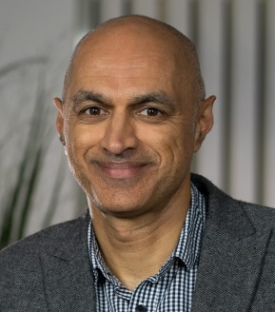
Naveed Sattar, Chair of the Obesity Healthcare Goals.
Naveed Sattar is a medical researcher and Professor of Cardiometabolic Medicine at the School of Cardiovascular & Metabolic Health at the University of Glasgow and is clinically active in cardiometabolic disease treatment and prevention as an Honorary Consultant at the Glasgow Royal Infirmary.
With over 25 years of academic experience and a remarkable track record of collaboration across a number of medical fields, Naveed is recognised as a world leading expert on obesity, diabetes and cardiovascular disease. Naveed enjoys challenging conventional wisdom, and his research on the pathogenesis, assessment and treatment of cardiometabolic conditions has helped shape clinical practice across the UK and Europe, leading to new insights in several areas. He has also contributed to 8 clinical guidelines for the treatment of cardiometabolic conditions, including obesity.
With over 1300 published papers authored Naveed has been in the top 1% of cited clinical academics in the world since 2014, receiving several national and international prizes for his research. He has also extensively contributed to clinically significant trials in the field – both lifestyle interventions and pharmaceutical trials – as well as mechanistic insights behind the impact of weight loss in several conditions.
Further information and relevant links
-
Government to use Vaccine Taskforce model to tackle health challenges.
-
New obesity treatments and technology to save the NHS billions.
-
Announcement of the 12 successful projects of the Obesity Pathway Innovation Programme.
Contact details
You can contact the Obesity Healthcare Goals by email: healthcaregoals@officeforlifesciences.gov.uk