The Land Use Framework for England (accessible)
Updated 6 May 2026
Applies to England

© Crown copyright 2026
This publication is licensed under the terms of the Open Government Licence v3.0 except where otherwise stated. To view this licence, visit nationalarchives.gov.uk/doc/open-government-licence/version/3 or write to the Information Policy Team, The National Archives, Kew, London TW9 4DU, or email: psi@nationalarchives.gov.uk.
Where we have identified any third party copyright information you will need to obtain permission from the copyright holders concerned.
This publication is available at https://www.gov.uk/government/publications/land-use-framework/the-land-use-framework-for-england-accessible
Foreword
Land is our greatest natural asset and the foundation of our lives. The landscapes of England are the product of centuries of changing use, the source of our food, home to the ecosystems that sustain life, and the foundation of a growing economy. How we decide to use that land in the decades ahead will shape everything: the homes our children live in, the energy that powers our economy, the nature we pass on to future generations.
Last year, we ran a ‘national conversation’ on land use. We heard clearly that the way many decisions have been made about land has left us vulnerable to short-term shocks and the long-term impacts of climate change. Our finite land is under more pressure than ever. But we also heard that, by taking a different course, we can develop more resilient landscapes and deliver a more prosperous future.
Today, we are acting on what we heard. England’s first ever Land Use Framework sets out a coherent national vision for how we use our land, backed by the most advanced spatial analysis ever undertaken in this country. It demonstrates clearly that we have enough land to build the homes needed to address the housing crisis, maintain domestic food production, restore nature at scale, and build clean, homegrown power to provide energy security. These are not competing demands. With the right data, the right tools, and the strategic direction this Framework provides, they are complementary ones.
To date, many of these challenges have been addressed in isolation, leading to a confused picture and missed opportunities for land to deliver multiple benefits. However, we can bring an end to this fragmented approach. We can plant trees to reduce flood risk to homes and farmland, locate energy infrastructure alongside nature-rich food production and ensure nature recovery is at the heart of resilient growth and development.
No one understands the connection between land and resilience better than the farmers who work it. They see the impact of declining pollinators, worsening soil health, birds disappearing from their fields and the rising frequency and severity of flooding. These challenges can be addressed for the benefit of our national security, farm businesses and ecosystem health.
This Framework makes a clear, long-term commitment to maintain overall food production in England, to underpin our future food security and drive economic growth. It sets out how we will safeguard our most productive land and give every farmer, whether owner or tenant, the rights, data and certainty to invest with confidence.
This is not a document that tells people what to do with their land, nor a replacement for the planning system. It is a blueprint for smarter, more informed decisions and shares cutting-edge data with those who need it most. It will speed up house building and infrastructure delivery, support farm business diversification and profitability, and accelerate the recovery of our environment.
The landscapes we know and love have always evolved. How they change next is in our hands. Today, for the first time, we have a framework worthy of that responsibility.
The Rt Hon Emma Reynolds MP
Secretary of State for Environment, Food & Rural Affairs
Section I: The Land Use Framework
This framework’s purpose
This Land Use Framework for England sets out how we can use our land more effectively. Changes are needed to increase the resilience of our homes, communities, infrastructure, and food systems, while speeding up development and restoring nature. A thriving natural environment and resilience to a changing climate are the foundations of our economy and essential for food security and profitable farm businesses.
The framework describes why change is needed and how it can be achieved if we use land more efficiently, for multiple benefits. It is not our intention to use the framework to bind decision-makers or prescribe specific land uses in specific places; we want it to inform decisions, not impose them.
The first section of the framework includes a vision for England’s future landscapes, illustrating how a strategic approach, better decision-making and data means land can support house building and infrastructure, a resilient food system, climate mitigation and thriving nature. It is based on the most sophisticated analysis of land use change in England to date which shows that we have enough land to meet our objectives.
The second section sets out a new set of principles to inform how decisions are made about land. These will inform national decision-making, including national policy relating to strategies and plans prepared regionally and locally, as well as actions of individual landowners and managers.
The third section sets out actions we will take to support land use change, in partnership with others. This includes better join-up of national and local plans, and collaboration on new tools and data to help make quicker, more predictable decisions on land for housing, energy, infrastructure, food and nature. It explains how we will start to link incentives to the potential of the land. It sets out our commitment to make land digital, driving long-term investment, transparency of land use and better data sharing.
The Land Use Framework builds on the Land Use Consultation and national conversation on land use, which ran from January to April 2025. The results, from every region of England, illustrated why change is needed. Consistent feedback from the Land Use Consultation was the need for clarity on long-term land use change scenarios and, crucially, where these changes might need to happen. Many respondents wanted Government to set a strategic direction for land use to help inform their decisions. Feedback showed that a lack of strategic spatial planning and accessible data holds back development, slowing down the building of homes and vital infrastructure.
Respondents provided suggestions on how land use change can be delivered effectively, including short-term priorities and longer-term reforms. Many responses drew on practical experience to explain why the scale and pace of this change requires a spatial approach to policy-making and delivery across local, regional and national Government. The consultation responses inform everything that follows and are summarised in the Land Use Consultation Summary of Responses published alongside this framework.
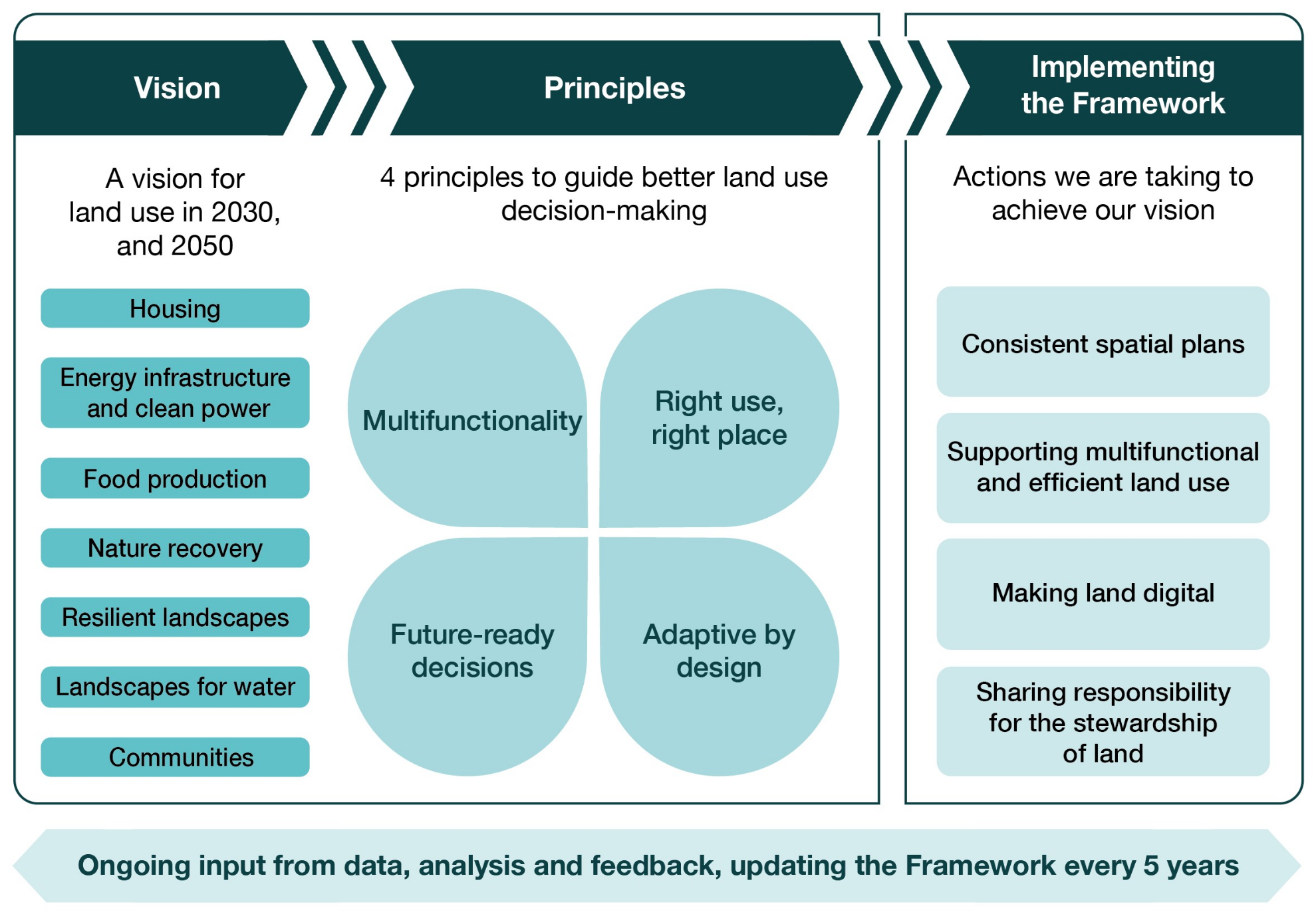
Figure 1: An overview of the Land Use Framework.
Figure 1: Text alternative description
The Framework document consists of three sections: Vision, Principles and Implementing the Framework.
The first section sets out a vision for land use to 2050 that considers housing, energy infrastructure and clean power, food production, resilient landscapes, landscapes for water, nature recovery and communities.
The second section outlines four principles to guide better land use decision-making: multifunctionality; right use, right place; future-ready decisions; and adaptive by design.
The final section describes actions we are taking to implement these under four overarching themes: consistent spatial plans; supporting multifunctional and efficient land use; making land digital; and sharing responsibility for the stewardship of the land.
The Framework is informed by data, analysis and stakeholder feedback, which will continue to be used to support implementation and publication of an updated Land Use Framework every five years.
We plan to update the framework every five years, to set out progress made and next steps on implementation, including developments on data, tools, collaboration and partnerships. Responses to the consultation indicated updating the framework would help drive best practice, and 87% of respondents supported a commitment to regular updates.
The framework will provide evidence and broad direction that can inform decision-making on land use, without itself forming part of planning policy or individual planning decisions.
We will continue to work closely with the devolved Governments in Scotland, Wales and Northern Ireland to share best practice on the devolved issues addressed in this framework and to collaborate on cross-border issues. The Land Use Framework will play a critical role in enabling delivery of our domestic and international commitments, including our Carbon Budgets, National Biodiversity Strategies and Action Plans, and Nationally Determined Contribution to international action on climate change.
Defining the challenge
Land in England is a precious and finite natural asset. It is the foundation of our economy and how we use it directly affects our living standards today and those of future generations. This government is committed to accelerating economic growth by rapidly scaling up the building of new homes and infrastructure in every English region while also restoring nature at scale. At the same time, we must maintain food security and national security and increase the resilience of our society to the impacts of climate change and ecosystem degradation. The environmental, economic and social resilience of England depends on how well we use our land. Figure 2 shows how our land is used today.
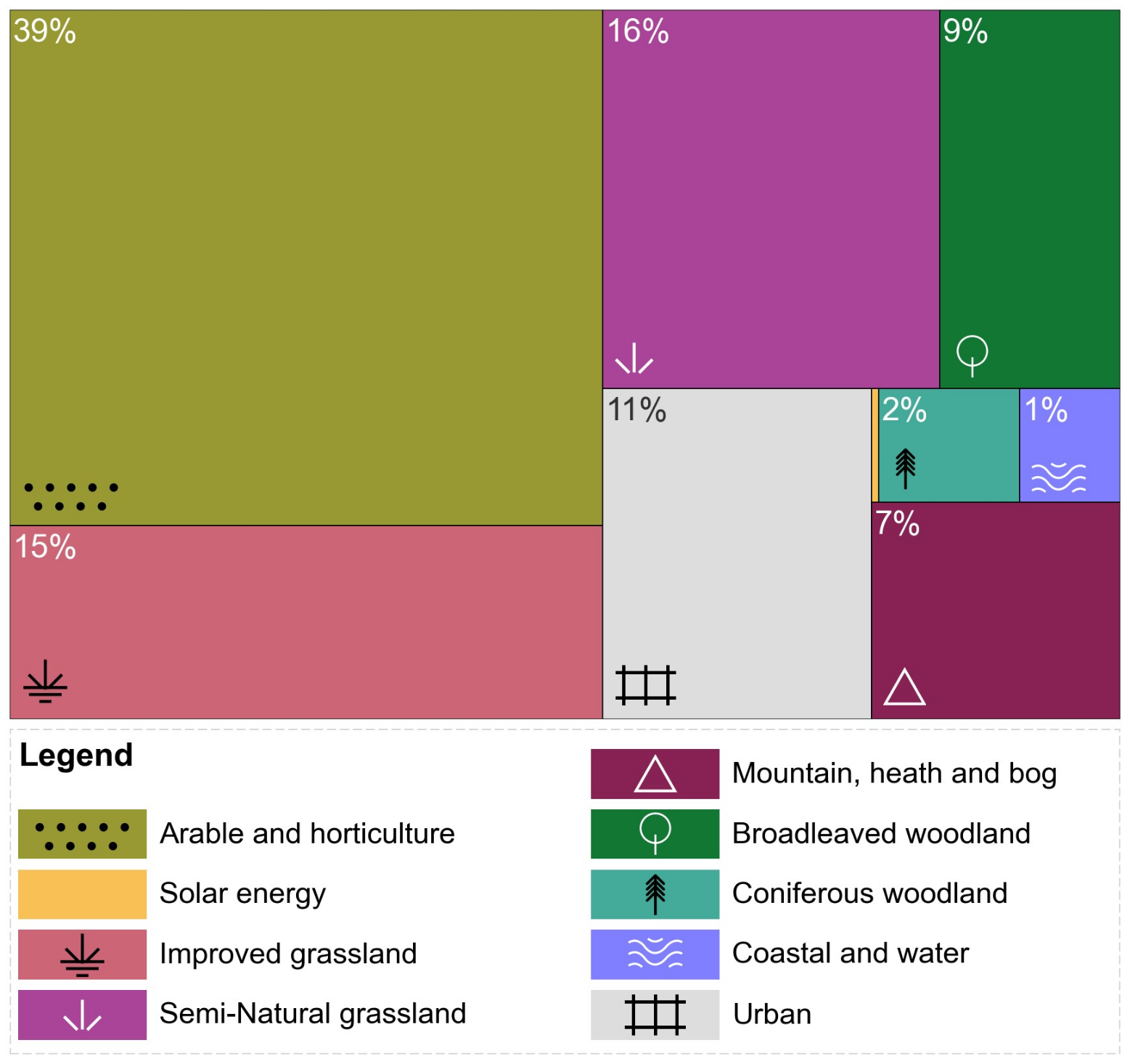
Figure 2: Percentages of England’s total land area occupied by different types of land use (derived from Natural England’s Living England project[footnote 1]. The majority of land in England is rural, predominantly used for agriculture. Nevertheless, by population, England is largely urban, with 84% of people living in urban areas in 2024 (Source: Statistical Digest of Rural England).
To meet these challenges and address the concerns that we have heard from communities and businesses, we need to act today to address the inefficiency of current land use. Some farmers, developers and planners are already demonstrating that it is possible to deliver multifunctional and efficient land use, and we want to encourage more to take up this challenge. Many responses to the Land Use Consultation described the land where they live and work, and often the whole of England, as trapped between competing demands that struggle to be reconciled. Many of these responses stated that this was the result of inefficient land use that has locked us into false choices between infrastructure and nature, or homes and food. They thought this was being driven by a lack of information, join-up, and long-term direction which has slowed delivery down and led to inefficient decision-making.
This ‘trap’ of inefficient land use was reflected in many responses, as a barrier to the development of critical infrastructure and new homes, a threat to food production, or a cause of the ongoing collapse of river ecosystems and rising flood risk. Analysis developed for the Land Use Framework supports this insight from the consultation. It shows that we have enough land to deliver all of our objectives, provided we use it in a more efficient and multifunctional way.
Spatial optimisation modelling suggests that the UK is currently far from being optimal with respect to any of the main objectives for rural land use (food and forestry production, nature, and carbon sequestration). This means that there are many opportunities for changes in a more strategic direction to be beneficial.
The Royal Society, consultation response
New homes and towns are needed across England so that families can have a safe roof over their head and achieve the dream of homeownership. Communities see the need for house building but also worry that there are conflicts, including with food production and nature recovery. This was the main theme in meetings we hosted with citizens across the country from Taunton to Penrith, and in consultation responses from local authorities.
Alongside the need for more homes, some of our existing housing is increasingly at risk from flooding as climate change drives more frequent and more extreme weather events. Approximately 4.6 million properties in England are at risk of surface water flooding and by 2050, one in four properties in England are projected to be at risk of flooding from river, sea or surface water under a high emissions scenario[footnote 2]. This includes homes and crucial infrastructure related to public services, such as education and transport. Responses highlighted the need for Government to provide better regional, local and spatial climate information and support to ensure planned land use changes help mitigate and are resilient to future climate change.
1 in 4 homes are projected to be at risk from flooding by 2050 and 59% of grade 1 farmland.
Building an energy system from clean, homegrown power is vital to ensure lower bills and energy security. More electricity is also needed to meet growing demand, which is changing the way land is used across England. We need to take back control of our energy system to build resilience against energy price shocks, moving away from the way we have powered our nation for decades, built around oil, gas, and coal. We also know that boosting homegrown, renewable energy is the best way to reduce our exposure to volatile fossil fuel markets, protect bill payers, and strengthen our energy independence.
We heard from farmers in East Anglia where new transmission lines are needed to connect offshore wind generation to the national grid, and communities in the North East where large solar farms are expected to change the farming landscape. This new infrastructure is being delivered near the towns, villages and rural homes where local communities will have the opportunity to benefit from local clean energy. At a national level, these are small land use changes in percentage terms and there will be opportunities to continue farming alongside solar or wind generation. These include continued livestock grazing and agrivoltaics, the integration of solar with arable farming.
Recent years have illustrated how land use change is critical to increase the resilience of agriculture and maintain our food production. We heard from livestock farmers in Shropshire and arable farmers in Norfolk who had experienced drought followed by flooding. The heatwaves of 2022 and 2025, and the extensive flooding of farmland in early 2026 and between October 2023 and March 2024, are just recent examples of the extreme weather that is changing farming across England.
We know that the United Kingdom is one of the most nature depleted countries in the world (Source: State of Nature). We heard how people in Norfolk missed the meadows they remembered from their youth and had noticed local wildlife declines. These habitats are now more vulnerable because of climate change, putting wildlife at greater risk (Source: Duffield et al. 2024).
Species abundance in England has reduced by around 33% since 1970.
Creating and restoring a range of wildlife-rich habitats in a connected way will be needed to provide the foundations for nature’s recovery. Moorlands and peatlands, which are our largest terrestrial carbon stores and home to rare species, will need to be restored to bring back their unique wildlife, whilst also acting as the ‘natural water towers’ of England, addressing water scarcity and flooding risks to cities such as Manchester and Leeds. By making more space for nature we will not only provide vital habitats for species, but reduce emissions and improve our water environment and air quality nationwide too.
Vision for land use in 2030 and 2050
This section of the framework sets out a long-term vision, informed by consultation responses. It will evolve through future Land Use Frameworks in response to new demands on land, further consultation feedback and wider events. It will be for local areas and regions to adopt or adapt this vision to match their priorities and shape their own plans for efficient land use.
By 2030, we will have begun to transform decision-making to address the issues raised in the consultation and provided long-term clarity for businesses, communities, farmers and land managers. As set out below, this means that changes will have been made to facilitate better coordination and multi-functional land use in all English regions.
After another 20 years, the changes seen in 2030 will be becoming much more evident, with multifunctional landscapes the norm across England. The changes, including better informed infrastructure delivery, will have been shaped by the five Land Use Frameworks which Government plans to publish in the intervening period. Each framework will have provided additional actions, analysis, and data to support this vision.
Housing
By 2030, improved coverage of up-to-date development plans, including the roll-out of spatial development strategies (SDSs) across England, will enable areas to plan for the homes and development their communities need, whilst protecting and enhancing the environment. Growth will be directed to the right places, prioritising sustainable and well-connected locations, and support a diverse mix of homes to support resilient communities. Where appropriate, higher density development will support thriving neighbourhoods, access to jobs and services, and make the best use of land within our towns and cities. Local Nature Recovery Strategies (LNRS) will align development with nature restoration. Biodiversity Net Gain and the use of nature-based solutions will help to make sure that development leaves the natural environment in a measurably better state than it was in beforehand, and Environmental Delivery Plans will enable development to come forward more easily while securing better outcomes for our most valued habitats and species. Timber production will expand to provide low-carbon building materials for future housing.
By 2050, there will be a step-change in the environmental quality of our urban environments, and new towns will be exemplars of the places which can be created when the use of land is optimised. New developments will support substantial improvements in green infrastructure, both integrated within sites (including through sustainable drainage provision and other nature-based improvements) and through contributions to off-site green infrastructure networks and large-scale habitat creation and restoration. Planners and developers will be able to assess the suitability of locations for housing and infrastructure quickly using a streamlined digital planning service and decision support tools. These will be built on a flow of accurate data from national and local government, facilitating simultaneous assessment of environmental impacts, social and transport metrics, and the options to manage or mitigate impacts. These tools will, for example, support a significant reduction in the number of homes delivered at high risk of flooding.
Energy infrastructure and clean power
By 2030, renewable energy infrastructure will drive increased energy security; at least 95% of electricity will come from clean power sources, and billpayers across the country will be protected from spikes in energy prices. Solar and wind will remain a small proportion of land use, and much of this land will be managed sustainably to boost and deliver other outcomes, such as grazing animals for food production or rewetting lowland peat soils beneath new solar farms. Coordinated spatial planning of electricity networks will encourage investment in rural areas, such as through new data centres, and unlock opportunities for greater food security, for example through glasshouse horticulture. New homes will be built with energy efficiency in mind, and thousands of new homes will be built under the Future Homes Standards with energy generation as part of their fabric.
By 2050, we will have an energy sector based on renewable and nuclear power, and the windfarms that powered the economy in 2030 have been repowered with more efficient technology. Strategic spatial planning will ensure a fairer and more efficient distribution of solar and wind infrastructure across England, with improved electricity transmission networks connecting communities and industry to offshore wind and the European power grid, with much of this being delivered alongside productive agriculture. Thousands more people will work across the energy sector, which will see major investment and development of technologies that help meet our climate targets.
Food production
By 2030, farmers and land managers will have clarity on the long-term opportunities for their land and policy on food production. This will enable greater investment in highly productive food growing and farm business diversification and help farming become more profitable. Farmers will be able to access the information that helps them consider where their land fits in a national spectrum of potential uses, whether for sustainably producing high quality food, supporting nature recovery or increasing resilience to climate change. Farmers will have sight of planned updates to Environment Land Management schemes (ELMs), which alongside other incentives are targeted towards where they are most impactful. It will be easier for them to see the full range of benefits that they could be paid to deliver on their land. Many farm businesses will be stacking multiple income streams on top of food production, supporting investment in the core business of food growing while benefiting from income diversification.
By 2050, agricultural land will be managed to prioritise sustainable food production and environmental benefits. Supported by a continued close partnership between farmers and the Government, farmers will have a clear, long-term view of the funding options available to them and confidence to invest in their land. Agricultural land use reflects a continuum of approaches balancing food production and other outcomes according to the relative strengths of the land[footnote 3]. We will produce more of what we consume, partly because more of our land will be efficiently growing the high value food that people recognise on their plates, rather than ingredients for processed and unhealthy food or animal feed[footnote 4], and farmers will see more of this value. Farmland will be more resilient to the impacts of climate change through sustainable management and multifunctional land use approaches such as integrating trees for flood and drought resilience.
Nature recovery
By 2030, our landscapes will include a mix of different land uses, but some less productive landscapes will be making more space for nature and capturing carbon. Government will have supported the delivery of approximately 350,000 football pitches worth of new wildlife-rich habitats outside of protected sites, helping British wildlife thrive in a new network of habitats. Our National Parks and National Landscapes will be working with land managers and local communities to deliver their management plans and, alongside LNRSs across England, will be making a strong contribution to nature recovery, 30by30 and increased access to nature.
By 2050, new wildlife-rich habitats will be delivered across England, creating new strongholds and connected networks for nature as wildlife populations continue to increase. Tree and woodland cover across England will have reached 16.5%, including productive softwoods (such as conifers) and broadleaf species (such as oak). New national forests will have changed our landscapes for the better and our towns and cities will appear greener, transforming access to nature. Intensive arable and pastureland will have been moved back from the edge of rivers, creating beautiful riverside woodlands, helping clean up rivers and allowing nature to thrive.
Resilient landscapes
By 2030, nature-based solutions will be delivered at pace to support landscape-scale adaptation to and mitigation of climate change impacts. This will include restoring the peatlands, coastal habitats and wetlands that store carbon and reduce flood and wildfire risk to homes, infrastructure and nature, and increasing the tree canopy cover vital for reducing urban overheating. This will increasingly be funded by private investment and larger landowners who will have the data and policy certainty needed to make long-term investment decisions. Resilience to climate change will also be supported through greater investment in nature-based solutions to, for example, tackling water system challenges. The largest landowners and the Government Estate will be at the forefront of this change, testing new approaches to multifunctional agriculture like agroforestry, protecting our nature and heritage assets, and reporting on actions taken to manage climate risks.
By 2050, public and private investment will be driving landscape scale restoration, supporting large, connected and resilient ecosystems valued for their ecosystem services. Landscapes will support diverse habitats in which species thrive in a changing climate – such as mosaics of woodlands and grasslands providing shade from extreme heat. Changes in agricultural land use will have increased the resilience of food production, infrastructure and homes to the impacts of climate change, including support for the farmers who protect downstream communities by holding more flood waters on their land. Widescale conservation planning will factor in unpreventable changes, such as managing inward coastal change to support biodiversity and buffer coastal communities and heritage sites against flooding and erosion.
Landscapes for water
By 2030, enhanced regional and catchment-scale water planning will involve more land managers and planning authorities to tackle water pollution, reduce flooding and water supply risks, and support growth. Rivers and lakes will have become cleaner, and nature will be returning, thanks to restoration of river corridors and infrastructure upgrades like investment in measures that reduce storm overflows. New urban and transport developments will include more sustainable drainage systems such as ponds and wetlands. Farmers will have a clearer set of farming rules which help them manage impacts on water through actions like reducing soil and nutrient loss to waterbodies.
By 2050, whilst more frequent extreme weather will mean that many rivers flood more frequently, greater woodland cover, restored peatlands and wilder river habitats will slow flood waters, protecting towns and cities and making the economy more resilient. Towns and cities will absorb rainwater through greener, more permeable streets, roofs and gardens and reduce the amount of rainwater entering drains and contributing to pollution. Higher water quality in our rivers and groundwaters, and fewer pollutants entering our water courses from fields, roads and homes, will translate to lower treatment costs for water companies than they would otherwise be.
Communities
By 2030, communities will have a greater say in the stewardship of the landscapes they love, and will be able to access better mapping of their areas showing what land use changes are being delivered by local land managers and how they might benefit from them. Local input into plans and strategies will ensure that heritage infrastructure and the history of places are reflected in future land use plans, integrating canals and flood meadows into water management and regenerating woodlands where they stood long ago. Urban communities will see more tree planting and green spaces appearing as their streets and open spaces are renovated, improving air quality, protecting against flooding and managing urban heat. Rural communities will be able to access a greater range of economic opportunities and see wildlife returning to their local areas.
By 2050, urban and rural communities will understand how the land around them is being used, as digital planning systems, land use data and environmental mapping are brought together for transparency and democratic engagement. Communities will have the agency to support authorities and landowners, whether by adopting local parcels of public land for nature or food growing, or offering to buy land that would be of greater value to them than the current owner. People across the country will feel more connected to their local heritage, and nature that thrives across England.
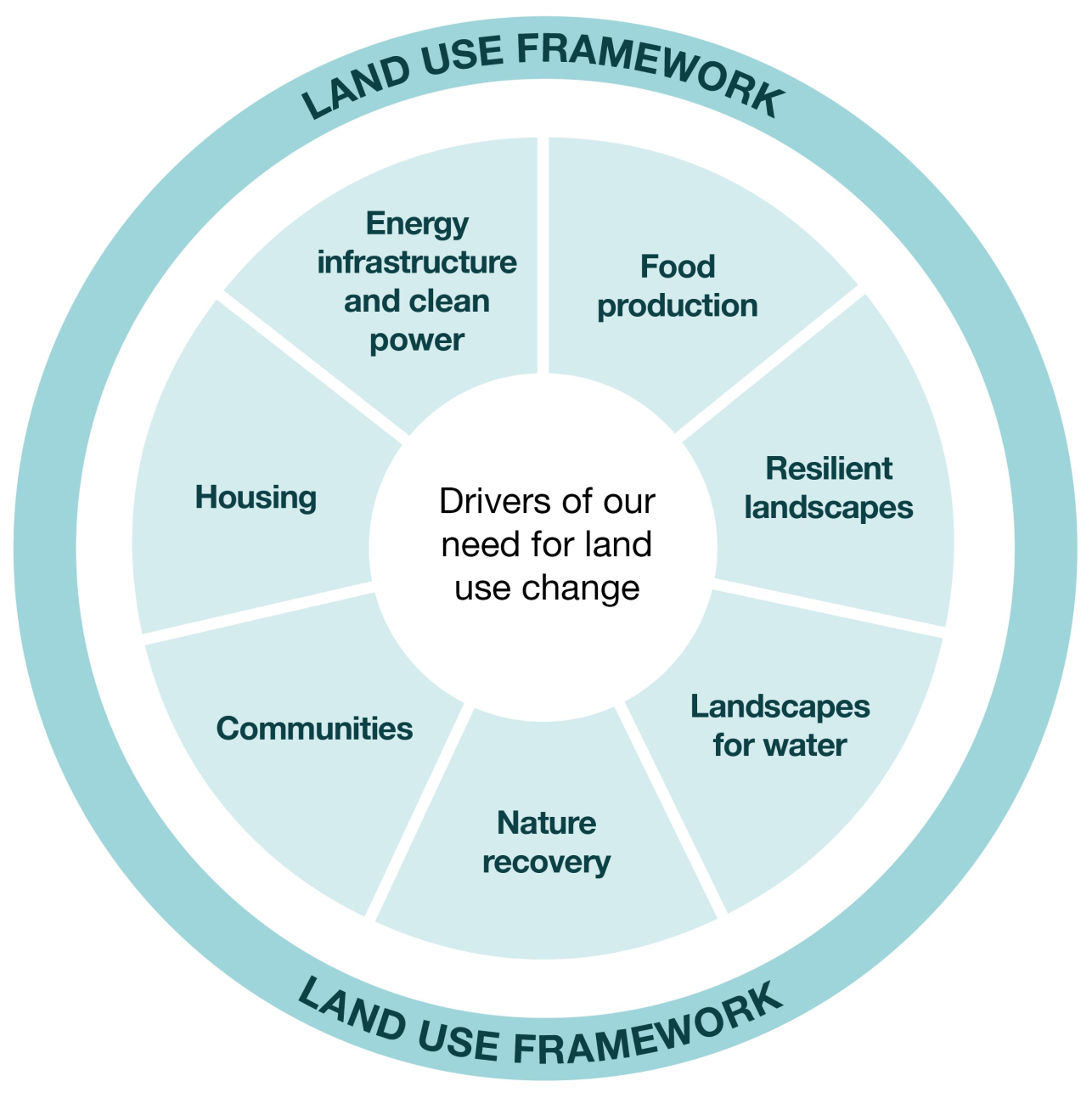
Figure 3: The key drivers of the need for land use change in England that the Land Use Framework is considering.
Figure 3: Alternative text description
The key drivers of the need for land use change in England are housing, energy infrastructure and clean power, food production, resilient landscapes, landscapes for water, nature recovery and communities.
The Land Use Framework brings these together to set out a vision for land use in 2030 and 2050, and to understand how these demands on land can be met in combination.
Key insights from the land use evidence base
Achieving our vision will mean changing how some of our land is used. This land use change will not be uniform across the country; we recognise that land across England is suited to different uses. Importantly, this analysis is intended to help inform approaches to decision-making, it does not prescribe what will need to happen where.
In the Land Use Consultation, we set out analysis of a future in which England meets its Environment Act (2021) and Climate Change Act (2008) targets based on land suitability. The spatial analysis set out in the consultation’s Analytical Annex aims to reduce trade-offs by avoiding land use change on our best agricultural land. It showed how landowners and land managers can make decisions that limit the scale of land use change and support profitability.
Consultation respondents expressed a range of views on the extent of land use change required to deliver government objectives. This included suggestions that the scale of land use change had been underestimated if we are to address all environment and climate objectives, and concerns that changes in agricultural land could undermine food security.
We are updating that analysis in response to the feedback received through the Land Use Consultation, including: projections for housing targets and renewable energy infrastructure, refreshed baseline data, and revised Environmental Improvement Plan (EIP) targets (Table 1 and Figure 4).
There is more we want to do, including taking account of changes proposed locally, more targeted action for water quality, assessing climate change impacts and having greater certainty on the role of biomass in our climate mitigation pathways. As such, we will continue to refine this analysis and we expect that these figures will continue to evolve; we commit to being open and transparent about the scale of change required to meet the Government’s objectives. The framework is not a static document and we will publish updated analysis on GOV.UK, as well as progress on policy and implementation.
To this end, this framework shares a snapshot of the revised analysis and three key insights from our evidence base:
- There is enough land to deliver our objectives: If we can make land use more efficient, there is enough land to deliver our vision and increase the resilience and productivity of our economy, food system, and environment.
- Changes should play to the strengths of the land: Different parts of England are better suited to different uses and change needs to happen in the right places to maximise benefits.
- Cross-sector opportunities are key to efficiency and growth: Spatial decisions made by one sector will often affect another, meaning strategic spatial planning at landscape scale will be key to growth, food security and nature recovery.
These three insights are explained below and inform the principles in the following section.
There is enough land to deliver our vision
Our analysis demonstrates that we have enough land to deliver our objectives for nature restoration and development without reducing domestic food production or compromising on these objectives (Figure 4). This requires food production to increase in line with the historic averages, which is feasible according to our projections, and reform of policy design and delivery to improve decision making and support an increase in the efficiency of land use. For example, we need to strategically conserve the agricultural land with the greatest long-term potential for food production, avoid development on nature reserves, introduce habitats for wildlife within farming landscapes, and expand the area of semi-natural habitat.
For this analysis, we grouped land management and land-use change into five categories, including renewables and urban expansion which have been added since the consultation (Table 1 and Figure 4). Table 1 shows the approximate areas and percentages of England’s total land and Utilised Agricultural Area (UAA) that our analysis indicates may need to change in use or management by 2050. Categories have been updated, condensing changes in agricultural practice use to a single category (B) and to include Renewables (D) and Urban Expansion (E). Categories D[footnote 5] [footnote 6] and E are projections based on objectives and are likely to change as policies and spatial planning within these areas develop. Our analysis, in line with the analysis informing our consultation, shows that most changes are about making land more multifunctional alongside food production, rather than taking land out of production entirely.
There is inherent uncertainty in forecasting the electricity mix to 2050 and further details will be provided in the publication of the Strategic Spatial Energy Plan (SSEP) in Autumn 2027. It is possible that the amount of land in England required to meet our energy objectives beyond 2035 may be more than 2%. This is higher than the percentage stated for Category D.
|
Category description |
Area |
Percentage of England |
Percentage of UAA |
|
|---|---|---|---|---|
|
Category A – Land management change Changes in the way land is farmed, without introducing new habitats or planting trees. Examples: Planting cover crops to reduce soil loss or reducing fertiliser use to prevent water pollution. |
n/a (See “Note 1”) |
n/a (See “Note 1”) |
n/a (See “Note 1”) |
|
|
Category B – Changes in agricultural practice Remains primarily for food production but includes some land use change for environmental / climate benefits. Examples: Arable field margins, agroforestry, creation or restoration of species-rich grassland habitats; responsible management of peat. |
480,000 ha |
4% |
5% |
|
|
Category C – Land use change toward climate and nature benefits Land is primarily for delivering environmental and climate benefits, though small amounts of food continue to be produced on some. Examples: Restoration and maintenance of peat-forming and peat-dependent habitats, creation of woodland, creation and restoration of lowland heathland habitats. |
788,000 ha |
6% |
9% |
|
|
Category D – Renewables (2035) Land is used for solar and wind energy. Some of this land will continue to be used for food production. Examples: Land under solar panels, and there may be overlap with Category C, for example solar and onshore wind on grassland grazed for nature benefits. |
129,000 ha5 |
1% |
2% |
|
|
Category D – Renewables (2050) As above, including projection to 2035. |
155,000 ha6 |
1% |
2% |
|
|
Category E – Urban Expansion Land becomes non-agricultural and is used for development, including housing. |
168,000 ha |
1% |
2% |
Table 1: Approximate areas and percentages of total land in England and Utilised Agricultural Area (UAA) in England that may need to change in use or management by 2050. Note 1: Category A is not in scope of analysis for land use change. The vast majority of farmland will need to be managed differently to adapt to climate change, increase its long-term capacity for food production, and reduce its environmental and climate impact.
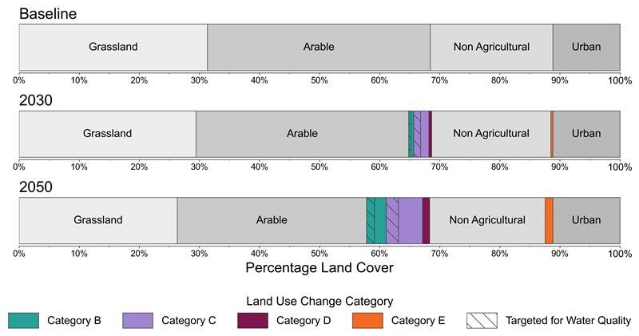
Figure 4: Estimated type and extent of land use change needed as a percentage of England’s total area to 2030 and 2050. Categories of land use change are defined in Table 1; Category A is not considered a land use change and is therefore not included in this figure.
Figure 4: Alternative text description
Horizontal stacked bar charts display modelled land use changes across baseline, 2030 and 2050. Colour-coded categories B-E indicate specific land use changes and a hatched pattern indicates land use change targeted for water quality.
We expect the majority of land to remain as farmland with improved input efficiency and soil health (Category A). For example, planting cover crops in the right places to reduce soil loss or reducing fertiliser use to prevent water pollution. Introducing more sustainable farm practices (Category B) plays a key role. Many of these improvements can be implemented within existing farmed land, such as arable field margins and hedgerows, minimising the area of land taken out of food production. Integrating trees in areas of intensive agriculture (agroforestry) could reduce soil erosion and flood risk, improve water and air quality, support biodiversity, and store carbon.
Figure 5a shows where the greatest opportunities for agroforestry may lie in England, highlighting areas in the East of England for suitability. Agroforestry systems could improve the long-term resilience of farmland to drought and flooding, by increasing soil moisture retention and thus drought resilience in areas where it may be needed most. Figure 5b shows the potential impacts of climate change through the loss of soil moisture, most visible in the East of England, further highlighting the potential benefits of adopting agroforestry in these areas.
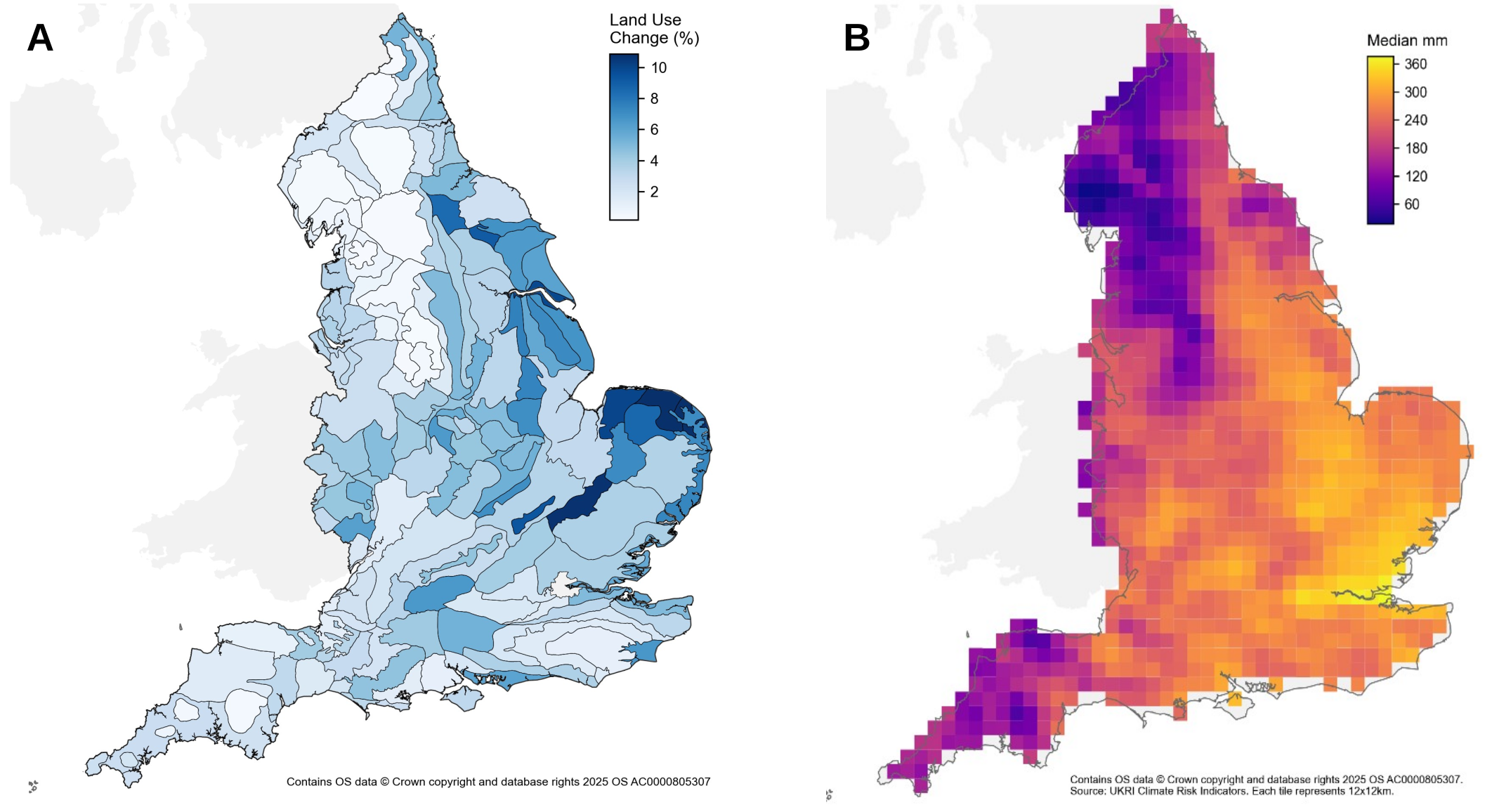
Figure 5a: Map showing suggested percentage of land use change in England’s National Character Areas (NCAs) related to delivering agroforestry targets according to our analysis of spatial suitability. 5b: Average changes in potential soil moisture deficit (PSMD) for the period 2021-2050 across England. These are based on a global temperature trajectory that reaches 2°C above pre-industrial levels by 2100. Data is derived from the Climate Risk Indicator Explorer. For more information on climate risk indicators see Arnell et al. 2021.
Figure 5: Alternative text description
Figure 5a is a choropleth map showing land use change percentages for agroforestry across England’s National Character Areas. Colour gradient from light to dark blue indicates increases from 2% to 10%, with highest changes concentrated in eastern regions.
Figure 5b is a heat map showing average changes in potential soil moisture deficit for the period 2021-2050 across England. The highest changes to soil moisture deficit can be seen in the eastern and southern regions of England.
Other land use changes (Category C-E in Table 1) include habitat restoration, renewables and urban expansion. In our analysis, these changes are not suggested for the most productive agricultural, Best and Most Versatile (BMV) land in England. For development, this reflects the approach of National Planning Policy Framework (NPPF), which directs development away from BMV land. However, it is for farmers and landowners to decide how best to use their land and some development or habitat restoration may still be proposed on BMV land. Where this is the case, there may be the potential for multifunctionality such as through agrivoltaic systems (installing solar panels above crops) and habitat restoration near agricultural land can deliver wider, landscape level benefits, with spill-over effects including improved soil and water quality, and pollination services.
Change should play to the strengths of the land
England’s landscapes differ in their potential for development, agricultural production and ecosystem enhancement. Considering these strengths can help to optimise benefits and reduce potential trade-offs between different outcomes.
One of the opportunities supported through consultation responses was prioritising land use change in areas that are less suitable for high-value sustainable agriculture. This allows other benefits, such as environmental improvement, to be maximised while keeping more of the Best and Most Versatile (BMV) agricultural land producing food.
Habitat creation and restoration, for example, should be directed to the places where it can have the greatest ecological impact, helping to reconnect fragmented landscapes, support priority species and deliver the greatest contribution to nature recovery. Our analysis suggests there are areas of England more suitable for certain types of habitat restoration. Figure 6 shows relatively higher opportunities, illustrated in green, in the following broad geographical areas: in the North West, due to suitability for upland peat restoration; the South West, indicating potential for grassland restoration and broadleaf woodland creation; and the South East, suggesting opportunities for grassland restoration and creation.
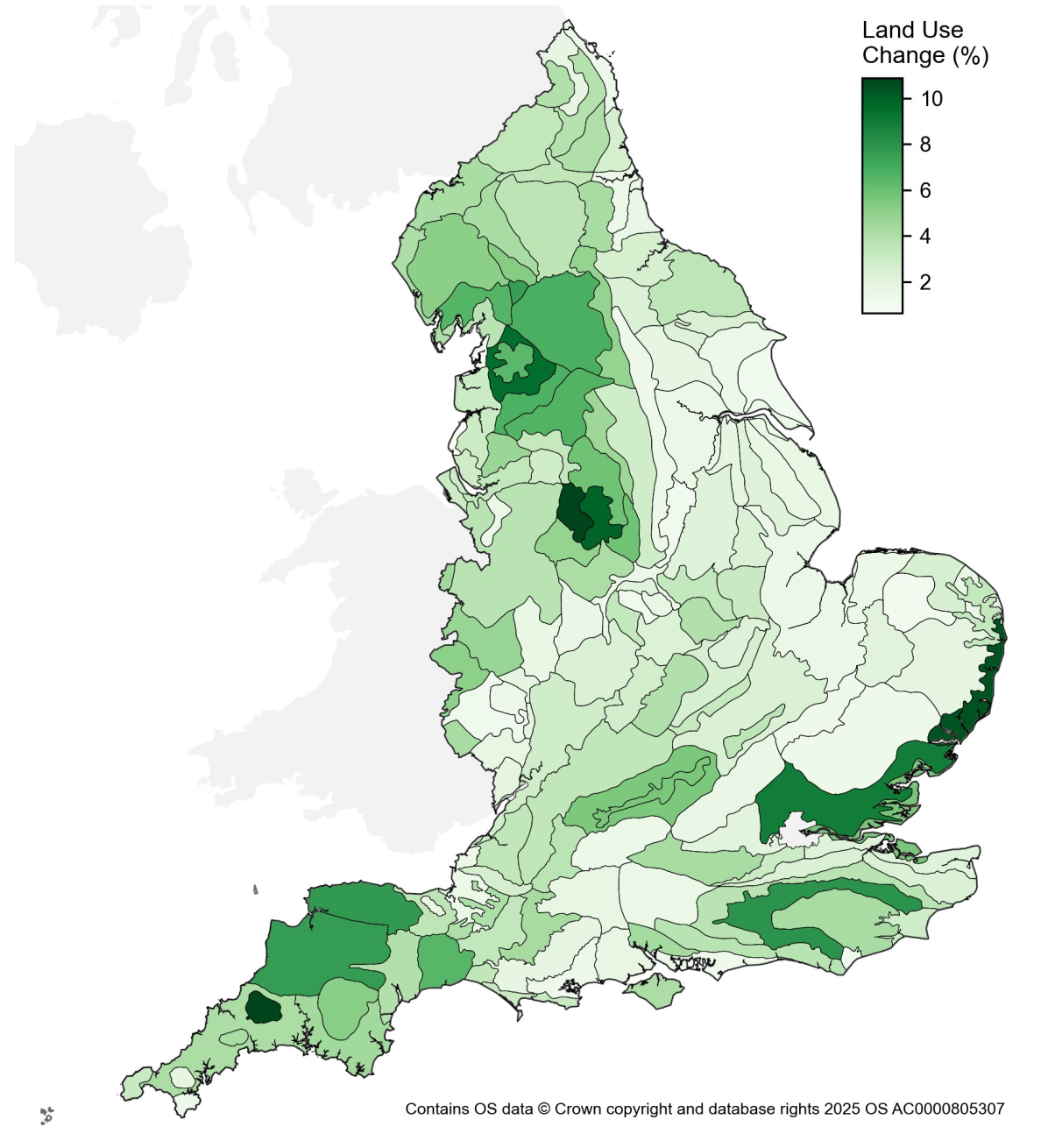
Figure 6: Map showing suggested percentage of land use change in England’s National Character Areas (NCAs) related to delivering habitat targets according to our analysis of spatial suitability.
Figure 6: Alternative text description
Choropleth map showing land use change by percentage across National Character Areas in England, with shades of green indicating changes from 2% to 10%. Darker green regions highlight areas with the highest land use change, notably in the North West, South West and South East of England.
Figure 7 illustrates how targeting habitats to certain areas can deliver additional co-benefits, such as the potential for woodland creation to store carbon, improve natural flood management and water quality. Tree canopies intercept rainfall and woodland soils store more water, helping to reduce peak flows in rivers. When planted in upper water catchments or alongside river corridors, new woodland can lower downstream flood risk, providing climate resilience benefits alongside habitat enhancement.
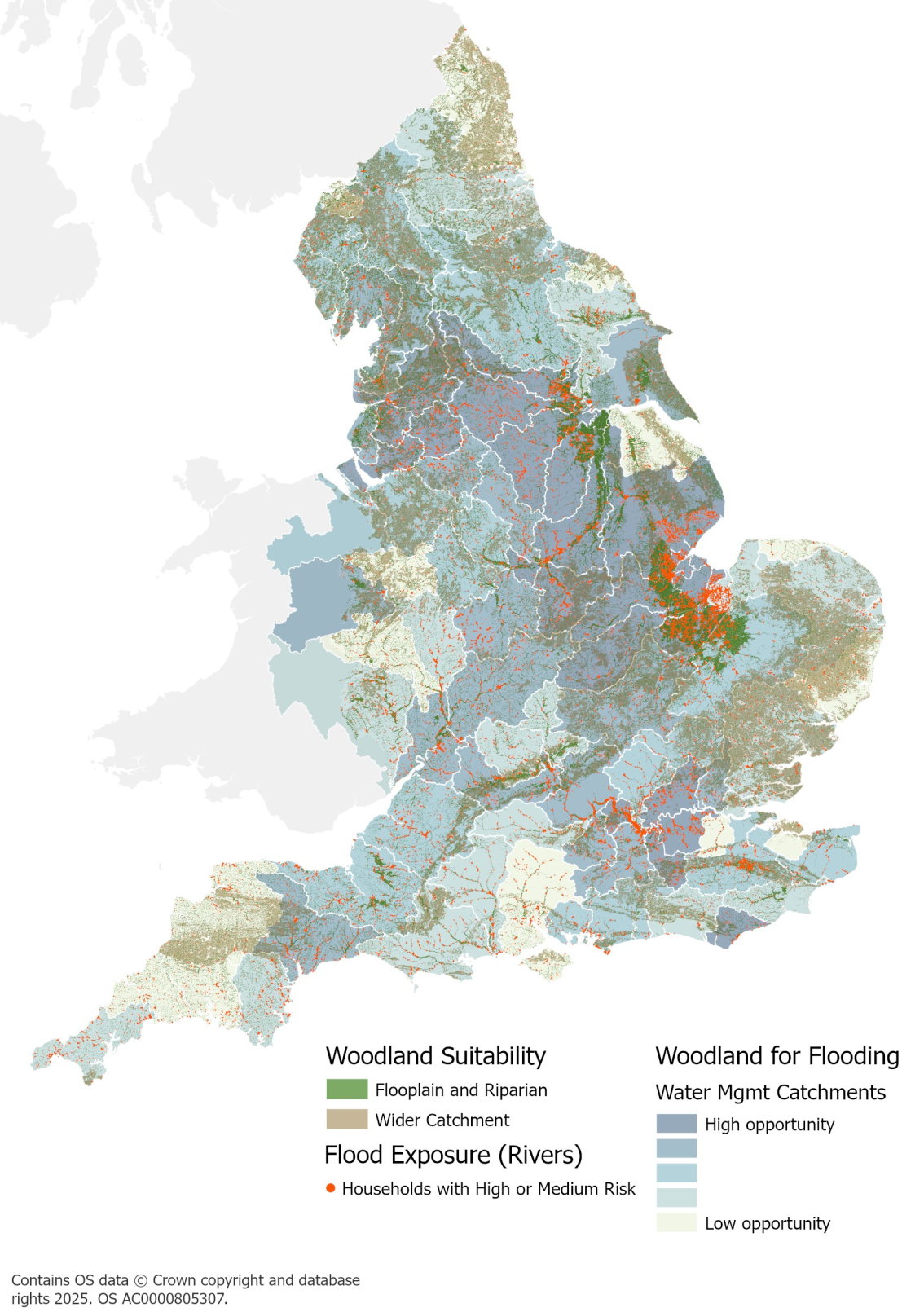
Figure 7: Map showing the suitability for woodland creation and households exposed to flooding from rivers. The map illustrates the relative opportunity within each water management catchment for a nature-based solution: planting trees next to rivers to help reduce flood risk. The map uses Environment Agency data on properties at Risk of Flooding from Rivers and Sea with Flood Zone sources to identify households exposed to river flooding. Their density within each water management catchment is weighted by the share of land with Working With Natural Processes potential for riparian or floodplain woodland planting producing an opportunity measure.
Figure 7: Alternative text description
Map of England showing woodland suitability, flood exposure, and water management catchments for flooding. Woodland suitability is indicated by green shades for floodplain and wider catchment areas, flood exposure by red dots marking households with high or medium risk along rivers, and water management catchments by blue shading representing high and low opportunity areas for flooding management.
Achieving more efficient land use means focusing land use change in areas where land is most suitable. When targets for development, renewable energy, sustainable farm practices and habitat creation are considered together, our analysis suggests opportunities in England are not uniform (Figure 8a). For example, peatland habitat is concentrated in relatively few upland areas (particularly in the North West and South West). Prioritising restoration in these locations creates multiple benefits, for example storing carbon and reducing peak river flows to limit flooding while avoiding pressure on more versatile, productive farmland.
The spatial pattern of land use change can shift when certain targets are prioritised in the analysis. For example, when prioritising land use change towards improving water quality and biodiversity, a higher proportion of change is seen within areas of intensive agricultural production in the east of England (Figure 8b). This is because productive farming regions such as East Anglia are likely to have more fertiliser and soil washing off fields, which affects the water quality of rivers and waterways. As a result, there is a particular opportunity for habitat creation and nature-based interventions in these landscapes, such as buffer strips, to intercept pollutants and reduce the volume of nutrients entering watercourses, whilst maintaining food production.
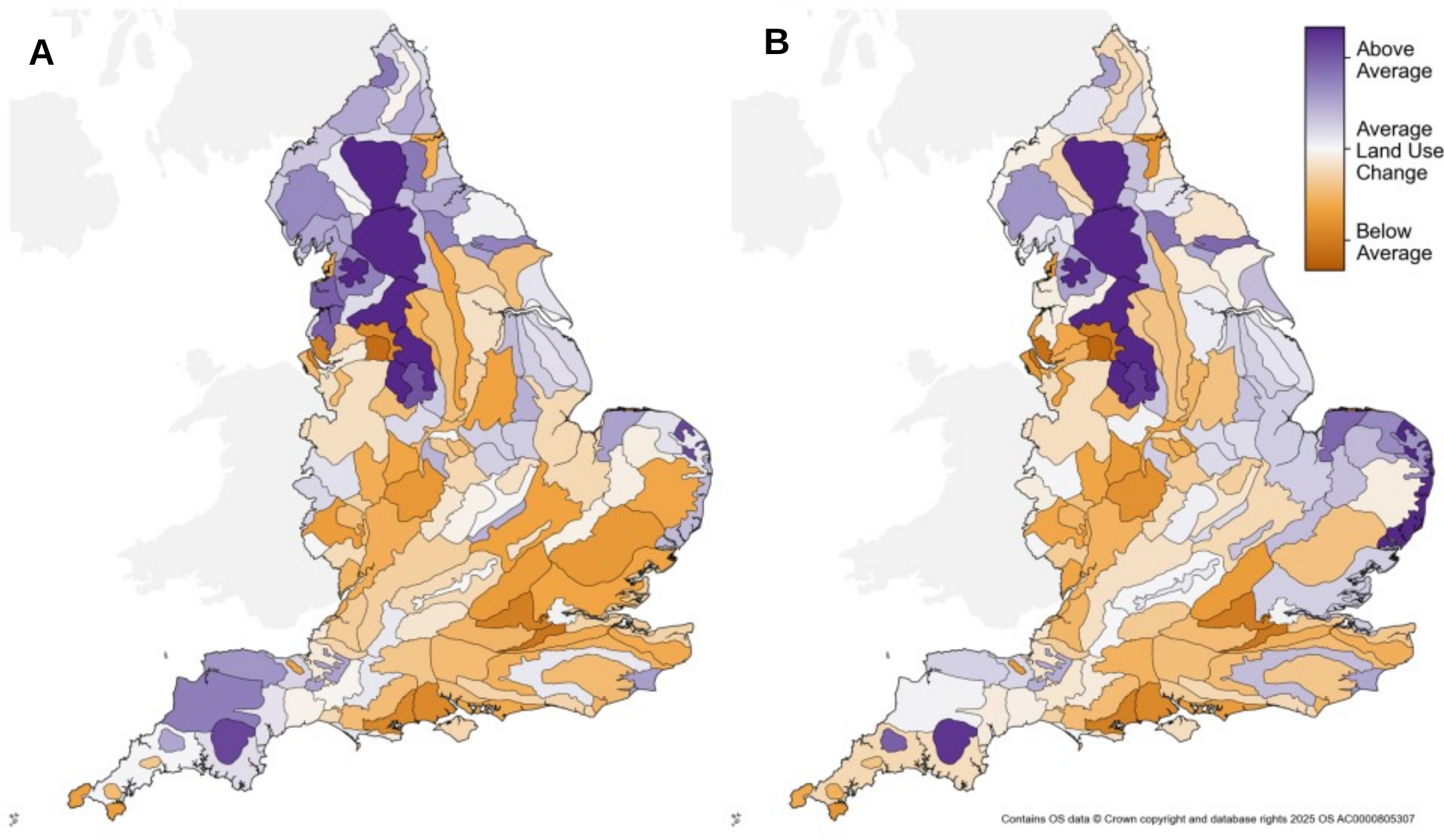
Figure 8: Modelled relative proportion of land use change in England’s National Character Areas (NCAs) in 2050. The model scenarios suggest where change might happen given how the suitability for different types of land use change varies across the country. 8a: The distribution of land use change, including urban development, renewable energy, sustainable farm practices and habitat creation, when allocated to areas best suited to achieving their primary benefit. 8b: The distribution of land use change when there are additional targets for co-benefits in water quality and biodiversity.
Figure 8: Alternative text description
Two side-by-side choropleth maps of England display land use change categorised by regions, with colours indicating above average (purple), average (white), and below average (orange) changes.
Map A shows clusters of above average change in northern and western areas and below average change in southern and eastern regions.
Map B shows clusters of above average change in northern and eastern areas and below average change in southern and western regions.
Cross-sector opportunities are important for efficiency and growth
Delivering outcomes at a national scale means opportunities are interconnected across sectors. Upland peat restoration provides a good example of how targeted interventions can deliver benefits across multiple sectors simultaneously.
Upland peatlands feed rivers and reservoirs serving major urban areas (Figure 9), meaning restoration can also enhance water quality and security by reducing levels of sediment and pollutants, and water treatment needs, which can lead to reducing the pressure on customers’ water bills. In this way, restored peatlands act as ‘natural water towers’, strengthening regional water sources and demonstrating how targeted action can generate cross-sector benefits. Simultaneously, upland deep peat provides highly efficient carbon storage when in good condition. Restoring the most carbon-rich and degraded peat areas delivers significant climate benefits while allowing some food production to continue, through grazing, improving wildlife habitat and preserving heritage assets.
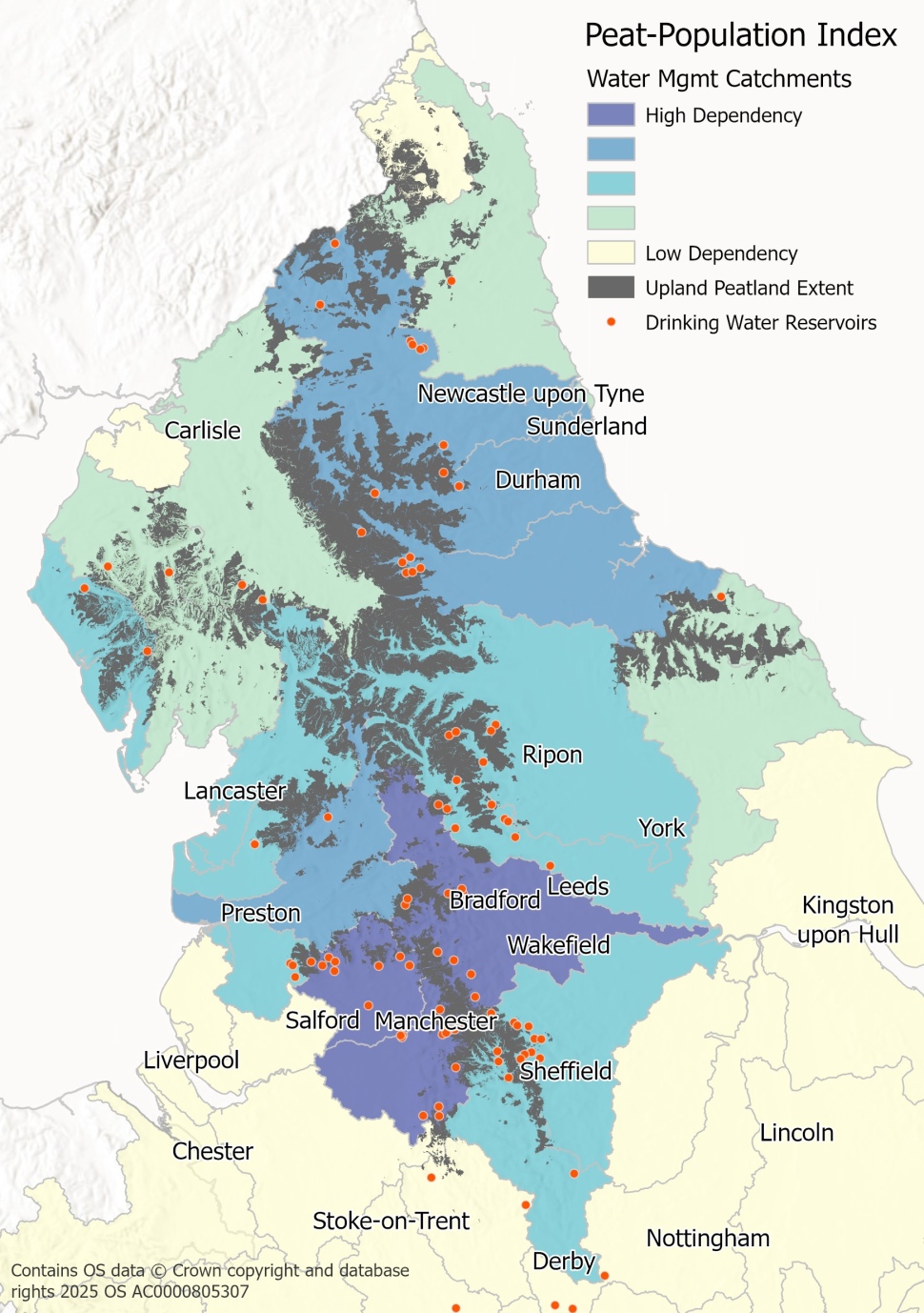
Figure 9: A map of northern England showing the distribution of upland peat and the relative dependency of the populations within catchments on peat for delivering clean drinking water within catchments. The map uses Natural England’s England Peat Map to identify the upland peat above the Moorland Line. Following Xu et al. (2018), it relates the proportion of upland peat in each catchment to population density derived using NERC’s gridded population data to produce an index of dependency. Locations of major drinking water reservoirs from UKCEH are also shown.
Figure 9: Alternative text description
Map showing Peat-Population Index across water management catchments in northern England, with areas colour-coded by dependency level. Red dots mark drinking water reservoirs, highlighting clusters near major cities like Manchester, Leeds, and Newcastle upon Tyne.
The insights in this section highlight the importance of taking a considered approach to land use change to ensure that we minimise trade-offs and maximise cross-sector opportunities. Such an approach will improve the efficiency of land use and help unlock growth while supporting food security, nature recovery and climate mitigation.
Habitat creation and 30by30
We are developing a delivery plan for 30by30, to conserve and effectively manage 30% of land for nature. Spatial analysis, building on the analysis in this section, shows us which land might be most suitable for future inclusion in 30by30.
Around 7% of England’s land is already counting towards the target, with a further 3.5% already identified as taking action towards the target. By 2030 we will have made measurable progress, supported by a list of prioritised areas moving towards meeting the 30by30 criteria. This includes the 9% of England with existing habitats that partly meet the criteria, and the 12.5% with ecological potential for future habitat creation or restoration (Source: Methodology Note).
There are a wide range of landscapes supporting nature’s recovery, such as sites of special scientific interest (SSSIs) in favourable and unfavourable recovering condition, public woodland managed for nature, National Nature Reserves, Landscape Recovery areas, nature reserves, ancient woodlands, land being restored under Biodiversity Net Gain agreements, lakes and restored peatlands. Taken together, these areas represent approximately 32% of England that either already contributes to, or has the potential to contribute to, the 30by30 target.
Section II: Better land use decisions
Land use principles
Key to achieving more efficient land use is the set of principles that we consulted on. These will improve how Government makes policy relating to land use, and inform:
- National strategies and programmes relating to or having an impact on land.
- Strategies and plans prepared regionally and locally.
- Actions of individual landowners and managers.
While they will inform spatial planning at the national government level, the principles are separate from the planning process. They are not intended, as with the rest of this Land Use Framework, to be a material consideration for the preparation of development plans or for making decisions on planning applications or nationally significant infrastructure projects.
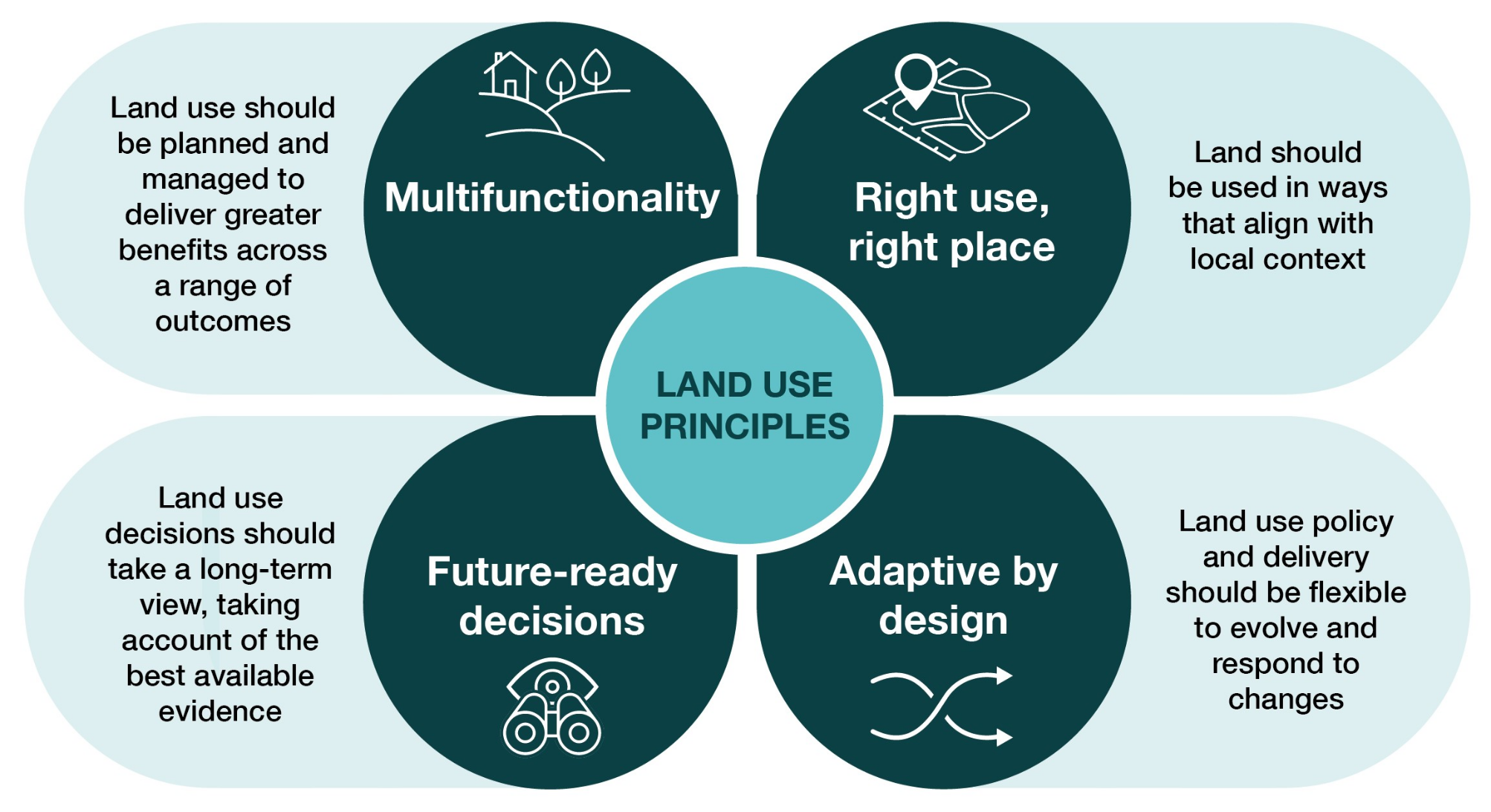
Figure 10: Four principles to inform decisions relating to, or having an impact on, land in England.
Figure 10: Alternative text description
The four principles to inform decisions relating to, or having an impact on, land in England are: ‘Multifunctionality; ‘Right use, right place’; ‘Future-ready decisions’; and ‘Adaptive by design’.
We heard that the principles we consulted on were helpful but needed to be more specific. Building on this feedback, we have refined the principles to the four below.
-
Multifunctionality: land use should be planned and managed to deliver greater benefits across a range of outcomes, tailored to local priorities and opportunities, societal needs, and environmental pressures. For example, solar generation designed to enable continued grazing of animals; restoration of upland peatlands to reduce carbon emissions, store water and provide biodiverse habitats; or a network of urban green spaces helping with wellbeing, biodiversity, flood protection and cooling during heatwaves.
-
Right use, right place: land should be used in ways that align with local context and account for natural, social and economic factors (such as proximity to major conurbations, access to nature and heritage, or soil quality). Decisions should draw on local knowledge, values, data and priorities to ensure coherent and fair outcomes. For example, this includes prioritising land uses that are spatially sensitive, like high-quality farmland and irreplaceable habitats, and optimising the location of infrastructure, such as grid-connected sites for renewables.
-
Future-ready decisions: land use decisions should take a long-term view, aiming to meet the needs of the present without compromising the ability of future generations to meet their own needs. This should take account of the best available, up to date, relevant and proportionate evidence to anticipate future environmental, social, and economic conditions – including climate change impacts. For example, tree planting decisions should consider species and locations according to climate change pressures and factors such as water availability.
-
Adaptive by design: land use policy and delivery should be flexible enough to incorporate new evidence, respond to emerging needs and challenges, and evolve with changing local and national priorities. For example, regularly updated climate adaptation plans and consistent assumptions help ensure resilience of infrastructure.
Applying the principles
Government will take a leading role in applying these principles. This includes using them to inform the development of policy and delivery mechanisms where they relate to or impact the use of land, and supporting others to integrate them into their own planning and decision-making.
Applying the principles will help to achieve clearer priorities at national and local levels. As a result, the spatial implications of Government commitments on land will be more transparent, strategic and coherent. This will provide more certainty to developers, landowners and communities on where investment needs are, where trade-offs could occur, and where there are opportunities for multiple benefits.
In a planning context, the principles will be taken into account as we prepare or update relevant statements of national policy, including the National Planning Policy Framework and National Policy Statements[footnote 7].
We also encourage all land managers to factor in these principles in the way they manage their land. Major landowners in the National Estate for Nature[footnote 8] group will apply the principles as they develop and deliver their estate management plans from April 2026. The work of the National Estate for Nature group will then provide practical examples of how the principles can be applied to land management decisions, which we will disseminate for others to learn from.
“Section III: Implementing the framework” sets out a series of actions we are taking to start to apply these principles, and to help others do the same.
Section III: Implementing the framework
This section explains how we are starting to implement the Land Use Framework, addressing the challenges we heard through consultation. The suite of actions below reflect only our first steps, and we will continue to draw on the Land Use Framework Summary of Responses, published separately, as we implement the framework.
The actions described in this section are split into the following subsections:
- Consistent spatial plans: joining-up decisions on land use.
- Supporting multifunctional and efficient land use.
- Making land digital.
- Sharing responsibility for the stewardship of land.
Consistent spatial plans: joining-up decisions on land use
This government is undertaking significant reforms to move to a streamlined planning system that is plan-led, pro-growth, accessible and understandable to all, and offers greater certainty. But planning reform in isolation cannot coordinate the multiple, overlapping demands on land across infrastructure, housing, food, nature and climate, which is why this Land Use Framework sets out a cross‑government approach for a single, shared spatial picture of land use.
Historically, decision-makers have lacked the information or tools needed to fully understand and manage trade-offs involved in land use changes. This has led to planners, developers, investors and communities not seeing how development and nature can be delivered together, or how energy can be generated alongside food production. Below, we set out actions to address the number and complexity of plans and maps that consultation respondents, including local authorities and developers, cited as a barrier to long-term planning and investment decisions.
Coordinating our national approach to land use
We heard through consultation that developers currently lack clarity on how decisions on land factor in development, food, nature and other priorities. Seeing strategies with bold ambitions for energy, housing, transport, national security, farming, climate and the environment has led to questions about whether there is enough land to satisfy all of Government’s land use priorities, and how they might fit together.
Achieving more efficient land use means integrating existing mapping and planning across outcomes and sectors, without creating new top-down plans. To provide clarity on our national approach to land use, we will:
- Set out national spatial priorities for infrastructure as part of the refreshed 10 Year Infrastructure Strategy in 2027. This will be overseen by the National Infrastructure and Service Transformation Authority (NISTA) and will help to coordinate infrastructure investment.
- Publish an updated version of the National Planning Policy Framework following the consultation which ran from December 2025 to March 2026. The consultation proposed clearer, more ‘rules based’ policies for decision-making and plan-making, designed to make planning policy easier to use and to underpin the delivery of faster and simpler local plans.
- Develop a coherent set of spatial plans for key infrastructure sectors, building on the approach being taken for energy, and using principles and insights from the Land Use Framework. Also coordinated by NISTA, this will provide a more effective basis for identifying and managing interactions between infrastructure and other place-based plans.
- Prioritise the development of Environmental Delivery Plans (EDPs) based on their capacity to accelerate the building of homes and infrastructure, while unlocking the positive impact development can have in driving the recovery of protected sites and species. This will be informed by integrated spatial mapping and plans for different sectors.
To give planning authorities, developers and investors a clear picture of environment, climate, food and rural priorities to make informed investment decisions, we will:
- Establish a Land Use Unit in Defra to produce the first single map of national spatial priorities for Defra outcomes. When published on GOV.UK alongside wider Government priorities, this will give a unified spatial picture across food production, nature recovery, water, climate change, infrastructure, housing and growth. This will improve coordination and help prioritise investment in locations that reduce the tension between development and environment. We will publish this as a dynamic online map, integrating housing and growth priorities via the work of NISTA, to aid decision-making at the regional and local levels; it will not prescribe land uses.
- Develop a long-term assessment of climate change impacts on land use in 2°C and 4°C scenarios, which will inform spatial priorities for infrastructure, housing, food production and environmental outcomes - ensuring we deliver the right actions in the right place in a changing climate. Nationally, this will inform what a resilient land system could look like, aligning with the cross-Government intention to set stronger objectives that will be set out in the fourth National Adaptation Programme for climate change, due in 2028. It will also inform policy such as Environmental Land Management scheme design.
Improving regional alignment across sectors
During the consultation we heard that national strategies are at times unclear for the regions and landscapes where they are expected to be put into practice. We will strengthen links between national, regional and local strategies to clarify the contributions that places make to national outcomes and targets.
Local authorities face a huge policy agenda in relation to land use – housing development, energy infrastructure, nature recovery, planning reform, etc. – but often experience a lack of integration between these.
The Association of Directors of Environment, Economy, Planning and Transport (ADEPT) consultation response
The first priority will be to make it easier for local and regional decision-makers to understand national spatial priorities and how they interact. We are strengthening England’s plan‑led system by reintroducing a strategic tier across England. New powers in the Planning and Infrastructure Act 2025 will place a statutory duty on mayoral strategic authorities and other Strategic Planning Authorities[footnote 9], to prepare spatial development strategies (SDSs) that will bridge national policies and local planning. SDSs will address strategic cross boundary issues, allowing for local plans to focus on allocating specific sites and setting detailed policy.
Government will provide a coordinated, spatial picture of national priorities on land that will help Strategic Authorities use their new planning powers to combine national and local priorities in delivering growth, housing, and nature recovery. To support this, we will:
- Publish quantitative data about land use change needed to meet national environmental, climate and food outcomes, at the regional scale on GOV.UK. We will consider options for Planning Practice Guidance (PPG) to set out how the data and evidence from the Land Use Framework could support the preparation of SDSs.
- Continue to explore interactions between SDSs and the Strategic Spatial Energy Plan (SSEP), due to be published in Autumn 2027. The SSEP will identify demands on land use, and consider them alongside societal and environmental factors, to spatially optimise the energy infrastructure required for generation and storage across Great Britain.
- Establish partnerships between national, regional and local decision-makers, including through Defra’s place-based Pathfinders and regional water planning piloting. This will include exploring how quantitative data about land use change for environmental and food outcomes, such as advisory regional forestry targets, could help in preparing local and regional strategies.
The second priority is to improve flows of information between local, regional and national decision-makers, so that decisions can better support regional and local priorities. We will:
- Show how England’s local and regional planning system, taken as a whole, contributes to national objectives for growth, housing, food, environment, and climate change. We will do this by publishing national aggregations of local and regional sectoral spatial strategies and plans, that Government is able to collect data from, including spatial development strategies.
- Deliver strengthened regional and catchment water planning overseen by the newly established Regional Water Planning Steering Group. This includes establishing regional planning groups across England to deliver early rollout and test regional planning functions, supporting delivery of national strategic objectives and regional and local priorities. We will also test how catchment partnerships can effectively convene cross-sector partners, harness local insight and implement solutions at the catchment level, to feed into regional planning.
- Publish a national map aggregating data from LNRSs in 2026, with analysis of priority land use change on GOV.UK. This will show what the LNRSs propose for restoring nature and how they contribute to Environment Act targets and our 30by30 commitment.
These actions will facilitate closer interactions between national, regional and local scales of spatial planning and delivery, which support and are informed by land managers and communities. For example, local input into Protected Sites Strategies helps to inform Local Nature Recovery Strategies, in turn informing national policy like the Environmental Improvement Plan. At the same time, national policy, including this framework, provides clear spatial analysis and greater access to data, principles for land use decisions and management, and incentives and enabling policy to inform regional and local planning and support land managers and communities at individual sites.
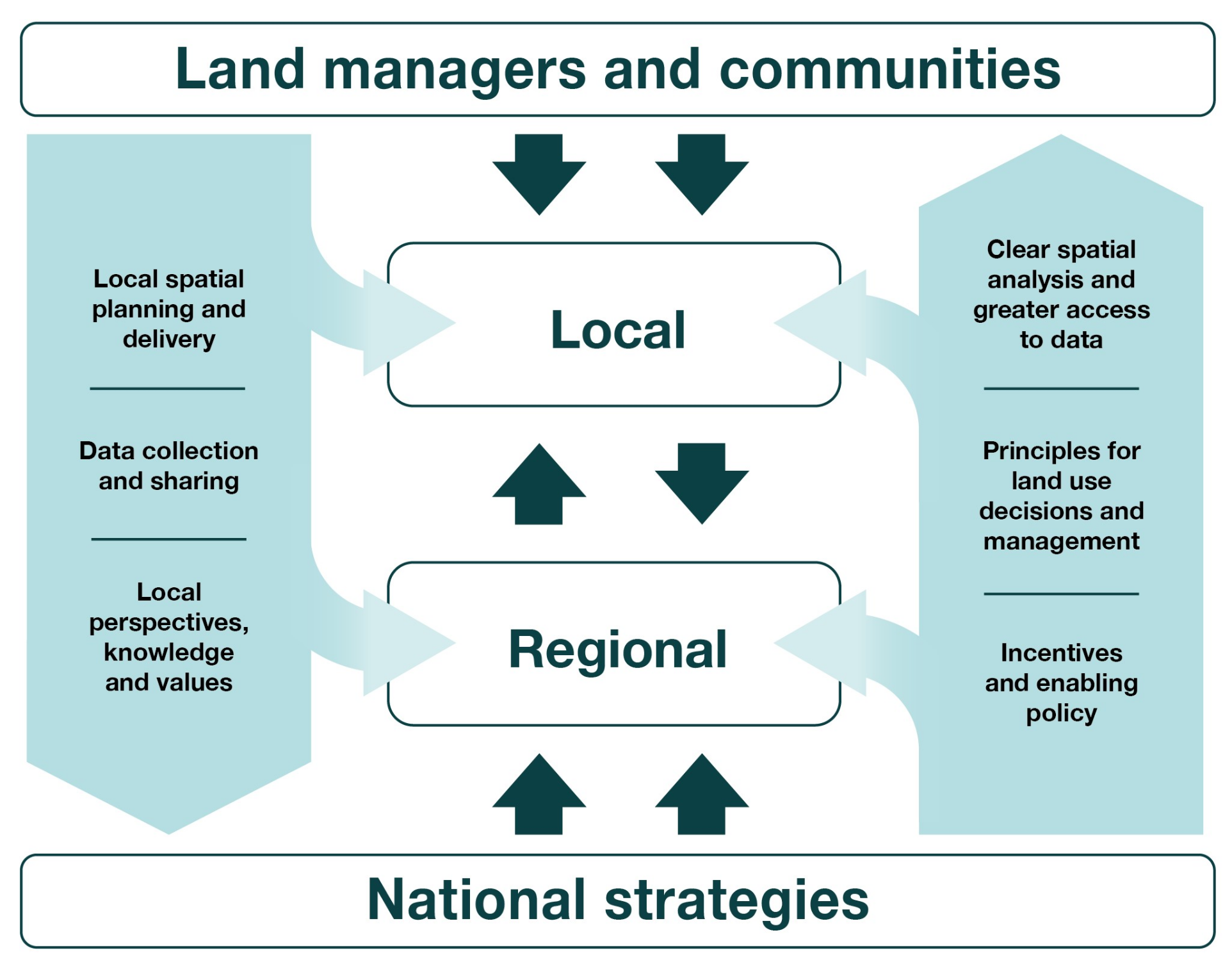
Figure 11: Flow diagram showing how implementation of the Land Use Framework will support the two-way join-up between different scales of spatial planning and delivery.
The final priority is to tackle the problems caused by disconnected decision-making across sectors at the local and regional levels. During the Land Use Consultation, we heard about development delayed by insufficient water infrastructure, farms held back by weak grid links, and missed opportunities for nature-based solutions to protect infrastructure. This fragmented decision-making is being driven by sectoral data and tools that do not interact, misaligned processes, and the number of decision-makers and plans involved.
Planning reform will help improve cross‑sector alignment at the local level by setting clearer expectations for how infrastructure, environmental and development needs should be planned together. For example, our proposed plan‑making policies would require authorities to work proactively with infrastructure providers to identify where additional water, transport, utilities and other strategic infrastructure is needed to support growth and to coordinate this across boundaries. For the first time, LNRSs are also explicitly referenced in national planning policy, giving their spatial priorities for nature national visibility.
To support better join‑up in local spatial planning, we will bring the information of different sectors together, enabling decision-makers to deliver better, more joined-up plans for their places. As first steps, we will:
- Improve combined mapping platforms so that decision-makers can see land through priorities and uses for different sectors and identify opportunities for cross-sector benefits. See “Making land digital” for our plans to improve land use data.
- Use Planning Practice Guidance to support Strategic Planning Authorities in identifying opportunities to secure multiple land use benefits through their approach to development. This could include setting out how spatial development strategies should take account of relevant LNRSs, and how they can best consider wider strategic environmental and food[footnote 10] opportunities associated with growth.
- Publish new guidance for Internal Drainage Boards which may clarify their climate and environmental purposes, reflect local environmental priorities, and incentivise the investments needed to manage water sustainably, including in reducing greenhouse gas emissions from peat soils.
Supporting multifunctional and efficient land use
In every scenario, the Government’s objectives across housing, infrastructure, national security, food, climate and nature require more multifunctional and efficient land use. There is an important role for Government to play in supporting people with the information, skills and incentives to make the best use of land.
The actions below set out how we will ensure the best farmland is kept productive, support land use changes where they will be most impactful, develop new funding opportunities for private organisations to finance changes, and increase resilience to climate change. We explain how we will ensure development can proceed at pace with reduced impacts on our best agricultural land and wildlife habitats.
Keeping landscapes productive for food
Government is clear that food security is national security. We agree with consultation respondents who called for the strategic safeguarding of the best farmland from permanent land use changes, and for improving the resilience of our agricultural land to the impacts of climate change. Better data and decision-making principles can help decision-makers understand where there are opportunities for change or multifunctional land management, and where resilient, sustainable food production is the priority.
A key finding of our analysis[footnote 11], is that the projected scale of land use change can be achieved without reducing domestic food production or compromising on other objectives, provided we make land more efficient at delivering different outcomes. We know the farming sector wants to become more resilient, and our consultation generated constructive debate about how productivity increases could be achieved in a future of more frequent extreme weather events.
Volatility in yields has also been increasing in recent years, as more extreme weather becomes more common. With climate change likely to result in ever more extreme weather, we may expect yields to reduce rather than grow in the future.
NFU, consultation response
In all scenarios, we need to produce food more sustainably from less land using a mixture of productivity improvements and the expansion of highly efficient sectors. Maintaining domestic food supply is a critical component of food system resilience. As such, we are:
- Making a clear, long-term commitment to maintain overall food production in England, by increasing farm productivity and profitability, and developing sector plans to underpin our future food security and drive economic growth.
To support this ambition, we will:
- Develop a portfolio of sector growth plans, beginning with horticulture and poultry, to provide a formal framework to strengthen domestic production and maintain food security. These plans will look at opportunities to improve productivity, profitability and resilience across farming sectors.
- Use the new Farming and Food Partnership Board, established following Baroness Batters’ independent Farming Profitability Review, to bring together senior leaders from farming, food production, retail, finance and Government and drive growth, productivity, long-term profitability across the farming sector. This will inform the Farming Roadmap, which will be published later this year.
- Safeguard our best and most versatile farmland from permanent land use change (such as woodland creation and urban expansion) by publishing updated Agricultural Land Classification data and mapping as it becomes available.
- Include any permanent changes in agricultural land use in future Food Security Reports, and share this data with plan-makers so that the implications of strategic development decisions on food security can be better understood, and inform application of planning policy. This will enable us to monitor changes in land use and safeguard food production.
- Assess dependence on food imports in the UK Food Security Report in 2027, helping to ensure that land use changes here do not disproportionately increase our need for ‘imported hectares’ from abroad. Monitoring this change will enable Government to respond to the risk that we increasingly displace the nature and climate impacts of food production abroad.
- Introduce flexibility for farmers planting trees in fields to create agroforestry systems, allowing them to trial resilient farming approaches without being locked into permanent change through felling licencing. We will explore how to achieve this with the Forestry Commission.
- Build climate impacts and adaptation into policy design, including for Environmental Land Management (ELM) schemes, such as with the Climate Resilience of Agriculture project which is exploring how climate change may impact our food production, farming and livelihoods, and the potential adaptation solutions required. We will also examine how this work could be accessible to farmers or their advisors to help them mitigate and adapt to climate change.
- Provide up to £50m funding over the next four years for water infrastructure, local collaboration and trials of farming with a higher water table to support farmers and land managers to restore and undertake more sustainable management of lowland peat soils to reduce carbon emissions.
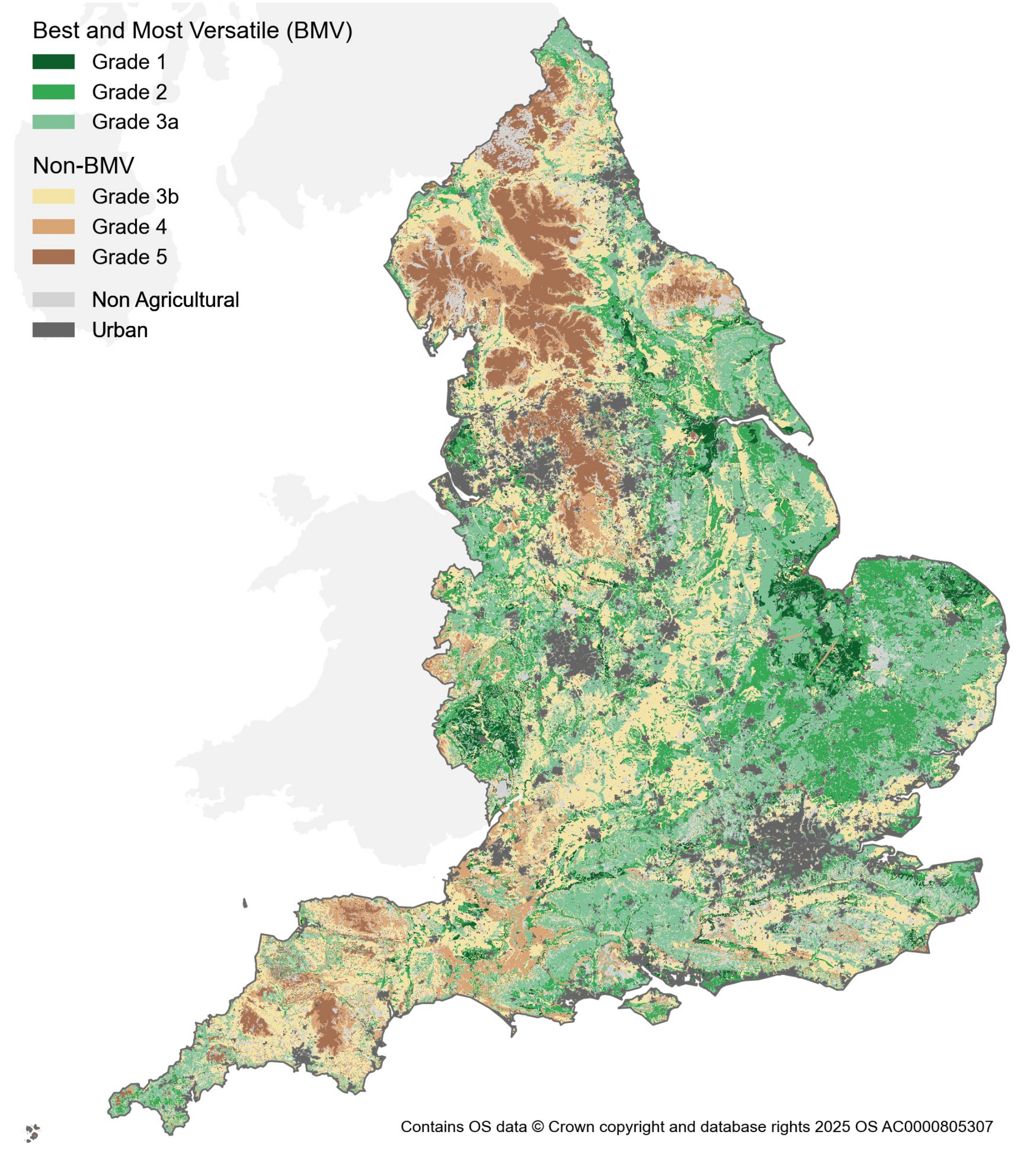
Figure 12: New Predictive Agricultural Land Classification (ALC) map for England. This map replaces the outdated Provisional ALC map by incorporating more recent classification methodologies, including the distinction of Grades 3a and 3b land, and is based on best available data from the National Soil Map for England (NATMAP) and updated modelling. A full technical annex and mapping layer will be available later in 2026.
Consultation responses highlighted that tenant farmers face significant barriers to business resilience and profitability and are often locked out of opportunities to change land use even where they would enhance productivity and profitability. Policy has historically been designed for owner occupiers, perpetuating rather than addressing these barriers. To address this tenant farmers will need a stronger voice in policy-making.
We will ensure that land use change policy is designed to be accessible to the tenanted sector which manages 32% (2.9Mha) of England’s agricultural land, often in areas where the potential for land use change is high. Ensuring a just transition in this way means supporting tenant farmers to stay on the land with access to the opportunities and value that land use change can bring to their businesses.
This will require reforms to ensure that tenant farmers have the rights and the certainty required to invest in their businesses. The Law Commission will deliver a detailed and independent review of agricultural legislation which will inform a reform of the body of law governing the tenant farm sector and landlords. To accelerate progress and inform the Law Commission review, we will:
- Work with landowners, including members of the National Estate for Nature to test, implement and encourage wide uptake of longer-term tenancy agreements that include specific provisions for environmental improvement.
- Reform the Farm Tenancy Forum to give tenant farmers a greater role in policy-making.
- Work with the Commissioner for the Tenant Farming Sector to ensure that the voice of the tenant farming sector on the impacts and opportunities of land use change informs policy and legislative developments.
- Work with the sector to understand what fair compensation is for tenants who may lose land to non-agricultural development to inform policy and legislative developments.
We also heard the challenges that land managers, farm advisors, and planners face in gaining the knowledge and skills needed to adopt innovative land use practices, tools, or processes. The fragmented training landscape and key technical gaps across digital literacy, natural capital and climate were all cited as barriers. To support the knowledge and skills needed for the land use transition, we will:
- Work with awarding organisations and partners, to review topics such as mixed farming and multifunctional land use in the T Level curriculum. This will improve skills around climate-resilient and nature-positive land management in the existing workforce and help to bring new entrants into farming and land management sectors to address capacity and capability shortages.
- Work with training providers to develop courses to upskill farm advisors in land management practices, and improve professional standards to ensure farmers and land managers can receive high quality, tailored support.
- Complete modelling in 2026 to map out workforce needs and skills requirements across Defra sectors up to 2050. This will inform how we take action to address capacity and skills gaps in land use sectors, such as identifying priorities for training and guidance.
- Launch a new Farmer Collaboration Fund later this year, with up to £30m funding over 3 years. This will facilitate collaboration between farmers to support a wide range of actions, including land use change activity.
- Support the launch of a new Innovation Academy at the new Royal Agricultural University Innovation Village. This will build skills and expertise in multi-functional land management to improve resilience in food production and expand on-farm innovation to deliver social and environmental benefits and a thriving rural economy.
Aligning incentives with spatial priorities
A targeted approach to financial incentives and regulation is critical to reducing the scale of change required to farmland, increasing the value for money of public spending, and delivering on wider Government priorities alongside the Environment Improvement Plan (2025) and the Carbon Budget and Growth Delivery Plan (2025). Better aligning incentives with spatial priorities will give farmers and investors the clarity needed to make long-term decisions about land use and investment that account for future climate change.
We heard concerns that current incentives are not adequately tailored to reduce trade-offs between outcomes or address inefficient existing uses of land. This is why we must make changes in a way that safeguards homegrown food production and avoids moving more of the environmental impacts of food production abroad. We also heard that Government should safeguard the best and most versatile land by targeting non-agricultural land use, such as development and nature recovery, towards less productive land.
In line with the findings of Baroness Batters’ independent Farming Profitability Review, our priority is to ensure farmers are fairly rewarded for the quality of their produce, including positive environmental outcomes. We will ensure that new opportunities are fairly distributed nationally and that the transition strengthens, rather than compromises, the resilience of domestic food production.
We have recently set out details of a revised Sustainable Farming Incentive offer for 2026. We want as many farmers as possible delivering positive environmental actions through the scheme, and we have an Environmental Improvement Plan target to double the number of farms delivering for nature by 2030. To support this, we will introduce a number of changes to help the funding go further, to deliver more for the environment, and to allow as many farmers as possible to farm more sustainably. The core design of the Sustainable Farming Incentive (SFI) will provide a stable framework for the rest of this Parliament, though we expect to make refinements and improvements where we can.
Future phases of reform will explore where the greatest opportunities are to meet priority outcomes. In doing so, we will give farmers a clearer idea of what actions may work best in their area. Working in partnership with farmers, we will gradually transition towards a more spatial approach to structuring incentives for land use change and management, including through some ELM schemes and water company spending, where the evidence suggests it may be beneficial. In addition, we will do more work on the potential to spatially target regulation. Any changes will be made transparently and proportionately in partnership with farmers.
To deliver on this, we will:
- Improve the spatial prioritisation of water company investment through reforms to regional water planning, as announced in the Water White Paper.
- Invest in cross-sector catchment partnerships to strengthen catchment-level water planning. This will empower farmers and other local stakeholders to feed in proposals for action to tackle water system issues, to inform regional water planning and influence prioritisation of investment.
- Work with farmers to co-produce an approach that focuses payments for a selection of SFI actions in the areas where they will make the greatest impact from 2027, ensuring that all other actions continue to be available to farmers across England. To inform our approach, we will first publish the assumptions and analysis underpinning potential changes later this year to ensure the sector has full sight of the evidence we are considering. This will include maps of spatial suitability for priority environmental outcomes. Changes will be made incrementally to a clear timetable and will be subject to the findings of this published analysis, and the feedback we receive through coproduction.
- Invest in modernising digital farm and land services to give farmers clearer sight of the public and private funding opportunities available where they are.
- Provide further detail on how we expect farming advice and ELM schemes to evolve over the next five to ten years in the forthcoming Farming Roadmap, including through spatial targeting. It will set out that by 2030, some payments for land use change under Countryside Stewardship and any relevant payments under SFI will be spatially targeted. Landscape Recovery will be spatially prioritised. This is subject to the findings of the published analysis and the feedback we receive through the process of coproduction.
Diversifying the financing of land use change
Meeting our ambitious environment targets while supporting the transition to sustainable business practices will require a much greater role for private nature markets. We heard through our consultation that investment will be needed in particular to support the transition to sustainable farming, whether that is moving to regenerative practices, investing in equipment, or making adaptations to on-farm infrastructure. Public payments alone will not be enough for the transformative changes to land management and land use needed at the farm level, and there is an increasing role here for private finance.
But we also heard that many in the farming sector lack knowledge about, or confidence in, payments from private sources. Scaling and combining these types of finance requires these markets to be carefully shaped, including through clear standards.
To address this, we will:
- Take steps to increase private demand for the environmental services that farmers and land managers can provide. We will set out more details in our response to the call for evidence on private demand for ecosystem services in March.
- Ensure that public payments can be combined with private payments as recommended by the Corry Review, making it easier for land managers to access a wider range of revenue opportunities.
- Require publication of data on nature and carbon market projects, enabling common mapping of actions so that farmers can see what is being proposed in the surrounding landscapes, allowing them to consider pursuing joined-up action with neighbours.
- Ensure that the recently doubled funding to river catchment partnerships increases their capacity and capability to convene cross-sector partners, harness local insight and implement solutions at the catchment scale, feeding into regional planning. This will include projects which bring together funding from different sources such as water company investment, ELM payments and floods funding.
- Bring together farmers, agri-food businesses and major financial institutions to attract capital flows into the transition to sustainable and climate resilient farming, including through supporting work led by the Green Finance Institute and the World Wide Fund for Nature (WWF) on a Nature Positive Pathway for the agri-food system in 2026.
We know that in some cases, some landowners might not want, or be able, to carry out the changes that are demanded by their supply chains or that are necessary to keep their businesses resilient. Building on recent and historic examples of purchasing land for the public good, such as for the public forest estate, we will:
- Explore further opportunities to use public land purchase, where there is land manager appetite, as a mechanism for increasing peatland restoration for environmental and climate delivery.
Multifunctional urban land
Only 8.7% of England’s land is developed (Source: Land use statistics: England 2022), with a small year-on-year change in developed area seen in the last 25 years. However, every square metre of land matters, and changes to urban areas – where the majority of the population live – have important consequences for wellbeing, flood risk and climate. We heard concerns that haphazard planning overlooks opportunities to build on low value land and safeguard agricultural land and wildlife habitats. We also heard that people in urban areas have unequal access to green infrastructure, the green and blue spaces that deliver benefits for nature, climate and communities.
We want to take action to reduce the pressure of development on other land uses, ensuring that our homes and infrastructure can be delivered rapidly with confidence from communities that it is in the right place and designed to include space for nature. To ensure we make the best use of land, we have consulted on a new National Planning Policy Framework, including a range of proposals such as a new requirement for local plans to set standards for green infrastructure provision, drawing on the Green Infrastructure Framework, and in a way which complements or incorporates those for recreational land.
We are also proposing a ‘default yes’ to suitable planning applications for developments within a reasonable walking distance of well-connected stations, supporting the intensification of urban and suburban locations, and setting clear expectations for minimum densities in locations with good transport connectivity. These areas, which have the highest demands on our energy system, need to be powered locally and sustainably. By deploying technologies such as rooftop solar, we can make use of existing built land for electricity generation, reducing pressures for land for renewables in other areas.
We also want to ensure our cities, towns, villages and transport routes are best able to support wildlife and small-scale food growing, for climate resilience, biodiversity, and wellbeing.
To improve the multifunctionality of existing developed areas, we will:
- Support increased delivery of high-quality urban green and blue spaces in towns and cities through the application of the Green Infrastructure Framework. We will do this by:
- Exploring how we can integrate maps of green infrastructure into existing common data portals, to help users visualise where communities are missing out on green infrastructure benefits and target improvements appropriately.
- Providing local and responsible authorities with streamlined key metrics, suggested minimum targets and national data from within the Green Infrastructure Framework to make it easier for authorities to identify priorities. This data can be used to aid the development of SDSs and urban elements of Local Nature Recovery Strategies (LNRSs).
- Update Biodiversity Duty guidance to provide more information to public authorities on how they can reduce the use of pesticides in public spaces (including through using Integrated Pest Management approaches)[footnote 12] and advise that public authorities avoid the use of plastic grass in public spaces, unless for specific sporting sites. This will help public authorities reduce pressures on water quality and wildlife in urban areas.
- As part of water planning reforms, identify opportunities and secure more investment for multifunctional sustainable urban drainage systems, such as wetlands and swales, which support biodiversity, store rainwater that would otherwise contribute to storm overflows, and reduce flood risk in urban areas.
- Provide new guidance for planners and tree officers, working with organisations such as the Woodland Trust, Arboricultural Association and Royal Horticultural Society to help fill urban parks, woodlands and streets with trees and other habitats that deliver more for communities and their wildlife.
- Revise street design guidance in the Manual for Streets to support local authorities in delivering more planting and trees through highways upgrades and active travel delivery.
Empowering communities to improve local land
In both urban and rural areas, communities want to have a greater say over land use change in their neighbourhoods. We heard the need to empower communities to act in the areas that matter to them, making their spaces work better for people and nature.
We will:
- Support making under-used land available for food growing and nature recovery where appropriate[footnote 13], working with initiatives like Right to Grow. We will do this by:
- Clarifying with guidance, such as that for the public authority Biodiversity Duty, that authorities should consider awarding management of land to communities for food growing or nature recovery, and exploring whether further guidance would improve confidence in doing this.
- Exploring how existing mapping tools and more publicly accessible land ownership data could be used to help local authorities and communities identify under-used land for these purposes.
- Use statutory guidance to clarify communities’ ability to use new community right to buy powers to protect land that has value to the community, for example for its community food production, natural capital, or access benefits. Under the powers introduced through the English Devolution and Community Empowerment Bill, communities will be able to register land that furthers their economic or social interests as an asset of community value and, if the owner of the land puts it up for sale, communities will have the right of first refusal on its purchase.
Access and recreation
We want people to be able to access and enjoy green and blue spaces – whether rivers, hills or coasts – and remain committed to making more of England safe and accessible to the public. However, we recognise the challenges landowners face with regard to responsible use and legal liabilities when the public encounter natural hazards in the countryside, and the need to look after our rivers and coastal areas so they can be enjoyed safely.
To support land managers and owners in making more land accessible and continuing to welcome responsible access, alongside continuing work to review and seek further opportunities to disseminate the Countryside Code, we will:
- Consult on the feasibility and demand for making landowner liability more proportionate to encourage access, in line with coastal access. This would look at the feasibility of applying the lower level of liability that applies to land subject to coastal access rights, to other land with public access, be that permissive or given under other legislation.
We also remain committed to making more of England safe and accessible to the public, including our waterways. We will:
- Publish a government response summarising the outcomes of our consultation on proposals to designate 13 new bathing water sites in England, including new rivers and coastal waters that are already popular with bathers.
A large area of land in England is managed primarily for recreation. Shooting estates and other recreational land, such as golf courses and equine land, can play an important role in local economies, and we recognise that some of this land makes a strong contribution to supporting wildlife and tackling climate change. To keep more agricultural land in production, we want to support all recreational land to deliver the social and environmental benefits that some already does. We will work with recreational management associations to support more voluntary action to reduce the use of potential pollutants, invite nature to share these spaces, and boost the natural capital value of this land even more.
Land managed for gamebird shooting covers a substantial area of England. For example, estimates suggest that land managed for grouse shoots covers around 3.3% of England (Source: Game and Wildlife Conservation Trust. We recognise the value of well-managed recreational shoots as part of countryside economies and culture, but know that recreational gamebird shooting can have trade-offs with environmental, economic, and animal health and welfare outcomes. This can limit the ability of this land to deliver multiple benefits, including those for nature and climate resilience. In order to future-proof the sector and ensure high environmental and animal health and welfare outcomes, we want to transition to the highest standards of practice being consistently applied for upland and lowland shooting.
To support this, we will:
- Work with the sector and other stakeholder groups to explore wider measures such as licensing and any associated conditions for recreational gamebird shooting and release, going beyond current approaches which only apply on or near European protected sites. This will begin with evidence gathering and any proposed changes will be subject to public consultation.
Making land digital
All decision-makers need to be able to make more informed decisions about land. This requires access to better, real-time, data to identify trade-offs and synergies.
More data needs to be collated and shared with greater granularity to better inform and speed up planning for strategic delivery.
Barratt Redrow plc, consultation response
We need to capitalise on emerging technology, including artificial intelligence, to transform the way we collect, manage and share environmental and spatial data in England. This means getting more data into digital maps, updating and integrating siloed mapping platforms, reducing unnecessary paywalls on publicly owned data, and investing in the technology and systems that host our environmental data.
In short: we plan to ‘make land digital’, so that land data can be captured, accessed and applied spatially and in digital formats. This work will bring together innovators from across relevant business sectors, data providers and academia.
Although spatial data can augment on the ground knowledge, it should never replace it. Data needs to be used alongside local knowledge to make the best decisions. Our reforms will give developers, farmers and investors access to high quality land use data and tools to support better business decisions, empowering them to make the most of their land.
Improving the availability of decision-making data
Consultation responses were clear that Government must increase access to, and the interoperability of, land use data to support effective decision-making. To integrate and release land use data sets, we will:
- Make foundational data on land linkable and available to all those who need it, through the Government National Data Library.
- Publish updated cross-Government land use statistics, using an updated methodology expected this year and taking advantage of new, more granular data from Ordnance Survey.
- Improve combined mapping platforms that enable decision-makers to see land through the lenses of different sectors. We will assess whether Multi-Agency Geographic Information for the Countryside (MAGIC), the Ministry of Housing, Communities and Local Government (MHCLG)’s Planning Data Platform, or an alternative, provides the best basis for this. In the short-term, we will provide a single directory of existing GOV.UK spatial mapping platforms to help decision-makers[footnote 14] navigate the wide range of spatial data across sectors and continue to work to ensure that data is available for use in mapping tools developed by businesses.
- Work with providers of foundational national geospatial data, such as Ordnance Survey, over the next 12 months to understand user needs when increasing access to richer land data, and to test options for improving data accessibility and interoperability for decision-making.
As well as updating and publishing additional land use analysis later this year on GOV.UK, we will:
- Publish a map of Defra’s public spending on land management, nature restoration and land use change activity within the next 12 months. This will increase transparency and support more diversified funding sources and blended finance approaches between public and private partners.
- Provide an open-access National Soil Map of England and Wales (NATMAP) by spring 2026, making the definitive source of soils information in the UK freely available.
- Publish a Predictive Agricultural Land Classification (ALC) map, technical annex and mapping layer this spring to replace the outdated Provisional ALC map. We will complete a technical review of the ALC system by 2028 so that new data and methodologies are incorporated to better classify agricultural land. This will help to strengthen our assessment of, and decision-making on, the role of land in long-term food security and, along with other evidence on agricultural production potential, ensure food production continues to be considered in planning decisions.
- Publish all survey condition data that the Natural Capital and Ecosystem Assessment (NCEA) programme collects through Defra’s open Data Services Platform and complete a baseline assessment of our natural assets by 2029. This will provide the basis for long-term investment decisions in land and land use change. Explore how we can supplement Government-collected data with citizen science observations and emerging technologies such as Earth Observation.
- Modernise environmental datasets and integrate more environmental data[footnote 15] into common mapping platforms. This will include reviewing assumptions to address barriers to nature recovery. For example, exploring potential barriers to woodland creation and expansion in the uplands with a review of the implementation of the Low Sensitivity Map for Woodland Creation.
- Work with partners to address key data gaps reported by regional decision-makers, such as public rights of way and local biodiversity data, and to improve processes. For example, work with Royal Society of Wildlife Trusts and Local Environmental Records Centres to explore how to share information about Local Wildlife Sites without undermining the business models that enable stewardship of local data.
- Launch new research projects to better understand how different habitats might be affected by future climate change, including extreme weather events, such as heatwaves, drought and extreme rainfall. This will be part of a wider project exploring how land use change actions might impact the environment. Insights will be published and inform policies such as Environmental Land Management schemes.
Reforming data tools and systems
We also heard that new or improved tools and systems will be required to support farmer and planning decisions. There are significant opportunities to improve or better integrate our data tools and stimulate private sector innovation. We need to ensure systems and land data can talk to each other and be interoperable. For example, by establishing shared data models, introducing unique identifiers for land, and digitising elements of our systems. This can also help streamline work that farmers and land managers need to undertake whilst enabling them to better access and track data and information. This will complement innovative efforts outside government, such as the Protected Landscape Partnership’s Landscape Observatory.
To enable this, we will:
- Reform data sharing across Government and with relevant partners to support digital innovation with Government land data, including incorporating geospatial data standards and expanding relevant Application Programming Interfaces (API) for environmental data sets relevant to land management and planning decisions over the next 12 months.
- Explore options to better integrate Government mapping tools[footnote 16] and address any identified gaps.
- Digitise land data as part of wider reforms, such as the Government’s Digital Planning Programme and a future farm and land service for farmers and land managers. This will include enabling digital submission, collation and sharing of information. This will reduce the burdens placed on farmers and land managers and make it easier for them to take decisions about the land they farm whilst also improving quality and accuracy of land data.
Expanding transparency of land ownership
Improved transparency of land ownership data is needed to reduce the risk of fraud, ease administrative difficulties, and increase the opportunities for landscape-scale planning and collaboration. Despite the benefits of land registration, and compulsory registration being in place since 1990, 10% of land in England remains unregistered.
We heard that the costs to access land title data, while modest, add up for local authorities, developers and those trying to connect landowners for landscape-scale development or nature restoration projects. We heard that expanding transparency of land ownership data would reduce costs for strategic projects, whilst also bolstering accountability.
To improve transparency and accuracy of land ownership data, we will:[footnote 17]
- Work with HM Land Registry this year to provide access to free, spatial land ownership data for larger properties covering the vast majority of England and Wales, excluding almost all homeowners.
- Develop options this year for reporting on broad trends in land ownership so that ownership consolidation be monitored.
- Explore options to incentivise registration of the remaining unregistered 10% of England’s land. First, for example by engaging owners and land managers on the benefits and barriers to registration. Then, from 2029, by encouraging land registration through public payment schemes, whilst ensuring that this would not unfairly impact tenant farmers and land managers.
Sharing responsibility for the stewardship of land
Addressing the challenges of land use change will take time and experimentation. It will also mean the rest of society stepping up to match the efforts of the individual farmers and land managers leading the change. That means learning from practice in the places where businesses and communities are already delivering more from their land.
This section describes the first steps Government will take to build long-term partnerships with businesses and communities to implement the Land Use Framework. This section sets out how responsibility could expand across five core groups:
- Mayoral Authorities and local government.
- The Government Estate
- Major landowners
- Landscape partnerships
- Citizens and local communities
Mayoral Authorities and local government
This framework has described how a new approach to spatial strategy, data and governance can enable collaboration across sectors and scales of Government. This paves the way for a future of more evenly shared responsibility. If we want growth and resilient, sustainable outcomes, we have to share the responsibility for these outcomes across all the decision-makers with an influence. As new Strategic Authorities take shape, some are already experimenting with more active support for farm profitability, urban climate adaptation and natural flood management.
Mayoral and local authorities will have the opportunity to engage in the process for developing Regional Energy Strategic Plans (RESPs). RESPs will take a ‘bottom up’ approach to how distribution networks should evolve to meet both local priorities and national objectives, informing plans for electricity and gas distribution. Transitional RESPs were published in January 2026, with the first full RESPs due to be published by the end of 2028.
The Land Use Framework should also help Responsible Authorities and supporting authorities to identify where the biggest potential trade-offs and benefits might occur in order to guide engagement with landowners as part of the development and implementation of LNRSs.
Wildlife and Countryside Link, consultation response
Defra is testing how to help local authorities and regulators in delivering the ambitions in Local Nature Recovery Strategies and the Environmental Improvement Plan. We are running a programme of pathfinder projects with partners such as existing combined authorities and Protected Landscape organisations. The pathfinders will design a blueprint for bringing together local actors to address local and national priorities more effectively across a range of outcomes, such as environment, planning, and growth.
The Government Estate
The Government Estate is the largest in England, approximately 550,000 ha (Source: Cabinet Office). It exists to deliver essential public services, including defence, justice, transport infrastructure and healthcare. Its size and distribution mean Government land is uniquely placed to support landscape scale recovery by connecting habitats needed for species movement, climate resilience and mitigation, and a healthy natural environment.
As a critical national asset, the estate will be managed in line with the vision of the Land Use Framework, expanding the range of benefits it is delivering wherever this is compatible with operational needs and priorities. We will:
- Publish the Government Estate Nature Plan in 2026, ensuring that Government land contributes meaningfully to reversing nature’s decline, strengthening our economy, and safeguarding the wellbeing of future generations.
Major landowners
The newly established National Estates for Nature (NEN) Group brings together England’s largest landowners, from the public, private and third sectors. These organisations own approximately 11% of England and have a unique opportunity to transform land use for the better. The NEN is a long-term partnership between the Government and major landowners to increase the range of benefits their landscapes provide and safeguard their land and assets from pressures such as climate change.
Government is supporting these major landowners to take greater responsibility and act at scale. Plans for the NEN include:
- Publish land use plans by April 2026. NEN members have committed to a ‘minimum standard’ of action, including published estate management quantifying land cover and land use, with intended contribution to nature recovery and emissions reduction.
- Apply the Land Use Framework Principles. NEN members have committed to apply the principles on their estates over the next 12 months.
- Explore options for major landowners to report on how climate impacts will affect their land management functions as part of the 5th Adaptation Reporting Power (ARP) in its 2026 consultation. Defra will provide guidance, and make decisions on an approach informed by engagement with major landowners.
- Review other options for major estates to report on their landscape management over the next 12 months, such as exploring the scope of the Agriculture Act 2020.
Landscape partnerships
Baroness Batters’ Independent Farming Profitability Review highlighted the importance of farmer collaboration to support changes to land use and land management and to increase the resilience and profitability of farming. Through the new Farmer Collaboration Fund the Government will help those groups to connect with experts and create strong partnerships on everything from environmental action to business growth. The Government will also explore how these groups could share their priorities, potentially through spatial maps and plans, to support the integration of food production into spatial planning.
National Landscapes and National Parks also have vital roles to play in delivering our nature recovery, climate and health ambitions in a way that protects priority areas for food production. Their statutory management plans are crucial to coordinating cross-sector action needed to deliver these local and national priorities. They unite partners and communities around a shared vision for how these iconic places should function in the long-term. By aligning efforts at the landscape-scale, management plans maximise benefits including food, climate, nature and the socio-economic wellbeing of communities.
The Land Use Unit will make Defra data and analysis more externally visible and apply insights from local decision-making to national policy. The Unit will invest in new partnerships to learn from projects generating practical insights about land use change across England.
The importance and relevance of regional variation in land use can only be fully understood by utilising local knowledge and expertise and by facilitating participation in the co-design process.
Agriculture and Horticulture Development Board (AHDB), consultation response
This will include the uplands project in Dartmoor and Cumbria announced at the 2026 Oxford Farming Conference. Dartmoor and Cumbria have been shaped by centuries of farming, conservation and community stewardship. The landscapes of Dartmoor and Cumbria provide essential water, soil stability and other benefits to its communities and neighbouring towns and cities. Both contain significant opportunities to restore magnificent and complex ecosystems such as temperate rainforests. Innovations in land management and investment in land use change in Dartmoor and Cumbria are already providing the blueprint for new models of land stewardship.
Defra will launch long-term partnerships with Dartmoor and Cumbria, working closely with experts and partners including National Park Authorities. Through such partnerships, we want to understand directly from local communities what solutions and Government support they see as most appropriate on land use change, resilient food systems, nature and securing long-term private investment.
Citizens and local communities
Delivering our vision for land use in England means us all playing our part, not just farmers and major landowners. The decisions we make on what we buy, eat and how we manage our own small patches add up. Through our consultation events and online consultation, we heard the passion that members of the public and local leaders feel for how their landscapes are used and what they want to see done differently. Gardeners, those with allotments, and community leaders can all play a part in delivering more from the land nearest to homes and communities.
With local partnerships and guidance from expert organisations, there is a role that many of us can play in producing healthy food and making room for wildlife that will reduce the demands on our farmland and bring the benefits closer to the places people live. To complement the wider actions we are taking in our cities, towns and villages, and support individuals who want to deliver more through the 4.9% of England that is made up of gardens, we will:
- Work with organisations like the Royal Horticultural Society and Nature Towns and Cities on guidance and tools for individuals and communities taking action in their own spaces, including gardens and community managed spaces, to support wildlife, food production and wellbeing. We will link to these on GOV.UK.
As citizens, we can also feed into the plans and strategies. Through our consultation events and online questionnaire, we heard the passion that members of the public and local leaders feel for how their local landscapes are used and what they want to see done differently. This year we will:
- Support the development of new capabilities in Defra and other departments to gather further insights to inform ongoing analysis published on GOV.UK. This will not be for resolving individual cases or projects, but will enable faster adaptation of policy to support delivery of the change we need.
Next steps
This first Land Use Framework for England sets out our initial steps to tackle the issues raised through the national conversation on land use. When implemented, it will help decision-makers to deliver critical infrastructure, restore nature at scale and maintain domestic food production.
As set out in Section 3, we will continue to develop our analysis and remain transparent about how this informs policy development. We will partner with others in doing this, including by integrating more data from local and regional plans and strategies to ensure our work reflects both local and national priorities.
Our national land use conversation is not over. We have set out our first steps but will continue to engage with farmers, developers and other citizens as we implement this Framework. We will also ensure our future work, such as the Farming Roadmap, addresses the most pressing issues and helps achieve our vision. This approach, centred on transparency and partnership, will help inform the next Land Use Framework, published in five years’ time.
-
D1: Percentage land cover in England by broad habitat types, 2023: Environmental Indicator Framework Theme D (Wildlife) - GOV.UK ↩
-
The National assessment of flood and coastal erosion risk in England 2024 uses the Met Office’s 2018 UK Climate Projections Representative Concentration Pathway (RCP) 8.5, which aligns with Climate Change Committee advice that 4°C should be considered as part of adaptation planning. ↩
-
We expect this continuum to broadly reflect the three compartment model described in the independent National Food Strategy, creating a mosaic of different landscapes: semi-natural land, low intensity farmland and higher intensity farming. ↩
-
While data is not available for England and the figure is likely to be lower, 85% of the UK’s Utilised Agricultural Area (UAA) in 2023, across both arable and grassland, was used for animal feed or animal production. ↩
-
2035 land estimates are based on onshore renewables capacities included in CPAP2030 (Clean Power 2030 Action Plan - GOV.UK). The estimate assumes that all additional solar deployment takes the form of ground‑mounted installations. This represents a highly conservative, and unlikely, scenario, as a substantial share of future solar capacity is expected to be delivered through rooftop systems. The values shown should therefore be interpreted as an upper‑bound estimate of the potential land impact of new solar installations in 2035. ↩
-
The 2050 area is a simple trend-based extrapolation from historical data and is not scenario-based or policy. ↩
-
The National Planning Policy Framework sets out the Government’s planning policies for England and how these are expected to be applied. It provides a comprehensive framework for the preparation of development plans at a variety of scales and for making decisions on planning applications. National Policy Statements set out the Government’s policy need for different types of nationally significant infrastructure and are the framework against which Development Consent Order applications are assessed. ↩
-
The National Estate for Nature Group, convened by Defra, brings together England’s most significant landholders from across the public, private and third sectors, to take action on its estates towards the terrestrial Environment Act targets and related objectives such as 30by30. ↩
-
Non-mayoral combined authorities, combined county authorities and upper tier local authorities in areas without devolution arrangements ↩
-
As part of this, we will make it easier to consider outcomes that are currently underrepresented in spatial planning. For example, to better reflect timber production priorities, the Forestry Commission will develop regional advisory targets for forestry based on opportunities in the low sensitivity map for woodland creation alongside others such as those raised in LNRSs. ↩
-
As described in the Analytical Annex to the Land Use Consultation ↩
-
In our 2025 UK Pesticides National Action Plan, we committed to gather more data on Integrated Pest Management and pesticide usage in the amateur and amenity sectors including by exploring how we make more effective use of existing mechanisms such as the Pesticides Usage Survey. This will allow us to better understand use, how the amateur and amenity sectors contribute to overall pesticide load and the potential Integrated Pest Management approaches they could implement that would reduce their pesticide use. ↩
-
where land is not in active use for another purpose or suitable for development. ↩
-
Decision-makers can include land managers, developers, local authorities and planning authorities, to central government. ↩
-
Such as layers for cultural heritage, climate change resilience and adaptation, air quality and artificial light and noise pollution. ↩
-
Including Department for Transport Connectivity Tool, MHCLG Flood Map for Planning, and NISTA/MHCLG ALIGN spatial tool for infrastructure planning. ↩
-
Subject to impact assessment, including the rights and freedoms of citizens, commercial sensitivities or matters of national security. ↩