Areas for producing spatial development strategies
Published 12 February 2026
Applies to England

© Crown copyright 2026
This publication is licensed under the terms of the Open Government Licence v3.0 except where otherwise stated. To view this licence, visit nationalarchives.gov.uk/doc/open-government-licence/version/3 or write to the Information Policy Team, The National Archives, Kew, London TW9 4DU, or email: psi@nationalarchives.gov.uk.
Where we have identified any third party copyright information you will need to obtain permission from the copyright holders concerned.
This publication is available at https://www.gov.uk/government/consultations/areas-for-producing-spatial-development-strategies/areas-for-producing-spatial-development-strategies
The government is committed to getting Britain building again. This paper forms part of a series of working papers on different aspects of planning reform, designed to inform further policy development and implementation in collaboration with the wider sector.
Summary
This paper seeks views on a series of proposed geographies over which spatial development strategies (SDS) should be produced. The geographies proposed in this paper are intended specifically for strategic planning purposes. The Government recognises the value in aligning strategic planning with devolution geographies. Where mayoral devolution arrangements already exist, or will be implemented from April 2026, these are the most appropriate footprints on which to prepare spatial development strategies.
Where we believe that there is general agreement for strategic working which reflects the sensible geography criteria in the English Devolution White Paper published in December 2024, these areas are shown as proposed SDS geographies. Where no such arrangement or proposals exist, SDSs should still be developed over footprints that reflect the same sensible geography criteria in the White Paper, and we are inviting proposals and views.
The full set of geographies are summarised in a table at Annex A, and shown on a map at Annex B. In parallel, we have announced the government’s intention to progress a new wave of Foundation Strategic Authorities (FSAs) in areas currently lacking devolution.
Body responsible for the consultation
The Ministry of Housing, Communities and Local Government (MHCLG).
Duration
This consultation will last from 12 February to 26 March 2026.
How to respond
Respond to the consultation by completing the online survey.
Alternatively, you can email your response to the questions in this consultation to strategicplanning@communities.gov.uk.
If replying by email, it would be useful if you could confirm whether you are replying as an individual or submitting an official response on behalf of an organisation and include:
- your name
- your position (if applicable)
- the name of organisation (if applicable)
- an address (including post-code)
- an email address
- a contact telephone number
If you have any questions about completing the survey, please contact us at strategicplanning@communities.gov.uk.
Introduction
The government was clear in its manifesto that housing need in England cannot be met without planning for growth on a larger than local scale, and that it will be necessary to introduce effective new mechanisms for cross-boundary strategic planning.
In the English Devolution White Paper, published in December 2024, we reaffirmed our intention to reintroduce mandatory strategic planning through the production of sub-regional Spatial Development Strategies (SDSs) across England.
The Planning and Infrastructure Act, which received Royal Assent in December 2025, contains provisions that place a duty on combined authorities, combined county authorities, upper-tier councils and unitary authorities to prepare a SDS for their area. The Bill also enables the government to establish ‘strategic planning boards’ to prepare SDSs on behalf of specified groupings of these authorities.
Secondary legislation is required to make the strategic planning system operational. This is expected to be laid before Parliament breaks for summer recess, and at this point we will commence the SDS provisions in the Act, meaning that the duty to produce an SDS will become active.
A key aspect of the secondary legislation will be statutory instruments to create strategic planning boards (SPB) for any areas where strategic planning authorities need to operate in partnership to produce their SDS, on which more detail is set out below.
Objectives
We want to seek initial views on the proposed geographies over which SDSs should be prepared, which will in turn enable prospective strategic planning authorities to undertake preparatory work on their SDSs, ahead of the legislation commencing. MHCLG has identified a funding package up to 2028-29 to support the production of every SDS. Full funding allocations will not be awarded until the geographies are confirmed.
However, in March we intend to begin funding areas that are in a more prepared position to begin work on their SDS. This includes all mayoral strategic authorities and also other authorities at a more advanced stage in preparing for their SDS. Any authority in this category will be contacted by MHCLG directly. Outside of mayoral strategic authorities, early funding of a particular authority is not a confirmation of the SDS geography.
A sense of the potential geography of the SDSs will also assist local planning authorities and infrastructure providers in ensuring that they are in communication with the relevant strategic planning authorities about the forthcoming SDS and their local plans, and plans and proposals for infrastructure.
Spatial development strategies
SDSs are high-level spatial plans looking ahead at least 20 years. They will set the framework for local plans, which will have to be in general conformity with the relevant SDS. The draft National Planning Policy Framework (NPPF), which is currently out to consultation, contains proposed policy on the content of an SDS and we welcome views on this through that consultation.
SDSs will ensure that sub-regional areas can effectively plan to:
- to meet their housing needs
- co-ordinate the provision of strategic infrastructure
- grow their economies
- improve the environment and climate resilience
They will set a spatial framework for their area, identifying the appropriate scale of growth and development, and they may also identify the need for regeneration, protection or improvement of the built or natural environment.
SDSs can identify broad locations for growth and development and the necessary infrastructure needed to support that growth. This may entail the re-distribution of housing need and other development needs between local planning authorities and may include specific policies for development or to be taken into account by local planning authorities when preparing or updating their local plans.
It is important to stress that SDSs are not big local plans. They cannot be site-specific or allocate/designate particular sites. The site-specific role is preserved for local plans, which will have to be in ‘general conformity’ with the SDS once it has been adopted. The government does not intend to set a limit or range on the size or length of SDSs, but they are expected to be succinct, and not get into detail or locally specific issues.
Authorities that will be strategic planning authorities under the Planning and Infrastructure Bill
The Planning and Infrastructure Act sets out that, where they exist, mayoral combined authorities, combined authorities, mayoral combined county authorities and combined county authorities will be the strategic planning authorities. This includes the six Devolution Priority Programme areas once they have been established as mayoral combined authorities/mayoral combined county authorities. Foundation Strategic Authorities will also be strategic planning authorities but they may need to be grouped with other authorities for their SDS.
We have already confirmed that mayoral strategic authorities will prepare an SDS for their area – with the exception of the West of England Combined Authority, where we have agreed that its SDS will be produced jointly with North Somerset Council due to the advanced discussions about the future of devolution arrangements over that geography.
In areas without mayoral strategic authorities, the responsibility for producing SDSs will sit with non-mayoral foundation strategic authorities, or where they do not exist, it will sit with upper tier county councils and unitary authorities. These authorities are generally expected to work together to produce SDSs over ‘sensible geographies’ via strategic planning boards, see below.
This paper therefore:
- confirms SDS geographies for mayoral strategic authorities
- proposes SDS geographies where we understand that there is general agreement about the sensible SDS geography
- invites proposals for sensible SDS geographies in areas where we are not aware of any general agreement
In setting out these proposals we recognise that there is no perfect set of geographies and that any SDS geographies agreed over the coming months may need to change to reflect future devolution arrangements.
How ‘sensible’ geographies are determined
The English Devolution White Paper sets out criteria for sensible geographies. This includes the principle that devolution geographies should ensure the effective delivery of key functions, like SDSs. As such, where mayoral devolution arrangements already exist, these will be used as the basis for producing SDSs.
Where mayoral devolution arrangements do not yet exist, the government proposes to prioritise existing local consensus on the geographies for working together – i.e. where proposals for devolution have previously been submitted to government with full local consensus, provided these are sufficiently in line with the other sensible geography criteria: scale, with populations of over 1.5m wherever possible to create genuinely strategic SDSs; public service boundary alignment; and ensuring no ‘islands’ are created.
The government is open to considering amendments to these proposals where places want to agree devolution over different geographies. If a future devolution agreement comes forward on a different geography once the SDS map footprint is confirmed, then any SDS will have to be amended, reviewed or replaced to fit that new devolution geography. The timing of any such change will depend on the status of the relevant SDS.
Finally, there are some areas of the country where there are a range of plausible SDS geographies, and/or where possible future devolution arrangements are particularly uncertain; these areas are marked in grey on the SDS map at Annex B.
For these areas, we particularly welcome views about the potential SDS geographies, bearing in mind potential future devolution, as well as the prospective alignment of public service delivery boundaries, for example, for Integrated Care Boards, Police and Crime Commissioners and Fire & Rescue Authorities.
Strategic planning boards
Strategic planning boards (SPB) are the mechanism to formally establish a partnership of strategic planning authorities where those authorities need to work together to produce an SDS. In such cases, the SPB will become the strategic planning authority. These are provided for in the Planning and Infrastructure Act and each board would be established by secondary legislation.
The Act includes a requirement for the government to consult the relevant strategic and local planning authorities within and adjoining any proposed strategic planning board area on each set of draft regulations. We anticipate consulting on the first of those boards as soon as possible and making the secondary legislation from summer 2026.
Where areas confirm that they are content to move ahead with a proposed geography and how an SPB would operate, we intend to progress these arrangements quickly. The statutory consultation on such early agreed SPBs may overlap with the consultation period on this paper, but that is not an indication that a final decision has been taken on the geography of any SPB.
Where further discussions are needed, finalising the arrangement may take longer, although we will aim to lay the secondary legislation by the summer. There is no requirement for all SPBs to be established at the same time, but in order to achieve national coverage of SDSs within a reasonable timeframe, we do not intend to significantly delay the creation of SPBs beyond the summer.
Implications of local government reorganisation
For areas undergoing local government reorganisation which do not have a devolution agreement, the duty to prepare an SDS will shift from the current county councils and unitary authorities to the new unitary authorities. A new strategic planning board will therefore need to be established for April 2028 (or April 2027 in the case of Surrey). In practical terms, the strategic planning authorities should work with the shadow unitary authorities to ensure a smooth handover of the SDS.
In areas where local government reorganisation is happening but a strategic authority already exists, the SDS responsibility will remain with the strategic authority, so there would be no outward change. However, the internal make up of constituent members of that strategic authority will change and this will need to be managed by the strategic authority for the SDS, as it will for the authority’s other functions.
Timeline for agreement
SDS areas will not be formally agreed until after the draft secondary legislation has been consulted on and laid in Parliament.
However, it is helpful to gather views on the proposed and potential SDS groupings now, so that strategic planning authorities can start to consider how they will prepare for the SDS duty and begin engaging with other important stakeholders, while accepting that these are consultation proposals and may not ultimately be the final SDS areas.
What strategic planning authorities can do ahead of the legislation being commenced
Strategic planning authorities will not be able to commence work formally on an SDS until the legislation is commenced, which is currently expected to be summer 2026. However, authorities can undertake preparatory work in anticipation of the duty.
Each area will be at different stages, and if the final SDS areas change, then some of that work may need to be adjusted or transferred to other areas, but the kinds of activities that may be considered could include:
- building the strategic planning team and understanding the legislative SDS requirements, and draft policy in the NPPF consultation
- engaging with local planning authorities
- understanding the timetables for local plans
- engaging with neighbouring SDSs areas
- engaging with infrastructure providers, and potentially established an “infrastructure board”
- producing a project plan and draft timetable for an SDS
- collating existing evidence from combined authorities, local planning authorities, infrastructure providers, government and others
- commissioning work to fill clear evidence gaps
- linking to work on any local growth plan or other relevant plan/strategy
Issues that cross spatial development strategy borders
Whichever boundaries are used to prepare SDSs, there will always be some issues, development needs, infrastructure or specific projects which cross them. It will be essential that strategic planning authorities engage and cooperate effectively across those boundaries. This is required by the National Planning Policy Framework and can be expected to attract comment at the draft SDS consultation stage and be tested at the examination of an SDS.
There are some large-scale growth areas that cross multiple SDSs, such as the Northern Growth Corridor, Oxford-Cambridge Growth Corridor or the Thames Estuary. The government will expect SDSs to be supportive of the growth ambitions of these areas and to have consistent approaches across SDS boundaries.
There are also several parts of the country where national park authorities straddle proposed SDS boundaries and are the local planning authorities. Engagement with these authorities will be particularly important for the relevant strategic planning authorities.
London
In London, the Mayor of London has had the duty to produce an SDS for over 20 years. This is provided for in the Greater London Authority Act 1999 and in the Town and Country Planning (London Spatial Development Strategy) Regulations 2000.
London will continue to produce its SDS under the GLA Act rather than under the provisions set out in the Planning and Infrastructure Act. However, the 2 systems are intended to be similar, with any differences reflecting the unique circumstances of Greater London and its governance model and the fact that strategic planning is now a well-established part of the development plan framework in London.
Conclusion and areas for further work
This working paper is an important step toward implementing the SDS duty. It confirms the area for a number of SDSs and makes clear proposals about a further series of SDS areas. Where SDS areas are less clear, we invite views and ideally proposals for the area over which SDSs should be prepared.
We will follow this paper with statutory consultation for strategic planning boards, some of which may overlap with this consultation period. We also intend to give some initial funding to authorities to begin preparing for the SDS duty.
Consultation questions
We would welcome views on this paper and in particular the following questions:
-
Which SDS area(s) are you interested in?
-
Do you agree with the proposed SDS area (where one is provided)? If so, please explain the strengths of the proposal as you see them.
-
If you do not agree with the proposed SDS area, please explain the issues/challenges that it/they would present.
-
If you do not agree with the proposed SDS area, please suggest and explain one or more alternatives that you believe would work better.
-
If there is no proposed SDS area for your area of interest, we would welcome your preferred SDS area with an explanation of your reasoning.
The closing date for responses is 26 March 2026.
Annex A: Proposed SDS areas
Group 1: Proposed SDS geographies based on existing devolution footprints
| SDS Area | Strategic Planning Authorities | Strategic Planning Board (SPB) required? |
|---|---|---|
| Greater London | Greater London Authority | No |
| North East | North East Combined Authority | No |
| Tees Valley | Tees Valley Combined Authority | No |
| Lancashire | Lancashire Combined County Authority | No |
| York and North Yorkshire | York and North Yorkshire Combined Authority | No |
| Liverpool City Region | Liverpool City Region Combined Authority | No |
| Greater Manchester | Greater Manchester Combined Authority | No |
| West Yorkshire | West Yorkshire Combined Authority | No |
| South Yorkshire | South Yorkshire Combined Authority | No |
| Hull and East Yorkshire | Hull and East Yorkshire Combined Authority | No |
| East Midlands | East Midlands Combined County Authority | No |
| Greater Lincolnshire | Greater Lincolnshire Combined County Authority | No |
| West Midlands | West Midlands Combined Authority | No |
| Cambridgeshire and Peterborough | Cambridgeshire and Peterborough Combined Authority | No |
Group 2: Proposed SDS geographies based on Devolution Priority Programme footprints
| SDS Area | Strategic Planning Authorities | SPB required? |
|---|---|---|
| Cumbria | Cumbria Combined Authority | No |
| Cheshire and Warrington | Cheshire and Warrington Combined Authority | No |
| Norfolk and Suffolk | Norfolk and Suffolk Combined County Authority | No |
| Greater Essex | Greater Essex Combined County Authority | No |
| Hampshire and the Solent | Hampshire and the Solent Combined County Authority | No |
| Sussex and Brighton | Sussex and Brighton Combined County Authority | No |
Group 3: Proposed SDS geographies not based on existing devolution footprints
| SDS Area | Strategic Planning Authorities | SPB required? |
|---|---|---|
| Bracknell Forest, (Buckinghamshire), Oxfordshire, Reading, Slough, Swindon, West Berkshire, Windsor and Maindenhead and Wokingham | Bracknell Forest Council Buckinghamshire Council Oxfordshire County Council Reading Borough Council Slough Borough Council Swindon Borough Council West Berkshire Council Royal Borough of Windsor and Maidenhead Wokingham Borough Council |
Yes |
| Bedford, Central Bedfordshire, Luton and Milton Keynes | Bedford Borough Council Central Bedfordshire Council Luton Borough Council Milton Keynes City Council |
Yes |
| Hertfordshire | Hertfordshire County Council | No[footnote 1] |
| Wessex | Bournemouth, Christchurch and Poole Council Dorset Council Somerset Council Wiltshire Council |
Yes |
| Surrey | Surrey County Council | No[footnote 1] |
| Kent and Medway | Kent County Council Medway Council |
Yes |
| Leicester, Leicestershire & Rutland | Leicestershire County Council Leicester City Rutland County Council |
Yes |
| Stoke and Staffordhire | Staffordshire County Council Stoke on Trent City Council |
Yes |
| West of England and North Somerset | West of England Combined Authority North Somerset Council |
Yes |
Group 4: Remaining areas where we want to hear proposals for appropriate SDS geographies
| SDS Area | Strategic Planning Authorities | SPB required? |
|---|---|---|
| No proposed SDS area | North Northamptonshire Council West Northamptonshire Council Warwickshire County Council Worcestershire County Council Gloucestershire County Council Shropshire Council Herefordshire Council Telford and Wrekin Co-operative Council Cornwall Council Devon and Torbay Combined County Authority Plymouth City Council |
To be confirmed |
Annex B: Map showing the proposed SDS areas
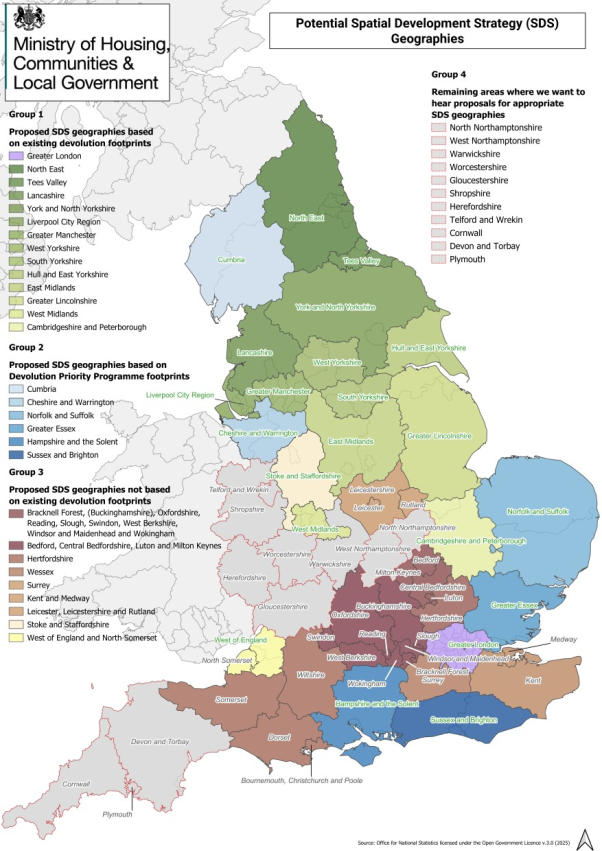
Annex B is a map of England that shows the proposed SDS areas. It is colour coded based on the 4 groups outlined in Annex A.
Information for local authorities
Producing an SDS for authorities preparing for local government reform and/or devolution
We are going through a period of change and in some areas the responsibility for preparing an SDS will change during its production. The bodies to be given the strategic planning duty under the Planning and Infrastructure Act are set out in the table at Annex A. Where there is more than one strategic planning authority for any SDS area this will require a strategic planning board to be established by secondary legislation.
Local government reorganisation will be implemented in April 2028 at the earliest (April 2027 for Surrey). This will mean that current county councils and district councils will be abolished and replaced with new unitary authorities. This will mean that strategic planning boards established in spring/summer 2026 will need to be reconstituted or replaced with a strategic planning board consisting of the new unitary authorities.
For any single county SDS areas, such as we propose for Surrey and Hertfordshire, a strategic planning board will need to be established at the point when local government reorganisation takes effect.
If a new mayoral strategic authority is established, then that new mayoral authority will take on the SDS duty and the strategic planning board will be dissolved, regardless of the progress toward local government reorganisation.
If a new non-mayoral strategic authority is established, it will have the SDS duty but there will have to be a decision taken on whether it meets the sensible geography criteria to produce its own SDS, or whether it joins with one or more other strategic planning authorities under an SPB to produce the SDS.
Changing work that has been done if a new body becomes responsible for preparing an SDS
This will depend on the stage which the SDS has reached. A strategic planning authority can change and re-consult on an SDS up to the point of submission for Examination. After that point, the SDS can only be withdrawn if it fails at Examination, if the Secretary of State directs that it should be withdrawn, or if the strategic planning authority votes against adopting it.
Jointly producing an SDS
Two or more proposed SDS areas, and/or combined authorities, can produce an SDS jointly.
This would require a strategic planning board to be established. Each case would have to be considered individually but the general intention is that where mayoral devolution has taken place or will take place, this should be the footprint on which a range of functions should be undertaken, including SDSs. This approach ensures that devolved authorities are empowered and enabled to make rapid progress on their SDS. The one exception to this is the case of West of England and North Somerset where it has already been agreed that an SDS will be done jointly across those authorities.
Implications for national park authorities who are local planning authorities
National park authorities will not have responsibility for producing SDSs. However, it will be essential for strategic planning authorities to engage with national park authorities. Some national park authorities may be covered by more than one SDS. This could bring challenges for their local plans as they may need to be in general conformity with more than one SDS.
We do not expect this to be an insurmountable problem because National Parks are not expected to be the focus for significant amounts of new development. However, we will keep this matter under consideration and close engagement between national park authorities and strategic planning authorities will be important in managing any challenges.
About this consultation
This consultation document and consultation process have been planned to adhere to the Consultation Principles issued by the Cabinet Office.
Representative groups are asked to give a summary of the people and organisations they represent, and where relevant who else they have consulted in reaching their conclusions when they respond.
Information provided in response to this consultation may be published or disclosed in accordance with the access to information regimes (these are primarily the Freedom of Information Act 2000 (FOIA), the Environmental Information Regulations 2004 and UK data protection legislation. In certain circumstances this may therefore include personal data when required by law.
If you want the information that you provide to be treated as confidential, please be aware that, as a public authority, the Department is bound by the information access regimes and may therefore be obliged to disclose all or some of the information you provide. In view of this it would be helpful if you could explain to us why you regard the information you have provided as confidential. If we receive a request for disclosure of the information we will take full account of your explanation, but we cannot give an assurance that confidentiality can be maintained in all circumstances. An automatic confidentiality disclaimer generated by your IT system will not, of itself, be regarded as binding on the Department.
The Ministry of Housing, Communities and Local Government will at all times process your personal data in accordance with UK data protection legislation and in the majority of circumstances this will mean that your personal data will not be disclosed to third parties. A full privacy notice is included below.
Individual responses will not be acknowledged unless specifically requested.
Your opinions are valuable to us. Thank you for taking the time to read this document and respond.
Are you satisfied that this consultation has followed the Consultation Principles? If not or you have any other observations about how we can improve the process please contact us via the complaints procedure.
Personal data
The following is to explain your rights and give you the information you are entitled to under UK data protection legislation.
Note that this section only refers to personal data (your name, contact details and any other information that relates to you or another identified or identifiable individual personally) not the content otherwise of your response to the consultation.
1. The identity of the data controller and contact details of our Data Protection Officer
The Ministry of Housing, Communities and Local Government (MHCLG) is the data controller. The Data Protection Officer can be contacted at dataprotection@communities.gov.uk or by writing to the following address:
Data Protection Officer
Ministry of Housing, Communities and Local Government
Fry Building
2 Marsham Street
London
SW1P 4DF
2. Why we are collecting your personal data
Your personal data is being collected as an essential part of the consultation process, so that we can contact you to respond to the consultation, and we may also contact you regarding your response and for statistical purposes or use it to contact you about related matters.
We will collect your IP address if you complete a consultation online. We may use this to ensure that each person only completes a survey once. We will not use this data for any other purpose.
For named consultees listed in Annex B, who MHCLG is emailing directly to inform them of the consultation, names and email addresses of relevant persons have either been taken from existing MHCLG systems, provided by other government departments or local authorities, or found on public websites.
Sensitive types of personal data
Please do not share special category personal data or criminal offence data as we have not asked for this. By ‘special category personal data’, we mean information about living individual’s:
- race
- ethnic origin
- political opinions
- religious or philosophical beliefs
- trade union membership
- genetics
- biometrics
- health (including disability-related information)
- sex life
- sexual orientation.
By ‘criminal offence data’, we mean information relating to a living individual’s criminal convictions or offences or related security measures.
3. Our legal basis for processing your personal data
The collection of your personal data is lawful under article 6(1)(e) of the UK General Data Protection Regulation as it is necessary for the performance by MHCLG of a task in the public interest/in the exercise of official authority vested in the data controller. Section 8(d) of the Data Protection Act 2018 states that this will include processing of personal data that is necessary for the exercise of a function of the Crown, a Minister of the Crown or a government department i.e. in this case a consultation.
There is also a statutory duty to consult. The 2007 Act requires that, before a proposal for establishing unitary local government can be implemented, the Secretary of State must first consult any local authority that is affected by a proposal (but which has not submitted it), and any such other persons as she considers appropriate.
4. With whom we will be sharing your personal data
MHCLG may appoint a ‘data processor’, acting on behalf of the Department and under our instruction, to help analyse the responses to this consultation. Where we do we will ensure that the processing of your personal data remains in strict accordance with the requirements of the data protection legislation.
5. For how long we will keep your personal data, or criteria used to determine the retention period.
Your personal data will be held for 2 years from the closure of the consultation, unless we identify that its continued retention is unnecessary before that point.
6. Your rights, for example access, rectification, restriction, objection
The data we are collecting is your personal data, and you have considerable say over what happens to it. You have the right:
a) to see what data we have about you
b) to ask us to stop using your data, but keep it on record
c) to ask to have your data corrected if it is incorrect or incomplete
d) to object to our use of your personal data in certain circumstances
e) to lodge a complaint with the independent Information Commissioner (ICO) if you think we are not handling your data fairly or in accordance with the law. You can contact the ICO at https://ico.org.uk/, or telephone 0303 123 1113.
Please contact us at the following address if you wish to exercise the rights listed above, except the right to lodge a complaint with the ICO: dataprotection@communities.gov.uk or
Knowledge and Information Access Team,
Ministry of Housing, Communities and Local Government,
Fry Building,
2 Marsham Street,
London
SW1P 4DF
7. Your personal data will not be sent overseas.
8. Your personal data will not be used for any automated decision making.
9. Your personal data will be stored in a secure government IT system
We use a third-party system, Citizen Space, to collect consultation responses. In the first instance your personal data will be stored on their secure UK-based server. Your personal data will be transferred to our secure government IT system as soon as possible, and it will be stored there for 2 years before it is deleted.