HPR volume 20 issue 11: news (26 November 2026)
Updated 26 November 2026

© Crown copyright 2026
This publication is licensed under the terms of the Open Government Licence v3.0 except where otherwise stated. To view this licence, visit nationalarchives.gov.uk/doc/open-government-licence/version/3 or write to the Information Policy Team, The National Archives, Kew, London TW9 4DU, or email: psi@nationalarchives.gov.uk.
Where we have identified any third party copyright information you will need to obtain permission from the copyright holders concerned.
This publication is available at https://www.gov.uk/government/publications/health-protection-report-volume-20-2026/hpr-volume-20-issue-11-news-26-november-2026
Shiga toxin-producing E. coli and haemolytic uraemic syndrome associated with travel to Egypt
The UK Health Security Agency (UKHSA) is investigating an increase in cases of Shiga toxin-producing Escherichia coli (STEC) and haemolytic uraemic syndrome (HUS) in residents of England following travel to Egypt. This increase appears broadly consistent with the year-on-year rise in travel to Egypt since 2021. However, whilst Egypt is not in the top 10 most visited countries by UK travellers (1), it accounts for 60% of all travel-associated HUS cases with confirmed or probable STEC reported in 2025 to 2026.
As of 9 October 2026, 71 confirmed or probable STEC cases have been reported in 2026 in residents of England following travel to Egypt. Of these, 6 developed STEC–HUS, 1 of whom died (see table below). There were 2 additional cases of clinical HUS reported following travel to Egypt in 2026 where neither STEC nor another causative organism was detected. Of the STEC–HUS cases diagnosed in 2026, 5 reported travel to Hurghada and 1 to Sharm el Sheikh, 50% were female, and the median age was 4.5 years. All STEC cases had diarrhoea prior to progressing to HUS. Annual STEC and HUS case numbers associated with travel to Egypt are detailed in the table.
Haemolytic uraemic syndrome is a rare condition characterised by microangiopathic haemolytic anaemia, thrombocytopenia, acute renal failure and in some cases seizures. There are approximately 40 to 50 cases of HUS reported in England each year (incidence 0.12 per 100,000 per year) although this is likely an underestimate (2). Over 90% of HUS cases are caused by infection with Shiga toxin-producing Escherichia coli (STEC), although other enteric pathogens including Shigella and diarrheagenic E. coli can also cause HUS. HUS is the most common cause of acute kidney failure in children below 5 years of age (3). It can be fatal in extremes of age, especially in those below 5 years of age and the elderly.
STEC is a zoonotic bacterial pathogen which is haboured by ruminants and causes acute gastrointestinal illness in humans. Infection can be acquired by eating contaminated food and drinking or swallowing untreated water. STEC is also very easily transmitted from person to person and also through contact with animals such as camels, sheep and other ruminants which carry it in their gut (4). Good hand hygiene should be practised after touching the animals or their enclosures to reduce the risk of infection, by washing hands with soap and water after animal contact. Infections can occur in a wide range of travel and holiday settings, including all-inclusive resorts where cases can be exposed to contaminated water in swimming pools or natural water.
Symptoms of STEC infection include severe stomach cramps, watery or bloody diarrhoea, vomiting and a low-grade fever (5). Travellers experiencing sudden onset of gastrointestinal symptoms, especially in absence of a fever should seek urgent medical help. Maintaining good hydration, including via intravenous fluid administration, can help prevent STEC cases from progressing to HUS (6). Antibiotics are contraindicated in STEC gastroenteritis as some antibiotics can increase risk of HUS by exacerbating toxin release (7). STEC–HUS typically begins 5 to 7 days after gastrointestinal illness, with symptoms including reduced urination, weakness and fatigue, easy bruising or swelling, and decreased alertness. Medical attention should be sought urgently in this instance.
UKHSA is liaising with ABTA and Egyptian public health authorities about travel-associated STEC and HUS cases diagnosed in England. Communications for clinicians are planned. Further information and updated advice for travellers is available on the National Travel Health Network and Centre (NaTHNaC) website, including more detailed information about HUS and STEC infection, as well as food and water hygiene.
Cases of Shiga toxin-producing Escherichia coli (STEC) and Haemolytic Uraemic Syndrome (HUS) in people resident in England reporting travel to Egypt, January 2022 to October 2026
| Year | STEC cases (confirmed or probable) [Note1] |
STEC-HUS cases [Note2] |
Other clinical HUS cases [Note3] |
|---|---|---|---|
| 2022 | 43 | 4 | 0 |
| 2023 | 30 | 1 | 1 |
| 2024 | 48 | 4 | 0 |
| 2025 | 75 | 6 | 1 |
| 2026 | 71 | 6 | 2 |
Note 1. The case definitions used for STEC were:
Confirmed STEC: a case with either:
- a positive culture for STEC or a positive STEC PCR at Gastrointestinal Bacteria Reference Unit (GBRU);
- a case of clinically diagnosed STEC–HUS with either a positive STEC culture or STEC PCR in GBRU or positive STEC PCR in local/diagnostic laboratory.
Probable STEC: a case with either:
- a positive local STEC O157 culture;
- an epidemiological link to a confirmed case with acute diarrhoea (which may be bloody) and/or a positive local STEC PCR;
- a positive local STEC PCR BUT negative culture for STEC O157 with bloody diarrhoea.
Note 2. The case definitions used for HUS were:
Confirmed clinical HUS:
- a case of HUS with a triad of microangiopathic haemolytic anaemia, thrombocytopenia and acute kidney injury;
Confirmed STEC–HUS:
- an STEC–HUS case that met the clinical definition of a confirmed clinical HUS case and met the confirmed or probable STEC case definition.
Note 3. For the 4 HUS cases where STEC was not identified, 3 isolated E. coli (not STEC) and 1 had no causative organism identified.
References
1. Office for National Statistics (2026). ‘Travel trends estimates: UK residents’ visits abroad’
2. McGeoch LJ, Quinn O, Douglas A, Sawyer C, Jenkins C, Balasegaram S (2025). ‘The epidemiology of haemolytic uraemic syndrome in England, 2009 to 2023: an analysis of national surveillance data’. Journal of Infection: volume 91 number 2
3. Byrne L, Douglas A, Launders N, Godbole G, Lynn R, Inward C, Jenkins C (2023). ‘Haemolytic uraemic syndrome in children England, Wales, Northern Ireland, and Ireland: a prospective cohort study’. Epidemiology and Infection
4. Baschera M, Cernela N, Stevens MJA, Liljander A, Jores J, Corman VM, and others (2019). ‘Shiga toxin-producing Escherichia coli (STEC) isolated from fecal samples of African dromedary camels’. One Health.
5. UKHSA (2024). ‘Shiga toxin-producing Escherichia coli (STEC): symptoms, how to avoid, how to treat’
6. Grisaru S, Xie J, Samuel S, and other (2017). ‘Associations between hydration status, intravenous fluid administration, and outcomes of patients infected with Shiga toxin–producing Escherichia coli: a systematic review and meta-analysis’. JAMA Pediatrics: volume 171, number 1, pages 68 to 76
7. Dato L, Mancuso MC, Daprai L, Ria T, Rossetti D, Callegaro A, Ardissino G (2026). ‘Bloody diarrhoea, STEC infection and HUS in the molecular microbiology era’. Pediatric Nephrology: volume 41, number 4, pages 973 to 980
ESPAUR annual report in summary
The annual English Surveillance Programme for Antimicrobial Utilisation and Resistance (ESPAUR) report, published by the UK Health Security Agency (UKHSA) on 12 November, covers activity up to March 2026 and data on resistance and usage to the end of 2025 (1). Some of the key findings of the thirteenth report are provided in this HPR. Further details are available through the comprehensive published report and infographics.
Antimicrobial resistance
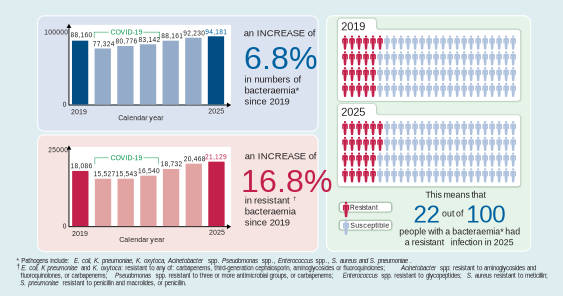
In 2025, the total number of patient episodes of bacteria isolated from blood (bacteraemia) increased by 22.9% from 2019. Coagulase-negative Staphylococci (CoNS) were significant drivers of the increase and accounted for 44.6% of the increase (15,583 of 34,940 additional episodes).
The estimated burden of resistance, due to bacteria of public health importance resistant to one or more defined antibiotics, increased by 16.8% from 18,068 in 2019 to 21,129 in 2025 (Figure 1). Of all bacteraemia episodes for AMR burden pathogens (n=94,181), 22% were resistant to one or more critical antibiotics in 2025, up from 21% in 2019, highlighting that the increase in resistant bacteraemia episodes may be attributable to the increase in bacteraemia episodes rather than solely due to an increase in resistance.
An estimated total of 8,552 patients with selected Gram-negative bacteraemia (E. coli, K. pneumoniae, Pseudomonas spp., Acinetobacter spp.) died within 30 days of their infection episode in 2025. The crude 30-day all-cause mortality rate was higher among patients with a carbapenemase-producing Gram-negative organism isolated from a sterile site (21.2%, est. n=62) or among patients infected with a strain resistant to one or more antibiotics (16.0%, est. n=2,318), compared to those who had an antibiotic-susceptible strain (14.4%, est. n=6,129).
Figure 1. The burden of bacteraemia and resistant bacteraemia
There is regional and demographic variation in the burden of overall bacteraemia incidence and antibiotic-resistant bacteraemia in England. AMR burden increased markedly with age, with individuals aged ≥75 years accounting for around half of all episodes and experiencing the highest rates of resistance. However, infants aged <1 year also experienced a disproportionately high AMR burden, second only to that observed in the oldest age group.
Marked differences were observed in the proportion of bacteraemia episodes that were resistant across ethnic groups, with 42.4% episodes resistant in the Asian or Asian British ethnic group, 32.8% in the Black, African, Caribbean or Black British ethnic group, compared with 20.7% in the White ethnic group. These differences persisted across most adult age groups and in both sexes and may be masked when examining overall population estimates alone.
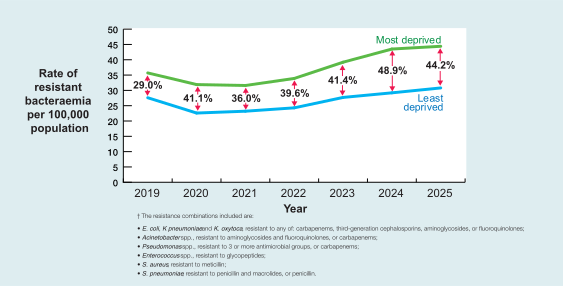
AMR burden remained disproportionately higher in deprived populations, with rates increasing across all deprivation quintiles between 2019 and 2025. While the gap between the most and least deprived quintiles in overall bacteraemia rates narrowed between 2019 and 2025 (from 28.4% to 23.6%), the gap in resistant bacteraemia widened from 29.0% in 2019 to 44.2% in 2025 (Figure 2).
Figure 2. Rate of resistant bacteraemia by Index of Multiple Deprivation from 2019 to 2025
Antimicrobial usage
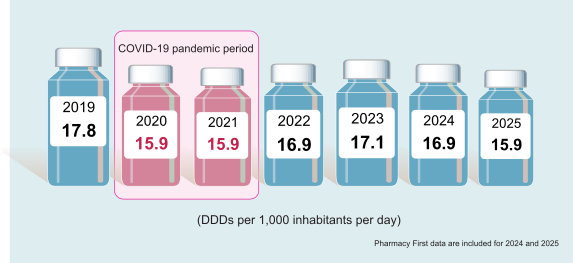
The UK’s National Action Plan (NAP) for AMR 2024 to 2029 set the UK-wide target to reduce antimicrobial use by 5% from the 2019 baseline by 2029. Total NHS antibiotic consumption in England in 2025 was 10.7% lower than in 2019. General practice remained the largest contributor to consumption (65.4% of total use) and was the main driver of the overall reduction, with consumption 18.8% lower than in 2019, while hospital consumption increased by 5.6% over the same period (Figure 3).
Figure 3. Total consumption of antibiotics increasing towards pre-pandemic levels
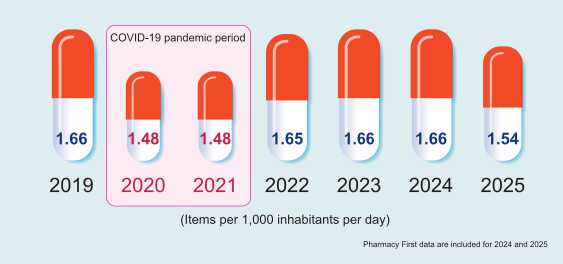
Primary care remained the largest contributor to antibiotic consumption in England in 2025, accounting for 75.8% of total use, with overall consumption decreasing by 7.2% compared with 2024 and by 7.5% compared with 2019. When measured as items per 1,000 inhabitants per day, there was a large decline in consumption in 2020 and 2021 due to the COVID-19 pandemic. Antibiotic consumption subsequently increased to 2019 levels in 2023 and then decreased to 1.54 per 1,000 inhabitants per day in 2025 (Figure 4).
Reductions were observed across general practice, dental and other community settings, reflecting lower prescribing following the post-pandemic increases associated with heightened respiratory and Group A Streptococcus activity, alongside ongoing antimicrobial stewardship initiatives promoting appropriate antibiotic use and shorter treatment courses. Antibiotic consumption remained highest in older adults and in more deprived populations, with persistent deprivation-related inequalities despite a narrowing of the gap since its post-pandemic peak. In children, prescribing generally remained below 2019 levels, although antibiotic use in infants aged under one year remained higher than pre-pandemic levels, warranting continued surveillance.
Figure 4. Antibiotic prescribing in primary care from 2019 to 2025
Private (non-NHS) antibiotic consumption declined for the first time since the pandemic between 2024 and 2025, driven mainly by reduced community pharmacy supply, which may reflect changes in healthcare-seeking behaviour, increased use of NHS services such as Pharmacy First and optimisation of antibiotic treatment durations in line with NICE guidance. Antibiotics supplied through private (non-NHS) routes represented 4.0% of total primary care antibiotic consumption across NHS and private sectors in England in 2025.
Total systemic antifungal consumption increased by 11.0% between 2019 and 2025, with 87% of use occurring in the community and notable shifts in hospital consumption towards broader-spectrum antifungal agents. Rising community use, particularly of terbinafine (+13.5% during this period), is of concern given the emergence of terbinafine-resistant Trichophyton indotineae in England.
Antimicrobial stewardship
Treat Antibiotics Responsibly, Guidance, Education and Tools (TARGET) have released new resources in the prevention and management of recurrent urinary tract infections which adds to the TARGET ‘How-to…?’ series to support primary care staff. The resources are in line with national guidance and offer evidence-based guidance for reviewing patients on long-term or repeat antibiotics for complex conditions. New resources also include resources that aid decision-making for parents of children with acute cough as well as resources for cellulitis management.
The national antimicrobial intravenous-to-oral switch (IVOS) criteria for prompt switch for adults, antimicrobial prescribing and stewardship competency framework and the SSTF toolkit are currently under review. Feedback was received from multidisciplinary team stakeholders and subject-matter experts, with 13 responses for IVOS, 51 for the competency framework, and 16 for SSTF. Responses are now being collated with publication of the updated tools planned for 2027.
A Health Inequalities toolkit has been developed by UKHSA in collaboration with 4 UK nations to support regional UKHSA, NHS colleagues and public health teams in identifying and addressing health inequalities in access, infection incidence, clinical outcomes, vaccine uptake, and antimicrobial exposure. Resources have been identified through a series of published and grey literature scoping reviews and stakeholder feedback.
An umbrella review of behavioural interventions for AMR identified 44 unique intervention combinations across 40 review articles, with education, persuasion, training and enablement suggested as the most practical and acceptable interventions to implement.
A rapid scoping review found that pharmacy-led interventions were associated with reductions in inappropriate and broad-spectrum antibiotic use, increased guideline-concordant prescribing, greater antibiotic de-escalation, improved access to healthcare services, enhanced AMR knowledge, and increased uptake of care among underserved populations. This shows that pharmacy professionals have the potential to address inequalities related to infection management, antibiotic use, and AMR. However, there is limited evidence that these interventions directly reduce disparities in outcomes.
Finally, several research projects are currently ongoing including projects which aim to improve understanding of the implementation and effectiveness of national AMS initiatives, repeat antibiotic prescribing, primary care access to private (non-NHS) antibiotics and information related to AMR and appropriate antibiotic usage on social media.
Professional and public education, engagement and training
The UK NAP for AMR identifies public and professional engagement and education as key outcomes for driving behaviour change. To support this, TARGET (Treat Antibiotics Responsibly, Guidance, Education and Tools) and Royal College of General Practitioners delivered three webinars, with strong social media engagement. Webinar attendance was 980, with additional 643 YouTube playbacks to date (as of May 2026) across three webinars. TARGET training reached over 3,000 primary care professionals across England since inception, with significant estimated impact on reducing antibiotic prescribing by 0.18 items and generating cost savings of £2.04 per 1,000 patients per month following roll-out.
e-Bug continues to achieve strong user engagement with its resources, with 198,979 page views (55% increase compared to previous year). There is also consistent reach across all social channels and campaigns.
The 2024 UKHSA AMR public survey showed findings that phase 2 of the Andi Biotic campaign targeting messaging around correct antibiotic behaviours and AMR awareness using humour-led content to younger adults was a success reaching 10.35 million users, an 87% increase compared to Phase 1.
World AMR Awareness Week and European Antibiotic Awareness Day took place in November. The webpage hosts the toolkit of promotional resources. The Antibiotic Guardian (AG) campaign which encourages pledges to support AMS, received 5,148 pledges in 2025, totalling 195,796 pledges made on the main page since inception of the campaign in 2014. In 2025, as part of UK’s actions to tackle health inequalities, the AG pledges were translated to Urdu, Punjabi, Mandarin, Polish, and Romanian.
Research and knowledge mobilisation
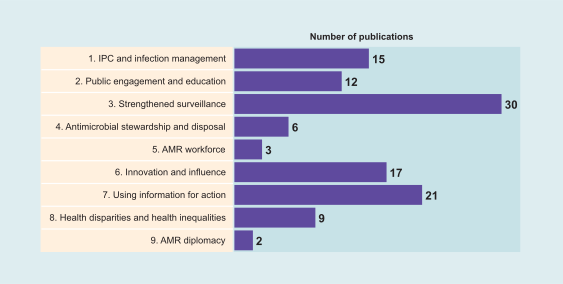
A wide range of new and ongoing research projects were undertaken in the fields of HCAI and AMR in the last year, with the publication of over 100 peer-reviewed papers from across UKHSA (Figure 5).
Figure 5. AMR peer-reviewed publications from April 2025 to March 2026 by UK National Action Plan for AMR 2024 to 2029 outcome
Finally, annual feedback surveys continue to show that a large proportion of ESPAUR report users continue to recommend the report to other stakeholders (85.2%, 277 out of 325). UKHSA also continues to work to knowledge mobilise the report. Various activities have been undertaken to knowledge mobilise the ESPAUR report, these include an infection control matters podcast featuring the 2024 to 2025 report. ESPAUR report abstracts featuring the 2024 to 2025 report chapters were published in the JAC-Antimicrobial Resistance journal in 2026. Social media assets used for the ESPAUR report were shared on platforms Facebook, Instagram, X (Twitter) and LinkedIn and data showed engagement with the assets across the platforms.
Reference
1. UKHSA (2026). ‘English surveillance programme for antimicrobial utilisation and resistance (ESPAUR) Report 2025 to 2026’
GRASP annual report in summary
The UK Health Security Agency (UKHSA) has published its annual Gonococcal Resistance to Antimicrobials Surveillance Programme (GRASP) report, presenting the latest data on antimicrobial resistance in Neisseria gonorrhoeae in England and Wales.
Most isolates remain susceptible to ceftriaxone. However, 3 out of 1,383 cases (0.2%) of ceftriaxone-resistant Neisseria (N.) gonorrhoeae were detected in the GRASP sentinel surveillance programme in 2025. Ceftriaxone-resistant cases in the UK have been detected sporadically since 2015, although the first case in GRASP sentinel surveillance was not detected until 2024.
The percentage of isolates with reduced susceptibility to ceftriaxone (minimum inhibitory concentration (MIC) >0.03 mg/L) remains low at 1.9% but has increased annually since 2021.
Cefixime resistance decreased from a peak of 5.6% in 2023 to 2.1% in 2025.
Reduced susceptibility to ceftriaxone and resistance to cefixime were both associated with the presence of mosaic or semi-mosaic penA alleles. Mosaic penA alleles were identified in 23.8% of isolates, the highest proportion observed since genomic surveillance began in 2022. However, reduced ceftriaxone susceptibility and cefixime resistance remained rare.
Reduced susceptibility to azithromycin (epidemiological cut-off value (ECOFF) >1 mg/L) doubled in the last year to 25.5%, mainly due to an increase in isolates with an MIC of 2.0 mg/L, just above the ECOFF.
Most isolates (92%) were resistant to tetracycline (MIC >0.5 mg/L), while high-level (MIC >8 mg/L) plasmid-mediated resistance increased from 30.1% in 2024 to 39.2% in 2025.
Over a quarter of isolates (26.4%) were resistant to penicillin (MIC >1 mg/L), similar to the previous year.
Ciprofloxacin resistance was inferred from genomic data and increased to 51.6% in 2025.
Antimicrobial susceptibility testing for gepotidacin and zoliflodacin has been included for the first time. The modal MIC was low at 0.5 mg/L for gepotidacin and none were above the ECOFF (MIC >2 mg/L). The modal MIC was also low for zoliflodacin at 0.06 mg/L and none were above a tentative breakpoint of >0.25 mg/L.
Multilocus sequence typing (MLST) identified increasing dominance of a small number of expanding gonococcal lineages. The 2 most common lineages together accounted for 33.1% of isolates sequenced in 2025. Major lineages differed in the proportions of isolates identified among sexual orientation groups, as well as in their antimicrobial resistance profiles, highlighting the impact of changing gonococcal population structure on resistance trends.
Prescribing data demonstrated excellent adherence to the UK guideline for managing infection with N. gonorrhoeae, with 98.1% of individuals receiving the recommended first-line of ceftriaxone 1g intramuscular (IM) monotherapy in 2025.
Suspected ceftriaxone-resistant isolates (MIC >0.125 mg/L, European Committee on Antimicrobial Susceptibility Testing (EUCAST) breakpoint) should be referred to the Sexually Transmitted Infections Reference Laboratory (STIRL) for confirmatory testing and follow-up.
Possible cases of ceftriaxone treatment failure should be reported to UKHSA via the secure HIV and STI Data Exchange for registered users (contact grasp.enquiries@ukhsa.gov.uk for access).
Monitoring flu-like symptoms in the UK through participatory surveillance
FluSurvey, the UK’s longest-running participatory surveillance system, relies on members of the public voluntarily reporting symptoms of ‘influenza-like illnesses’ on a weekly basis during the winter season. The data collected provides valuable insight into illness circulating in the community that would otherwise go unseen by healthcare-based surveillance systems.
Researchers in the FluSurvey team recently published analyses highlighting a low proportion of participants with flu-like illness who report contact with healthcare services and the wider impact of flu like illnesses on daily life (1). Despite the majority treating their symptoms at home, most reported disruption to daily life and almost half reported missing work or school due to their illness.
Free PCR self-testing kits were also piloted last winter and are available again this season. A sample of eligible participants reporting respiratory symptoms are offered a free postal swab to test for flu, COVID-19 and RSV with results communicated back to the participant. Analyses from last season’s pilot supported its value in providing timely public health insights – including a high proportion of positive feedback, with 97% reporting that they would be willing to participate in self-swabbing again.
Registration is now open for the public to sign up to participate in this winter’s FluSurvey that involves completing a short survey each week.
Reference
1. ‘Data shows almost half of people with flu-like symptoms miss work or school’. UKHSA website news story.
Infection reports in this issue
Laboratory confirmed cases of pertussis in England: April to June 2026
Laboratory confirmed cases of invasive meningococcal infection in England: July to September 2026
Group A streptococcal infections: report on seasonal activity in England, 2026 to 2027
Laboratory surveillance of streptococcal bacteraemia in England: 2025 update
Vaccine coverage
MenB young adults vaccine coverage report up to October 2026