Group A streptococcal infections: report on seasonal activity in England, 2026 to 2027
Published 26 November 2026
Applies to England

© Crown copyright 2026
This publication is licensed under the terms of the Open Government Licence v3.0 except where otherwise stated. To view this licence, visit nationalarchives.gov.uk/doc/open-government-licence/version/3 or write to the Information Policy Team, The National Archives, Kew, London TW9 4DU, or email: psi@nationalarchives.gov.uk.
Where we have identified any third party copyright information you will need to obtain permission from the copyright holders concerned.
This publication is available at https://www.gov.uk/government/publications/group-a-streptococcal-infections-seasonal-activity-in-england-2026-to-2027/group-a-streptococcal-infections-report-on-seasonal-activity-in-england-2026-to-2027
Main points
Scarlet fever in-hours GP consultations for the first few weeks (week 37 to 46, 2026) of the 2026 to 2027 are in line with normal seasonal levels. Laboratory notifications of invasive group A streptococcal (iGAS) infection during this period are similar to this point last season. Activity levels for both iGAS infection and scarlet fever are increasing as is usual for this time of year
Given the potential for severe presentations, scarlet fever cases should be treated promptly with antibiotics to limit further spread and reduce risk of potential complications in cases and their close contacts. Clinicians should continue to be alert to the severe complications of GAS infections and maintain a high degree of clinical suspicion when assessing patients, particularly those with preceding viral infection (including chickenpox) or their close contacts. Resistance to tetracycline and erythromycin remains common among GAS isolates with reported susceptibility results; clinicians should continue to consider the full antibiogram when treating patients with reported penicillin allergy.
Updated UK public health guidance on the management of close contacts of iGAS cases in community settings was published on 15 December 2022, with public health action extended to include patients with probable invasive GAS infection and additional close contact groups recommended for antibiotic prophylaxis. The evidence base underpinning the change in risk groups has been published at Antibiotic chemoprophylaxis for close contacts of invasive group A streptococcus in community settings: evidence review.
National guidance on the management of scarlet fever outbreaks highlights essential tools to limit spread:
- prompt notification of scarlet fever cases and outbreaks to UK Health Security Agency (UKHSA) health protection teams (HPTs)
- collection of throat swabs (prior to commencing antibiotics) when there is uncertainty about the diagnosis
- exclusion of cases from school and work until 24 hours of antibiotic treatment has been received
Numbers presented in this seasonal activity update are based on data available as of 18 November 2026 for diagnoses up to and including 15 November 2026 (end of week 46). The most recent iGAS data is provisional because of reporting delay, numbers presented may change as updated data becomes available.
The information presented in this report is presented on the UKHSA data dashboard, where aggregate numbers can also be downloaded.
Key definitions are available at the end of the report.
Scarlet fever
Scarlet fever GP in-hours consultations have been following expected trends in the first few weeks of the 2026 to 2027 season (week 37, 2026, to week 46, 2026) with the most recent week seeing an increase in rate (Figure 1). To date this season the weekly rate of in-hours GP consultations have been increasing in line with usual patterns for this time of year. For the latest week, the rate (0.89, week 46, 2026) falls within the range (0.06 to 2.10) observed for the same week in the last 6 seasons (2020 to 2021 season to 2025/26 season).
Figure 1. Weekly scarlet fever GP in-hours consultation rate in England, 2020 to 2021 season onwards
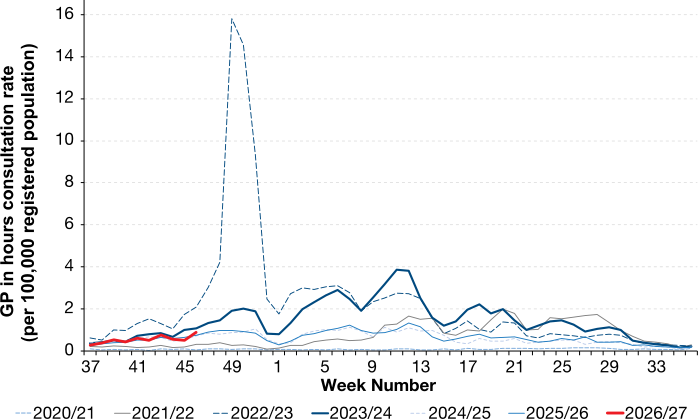
Note: data shown for the current season goes up to week 46 (15 November 2026).
Invasive group A streptococcal infection
Laboratory notifications of iGAS infection so far this season (week 37, 2026, to week 46, 2026) are within the range normally seen at this time of year (Figure 2). A total of 435 notifications of iGAS disease have been received, similar to the same point last season (436; 2025 to 2026), and slightly above the average of 349 notifications for the same period over the last 6 seasons (2020/2021 to 2025/2026; range 149 to 534). Between week 42 and week 44, 2026, the number of iGAS isolates displayed an increasing trend, from 42 to 62 notifications. Data presented for weeks 45 and 46 remain provisional.
To date this season (up to week 46), the highest notification rates were observed in the North East (1.3 per 100,000 population), followed by Yorkshire and Humber (1.1 per 100,000). The lowest rates were seen in London and the West Midlands (both 0.5 per 100,000).
Figure 2. Weekly laboratory notifications of invasive GAS, England, 2020 to 2021 season onwards
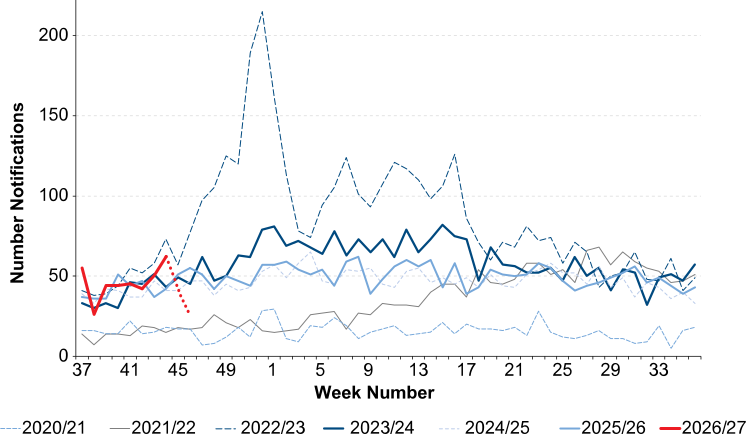
Note: Numbers of notifications in the latest weeks of the 2026 to 2027 season are expected to increase due to a lag in laboratory reporting. The decline in notifications in recent weeks should be interpreted with caution. The values shown for the most recent weeks are therefore represented by a dashed line.
Rates of iGAS infection so far in the 2026 to 2027 season are highest in people aged 75 years and over (2.4 per 100,000), followed by people aged under 1 year (1.2 per 100,000). The lowest notification rate (0.1 per 100,000) is in cases aged 10 to 14 years.
The median age of notified cases of iGAS infection for the current season to date is 56 years (range 0 to 98 years). This is within range of median age reported for this point in the preceding five seasons (47 to 59 years).
Antimicrobial susceptibility results from routine laboratory surveillance for iGAS infection (weeks 37, 2026, to 46, 2026) continue to show the elevated levels of tetracycline and erythromycin resistance reported during the 2025 to 2026 and 2024 to 25 seasons (1). Changes in the resistance rates are likely to reflect dominant emm types currently circulating this season.
Specifically:
- 20% were resistant to erythromycin (27.6% in 2025 to 2026; range 5.2% to 27.6% in last 6 seasons)
- 47.5% were resistant to tetracycline (50.1% in 2025 to 2026; range 22.9% to 50.1% in the last 6 seasons)
- 12.2% were resistant to clindamycin (11.4% in 2025 to 2026; range 5.7% to 16.1% in the last 6 seasons)
- 2.4% were resistant to co-trimoxazole (4.6% in 2025 to 2026; range 3.7% to 7.8% in the last 6 seasons)
Analysis of reference laboratory sterile-site iGAS isolate submissions indicated a diverse range of emm gene sequence types identified this season (week 37, 2025, to week 37, 2026), emm 49.8 continuing to be the most common (17.6% of isolates), followed by emm 89.0 (10.4 %) and emm 76.0 (9.6%).
Discussion
GP in-hours rates for scarlet fever are currently within expected levels for the current 2026 to 2027 season.
Invasive GAS incidence is higher than average, although in line with levels seen at this point in recent seasons. Incidence by age group follows the expected pattern with highest rates in the elderly.
Of note this season, the antimicrobial resistance to second line therapeutic agents (like tetracyclines and macrolides) remains elevated. This is likely a result of emm 49.8 continuing to be the dominant emm type this season, with investigations having shown that emm 49.8 isolates have a higher frequency of resistance to tetracycline and macrolide (more than 95%), but predominantly susceptible to co-trimoxazole and clindamycin (1). GAS remains susceptible to penicillin which remains the drug of choice, however, with variable susceptibility to second line agents the full antibiogram should be considered when treating patients with reported penicillin allergy.
Prompt antibiotic treatment of scarlet fever is recommended to reduce risk of complications and limit onward transmission. GPs and other frontline clinical staff are also reminded of the increased risk of invasive disease among household contacts of scarlet fever cases (2,3). Clinicians should continue to maintain a high index of suspicion in relevant patients for invasive disease as early recognition facilitates prompt initiation of specific and supportive therapy for patients with iGAS infection.
Relevant guidelines and frequently asked questions are available on GOV.UK as follows:
- Guidelines for the public health management of scarlet fever outbreaks in schools, nurseries and other childcare settings
- Scarlet fever: symptoms, diagnosis and treatment
- Guidelines for the management of close community contacts of invasive GAS cases
- Prevention and control of group A streptococcal infection in acute healthcare and maternity settings
- Report a Notifiable Disease (eNOIDS)
All invasive disease isolates – and also non-invasive isolates – from suspected clusters or outbreaks should be submitted for typing to:
Staphylococcus and Streptococcus Reference Section
Antimicrobial Resistance and Healthcare Associated Infections (AMRHAI)
UK Health Security Agency, 61 Colindale Avenue
London, NW9 5HT
Further information on health equity groups is published annually within the annual streptococcal bacteraemia report, describing trends by ethnic group and deprivation for GAS bacteraemia.
Data from the report Streptococcal infections, and from the routine weekly syndromic surveillance scarlet fever GP-in hours rates, is available on the UKHSA Dashboard.
Data sources and methods
Scarlet fever data is presented as GP in-hours consultation rates per 100,000 registered population. This information is collected from UKHSA’s GP in-hours syndromic surveillance system. This system is sentinel, which means that not all GP practices in England are included, and coverage varies by UKHSA region, so comparison between geographic regions is not recommended. The system currently includes approximately 19 million registered patients across England. The data included is from two sources: technology provider TPP and ORCHID (Oxford and Royal College of General Practitioners Clinical Informatics Digital Hub). The indicator for scarlet fever syndromic is based on diagnoses recorded during GP in-hours patient consultations, and diagnoses are based on signs and symptoms and may not be laboratory confirmed. The weekly rates presented differ from the daily rates reported as standard elsewhere (4).
Invasive GAS laboratory notification data was extracted from the UKHSA Second Generation Surveillance System (SGSS) and combined with specimen referrals to the Staphylococcus and Streptococcus Reference Section to produce a total number of episodes for England. Data was extracted on 18 November 2026.
Antimicrobial resistance data is based on phenotypic test results for tetracycline, erythromycin, clindamycin, or co-trimoxazole reported by laboratories to SGSS and are reported as susceptible or resistant.
Population rates are calculated per 100,000 using the relevant year’s ONS mid-year population estimate.
The M protein gene (emm) encodes the cell surface M virulence protein. Information for the emm gene, in this report, was extracted from UKHSA’s SGSS and contains data covering the period 7 September 2026 to 15 November 2026.
Prior to the COVID-19 pandemic, there were a number of seasons when elevated incidence of scarlet fever and iGAS was seen, in particular the 2017 to 2018 season. During the pandemic, there was an unprecedented reduction in the number of scarlet fever and iGAS notifications, affecting the 2019 to 2020 season and the 2021 to 2022 season.
After the pandemic a resurgence in scarlet fever and iGAS was reported, affecting the 2022 to 2023 season. The seasonal averages presented within the report should be interpreted with these fluctuations in mind.
References
1. UKHSA (2026). ‘Group A streptococcal infections: seasonal activity in England, 2025 to 2026’.
2. Lamagni T, Guy R, Chand M, Henderson KL, Chalker V, Lewis J, and others (2018). ‘Resurgence of scarlet fever in England, 2014 to 2016: a population-based surveillance study’. The Lancet Infectious Diseases: volume 18, number 2, pages 180 to 187
3. Watts V, Balasegaram S, Brown CS, Mathew S, Mearkle R, Ready D, and others (2019) . ‘Increased risk for invasive group A streptococcus disease for household contacts of scarlet fever cases, England, 2011 to 2016’. Emerging Infectious Diseases: volume 25, number 3, pages 529 to 537
4. UKHSA (2024). ‘Syndromic Surveillance Systems and Analyses’
Acknowledgements
These reports would not be possible without the weekly contributions from microbiology colleagues in laboratories across England, without whom there would be no surveillance data.
Feedback and specific queries about this report are welcome via hcai.amrdepartment@ukhsa.gov.uk