Diphtheria in England: 2025
Updated 26 November 2026
Applies to England

© Crown copyright 2026
This publication is licensed under the terms of the Open Government Licence v3.0 except where otherwise stated. To view this licence, visit nationalarchives.gov.uk/doc/open-government-licence/version/3 or write to the Information Policy Team, The National Archives, Kew, London TW9 4DU, or email: psi@nationalarchives.gov.uk.
Where we have identified any third party copyright information you will need to obtain permission from the copyright holders concerned.
This publication is available at https://www.gov.uk/government/publications/diphtheria-in-england-and-wales-annual-reports/diphtheria-in-england-2025
This report summarises the epidemiology of diphtheria in England for 2025 and reiterates current recommendations on diagnosis and clinical management of diphtheria.
Main messages
The main points arising from this report are that:
- diphtheria is a vaccine-preventable disease that can be life-threatening
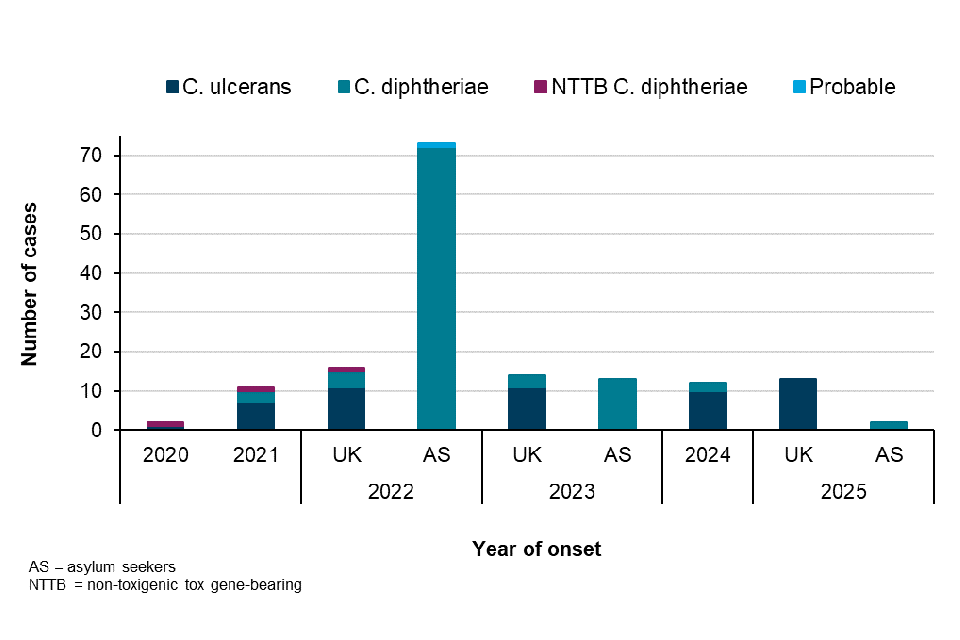
- from January to December 2025, toxigenic corynebacteria were isolated from 15 individuals in England – 2 Corynebacterium diphtheriae cases and 13 Corynebacterium ulcerans cases
- there were 2 deaths
- 9 of the 13 toxigenic C. ulcerans cases presented with cutaneous symptoms – 2 cases had mild respiratory symptoms, one case was asymptomatic and one case had an atypical presentation
- both toxigenic C. diphtheriae cases presented with cutaneous symptoms
- the 2 toxigenic C. diphtheriae cases were among asylum seekers with recent arrival in England, compared with 0 cases in 2024 and 13 cases in 2023
- there were no non-toxigenic tox gene-bearing (NTTB) cases in humans, compared with 0 reported in each of the 2 years prior
- 5 cases of non-toxigenic C. diphtheriae associated with infective endocarditis were reported by clinicians in England
Background
Diphtheria is a very rare infection in England due to the success of the routine immunisation programme introduced in 1942, when the average annual number of cases was about 60,000 with 4,000 deaths (1). Over the past decade, the number of diphtheria cases in England has increased from an average of 2 to more than 10 cases per year (with the exception of 2020).
Diphtheria vaccine is an inactivated toxoid vaccine available as a combination vaccine that is highly effective in protecting individuals from the effects of toxin-producing corynebacteria.
There are three Corynebacterium species that can potentially produce toxin:
- C. diphtheriae
- C. ulcerans
- Corynebacterium pseudotuberculosis (C. pseudotuberculosis)
The latter two are both less common globally in humans and traditionally associated with farm animal contact and the consumption of dairy products and more recently, for C. ulcerans, with companion animal contact (2,3).
Although there is no direct evidence of person-to-person transmission of C. ulcerans infection, there have been incidents that suggest this mode of transmission is possible (3) and therefore contact tracing is carried out as for cases of toxigenic C. diphtheriae infection.
Diphtheria can present with a range of clinical presentations. Classic respiratory diphtheria is characterised by a swollen ‘bull neck’ and strongly adherent pseudomembrane which obstructs the airways. A milder respiratory form of the disease, where patients present with sore throat or pharyngitis, can occur in immunised or partially immunised individuals (2). Cutaneous presentations, characterised by ‘rolled edge’ ulcers, are also common, particularly in tropical regions (3).
Treatment involves prompt administration of diphtheria anti-toxin (DAT) for severe cases to prevent the late complications from circulating toxin, and appropriate antibiotics for clearance of the organism from the nasopharynx or wounds. Public health management of clinical cases of diphtheria in England is provided by local health protection teams (HPTs), including identification, assessment and prophylaxis of close contacts (3).
Laboratory confirmation of diphtheria is usually made by detection of the expression of diphtheria toxin in isolates of C. diphtheriae, C. ulcerans or C. pseudotuberculosis or initially using PCR for species confirmation and detection of the diphtheria toxin gene.
The determination of toxigenicity in England requires submission of isolates of these three species to UK Health Security Agency’s (UKHSA) Vaccine Preventable Bacteria Section (VPBS), within the Respiratory and Vaccine Preventable Bacteria Reference Unit (RVPBRU), which is the National Reference Laboratory (NRL) for diphtheria. Species identification and the presence of the toxin (tox) gene are tested for using real-time PCR. If the tox gene is detected, the isolate is tested for expression of diphtheria toxin using the Elek test (4). As the Elek test can take up to 48 hours, public health actions proceed on the basis of the results from PCR testing.
The availability of both PCR and Elek testing has identified a number of C. diphtheriae isolates carrying the tox gene (PCR-positive) but not expressing the toxin (Elek-negative), termed non-toxigenic tox gene-bearing (NTTB) strains (3). The pathogenesis and clinical significance of isolation of this organism are not yet well understood; NTTB are not thought to cause diphtheria and therefore, as reversion to toxin expression is considered highly unlikely, current guidance recommends such cases are managed as non-toxigenic strains with antibiotic therapy only if clinically indicated (3).
Cases of diphtheria in England in 2025
This 2025 review updates a previous annual review of diphtheria cases in England for 2024 (5). Data sources for the enhanced surveillance of diphtheria include notifications, reference and NHS laboratory reports, death registrations, and individual case details such as vaccination history, source of infection, and severity of disease obtained from hospital records and general practitioners.
During 2025, toxigenic strains of corynebacteria were identified from 15 persons by the NRL (2 C. diphtheriae; 13 C. ulcerans). No NTTB C. diphtheriae strains were identified in humans between 2023 and 2025, with 1 in both 2022 and 2021, and 2 in 2020. Figure 1 summarises case numbers from 2020 to 2025 – exact annual counts will be available in the supplementary report.
Figure 1. Diphtheria cases in England: 2020 to 2025
Diphtheria is a notifiable disease in accordance with the amended Public Health (Control of Disease) Act 1984 and accompanying regulations (6).
Suspected cases are reported to UKHSA via the Notifications of Infectious Diseases (NOIDs) system by registered medical practitioners based on clinical suspicion, or by local microbiology laboratories via the Second-Generation Surveillance System (SGSS) on identification of a notifiable organism.
NOIDs reports, which were published weekly prior to April 2025 and are available at Notifiable diseases: weekly reports for 2025, are temporarily paused and not reported here.
During 2025, the NRL received a total of 535 isolates for confirmation and toxigenicity testing from 473 individual cases for investigation (194 humans and 279 animals) from England. Figure 2 summarises isolate counts from 2020 to 2025 – exact annual counts will be available in the supplementary report.
Figure 2. Isolates received at the National Reference Laboratory, England: 2020 to 2025
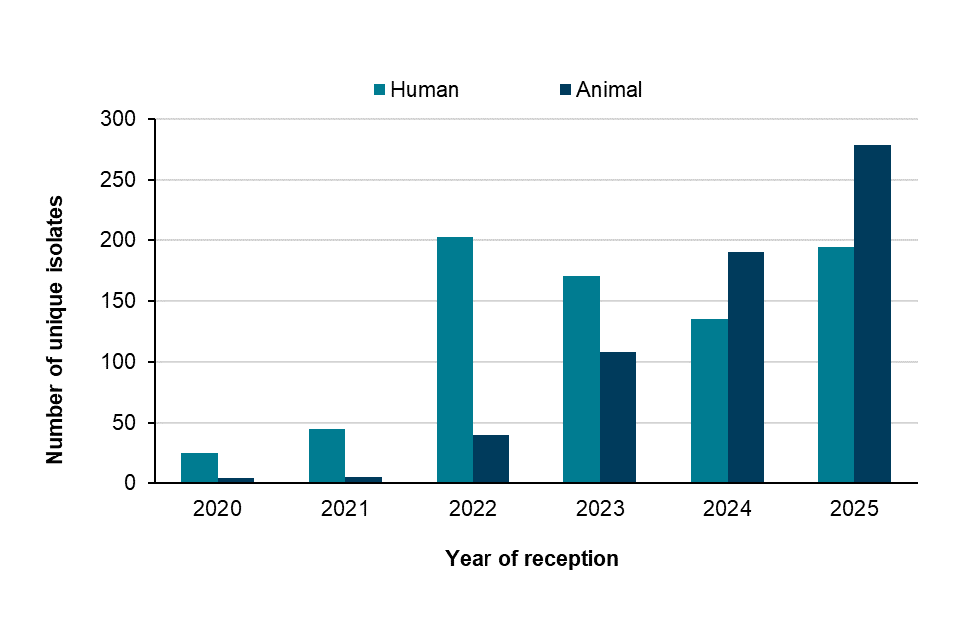
Among humans, 13 individuals were identified as being infected by toxigenic C. ulcerans and 2 individuals by toxigenic C. diphtheriae.
Among animals, toxigenic C. ulcerans strains were confirmed amongst 133 isolates from 114 animals, 4 of which were epidemiologically linked to a human case. Toxigenic C. diphtheriae was identified in 2 animals.
Of the remaining isolates, 197 were non-toxigenic C. diphtheriae, 132 were non-toxigenic C. ulcerans, 1 was NTTB C. ulcerans, 18 were non-toxigenic C. pseudotuberculosis and 36 were neither C. diphtheriae, C. ulcerans, or C. pseudotuberculosis.
Table 1. Summary of (a) Toxigenic corynebacteria by strain, and (b) NRL toxigenicity testing: England, 2025
| (a) All toxigenic corynebacteria isolates from human cases in 2025 | |
|---|---|
| Toxigenic C. diphtheriae | 2 |
| Toxigenic C. ulcerans | 13 |
| NTTB C. diphtheriae | 0 |
| (b) All toxigenic corynebacteria isolates submitted to the NRL in 2025 (human and animal) | |
|---|---|
| Toxigenic C. diphtheriae [note 1] | 5 |
| NTTB C. diphtheriae | 0 |
| Non-toxigenic C. diphtheriae [note 2] | 197 |
| Toxigenic C. ulcerans [note 3] | 146 |
| NTTB C. ulcerans | 1 |
| Non-toxigenic C. ulcerans [note 4] | 132 |
| Non-toxigenic C. pseudotuberclerosis | 18 |
| Other – Not C. diphtheriae, C. ulcerans or C. pseudotuberclerosis [note 5] | 36 |
Note 1. Includes 5 isolates from 4 individuals
Note 2. Includes multiple isolates from 12 individuals
Note 3. Includes multiple isolates from 12 animals
Note 4. Includes multiple isolates from 8 individuals
Note 5. Includes multiple isolates from 14 individuals
Toxigenic Corynebacterium diphtheriae
In 2025, toxigenic C. diphtheriae strains from 2 individuals were identified in England. Both cases were people seeking asylum with recent arrival in England.
The 2 cases were young males (age group 15 to 24) with no or unknown vaccination history.
Both cases presented with cutaneous skin lesions or wounds acquired during extensive travel en-route to the UK, prompting clinical assessment and screening for corynebacteria. Group A Streptococcus and Staphylococcus aureus were also isolated from skin lesions from one of the cases. None of the cases reported associated respiratory symptoms.
In 2022, an outbreak of diphtheria was reported among migrants in Europe (7) with a similar increase in cases identified among individuals arriving by small boat to England (8). This continued into 2023, though there was a marked decrease in cases cases and there were no toxigenic C. diphtheriae strains identified amongst people seeking asylum in 2024.
Toxigenic Corynebacterium ulcerans
Toxigenic C. ulcerans isolates from 13 individuals were identified in 2025, of which 9 had a cutaneous presentation, 2 had a sore throat (with isolation from a throat swab), one was asymptomatic, and one case with underlying immunosuppression and who was receiving chemotherapy presented with shortness of breath. Of the cases, 7 were male and ages ranged from 9 to 81 years.
Six of the cases were hospitalised, none of whom treated with DAT. There were 2 fatalities, both with invasive disease. One fatality, an intravenous drug user (IVDU), was admitted to hospital with necrotising fasciitis and died after 4 days in intensive care. The second fatality was immunosuppressed due to underlying metastatic pancreatic cancer and died 2 days after admission.
Four cases were fully vaccinated, 2 were partially vaccinated, one was unimmunised, and vaccination status was not known for 6 cases, including both the fatal cases.
Animal contact was reported for 11 human cases, of which 3 separate cases had animals that subsequently tested positive for toxigenic C. ulcerans.
Contact tracing for all cases was carried out, with all identified close contacts being offered antibiotic prophylaxis and vaccinations (as necessary). Healthcare workers (HCW) with significant exposure were identified where insufficient personal protective equipment (PPE) was used. HCW close contacts were risk assessed individually and all were offered antibiotic prophylaxis and a dose of diphtheria containing vaccine as necessary.
Table 2. Clinical presentation of diphtheria cases and causative organism, England 2025
| Clinical presentation of cases | Toxigenic C. diphtheriae | Toxigenic C. ulcerans | Total |
|---|---|---|---|
| Severe respiratory diphtheria (sore throat with exudate or membrane) | – | – | 0 |
| Mild respiratory diphtheria (sore throat/pharyngitis) | – | 2 | 2 |
| Cutaneous diphtheria | 2 | 9 | 11 |
| Cutaneous and respiratory diphtheria | – | – | 0 |
| Asymptomatic/respiratory carrier | – | 1 | 1 |
| Other | – | 1 | 1 |
Non-toxigenic Corynebacterium diphtheriae with infective endocarditis
Since July 2024, there has been an observed increase in non-toxigenic C. diphtheriae infections among people with a history of substance use (including non-injecting drug use) and/or experiencing homelessness (9).
Between January and December 2025, 11 cases of invasive infection were identified in this population, including 5 cases presenting with infective endocarditis. Other presentations included sepsis and bacteraemia. The majority of invasive infections were isolated from blood, with others isolated from bone, cerebrospinal fluid and deep tissue specimens. An additional 52 cutaneous cases were identified from non-sterile sites, most commonly from wounds or chronic ulcers.
UKHSA stood up a national response in January 2025, to co-ordinate the epidemiological and public health response and ongoing investigation. As part of this response, the national diphtheria guidance was updated to cover the principles of management of severe cases of infection and also clusters of non-toxigenic C. diphtheriae in settings for those who are vulnerable, for example, those experiencing homelessness and with substance use.
Further information
Microbiological laboratories are requested to promptly submit all suspected isolates of C. diphtheriae, C. ulcerans and C. pseudotuberculosis to the UKHSA NRL, RVPBRU, Colindale, London, using the laboratory request form R3 (10).
The test which initially helps to inform public health actions is a real-time PCR which confirms the identity of C. diphtheriae, C. ulcerans or C. pseudotuberculosis and determines whether the gene for the diphtheria toxin (tox) is present.
If the tox gene is detected, the isolate is then subjected to the Elek test to confirm expression of the toxin (4). The NRL also provides advice on all aspects of laboratory testing for diphtheria and related infections. Advice on immunisation against diphtheria, provision of vaccine and provision of diphtheria antitoxin for therapeutic use is available from the UKHSA Immunisation and Vaccine Preventable Diseases Division and in the published revised guidance for public health control and management of diphtheria (3).
As a disease becomes rare, the completeness and accuracy of surveillance information become more important and each clinical diagnosis (that is, notification) needs to be confirmed by laboratory diagnosis. In addition to notifications, enhanced surveillance for diphtheria incorporates data from reference and NHS laboratories, death registration, and individual case details such as vaccination history, source of infection and severity of disease obtained from hospital records, general practitioners and local incident team reports.
Linkage of notified cases of suspected diphtheria and confirmatory laboratory data shows that most notifications are cases of pharyngitis associated with isolation of non-toxigenic strains of C. diphtheriae. Interpretation of notification data should therefore be undertaken with caution.
References
1. UKHSA (2013). ‘Diphtheria: the Green Book, chapter 15’
2. Wagner KS, White JM, Crowcroft NS, De Martin S, Mann G, Efstratiou A. ‘Diphtheria in the United Kingdom, 1986-2008: the increasing role of Corynebacterium ulcerans’. Epidemiology and Infection 2010: volume 138, issue 11, pages 1,519 to 1,530
3. UKHSA (2024). ‘Public health control and management of diphtheria in England: 2024 guidelines’
4. De Zoysa A, Efstratiou A, Mann G, Harrison TG, Fry NK (2016). ‘Development, validation and implementation of a quadruplex real-time PCR assay for identification of potentially toxigenic corynebacteria’. Journal of Medical Microbiology 2016: volume 65, issue 12, pages 1,521 to 1,527
5. UKHSA (2024). ‘Diphtheria in England: 2024’. Health Protection Report: volume 19, number 4
6. UKHSA. ‘Notifiable diseases and causative organisms: how to report’
7. European Centre for Disease Prevention and Control (October 2022). ‘Increase of reported diphtheria cases among migrants in Europe due to Corynebacterium diphtheriae, 2022’
8. UKHSA (2022). ‘Diphtheria: cases among asylum seekers in England (data to 25 November 2022)’
9. Patel T, Anwar T, Mavrogiorgou E, Utjesanovic N, Aryee A, Litt DJ, and others (2025). ‘Fulminant infective endocarditis with toxin-negative Corynebacterium diphtheriae in people with substance use experiencing homelessness, England, 2024 to 2025 — UK Health Security Agency - PROD’. Eurosurveillance: volume 30, issue 13
10. UKHSA. ‘R3: Vaccine preventable bacteria section request form’
Acknowledgements
This report was prepared by Tara Patel, Edna Mugwagwa, Gayatri Amirthalingam, Rebecca Cordery and David Litt.
Enquiries relating to this document should be sent to:
immunisation.lead@ukhsa.gov.uk