Academic Engagement Toolkit
Updated 4 August 2026

© Crown copyright 2026
This publication is licensed under the terms of the Open Government Licence v3.0 except where otherwise stated. To view this licence, visit nationalarchives.gov.uk/doc/open-government-licence/version/3 or write to the Information Policy Team, The National Archives, Kew, London TW9 4DU, or email: psi@nationalarchives.gov.uk.
Where we have identified any third party copyright information you will need to obtain permission from the copyright holders concerned.
This publication is available at https://www.gov.uk/government/publications/engaging-with-academics-guide-for-policy-makers/academic-engagement-toolkit
Foreword: Purpose and how to use the toolkit
We developed this toolkit to help civil servants engage confidently with academics. It brings together practical guidance, tools and resources based on experience across government.
It is written from a Civil Service perspective, but we are sharing it openly to support greater transparency and inclusivity. Academic engagement does not happen in isolation. It involves many actors, both inside and outside government, and works best when those involved understand each other’s context. Civil servants are not alone in this work, and there are many individuals and organisations who can support effective engagement.
By setting out how government approaches academic engagement, this toolkit helps academics better understand the environment in which their insights are used. It also helps academics make more effective use of their time and effort, and to engage in ways that are most useful to government decision-making.
Ultimately, the aim is to support more informed, better-aligned engagement, improving how government and academia work together.
The toolkit is modular, so sections can be read in any order depending on user needs. Navigation links on the left side of the page and throughout the toolkit help you find relevant sections.
We recommend starting with section 1 for an overview of best practice and section 2 to understand the academic context. Longer sections have “quick tips” with practical tips or summaries of key concepts.
The toolkit does not cover how to assess or use evidence gathered from experts. It does not replace departmental processes or the guidance and advice available via Chief Scientific Adviser (CSA) offices (or equivalents). Contact the Government Office for Science (GO-Science) for further advice and signposting (section 12 for contact details).
The toolkit will be expanded in future iterations, particularly to include more case studies and how to guides. To contribute, or suggest improvements, use the contact details in section 12.
1. Introduction to academic engagement
Academic engagement refers to a wide range of activities between government and academia that enable the use of research, evidence or expertise to support better decision making. You can engage directly with academics or through a third-party knowledge mobiliser - an organisation or individual that helps connect research and policy (see section 2 for more).
Outside the Civil Service, academic engagement is usually called “policy engagement”. Whatever term is used, there are many ways to work with academics. Below are a few examples, and more can be found in section 4:
-
formal scientific advisory systems, such as Chief Scientific Advisers and Scientific Advisory Councils
-
speaking to individual experts for direct advice, including in-depth interviews
-
inviting researchers to a workshop or roundtable
-
supporting or commissioning academic research
-
hosting secondees.
There are many benefits to engaging with academics, but there are also important considerations – including the need for time, resources and knowledge to manage the engagement well. This toolkit supports you to navigate these considerations, starting with key principles for effective engagement.
Figure 1: Four key principles to support effective academic engagement.
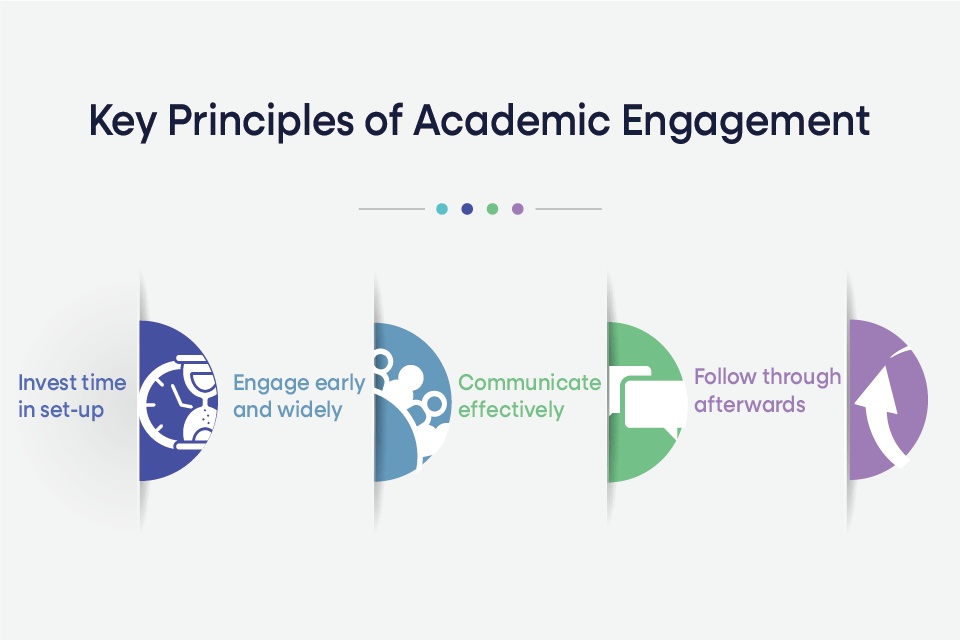
Alt text: Four key principles of academic engagement: invest time in set-up, engage early and widely, communicate effectively, and follow through afterwards. Each principle is represented by a coloured circular icon arranged in a horizontal flow.
Quick tips: Key principles for academic engagement
Start with this summary of best practice. Use the links to explore more detailed guidance in later sections of the toolkit.
Invest time in setting up your engagement for success
-
Spend time clarifying what the engagement is trying to achieve, and the desired outputs first. Then identify the mechanism to deliver these outputs (section 4). Internal experts, academics, and knowledge mobilisers can help with this clarification stage (section 5).
-
Understand the academic context, incentives and time pressure. Be upfront about expected effort, time commitment and timelines so academics can judge whether and how they can contribute (section 2).
-
Build in time for practicalities. Some longer term or formal engagements may need contracts or terms of reference, or agreements on expenses or remuneration (section 6).
Engage early and widely. Build diversity and inclusion in from the start
-
Start with short, exploratory conversations. Internal experts, academics and knowledge mobilisers can help frame questions and signpost to existing evidence and expertise through their research networks (section 5).
-
Encourage diverse representation across relevant disciplines, institutions, career stages and geographies. Identify and remove barriers to participation (section 3).
-
Academics often have good links with industry, civil society or groups with lived experience that can bring further diversity of views (section 2).
Communicate to achieve success
-
Share the decision-making context, constraints, realistic timescales, the type of input needed and the purpose of engagement section 2.
-
Agree shared expectations on ways of working. Be open about what deliverables are expected or needed (section 2 and section 8).
Follow through afterwards
-
Thank contributors. Tell them what was learned, how it was used and what happens next (section 7).
-
Share and disseminate findings publicly when possible and include fair acknowledgement of contributors (section 8).
-
Monitor and evaluate what changed as a result of the engagement. Capture outputs, outcomes and impact and use learning to improve future engagement (section 10).
-
Make sure relationships do not rely on individual contacts, keep records and plan for continuity (section 11).
2. Understand the academic context
It is important to recognise that the Civil Service and academia have different ways of working. Understanding the academic context helps engagement succeed.
Workload and time pressures:
-
Higher education institutions earn their funding in a competitive environment. Teaching responsibilities vary throughout the year, making some periods busier than others, and engagement more challenging.
-
Academics also need to support students and fulfil university commitments, deliver and publish research, develop successful funding bids, and undertake peer reviewing and impact and engagement work.
-
To allow academics to make informed decisions about engaging, be as explicit as possible about expected time commitments and deadlines.
-
It is also important to explain how contributions will be used as well as any potential restrictions, such as confidentiality agreements or limits on dissemination.
Career incentives:
-
Publishing peer-reviewed research and winning grants drive career progression in academia.
-
Demonstrating research impact may improve the success of funding bids but is often a personal motivator that doesn’t directly impact career progression. However, a small number of institutions are beginning to recognise policy impact in promotion cases.
-
Discuss upfront what academics want from the engagement and what you can offer. See section 7 to understand why acknowledging academic contribution matters.
Framing matters:
-
Academics will need background information to engage successfully.
-
Include relevant information about government priorities and the wider context. Set out any constraints, including political, legal and operational factors.
-
Communicate what value you expect academic expertise will bring. Useful insights from a research perspective can be very different to what is useful in a government decision-making context.
-
Explain what makes a “useful” contribution, such as the type of response, length and level of detail and provide an example if possible.
Communication styles:
-
Academic communications often include robust critique as a way to collaborate to improve the quality of ideas and evidence. This can appear critical to those not used to it.
-
Civil Service communications are often more concise and reflect collective positions so may be measured and carefully framed. This can appear less direct to those unfamiliar with the Civil Service.
-
Be aware of these differences and set expectations for participants on both sides to help communications between the groups.
Career Stage:
-
Engagement does not need to happen only at senior levels. Early to mid-career researchers may have more time and flexibility to engage and be closer to the detail, but in some cases will have less breadth of subject knowledge. See Annex A for a brief description of UK academic job titles to help you understand career stages.
-
Career stage may also impact confidence and willingness to engage. See section 3 for tips on more diverse and inclusive engagement.
Knowledge mobilisers:
-
Many academic institutions employ professional staff in academia-policy bridging roles to help academic research have real world impact. Job titles vary, but staff in these roles are increasingly referred to as “knowledge mobilisers.”
-
Knowledge mobilisers can connect you more quickly to a diverse range of academics with relevant subject and engagement expertise.
-
They can also help translate the “ask” from government into a format that is most accessible to academics.
-
See Hidden Talents, a report from Capabilities in Academic Policy Engagement (CAPE) to learn more about the role and skills of knowledge mobilisers.
3. Inclusive engagement for better outcomes
Inclusive and diverse engagement is best understood as an opportunity to improve decision making, rather than a procedural requirement. Diversity in academic engagement improves the quality of advice and decisions. Drawing on a broader range of experts and expertise helps avoid blind spots and leads to more robust thinking.
Understanding the difference between diverse experts (people) vs expertise (knowledge)
Diverse experts refer to engagement with a broader range of people to help ensure decision making is informed by varied perspectives and lived experiences. Diversity in this sense could include:
-
protected characteristic groups
-
institutions, sectors or career stages
-
geographic locations
-
professional or applied backgrounds
-
social and demographic backgrounds
Diverse expertise refers to drawing on diverse knowledge systems and multidisciplinary expertise to help teams better understand complex sets of issues. Diversity in this sense could include:
-
academic disciplines
-
types of evidence
-
methods used (e.g. qualitative, quantitative), including non-traditional evidence gathering
-
knowledge systems (e.g. published research, theory, practitioner or operational expertise, lived experience or insights from those affected).
Quick tips: Practical steps to embed equality, diversity and inclusion
-
Define and communicate what diversity means for your engagement. Explain why diverse perspectives (in terms of experts, expertise, or both) are relevant to the evidence need.
-
Advertise calls for evidence and engagement opportunities openly to reach a wide audience. Use language that specifically welcomes a diverse range of expertise and experts. Most of the routes to finding experts in section 5 can also be used to advertise opportunities.
-
Proactively broaden reach:
-
ask academic partners, knowledge mobilisers and organisations to identify underrepresented or less visible experts and expertise.
-
use specialist networks and representative groups for example Women in Science and Engineering and Black British Academics.
-
engage local universities or regional university policy networks (such as GW4 or Y-PERN), learned societies, and research institutes to access broader expertise and networks.
-
where feasible, invite junior academics to participate alongside experienced mentors to build confidence.
-
-
Use structured and inclusive engagement methods (anonymous inputs, pre-submission of views) to capture all perspectives and reduce groupthink.
-
Offer online options so people can take part regardless of location or other barriers.
-
Create inclusive environments by agreeing expectations for mutual respect.
-
Actively encourage input from all participants and use facilitation to ensure everyone feels confident to share and challenge ideas.
-
Be mindful of unconscious bias in expectations about ‘conventional’ academic experts, who may be perceived to carry more authority.
Further resources
-
Civil servants must comply with the Public Sector Equality Duty (PSED). The PSED requires all public authorities to consider how their decisions and engagement activities affect people with different protected characteristics, and to take active steps to eliminate discrimination and advance equality of opportunity.
-
Scientific Advice Mechanism to the European Commission offers an example of building diversity and inclusivity into scientific working groups.
-
Surfacing Equity, Diversity, and Inclusion within Academic-Policy Engagement – a University Policy Exchange Network (UPEN) report on what universities should be doing to ensure there are more diverse academic voices contributing to public policy.
-
Inclusive Practice in Knowledge Mobilisation, is a guide developed by CAPE and you can expect university knowledge mobilisers to apply it to their work.
4. Choose the right mechanisms for engagement
Before considering how to engage, clarify the purpose. Write down the challenge, the outputs you need and how success will be judged. Once objectives are agreed, time and resources will shape your choice of engagement method. Choose an approach that is proportionate to the task. Ensure you have resources to manage the chosen process well from start to finish. Different methods can be combined or used at different stages for the best results.
This section includes:
-
a quick tips section with prompts to help guide your choice of engagement mechanisms
-
a table summarising common methods
-
detailed guidance on each approach.
The list of mechanisms is illustrative, not exhaustive. There are many other ways to engage. Contact GO-Science to suggest or share examples for future iterations of the toolkit (section 12).
Quick tips: Prompts to help choose the right mechanism
Below is a series of prompts to help you think about the best engagement mechanism(s) for your purposes. Once the objectives of the engagement are agreed, ask:
-
What evidence, expertise or relevant advisory mechanisms already exist in our department or other departments?
-
How urgently is this needed? If there is a tight deadline (hours or days) there will be limited options compared to longer deadlines (weeks or months).
-
Is the engagement contributing to a final decision or the first step in a longer piece of work?
-
How much resource is available? All engagement requires some time to manage, but some methods are more intensive than others.
-
Is there budget? Some mechanisms will have financial costs.
-
How much external interest is there in the area? Is it a sensitive or contested issue?
-
Is the issue novel or is there a great deal of uncertainty?
-
Is it an issue of interest to other departments? Is collaboration on engagement needed?
Table 1: Summary of the academic engagement mechanisms detailed in the toolkit. It is illustrative and not exhaustive. Each mechanism is explained in detail after the table.
| Mechanism | Use it for | Typical use | Works well when | Watch out for |
|---|---|---|---|---|
| Direct advice | Quick advice and sense-checking | A quick steer on evidence or question framing | The ask is focused and time is short | Limited range of views; not enough on its own for high-stakes issues |
| Areas of Research Interest (ARIs) | Signalling longer-term evidence needs | Finding relevant expertise and shaping future work | The issue is strategic or exploratory | Not suitable for urgent advice |
| Calls for evidence | Gathering evidence and views at scale | Understanding the evidence base or inviting broad input | You need breadth, transparency and a clear record | Needs planning and analysis capacity |
| Science Advisory Committees/Councils (SACs) | Ongoing advice, challenge and assurance | Ad-hoc or standing advice on complex or high-profile issues | You need continuity, multidisciplinary input and formal governance | Slower and more resource-intensive |
| College of Experts | Repeated access to specialist input | Ad hoc advice across a policy area | You need regular input without a formal committee | Needs governance and active management |
| Seminars | Awareness and early discussion | Hearing from experts on the evidence | The aim is to inform thinking | Limited depth |
| Roundtables and workshops | Exploring options and testing assumptions | Structured discussion of trade-offs, uncertainty or options | Discussion across disciplines or perspectives will help | Needs careful facilitation |
| Research commissioning | Formal analysis, evaluation or defined outputs | A commissioned review, model or research product | You have a clear specification, time and resource | Higher cost and longer lead-in time |
| Secondments, fellowships, internships and exchanges | Building capability and longer-term relationships | Bringing expertise into the team or building links | A more embedded approach is justified | Long lead-in time and management demands |
Direct Advice
Direct advice involves engaging individually with 1 or more academics for targeted, evidence-informed input on a specific topic or seeking a professional opinion.
Direct advice can be particularly helpful when:
-
the deadline is tight
-
you need short-term focused expertise to explore an issue or sense‑check thinking
-
you need to clarify aspects of the existing evidence base.
While direct advice can be efficient and flexible, care should be taken to consider whether it is the most appropriate route. Relying on a small number of experts narrows the range of perspectives informing an issue, which can affect robustness and transparency. However, this may sometimes be the only option when deadlines are very short.
Areas of Research Interest (ARIs)
ARIs are lists of research topics and questions from government organisations to highlight their medium- and long-term evidence needs to external experts. ARIs that are promoted widely, and set out how researchers can get in touch, can help:
-
act as a catalyst for engaging with a diverse range of academics
-
surface existing evidence and expertise
-
align future research with government evidence needs.
Explore the full range of published questions from UK government in the searchable ARI Database at ari.org.uk.
You can use ARIs as a tool for academic engagement in several ways.
-
Hold events to promote your department’s existing ARIs to interested academics. Work in collaboration with knowledge mobilisers, universities or research organisations to co-host workshops or events around a few priority questions.
-
Share learning across government. Use the search function in the ARI database to identify research questions already being asked in your field of interest (in your department or others). Contact relevant leads to share learning around engagement mechanisms, challenges and the existing evidence and expertise.
-
Target engagement with those who have already shown interest in your departmental ARIs. Reach out to your CSA’s office (or equivalent) to access responses to your organisation’s ARIs.
-
Use the “full details” button under relevant questions in the ARI database to explore details on potentially relevant UKRI‑funded research found on Gateway to Research.
-
Contribute to future organisational ARIs. Work with your CSA’s office to highlight priority areas for the future, set out ways researchers can engage and how to get in touch.
To learn more about how ARIs work, visit Writing and using Areas of Research Interest - GOV.UK or get in touch at ari.support@go-science.gov.uk.
Calls for Evidence
Calls for evidence are a structured way to gather relevant research, data, practitioner insight and wider expertise at scale. They work best when you need to:
- reach beyond your existing networks
- gather input on a large scale
- keep a transparent record of what evidence you considered.
Calls for evidence work well for mapping the current evidence base and testing the framing of a problem. They can also help surface gaps and uncertainty and invite insight that may not be visible through literature alone.
Explore current calls for evidence on the policy papers and consultations webpage.
See the Calls for evidence: how to guide in this toolkit for more tips.
Science Advisory Groups
Scientific Advisory Councils and Scientific Advisory Committees (SACs) are formal mechanisms for accessing expert advice, with defined governance and remit. They usually have small memberships, an official chair and meet regularly online or in person. Departments normally have one Scientific Advisory Council, which provides advice on a range of topics covering the breadth of the department’s policies and offers strategic advice. They can also have several Scientific Advisory Committees, which provide advice on specific topic areas.
Use SACs as a route when you need:
-
standing forum for ongoing advice and challenge
-
collective discussion
-
well-defined governance, and an auditable record of input
-
continuity of expertise over time and broad, multidisciplinary views.
SACs are well suited to high-scrutiny or long-running issues. They also support transparent management of interests, and a chair-led process that can provide structured assurance. See Figure 2 to compare SACs with College of Experts.
SAC members may also be willing to offer exploratory conversations, direct advice or signposting. Contact them via the relevant SAC secretariat.
Find relevant SACs (and secretariat contact details) using the interactive SAC Map. Read the established good practice for working with SACs in the Code of Practice for Scientific Advisory Committees and Councils (CoPSAC).
College of Experts
Colleges of Experts are lists of specialists who agree to provide advice under a set Terms of Reference with a department. Colleges provide a way for departments to access ad hoc and timely expert advice on policies and projects. Membership can include up to 200 experts. There are no regular meetings and no chair.
Each member usually focuses on their own area of expertise and may be asked to:
-
review project proposals
-
provide peer review on research or papers
-
attend workshops
-
sit on expert panels.
Choose College of Experts as a route when you need:
-
repeated access to specialist input over time, but do not need the overhead of a standing committee
-
specialist, targeted advice, especially on complex issues or when the department’s priorities are broad or changing.
Colleges of Experts include external experts from a variety of organisations, including academia, industry, non‑governmental organisations (NGOs) and local government. Their combined expertise spans the breadth of the department’s remit. See examples of College of Experts established by Government Skills and DCMS.
Figure 2: Comparison of 3 common science advisory mechanisms, showing their typical structure, scope and use. The examples are illustrative and may vary by department and context.
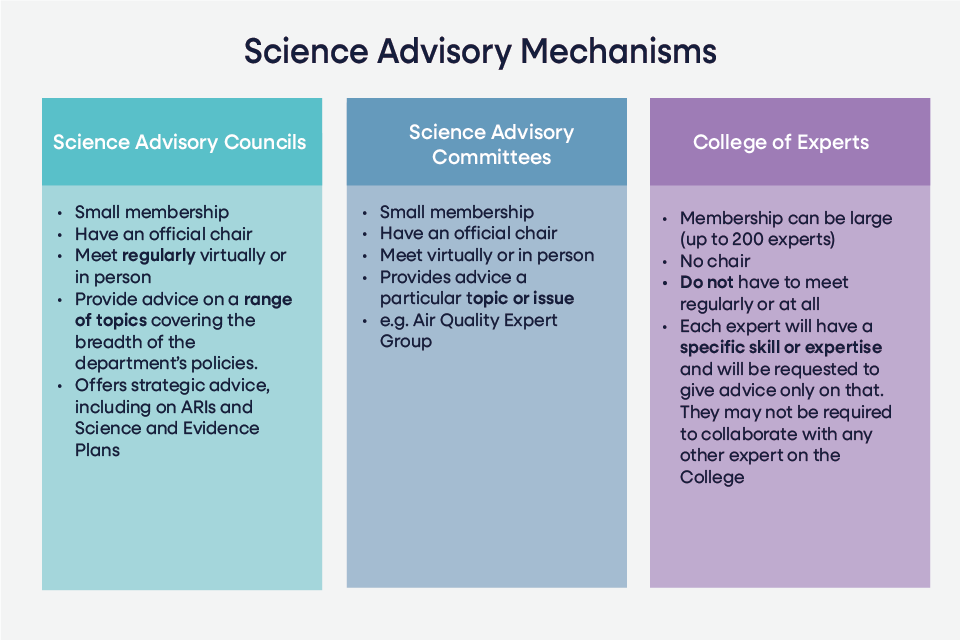
Alt text: Comparison of three models: Science Advisory Councils, Science Advisory Committees, and Colleges of Experts. Each is shown as a separate column with bullet points outlining key features such as membership size, structure, meeting frequency, and purpose. Councils and committees have small memberships and formal chairs, while Colleges of Experts can include a large number of specialists, have no chair, and do not meet regularly.
Seminars
Online seminars, “lunch and learns” or similar speaking opportunities are a practical, low-barrier way to connect civil servants with academics. Choose a seminar when you need to:
-
bring experts directly to relevant audiences
-
help civil servants stay informed about the latest evidence
-
build confidence with the skills needed to use research effectively.
Seminars are typically based around a specific department’s priorities but are often open to colleagues across government. Some departments or teams hold regular seminar series, while others organise them as needed.
Seminars are typically structured as follows:
-
run for 45-60 minutes
-
include between 1 and 3 speakers
-
often include a headline presentation followed by a short Q&A
-
an alternative format is a shorter presentation followed by a longer interactive discussion.
Speakers can come from:
-
existing engagements
-
advisory groups
-
respondents to ARIs or calls for evidence
-
new contacts can be found using methods in section 5.
Academics value speaking at seminars as an opportunity to share insights and get feedback to inform their research. See the case study on Professor Caroline Bond’s lunchtime seminar and policy dialogue for an example of how a seminar can lead to deeper engagement.
Roundtables and Workshops
Roundtables and workshops are well suited to early or mid-stage policy development, before positions are fixed. Use them when issues need:
-
structured discussion
-
interaction across disciplines or roles
-
facilitated dialogue.
They can help you to:
-
explore uncertainty, trade‑offs, emerging evidence or horizon scanning
-
test assumptions and framing with a range of experts
-
understand how evidence from different disciplines, sectors or perspectives fits together
-
surface risks, unintended consequences or areas of disagreement
-
support collective sense‑making or structured problem-solving on complex policy issues between experts, practitioners and decision-makers.
Choosing between a roundtable or workshop will depend on your purpose. For example, whether you are seeking expert challenge and sense‑making (roundtable), or collaborative development and problem‑solving (workshop).
Roundtables typically bring together a small number of experts, decision-makers and stakeholders to explore complex or contested policy questions in depth. Workshops are usually more structured and facilitative in format, and are often used for collaborative working, such as testing ideas or coproducing options. Workshops may involve a broader mix of participants and can accommodate larger groups by using facilitated activities or breakout sessions, rather than relying solely on open discussion.
See the Roundtables: how to guide in this toolkit for practical steps on designing and running a roundtable.
Research Commissioning
Departments can use research commissioning to procure a defined piece of research or analysis from an external supplier, such as a university, consultancy or research organisation. Research commissioning is useful when you need:
-
a well-defined output, with an audit trail
-
dedicated time and specialist capability beyond what can be achieved through informal advice or internal capacity
-
to manage risk through defined scope, quality assurance and governance.
Departments will have their own procurement procedures that must be followed. The following is good practice when commissioning research from academia.
-
Start with the decision and use-case: identify what decision the research will inform, who will use it and the level of assurance and audit trail needed.
-
Involve in-house technical and commercial expertise early: engage appropriate scientists, engineers or analysts to shape the question, methods and quality standards. Engage commercial and procurement colleagues early to choose the right route and allow sufficient lead time.
-
Plan governance and delivery management upfront: agree who is accountable for oversight, how progress will be tracked and how outputs will be quality assured and signed off. Allow time for internal checks and approvals.
Secondments, fellowships, internships and informal exchanges
There are a variety of structured ways to bring academic expertise into government for a defined period, including secondments, fellowships and internships. These inward exchange routes build capability and relationships but usually require long lead‑in times for approvals, negotiations with home institutions, clearance and onboarding.
Departments can use established inward exchange programmes or develop their own. For examples, see the UKRI Policy Fellows case studies for Professor Rowena Hill and Professor Ana Manzano.
Civil servants can also spend time in academic settings on outward exchange programmes to explore evidence needs.
Alongside formal placements, there are shorter term, less formal opportunities to gain experience and insight into working with academics via capacity building exchanges. These may include pairing schemes, short-term projects, visits or job shadowing between academics and civil servants.
For support finding suitable inward and outward exchange schemes:
-
Use the Directory of Exchange Schemes to explore existing schemes for both civil servants and academics, including STEM Futures and UKRI Policy Fellowships amongst many others
-
The ESRC-funded Evidence Exchange platform will signpost opportunities for civil servants to undertake exchanges into academia
-
Civil servants interested in a placement in academia or other sectors can explore options on Civil Service Careers: Secondments
-
Speak to your department’s Chief Scientific Adviser (CSA) office or equivalent for advice on opportunities
-
Contact your human resources (HR) or workforce team for guidance and practical considerations
Further resources for engagement mechanisms
- CAPE Resource Navigator – a curated collection of tools from CAPE, including templates for project scoping, rapid evidence assessments and policy fellowships.
5. Finding and accessing relevant experts
There are many routes for finding and engaging with academics or researchers internally across government, and externally in academia, research organisations and other settings. This section provides starting points to help you begin but is not an exhaustive list. Each of the options is explored in more depth after the quick tips guide. Before starting, we suggest reading section 3 on diverse and inclusive engagement.
Figure 3. Four ways to begin identifying relevant expertise. These routes can be used individually or in combination to identify appropriate academics for different engagement needs.
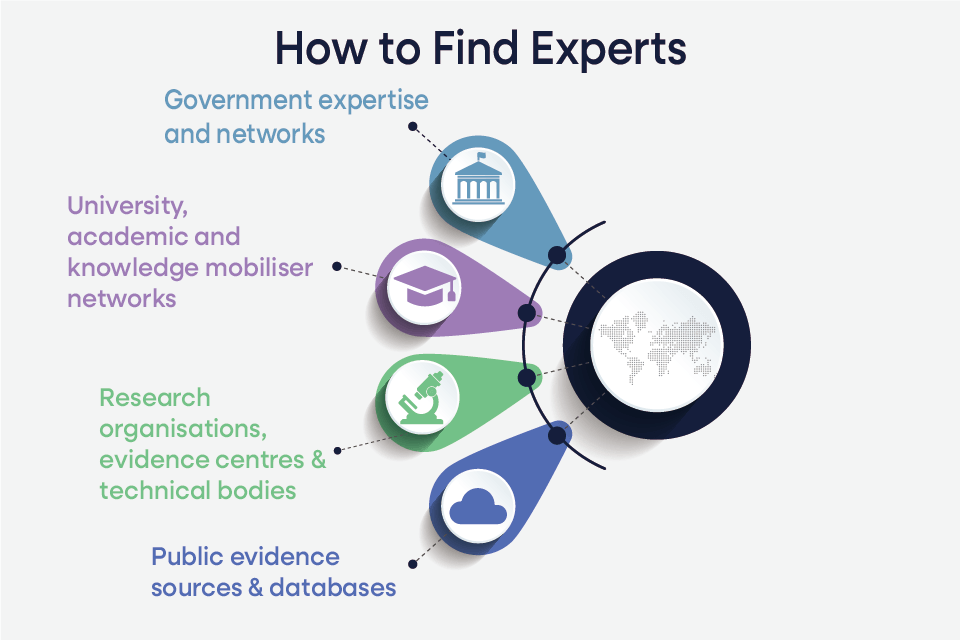
Alt text: Four routes for identifying relevant academic expertise: government expertise and networks; university, academic and knowledge mobiliser networks; research organisations, evidence centres and technical bodies; and public evidence sources and databases. The routes are shown as separate coloured sections to indicate that they can be used individually or together depending on the engagement need.
Quick tips: Four ways to begin identifying experts
-
Leverage existing government expertise and networks - speak to your CSA office, academic secondees and Government Science and Engineering Profession (GSE) or analytical professions colleagues. Check whether a relevant advisory group or College of Experts already exists.
-
Utilise university, academic and knowledge mobiliser networks - use UPEN and university-based policy centres or knowledge exchange teams. Consult the National Academies or relevant learned societies.
-
Use research organisations, evidence centres and technical bodies - consider researchers based in relevant Arm’s length bodies (ALBs), public sector research establishments (PSREs), What Works Network, and the National Research Organisations (NRO) group.
-
Draw on public evidence sources and databases – check published evidence. Use scholarly search engines and funder databases to see who is publishing, and how research is being used in policy.
Leverage existing government expertise and networks
Engage internal experts early to help refine questions, assess existing evidence and expertise, and identify appropriate types of academic expertise before you engage externally. Internal experts can be extremely useful in quality assurance of external input during engagement.
-
Talk to your Chief Scientific Adviser (CSA) and their team. They can signpost relevant disciplines, external networks and experts, convening routes and existing cross government activity. Departments may have routes to access external expertise quickly, which your CSA office can signpost. CSAs are often Head of the Science and Engineering Profession in their departments and can signpost to internal expertise. See Chief Scientific Advisers Network in Action for short case studies showing how CSA offices have supported policy teams across government.
-
Look for existing advisory capacity. Reach out to the secretariat of relevant Science Advisory Councils/Committees (SACs) or College of Experts (which can be found on the SAC map). Even if the group cannot address the evidence need directly, members can be a resource to suggest relevant expertise. If budget is available, Accelerated Capability Environment (ACE) or the Policy Insights Unit are internal services that can be commissioned to marshal external expertise at pace.
-
Science, engineering and analytical teams. Colleagues across science, engineering and analytical teams in your department (including civil servants and secondees) can help refine questions. They can sense-check assumptions and identify relevant evidence and expertise before you engage externally. They also provide valuable support in quality assuring external input during engagement. These teams often have strong networks and insight into what evidence already exists, or where gaps remain. Examples of professions that can help with these tasks include: Government Science & Engineering (GSE) Profession, Government Social Research (GSR) Profession, Government Economic Service (GES), Government Operational Research Service (GORS) and Government Statistical Service (GSS). Explore the full list of professions.
Use university, academic and knowledge mobiliser networks
-
UPEN works to connect public policy evidence needs with academic expertise and evidence from across its network of over 120 policy engaged universities, both at speed and for long-term collaboration. It also provides a single route to circulate engagement opportunities to academics and knowledge mobilisers via its fortnightly newsletter and website.
-
Many universities have policy engagement or knowledge exchange teams that can help clarify your ask and signpost suitable researchers. Many participate in regional or cross university networks that broaden reach. You can find university contacts through the UPEN directory. The Scottish Policy and Research Exchange also has a brokerage network across academia and policy.
-
National Academies are independent expert bodies that bring together leading researchers. They provide impartial, evidence-based advice and help connect government with specialist expertise. Each academy maintains a searchable directory of world-class experts who have been elected as fellows. They also have policy staff working in priority areas that may be able to offer advice and suggest contacts:
-
Royal Society (science): Website, Fellows Directory
-
Royal Academy of Engineering: Website, Fellows Directory
-
British Academy (social sciences and humanities): Website, Fellows Directory
-
Academy of Medical Sciences: Website, Fellows Directory
-
Royal Society of Edinburgh: Website, Fellows Directory
-
Learned Society of Wales: Website, Fellows Directory
-
Royal Irish Academy: Website, Members Directory
-
-
Learned societies and professional bodies advance a specific discipline or group of related disciplines, and some actively contribute to policy work. For examples, see a list of learned societies by discipline, curated by the University of Edinburgh.
Use research organisations, evidence centres and technical bodies
Beyond academia, the public sector research landscape contains deep applied capability.
-
Arm’s length bodies (ALBs) and public sector research establishments (PSREs) provide specialist advice, data and regulatory expertise and often maintain strong links to academia and industry. (see GOV.UK index of all public bodies/agencies)
-
The What Works Network synthesise evidence for practice across 12 policy areas. Details and links to the organisations are available on What Works Network - GOV.UK
-
The National Research Organisations (NRO) group is an alliance of 40 science and research centres that aim to align research with national priorities. The NRO acts as a single port of call for government partners seeking scientific expertise.
-
UKRI‑supported institutes and networks (such as Administrative Data Research UK, Health Data Research UK, UK Regulators’ Network) convene mission‑focused communities.
Draw on public evidence sources and databases
-
OpenAlex and Google Scholar can search over 450 million scholarly works from journal articles to datasets and preprints that can be used to find who is publishing on a topic and identify potential experts.
-
Curated lists or databases of experts in specific policy domains may exist, especially where expertise is concentrated (such as ACCESS Expert Database for climate and environment or the Trade and Public Policy (TaPP) Network for trade policy).
-
Funder websites or databases can be used to find relevant funded research projects. Examples include UKRI’s Gateway to Research and the EU’s CORDIS.
-
Parliamentary research including POSTnotes and research briefings from the House of Commons and House of Lords libraries include lists of experts who were consulted.
-
Use the ARI database to check which governmental organisations are already inviting experts to contribute their knowledge to your topic. Reach out to the team that holds responses, normally the CSA’s office. You can also find relevant UKRI-funded projects on the ARI Database.
Regardless of how you find experts, be sure to mitigate against potential biases in your expert selection and plan for inclusive engagement from the start (see section 3).
6. Practicalities of effective academic engagement
Good academic engagement depends on getting the practical arrangements right. Proportionate arrangements, handled well, help build trust with experts, protect sensitive information, and avoid undue delays.
Agreements and expectations
It is good practice, even for informal engagements, to consider the following points. You can adapt your approach so that it is proportionate to the nature and scale of the engagement:
-
Confirm in writing the purpose, intended outputs (if any) and timelines.
-
Set expectations on roles (e.g. adviser, reviewer, chair) and time commitment.
-
Be explicit about how input will be used, attributed and stored.
-
If confidentiality is needed, say so and use the appropriate forms/processes. This includes the use of non-disclosure agreements where necessary. The Code of Practice for Scientific Advisory Committees and Councils (CoPSAC) gives further guidance (see section 7).
-
Complete any required documentation and obtain approval for those documents, including:
-
a short, written scope of work
-
terms of reference (e.g. advisory groups or Colleges of Experts)
-
a contract or formal agreement
-
declarations of interests and confidentiality forms
-
Due diligence of expertise
Where appropriate, carry out proportionate checks to ensure the credibility and relevance of academic expertise. This may include reviewing publication records, institutional affiliations, and publicly available professional profiles. Such checks help ensure robustness, transparency and confidence in the expertise informing decisions.
Expenses and remuneration
Lack of budget should not be a barrier to engagement. Many academics are willing to engage without payment for general knowledge exchange and for recognition of their contribution. If there is no departmental funding to support the researcher, academics may be able to apply for limited support for policy engagement work through their university.
Confirm early whether the expert will be paid and what costs, if any, can be reimbursed. Approaches vary by department and expected time commitment, so check early with your CSA office and/or HR and Finance colleagues. For example, some SACs or College of Experts provide remuneration due to the required time commitment.
Remuneration should be transparent, agreed in advance, and aligned with departmental approvals. Payment and expenses decisions may trigger additional contracting, administration or reporting requirements, so build time into the process for this.
Security clearance
Some engagement may involve access to sensitive information, secure locations or restricted discussions. Work with your departmental security team to identify any eligibility constraints or security clearance requirements early and build them into timelines. Explain requirements to external experts at the outset as it may impact their willingness to participate. In some cases, an expert may already hold suitable clearance through other work, which can reduce delays.
Information handling
Good information handling supports openness and trust, while ensuring government obligations are met, and underpins successful collaboration.
-
Consider from the outset how information will be shared, recorded, and used during the engagement.
-
Explain how expert’s input will be used and attributed and if there are plans (or not) to publish findings.
-
Agree expectations on confidentiality from the outset, particularly for sensitive, contested, or high-profile topics.
-
Ensure all records and shared materials comply with departmental information management and data protection policies.
-
Universities will have their own research ethics and data management frameworks. If working in partnership, agree early who will own, manage and store data, and consider any associated research ethics requirements.
7. Acknowledging academic contributions
Academics usually engage with government alongside their teaching and research responsibilities and are rarely paid for this work. Thoughtful acknowledgement signals that their time and expertise are valued and helps build trust and sustain future collaboration.
Quick tips: Key principles for acknowledging contributions
-
Value time and expertise – academic engagement is usually unpaid and undertaken alongside core responsibilities.
-
Ask what recognition is useful – check early what form of acknowledgement is most helpful.
-
Publicly acknowledge contributions whenever possible – academics rely on citations and evidence of impact for funding applications and career progression. If public acknowledgement is not possible, acknowledge personally. Some form of acknowledgement is always better than none.
-
Acknowledgement is not the same as endorsement – recognition of contributions does not need to imply government agreement with findings or formal approval.
-
Be timely and specific – provide brief acknowledgement soon after the engagement, setting out how input was used, before civil servants move on to other priorities.
Ways to acknowledge academic contributions
Acknowledge contributions in ways that reflect academics’ needs and preferences, while recognising that not all requests can be met. What is most useful will vary by institution, discipline and career stage, so ask what form of recognition would be most valuable. The options below provide a starting point:
-
Write a letter (or email) of thanks that sets out how an academic’s input was used. Ask the academic to provide details for up to 3 people they would like copied into the letter (for example head of department or institution). This can be particularly important for early career researchers.
-
Name contributors on published works as it provides academics with evidence of their efforts. Listing contributors does not imply endorsement of their research (for examples see the “Acknowledgements” annex in this guidance or the “Contributor” section of any POSTnote).
-
Cite academic sources when they have influenced reports, submissions, briefings or published material, as citations are the “currency” of academia. Read advice on how to handle references in government publications from Design102, design studio for government.
-
Provide or co-produce a short case study when the academic has made significant contributions. Confirmation from civil servants about how research informed decision making can be valuable evidence for career progression, funding bids and internal reviews.
The Research Excellence Framework
Civil servants engaging with academics should be aware of the Research Excellence Framework (REF). REF is the UK’s system for assessing research quality and impact and directly informs levels of Research England funding for academic institutions. It takes place every 7 years and the next REF is planned for 2029.
Academics that made significant impact on government policy or decision making may ask you to provide evidence to support an impact case study. See Impact database: REF 2021 for case studies from the last exercise. There is scope to keep the contents of the evidence confidential if necessary.
8. Publication and dissemination
Publishing and presenting research are the standard ways for academics to disseminate knowledge and influence policy and practice. Set expectations from the start about whether the engagement may lead to a government publication, public citation of their contribution, or opportunity to author or co-author academic research.
While publication is not always possible, civil servants can offer other routes to disseminate research findings. Teach-ins, webinars, and invitations to speak at Civil Service events give academics a forum to share their research, test conclusions and gain feedback on the relevance to government decision making. Civil servants can gain in-depth insights into areas of research interest and the opportunity to ask experts key questions.
Invitations to speak or citations in government publications can be used by academics as evidence of their research impact. Set out that citing academic work, inviting speakers or sharing findings does not imply government endorsement.
9. Letters of support for grant proposals
Civil servants may receive requests from researchers asking their department to provide a letter of support (LoS) endorsing a research grant proposal. LoS are most appropriate for general funding calls rather than targeted calls where the department will work with any successful applicant. A LoS is not the same as a letter of acknowledgement, which recognises past contributions (section 7).
LoS requests offer valuable opportunities to co-create, contribute to, or express support for research that responds to government evidence needs. Requirements for LoS vary by funder but may include confirming the relevance to the department and any direct or in-kind contribution.
This section explains how civil servants should approach conversations with academics about LoS to improve consistency, particularly in departments that do not have their own guidance. Where departmental guidance and processes exist, those take priority.
What do academics want?
Academics requesting a LoS expect an explanation of why the government considers the project to be important, and a summary of its expected benefits. The department should set out how it will contribute, including any in-kind support such as technical expertise, advice, access to data, secondment hosting or contributions that help sharpen the project’s end-user focus. It should also confirm that government involvement does not imply rights over project outputs, and academic independence will be maintained.
Assessing a request for LoS
When considering whether to support a research bid, civil servants should begin with an assessment of the proposal’s value to the department. Support is not appropriate where the proposal adds little or no value to departmental priorities. This applies even if it sits within a broad area of interest, or when it is difficult to articulate a realistic policy impact. More than 1 proposal may be supported within the same call where it is in the department’s interest. HMG cannot favour applicants based on existing relationships.
It is important to understand if the department meets the criteria to offer a LoS, and the requesting academic should provide evidence of funder requirements for such a letter. For example, UKRI only allows LoS from project partners, which are a third-party person not employed on the grant, or a third-party organisation that provides specific contributions to the project. UKRI funding calls will usually specify the requirement. However, this typically means making direct contributions (cash, donated equipment or resources, seconded staff) or indirect or in-kind contributions (use of datasets, facilities, or equipment).
If your department does not already have decision guidance, the suggested decision-making rubric may be useful to guide your assessment. The decision to provide a LoS should be made by the relevant senior civil servant (SCS). In most cases the CSA (or equivalent) should be given sight of relevant LoS. In cases where a decision for support is not given, give constructive feedback explaining why.
Follow up
Maintain a record of contact details for academics granted a LoS. Ask academics to inform the department of funding outcomes. The time between research bid submission and a funding decision can be up to a year.
10. Monitoring and evaluating academic engagement
Quick tips: Key principles for monitoring and evaluating
-
Identify what you are trying to achieve and why – set out from the start what the academic engagement is intending to achieve and what success would look like. This will inform what you monitor and evaluate.
-
Focus on collecting information that will be used – capture information that will genuinely help decision-making, accountability or future engagement.
-
Keep approaches proportionate – match the level of monitoring and evaluation to the scale, maturity and sensitivity of the engagement.
-
Build it in from the start, and into everyday practice – record outputs, outcomes and learning as part of normal engagement processes, rather than as a standalone exercise.
-
Consider what would incentivise feedback – use monitoring and evaluation to recognise good practice, share learning and improve how engagement is done.
Why monitoring and evaluation matters
Monitoring and evaluating academic engagement help departments understand how much engagement is taking place, how well it is being done, and what difference it is making to policy and decision making.
Monitoring is used to track progress of delivery. Evaluation aims to provide understanding of the impact.
The burden on respondents and those conducting the monitoring and evaluation should be proportionate to the purpose. This includes only collecting data that will be both useful and used. A proportionate approach to monitoring and evaluation can help departments to:
-
understand whether academic engagement is improving policy, confidence or decision making
-
identify what types of engagement work best in different contexts
-
improve future engagement by learning what has worked well – and what has not
-
evidence value where time or resources are invested
-
build institutional memory, rather than relying on informal or personal knowledge
-
strengthen reputation and influence.
Build in monitoring and evaluation from the outset, rather than a retrospective exercise.
Evaluating impact and learning with case studies
Many outcomes of academic engagement are contextual and difficult to measure quantitatively. Case studies are a practical way to capture the impact of academic engagement and learning about how the engagement was carried out. They allow teams to describe what happened, what difference academic input made, and what they would do differently next time.
Well-designed case studies can help to:
-
show how academic input influenced thinking, framing, decisions or delivery
-
surface learning about what made an engagement effective (or less effective)
-
capture the reach and significance of impact
-
provide examples that support future engagement and capability building.
The types of impacts they can help to capture include where engagement:
-
informed problem definition or options development
-
changed or strengthened a policy direction
-
improved confidence, robustness or usability of outputs, or
-
revealed constraints, risks or unintended consequences.
Case studies do not need to show success to be valuable. Examples that surface challenges or lessons learned are often just as useful for improving practice. Share examples externally to celebrate successes, showcase impact and acknowledge academics. You can also share internally to show useful learning and approaches to improvement.
Further resources
-
The Evaluation Task Force’s Evaluation Academy: Introduction to Evaluation is a short introduction to evaluation concepts, approaches and terminology.
-
The Evaluation Task Force’s Evaluation and Trial Advice Panel (ETAP) connects civil servants and local government officials with academics and evaluation experts for advice on high-quality evaluations.
-
The Magenta Book is the comprehensive guide on designing government evaluations.
11. Building relationships and continuity
To make academic engagement resilient and useful over the long-term, focus on fostering institutional relationships that are structured, transparent and grounded in departmental priorities. Personal connections, however well-intentioned, are vulnerable to turnover, inconsistent practice, and the risk of perceived or actual partiality. Avoid situations where interactions could be misconstrued as preferential treatment or exclusive access. Conflicts of interest should be managed carefully, particularly in relation to research funding calls and letters of support (section 9).
Continuity in academic engagement can be disrupted by the movement of civil servants into new roles. This can result in the loss of valuable context, contacts and knowledge if relationships have been held privately or informally. To guard against this, manage engagement in ways that reduce the risk when civil servants move roles.
- Conduct engagement through team mailboxes, shared digital workspaces, and centrally accessible databases.
- Keep digital records of meetings, evidence submitted, and contacts as a useful tool for future evidence gathering needs.
- Make introductions and “handovers” to institutional connections, which can be as simple as an email, when team contacts change.
Contact
For advice on planning or running engagement contact your department’s Chief Scientific Adviser (CSA) office or relevant internal contacts.
For additional support or to suggest improvements to this toolkit email the Academic Engagement team at the GO-Science: academicengagement@go-science.gov.uk.
Annex A: UK academic job title summary
Academic job titles vary widely between institutions, disciplines and career pathways, so they should only be used as a rough guide to career stage and responsibilities. Choose who to engage based on the purpose of the work, relevant expertise and likely contribution, not title. The summaries below are generalisations, aimed to help you understand the context of academic career stages, and are not definitive. They are based on the UK context; equivalent international roles vary in scope and title.
-
PhD researchers usually work on a specific topic under supervision while completing their PhD. They can be part of a research group or department and contribute to ongoing projects.
-
Early career researchers, such as postdoctoral researchers, research associates, research fellows or clinical academic fellows, are often employed on fixed-term projects. They usually help deliver research, develop methods and contribute to publications within defined areas.
-
Junior academics, including lecturers, assistant professors and teaching fellows, often combine teaching, research and administrative responsibilities. The balance between these varies by institution and contract type.
-
Mid-career academics, such as senior lecturers, associate professors, readers or principal fellows, may lead research projects, supervise staff or students, and contribute to teaching and other university activities. These roles often mix subject expertise with wider responsibilities in departments or research groups.
-
Senior academics, such as professors, chairs or research centre directors, are established researchers with recognised expertise. They usually lead research strategy, take on institutional responsibilities and contribute to the wider academic community.
-
Heads of department, deans, pro vice-chancellors and vice-chancellors hold senior leadership roles. They oversee organisations, set strategy and engage externally at an institutional or national level and are often also professors.
Annex B: Acknowledgements
The Government Office for Science would like to thank everyone who supported the creation of this toolkit, through suggestions, sharing of resources and feedback. With their permission, we give special thanks to the contributors listed below.
The project was led by Dr Naureen Bhatti, Karri Aston, Dr Sarah Steiner, Dr Jo Foreman and Dr Sophie Boldon, and included Abdullah Alam, Alex Gidley and Christina Mulligan. We would like especially to thank our secondees, Dr Geoff Neale at University of Sheffield and Dr Lindsey Pike at University of Bristol, for their significant time and contributions to the toolkit.
We are very grateful to the individuals listed below for their time, effort, expertise and substantial contributions to content, development and framing:
-
Laura Bea, University of Southampton and Universities Policy Engagement Network (UPEN)
-
Dr Adam Cooper, University College London (UCL)
-
Nina Grassmann, GO-Science
-
Dr. Anjuli R. K. Shere, Department for Science, Innovation & Technology (DSIT)
We thank GO-Science staff from a variety of teams who gave support at different stages in the project:
-
Jessica Brodholt
-
Dr David Busse
-
Thomas Devoy
-
Ben Alexander Fitton
-
Dr Carrie Heitmeyer
-
Michael Holland
-
Dr Andrew Kaye
-
Dr Rosa Milodowski
-
Dr Kitty Saunders (UCL and GO-Science)
We also thank some of the many reviewers including external experts who gave feedback on sections at different stages. Acknowledging their contribution does not imply they endorse the final version of the toolkit.
-
Professor Jas Pal Badyal FRS, Welsh Government
-
Professor Christina Boswell, DSIT and University of Edinburgh
-
Maegan Bryon, UK Research and Innovation (UKRI)
-
Nicky Buckley, University of Cambridge
-
Alma Chapet-Batlle, Department for Education
-
Rob Davies, UCL
-
Ann Fielding, DSIT
-
Craig Frangleton, His Majesty’s Revenue and Customs
-
Teodor Grama, Institute for Government (IfG)
-
Ben Hepworth, Ministry of Justice
-
Professor Arlene Holmes-Henderson, Durham University
-
Elizabeth Hudson, UCL and Universities Policy Engagement Network (UPEN)
-
Hashim Kohan, University of Manchester
-
Alexia MacDonald, University of Bristol
-
Eleanor MacPherson, University of Glasgow
-
Dr Patrick McAlary, IfG
-
George O’Neill, Department for Transport
-
Richard Pickford, Nottingham Trent University
-
Laura Quayle, Sports England
-
Florence Reedy, Cabinet Office
-
Daniel Robinson, ESRC, UKRI
-
Dr Rebecca Rowe, UK Centre for Ecology & Hydrology
-
Saudamini Sigdel, IfG
-
Dr Robert Smith, University of Edinburgh
-
Dr Clare Stainthorp, UPEN and UCL
-
Dr Emily Staricoff, Department for Energy Security and Net Zero
-
Dr Olivia Stevenson, UCL
-
Joseph Taylor, DSIT
-
Dr Victoria Wright, Ministry of Housing, Communities & Local Government
Suggested citation
‘Academic engagement toolkit’, Government Office for Science (2026).