How to guide: Roundtables
Updated 4 August 2026

© Crown copyright 2026
This publication is licensed under the terms of the Open Government Licence v3.0 except where otherwise stated. To view this licence, visit nationalarchives.gov.uk/doc/open-government-licence/version/3 or write to the Information Policy Team, The National Archives, Kew, London TW9 4DU, or email: psi@nationalarchives.gov.uk.
Where we have identified any third party copyright information you will need to obtain permission from the copyright holders concerned.
This publication is available at https://www.gov.uk/government/publications/engaging-with-academics-guide-for-policy-makers/how-to-guide-roundtables
This guide sets out practical steps for:
-
planning a roundtable
-
delivering it effectively
-
following up afterwards
It is designed for teams organising their own roundtables but can be adapted for teams delivering roundtables on behalf of others.
Establish the purpose
-
Spend time clarifying what you are aiming to find out and why – this is important context so your eventual questions will be relevant.
-
If working with partners, be sure the purpose is agreed and roles are understood.
Identify and engage stakeholders
-
Contact relevant teams (including those working in related areas) to explain the purpose of the roundtable. This provides an opportunity to learn if similar activities have already been held and enables early sharing of learning.
-
Track your stakeholder management, so you have a record of who needs to be kept informed at what stage. An example stakeholder record could include:
| Department | Key contact | Interest/stake in topic | Action (Essential/keep updated/send final product/etc) |
|---|---|---|---|
Co-create the right questions
-
Agreeing the right questions is the most important step in planning a roundtable.
-
Make sure the questions can be answered within the time available. For a 90-minute roundtable 1 overarching question and 2 to 3 sub-questions is feasible.
-
Set out the form of evidence or level of consensus you want as an outcome.
-
Questions should focus on what the evidence is (see examples in the figure below) rather than vague policy questions (i.e.: How should government …?).
-
Test draft questions with a diverse range of topic experts, stakeholders and knowledge mobilisers.
-
Adjust questions based on their feedback before finalising.
Figure 4. Provides examples of questions and sub-questions for a 90-minute roundtable with academic experts.
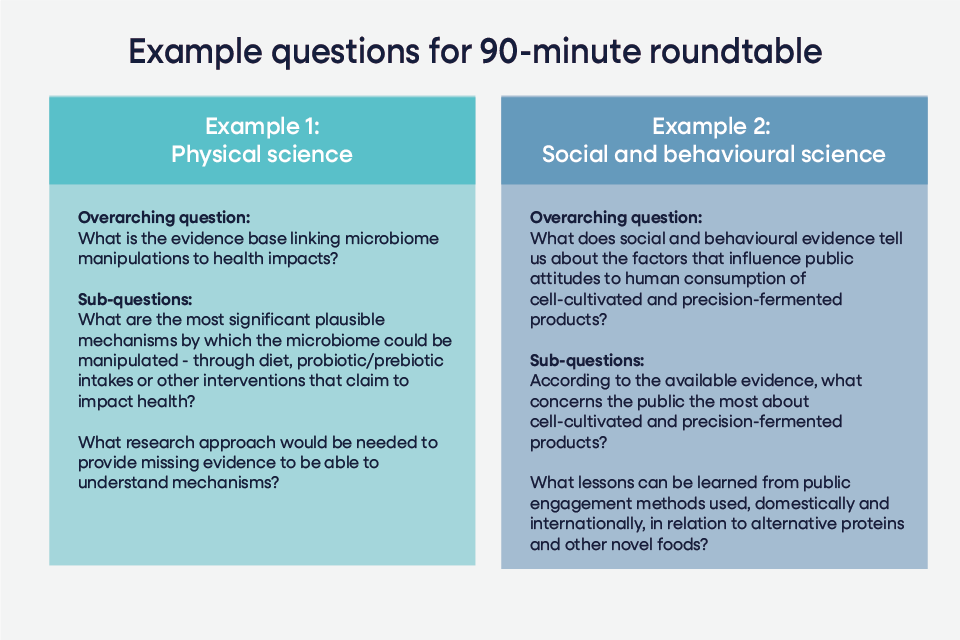
Alt text: Two side-by-side examples of questions for a 90 minute roundtable. The first column (physical science) includes an overarching question on links between microbiome manipulation and health impacts, with sub-questions on mechanisms and research approaches. The second column (social and behavioural science) includes an overarching question on public attitudes to cell-cultivated and precision fermented products, with sub-questions on public concerns and lessons from engagement methods.
Decide on the chair, length and location
-
Select an appropriate chair, such as a CSA or senior civil servant. They do not need to be a subject expert, but they should be confident in guiding discussion and helping participants explain complex topics in accessible terms. They need to ensure contributions are grounded in evidence and the discussion is kept to time.
-
Choose the chair early. This will shape how much time you have for the session and when it can take place, based on their availability. It may also influence whether the session is held online or in person.
-
Decide on in-person or online format. There are several advantages for holding roundtables virtually:
-
Better diversity of participant location, disciplines, and institutions and international participants can be invited.
-
No need to reimburse participants for travel.
-
Straightforward to record roundtables (with chair and participant consent) to ensure accurate note. Depending on department guidelines, AI may be used to assist with note taking.
-
-
In person may be preferable in some cases:
-
Where there’s a strong organiser or attendee preference.
-
Opportunity to organise side-discussions around the roundtable.
-
Particularly sensitive topics are being discussed.
-
Invite participants and observers
Build your long list of potential participants
-
Roundtables normally involve 10-12 experts. Confirm the target number of participants with the chair before sending invites.
-
Start with desk research and ask stakeholders for suggestions of participants. See section 5 for ways to find relevant experts.
-
Ensure you have people who can ‘represent’ different parts of the questions.
-
Create a long list and then curate a short list for initial round of invites.
Send and manage invitations
-
Send invitations out to a short list with a firm deadline, so you reserve the right to invite someone else if they do not respond.
-
Track responses and, if needed, invite others from the long list to fill expertise gaps. Be careful about sending too many invites out at once – only send as many out as you would be happy attending if everyone says yes.
-
Allow time for this process in your planning.
-
You can ask invitees for suggestions of other experts in the field to ensure a good range and as quality assurance for those you identified.
-
State that suggestions are not guaranteed invitations.
-
Ask experts not to forward the invitation themselves
-
Agree observers
-
Decide who the key observers are from relevant departments.
-
Ask if your chair has any preferences. They may prefer minimal observers, or for them to stay off camera, to ensure focus is on experts.
Use confidentiality statement for more sensitive topics
-
For more sensitive topics, include a confidentiality and discretion agreement at the point of invitation to set expectations around their involvement.
-
Provide invitees with a high-level overview of the topic in the invitation.
-
Send full information only after the invitee confirms attendance and agreement to the confidentiality statement.
-
This approach protects the information from going too far beyond those able to attend and provides a framework for confidentiality without going as far as a non-disclosure agreement (NDA),which can be difficult for academics.
Prepare participant briefing
-
Provide a short briefing for participants ahead of the roundtable. Include the purpose of the roundtable, who is chairing, agenda, specific questions being covered and anything they should prepare.
-
Specify if the roundtable is being held under Chatham House Rule, or any other ground rules and provide a link or further information.
-
Include a list of participants. This allows academics to plan the scope of their contribution (i.e. if they are they the only participant from their discipline they may wish to come prepared to represent others’ work).
Prepare Chair’s briefing
- Provide a chair’s briefings that includes background to the roundtable, any sensitive information or background that should not be shared, and an annotated agenda.
Take notes
-
Whenever possible, record the session and also split the notetaking up into suitable sections to manually write key notes. AI may be useful, if approved by your department for this use.
-
For online roundtables, designate a ‘chat monitor’ that makes sure any comments or references in the chat (which are encouraged) are recorded and assigned to the part of the discussion for which they were intended.
-
Aim for concise notes, with a “key points” section at the top to highlight major insights. See Rapid projects - GOV.UK for examples of effective write ups.
-
Ask the participants to review the note for factual accuracy, accurate representation of the discussion, and any additional references or evidence that should be cited.
-
Ensure the chair reviews and signs off the final version.
Follow-up with participants and stakeholders
-
Thank participants and chair in writing. Where possible, share the final note and how the insights will be used and any next steps.
-
Share the note with identified stakeholders across government.
-
Use internal systems to share and store the note as a future resource.