Energy debt circuit breaker: our joint strategy for domestic energy debt
Published 28 October 2026
Applies to England, Scotland and Wales

© Crown copyright 2026
This publication is licensed under the terms of the Open Government Licence v3.0 except where otherwise stated. To view this licence, visit nationalarchives.gov.uk/doc/open-government-licence/version/3 or write to the Information Policy Team, The National Archives, Kew, London TW9 4DU, or email: psi@nationalarchives.gov.uk.
Where we have identified any third party copyright information you will need to obtain permission from the copyright holders concerned.
This publication is available at https://www.gov.uk/government/publications/energy-debt-circuit-breaker-a-strategy-for-domestic-energy-debt/energy-debt-circuit-breaker-our-joint-strategy-for-domestic-energy-debt
Minister for Energy Consumers Foreword

Polly Billington MP
Energy is an everyday essential and nobody can live without it. When gas prices are high, as they have been in recent years following the wars in Ukraine and Iran, this means that for the most vulnerable, however much they ration their consumption, the cost of keeping the lights on can plunge them deeper into debt.
The result is that consumer energy debt now stands at £5 billion, triple what it was in 2021 before the Russian invasion of Ukraine. This is too high and it is time to act.
This debt doesn’t just trap the most vulnerable in a vicious, unsustainable cycle – it also has wider effects that ripple out across our society and economy, and risk undermining the entire energy market.
The cost of servicing debt is spread across all our consumers, contributing to high energy bills. Suppliers dedicate time and funding to recovering debt that could go towards improving the consumer experience, and managing this debt makes them less attractive to potential investors.
The consumer experience needs to change too. The minority who persistently fail to engage need to be incentivised to do so, otherwise it is unfair on the majority who either pay their bills on time or contact their supplier to discuss their options. Suppliers should learn from and adopt best practice to support their customers to manage their energy bills and avoid getting into debt.
That is why we are publishing our debt strategy today - a circuit breaker on energy debt. This will give struggling families some breathing space and restore fairness to the system. Our strategy is built on 3 simple principles:
- Relief – In the immediate term, we will provide targeted, one-off debt relief for vulnerable households to give them breathing space
- Repayment – Debt relief must go hand in hand with a route back to financial stability. We will support households to re-engage with their supplier and take practical steps to prevent debt building up again
- Reform – And in the medium to longer term, we will tackle the root causes of energy debt by modernising payment systems, improving supplier practices and making greater use of smart meters
Tackling this problem requires a major collective effort, from government, Ofgem, suppliers, charities, consumer groups, and, of course, consumers themselves.
As this strategy sets out, if we act together, we can reduce future costs on bills, overcome the effects of energy debt and take another step towards building the foundations for a fairer, more competitive, more cost-effective energy market that exists to deliver for the British people.
Polly Billington MP
Minister for Energy Consumers
Ofgem CEO Foreword

Tim Jarvis
Consumers rightly have expectations of the outcomes they should expect from the energy market. They expect to be treated fairly by their suppliers, supported when things go wrong, and that the system as a whole will deliver for them.
The rise in energy debt is a major barrier to achieving those outcomes: for those households struggling with debt, for energy consumers as a whole, and for the health of the energy market. Left unchecked, persistently high debt increases costs for all consumers, reduces market resilience, and diverts resources away from service improvements and innovation.
This strategy sets out how we plan to tackle household energy debt and make sure we support those struggling with their bills while maintaining the right balance of rights and responsibilities. With the support of government, we can implement our Debt Relief Scheme to target the legacy of the energy crisis and support those who are struggling with the burden of debt built up during that time. We also set out reforms to support suppliers to recover debt while ensuring protections for the most vulnerable and to prevent debt building up in the first place.
Through delivery of this strategy, we will improve consumer engagement, strengthen how suppliers identify and target support, modernise payment and repayment arrangements and address some of the structural issues that contribute to debt. We need a market where those struggling with affordability are given the support they need; those with specific vulnerabilities are protected to ensure continued supply; all are engaged with the market and contributing to affordable repayment plans where they have fallen behind; and the system operates in a way that ensures people do not fall into debt in the first place.
Our partnership with the government is vital to achieving these ambitions. Together with suppliers, charities, consumer groups, debt advisers and consumers themselves we can deliver the change that is needed.
The challenge is substantial, but with coordinated action, we can begin to reduce the stock of debt that has accumulated in recent years, stem the flow of new debt entering the system, and create a retail energy market that is fairer, more resilient and better equipped to support consumers in the years ahead.
Tim Jarvis
Chief Executive Officer, Ofgem
Executive summary
Consumer energy debt in Great Britain has now reached £5bn (Q2 2026). This figure has tripled since 2021 following Russia’s invasion of Ukraine, and the subsequent spike in global fossil fuel prices.[footnote 1] Today, prices are high and remain volatile in the wake of the war in the Middle East. These price rises mean that energy has become unaffordable for many people in Britain today; more than 2 million households are now in energy debt and arrears.
Escaping this debt can be difficult because energy is an essential good - many indebted customers find their energy bill is unaffordable, but much of their energy use is unavoidable. Indebted customers often try to reduce their energy use, which can have negative impacts on their physical health, and the stress of being in debt can also cause negative impacts on their mental health. This can make engagement difficult and mean customers don’t access the support available to them. As debt increases, bills become higher, and the cycle continues.
This debt has impacts across our entire energy market. The cost of this debt is spread amongst all consumers to prevent adverse market impacts and even greater costs to consumers. Suppliers dedicate resources to debt collection that could be focused on customer service or innovation. Our energy suppliers become less attractive to potential investors. Ultimately, if this debt is not resolved or mitigated, it can undermine the stability of our suppliers and the entire market.
We know that there is not a single, simple solution to the energy debt problem, but this government and Ofgem are committed to renewed action. This is why now is the right time for this new energy debt strategy and launching this package of consumer engagement, payment modernisation and market reforms. The strategy sets out our plan to tackle the scourge of energy debt, deliver on government commitments to give households breathing space and improve the cost and ease of living - ultimately reducing bills for everyone. This means acting to reduce both the stock of existing debt in the energy system, by supporting consumers to repay, and stemming the flow of new energy debt, through an ambitious package of retail market reform and modernisation.
It is also an opportunity to modernise how consumers engage with and pay for energy, supporting innovation in payment methods, making better use of smart technology, and creating a retail market that is fit for a more digital and flexible energy system. Throughout, our approach is to ensure the right incentives and processes are in place to enable suppliers to prevent and collect debt, balanced with appropriate consumer protection and support for those who need it.
Government analysis suggests that modernising and reforming payment methods – including our Standard Credit work and greater use of Smart Pay-as-you-Go - alongside the reform of the home moves process could save a typical household almost £30 by 2030, and over £10 a year in that year, rising to almost £20 a year in future years. This is in addition to savings in 2030 and beyond from wider elements of the debt strategy. Ultimately, this analysis estimates that the measures in this strategy could save a typical household around £130 over the next 10 years, compared to if they were not introduced, and should prevent the accumulation of more than £5bn of new debt by 2036. This is in addition to the range of consumer, national and industry benefits detailed throughout the strategy.
The strategy is built on the principles of relief, repayment and reform: providing targeted, one-off debt relief for vulnerable households to give them breathing space, helping households repay their debt and take practical steps to stop it accumulating again and tackling the root causes of energy debt through reforms. Based on these principles, we have developed 4 objectives for tackling energy debt:
- Customers receive the support they need to prevent debt escalation
- Greater use of modernised payment methods and practices to remove barriers to payment
- Improved consumer engagement mechanisms
- Stronger cross-sector collaboration on energy debt
Debt relief, where debt built up due to the exceptional bill increases from Russia’s illegal invasion of Ukraine, must be a central part of any plans. Only this way can indebted consumers be afforded the breathing room they need to get back in control of their energy bills. We will build on the work already undertaken to launch the Debt Relief Scheme, with a focus on promoting sustainable debt reductions by facilitating consumers to take action on their energy debt, as soon as possible in 2027.
We are clear that persistent lack of engagement or repayments by those who can afford to do so is unfair on the majority of customers who try to do the right thing, even in difficult circumstances. Ultimately, by reducing the barriers for people to engage with their energy debt, all consumers stand to benefit. Consumers remain responsible for paying their energy bills and making repayments when they fall into debt, and only through them acting can energy debt be properly tackled.
Alongside this, we are bringing forward new reforms to support consumers in debt or at risk of falling into energy debt, including changes to the home moves process, strengthening the rights of tenants to have smart meters installed, and placing obligations on landlords to notify suppliers of changes of occupancy. We will also continue efforts to improve the availability and use of data to reduce the build-up of debt.
In taking action to incentivise consumer engagement, we are also clear that energy suppliers have a vital role to play in the reduction of debt, and this strategy sets out actions for them to take. They must ensure that they are taking all steps to provide early support and guidance, building trust with customers and improving debt related processes. Put simply, suppliers must put good consumer outcomes first in everything they do.
It is right that we also consider how consumers can be supported, both to avoid falling into debt and to make repayments when they fall behind on their bills. While we must never see a return of the aggressive practices seen before 2023, which led to the forcible installation of traditional prepayment meters (PPM) in the homes of some vulnerable consumers, smart prepayment (known as Smart Pay-as-you-Go or Smart PAYG) can play a vital role in helping households to manage their energy bills, preventing energy debt and providing a structured path for energy debt repayment where affordable. That is why it is right that Ofgem revisit the rules to ensure the right balance is in place: ensuring suppliers can use this tool to help customers manage bills, whilst retaining protections for the most vulnerable. We will also go further, to help consumers consider Smart PAYG a tariff of choice, where appropriate for them, and look at options to widen availability of Smart PAYG related offerings without compromising consumer safety.
We will seek evidence on the role of Standard Credit in the debt pathway with a view to bring forward proposals to reduce the prevalence of Standard Credit for consumers falling into debt. Standard Credit is by far the most expensive tariff type, and the regulatory system can, in some circumstances, require suppliers to move consumers in debt onto Standard Credit as part of the debt pathway process.
We recognise that consumers’ ability to afford their bills is one of the biggest drivers of energy debt, and that reducing both bills and the number of consumers struggling with their bills is integral to a sustainable solution on energy debt. Improving energy affordability is a priority for the new government, and addressing energy debt is a key part if the solution. While we have already taken action to reduce bills, tackling affordability has wider considerations and implications. This strategy focuses specifically on debt but is a complement to wider actions on affordability which are beyond the scope of this strategy.
Only through all parties – government, Ofgem, suppliers, charities and consumer groups, and consumers themselves – taking collective action can the challenge of energy debt be dealt with in a sustainable manner. We are committing to take new action to reduce the existing stock of energy debt and stem the flow of new debt accruing. This new strategy sets out our plan to do that.
Summary of actions
This strategy sets out new and renewed actions by government and Ofgem to reduce existing domestic energy debt and prevent new debt from building up. The actions focus on 4 objectives:
- preventing debt escalation and targeted debt relief
- reforming payment and billing systems to remove barriers to payment
- improving consumer engagement mechanisms; and
- strengthening joint delivery across the sector
Objective 1: Customers receive the support they need to prevent debt escalation
| Action | Lead | Summary |
|---|---|---|
| Debt Relief Scheme | Ofgem | Ofgem will complete further consultation in late 2026 on the design of DRS, building on previous feedback from stakeholders. Subject to completing the necessary consultation processes and appropriately considering the feedback, Ofgem intend to launch and deliver a DRS in 2027. We will also engage with stakeholders on how to deliver the DRS. |
| Priority Services Register review | Ofgem / Government | Ofgem has initiated a programme of work to review the Priority Services Register (PSR) in energy and identify how it can better identify consumers in vulnerable situations and enable more effective support across the sector. It will publish an update on this in the autumn. |
| Improving Access to Data[footnote 2] | Ofgem / Government |
DESNZ will continue to work with other government departments, through the Government Digital Service Household Income Kickstarter, to explore how government can better use data to support those in most need of energy bill support. DESNZ and Ofgem will continue exploring how better data, including credit reference data, can support earlier identification of consumers in need, improve targeting of support and strengthen debt prevention. |
| Improved Consumer Experience[footnote 3] | Ofgem | Ofgem will respond to its Energy Consumer Outcomes implementation consultation in early 2027 |
| (cont.) |
Ofgem, Suppliers, Charities, Consumer Groups and Debt Advice Providers |
Ofgem will be collecting data to better understand where friction still exists following expectations we set out in this area at the start of 2026. |
| Linking debt with the Warm Homes Plan | DESNZ | Government will explore opportunities for maximising the impact of the Warm Homes Plan for those in debt or at risk of accumulating new debt, including working with energy suppliers and local partners to allow more effective targeting of home upgrades. |
Objective 2: Greater use of modernised payment methods and practices to remove barriers to payment
| Action | Lead | Summary |
|---|---|---|
| Home Moves Process | Ofgem | To better understand the impact of proposals, Ofgem has launched a consultation on the Home Moves Process – ‘Deemed Contract Guidance’ alongside this strategy. |
| (cont.) | DESNZ | When parliamentary time allows, the government will take new primary powers to place a new obligation on landlords to provide timely and accurate information to their supplier when tenants move into or out of a property. |
| Role of Standard Credit | Ofgem | Ofgem will bring forward a call for evidence in 2027 on the role of Standard Credit in the energy market, with a view to developing alternative arrangements that better support debt prevention and affordability. |
| Smart Pay-as-you-Go | Ofgem | Ofgem will review the wider prepayment landscape in 2027, with a focus on widening safe and appropriate access to Smart PAYG as a tool to help prevent, manage, and recover debt. This will also consider potential barriers to Smart PAYG adoption. |
| Giving Tenants Greater Control over their Energy Usage | DESNZ / Ofgem | When parliamentary time allows, DESNZ will introduce powers to strengthen tenants’ rights to access smart meters and develop supporting statutory guidance. DESNZ and Ofgem will continue to monitor the effectiveness of the new 2030 Smart Metering Framework, with Ofgem providing regulatory oversight of supplier performance and delivery against the new obligation for suppliers to take all reasonable steps to complete the smart meter rollout by 2030. |
| Facilitating Sustainable Payments | DESNZ / DWP | DESNZ, working closely with DWP, who are responsible for the Fuel Direct scheme, will work across government and key stakeholders to consider opportunities to facilitate sustainable repayments for those on benefits. |
| Variable Recurring Payments | Ofgem | By the end of 2026, Ofgem will convene a cross-sector Task and Finish group on variable recurring payments in the energy market and publish its findings by summer 2027. It will consider potential energy consumer use cases, barriers to consumer and supplier adoption, evidence needed to assess commercial viability and consumer outcomes and safeguards required for responsible innovation. |
Objective 3: Improved consumer engagement mechanisms
| Action | Lead | Summary |
|---|---|---|
| Energy debt advice | DESNZ | Government will continue working with Citizens Advice and the Money and Pensions Service (MaPS) on the mobilisation of the Consumer Energy Debt Advice (CEDA) service to expand debt advice capacity and support positive outcomes for consumers with energy debt. |
| (cont.) | DESNZ / Ofgem | Ofgem and government will consider how best to improve affordability assessments, given their links to repayment arrangements, PPM, Additional Support Credit (ASC), Standard Credit and the Debt Relief Scheme. |
| Supplier Debt and Support Practices | Suppliers | The government will use the Energy Debt Task and Finish group to identify and share examples of good practice, and to hold suppliers to account for taking opportunities to improve their engagement and debt collection processes. |
| Involuntary PPM Rules Review | Ofgem | Alongside this strategy, Ofgem have published a discussion paper on whether the current involuntary PPM installation rules are working as intended. Ofgem will work with stakeholders to test the theory of harm, case for change, and collaboratively develop any policy proposals before consulting in the first quarter of 2027. |
Objective 4: Stronger cross-sector collaboration on energy debt
| Action | Lead | Summary |
|---|---|---|
| Energy Debt Task and Finish group | DESNZ | Government will establish an Energy Debt Task and Finish group, chaired by the Minister for Energy Consumers, to coordinate delivery of this strategy, agree a cross-sector programme of work and support implementation of collective actions. |
Introduction
Energy is an essential service: everyone requires a basic level of consumption to heat their homes, cook, and meet other essential needs. The consequences of going without energy can be severe, and there are strong protections in place to prevent the most vulnerable customers from losing supply if they are unable to pay for their usage. In some circumstances, this can mean an energy supplier continuing to supply the household when they do not have the means to pay their bills or are otherwise not engaging. Many households also pay their bills in arrears, meaning it can be easier for them to fall behind on their energy bills than with non-essential goods or services, particularly at times when energy prices are high.
The sharp increase in energy prices following Russia’s invasion of Ukraine has been accompanied by a significant increase in household energy debt. Debt has tripled since 2022 and sat at £5.02bn as of Q2 2026. More than 2 million households are now in energy debt and arrears and less than half of these households have a repayment arrangement in place.[footnote 4]
Defining debt and arrears[footnote 5]
Arrears: A customer is in arrears if they have not paid a bill for longer than 91 days/13 weeks, and there is no formal arrangement to repay the debt.
Debt: A customer is in energy debt if they have an arrangement to repay overdue amounts by entering into a formal repayment plan (including prepayment meters repaying a debt, or non-prepayment meter customers on debt repayment arrangements extending beyond 91 days/13 weeks).
Bad debt: The amount of unpaid bills a supplier does not expect to recover.
For ease, references to ‘energy debt’ in this strategy cover both debt and arrears unless otherwise specified.
High levels of energy debt are in no one’s interest. The costs of managing bad debt are socialised across consumer bills to ensure suppliers can recover their operating costs and maintain protections for those in vulnerable situations. However, the cost for consumers, as a weighted average across all payment types and protected by the price cap, is now approximately £67 per year towards managing this debt, almost double the level seen before 2022. This adds further pressures at a time when prices are high.
Energy debt can have a significant impact on indebted households and there is evidence that prolonged indebtedness can have a negative impact on people’s physical and mental well-being. High levels of debt also undermine our energy system by disincentivising investment in the retail market and requiring suppliers to devote more resources towards debt administration and recovery.
Energy affordability is a priority for the government, and we are committed to supporting households with the cost of living and putting money back in people’s pockets. Stemming the growth of energy debt and reducing the costs it imposes on all consumers is central to that commitment. The government is also committed to ensuring households in debt receive the support they need to improve their financial situation.
The government has already taken action to give households breathing space with the cost of living. On his first day in office, the Prime Minister announced that VAT will be removed from domestic electricity bills from 1 October 2026 to 31 March 2027. This builds on previous action, such as taking an average of £150 off bills at Budget 2025 and expanding the Warm Home Discount scheme.
As well as short-term support, the government is also looking at what wider changes are needed to improve affordability, to make the whole system work coherently in the interest of consumers. This will mean putting our communities at the centre of delivering the Warm Homes Plan and devolving funding so regional and local government can play a critical role in co-ordinating and accelerating the pace of home and building upgrades over the course of the next decade. Through solar, clean heat and smart technology, people can directly benefit from the drive towards electrification.
This strategy builds on these interventions by setting out an ambitious package of reforms to reduce the flow of new debt, support households to repay, and ensure energy suppliers have the right tools to recover debt fairly. It recognises that energy debt is a systemic problem and breaking the debt cycle will require co-ordinated action by government, Ofgem, suppliers, charities and consumer groups and consumers themselves. This strategy sets out our plan to deliver it.
Given energy affordability has wider considerations and impacts beyond debt, this strategy should be considered as a complement to wider actions on affordability, which goes beyond the scope of this strategy.
The scale of the problem
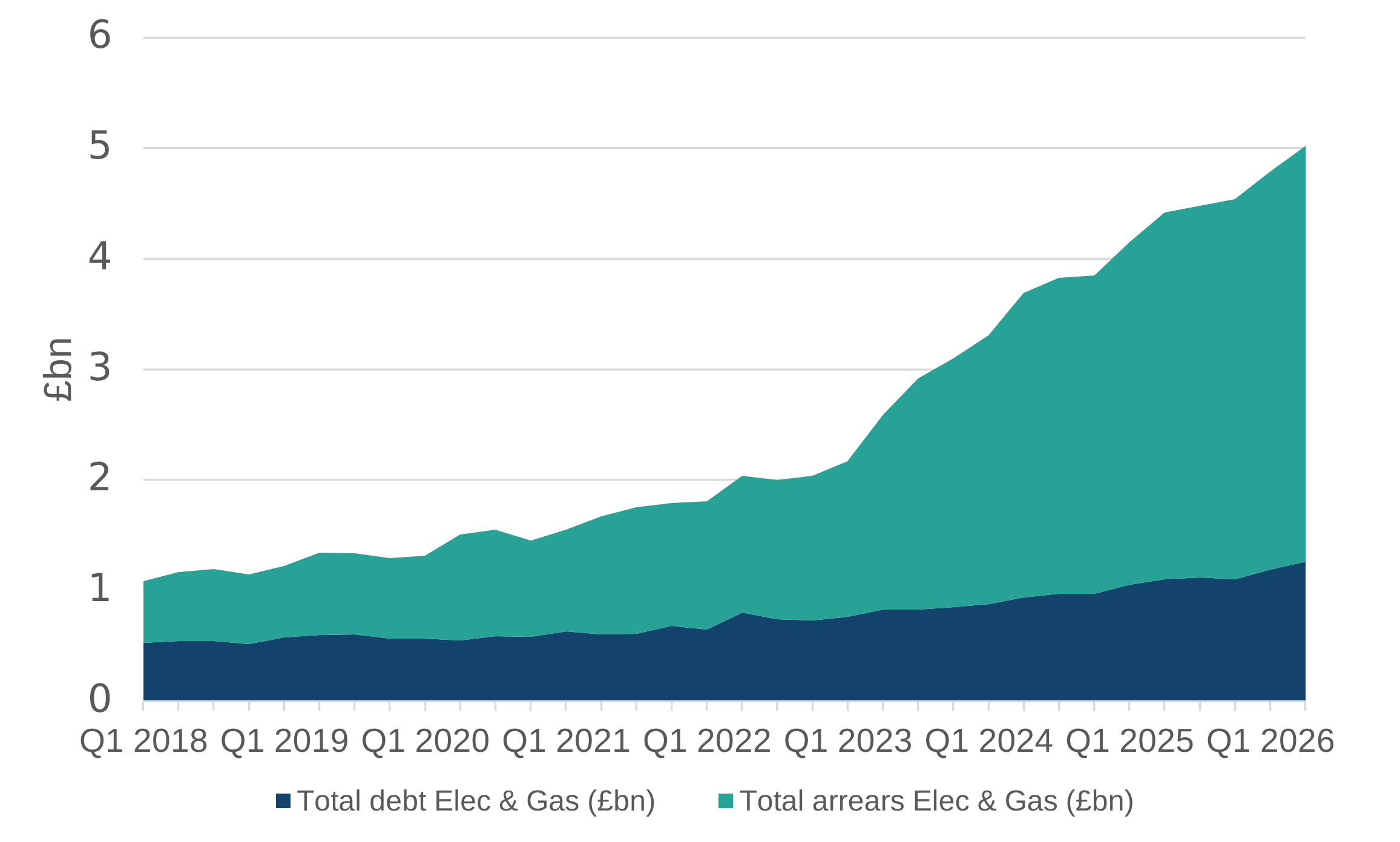
Household energy debt and arrears have increased sharply since Russia’s invasion of Ukraine in 2022. Figure 1 shows a particularly high growth in the level of arrears, which are not subject to a repayment arrangement.
Figure 1: Total Financial Value of Domestic Customer Debt and Arrears (>91 Days)
Source: Ofgem, Debt and Arrears Indicators[footnote 6]
Description of figure 1: A stacked area chart illustrating the total value of debt against the total value of arrears. It shows a steep growth in the level of arrears from Q1 2023 to Q1 2026.
Ofgem data also shows that average household electricity and gas debt and arrears have increased significantly over this period. Since Q3 2022, the average level of debt with a repayment arrangement in place has increased from £456 to £828 for electricity and £341 to £679 for gas. Average arrears have risen even faster, more than doubling from £927 to £1,876 for electricity and from £685 to £1,623 for gas.
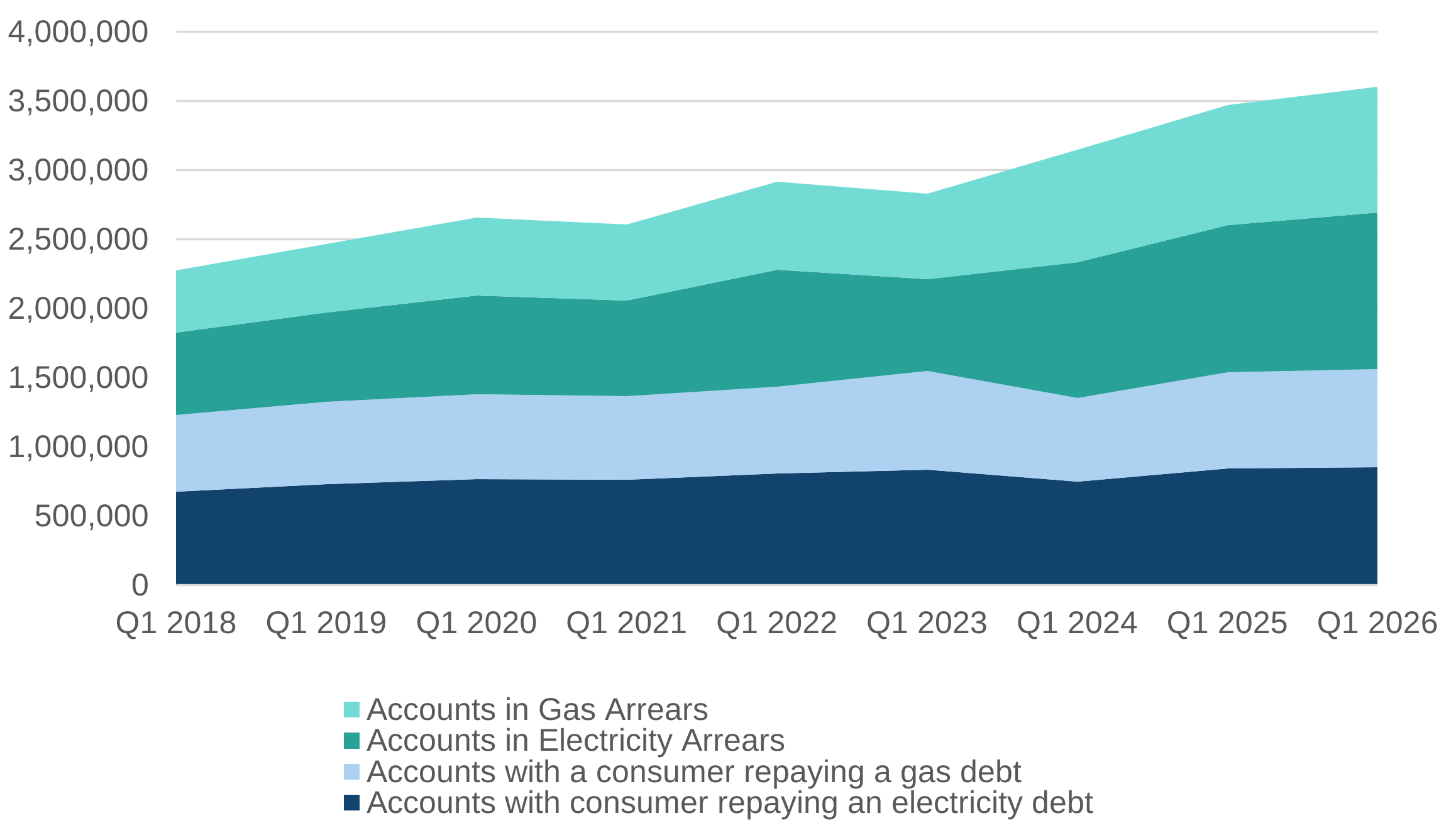
During the same period, the number of accounts in arrears increased markedly, while the number of accounts with a repayment arrangement has remained steady. In the first quarter of 2023, around 620,000 gas accounts and 660,000 electricity accounts were in arrears with no repayment arrangement. By the start of 2026, this had risen to over 900,000 gas accounts and 1.1 million electricity accounts. Ofgem data now shows that three-quarters of all debt is with customers who have no repayment plan.[footnote 7]
Figure 2: Total Number of accounts with a consumer repaying an energy debt/in arrears where there is no arrangement to repay the debt
Source: Ofgem, Debt and Arrears Indicators[footnote 8]
Description of figure 2: A stacked are chart showing the total number of accounts in arrears by type: gas, electricity, consumer repaying a gas debt; and consumer repaying an electricity debt.
Consequently, there are 2 components to the debt issue:
- the increased total stock of debt, which has risen significantly since Russia’s invasion of Ukraine; and
- the continued net flow of new debt accruing, which has also increased over this period, and continues to add to the stock of debt
Taking action on debt can also help improve energy affordability. As a result of rising levels of energy debt, we have seen increases to the debt-related costs allowance component of the price cap. As debt and arrears have risen – and where those rises were, in part, a consequence of factors outside of suppliers’ control – the allowance has needed to increase to reflect the resulting costs and to preserve the financial stability of the energy supply market and create space for suppliers to offer payment holidays and repayment plans to struggling households. In order for this cost component to be reduced, the stock and flow of energy debt must fall.
Understanding the drivers of energy debt
Affordability
Energy bills rose sharply following Russia’s invasion of Ukraine and are still higher than before the energy crisis. The price cap covering the period immediately before the invasion (running to 31 March 2022) was £1,093 for a typical dual-fuel direct debit customer.[footnote 9] The intervening period, when large amounts of debt were accrued, saw bills reach significantly higher levels than this, rising to around £2,100 while the Energy Price Guarantee was in force.[footnote 10] While prices have been lower since then, Britain’s exposure to fossil fuel markets, exacerbated by the ongoing conflict in the Middle East, means that prices remain higher than before the start of the crisis, with the Q4 2026 price cap being set at £1,723.
Figure 3: Price cap levels over time, broken down by component[footnote 11]
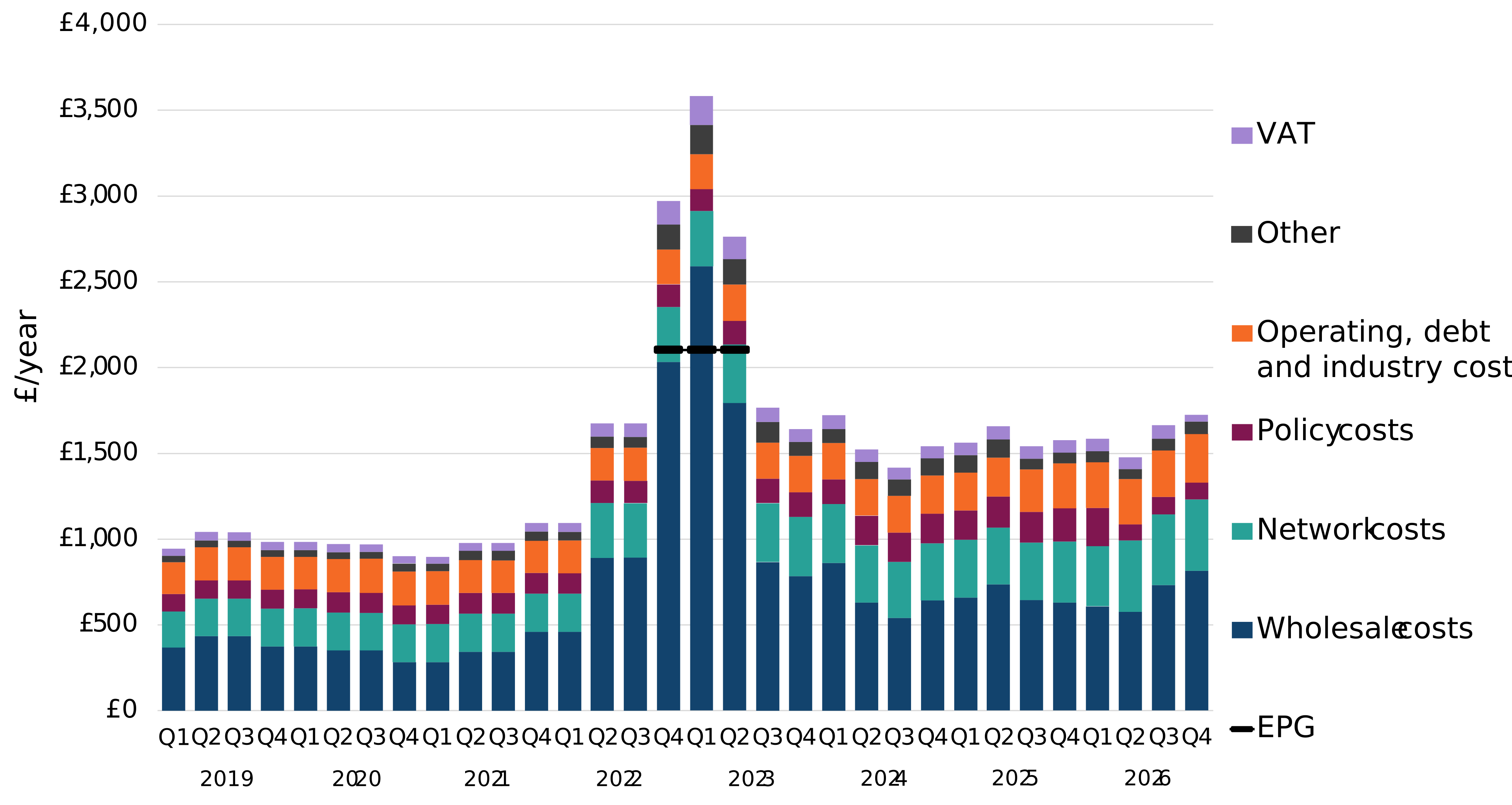
Note: Price cap based on current Typical Consumption Values (TDCVs) of 2,500 kWh for electricity and 9,500 kWh for gas. Dual fuel. Direct Debit, GB average. The EPC line shows the level of the EPG (at current TDCVs), which limited the price cap between Q4 2022 and Q2 2023.
Description of figure 3: A stacked bar chart showing price cap levels over time by component: VAT; operating, debt and industry costs; policy costs; network costs; wholesale costs; EPG; other.
High energy bills and wider cost of living pressures have stretched household budgets in ways which mean many have fallen behind on their bills. Research by Citizens Advice shows that 1 in 3 households worried about paying their energy bills last winter, and around 6.8 million households found it difficult to reliably afford their energy bills.[footnote 12] This reflects that many households are at risk of getting into energy debt but have carefully managed their finances and made difficult decisions to avoid doing so.
Other sectors have seen issues with consumer debt too, where there are commonalities with energy. Total water bill debt stands at over £2 billion, and just under one million customers have not paid a water bill for more than 12 months.[footnote 13] Outstanding balances on credit cards increased by around 9% between May 2025 and May 2026. However, the percentage of total balances outstanding which incurred interests have fallen since November 2023, suggesting that consumers may prioritise those debts over energy bills in order to avoid additional costs.[footnote 14]
In 2025 1 in 5 adults had to borrow money to buy food or pay bills, and half of UK adults were struggling to keep up with bills and commitments.[footnote 15] This situation endures in 2026: 89% of adults reported that the cost of living is the most important issue facing the UK today, with two-thirds finding that their cost of living had increased compared to a month ago.[footnote 16]
Citizens Advice found that many of the people it worked with on debt faced multiple affordability or debt barriers. Over half of its debt clients had 4 or more debt issues, and half had a negative budget and so were unable to pay down their debts at all.[footnote 17] The Resolution Foundation also found that the proportion of individuals living in families behind on at least one priority household bill had increased across all 4 of the bottom household income quintiles.[footnote 18]
Engagement
Three-quarters of energy debt now sits with accounts without a repayment arrangement in place.[footnote 19]
Falling behind on bills can be stressful and discourage customers from engaging with their supplier. Customers in debt may be reluctant to contact their supplier, may be uncertain about the support available to them, or may not realise that help can also be accessed through trusted third parties such as charities and debt advice services.
Energy UK’s recent Energy Debt: Everyone Pays report rightly identifies consumer engagement as a key part of the debt problem.[footnote 20] Debt resolution is more likely when consumers engage with the support available and share information about their circumstances.
Effective engagement is a shared responsibility: suppliers and the wider industry must create the conditions for customers to engage, while customers who are able to do so need to engage with the support and repayment options available to them.
We also know that the way the energy retail market operates does not consistently create the right incentives for customers to engage.
For example, the current regulatory framework does not require consumers to provide their details or set up an account when moving home, and Energy UK estimates that suppliers have no details for more than one million households.[footnote 21]
Under current arrangements, consumers are generally able to access energy immediately when they move into a property. This can result in consumers unknowingly accumulating debt for weeks or months before contact is established with a supplier. During this period, opportunities to establish early engagement, assess affordability, identify vulnerabilities and provide support may be missed, increasing the risk that debt builds up unnecessarily. Consumers may then struggle to repay this built-up debt. The process by which consumers move in or move out of a property is estimated to drive between 20% and 40% of the current debt stock.[footnote 22]
Targeting consumer support and protections
Lack of data on customers can make it harder for suppliers to identify customers who need support, including those who are vulnerable. Without verified customer data, it is also harder for suppliers to understand consumers’ ability to pay and develop repayment arrangements that are affordable and sustainable.
Many suppliers have strong and effective partnerships with debt advice organisations and the debt advice sector plays a critical role in providing valuable additional support to those in debt. Debt advice providers offer advice and practical support such as help to agree debt management or repayment plans.
As noted in the government’s Financial Inclusion Strategy, despite the important role debt advice can play, there is a significant gap between the number of adults who would benefit from receiving debt advice, and those who do.[footnote 23] It noted that in the 12 months to May 2024, 22% of UK adults in financial difficulty used a debt advice or debt management service, meaning the majority (78% or 3.5 million) did not access support, despite the benefit they would receive from it.
The debt advice charity StepChange also noted in 2024 that, “demand for debt advice is rising, there is growing financial pressure on both consumers and debt advice providers, and people are coming to debt advice with multiple needs and circumstances that make quick and conclusive resolutions to their debt problems harder to achieve.”[footnote 24]
The ‘Financial Inclusion Strategy’ set out action that the government is already taking to ensure that more people can access specialist debt advice, through increased funding for the Money and Pensions Service by over 10% to more than £100 million in 2025-26 and maintaining it above £100 million in 2026-27, alongside support for more efficient services. However the record level of energy consumer debt will continue to place additional pressures on the debt advice sector.
Suppliers play a critical role in preventing debt, supporting customers in payment difficulty, and managing arrears when they arise. While many suppliers have invested significantly in affordability support, customer assistance and debt management capabilities, outcomes remain inconsistent across the market. Strong referral pathways, information-sharing arrangements and collaborative working between suppliers and trusted intermediaries can improve consumer engagement and help ensure support is tailored to individual circumstances. Ofgem’s guide for energy suppliers and debt advice providers shows what is required to demonstrate this good practice.
Evidence from Citizens Advice[footnote 25] points to increasing levels of financial hardship among people seeking debt advice. In 2026, 51% of debt clients were in a negative budget, meaning their essential costs exceeded their income, with those households facing an average monthly shortfall of £254. While this evidence relates to debt clients generally rather than specifically to customers with energy debt, it demonstrates the significant affordability pressures facing many households.
Although data from Citizens Advice is not necessarily representative of all customers with energy debt, the evidence does demonstrate that customers in debt are not a homogeneous group and that, even amongst those seeking debt advice and support, financial circumstances can vary considerably. Within this cohort, some households face persistent shortfalls that limit their ability to pay for ongoing consumption or repay debt, while others (around half of those seeking energy debt advice from Citizen’s Advice) can afford to pay for ongoing consumption. For those consumers able to repay, sustainable repayment arrangements tailored to their circumstances can help customers maintain ongoing payments, avoid further debt accumulation, and improve the likelihood of successful payment over the longer term.
Getting the basics right can make a significant difference to debt outcomes. Accurate and timely billing, effective management of metering issues, clear communications and early customer engagement can help prevent debt from arising in the first place and support consumers to seek assistance before payment.
Payment methods
Main payment methods:
Direct Debit: Consumers pay a regular amount automatically from their bank account, helping to spread energy costs across the year and reduce the risk of missed payments.
Standard Credit: Consumers receive a bill after using energy and must then make a payment, typically by bank transfer, cash, cheque, or card.
Traditional prepayment meter: Consumers pay for energy in advance by topping up a card or key, usually at a shop or Post Office, before energy can be consumed.
Smart pay-as-you-go: Consumers pay for energy in advance using a smart meter that can be topped up remotely online, by phone, or through an app.
The current energy retail market was established on the assumption that most consumers would pay for their energy by Standard Credit, where customers pay in arrears after receiving a bill. Most consumers now pay by Direct Debit, but Standard Credit remains a core payment method.[footnote 26] The continued prevalence of Standard Credit makes energy, along with water, an outlier compared to how consumers typically pay for other services, such as rent, broadband and the TV Licence, and Council Tax.
Standard Credit is both the most expensive payment method and has the lowest customer satisfaction.[footnote 27] For a typical dual fuel household under the October to December 2026 price cap, Standard Credit consumers faced a premium of £138 and £183 per year respectively compared to those paying by Direct Debit or Prepayment Meter. This is because payment by Standard Credit is more expensive for suppliers to provide and includes a higher debt allowance relative to other payments due to the prevalence of debt amongst Standard Credit customers.
While Standard Credit offers a degree of flexibility for consumers, it also increases the risk of debt accumulation. Because payment is made after consumption, charges can build up before they become due. This can result in arrears accumulating quickly – particularly during winter or periods of elevated energy prices. Customers whose Direct Debit arrangements fail or are cancelled will usually move on to Standard Credit, meaning the payment method can become concentrated with customers already experiencing financial difficulty as well as those for whom a prepayment meter is not safe or reasonably practicable.
Alternatively, Direct Debit and Smart Pay-as-you-Go are examples of payment methods that align more closely with how consumers pay for many other household goods and services, either through regular scheduled payments or payment before consumption. These approaches can provide greater visibility of costs and support more active management of household budgets and enable earlier intervention when payment difficulties arise. As consumer expectations and technology evolve, there is an opportunity to develop a more dynamic and innovative payments landscape, including new payment models, such as Variable Recurring Payments, that provide greater flexibility, improve consumer experiences, support affordability and debt prevention, and promote competition and innovation across the retail energy market. These innovations will benefit now only customers in debt, but all consumers, helping to create an energy system fit for the modern day.
Debt Strategy objectives
As described above, there is no single driver of the stock and flow of energy debt we are now seeing in the market. While the drivers are diverse, there are common themes which emerge from them, and which point to areas where collective action is required.
Fundamentally, consumers’ ability to afford their bills is one of the biggest drivers of energy debt. Reducing energy bills and the number of consumers struggling with their bills is therefore integral to a sustainable solution on energy debt. While improving energy affordability is a priority for the new government, it is an issue which goes beyond energy debt. The government has taken action to reduce energy bills already, and will continue to explore all avenues to reduce them further to bring UK energy costs in line with other nations in Europe within 10 years.
Given energy affordability has wider considerations and impacts beyond debt, this strategy should be considered as a complement to wider actions on affordability, which go beyond its scope.
Taking piecemeal action on each individual driver without identifying common threads or the interactions between them is unlikely to lead to a sustained improvement on energy debt. Considering the drivers collectively and the interactions between them, we have established 4 systemic challenges where action is required:
Systemic challenges
- Indebted customers, who struggle to pay their energy bills and reduce the debt they have built up, need further support
- Barriers such as outdated payment/repayment methods and practices can make it hard for consumers to pay their bills, encouraging the build-up of debt
- Existing rules and processes do not always promote effective consumer engagement with debt. This can prevent action to make repayments or establish repayment arrangements that are based on robust assessments of ability to pay. Furthermore, inadequate data sharing/access to data limits the ability to engage consumers or tailor support effectively.
- Siloed action limits progress - taking action on debt requires a framework for common work and joint working across the energy consumers and debt landscape
These challenges will guide our thinking on tackling energy debt’s causes and negative effects, and as such we have developed 4 objectives that the strategy seeks to achieve.
| Systemic challenge | Objective | Objective description |
|---|---|---|
| Indebted customers, who struggle to pay their energy bills and reduce the debt they have built up, need further support. | Customers receive the support they need to prevent debt escalation | Customers in debt receive support, including debt write-offs through the Debt Relief Scheme, to reduce the stock of debt |
| Barriers such as outdated payment/ repayment methods and practices can make it hard for consumers to pay their bills, encouraging the build-up of debt. | Greater use of modernised payment methods and practices to remove barriers to payment | A more modernised system of payments and account practices are put into place to prevent the build-up of debt. This includes taking action on practices known to lead to increased debt, such as the home moves process or the prevalence of Standard Credit. |
| Existing rules and processes do not always promote effective consumer engagement with debt. This can prevent action to make repayments or establish repayment arrangements that are based on robust assessments of ability to pay. Furthermore, inadequate data sharing/access to data limits the ability to engage consumers or tailor support effectively. | Improved consumer engagement mechanisms | Barriers to engagement are removed and processes are improved to prevent new debt accumulating and encourage repayment. There is also better utilisation and sharing of data to support engagement. This includes reviewing the current rules around prepayment meters and encouraging improved supplier debt and support practices. |
| Siloed action limits progress - taking action on debt requires a framework for common work and joint working across the energy consumers and debt landscape | Stronger cross-sector collaboration on energy debt | All parties are clear on their role to tackle energy debt, and are working collectively to tackle the issue. This includes government convening an Energy Debt Task and Finish group to join up actions on energy debt. |
This new debt strategy sets out the government and Ofgem’s plans for achieving these objectives.
Monitoring progress against this strategy
Ofgem already publishes a range of information on consumer outcomes and retail market performance, including our debt and arrears indicators.[footnote 28] These provide important insights into how effectively the market is delivering for consumers. As this strategy is implemented, we will review whether our existing reporting continues to provide the most meaningful assessment of progress and explore opportunities to strengthen transparency further. This includes considering how best to track progress in reducing energy debt across the market as a whole, alongside reporting on the impact of individual interventions designed to reduce and prevent debt build-up, support sustainable repayment and improve consumer outcomes.
The need for concerted action
No single organisation can solve the challenge of energy debt alone: tackling energy debt is a shared responsibility. It requires concerted action across the sector, and different solutions to the different drivers of debt covered in the section above. There is a role to play for all parties - energy consumers, suppliers, government, Ofgem, charities consumer groups and debt advice providers. The full role of each of the parties is detailed in Annex A.
While all these parties have a critical role to play in tackling energy debt, consumers retain overall responsibility for paying their bills. The majority of consumers take action to pay their bills: they carefully manage their finances even when times are hard, they agree repayment plans with suppliers or debt advice charities when they fall behind, or they speak to their supplier to resolve issues. However, we recognise that the unique circumstances of the past few years have contributed to higher levels of debt and consumers finding it hard to keep on top of their bills. This has meant more customers lack the ability to pay due to a range of financial and personal circumstances.
While some customers lack the capacity to take action, there are, however, some consumers who choose not to engage (e.g. by not setting up an account when they move home) or pay their bills when they otherwise could do so. The government and Ofgem are committed to reducing the barriers for engagement, but the onus will remain on those consumers who are able to take action to do so. Persistent lack of engagement by those who can do so is unfair on the majority of customers who try to do the right thing, even in difficult circumstances. While it is right that support is offered to those consumers who need it, the right incentives and processes also need to be in place to ensure those who can pay or take action do so in a timely way.
Existing action on energy debt
Ofgem published its own debt strategy[footnote 29] in December 2024, setting out the action it would take to reset the debt in the domestic energy market and reform the system to do so. Similarly, the government has taken action to support consumers with energy bill pressures. This complements the action taken by energy suppliers to help their customers struggling with their bills, including providing practical support to keep homes warm in winter and provide bill credits. Charities and consumer groups also provide invaluable support to help customers, often in very vulnerable circumstances, to access support and to put in place sustainable debt solutions.
This section provides an overview of actions taken to date that have contributed to tackling consumer energy debt. These include measures introduced through wider regulatory, compliance, affordability and consumer protection interventions that support the strategy’s objectives by reducing debt, improving consumer outcomes, or strengthening protections for those at risk of falling into debt.
More detail on the individual interventions can be found in Annex B.
| Intervention | Party | Description |
|---|---|---|
| Energy Affordability | Government | Removal of VAT from domestic electricity bills from 1 October until 31 March 2027, taking around £45 off the price cap Removal of around £150 of costs off domestic bills, announced at Budget 2025 Expansion of £150 Warm Home Discount to around 6 million households and extension of scheme to 2031 |
| Warm Homes Plan | Government | Grants and loans to install heat pumps, solar panels, and batteries New rules to ensure landlords invest in energy efficiency upgrades for renters and social tenants |
| Cost of Living Support | Government | National Living Wage increases to boost pay for low-paid workers Increases to Universal Credit rates at Budget 2025 Free breakfast clubs rolled out to half a million more children Launch of £1 billion Crisis and Resilience Fund |
| Charity, Consumer Group and Debt Advice support | Charities, Consumer Groups and Debt Advice Providers |
Launch of Consumer Energy Debt Advice (CEDA) - a new holistic debt advice service, aiming to provide support to up to 150,000 clients per year by Citizens Advice in partnership with Money Advice Trust and StepChange Variety of initiatives, including consumer support on energy issues, negotiations of repayment plans, debt advice, advocacy and support, and support to maximise household income/access to support |
| Debt Standards | Ofgem | New initiatives to improve outcomes for consumers in debt, including clearer expectations on suppliers and good practice guidance on working with debt advisers |
| Smart Meter Rollout | Government | Introduction of new framework to ensure smart meters operate as they should and take all reasonable steps to complete the rollout of smart meters by the end of 2030 |
| Prepayment Meter (PPM) rules | Ofgem | Introduction of stronger rules on the involuntary installation of PPMs |
| Additional Support Credit (ASC) | Ofgem | Provision of clearer expectations in relation to assessing consumers’ best interests for ASC |
| Prepayment Meter redress | Ofgem | Around £70m in direct consumer compensation and debt write-offs |
| Data improvements | Government | Launch of Government Digital Service Household Income Kickstarter project to better utilise public sector data |
| Vulnerability Commitment | Energy UK | Voluntary commitment for how energy suppliers will support customers in vulnerable circumstances |
| Supplier and Industry Support | Suppliers | Variety of initiatives across industry, including debt matching schemes, funding debt advisers, debt write-off, provision of energy-saving equipment, and wellbeing support |
Going further
The actions above are important contributions to improving consumer outcomes, supporting the affordability of energy, and putting in place the foundations to sustainable solutions to energy debt. However, alone they are not sufficient to provide the required circuit breaker on energy debt and to tackle the 4 systemic challenges and achieve the strategy’s identified improved objectives.
Figure 4: Energy Debt Circuit Breaker – Objective
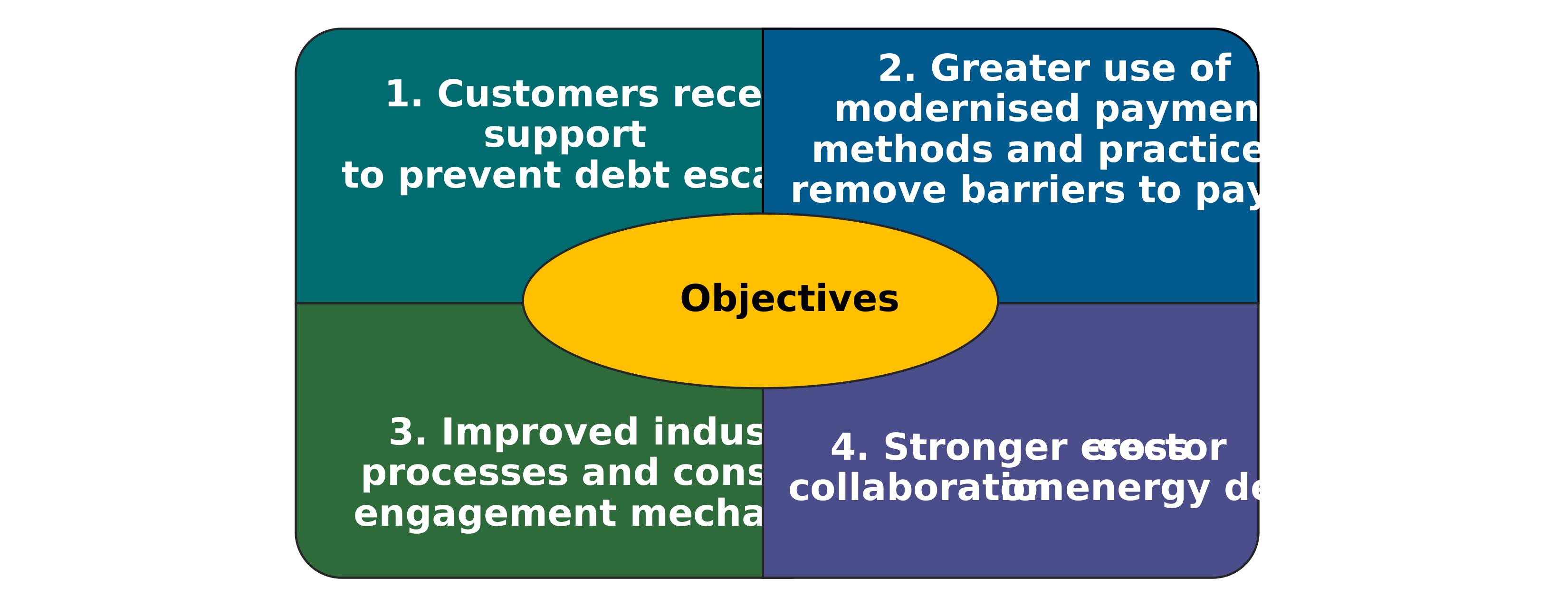
Description of figure 4: Circuit breaker objectives:
- Customers receive support to prevent debt escalation
- Greater use of modernised payment methods and practices to remove barriers to payment
- Improved industry processes and consumer engagement mechanisms
- Stronger cross-sector collaboration on energy debt
To turn the tide on energy debt, further action is needed to address each of those 4 challenges and confront the stock and flow of energy debt. This section sets out new and renewed actions to be taken by government and Ofgem to do that. The logos below illustrate which objective each action supports.
Debt Relief Scheme
We will deliver a Debt Relief Scheme in spring 2027, to provide targeted support to customers in genuine financial need.

(Supporting Objective 1)
The Debt Relief Scheme (DRS) is a one-off, targeted intervention designed to help customers in genuine financial need who hold debts arising from high prices experienced during the 2022-24 energy crisis, and who have little realistic prospect of repaying these debts. These debts are difficult to manage for consumers in serious financial difficulty, and have negative consequences for the wider retail energy market.
The DRS supports the first and third objectives of this debt strategy by reducing historic debt held by individual consumers in genuine financial need, and incentivising these customers to take action to prevent future debt buildup. Previous supplier-led debt matching and debt relief initiatives have delivered lasting benefits for consumers. In a recent example, 85% of households who received debt relief from their supplier remained debt free after 12 months.[footnote 30]
Ofgem consulted on the DRS in 2024 and published a Statutory Consultation in 2025. Since then, work across government has focussed on engaging stakeholders to understand how such a scheme can best support consumers, both through targeted write-offs and building consumer engagement with energy debt. Government has reviewed the design of the scheme to ensure it meets wider government objectives to support consumers and aligns with wider government policy interventions. DESNZ has worked with Ofgem to refine the scheme design to ensure that it has the most impact possible, delivers value for money to the billpayer, and fully complements the other elements of this strategy in the light of continued uncertainty around energy prices in the domestic retail market. These changes include:
- delivering DRS in a single phase to simplify scheme delivery;
- extending the eligibility criteria to consumers on means-tested benefits, disability benefits, and pensioners; and
- strengthening engagement criteria which consumers must meet in order to receive DRS support, by making greater use of smart prepayment and supplier repayment plans, whilst preserving protection for customers who are vulnerable or in greatest financial need
Subject to completing the necessary consultation processes and appropriately considering the feedback, Ofgem intend to launch and deliver a DRS in 2027. Ofgem will further consult on these changes and the design of DRS shortly building on previous feedback from stakeholders. We will also engage with stakeholders on how to deliver the DRS.
Lead organisations:
Ofgem (consultation on final DRS policy, delivery and supplier engagement) and DESNZ (ongoing policy development).
Next steps:
Further consultation in late 2026 followed by a decision early in 2027, working towards customer go-live in spring 2027, subject to the outcome of this consultation.
Reforming the home moves process
The government and Ofgem will address energy debt that arises in the home moves process by providing improved guidance to suppliers regarding remote switching to Smart PAYG during change of occupancy, as well as obligating landlords to provide their tenants’ contact details to the supplier.

(Supporting Objective 2)
Using evidence received from suppliers, Ofgem estimates that 20-40% of energy debt is associated with changes in occupancy, driven both by uncertainty over who new occupiers of a property are and consumers leaving properties without clearing outstanding balances.[footnote 31]
Home moves guidance
Alongside this strategy, Ofgem is consulting on improved guidance for suppliers on the home moves process.[footnote 32] The guidance would apply where no new occupier has contacted the supplier. In these circumstances, suppliers may assess whether the property is suitable for a remote switch to Smart PAYG.
The guidance will also standardise the protections available to customers who move into a property without registering with a supplier. This is intended to reduce the risk of customers receiving unexpected or large bills and give households greater control over their energy use from the outset. Earlier engagement with suppliers can also help customers access support sooner, including services such as the Priority Services Register.
Through Smart PAYG, households can continue to access energy for a minimum 2-week period giving the time to set up an account. This provides sufficient time for a consumer to contact their supplier and to inform them of any additional support needed if applicable.[footnote 33] When used with appropriate safeguards, Smart PAYG can help customers manage and budget for their energy use. Access to real-time consumption information can help households better understand their energy usage and make more informed decisions about how and when they use energy.
The consultation does not require suppliers to adopt this approach. Instead, it sets out a standardised process that suppliers can choose to follow, while retaining flexibility to design alternative home-move arrangements that meet regulatory requirements and deliver appropriate customer protections.
Improving information flows
Reforming the home moves process so there is more clarity on who is occupying a property also presents a significant opportunity to prevent avoidable energy debt from arising and give consumers in the private and social rented sectors more control over their energy usage. Improving the flow of information between landlords, tenants, and suppliers will help ensure accounts are established more quickly, billing is accurate, and consumers can be identified and supported at an earlier stage.
Government will introduce legislation to Parliament to reform the home moves process, placing a new obligation on landlords to provide timely and accurate information to their supplier when tenants move into or out of a property. Where neither the tenant nor landlord has provided the necessary information, landlords may become liable for energy charges associated with the property. We will consider whether different arrangements for financial liability are appropriate for the social rented sector. The reform would place similar obligations on landlords as exist with respect of water bills in England and Wales.[footnote 34]
This reform will create a fairer balance of responsibilities between tenants and landlords, recognising the important role landlords can play in providing timely information to suppliers about occupancy and tenancy changes that could help to reduce the amount of debt in the system. It will protect both tenants and landlords alike: it will prevent tenants from receiving large, backdated bills, or inheriting bills from previous occupiers, thereby increasing certainty over energy costs, and for landlords it will mean that their tenants are less likely to fall into energy debt, which may compromise their ability to pay rent or other bills. Moreover, it will support better outcomes for consumers as a whole, reducing costs across the energy system and help protecting bill payers from the costs of unrecovered debt.
We recognise that this reform may take some time to come into effect. Consequently, we will look at what shorter-term interim measures we can put in place, so that debt accumulation in the home moves process can be avoided sooner.
Lead organisations:
Ofgem (home moves guidance) and DESNZ (improving information flows)
Next steps:
- Home moves guidance: To better understand the impact of proposals, Ofgem has launched a consultation on the Home Moves Process – ‘Deemed Contract Guidance’ alongside this strategy.
- Improving information flows: When parliamentary times allows, the government will take new primary powers to place a requirement on landlords to provide timely and accurate information when tenants move into or out of a property. This will be followed by further engagement with key stakeholders including consumer groups, charities, landlord and letting agent groups and suppliers on the practical and operational details of this intervention.
Linking debt to the Warm Homes Plan
The government will explore maximising opportunities in the Warm Home Plan for those in debt.
(Supporting Objective 1)
The Warm Homes Plan will help households to upgrade their homes, bring down bills and lift up to one million households out of fuel poverty by 2030. Upgrades cannot only be for those who can afford them; they also need to be accessible for the most vulnerable, so that they too can benefit from technology that can dramatically reduce bills. Billions of Warm Homes Plan funding will be allocated directly to households on low incomes to allow them to benefit from technologies including heat pumps, solar PV and batteries. There is significant opportunity for these technologies to support customers in debt, or at risk of falling into debt to reduce their bills.
However, being in debt can currently be a blocker to consumer access to bill saving technologies and the accompanying smart and flexible tariffs which can maximise bill savings. Often, customers in debt are prevented from switching suppliers or tariffs until they clear their debt. We need to make sure that being in debt does not stop customers from accessing the very things that could support their path out of debt.
The Warm Homes Plan will give mayors, local government and communities the power to invest billions of pounds in their place, to upgrade millions of homes. We will explore opportunities for energy suppliers to identify customers in, or at risk-of being in debt, and the potential use of government data and technology to verify benefit status and income so that local partners can prioritise delivery of home upgrades to those most in need. Delivery of bill saving packages of technologies, such as solar and batteries, could result in large monthly savings, and there is an option to look at how savings could both provide a benefit to the household and also go towards paying down debt - this is a progressive approach to relieving the current debt burden on all energy consumers, for example the household could have a fixed bill and any savings above this are used for debt reduction.
Other opportunities could be available through the Warm Homes Fund, which will support innovative finance models to support home upgrades and reduce bills. Models considered in our call for evidence included property linked finance, revenue/ savings-sharing models and energy-as -service models, we will publish our response shortly. We will consider how these models could be used to support households in, or at risk of, debt by cutting their bills.
Lead organisation:
DESNZ
Next steps:
Government will explore opportunities for maximising the impact of the Warm Homes Plan for those in debt or at risk of accumulating new debt, including working with energy suppliers and local partners to allow more effective targeting of home upgrades.
Involuntary PPM rules review
Ofgem is launching a review of the involuntary PPM installation rules to understand how the existing rules are working in practice, whether they are achieving their intended objectives, and where improvements may be needed.

(Supporting Objective 3)
We are clear that the most vulnerable consumers must be protected, and we must never see a return to the consumer protection failures of the pre-2023 regime on PPMs.
We recognise that PPMs, in particular smart meters operating in PPM mode (Smart pay-as-you-go: SPAYG) demonstrate clear benefits to consumers. In addition to having the cheapest tariff under the price cap, SPAYG meters have a clear role to play in prevention, support and repayment of debt, which overall contributes to tackling the unsustainable levels of energy debt.
Ofgem’s review is considering a range of issues, including which groups of consumers should not have a PPM installed, the processes suppliers are required to follow before installing a PPM without consent, and whether it is appropriate for suppliers to verify customer circumstances.
Where a vulnerable customer is at risk of harm due to going off supply due to an inability to top up their PPM, suppliers are currently obligated to offer Additional Support Credit (ASC) to assist in temporary crisis situations. As part of the work to review PPM rules, Ofgem are also considering how to align broader PPM and ASC protections with the wider PPM framework, to ensure consistency in protections and consumer outcomes.
We are engaging extensively with consumer groups, charities, suppliers, and other stakeholders to understand how the rules are operating in practice and where there may be opportunities to improve clarity, consistency and consumer outcomes. This work will ensure that future reforms are informed by evidence and real-world consumer experiences.
As Ofgem take the review of the PPM rules forward, we want to, demonstrate the value of Smart PAYG to consumers, suppliers and the system and expand the role it can play.
Lead organisation:
Ofgem
Next steps:
Today, alongside this Strategy, Ofgem has published a discussion paper to seek stakeholder views on whether the current involuntary PPM installation rules are working as intended appropriate.[footnote 35] Ofgem will work with stakeholders to test the theory of harm, case for change, and collaboratively develop any policy proposals before consulting in the first quarter of 2027.
Smart Pay-as-you-Go (SPAYG)
Ofgem will develop a framework for Smart Pay as You Go innovation trials over the coming months, and will open the scheme for trial applications in 2027.
(Supporting Objective 2)
Smart PAYG has the potential to combine the debt prevention benefits of prepayment with a significantly improved customer experience alongside a wider range of options for consumer protections. We already see high levels of consumer satisfaction from Smart PAYG, and we want more consumers to be able to access innovative and attractive Smart PAYG products where this payment method is appropriate for their needs.
Working with industry and consumer groups, we will support the development of a modern Smart PAYG market that gives consumers greater flexibility, choice and control over how they pay for energy. At the same time, we will ensure that robust protections remain in place for consumers in vulnerable circumstances. However, we recognise that existing rules currently do not support many of the more innovative usages of Smart PAYG.
Therefore, Ofgem will develop a Smart PAYG innovation programme to enable suppliers to test new products, services and regulatory approaches. Together, these initiatives will help deliver a prepayment market that is innovative, proportionate and focused on positive consumer outcomes.
While this work sits alongside, and may inform, the review of the involuntary PPM (IPPM) rules, Ofgem’s proposals on Smart Pay As You Go innovation is much broader in scope and much of the innovation work is envisioned to encourage consumer uptake of Smart PAYG as a tariff of choice.
Lead organisation:
Ofgem
Next steps:
This work will be informed by and inform both by the involuntary PPM rules review and the Standard Credit review and call for input. Ofgem will publish a plan to review the wider PPM landscape – including opportunities to widen access to Smart PAYG – in 2027. Ofgem will consult in early 2027 on powers to authorise supplier trials on Smart PAYG, which will consider the appropriate framework to enable safe and controlled trials of innovative propositions in the Smart PAYG market, with a view to the first authorised trials starting that summer.
Giving tenants greater control over their energy use
The government will bring in new legislation to strengthen tenants’ rights to get smart meters installed, helping them to manage their energy use to become even more energy efficient and save money on bills.
(Supporting Objective 2)
Over 42 million smart and advanced meters have been installed in homes and small businesses across Great Britain, representing 72% of all meters. A new smart metering Framework came into effect on 20 May 2026 (details of the framework and existing measures to support the rollout are set out in Annex B). Further intervention is however needed in the domestic Private Rented Sector (PRS), where smart meter installations have persistently lagged behind other tenure types. Recent data for Great Britain shows private renters (64%) and social renters (66%) are both less likely to say they have a smart meter than owner-occupiers (73%).[footnote 36] Evidence from energy suppliers and consumer groups suggests that confusion between tenants and landlords about responsibilities for installing smart meters is a key barrier, alongside a minority of private landlords who actively prohibit the installation of smart meters by their tenants.
The government therefore intends to bring in new legislation to strengthen private and social tenant rights in relation to getting a smart meter and tackle bad practice from landlords, when parliamentary time allows. These powers will establish that a tenant who pays the energy bills at their rented property can get a smart meter without their landlord’s consent. We acknowledge that in a small number of circumstances, landlords may have legitimate reasons for either knowing that a smart meter has been installed or to refuse the installation of a smart meter. The government will therefore develop statutory guidance for landlords and tenants to underpin this new right.
Upcoming reforms to PRS Minimum Energy Efficiency Standards (MEES) will also be effective in increasing smart meter installations in this sector. The reforms will require private rented homes to meet a dual-metric standard set against new EPC metrics by October 2030. Landlords must first meet a fabric metric standard and then have choice between the remaining 2 metrics of either a heating system or a smart readiness standard. If a landlord chooses to invest in improving the smart readiness of their property, smart meters will likely be required, alongside other proposed measures, such as solar panels, to enable tenants to access smart tariffs and services. These measures will improve the flexibility of the building’s energy use, enabling the tenant to lower their energy bills further and help prevent the build-up of debt.
Government will publish detailed guidance on GOV.UK to inform landlords, tenants, and local authorities about the MEES requirements ahead of the date they come into force. We will use this guidance to further communicate the benefits of smart metering to landlords and tenants, to further encourage uptake and reduce the likelihood of tenant refusal exemptions.
Lead organisation:
DESNZ
Next steps:
Government intends to bring in new legislation to strengthen tenants’ rights in relation to getting smart meters, as soon as parliamentary time allows. Alongside this, we intend to develop statutory guidance for landlords and tenants and will set out further details of the policy at that point.
Role of Standard Credit
Ofgem will, in 2027, publish a call for input on the potential to phase out the use of Standard Credit as the default payment mechanism.
(Supporting Objective 2)
How we consume and use energy has changed significantly in the decades since the British energy system was established by the Gas Act 1986 and Electricity Act 1989, but the default assumptions about how we are billed and pay for it has not.
Many customers are on payment methods which require payment in full on receipt of bill, otherwise known as Standard Credit. Some customers use Standard Credit by choice and some because they have been defaulted on to this method after missing a Direct Debit payment. Standard Credit is the most expensive way to pay for energy, and because it requires a customer to pay each bill in full, it doesn’t normally allow partial payment or payment smoothing. These are all poor consumer outcomes, which also can contribute significantly to the build-up of debt.
We know however that some customers actively choose a Standard Credit arrangement, such as through a fixed term contract, and we know that many people like the fact that Standard Credit means they are never in credit or debt with their supplier if they settle the bill in full on time.
However, this payment method is increasingly out of step with how consumers consume and pay for other services and predates the technological innovation created by smart meters. Now is the right time for us to look to phase out the use of Standard Credit as default, through working with the energy sector- including suppliers, and charities, and consumer groups- to develop new options and processes so that alternatives to Standard Credit are as widely available as possible, and people are no longer defaulted onto Standard Credit. This will touch on many other workstreams in this strategy including Home Moves reform, and our work to modernise payment methods such as Variable Recurring Payments and Smart Pay As You Go.
For some consumers, Standard Credit might remain the best method of payment for their needs and this review will not prevent those consumers from choosing Standard Credit.
Lead organisation:
Ofgem
Next steps:
Ofgem will bring forward a call for evidence in 2027. This will look at the role of Standard Credit in the energy market. Working with stakeholders, Ofgem will consider opportunities to move away from payment by Standard Credit by default.
Following the outcome of the review into Involuntary PPM rules, Ofgem will specifically consider the debt pathway and beginning the process to develop alternative regulatory frameworks, systems, processes and consumer offerings which could reduce or remove the use of a Standard Credit stage in the debt journey.
Variable Recurring Payments
Ofgem is exploring how new payment methods like Variable Recurring Payments (VRPs) can provide consumers with greater choice and control over how they pay for their energy. They could help consumers manage energy costs more flexibly, reduce the risk of missed payments and enable suppliers to be more proactive and tailor support before debt escalates.
(Supporting Objective 2)
Many consumers have income patterns that do not align with traditional billing and payment cycles. Research suggests a growing proportion of consumers receive their income at irregular intervals, in fluctuating amounts or from multiple sources.[footnote 37] While Direct Debit works well for many consumers, some consumers value greater flexibility and control over the timing and amount of payments.[footnote 38] This can contribute to consumers choosing Standard Credit despite higher costs and increased risk of debt build up. Modern payment innovations such as VRPs could help address this gap in existing payments by supporting payment arrangements that better reflect consumers’ individual circumstances.
Ofgem’s work on payment methods sits within a wider modernisation of the UK payments landscape. The government’s National Payments Vision supports greater consumer choice, innovation and competition, including the expansion of open banking enabled payments like VRPs.[footnote 39] The recently established industry-led UK Payments Initiative, supported by the Financial Conduct Authority, is helping businesses introduce these payments and the energy sector has been identified among the initial use cases.
Unlike conventional payment methods, VRPs can allow consumers to immediately authorise and amend payments within agreed limits. When combined with consented open banking information, the timing or value of the payment could better reflect a consumer’s circumstances. Depending on its design, this could mean taking smaller or more frequent payments, pausing payments when funds are limited, or enabling larger payments when a customer has sufficient headroom.
To support this work, Ofgem has convened cross-sector discussions involving energy suppliers, consumer groups, financial services firms and the Financial Conduct Authority. These discussions have explored the potential opportunities and risks of VRPs, including consumer trust and engagement, access and inclusion, data use, supplier incentives, integration with existing supplier systems and the interaction with current payment methods.
Ofgem sees potential for VRPs to increase consumer choice, support more flexible ways to pay for energy and improve outcomes for consumers whose income and expenditure patterns are not well served by traditional payment methods. While uptake will ultimately be driven by consumer demand and commercial decisions, Ofgem has an important role in helping ensure the regulatory framework supports innovation and delivers positive consumer outcomes.
Lead organisation:
Ofgem
Next steps:
Ofgem’s engagement to date has helped identify the high-level opportunities, risks and barriers associated with VRPs. Supporting the safe and effective development and adoption of VRPs across the energy market requires more detailed cross-sector work to test potential use cases, better understand legislative, regulatory and commercial barriers to development and consider whether additional safeguards are needed to protect consumers. To support this, by the end of 2026 Ofgem will establish a cross-sector Task and Finish Group on VRPs in the energy market and publish its findings by summer 2027.
Facilitating sustainable payments
The government will investigate supporting those struggling to budget for energy payments with facilitated sustainable payments.
(Supporting Objective 2)
For many consumers, we recognise that finding a route into managing budgets for both debt repayments and ongoing consumption can be one of their biggest challenges. While consumers are ultimately responsible for paying their bills, it is right that we identify ways to help them do that.
There are some existing mechanisms for doing this. For example, Fuel Direct is a long-standing scheme that allows eligible consumers receiving certain benefits to have deductions taken directly from their benefits and used to help clear debt or, with consent, pay for ongoing consumption to help prevent further debt from building up. It is intended as a safety net for eligible consumers on certain benefits who are struggling to manage their energy bills, and where other debt repayment or ongoing consumption payment options have already been explored.
Feedback on the efficacy of government mechanisms to support sustainable debt repayment, particularly by those in receipt of benefits, has been mixed. The government will therefore investigate solutions to support those struggling to budget, manage paying for their energy debt and ongoing energy consumption.
Lead organisation:
DESNZ
Next steps:
DESNZ, working closely with DWP, who are responsible for the Fuel Direct policy, will work across government and key stakeholders to consider opportunities to facilitate sustainable repayments for those on benefits.
Improved consumer experience
A good customer experience and confidence that they will receive a quality service from their supplier is key to building consumer engagement. Only through sustained and improved consumer engagement on debt can both the stock and flow of debt be reduced.

(Supporting Objectives 1 & 4)
Consumer outcomes
Ofgem’s proposed Debt Outcome will put good consumer outcomes at the centre of how suppliers prevent and manage debt. It will make suppliers more responsible and accountable for identifying payment difficulties early, providing tailored interventions that meets consumers’ needs and offering flexibility in how they pay.
In June 2026, Ofgem published the ‘Consumer outcomes strategic direction’.[footnote 40] It sets out our plans to move towards a more outcomes-based approach to regulation in the retail energy market. This included a proposed Debt Outcome for consumers who are in debt or at risk of falling into debt.
The Debt Outcome will make clear that suppliers should proactively identify payment difficulties, offer appropriate support and develop affordable and sustainable repayment arrangements that reflect individual circumstances. It will apply across the debt pathway, from preventing debt and offering early help through to managing and recovering debt. This should encourage a more preventative approach and reduce reliance on reactive interventions once significant arrears have built up.
The other consumer outcomes will also help prevent and manage debt. For example, the Billing Outcome recognises that accurate and timely bills, clear communications and prompt resolution of problems can help consumers manage their bills and prevent avoidable debt. Together, the consumer outcomes will strengthen supplier accountability, promote greater consistency across the market and inform how Ofgem monitors and assesses supplier performance.
Improved relationships between suppliers and debt advice
To build on the evidence base established to date through engagement with suppliers and debt advice providers, Ofgem will be conducting consumer journey sampling to better understand what drives positive outcomes for consumers in payment difficulty.
Ofgem remain committed to improving debt standards and improving the outcomes delivered for consumers regardless of the route they take to seek support. Ofgem is building on the foundations established as part of work undertaken to promote greater consistency across the market, encourage earlier intervention, strengthen links between suppliers and trusted support organisations and support a culture that prioritises good consumer outcomes alongside effective management. This work will help identify and promote effective approaches to affordability assessments, repayment arrangements, referrals to debt advice and wider consumer support.
Lead organisation:
Ofgem
Next steps:
- Consumer outcomes: Ofgem will respond to the Energy Consumer Outcomes Implementation consultation in early 2027.
- Improved relationships between suppliers and debt advice: Ofgem will be collecting data to better understand where friction still exists following expectations we set out in this area at the start of 2026.
Supplier debt and support practices
The government and Ofgem are clear that suppliers should do all they can to identify and support consumers in debt or at risk of falling into debt. Going further, we are asking that energy suppliers support a collective endeavour to share and adopt best practice for consumer engagement and support. The government will support this through the establishment of the Energy Debt Task and Finish group (see below).
(Supporting Objective 3)
Tackling energy debt requires concerted action from all parties, including interventions at timely and appropriate moments in the consumer journey. Suppliers have the most direct relationship with their customers. In developing this strategy, we have seen many examples of effective support and engagement practices on debt from suppliers.
The approaches taken by suppliers vary, as is right given the need to tailor their debt collection, customer service, and support approaches to the needs of their consumers. There have also been initiatives, such as Energy UK’s Winter Commitments, which have sought to bring some standardisation to how suppliers support their consumers.[footnote 41]
Some of the ways energy suppliers are helping consumers get the support they need are set out below, taken from Ofgem’s recent ‘Consumer Vulnerability Strategy: progress report’.[footnote 42] While it is not for government and Ofgem to direct suppliers on the exact support they should offer, these examples do show practices that could help consumers if they are used more widely throughout the sector.
Alongside this strategy, we have published ‘Behavioural strategies for preventing and reducing energy arrears: a guidebook for practitioners’.[footnote 43] Drawing on evidence from real-world trials and evaluations across the energy, water, tax, rent and consumer credit sectors, the guidebook sets out practical approaches that have been shown to improve payment outcomes, reduce arrears and increase take-up of support schemes. It highlights the importance of timely and empathetic communications, reducing friction in repayment processes, simplifying access to support, and using behavioural insights to encourage positive consumer engagement.
Examples of good supplier practice
Earlier identification through data and frontline prompts: One example of good practice is suppliers using frontline insight, customer contact data and digital tools to identify vulnerability earlier, rather than relying solely on customers to self-disclose. British Gas described developing real-time alerts, system prompts, frontline training and speech analytics to support earlier identification of vulnerability during customer interactions, alongside guided journeys to help staff record needs consistently and route customers to appropriate support. Meanwhile, Scottish Power introduced its Ask Bruce AI assistant, which directs agents through appropriate vulnerability prompts and digital assessments embedded in CRM systems to support consistent capture of vulnerability information.
Partnerships with advice and community organisations: Many suppliers work with advice bodies, charities and community organisations to identify consumers whose needs may not be visible through routine supplier contact and connect them to wider support. For example, Utilita, Utility Warehouse, British Gas, E.ON and EDF outlined working with third-sector advice bodies and community organisations to help identify consumers in vulnerable situations, including through referrals and additional data sources. In the affordability context, E.ON, Utilita, British Gas, Utility Warehouse and EDF described working with advice and community organisations to help identify consumers in vulnerable situations whose needs may not be visible through routine contact.
Flexible, compassionate support for customers in payment difficulty: Several suppliers also give frontline or specialist teams greater flexibility to respond when customers are struggling to pay. For example, Outfox and Good Energy have empowered frontline staff to make timely decisions such as offering support credits, adjusting repayment schedules or escalating cases for further review without requiring extensive internal referral processes. Octopus, E.ON, British Gas, Scottish Power and Tru Energy have also established specialist teams trained to deliver tailored affordability assessments and support consumers through payment difficulties, while EDF have a similar model delivered through a vulnerability partnership.
Reducing repeated disclosure and making support easier to access: There are also examples of suppliers reducing the burden on consumers to repeatedly explain their circumstances, which can be a disincentive to engagement. For example, E.ON has developed an internal tool, Next Care, to support sensitive, consent-based capture of more detailed information about consumers’ circumstances beyond high-level PSR flags. The tool prompts structured, empathetic conversations, helps frontline staff ask more targeted questions and provides personalised signposting to charities and partners based on specific vulnerable circumstances. Utility Warehouse consolidates vulnerability information across services, alongside self-service options to notify changes in circumstances, while Octopus Energy redesigned customer journeys so consumers only need to explain their circumstances once, with information stored centrally and applied consistently across contact channels, including through use of the PSR.
Supporting vulnerable consumers over Winter with debt relief and debt-matching support: Another example of good practice is suppliers combining debt relief with debt-matching support to help consumers maintain affordable ongoing payments, reduce the risk of falling back into arrears and move towards long-term financial stability. EDF has set aside £6 million for debt relief and debt-matching support through its Customer Support Fund for winter 2026/27, as part of a wider £30 million package for vulnerable customers. Last year, EDF’s Customer Support Fund cleared around £2.5 million of debt, with EDF reporting that more than 85% of customers who received debt relief through its support schemes remained debt-free after 12 months.
Using affordability support and payment flexibility to prevent escalation: A further example is suppliers using more flexible payment arrangements to help customers manage payments before difficulties escalate. Ofgem’s report states that Octopus outlined offering weekly or fortnightly direct debits, with payments reviewed and adjusted more easily. This can give consumers greater control over payment frequency and amounts, and may help those without regular income maintain payments and reduce the risk of falling into arrears.
Lead organisation:
DESNZ
Next steps:
The government will use the Energy Debt Task and Finish group to identify and share examples of good practice, and to hold suppliers to account for taking opportunities to improve their engagement and debt collection processes.
Priority Services Register review
Ofgem has initiated a programme of work to establish how the Priority Services Register (PSR) in energy can evolve to better identify consumers in vulnerable situations and enable more effective support across the sector.

(Supporting Objectives 1 & 3)
Ofgem is engaging with consumer groups, charities, suppliers and networks to better understand whether the PSR remains fit for purpose, how support is delivered in practice, and where improvements could be made. As this work develops, we will consider how reforms could support more consistent identification and definitions of vulnerability, better targeting of support and stronger links between vulnerability protections and wider consumer support programmes.
This work focuses on specific energy consumer needs, and will be undertaken alongside any evolution of the PPM protections to ensure alignment.
More widely, the government recognises the importance of identifying and supporting consumers who may need additional support when accessing essential services across sectors. For example, consumers may find it hard to share information with multiple different providers, be required to provide different information to providers operating in different sectors, or may qualify for support under one sector’s system but not another. Government departments and regulators are engaging on these issues to establish how best to improve the identification and support of vulnerable consumers, including opportunities to make it easier for vulnerable consumers to register for or receive support.
Ofgem will also support this work.
Lead organisations:
Ofgem and government
Next steps:
Engagement with stakeholders has begun and Ofgem has gathered initial findings. It aims to publish an update in late autumn. The Energy Debt Task and Finish group will also consider opportunities to support this work.
Improving access to data
We will continue to develop better means of targeting support to those who most need it through the Government Digital Service Household Income Kickstarter project and by exploring the potential of credit reference agency data.
(Supporting Objectives 1 & 3)
Historically, the absence of reliable government data on household income has meant financial support is directed either at those receiving means-tested benefits or at everyone regardless of need. Receipt of means-tested benefits is an imperfect proxy for financial difficulty, so support provided this way misses a large proportion of struggling families, including many already falling behind on bills. Universal interventions, by contrast, reach those households but deliver poor value for money to taxpayers or billpayers.
Household income data
The Household Income Kickstarter was established to test whether government financial support could be targeted more effectively using overall household income rather than eligibility for means-tested benefits alone. The Kickstarter focuses on creating a dataset that would allow fuel-poor households to be identified for future energy bill support schemes and reducing the risk that unaffordable bills translate into sustained energy debt.[footnote 44]
Wider efforts on improving data matching and verification will complement work to improve data and information flows across the energy market, improving occupancy information flows between landlords, tenants and suppliers when people move home. This will complement and help to inform the work being undertaken by Ofgem to review the Priority Services Register and wider government work to make it easier for consumers with additional support needs to access appropriate support across essential services.
Use of Credit Reference Agency data
Credit reference agencies hold important information on consumers’ financial circumstances and play a key role in helping prevent people from taking on unaffordable levels of credit. In recent years, the energy sector has made increasing use of credit reference data to support customer engagement, debt prevention and affordability assessments. However, use of this information remains inconsistent across the market, and reporting of energy debt to credit reference agencies varies significantly between suppliers.
More effective and consistent use of credit reference data could help suppliers identify emerging financial difficulties earlier, provide more targeted support to customers, and strengthen debt prevention activities. It could also improve understanding of the drivers, distribution and development of energy debt across the market.
Lead organisations:
DESNZ, working with DCMS and other government departments, and Ofgem
Next steps:
- Household Income Data: DESNZ will continue to work with other government departments through the Household Income Kickstarter, including HMRC and DWP, to explore how government can better use data to support those in most need of energy bill support.
- Use of Credit Reference Agency data: Ofgem is working with suppliers, consumer groups, charities and the credit information industry to determine how credit reference data can be used more effectively and consistently, while ensuring appropriate consumer protections are maintained. Ofgem will publish an update on this work in early 2027.
Energy debt advice
Independent debt advice can be critical for many consumers seeking to take action on energy debt. Good debt advice can help put repayment plans in place, identify ways to access support, reduce expenditure, and secure valuable breathing space or write-offs for consumers.
(Supporting Objective 3)
Consumer Energy Debt Advice (CEDA)
We will continue to work with partners on the full mobilisation of the CEDA service to ensure it is achieving maximum value for consumers.
Last year, the government worked with Citizens Advice to launch the new Consumer Energy Debt Advice (CEDA) service, which they are delivering in partnership with Money Advice Trust and StepChange. CEDA provides support to households and small businesses in England and Wales with energy debt to help them get their finances back on track.
Early data from the CEDA service shows the valuable impact it is already having. Between August 2025 and June 2026, the service had achieved financial outcomes of more than £2.6m for 8,268 clients with energy debts: an average of more than £300 per client.[footnote 45] Once fully mobilised, Citizens Advice estimate the service will have the capacity to reach 150,000 clients a year and estimate it will help reduce the cost of bad debt within the price cap by £2.53 and reduce the human cost involved in problem debt and its effects to the value of £4,300 per person helped.
The levy used to fund the CEDA service applies to energy bills in Great Britain, so the Scottish Government has also received additional funding. This has been issued to Citizens Advice Scotland, StepChange and Advice Direct Scotland – to increase capacity for energy debt advice within the existing services which are funded by the Scottish Government.
We recognise the critical role tailored debt advice can play in helping consumers to put in place sustainable solutions. Government will continue to work closely with Citizens Advice on the continued mobilisation of the CEDA service to ensure it provides maximum value to consumers.
Improving income and expenditure assessments
Through Ofgem’s Debt Standards work, we will continue to work with suppliers, debt advice organisations and other stakeholders to improve the consistency and effectiveness of affordability assessments, including consideration of the Standard Financial Statement (SFS) and the Common Financial Statement (CFS) in Scotland.
Effective income and expenditure assessments (I&EAs) are fundamental to ensuring consumers receive repayment arrangements that are affordable, sustainable, and tailored to their individual circumstances. High-quality affordability assessments can help prevent debts escalating, reduce the likelihood of repeated payment difficulties and support better long-term outcomes for consumers.
I&EAs are fundamental to the development of other areas of work discussed in this strategy (such as PPMs, ASC, the role of Standard Credit). Assessing household affordability is necessary not only to understand ability to pay, but also to establish appropriate routes to alternative support, in particular where the consumer may be in a vulnerable situation.
This includes exploring how better information, stronger links with debt advice services and emerging data-sharing opportunities can support more accurate assessments of a consumer’s ability to pay. We will also consider the link with Ofgem’s Consumer Outcomes work and what level of prescription on I&EAs is appropriate, if any, in an outcomes-based approach.
Lead organisations:
DESNZ, Ofgem
Next steps:
- The government will continue to work with Citizens Advice and the Money and Pensions Service (MaPS) on the continued mobilisation of the CEDA service to ensure it is achieving maximum value for consumers by expanding debt advice capacity and achieving positive outcomes for consumers in debt.
- Ofgem and government will build consideration of improving I&EAs into the work of the Energy Debt Task and Finish group.
Energy Debt Task and Finish group
We will create a new Energy Debt Task and Finish group to deliver collaborative action across industry to reduce energy debt.

(Supporting Objective 4)
Tackling energy debt requires collective action. To support delivery of this strategy, the government will establish a new Energy Debt Task and Finish group, chaired by the Minister for Energy Consumers (Polly Billington MP). The group will bring together senior representatives from government, Ofgem, energy suppliers, charities, and consumer groups to drive collective action, oversee delivery of the strategy, and identify further opportunities to tackle energy debt.
The Task and Finish group will help ensure action to tackle energy debt is coordinated, practical and focused on consumers’ needs. By bringing key organisations together, it will identify and resolve barriers, share evidence, test proposals with delivery partners and track progress against agreed actions.
The Task and Finish group’s initial priority will be to agree a shared programme of work and a collective set of actions to be taken forward by members. This is likely to consider how best to support energy consumers in debt, improve the management of repayment arrangements, use data responsibly to identify support needs, and ensure households can access the right help at the right time.
Lead organisation:
DESNZ
Next steps:
The Task and Finish group will meet to agree to its initial priorities and programme of work. Members will then develop a shared action plan setting out agreed activities, responsibilities and timelines, with progress reviewed through future meetings.
Next steps
This strategy sets out the government and Ofgem’s ambitions to deliver a circuit breaker to tackle the high stock and flow of domestic consumer energy debt. Delivering that change requires all parties to do their part. The new Energy Debt Task and Finish group will develop a shared programme of work and a collective set of actions to be taken forward by members, building on the measures on this strategy. A timeline setting out some of the key actions is included below.
Both the government and Ofgem recognise that suppliers, charities, consumer groups, and debt advice services all have valuable insights and contributions to make both to tackle energy debt and to support consumers do so. We will continue to work closely with the Task and Finish group and wider energy system stakeholders on energy debt, and will carefully consider other options or proposals on other potential actions.
Government and Ofgem will continue to work closely on the delivery of the actions set out in this strategy to deliver sustainable solutions to debt. In addition, we are thinking more widely about what opportunities there may be in other areas to indirectly help reduce the accumulation of energy debt or help those who are in debt.
Technology such as heat pumps, solar panels, home batteries and electric vehicles can result in significant savings on bills for consumers, especially when coupled with the right tariffs. Energy debt should not be a blocker for the uptake of new technologies or tariffs – everyone should be able to benefit from the potential savings. We are exploring how we can integrate debt alleviation into the delivery of the Warm Homes Plan, and what opportunities there are to ensure those in energy debt don’t miss out.
More broadly, we’re looking to reform the retail market in future, as we recognise the opportunities for innovation which ensures it delivers the best value and outcomes for consumers. Future innovations in the market may create new opportunities for consumers to manage their debt, for example by enabling PPM customers to use seasonality to their advantage. Government and Ofgem are committed to ensuring join up, so that future change or innovations can benefit all consumers, including those in the most need.
We are committed to taking action to reduce debt, make energy more affordable and enabling consumers to take advantage of opportunities within the retail market to bring bills down for good.
Timeline
2026:
- October – Debt Strategy Published (HMG/Ofgem)
- October – Home Moves guidance consultation published (Ofgem)
- October – PPM rules discussion paper published (Ofgem)
- November – Energy Debt Task and Finish Group launched (HMG)
- Before end – Publication of DRS consultation (Ofgem)
- Before end – VRP Task and Finish Group established (Ofgem)
- Before end – Update on Priority Service Register review published (Ofgem)
2027:
- Q1 – Update on Credit Reference Agency data (Ofgem)
- Q1 – Energy Consumer Outcomes Implementation consultation response (Ofgem)
- Spring – DRS launched (Ofgem)
- Summer – VRP Task and Finish group publish their findings (Ofgem)
- This year – Standard Credit Call for Evidence published (Ofgem)
- This year – Develop and consult on policy proposals for PPM rules (Ofgem)
- This year – Consult on, and authorise trials of innovative SPAYG propositions (Ofgem)
When Parliamentary time allows:
- Legislation to strengthen tenants’ rights to smart meters (HMG)
- Legislation on home moves reform (HMG)
Annex A – The role each party plays in tackling energy debt
Energy consumers
- Sign up for energy supply in a timely manner when moving home
- Pay energy bills where they are able to do so
- Engage with their supplier or trusted intermediaries (e.g. debt advice charities) when experiencing payment difficulties or falling into energy debt
- Provide accurate information about their circumstances so that appropriate support can be offered
- Agree and maintain affordable repayment arrangements where possible
- For those without a smart meter, provide timely, accurate meter readings or consider upgrading to a smart meter
Energy suppliers
- Proactively identify and engage with consumers showing signs of payment difficulty
- Comply with regulatory requirements and standards relating to debt and debt collection, vulnerability, and consumer protection
- Offer appropriate support to consumers (such as sustainable repayment plans) and signpost to independent debt advice/support services
- Support consumers by making good use of the existing data and identify opportunities to improve the data they hold
- Providing smart meters to ensure consumers have greater visibility of consumption and accurate bills
Government
- Set overarching policy and legislative framework and strategic direction for tackling energy debt
- Own and deliver policy on wider economic, welfare, cost-of-living, and energy affordability, including any associated interventions
- Convene relevant parties to drive collective action on energy debt
Ofgem
- Protect the interests of consumers and ensure energy markets work fairly and effectively
- Set and enforce regulatory requirements relating to the retail energy market, tariff offerings, energy debt, and consumer protections
- Monitor supplier performance and take compliance or enforcement action where necessary
- Work with government to develop and implement market-wide interventions where appropriate to tackle systemic debt issues
Charities, Consumer Groups, and Debt Advice Providers
- Provide independent advice, advocacy, and representation for consumers
- Support consumers to engage with suppliers and access assistance
- Engage directly with suppliers on consumers behalf to drive improved outcomes on debt repayment and accrual
- Help consumers manage debts, agree repayment plans, and improve financial resilience
Annex B – Existing interventions to tackle energy debt
Affordability interventions
The government has taken a package of measures to reduce energy costs for households. This includes acting quickly to reduce household energy costs through the Prime Minister’s first-day commitment to remove VAT from domestic electricity bills.[footnote 46] VAT was removed from domestic electricity bills from 1 October 2026, in time to affect the Q4 2026 Ofgem price cap. This is expected to take around £45 per year off the price cap, in addition to the £150 of costs removed from bills at the 2025 Budget. Suppliers are expected to pass the VAT reduction on to all customers, including those on fixed tariffs. This action applies to and is funded for this financial year.
The Warm Home Discount (WHD) provides eligible low-income households in Great Britain with a £150 energy bill rebate off their winter energy bill.[footnote 47] Last winter, the government took action to expand WHD, meaning that around 6 million households received the discount. We have also legislated to extend the scheme for a further 5 years, meaning it will run until 31 March 2031.
The ‘Fuel Poverty Strategy for England’ was published alongside the ‘Warm Homes Plan’, setting out a policy plan to help lift up to one million families out of fuel poverty by 2030.[footnote 48] The plan includes grants to support technologies such as heat pumps, solar panels, batteries and insulation, alongside direct bill support to reduce energy costs for those on low incomes and in fuel poverty.
Ofgem has acted to reduce inequalities between payment methods through the levelisation of prepayment meter and direct debit standing charges. Prior to these changes, many prepayment customers paid higher standing charges than equivalent direct debit customers, despite often being among those least able to afford higher energy costs. By removing these differences, levelisation has reduced bills for millions of prepayment customers and helped address an affordability penalty associated with particular payment methods.
Debt standards
Ofgem is committed to raising the standards of service for consumers experiencing payment difficulties. Our ambition is to ensure consumers receive timely engagement, clear communications, affordable and sustainable repayment arrangements, and access to appropriate support wherever they live and whichever supplier they are with.
Ofgem has already begun this work through a range of initiatives designed to improve outcomes for consumers in debt. These include research into debt advice referral pathways between suppliers and advice providers, publication of our expectations of suppliers and good practice guidance on working with debt advisers, and ongoing work with Energy UK and the Money and Pensions Service (MaPS) to strengthen partnerships between industry and the debt advice sector.[footnote 49]
Smart metering rollout
Smart meters are an essential upgrade to our national energy infrastructure. They bring significant benefits to consumers and underpin a modern, clean and flexible energy system. They help consumers take control of their energy use, cut their energy bills, and allow energy suppliers to apply credit support directly to the meter. By supporting grid resilience and flexibility, they also play a vital role in the government’s commitment to deliver homegrown clean energy we control.
A new smart metering framework came into effect on 20 May 2026, setting stretching new obligations on energy suppliers to accelerate and take all reasonable steps to complete the rollout by the end of 2030 and pre-emptively transition the smart meter network to use 4G communications services by 2033.[footnote 50] The new framework requires energy suppliers to submit annual legally binding deployment plans to Ofgem, in which they must demonstrate how they are taking all reasonable steps to fulfil their obligations. Ofgem has established specific reporting requirements for prepayment meters and consumers on the Priority Services Register within the plans, which will allow better targeting of interventions to improve rollout outcomes for these key consumer groups.
An existing Operational Licence Condition (OLC) requiring energy suppliers to take all reasonable steps to ensure smart meters operate in smart mode was also updated as part of the new framework. Suppliers are now required to ensure smart meters are back working in smart mode as soon as possible and no later than 90 days from the date energy suppliers are first aware of an issue.
Ofgem also introduced 3 new Smart Guaranteed Standards of Performance (GSoP) in February 2026, to improve the service offered by energy suppliers. These GSoPs require energy suppliers to automatically pay £40 compensation to consumers if the relevant standard is not met, when a supplier:
- does not offer a smart meter installation appointment within 60 days of a request being made by the consumer;
- fails to install a smart meter for a reason within the supplier’s control; and
- fails to investigate and provide a resolution plan to a consumer-reported smart meter issue within 5 working days
Action on Prepayment Meters (PPM) and Additional Support Credit
Following reports of consumer harm as a result of supplier behaviour when installing involuntary PPMs in 2023, Ofgem introduced an industry wide moratorium on the practice while stronger rules were developed. These rules, introduced in November 2023, introduced strengthened Safe and Reasonably Practicable (S&RP) assessments.[footnote 51] This introduced a Do Not Install category (consumers for whom it would never be S&RP to install PPM) and a Further Assessment Needed category (for whom additional assessment of financial and vulnerable situations should be conducted).
These categories were supported by more prescriptive process obligations on suppliers. These included:
- a Debt Trigger, which imposed restrictions on how quickly, and at what debt value an involuntary PPM could be installed
- a minimum of 10 contact attempts; and
- site welfare visits to provide an additional layer of oversight to assessment
Further, before suppliers were permitted to recommence involuntary PPM installations, Ofgem assessed their readiness to comply, and supported phased re-introduction, with significantly enhanced ongoing monitoring of supplier practices and consumer outcomes. This process also required suppliers to review their historical installations, correct any that occurred non-compliantly and provide compensation to affected customers, as well as contacting all PPM customers to ensure that their PPM remained S&RP.
In 2020, Ofgem published its decision to introduce a package of measures to improve outcomes and prevent harm associated with self-disconnecting and self-rationing.[footnote 52] These measures included requirements for suppliers to identify customers who are self-disconnecting and to offer short-term support through emergency and friendly-hours credit as well as to offer Additional Support Credit (ASC) to PPM customers in vulnerable situations who have self-disconnected or self-rationed.
As Ofgem introduced the strengthened rules for PPM, it also set expectations that there should be a high threshold for suppliers to refuse ASC. This contributed to risk-adverse supplier practices leading to a substantial increase in the provision of ASC, which was not always in the customers best interests as intended by the policy. There was also some evidence that increased ASC was contributing to increasing debt in the energy system. In November 2025, Ofgem published a letter reiterating expectations on suppliers, including:
- expectations for supplier case-by-case assessment
- guidance on identifying and responding to vulnerability
- examples of good practice across the sector; and
- clarification on when ASC may not be appropriate and how to respond in such cases[footnote 53]
PPM redress
In addition to strengthening the PPM rules, Ofgem conducted a Market Compliance Review to assess compliance against the historic rules, with some suppliers escalated to enforcement action alongside British Gas, in respect of which an enforcement investigation was already open.[footnote 54] [footnote 55] As part of these investigations, a more comprehensive compensation package was developed, with energy suppliers that did not follow the rules for installing involuntary PPMs paying £18.6 million in compensation and debt write offs to at least 40,000 customers.[footnote 56]
The enforcement investigation into British Gas concluded that they failed to meet the standards required when installing PPM and breached conditions specifically designed to protect consumers in vulnerable situations. In recognition of the findings, British Gas agreed to pay £20m into Ofgem’s Voluntary Redress Fund, write off up to £70m of energy debt for consumers in vulnerable situations in accordance with a framework agreed by Ofgem, pay compensation to affected customers in the period 2018-2021 and continue to provide the remainder of a £22.4m voluntary support package, specifically aimed at supporting PPM customers.
Similarly, OVO agreed to a settlement package for inadequate monitoring of PPM customers, including those on the Priority Services Register (PSR), leading to breaches of Ofgem’s rules designed to protect customers in vulnerable situations – exposing customers to a clear risk of harm. OVO’s package included £7m payment to the Voluntary Redress Fund and a £3.4m package of credit and debt relief (in lieu of compensation).
Supplier and industry support
Suppliers, consumer groups and charities have already taken significant steps to support consumers experiencing payment difficulty and reduce the risk of debt escalating. While debt levels remain high, there are examples of approaches that are helping to improve outcomes for consumers and that may provide a foundation for wider change across the market. Energy suppliers have the most direct relationship with most energy consumers, and so are often best placed to offer tailored support directly to those who need it most.
Many suppliers are increasingly taking a more proactive approach to identifying customers who may be at risk of financial difficulty. This includes using consumption, billing and payment information to identify changes in customer circumstances and emerging payment challenges, enabling earlier engagement before substantial debt has accrued. Some suppliers are also making better use of vulnerability information and Priority Services Register data to ensure support is tailored to customers’ individual needs. Partnerships with debt advice organisations, charities and specialist support services can also help improve customer engagement, provide access to wider financial support, and assist consumers in finding sustainable solutions to their energy debt.
Across the sector, there is growing recognition of the importance of communication and customer experience. Good practice includes designing bills and communications so they are easier to understand, providing clear routes to support, offering multiple channels for engagement, and ensuring frontline staff are trained to recognise vulnerability and deliver support with compassion and understanding. These approaches can help consumers engage earlier and prevent problems from becoming more severe.
Beyond suppliers, networks and third-sector organisations also play an important role. Through initiatives funded under the Vulnerability and Carbon Monoxide Allowance (VCMA), gas networks support a range of affordability measures, including fuel vouchers, income maximisation services (e.g. entitlement to benefits) and energy efficiency advice for households at risk of financial hardship. Cross-sector initiatives are also being developed to improve data sharing and reduce the burden on consumers repeatedly explaining their circumstances when seeking support.
Further information on the approaches being taken by suppliers was published in Ofgem’s ‘Consumer Vulnerability Strategy: progress report’.[footnote 57]
These examples demonstrate that effective debt prevention and support often share a number of common features: early identification of need, effective use of data, strong partnerships with trusted intermediaries, and support that reflects consumers’ individual circumstances. As part of this strategy, Ofgem will continue to work with suppliers, consumer groups and charities to identify, promote and scale effective practice across the market.
Charity and consumer group actions
Charities, consumer groups and debt advice providers have taken a range of practical actions to support households in energy debt. A key example is the Consumer Energy Debt Advice service (CEDA), launched by Citizens Advice in 2025 and delivered in partnership with StepChange and the Money Advice Trust. The service provides specialist, holistic debt advice to households and small businesses in England and Wales, including support to understand energy debt, negotiate repayment plans, maximise income, budget effectively, access wider support and identify sustainable debt solutions.
This builds on the wider role played by Citizens Advice, StepChange, Money Advice Trust and other advice-sector organisations in helping consumers engage with energy debt and the market more broadly. In their statutory role in the energy sector, Citizens Advice provides frontline advice which supports consumers to understand their rights, check whether bills and charges are accurate, access support when they are struggling to pay, and engage with suppliers where needed. Throughout 2025/26, its consumer service dealt with 139,600 contacts which were related to supporting people with energy issues.[footnote 58]
Debt advice providers and consumer groups and charities also play an important advocacy and evidence role. Their frontline insight helps identify where consumers face barriers to engaging with suppliers, where repayment arrangements may not be affordable, and where supplier processes could be improved. This includes highlighting the importance of effective referrals from suppliers to free debt advice, better treatment of consumers in vulnerable circumstances, stronger data sharing, and smoother customer journeys.
Taken together, these activities show the value of trusted intermediaries in helping consumers engage with debt, access support earlier, agree sustainable repayment arrangements and reduce the risk that energy debt escalates. They also demonstrate why effective collaboration between suppliers, government, Ofgem, charities, consumer groups and debt advice providers is central to delivering this strategy.
Improving the coordination of support
Supplier, charity, and consumer group activities are complemented by Ofgem’s work to strengthen relationships between suppliers and debt advice providers, including the publication of a guide for energy suppliers and debt advice providers, which sets out good practice for partnership working, referrals, information sharing and delivering positive consumer outcomes.[footnote 59] Ofgem has also published expectations on how suppliers should work with debt advice providers to support consumers in energy debt, reinforcing the importance of effective referral pathways, constructive engagement and a consumer-centred approach to debt management. Together, these initiatives help build greater consistency across the sector and support better outcomes for consumers experiencing payment difficulties.
Energy UK Vulnerability Commitment
Energy suppliers and consumer groups are also taking action to improve support for customers in vulnerable circumstances. Energy UK’s Vulnerability Commitment is a voluntary set of principles and commitments from energy suppliers to support customers in vulnerable circumstances in addition to existing industry regulations.[footnote 60] The Commitment was developed in consultation with energy suppliers, consumer and charity groups, the energy regulator and customers themselves, and aims to drive continuous improvement based on 3 key principles: accessibility, collaboration, and innovation.
The Commitment is independently chaired and scrutinised, with an expert panel assessing suppliers’ performance each year. The 15 signatories to the Commitment collectively supply energy to more than 95% of UK homes. In 2025, the focus was on improving outcomes for customers in vulnerable circumstances, including through more personalised support, addressing both acute and enduring challenges, and demonstrating how the Commitment can drive improved performance across the sector.
The Vulnerability Commitment forms part of wider action across the sector to improve outcomes for customers in vulnerable circumstances. Suppliers are using the Commitment to drive continuous improvement and share good practice, while Ofgem’s Consumer Vulnerability Strategy provides a framework for how energy companies identify and support consumers in vulnerable situations. Together, these initiatives support this new debt strategy by providing a more consistent and proactive approach to supporting vulnerable consumers.
-
Ofgem, Debt and arrears indicators ↩
-
Also supports objective 3: improved repayment methods and consumer engagement mechanisms. ↩
-
Also supports objective 4: stronger cross-sector collaboration on energy debt ↩
-
Ofgem, Debt and arrears indicators ↩
-
5 As defined for the purposes of Ofgem’s social obligations reporting and debt and arrears indicators. ↩
-
Ofgem, Debt and arrears indicators ↩
-
Ofgem, Debt and arrears indicators ↩
-
Ofgem, Debt and arrears indicators ↩
-
Price adjusted to reflect Ofgem’s new Typical Domestic Consumption Value (TDCV). Contemporaneous figure for the price cap at 31 March 2022 was £1,277. ↩
-
Price adjusted to reflect Ofgem’s new TDCV. Contemporaneous figure was £2,500 ↩
-
Values are based on Ofgem’s new Typical Domestic Consumption Values (TDCVs) of 2,500 kWh for electricity and 9,500 kWh for gas, as of Q3 2026. Prior TDCVs stood at 2,700 kWh for electricity and 11,500 kWh for gas. See Ofgem’s consultation for more details: Ofgem (2026) ‘Review of typical domestic consumption values’ ↩
-
Citizens Advice (2026) ‘Citizens Advice responds to energy debt figures from Ofgem’ ↩
-
Ofwat (2025) ‘Analysis of household customer debt’, page 7 ↩
-
UK Finance (2026) ‘Card Spending Update – May 2026’, page 1, page 2 ↩
-
Money and Pensions Service (2025) ‘Strategic plan 2025-28’, page 9 ↩
-
Office for National Statistics (2026) ‘Public opinions and social trends, Great Britain: August 2026’, page 2 ↩
-
Citizens Advice (2025) ‘Deeper in Debt: Citizens Advice debt data update’, page 6; page 9 ↩
-
Resolution Foundation (2025) ‘Money on my mind’, page 29; ‘priority household bill’ was defined as electricity, gas, other fuels, water, telephone, insurance, Council Tax or rent. ↩
-
Ofgem, Debt and arrears indicators ↩
-
Energy UK (2026) ‘Energy debt: Everyone pays’ ↩
-
Energy UK (2026) ‘Energy debt: Everyone pays’, page 26 ↩
-
Ofgem (2025) ‘Tackling energy debt when moving home’, page 5 ↩
-
HM Treasury (2025) ‘Financial Inclusion Strategy’ ↩
-
StepChange (2024) ‘Response to the Money and Pensions Service consultation’ ↩
-
Citizens Advice (2026) ‘Out of the Red: Tackling debt to turn the tide on living standards’ ↩
-
16% of domestic energy accounts pay by Standard Credit, 65% of debt and arrears is held by accounts which pay by Standard Credit. ↩
-
Ofgem (2026) ‘Energy Consumer Satisfaction Survey: July to August 2026 summary’, table 12 ↩
-
Ofgem, Debt and arrears indicators ↩
-
Ofgem (2024) ‘Debt Strategy: a ‘reset’ and ‘reform’ for customers in debt’ ↩
-
EDF (2026) ‘EDF sets aside £30 million to support vulnerable customers over winter, including £6m in debt support as this continues to rise’, 13 Oct 2026 ↩
-
Ofgem (2025) ‘Tackling energy debt when moving home: call for input’, page 11 ↩
-
Ofgem (2026) ‘Proposed moving home process guidance: consultation’ ↩
-
Subject to consultation ↩
-
Ofgem (2026) ‘Prepayment meter protections: discussion paper’ Ofgem ↩
-
DESNZ, Public Attitudes Tracker ↩
-
Centre for Inclusive Money, Real Accounts: a long-term study of UK households’ financial lives ↩
-
Ofgem (2026) ‘Consumer impacts of market conditions survey: February to March 2026’ ↩
-
HM Treasury (2024) ‘National Payments Vision’ ↩
-
Ofgem (2026) ‘Consumer outcomes strategic direction’ ↩
-
Energy UK (2024) ‘Energy UK’s Winter 2024 Commitment’ ↩
-
Ofgem (2026) ‘Consumer Vulnerability Strategy: progress report’ ↩
-
Ofgem (2026) ‘Behavioural strategies for preventing and reducing energy arrears’ ↩
-
DSIT (2026) ‘National Data Library: progress update, January 2026’ ↩
-
Citizens Advice (2026) ‘Citizens Advice consumer advice and advocacy annual report 2025-26’, Page 17 ↩
-
Prime Minister’s Office (2026) ‘New PM cuts tax on household electricity bills to give breathing space on cost of living’, press release, 21 July 2026 ↩
-
DESNZ (2026) ‘Millions reminded to get £150 off energy bills this winter’, press release, 31 July 2026 ↩
-
DESNZ (2026) ‘Fuel Poverty Strategy for England’ ↩
-
Ofgem (2026) ‘How energy suppliers and debt advisers can work better together’ ↩
-
DESNZ (2026) ‘Smart metering policy framework post 2025’ ↩
-
Ofgem (2023) ‘Involuntary prepayment meter decision’ ↩
-
Ofgem (2020) ‘Self-disconnection and self-rationing: decision’ ↩
-
Ofgem (2025) ‘Additional Support Credit: our expectations’ ↩
-
Ofgem (2026) ‘OVO agrees settlement in relation to Ofgem’s investigation of its monitoring of prepayment meter customers’, press release, 3 June 2026 ↩
-
Ofgem (2026) ‘British Gas agrees settlement in relation to Ofgem’s investigation of unfair treatment of prepayment meter customers’, press release, 15 May 2026 ↩
-
Ofgem (2025) ‘Compensation for installing prepayment meters without permission’, press release, 28 May 2025 ↩
-
Ofgem (2026) ‘Consumer Vulnerability Strategy: progress report’ ↩
-
Citizens Advice (2026) ‘Citizens Advice consumer advice and advocacy annual report 2025-26’ ↩
-
Ofgem (2026) ‘How energy suppliers and debt advisers can work better together’ ↩
-
Energy UK, Vulnerability Commitment ↩