Better Outcomes through Linked Data: Links between homelessness and offending
Published 11 December 2025
Applies to England

© Crown copyright 2025
This publication is licensed under the terms of the Open Government Licence v3.0 except where otherwise stated. To view this licence, visit nationalarchives.gov.uk/doc/open-government-licence/version/3 or write to the Information Policy Team, The National Archives, Kew, London TW9 4DU, or email: psi@nationalarchives.gov.uk.
Where we have identified any third party copyright information you will need to obtain permission from the copyright holders concerned.
This publication is available at https://www.gov.uk/government/publications/better-outcomes-through-linked-data-links-between-homelessness-and-offending/better-outcomes-through-linked-data-links-between-homelessness-and-offending
Foreword
The Ministry of Housing, Communities and Local Government (MHCLG) is committed to following an evidence-informed approach to reducing homelessness and rough sleeping.
This report was produced by MHCLG in collaboration with the Ministry of Justice (MoJ), with the aim of linking together people in the statutory homelessness system with people in the prison and probation systems. The research was carried out by the Homelessness Pilot team at MHCLG as part of the Better Outcomes through Linked Data (BOLD) programme, led by MoJ. The pilot aims to develop MHCLG’s evidence base by linking its data on homelessness and rough sleeping to other datasets.
By linking datasets, we have the potential to enhance our existing data, with deeper insights and more context into the ongoing issues faced by vulnerable people supported by government departments. This evidence base is essential to help MHCLG make data driven decisions to improve the lives of those affected by homelessness and rough sleeping.
This project is the first time MHCLGs Homelessness Case Level Information Collection (H-CLIC) has been linked to data from another government department. This has enabled us to demonstrate that the H-CLIC collection can be linked to other departments’ data, whilst doing a deep dive into a specific cohort of individuals in the housing support system.
I would like to thank the BOLD Homelessness Pilot team for conducting this research, analysts in the H-CLIC team for overseeing the collection of homelessness data and personal information, colleagues at the ONS for their hard work linking the datasets together, and the policy and analytical colleagues at MHCLG and MoJ for reviewing the outputs. I would also like to thank the participating local authorities whose contributions have allowed us to do this work.
Finally, I would like to thank those leading the BOLD programme. This work has given MHCLG the opportunity to collaborate on exciting areas of research and improve our evidence base, for which I am especially grateful.
Stephen Aldridge
Director for Analysis and Data & Chief Economist
Ministry of Housing, Communities and Local Government
Executive summary
This report shows the findings from analysis of the associations between homelessness and offending which has been conducted by the Homelessness Pilot as part of the Better Outcomes through Linked Data (BOLD) programme. For more information on BOLD: Ministry of Justice: Better Outcomes through Linked Data (BOLD).
The work is based on a data-sharing agreement that was secured between the Ministry of Housing, Communities and Local Government (MHCLG) and the Ministry of Justice (MoJ). Data linking for this project was carried out by the Office for National Statistics (ONS). The analysis into the linked dataset has been carried out by the Homelessness Pilot Team, based in MHCLG.
Background
This project aims to explore the associations between housing support and offending journeys so that action can be taken to mitigate poor housing outcomes and reduce reoffending. We linked a combined prison and probation dataset from the MoJ with MHCLG’s Homelessness Case Level Information Collection (H-CLIC).
Our specific objectives for this project is to understand:
- How long after leaving prison are people vulnerable to homelessness and why
- Whether different outcomes after presenting as homeless are associated with different reoffending outcomes
- Whether people identified as in need of housing support upon leaving an institution (in MoJ datasets) go on to receive homelessness support
- Whether reoffending history and different offence types are associated with different homelessness outcomes
Summary of key findings
A summary of the key findings can be found below. Further details of the analysis produced for this report are in section 4 of this report.
Characteristics of our linked homeless and offending dataset
For this project we linked together individuals’ information from MHCLG’s Homelessness Case Level Information Collection (H-CLIC) to operational data from His Majesties Prison and Probation Services (HMPPS); the Prison National Offender Management System (p-NOMIS), National Delius System (NDelius) and the Offender Assessment System (OASys). The homelessness data covers 52 local authorities across England from 2018 to 2022, and the offending datasets covered England and Wales from January 2011 to January 2023. The linked dataset contained 7,116 unique individuals with an H-CLIC record and at least one HMPPS record.
Of these 7,116 individuals:
- 23% were female, which is consistent with the male: female split in the criminal justice system. 57% (4,028) of the cases include a prison record, of these 16% were female. In the wider prison population only 4% are female, therefore female offenders leaving prison are overrepresented in our linked data set.
- 79% were identified by housing support during assessment as part of a one adult household, and 9% as a single adult with dependent child household. The majority of offenders were also the main applicant of their housing support case (93%).
- 68% had at least one support need recorded in their housing support case, with the most common support need being history of mental health problems. An offending history was only recorded in 53% of cases where an offender entered housing support after leaving prison, suggesting that either a majority of prison leavers are not reporting to housing support their history with the criminal justice system, or that this information is not being recorded in their housing support case.
Entering the housing support system after leaving prison
In the linked dataset 3,705 individuals were recorded in H-CLIC after leaving prison. Over half of these cases approached housing support within 2 years of release. The speed at which offenders approached housing support was significantly impacted by factors including the offenders sex, their sentence length and whether they were referred by the prison/ probation services to housing support.
- Male and female offenders enter the housing support system at the same rate for the first month post release, after which male offenders are more likely to enter the housing support system than female offenders.
- Offenders with prison sentences of 12 or more months enter the housing support system at a quicker rate than those with sentence of less than 6 months or 6-12 months.
- Offenders referred to housing support by a prison or probation agency enter the housing support system at a significantly faster rate than those who were referred by other agencies (such as Adult Social Services or Jobcentre Plus) or offenders who approached housing support without being referred. Within 100 days of release from prison, 72% of offenders referred by prison service and 53% of offenders referred by the probation service had approached the housing support system. In comparison to only 19% of people referred by other referral agencies and 24% who approach housing support without a referral.
Offending after housing support
Of the 7,116 individuals in our linked dataset, 2,151 had a linked offence record after their housing support cases started. The highest rates of offending following a housing support case were for individuals whose housing support case ended with no accommodation secured, whereas the lowest rates of individuals committing an offence resulting in a prison sentence were from individuals whose housing support cases ended in them securing accommodation for 6+ months.
Housing support outcomes by offence type and history of offending
The journey through the housing support system for prison leavers on their first custodial sentence compared to prison leavers who had had multiple custodial sentences were very similar. Approximately 75% entered under a relief duty so were already homeless on approach. Both first time custodial offenders and repeat custodial offenders had similar likelihood of being housed after either a successful prevention duty or relief duty (45% for first time, 44% for repeat) with the accommodation type being most likely to be social rented supported housing for both groups. Offenders who had a repeated custodial sentence were more likely to be owed a main homelessness duty if homeless following relief (49% compared to only 36% of first-time offenders), this may be due to these offenders being more likely to have multiple support needs.
Similar housing support outcomes were also found for offenders when analysing the offence type they committed. The most common outcome was for their housing duty to end unsuccessfully without accommodation being secured or a main duty owed. 44% of the offenders had a successful housing duty which secured accommodation for 6 or more months, with the most common accommodation types secured were ’Socially rented supported housing or hostels’ and ‘private rented sector.’
Short-term prison sentences and homelessness
Offenders with longer prison sentences of over a year entered the housing support system at a slightly faster rate than those with shorter prison sentences, having less days on average between leaving prison and approaching their local authority for housing support. The offenders with longer sentences were also more likely to have been referred to housing support by the prison or probation services, suggesting that their risks of homelessness following their prison sentences were more likely to have been identified and referred by the justice system.
Our linked dataset only contains cases that have a homeless record and a prison record. As such we cannot compare the overall proportions of prison leavers who become homeless, as we do not have the data for prison leavers who do not interact with housing support.
1. Introduction
1.1 The Better Outcomes through Linked Data (BOLD) Programme
BOLD is an HMT-funded partnership initiative between the Ministry of Justice (MoJ), the Ministry of Housing, Communities and Local Government (MHCLG), the Department of Health and Social Care (DHSC), and Public Health Wales (PHW).
BOLD aims to deliver better evidenced, joined-up and more effective cross-government interventions to support vulnerable adults at specific touch points in their interactions with government, and across their whole user-journeys, supported by linked data and evidence.
To facilitate this, BOLD aims to manage the transfer and processing of data from across government. There are four ‘demonstrator pilots’ underway as part of BOLD: reducing homelessness (led by the MHCLG) supporting victims of crime (led by MoJ) reducing reoffending (led by MoJ) substance misuse (led in England by DHSC and in Wales by PHW).
1.2 Projects aims and objectives
The aim for this project is to understand any associations between housing support and offending ‘journeys’ so that action can be taken to reduce the risk of poor housing outcomes and of reoffending. To do this we linked a combined prison and probation dataset controlled by MoJ with MHCLG’s Homelessness Case Level Information Collection (H-CLIC).
Our specific objectives for this project is to understand:
- How long after leaving prison are people vulnerable to homelessness and why
- Whether different outcomes after presenting as homeless are associated with different reoffending outcomes
- Whether reoffending history and different offence types are associated with different homelessness outcomes
- The relationship between short term sentences and homelessness
2. Datasets
2.1 Homelessness data - MHCLG
The Homelessness data for this project is based on two MHCLG data collections from local authorities:
Homelessness Case Level Information Collection (H-CLIC)
Homelessness statistics which provide quarterly information about those who local authorities have a duty to accommodate as they are homeless through no fault of their own, eligible for assistance, and have a ‘priority need’. This primarily includes those with children or a vulnerability, including disability or mental ill-health. It also includes information about new statutory duties created by the Homelessness Reduction Act 2017 to try and prevent and relieve homelessness for single people, regardless of priority need, or intentional homelessness.
This is a mandatory data collection, covering all local authorities in England, and has been collected since the second quarter of 2018. National statistics are published on a quarterly and annual basis. This report includes H-CLIC data up to the end of 2022.
Homelessness Data England project (HDE)
HDE was set up to collect personal identifiers from local authorities to allow H-CLIC data to be linked to other administrative datasets. This data collection is optional for local authorities, so is made up of a subset of England’s local authorities. As of January 2024, 52 local authorities were involved in HDE and submitting personal identifier data to MHCLG. See Annex A for the list of participating local authorities.
2.2 Offending data - MoJ
The offending data for this project includes data from three operational databases from His Majesties Prison and Probation Service (HMPPS);
Prison National Offender Management System (p-NOMIS)
This database is a prison caseload management system. It contains offenders’ personal details, age group, type of offence(s), type of custody (including those remanded on bail and sentenced), sentence length, prisoner movement data (internal and external), case note information, addresses of the prisoner (release, reception, and curfew) and involvement in breaches of prison discipline.
National Delius System (NDelius)
This database is a probation caseload management system, it is the primary dataset used by Probation Officers. The database captures all insights on a person on probation.
Offender Assessment System (OASys)
Operational database used to assess the risks and needs associated with the offending behaviour of offenders across prisons and probation.
Each of the MoJ datasets used for this report cover the period 1 January 2011 – 31 January 2023.
2.3 Definitions
Prevention Duty: Applies when an applicant is threatened with homelessness within 56 days and eligible for assistance. The local authority must take reasonable steps to help the applicant to secure that accommodation does not cease to be available.
Relief Duty: Applies when an applicant is homeless and eligible for assistance. The local authority must take reasonable steps to help the applicant secure that suitable accommodation becomes available.
Main Duty: The ‘main’ homelessness duty describes the duty a local authority has towards an applicant who is unintentionally homeless, eligible for assistance and has priority need. These households are only owed a main duty if they did not secure accommodation in the prevention or relief stage and so is not owed to those ‘threatened with homelessness.’ In addition, a minimum of 56 days of assistance must have elapsed from a household approaching the local authority to being owed a main duty.
Household: Each case in H-CLIC is representative of a household, which includes all people who have made a joint application. Each household case will include one individual as the ‘main applicant.’ Households can be either single adult households or multiple adults and can be households with or without children.
Support Needs: Areas of additional needs that mean the household requires support to acquire and sustain accommodation, giving an indication of the additional services local authorities need to provide. Support needs recorded in homelessness datasets are self-reported by the applicant at the time they contact the local authority and might not be verified. ‘History of Offending’ is included in H-CLIC as a support need.
Duty to Refer: Certain public authorities must notify local authorities that a person who has engaged with them might be homeless or at risk of homelessness. Referrals under the duty to refer are made to the local authorities housing support. The prison and probation services are both public authorities that have a duty to refer.
3. Methodology
3.1 Data linking
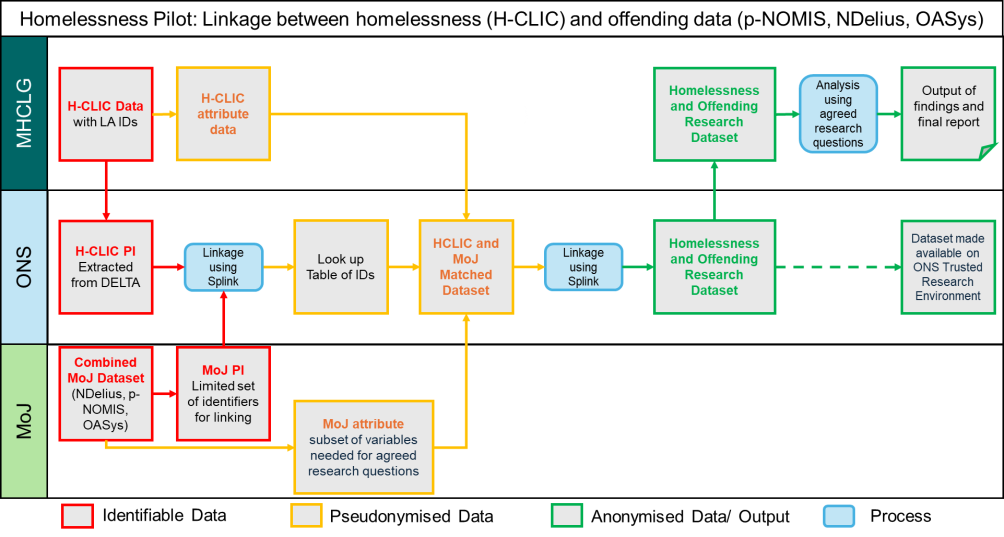
The Office for National Statistics (ONS), acted as data processor for the data linking section of this project on behalf of MHCLG and MoJ. The data linking process between the three departments is shown in Figure 3.1 below.
ONS carried out probabilistic linkage on all records from the H-CLIC and MoJ personal identifying datasets, using the probabilistic linkage package Splink. The linkage produced an ‘ID lookup’ table, containing the identifiers from H-CLIC and the MoJ datasets, but not the personal identifying data.
The ID lookup was then used to join the H-CLIC and MoJ attribute datasets together, using IDs in common between the personal data and attribute data. After joining the attribute data, IDs were hashed to prevent re-identification. The data set was also filtered to remove any links that were missing H-CLIC attribute date and to remove any records where dates did not align between datasets.
Figure 3.1: Overview of the data linking process
MHCLGs H-CLIC data and MoJs Offender data were brought together and linked by ONS, with identifiable data being kept separate from pseudo-anonymised attribute data to prevent identification. An anonymised version of the dataset was produced which has been used for the analysis in this report.
3.2 Data analysis
After the linked datasets were produced, descriptive statistics were used to identify characteristics and other features of interest for the people who had interacted with both the justice and housing support system. These are presented in the results section below.
3.2.1 Time between event analysis
One method of analysis used to explore the linked dataset was time between event analysis, also known as survival analysis. Time between event analysis is used to estimate time until a specific event occurs. For our analysis this is the time between leaving prison (start event) and entering the homelessness system (event of interest) allowing us to explore how long after leaving prison people are at risk of homelessness.
Time between event analysis can be presented visually using Kaplan Meier curves to show the proportion of the group that have yet to experience the event of interest. Separate curves can be plotted for separate groups (for example using a characteristic like sex), allowing us to compare how rates differ between the group. This includes a log rank test which compares the Kaplan Meier curves to see if there is a statistically significant difference between the rates. If the p-value from the log rank test is less than the chosen significance level, we conclude that there is a significant difference between the times to events for the groups based on the chosen difference or characteristic.
4. Results
4.1 Data linking results
Linking H-CLIC data to the offending data resulted in a linked dataset of 66,229 record pairs of a person with a H-CLIC case to a person in the offending dataset (who could have any combination of one or more p-NOMIS or NDelius records, and one or more supporting OASys records). Each pair of records was given a linking score indicating how likely it is that the two records were the same person. Where multiple records were associated with the same ID, the highest scoring version of each record pair was retained. This resulted in a linked dataset of personal identifiers made up of 38,495 distinct record pairs, which related to 10,301 individuals from H-CLIC and 9,200 individuals from the MoJ Datasets. There were more individuals in H-CLIC than the MoJ dataset because H-CLIC is at the household level. Cases where another person in the household was linked to an offender’s record were removed from the final linked dataset.
After joining the attribute data onto the lookup table of personal identifiers, any records pairs missing H-CLIC data were removed. This resulted in a linked attribute dataset containing 7,214 individuals with a H-CLIC record and at least one offending record. Some records had to be removed during data cleaning due to missing or erroneous dates in the offending datasets. The final linked dataset for analysis contained 7,116 individuals, with each individual having at least one H-CLIC case and at least one prison or probation record, 7.7% of the 91,991 individuals in the H-CLIC Personal Identifiers.
The linking process from the original H-CLIC and offending datasets down to the analysis dataset of 7,116 individuals is presented in Figure 4.1 below. The start dates of H-CLIC, p-NOMIS and NDelius cases in the dataset are compared in Figure 4.2.
Figure 4.1: Flowchart showing the linking process between the H-CLIC and Offending datasets, resulting in the Analysis dataset of 7,116 individuals used for this report
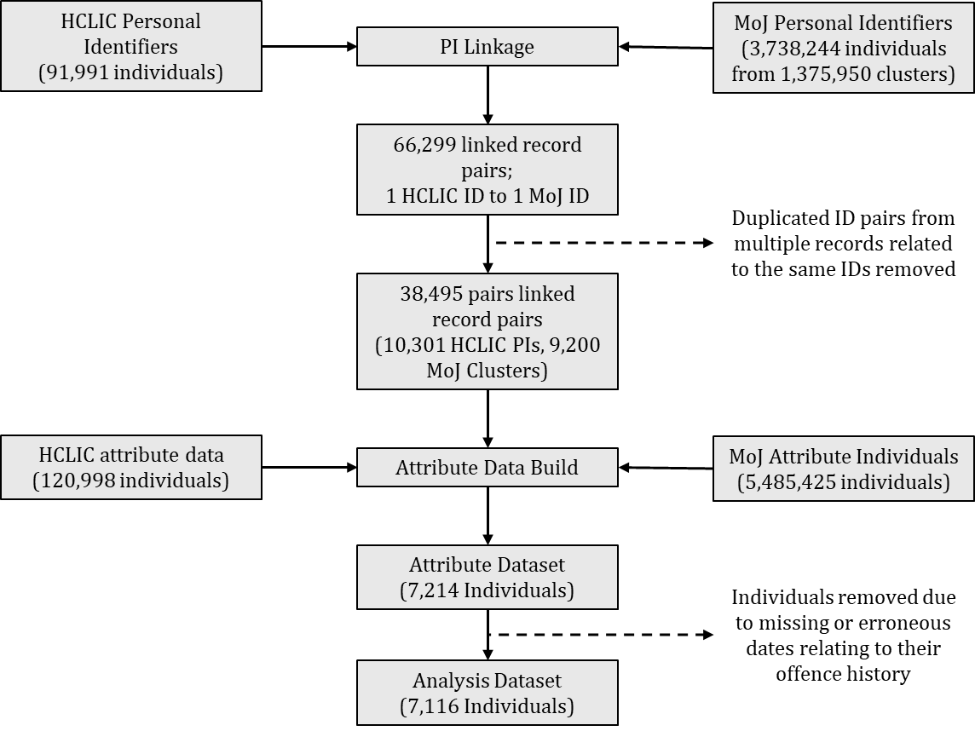
Figure 4.2: Due to the time cuts available of the original datasets the majority of H-CLIC cases in the linked dataset are between 2020/21 Q3 to 2022/23 Q2, but the linked p-NOMIS and NDelius records occur at a steady rate over the period 2010/11 Q4 to 2022/23 Q2
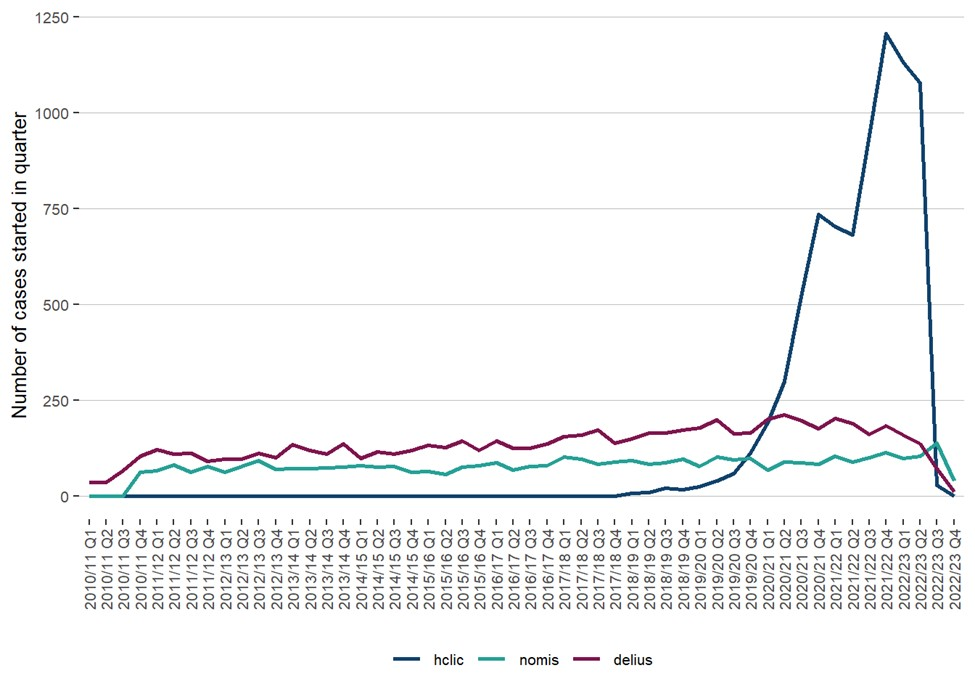
Number of applications of homelessness for linked offenders per quarter compared to dates convicted to prison (p-NOMIS) and probation offence date (NDelius), 2010/11 Q1 to 2022/23 Q4.
The upward trend of homelessness applications in the dataset is mainly attributed to the timings around the Homelessness data England project, with more LAs onboarding and submitting personal information as the project progressed. Therefore, the majority of cases (69.7%) in the linked dataset have an offenders offence occurring before their housing support case.
4.2 Characteristics of the linked dataset
7,116 individuals were recorded in the linked dataset. Among them, 4,028 had at least one prison record linked to their homeless record, and 7,027 had at least one probation record linked to their homeless record. Additionally, 3,939 individuals had both at least one prison record and at least one probation record.
Demographics of linked homeless - offender dataset
Sex of offender
77% of the 7,116 individuals in the linked data set were male, and 23% were female. This is broadly consistent with MoJ statistics.[footnote 1] on Women and the Criminal Justice System which found that in 2021, 79% of individuals dealt with by the Criminal Justice System were male, and 21% were female.
However, of the 4,028 individuals with a prison record in the linked data set 84% were male and 16% were female. In the wider prison population only 4% are female, therefore female offenders leaving prison are overrepresented in our linked data set.
Household type
The majority of individuals approached housing support as part of a one adult household. This accounted for 79% of individuals in our linked dataset. The next most common household type was a lone parent household (one adult with dependent children) at 9% of individuals. Lone parent household were more likely to be female single parents (6% of all individuals) than male single parents (3%).
Individuals were most often the main applicant of their housing support case. This was the case for 93% of individuals in the linked data set. 5% of individuals were the partner/spouse of the main applicant and less than 2% were the main applicant’s son or daughter.
Support needs of offenders household
Of the 7,116 individual households, 68% (4,874) had at least one support need recorded in their housing support case. Among the households who had a support need, 31% had one support need (1,492), 22% had 2 support needs (1,052), and 48% had 3 or more (2,330). In comparison, the 2022-23 H-CLIC annual statistics show that 53% of all households had at least one support need, of which 45% had one support need, 24% had 2 support needs, and 31% had 3 or more. Household in the linked data set, were found to be more likely to have a support need and more likely to have multiple support needs. The most common support needs are shown in Figure 4.3.
Figure 4.3: The most common H-CLIC support need was a history of mental health problems at 42%. Having an offending history was the second most common support need identified
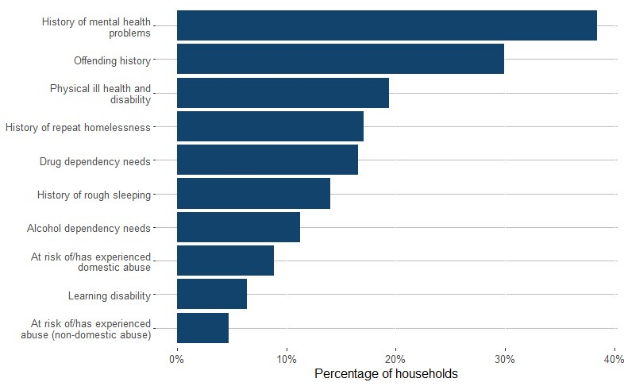
Bar chart showing the proportion of offenders households with the most prevalent support needs.
The H-CLIC offending history support need appeared in 33% of cases. This is a lot more prevalent than in the 2022-23 H-CLIC annual publication where 9% of all households had this support need but is low for the cohort in the linked data set.[footnote 2] The guidance for H-CLIC is that the offending history support need covers: Applicants who are noted as having a history of offending, including those who are currently in contact with the criminal justice system – for example through Probation Services (and applicants whose household includes such a person) who, as a result of their current or previous offending, may or may not require support. As such we would expect all cases where an offender (89% of cases in linked dataset) had offended pre-H-CLIC case to have this support need flag.
Figure 4.4 below focuses on the offending support need flag for just the 3,705 individuals in our dataset whose housing support case is after a prison record. 53% of the offenders did not have an offending history support need included in their H-CLIC record. This suggests that the majority of offenders did not declare that they had an offending history when they approached their local authority for housing support, or that their local authority failed to record the offenders’ support need
Figure 4.4: Over half of the individuals whose housing support case was after a prison sentence did not have a recorded support need of an offending history
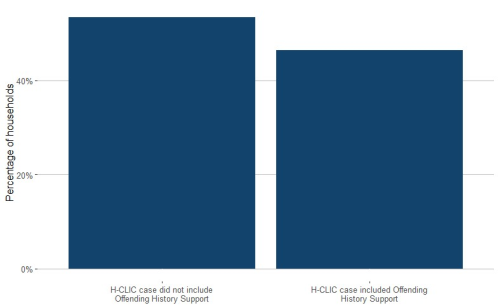
Bar chart showing the proportion of prison leavers who had an offending history support need on their housing support case.
Reason for loss of last settled home for prison leavers household
Figure 4.5 below focuses on the reason recorded in the housing support case for why the claimant lost (or was at risk of losing) their last settled accommodation for the 3,705 individuals in our dataset whose housing support case is after a prison record.
Figure 4.5: Family and friends no longer willing or able to accommodate was the most common reason for loss of home for prison leavers approaching housing support
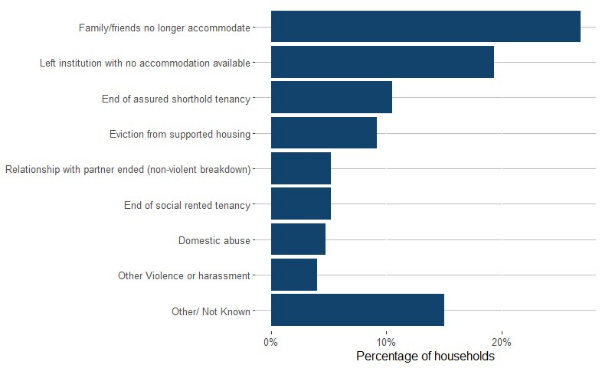
Bar chart showing the proportions of households by reason for loss (or threat of loss) of last settled home, for cases with a prison case before housing support.
For household of prison leavers, 19% had their reason for loss of their last settled home in their housing support case as being that they had no accommodation when they left an institution. For the majority of these cases it is likely that they were homeless from leaving prison.
However the most common reason for loss of last settled home was friend or family no longer being able to accommodate. 27% of prison leavers households had this as their reason for approaching housing support. Suggesting that prison leavers were initially supported with a place to stay by family and friends after leaving prison, but that this was not a long term housing solution.
409 out of the 3,705 prison leavers (11%) were rough sleeping at the time of their housing support application. Of these, 111 (27%) had their reason for loss of last settled home as being their family or friends were no longer able to accommodate them, and 53 (13%) had no accommodation after leaving an institution.
4.3 Research questions
4.3.1 How long after leaving prison are people still vulnerable to homelessness and why?
Of the 7,116 individuals in the linked dataset 3,705 individuals were recorded in H-CLIC after leaving prison, indicating they were assessed as being homeless or at risk of homelessness. Figure 4.6 shows the range of time between an individual’s prison and homeless cases, ranging from cases where people became homeless directly after leaving prison to those who did not become homeless until 10 years after leaving prison.
Figure 4.6: The rate at which prison leavers approached housing support at its highest rate soon after the offender left prison, before reducing to a much lower rate
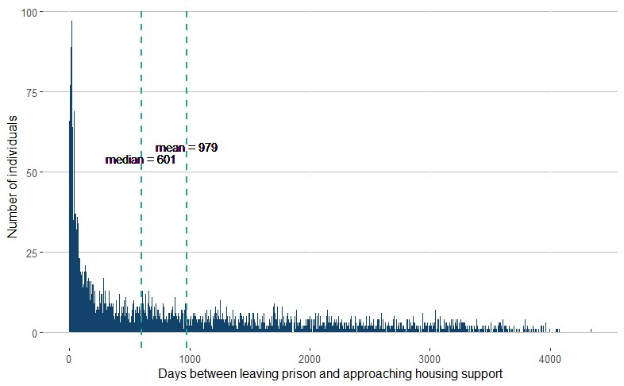
Histogram showing the distribution of offender’s time between leaving prison and entering the housing support system in days.
The average length of time between prison and homeless cases in our linked dataset is 979 days (approximately 2 years and 8 months). This average time is likely increased due to our data sample having prison data from 2011 onwards, but homeless data from 2018. (see limitations section for further details). The median time between prison and homeless cases in our dataset is 601 days, so over half of the prison leavers approach the housing support system within two years of leaving prison. Figure 4.6 shows a significant negative skew, with the rate of prison leavers becoming homeless occurring at its highest rate soon after they leave prison, before reducing to a much lower rate.
Time between event analysis was used to calculate the time between individuals leaving prison and entering the housing support system. Time between event analysis provides an estimate of time between two set ‘events,’ here defined as the individual leaving prison and approaching their local authority for housing support.
The proportion of the group who have yet to experience the second event (in this case approaching their LA for housing support), is presented in the Kaplan-Meier curves in Figures 4.7, 4.8 and 4.9 below. Given everyone in our dataset does end up homeless at some point after leaving prison, the curve would get to 0% (all approached) given a long enough time. We focused the graph on just the first year after prison release to see the rate at which different groups approach housing support over their first-year post release.
Figure 4.7: Male offenders approached the housing support system after leaving prison at a faster rate than female offenders
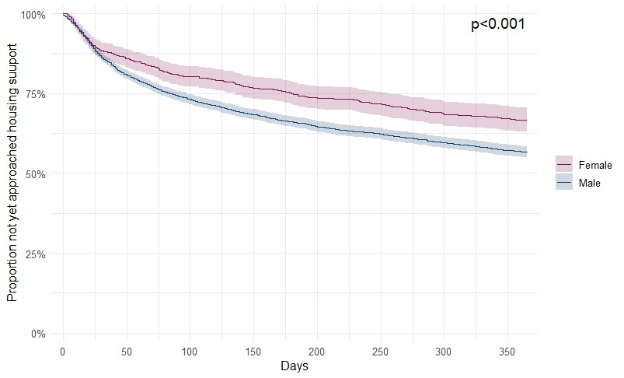
Kaplan-Meier Curve showing the proportion of prison leavers yet to enter the homelessness system by sex.
Comparing rates between sexes, we find that male and female offenders enter the housing support system at the same rate for the first month post release, after which male offenders are more likely to enter the housing support system than female offenders. The log rank test shows that the difference between the rates of approach is statistically significant.
Figure 4.8: Offenders referred to housing support by a prison or probation agency enter the housing support system at a significantly faster rate than those not referred to housing support or those who were referred by other agencies
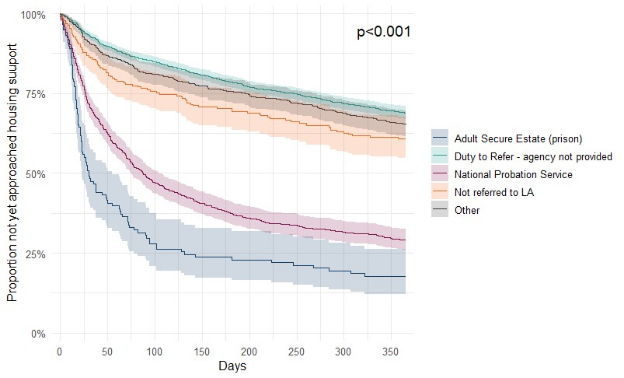
Kaplan-Meier Curve showing the proportion of prison leavers yet to enter the homelessness system by agency who referred them to housing support.
Controlling our survival analysis for the referral agency which referred to housing support we see that within 100 days of release:
- 72.0% of offenders referred by prison service have approached the housing support system
- 53.0% of offenders referred by the probation service have approached the housing support system
In comparison only 19.0% of people referred by other referral agencies (such as Adult Social Services) and 24.3% who approach housing support without a referral have approached housing support within 100 days of their release, suggesting that for these offenders their prison case is not the primary reason for their homelessness case.
This suggests that housing risk immediately on release from prison is being identified by the prison/probation services, and those most at risk are being referred to their local authority for support.
Figure 4.9: Offenders with a short prison sentence of less than 12 months enter the housing support rate at a slower rate that those with longer sentences
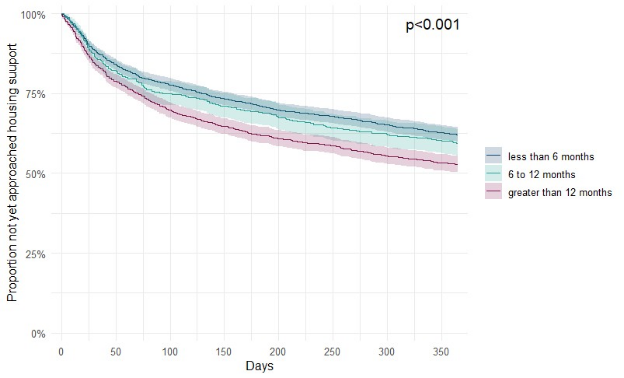
Kaplan-Meier Curve showing the proportion of prison leavers yet to enter the homelessness system by the length of their prison sentence.
Comparing the rates by length of prison sentence we see that those with prison sentences of 12 or more months enter the housing support system at a quicker rate than those with sentence of less than 6 months or 6-12 months. The log rank test shows that this difference is statistically significant.
The relationship between short-term sentences and homelessness is explored further in research question 4.3.4 below.
4.3.2 Whether different outcomes after presenting as homeless are associated with different reoffending outcomes
Of the 7,116 individuals in our linked dataset, 30.3% (2,151) offended after their housing support cases started (Table 4.1). The majority of these cases (1,263) were offences that resulted in probation orders, for instance community orders or fines. The other 888 offenders received a prison sentence. Of the 888 offenders who received prison sentences 346 (60.4%) had previously had prison sentences. In comparison, 4,963 individuals in our datasets had no offence following their housing support case.
Table 4.1: Sentence type post H-CLIC Case
| Sentence type | Number of offenders | Proportion |
|---|---|---|
| No sentence | 4,965 | 69.8% |
| Probation | 1,263 | 17.7% |
| Prison | 888 | 12.5% |
For those who were homeless within 1 year of release from prison (1,554 offenders) 48.3% reoffended after starting their housing support case (Table 4.2).
Table 4.2: Sentence type post H-CLIC Case, for offenders who were homeless within 1 year of release from custody
| Sentence type | Number of offenders | Proportion |
|---|---|---|
| No sentence | 804 | 51.7% |
| Prison | 403 | 25.9% |
| Probation | 347 | 22.4% |
This is lower than MoJs Reoffending by Accommodation Status on Release from Custody statistics which showed that people who were homeless upon release from custody had a 65.2% reoffending rate and people rough sleeping upon release had a 67.2% reoffending rate.[footnote 3] However, our dataset does not completely match with MoJs official definition of reoffending as we do not have information on if an offender received either a reprimand, caution, or warning. Our dataset only includes if a reoffence resulted in either a custodial (prison) or non-custodial (probation) sentence. As such our reoffending figure of 48.3% is likely to be an underestimate.
This also does not include offenders who are homeless but who do not approach their local authority for assistance.
For outcomes from homeless support cases, we have grouped outcomes together as:
- Successful – A successful prevention or relief duty which ended with the household securing accommodation
- Main Duty – The Applicant has priority need and is unintentionally homeless at the end of their relief duty and is therefore owed the ‘main’ homelessness duty. The household will then be housed in temporary accommodation
- Ended – the household has neither secured accommodation nor been found homeless after 56 days, and includes: Contact lost, withdrawn application, and refusal of suitable accommodation
- Ongoing – cases where the housing support case is ongoing at time of the data extract
Figure 4.10 below compares the outcomes of people’s homelessness case against whether there was an offence post the individuals H-CLIC case.
Figure 4.10: Individuals whose homeless case ended without accommodation were more likely to go on to reappear in the prison or probation datasets than those whose cases secured accommodation
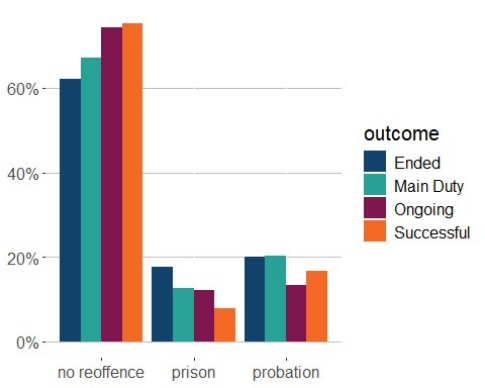
Bar chart showing the proportions of offending outcomes by outcome of homeless support case.
Individuals whose housing support case ended with no accommodation secured were most likely to re-offend with 37.7% having a further sentence. This suggests that negative outcomes from an individual’s housing support case are associated with an individual being more likely to reappear in the justice system.
The reason for a case to end with ‘no accommodation secured’ for the majority of cases is contact being lost between the claimant and the local authority with no further detail provided. For 9.5% of the offenders who received a prison sentence after the start of their housing support case the accommodation at the end of their homelessness duty was listed as ‘custody,’ indicating they were sentenced to/recalled to prison which ended their housing support case.
4.3.3 Reoffending history and different offence types and the association with different homelessness outcomes
Reoffending history
To compare the housing outcomes for offenders on their first custodial sentence against offenders who had had multiple custodial sentences, flows analysis was carried out to explore the journeys and outcomes for offender households flowing through the homelessness duties.
There were 1,267 offenders who left prison and were identified as homeless within 1 year of release, and whose prison (p-NOMIS) record contained the offenders custodial sentence count. Of the 1,267 offenders; 305 were first time offenders (with sentence counts of 1) and 962 were repeat offenders (with sentence counts of 2 or more). Of the 1,267 households:
- 44.0% secured accommodation for 6 or more months
- 31.5% left the system for other reasons
- 11.3% were owed a main duty
- 13.3% were homeless and not owed a main duty following relief
Note on Sankey plots in figure 4.11 and 4.12: The size of each ‘flow’ in each diagram is proportional to the number of homelessness cases taking that particular route through the system. Each coloured box indicates a stage in a homelessness duty or outcome, and their size is proportional to the number of households reaching that stage. The system has two entry points: households threatened with homelessness and owed a Prevention duty (the leftmost box), and households initially homeless and owed a Relief duty (note that this box also includes where some cases have flowed from Prevention).
Figure 4.11: Flow of households for prison leavers after their first custodial sentence
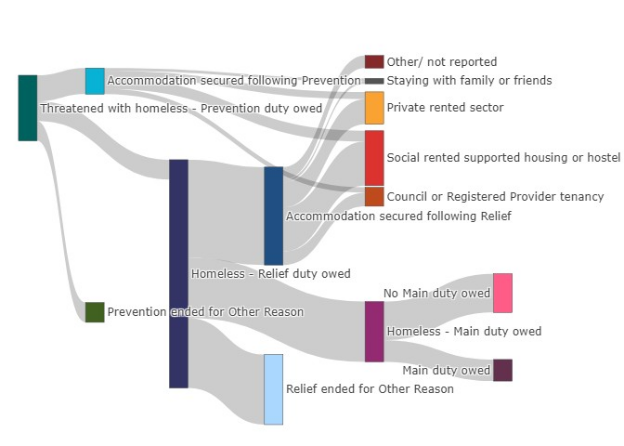
Among the 305 households of first custodial sentence prison leavers, 23.9% entered H-CLIC under a prevention duty, while 76.1% entered under a relief duty.
A total of 45.3% of households successfully secured accommodation:
- 9.5% were housed following a prevention duty, with the most common type of housing being ‘social rented supported housing or hostel.’
- 35.7% were housed following a relief duty, with the most common type of housing being ‘social rented supported housing or hostel.’
Of the 67 households who were homeless after relief and awaiting a main duty decision, 35.8% were owed a main duty.
Figure 4.12: Flow of prison leavers households for prison leavers after a repeat custodial sentence
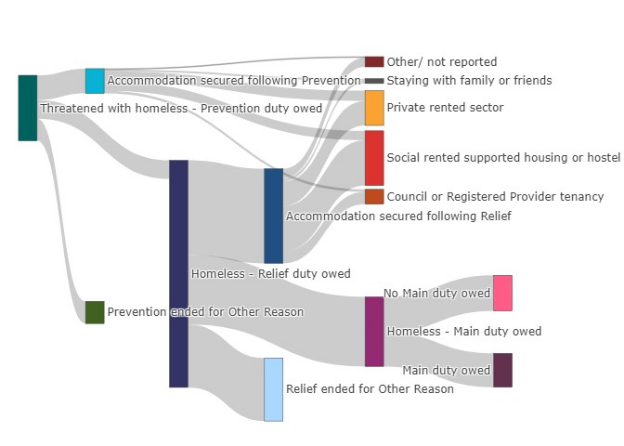
Among the 962 households of repeat custodial sentence prison leavers, 23.9% entered H-CLIC under a prevention duty, while 76.1% entered under a relief duty.
A total of 43.6% of households successfully secured accommodation:
- 9.0% were housed following a prevention duty, with the most common type of housing being the ‘Private Rented Sector.’
- 34.5% were housed following a relief duty, with the most common type of housing being ‘social rented supported housing or hostel.’
Of the 244 households who were homeless after relief and awaiting a main duty decision, 48.8% were owed a main duty
Comparing the flows analysis for first time offenders custodial sentence prison leavers against repeat offenders’ custodial sentence, we find that similar housing outcomes were seen between households of repeat offenders and first-time offenders.
For both groups, approximately three in four households entered the housing support system on a relief duty so were already homeless on their approach to their local authority. This suggests that either the threat of homelessness may not have been identified early enough for a prevention duty to be offered, or perhaps that offenders did not have suitable long-term accommodation to return to after being released from prison for a prevention duty to be a viable option.
Both first time offenders custodial sentence and repeat offenders custodial sentence prison leavers had similar likelihood of being housed after either a successful prevention duty or relief duty (45.3% for first time offenders sentence, 43.6% for repeat), but first-time sentence prison leavers offenders had a slightly higher rate of success at the prevention duty stage at 39.7% compared to 37.8% for repeat offenders on a repeat sentence. This could be due to first time offenders on their first custodial sentence were being more likely to be in accommodation which they would be able to stay in following their prevention duty, without becoming homeless and requiring a relief duty to find alternative accommodation.
The most common housing outcome for both first time and repeat custodial sentence prison leaver’s offender’s household was to ‘Social rented supported housing or hostel’ following a relief duty. This accounted for 20.0% of first-time offenders and of repeat offenders. The next most common accommodation type was ‘Private rented accommodation’ for both groups.
Repeat custodial sentence prison leavers had a higher rate of Main duty decisions being identified as priority need and owed a Main homelessness duty at 48.8% compared to only 35.8% of first-time sentenced. There are a number of reasons an applicant may be identified as a priority need, one of which is a person being identified as vulnerable due to having spent time in prison. However, the linked data set does not show that repeat offenders are more likely to be assessed as having a priority need due to having been in custody. The reason for ‘priority need’ being identified for the majority of the first-time and repeat offenders in the linked dataset was due to either having a physical disability/ill health or mental health problems.
The closest comparison group in the 2022-23 H-CLIC annual flows analysis is the flow of households who are homeless, or threatened with homelessness, on departure from custody.[footnote 4] These are households whose households’ cases have their reason for loss of last settled accommodation being their release from a custodial institution this accounted for 8,130 households in England (3.1% of H-CLIC households).
Over two thirds (67.3%) of the cases on departure from custody in the annual flows were homeless on initial approach and owed a relief duty. A higher proportion of these households entered on a prevention duty (32.7%) than the households in our linked dataset (23.9% for first custodial sentence, 23.9% for repeat sentence). This is likely due to entering the housing support system directly from prison, so having a higher chance of having had their housing risk identified early enough for a prevention duty to be possible.
39.1% of the cases on departure from custody in the annual flows secured accommodation for 6+ months, which is lower than the households in our linked dataset. This is likely driven to the households in H-CLIC having a higher proportion of cases ended for ‘other reasons’ at 36.7% compared to 32.8% first time custodial sentence and 31.1% for repeat sentence in our linked dataset. Duty ending for other reasons include any reasons for contact being loss between the local authority and the claimant, including returning to prison on recall or after a further offence.
As with the offenders in our linked dataset, the most common accommodation outcome for households on departure from custody in H-CLIC was social rented supported housing or a hostel, accounting for 48.1% of those accommodated after a prevention duty and 48.4% of those accommodated after a relief duty. For all households in H-CLIC supported housing or a hostel is the third most common accommodation outcome, behind private rented sector and council registered provider tenancy, at 19.4%. This suggests that offenders are more likely to be placed in supported housing than general housing support cases.
Of the 1,800 households on custody departure who were homeless after relief and due a main duty decision, 690 (38.3%) were owed a main duty. This is similar to the rate of first-time custodial sentence prison leavers in our linked dataset (35.8%) but lower than the rate for those on a repeat custodial sentence (48.8%). This suggests that offenders with a history of repeat custodial sentences may be more likely to be identified as a ‘priority need’ under the main homelessness duty. This may be due to repeat offenders being more likely to have multiple disadvantages.
Offence type
To compare the homeless outcomes for offenders based on their offence types we have grouped the offenders based on their prison record main offence into offence groups as defined in MoJs Criminal Justice quarterly statistics.[footnote 5] For this analysis we have focused on offenders who left prison and became homeless within 1 year of release, and whose prison record contained details of their offence, a total of 1,244 offenders. The most common offence types were ‘Violence against the person’ (21.1%), ‘Theft Offences (19.8%) and Summary non-motoring’ (16.6%).
Due to some offence types having a small number of offenders which would require data suppression if we ran our flows analysis, we instead focused our analysis on the main stages of the offender’s flow through their homelessness applications. Figure 4.13 focuses on the entry into the housing support system on either prevention or relief, Figure 4.14 the outcome of their housing support duty and Figure 4.15 explores the accommodation types secured after the duties which were successful.
Figure 4.13: The majority of offenders entered the housing support system on a relief duty, so were already homeless when they approached their local authority
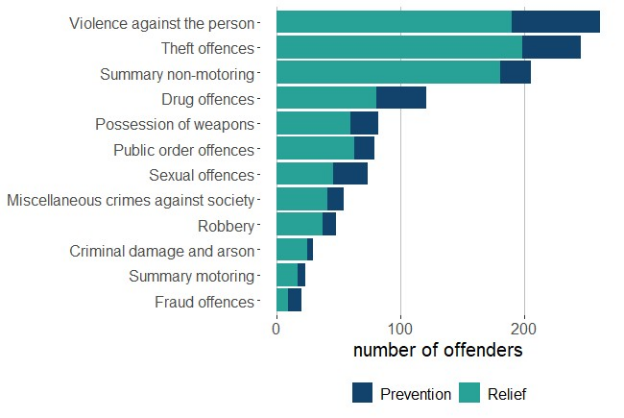
Stacked bar chart showing the proportion of offender’s households owed a prevention or relief duty, by offence group.
The proportion of households owed a prevention or relief duty on approach to their local authority. All offence types followed the pattern of the majority of offenders being owed a relief duty on approach instead of prevention, except for those committed for ‘Fraud offences’ for whom 55.0% approached on prevention.
Figure 4.14: Most offenders’ homeless duties ended unsuccessfully, with accommodation not being secured or a main homeless duty being owed
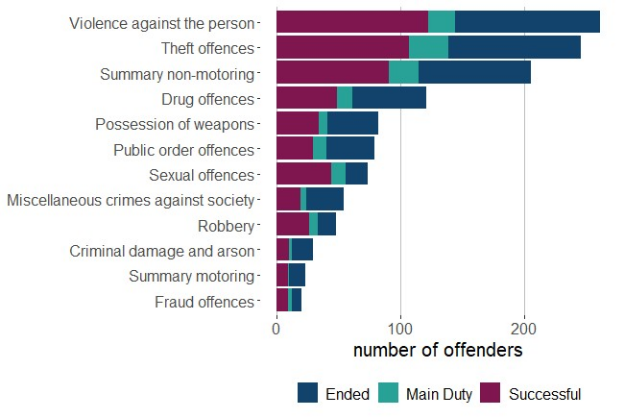
Stacked bar chart showing the proportion of household’s duty outcomes, by offence group.
For the majority of main offence types the most common outcome was for the duty to end unsuccessfully without accommodation being secured or a main duty owed. Except for those who had committed sexual offences (59.5% successfully accommodated) and Robbery (54.2% successfully accommodated).
Figure 4.15: Offenders who did receive accommodation at the end of their duty were most likely to be housed in socially rented supported housing
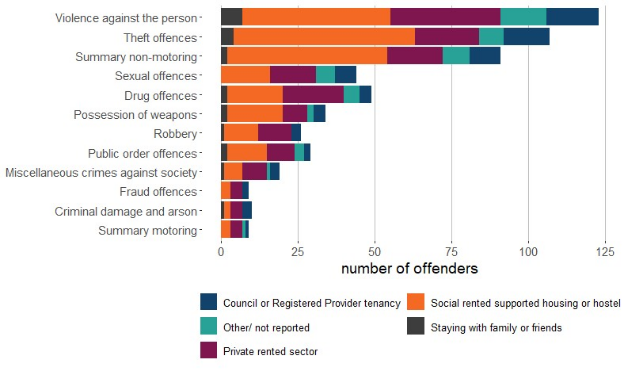
Stacked bar chart showing the proportion of households who secured accommodation by offence type.
550 (41%) of the offenders had a successful duty and secured accommodation for 6 or more months. Figure 4.15 shows the proportions of households that received which type of accommodation. The most common accommodation types for offenders were ’Socially rented supported housing or hostels’ and ‘private rented sector.’ For all households in H-CLIC the most common housing outcomes were private rented sector (34% of secured accommodation) and council or registered provider tenancy (30.7%). Social rented supported housing was received by 19.4% of households receiving accommodation. This suggests that offenders are more likely to be placed in supported housing than general housing support cases.
4.3.4 The relationship between short-term sentences and homelessness
A short-term prison sentence is defined as a prison sentence of up to 12 months. Looking at our cohort of offenders who became homeless within a year of leaving prison 56.5% had a short-term sentence, as shown in Table 4.4.
Table 4.4: Prison sentence length for offenders who entered H-CLIC within 1 year of release
| Sentence length | Number of offenders | Proportion |
|---|---|---|
| Less than 6 months | 659 | 42.5% |
| 6 to 12 months | 217 | 14.0% |
| Greater than 12 months | 675 | 43.5% |
Our linked dataset only contains cases that have a homeless and offending record. As such we cannot compare the overall proportions of prison leavers who become homeless, as we do not have the data for offenders who do not interact with housing support (see limitations). As such we cannot say wherever offenders with shorter or longer sentences or more or less likely to be at risk of homelessness on release from prison. However, we can compare the rates at which those who do become homeless approach their local authority for support after leaving prison (shown in Figure 4.16) and explore whether the risk of homelessness is being identified during the offender’s time in the justice system (shown in Figure 4.17).
Figure 4.16: More than half of the offenders who were homeless within 1 year of leaving prison approached the housing support system within 10 weeks of their release
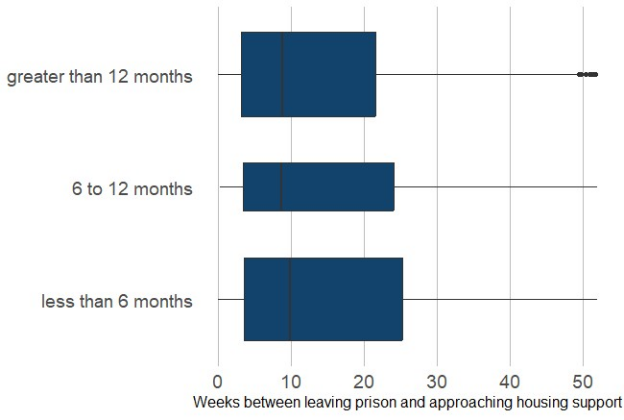
Boxplots showing the distribution of time between leaving prison and approaching housing support, by length of sentence.
If we look at the distribution of time between leaving prison and entering the homeless systems, 50% of offenders for each sentence length were in the housing support system within 10 weeks. Offenders with sentences greater than 12 months continued to enter the housing support system at a faster rate than those with short sentences, with the upper quartile of offenders with sentences greater than 12 months being a month lower than for offenders with sentences of less than 6 months. This follows on from the Kaplan Meier curve in figure 4.9 above.
Figure 4.17: Offenders with the shortest sentences of less than 6 months were the least likely to have been referred to housing support by the prison or probation service
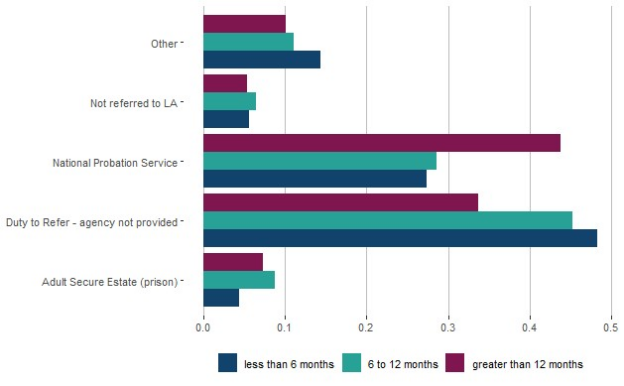
Bar chart showing the proportion of offenders referred to housing support by an agency by the length of their prison sentence.
Offenders with shorter sentences were less likely to be referred to housing support by referral agencies related to their time in custody suggesting that the risk of homelessness may not have been identified for offenders who spent less time in custody. Shorter custodial sentences may limit the time available to access support for successful release planning.
For all sentences lengths, offenders were much more likely to be referred to housing support by the probation service than by the prison service. This is also the case in the 2022-23 H-CLIC annual statistics where 21% of all referrals under a duty to refer were made by the probation service, compared to 3% made from prison.
For all sentence lengths approximately 95% of people are being referred to their local authority by a referral agency. This compares to all households in H-CLIC where in 2022-23 only 14.4% of households were assessed following a referral. This shows that prison leavers in the linked dataset are having their homelessness risks identified and they are being referred to their local authority for support, but many are not being recorded as having been referred by the justice system in their housing support case.
4.4 Limitations
The main limitations of our analysis are due to the data available for linkage:
4.4.1 Coverage of homelessness data
The Homelessness data able to be used for this linkage project was limited by the size of the HDE personal identifying data collection and the local authorities involved with that project. As such our linked dataset for this project contains a small time cut of H-CLIC and a limited number of local authorities. Additionally, the local authorities involved with HDE were self-selected so the findings from our analysis are unlikely to be representative of the rest of England.
For future data linking projects a greater number of participating local authorities submitting data would enable more detailed analysis.
4.4.2 Poor linking with the OASys dataset
The Linked Offender dataset for this project was made up of three datasets; p-NOMIS covering prison data, NDelius covering probation and OASys which covers the risks and needs of offenders in prison and on probation. However, the data linking for this project did not produce many matches against the OASys dataset which impacted the analysis for one of our original research questions.
This research question was Do people identified as ‘homeless’ upon leaving an institution (in MoJ datasets) go on to receive homelessness support.’ Analysis for this question would have used an offenders response to the accommodation section of their OASys assessments as an indicator for offenders having a known accommodation issue upon their release. The linked data set contained less than 10 individuals who had all the relevant records, so we were unable to carry out analysis for this research question.
The findings in the time between events analysis (figure 4.8 above) do suggest that there is a link between offenders being referred by the prison or probation service and them entering the housing support system. As such this question could be worth exploring in a future data linkage project, assuming we could improve the linkage rate with OASys. To further explore this use case, it would be beneficial to include cases identified as at risk of homelessness but who do not enter the housing support system to act as a counterfactual.
4.4.3 Offender datasets used do not allow for full definition of reoffending to be met
MoJ define a proven reoffence as any offence committed in a one-year follow-up period that leads to a court conviction, caution, reprimand, or warning in the one-year follow-up or within a further six-month waiting period to allow the offence to be proven in court. As our linked dataset only contains details on offenders who have committed an offence that resulted in a custodial sentence (prison) or community order (probation), our estimates for reoffending do not align with MoJs official statistics and are likely to be an underestimate. For a future linking project to align with MoJs official statistics we would need to link with data from the Police National Compute (PNC), to get information on less severe crimes which resulted in cautions, reprimands, or warnings.
4.4.4 Linked dataset contains only the linked cases, not individuals who have only experienced homelessness or offending
The linked dataset produced for this project contains only linked cases where an individual has at least one homelessness case and at least one prison or probation sentence. It does not include individuals that only appear in one of the original datasets. This limits the scope of some of our analysis as we cannot directly compare our results to those who are homeless but have had no interaction with the criminal justice system, beyond comparing to total figures from H-CLIC.
4.4.5 Impacts of COVID-19
The time period covered by this analysis includes the COVID-19 pandemic, where process and policies around prison leavers, probation services, and housing support were impacted. As the Homelessness data coverage is from 2020 Q3 onwards our dataset has no pre-COVID baseline for housing support. Because of this we have not attempted to separate out or analyse any impacts of COVID-19 specific process or policies in this report.
5. Summary
This study helps form the evidence base of MHCLG and BOLD by linking homelessness case-level data to operational datasets from the MoJ, for the first time.
Our main findings were:
- Over half of prison leavers entering the housing support system were not registered as having an offending history as a support need in their housing support case. This suggests that the number of offenders in the housing support system may be under reported in MHCLGs official statistics.
- The speed at which offenders enter the housing support system after release from prison is impacted by their sex and whether they are referred to their local authority for support by a prison or probation agency.
- Once an offender has approached their local authority for support, details of their offence have only a small impact on their journey through the homelessness system. There were only minor differences found between first time offenders and re-offenders flow through the system, as well as only small differences in outcomes being found based on an offender’s type of offence committed.
- The majority of prison leavers (95%) who entered the housing support system within a year of release from prison are referred to their local authority by an agency with a duty to refer, however offenders with longer sentence counts of over a year are more likely to be referred by the prison or probation service. This suggests that offenders who have longer interactions with the justice system are more likely to have their housing needs identified by the justice system.
Improving support available for offenders in the housing support system
Our findings in this report suggest that a number of households are either not being identified by their local authority as having an offending history or are not declaring that they have one. This may mean that a number of individuals are missing out on additional support being offered as part of their housing support case, either because they are not being offered the support, or do not know it is available to them. Our findings also show that individuals whose homeless case ended without accommodation were more likely to go on to reappear in the prison or probation datasets than those whose cases secured accommodation. While we can’t draw causal links from this research it is possible that improving the housing support offer for households with an offending history may reduce the risk of an individual committing a further offence.
6. Further Information
6.1 Research reports
The BOLD homelessness pilot has produced other research reports exploring linked datasets using MHCLGs homelessness data. They are all ad-hoc MHCLG publications which serve as proof of concept within the wider BOLD programme. These can be found on gov.uk.
MHCLG’s statutory homelessness statistics, which also deliver insights from H-CLIC, are labelled as Accredited Official Statistics. Further information on Accredited Official Statistics is available via the UK Statistics Authority website.
6.2 Upcoming MHCLG projects linking homelessness and offending
Findings and lessons learnt from this data linking project will be used to support and further develop other MHCLG projects exploring the links between homelessness and offending.
Rough Sleeping Questionnaire
MHCLG is currently undertaking a questionnaire of people who have slept rough to understand the experiences, support needs, and vulnerabilities of people who sleep rough in England. The questionnaire has been updated and is being rerun from when it was first undertaken in 2019-20: Rough sleeping questionnaire: initial findings.
As part of this project, we will be linking to HMPPS’ prison (p-NOMIS) and probation (NDelius) datasets, as well as linking to courts data from HM Courts & Tribunal Service (HMCTS), to explore how rough sleepers have interacted with the prison and probation system.
Changing Futures
Changing Futures is a 5-year, £91.8 million programme aiming to improve outcomes for adults experiencing multiple disadvantage – including combinations of homelessness, substance misuse, mental health issues, domestic abuse and contact with the criminal justice system. The programme is running in 15 areas, covering 34 top-tier council areas, across England from 2021 to 2026: Changing Futures.
Systems-wide Evaluation of Homelessness and Rough Sleeping - Criminal Justice Deep Dive
The Systems-Wide Evaluation of Homelessness and Rough Sleeping is a 3-year, £3 million programme that aims to understand what works at a systems level and identify the most effective and impactful levers for change. The evaluation includes a Criminal Justice Deep Dive that aims to understand the interactions between the criminal justice system and homelessness and rough sleeping system. The Criminal Justice Deep Dive reports will be published in Summer 2025. The Systems-Wide Evaluation Interim report can be found here: Systems-wide evaluation of homelessness and rough sleeping: preliminary findings.
6.3 BOLD privacy notice
More information on the processing of personal data across the BOLD programme can be found here: Better Outcomes through Linked Data (BOLD): Privacy Notice.
6.4 Enquiries or feedback
The work by the BOLD pilot teams could be useful to people who want to ensure that provisions for homelessness support applications are operating as intended.
If you have any enquiries or feedback about this report, email the BOLD Homelessness Pilot Team at MHCLG.
Annex A: List of participating local authorities
The following local authorities have submitted personal data as part of the Homelessness Data England (HDE) project:
- Arun District Council
- Ashford Borough Council
- Babergh District Council
- Barrow-in-Furness Borough Council*
- Bath and North East Somerset Council
- Blackburn with Darwen Borough Council
- Bristol City Council
- Broadland District Council
- Canterbury City Council
- Chelmsford City Council
- Crawley Borough Council
- Darlington Borough Council
- Dartford Borough Council
- Dover District Council
- East Hertfordshire District Council
- Folkestone and Hythe District Council
- Great Yarmouth Borough Council
- Kensington and Chelsea Royal Borough
- Leicester City Council
- Liverpool City Council
- Maidstone Borough Council
- Mid Devon District Council
- Mid Suffolk District Council
- Newcastle-under-Lyme Borough Council
- North Kesteven District Council
- North Somerset Council
- North Tyneside Council
- Northumberland County Unitary Authority
- Oadby and Wigston Borough Council
- Preston City Council
- Reigate and Banstead Borough Council
- Sevenoaks District Council
- Slough Borough Council
- South Kesteven District Council
- South Lakeland District Council*
- South Norfolk Council
- Southwark London Borough
- Spelthorne Borough Council
- Stoke-on-Trent City Council
- Sunderland City Council
- Surrey Heath Borough Council
- Sutton London Borough
- Tandridge District Council
- Thanet District Council
- Tonbridge and Malling Borough Council
- Tunbridge Wells Borough Council
- Walsall Metropolitan Borough Council
- West Lancashire Borough Council
- West Lindsey District Council
- West Suffolk Council
- Wiltshire County Unitary Authority
- Worcester City Council
The local authorities are self-selected; therefore, trends may not be representative of non-participating local authorities.
*In April 2023 two of the participating local authorities, Barrow-in-Furness and South Lakeland, were both replaced by Cumberland Council. The linked dataset was unaffected by previous boundary changes.
Annex B: Data tables
Table A1: Number of applications of homelessness (H-CLIC), dates convicted to prison (p-NOMIS) and probation offence date (NDelius) for linked offenders per quarter, 2010/11 Q1 to 2022/23 Q4
Data table for Figure 4.2
| Quarter | H-CLIC cases | p-NOMIS cases | NDelius cases |
|---|---|---|---|
| 2010/11 Q1 | 0 | 0 | 36 |
| 2010/11 Q2 | 0 | 0 | 37 |
| 2010/11 Q3 | 0 | 0 | 67 |
| 2010/11 Q4 | 0 | 64 | 104 |
| 2011/12 Q1 | 0 | 66 | 121 |
| 2011/12 Q2 | 0 | 82 | 111 |
| 2011/12 Q3 | 0 | 64 | 113 |
| 2011/12 Q4 | 0 | 79 | 92 |
| 2012/13 Q1 | 0 | 64 | 97 |
| 2012/13 Q2 | 0 | 78 | 98 |
| 2012/13 Q3 | 0 | 93 | 112 |
| 2012/13 Q4 | 0 | 71 | 101 |
| 2013/14 Q1 | 0 | 73 | 135 |
| 2013/14 Q2 | 0 | 72 | 119 |
| 2013/14 Q3 | 0 | 74 | 110 |
| 2013/14 Q4 | 0 | 76 | 137 |
| 2014/15 Q1 | 0 | 81 | 99 |
| 2014/15 Q2 | 0 | 76 | 117 |
| 2014/15 Q3 | 0 | 78 | 111 |
| 2014/15 Q4 | 0 | 64 | 120 |
| 2015/16 Q1 | 0 | 65 | 133 |
| 2015/16 Q2 | 0 | 57 | 127 |
| 2015/16 Q3 | 0 | 76 | 144 |
| 2015/16 Q4 | 0 | 81 | 120 |
| 2016/17 Q1 | 0 | 87 | 145 |
| 2016/17 Q2 | 0 | 69 | 126 |
| 2016/17 Q3 | 0 | 78 | 126 |
| 2016/17 Q4 | 0 | 81 | 136 |
| 2017/18 Q1 | 0 | 102 | 156 |
| 2017/18 Q2 | 0 | 97 | 160 |
| 2017/18 Q3 | 0 | 84 | 173 |
| 2017/18 Q4 | 0 | 90 | 139 |
| 2018/19 Q1 | 8 | 94 | 151 |
| 2018/19 Q2 | 10 | 84 | 165 |
| 2018/19 Q3 | 21 | 87 | 165 |
| 2018/19 Q4 | 18 | 97 | 173 |
| 2019/20 Q1 | 25 | 78 | 178 |
| 2019/20 Q2 | 40 | 102 | 200 |
| 2019/20 Q3 | 59 | 95 | 163 |
| 2019/20 Q4 | 112 | 99 | 166 |
| 2020/21 Q1 | 192 | 68 | 202 |
| 2020/21 Q2 | 299 | 90 | 212 |
| 2020/21 Q3 | 521 | 88 | 198 |
| 2020/21 Q4 | 735 | 84 | 177 |
| 2021/22 Q1 | 703 | 104 | 204 |
| 2021/22 Q2 | 682 | 90 | 190 |
| 2021/22 Q3 | 942 | 100 | 161 |
| 2021/22 Q4 | 1206 | 114 | 185 |
| 2022/23 Q1 | 1131 | 99 | 160 |
| 2022/23 Q2 | 1078 | 105 | 137 |
| 2022/23 Q3 | 29 | 138 | 73 |
| 2022/23 Q4 | 0 | 41 | 12 |
Table A2: Outcomes of the homelessness duties owed to all households of prison leavers after their first custodial sentence
Data table for Figure 4.11
| Total initially owed duty | Prevention duty | Relief duty | ||||
|---|---|---|---|---|---|---|
| Households | % of total | Households | % of prevention duties | Households | % of relief duties | |
| Total assessed as owed a duty | 305 | 100.00% | 73 | 100.00% | 254 | 100.00% |
| Total secured accommodation at duty end | 138 | 45.25% | 29 | 39.73% | 109 | 42.91% |
| Duty ended for Other reasons | 100 | 32.79% | 22 | 30.14% | 78 | 30.71% |
| Homeless at duty end | 89 | 29.18% | 22 | 30.14% | 67 | 26.38% |
| Homeless after relief - owed main duty | 24 | 7.87% | - | 24 | 9.45% | |
| Homeless after relief - not owed a main duty | 43 | 14.10% | - | - | 43 | 16.93% |
Table A3: Accommodation secured for households of prison leavers after their first custodial sentence
Data table for Figure 4.11
| Prevention duty | Relief duty | |||
|---|---|---|---|---|
| Private rented sector | 8 | 27.59% | 28 | 25.69% |
| Council or Registered Provider tenancy | 6 | 20.69% | 15 | 13.76% |
| Social rented supported housing or hostel | 12 | 41.38% | 49 | 44.95% |
| Staying with family or friends | 3 | 10.34% | 3 | 2.75% |
| Other / not reported | 0 | 0.00% | 14 | 12.84% |
| Total | 29 | 100.00% | 109 | 100.00% |
Table A4: Outcomes of the homelessness duties owed to all households of prison leavers after a repeat custodial sentence
Data table for Figure 4.12
| Total initially owed duty | Prevention duty | Relief duty | ||||
|---|---|---|---|---|---|---|
| Households | % of total | Households | % of prevention duties | Households | % of relief duties | |
| Total assessed as owed a duty | 962 | 100.00% | 230 | 100.00% | 797 | 100.00% |
| Total secured accommodation at duty end | 419 | 43.56% | 87 | 37.83% | 332 | 41.66% |
| Duty ended for Other reasons | 299 | 31.08% | 78 | 33.91% | 221 | 27.73% |
| Homeless at duty end | 309 | 32.12% | 65 | 28.26% | 244 | 30.61% |
| Homeless after relief - owed main duty | 119 | 12.37% | - | 119 | 14.93% | |
| Homeless after relief - not owed a main duty | 125 | 12.99% | - | - | 125 | 15.68% |
Table A5: Accommodation secured for households of prison leavers after a repeat custodial sentence
Data table for Figure 4.12
| Prevention duty | Relief duty | |||
|---|---|---|---|---|
| Private rented sector | 36 | 41.38% | 86 | 25.90% |
| Council or Registered Provider tenancy | 9 | 10.34% | 43 | 12.95% |
| Social rented supported housing or hostel | 33 | 37.93% | 159 | 47.89% |
| Staying with family or friends | 6 | 6.90% | 11 | 3.31% |
| Other / not reported | 3 | 3.45% | 33 | 9.94% |
| Total | 87 | 100.00% | 332 | 100.00% |