Country policy and information note: humanitarian situation, Afghanistan, April 2026 (accessible)
Updated 15 May 2026

© Crown copyright 2026
This publication is licensed under the terms of the Open Government Licence v3.0 except where otherwise stated. To view this licence, visit nationalarchives.gov.uk/doc/open-government-licence/version/3 or write to the Information Policy Team, The National Archives, Kew, London TW9 4DU, or email: psi@nationalarchives.gov.uk.
Where we have identified any third party copyright information you will need to obtain permission from the copyright holders concerned.
This publication is available at https://www.gov.uk/government/publications/afghanistan-country-policy-and-information-notes/country-policy-and-information-note-humanitarian-situation-afghanistan-april-2026-accessible
Version 4.0, April 2026
Executive summary
The general humanitarian situation in Afghanistan is not so severe that there are substantial grounds for believing there is a real risk of serious harm because conditions amount to torture or inhuman or degrading treatment as defined in paragraphs 339C and 339CA(iii) of the Immigration Rules, or on the general approach to Article 3 ECHR ‘living conditions’ cases set out in OA (Somalia) (CG) [2022] UKUT 33 (IAC) (2 February 2022).
However, Afghanistan faces a severe humanitarian situation following decades of conflict, underdevelopment and economic fragility, compounded by acute food insecurity, climate-driven drought, recurrent natural hazards, large-scale returns and restrictions on women and girls.
In 2026, approximately 21.9 million people (45% of the population) require humanitarian assistance, with priority needs including food assistance, treatment of acute malnutrition, essential health services, safe water, shelter and protection services, particularly for women and girls.
Acute food insecurity is the primary driver of need: from September to October 2025, 13.8 million people (28% of the population) faced crisis or worse (IPC Phase 3 or above), including 2.9 million in emergency (IPC Phase 4), with very limited food assistance coverage reported as reaching 2.7% of the population in that period.
Approximately 15.9 million people require water, sanitation and hygiene (WASH) assistance, linked to returns, prolonged drought, disease outbreaks, flooding, earthquakes and winter water shortages.
An estimated 14.4 million people require health assistance in 2026. The health system is weak and unevenly distributed, with 33% of the population living in underserved areas. At least 422 primary health care facilities closed in 2025 due to funding shortfalls, affecting access to services for an estimated 3.3 million people.
Approximately 4.2 million people require shelter interventions. Over 2.6 million people returned from Pakistan and Iran in 2025, increasing pressure on housing. In urban areas, 73% of residents live in informal settlements, and rental prices in major cities have risen sharply.
All cases must be considered on their individual facts, with the onus on the person to demonstrate they face persecution or serious harm.
Assessment
Section updated: 14 April 2026
About the assessment
This section considers the evidence relevant to this note – that is the country information, refugee/human rights laws and policies, and applicable caselaw – and provides an assessment of whether, in general:
- the humanitarian situation is so severe that there are substantial grounds for believing that there is a real risk of serious harm because conditions amount to inhuman or degrading treatment as within paragraphs 339C and 339CA(iii) of the Immigration Rules/Article 3 of the European Convention on Human Rights (ECHR)
Decision makers must, however, consider all claims on an individual basis, taking into account each case’s specific facts.
This CPIN has been developed with assistance from Artificial Intelligence (AI). Where AI has been used, it has been reviewed by a human editor.
Sources cited in the country information may refer interchangeably to the Taliban (Taleban), Islamic Emirate of Afghanistan (IEA), the Islamic Emirate, the interim government or the de facto authorities or government. Within this assessment, they are referred to as ‘the Taliban’ and, since 15 August 2021, are considered the controlling party of the state (for the purposes of Article 1(A)(2) of the Refugee Convention).
1. Material facts, credibility and other checks/referrals
1.1 Credibility
1.1.1 For information on assessing credibility, see the instruction on Assessing Credibility and Refugee Status]https://www.gov.uk/government/publications/considering -asylum-claims-and-assessing-credibility-instruction).
1.1.2 Decision makers must also check if there has been a previous application for a UK visa or another form of leave. Asylum applications matched to visas should be investigated prior to the asylum interview (see the Asylum Instruction on Visa Matches, Asylum Claims from UK Visa Applicants).
1.1.3 Decision makers must also consider making an international biometric data-sharing check, when one has not already been undertaken (see Biometric data-sharing process (Migration 5 biometric data-sharing process)).
1.1.4 In cases where there are doubts surrounding a person’s claimed place of origin, decision makers should also consider language analysis testing, where available (see the Asylum Instruction on Language Analysis).
Official – sensitive: Not for disclosure – Start of section
The information in this section has been removed as it is restricted for internal Home Office use only.
Official – sensitive: Not for disclosure – End of section
1.2 Exclusion
1.2.1 Members of the Taliban, and non-state armed groups including the Afghanistan Freedom Front (AFF), National Resistance Front (NRF), and Islamic State in the Khorasan Province (ISKP), have been responsible for serious human rights abuses.
1.2.2 Decision makers must consider whether there are serious reasons to apply one (or more) of the exclusion clauses. Each case must be considered on its individual facts.
1.2.3 If the person is excluded from the Refugee Convention, they will also be excluded from a grant of humanitarian protection (which has a wider range of exclusions than refugee status).
1.2.4 For guidance on exclusion and restricted leave, see the Asylum Instruction on Exclusion under Articles 1F and 33(2) of the Refugee Convention, Humanitarian Protection and the instruction on Restricted Leave.
Official – sensitive: Not for disclosure – Start of section
The information in this section has been removed as it is restricted for internal Home Office use only.
Official – sensitive: Not for disclosure – End of section
2Convention reason(s)
2.1.1 A severe humanitarian situation does not in itself give rise to a well-founded fear of persecution for a Refugee Convention reason.
2.1.2 In the absence of a link to one of the 5 Refugee Convention grounds necessary to be recognised as a refugee, the question to address is whether the person will face a real risk of serious harm in order to qualify for Humanitarian Protection (HP).
2.1.3 However, before considering whether a person requires protection because of the general humanitarian situation, decision makers must consider if the person faces persecution for a Refugee Convention reason. Where the person qualifies for protection under the Refugee Convention, decision makers do not need to consider if there are substantial grounds for believing the person faces a real risk of serious harm meriting a grant of HP.
2.1.4 For further guidance on the 5 Refugee Convention grounds, see the Asylum Instruction, Assessing Credibility and Refugee Status.
3. Risk
3.1.1 The general humanitarian situation in Afghanistan is not, in itself, so severe that there are substantial grounds for believing there is a real risk of serious harm because conditions amount to torture or inhuman or degrading treatment as defined in paragraphs 339C and 339CA(iii) of the Immigration Rules/Article 3 of the European Convention on Human Rights (ECHR).
3.1.2 Decision makers should note the Upper Tribunal (UT)’s findings on the approach to Article 3 ECHR ‘living conditions’ cases in OA (Somalia) (CG) [2022] UKUT 33 (IAC) (2 February 2022):
‘In an Article 3 “living conditions” case, there must be a causal link between the Secretary of State’s removal decision and any “intense suffering” feared by the returnee. This includes a requirement for temporal proximity between the removal decision and any “intense suffering” of which the returnee claims to be at real risk. This reflects the requirement in Paposhvili [2017] Imm AR 867 for intense suffering to be “serious, rapid and irreversible” in order to engage the returning State’s obligations under Article 3 ECHR. A returnee fearing “intense suffering” on account of their prospective living conditions at some unknown point in the future is unlikely to be able to attribute responsibility for those living conditions to the Secretary of State, for to do so would be speculative.’ (Headnote 1)
3.1.3 Applying OA, the threshold for granting humanitarian protection under paragraphs 339C and 339CA(iii) of the Immigration Rules in an Article 3 ECHR ‘living conditions’ case is very high. The onus is on the person to show that, on return to Afghanistan, they would be unable to secure food, water, accommodation and other absolute essentials (including through their support networks) and that this would cause ‘intense suffering’ that is ‘serious, rapid and irreversible’.
3.1.4 In assessing whether this high threshold is met, decision makers must consider the person’s individual circumstances. This includes (but is not limited to) factors such as gender, age, marital status, medical conditions and any other relevant vulnerabilities, as well as the extent to which support is available through family, friends, community or tribal affiliations. While humanitarian aid organisations operate in Afghanistan, they are unable to reach all people in need (PiN), due to high levels of need, insufficient donor funding and security concerns in some locations (see Humanitarian aid).
3.1.5 The country guidance case AS (Safety of Kabul) Afghanistan CG [2018] iUKUT 118 (IAC) (28 March 2018), heard on 25 and 27 September, 24 October, 20 November and 11 December 2017, considered humanitarian conditions in the context of whether it was reasonable for healthy single men without connections or support in Kabul to relocate there. The UT held that ‘… it will not, in general be unreasonable or unduly harsh for a single adult male in good health to relocate to Kabul even if he does not have any specific connections or support network in Kabul’ (paragraph 241(ii)).
3.1.6 This case was reconsidered by the UT in the country guidance case AS (Safety of Kabul) Afghanistan (CG) [2020] UKUT 130 (IAC) (1 May 2020), heard on 19 and 20 November 2019 and 14 January 2020, which, whilst not directly addressing whether conditions breached Article 3 ECHR, held that:
‘The Panel in the 2018 UT decision found that much of Kabul’s population lives in inadequate informal housing with limited access to basic services such as sanitation and potable water. They noted that healthcare provision, although poor, is better in Kabul than elsewhere.
‘The evidence before us indicates that the position is unchanged. As was the case when the Panel made its findings in the 2018 UT decision, most of Kabul’s population is poor, lives in inadequate housing with inadequate sanitation, lacks access to potable water, and struggles to earn sufficient income to sustain itself in a society without any safety net.
‘However, it is also apparent, most notably from [the UN Office for the Coordination of Humanitarian Affairs] OCHA’s 2020 Humanitarian Needs Overview of Afghanistan, that, in terms of people in need, the situation in Kabul is significantly better than much of the rest of Afghanistan.
‘The position today is comparable to 2017. A departure from the findings of the Panel in the 2018 UT decision cannot be justified’ (paras 224 to 227).
3.1.7 Whilst AS pre-dates the Taliban’s assumption of control over all of Afghanistan, the country information in this note does not indicate that there are very strong grounds supported by cogent evidence to depart from these findings.
3.1.8 Afghanistan’s economy grew in 2024 and 2025, but rapid population growth, a widening trade deficit and persistent poverty remain challenges. In 2024, 75% of the population was assessed as subsistence-insecure (unable to meet basic survival needs such as food, water, healthcare, heating, shelter and essential items). In 2026, acute poverty affects 65% of the population, rising to 75% in rural areas. Female-headed households face higher and more severe deprivation (see Economy and poverty).
3.1.9 Unemployment is widespread, particularly in urban areas, and labour markets are over-saturated, with many workers unable to secure even low-paid work. Employment has shifted away from salaried jobs towards casual labour and self-employment. Women, youth, returnees and people with disabilities are disproportionately affected. Women’s participation in the workforce is low due to restrictions, with many confined to insecure informal or home-based work. Returnees face especially high unemployment (80 to 95% in areas of high return) and lower incomes compared to host communities, placing additional pressure on local labour markets and services. Although poverty is more acute in rural areas, the capacity for self-production and long‑developed coping mechanisms has generally reduced households’ vulnerability to labour market shocks (see Employment).
3.1.10 In 2026, approximately 21.9 million people (45% of the population) require humanitarian assistance, 17.5 million of whom are being targeted by humanitarian partners for aid. Priority needs include food assistance, treatment of acute malnutrition, essential health services, safe water, shelter and protection services, especially for women and girls. Afghanistan also faces recurrent natural hazards including drought, flash floods and earthquakes, causing deaths and widespread damage. Nearly 3.2 million internally displaced persons (IDPs) were recorded at the end of 2025, down from 4.2 million in 2024. Afghan returnees arriving from neighbouring countries (at least 2.6 million in 2025) faced challenges accessing shelter, food, clean water, income and healthcare. Humanitarian needs are nationwide, with severity levels varying by province (see Humanitarian situation – Scale, location and type of need).
3.1.11 Acute food insecurity is the primary driver of humanitarian need. From September to October 2025, 13.8 million people (28% of the population) faced crisis or worse (Integrated Food Security Phase Classification (IPC) Phase 3 or above), including 2.9 million in emergency (IPC Phase 4). Limited food assistance coverage (reported as reaching 2.7% of the population in late 2025) and a weak economy exacerbate the situation. Diets are often limited to staple foods with low nutritional value and 78% of Afghans cannot afford nutritious food. Seasonal and regional variations affect food insecurity severity (see Food insecurity).
3.1.12 Approximately 15.9 million people require water, sanitation and hygiene (WASH) assistance, especially in northern, western, eastern, southeastern and central highland regions. Needs are linked to population returns, drought, disease outbreaks (acute watery diarrhoea and cholera), flooding, earthquakes and winter water shortages. Seasonal hazards disrupt water access and an estimated 67% of households report drought and water scarcity. Rural households and female-headed households face greater barriers to safe water access, and water quality issues have led to health problems that disproportionately affect women, children and the elderly. Humanitarian response plans target 7.8 million people for WASH assistance in 2026 (see Water, sanitation and hygiene (WASH)).
3.1.13 An estimated 14.4 million people require health assistance in 2026. The health system is weak and unevenly distributed, with 33% of the population living in underserved areas. At least 422 primary health care facilities closed in 2025 due to funding shortfalls, affecting access to services for an estimated 3.3 million people. Health assistance targets 7.2 million people (see Health, and also the Country Policy and Information Note Afghanistan: Healthcare and medical treatment).
3.1.14 Approximately 4.2 million people require shelter interventions due to natural disasters, the influx of returnees, economic hardship and social inequalities. Over 2.6 million people returned from Pakistan and Iran, increasing pressure on housing, especially in Balkh, Faryab, Herat, Kabul and Kunduz. An estimated 30% of the population lives in urban areas, with 73% of urban residents living in informal settlements, which are vulnerable to natural hazards and forced evictions. Housing shortages, high property prices and rising rents have worsened the urban housing crisis, with rents reported as doubling in parts of Kabul and similar trends in other cities. Returnees face particular difficulties affording housing (see Housing and shelter).
3.1.15 Humanitarian response capacity has been affected by funding reductions and operational constraints. Major donors, including the US, cut humanitarian funding in April 2025, contributing to closures of health centres and the suspension of key aid programmes. Taliban restrictions have further complicated aid delivery, including interference in programme implementation and restrictions on female aid workers. In 2025, humanitarian partners reached 17.1 million people with at least one form of assistance, including support for food, healthcare, WASH, protection, nutrition, education and shelter. Community feedback indicates most assistance meets basic needs (see Humanitarian aid – Funding and reach).
3.1.16 Decision makers must consider each case on its individual facts. Even where the general humanitarian situation does not, in itself, establish a real risk of serious harm, a person may still face a real risk because of their particular circumstances.
3.1.17 For further guidance on assessing risk, see the Asylum Instruction on Assessing Credibility and Refugee Status.
4. Protection
4.1.1 The Taliban is not able to provide protection against a breach of Article 3 because of general humanitarian conditions if this occurs in individual cases.
4.1.2 For further guidance on assessing state protection, see the Asylum Instruction on Assessing Credibility and Refugee Status.
5. Internal relocation
5.1.1 Internal relocation to Kabul is likely to be reasonable for single men in good health. It is unlikely to be reasonable for lone women and female heads of household.
5.1.2 In regard to internal relocation to Kabul, in the country guidance case AS (Safety of Kabul) Afghanistan (CG) [2020], the UT held that:
‘Having regard to the security and humanitarian situation in Kabul as well as the difficulties faced by the population living there (primarily the urban poor but also IDPs and other returnees, which are not dissimilar to the conditions faced throughout many other parts of Afghanistan) it will not, in general, be unreasonable or unduly harsh for a single adult male in good health to relocate to Kabul even if he does not have any specific connections or support network in Kabul and even if he does not have a Tazkera.
‘However, the particular circumstances of an individual applicant must be taken into account in the context of conditions in the place of relocation, including a person’s age, nature and quality of support network/connections with Kabul/Afghanistan, their physical and mental health, and their language, education and vocational skills when determining whether a person falls within the general position set out above. Given the limited options for employment, capability to undertake manual work may be relevant.
‘A person with a support network or specific connections in Kabul is likely to be in a more advantageous position on return, which may counter a particular vulnerability of an individual on return. A person without a network may be able to develop one following return. A person’s familiarity with the cultural and societal norms of Afghanistan (which may be affected by the age at which he left the country and his length of absence) will be relevant to whether, and if so how quickly and successfully, he will be able to build a network’ (paragraphs 253(iii) to 253(v)).
5.1.3 In the country guidance case of AK (Article 15(c)) Afghanistan CG [2012] UKUT 00163(IAC), heard on 14 to 15 March 2012 and promulgated on 18 May 2012, the Upper Tribunal held that it would be unreasonable to expect lone women and female heads of household to relocate internally without the support of a male network (paragraph 249B (v)). This was confirmed in the country guidance case AS (Safety of Kabul) [2020].
5.1.4 Whilst both AK and AS pre-date the Taliban’s assumption of control over all of Afghanistan, the country information in this note does not indicate that there are very strong grounds supported by cogent evidence to depart from these findings.
5.1.5 For further guidance on internal relocation and factors to consider, see the Asylum Instruction on Assessing Credibility and Refugee Status.
6. Certification
6.1.1 Where a claim is refused, it is unlikely to be certifiable as ‘clearly unfounded’ under section 94 of the Nationality, Immigration and Asylum Act 2002.
6.1.2 For further guidance on certification, see Certification of Protection and Human Rights claims under section 94 of the Nationality, Immigration and Asylum Act 2002 (clearly unfounded claims).
Country information
About the country information
This section contains publicly available or disclosable country of origin information (COI) which has been gathered, collated and analysed in line with the research methodology. It provides the evidence base for the assessment which, as stated in the About the assessment, is the guide to the current objective conditions.
The structure and content follow a terms of reference which sets out the general and specific topics relevant to the scope of this note.
This document is intended to be comprehensive but not exhaustive. If a particular event, person or organisation is not mentioned this does not mean that the event did or did not take place or that the person or organisation does or does not exist.
The COI included was published or made publicly available on or before 31 March 2026. Any event taking place or report published after this date will not be included.
Decision makers must use relevant COI as the evidential basis for decisions. Where information is limited or absent, this may reflect constraints on monitoring, data collection and reporting in Afghanistan, including restrictions on civic space and media freedom and risks of retaliation. Decision makers should therefore treat an absence of reporting with caution and should not automatically draw adverse inferences from a lack of information.
7. Socio-economic situation
7.1 Basic indicators
| Population | 43.8 million (2025 estimate)[footnote 1] Kabul: 5 to 6 million[footnote 2] |
| Life expectancy | Male: 65, Female: 68 (2025 estimate)[footnote 3] |
| Maternal mortality rate (deaths per 100,000 live births) | 521 (2023 estimate)[footnote 4] |
| Under-5 mortality rate (deaths per 1,000 live births) | 55.5 deaths (2023 estimate)[footnote 5] |
| Child malnutrition, (moderate or severe, under age 5) | 2.6 million cases of moderate acute malnutrition (MAM) 900,000 cases severe acute malnutrition (SAM) (mid-2025 estimates)[footnote 6] |
| Adult literacy rate (age 15 and above) | 37% (2021 estimate)[footnote 7] |
7.2 Economy and poverty
7.2.1 In December 2025, the World Bank reported that, according to their latest Afghanistan Development Update, ‘Afghanistan’s economy is expanding for the second consecutive year, supported by low inflation and stronger revenues. However, rapid population growth, a widening trade deficit, and persistent poverty continue to weigh on the country’s outlook …’[footnote 8]
7.2.2 Summarising the Development Update, the World Bank article noted:
‘Afghanistan’s GDP is projected to grow by 4.3 percent in 2025, following growth of 2.5 percent in 2024. This expansion is largely driven by demand from more than two million recent returnees from Iran and Pakistan, who are stimulating activity in the services and industry sectors. The agriculture sector remains resilient, achieving a record irrigated wheat harvest despite severe drought conditions, while mining and construction continue to support economic output.
‘Despite overall growth, rapid population expansion estimated at 8.6 percent in 2025 has led to a projected 4 percent decline in GDP per capita. Inflation remains among the lowest in the region, averaging 2 percent in 2025, supported by stable food prices and currency appreciation. While this price stability offers short-term relief for households, it also reflects Afghanistan’s heavy dependence on imports and exposure to external shocks.’[footnote 9]
7.2.3 No national poverty survey has been conducted since 2019.[footnote 10] In the absence of official poverty data, the UN Development Programme (UNDP) uses the Subsistence Insecurity Index (SII) as a replacement for poverty measurement. It found that 75% of the population was subsistence‑insecure in 2024, meaning they cannot meet basic survival needs such as food, water, healthcare, heating, shelter, and essential items.[footnote 11]
7.2.4 The European Union Agency for Asylum (EUAA) noted in their Afghanistan Country Focus, based on a range of sources covering the period of 1 October 2024 to 30 November 2025[footnote 12], that ‘A significant portion of the population struggle to cover their basic needs, and have expenses exceeding their income … Households in crisis resorted to negative coping strategies, including taking on debt, taking children out of school and engaging them in child labour, or marrying off girls. More extreme, but still reported, strategies included selling children and selling body organs.’[footnote 13]
7.2.5 The same report noted:
‘Some reports suggest that poverty is more intense in rural areas, but the possibility of many households to self-produce generally makes them less vulnerable to changes in workforce demands. A multi-authored research article of Biruni Institute suggested that the rural population has adapted over the years and developed diverse coping mechanism to handle economic shocks. The urban population, in contrast, lacked informal insurance mechanisms such as land, food savings, localised co-insurance, and could not rely on any formal insurance mechanism of a welfare state either, for example unemployment benefits. The World Bank also reported on improved security and better market access reducing rural poverty.’[footnote 14]
7.2.6 The UN Office for the Coordination of Humanitarian Affairs (OCHA) reported in their Humanitarian Needs and Response Plan (HNRP) 2026, published 30 December 2025, that ‘Multi-dimensional poverty in Afghanistan remains widespread, with 65 per cent of the population living in acute poverty and nearly four in 10 people (39 per cent) experiencing severe multi-dimensional deprivation, rising to 75 per cent in rural areas.’[footnote 15]
7.2.7 The UNDP noted regarding women that:
‘Female-headed households were far more likely to experience subsistence insecurity than male-headed households and experienced more severe deprivation across a broader range of indicators. This continued a trend seen in previous years. In 2024, 88 percent of female-headed households were subsistence insecure, compared to 74 percent of male-headed households. Female-headed households were more likely to lag in those indicators relating to working male members in the household, the frequent use of coping strategies to address food shortages, and housing inadequacy.’[footnote 16]
7.2.8 The World Bank noted, ‘The banking sector remains fragile, marked by regulatory uncertainty, rising non-performing loans, and constrained lending activity. Liquidity pressures persist, with much of the recent increase in cash circulating outside the formal banking system. The transition to Islamic finance and limited access to formal banking remain key barriers to financial inclusion, especially for recent returnees.’[footnote 17]
7.3 Employment
7.3.1 The January 2026 EUAA Country Focus noted that:
‘Unemployment is widespread, and in urban areas poverty is driven by the lack of job opportunities. The urban population rely heavily on the construction sector, which “boomed” in 2024, especially in Kabul, as reported by the World Bank. However, the job markets in Afghan cities are over-saturated, with unemployed labourers struggling to secure even low-paid daily-wage jobs. There is also a significant gender disparity in accessing economic opportunities, in particular for female-headed households. The unemployment rate doubled in the period 2020–2023, with women and youth being most affected. According to an estimate of the International Labour Organisation (ILO), the unemployment rate in 2024 was 13.3 % of the total labour force. However, there is a great discrepancy between men and women, with most men (84 %) having a job in 2024, according to a UNDP household survey, in contrast to 7 % of female household members. Another group that is disproportionally affected is the educated youth, according to the World Bank.’[footnote 18]
7.3.2 Regarding rural areas, the EUAA report noted that, according to some reports, ‘… poverty is more intense in rural areas, but the possibility of many households to self-produce generally makes them less vulnerable to changes in workforce demands. A multi-authored research article of Biruni Institute suggested that the rural population has adapted over the years and developed diverse coping mechanism to handle economic shocks.’[footnote 19]
7.3.3 The same report stated:
‘UNDP reported on a decline in salaried work in 2024 and an increase in casual labour and self-employment. According to this source, only 11 % of household income came from salaried employment in 2024, while 40 % derived from casual labour. Meanwhile, the most recent Whole of Afghanistan Assessment (WoAA) indicated a drop in average household incomes in 2024 from 10 712 AFN to 9 004 AFN [approximately GBP 120 to GBP 100[footnote 20]]. The private sector has been one of few alternatives for working women, but restrictions on gender mixing have been excluding women from many jobs and restricted many to home-based self-employment. As a result, small-scale women-run businesses have significantly increased. However, as noted by the World Bank, increasing self-employment among women “often reflects survival rather than true entrepreneurship”. Female-headed households are facing particularly severe decline in income and expenditure.’[footnote 21]
7.3.4 The World Bank reported in December 2025 that:
‘Nearly one in four young Afghans is unemployed, while restrictions on women’s economic participation and education continue to undermine human capital development and future growth prospects.
‘Afghanistan is experiencing one of its largest waves of returns in recent history, with an estimated 4 to 4.7 million individuals returning between September 2023 and July 2025. The socio-economic profile of returnees is highly varied, with some bringing valuable skills and assets, while many remain vulnerable due to lack of education and limited resources. Local labor markets and public services is under strain, especially in border districts and urban centers.’[footnote 22]
7.3.5 The HNRP 2026 noted that, ‘Returnees face some of the lowest income levels recorded across population groups, averaging AFN 6,623 ($101) per month, compared with AFN 8,475 ($130) among host communities. In high-return districts, returnee unemployment reaches 80–95 per cent.’[footnote 23]
7.3.6 UN Women noted in August 2025 that only one in four women was working or seeking work, compared with nearly 90% of men. This disparity was driven by Taliban policies that ban women from many sectors that previously employed them, including the civil service, national and international NGOs, and beauty salons. Women who were able to work were largely confined to low‑paid, insecure jobs in the informal economy. Women’s civil society organisations were also heavily affected. Bans on female NGO workers and the removal of women from leadership roles forced many organisations to close, scale back operations, or operate under severe constraints.[footnote 24]
7.3.7 A submission made on 19 May 2025 to the UN Convention on the Elimination of all Discrimination Against Women (CEDAW) committee, by the Women’s International League for Peace and Freedom (WILPF), noted that:
‘Since August 2021, the situation for persons with disabilities has deteriorated significantly. Unemployment has risen sharply, and many individuals with disabilities who were previously employed have lost their livelihoods. Those who relied on family members for financial support are now struggling, as these relatives are also out of work. In addition, financial assistance from the Ministry of Martyrs and Disabled has been severely reduced or, in many cases, entirely discontinued.’[footnote 25]
8. Humanitarian situation
NOTE: The maps in this section are not intended to reflect the UK Government’s views of any boundaries.
8.1 Scale, location and type of need
8.1.1 The Report of the UN Secretary-General on the situation in Afghanistan, dated 27 February 2026, noted that:
‘Decades of conflict, underdevelopment and economic fragility have left millions of Afghans in a severe humanitarian situation. These challenges are compounded by acute food insecurity, climate-driven drought, restrictions on women and girls, recurrent natural hazards and large-scale returns. An estimated 21.9 million people, or 45 per cent of the population, require humanitarian assistance in 2026. Priority needs include food assistance, treatment of acute malnutrition, essential health services, access to safe water, and shelter, alongside protection services, particularly for women and girls.’[footnote 26]
8.1.2 The January 2026 EUAA Country Focus noted that:
‘Afghanistan is vulnerable to climate-related disasters and face annual flash floods, persistent droughts and earthquakes causing severe damage and deaths. Reuters reported on an annual average of 560 persons being killed by earthquakes in Afghanistan and annual damages of USD 80 million [approximately GBP 59 million]. A compilation by UN OCHA indicated that over 90 000 people had been affected by natural disasters in 2025 (as of 6 October), 2 059 people were killed and 3 882 injured. Moreover, 4 467 houses were damaged and 7 559 houses destroyed. The most destructive incident of 2025 was an earthquake hitting the eastern province of Kunar on 31 August, affecting over 59 000 people in adjacent districts, killing 1 986 persons and injuring 3 565, as reported by UN OCHA. In some cases, entire communities were wiped out, with women and children being overrepresented among those dead and injured.’[footnote 27]
8.1.3 In addition, the EUAA report noted ‘Millions of Afghans have returned from Iran and Pakistan in recent years, and over 2.5 million in 2025 alone. Returnees face multiple challenges upon arrival, including accessing adequate shelter, income, food, clean water, and healthcare.’[footnote 28] According to OCHA, more than 2.6 million people returned in 2025.[footnote 29] [footnote 30]
8.1.4 As of the end of December 2025, there were nearly 3.2 million IDPs in Afghanistan[footnote 31], compared to 4.2 million at the end of 2024.[footnote 32]
8.1.5 Humanitarian needs were described by OCHA as nationwide, affecting all regions of Afghanistan.[footnote 33] The HNRP 2026 included the map below[footnote 34] showing the overall number of people in need and the planned reach:
- The blue shading shows severity of overall humanitarian need by province (darker = more severe)
- Each province also has a pie chart showing people in need compared with the people targeted for assistance
- The size of each pie chart indicates the total number of people (larger = more people)
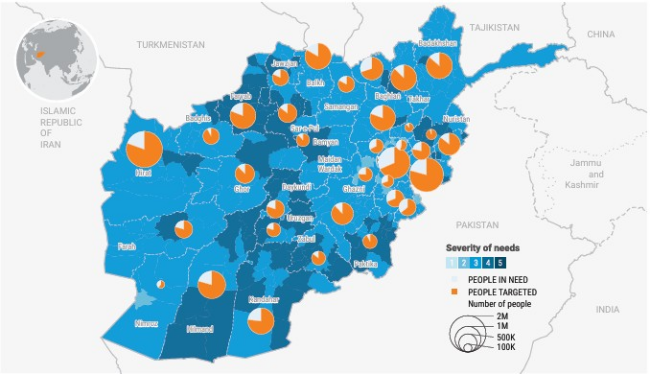
Note: Province names and figures are set out in the province-level table at paragraph 8.1.6.
See also Humanitarian aid – Funding and reach
8.1.6 Province‑level PiN and severity data were derived from the Joint Intersectoral Analysis Framework (JIAF), produced by OCHA Afghanistan in collaboration with humanitarian partners, and published via the Humanitarian Data Exchange (HDX).[footnote 35] Intersectoral severity is classified on a scale from 1 (minimal) to 5 (catastrophic), reflecting the intensity of humanitarian conditions affecting the population.[footnote 36] The table below shows the number of PiN per province and the severity, using the JIAF Humanitarian Needs People in Need and Severity 2026 dataset[footnote 37]:
| Province | Total population | People in Need (PiN) | PiN % of population | Severity class |
|---|---|---|---|---|
| Badakhshan | 1,679,524 | 1,027,521 | 61.2 | 3 |
| Badghis | 834,594 | 406,751 | 48.7 | 3 |
| Baghlan | 1,963,081 | 979,320 | 49.9 | 3 |
| Balkh | 2,437,337 | 1,043,029 | 42.8 | 3 |
| Bamyan | 515,909 | 265,822 | 51.5 | 3 |
| Daykundi | 820,911 | 489,512 | 59.6 | 4 |
| Farah | 878,882 | 472,432 | 53.8 | 3 |
| Faryab | 1,825,801 | 1,008,540 | 55.2 | 4 |
| Ghazni | 1,533,903 | 730,822 | 47.6 | 3 |
| Ghor | 1,075,241 | 573,565 | 53.3 | 3 |
| Hilmand | 2,862,520 | 1,148,120 | 40.1 | 3 |
| Hirat | 3,629,768 | 1,976,644 | 54.5 | 3 |
| Jawzjan | 738,468 | 406,654 | 55.1 | 3 |
| Kabul | 5,995,339 | 1,486,620 | 24.8 | 3 |
| Kandahar | 2,222,610 | 1,043,243 | 46.9 | 3 |
| Kapisa | 639,963 | 162,216 | 25.3 | 2 |
| Khost | 1,353,165 | 444,698 | 32.9 | 3 |
| Kunar | 1,358,622 | 735,939 | 54.2 | 3 |
| Kunduz | 1,436,180 | 788,760 | 54.9 | 3 |
| Laghman | 1,034,728 | 478,697 | 46.3 | 3 |
| Logar | 739,712 | 221,617 | 30.0 | 3 |
| Maidan Wardak | 872,010 | 294,978 | 33.8 | 3 |
| Nangarhar | 3,888,349 | 1,734,445 | 44.6 | 3 |
| Nimroz | 433,175 | 89,640 | 20.7 | 2 |
| Nuristan | 307,892 | 162,907 | 52.9 | 4 |
| Paktika | 560,510 | 309,779 | 55.3 | 4 |
| Paktya | 1,164,502 | 454,180 | 39.0 | 3 |
| Panjsher | 250,302 | 114,358 | 45.7 | 3 |
| Parwan | 968,404 | 305,581 | 31.6 | 3 |
| Samangan | 662,519 | 402,331 | 60.7 | 3 |
| Sar-e-Pul | 868,072 | 532,162 | 61.3 | 4 |
| Takhar | 1,859,589 | 1,004,739 | 54.0 | 3 |
| Uruzgan | 644,804 | 296,085 | 45.9 | 4 |
| Zabul | 539,247 | 297,577 | 55.2 | 4 |
| Total | 48,595,633 | 21,889,284 | 45.0 | – |
8.1.7 The HNRP 2026 noted that, although the number of people estimated to be in need in 2026 represented a 4% decrease compared to 2025, humanitarian needs remained among the highest globally in a non‑conflict setting.[footnote 38] [footnote 39] Humanitarian partners planned to target 17.5 million people for assistance in 2026, representing around 80% of those assessed to be in need, with prioritisation based on severity and the presence of life‑threatening needs.[footnote 40] [footnote 41]
8.1.8 The chart below, created by CPIT based on HNRP 2026 data[footnote 42], shows the number of people in need and targeted by sector:
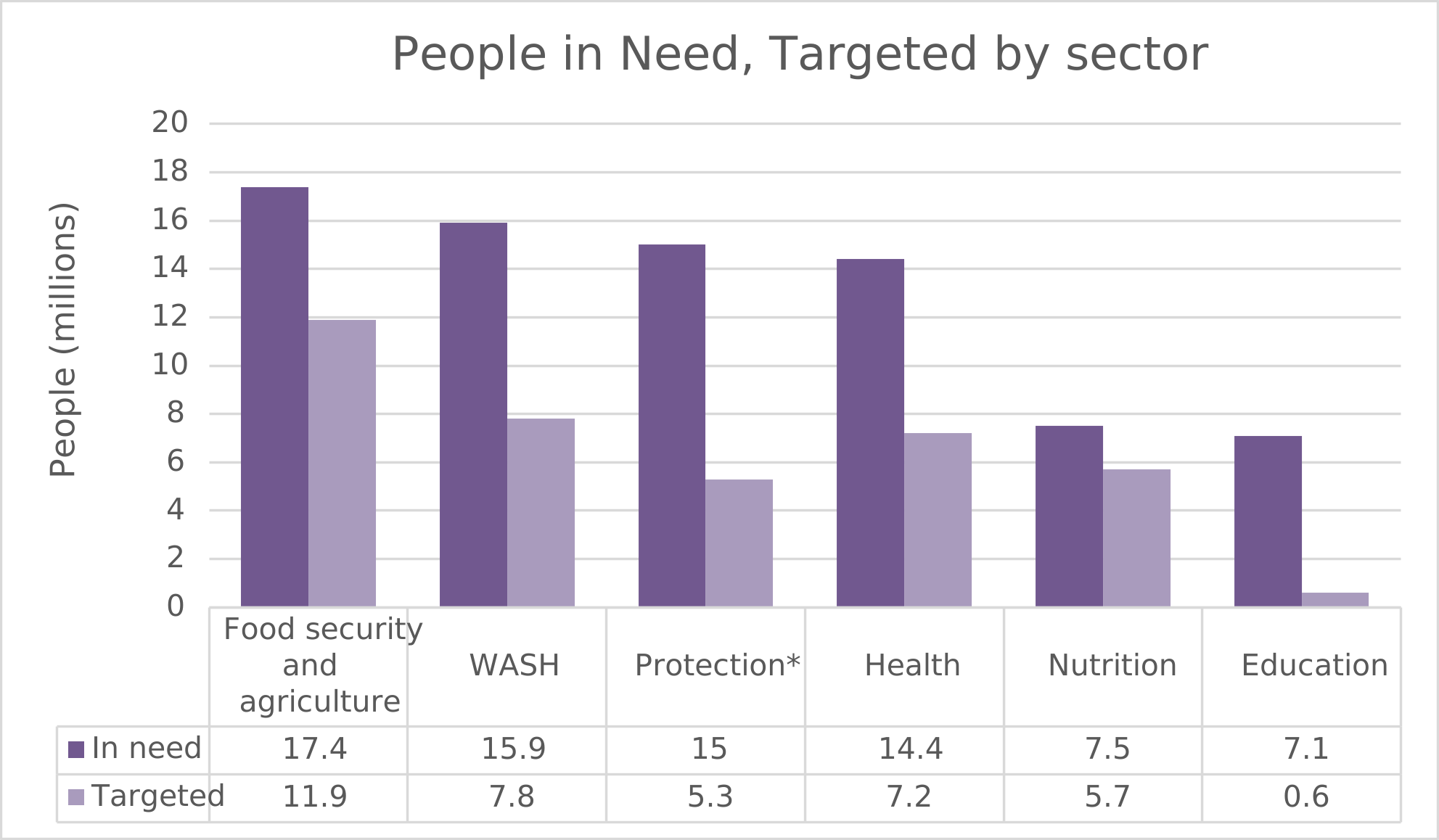
*Protection refers to humanitarian actions that prevent and respond to violence, abuse, exploitation and rights violations, particularly affecting women, children, returnees, and persons with disabilities
8.2 Food insecurity
8.2.1 The HNRP 2026 identified acute food insecurity as the primary driver of humanitarian need.[footnote 43] The Integrated Food Security Phase Classification (IPC) analysis for the period September 2025 to September 2026, recorded that, from September to October 2025, an estimated 13.8 million people (28% of the population) were classified in IPC Phase 3 or above (crisis or worse), including about 2.9 million (6%) in IPC Phase 4 (emergency) and 10.9 million (22%) in IPC Phase 3 (crisis).[footnote 44] See Understanding the IPC Scales for the Acute Food Insecurity (AFI) phases and description.[footnote 45]
8.2.2 The graph below shows the population in IPC Phase 3 and Phase 4 by Province (September to October 2025). Bars show the estimated number of people assessed as facing Crisis (IPC Phase 3) or Emergency (IPC Phase 4). Figures represent combined urban and rural populations at province level. Darker shading indicates higher severity (Phase 4).
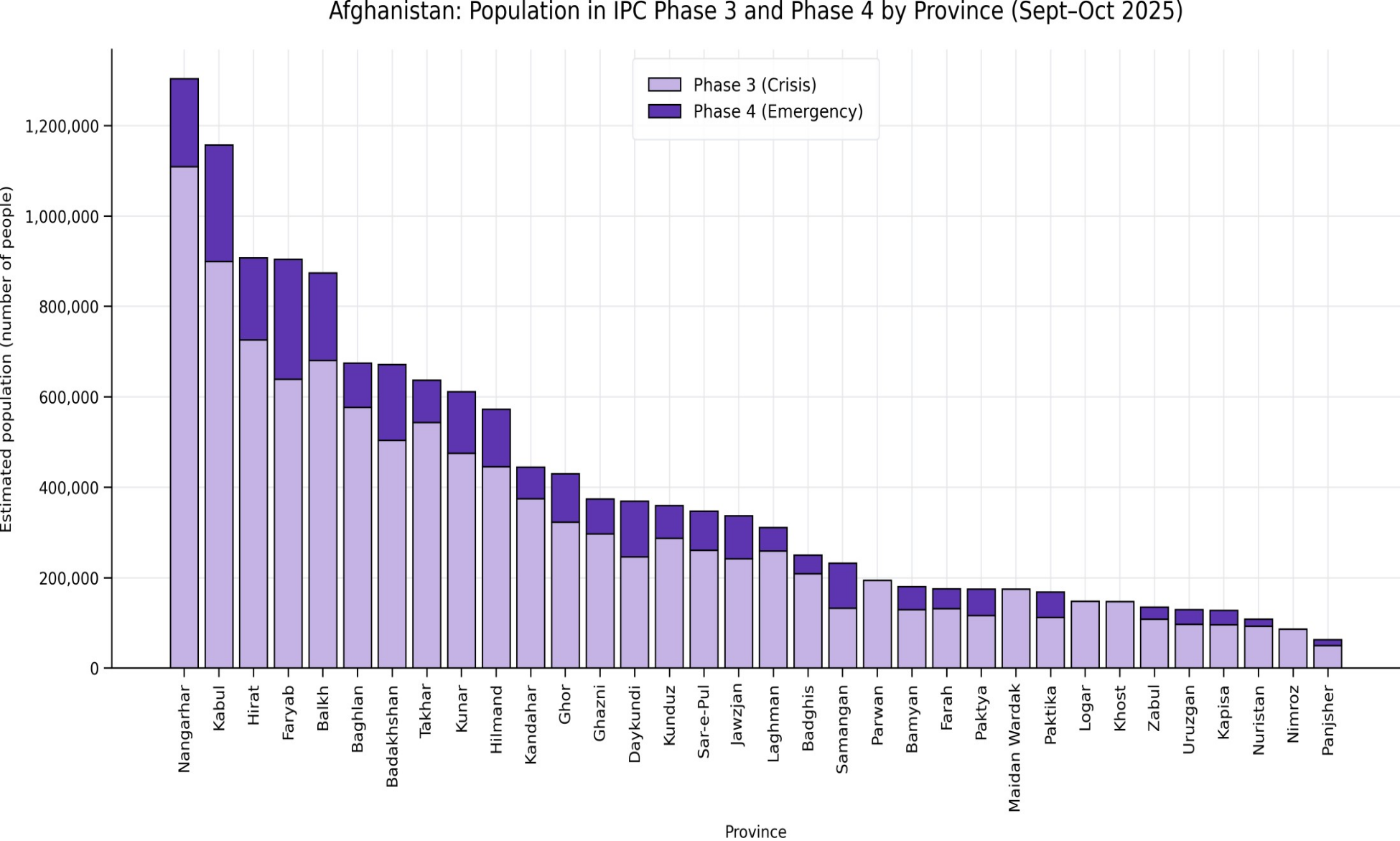
Source: IPC Afghanistan Acute Food Insecurity Analysis, September to October 2025.[footnote 46] [footnote 47] Graph developed with assistance from generative AI
8.2.3 During the winter lean season (November 2025 to March 2026), an estimated 17.4 million people in Afghanistan were projected to face Crisis or worse acute food insecurity (IPC Phase 3+), including 4.7 million in IPC Phase 4), an increase of 2.6 million more food-insecure people compared with the previous year.[footnote 48] [footnote 49]
8.2.4 The HNRP 2026 food security and agriculture narrative by Humanitarian Action, described an economy that was ‘slowly recovering’ but ‘extremely fragile’, and reported that multiple shocks – including 4 consecutive years of drought, recurrent natural disasters (including earthquakes and flash floods), weak economic conditions, and an increasing influx of returnees – were worsening food insecurity and pressuring livelihoods.[footnote 50]
8.2.5 The January 2026 EUAA Country Focus, citing various sources, noted that:
‘… although large parts of the population have an acceptable calorie-intake, their diets mainly consists of [sic] of less nutritious food such as staples, while the consumption of meat, dairy and vegetables is more rare, which might have long-term health implications. WFP [World Food Programme] reported on 78% of Afghans being unable to afford nutritious food … Households have coped with food insecurity by adjusting their diets to avoid expensive food, and adults have been skipping meals so that their children can eat. Some families only consume bread and tea.’[footnote 51]
8.2.6 The IPC analysis stated that very limited food assistance coverage (reported as reaching 2.7% of the population between September and October 2025), together with a weak and contracting economy exemplified by high unemployment and declining remittances, and the impacts of drought and earthquakes, were aggravating acute food insecurity.[footnote 52] In February 2026, the WFP estimated it could reach 2 million people per month out of the 17.4 million who needed food aid.[footnote 53]
8.2.7 For the first projection period (November 2025 to March 2026), IPC reporting identified provinces predicted to face the highest severity and be classified in IPC Phase 4 as including Badakhshan, Ghor, Faryab, Jawzjan, Samangan, Bamyan, and Daykundi.[footnote 54] [footnote 55]
8.2.8 Seasonal improvement was expected for the period April to September 2026, as indicated in the IPC map below.[footnote 56]
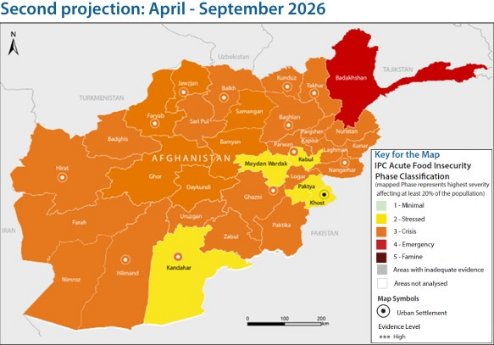
Source: IPC Acute Food Insecurity Analysis[footnote 57]
8.3 Water, sanitation and hygiene (WASH)
8.3.1 The OCHA HNRP 2026 reported that approximately 15.9 million people in Afghanistan were assessed as in need of WASH assistance. WASH needs were most prominent in ‘… the north/northwest (Badghis, Faryab, Jawzjan, Samangan, Balkh, Sar-e-Pul), west (Herat, Ghor), east/southeast (Nangarhar, Khost, Paktya) and central highlands (Bamyan, Daykundi).’[footnote 58] Such needs were linked to large‑scale population returns, prolonged drought, acute watery diarrhoea (AWD) and cholera outbreaks, recurrent flooding, earthquakes and winter water shortages, which have affected the functionality and safety of water and sanitation systems nationwide.[footnote 59] [footnote 60]
8.3.2 According to Humanitarian Action’s narrative on the HNRP 2026, seasonal and climate‑related hazards disrupted access to safe water. Spring floods damaged water supply infrastructure, and summer heat coincided with peaks in AWD cases. Winter conditions have restricted access to water in high‑altitude areas, such as Bamyan and Daykundi, due to freezing temperatures.[footnote 61]
8.3.3 The HNRP 2026 cited findings from the Whole of Afghanistan Assessment (WoAA) 2025, which indicated that 67% of households reported experiencing drought, alongside widespread water scarcity. According to the WoAA, 25% of households relied on unimproved water sources, while 37% lacked soap for basic hygiene as water was prioritised for drinking, reflecting affordability and access constraints.[footnote 62]
8.3.4 The WoAA highlighted disparities in WASH access between population groups. Rural households faced greater distance and affordability barriers to water, while female‑headed households were more likely to rely on unsafe water sources. Only 41% of households with a person with a disability reported access to an accessible latrine.[footnote 63]
8.3.5 Humanitarian organisation, Mercy Corps, reported in October 2025 that:
‘Drawing on a field survey of 292 returnee households in Herat and Kandahar, alongside secondary research, this report finds that water access for both returnees and host communities is deteriorating at an alarming pace … Over 75% of surveyed households reported that accessing clean water is “difficult” or “very difficult,” and more than 70% said the situation had worsened significantly in the past six months due to the influx of returnees. The health implications are already stark: 45% of households reported recurring illnesses linked to poor water quality, including widespread diarrheal disease and kidney problems closely associated with high salinity. Women, children, and the elderly are disproportionately affected, particularly in communities where sanitation – including critical practices like hand washing – is curtailed to save scarce water, thus increasing risk of disease.’[footnote 64]
8.3.6 The HNRP 2026 stated that the WASH Cluster planned to target 7.8 million people for assistance in 2026, out of the 15.9 million assessed as in need. The response was intended to focus on ‘… critical water shortages, sanitation gaps and disease outbreak risks,’ particularly in areas affected by drought, flooding, population returns, and AWD and cholera outbreaks.[footnote 65] [footnote 66]
8.3.7 According to an undated report by UNICEF:
‘Record droughts have forced families from their homes by the tens of thousands, in search of clean water for drinking, cooking and bathing. Today, nearly two thirds of people have been impacted by drought …
‘As river levels plummet, extreme weather is predicted to become the norm across the country. Rising temperatures and hazardous pollution are worsening the water crisis, making water less safe while it becomes more scarce …
‘… the burdens of water scarcity fall heaviest on girls. Women and girls are often responsible for fetching water for their households – an everyday chore that robs them of precious hours for learning or pursuing livelihoods. They’re also obliged to stay home and care for children who fall ill with disease or malnutrition. Increasingly, water and food shortages are driving parents to offer daughters into child marriage, a last resort against hunger.’[footnote 67]
8.4 Health
8.4.1 According to the HNRP 2026, an estimated 14.4 million people in Afghanistan were assessed to require health assistance in 2026. The health system was described as weak and unevenly distributed, with approximately 33% of the population living in underserved areas, particularly in rural and hard‑to‑reach locations, and among women, children, displaced populations and people with disabilities. Health partners aimed to target 7.2 million people with health aid.[footnote 68] [footnote 69]
8.4.2 The HNRP 2026 reported that at least 422 primary health care facilities, including Mobile Health and Nutrition Teams (MHNT), closed during 2025 due to funding shortfalls, affecting access to services for an estimated 3.3 million people.[footnote 70]
8.4.3 For further information on health care services see the Country Policy and Information Note Afghanistan: Healthcare and medical treatment.
8.5 Housing and shelter
8.5.1 The HNRP 2026 estimated there were 4.2 million PiN of shelter interventions due to ‘… natural disasters, the increased influx of returnees, and compounded economic hardship and social inequalities that continue to heighten vulnerabilities among affected communities.’[footnote 71] Shelter was a primary need for the more than 2.6 million people who returned to the country from Pakistan and Iran.[footnote 72] [footnote 73] Areas with high return volumes, including the provinces of Balkh, Faryab, Herat, Kabul and Kunduz, increased pressure on housing in already overstretched communities.[footnote 74]
8.5.2 UN Habitat reported in their strategic priorities for 2027 to 2027 that an estimated 30% of the population lived in urban areas, with at least 73% of those (2020 figures) living in informal settlements.[footnote 75] The report noted, ‘The housing situation is inadequate in informal settlements (in urban, peri-urban and rural areas), with many people being forced to construct their homes with little means and little technical knowledge, making them vulnerable to earthquakes, landslides and flooding.’[footnote 76] Residents in such informal housing were vulnerable to forced evictions due to limited land and tenancy rights.[footnote 77]
8.5.3 Citing various sources, the January 2026 EUAA Country Focus stated that:
‘The large influx of returnees has added pressure on the urban “housing crisis”, with the demand accelerated by housing shortages and surging rents in cities like Herat and Kabul. In some city areas, rents reportedly more than doubled in 2025. In particular returnees struggle to afford the high rents, but also other Afghans struggle with finding affordable options, including individuals with salaried employment and living in rural areas with cheaper alternatives. Property prices in city areas have also spiked making it difficult for people of the middle class and below to buy a home, as reported by the AAN.’[footnote 78]
8.5.4 Over the past year, residential rental prices in major Afghan cities have risen sharply due to a surge in returnees, limited housing supply, and lack of regulatory enforcement.[footnote 79] [footnote 80] In Kabul, average apartment rents have doubled to around AFN 13,000 per month, with houses reaching AFN 15,000[footnote 81] [footnote 82](about GBP 154 to GBP 178 per month[footnote 83]). Other cities such as Herat and Mazar-i-Sharif have seen similar upward trends.[footnote 84] [footnote 85]
9. Humanitarian aid
9.1 Funding and reach
9.1.1 The January 2026 EUAA Country Focus noted that:
‘The US, previously the largest state donor contributing to Afghan aid relief, decided to cut funds to almost all of its humanitarian programmes in April 2025, and other donors have followed. The consequences of aid cuts have included, inter alia, hundreds of health centres shutting down, and the suspension of USAID programmes supporting millions of Afghans with food provision, urgent healthcare services, and water, sanitation and hygiene (WASH) services. Restrictions by the de facto authorities have also negatively impacted aid delivery, and complicated the work of aid organisations on the ground.’[footnote 86]
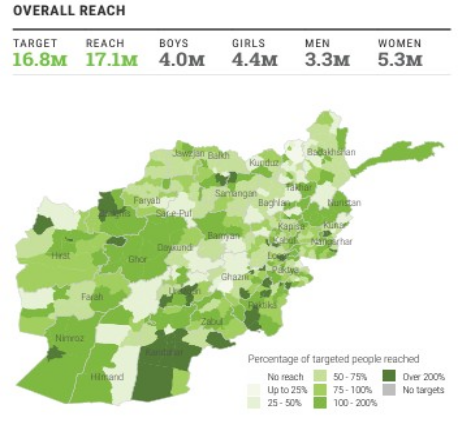
9.1.2 Regarding assistance delivered in 2025, the OCHA reported that, from January to December 2025, humanitarian partners reached 17.1 million people with at least one form of assistance, including 4 million who received 3 or more types of support. Some 10.5 million received food and livelihood support, 7.8 million received healthcare, 3.5 million received water, sanitation and hygiene (WASH) support, 6.3 million received protection services, 5.5 million received nutrition assistance, 707,000 received education support, and about 733,000 received emergency shelter and non-food items.[footnote 87]
9.1.3 The OCHA mapped the regions in which people targeted for aid were reached by at least one response activity in 2025. Some areas were not reached by humanitarian aid due to severe funding shortfalls, access constraints, security and operational limitations, restrictions affecting female staff participation, and the prioritisation of highest‑severity districts under limited resources:
Source: OCHA, 18 February 2026[footnote 88]
9.1.4 The HNRP 2026 found that, following community feedback monitoring,
‘As of August 2025, three out of four of 4,621 respondents reported that assistance met their basic needs fully or mostly, though persons with disabilities expressed higher dissatisfaction levels (28 per cent) than other groups (22 per cent) … 38 per cent of respondents preferred a combination of cash and in-kind assistance, and 27 per cent preferred cash alone, reflecting strong demand for assistance that allows households to prioritise food, rent, healthcare, transport and debt repayment.’[footnote 89]
9.1.5 Though aid reached PiN, the OCHA reported in February 2026 that:
‘Humanitarian partners continued to face systemic and administrative constraints affecting the timely delivery of assistance, including interference in programme implementation, movement restrictions, and incidents of violence against personnel and facilities. These disruptions led to the temporary suspension of 78 activities and closure of five health facilities. Most incidents were reported in the Central, Eastern, Southern, and Northern regions …
‘Interference in humanitarian operations remained the most frequently reported type of access constraint, constituting roughly 49 per cent of all incidents. These cases included interference in programme implementation, requests by De facto Authorities (DfA) for sensitive data – including beneficiary lists – and restrictions on national female staff participating in humanitarian activities, such as field missions.’[footnote 90]
Research methodology
The country of origin information (COI) in this note has been carefully selected in accordance with the general principles of COI research as set out in the Common EU [European Union] Guidelines for Processing Country of Origin Information (COI), April 2008, and the Austrian Centre for Country of Origin and Asylum Research and Documentation’s (ACCORD), Researching Country Origin Information – Training Manual, 2024. Namely, taking into account the COI’s relevance, reliability, accuracy, balance, currency, transparency and traceability.
Sources and the information they provide are carefully considered before inclusion. Factors relevant to the assessment of the reliability of sources and information include:
- the motivation, purpose, knowledge and experience of the source
- how the information was obtained, including specific methodologies used
- the currency and detail of information
- whether the COI is consistent with and/or corroborated by other sources
Commentary may be provided on source(s) and information to help readers understand the meaning and limits of the COI.
Wherever possible, multiple sourcing is used and the COI compared to ensure that it is accurate and balanced, and provides a comprehensive and up-to-date picture of the issues relevant to this note at the time of publication.
The inclusion of a source is not, however, an endorsement of it or any view(s) expressed.
Each piece of information is referenced in a footnote.
Full details of all sources cited and consulted in compiling the note are listed alphabetically in the bibliography.
Terms of reference
The ‘Terms of Reference’ (ToR) provides a broad outline of the issues relevant to the scope of this note and forms the basis for the country information.
The following topics were identified prior to drafting as relevant and on which research was undertaken:
- socio-economic indicators, including statistics on life expectancy, literacy, school enrolment, poverty rates, levels of malnutrition
- socio-economic situation, including access to and availability to:
- food
- water for drinking and washing
- accommodation and shelter
- employment
- healthcare
- support providers, including government and international and domestic non-government organisations
- variation of conditions by location and/or group
- whether government is purposely withholding or not delivering support services, if so to which areas/groups
Bibliography
Sources cited
European Union Agency for Asylum (EUAA), Afghanistan: Country Focus, 22 January 2026. Accessed: 29 January 2026
Hasht-e Subh, Housing Crisis in Kabul and Herat, 2 July 2025. Accessed: 27 March 2026
Humanitarian Action, Humanitarian Needs and Response Plan Afghanistan 2026:
-
Emergency shelter and NFI, 28 January 2026. Accessed: 25 March 2026
-
Health, 28 January 2026. Accessed: 24 March 2026
-
Food Security and Agriculture, 28 January 2026. Accessed: 19 March 2026
-
Water, Sanitation and Hygiene, 28 January 2026. Accessed: 20 March 2026
Humanitarian Data Exchange (HDX), Afghanistan: JIAF Humanitarian Needs People in Need and Severity 2026, 19 February 2026. Accessed: 18 March 2026
Integrated Food Security Phase Classification (IPC):
-
Afghanistan IPC Acute Food Insecurity Analysis: September 2025 - September 2026, 16 December 2025. Accessed: 30 March 2026
-
Understanding the IPC Scales, no date. Accessed: 30 March 2026
Internal Displacement Monitoring Centre (IDMC), Country Profile Afghanistan, 14 May 2025. Accessed: 30 March 2026
International Federation of Red Cross and Red Crescent Societies (IFRC), Afghanistan Malnutrition Crisis 2024, 1 December 2025. Accessed: 28 January 2026
Joint Intersectoral Analysis Framework (JIAF), JIAF 2 Technical Manual, July 2024. Accessed: 18 March 2026
Mercy Corps, Crisis Compounded Afghanistan’s Returnees Face an Escalating Water Emergency, October 2025. Accessed: 30 March 2026
RASC News Agency, Afghanistan’s Urban Housing Crisis Deepens: Soaring Rents Add New Layer to Humanitarian Emergency, 11 July 2025. Accessed: 27 March 2026
TOLOnews, Herat Sees Unprecedented Rent Hikes, 25 April 2025. Accessed: 27 March 2026
UN Children’s Fund (UNICEF):
-
Afghanistan Key demographic indicators, no date. Accessed: 28 January 2026
-
Water, sanitation and hygiene, no date. Accessed: 30 March 2026
UN Development Programme (UNDP), Afghanistan Socio-Economic Review 2023-2024 , April 2025. Accessed: 28 January 2026
UN General Assembly (UNGA), The situation in Afghanistan and its implications for international peace and security : report of the Secretary-General A/80/658, 27 February 2026. Accessed: 17 March 2026
UN High Commissioner for Refugees (UNHCR), Total IDPs in Afghanistan as of 31 December 2025, last updated 31 December 2025. Accessed: 30 March 2026
UN Office for the Coordination of Humanitarian Affairs (OCHA):
-
Afghanistan: Humanitarian Needs and Response Plan 2025, Response Overview (1 January - 31 December 2025), 18 February 2026. Accessed: 18 March 2026
-
Afghanistan: Humanitarian Needs and Response Plan 2026, December 2025. Accessed: 18 March 2026
-
Afghanistan: Humanitarian Needs and Response Plan 2026 Summary, 2 December 2025. Accessed: 18 March 2026
UN Population Fund (UNFPA), Afghanistan Population 2025, 2025. Accessed: 28 January 2026
UN Women, FAQs: What it’s like to be a woman in Afghanistan today, 7 August 2025. Accessed: 30 March 2026
Women’s International League for Peace and Freedom (WILPF), Submission to the UN CEDAW Committee, 19 May 2025. Accessed: 30 March 2026
World Bank Group:
-
Afghan Economy Expands Amid Persistent Challenges, 10 December 2025. Accessed: 29 January 2026
-
Literacy rate, adult total (% of people ages 15 and above) – Afghanistan, September 2025. Accessed: 28 January 2026
World Food Programme (WFP), WFP Afghanistan Country Brief, February 2026, 20 February 2026. Accessed: 19 March 2026
Xe.com, Currency converter (AFN to GBP) as of 29 January 2026. Accessed: 29 January 2026
Sources consulted but not cited
Health Cluster/World Health Organization (WHO), Afghanistan: Public Health Situation Analysis (PHSA), 4 March 2026. Accessed: 23 March 2026
Kabul Times, Rising rents and hidden cost of housing instability in Afghanistan, 11 May 2025. Accessed: 27 March 2026
Schwartz L, Hassanpoor Z, Lane H and Klapheke E, Economic constraints and gendered rules: Understanding women’s perspectives of how government-imposed restrictions impact women’s mental health and social wellbeing across Afghanistan, SSM - Mental Health, Volume 6, 2024. Accessed: 30 March 2026
WASH Cluster Afghanistan, Afghanistan Humanitarian Response: WASH Cluster Updates - Cluster Achievements - January 2026, 16 February 2026
World Bank Group, Afghanistan Macro Poverty Outlook, October 2025. Accessed: 29 January 2026
World Vision, Policy Brief: Broken Systems, Empty Plates in a World of Plenty, 27 March 2026. Accessed: 30 March 2026
UNHCR:
-
2025 Afghan Returns – One Year Recap, 24 February 2026. Accessed: 30 March 2026
-
Afghanistan post-return monitoring survey report, 30 December 2025. Accessed: 30 March 2026
-
Guidance Note on Afghanistan - Update II, September 2025. Accessed: 31 March 2026
Version control and feedback
Clearance
Below is information on when this note was cleared:
- version 4.0
- valid from 15 April 2026
Official – sensitive: Not for disclosure – Start of section
The information in this section has been removed as it is restricted for internal Home Office use only.
Official – sensitive: Not for disclosure – End of section
Changes from last version of this note
Updated country information and refreshed assessment, including updated humanitarian indicators and related risk analysis.
Feedback to the Home Office
Our goal is to provide accurate, reliable and up-to-date COI and clear guidance. We welcome feedback on how to improve our products. If you would like to comment on this note, please email the Country Policy and Information Team.
Independent Advisory Group on Country Information
The Independent Advisory Group on Country Information (IAGCI) was set up in March 2009 by the Independent Chief Inspector of Borders and Immigration to support them in reviewing the efficiency, effectiveness and consistency of approach of COI produced by the Home Office.
The IAGCI welcomes feedback on the Home Office’s COI material. It is not the function of the IAGCI to endorse any Home Office material, procedures or policy. The IAGCI may be contacted at:
Independent Advisory Group on Country Information
Independent Chief Inspector of Borders and Immigration
3rd Floor
28 Kirby Street
London
EC1N 8TE
Email: chiefinspector@icibi.gov.uk
Information about the IAGCI’s work and a list of the documents which have been reviewed by the IAGCI can be found on the Independent Chief Inspector’s pages of the GOV.UK website.
-
UNFPA, Afghanistan Population 2025, 2025 ↩
-
EUAA, Afghanistan: Country Focus (page 91), 22 January 2026 ↩
-
UNFPA, Afghanistan Population 2025, 2025 ↩
-
UNFPA, Afghanistan Population 2025, 2025 ↩
-
UNICEF, Afghanistan Key demographic indicators, no date ↩
-
IFRC, Afghanistan Malnutrition Crisis 2024, 1 December 2025 ↩
-
World Bank, Literacy rate, adult total (% of people ages 15 and above) …, September 2025 ↩
-
World Bank, Afghan Economy Expands Amid Persistent Challenges, 10 December 2025 ↩
-
World Bank, Afghan Economy Expands Amid Persistent Challenges, 10 December 2025 ↩
-
UNDP, Afghanistan Socio-Economic Review (page 14), April 2025 ↩
-
UNDP, Afghanistan Socio-Economic Review 2023-2024 (page 21), April 2025 ↩
-
EUAA, Afghanistan: Country Focus (page 10), 22 January 2026 ↩
-
EUAA, Afghanistan: Country Focus (page 78), 22 January 2026 ↩
-
EUAA, Afghanistan: Country Focus (page 79), 22 January 2026 ↩
-
OCHA, Afghanistan: HNRP 2026 (page 6), 30 December 2025 ↩
-
UNDP, Afghanistan Socio-Economic Review 2023-2024 (page 21), April 2025 ↩
-
World Bank, Afghan Economy Expands Amid Persistent Challenges, 10 December 2025 ↩
-
EUAA, Afghanistan: Country Focus (page 80), 22 January 2026 ↩
-
EUAA, Afghanistan: Country Focus (page 79), 22 January 2026 ↩
-
Xe.com, Currency converter (AFN to GBP) as of 29 January 2026 ↩
-
EUAA, Afghanistan: Country Focus (pages 80 to 81), 22 January 2026 ↩
-
World Bank, Afghan Economy Expands Amid Persistent Challenges, 10 December 2025 ↩
-
OCHA, Afghanistan: HNRP 2026 (page 21), 30 December 2025 ↩
-
UN Women, FAQs: What it’s like to be a woman in Afghanistan today, 7 August 2025 ↩
-
WILPF, Submission to the UN CEDAW Committee, 19 May 2025 ↩
-
UNGA, The situation in Afghanistan and its implications for … (paragraph 57), 27 February 2026 ↩
-
EUAA, Afghanistan: Country Focus (page 77), 22 January 2026 ↩
-
EUAA, Afghanistan: Country Focus (page 77), 22 January 2026 ↩
-
OCHA, Afghanistan: HNRP 2026 (page 45), 30 December 2025 ↩
-
Humanitarian Action, HNRP 2026: Emergency shelter and NFI, 28 January 2026 ↩
-
UNHCR, Total IDPs in Afghanistan as of 31 December 2025, last updated 31 December 2025 ↩
-
IDMC, Country Profile Afghanistan (Displacement data), 14 May 2025 ↩
-
OCHA, Afghanistan: HNRP 2026 (page 24), 30 December 2025 ↩
-
OCHA, Afghanistan: HNRP 2026 (page 24), 30 December 2025 ↩
-
HDX, Afghanistan: JIAF Humanitarian Needs People in Need and Severity 2026, 19 February 2026 ↩
-
JIAF, JIAF 2 Technical Manual (page 46), July 2024 ↩
-
HDX, Afghanistan: JIAF Humanitarian Needs People in Need and Severity 2026, 19 February 2026 ↩
-
OCHA, Afghanistan: HNRP 2026 (page 11), 30 December 2025 ↩
-
OCHA, Afghanistan: HNRP 2026 Summary, 2 December 2025 ↩
-
OCHA, Afghanistan: HNRP 2026 (page 24), 30 December 2025 ↩
-
OCHA, Afghanistan: HNRP 2026 Summary, 2 December 2025 ↩
-
OCHA, Afghanistan: HNRP 2026 (page 2), 30 December 2025 ↩
-
OCHA, Afghanistan: HNRP 2026 (page 49), 30 December 2025 ↩
-
IPC, Afghanistan IPC Acute Food Insecurity Analysis … (pages 1, 5, 22), 16 December 2025 ↩
-
IPC, Understanding the IPC Scales (page 4), no date ↩
-
IPC, Afghanistan: Acute Food Insecurity Country Data (Current, Oct 2025), 9 February 2026 ↩
-
IPC, Afghanistan IPC Acute Food Insecurity Analysis … (pages 4, 5), 16 December 2025 ↩
-
IPC, Afghanistan IPC Acute Food Insecurity Analysis … (page 1), 16 December 2025 ↩
-
OCHA, Afghanistan: HNRP 2026 (page 49), 30 December 2025 ↩
-
Humanitarian Action, HNRP 2026 Food Security and Agriculture, 28 January 2026 ↩
-
EUAA, Afghanistan: Country Focus (pages 81 to 82), 22 January 2026 ↩
-
IPC, Afghanistan IPC Acute Food Insecurity Analysis … (page 1), 16 December 2025 ↩
-
WFP, WFP Afghanistan Country Brief, February 2026, 20 February 2026 ↩
-
IPC, Afghanistan IPC Acute Food Insecurity Analysis … (page 2), 16 December 2025 ↩
-
Humanitarian Action, HNRP 2026 Food Security and Agriculture, 28 January 2026 ↩
-
IPC, Afghanistan IPC Acute Food Insecurity Analysis … (pages 1 and 2), 16 December 2025 ↩
-
IPC, Afghanistan IPC Acute Food Insecurity Analysis … (page 1), 16 December 2025 ↩
-
OCHA, Afghanistan: HNRP 2026 (page 61), 30 December 2025 ↩
-
OCHA, Afghanistan: HNRP 2026 (page 61), 30 December 2025 ↩
-
Humanitarian Action, HNRP 2026: Water, Sanitation and Hygiene, 28 January 2026 ↩
-
Humanitarian Action, HNRP 2026: Water, Sanitation and Hygiene, 28 January 2026 ↩
-
OCHA, Afghanistan: HNRP 2026 (page 61), 30 December 2025 ↩
-
Humanitarian Action, HNRP 2026: Water, Sanitation and Hygiene, 28 January 2026 ↩
-
Mercy Corps, Crisis Compounded Afghanistan’s Returnees Face … (page 3), October 2025 ↩
-
OCHA, Afghanistan: HNRP 2026 (pages 24, 25, 62), 30 December 2025 ↩
-
Humanitarian Action, HNRP 2026: Water, Sanitation and Hygiene, 28 January 2026 ↩
-
UNICEF, Water, sanitation and hygiene, no date ↩
-
OCHA, Afghanistan: HNRP 2026 (page 52), 30 December 2025 ↩
-
Humanitarian Action, HNRP 2026: Health, 28 January 2026 ↩
-
OCHA, Afghanistan: HNRP 2026 (page 52), 30 December 2025 ↩
-
OCHA, Afghanistan: HNRP 2026 (page 45), 30 December 2025 ↩
-
OCHA, Afghanistan: HNRP 2026 (page 45), 30 December 2025 ↩
-
Humanitarian Action, HNRP 2026: Emergency shelter and NFI, 28 January 2026 ↩
-
OCHA, Afghanistan: HNRP 2026 (page 45), 30 December 2025 ↩
-
UN Habitat, Strategic Priorities UN-Habitat Afghanistan 2026-2027 (page 10), June 2025 ↩
-
UN Habitat, Strategic Priorities UN-Habitat Afghanistan 2026-2027 (page 11), June 2025 ↩
-
UN Habitat, Strategic Priorities UN-Habitat Afghanistan 2026-2027 (page 11), June 2025 ↩
-
EUAA, Afghanistan: Country Focus (pages 85 to 86), 22 January 2026 ↩
-
Hasht-e Subh, Housing Crisis in Kabul and Herat, 2 July 2025 ↩
-
RASC News Agency, Afghanistan’s Urban Housing Crisis Deepens …, 11 July 2025 ↩
-
Hasht-e Subh, Housing Crisis in Kabul and Herat, 2 July 2025 ↩
-
RASC News Agency, Afghanistan’s Urban Housing Crisis Deepens …, 11 July 2025 ↩
-
Xe.com, Currency converter (AFN to GBP) as of 27 March 2026 ↩
-
TOLOnews: Herat Sees Unprecedented Rent Hikes, 25 April 2025 ↩
-
RASC News Agency, Afghanistan’s Urban Housing Crisis Deepens …, 11 July 2025 ↩
-
EUAA, Afghanistan: Country Focus (pages 85 to 86), 22 January 2026 ↩
-
OCHA, Afghanistan: HNRP 2025, Response overview (page 1), 18 February 2026 ↩
-
OCHA, Afghanistan: HNRP 2025, Response overview (pages 2, 5), 18 February 2026 ↩
-
OCHA, Afghanistan: HNRP 2026 (page 16), 30 December 2025 ↩
-
OCHA, Afghanistan: Humanitarian Access Snapshot (February 2026), 11 March 2026 ↩