Ridge and furrow guidance for forestry in England
Find out how to identify, protect and manage ridge and furrow earthworks in forestry projects.
Applies to England
If you have ridge and furrow earthworks on your land, follow this guidance when developing and implementing forestry projects. These include:
- woodland creation
- woodland/forest management plans
- fellingoas
- thinning
- restocking
- agroforestry (when covered by forestry regulations)
- roads
- quarries
Historic environment organisations should follow this guidance when providing information and advice on forestry projects.
What is ridge and furrow?
Ridge and furrow is an alternating linear pattern of parallel banks (ridges) and hollows (furrows) created by repeated ploughing over many years.
These earthworks provide evidence of agricultural processes from prehistoric to post-medieval times. These include cultivation methods, the technology and animals used and the organisation of land.
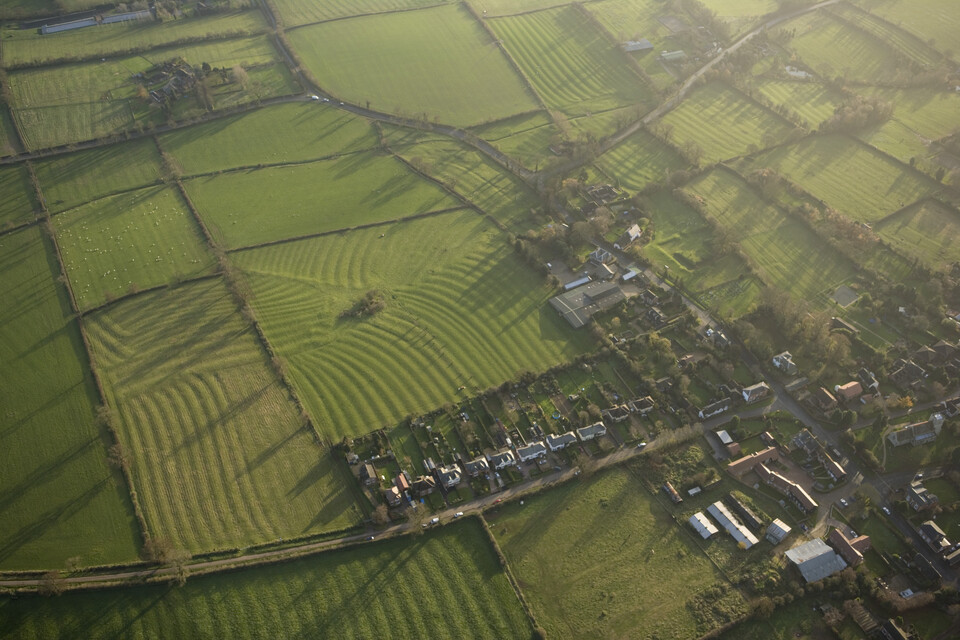
Curving medieval ridge and furrow earthworks at Mursley, Buckinghamshire. Credit: Historic England, 2006
Most of England’s ridge and furrow survives in grassland, where it has been protected from disturbance. Around 6% is in woodland.
To learn more about ridge and furrow, read Historic England’s introduction to field systems.
Why it needs protecting
Ridge and furrow earthworks provide valuable evidence of human activity and farming practices from the prehistoric era onwards. Many have been lost over the years, so it is vital to protect and manage the best examples.
Medieval examples show the organisation of English society, symbolising open fields farmed by many people working together. Their survival within later fields embodies the reorganisation of the countryside in the 18th and 19th centuries. Ridge and furrow created by steam ploughing shows the industrialisation of farming and the cultivation of land that may not have seen arable farming for centuries.
Ridge and furrow contributes to historic landscape character and sense of place. It can have historical, aesthetic and communal importance. Some have high ecological value. Some contain undisturbed soils that store carbon well.
Although ridge and furrow can survive well in woodland, there are examples of loss or damage to:
- ground preparation for tree planting, for example cultivation
- forestry vehicles, such as harvesters and forwarders causing rutting and compaction
The Forestry Commission encourages the protection and management of important ridge and furrow examples as surviving elements of the historic environment, which is in-line with the UK Forestry Standard (UKFS) 5th edition.
What to do if you have ridge and furrow
When we consider applications, such as for funding or felling, we assess how you plan to protect and manage important ridge and furrow.
Where present, you should include maps and lists of ridge and furrow earthworks in your woodland proposal. This will ensure you identify constraints, meet UKFS requirements and maximise opportunities.
Important ridge and furrow in your forestry project is considered as a historic environment constraint. Read our historic environment guidance for more information.
Follow these steps to accommodate ridge and furrow in your forestry proposal:
- Identify and assess the importance of ridge and furrow on your land.
- Conduct visual surveys.
- Conduct specialist surveys.
- Protect ridge and furrow earthworks.
- Manage ridge and furrow earthworks in your woodland long term.
Step 1: identify and assess the importance of ridge and furrow on your land
Identify
Ridge and furrow earthworks differ slightly according to age:
Prehistoric (cord rig)
The ridges are narrow, usually between 1 to 1.5 metres wide, straight or curved, and located within unenclosed rectangular plots up to 0.5 hectares. These date back to the first millennium BC or older and are very rare.
Cord rig is mainly found in northern England, with most in Northumberland.
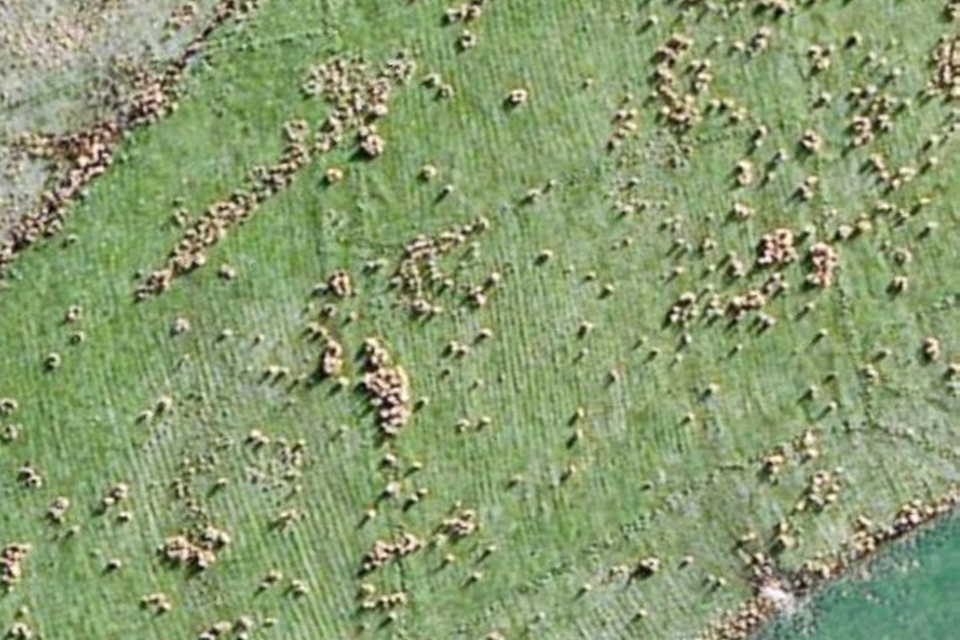
Cord rig at Rattenraw, Northumberland. Credit: Richard Carlton
Medieval
The ridges often look like a reversed ‘S’ or ‘C’ when viewed from above. Ridges vary in width, sometimes up to 20m wide. These earthworks were created by the movement of oxen pulling ploughs.
Medieval ridge and furrow earthworks survive across England, and are common in the Midlands. However, most have been levelled due to changes in ploughing in the post medieval period, the spread of mechanised farming in the 20th century and development.
Post-medieval
The ridges are straight and narrow, and rarely more than 4.5m wide. Created by ploughs pulled by oxen, horses and, from 1850 onwards, steam traction engines.
Post-medieval ridge and furrow earthworks are also present throughout much of England. About a third is in the northeast and Yorkshire.
Get help identifying ridge and furrow earthworks on your land in the following ways:
Contact your local historic environment service if your forestry project is for:
- afforestation
- deforestation
- agroforestry
- forest quarry or road
- a woodland management plan
If your project is part of a Countryside Stewardship application, find your Historic Environment Farm Environment Record.
You can also identify ridge and furrow earthworks in England online by using:
- Forestry Commission’s map browser/Land Information Search open ‘Map Layers’, then check: Constraints > Ridge and Furrow Areas
- Forestry Commission’s historic environment opportunity map for new woodland
- Historic England’s aerial photo explorer
- Environment Agency’s agricultural land environmental risk and opportunity tool
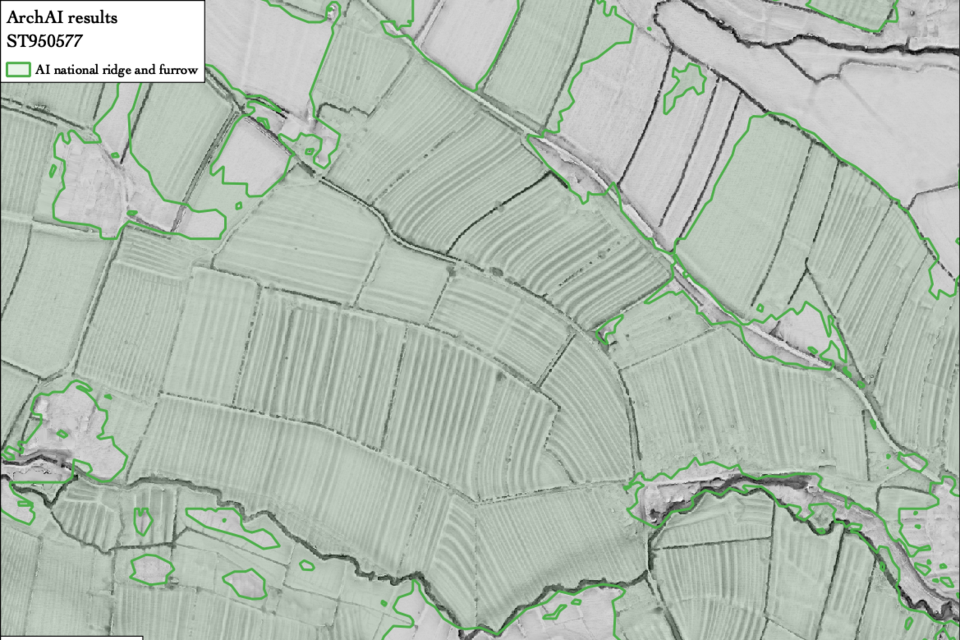
Ridge and furrow earthworks identified by artificial intelligence from LiDAR data. Credit: ArchAI, using National LiDAR Programme data from the Environment Agency under an Open Government Licence
Assess importance
Important ridge and furrow earthworks will need protection before forestry projects can proceed and during their delivery. This applies to the management of existing woodland, woodland creation, agroforestry, quarries and roads.
Some less important ridge and furrow will be suitable for woodland creation, woodland management or agroforestry projects and won’t need protecting.
We encourage you to assess earthworks on a case-by-case basis and determine importance through their:
- legal status
- form
- date
- survival and condition
- rarity – at county, regional and national level
- association with other heritage features
- setting
- historic landscape character and sense of place
Important earthworks that may be unsuitable for woodland creation include:
- all prehistoric cord rig
- important medieval ridge and furrow in grassland
- exceptional examples of steam ploughed ridge and furrow
Get advice from our Historic Environment team by emailing: historic@forestrycommission.gov.uk.
Historic environment organisations can also advise on the importance of ridge and furrow. You should also contact them about your project’s impact or opportunities. Find out when to notify historic environment organisations about forestry proposals.
Some important earthworks are legally protected as Scheduled Monuments. Find information on these sites on the National Heritage List for England.
Step 2: visual survey
Carry out a ‘walk over’ survey of your land to assess how well the ridge and furrow earthworks survive. Take photographs if necessary.
Following your visual survey, you may need to reassess relative importance using the Step 1 criteria.
Step 3: specialist surveys
Most forestry projects involving ridge and furrow earthworks will not need a commissioned archaeological survey. This is because:
- forestry operations will avoid important ridge and furrow earthworks
- existing LiDAR data provides a permanent record of less important ridge and furrow earthworks
Where LiDAR is used to provide a permanent record, you should collate LiDAR images in a report and submit this to the relevant local Historic Environment Record. You can also get support from us by emailing historic@forestrycommission.gov.uk.
In rare cases, we may identify the need for a specialist survey. For example, a high-resolution LiDAR survey, a photogrammetry survey or an analytical archaeological survey.
Funding to cover the costs of a specialist survey may be available through the Woodland Creation Planning Grant supplementary payments, Countryside Stewardship or other grants. The Chartered Institute for Archaeologists’ registered organisations or accredited professionals may be able to undertake specialist surveys for you.
You should submit reports on specialist surveys to the relevant local Historic Environment Record and OASIS. You should submit physical and digital archives created by specialist surveys to appropriate archaeological archive centres.
Following a specialist survey, you may need to reassess relative importance using the Step 1 criteria.
Step 4: protect important ridge and furrow
Important ridge and furrow earthworks should be protected during the management of existing woodland, woodland creation and agroforestry.
Protection methods will depend on the type of forestry project:
1. Management of existing woodland or agroforestry
To protect important ridge and furrow earthworks you should:
- outline protection measures in your woodland management plan
- include ridge and furrow earthworks on operational site assessments, plans and maps
- write a method statement
- mark earthworks out on the ground, using spray paint on existing trees, wooden posts or canes
- brief forest staff on location and importance ahead of forestry operations
- avoid damage, disturbance and crossing during operations
2. Creation of woodland or agroforestry
To protect important ridge and furrow earthworks you should:
- avoid entirely or place in open space
- avoid disturbance from forestry machinery
- outline protection measures in your woodland creation or agroforestry plan
Where long-term woodland management will cause minimal ground disturbance, you may be able to plant on less important ridge and furrow earthworks, or within selected areas. You may be able to reduce the risk of damage by planting alternative species or in a lower density.
If long-term woodland management methods will cause ground disturbance, less important ridge and furrow earthworks may not survive.
Infographic showing ridge and furrow in the landscape
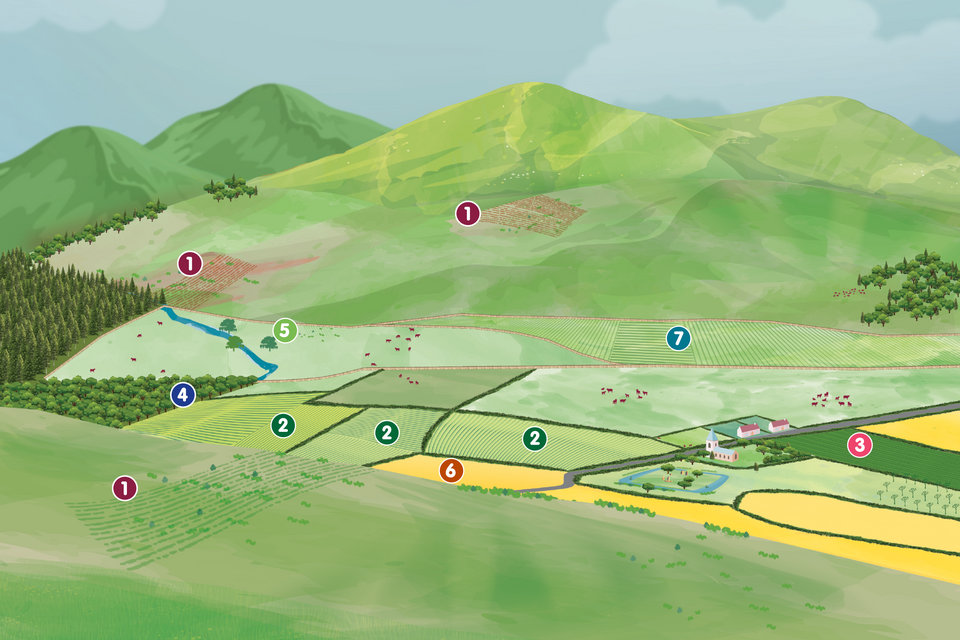
An illustrated example of various types of ridge and furrow based within a fictitious English landscape, with the aim of helping the forestry sector identify, protect and manage ridge and furrow in England. The illustration has been annotated with areas 1 to 7.
Infographic area descriptions
- Prehistoric cord rig: avoid.
- Important medieval ridge and furrow in grassland: avoid.
- Earliest evidence for steam ploughing in county: avoid.
- Well-preserved medieval ridge and furrow in woodland: protect.
- Poorly preserved isolated medieval ridge and furrow: possibly no protection required, assess on a case-by-case basis.
- Levelled medieval ridge and furrow in arable: no protection required.
- Less important and extensive post medieval ridge and furrow: no protection required.
View the full-scale version of the infographic: .
Step 5: long term management
You should outline your conservation management intentions in your woodland management and woodland creation plans.
Important ridge and furrow earthworks may need active conservation management, such as:
- grazing
- cutting open space
- regular monitoring of tree condition
- controlling scrub
Make sure your management techniques do not cause ground disturbance.
Less important earthworks are unlikely to need active conservation management.
Find out more
For more advice, read our historic environment guidance for forestry in England.
Find other constraints and checks you should consider in your forestry project.
Contact us
If you have any questions, contact your local Forestry Commission area office.