2005 to 2024 UK local and regional greenhouse gas emissions technical report (web accessible)
Updated 30 June 2026

© Crown copyright 2026
This publication is licensed under the terms of the Open Government Licence v3.0 except where otherwise stated. To view this licence, visit nationalarchives.gov.uk/doc/open-government-licence/version/3 or write to the Information Policy Team, The National Archives, Kew, London TW9 4DU, or email: psi@nationalarchives.gov.uk.
Where we have identified any third party copyright information you will need to obtain permission from the copyright holders concerned.
This publication is available at https://www.gov.uk/government/statistics/uk-local-authority-and-regional-greenhouse-gas-emissions-statistics-2005-to-2024/2005-to-2024-uk-local-and-regional-greenhouse-gas-emissions-technical-report-web-accessible
Executive summary
The local and regional greenhouse gas (GHG) emissions estimates for 2005-2024 are produced in order to provide a nationally consistent evidence base of sub-national GHG emissions. These estimates can be used as an important body of information by local authorities (LAs) and other relevant organisations to help identify high emitting sources of GHG emissions and energy intensive sectors, monitor changes in GHG emissions over time, and help design carbon reduction strategies.
This report, prepared by Ricardo on behalf of the Department for Energy Security and Net Zero (DESNZ), sets out how the local and regional GHG emissions estimates for 2005-2024 were compiled. The full data set – which is classified as Accredited Official Statistics – and statistical summary can be found on the GOV.UK website.
The data set provides a spatial disaggregation of territorial carbon dioxide (CO2), methane (CH4) and nitrous oxide (N2O) emissions from the UK GHG Inventory (GHGI), part of the National Atmospheric Emissions Inventory (NAEI), on an end user basis. This means that emissions from the production and processing of fuels, including the production of electricity, are reallocated to users of these fuels to reflect total emissions for each type of fuel consumed. The disaggregation methodology is complex, and different approaches are used to make best use of the quantity and quality of suitable data that are available for each sector.
The activity data used to produce these estimates come from six main sources:
- DESNZ sub-national gas and electricity consumption statistics
- non-departmental public body: Environmental Agency (EA)
- Devolved Government organisations: Natural Resources Wales (NRW), Scottish Environment Protection Agency (SEPA), and the Department of Agriculture, Environment and Rural Affairs (DAERA) for Northern Ireland
- point source emissions from large industrial installations
- high resolution emissions distribution mapping data developed under the NAEI programme
- land use, land-use change and forestry (LULUCF) regional data supplied by The UK Centre for Ecology and Hydrology (UKCEH), under the NAEI programme
National end user emissions data are used to calculate emission factors for each activity. Local authority activity data are then multiplied by the relevant emission factor to generate an estimate of emissions in each LA. This data set and the GHG Inventory are subject to continuous improvement to increase confidence in the estimates. Efforts are concentrated each year on topics identified in both inventory and emissions mapping improvement plans with the aims of improving accuracy and reducing uncertainties. Details on the improvements made in this year’s submission are in section 1.
In some cases, population data are used to allocate emissions to the end user. Population timeseries estimates for LAs used in this publication are derived from census-based mid-year population estimates. In years where census-based data are available these are used as the estimates for corresponding years. Estimates in intervening years are based on dynamic population model (DPM) trends between the relevant year and each census year, weighted according to the inverse of the interval in years. This approach ensures consistent timeseries of data for all LAs, avoiding step changes in population estimates whilst aligning in census years with the published ONS data.
1. Introduction
Purpose of the estimates
The statistics provide a spatial disaggregation of the CO2, CH4 and N2O emissions from the GHGI on an end user basis. The GHG emissions are estimated, by sector, for each LA in the UK. The data help identify the key sources of GHG emissions in each area; allow changes in GHG emissions over time to be monitored and can help mitigation actions to be targeted.
Methodology
This is the technical report for the UK LA and regional GHG emissions statistics for 2005 to 2024. It provides a detailed technical description of the methodology.
Two further methodology documents also accompany the dataset on the GOV.UK website:
- Mapping GHG emissions and removals for the land use, land use change and forestry sector. A detailed description of the methods used to compile the LA estimates of LULUCF emissions.
- Employment based energy consumption in the UK. A detailed methodological report describing the methods used to estimate the energy use at the UK level by the smaller industrial, commercial, and public sectors and to model the distribution of the energy use across the UK at LA level and at 1×1 km resolution.
The following sections explain the technical approaches used to generate estimates of the GHG emissions according to energy use in each sector.
The UK Greenhouse Gas Inventory
The UK GHGI is compiled annually by a consortium, led by Ricardo, on behalf of the DESNZ as part of the NAEI programme. The GHGI is compiled and reported using international best practice guidance and draws on a variety of official statistics and sector specific data sources.
The UK GHGI is reported each year to the United Nations Framework Convention on Climate Change (UNFCCC) and is used to assess compliance with UK domestic and international emissions reduction targets. A consistent method and common base of activity data is used across the NAEI programme. This provides internally consistent inventories and emissions projections of GHGs and air quality pollutants.
End user basis for reporting emissions
Energy emissions
These statistics cover territorial CO2, CH4 and N2O emissions, meaning emissions that occur within UK borders. These emissions are reported in a variety of different formats to suit different organisations and purposes each year.
One of these is known as the end user format in which emissions from the production and processing of fuels, and the production of electricity, are reallocated to final consumers of the energy to reflect the total emissions relating to that energy use. This difference in reporting mainly affects emissions related to electricity generation from power stations and fuel processing in refineries. This is in contrast to the ‘by source’ emission reporting in which emissions are attributed to the sector that emits them directly.
Emissions from sources other than those related to energy supply are reported in the same sectors under both the ‘end user’ and ‘by source’ approaches, based on the location of the emission. End user GHG emissions at UK level are reported by DESNZ as Accredited Official Statistics; however, these emissions will be slightly higher than those shown in the LA breakdown as they include emissions from some excluded sources which are deemed not to belong to any particular LA.
The end user basis for reporting emissions has been chosen for this dataset because it accounts for the emissions from energy use at the local level and does not penalise local areas for emissions from the production of energy which is then ‘exported’ to and used in other areas. The method used follows, as closely as possible, that used for the end user emissions calculated as part of the national and Devolved Government Greenhouse Gas Inventories, although they are not identical. This is because more detailed site-specific data on emissions and fuel consumption data have been used, in order to include more accurate data on emissions from large sources at the local level. The requirements of international inventory compilation (IPCC 2006a) specify that national datasets of fuel consumption (i.e. the DESNZ Digest of UK Energy Statistics, DUKES) must be used for national estimates. The ETS data for 2005-24 are not fully consistent with DUKES but were used during the compilation process of allocating consumption to particular industrial consuming sectors.
Sectors where emissions occur can be divided into 3 categories in the NAEI:
- energy producers (the production and processing of fuels including electricity)
- energy users (such as residential, industrial and road transport)
- others (which emit CO2, CH4 and N2O but where the emissions are not related to fuel use, such as agriculture, industrial process emissions, LULUCF and waste)
Table 1 (see the PDF version of this document) shows the UK GHG emissions by source in 2024 split into these three types of sectors. Emissions from CH4 and N2O are converted to carbon dioxide equivalents (CO2e) using the Intergovernmental Panel on Climate Change (IPCC) Assessment Report 5 global warming potential values.
The end user model reallocates emissions from energy supply industries to each energy use sector in the inventory in proportion to the amount of energy used by each. Some fuel producers use fuel from other fuel producers, for example refineries use electricity. The refineries therefore ‘receive’ emissions from electricity producers and in turn these emissions are reallocated to the users of the refineries’ products. This requires an iterative approach to emissions estimation from the end users which terminates when all fuel producers have no more fuel to reallocate to end users.
Table 2 (see the PDF version of this document) shows the total emissions in the UK GHG Inventory for the end user categories including both reallocated energy supply emissions and the primary emissions at the point of fuel use.
Consistent with IPCC reporting guidelines, CO2 emissions from the combustion of biofuels are excluded from the emissions totals presented here. Non-CO2 GHG emissions from the combustion of biofuels are included. For more information on both the UK GHGI and the end user emissions calculations, please see the UK National Inventory Document (NID) (Brown et al., 2026).
Waste emissions
Unique to the LA GHG data set, a reallocation is made to the location of emissions from waste to landfill. Emissions are allocated back to the producer of the waste e.g. households and industry, using data on mass of the biological component of waste landfilled by LA. This method is described in Section 11.
Improvements
As described in the executive summary, the GHG Inventory and subsequently the LA GHG emissions statistics undergo continuous improvement every year. This year, all of the methodology changes originated in the UK greenhouse gas emissions estimates, so more detail about them is available in the Revisions to the UK Greenhouse Gas Inventory section of the final 2024 UK greenhouse gas emissions statistics.
The emissions sources in the local and regional greenhouse gas emissions statistics that are most affected by these revisions are wastewater (included in the Waste ‘Other’ sub-sector), landfill, shipping (included in the Transport ‘Other’ subsector for those parts that are allocated to local areas), agriculture and LULUCF.
2. Non-domestic electricity
Allocating emissions to electricity consumption
Electricity consumption data for 2005-2024 at LA level for England, Wales and Scotland are published by DESNZ. More limited data are also available for Northern Ireland (see Section 2). These datasets have been used to map CO2, CH4 and N2O emissions from electricity generation to the point of consumption.
The emissions associated with electricity consumption have been estimated using an average UK emission factor for the relevant year in units of kt GHG per GWh. This average allocates equal shares of coal, gas, oil and renewable powered generation to all electricity consumers and is derived from the UK GHG Inventory for 2024(Brown et al., 2026). The factors used are shown in Table 3. The end user GHG emission for electricity consumption from the NAEI (as shown in Table 3) was distributed across the LAs in proportion to the consumption data for both domestic and non-domestic users. The emissions from electricity are around 97% CO2 each year.
Annualised electricity consumption data were compiled at meter point using Meter Point Administration Number (MPAN) level data. This data product is compiled by agents of the electricity suppliers, who collate/aggregate electricity consumption levels for each MPAN. The locations of these meters were determined from the Gemserv database supplied by ECOES (Electricity Central Online Enquiry Service). Where the address information was not available in the Gemserv database the Royal Mail Postcode Address File (PAF) was used to obtain a full address and postcode and reduce unallocated consumption.
Each meter is allocated a profile class, which enables consumption of domestic customers (profiles 1 and 2) to be identified from the consumption of non-domestic customers (profiles 3 to 8). In addition, profile 1 and 2 meters are reallocated to the non-domestic sector if annual consumption is greater than 100,000 kWh. Also re-allocated to the non-domestic sector are those consuming over 50,000 kWh with address information indicating non-domestic consumption (DESNZ 2025b).
Table 3: Electricity CO2e factors used in this analysis.
| Year | Total UK emission for electricity (kt CO2e) | Total consumption (GWh) | Electricity GHG factor (kt CO2e per GWh) |
|---|---|---|---|
| 2005 | 180,985 | 334,561 | 0.541 |
| 2006 | 189,422 | 332,495 | 0.570 |
| 2007 | 185,375 | 325,464 | 0.570 |
| 2008 | 182,003 | 319,082 | 0.570 |
| 2009 | 159,404 | 308,113 | 0.517 |
| 2010 | 164,519 | 310,332 | 0.530 |
| 2011 | 152,288 | 297,984 | 0.511 |
| 2012 | 165,259 | 302,649 | 0.546 |
| 2013 | 151,533 | 301,661 | 0.502 |
| 2014 | 128,819 | 303,711 | 0.424 |
| 2015 | 108,881 | 299,125 | 0.364 |
| 2016 | 86,828 | 288,660 | 0.301 |
| 2017 | 76,338 | 290,806 | 0.263 |
| 2018 | 69,716 | 287,976 | 0.242 |
| 2019 | 61,938 | 283,462 | 0.219 |
| 2020 | 52,926 | 267,768 | 0.198 |
| 2021 | 58,089 | 269,506 | 0.216 |
| 2022 | 55,469 | 260,357 | 0.213 |
| 2023 | 47,216 | 259,395 | 0.182 |
| 2024 | 39,786 | 259,803 | 0.153 |
Note: includes Northern Ireland electricity consumption and sales direct from high voltage lines
Figure 1: Time-series of electricity consumption and associated emissions in the UK.
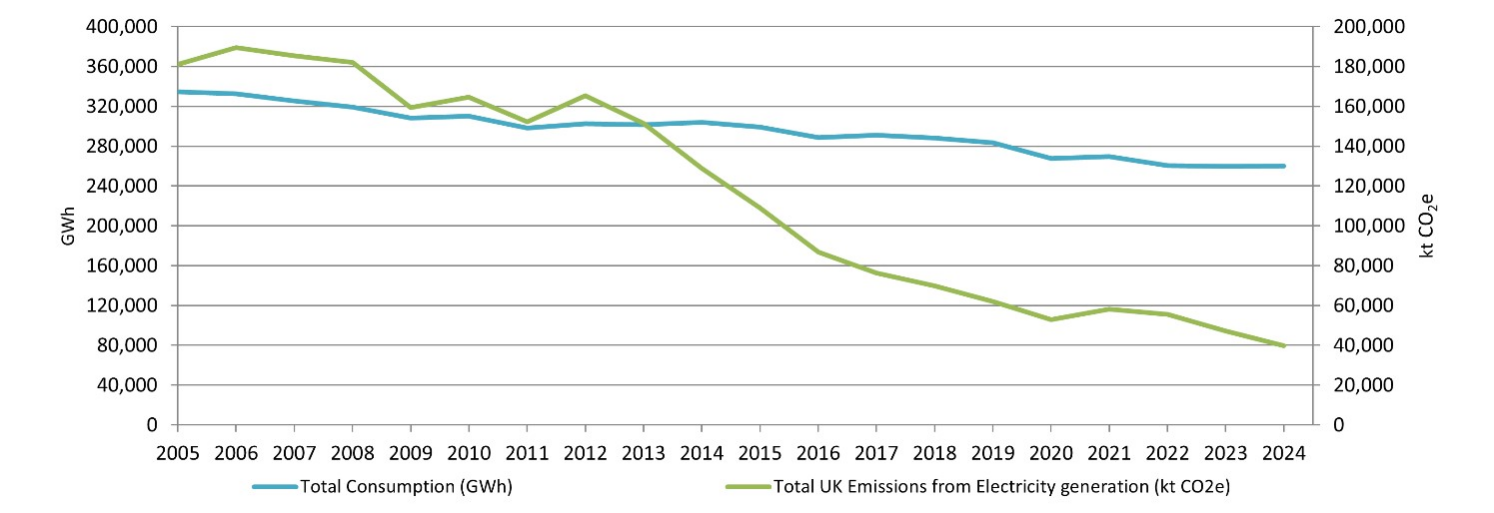
From 2005 to 2009 there was a continuous decrease in electricity consumption and a similar trend in the associated emissions, with a drop in consumption between 2008 and 2009 likely to be associated with the economic recession. Emissions in 2009 declined due to both the reduction in consumption and due to a reduction in carbon intensity of generated electricity. In 2010, electricity consumption and emissions were slightly higher than in 2009. This was likely to be due to the coldest December on record, and the stabilisation of the economic downturn may also have contributed. In 2011, electricity consumption was lower again due to a warmer winter. After 2011 consumption rose again, but since 2014 it has fallen to below 2011 levels. Electricity consumption increased slightly from 2020 to 2021 as COVID-19 restrictions were lifted and business resumed, but remained below the 2019 consumption. From 2021 to 2024, electricity consumption has fallen steadily from the 2021 level.
The long-term trend from 2005 is a steady decrease in total electricity consumption. This is due in part to a fall in the average electricity consumption per household due to energy efficiency improvements e.g. better insulation and improved appliances, as well an increase in the price of electricity since 2005 (DESNZ 2025a). Figure 1 shows from 2012 onwards the production of emissions reduces at a much quicker rate than the consumption rate of electricity, likely due to switch away from coal in the overall generation mix, toward gas and renewable generation, and some improvements in the efficiency of generating plants.
The average electricity emission factor is dependent on the mix of electricity generation types used that year. Increases in emission factor from 2005-08 are due to an increase in the proportion of electricity produced using coal. During 2010, an increase in coal consumption and a decrease in nuclear power (due to technical problems at some stations) led to a spike in the average emission factor. Supply of gas also increased over this period (DECC, 2011). In 2012, rises in the price of natural gas caused another spike in average electricity emission factor, as UK power generation switched from using natural gas to coal. From 2013 onwards, the price of natural gas relative to coal has reversed and is cheaper than coal (DECC, 2012 and DECC, 2014). Since then, the average electricity emission factor has been rapidly declining.
In 2024, the emission factor has decreased compared to 2023, reflecting continued decarbonisation of the electricity system. This is primarily due to a sustained reduction in fossil fuel generation—particularly coal, which fell to a new record low—as well as a record increase in renewable generation, with renewables exceeding 50% of total generation for the first time. While electricity demand remained broadly stable, it continues to be lower than pre‑pandemic levels, influenced by higher energy prices and relatively mild temperatures in recent years.
Overall, the emission factor has decreased over the timeseries due to the continuing decrease in coal fired generation - with the last coal fired power station in UK closing in 2024. In addition, there are increases in the share of low carbon electricity generation due mostly to consistently increasing renewable capacity over the timeseries, particularly in wind power. Nuclear generation has fallen slightly over the timeseries; however, this has been substantially outweighed by the increase in electricity from renewable sources (DESNZ, 2025). Overall, the emission factor has declined by 72% between 2005 and 2024.
Electricity consumption in Northern Ireland
Following the creation of a single electricity market in Ireland in late 2007, consumers could choose their electricity supplier, and confidentiality restrictions on the consumption data were reduced. As a result of this, figures for domestic electricity consumption by calendar year from 2008-2011 and non-domestic electricity consumption in 2009-2011 at District Council level in Northern Ireland are published by DESNZ. Data for domestic consumption for financial years since 2012/2013 have been available since December 2015, and are now an annual publication. These statistics are produced by DESNZ using aggregated meter point data derived from Northern Ireland Electricity’s Distribution Use of System (DUoS) Billing system.
The data are based on billed units and relate to final consumption at the point it was derived. Therefore, this data set excludes autogeneration that does not pass through the public distribution network. To develop a consistent time-series from 2005-2024 utilising both the calendar and financial year data, the subnational data sets are scaled such that the total is consistent with DESNZ calendar year sales data for Northern Ireland. Missing LA-scale data for years 2005-9 is extrapolated such that the total is consistent with calendar year sales data.
Unallocated electricity
Where electricity sales within the data sets have not been successfully allocated to specific LAs, they have been assigned to an additional ‘unallocated’ category. DESNZ data up until 2016 also included data on direct sales of electricity to high voltage lines, around 3-4 TWh each year, which could not be allocated to any region or LA due to a lack of accurate address information. Emissions associated with this electricity consumption are included in the final data set as an unallocated item.
This takes the overall percentage of electricity consumption unallocated to LAs, either because of a lack of data to support accurate geo-referencing, statistical differences or because it is direct sales, to 6.1% in the non-domestic sector and 0.06% in the domestic sector in 2024.
Industrial, commercial, agriculture and public sector split
Emissions from non-domestic electricity consumption are split into the following categories; Industry, Agriculture, Commercial, and Public Sector Electricity. The 2007 UK Standard Industrial Classification (SIC07) codes for each of these categories are shown in Table 4.
Table 4: classification of non-domestic categories by SIC07 code.
| Non-domestic category | SIC07 codes included |
|---|---|
| Industry | 02-32, 35-39 and 42 |
| Agriculture | 01 |
| Public Sector | 84-87 |
| Commercial | All other SIC codes |
Except for large point sources, energy consumption data for these categories at an individual site level are not available in a consistent format across the UK and therefore, proxy data on employment and energy use are used to estimate energy use and emissions at these locations.
The split generated from this data is specific to LA and year for 2015 onwards, with 2015 splits applied for 2005-2014 emissions. The methodology behind these emissions estimates and mapping are explained further in Section 5, of this report and a full account is presented in the ‘Employment based energy consumption in the UK’ report.
3. Non-domestic gas consumption
Allocating emissions to gas consumption
The gas consumption data published by DESNZ include estimates of gas consumption by the domestic sector and the non-domestic sector for each LA in Great Britain for 2005-2024. These statistics are based on data obtained from Xoserve and groups of independent gas transporters. Xoserve was set up in May 2005 after the restructuring of the gas distribution network with the role to deliver transportation transactional services to gas shippers (suppliers) on behalf of the gas transporters. These data have been mapped to LA areas very accurately, using geographical information from the National Statistics Postcode Directory (NSPD).
The Annual Quantity (AQ) gas consumption data supplied to DESNZ from Xoserve, used in the sub-national analysis, is an estimate of annualised consumption between two meter readings at least 6 months apart but ideally close to a year apart. These have historically covered the gas year (1 October to 30 September). However, from 2016 the period covered by gas consumption has changed due to a new data collection method implemented by Xoserve, shifting again in 2017 and 2018. It has remained mid-May to mid-May for the proceeding years. Table 5 below summarises the time period covered per consumption year.
Table 5: Gas consumption years used in Sub-national gas consumption statistics.
| Gas consumption year | Start and end date |
|---|---|
| 2005-2015 | 1 October to 30 September |
| 2016 | mid-July 2016 to mid-July 2017 |
| 2017 | mid-June 2017 to mid-June 2018 |
| 2018 – current | mid-May (year) to mid-May (year +1) |
Not all AQs are recalculated each year, mainly because gas shippers have not provided any new meter readings. In these cases, the previous year’s data is carried forward.
A weather correction factor is applied (except to sites that have automatic meter reading) so that AQ data are adjusted to normal weather conditions. The methodology for this adjustment is detailed in the Overview of weather correction of gas industry consumption data published by DECC in November 2014.
In 2025, DESNZ published gas consumption data for 2015-2024 that are not weather corrected, however for 2005-15 the data available does not currently enable the weather correction factor to be removed from the annual quantities, or for estimates on a calendar or financial year basis to be produced (DECC, 2012).
For these reasons, the AQ cannot be exactly aligned to gas consumption data in the Digest of UK Energy Statistics (DUKES) (DESNZ 2025c), which are based on a calendar year and are not weather corrected, or to the sub-national electricity data which are partly calendar year and partly annual from 31st January to 30th January (DESNZ 2025a).
DESNZ uses the gas industry standard cut-off point of 73,200 kWh to identify small and medium business consumers (DESNZ 2025b). This incorrectly allocates many small businesses to the domestic sector and, conversely, a small number of larger domestic consumers to the non-domestic sector. It also means that meters can change sectors from year to year. DESNZ estimate that around 2 million small businesses are incorrectly identified as domestic because of this cut-off (DESNZ 2025b). These domestic and non-domestic definitions are applied for the purposes of the UK LA and regional GHG emissions statistics for 2025 to 2024.
To ensure non-disclosure agreements are maintained, some suppression of data for the largest gas consumers has taken place. This relates to the industrial and commercial consumption data and comprises approximately 50 power stations and 110 large industrial, commercial, or public sector users. However, the LA areas in which these users are located are known, as is the total gas usage by the large (excluded) users.
Energy use and emissions estimates for the excluded sites have been calculated by Ricardo using the data from the NAEI point source database, which uses a combination of public domain emissions data and data from the Emissions Trading System (ETS) reports to regulators. This database and the method used to obtain estimates of emissions and fuel use at point sources are described in Section 4. These data are included in the Large Industrial Installations sector – Sector C, along with point source emissions from other fuels.
These exclusions from the Xoserve data set are determined by considering sites consuming over 58,600,000 kWh per year which have any of the following attributes:
- Shared Supply Meter Point (SSMP) – that is, 2 or more Gas Shippers to the site
- On Short haul Tariff Charge (due to close proximity to an input terminal)
- Daily Metered site on Connected System Exit Points (large meter point connected to a pipeline which is owned and operated by Independent Gas Transporters)
- an interconnector
- site with telemetry equipment
Data from the NAEI points source database have been used to estimate fuel use from 2005 to 2024. There are, in some cases, discrepancies between the DUKES fuel use statistics and those either reported in the ETS or calculated by Ricardo. These differences mean that the data presented here for Industrial and Commercial emissions of CO2, CH4 and N2O are not fully consistent with the UK GHGI. The differences are described in Section 4.
The comparison between DESNZ estimated gas consumption for the excluded sites and gas consumption as estimated by Ricardo from the NAEI points source database is shown below in Table 6. The difference between these figures is due mainly to two reasons. Firstly, different scopes apply for different reporting requirements; emission reporting in some instances only requires reporting for a particular furnace rather than an entire site, and it is not clear whether exclusions from the sub-national data set are for whole sites or single meters. Secondly, the company names used in the point source database and those supplied by Xoserve are not always consistent and it is therefore not possible to match them all with absolute certainty.
The total of industrial and commercial emissions from end user gas consumption in this LA data set is consistent with those in the UK GHG Inventory, no emissions are excluded from the data set total because of the differences described above. This means that the difference between the Ricardo and DESNZ estimated gas consumption from large point sources is spread DESNZ LA gas consumption data, effectively increasing the implied emission factor (IEF) for gas use by a small amount (IEFs shown in Table 8).
Industrial, commercial, agriculture and public sector split
Like electricity, emissions associated with non-domestic gas consumption are estimated using employment and energy use data as explained in Section 5, of this report and a full account is presented in the ‘Employment based energy consumption in the UK’ report.
Table 6: Comparison of DESNZ excluded gas consumption and Ricardo calculated gas consumption at large point sources.
| Gas consumption excluded from sub-national data set (GWh) | DESNZ estimated excluded gas | Ricardo estimated excluded gas | Difference | Difference as a percentage of total gas consumption |
|---|---|---|---|---|
| 2005 | 110,327 | 78,332 | 31,995 | 4.6% |
| 2006 | 88,519 | 72,876 | 15,643 | 2.4% |
| 2007 | 100,686 | 73,728 | 26,958 | 4.3% |
| 2008 | 100,460 | 74,942 | 25,518 | 4.0% |
| 2009 | 99,735 | 64,509 | 35,226 | 6.0% |
| 2010 | 94,996 | 65,227 | 29,769 | 4.6% |
| 2011 | 96,224 | 61,498 | 34,726 | 6.5% |
| 2012 | 102,576 | 59,939 | 42,636 | 7.3% |
| 2013 | 105,000 | 56,513 | 48,487 | 8.2% |
| 2014 | 100,623 | 54,113 | 46,511 | 9.2% |
| 2015 | 97,891 | 51,880 | 46,011 | 8.8% |
| 2016 | 96,155 | 48,729 | 47,426 | 9.0% |
| 2017 | 98,800 | 51,613 | 47,186 | 9.0% |
| 2018 | 104,338 | 47,417 | 56,921 | 10.6% |
| 2019 | 101,390 | 49,236 | 52,153 | 9.9% |
| 2020 | 95,825 | 49,455 | 46,369 | 9.0% |
| 2021 | 95,376 | 42,060 | 53,316 | 9.8% |
| 2022 | 84,523 | 38,416 | 46,107 | 9.9% |
| 2023 | 82,893 | 43,615 | 39,278 | 8.9% |
| 2024 | 84,989 | 35,605 | 49,384 | 10.8% |
Gas consumption in Northern Ireland
Data for Northern Ireland are estimated using information on total Northern Ireland gas consumption from energy providers Airtricity and Firmus energy, and from 2015 onwards DESNZ sub-national gas consumption statistics, which provides total consumption, number of meters and average consumption per meter for each District Council area in Northern Ireland (DESNZ 2025d).
Comparison of DESNZ subnational data with data from gas suppliers shows that the supplier data is consistently lower and may not represent all consumption in Northern Ireland. 2005-14 estimates based on data from gas suppliers have therefore been re-based using 2015 consumption at LA level from DESNZ subnational estimates ensuring a more consistent timeseries and more accurate estimates for consumption in early years.
Calculating GHG emissions
To calculate the total amount of CO2, CH4 and N2O emissions represented by the DESNZ gas consumption (i.e. without the excluded large gas users) it is necessary to remove the GHG emissions associated with these large users from the national total end user emissions. For 2005-2015 emissions from gas consumption in Northern Ireland must be removed from total UK emissions as Northern Ireland gas consumption are not weather corrected whilst Great Britain consumption data are. For these years it is therefore more accurate to use a UK-wide average emission factor for gas consumption in Northern Ireland, and adjust only the weather corrected Great Britain consumption such that the UK total is consistent with GHGI totals based on DUKES. This normalisation approach is continued for 2015-2024 data where both Great Britain and Northern Ireland consumption data are not weather corrected. To ensure that there is no artificial timeseries step change caused by differences in normalisation approach across years, the effect of weather correction on Northern Ireland data is removed in these years by utilising regional consumption data from the DA GHGI.
This calculation is shown in Table 7 (see the PDF version of this document) where the industrial sectors using gas are listed at the top, with emissions associated with the large gas users and Northern Ireland removed from this total and domestic gas use emissions are added at the bottom. Northern Ireland emissions are calculated by applying the implied emission factor calculated in Table 7 to gas consumption data reported by energy suppliers.
The Northern Ireland implied emission factor is calculated using the total UK end user emissions from the UK GHGI and the total end user (all sectors other than energy suppliers) gas consumption. The result of the calculation in Table 7 is a national total gas emission consistent with the DESNZ sub-national gas consumption data set. The resultant implied CO2e emission factors for the DESNZ sub-national gas consumption data set are shown in Table 9. Around 97% of total CO2e GHG emissions from gas combustion are CO2.
These data are revised for the entire timeseries each year due to a variety of factors, primarily improvements to the UK GHGI (Brown et al., 2026) and to DUKES commodity balances (DESNZ 2025c). All emissions used in these calculations are ‘end user’ emissions and include emissions from the production and transportation of gas. Power stations’ emissions are not included in any of these calculations as they are distributed by electricity consumption.
Table 8: Northern Ireland gas GHG emission factors calculated from UK GHGI data.
| Year | Total UK emission for gas | Total consumption (GWh gross) | Northern Ireland gas GHG factor (kt CO2e per GWh) |
|---|---|---|---|
| 2005 | 140,295 | 695,242 | 0.202 |
| 2006 | 132,732 | 659,390 | 0.201 |
| 2007 | 126,587 | 631,226 | 0.201 |
| 2008 | 128,817 | 645,501 | 0.200 |
| 2009 | 116,709 | 583,836 | 0.200 |
| 2010 | 127,924 | 642,608 | 0.199 |
| 2011 | 107,578 | 537,496 | 0.200 |
| 2012 | 116,740 | 583,232 | 0.200 |
| 2013 | 118,653 | 591,740 | 0.201 |
| 2014 | 102,266 | 508,227 | 0.201 |
| 2015 | 105,475 | 525,776 | 0.201 |
| 2016 | 104,676 | 527,726 | 0.198 |
| 2017 | 103,689 | 523,737 | 0.198 |
| 2018 | 106,279 | 538,580 | 0.197 |
| 2019 | 103,575 | 525,323 | 0.197 |
| 2020 | 101,654 | 516,839 | 0.197 |
| 2021 | 106,267 | 543,575 | 0.195 |
| 2022 | 91,225 | 463,928 | 0.197 |
| 2023 | 86,566 | 438,858 | 0.197 |
| 2024 | 89,792 | 456,381 | 0.197 |
Table 9: Gas GHG emission factors used for Great Britain.
| Year | Total UK emission for gas (to distribute using DESNZ gas data) | Total consumption in DESNZ gas data (GWh gross) | Great Britain gas GHG factor (kt CO2e per GWh) |
|---|---|---|---|
| 2005 | 126,171 | 660,515 | 0.191 |
| 2006 | 119,271 | 628,733 | 0.190 |
| 2007 | 112,719 | 614,093 | 0.184 |
| 2008 | 114,793 | 586,455 | 0.196 |
| 2009 | 104,612 | 539,058 | 0.194 |
| 2010 | 116,500 | 540,642 | 0.215 |
| 2011 | 96,754 | 513,166 | 0.189 |
| 2012 | 105,854 | 510,047 | 0.208 |
| 2013 | 108,376 | 498,402 | 0.217 |
| 2014 | 92,849 | 501,285 | 0.185 |
| 2015 | 96,402 | 499,390 | 0.193 |
| 2016 | 96,152 | 486,716 | 0.198 |
| 2017 | 94,579 | 512,570 | 0.185 |
| 2018 | 97,686 | 492,005 | 0.199 |
| 2019 | 94,677 | 501,153 | 0.189 |
| 2020 | 92,907 | 527,987 | 0.176 |
| 2021 | 98,464 | 473,074 | 0.208 |
| 2022 | 84,434 | 435,382 | 0.194 |
| 2023 | 79,211 | 425,690 | 0.186 |
| 2024 | 82,837 | 419,422 | 0.198 |
It is important to note that the compilation of the DESNZ sub-national gas consumption data set up until 2015 uses a weather correction factor based on a Met Office model using historic data. This takes account of the warmer weather in more recent years (DESNZ 2025b). This is done to observe long-term energy consumption trends without being affected by particularly warm or cold years.
The total UK GHG emissions from gas consumption in the local-level GHG data set are consistent with those from the UK GHDGI which is based on DUKES which is not weather corrected. The national emissions from gas consumption are allocated to LAs based on DESNZ sub-national gas consumption data which are weather corrected up until 2015. This results in a partial weather correction whereby the impacts of changes in the weather are still evident in the time series for an individual LA, but the magnitude of change is reduced. From 2022, gas consumption data that has not undergone a weather correction was published by DESNZ. Since then, this data set has been used, for the years 2015 – latest NAEI year, so the full effect of trends in gas consumption arising from changes in weather should be evident in LA level emissions data.
The magnitude of the weather correction is particularly evident for 2010 in Table 9 above, the implied emission factor is much higher because it was an extremely cold year and more gas was used. Similarly, there is another rise in 2012 and in 2013 the implied emission factor due to the unusually cold weather in the latter months of 2012 and the first half of 2013. In 2014 and 2015, the implied emission factors are lower because they were warm years. Even though the data from 2015 onwards are not weather corrected an increase in the IEF for 2021 is seen as there was a cold start to the year which is covered in the yearly DUKES data but not in the subnational data, which covers the period of mid-May 2022 to mid-May 20234. This explains why the subnational gas statistics decrease from 2021 to 2022 whilst the DUKES data increases over the same time period, then decreases again in 2023, see Figure 2 (DESNZ 2025a).
Figure 2: Natural gas consumption and emission factors, weather-corrected (Great Britain 2005-2014 and all of Northern Ireland) and not weather-corrected (Great Britain 2015-2024).
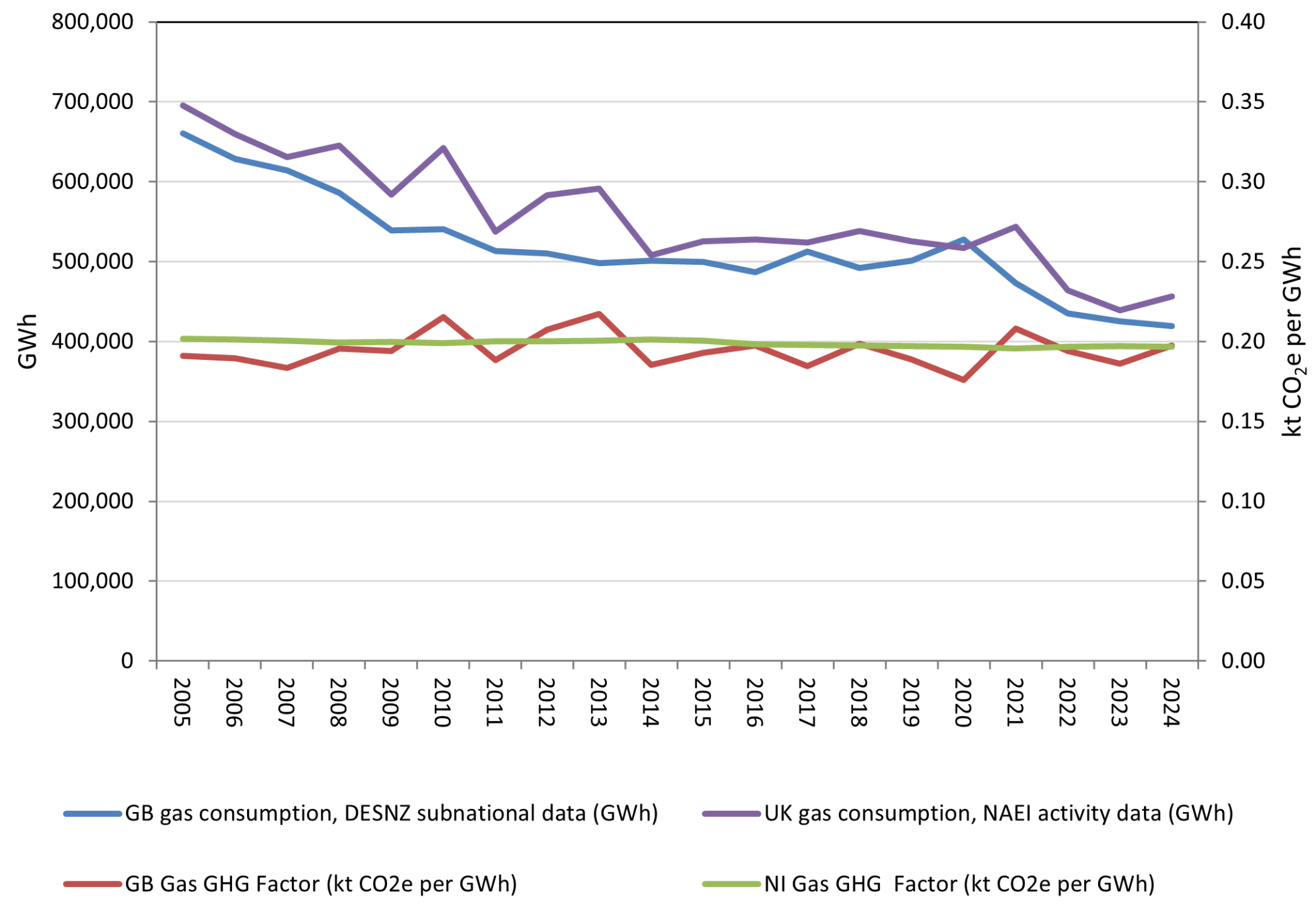
Note: UK gas consumption data are from DUKES in which data are reported for a calendar year. Great Britain gas data are from subnational statistics which report mid-May to mid-May the next year. This can cause discrepancies between the values for Great Britain and the UK.
In Figure 2, total natural gas consumption decreased by 1.5% for 2024 compared to 2023 as a result of warmer average annual temperatures and higher prices in more recent years. (DESNZ 2025c).
4. Large industrial installations
Data sources and summary of methods
Emissions from large industrial installations are mapped using the NAEI database of point sources. For this LA GHG end user data set, an additional calculation is made to account for the GHG emissions emitted during the processing of fuels used in industrial installations. For more information on end user inventories see Section 1.
The site-specific estimates of emissions have been compiled from a number of detailed data sources that report fuel consumption and/or emissions:
- Information on fuels burnt during 2005-2024 which is held in the EA, SEPA, NRW, and DAERA databases of installations that are in the UK ETS or the EU ETS.
- Information on GHG emissions from combustion processes during 2005-2024which have been reported by operators regulated under Integrated Pollution Prevention and Control (IPPC) to the EA and NRW for inclusion in the Pollution Inventory (PI), to SEPA for inclusion in the Scottish Pollutant Release Inventory (SPRI) and to the Northern Ireland Environment Agency for inclusion in their Pollution Inventory (PIV). These are hereafter described as the IPPC data sets.
Some additional data, supplied by trade associations or individual process operators, have been used to inform the development of the point source fuel use estimates and, in the case of steelworks, these data are used directly in the generation of point source data.
Point source fuel and GHG emissions estimates have been made for the following sectors:
- power stations, refineries, and coke ovens
- other plant regulated as combustion processes under Integrated Pollution Control (IPC) and, more recently, IPPC
- integrated steelworks
- cement clinker manufacture
- lime manufacture
- other plant regulated under IPC and IPPC
- other sites for which ETS annual emissions data are available
Note that emissions in the energy supply and fuel production sectors are not included at the point of emissions in the data set accompanying this report. These emissions have been redistributed to the locations of the relevant fuel consumption. See Section 1.
To produce a consistent data set for all sectors and years to be used in this and other emissions mapping work, the following key methods are used for calculating and checking point source emission estimates:
- Direct use of ETS fuel consumption and GHG emission data: Fuel consumption data are checked against inventory classifications and DUKES fuel consumption data. There can be differences in terms of scope of reporting.
- Estimates of emissions from processes outside the scope of ETS, based on IPPC and industry data: Relationships between these installations and those that report the ETS need to be established in order to prevent double counting of emissions and fuel consumption. This also helps to gain information on sources of emissions at installations and the types of fuels used where this is not published.
- Gap filling and modelled estimates where data are not available: In the above sources of data, there are often gaps where sites have not reported emissions for some years. These gaps can be due to installations falling below reporting thresholds for certain years or because of the changing scope of reporting requirements, or simply because of plant closures or replacement. A judgement needs to be made about whether each of these gaps is realistic or if emissions need to be estimated to fill the gap.
More information is given on the above key methods in Section 4 below.
As mentioned previously, the data presented in this report are not fully consistent with the UK GHGI (including the Devolved Government GHGIs) because of the use of emissions data reported by operators and also the ETS dataset, both of which are independent of DESNZ official statistics on fuel use which are used for the UK and Devolved Government GHGIs. However, analyses carried out as part of the GHGI programme of work indicate that the ETS and other operators’ data are broadly in line with DESNZ energy statistics, and it is estimated that the use of operators’ data leads to a difference in estimated carbon emissions of less than 1% of the UK national total.
The advantage of using more detailed, installation-specific, data from operators is that this ensures the use of the best possible information on the fuels used at each industrial and commercial site, even if the total fuel use across the UK is marginally different from that reported in DUKES. Details of where the differences are most significant are given in Section 4.
The emissions in the NAEI point source database are calculated as ‘by source’ emissions rather than by end user. Therefore, where appropriate (only for fuel combustion emissions) an end user increment, representing GHG emissions arising from fuel production (e.g. refineries), is also allocated to that end user.
For the purposes of reporting emissions by fuel type a simplified classification of fuel types has been used. This is shown in Table 10.
Table 10: Fuel categories for reporting emissions.
| Fuel name | Fuel category |
|---|---|
| Natural gas | Natural gas |
| Biogas in the gas grid | Natural gas |
| Burning oil | Oils |
| DERV | Oils |
| Fuel oil | Oils |
| Gas oil | Oils |
| LPG | Oils |
| Naphtha | Oils |
| OPG | Oils |
| Orimulsion | Oils |
| Petrol | Oils |
| Lubricants | Oils |
| Blast furnace gas | Process gases |
| Coke oven gas | Process gases |
| Sour gas | Process gases |
| Anthracite | Solid fuels |
| Coal | Solid fuels |
| Coke | Solid fuels |
| Peat | Solid fuels |
| Petroleum coke | Solid fuels |
| SSF | Solid fuels |
| Biogas | Wastes and biofuels |
| Biomass | Wastes and biofuels |
| Landfill gas | Wastes and biofuels |
| Liquid bio-fuels | Wastes and biofuels |
| Non-municipal solid waste: biomass fraction | Wastes and biofuels |
| Non-municipal solid waste: non-biomass fraction | Wastes and biofuels |
| Plant Biomass | Wastes and biofuels |
| Scrap tyres | Wastes and biofuels |
| Sewage gas | Wastes and biofuels |
| Waste | Wastes and biofuels |
| Waste oils | Wastes and biofuels |
| Waste solvent | Wastes and biofuels |
| Wood | Wastes and biofuels |
Improvements
The point source data cover the period 2005-2024. There is a programme of continuous improvement and revisions have been made to the point source data for 2005-2024 in a few instances where additional data have become available, or where other changes (such as changes to the methodology of the UK GHGI) have an impact on the point source data. Most point source data, however, will be unchanged from the values used in the previous version of the local and regional GHG emissions estimates.
Detailed estimation methods
The derivation of estimates from the above data sources is described in the following sections. There are a number of sectors which are problematic, and a short section outlining these issues then follows.
Fuel use for ETS processes
The EA have provided access to the data that the operators of installations in England have reported for fuel consumption and GHG emissions in 2005-2024 under the ETS. Equivalent data were also received from NRW, (Wales), DAERA (Northern Ireland), and from SEPA (Scotland).
The type and quantity of fuels burnt by ETS processes are included in the data provided by the regulatory authorities and these fuels have each been assigned to one of the standard fuel types used in the NAEI (coal, fuel oil, gas oil). Each ETS process has also been allocated to one of the industrial sector classifications used in the NAEI – these are, in turn, based on the classification used in DUKES.
Estimating fuel use for non-ETS processes
A number of combustion processes are not covered by the ETS in the UK, for example small combustion installations would be outside the scope of the scheme. During phase 1 (2005-2007) and phase 2 (2008-2012) the scope of ETS was considerably narrower than now, with many sites not required to take part during phase I because of their involvement in other programmes, and driers, furnaces and similar types of installation that use heat in-situ not being covered at all until phase 3 started in 2013. In these cases, data may be available from other sources including the IPPC data sets.
The IPPC data will also cover many of the combustion processes within the ETS data sets. It is therefore necessary to compare the IPPC data with the ETS data at the level of individual installations, to identify additional emissions present in the IPPC data. Care has had to be taken to correctly match up those installations reporting under IPPC that also report in the ETS data sets, in order that the comparison is accurate.
The ETS data provided by the EA includes some information on the relationship between the processes covered by ETS applications and processes reporting to the PI, but in most cases it has been necessary to use expert judgement to define the connections between ETS and IPPC installations. This is not always straightforward in that the two data sets quite often have different operator names, site names, or site addresses for installations that appear to refer to the same site, and there are also instances where a single IPPC installation relates to multiple ETS installations, and vice versa.
It has taken time to unpick the two sets of data and to understand the relationships between the installations in the ETS data, and those in the IPPC data sets, and this led to revisions to the point source data during the early years of these data being produced. There are likely still some areas of uncertainty in this ‘mapping’ of ETS sites to IPPC sites, but we believe that we now have a good understanding of the relationships for most existing ETS installations. Revision of data due to changes in assumptions in this area should now occur only rarely.
Once the relationship between installations in the two data sets has been established, it is a simple task to compare the reported emissions and to check which installations report additional emissions in the IPPC data, or which only report emissions in the IPPC data. These additional emissions in the IPPC data are added to the point source database. There are also instances where installations report lower emissions in the IPPC data, but these do not need to be considered further and can be ignored.
The additional IPPC data are initially just emissions from an unknown source, and so the next step is to assign those emissions to an emission source category. These additional emissions result from the fact that the scope of reporting is often different in ETS and the IPPC data, and that the scope of IPPC is wider. Most importantly, during phases I and II of the EU ETS, the UK used the medium definition of combustion installations which covers the production of electricity, heat or steam for the purposes of energy production.
This meant that, for example, most furnaces used to produce chemicals or melt metals were not covered by ETS in the UK in 2012, although this has now changed with the start of Phase III of the scheme in 2013. The IPPC data for some installations can combine the emissions from combustion processes that are covered by ETS with emissions from processes that are not. For example, a chemical industry site could have steam-raising boilers (covered by both ETS and IPPC data), and product driers (covered only by IPPC). The IPPC data sets can also include carbon from biological fuels such as wood, as well as carbon from non-combustion processes such as chemical syntheses and fermentation.
Finally, there is also the possibility that the additional emissions in the IPPC data set are due to the use of different assumptions, provisional data or due to errors. Therefore, as well as identifying the relationship between ETS and IPPC installations, it is also necessary to understand the reasons the scope of emissions is different, and particularly whether additional carbon emissions from the IPPC installation is related to non-ETS combustion using fossil fuels, use of biofuels, some non-combustion process, or is anomalous.
This is done using expert judgement, supported by some in-depth research for some of the most significant sites in order to determine the exact scope of both ETS and IPPC installations, although limited access to documentation of the scope of ETS and IPPC permits, and the resource-intensive nature of the investigations needed, mean that our understanding of the relationship between the two data sets is continually developing. This aspect of the points data processing is expected to improve still further in future years, although we believe that fewer revisions will need to be made in the future years compared with previous versions of the data.
Once expert judgements have been made about the nature of the additional emissions in the IPPC data sets, these emissions are assigned to fuels or other GHGI emission source categories where appropriate, or removed from the point source data if considered likely to be either biocarbon or anomalous.
Gap-filling and modelled estimates
None of the data sets are fully complete and exactly overlapping with the scope required for LA GHG emissions reporting. In the case of the EU ETS, the scope of the scheme has changed over time and various installations were able to ‘opt-out’ in Phase I; for example, many cement kilns, brickworks and food & drink industry sites did not need to report. These and other opted-out sites then joined ETS for the start of phase II in 2008, but a voluntary de minimis limit was also introduced in that year which allowed operators to exclude individual combustion units that were < 3 MWth from their rated thermal input calculation such that many installations no longer exceeded the 20 MWth limit requiring their inclusion in the scheme.
Many public sector sites such as hospitals and universities ceased reporting to ETS in 2008, likely because of the de minimis rule. For ETS phase III, the definition of a combustion installation was changed to the ‘broad’ classification which meant that furnaces and similar devices that use heat directly were included under ETS. As a result, many additional sites started to report to ETS in 2013, including many roadstone coating plants, food production sites, and metal industry sites.
The IPPC data sets do not require reporting of emissions below set ‘reporting thresholds’, so some installations where carbon emissions are close to that threshold value report emissions in some years where the threshold is exceeded, and report no emission value in years when it is not.
If left unchanged, these gaps and data inconsistencies in the ETS and IPPC data sets could lead to unreliable emissions time-series data for individual installations and for LA areas and so expert judgement is used to assess the time-series and to fill gaps where appropriate, usually by extrapolation of data from other years. We take account of the fact that some apparent gaps in data will be due to plant closures or mothballing of plants, or plants not being in existence in a few cases where there are gaps at the start of the time-series. It is likely that we are not aware of all details of plant commissioning and plant closures, so some revisions might be necessary in this part of the processing in future years.
A final aspect of the point source data is the inclusion of a limited set of data where emissions are modelled rather than based on operators’ data. This is necessary for some processes operated under IPPC which emit relatively small quantities of carbon dioxide and therefore almost invariably do not need to report emissions, for example various small electric arc steelworks, and chemical waste incinerators. It is also done for certain types of process that are not included in the IPPC data sets at all, such as small glassworks. Finally, it is done in instances where IPPC data cannot easily be used, examples in this instance being MSW incinerators where emissions reported in the IPPC data could be dominated by carbon dioxide from waste containing biological carbon, but would also include carbon dioxide from fossil fuels burnt to support the incineration process.
Estimating fuel use for steelworks
The development of estimates for integrated steelworks is dealt with separately here since it presents unique challenges. The estimates utilise a range of data sources:
- DUKES provides detailed fuel use data for the iron and steel sector
- the PI provides emission estimates for GHGs for each integrated works but no fuel data - estimates are site totals only and no breakdown by process is given
- ETS data provides fuel use data but does not break it down fully by process type
- British Steel and Tata Steel ltd (previously SSI) (the current/previous operators of the processes) provide GHG emission estimates by process type but not by fuel type
Unfortunately, none of these sources of data give a fully detailed picture of fuel use and related emissions by process. In addition, the data sources are not completely consistent for all years (in large part because the scope of the data sets is different) and so judgements need to be made about how to combine the various data to generate fuel use estimates.
Overall, the data from operators are the most complete set of emissions data across the time series, while the ETS data set is the most accurate in terms of fuel use. Therefore, the fuel use patterns shown in the ETS data are used to disaggregate the emissions data provided by operators. The operators’ data did include emissions from some additional installations such as reheat furnaces during Phase 1 of the EU ETS and so the emissions from these furnaces are assigned to fuels based on expert judgement.
Areas of uncertainty in the fuel use estimates
There are several issues which contribute to uncertainty in the LA GHG emission estimates and related fuel use estimates. Emission and fuel use estimates for processes included in the IPPC data sets but not in the ETS are based on Ricardo assumptions about fuels used because IPPC does not require reporting of fuel split. These assumptions are based on an evaluation of data such as:
- Integrated Pollution Control (IPC authorisation documents which are quite old now but do give an accurate picture of processes in the early to mid-1990s
- IPPC authorisation documentation which are much more up to date but only available to us for a smaller number of processes
- recent emissions data for pollutants such as metals and sulphur dioxide SO2 that could indicate the use of solid or liquid fuels
- our general knowledge of a particular process and typical fuels used for that type of process
- geographical location (for example, processes in very rural areas, such as in Northern Ireland, are somewhat less likely to burn gas)
- any information on processes available from other sources such as DUKES or the internet
The uncertainty can be broken down into 2 issues. Firstly, and perhaps most important, is the significant level of uncertainty for a relatively small number of sites over the exact nature of the emission sources. This type of uncertainty is greatest for processes within certain sectors where emissions could result from numerous sources, such as use of biofuels and wastes in combustion processes as well as fossil fuels and non-combustion processes. These sectors would include the chemical, food & drink, and paper industries.
The second issue is uncertainty over the fuels burnt at installations where it is assumed that fuel combustion is taking place. For many sectors of industry, there is a relatively straightforward choice of fuel – natural gas or, less usually, oil (usually fuel oil if large-scale but gas oil might be used on a small-scale or as a backup fuel) or coal. As already stated, reported emissions of SO2 or metals can indicate coal or fuel oil use, so normally, in the absence of emissions data for these pollutants, our assumption has been that gas is the most likely fuel used. In Northern Ireland and some rural areas, gas use is less likely and fuel oil, for example more likely. For many sites, the expert judgements used to allocate emissions to fuels to introduce uncertainty, but we believe that in most cases the uncertainty is low.
For some sectors, the choice of fuel is more difficult and indeed a range of fuels may be burnt on many sites. Metal industry sites may use coke, and chemical industry sites may burn chemical by-products as well as conventional fossil fuels.
As well as these general areas of uncertainty, some specific issues should be noted:
- Fuel use estimates for cement works prior to 2008 are uncertain because most sites opted out of the ETS. So, while national fuel use data are believed to be very accurate (being supplied by the industry itself), very little information is available at the level of individual sites. CO2 is emitted both from fuel combustion but also from the calcination of the limestone and dolomite used to make the cement clinker. Prior to 2006, emissions data from the IPPC data sets did not indicate how much CO2 was ‘thermal’ in nature and how much was ‘chemical’ and so cannot be used to give an accurate estimate of fuel use by site. The system of separate reporting of chemical and thermal CO2 for each site for 2006-2008 eased this problem, allowing an accurate split of fuel-related and calcination-related emissions for the opted-out sites for 2006 and 2007, but this gave no indication of the actual fuels burnt at each site. Reporting of data in the ETS increased in 2008 to cover all sites due to the end of opt-outs and so in theory these fuel use data could be used to estimate the fuel mix at each plant in earlier years. However, the national data show that there have been some significant changes in fuel use over the last 7 years and this is supported by ETS data for those plants that did not opt out. For the early part of the time-series we estimate fuel use on a site-by-site basis, taking into account both the overall national trends in fuel use for 2005-2007, as shown in the industry’s data, and the individual site preferences with regard to fuels, as shown in the 2008 ETS data.
- Fuel use estimates for lime works are somewhat less uncertain because these typically burn a single fuel (in most cases gas). However, a handful of sites do burn a varying mixture of solid and liquid fuels and, as for cement works, CO2 is emitted both from fuel combustion but also from the calcination of the limestone used to make the lime. This brings with it similar problems to those associated to cement works. The system of separate reporting of chemical and thermal CO2 for each site during 2006-2008 eased this problem and the ETS data for 2008 onwards has been used to improve the estimates for solid and liquid fuels. One further problem at some sites is that emissions reported in the PI also include other sources of CO2, such as gas-fired CHP plant, and driers. However, in these cases, cross-comparison with ETS data for 2008 can give an indication of the proportion of emissions from the lime kilns (using solid fuels) compared with other plant (using gas and liquid fuels).
- Integrated steelworks use fuels in many processes and these uses include fuel transformations and combustion processes. The absence of a single, complete set of data for steelworks, means that fuel use estimates are based on combining data sets which are not fully consistent. Discussions with Tata Steel have helped us to better understand the differences between different data sets.
- Several other processes produce GHG both from the combustion of fuels and from chemical transformations. Examples include primary aluminium production; electric arc steel-making; chemical processes such as production of ammonia, soda ash & titanium dioxide; and glass-making. Emissions data given in the IPPC data sets will include both ‘thermal’ and ‘chemical’ GHG emissions for each site, but these are only reported separately in the PI and then only for some sites for the period 2006-2008, with the separate reporting being dropped again in 2009. Use of the IPPC data sets therefore requires assumptions to be made about the split between fuel-related and non-fuel related emissions.
- Several processes reporting in the IPPC data sets may only use process-wastes as fuels, and this may not be taken account of in the fuel use estimates. Generally, unless we have good evidence to the contrary, it is assumed that all reported CO2 emissions are from fossil fuels but, in the chemical and food industries in particular, it is quite possible that some of the emissions are from process wastes.
The overall impact of these issues cannot be easily quantified, but we believe that good progress towards resolving most of them has been made and that, while further improvements could be made in the future, widespread changes to the time-series of emission estimates are very unlikely.
Comparison of site-specific estimates with the UK GHGI
A comparison between the total GHG estimates by sector for the large fuel consumers (points) and the sector emission totals in the UK GHGI are summarised in Table 11. Note that these are ‘by source’ emissions i.e. they exclude the reallocation of emissions from fuel production to end users.
Table 11: Comparison of total GHG emission estimates at point sources by sector with UK GHGI data (kt CO2e) 2024.
| Source | UK GHGI (kt CO2e) | Points (kt CO2e) | Points total as percentage of UK GHGI total |
|---|---|---|---|
| Iron and steel - combustion plant | 4,579 | 3,789 | 83% |
| Chemicals (combustion) | 4,715 | 5,389 | 114% |
| Other industrial combustion | 11,956 | 4,346 | 36% |
| Cement - decarbonising | 3,469 | 3,462 | 100% |
| Food & drink, tobacco (combustion) | 3,948 | 3,088 | 78% |
| Blast furnaces | 1,397 | 1,233 | 88% |
| Cement production - combustion | 1,561 | 1,618 | 104% |
| Public sector combustion | 8,989 | 1,876 | 21% |
| Pulp, Paper and Print (combustion) | 1,001 | 1,315 | 131% |
| Sinter production | 782 | 1,022 | 131% |
| Lime production - decarbonising | 983 | 954 | 97% |
| Lime production - non decarbonising | 373 | 455 | 122% |
| Glass - general | 299 | 300 | 100% |
| Chemical industry - titanium dioxide | 128 | 130 | 101% |
| Brick manufacture - all types | 197 | 192 | 98% |
| Miscellaneous industrial/commercial combustion | 13,354 | 421 | 3% |
| Non-Ferrous Metal (combustion) | 570 | 193 | 34% |
| Basic oxygen furnaces | 35 | 330 | 950% |
| Chemical industry - soda ash | 97 | 78 | 80% |
Table 11 compares the summed emissions for point sources and the national (UK GHGI) emission for sectors other than energy suppliers and other excluded sectors.
Figures for most source sectors are in good agreement; the point source emissions are all within a few percent of the UK GHGI estimates. In some source sectors, the point source emission is lower than the national emission. This is to be expected since many smaller processes will not be included in the point source data. For example, the point source emissions for miscellaneous industrial/commercial combustion, other industrial combustion, non-ferrous metal (combustion), and public sector combustion, are less than half of GHGI emissions, because many combustion plants in these sectors are too small to be included in the ETS data or IPPC data sets.
Autogenerators are not included in these tables as we are largely unable to distinguish between autogenerators and industrial combustion plants in the ETS and IPPC data. Therefore, almost all emissions that would be classified in the GHGI as from autogeneration are instead listed in the point source data as from industrial combustion processes. This means that Table 11 underestimates autogeneration emissions, while overestimating the level of reporting in sectors such as pulp, paper and print (combustion), electric arc furnaces and basic oxygen furnaces.
In the case of combustion in the paper industry, the point source data exceed the national total. This demonstrates the impact of the autogeneration issue – because autogeneration within the paper sector cannot be separately identified and split out, the point source emissions in these sectors then exceed the UK GHGI totals, while the point source data for autogeneration are too low. In the case of the chemical and food sectors, this problem is not so severe, so the points data are below but still close to the national total, and for other industrial combustion, the points figure is well below the UK GHGI estimate.
A more realistic comparison of UK GHGI and points data can be made by combining the estimates for autogeneration and the 4 industrial source categories, thus avoiding differences in scope. Taken as a group in this way, the points data for autogenerators and the 4 industrial source categories are 60% of the UK GHGI total (14,168 kt CO2e, out of 23,654) which does not seem unreasonable, since in all four sectors one would expect a significant quantity of fuel to be used by small plants not included in the points data.
The estimates for iron and steel (combustion) are as expected – the sector is dominated by fuel combustion at a small number of very large steelworks, but a small proportion of sector emissions occur at foundries and other small sites. Estimates for non-ferrous metals (combustion) show a higher proportion of emissions outside the points data and this can be explained by the fact that this sector is less dominated by large plants – the UK has relatively few large non-ferrous metal processes, and most of the sector is small-scale, foundries, galvanisers, alloys production or similar.
In the remaining cases, the differences are due to inconsistencies between the UK GHGI and the point source emissions, and some commentary on these differences is given below.
The point sources database figure for basic oxygen furnaces is much higher than in the GHGI. The points data are based on operator’s own estimates, while the GHGI figures are derived using DUKES energy data and a carbon-balance type approach. There are also some differences in the way in which the GHGI emissions are allocated to the different stages of the steelmaking process, compared with the way in which the operators do it, and the different basic methodology, together with the differences in allocation, account for the large difference for basic oxygen furnaces (and also for flaring at steelworks which is not included in Table 11).
The following table shows fuel consumption estimates by fuel type. In each case the data derived here are compared with data taken from the UK GHGI.
Table 12: Comparison of estimates of point source GHG emissions by fuel with UK GHGI data (emissions in kt CO2e) 2024.
| Fuel category | Fuel | UK GHGI | Points | % Points |
|---|---|---|---|---|
| Natural gas | Colliery methane | 1 | 0 | 0% |
| Natural gas | 84,175 | 15,505 | 18% | |
| Oils | Burning oil | 9,667 | 142 | 1% |
| Fuel oil | 779 | 92 | 12% | |
| Gas oil | 12,088 | 263 | 2% | |
| LPG | 3,035 | 178 | 6% | |
| OPG | 1,224 | 1,272 | 104% | |
| Process gases | Blast furnace gas | 5,023 | 4,527 | 90% |
| Coke oven gas | 56 | 5 | 9% | |
| Solid fuels | Coal | 1,995 | 1,140 | 57% |
| Anthracite | 67 | - | 0% | |
| Coke oven coke | 616 | 667 | 108% | |
| Petroleum coke | 796 | 287 | 36% | |
| Other Smokeless | 638 | - | 0% | |
| Wastes and biofuels | Scrap tyres | 117 | 107 | 92% |
| Waste | 428 | 487 | 114% | |
| Chemical waste | - | - | N/A | |
| Clinical waste | - | 33 | N/A |
Table 12 compares the data for fuels used at point sources with the national (UK GHGI) data, but excludes fuels used by energy suppliers and other excluded sectors. The point source data would be expected to be lower than the UK GHGI estimates because of the absence of smaller combustion processes from the point source data.
This is true for most of the most important fossil fuels – natural gas, burning oil, fuel oil, gas oil, LPG, petroleum coke and coal. Burning oil and LPG are very much lower, as these fuels are almost exclusively used in small equipment, but for emissions from fuels such as OPG, coke and blast furnace gas, which are all expected to be burnt almost exclusively in larger plants, the points estimates for these fuels are a significant proportion of the UK GHGI total.
Natural gas, fuel oil, gas oil and coal, on the other hand, are assumed to be used in plant of all sizes, and so the points data would be expected to cover a lower proportion of emissions.
In summary, there is good agreement between the GHG emission and fuel consumption estimates derived from the UK GHGI and the point source data in many areas, but differences in other areas. Differences are proportionally greater for CH4 and N2O due greater uncertainty and variation in emission factors, however highest in absolute terms for CO2. Overall however, these differences are small, and in nearly all cases the difference is to be expected and therefore acceptable because the point source data are not designed to cover all UK sources in a given sector, or because of differences in the scope of the figures in the two data sets. The comparisons indicate some areas where one or other data set could be improved, however these improvements would have a trivial impact on overall agreement.
Year to year consistency within the fuel use estimates
The point source data which are used as the basis of these fuel use estimates have been produced for the period 2005 to 2024 and considerable effort has been expended to ensure as much consistency from year to year as possible. Where data for a particular plant are available for some years but not for others, then a judgement has been made regarding whether to leave the ‘gaps’ or to fill them using the data reported for other years. As a general starting point, it has been assumed that it is more likely that gaps in reporting are due to the operator not being required to report, rather than that the process was not in existence.
Changes to the scope of reporting, particularly in the ETS, as well as changes in the availability of data from one year to another can also affect time series consistency. Most problematic are those instances where for some years only ETS data are available, while for other years, only IPPC data are available. In these cases, it is difficult to judge whether changes in emissions from one year to another are due to actual changes or if they just represent differences in the scope of reporting for ETS and IPPC data sets. As more data has become available and more will be in the future, we are improving our understanding of these processes, and revisions may be required to improve the point source data.
5. Non-domestic ‘other’
The industrial sectors in the NAEI are mapped using a combination of point source estimates of emissions and area source employment-based distributions. For some sectors UK GHGI emissions estimates are entirely accounted for by point source emissions (see Section 4). In this instance, all the emissions would be mapped as point sources. In other cases, there are sectors that have no identified point sources, in which case all emissions are mapped as an area source.
Many sectors, however, are comprised of a combination of point source and area source emissions. In this situation point source emissions are mapped explicitly and the remaining residual emissions (i.e. the national total minus the point source emission total for the relevant sector) are treated as an ‘area source’ and distributed across the UK using modelled high resolution (postcode level) emission distributions based on detailed employment and fuel use data. Small industrial combustion is an example of a sector for which the area source distribution is particularly important but there are also some identified point sources.
Area source emissions: high resolution employment based distributions
Emission distribution maps for the small industrial combustion, public services, commercial and agriculture (stationary combustion) sectors are annually updated using the latest employment and energy statistics. The method used is described in more detail in the Employment based energy consumption mapping in the UK document that accompanies this report. The following data sets are used:
- Office for National Statistics (ONS) Inter-Departmental Business Register (IDBR) which provides data on employment at business unit level by SIC code.
- Energy Consumption in the UK (ECUK) data on industrial and service sector fuel usage.
- Site-specific fuel consumption as described in Section 4. These are compiled from data for regulated processes reported in the EA Pollution Inventory, Scottish SPRI, DoE NI Inventory of Statutory Releases, by the UK and EU ETS, and from other data obtained by the UK GHGI.
- DESNZ natural gas consumption by postcode data.
- Energy Performance Certificate (EPC) and Display Energy Certificate (DEC) data to provide addresses and postcodes on the fuel type used as main heating fuel. The fuels covered are: Anthracite, Biogas, Biomass, District Heating, Dual Fuel Appliances (Mineral + Wood), Coal, Grid Displaced Electricity, Grid Supplied Electricity, LPG, Natural Gas, Oil, Smokeless Fuel (inc Coke), Waste Heat.
- Business Register and Employment Survey (BRES) annual employment estimates for the UK split by Region and Broad Industry Group (SIC2007).
The first step was to allocate NAEI point sources to SIC section and to identify the relevant individual businesses at these locations in the IDBR employment database. This was to allow calculation of the energy for each sector which is already accounted for by point sources and therefore estimate the total residual energy which needs to be distributed using the employment data. This retained the level of detail across emissions subsectors required for the mapping, as the use of total energy by SIC codes would have resulted in a reduction in the quality of the final distribution.
The employment data by SIC codes in the IDBR database were matched with DESNZ energy consumption data sets, to calculate total employment for each sector for which energy consumption data were available. Fuel intensity per employee was calculated for each sector. For commercial and public service sectors the employment data needed to be aggregated to match the level of aggregation of the energy data.
In the case of industrial sectors, a comparable approach was used; where this energy intensity calculation was done at the level of 2-digit SIC codes. Energy consumption data were available for coal, gas oil, fuel oil and natural gas. These were combined to calculate industry specific fuel intensities for coal, oil and gas.
The IDBR employment data at local unit level were aggregated to 2-digit SIC codes at LA resolution using postcodes and grid references provided as part of the database. The employment totals for each sector were then multiplied by the appropriate fuel intensity per employee values to make fuel use distributions across the UK. It has been assumed that fuel intensity for each sector is even across the sector. This is a simplification of reality but necessary because of a lack of more detailed estimates of fuel use.
The resulting fuel distributions have been refined using a subsequent set of modelling steps:
- Sites of employment corresponding to the locations of the highest emissions (as defined by the NAEI point source database) have been removed from the distributions. This is to prevent double counting of emissions at these locations (emissions are mapped as point sources).
- Where evidence of areas with natural gas availability, the DESNZ natural gas consumption by postcode data set has been used to identify sites with and without gas.
To produce time-series statistics the following ECUK tables were used:
- Industrial final energy consumption at 2-digit SIC code by fuel type, for the years 2009-2024 Pre-2009 ECUK tables were only available at SIC2003 level.
- Service sector final energy consumption by sub-sector, for the years 2005-2024.
The employment activity was also back-calculated with the use ONS annual employment estimates and applied to each Region and by Broad Industry Group. This was available for the years 2008-2024. Pre-2008 activity has been estimated from earlier NAEI studies.
Figure 3 shows the process to convert non-domestic fuel usage from individual employment sites into emissions.
Figure 3: Non-domestic oil and coal use allocation process.
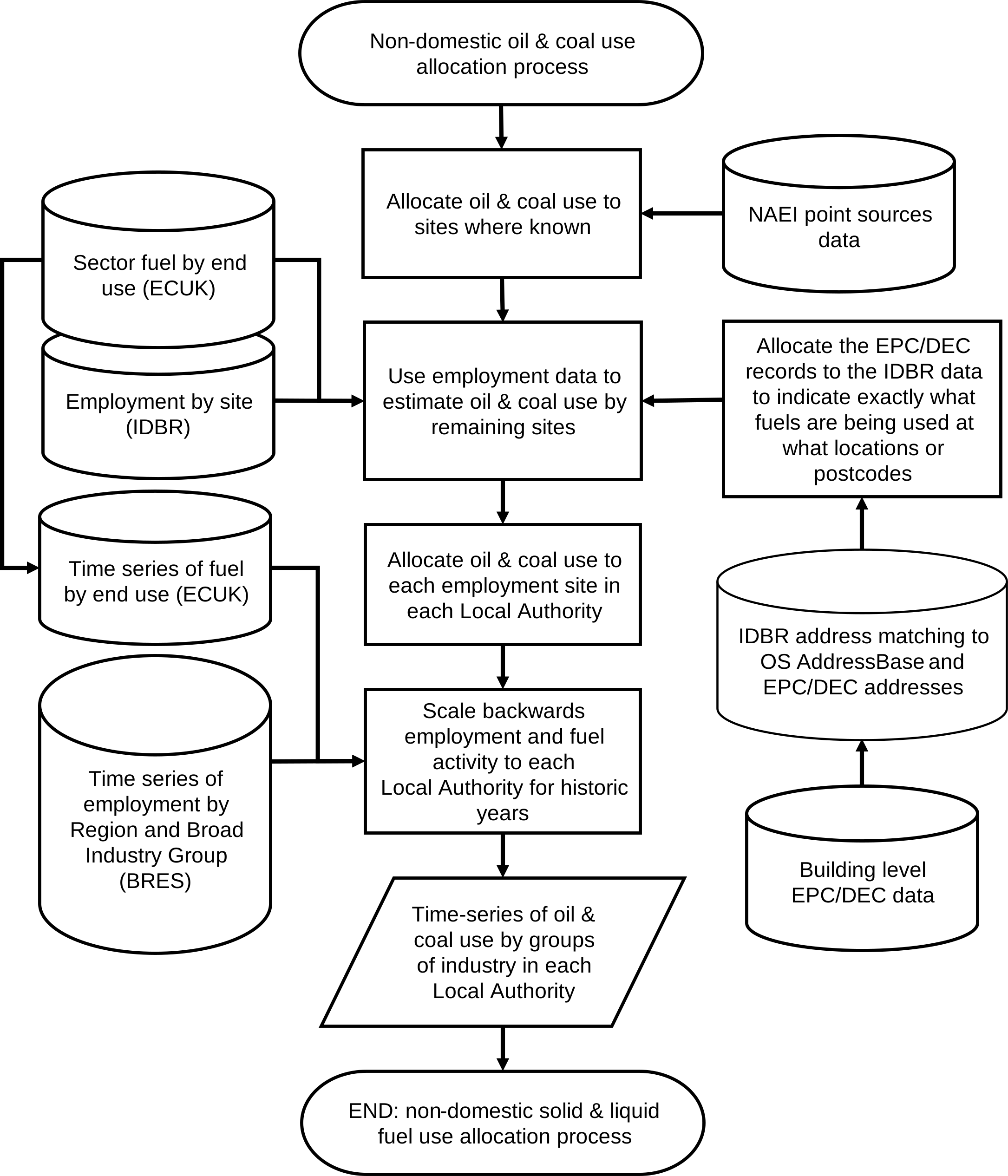
Industrial off-road emissions
For some sectors a simple map of employment has been used instead of fuel use. These are mostly for sectors where process emissions are important but also for estimating the distribution of industrial off-road emissions. These have been mapped using a distribution of employment in heavy industries.
6. Agricultural emissions
Soils and livestock
GHG emissions in the agriculture sector arise primarily from livestock (reported under agriculture livestock), and urea application, liming of soils and fertiliser application to soils (reported under agriculture soils). The distributions of CO2, CH4 and N2O emissions from agricultural sources are mapped by the UKCEH. Agricultural census/survey data for 2024 were acquired at the holding level from the four UK countries’ statistical authorities, i.e. Defra, Scottish Government, Welsh Government and DAERA. These censuses contain data on area by main crop types and livestock types and numbers.
Aggregated cattle population data were supplied to and processed by Cranfield University from cattle tracing system (CTS) data. The holding level data for the different countries were aggregated to a common set of emission source categories used by the agricultural emission inventory model to ensure compatibility between the different countries’ systems and consistency.
The effects of management practice are considered when making estimates of agricultural emissions in the NAEI, but these are based on assumptions at the country level rather than at the local level. The emission estimates are based on a model jointly developed and first implemented for the 2016 inventory by Rothamsted Research, ADAS, UKCEH and Cranfield University. The 10x10 km estimates from the emissions model have been spatially resolved to produce non-disclosive high-resolution 1x1km emission maps. These data are then mapped onto a LA distribution grid for the LA GHG emissions estimates. (Tsagatakis et al, 2025)
To align the subsectors used in these statistics with the Territorial Emissions Statistics (TES) sectors now used in the UK GHG emission statistics. Since last year there have been no significant changes to the methodology for estimating these emissions, or to the overall coverage of the agriculture sector.
Agriculture ‘other’
Electricity and gas consumption in the agriculture sector are included in DESNZ local gas and electricity data sets described in Sections 2 and 3 and therefore are disaggregated using the method described in these sections.
Consumption of solid and liquid fuels has been calculated for each year using the IDBR employment data. The distribution of solid and liquid fuels has been made based on data gathered from EPC and DEC data. The method used to calculate the gas availability distribution is explained in the supporting document Employment based energy consumption mapping in the UK accompanying this report.
Off-road mobile machinery emissions associated with activity in the agriculture sector are distributed using a combination of arable, pasture and forestry land use data. Each of these land cover classes was weighted according to the off-road machinery activity on each land use. This used data on the number of hours of use of tractors and other machinery on these land use types.
7. Domestic emissions
Domestic electricity consumption
Electricity consumption data for 2005 to 2024 published by DESNZ has been used to map GHG emissions from electricity generation to the point of consumption. The emissions associated with electricity consumption have been estimated using an average UK factor for the relevant year in terms of kt GHG per GWh. This average allocates equal shares of coal, gas, oil, nuclear and renewable powered generation to all the electricity consumers and is derived from the UK GHGI for 2024. The factors used are described in Section 2.
Electricity consumption reported in the sub-national data set does not match exactly with DUKES. This is partly due to the inclusion of some non-domestic users within this data set as described in Section 2. Other reasons for the differences (DESNZ 2025b) are that:
- the sub-national consumption data are aggregated from the bottom-up meter point level and the DUKES statistics are produced using a top-down approach
- DUKES contains a wider sector breakdown than the simple domestic and non-domestic split
- the sub-national consumption data are not for exactly a calendar (31 January to 30 January the following year) year whereas DUKES data are based on a calendar year
- the sub-national data excludes some Central Volume Allocation (CVA) users – these are very large industrial consumers receiving electricity via the high voltage system;
- some sub-national consumption is estimated as opposed to actual metered consumption
- 2005-2008 sub-national consumption data covers only Great Britain and DUKES covers the United Kingdom
The DESNZ data set outlined above does not currently provide a distribution of electricity consumption in Northern Ireland. However, following the creation of a single electricity market in Ireland in late 2007, consumers were able to choose their electricity supplier and confidentiality restrictions on the data were reduced. Estimates for domestic electricity consumption in 2008-2024 at District Council level in Northern Ireland are available on the GOV.UK website alongside the Great Britain statistics. These statistics are produced by DESNZ using aggregated meter point data derived from Northern Ireland Electricity’s Distribution Use of System (DUoS) Billing system.
As Northern Ireland electricity consumption data are not available for the whole time series, the distribution of electricity consumption between LAs for 2008 has been used for the years 2005-2008.
Data on total electricity sales as reported by Northern Ireland suppliers are available in the sub-national electricity and gas summary report (for example, DESNZ 2025a). For all years, there is a statistical difference between the total electricity sales and the published meter point data (DESNZ 2025d). Published meter point data provides electricity consumption disaggregated by domestic and non-domestic sources, and it is the year-specific ratio of domestic to non-domestic consumption from this source which is used to split total electricity consumption. The statistical difference between total electricity sales and meter point data is distributed across all LAs in Northern Ireland, including the unallocated sector, on the basis of the year-specific relative consumption within each.
More information on how GHG emissions from electricity consumption are aggregated to LA can be found in Section 2.
Domestic gas consumption
The gas consumption data published by the DESNZ provides estimates of gas consumption by the domestic sector and the industrial and commercial sector for each LA in Great Britain for 2005-2024, and for each LA in Northern Ireland for 2015-2024; these are published on the gov.uk website. The gas consumption estimates for the domestic sector have been used to calculate CO2, CH4 and N2O emissions for the domestic gas sector using the implied emission factor for Northern Ireland shown in Table 8 and for Great Britain shown in Table 9. More information about how emissions estimates from gas consumption data were produced is provided in Section 3.
Gas consumption reported in the sub-national data set does not match exactly with DUKES for the following reasons (DESNZ 2025b):
- the sub-national consumption data are aggregated from the bottom-up meter point level and the DUKES statistics are produced using a top-down approach
- DUKES contains a wider sector breakdown than the simple domestic and non-domestic split
- the sub-national gas data is based on the gas year, the period covering 1 October through to the following 30th September, whereas DUKES in based on the calendar year - for example, this means that domestic gas emissions shown in the LA GHG statistics for the year 2024 actually reflect emissions from gas use in the period 1 October 2023 to 30 September 2024
- Great Britain sub-national gas data are weather corrected up to 2014 and then are not weather corrected from 2015 onwards whereas DUKES for all years is not weather corrected, since 2015 therefore this is not a reason for variation between DUKES and subnational consumption
- 2005-2014 sub-national consumption data covers Great Britain and DUKES covers the United Kingdom
Domestic ‘other’
Domestic oil and solid fuel use distributions were created by spatially resolving detailed local information on central heating and house type data from the 2021 census with data from the DESNZ National Household Model (NHM), which provided average household energy consumption estimates across the 13 regions of England, Wales and Scotland. Regions within England and Wales follow the regional classification scheme, with Scottish regions abiding by the Met Office 3-tier regional (Northern, Eastern and Western) classification to represent the spatial variations in climate.
Solid fuel use was assigned to solid fuel burnt in boilers and non-boiler appliances (such as open fireplaces, closed stoves). It was assumed that solid fuel activity for boilers was used in properties which, according to Census 2021, had Solid Fuel Central Heating. Solid fuel activity for non-boiler appliances was assumed to be used in houses and bungalows with no central heating. Supplementary heating from the same technologies was considered more likely to be located in houses and bungalows only. Apartments were excluded for solid fuel use to be consistent with The NHM assumptions on wood use. The number of supplementary heating users for wood was calibrated at regional level by comparing the total wood user count (as derived from all the above assumptions) against the regional count from the Defra Solid Fuels Survey.
Recreational use of N2O and Other food - cream consumption (use of pressurised cream containers) are also included in Domestic ‘Other’. Further information on the data sets and methodology used to develop the domestic model can be found in the UK Emission Mapping Methodology (Tsagatakis, et al., 2025).
8. Road transport
Emission factors and fuel consumption factors
Fuel consumption factors and emission factors combined with traffic data for 6 major classes of vehicles are used to estimate national fuel consumption and emissions estimates from passenger cars, light goods vehicles (LGVs), rigid and articulated heavy goods vehicles (HGVs), buses/coaches and mopeds/motorcycles. The vehicle classifications are further sub-divided by fuel type (petrol, diesel) and the regulatory emission standard the vehicle or engine had to comply with when manufactured or first registered.
The vehicle Euro emission standards apply to the pollutants nitrogen oxides (NOx), particulate matter, carbon monoxide (CO) and hydrocarbons but not to CO2 or fuel consumption. Nevertheless, the Euro standards are a convenient way to represent the stages of improvement in vehicle or engine design that have led to improvements in fuel economy and are related to the age and composition profile of the fleet. For example, the proportion of pre-Euro 1 and Euro 1-4 vehicles in the national car fleet can be associated with the age of the car fleet (year-of-first registration).
Fuel consumption and emission factors are expressed in grams of fuel or emissions per kilometre driven respectively for each detailed vehicle class. The methodology combines traffic activity data (from the Department for Transport’s (DfT) national traffic census) with fleet composition data and fuel consumption/emission factors. The vehicle fleet composition data are based on licensing statistics and evidence from Automatic Number Plate Recognition (ANPR) data from DfT; these provide an indication of the vehicle mix by engine size, vehicle size, age, engine and exhaust treatment technology, Euro emission standards, and fuel type as observed on different road types.
Fuel consumption factors are based on a combination of published compilations of factors derived from vehicle emission test data from European sources and factors from industry on the fuel efficiency of cars sold in the UK. In the former case, representative samples of vehicles are tested over a range of drive cycles associated with different average speeds on different road conditions. There are many parameters that affect the amount of fuel a vehicle consumes, the average vehicle speed is one of them, so the NAEI uses functions that relate fuel consumption to average speed.
Fuel consumption factors for all vehicle types are derived from the fuel consumption-speed relationships given in the COPERT 5 source. COPERT 5 “Computer Programme to Calculate Emissions from Road Transport” is a model and database of vehicle emission factors developed on behalf of the European Environment Agency and is used widely by European Union (EU) member states to calculate emissions from road transport. It is a source of factors recommended for national inventory reporting in the EMEP/EEA Emissions Inventory Guidebook (2023).
This included a method for passenger cars which applies a year-dependent ‘real-world’ correction to the average type-approval CO2 factor weighted by new car sales in the UK from 2005-2024. The new car average type-approval CO2 factors for cars in different engine size bands were provided by the Society of Motor Manufacturers and Traders (SMMT, 2015). The real-world uplift uses empirically-derived equations in the Guidebook that take account of average engine capacity and vehicle mass.
The fuel consumption maps are calculated from the speed related fuel consumption factors multiplied by vehicle flows. The method for calculating these maps is described in the next section. For GHG emissions, fuel consumption is used as a proxy for the distribution of emissions and activity data sourced at a national level from the NAEI end user inventory.
NAEI vehicle fuel consumption and emissions are estimated for individual vehicle types from a bottom-up approach using an array of traffic statistics and exhaust emission and fuel consumption factors representing the real-world performance of vehicles. These estimates are reconciled to national energy consumption statistics from DUKES. Further details of the NAEI reconciliation methodology and the effect of this across the timeseries may be found in Section 3 method statement (MS) 8 of the UK NID (Brown et al., 2026). Petrol and diesel fuel contain an element of bioethanol and biodiesel; the fuel consumption and emission factors of these are not calculated separately but are weighted into the petrol and diesel factors.
The emission factors applied for road transport in LA GHG statistics are provided below in Table 13. These are derived from NAEI by-source emission factors, calculated from the carbon content of the fuel used, adjusted to an end user basis to account for emissions from the production and processing of fuels. NAEI CO2 emission factors per unit of fuel for road transport are different for petrol and diesel vehicles, but do not vary according to vehicle type. Whereas CH4 and N2O emissions do vary by vehicle as well as fuel type.
Table 13: Emission factors applied for road transport in LA GHG statistics.
| Year | By-source GHG factor | End-user GHG factor | ||
| Petrol | DERV | Petrol | DERV | |
| 2005 | 2.824 | 2.914 | 3.205 | 3.290 |
| 2006 | 2.819 | 2.916 | 3.168 | 3.261 |
| 2007 | 2.815 | 2.922 | 3.161 | 3.265 |
| 2008 | 2.809 | 2.923 | 3.143 | 3.254 |
| 2009 | 2.802 | 2.921 | 3.148 | 3.263 |
| 2010 | 2.801 | 2.924 | 3.151 | 3.270 |
| 2011 | 2.799 | 2.924 | 3.141 | 3.262 |
| 2012 | 2.795 | 2.924 | 3.104 | 3.230 |
| 2013 | 2.794 | 2.927 | 3.099 | 3.229 |
| 2014 | 2.793 | 2.928 | 3.094 | 3.225 |
| 2015 | 2.792 | 2.927 | 3.101 | 3.233 |
| 2016 | 2.792 | 2.928 | 3.090 | 3.223 |
| 2017 | 2.794 | 2.929 | 3.095 | 3.227 |
| 2018 | 2.797 | 2.930 | 3.098 | 3.228 |
| 2019 | 2.800 | 2.936 | 3.106 | 3.239 |
| 2020 | 2.800 | 2.935 | 3.137 | 3.269 |
| 2021 | 2.801 | 2.924 | 3.106 | 3.226 |
| 2022 | 2.803 | 2.925 | 3.080 | 3.199 |
| 2023 | 2.800 | 2.925 | 3.073 | 3.196 |
| 2024 | 2.803 | 2.925 | 3.061 | 3.180 |
Note: By kt CO2e per ktoe gross.
Road transport mapping methodology
The base map of the UK road network used for calculating hot exhaust road traffic emissions has been developed from two mapping data sets. The Ordnance Survey Open Roads (OSOR) data set (see Figure 4) provides locations of all roads (motorways, A-roads, B-roads and unclassified roads) in Great Britain. For Northern Ireland, a data set of roads was obtained from Ordnance Survey of Northern Ireland, part of Land & Property Services Northern Ireland.
Fuel consumption factors for each road are determined by the urban road status, road type and speed limit of each road segment. Speed limits are available for each major road from Basemap. The speed limit for minor roads is assumed to be 30mph in urban areas and 60mph in rural areas.
Figure 4: Illustration of OSOR road network and DfT count point data for the Greater London area.
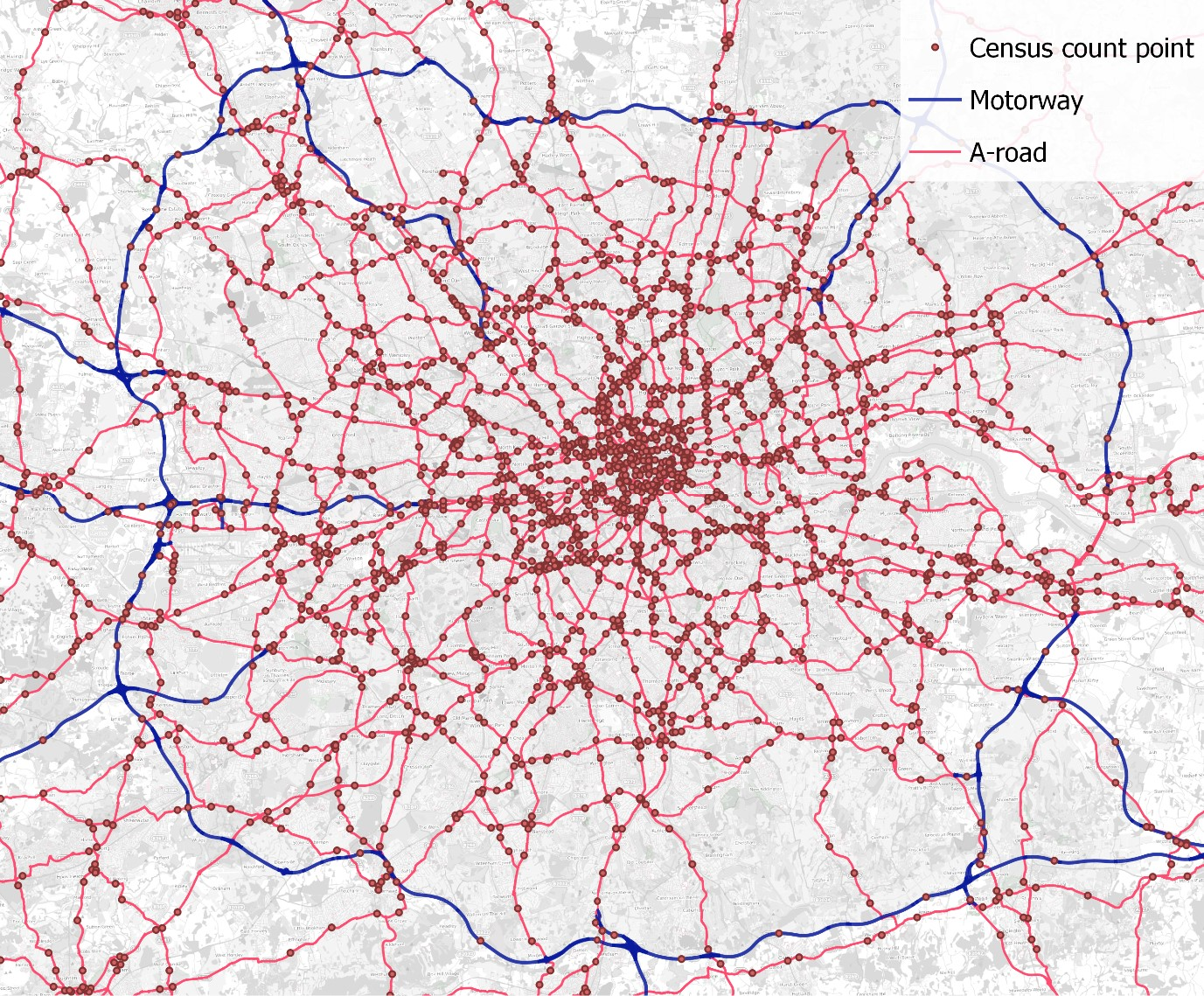
© Crown copyright. All rights reserved BEIS. Licence number 100037028 [2018]
© OpenStreetMap contributors.
Mapping traffic on major roads
Traffic flow data for major roads (A-roads and motorways) are available on a census count point basis for both Great Britain (DfT, 2019) and Northern Ireland (DfI Northern Ireland, 2019). The data comprise counts of each type of vehicle as an Annual Average Daily Flow (AADF), aggregated up to annual flows by multiplying by 365. These AADF statistics take account of seasonal variation using ‘expansion factors’ applied to single day counts based on data from automatic counts for similar roads and vehicle types.
Differences between Great Britain and Northern Ireland data sets should be noted. Coverage of roads in Great Britain is considerably denser than that for Northern Ireland. Additionally, in Northern Ireland, some count points record total vehicles, rather than a split of different vehicle types. An average vehicle split has been applied to these records.
For Northern Ireland, traffic counts were allocated according to the proximity of the point where the count was made and major roads with the same road number – i.e. each link has the nearest count point with the same road number assigned to it – using a computer script.
For Great Britain, the OSOR network is more complex than the NI road network, and count point allocation required a different approach. Here, count points were allocated to a section of the major road network according to shared road number and spatial proximity to the stretch of road that each count point covers (Figure 5).
This was done by using a highly simplified, straight line, DfT representation of the start and end of each count points’ coverage (‘count point lines’). A series of computer-based processes were used to automatically perform this allocation. Where count point lines overlapped LA boundaries, OSOR roads were split at that boundary and each split assigned to the relevant LA. Automated allocation was followed up with manual checking and verification.
Figure 5: Traffic flows are assigned to the road network (Ordnance Survey Open Roads) by selecting OSOR sections that fall between the start and end points of traffic census count point coverage (DfT road line).
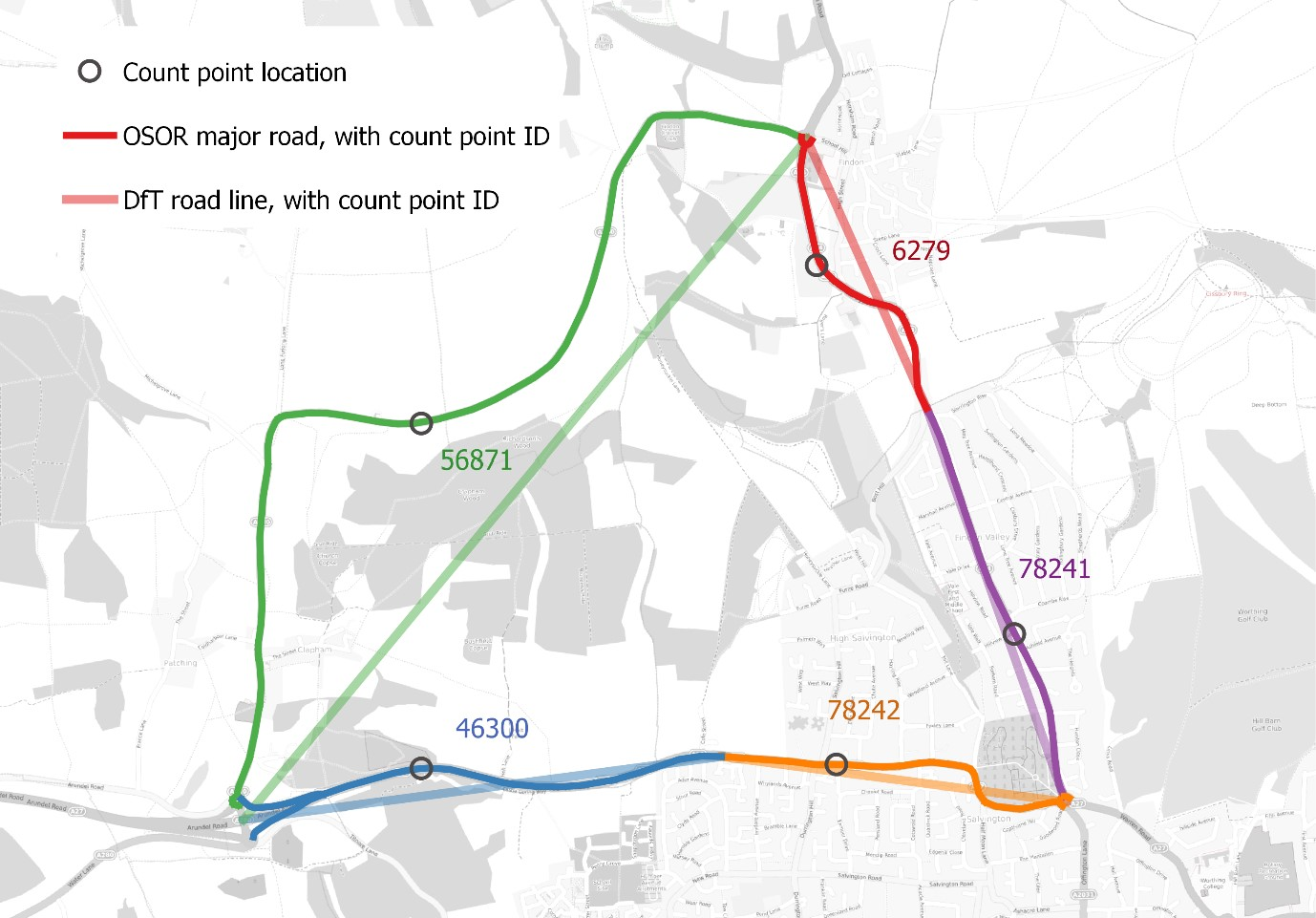
© Crown copyright. All rights reserved DESNZ. Licence number 100037028 [2018].
© OpenStreetMap contributors.
Mapping traffic on minor roads
Traffic flow data are not available on a link-by-link basis for most minor roads. But where these data are available, they have been used to enhance the accuracy of the mapping. Traffic flows in most minor roads have been modelled based on average regional flows and fleet mix (data from DfT) in a similar way to previous years. Regional average flows by vehicle type have been applied to each type of minor road – B and C roads or unclassified roads. These data were obtained from DfT.
For Northern Ireland vehicle-specific minor road flows have been calculated from 2014 data (DfI Northern Ireland, 2019) which provides information on vehicle kilometres travelled for vehicle types and by road types.
County level vehicle kilometre estimates have been obtained from DfT (unpublished) and used to ensure consistency between the NAEI and DfT modelling, to correct at county level the estimates of vehicle kilometres in the NAEI mapping.
Vehicle fleet composition
A development in the 2010 NAEI was the use of DfT Automatic Number Plate Recognition (ANPR) data to define fleet composition on different road types for the whole of Great Britain while combining country specific vehicle licensing data (DVLA data) to define regional variation (DfT, 2010). The ANPR data continues to be used in two aspects in the latest NAEI to define:
- petrol, diesel and electric mix in the car and LGV fleet on different road types (urban, rural and motorway)
- variations in age and Euro standard mix on different road types
For other vehicles, it has been assumed that 100% of motorcycles are fuelled by petrol and 100% of heavy goods vehicles and buses run on diesel. More information on the methodology can be found in the UK Informative Inventory Report (Elliott et al., 2026). It is also assumed that the biofuel percentages of the fuel are consistent over all LAs but vary year on year.
Fuel consumption calculations
The next step after mapping vehicle movements is to apply the emissions and fuel consumption factors discussed earlier.
The urban or rural classification of a section of OSOR road covered by a count point (here called a ‘count point road’) was determined through the following logic:
- count point roads that have at least two-thirds of their DfT defined length within an urban area: classify as urban
- count point roads that have at least two-thirds of their DfT defined length outside an urban area: classify as rural
Count point roads not captured by cases 1 or 2 were split at the urban boundary and urban or rural classification of these splits were classed as urban or rural if they were within or outside an urban area. Count point roads intersecting urban areas more than twice were classed based on the majority urban or rural length of the whole road section. Splits of less than 100m were given the urban or rural classification of their counterpart, and splits of less than 15% of the total count point road length were manually inspected for validity.
Vehicle kilometre estimates for each road link are multiplied by fuel consumption (or emission factors) taking into account the speed limit (taken from Basemap) of the road of concern. These calculations were performed for each major road link in the road network resulting in maps of fuel use by fuel type and emissions by pollutant. Each road link is then split into sections according to the LA boundaries which then allow aggregation of fuel consumption estimates for each LA across the UK.
A similar calculation is done for minor roads, using speed limit (30 mph urban areas, 60 mph rural areas) for different types of minor roads and applying the relevant fuel consumption factor for that road type to the vehicle kilometre data modelled as described above. These calculations are undertaken at a resolution of 1×1 km across the UK and the results are aggregated to LA boundaries for the estimates of fuel consumption published by DESNZ.
The use of a speed limit approach to estimating emissions for different traffic conditions is a necessary simplification of real-world conditions. At present it is the only appropriate method for national scale modelling. However, work has shown that for modelling vehicle emissions for an inventory covering a road network on a national scale, it is sufficient to calculate emissions from emission factors in g/km related to the speed limit of the vehicle in the drive cycle (Zachariadis and Samaras, 1997). Emission factors for speed limits on the road network are then combined with the national road traffic data.
Continuous improvements for road transport
Methodologies for calculating fuel consumption and emissions are periodically updated as our understanding of the factors that affect them improves. In addition, the input data used to calculate them are updated as DfT revises information, provides more detail in the information gathered and as new information becomes available. Consequently, revisions to the trends in calculated values of road transport fuel consumption and emissions are an inevitable consequence as the science and evidence base improves. The NAEI uses consistent data and approaches to meet the needs of GHGI compilations.
9. Other transport emissions
The emission sources include in other transport are;
- road transport – LPG
- road transport – natural gas
- road transport – lubricants
- road transport – urea
- railways – coal
- inland waterways/domestic navigation
- aircraft support vehicles
These sources are distributed to Local Authorities using NAEI detailed spatial distribution maps as outlined in UK Emission Mapping Methodology (Tsagatakis, et al., 2025).
Railways
It is not possible to separate electricity consumed by the railways from that consumed by other commercial and industrial activities in the DESNZ data set. Therefore, it is not possible to report all rail emissions as a separate sub-sector within the transport sector. Emissions attributable to electricity consumption in the rail sector are included in the commercial and industrial sector, whilst diesel and coal emissions from railways are included in separate sub-sectors and their methodologies are explained below.
The UK total diesel rail emissions are compiled for three journey types: freight, intercity and regional. The emissions are spatially disaggregated based on a Rail Safety and Standards Board (RSSB) project that mapped 2019 emission estimates for each line in Great Britain for passenger and freight trains. The emissions along each rail link between Timing Point Locations (TIPLOCs) were assumed to be uniform along the length of the rail link, as no information on either load variation or when engines were on or off is yet available on a national basis. For years other than 2019, emissions along each line have had to be scaled at UK level, as described in the UK Informative Inventory Report (Elliott, et al., 2026), using trends from official statistics on fuel consumption by rail operators.
Rail emissions are distributed across Northern Ireland based on 2019 data from Translink on the number of services run on different routes. These data are for passenger trains only as there is no freight activity in Northern Ireland.
Coal based rail emissions have been accounted for by extracting station, line and operating information from the latest version of the ‘UK Heritage Railways’ website. This information was then verified against two additional independent UK heritage railway guides (www.heritagerailwaysmap.co.uk and http://steamrailwaylines.co.uk/, although the latter no longer hosts information on this subject) and dedicated webpages for specific lines. National coal-based rail emissions have been proportionally allocated based on the number of days a line operated per year (consistent across all sections of a lines track).
In total, 86 operational heritage lines were identified, and their main station coordinates plotted. Those stations with track lengths greater than 5 miles were mapped with the assistance of route schematics alongside the aerial imagery and OS Open Background map services provided by ESRI (Environmental Systems Research Institute). For the remaining 48 stations activity was assigned to a single 1x1km grid.
Other road transport emissions
Emissions from the combustion of LPG and natural gas in road vehicles are calculated from fuel consumption factors in the same manner that emissions from petrol and diesel vehicles are and as discussed in section 8.
Combustion of lubricants in road vehicles are allocated using estimates of total vehicle kilometres calculated from the NAEI maps of traffic flows.
Aircraft support vehicles
The locations of airports and their air support activity were mapped for the years 2005–2024 using data from the Civil Aviation Authority (CAA), as part of the NRMM spatial improvement undertaken in last year’s submission. Emissions were allocated to individual airports based on the number of annual aircraft movements, also using CAA data.
Inland waterways
Details of the approach used to estimate emissions are given in the UK GHGI improvement programme report (Walker et al.,2011). A bottom-up approach was used based on estimates of the population and usage of different types of craft and the amounts of different types of fuels consumed. Estimates of both population and usage were made for the baseline year of 2008 for each type of vessel used on canals, rivers and lakes and small commercial, service, and recreational craft operating in estuaries / occasionally going to sea. For this, data were collected from stakeholders, including the British Waterways, DfT, EA, Maritime and Coastguard Agency (MCGA), and Waterways Ireland.
Sparse data were available to estimate the distribution of emissions from this sector. As a result, total emissions from the inland waterways sector were mapped using data sets of vessel activity for a limited number of Great Britain and Northern Ireland waterways. Lock passage information for Northern Ireland were provided by Waterways Ireland (Waterways Ireland, 2012) for the Shannon Erne Waterway and the five Locks on the Lower Bann Navigation as well as a geospatial data set. Data for Great Britain, including geospatial data, were provided by the British Waterways (British Waterways, 2012). Where data gaps were identified, additional activity data were taken from the ‘Members’ area of the Association of Inland Navigation Authorities website (AINA, 2012).
The activity data were used in combination with geospatial information to calculate the product of boat activity and distance. This was subsequently combined with UK emissions data.
10. Land use, land use change and forestry emissions
LULUCF activities are both a source and sink for atmospheric CO2 and a source of CH4 and N2O. Generally, emissions are produced from conversion of land to cropland and settlements, and are removed through forest growth and conversion of cropland to grassland. Currently in the UK, LULUCF activities are a net sink of CO2 however when including CH4 and N2O LULUCF becomes a net source of CO2e.
Forest Research and UKCEH prepare estimates of the uptake (removal from atmosphere) of CO2 by afforestation and net loss or gain of CO2 from soils (emissions to or removals from the atmosphere) for inclusion in the UK GHGI. In addition to this, estimates of emissions of CH4 and N2O to the atmosphere have been made. These emissions are classified as the LULUCF sector for inclusion in the UK GHGI.
The estimates are reported according to IPCC classification of sources and removals. The UK implemented the TES sectors for domestic inventory reporting in 2024. Estimates for 2024 are shown in Table 14. Categories are presented in the table in the order of the absolute magnitude of the net emissions or removals. The emissions are also divided into the categories used for reporting these emissions in the national inventory. The emissions to the atmosphere are given as positive values; the removals from the atmosphere are given as negative values.
Changes in net emissions from the LULUCF sector over time are dominated by the decrease in net CO2 emissions. While CH4 emissions are relatively stable over time, they dominate overall LULUCF net emissions by gas in CO2e terms from 2000 onwards (Brown et al. 2026). Estimates in the 2024 LULUCF sector of the inventory for the different GHGs are -6,761.78 Gg CO2 for carbon dioxide, 5,745.64 Gg CO2e for methane (or 205.20 Gg CH4), and 1,300.99 Gg CO2e for nitrous oxide (or 4.91 Gg N2O) across the UK in 2024. GHG emissions are produced by undrained modified, rewetted and near natural peatlands (note that CH4 emissions from near-natural bogs are cancelled out by CO2 uptake in CO2e terms), drainage ditches on peatlands, biomass burning during wildfires or the conversion of forest land to cropland, grassland or settlements. Direct and indirect emissions of N2O are also produced from nitrogen fertilisation of new forests and soil mineralisation following land-use change. Emissions of non-CO2 gases from agricultural land (e.g. due to fertilisation) are reported in the agriculture sector of the UK GHGI.
Full details of the methodology used by UKCEH to estimate emissions and removals by LA for 2024 are provided in the separate Mapping greenhouse gas emissions and removals for the land use, land use change and forestry sector document accompanying this report.
Table 14 (see the PDF version of this document) shows the GHG emissions from LULUCF in 2024 (kt CO2e).
11. Waste
Emissions from non-electricity related process in the waste sector for 2018-2020 have been included in the LA GHG data since the 2020 submission, and a full time series going back to 2005 since the 2022 submission. Emissions associated with electricity used in the waste industry comes under Non-domestic electricity. This is also true for emissions from energy from waste plants for which the emissions are associated to the end user of the electricity.
Landfill emissions
Solid waste disposal is a key category for methane emissions in the UK GHGI (Brown et al, 2026). Methane emissions from landfill arise from the decomposition of biodegradable solid waste placed in landfill, with UK level emissions estimates for this published in the NAEI.
In the LA GHG data set the emissions from landfill have been allocated back to the producer of the waste e.g. households and industry. To do this, landfill data by LA was obtained for each country of the UK from the Environment Agency, DAERA and through communication with NRW and SEPA. The total mass of biological component for each LA was calculated from this data by applying defined percentages of biological component for each waste type. The National Inventory Document table 7.1 gives a breakdown of the percentages of biodegradable matter for each category of waste (Brown et al, 2026). Using the mass of biological component per LA the total methane for each country could be apportioned to the LAs where the waste originated.
For England, data from the waste data interrogator (WDI) is available for 2006 onwards with 2005 data using the same split as 2006. This data set has a significant proportion of unallocated biodegradable waste in the earlier years (26% of 2006), but this has decreased and since 2014 is <1% of the biodegradable waste reported.
The Welsh WDI is available for 2013 onwards so before this the 2013 splits are used to allocate methane emissions to each local authority.
DAERA provide data on Northern Ireland biodegradable waste sent to landfill for the whole timeseries.
SEPA provided data on the origin of waste in Scottish landfills from 2007 onwards, excluding 2019. 2005, 2006 use the 2007 local authority split, and 2019 uses an average of the 2018 and 2020 split.
In some cases, the raw landfill data is allocated to a region of origin rather than a specific local authority, in these cases waste from the region is split in between the LAs within that region using the ONS population statistic for that year.
This is a top-down methodology for estimating emissions from LAs so will vary from the carbon factors published by DESNZ which can be used in a bottom-up approach to estimating emissions from waste landfilled.
Other waste emissions
Total emissions from wastewater treatment, sewage sludge decomposition, composting and anaerobic digestion were mapped using the ONS population statistics
12. Protected Landscapes
Protected Landscapes consist of the UK’s National Parks, National Landscapes and Areas of Outstanding Natural Beauty (AONBs).
For each detailed sector the UK-wide activity distributions (such as domestic natural gas) have been geospatially analysed with the Protected Landscape boundaries to calculate proportions of each Protected Landscape to the UK national total.
In most cases, it has been possible to be more geographically accurate in the allocation of emissions to Protected Landscape. In the case of employment-based distribution grids, detailed locations of employment activity have been extracted from the IDBR. Full details on the generation of employment-based emissions data can be found in Non-domestic ‘other’ .
A similar approach was possible for the major road network (A-roads and motorways). The road network was intersected with Protected Landscape boundaries, allowing the exact length of each road inside and outside of them to be calculated. This allowed a detailed estimate of fuel consumption and vehicle kilometres travelled within each area to be calculated. The derived sectoral proportion was then multiplied by the national emission estimates to arrive at an aggregated total of end-user GHG emissions within each Protected Landscape.
13. Uncertainty analysis
As with any inventory, the end user LA GHG emissions estimates are associated with a degree of uncertainty. This section describes how uncertainty has been analysed in this data set.
Overall uncertainties in the emission estimates for each LA have been assessed by combining three variables. Two of these three variables are sets of uncertainty estimates:
- Uncertainty in national emissions: estimates of the percentage error relating to the national total emissions by sector.
- Uncertainty in the spatial distribution of emissions: an assessment of the degree of correlation between modelled and real-world distributions of fuel consumption, activity and emissions.
- The proportion that each sector contributes to emissions in each LA.
Overall uncertainties in the 2024 emissions have been estimated using the sum of the squares method for propagating errors through calculations. This method uses the input data on estimates of component uncertainties as described in the following sections.
Uncertainties on LULUCF net emissions are excluded from this analysis since they are very high and would mask other variations in uncertainty. For example, there are over a dozen LAs for which the uncertainty is at least doubled when including LULUCF, of which several are at least tripled, and there is one extreme case where the uncertainty is an order of magnitude higher.
Further information on LULUCF uncertainties may be found in the UK NID (Brown et al., 2026) and the ‘Mapping greenhouse gas emissions and removals for the land use, land use change and forestry sector’ document accompanying this report.
Uncertainty in the national sectoral GHG emissions
Uncertainty estimates for the national total GHG emissions, using the sectors set out by the IPCC that are used in international reporting, are calculated in the UK GHGI. This analysis is published in the UK NID (Brown et al., 2026).
The uncertainty analysis in the national inventory is calculated using a Monte Carlo simulation, based on assigning probability distribution functions (PDFs) to each emission factor and piece of activity data. Errors in the UK GHGI are expressed as half the difference between 2.5 and 97.5 percentiles, equivalent for normal distributions to 1.96s/E, where E is the central (best) estimate of the emission and s is one standard deviation of the mean.
The emission sectors used for the local GHG estimates do not match the sectors reported in the UK NID. Therefore, the percentage error values have been combined, via calculation of a weighted average (weighted by emission in each subsector and by fuel), to give national emission percentage error for each of the sectors. These percentage errors are shown in Table 15.
Uncertainty in the geographical distributions
The uncertainties in the geographical distributions of emissions for each sector are difficult to quantify. Experts familiar with the mapping methods and emissions by sector have estimated semi-quantitative distribution uncertainties using expert judgement when the local GHG estimates were compiled. With the exception of the DESNZ data on gas and electricity, no quantitative estimates of uncertainty for the individual components exist. Therefore, numerical uncertainties have been estimated using ‘expert judgment’ through a process of ‘expert elicitation’ as described in the 2006 IPCC Guidelines for National Greenhouse Gas Inventories (IPCC, 2006b), Table 15 provides notes on each sector to help to explain the reasons for the uncertainty scores chosen.
Uncertainty estimates for the domestic and industrial gas and electricity emissions have been obtained from DESNZ. They are based on the amount of the consumption that was located correctly based on allocating meter locations to LAs. However it is also necessary to take account of the amount of estimated meter readings used to calculate these consumption data and the cut-off point used to determine whether meters are classed as domestic or non-domestic (see Sections 2 and 3) therefore the higher uncertainty estimates set out in Table 15 are used.
The mapping of emissions has been divided into point and area sources. In general, mapped point source data are expected to be more accurate than that for area sources since it is predominantly based upon reliable data used for regulatory purposes. As we have seen, area source emissions are mapped using a variety of surrogate data types of varying quality. As part of this process, every attempt is made to utilise the highest quality data (within overall budgetary constraints), however, in some cases the surrogate statistics used may be poorly suited to this task.
Other industrial emissions data (large gas users, wastes and biomass and non-fuel emissions) are considered to have fairly low uncertainty as the geographical location of many of these sources and energy consumption are well reported (see Section 4).
The main reasons for uncertainties in the road transport sector are the use of sample/survey data to represent both vehicle movements and emission factors. Average daily flows and average speeds are used on major road links which does not take account of fluctuations in flows and speeds through the day or year. Regionally average flows and speeds are assumed on minor roads because there are not sufficient data to model this more accurately. However, state of the art national data sets are used in all cases where these are made available, and the mapping approach is compliant with the method recommended by international guidance of the EMEP/EEA air pollutant emission inventory guidebook.
The estimates of emissions for minor roads also have relatively high uncertainty. There are too few measurements of traffic movements on minor road links to allow detailed modelling to be undertaken therefore regional traffic flows are used.
The next most significant sources of emissions after road transport are agriculture and waste, which are dominated by CH4 and N2O. Emissions of these GHGs are more uncertain than those of CO2 since the chemical mechanism behind the emission process is less strictly defined, and more dependent on abatement and environmental factors.
High uncertainties are assigned to some other sectors which contribute less to total emissions. In particular, the combustion of coal and liquid fuels in small industry, commercial and public service sectors. This is because there is very limited knowledge of the distributions of coal and liquid fuel use. This work does not consider localised renewable consumption or energy efficiency through the use of combined heat & power and does not attempt to correct or fill gaps in DESNZ electricity use or gas use data sets.
Table 15 also shows the percentage of UK total emissions in each sector. This is presented here to show the relative importance of each sector, but these numbers are not used in the uncertainty analysis. The uncertainty analysis uses actual amounts of emissions in each LA rather than a UK average.
Combining the uncertainty estimates using sum of squares method
The three variables set out at the start of this section have been combined as follows. The percentage emission error in each LA total GHG estimate is calculated using the sum of the squares method using the equation:

Where:
e is the local emission in the LA for a given sector
i1 is the UK emission uncertainty error for that sector
i2 is the mapping emission uncertainty error for that sector
Table 15: Summary of information used in uncertainty analysis and comments on data quality.
| Sector | Percentage of 2024 UK emissions excluding LULUCF | National emission error | Geographical estimated error | Comment on estimated geographical error |
|---|---|---|---|---|
| Industry and commercial electricity | 6.75% | 6.3% | 5% | 97.7% of postcodes have been located correctly. Additional estimate of uncertainty has been made based on 20% of MPAN readings being estimates. |
| Industry and commercial gas | 8.49% | 5.0% | 3% | DESNZ geographical allocation for gas is good. However, the DESNZ definition of domestic gas consumers includes some small commercial users. But there is no numerical estimate of this uncertainty. |
| Large industrial installations (non- ETS) | 0.12% | 9.5% | 5% | Good location information for point sources but still some emissions modelled |
| Large industrial installations (ETS) | 5.98% | 1.0% | 1% | Estimated % error. Grid references for sites provided by operators. Emissions reported and verified though ETS but some variation in quality of monitoring of emissions. |
| Industrial and commercial other fuels | 4.08% | 19.2% | 30% | Area emissions modelled using employment and fuel intensity factors. There will be spatial variations in energy intensity that is not taken into account. Good location information for point sources but still some emissions modelled |
| Agriculture | 14.59% | 14.0% | 30% | Modelled estimates using fuel and employment distributions for stationary combustion; Agricultural census/survey data for 2024 were acquired at the holding level from the four UK countries’ statistical authorities. These data are used to distribute livestock, soils and machinery emissions. |
| Diesel railways | 0.49% | 21.3% | 10% | Emissions are distributed based on a Rail Safety and Standards Board (RSSB) project that mapped 2019 emission estimates for each line in Great Britain for passenger and freight trains, and in Norther Ireland based on 2019 data from Translink on the number of services run on different routes. |
| Domestic electricity (Great Britain) | 4.19% | 6.3% | 3% | 98.8% of postcodes have been located correctly. Additional estimate of uncertainty has been made based on 20% of MPAN readings being estimates. |
| Domestic electricity (Northern Ireland) | 0.11% | 6.3% | 8% | Based on 92.4% of postcodes being located correctly. |
| Domestic Gas | 14.53% | 4.7% | 3% | DESNZ geographical allocation for gas is very good. However, the DECC definition of domestic gas consumers includes some small commercial users. There is a 3% difference between domestic/non-domestic categories in the LA GHG emissions statistics and the national inventory. |
| Domestic ‘other fuels’ | 2.90% | 12.2% | 10% | Estimates made using complex modelling of household energy demand compared with known gas usage. Emissions are mapped on population distribution, but distribution of garden machinery is not correlated with population density because of smaller garden sizes etc in densely populated areas. Emissions mapped on population distribution which is reasonably well correlated with use of household products. |
| Road transport (A roads) | 12.48% | 3.4% | 5% | Activity data are good quality annual average traffic count points. missions calculated using complex modelling of fleet mix and average speeds on different roads. |
| Road transport (motorways) | 6.59% | 3.4% | 5% | Activity data are good quality annual average traffic count points. Emissions calculated using complex modelling of fleet mix and average speeds on different roads. |
| Road Transport (minor roads) | 11.77% | 3.4% | 20% | Activity data are calculated from regional average traffic flows and vehicle splits. Emissions calculated using complex modelling of fleet mix and average speeds on different roads. |
| Transport ‘other’ | 0.97% | 23.4% | 30% | Locations of LPG use and burning of engine oil are not known and are therefore distributed across all road traffic activity. |
| Waste | 5.94% | 59.2% | 9% | Emissions from landfill distributed using Devolved Government data on waste disposed to landfill and NAEI landfill totals for Devolved Governments. Other waste emissions are mapped using population statistics, composting and anaerobic digestion sites among others. |
Results of the uncertainty analysis
Figure 6 shows the uncertainty distribution across the local authorities, which is then mapped into Figure 7 to show how the errors calculated from the sum of the squares method vary across the UK. The percentage error is 4 or lower for 29% of LAs.
Figure 6: Uncertainty distribution.
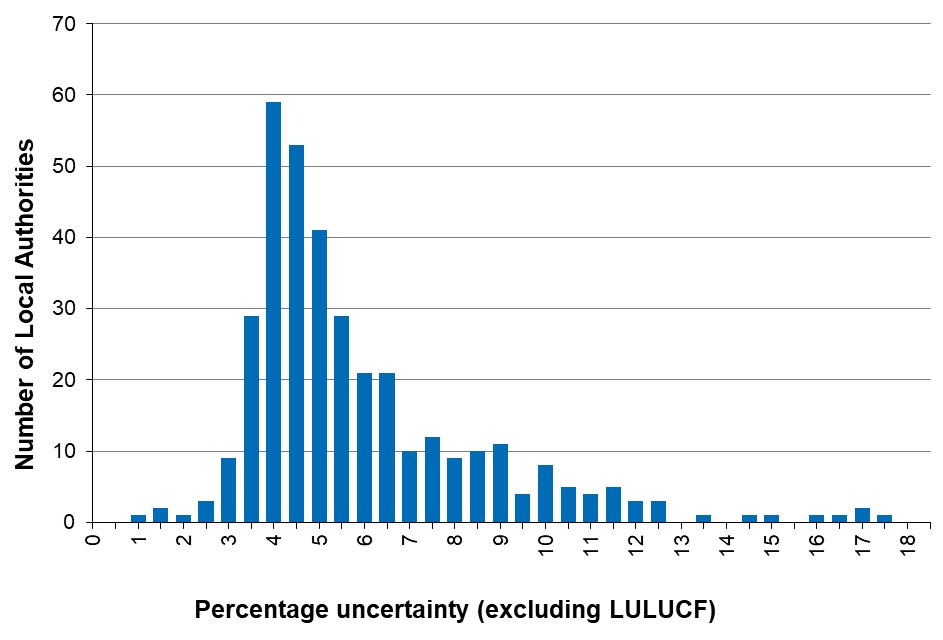
The limited spread around the mean in Figure 6 may seem surprising given the size of some of the uncertainties in Table 15, particularly for mapping uncertainties. Two factors are relevant:
- The smallest uncertainties tend to be for the largest emissions.
- Uncertainties within individual sectors cancel against uncertainties in other sectors within each LA area to a significant extent.
The latter may have important consequences for setting abatement levels by sector within each LA without further analysis at a more local level.
The emissions are dominated by the electricity and gas use in domestic, industrial and commercial sectors for which the UK estimates and the mapping distributions have low percentage errors. Higher overall percentage errors occur particularly where emissions in an LA are dominated by CH4 and N2O from agriculture and waste sources.
In percentage terms the smallest estimated spread for any LA is for Neath Port Talbot (±0.90%). This LA has a significant level of emissions from large ETS installations. The largest spread is for the Orkney Islands (±17.1%) because of the relatively high significance of emissions from agricultural livestock.
The median uncertainty across LAs in each country of the UK, the UK as a whole, and for the Protected Landscapes is presented in the Table 16.
Table 16: Median uncertainty for each country, the UK as a whole, and Protected Landscapes.
| Nation | Median uncertainty excluding LULUCF | Median uncertainty including LULUCF |
|---|---|---|
| England | ±4.6% | ±5.3% |
| Scotland | ±5.3% | ±9.7% |
| Wales | ±6.2% | ±6.6% |
| Northern Ireland | ±10.4% | ±13.3% |
| UK | ±4.8% | ±5.6% |
| National Parks | ±12.8% | ±25.3% |
| National Landscapes and AONBs | ±11% | ±20.5% |
By comparison, the UK GHGI uncertainty estimate on total UK GHG emissions for 2024 was ±2.7%. In the GHG inventories for England, Scotland, Wales and Northern Ireland, the uncertainty estimates for the GHG total were ±3%, ±6%, ±3% and ±5% respectively. In each case these inventories include LULUCF in the estimates of uncertainty. Emissions and removals from LULUCF tend to be concentrated in a small number of LAs, so the impact of LULUCF uncertainty does not noticeably impact on the figures for LAs at Devolved Government level.
By contrast, LULUCF is a much more dominant source in the Protected Landscapes. Median uncertainties for both groups of areas are heavily impacted by the uncertainty of LULUCF estimates. Uncertainty excluding LULUCF is also generally higher than in LAs largely due to the significance of emissions from agriculture.
Figure 7: Estimated uncertainty in the GHG emissions 2024 (not including LULUCF emissions).
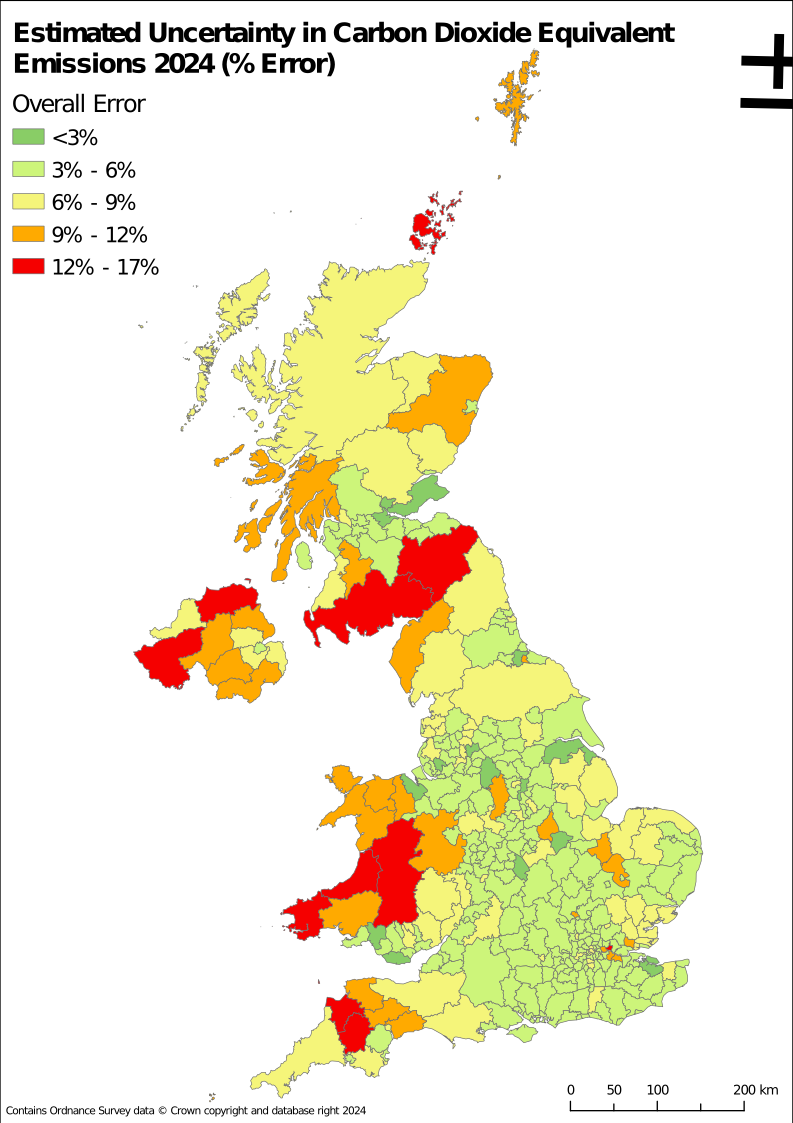
14. References
AINA. (2012), Association of inland navigation authorities. Retrieved from http://www.aina.org.uk/members
British Waterways (2012), Ben Mansbridge, Glenn Millar. Personal communication.
Brown, P., Cardenas, L., Del Vento, S., MacCarthy, J., Mullen, P., Gorji, S., Richmond, B., Thistlethwaite, G., Thomson, A., Wakeling, D. and Willis, D. With contributions from Anthony, S., Aston, C., Bahou, J., Barber, R., Broomfield, M., Buys, G., Carnell, E., Carswell, A., Clilverd, H., Dragosits, U., Elliott, M., Gibbs, M., Gilhespy, S., Gluckman, R., Hamilton, N., Hampshire, K., Henshall, P., Hobson, M., Hows, S., Ingledew, D., Karagianni, E., Kelsall, A., King, K., Levy, P., Manning, A., Marshall, O., Matthews, R., Milne, A., Nickerson, R., O’Doherty, S., Passant, N., Pang, Y., Pearson, B., Pitt, J., Raine, B., Redington, A., Rose, R., Richardson, J., Sandars, D., Skirvin, D., Stanley, K., Stewart, R., Thornton, A., Tomlinson, S., Vaughan, A., Walker, C., Watterson, J., Wong, J., Young, D. and Young, H. (2026), ‘UK Greenhouse Gas Inventory, 1990 to 2024: Annual Report for Submission under the Framework Convention on Climate Change. UK Greenhouse Gas Inventory, 1990 to 2024: https://naei.energysecurity.gov.uk/reports/uk-greenhouse-gas-inventory-1990-2024-annual-report-submission-under-framework-convention
DESNZ (2025), Energy trends March 2025. Available online: https://www.gov.uk/government/statistics/energy-trends-march-2025
DESNZ (2025a), Sub-national electricity and gas consumption summary report 2024. Available online: https://www.gov.uk/government/statistics/subnational-electricity-and-gas-consumption-summary-report-2024
DESNZ (2025b), Sub-national consumption statistics. Methodology and guidance booklet. Available online: subnational consumption statistics: methodology and guidance (publishing.service.gov.uk)
DESNZ (2025c), Digest of United Kingdom Energy Statistics (DUKES) 2024. Available online: https://www.gov.uk/government/statistics/digest-of-uk-energy-statistics-dukes-2025
DESNZ (2025d), Northern Ireland sub-national electricity consumption 2009 to 2024 https://www.gov.uk/government/statistics/sub-national-electricity-consumption-statistics-in-northern-ireland
DECC (2011), Energy trends March 2011
DECC (2012), Energy trends December 2012 https://www.gov.uk/government/uploads/system/uploads/attachment_data/file/65906/7343-energy-trends-december-2012.pdf
DECC (2014), Energy trends March 2014 https://www.gov.uk/government/uploads/system/uploads/attachment_data/file/295362/et_march_2014.pdf
DfT (2010), Personal communication with mike dark, vehicle licensing statistics, department for transport
DfT (2019), Annual average daily traffic flows. Retrieved from transport statistics department: http://www.dft.gov.uk/traffic-counts/
DfI NI (2019), Traffic and travel information (incorporating annual traffic census and variations in traffic flow): https://www.infrastructure-ni.gov.uk/publications/traffic-and-travel-information-incorporating-annual-traffic-census-and-variations
Elliott M, Ingledew D, Richmond B, Barber R, Del Vento S, Gorji S, Hows S, Kelsall A, MacCarthy J, Marshall, O, Pang Y, Passant N, Rose R, Stewart R, Thistlethwaite G, Tsagatakis I, Wakeling D, Wiltshire J, Wong J (Ricardo, member of WSP), Bahou J, Blannin L, Cottey R, German R, Gibbs M, Gomes A, Hobson M, King K, Putman S (Aether), Anthony S (ADAS), Carswell, A, Cardenas, L, Gilhespy, S (Rothamsted Research), Sanders D (Cranfield University), Dragosits U, Tomlinson S (UKCEH) (2026) UK informative inventory report (1990 to 2024),https://naei.energysecurity.gov.uk/reports/uk-informative-inventory-report-1990-2024
EMEP (2023), EMEP/EEA air pollution emission inventory guidebook 2023 https://www.eea.europa.eu/en/analysis/publications/emep-eea-guidebook-2023
IPCC (2006a), 2006 IPCC guidelines for national greenhouse gas inventories, volume 2 energy, https://www.ipcc-nggip.iges.or.jp/public/2006gl/vol2.html
IPCC (2006b), 2006 IPCC guidelines for national greenhouse gas inventories, chapter 3 uncertainties,www.ipcc-nggip.iges.or.jp/public/2006gl/pdf/1_volume1/v1_3_ch3_uncertainties.pdf
Network Rail (2012), SRS provisional data provided by Network Rail’s geospatial network team in December 2012
SMMT (2015), Personal communication, society of motor manufacturers and traders, September 2015
Tsagatakis, I., Richardson, J., Evangelides, C., Hamilton, N., Richmond, B., Hows, S-M., Pearson, B., Passant, N., Pommier, M., Otto, A,. Vaughan, A., & Wakeling, D. (2025), UK Spatial Emissions Methodology: A report of the National Atmospheric Emission Inventory 2023. Retrieved from: https://naei.energysecurity.gov.uk/reports/uk-spatial-emissions-methodology-report-national-atmospheric-emissions-inventory-2023
UKCEH (2026), Mapping carbon emissions & removals for the land use, land-use change & forestry sector. Rachel Nickerson, Hannah Clilverd, Gwen Buys, Sam Tomlinson, Amanda Thomson, Hannah Young.UKCEH, Paul Henshall, Forest Research.
Walker, H., Conolly, C., Norris, J., & Murrells, T. (2011), Greenhouse gas emissions from inland waterways and recreational craft in the UK. AEAT/ENV/R/3175, Task 25 of the 2010 DA / UK GHG Inventory Improvement Programme. http://uk-air.defra.gov.uk/reports/cat07/1106231031_ip_task_25_inland_waterways_issue_1.pdf
Waterways Ireland (2012, February), Personal communication.
Zachariadis, TH. & Samaras, Z. (1997), Int. J. of vehicle design, 18, 312