UK Defence Export Statistics 2024
Published 5 March 2026

© Crown copyright 2026
This publication is licensed under the terms of the Open Government Licence v3.0 except where otherwise stated. To view this licence, visit nationalarchives.gov.uk/doc/open-government-licence/version/3 or write to the Information Policy Team, The National Archives, Kew, London TW9 4DU, or email: psi@nationalarchives.gov.uk.
Where we have identified any third party copyright information you will need to obtain permission from the copyright holders concerned.
This publication is available at https://www.gov.uk/government/statistics/uk-defence-export-statistics-2024/uk-defence-export-statistics-2024
The Finance and Economics Statistical Bulletin series provides figures on the composition and scope of the Department’s expenditure, information on the impact of defence spending on the wider economy, and compares MOD spending to that of other departments and countries.
UK Defence Export Statistics presents information and trends on UK defence export orders over time. Included is a focus on UK defence export orders by destination region and by type of product and service.
Before this year, this statistical release has been published by the Department for Business and Trade (DBT). However, after a Machinery of Government (MoG) change effective 31 July 2025, responsibility for defence exports promotion moved from DBT to the Ministry of Defence (MOD). The UK Defence and Security Exports (UKDSE) team (now called International Collaboration and Exports), moved to the MOD as part of this change, with it also being agreed that MOD will take responsibility for publishing the UK Defence Export Statistics. As the process for producing the 2024 report was already advanced at the time of this change, DBT have been responsible for running the analysis and drafting this report. MOD will take ownership of the full process for producing the 2025 report and beyond.
1. Introduction
This statistical release presents information and trends on UK defence exports over the period from 2013 to 2024. The scope of the statistics is the value of export contracts to overseas Ministries of Defence and associated Armed Services. The full value of a contract is assigned to the year in which it was signed, regardless of when physical delivery takes place. Further information can be found in the Background Quality Report accompanying this release on the GOV.UK website.
Information about UK defence export orders comes solely from a survey of known UK defence exporters, carried out by the International Collaboration and Exports (ICE) team (formerly UKDSE when part of DBT). Please see the Background Quality Report published alongside these statistics for more information about data sources.
The information collected on the defence market is vital to our understanding of the shape of the market and trends and helps ICE target support to the defence industry.
This is the 12th year that defence export figures have been published as Official Statistics. They are designated as Official Statistics under the Statistics and Registration Service Act 2007. Its aim is to support users to understand the strengths and limitations of these statistics, ensuring that the Ministry of Defence (MOD) is compliant with the quality principles as stated in the Code of Practice for Statistics, and therefore, should help to reduce the risk of misusing data.
1.1 Notice of Change
Releases prior to the 2023 publication have used other sources of data to supplement the UK survey for the UK export figures.
Since the 2023 release, we have removed these sources due to comparability issues. This reduced the defence export estimates for 2013 to 2022 by 4%, equivalent to around £4 billion. We amended the time series in the 2023 publication to reflect this change and continue to use the revised figures in this publication.
We also removed the “rest of the world” defence exports section from the Official Statistics release in 2023 due to issues of comparability, coverage, and quality. A separate “Market Intelligence” publication will follow this release later in the year, providing MOD’s indicative estimates of the “rest of the world” export market.
1.2 Notice of Correction
During production of the 2024 statistics, it was found that some double counting and incorrect values were used in previous releases, due to the way the data was reported. Those errors have been corrected in these statistics, with the latest datasets and more robust processes now being used. The issue has had a bigger impact on more recent years; the correction has resulted in an 18% reduction in the total value of defence orders in 2023 and a 15% reduction in 2022. Over the full 11-year period of our timeseries, 2013 to 2023, it has led to a 4% reduction in the total value of defence orders.
1.3 Note on Defence Export Trends and Cycles
Defence exports as measured by orders and contracts typically see significant peaks and troughs that may not reflect the flow of delivery or receipt of payment. This is because the fulfilment of those orders, along with any associated payments, could be spread over several years. That spread is not captured in the data collected for these statistics, and the value of orders can therefore change substantially from year-to-year. Moving five-year averages are used in this release to present trends that are less affected by large changes from year-to-year.
The original in-year values that were used to calculate the moving averages and create the charts are provided in an Open Document Spreadsheet published alongside these statistics.
1.4 Note on Inflation
All figures are reported in nominal prices (not adjusted for inflation), unless otherwise stated. We recognise that some of the recent increases in trade values will be partly due to price increases.
1.5 Note on Ukraine
Much of the UK’s transfers of defence equipment and expertise to Ukraine since Russia’s invasion in 2022 has been in the form of military assistance, rather than through private contracts that would appear in the ICE survey used for these statistics. For this reason, the defence export figures shown in this release do not show the full scale of UK military support or aid to Ukraine.
1.6 Note on Non-Comparability with the Security Export Statistics
The 2024 defence export statistics are not comparable with the 2024 security export statistics as the data for security are collected on a revenue basis, as opposed to an orders basis for defence.
2. Executive Summary
- In 2024, the UK won defence orders worth £13.2 billion, compared to £11.9 billion in 2023, an increase of approximately 10.4% in nominal prices.
- Over the five years from 2020 to 2024, annual UK defence orders averaged £9.3 billion.
- Over the five years from 2020 to 2024, aerospace exports are estimated on average to have accounted for 52.8% of the value of UK defence exports.
- Over the five years 2020 to 2024, Europe was the largest defence market for the UK with 38.4% of the total UK exports. Increases in export orders to Europe in 2024, were largely driven by major deals with Poland.
3. UK Defence Exports
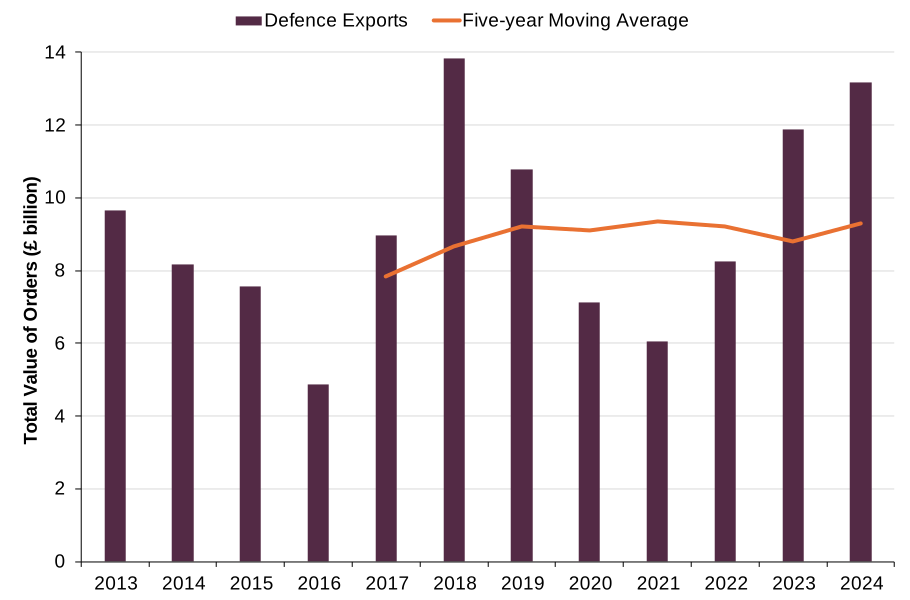
The total value of UK export orders in 2024 was £13.2 billion, an increase of £1.3 billion in nominal prices compared to 2023. The main driver for the increase in 2024 was a £2.6 billion increase in the value of UK defence exports to Europe. This offset the decrease seen across all other regions apart from Africa. To highlight trends which are not as affected by large orders within one year, Figure 1 includes a five-year moving average, which shows the average of the annual totals seen in the five years up to and including the corresponding year.
Figure 1: Value of UK defence export orders from 2013 to 2024 and five-year moving average
Source: ICE survey of UK defence exporters
Figure 1 presents a time series of UK defence export orders in nominal prices. To highlight trends which are not as affected by large orders within one year, Figure 1 includes a five-year moving average, which shows the average of the annual totals seen in the five years up to and including the corresponding year.
The five-year moving average of UK defence exports orders has remained fairly stable since 2018, at around £9 billion. There were below average exports in 2020 to 2021, possibly due to the impact of the COVID-19 pandemic, followed by a steady increase from 2022 onwards. This reflects increased defence spending globally as a result of the war in Ukraine.
4. UK Defence Exports by Destination Region
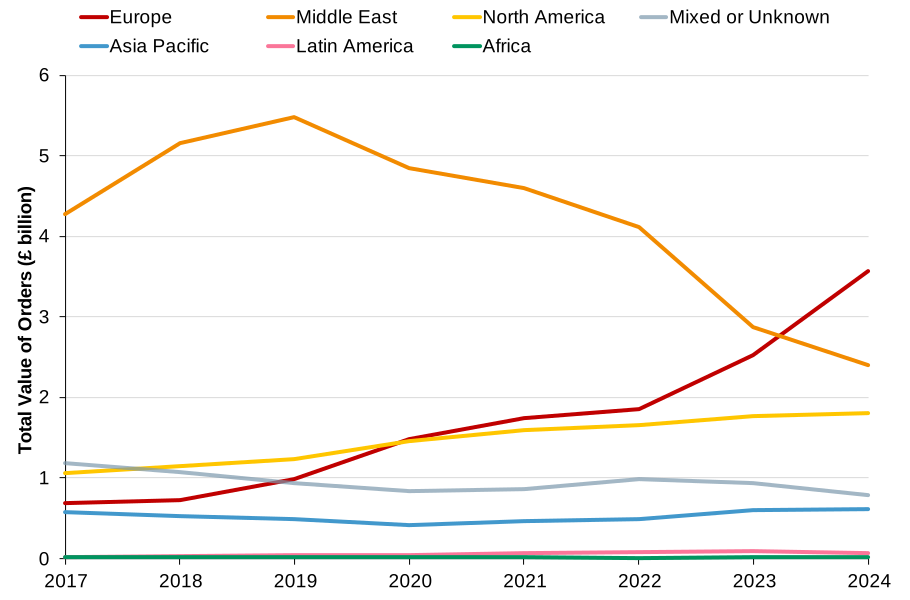
The Middle East[footnote 1] was on average the largest market for UK defence export orders since 2017, before being overtaken by Europe in 2024. Five-year average exports to Europe increased from £0.7 billion in 2017 to £3.6 billion in 2024. This is largely due to a large deal with Poland.
Five-year moving average exports to the Middle East have shown a decline since 2019, reflecting a drop in in-year orders following large contracts in 2018 of Typhoon Aircraft and Brimstone Missiles to Qatar. Please see the note in section 1 regarding the variability of orders and contracts.
Figure 2: Value of UK defence export orders by destination region: five-year moving average
Source: ICE survey of UK defence exporters
Figure 2 presents a five-year moving average time series for UK defence export orders by destination region in nominal prices. Regions are labelled according to decreasing levels of orders in 2024.
5. UK Defence Exports by Sector
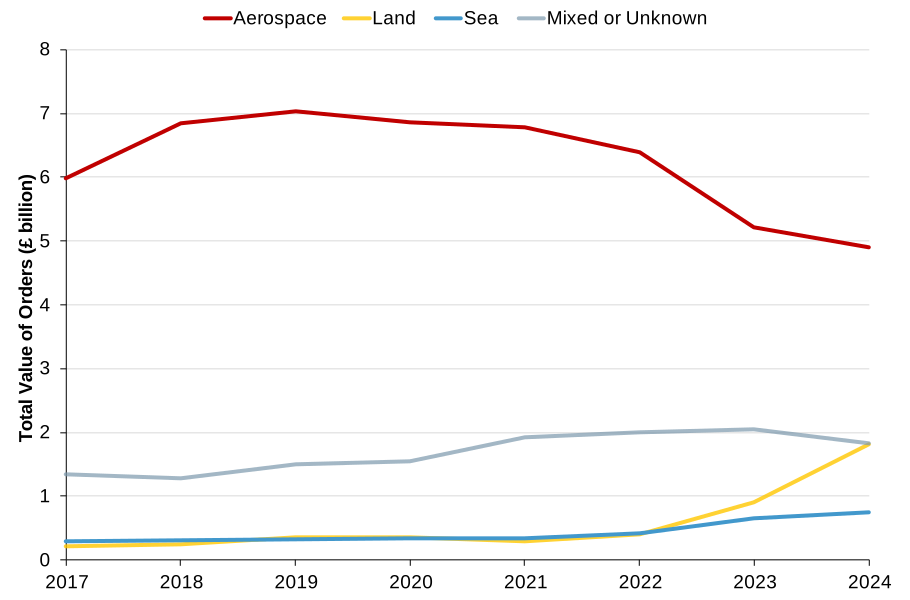
When processing the statistics, goods are categorised into the following four categories depending on their intended use: aerospace, sea, land and unknown. Aerospace products have accounted for the largest share of UK defence export orders for the entire period covered in this publication (2013 to 2024). For the five-year period from 2020 to 2024, aerospace products accounted for 53% of the total value of UK defence export orders.
Note that it is not always possible to relate contract information to a specific product group. Where contracts do not clearly fit within a specific product type, they have been included as ‘Mixed or Unknown’.
Figure 3: Value of UK defence export orders by product: five-year moving average
Source: ICE survey of UK defence exporters
Figure 3 presents a five-year moving average time series for UK defence export orders by product in nominal prices.
6. Further Information
Ministry of Defence statistics site
UK Security Exports site and historic UK Defence Export Statistics
7. Contact
Responsible statistician: Analysis-Expenditure Head of Branch
Telephone: 0303 378 6554
Further information/mailing list: Analysis-Expenditure-PQ-FOI@mod.gov.uk
Background quality report: Background Quality Report
Would you like to be added to our contact list, so that we can inform you about updates to these statistics and consult you if we are thinking of making changes? You can subscribe to updates by emailing Analysis-Publications@mod.gov.uk.
-
For the purposes of these statistics, Egypt is included in the Middle East rather than Africa. This should be considered if comparing with other trade statistics. ↩