Seasonal influenza vaccine uptake in children of school age in England: winter season 2025 to 2026 report
Published 28 May 2026
Applies to England

© Crown copyright 2026
This publication is licensed under the terms of the Open Government Licence v3.0 except where otherwise stated. To view this licence, visit nationalarchives.gov.uk/doc/open-government-licence/version/3 or write to the Information Policy Team, The National Archives, Kew, London TW9 4DU, or email: psi@nationalarchives.gov.uk.
Where we have identified any third party copyright information you will need to obtain permission from the copyright holders concerned.
This publication is available at https://www.gov.uk/government/statistics/seasonal-influenza-vaccine-uptake-in-children-of-school-age-winter-season-2025-to-2026/seasonal-influenza-vaccine-uptake-in-children-of-school-age-in-england-winter-season-2025-to-2026-report
This report describes the final end of season influenza vaccine uptake for the school-aged programme in England. All school children aged 4 to 16 years (reception to year 11) were eligible during the 2025 to 2026 season.
All data in this report represents data returned from 99.4% (153 of 154) of local authorities in England on cumulative vaccinations administered from 1 September 2025 to 31 January 2026.
Comparisons are made to the previous season (2024 to 2025), which had 100% of local authorities provide data. In the previous season all primary school-aged children in reception to year 6, and secondary school-aged children in years 7 to 11, were eligible for vaccination. The Background information section provides more information on differences in the programme between seasons.
Main points
In the 2025 to 2026 season:
-
55.5% (2,486,382 out of 4,478,946 ) of primary school-aged children (reception to year 6) were vaccinated compared with 54.5% (2,514,483 out of 4,613,378) during the 2024 to 2025 season
-
48.0% (1,661,391 out of 3,460,677) of secondary school children (year 7 to year 11) were vaccinated compared with 44.6% (1,560,525 out of 3,498,084) during the 2024 to 2025 season
-
52.2% (4,147,773 out of 7,939,623) of all school-aged children in reception to year 11 were vaccinated compared with 50.2% (4,075,008 out of 8,111,462) during the 2024 to 2025 season
Results summary for seasonal influenza vaccine uptake in school-aged children
This season (2025 to 2026), all primary school-aged children in reception to year 6, and secondary school-aged children in years 7 to 11, were eligible for vaccination.
Data tables and graphs showing final, end of season vaccine uptake for children in school years reception to year 11 at NHS region and local authority level are described and shown throughout this section. Vaccine uptake guidance and coverage data for this season and previous seasons is also available.
Cumulative vaccine uptake by academic year for the national programme in England this season is presented in Table 1a for primary school-aged children, Table 1b for secondary school-aged children, and in Table 1 of the supplementary data set.
Table 1a. Change in seasonal influenza vaccine uptake (%) in primary school-aged children in England between 2025 to 2026 and 2024 to 2025 seasons
| School year | Age (years) | Number of vaccinated children in 2025 to 2026 | Total number of children eligible for vaccine in 2025 to 2026 | Vaccine uptake in 2025 to 2026 (%) | Vaccine uptake in 2024 to 2025 (%) | Percentage point changes |
|---|---|---|---|---|---|---|
| Reception | 4 to 5 | 328,648 | 583,337 | 56.3 | 54.7 | 1.6 |
| Year 1 | 5 to 6 | 340,610 | 605,237 | 56.3 | 55.6 | 0.7 |
| Year 2 | 6 to 7 | 351,285 | 626,791 | 56.0 | 55.3 | 0.7 |
| Year 3 | 7 to 8 | 359,728 | 644,924 | 55.8 | 54.6 | 1.2 |
| Year 4 | 8 to 9 | 364,239 | 661,984 | 55.0 | 54.6 | 0.4 |
| Year 5 | 9 to 10 | 372,622 | 677,888 | 55.0 | 54.1 | 0.9 |
| Year 6 | 10 to 11 | 369,250 | 678,785 | 54.4 | 52.9 | 1.5 |
| Total (reception to year 6) | 4 to 11 | 2,486,382 | 4,478,946 | 55.5 | 54.5 | 1.0 |
Table 1b. Change in seasonal influenza vaccine uptake (%) in secondary school-aged children in England between 2025 to 2026 and 2024 to 2025 seasons
| School year | Age (years) | Number of vaccinated children in 2025 to 2026 | Total number of children eligible for vaccine in 2025 to 2026 | Vaccine uptake in 2025 to 2026 (%) | Vaccine uptake in 2024 to 2025 (%) | Percentage point changes |
|---|---|---|---|---|---|---|
| Year 7 | 11 to 12 | 355,835 | 672,402 | 52.9 | 50.0 | 2.9 |
| Year 8 | 12 to 13 | 341,495 | 690,218 | 49.5 | 46.0 | 3.5 |
| Year 9 | 13 to 14 | 334,646 | 706,860 | 47.3 | 44.5 | 2.8 |
| Year 10 | 14 to 15 | 327,853 | 701,949 | 46.7 | 42.5 | 4.2 |
| Year 11 | 15 to 16 | 301,562 | 689,248 | 43.8 | 40.0 | 3.8 |
| Total (years 7 to 11) | 11 to 16 | 1,661,391 | 3,460,677 | 48.0 | 44.6 | 3.4 |
| Total (reception to year 11) | 4 to 16 | 4,147,773 | 7,939,623 | 52.2 | 50.2 | 2.0 |
This season the total vaccine uptake for all primary school-aged children was 1.0 percentage points higher compared with the previous season (55.5% compared with 54.5% in 2024 to 2025 season, as shown in Table 1a). The total uptake in secondary school-aged children was 3.4 percentage points higher than the previous season (48.0% compared with 44.6%). The total uptake in all school-aged children (reception to year 11) was 2.0 percentage points higher than the previous season (52.2% compared with 50.2%, Table 1b).
By year group, this season the highest uptake was among children in reception and year 1 (56.3%) and the lowest in children in year 11 (43.8%, as shown in Table 1a and Table 1b).
In comparison with the previous season for primary school year groups, increases in vaccine uptake ranged from 0.4 percentage points (year 4) to 1.6 percentage points (reception). Uptake in years 1, 2, 4, and 5 increased by fewer than 1 percentage point compared with the previous season. Fewer than 1 percentage point difference with the previous season is considered comparable. Vaccine uptake in reception and years 1 and 3 increased by over 1 percentage point (ranging from 1.2 to 1.6 percentage points increases, as shown in Table 1a). See the Vaccine uptake in primary school children section for further details.
Vaccine uptake in all secondary school year groups increased this season compared with the previous season. Increases ranged from 2.8 percentage points (year 9) to 4.2 percentage points (year 10), as shown in Table 1b. See the Vaccine uptake in secondary school children section for further details.
The national ambition for this season was to demonstrate a 100% offer and to achieve at least the uptake levels of the previous season. Of 150 local authorities in England, 106 (70.7%) had an uptake equal or above that of the previous season. See the Ambitions for flu immunisation programme section for further details.
Response rates
All uptake figures in this final end of season report represent data returned from 99.4% (153 of 154) of local authorities in England on cumulative influenza vaccinations administered from 1 September 2025 to 31 January 2026. Data from the previous season’s annual report represented a 100% return (154 of 154 local authorities).
This season’s figures are based only on the local authorities that submitted data (99.4%). As local authorities vary in population size and the number of eligible children, the data has not been extrapolated to give an estimate of the 100% response rate. Local authority-level data is provided in Table 4 of the supplementary dataset.
Throughout this season, provisional uptake data was published on a cumulative monthly basis. The final end-of-season response rate for this annual report (99.4%) was higher than the rates observed in all provisional monthly surveys except the penultimate (December) survey (Table 7a and Table 7b in the supplementary data set). The response rate for the December survey (99.4%) was equivalent to the final end-of-season. Monthly surveys with a lower response rate included the last monthly survey (data up to 31 January 2026, published February 2026). This had a response rate of 90.9%, with a total of 52.0% of all school-aged children (reception to year 11), 55.4% of primary school-aged children (reception to year 6) and 47.8% of secondary school-aged children (years 7 to 11) receiving a vaccine in England. Caution should be used when interpreting provisional monthly data as the vaccine uptake percentages are based on denominators of those local authorities returning data that month.
National uptake
Based on a 99.4% response rate (not 100%) this season, over 4,147,000 out of over 7,939,000 children (52.2%) in school years reception to year 11 in England were vaccinated between 1 September 2025 and 31 January 2026 (Table 1b). Across local authorities, the median vaccine uptake was 51.1% (Table 2a).
Table 2a. Seasonal influenza vaccine uptake (%) in primary, secondary and all school children, England, calculated across local authorities, 2025 to 2026 season
| School year | Total number of eligible children | Total number of children vaccinated | Influenza vaccine uptake (%) | Median influenza vaccine uptake (%) | Lower quartile influenza vaccine uptake (%) | Upper quartile influenza vaccine uptake (%) |
|---|---|---|---|---|---|---|
| Primary school-aged children (reception to year 6) | 4,478,946 | 2,486,382 | 55.5 | 55.0 | 46.9 | 62.7 |
| Secondary school-aged children (year 7 to year 11) | 3,460,677 | 1,661,391 | 48.0 | 46.2 | 37.2 | 54.7 |
| All school-aged children (reception to year 11) | 7,939,623 | 4,147,773 | 52.2 | 51.1 | 42.2 | 58.9 |
As the final end-of-season data did not have a 100% response rate this season, the total number of children vaccinated is not directly comparable with the previous season, which had a 100% response rate. However, for reference, during the previous season, based on a 100% response rate, over 4,075,000 children from school years reception to year 11 in England were vaccinated between 1 September 2024 to 31 January 2025. Table 2b shows the previous season’s data, with a median of 49.6% across responding local authorities. Although not directly comparable due to the difference in response rate, this season more school-aged children were vaccinated than in the previous season (Table 2a and Table 2b).
If the previous season was recalculated on a comparable basis to this season’s 99.4% response rate (excluding data from the same local authority who did not submit data this season), uptake for the previous season would be 50.4%. This is equivalent to over 4,023,000 out of over 7,986,000 school-aged children vaccinated. This equates to over 124,000 more children being vaccinated this season compared with the previous season. This is driven by the increases seen in secondary school-aged children.
Table 2b. Seasonal influenza vaccine uptake (%) in primary, secondary and all school children, England, calculated across local authorities, 2024 to 2025 season
| School year | Total number of eligible children | Total number of children vaccinated | Influenza vaccine uptake (%) | Median influenza vaccine uptake (%) | Lower quartile influenza vaccine uptake (%) | Upper quartile influenza vaccine uptake (%) |
|---|---|---|---|---|---|---|
| Primary school-aged children (reception to year 6) | 4,613,378 | 2,514,483 | 54.5 | 55.1 | 45.5 | 63.0 |
| Secondary school-aged children (year 7 to year 11) | 3,498,084 | 1,560,525 | 44.6 | 43.1 | 33.4 | 51.2 |
| All school-aged children (reception to year 11) | 8,111,462 | 4,075,008 | 50.2 | 49.6 | 40.9 | 57.5 |
Vaccine uptake in primary school children
For primary school-aged children (reception to year 6), the cumulative and median uptake are shown by year group in Table 3a (this season) and Table 3b (the previous season).
As stated previously, as the final end-of-season data did not have a 100% response rate this season, the total number of children vaccinated is not directly comparable with the previous season, which had a 100% response rate. This season, the number of vaccinated primary school-aged children was fewer than the previous season. This may be due to lower data return, with one fewer local authority submitting data. If uptake were recalculated on a comparable basis to this season’s 99.4% response rate (excluding data from the same local authority who did not submit data this season), uptake for the previous season would be 54.6%. This is equivalent to over 2,482,000 out of over 4,542,000 primary school-aged children vaccinated. This equates to over 4,000 more primary school aged children being vaccinated this season compared with the previous season.
Table 3a. Seasonal influenza vaccine uptake (%) in primary school children, by year, England, calculated across local authorities, 2025 to 2026 season
| School year | Total number of eligible children | Total number of children vaccinated with influenza vaccine | Influenza vaccine uptake percentage (%) | Median influenza vaccine uptake (%) | Lower quartile influenza vaccine uptake (%) | Upper quartile influenza vaccine uptake (%) |
|---|---|---|---|---|---|---|
| Reception | 583,337 | 328,648 | 56.3 | 56.3 | 47.6 | 62.8 |
| Year 1 | 605,237 | 340,610 | 56.3 | 55.7 | 48.0 | 63.5 |
| Year 2 | 626,791 | 351,285 | 56.0 | 55.6 | 47.2 | 63.6 |
| Year 3 | 644,924 | 359,728 | 55.8 | 55.6 | 47.3 | 62.7 |
| Year 4 | 661,984 | 364,239 | 55.0 | 54.4 | 46.6 | 62.2 |
| Year 5 | 677,888 | 372,622 | 55.0 | 54.1 | 45.9 | 62.5 |
| Year 6 | 678,785 | 369,250 | 54.4 | 54.2 | 45.9 | 61.4 |
| Total (reception to year 6) | 4,478,946 | 2,486,382 | 55.5 | 55.0 | 46.9 | 62.7 |
Table 3b. Seasonal influenza vaccine uptake (%) in primary school children, by year, England, calculated across local authorities, 2024 to 2025 season
| School year | Total number of eligible children | Total number of children vaccinated with influenza vaccine | Influenza vaccine uptake percentage (%) | Median influenza vaccine uptake (%) | Lower quartile influenza vaccine uptake (%) | Upper quartile influenza vaccine uptake (%) |
|---|---|---|---|---|---|---|
| Reception | 603,721 | 330,200 | 54.7 | 55.4 | 46.2 | 62.4 |
| Year 1 | 630,362 | 350,632 | 55.6 | 55.6 | 47.1 | 63.6 |
| Year 2 | 650,832 | 359,668 | 55.3 | 56.0 | 46.1 | 63.3 |
| Year 3 | 670,228 | 365,841 | 54.6 | 54.5 | 46.0 | 63.0 |
| Year 4 | 684,268 | 373,583 | 54.6 | 54.5 | 45.7 | 63.2 |
| Year 5 | 685,021 | 370,369 | 54.1 | 53.5 | 45.3 | 62.6 |
| Year 6 | 688,946 | 364,190 | 52.9 | 53.3 | 44.1 | 60.9 |
| Total (reception to year 6) | 4,613,378 | 2,514,483 | 54.5 | 55.1 | 45.5 | 63.0 |
Vaccine uptake in secondary school children
For secondary school-aged children (years 7 to 11), the cumulative and median uptake are shown by year group in Table 4a (this season) and Table 4b (previous season).
This season, for secondary school-aged children (years 7 to 11), more secondary school-aged children were vaccinated than in the previous season (Table 4a and Table 4b). As stated above, as the final end-of-season data did not have a 100% response rate this season, the total number of children vaccinated is not directly comparable with the previous season, which had a 100% response rate. If uptake were recalculated on a comparable basis to this season’s 99.4% response rate (excluding data from the same local authority who did not submit data this season), uptake for the previous season would be 44.7%. This is equivalent to over 1,541,000 out of over 3,444,000 secondary school-aged children vaccinated. This equates to over 120,000 more secondary school-aged children being vaccinated this season compared with the previous season.
Table 4a. Seasonal influenza vaccine uptake (%) in secondary school children, by year, England, calculated across local authorities, 2025 to 2026 season
| School year | Total number of eligible children | Total number of children vaccinated with influenza vaccine | Influenza vaccine uptake percentage (%) | Median influenza vaccine uptake (%) | Lower quartile influenza vaccine uptake (%) | Upper quartile influenza vaccine uptake (%) |
|---|---|---|---|---|---|---|
| Year 7 | 672,402 | 355,835 | 52.9 | 51.8 | 42.0 | 59.3 |
| Year 8 | 690,218 | 341,495 | 49.5 | 47.8 | 38.8 | 56.4 |
| Year 9 | 706,860 | 334,646 | 47.3 | 46.0 | 36.8 | 54.1 |
| Year 10 | 701,949 | 327,853 | 46.7 | 45.2 | 35.3 | 53.5 |
| Year 11 | 689,248 | 301,562 | 43.8 | 42.5 | 31.1 | 50.2 |
| Total (year 7 to 11) | 3,460,677 | 1,661,391 | 48.0 | 46.2 | 37.2 | 54.7 |
Table 4b. Seasonal influenza vaccine uptake (%) in secondary school children, by year, England, calculated across local authorities, 2024 to 2025 season
| School year | Total number of eligible children in the local authority geography | Total number of children vaccinated with influenza vaccine | Influenza vaccine uptake percentage (%) | Median influenza vaccine uptake (%) | Lower quartile influenza vaccine uptake (%) | Upper quartile influenza vaccine uptake (%) |
|---|---|---|---|---|---|---|
| Year 7 | 694,488 | 347,190 | 50.0 | 48.9 | 38.5 | 57.1 |
| Year 8 | 710,606 | 326,629 | 46.0 | 44.6 | 35.5 | 52.7 |
| Year 9 | 708,704 | 315,422 | 44.5 | 42.8 | 34.0 | 51.3 |
| Year 10 | 698,258 | 296,617 | 42.5 | 41.0 | 30.5 | 48.7 |
| Year 11 | 686,028 | 274,667 | 40.0 | 39.1 | 28.3 | 46.8 |
| Total (year 7 to 11) | 3,498,084 | 1,560,525 | 44.6 | 43.1 | 33.4 | 51.2 |
Ambitions for flu immunisation programme
In this season, 106 of 150 responding local authorities in England (70.7%) achieved uptake equal to or above the previous season. The total number of responding local authorities is 150, as 3 local authorities report jointly within 2 reporting arrangements (City of London and Hackney; Cornwall and Isles of Scilly; and Leicestershire and Rutland).
Therefore, a higher proportion of local authorities achieved the national ambition compared with the previous season, when 51.9% (80 of 154 local authorities) achieved the national ambition (uptake equal to or above the previous season).
For this season, among primary school‑aged children, 55.3% of responding local authorities had uptake equal to or above that of the previous season. Among secondary school‑aged children, 78.6% of responding local authorities met or exceeded the previous season’s uptake.
Trends in uptake over seasons
The cumulative vaccine uptake for all eligible year groups each season since the schools’ programme was rolled out nationally are shown in Table 5a (primary school), Table 5b (secondary school) and supplementary Table 5a.
Table 5a. Seasonal influenza vaccine uptake (%) for primary school-aged children in England from winter seasons 2015 to 2026
| School year | Reception | Year 1 | Year 2 | Year 3 | Year 4 | Year 5 | Year 6 | Total: primary school-aged children |
|---|---|---|---|---|---|---|---|---|
| 2025 to 2026 | 56.3 | 56.3 | 56.0 | 55.8 | 55.0 | 55.0 | 54.4 | 55.5 |
| 2024 to 2025 | 54.7 | 55.6 | 55.3 | 54.6 | 54.6 | 54.1 | 52.9 | 54.5 |
| 2023 to 2024 | 55.9 | 56.4 | 55.6 | 55.8 | 55.1 | 54.1 | 53.3 | 55.1 |
| 2022 to 2023 | 56.7 | 56.4 | 57.5 | 57.3 | 56.2 | 55.6 | 54.2 | 56.3 |
| 2021 to 2022 | 56.9 | 58.9 | 58.8 | 58.0 | 57.3 | 56.2 | 55.8 | 57.4 |
| 2020 to 2021 | 64.2 | 64.5 | 63.7 | 63.2 | 61.8 | 61.1 | 59.2 | 62.5 |
| 2019 to 2020 | 64.3 | 63.6 | 62.6 | 60.6 | 59.6 | 57.2 | 55.0 | 60.4 |
| 2018 to 2019 | 64.3 | 63.6 | 61.5 | 60.4 | 58.3 | 56.5 | [z] | 60.8 |
| 2017 to 2018 | 62.6 | 61.0 | 60.4 | 57.6 | 55.8 | [z] | [z] | 59.5 |
| 2016 to 2017 | [note 1] | 57.6 | 55.4 | 53.3 | [z] | [z] | [z] | 55.4 |
| 2015 to 2016 | [note 1] | 54.4 | 52.9 | [z] | [z] | [z] | [z] | 53.6 |
Note 1: children in reception were vaccinated through GP practices, not school-aged delivery.
The highest national uptake on record in England for school-aged children was during the 2020 to 2021 season (the first year of the COVID-19 pandemic). That season, children in reception to year 7 were eligible for the programme. For most year groups (year 1 to year 7), the highest uptake was seen in the 2020 to 2021 season. For children in reception, the highest uptake was seen before the COVID-19 pandemic (2018 to 2019 and 2019 to 2020 seasons) with uptake of 64.3%. The highest uptake in a year group was seen in 2020 to 2021 in year 1 (64.5%).
This season, vaccine uptake in primary school-aged years groups was comparable (within 1 percentage point difference) or higher compared with the previous season and for all year groups. This was comparable with that seen in the 2023 to 2024 season, apart from in year 6 where uptake was 1.0 percentage point higher (54.4% this season compared with 53.4% in 2023 to 2024 season). Compared with 2022 to 2023 (the first year of living with COVID-19), uptake was comparable (reception, years 1, 5 and 6) or higher (years 2, 3, and 4, with uptake ranging from 1.2 to 1.5 percentage points higher compared with this season (Table 5a and Figure 1).
Figure 1. Seasonal influenza vaccine uptake (%) for children in primary school in England by year group, 2025 to 2026 season and the previous 6 seasons

This season, uptake in all primary school-aged year groups remained below levels seen before the COVID-19 pandemic season (2019 to 2020 season, as shown in Figure 1 and Table 5a. This ranged from 0.6 percentage points lower (year 6) to 8.0 percentage points lower (reception).
All primary school-aged children (reception to year 6) have been eligible for the national nasal spray live attenuated influenza vaccine (LAIV) programme since the 2019 to 2020 season (the last season prior to the COVID-19 pandemic). Across those 7 seasons, this season has the third lowest uptake of 55.5% (2,486,382 out of 4,478,946 (99.4% response rate)). Compared with the last pre-pandemic season (2019 to 2020), this season was 4.9 percentage points lower (60.4%, 2,876,531 out of 4,764,192 with 100% response rate). Compared with the season with the highest primary school uptake on record (2020 to 2021 season, the first year of the COVID-19 pandemic), this season was 7.0 percentage points lower (62.5%, 2,962,494 out of 4,740,044, with a 100% response rate).
Table 5b. Seasonal influenza vaccine uptake (%) for secondary school-aged children in England from winter seasons 2020 to 2026
| School year | Year 7 | Year 8 | Year 9 | Year 10 | Year 11 | Total: secondary school-aged children (years 7 to 11, unless otherwise stated) | Total: all school-aged children (reception to year 11, unless otherwise stated) |
|---|---|---|---|---|---|---|---|
| 2025 to 2026 | 52.9 | 49.5 | 47.3 | 46.7 | 43.8 | 48.0 | 52.2 |
| 2024 to 2025 | 50.0 | 46.0 | 44.5 | 42.5 | 40.0 | 44.6 | 50.2 |
| 2023 to 2024 | 49.1 | 45.0 | 42.5 | 41.6 | 35.7 | 42.8 | 49.9 |
| 2022 to 2023 | 45.2 | 40.7 | 39.6 | [note 1] | [note 1] | 41.9 | 51.9 [note 4] |
| 2021 to 2022 | 48.5 | 45.8 | 42.2 | 42.0 | 38.9 | 43.6 | 51.7 |
| 2020 to 2021 | 56.2 | [z] | [z] | [z] | [z] | 56.2 [note 3] | 61.7 [note 5] |
Note 1: figures are not reported here. Once offers had been made to younger children and at‑risk groups, and subject to vaccine availability, any remaining doses were offered to Years 10 and 11.
Note 2: total for years 7 to 9 only.
Note 3: total for year 7 only.
Note 4: total for reception to year 9 only.
Note 5: total for reception to year 7 only.
This season followed the general trend seen in previous seasons, with uptake decreasing as the age of school‑aged children increased, as shown in Table 5a (primary school), Table 5b (secondary school) and supplementary Table 5a. As discussed in the Background information section, comparisons between seasons are limited due to the differences in the phased rollout of the school-aged programme, particularly among the secondary school-aged programme.
The number of children vaccinated each season since the national nasal spray LAIV programme was introduced in the 2013 to 2014 season can be found in supplementary Table 6a. A summary of the total number of children vaccinated in each delivery setting can be found in supplementary Table 6b.
Progress throughout the 2025 to 2026 season
Throughout the season, monthly vaccine uptake data was collected from October to January, with provisional data published the following month (November to February). During the season, the national level vaccine uptake data in primary school-aged children showed an increase during the first 2 months of the vaccination campaign (collected in October and November) which then plateaued for data collected for December and January. See supplementary Table 7a on vaccine uptake percentage in each survey month in primary school-aged children.
See the Background information section for differences in programme implementation between seasons and therefore the limitations to comparisons between seasons.
For primary school‑aged children, when compared with the same time point in previous seasons, this season recorded the highest vaccine uptake on record by 31 October (32.7%, compared with 30.0% in 2024 to 2025, as shown in Figure 2).
Figure 2. Seasonal influenza vaccine uptake (%) for primary school-aged children in England by month for the 2025 to 2026 season compared with the 2024 to 2025, 2023 to 2024 and the 2019 to 2020 seasons

Note 1: the 2019 to 2020 season is given as a comparison season, as this season was the first season when all primary school-aged children (reception to year 6) were eligible for the national programme. This was also the last season prior to the COVID-19 pandemic. There were supply issues with the nasal spray vaccine used for the children’s programme during the 2019 to 2020 season.
After a strong start to the vaccination campaign, with a relatively high number of vaccinations delivered early on, uptake slowed as the campaign continued. By 30 November, influenza vaccine uptake was comparable (within 1 percentage point difference) to previous seasons, including last season (48.4%, compared with 49.1%). By 31 December, vaccine uptake was 2.7 percentage points lower than that seen at the same time point in pre-COVID-19 pandemic seasons (55.2% compared with 57.9% in 2019 to 2020 season). In comparison, during the 2019 to 2020 season, there was an increase of over 14.3 percentage points between 1 and 31 December, whereas this season saw a smaller increase of 6.8 percentage points over the same period. Vaccine uptake up to 31 January (55.5%) was comparable to the two previous seasons (54.5% in 2024 to 2025 and 55.1% in 2023 to 2024) (as shown in supplementary Table 7a, Table 5a, and Figure 2).
In secondary school-aged children during the 2025 to 2026 season, vaccine uptake increased during the first 3 months of the programme (October, November and December) and plateaued in January. Vaccine uptake in each survey month in secondary school-aged children can be found in supplementary Table 7b. Throughout the vaccination campaign, uptake in secondary school-aged children was lower than in primary school-aged children. During December, uptake increased by over 13.0 percentage points in secondary school-aged children compared with an increase of fewer than 7.0 percentage points in primary school-aged children. Although the cumulative monthly influenza vaccine uptake data published during the 2025 to 2026 season demonstrated some variability in the prioritisation of school-aged cohorts early in the vaccination campaign, the national vaccination trends align with the Joint Committee on Vaccination and Immunisation (JCVI) advice to vaccinate the youngest age groups first (PDF, 484 KB).
Vaccine uptake by NHS region
In all school-aged children (reception to year 11), variation in vaccine uptake was observed between the 7 NHS England regions, ranging from 40.1% (London) to 60.5% (East of England). The East of England, North East and Yorkshire, South East, and South West were all above the national uptake of 52.2% (Table 6).
Table 6. Estimated number and seasonal influenza vaccine uptake (%) for reception to year 11 by NHS region in England from 1 September 2025 to 31 January 2026
| NHS commissioning region | Total number of children eligible for vaccination | Number of children vaccinated with at least one dose of influenza vaccine | Number of children unvaccinated | Vaccine uptake (%) |
|---|---|---|---|---|
| East of England | 964,953 | 583,900 | 381,053 | 60.5 |
| London | 1,225,024 | 491,610 | 733,414 | 40.1 |
| Midlands | 1,565,603 | 770,430 | 795,173 | 49.2 |
| North East and Yorkshire | 1,033,252 | 541,069 | 492,183 | 52.4 |
| North West | 1,089,262 | 535,000 | 554,262 | 49.1 |
| South East | 1,315,947 | 776,127 | 539,820 | 59.0 |
| South West | 745,582 | 449,637 | 295,945 | 60.3 |
| England | 7,939,623 | 4,147,773 | 3,791,850 | 52.2 |
In primary school-aged children, variation in vaccine uptake was observed between the 7 NHS England regions, as shown in Figure 3a. Figure 3a also shows the difference in population size for each region.
Figure 3a. Number and estimated proportion of primary school-aged children in England vaccinated with seasonal influenza vaccine by NHS region between 1 September 2025 to 31 January 2026
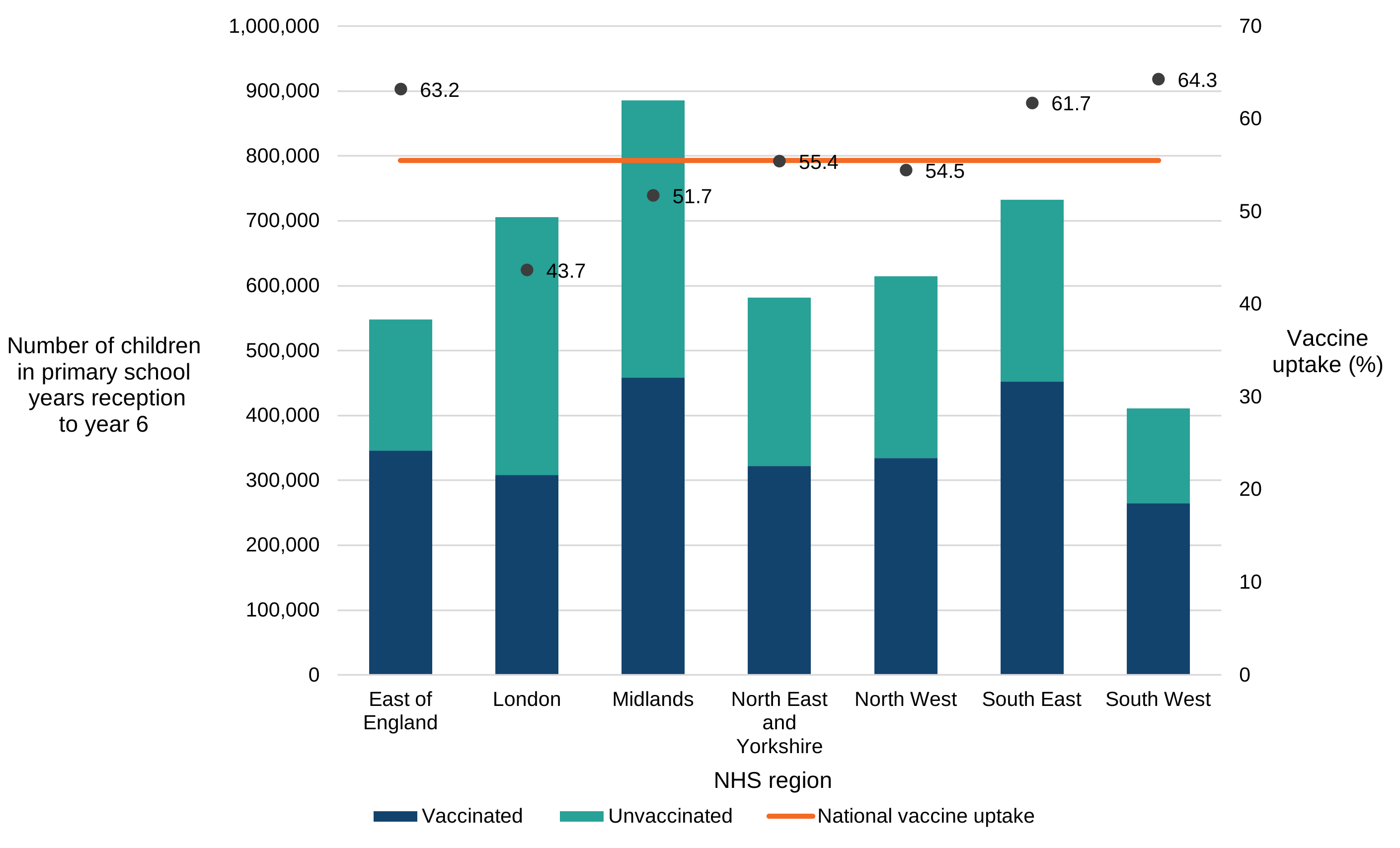
Note 1: orange line shows the national primary school-aged average uptake of 55.5%.
All regions had higher uptake than the previous season, except for the North West (1.0 percentage points lower, as shown in Table 7a. Increases in uptake ranged from 0.1 percentage points (London) to 3.2 percentage points (East of England).
Table 7a. Change in seasonal influenza vaccine uptake in primary school-aged children in England between the 2025 to 2026 and 2024 to 2025 seasons
| Region | Influenza vaccine uptake (%) in 2025 to 2026 | Influenza vaccine uptake (%) in 2024 to 2025 | Percentage point change |
|---|---|---|---|
| East of England | 63.2 | 60.0 | 3.2 |
| London | 43.7 | 43.6 | 0.1 |
| Midlands | 51.7 | 50.9 | 0.8 |
| North East and Yorkshire | 55.4 | 54.0 | 1.4 |
| North West | 54.5 | 55.5 | -1.0 |
| South East | 61.7 | 60.4 | 1.3 |
| South West | 64.3 | 62.8 | 1.5 |
| Total | 55.5 | 54.5 | 1.0 |
In secondary school-aged children, variation in vaccine uptake was observed between the 7 NHS England regions (Figure 3b).
Figure 3b. Number and estimated proportion of secondary school-aged children in England vaccinated with seasonal influenza vaccine by NHS region between 1 September 2025 to 31 January 2026
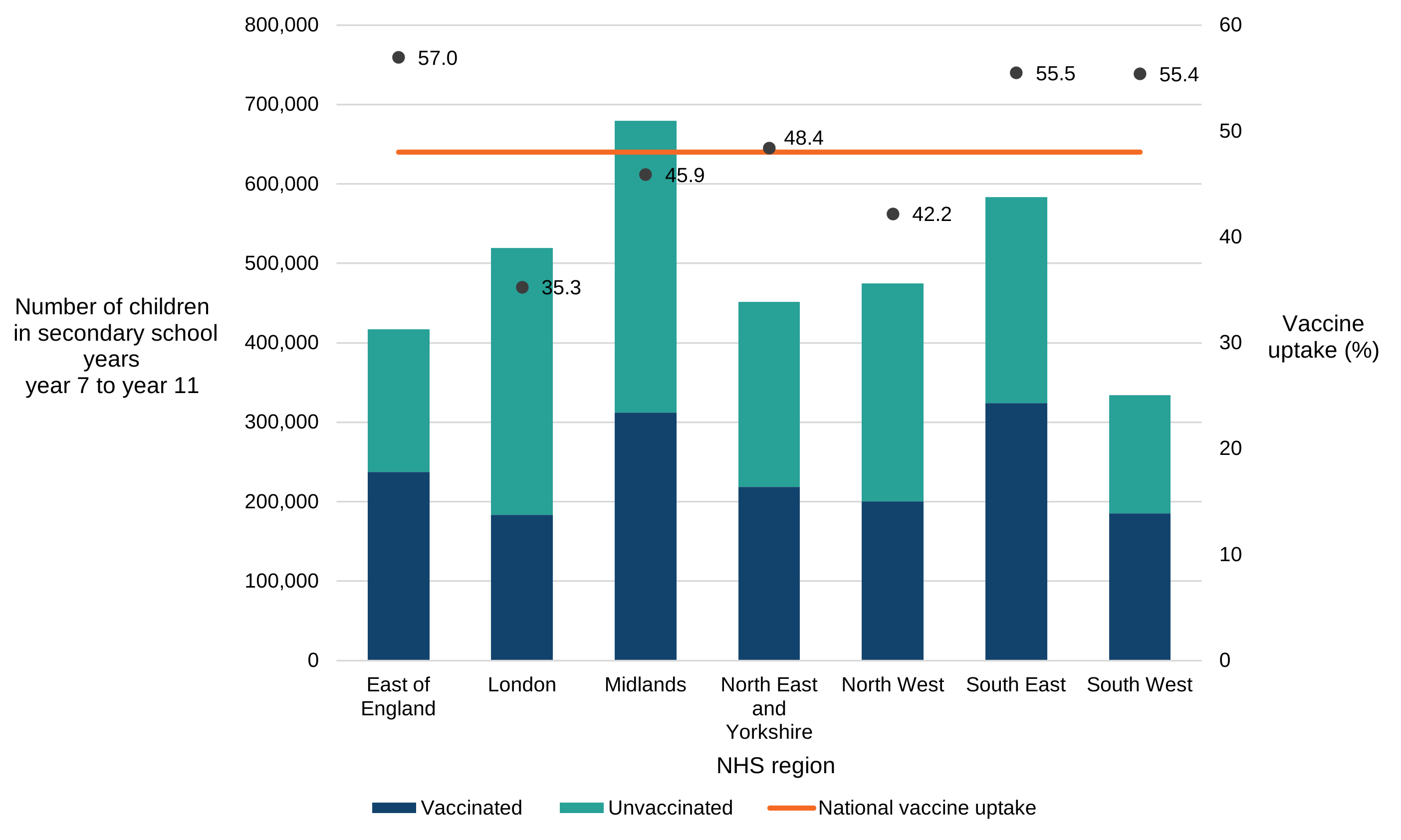
Note 1: the orange line shows the national secondary school-aged average uptake of 48.0%.
All regions had uptake higher than the previous season (Table 7b). Increases in uptake ranged from 2.0 percentage points (London) to 6.0 percentage points (East of England).
Table 7b. Change in seasonal influenza vaccine uptake in secondary school-aged children in England between the 2025 to 2026 and 2024 to 2025 seasons
| Region | Influenza vaccine uptake (%) in 2025 to 2026 | Influenza vaccine uptake (%) in 2024 to 2025 | Percentage point change |
|---|---|---|---|
| East of England | 57.0 | 51.0 | 6.0 |
| London | 35.3 | 33.3 | 2.0 |
| Midlands | 45.9 | 42.1 | 3.8 |
| North East and Yorkshire | 48.4 | 45.0 | 3.4 |
| North West | 42.2 | 39.6 | 2.6 |
| South East | 55.5 | 52.1 | 3.4 |
| South West | 55.4 | 51.7 | 3.7 |
| Total | 48.0 | 44.6 | 3.4 |
In all school-aged children (reception to year 11), variation in vaccine uptake was observed between the 7 NHS England regions (Figure 3c).
Figure 3c. Number and estimated proportion of all school-aged children in England vaccinated with seasonal influenza vaccine by NHS region between 1 September 2025 to 31 January 2026

Note 1: the orange line shows the national all school-aged children average uptake of 52.2%.
All regions had an uptake higher than the previous season (Table 7c). Increases in uptake ranged from 0.4 percentage points (North West) to 4.4 (East of England).
Table 7c. Change in seasonal influenza vaccine uptake in all school-aged children in England between the 2025 to 2026 and 2024 to 2025 seasons
| Region | Influenza vaccine uptake (%) in 2025 to 2026 | Influenza vaccine uptake (%) in 2024 to 2025 | Percentage point change |
|---|---|---|---|
| East of England | 60.5 | 56.1 | 4.4 |
| London | 40.1 | 39.4 | 0.7 |
| Midlands | 49.2 | 47.1 | 2.1 |
| North East and Yorkshire | 52.4 | 50.1 | 2.3 |
| North West | 49.1 | 48.7 | 0.4 |
| South East | 59.0 | 56.7 | 2.3 |
| South West | 60.3 | 57.8 | 2.5 |
| Total | 52.2 | 50.2 | 2.0 |
Vaccine uptake by local authority
The combined vaccine uptake for children in school years reception to year 11 by local authority varied across England, ranging from 24.8% in Birmingham to 75.3% in Cambridgeshire (supplementary Table 4). The following local authorities report collectively:
- City of London and Hackney
- Cornwall and Isles of Scilly
- Leicestershire and Rutland
Therefore, the total local authority count in this section is 151 in contrast to the 154 referenced elsewhere in the report. Of the 151 local authorities included in this section, 150 responded with data.
The range in vaccine uptake (%) by school year group and local authority is shown in Table 8.
Table 8. Range of seasonal influenza vaccine uptake (%) by school year group and local authority, 2025 to 2026 season
| Year group | Minimum vaccine uptake (%) | Maximum vaccine uptake (%) |
|---|---|---|
| Reception | 26.9 | 76.1 |
| Year 1 | 27.4 | 82.4 |
| Year 2 | 28.6 | 83.5 |
| Year 3 | 26.5 | 82.0 |
| Year 4 | 27.6 | 81.1 |
| Year 5 | 27.5 | 76.5 |
| Year 6 | 26.9 | 76.3 |
| Year 7 | 21.9 | 77.0 |
| Year 8 | 19.7 | 75.2 |
| Year 9 | 18.7 | 70.5 |
| Year 10 | 18.0 | 72.3 |
| Year 11 | 15.6 | 68.3 |
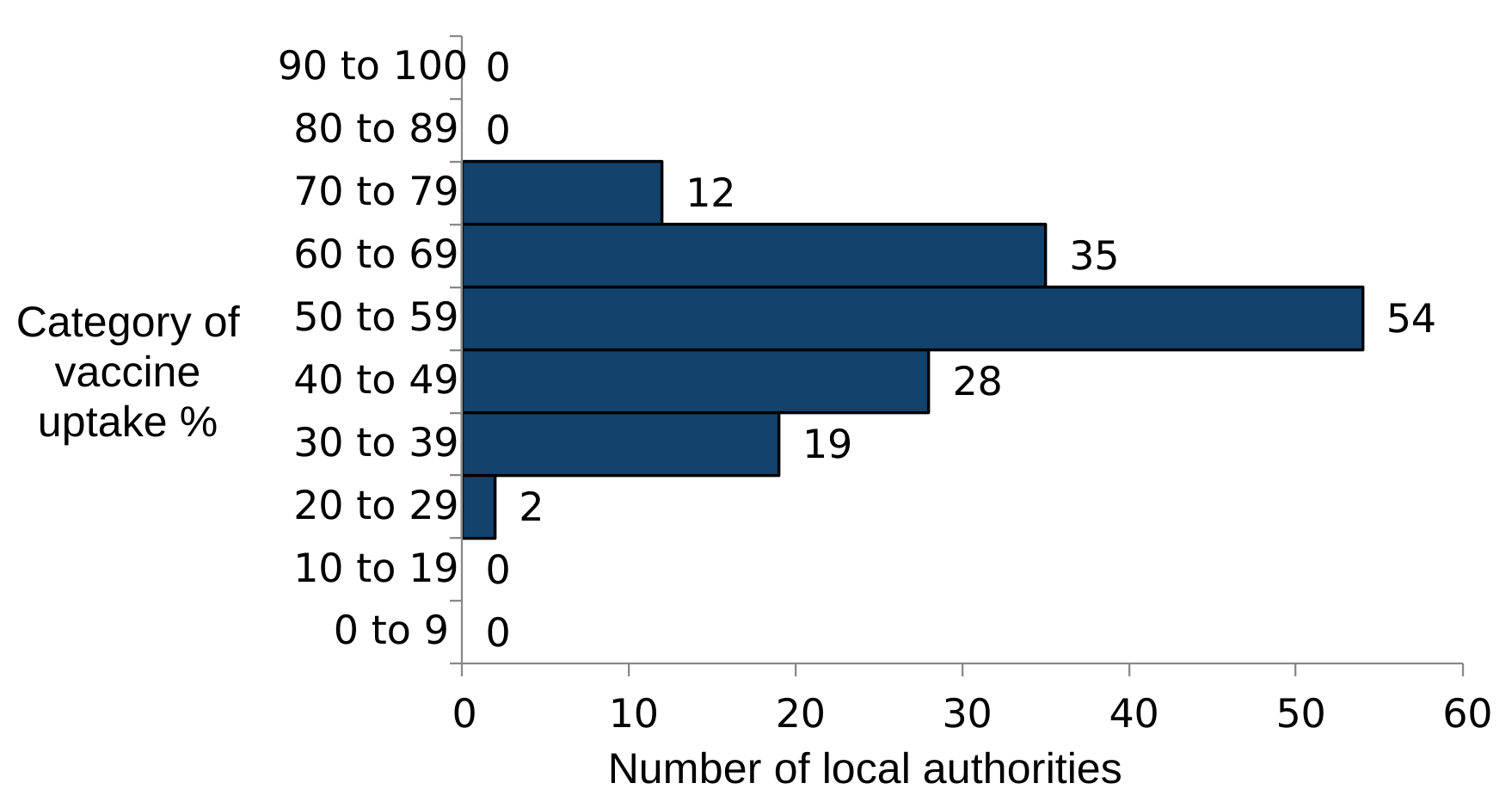
For primary school‑aged children (reception to year 6), no local authorities had uptake below 20%. 2 of 150 responding local authorities (1.3%) had an uptake between 20% and 29%. A further 19 (12.6%) had an uptake between 30% and 39%. 28 (18.5%) had an uptake of between 40% and 49%. 54 (35.8%) had an uptake of between 50% and 59%. 35 (23.2%) had an uptake of between 60% and 69%. 12 (7.9%) had an uptake of between 70% and 79%. No local authorities achieved uptake of 80% or higher (Figure 4a).
Figure 4a. Distribution of local authorities by seasonal influenza vaccine uptake (%) for primary school-aged children, England, 2025 to 2026 season
For secondary school‑aged children (year 7 to year 11), no local authorities had uptake below 10%. 2 of 150 responding local authorities (1.3%) had an uptake between 10% and 19%. 16 (10.6%) had an uptake between 20% and 29%. 28 (18.5%) had an uptake between 30% and 39%. 45 (29.8%) had an uptake between 40% and 49%. 37 (24.5%) had an uptake between 50% and 59%. 20 (13.2%) had an uptake between 60% and 69%. 2 (1.3%) had an uptake between 70% and 79%. No local authorities achieved uptake of 80% or higher (Figure 4b).
Figure 4b. Distribution of local authorities by seasonal influenza vaccine uptake (%) for secondary school-aged children, England, 2025 to 2026 season

For all school‑aged children (reception to year 11), no local authorities had an uptake below 20%. 5 of 150 responding local authorities (3.3%) had an uptake between 20% and 29%. A further 22 (14.6%) had an uptake between 30% and 39%. 42 (27.8%) had an uptake between 40% and 49%. 48 (31.8%) had an uptake between 50% and 59%. 27 (17.9%) had an uptake between 60% and 69%. 6 (4.0%) had an uptake between 70% and 79%. No local authorities achieved uptake of 80% or higher (Figure 4c).
Figure 4c. Distribution of local authorities by seasonal influenza vaccine uptake (%) for all school-aged children, England, 2025 to 2026 season

Glossary
At-risk
At-risk patients with clinical risk groups as listed in the Green Book.
Green Book
The Green Book, or Immunisation against infectious disease has the latest information on vaccines and vaccination procedures, for vaccine preventable infectious diseases in the UK. Chapter 19 refers to influenza.
ImmForm
A website that provides a secure online platform for vaccine uptake data collection for several immunisation surveys, including the seasonal influenza vaccine uptake collection.
School-age year
The school-age year is determined by the child’s age on the 31 August. This will be correct for the majority of children.
Median
The median is used when the data includes clear outliers that could distort the mean, making it a less reliable measure of central tendency. The median is less affected by extremes and gives a more accurate reflection of the typical vaccine uptake across school years. This makes it a better choice for understanding the overall trend in the presence of uneven data.
IQR
Interquartile range (IQR) is defined as the difference between the upper and lower quartile values in a set of data. It is commonly referred to as IQR and is used as a measure of spread and variability in a data set.
Data sources and methodology
UKHSA provides screening and immunisation teams in England a standard protocol describing the inclusion criteria and method of collecting the data. Data providers must use a suitable data source to identify eligible school cohorts in the local area. These sources are decided upon locally, usually by the screening and immunisation team or the school-aged immunisation service (SAIS). Most children are offered a single dose of vaccine. Eligible children in clinical at-risk groups without prior vaccination history aged under 9 years are recommended 2 doses of vaccine and are counted as one vaccination in the numerator. More information about this can be found in chapter 19 of the Green Book.
Cumulative data on seasonal influenza vaccine uptake was collected for 153 local authorities between 1 September 2025 to 31 January 2026 using the ImmForm website managed by UKHSA. ImmForm provides a secure online platform for vaccine uptake data collection for nearly all the national immunisation programmes, including the seasonal influenza vaccine uptake collections. UKHSA coordinated and managed the data collection and produced monthly provisional data on vaccinations. This allowed the NHS and Department of Health and Social Care (DHSC) to track the progress of the programme during the 2025 to 2026 influenza season. This collection received approval as a mandatory collection from the Data Alliance Partnership Board (DAPB) under the reference ‘DAPB2195 Amd 50/2022 Childhood Influenza Vaccination Programme: Primary School Age Children.’
Final end-of-season programme vaccine uptake was calculated based on the number of children in the target population reported as having received the influenza vaccine (either LAIV or inactivated influenza vaccine during the campaign period). Therefore, vaccine coverage reflects all children in school years reception to year 11 (aged 4 years rising to aged 16 years old, based on age on 31 August 2025) that received an influenza vaccine between 1 September 2025 and 31 January 2026. Compared with the provisional monthly data, the final end-of-season vaccine uptake date undergoes additional data validation and quality assurance processes.
Data in this report covers all reported vaccinations given during the 2025 to 2026 season and is compared with data from the season before where this is available. Additional tables also compare uptake data from 2025 to 2026 season with all previous seasons where school-aged delivery has taken place.
Target population
In 2025 to 2026, primary school-aged children in reception to year 6 and secondary school-aged children in years 7 to 11 were included for the national school-aged childhood influenza vaccination programme. The target population is defined by school age cohorts born between 1 September 2009 and 31 August 2021, as defined by the child’s age on 31 August 2025 (Table 9). This season all children in reception to year 11 (aged 4 years rising to 16 years old) were offered the vaccine.
Table 9. Year group cohort definitions
| Academic year group | Age range on 31 August 2025 | Born from date | Born to date |
|---|---|---|---|
| Reception | Aged 4 to 5 years | 1 September 2020 | 31 August 2021 |
| 1 | Aged 5 to 6 years | 1 September 2019 | 31 August 2020 |
| 2 | Aged 6 to 7 years | 1 September 2018 | 31 August 2019 |
| 3 | Aged 7 to 8 years | 1 September 2017 | 31 August 2018 |
| 4 | Aged 8 to 9 years | 1 September 2016 | 31 August 2017 |
| 5 | Aged 9 to 10 years | 1 September 2015 | 31 August 2016 |
| 6 | Aged 10 to 11 years | 1 September 2014 | 31 August 2015 |
| 7 | Aged 11 to 12 years | 1 September 2013 | 31 August 2014 |
| 8 | Aged 12 to 13 years | 1 September 2012 | 31 August 2013 |
| 9 | Aged 13 to 14 years | 1 September 2011 | 31 August 2012 |
| 10 | Aged 14 to 15 years | 1 September 2010 | 31 August 2011 |
| 11 | Aged 15 to 16 years | 1 September 2009 | 31 August 2010 |
Data in this report is a school-aged collection, predominantly delivered in schools and a GP-based delivery model for some local areas and cohorts (the Isles of Scilly, and those aged 2 and 3 years). Children who reside in one locality attending schools in neighbouring localities would be captured by the schools in the neighbouring locality to avoid double counting. Data providers can use single or multiple sources as appropriate to identify their eligible population.
For the 153 local authorities where the programme was delivered through a school model, the denominator was based on all the eligible children in schools (all state-funded primary schools, special schools, academies, faith schools, free schools, pupil referral units, and independent schools) in the local authority geography. The denominator was also based on those children who were educated out of school in the local authority geography. This was defined by child age on 31 August 2025 using routine data sources such as the local education authority school registers. Data was submitted by data providers and/or screening and immunisation coordinators at the local authority level. Data was submitted on the ImmForm reporting website via manual upload.
For the Kernow local authority (which comprises Cornwall and the Isles of Scilly), most children were offered the vaccine through school delivery programmes, except for the Isles of Scilly, where the programme was delivered through GPs. The denominators for the Isles of Scilly were derived from GP systems that are based on the number of patients registered with a GP practice located within the local authority’s geographical boundary, as defined by a child’s age on 31 August 2025. Data was submitted on the ImmForm reporting website either via an automated extraction (XML bulk upload or a web service) or provided by GP IT software suppliers who extract data directly from GP computer systems as described in full in the Seasonal influenza vaccine uptake in GP patients: winter season 2025 to 2026 report. Data was submitted at GP practice level and then aggregated at local authority level by GP postcode for reporting purposes.
Data limitations
The identification of the school-aged population may differ between localities depending on the data sources consulted. Depending on the characteristics of the local school-age population, it may be necessary that providers use multiple data sources to identify eligible school-aged cohorts. These include the school roll call and the local Child Health Information Services (CHIS) system.
Where the denominators (total number of children eligible for the influenza vaccine) were not amended from the previous season, denominators from the school census survey from January 2025 were used. This survey was shared with data providers at the start of the data collection as not all will have a complete school roll call while consent forms are still being collected. Some of the school data providers will only be indicating those children that have returned information on their vaccination status in consent forms (those who have already received the vaccine at the GP).
Although every effort is made to capture vaccinations delivered in other settings within this data collection, it should be noted that the completeness of these figures may vary. It is important to note that not all data providers may be able to access information on children vaccinated through other settings such as GP practices. Most of the children vaccinated in GP practices are at-risk children that have been called in by their GP to receive the vaccination.
Healthy children in school years reception to year 11 who are not in a clinical risk group should not ordinarily be offered vaccination by their GP practice unless commissioned to vaccinate these children.
For these reasons, some caution is advised when making direct comparisons of vaccine coverage between localities and historic data as delivery models and timing of vaccine supply will affect any comparisons.
Further challenges to note when comparing to previous seasons were in the 2021 to 2022 season (the second year that implementation of the secondary school programme took place), the influenza immunisation programme was also affected by pupil and immunisation staff absences as a result of COVID-19. The 2022 to 2023 season saw a change in policy for secondary school-aged children between April and July 2022, and therefore the time to implement the secondary school-aged programme was extended into the new year. For the first time, the annual report for the 2022 to 2023 season described influenza vaccine uptake for children of school age up to 28 February (rather than 31 January). Comparability between seasons for secondary school-aged vaccine uptake is therefore limited.
Throughout the 2025 to 2026 season, cumulative monthly vaccine uptake was published on UKHSA’s website on a cumulative monthly basis.
Background information
This is the eleventh report evaluating uptake in the national childhood influenza school-aged vaccination programme across England. It is important to continue to monitor uptake in all current groups and improve on the uptake in future seasons.
Childhood influenza programme roll-out timeline
Following the recommendation of the JCVI (PDF, 19.9 KB) in 2012 and accompanying statement (PDF, 150 KB), the DHSC (formerly the Department of Health) in partnership with UKHSA, (formerly Public Health England) and NHS England began the phased roll-out of the national influenza vaccination programme to ultimately cover all those aged 2 to 16 years (inclusive) in the UK. This programme uses the licensed nasal spray LAIV, with the aim of providing direct protection for those immunised, as well as indirectly protecting the remaining population by reducing transmission.
Outlined below are the changes in the school-aged programme for each season since the schools’ programme was introduced.
In summary, between 2014 to 2015 and the 2020 to 2021 seasons, the school-aged immunisation programme saw a consistent expansion with the addition of one year group each season. In contrast, 2023 to 2024 and the previous 2 seasons (2021 to 2022 and 2022 to 2023) saw the addition of multiple additional year groups within one season. Primary school roll out (reception to year 6) was completed in the 2019 to 2020 season.
Implementation of the secondary school programme began in 2020 to 2021 season with an addition of one school year group (year 7). During the 2021 to 2022, 2022 to 2023 and 2023 to 2024 seasons, multiple secondary school-aged year groups were added within one season. An additional challenge for all of these seasons was that the announcements of the expansion into secondary schools were made later in the programme planning cycle than usual (in July 2021, July 2022 and July 2023, respectively), just weeks prior to schools closing for the summer term. This meant that the time to plan the secondary school age programme was reduced. See each season’s section for links to the annual flu letters with more details for that season. The 2024 to 2025 season was the first season since 2019 to 2020 where confirmation of school cohorts was made at the usual time in the programme planning cycle (the annual flu letter was published in March 2024). For the 2025 to 2026 season, confirmation of school cohorts included in the programme was also made at the usual time in the planning cycle, (the annual flu letter was published in February 2025).
Season summaries
2013 to 2014
The children’s programme began in the 2013 to 2014 season with all children aged 2 and 3 years being offered vaccination with nasal spray LAIV through general practice and a school pilot programme was rolled out in geographically distinct areas in England, targeting all primary school-age children (aged 4 to 10 years, rising to 11 years old).
2014 to 2015
In the 2014 to 2015 season, the national programme was extended to those aged 4 years through general practice in England. In addition, the school pilot programme was extended to a total of 14 pilot areas (including 6 pilots that participated in 2013 to 2014 season), targeting both primary school-aged children (aged 4 to 10 years, rising to 11 years) and secondary school-aged children (aged 12 years rising to 13 years).
2015 to 2016
In the 2015 to 2016 season, the national programme was extended to include children of appropriate age in school years 1 and 2. For most children, this was offered via a school-based programme, although in a few areas of England vaccinations were delivered through alternative schemes such as community pharmacies and general practices. The 2014 to 2015 pilot areas continued to offer vaccination to all primary school-age children (aged 5 to 10 years, rising to 11 years old) in 2015 to 2016. Pilot evaluations can be found in this report and the annual childhood influenza vaccination pilot programme, England 2014 to 2015
2016 to 2017
In the 2016 to 2017 season, the national programme was extended to include children in school year 3, offering nasal spray LAIV vaccination to all children in school years 1, 2 and 3. Most children were offered the influenza vaccine via a school-based programme. However, in a few areas, vaccinations were delivered through alternative schemes such as community pharmacies and general practice. Children aged 2, 3 and 4 years (but not 5 years or older) continued to be vaccinated by GPs. Vaccination continued to be offered to primary school-aged children (aged 5 to 10 years, rising to 11 years old) in the areas that had participated previously as pilot areas in England.
2017 to 2018
In the 2017 to 2018 season, the national programme was extended to include children in reception (aged 4 years, rising to 5 years) to children in year 4 (aged 8 years rising to 9 years) and all children of primary school age (aged 4 to 10 years, rising to 11 years) in areas that participated previously as pilot areas. The mode of vaccination remained primarily through school delivery models with children aged 2 and 3 years offered the vaccine in GP practices, the only exception being the Isles of Scilly who delivered the vaccines through GP practices.
2018 to 2019
In the 2018 to 2019 season, the national programme was extended to include children in year 5 (aged 9 years rising to 10 years). For most children, the nasal spray LAIV vaccine was offered via school-based programmes (with additional mop-up clinics where required), with the Isles of Scilly operating via a GP model. Children aged 2 and 3 years (but not aged 4 years or older on 31 August 2018) were still offered the vaccine through general practices.
Vaccination continued to be offered to primary school-aged children in reception to year 6 (aged 4 to 10 years rising to 11 years) in those areas that previously participated in primary school pilots in England.
2019 to 2020
During the 2019 to 2020 season, the national programme was extended to include children of year 6 (aged 10 years rising to 11 years) and thus included all children of primary school age for the first time and no additional age cohorts were added to the previous pilot areas. It is important to note that there were supply issues for the nasal spray LAIV vaccine in this season that may have affected the programme (more information about this can be found in the 2020 to 2021 edition of this release). The mode of vaccination remained primarily through school delivery, with eligible children in the Isles of Scilly (and all children aged 2 and 3 years) offered the vaccine in GP practices.
2020 to 2021
During the 2020 to 2021 season, the national programme was extended to include children of year 7 (aged 11 years rising to 12 years), with no pilot areas. This was announced later in the programme planning cycle than usual (August 2020). The mode of vaccination remained primarily through school delivery, with eligible children in the Isles of Scilly and all children aged 2 and 3 years offered the vaccine in GP practices. Please note that the programme will have been affected by the second and third national COVID-19 restrictions (‘lockdowns’) in England that began on the 31 October 2020 and 6 January 2021. The third lockdown included school closures except for vulnerable children and children of key workers.
2021 to 2022
During the 2021 to 2022 season, the national programme was extended as a temporary measure during the COVID-19 pandemic to also include children of year 8 (aged 12 rising to 13 years), year 9 (aged 13 rising to 14 years), year 10 (aged 14 rising to 15 years) and year 11 (aged 15 rising to 16 years) with no pilot areas. This was the first season where all children aged 2 years through to 16 years had been offered the vaccine. This was an expansion of 4 additional year groups (whereas previous seasons have seen an expansion of one additional year group) and was announced later in the programme planning cycle than usual (July 2021). The mode of vaccination remained primarily through school delivery, with eligible children in the Isles of Scilly (and all children aged 2 and 3 years) offered the vaccine in GP practices. Note that the programme will have been affected by the COVID-19 related pupil and immunisation staff absences.
2022 to 2023
For the 2022 to 2023 season, between April 2022 and July 2022 there was a change in policy for school-aged children, with an expansion from the original policy of primary school-aged children (reception to year 6), to also include secondary school-aged children focusing on years 7, 8 and 9, with any remaining vaccine offered to years 10 and 11, subject to vaccine availability. More details about this can be found in the National flu immunisation programme plan 2022 to 2023 and Statement of amendments to annual flu letter 2022 to 2023. Vaccination of younger cohorts and at-risk children was therefore prioritised first with vaccination of secondary school-aged children continuing into the new year. Therefore, for the first-time data for the 2022 to 2023 season included data submitted up until 28 February.
During the 2022 to 2023 season, the national programme included all primary school-aged children and secondary school-aged children in year 7 (aged 11 years rising to 12 years) to year 9 (aged 13 years rising to 14 years), with no pilot areas. The mode of vaccination remained primarily through school delivery, with eligible children in the Isles of Scilly and all children aged 2 and 3 years offered the vaccine in GP practices.
2023 to 2024
For the 2023 to 2024 season, the national programme included all primary school-aged children and secondary school-aged children in year 7 to year 11 (aged 15 years rising to 16 years), with no pilot areas. The inclusion of primary school-aged children (reception to year 6) in the national programme was announced in May 2023, with confirmation of the inclusion of secondary school-aged children (year 7 to year 11) announced in July 2023. The mode of vaccination remained primarily through school delivery, with eligible children in the Isles of Scilly (and all children aged 2 and 3 years) offered the vaccine in GP practices.
2024 to 2025
For the 2024 to 2025 season, the national programme included all primary school-aged children and secondary school-aged children in year 7 to year 11 (aged 15 years rising to 16 years), with no pilot areas. The inclusion of primary and secondary school-aged children (reception to year 6) in the national programme was announced in March 2024 which allowed for optimal planning timelines for the first time since the 2019 to 2020 season. The mode of vaccination remained primarily through school delivery, with eligible children in the Isles of Scilly (and all children aged 2 and 3 years) offered the vaccine in GP practices.
2025 to 2026
For the 2025 to 2026 season, the national programme included all primary school-aged children and secondary school-aged children in year 7 (aged 11 years rising to 12 years) to year 11 (aged 15 years rising to 16 years), with no pilot areas. The inclusion of primary and secondary school-aged children (reception to year 6) in the national programme was announced in February 2025 which allowed for optimal planning timelines for the second time since the 2019 to 2020 season. The mode of vaccination remained primarily through school delivery, with eligible children in the Isles of Scilly (and all children aged 2 and 3 years) offered the vaccine in GP practices. Some community pharmacies offered the vaccine to children aged 2 and 3 years.
Further information and contact details
Intended audience
This report is aimed at professionals directly involved in the delivery of the influenza vaccine to children such as GPs, pharmacy leads, screening and immunisation teams, local commissioners involved in the planning and financing of local health services, the wider public health community, governmental organisations and researchers with an interest in the influenza vaccination programme in England.
Aim of the report
This report provides an evaluation of the national childhood influenza vaccination programme in school-aged children (from school years reception to year 11) at national and sub-national levels.
Feedback and contact information
You are welcome to contact us directly by emailing childfluvac@ukhsa.gov.uk with any feedback you may have about this report and data.
Alternatively, you can contact Office for Statistics Regulation (OSR) with any comments about how we meet these standards by emailing regulation@statistics.gov.uk or via the OSR website.
Acknowledgements
The authors would like to thank everyone who contributed to the data collection, specifically:
- all NHS school-age vaccination providers who participated in, delivered and supported the childhood influenza vaccination programme uptake collection for 2025 to 2026
- all data providers and NHS England public health commissioning team colleagues (including screening and immunisation influenza coordinators and others)
- the ImmForm helpdesk and development team who provided and supported the online survey
Official statistics
Our statistical practice is regulated by the OSR. OSR sets the standards of trustworthiness, quality and value in the Code of Practice for Statistics that all producers of official statistics should adhere to.
UKHSA is committed to ensuring that these statistics comply with the Code of Practice for Statistics. This means users can have confidence in the people who produce UKHSA statistics because our statistics are robust, reliable and accurate. Our statistics are regularly reviewed to ensure they support the needs of society for information.
UKHSA has conducted a formal review of these statistics. Following this review, an implementation plan has been developed to continue to improve the trustworthiness, quality, and value of these statistics. Key continuous improvements made will be highlighted within future releases of these statistics for transparency.