Safeguarding adults, England, 2025 to 2026: statistical commentary
Published 26 November 2026
Applies to England

© Crown copyright 2026
This publication is licensed under the terms of the Open Government Licence v3.0 except where otherwise stated. To view this licence, visit nationalarchives.gov.uk/doc/open-government-licence/version/3 or write to the Information Policy Team, The National Archives, Kew, London TW9 4DU, or email: psi@nationalarchives.gov.uk.
Where we have identified any third party copyright information you will need to obtain permission from the copyright holders concerned.
This publication is available at https://www.gov.uk/government/statistics/safeguarding-adults-england-2025-to-2026-report/safeguarding-adults-england-2025-to-2026-statistical-commentary--2
Introduction
This statistical commentary provides an overview of findings from the safeguarding adults collection (SAC) for the period 1 April 2025 to 31 March 2026.
The SAC is a mandatory data collection from local authorities in England. Safeguarding adults is a statutory duty for councils with adult social services responsibilities (CASSRs) in England under the Care Act 2014 (Care Act) to safeguard vulnerable adults from abuse or neglect. The data is collected directly from these councils, which will be referred to as local authorities throughout this report. All 153 local authorities submitted data for 2025 to 2026.
This publication presents information about safeguarding concerns that were raised and where enquiries took place during the year. It also contains case details for safeguarding enquiries that concluded during the reporting period.
See the ‘Terminology’ section for definitions of terms used on this page.
Data presentation
All numbers in this commentary are rounded to the nearest 10 and proportions are rounded to the nearest one decimal place.
Interpreting the statistics
There is a significant degree of variation between local authorities for certain measures. In many instances this variation will result from differing interpretations of the Care Act and different practices by local authorities, rather than from poor data quality. In this commentary we only discuss England level figures, but this should be kept in mind when interpreting these figures.
For further information on using these statistics see ‘Safeguarding adults, England, 2025 to 2026: background, quality and methodology’ on the Safeguarding adults, England: 2025 to 2026 report page.
Supplementary information
This release should be read alongside the guidance for the completing the SAC return 2025 to 2026, which sets out the guidelines local authorities followed when completing and submitting the safeguarding data.
An interactive dashboard is planned for release by spring 2027. This will present the main points of this release together with local authority-level figures, allowing users to compare data at both England and local authority level.
SAC data is used to calculate the proportion of section 42 safeguarding enquiries where a risk was identified and the reported outcome was that this risk was reduced or removed. These metrics are used in the adult social care outcomes framework (ASCOF) measure 4B. For full details of how the scores are calculated, see the ASCOF handbook of definitions. The underlying data can be found in tables 3a and 3b of the accompanying data tables on the Safeguarding adults, England: 2025 to 2026 report page.
Main points
2025 to 2026 findings
These main points of interest are from the accompanying data tables on the Safeguarding adults, England: 2025 to 2026 report page.
Safeguarding concerns
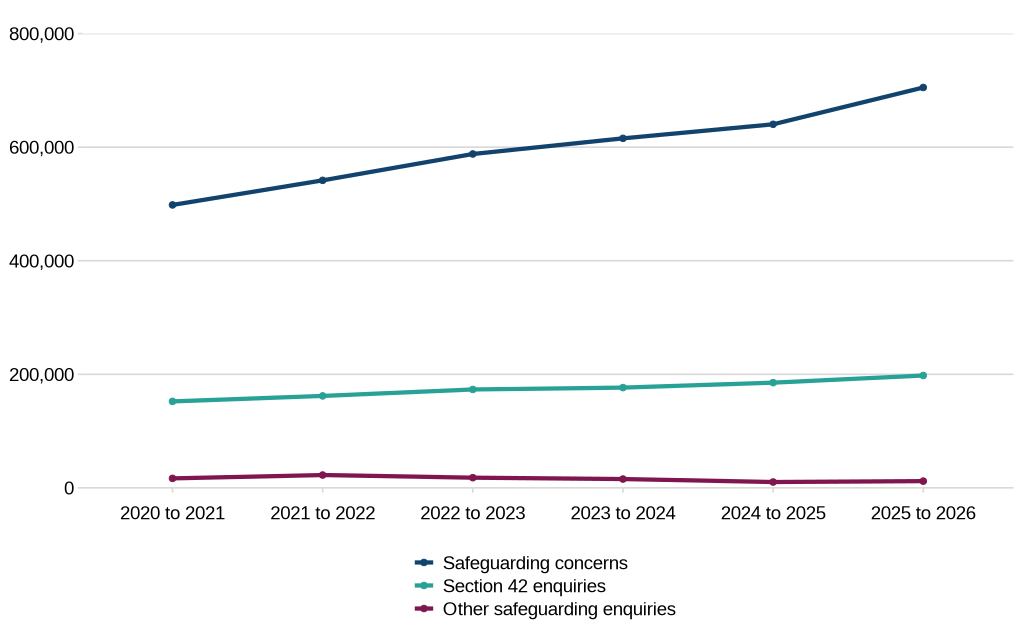
During 2025 to 2026, there were an estimated 705,100 safeguarding concerns raised, compared with 640,240 in 2024 to 2025 (an increase of 10.1%).
Section 42 enquiries
There were an estimated 197,860 safeguarding section 42 enquiries that commenced during 2025 to 2026, compared with 185,270 in 2024 to 2025 (an increase of 6.8%).
These enquiries involved 158,010 individuals, compared with 148,830 in 2024 to 2025.
Other enquiries
During 2025 to 2026, there were an estimated 11,870 ‘other’ safeguarding enquiries reported, compared with 10,280 in 2024 to 2025 (an increase of 15.4%).
Type and location of risk
‘Neglect and acts of omission’ was the most common type of risk in section 42 enquiries that concluded during 2025 to 2026 (39.1% of risks).
The most common location of risk was the person’s own home (54.8% of risks).
Outcome of enquiries
Of the section 42 enquiries where a risk was identified and concluded during 2025 to 2026, 90.9% were reported as having reduced or removed the risk.
Concerns and enquiries by year
Figure 1: number of safeguarding concerns and enquiries, England, by year
Source: SAC
This data can be found in the ‘key measures’ table in the accompanying data tables on the Safeguarding adults, England: 2025 to 2026 report page.
Figure 1 shows that the number of safeguarding concerns and section 42 enquiries have increased each year since 2020 to 2021. There has been some variation in the growth rate of concerns, with an average of a 7.2% increase each year since 2020 to 2021. Section 42 enquiries have increased by an average of 5.4% each year. Following a small increase in 2021 to 2022, the number of ‘other’ enquiries has generally decreased each year, with a small increase occurring in 2025 to 2026.
Further information
The data used in this publication was collated by the Department of Health and Social Care from the SAC mandatory data collection of local authorities in England. Data was provided by all 153 local authorities.
More detailed information about data sources and methodology can be found in the ’background, quality and methodology’ document for these statistics on the Safeguarding adults, England: 2025 to 2026 report page.
Terminology
Concluded section 42 enquiries
When the safeguarding investigation is complete and the conclusions and actions have been decided. Only enquiries that concluded within this reporting year should be recorded. This can include cases that began in a previous reporting period.
Location of risk
Where the alleged safeguarding incident took place.
‘Other’ safeguarding enquiry
Where a concern is raised about a risk of abuse but it does not meet the 3 criteria under section 42 of the Care Act 2014.
Safeguarding concern
A sign of suspected abuse or neglect that is reported to the local authority or identified by the local authority.
Section 42 safeguarding enquiry
Where a concern is raised about a risk of abuse and this instigates an investigation under safeguarding procedures in accordance with section 42 of the Care Act 2014.
Source of risk
The person who is suspected of carrying out abuse.
Type of risk
The nature of the allegations made. Any of these types of abuse may be perpetrated as a result of deliberate intent, negligence or ignorance.
Contact
We welcome feedback from our users on how you use our products, how well these products meet your needs and how they could be improved.
For feedback and any further questions, contact asc.statistics@dhsc.gov.uk.