Prison leavers in substance misuse treatment: 4-week outcomes - report
Published 23 April 2026
Applies to England

© Crown copyright 2026
This publication is licensed under the terms of the Open Government Licence v3.0 except where otherwise stated. To view this licence, visit nationalarchives.gov.uk/doc/open-government-licence/version/3 or write to the Information Policy Team, The National Archives, Kew, London TW9 4DU, or email: psi@nationalarchives.gov.uk.
Where we have identified any third party copyright information you will need to obtain permission from the copyright holders concerned.
This publication is available at https://www.gov.uk/government/statistics/prison-leavers-in-substance-misuse-treatment-4-week-outcomes/prison-leavers-in-substance-misuse-treatment-4-week-outcomes-report
Summary
Overview
This report analyses the outcomes of prison leavers in England between August 2018 and December 2022 receiving substance misuse treatment. It assesses mortality and re-incarceration rates within 4 weeks of prison release.
The analysis linked data from 3 sources:
- the Ministry of Justice’s (MOJ) Prison National Offender Management Information System (p-NOMIS)
- the Office for National Statistics’ (ONS) mortality register
- the National Drug Treatment Management System (NDTMS), managed by the Department of Health and Social Care (DHSC)
The Better Outcomes Through Linked Data (BOLD) programme team at DHSC carried out the data linkage and analysis.
Background
The Prison and Probation Ombudsman report Learning lessons bulletin on post-release deaths found that drug-related deaths are the leading cause of mortality in the first 2 weeks after leaving prison. A study by Marsden and others (2017) on opioid substitution treatment (OST) in prison found that OST reduces the risk of all-cause mortality in the first 4 weeks after release.
The aim of this study was to assess the feasibility of linking together the p-NOMIS, NDTMS and ONS mortality data sets to understand the rates of mortality and re-incarceration within 4 weeks of release from prison-based substance misuse treatment.
The questions to be addressed by the analysis were:
- what were the demographic and offending characteristics for prison leavers who were in prison-based substance misuse treatment?
- what were the mortality and re-incarceration rates for prison leavers who were in prison-based substance misuse treatment?
- is OST associated with a difference in risk of mortality and re-incarceration rates for prison leavers who were in prison-based treatment for opiate use?
Methods
Data from ONS, DHSC and MOJ was linked to identify all prison leavers who had been in substance misuse treatment before release and to analyse their mortality and re-incarceration. All demographic and offence-related information was taken from the p-NOMIS data set.
All analysis in this report uses a single prison spell (a period of time spent in prison) as the unit of measure. This means that an individual can appear more than once in the analysis if they were in prison multiple times.
The OST-specific analysis included all people who left prison between August 2018 and December 2022 and were in treatment services for problems with opiates while in prison. The 28-day mortality and re-incarceration outcomes of people who received OST on their final day in prison was compared against those who did not.
You can find more details about the methodology in the analysis methodology section and in the methodology section of the accompanying technical report on the Prison leavers in substance misuse treatment page.
Findings
The main findings were that:
- 39.6% of prison spells completed between August 2018 and December 2022 were matched to a prison-based substance misuse treatment record
- prison spells between 8 and 14 days were more than twice as likely to be matched to a substance misuse treatment record than prison spells of 7 days or less (41.0% and 19.6% respectively)
- prison spells for theft offences had the highest rate of prison-based substance misuse treatment, at 61.0%
- prison leavers receiving OST on their final day in prison was associated with a 50% reduced risk of all-cause mortality and a 54% reduced risk of drug-related mortality in the 4 weeks following release
- receiving OST on the final day in prison was also associated with a 19% increased risk of returning to prison within 4 weeks of release
Introduction
There is a high prevalence of substance misuse in prisons in England, particularly among prisoners serving short sentences. The MOJ report Identified needs of offenders, custody and community found that in October 2024, 74% of people assessed who were serving sentences of less than 12 months had an identified substance misuse need.
Dame Carol Black’s 2021 Review of drugs part two: prevention, treatment, and recovery estimated that people with serious drug addiction occupy 33% of all prison places.
Alcohol and drug treatment in secure settings 2023 to 2024 reported that nearly half (47.6%) of prisoners who receive prison-based substance misuse treatment said that opiates were one of their problem substances.
The ONS report Drug-related deaths and suicide in offenders in the community found that between 2011 and 2021 in England and Wales, the risk of drug-related death in offenders in the community was over 16 times greater than in the general population.
Previous studies have examined the risk of mortality among people with an opiate treatment need after leaving prison. A study by Marsden and others (2017) reported that prison-based OST in England was associated with a 75% reduction in all-cause mortality and an 85% reduction in fatal drug-related poisoning in the first month after release.
A main factor behind this increased risk is reduced opiate tolerance during imprisonment. People who stop using opiates while in prison will reduce their opiate tolerance, meaning that resuming previous doses after release can be fatal. One of the main treatments available in prisons is OST, which maintains opioid tolerance and reduces the risk of relapse.
Understanding this risk provides the context for the current data linkage analysis and the need for targeted interventions to improve outcomes for this population.
Data sets
NDTMS
NDTMS collects monthly data on people accessing publicly funded specialist substance misuse treatment services, which are available in every local council in England.
NDTMS data is divided into 2 main categories based on treatment setting:
- community setting - people receiving structured substance misuse treatment in the community
- secure setting - people receiving structured substance misuse treatment in prisons, immigration removal centres and young offender institutions
In the data sets used for analysis, there were a total of 479,429 adults in contact with substance misuse treatment services in the community whose treatment started between 1 August 2018 and 31 December 2022. In the same period, there were 124,811 people who were in contact with substance misuse treatment services in secure settings.
NDTMS reporting divides adults in treatment into 4 substance groups:
- opiate
- non-opiate only
- non-opiate and alcohol
- alcohol only
For more information on the substance groups, see the technical report.
For more information on the NDTMS data set, see the ‘data sets’ section of the technical report.
p-NOMIS
The Prison National Offender Management Information System (p-NOMIS) is a national database that records information on all people in custody in England and Wales. It includes both sentenced prisoners and people on remand (in custody awaiting trial or sentencing).
The p-NOMIS data set used in this analysis had data on every prison spell completed between 1 August 2018 and 13 March 2023. There were 228,923 people in the data set, corresponding to 410,162 prison spells.
ONS mortality register
The ONS mortality register is the official record for all registered deaths in England and Wales.
The data set used in this analysis contained information on each death that was registered between 1 January 2018 and 31 December 2024.
As there can be delays between the date of death and the date the death is registered, ONS assessed the data set to have sufficient coverage of the reporting of deaths occurring in the period. However, there will be some deaths that were not registered before 31 December 2024.
ONS classified the causes of death according to the International Classification of Diseases (10th revision).
Data linkage
We linked the data sets using the Splink open source software developed by analysts at MOJ. You can read about the Splink record linkage at Joined up data in government: the future of data linking methods.
We used both deterministic and probabilistic linkage methods to match people from the p-NOMIS data set to the ONS mortality register and NDTMS data sets.
Of the 228,923 prison leavers in the p-NOMIS data set:
- 80,485 (35%) people linked to a substance misuse treatment record at least once while in prison
- 32,893 linked to a substance misuse treatment record in the community, of whom 25,476 linked to a treatment record in prison
- 4,272 were linked to a death record, registered before 31 December 2024, of whom 2,613 had been in treatment at least once
We removed any prison spells that did not fit the analysis criteria from the data set used for analysis, as explained in the technical report. This final data set contained information on 155,235 people across 270,113 prison spells, linking to 3,029 deaths, 258,085 secure setting treatment episodes and 69,702 community treatment journeys.
Summary statistics
We analysed 270,113 prison spells between August 2018 and December 2022. Of these, 106,874 spells (39.6%) linked to a secure setting treatment. Of those, 66,344 (62.1%) were spells with treatment for opiates.
Table 1: number of prison spells matched to secure setting treatment, by substance group
| Substance group | Number of prison spells |
|---|---|
| Not in treatment | 163,239 |
| Opiates | 66,344 |
| Alcohol only | 13,155 |
| Non-opiates and alcohol | 15,318 |
| Non-opiates only | 12,057 |
Demographics: sex
There were more than 9 times the number of male prison spells analysed compared with female prison spells. A significantly higher proportion of prison spells matched a substance misuse treatment for female prison leavers (51.8%) when compared with male prison leavers (38.2%). Of those who were in treatment, a significantly higher proportion of females were in treatment for opiates (75.7%) compared with males (60.1%).
Table 2: percentage of prison spells matched to secure setting treatment, by sex
| Sex | Total prison spells | Not in treatment | In treatment |
|---|---|---|---|
| Male | 243,743 | 61.8% | 38.2% |
| Female | 26,370 | 48.2% | 51.8% |
Figure 1: percentage of treatment-matched prison spells by sex and substance group
| Sex | Opiates | Alcohol only | Alcohol and non-opiates | Non-opiates only |
|---|---|---|---|---|
| Male | 60.1% | 12.7% | 15.2% | 12.0% |
| Female | 75.7% | 9.4% | 8.3% | 6.7% |
Demographics: age
Prison spells of people aged 35 to 39 and 40 to 49 had the highest proportion who matched to a secure setting treatment, at 50.0% and 52.1% respectively. People aged 18 to 24 and 60 and over had the lowest proportion, at 19.9% and 17.2% respectively.
Opiates was the most common substance group for all age groups, except:
- people aged 18 to 24, where non-opiates only was the largest substance group
- people aged 60 and over, where alcohol only was the largest substance group
Table 3: percentage of prison spells matched to secure setting treatment, by substance group and age on prison exit
| Age on prison exit | Total prison spells | Not in treatment | In treatment |
|---|---|---|---|
| 18 to 24 | 42,263 | 80.1% | 19.9% |
| 25 to 29 | 47,190 | 67.6% | 32.4% |
| 30 to 34 | 53,528 | 57.6% | 42.4% |
| 35 to 39 | 46,115 | 50.0% | 50.0% |
| 40 to 49 | 54,548 | 47.9% | 52.1% |
| 50 to 59 | 20,714 | 61.3% | 38.7% |
| 60 and over | 5,755 | 82.8% | 17.2% |
Figure 2: percentage of treatment-matched prison spells by age group and substance group
| Age on prison exit | Opiates | Alcohol only | Alcohol and non-opiates | Non-opiates only |
|---|---|---|---|---|
| 18 to 24 | 30.7% | 7.7% | 27.0% | 34.6% |
| 25 to 29 | 48.3% | 10.0% | 21.8% | 19.8% |
| 30 to 34 | 61.1% | 10.8% | 16.9% | 11.2% |
| 35 to 39 | 71.5% | 10.1% | 11.5% | 6.9% |
| 40 to 49 | 73.8% | 12.4% | 8.5% | 5.4% |
| 50 to 59 | 59.3% | 26.6% | 9.2% | 5.0% |
| 60 and over | 30.8% | 55.4% | 8.2% | 5.6% |
Prison spell length
Generally, the longer the prison spell, the higher the proportion of people matched to treatment in a secure setting.
Prison spells of 7 days or less had the lowest proportion of people matched to treatment in a secure setting at 19.6%. This is less than half the proportion for prison spells of 8 to 14 days (41.0%).
Opiates were the most common substance group for all prison spell lengths and were much more prevalent in shorter spells.
Table 4: percentage of prison spells matched to secure setting treatment by length of prison spell
| Length of prison spell | Total prison spells | Not in treatment | In treatment |
|---|---|---|---|
| 7 days or less | 23,752 | 80.4% | 19.6% |
| 8 to 14 days | 24,774 | 59.0% | 41.0% |
| 15 to 28 days | 33,605 | 61.5% | 38.5% |
| 4 to 8 weeks | 49,493 | 60.6% | 39.4% |
| 8 weeks to 6 months | 77,405 | 58.3% | 41.7% |
| 6 months to 1 year | 33,599 | 57.3% | 42.7% |
| 1 to 2 years | 21,266 | 52.9% | 47.1% |
| 2 years or more | 6,219 | 51.9% | 48.1% |
Figure 3: percentage of treatment-matched prison spells by prison spell length and substance group
| Length of prison spell | Opiates | Alcohol only | Alcohol and non-opiates | Non-opiates only |
|---|---|---|---|---|
| 7 days or less | 73.0% | 14.5% | 8.2% | 4.3% |
| 8 to 14 days | 80.1% | 9.9% | 6.3% | 3.7% |
| 15 to 28 days | 74.2% | 11.1% | 8.9% | 5.8% |
| 4 to 8 weeks | 65.2% | 14.9% | 12.4% | 7.6% |
| 8 weeks to 6 months | 61.2% | 13.1% | 15.1% | 10.7% |
| 6 months to 1 year | 48.1% | 12.0% | 21.0% | 18.9% |
| 1 to 2 years | 47.5% | 9.2% | 21.2% | 22.1% |
| 2 years or more | 36.7% | 9.1% | 24.5% | 29.8% |
Offence type
Prison spells for theft offences had the highest proportion that matched to a secure setting treatment at 60.1%. Prison spells for sexual offences had the lowest proportion at 21.7%.
Opiates were the most common substance group for all offender groups except those with a sexual offence conviction. Of prisoners in secure setting treatment for a theft offence, 79.9% were in treatment for opiates.
Summary offences are the less serious cases, such as motoring offences and minor assaults. These cases are completed in the magistrates’ courts. Summary offences are subdivided into ‘summary motoring’ and ‘summary non-motoring’.
Table 5: percentage of prison spells matched to secure setting treatment, by offence group
| Offence | Total prison spells | Not in treatment | In treatment |
|---|---|---|---|
| Summary non-motoring | 119,956 | 56.7% | 43.3% |
| Theft offences | 90,489 | 39.9% | 60.1% |
| Violence against the person | 82,280 | 61.9% | 38.1% |
| Miscellaneous crimes against society | 63,556 | 58.4% | 41.6% |
| Drug offences | 43,133 | 61.4% | 38.6% |
| Possession of weapons | 38,977 | 56.1% | 43.9% |
| Public order offences | 31,163 | 61.0% | 39.0% |
| Not known | 30,418 | 66.6% | 33.4% |
| Summary motoring | 29,552 | 66.5% | 33.5% |
| Criminal damage and arson | 28,637 | 59.6% | 40.4% |
| Robbery | 15,130 | 47.8% | 52.2% |
| Fraud offences | 11,518 | 50.8% | 49.2% |
| Sexual offences | 10,154 | 78.3% | 21.7% |
Many prison spells relate to more than one offence, so the total number of offences is larger than the total number of prison spells.
Figure 4: percentage of treatment-matched prison spells by offence group and substance group
| Offence | Opiates | Alcohol only | Alcohol and non-opiates | Non-opiates only |
|---|---|---|---|---|
| Summary non-motoring | 59.7% | 14.1% | 16.0% | 10.2% |
| Theft offences | 79.9% | 4.3% | 8.0% | 7.9% |
| Violence against the person | 44.1% | 19.5% | 23.1% | 13.3% |
| Miscellaneous crimes against society | 67.0% | 7.4% | 12.4% | 13.1% |
| Drug offences | 59.2% | 3.5% | 14.9% | 22.5% |
| Possession of weapons | 59.6% | 9.6% | 16.4% | 14.4% |
| Not known | 62.1% | 11.8% | 14.1% | 12.0% |
| Public order offences | 52.8% | 17.6% | 17.8% | 11.8% |
| Summary motoring | 50.0% | 14.2% | 18.8% | 17.0% |
| Criminal damage and arson | 46.0% | 17.0% | 24.1% | 13.0% |
| Robbery | 61.3% | 6.3% | 16.0% | 16.4% |
| Sexual offences | 26.1% | 28.3% | 28.2% | 17.4% |
| Fraud offences | 77.3% | 4.0% | 8.3% | 10.5% |
For more information on how we grouped the offences, see the technical report.
Mortality and re-incarceration analysis of all prison leavers
Mortality and re-incarceration within 4 weeks of leaving prison
There were 2,888 deaths linked to prison spells in the analysis data set, of which 293 occurred within 4 weeks of leaving prison.
The rates of mortality and re-incarceration after 4 weeks were higher for prison leavers who were matched to a substance misuse treatment than those who were not.
In the first 4 weeks after release:
- prison leavers in treatment for opiates had the highest rate of mortality at 0.21%
- prison leavers in treatment for opiates and alcohol only had the highest rates of re-incarceration, at 19.78% and 18.70% respectively
Table 6: mortality and re-incarceration of prison leavers 4 weeks after release, by treatment substance group
| Substance group | Died within 4 weeks | Re-incarcerated within 4 weeks | Neither died nor re-incarcerated | Total |
|---|---|---|---|---|
| Not in treatment | 0.06% | 10.95% | 88.99% | 163,239 |
| In treatment: opiates | 0.21% | 19.78% | 80.01% | 66,344 |
| In treatment: alcohol only | 0.16% | 18.70% | 81.14% | 13,155 |
| In treatment: alcohol and non-opiates | 0.08% | 15.50% | 84.42% | 15,318 |
| In treatment: non-opiates only | 0.11% | 11.03% | 88.86% | 12,057 |
| All prison spells | 0.11% | 13.76% | 86.14% | 270,113 |
Cumulative rates of mortality and re-incarceration
The figures below show the unadjusted cumulative rate of mortality and re-incarceration of prison leavers over the first 4 weeks after release, split by treatment group.
Figure 5: unadjusted cumulative mortality rate of prison leavers by substance treatment group in the first 4 weeks following release
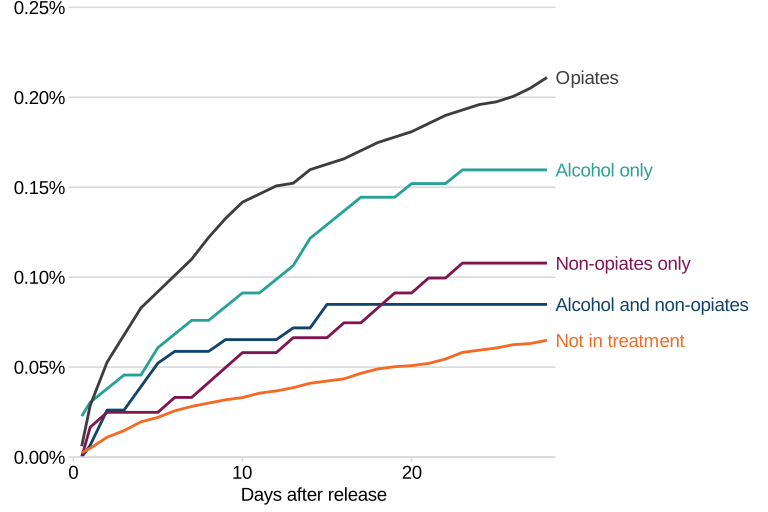
Mortality is highest in the first 10 days after release for all groups, with people treated for opiates showing the greatest risk over the first 4 weeks after release.
You can find the corresponding data for figure 5 in table 4 of the accompanying data tables on the Prison leavers in substance misuse treatment: 4-week outcomes page.
Figure 6: unadjusted cumulative re-incarceration rate of prison leavers by substance treatment group, in the first 4 weeks following release
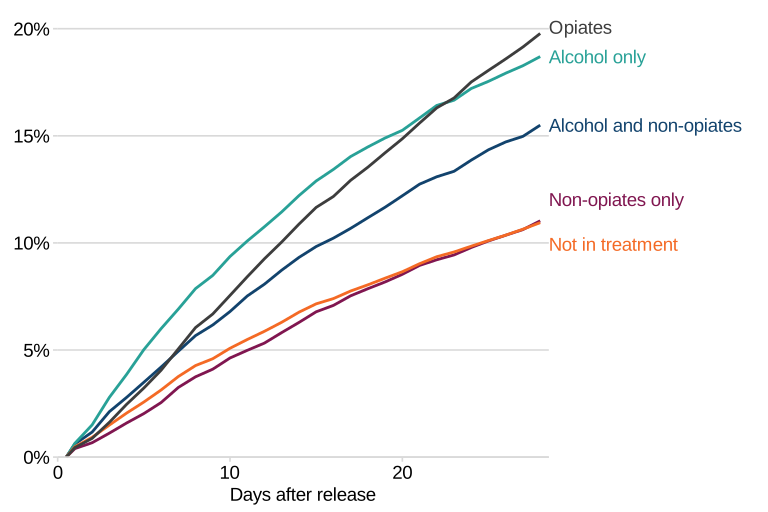
The rate of re-incarceration is higher for those in treatment for opiates and alcohol only compared with all other groups. Those in treatment for non-opiates only and those not in treatment have a similar rate of re-incarceration and are lower than all other groups.
You can find the corresponding data for figure 6 in table 5 of the accompanying data tables on the Prison leavers in substance misuse treatment: 4-week outcomes page.
You can find more details about the mortality and re-incarceration analysis in the technical report.
Causes of death
Of the 293 prison leavers who died within 4 weeks of release, 182 (62.1%) were drug-related deaths.
The first week after release had the highest risk of death, with 48.5% of all deaths in the first 4 weeks after release occurring in the first 7 days. The proportion of deaths that were drug-related was higher in the first 7 days (71.1%) compared with any of the following 3 weeks.
Figure 7: deaths after prison release by cause and days after release
| Days after release | Drug-related death | Other cause of death |
|---|---|---|
| 0 to 7 days | 101 | 41 |
| 8 to 14 days | 38 | 28 |
| 15 to 21 days | 24 | 21 |
| 22 to 28 days | 19 | 21 |
Figure 8: percentage of deaths after prison release by cause and days since release
| Days after release | Drug-related death | Other cause of death |
|---|---|---|
| 0 to 7 days | 71.1% | 28.9% |
| 8 to 14 days | 56.7% | 42.4% |
| 15 to 21 days | 53.3% | 46.7% |
| 22 to 28 days | 47.5% | 52.5% |
Drug-related causes were the primary cause of death in the first 4 weeks for all substance groups, except alcohol only. Of alcohol-only deaths, 23.8% were drug related.
Non-opiates only (76.9%) and opiates (72.9%) were the substance groups with the largest proportion of drug-related deaths.
More than half (53.8%) of deaths among people not in treatment were from drug-related causes. This suggests that the treatment needs of prison leavers may not always be identified.
Figure 9: percentage of deaths in the first 4 weeks after prison release by substance group and cause
| Substance group | Drug-related death | Other cause of death |
|---|---|---|
| Opiates | 72.9% | 27.1% |
| Non-opiates only | 76.9% | 23.1% |
| Alcohol and non-opiates | 61.5% | 38.5% |
| Alcohol only | 23.8% | 76.2% |
| Not in treatment | 53.8% | 46.2% |
The high prevalence of deaths, particularly drug-related deaths, in the first 4 weeks after release shows a need to investigate opiate users further. This is also supported by the high re-incarceration rates for this group.
Analysis methodology
Group selection
We analysed a specific group of prison leavers that had prison spells that matched to a treatment for opiates in a secure setting. The group used for the analysis also had to meet specific requirements, which are outlined in the analysis methodology section of the technical report.
Of the 66,344 prison spells that matched to a treatment for opiates, 61,322 matched the specific requirements and were used for the detailed analysis.
Intervention definitions
The analysis data set of 61,322 prison spells was then separated into 2 groups:
- intervention group: people receiving OST on their final day in prison
- control group: people not receiving OST on their final day in prison
The intervention group was 46,214 spells and the control group was 15,108 spells. Of the control group, there were 7,822 spells where OST was prescribed at some point, but not on the final day in custody.
For the purposes of this analysis, OST is defined as one of the following treatments, as recorded in NDTMS data:
- opioid maintenance (buprenorphine or methadone): a treatment for chronic opiate users to engage them in treatment on release, where it is considered necessary (based on a full clinical assessment) to protect them from the risks of opiate overdose
- opioid reduction (buprenorphine or methadone): a treatment used where the person is receiving substitute opioid prescribing and their care plan objective is reduction with a commitment to becoming drug-free
We excluded treatments using buprenorphine depot injection (a long-acting, slow-release medication, for example Buvidal) from the analysis due to small sample numbers.
Opioid maintenance using methadone was the most common treatment method, used in 83% of prison spells in the analysis data set.
Figure 10: percentage of prison spells by opioid substitution treatment type
| Treatment type | Percentage of prison spells |
|---|---|
| Opioid maintenance: methadone | 83% |
| Opioid maintenance: buprenorphine | 5% |
| Opioid reduction: methadone | 15% |
| Opioid reduction: buprenorphine | 1% |
Not all prison spells in the analysis data set matched to an OST type and some prisoners received more than one type of OST during a single prison spell, so percentages will not add to 100%.
Intervention group demographics
People aged 35 to 39 years old had the highest proportion receiving OST on their final day in prison (77.7%). The 18 to 24 age group had the lowest proportion (63.5%).
Table 7: intervention and control breakdown by age on prison exit
| Age on prison exit | Total prison spells | Had OST on final day (intervention group) | Did not have OST on final day (control group) |
|---|---|---|---|
| 18 to 24 | 2,381 | 63.5% | 36.5% |
| 25 to 29 | 6,850 | 73.5% | 26.5% |
| 30 to 34 | 12,885 | 75.5% | 24.5% |
| 35 to 39 | 15,316 | 77.7% | 22.3% |
| 40 to 49 | 19,243 | 76.6% | 23.4% |
| 50 and over | 4,647 | 70.8% | 29.2% |
| All | 61,322 | 75.4% | 24.6% |
Female prison leavers were more likely than males to receive OST on their final day in prison. Of female prison leavers, 81.4% received OST on their final day, compared with 72.3% of males.
Table 8: intervention and control breakdown by sex
| Sex | Total prison spells | Had OST on final day (intervention group) | Did not have OST on final day (control group) |
|---|---|---|---|
| Male | 51,575 | 74.1% | 25.9% |
| Female | 9,747 | 82.2% | 17.8% |
| All | 61,322 | 75.4% | 24.6% |
The shorter a prison spell, the more likely the prison leaver was to receive OST on their final day in prison. For spells under 8 weeks, 84.6% received OST on their final day, compared with 65.5% who were in prison for 8 weeks or more.
Table 9: intervention and control breakdown by prison spell length
| Length of prison spell | Total prison spells | Had OST on final day (intervention group) | Did not have OST on final day (control group) |
|---|---|---|---|
| Under 8 weeks | 31,678 | 84.6% | 15.4% |
| 8 weeks or more | 29,644 | 65.5% | 34.5% |
| All | 61,322 | 75.4% | 24.6% |
Outcome definitions
In this analysis, there were 2 outcomes defined following release from prison:
- prison leaver died within 4 weeks of release (with sub-categories for all-cause mortality and drug-related death)
- prison leaver returned to prison within 4 weeks of release
If neither outcome happened within 4 weeks, we treated this as a censoring event. This means the person’s outcome was not observed within the study period, and their data was only included up to that point.
Of the 61,322 prison spells analysed:
- 12,257 (20.0%) resulted in re-incarceration within 4 weeks
- 128 (0.2%) resulted in a death within 4 weeks of release
Of these 128 deaths, 94 (73.4%) were from drug-related causes.
We analysed the data using a Fine-Gray competing risks model. This analysed the relationship of demographic, offence and treatment characteristics to the different outcomes.
The model accounts for the fact that once one outcome has occurred, it prevents the other outcome occurring. This is referred to as a competing risk.
The model calculates a sub-distribution hazard ratio (SHR). This is the relationship between a characteristic and an outcome, while adjusting for other characteristics and competing risks.
You can find more detail about the analysis methodology in the technical report.
Analysis
All-cause mortality analysis
Of the 46,214 spells in which the prisoner received OST on their final day in prison, 75 resulted in the prisoner dying within 4 weeks (0.16%). Of the 15,108 spells in which the prisoner did not receive OST on the final day, 53 resulted in death within 4 weeks (0.35%).
Using a Fine-Gray competing risks model, adjusted for relevant characteristics, the SHR for mortality (with re-incarceration as a competing risk) was 0.50. This means that receiving OST on the final day in prison was associated with a 50% reduced risk of all-cause mortality. The 95% confidence interval (CI) was 0.35 to 0.72. This means we are 95% confident the true rate falls within this range.
Figure 11: cumulative incidence of all-cause mortality, correcting for the competing risk of re-incarceration, by OST intervention
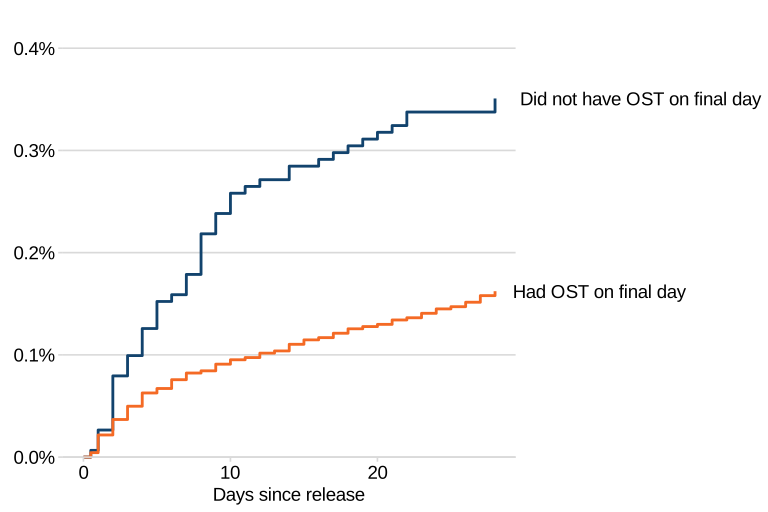
You can find the corresponding data for figure 11 in table 6 of the accompanying data tables on the Prison leavers in substance misuse treatment: 4-week outcomes page.
Association of characteristics with mortality
We assessed the association of the following characteristics with mortality:
- age group
- ethnicity
- sex
- prison end day
- prison end year
- injecting status
- offence groups
- prison spell length
- engagement with community treatment
- possession of take-home naloxone
- provision of OST on the final day in prison
The only characteristics other than OST on final day in prison that had a significant impact on mortality within 4 weeks were:
-
injecting status: people who had previously injected or were currently injecting had an SHR of 2.28 (95% CI 1.48 to 3.51) compared with those who had never injected. This suggests that injection history was associated with a 128% increased risk of all-cause mortality
-
prison spell length: prison spells under 8 weeks had an SHR of 0.63 (95% CI 0.43 to 0.93) compared with prison spells lasting 8 weeks or more. This suggests that shorter sentences were associated with a 37% decreased risk of all-cause mortality
-
offence groups: prison leavers who had a possession of weapons offence had an SHR of 1.65 (95% CI 1.11 to 2.44) compared with those who did not. This suggests that these offences were associated with a 65% increased risk of all-cause mortality
All other characteristics did not have a statistically significant association with mortality within 4 weeks of release (to 95% confidence).
Re-incarceration analysis
Of the 46,214 spells in which the prisoner received OST on their final day in prison, 9,550 resulted in the prisoner returning to prison within 4 weeks (20.3%). Of the 15,108 spells in which the prisoner did not receive OST on the final day, 2,707 resulted in a return to prison within 4 weeks (17.0%).
Using a Fine-Gray competing risks model, adjusted for other characteristics, prisoners who received OST had an SHR for re-incarceration within 4 weeks of 1.16 (95% CI 1.11 to 1.21) compared with those who did not. This suggests that receiving OST on the final day in prison was associated with a 16% increased risk in re-incarceration within 4 weeks.
Figure 12: cumulative incidence of re-incarceration, correcting for the competing risk of mortality, by OST intervention
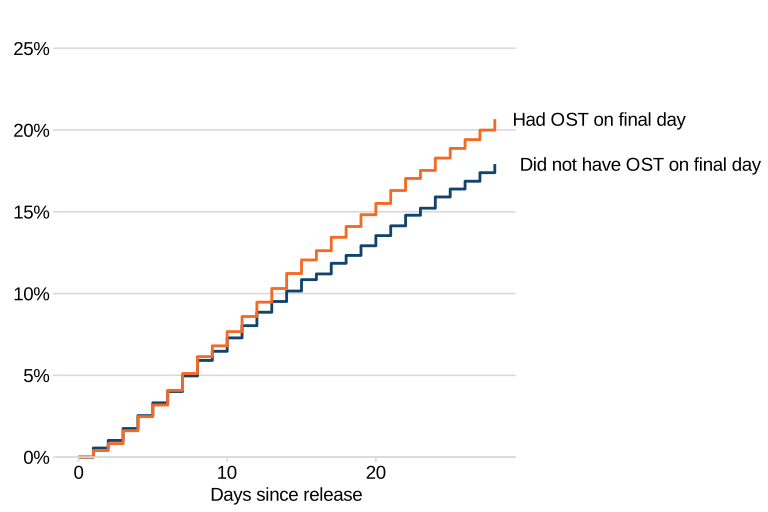
You can find the corresponding data for figure 12 in table 7 of the accompanying data tables on the Prison leavers in substance misuse treatment: 4-week outcomes page.
Association of characteristics with re-incarceration
The characteristics that had a statistically significant association with re-incarceration within 4 weeks, other than OST on the final day in prison, are summarised in the table below.
Table 10: significant association of characteristics with re-incarceration within 4 weeks
| Characteristic | Reference | SHR | 95% CI |
|---|---|---|---|
| Age group: 25 to 29 | 18 to 24 | 0.91 | 0.83 to 0.99 |
| Age group: 30 to 34 | 18 to 24 | 0.81 | 0.75 to 0.89 |
| Age group: 35 to 39 | 18 to 24 | 0.74 | 0.68 to 0.81 |
| Age group: 40 to 49 | 18 to 24 | 0.67 | 0.62 to 0.73 |
| Age group: 50 and over | 18 to 24 | 0.57 | 0.51 to 0.63 |
| Sex: male | Female | 1.40 | 1.32 to 1.47 |
| Ethnicity: White British and Irish | Other ethnicities | 1.14 | 1.08 to 1.21 |
| Prison spell length: under 8 weeks | 8 weeks or more | 1.21 | 1.16 to 1.26 |
| Community treatment: engaged within 7 days | Not engaged within 7 days | 0.66 | 0.63 to 0.69 |
| Injecting status: has ever injected | Has never injected | 1.20 | 1.15 to 1.24 |
| Public order offences | Offence not committed | 1.52 | 1.44 to 1.6 |
| Summary non-motoring | Offence not committed | 1.32 | 1.27 to 1.37 |
| Theft offences | Offence not committed | 1.28 | 1.23 to 1.33 |
| Violence against the person | Offence not committed | 1.25 | 1.19 to 1.30 |
| Criminal damage and arson | Offence not committed | 1.17 | 1.10 to 1.25 |
| Possession of weapons | Offence not committed | 0.95 | 0.90 to 1.00 |
| Robbery | Offence not committed | 0.87 | 0.80 to 0.94 |
| Miscellaneous crimes against society | Offence not committed | 0.85 | 0.82 to 0.89 |
| Drug offences | Offence not committed | 0.78 | 0.74 to 0.83 |
| Sexual offences | Offence not committed | 0.67 | 0.62 to 0.73 |
When assessing the association of characteristics with re-incarceration, the characteristic is compared against a reference value. For example, the age group 25 to 29 has an SHR of 0.91 when compared with the reference age group of 18 to 24. This means that compared with 18 to 24 year olds, 25 to 29 year olds had a 19% reduced risk of re-incarceration.
All other characteristics did not have a statistically significant association with re-incarceration within 4 weeks of release (to 95% confidence).
Drug-related mortality analysis
Drug-related deaths are defined to the specification used by ONS. For more information on definitions, see the technical report.
Of the 46,214 spells in which the prisoner received OST on their final day in prison, 54 resulted in the prisoner dying of a drug-related cause (0.12%). Of the 15,108 spells in which the prisoner did not receive OST on the final day, 40 died of a drug-related cause within 4 weeks (0.26%).
We used a Fine-Gray competing risks model, adjusted for other characteristics, with other cause mortality and re-incarceration as competing risks. Prisoners who received OST had an SHR for drug-related death in the first 4 weeks following release of 0.46 (95% CI 0.30 to 0.70) compared with those who did not. This suggests that receiving OST on the final day in prison was associated with a 54% reduced risk of drug-related mortality within 4 weeks.
Figure 13: cumulative incidence of drug-related mortality, correcting for the competing risk of re-incarceration and other cause mortality, by OST intervention
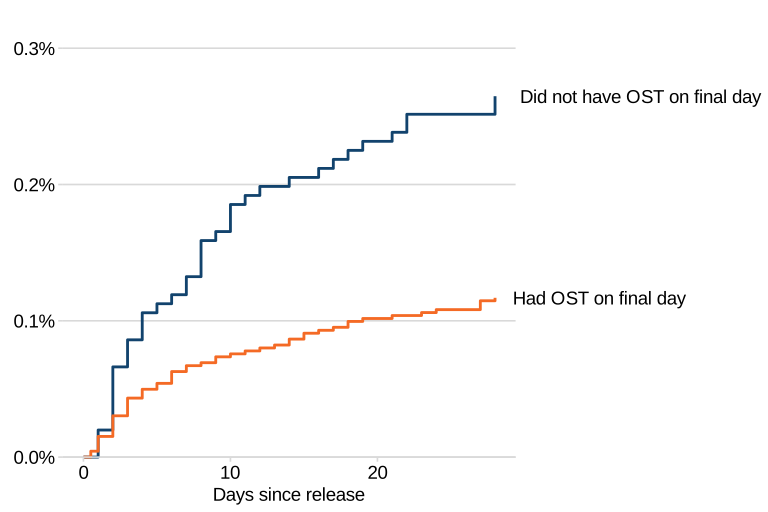
You can find the corresponding data for figure 13 in table 8 of the accompanying data tables on the Prison leavers in substance misuse treatment: 4-week outcomes page.
Impact of characteristics on drug-related mortality
The only characteristics other than OST on the final day in prison that had a significant impact on drug-related mortality within 4 weeks were:
-
injecting status: people who had previously injected or were currently injecting had an SHR of 2.23 (95% CI 1.35 to 3.68) compared with those who had never injected. This suggests that an injecting history was associated with a 123% increased risk in drug-related mortality
-
prison spell length: prison spells shorter than 8 weeks had a relative risk of 0.57 (95% CI 0.39 to 0.94) compared with prison stays over 8 weeks. This suggests that shorter sentences were associated with a 43% increased risk in drug-related mortality
-
offence groups: people in prison for summary non-motoring offences had a relative risk of 0.55 (95% CI 0.35 to 0.87) compared with those who were not. This suggests that these offences were associated with a 45% reduced risk in drug-related mortality
All other characteristics did not have a statistically significant impact on drug-related mortality within 4 weeks of release (to 95% confidence).
Conclusions
This study found that people receiving OST on their final day in prison were significantly less likely to die from drug-related causes within 4 weeks of release. This finding supports previous research and emphasises the effectiveness of OST as a harm reduction strategy and its potential to save lives during the critical period immediately after release from prison.
By using comprehensive linkage methods between multiple national data sets, we were able to analyse outcomes after release. While there are limitations related to data quality and linkage accuracy, the overall approach shows our observed associations are credible.
The results show the importance of continued access to OST for people leaving prison as a way of reducing drug-related deaths. They also show how linked administrative data can help inform policy and practice, and provide valuable insights into the outcomes of prison leavers.
Limitations
The findings should be interpreted considering the following limitations relating to the data and methods used.
This is the first time that the NDTMS, p-NOMIS and the ONS mortality register have been linked. No previous data was available to quality assure the linkage.
The linkage between p-NOMIS and ONS mortality register included some incorrect records classified as a match that we later found did not correspond. Where possible, we identified and excluded these from the analysis.
Linkage between p-NOMIS and NDTMS secure setting treatments was reliable, as both data sets shared unique identifiers (the p-NOMIS number). However, the linkage to NDTMS community treatment data was likely to be an underestimate, and some treatment episodes may not have been captured.
You can find more information in the ‘limitations’ section of the technical report.
Next steps and further analysis
Building on these findings, future analysis could focus on examining the long-term outcomes of people receiving different types of interventions after their release from prison.
For example, comparing the effectiveness of OST with other treatments, such as those for alcohol or stimulant use, could help determine whether there are similar reductions in deaths and reoffending across different substance use disorders. Also, breaking down data by demographic groups, including age, sex and ethnicity, could help identify populations at higher risk and inform the development of tailored support services.
Further methodological work to improve the accuracy and completeness of data linkage processes would be valuable. This could involve integrating additional administrative data sets, such as hospital admissions or primary care records, to provide a wider view of health and social care outcomes for prison leavers and those using substance misuse treatment services.
Future research on the data sets generated by the data linkage could explore the outcomes for prison leavers with other substance misuse needs, particularly alcohol. This would help us to better understand what affects their likelihood of re-incarceration or mortality after release.