Police workforce, England and Wales: 30 September 2025
Published 28 January 2026
Applies to England and Wales

© Crown copyright 2026
This publication is licensed under the terms of the Open Government Licence v3.0 except where otherwise stated. To view this licence, visit nationalarchives.gov.uk/doc/open-government-licence/version/3 or write to the Information Policy Team, The National Archives, Kew, London TW9 4DU, or email: psi@nationalarchives.gov.uk.
Where we have identified any third party copyright information you will need to obtain permission from the copyright holders concerned.
This publication is available at https://www.gov.uk/government/statistics/police-workforce-england-and-wales-30-september-2025/police-workforce-england-and-wales-30-september-2025
Frequency of release: Biannual
Forthcoming releases: Home Office statistics release calendar
Home Office responsible statistician: Jodie Hargreaves
Public enquiries: policingstatistics@homeoffice.gov.uk
Introduction
This release is a mid-year update of the Police workforce, England and Wales publication series, containing information on police workers (covering both officers and staff) in post on 30 September 2025.
For the first time, this release also includes information on growth under the Neighbourhood Policing Guarantee (NPG). In December 2024, under the Safer Streets Mission, the government announced the NPG and a commitment to put more police personnel into neighbourhood policing roles (chapter 3 includes details on which police workers are included in growth under the NPG). This is intended to ensure that the police are visible in every community, deterring and preventing crime as well as responding to emergencies. Funding for the additional neighbourhood policing personnel commenced on 1 April 2025 and police force delivery plans for the first year have been published on GOV.UK. Chapter 3 includes more information and reporting of growth under the programme.
Key findings
Total workforce
- as at 30 September 2025, the total paid police workforce size (including police officers, police staff, designated officers and police community support officers (PCSOs)) in England and Wales was 234,425 full-time equivalents (FTE), a decrease of 1,334 (0.6%) compared with 6 months earlier (235,760 FTE as at 31 March 2025)
This includes:
- 145,550 FTE police officers, down 892 FTE or 0.6% on 146,442 FTE in March 2025
- 81,662 FTE police staff and designated officers, down 340 FTE or 0.4% on 82,002 FTE in March 2025
- 7,213 FTE PCSOs, down 102 FTE or 1.4% on 7,315 FTE in March 2025
Neighbourhood policing under the Neighbourhood Policing Programme
- as at 30 September 2025 there were 19,017 FTE police personnel in neighbourhood policing roles[footnote 1], comprised of 12,968 FTE police officers and 6,049 FTE PCSOs
- there were an additional 541 FTE personnel in training, destined for a neighbourhood policing role in the future, bringing the total to 19,558 FTE (police officers and PCSOs combined)
- the combined total of 19,558 FTE in neighbourhood roles equates to growth of 2,383 FTE (13.9%) neighbourhood policing personnel on 31 March 2025. This comprises of a 19.7% (2,187 FTE) increase in police officers in neighbourhood policing roles and a 3.2% (196 FTE) increase in PCSOs
- as a proportion of planned growth, forces have achieved 80% of the total 2,972 FTE year one target so far at the 6 month mark, with a growth of 2,383 FTE as at 30 September 2025
1. Introduction
1.1 Introduction
This release is a mid-year update of the Police workforce, England and Wales publication series. It contains statistics on the number of police officers, police staff and designated officers[footnote 2], PCSOs, special constables and police support volunteers (PSVs) in post on 30 September 2025. The statistics cover the 43 territorial police forces in England and Wales. Data from the British Transport Police (BTP) and the National Crime Agency (NCA) is provided in the accompanying data tables, though their figures are largely excluded from analysis within this report and do not count towards the England and Wales total (which relates to the 43 territorial forces only).
Unless otherwise stated, total workforce figures quoted in the bulletin include those on career breaks or other forms of long-term absence (LTA), as well as those seconded into police forces from other forces or central services (for example, the Home Office and the NCA). It excludes those seconded out from forces to central services. The headline workforce figures in this release are all presented on a full-time equivalent (FTE) basis unless indicated otherwise. The accompanying data tables provide the same information on a headcount basis.
The user guide to police workforce statistics contains further information, including a glossary, conventions used, and other background information. It contains further information on the quality and limitations of the various data sets, and the ways in which the Home Office engages with users of the statistics.
1.2 Accredited Official Statistics status
The ‘Police workforce’ official statistics, presented in chapter 2, were independently reviewed by the Office for Statistics Regulation (OSR) the regulatory arm of the UK Statistics Authority (UKSA). They comply with the standards of trustworthiness, impartiality, quality and value in Code of Practice for Statistics and should be labelled ‘Accredited Official Statistics’.
The neighbourhood policing statistics, presented in chapter 3, have been compiled from row-level information received by the National Police Chiefs’ Council (NPCC) and have not been independently reviewed by the OSR. These statistics should be treated as ‘Official Statistics’.
The assaults on police employees statistics, presented in the Annex, are ‘Official Statistics in Development’ to acknowledge that they are undergoing development and should be interpreted with caution. There is a potentially wider degree of uncertainty in the figures whilst processes are established and verified. The Home Office intends to improve the completeness and quality of the data in future years.
1.3 Accountability statement
Our statistical practice is regulated by the OSR which sets the standards of trustworthiness, quality and value in the Code of Practice for Statistics that all producers of official statistics should adhere to. You are welcome to contact us directly via policingstatistics@homeoffice.gov.uk with any comments about how we meet these standards. Alternatively, you can contact OSR by emailing regulation@statistics.gov.uk or via the OSR website.
1.4 Revisions
Since the previous publication, covering the police workforce as at 31 March 2025, first released in July 2025, some forces have requested routine revisions to previously published data.
Four forces (Norfolk, Surrey, Thames Valley, and Wiltshire) have amended their special constable figures as at 31 March 2025. Three forces (Cambridgeshire, Durham and Hertfordshire) have amended their PSV figures as at 31 March 2025. One force (Devon and Cornwall) has amended their PSV figure as at 30 September 2024. Two forces (Cleveland and Merseyside) have amended their police staff and designated officer figures as at 30 September 2024.
Five forces (City of London, Humberside, Merseyside, Thames Valley, and West Mercia) have amended their figures for police officers seconded out to central services as at 30 September 2024. Six forces (Greater Manchester, Humberside, Lancashire, Lincolnshire, Merseyside, and Staffordshire) have amended their figures for police officers seconded out to central services as at 31 March 2025. For all these revisions the secondment type was changed from seconded to central services to another type of secondment out of the force, such as seconded to another police force. As such these officers continued to be counted as seconded out of the force and, following Home Office counting rules, continued to be excluded from the headline police officer figures. Figures for officers seconded out to central services are presented in the accompanying data tables.
Additionally, analysts identified an error in the code used to produce the initial data file used to create the police workforce open data tables for those in post as at 31 March 2025. It had not correctly applied the exclusions used as part of Home Office counting rules. The code had incorrectly included all PSVs in South Yorkshire police rather than exclude 85 PSVs who were aged 17 and under. It had also incorrectly excluded one FTE police officer and 6 FTE police staff from Kent’s data (equating to one police officer and 7 police staff in headcount terms).
Tables 1.1 and 1.2 show the scale of the revisions.
Table 1.1: Updates to previously published police workforce data (FTE), England and Wales
| Worker type | Time period | Original figure | Amended figure | Difference | Percentage (%) difference |
|---|---|---|---|---|---|
| Police staff and designated officers | Sept-24 | 82,370.60 | 82,191.12 | -179.48 | -0.2 |
| Police officers | Mar-25 | 146,441.81 | 146,442.44 | +0.63 | +0.0 |
| Police staff and designated officers | Mar-25 | 81,996.23 | 82,002.36 | +6.12 | +0.0 |
Table 1.2: Updates to previously published police workforce data (headcount), England and Wales
| Worker type | Time period | Original figure | Amended figure | Difference | Percentage (%) difference |
|---|---|---|---|---|---|
| Police staff and designated officers | Sept-24 | 89,270 | 89,017 | -253 | -0.3 |
| PSVs | Sept-24 | 6,984 | 6,393 | -591 | -8.5 |
| Police officers | Mar-25 | 148,452 | 148,453 | +1 | +0.0 |
| Police staff and designated officers | Mar-25 | 88,927 | 88,934 | +7 | +0.0 |
| Special constables | Mar-25 | 5,534 | 5,521 | -13 | -0.2 |
| PSVs | Mar-25 | 5,844 | 6,009 | +165 | +2.8 |
The data tables published alongside these statistics, which include data on worker types by Police Force Area (PFA), contain the latest data including revisions to previous time periods. In addition, updated open data tables have been published on the ‘Police workforce, England and Wales’, open data tables page on gov.uk. The absences, age, ethnicity, functions, joiners, length of service, and workforce open data tables have been updated following these revisions and corrections. The leavers, limited duties and promotions open data tables were not affected by these revisions and corrections.
Due to the revisions made to the as at 31 March 2025 data, the data tables accompanying the ‘Police workforce, England and Wales: 31 March 2025’ bulletin as published on 9 October 2025 are now out of date and are superseded by the open data tables.
2. Police workforce (FTE), as at 30 September 2025
2.1 Police workforce
There were 234,425 FTE paid police workers (including police officers, police staff, designated officers and PCSOs) employed by the 43 territorial police forces in England and Wales on 30 September 2025. This represents a decrease of 2,050 (0.9%) compared with 12 months earlier (236,476 FTE as at 30 September 2024), and a decrease of 1,334 (0.6%) compared with 6 months earlier (235,760 FTE as at 31 March 2025).
The size of the paid police workforce had been increasing from a low point of 198,378 FTE as at 30 September 2017 to 236,476 FTE as at 30 September 2024. Table 2.1 shows, over the past 12 months, there were decreases in all worker types. Since September 2024, the number of FTE police officers are down 0.9%, FTE police staff and designated officers are down 0.6% and FTE PCSOs are down 2.7%. There was also an 8.8% fall in the number of special constables and a 6.7% fall in the number of PSVs[footnote 3] compared to 30 September 2024 (both on a headcount basis).
Officers, as at 30 September 2025, account for 62% of the paid police workforce, the same proportion as the previous year (at 62% on 30 September 2024). The proportion of police staff (including designated officers) and PCSOs in the paid workforce was also the same as the previous year, accounting for 35% and 3% respectively.
Table 2.1: Police workforce (FTE) as at 30 September 2024, 31 March 2025, and 30 September 2025, England and Wales
| As at: 30-Sep-24 | As at: 31-Mar-25 | As at: 30-Sep-25 | Change in 12 months Sep-24 to Sep-25: Number | Change in 12 months Sep-24 to Sep-25: Percentage (%) | Change in 6 months Mar-25 to Sep-25: Number | Change in 6 months Mar-25 to Sep-25: Percentage (%) | |
|---|---|---|---|---|---|---|---|
| Police officers | 146,868 | 146,442 | 145,550 | -1,318 | -0.9 | -892 | -0.6 |
| Police staff and designated officers | 82,191 | 82,002 | 81,662 | -529 | -0.6 | -340 | -0.4 |
| PCSOs | 7,417 | 7,315 | 7,213 | -204 | -2.7 | -102 | -1.4 |
| Total paid workforce | 236,476 | 235,760 | 234,425 | -2,050 | -0.9 | -1,334 | -0.6 |
| Special constables (headcount) | 5,818 | 5,521 | 5,304 | -514 | -8.8 | -217 | -3.9 |
| PSVs (headcount) | 6,393 | 6,009 | 5,964 | -429 | -6.7 | -45 | -0.7 |
Source: Home Office, ‘Police workforce, England and Wales, 30 September 2025: data tables’
Notes:
- Excludes BTP and secondments to central services.
- Police staff and designated officers have been combined as some forces are unable to provide data on designated officers separately.
- Special constables and PSVs do not have contracted working hours so their numbers are provided on a headcount basis rather than FTE.
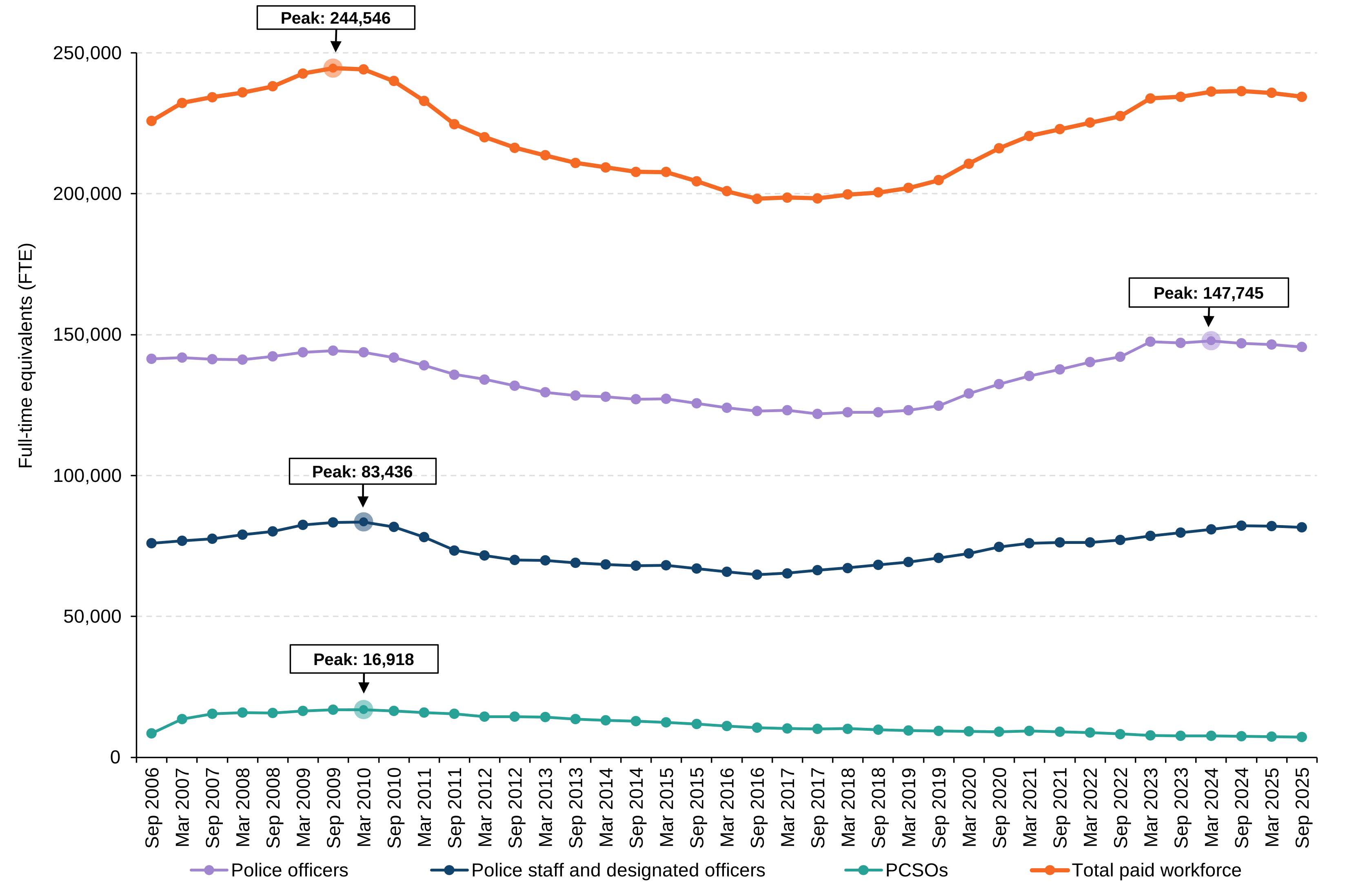
Figure 2.1 shows the long-term trend in police workforce numbers, broken down by worker type. This section focuses on overall workforce trends, sections 2.2 and 2.3 include more detailed analysis on the long-term trends for each worker type respectively.
Overall police workforce numbers increased to September 2009 when they reached a peak of 244,546 FTE. Numbers then decreased each year, reaching a low point in September 2016, at 198,195 FTE. Between March 2017 and September 2024, the previous downward trend reversed when the size of the paid police workforce increased every 6 months (with the exception of September 2017 when there was a small decrease).
In the latest year, the total police workforce decreased by 0.9% (2,050 FTE) compared to the previous year and is down 4.1% on the peak of 244,546 FTE in September 2009. The decrease in the total workforce means overall numbers are now similar to those in September 2023 when the total workforce was 234,438 FTE. Changes overtime vary by worker type, and sections 2.2 and 2.3 provide further breakdowns.
Figure 2.1: Police workforce (FTE) by worker type, as at 30 September 2006 to 2025, England and Wales
Source: Home Office, ‘Police workforce, England and Wales, 30 September 2025: data tables’, Table 4
Notes:
- Excludes BTP and secondments to central services.
- Police staff and designated officers have been combined as some forces are unable to provide data on designated officers separately.
- ‘Paid police workforce’ includes police officers, staff, designated officers and PCSOs.
2.2 Police officers
As at 30 September 2025, there were 145,550 FTE police officers in the 43 territorial police forces in England and Wales. This is a decrease of 0.9% (1,318 FTE) from the 146,868 FTE police officers on 30 September 2024, and a 0.6% (892 FTE) decrease compared with 31 March 2025.
The number of FTE police officers peaked at 147,745 on 31 March 2024, the highest number of officers on record (since comparable records began in March 2003). The latest data as at 30 September 2025, shows a 1.5% (2,195 FTE) decrease from the peak in March 2024, down to 145,550 FTE police officers.
As at 30 September 2025, there were 235 FTE police officers per 100,000 resident population in the 43 territorial police forces in England and Wales[footnote 4]. The Metropolitan Police Service (MPS) had the highest rate of officers per population, at 356, whilst Lincolnshire had the lowest rate of officers per population, at 149.
In addition to officers working in the 43 territorial police forces, the BTP employed 2,802 FTE police officers (down from 2,852 FTE on 31 March 2025), and the NCA employed 5,513 FTE officers (down from 5,617 FTE on 31 March 2025). It should be noted that NCA officers are defined on a different basis than the territorial forces and the BTP, since they include both those warranted with the powers of a police constable or other powers, as well as non-warranted officers (civilians involved in the investigation of serious and organised crime). There were also a further 383 FTE police officers seconded out to central services[footnote 5] as at 30 September 2025.
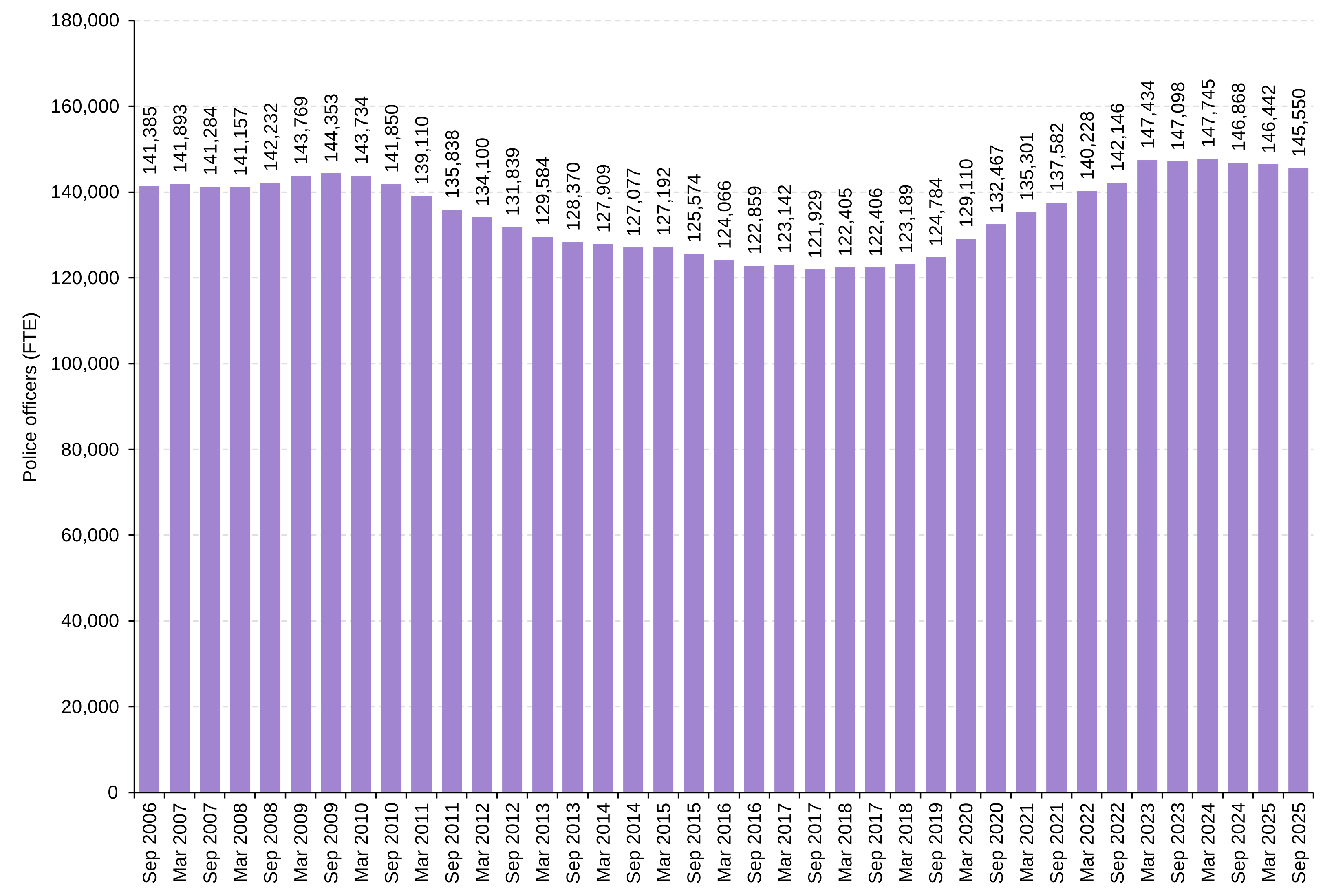
Figure 2.2 shows the long-term trend in FTE police officer numbers in the 43 territorial police forces.
Figure 2.2: Police officers (FTE), as at 30 September 2006 to 2025, England and Wales
Source: Home Office, ‘Police workforce, England and Wales, 30 September 2025: data tables’, Table 4
Notes:
- Excludes BTP and secondments to central services.
Officer numbers will fluctuate throughout the year based on recruitment and retention patterns. The Accredited Official Statistics in this series collect information on a biannual basis only, as a snapshot as at 31 March and 30 September each year.
Between March 2010 and September 2017, the number of officers in England and Wales declined and reached a low point in September 2017 (at 121,929 FTE officers). Between March 2018 and September 2018 officer numbers were stable. From September 2018 to March 2023 officer numbers increased every 6 months reaching 147,434 FTE as at 31 March 2023. Officer numbers dipped in September 2023 before reaching an all-time peak of 147,745 FTE in March 2024, the highest number of FTE officers since comparable records began in March 2003.
Since the peak as at 31 March 2024, officer numbers have fallen at each 6-month snapshot; as at 30 September 2025, there were 145,550 FTE police officers, a fall of 892 FTE (0.6%) officers since 31 March 2025, and a fall of 1,318 FTE (0.9%) since September 2024.
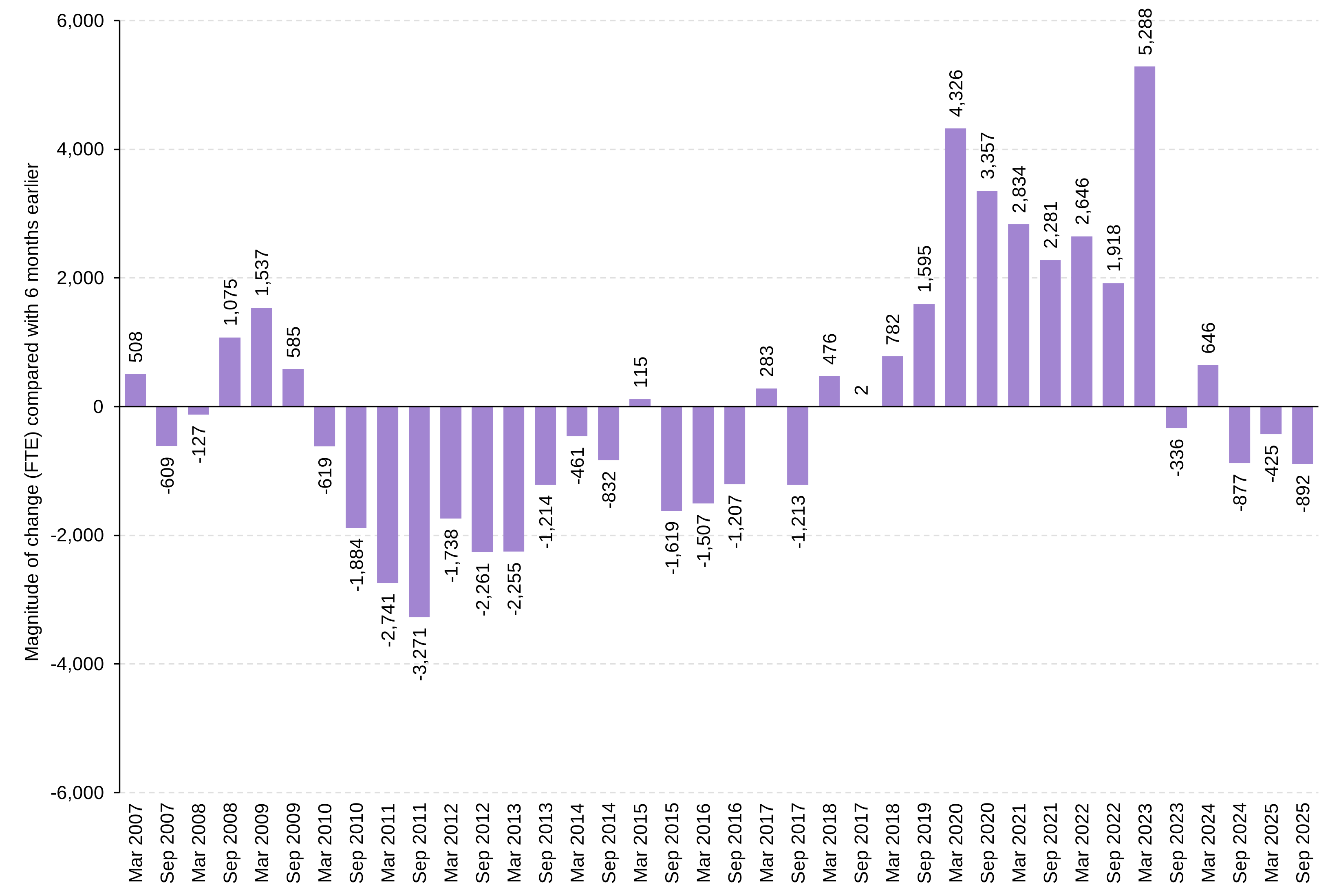
Figure 2.3 shows the change in the number of police officers as at 31 March 2007 to 30 September 2025, compared with the previous 6 month snapshot. The chart shows that between March 2018 and March 2023 officer numbers increased consistently every 6 months, coinciding with the Police Uplift Programme (a commitment made by the 2019 government to recruit an additional 20,000 police officers (headcount) by March 2023). Since the all-time peak of 147,745 FTE in March 2024, officer numbers have fallen by 2,195 FTE (1.5%) to 145,550 FTE as at 30 September 2025.
Figure 2.3: Change in the number of FTE police officers, as at 31 March 2007 to 30 September 2025 compared with the previous 6 months, England and Wales
Source: Home Office, ‘Police workforce, England and Wales, 30 September 2025: data tables’, Table 4
Notes:
- Excludes BTP and secondments to central services.
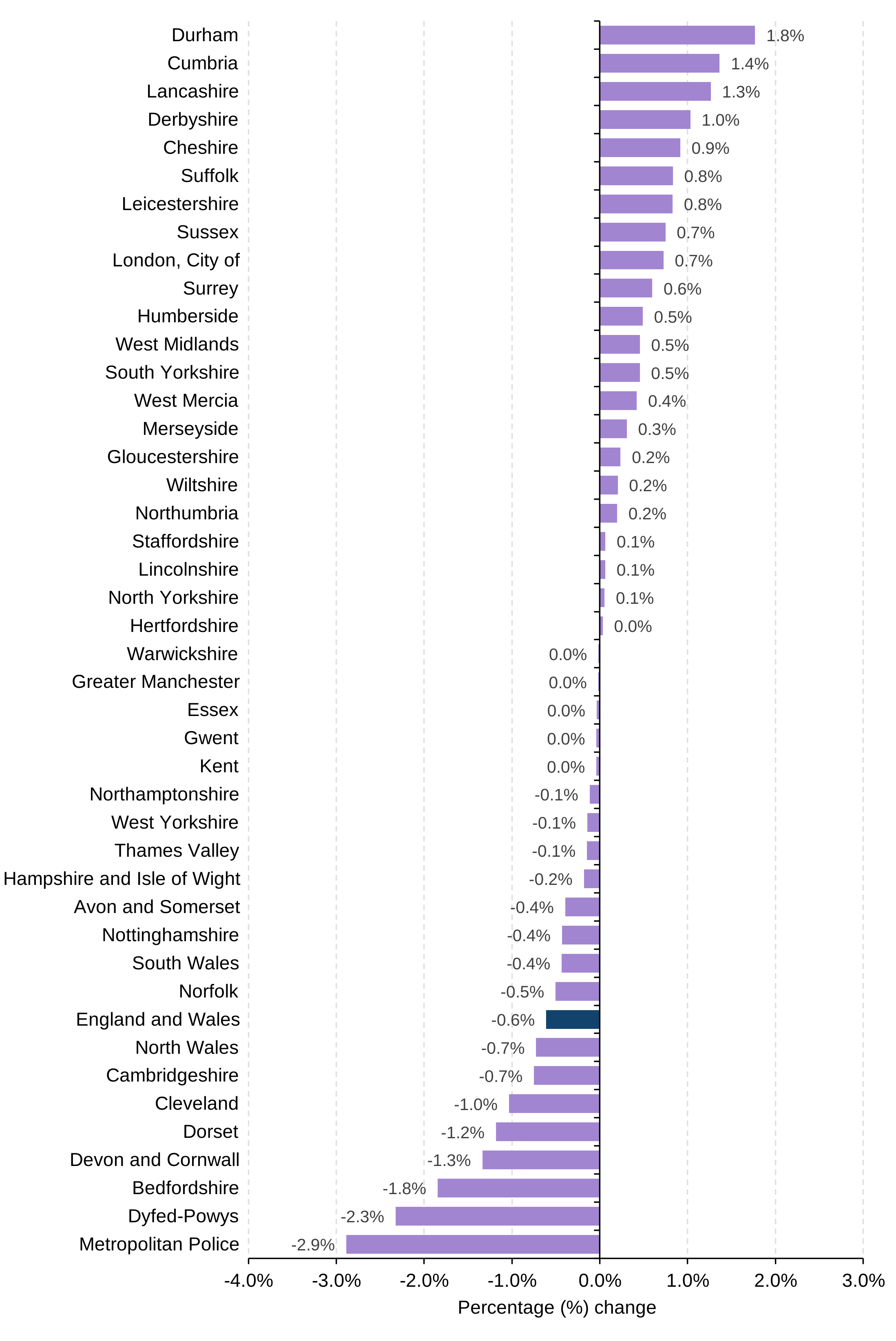
Figure 2.4 shows the percentage change in the number of police officers as at 30 September 2025 compared with 31 March 2025 by PFA. Between 31 March 2025 and 30 September 2025, 22 forces saw an increase in FTE officer numbers (with a combined total increase of 309 FTE). This was offset by a decline of 1,201 FTE in the remaining 21 forces, which can largely be attributed to the MPS, with a decrease in officer numbers of 961 FTE.
Figure 2.4: Percentage change in the number of FTE police officers, as at 30 September 2025 compared with 31 March 2025, by PFA, England and Wales
Source: Home Office, ‘Police workforce, England and Wales, 30 September 2025: data tables’, Table 1
Notes:
- Excludes BTP and secondments to central services.
2.3 Other worker types and volunteers
Police staff and designated officers
As at 30 September 2025, there were 81,662 FTE police staff and designated officers in the 43 territorial police forces in England and Wales. This is a decrease of 529 FTE (0.6%) compared to 30 September 2024 when there were 82,191 FTE police staff and designated officers, and a 0.4% (340 FTE) decrease compared with 31 March 2025.
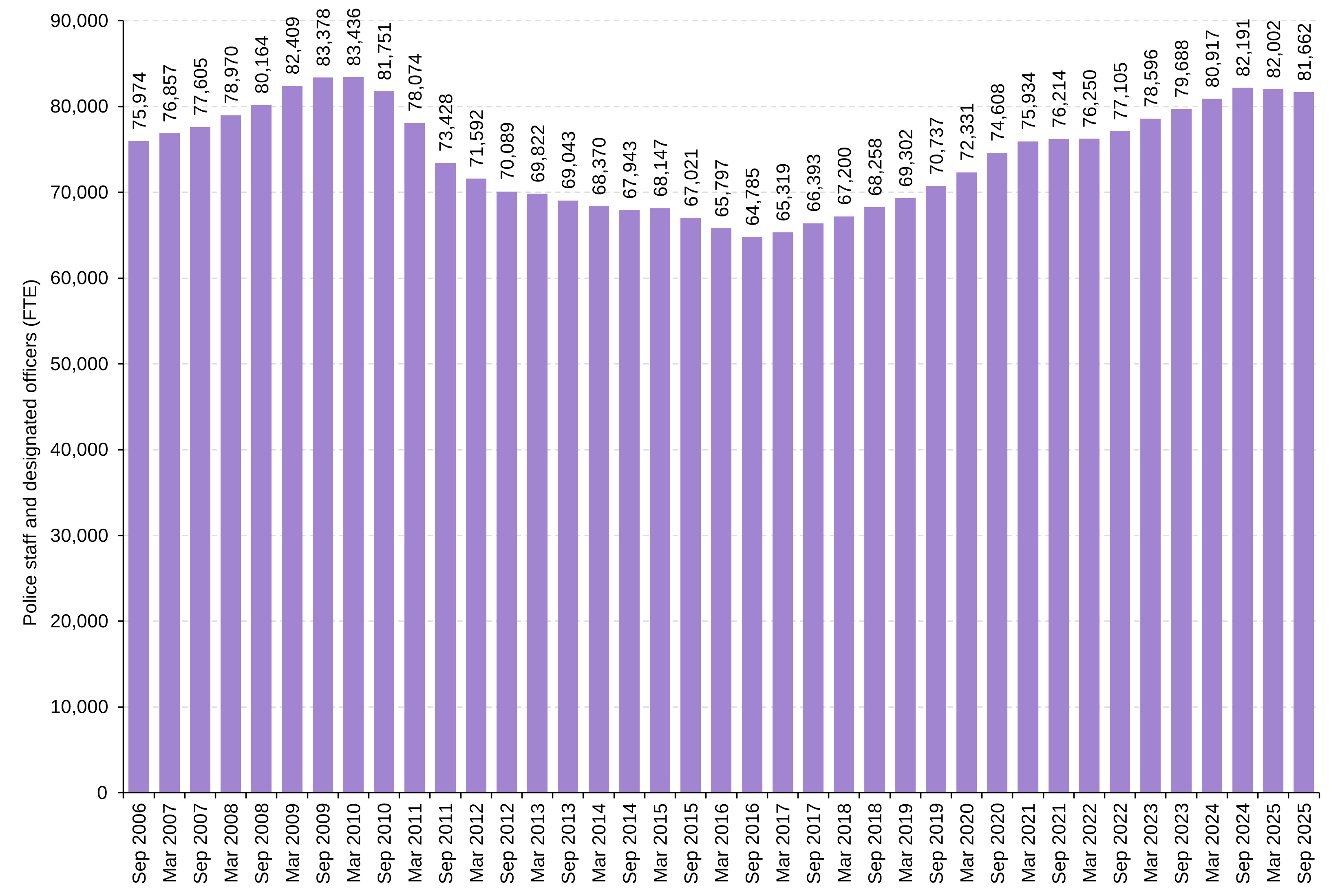
Figure 2.5 shows that, in general, police staff and designated officer numbers have followed a similar trend to police officer numbers over the past decade, peaking in March 2010 at 83,436 FTE. This was followed by a decline in the number of police staff and designated officers, reaching a low point in September 2016 (at 64,785 FTE). Since then, police staff and designated officer numbers increased every 6 months until 30 September 2024 when there were 82,191 FTE employed by the 43 territorial police forces in England and Wales. In the latest year, the number of FTE police staff and designated officers fell to 81,662 FTE as at 30 September 2025, a decrease of 529 (0.6%) compared with 12 months earlier (82,191 FTE as at 30 September 2024), and a decrease of 340 (0.4%) compared with 6 months earlier (82,002 FTE as at 31 March 2025). The current number of FTE police staff and designated officers, as at 30 September 2025, is 1,774 FTE (2.1%) fewer than the peak recorded in March 2010.
Figure 2.5: Police staff and designated officers (FTE), as at 30 September 2006 to 2025, England and Wales
Source: Home Office, ‘Police workforce, England and Wales, 30 September 2025: data tables’, Table 4
Notes:
- Excludes BTP and secondments to central services.
Police community support officers
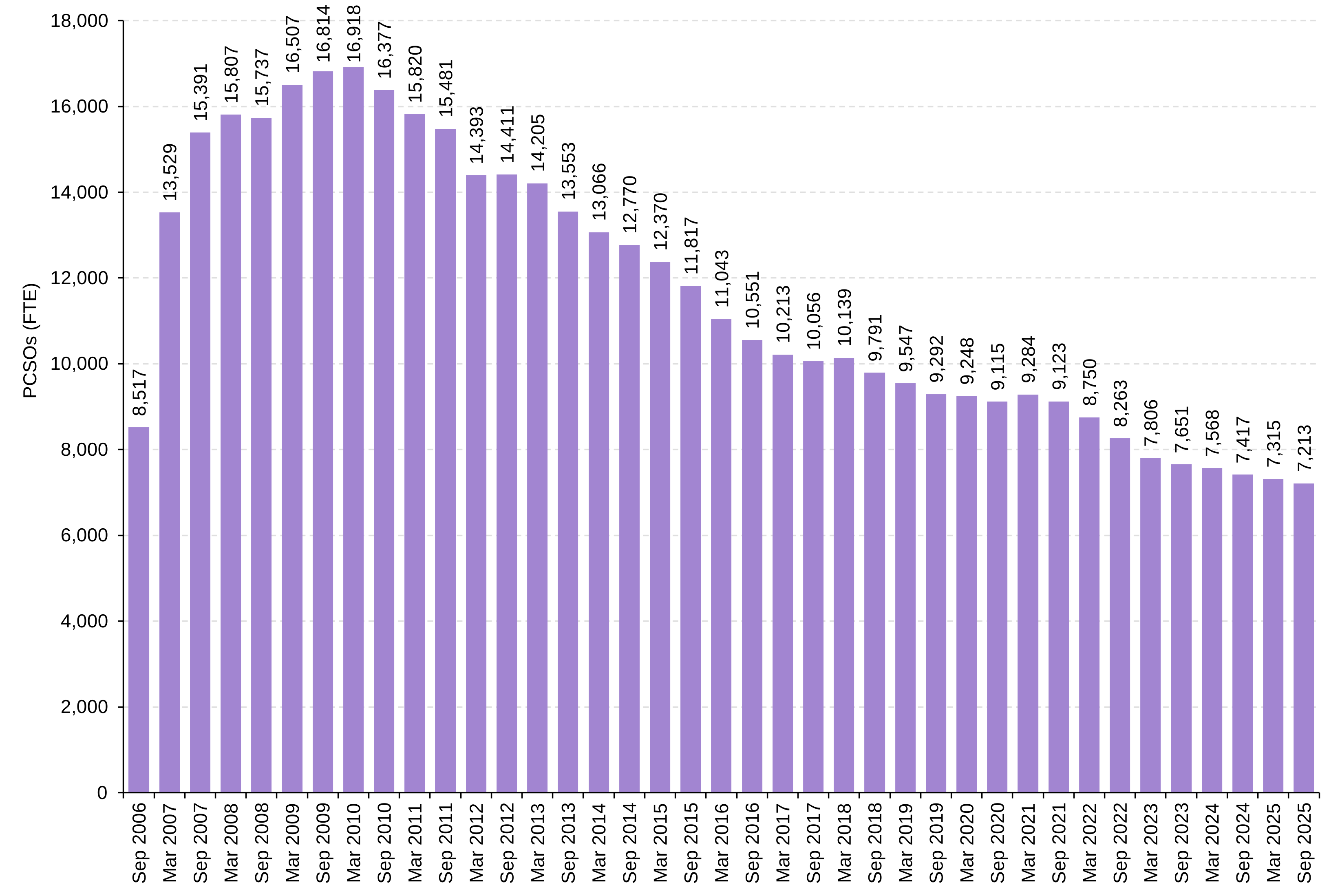
There were 7,213 FTE PCSOs employed by the 43 territorial police forces in England and Wales on 30 September 2025. This is a decrease of 204 (2.7%) compared with 12 months earlier (7,417 FTE as at 30 September 2024), and a decrease of 102 (1.4%) compared with 6 months earlier (7,315 FTE as at 31 March 2025). As shown in figure 2.6, PCSO numbers had been on an upward trend from September 2006, reaching a peak of 16,918 FTE in March 2010, since then PCSO numbers have been on a downward trend. The current number of FTE PCSOs, as at 30 September 2025, is 9,704 FTEs (57.4%) fewer than the peak recorded in March 2010.
Figure 2.6: PCSOs (FTE), as at 30 September 2006 to 2025, England and Wales
Source: Home Office, ‘Police workforce, England and Wales, 30 September 2025: data tables’, Table 4
Notes:
- Excludes BTP and secondments to central services.
Special constables
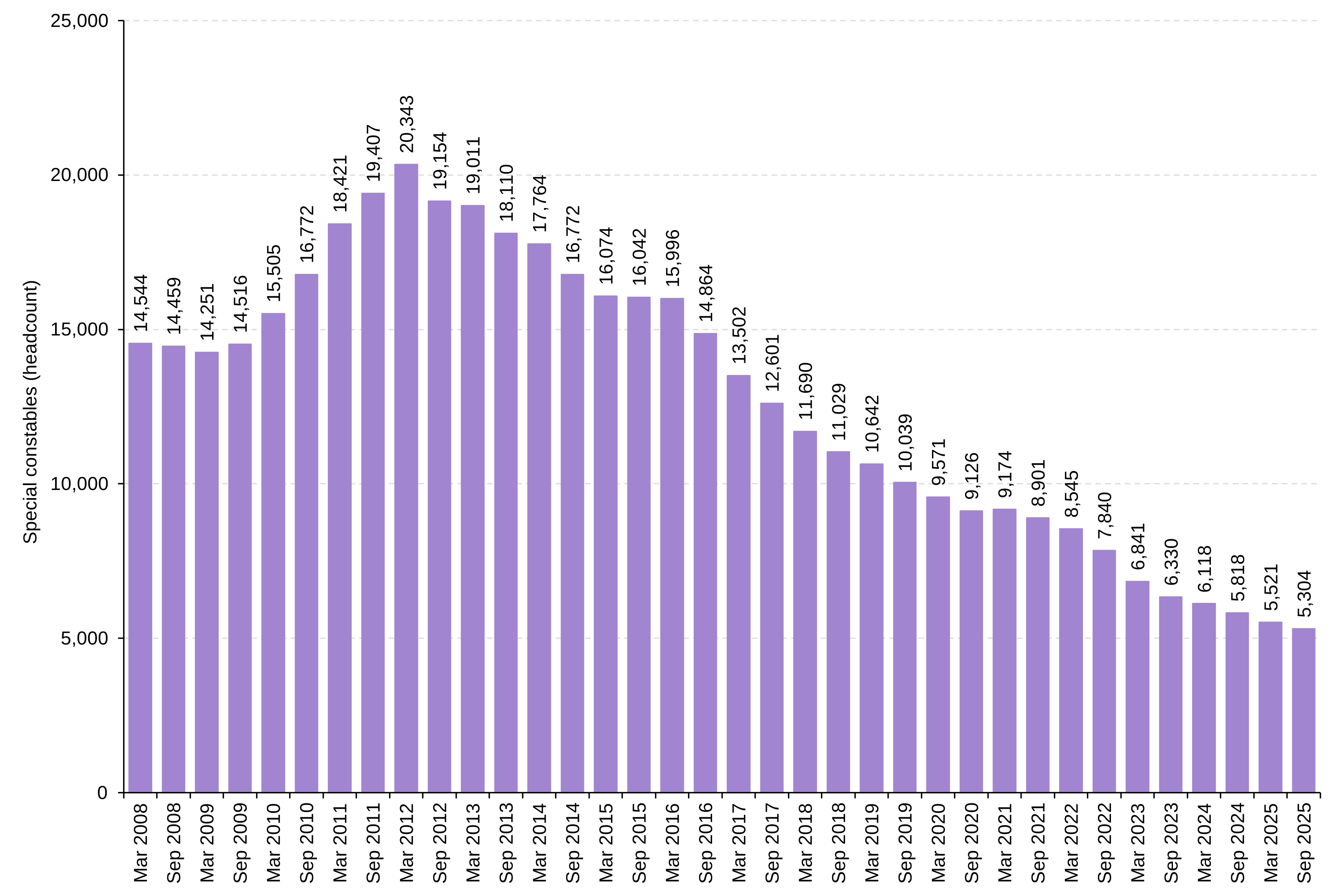
As at 30 September 2025, there were 5,304 special constables (headcount) in England and Wales, and a fall of 514 (8.8%) compared to 12 months earlier (5,818 as at 30 September 2024), and a decrease of 217 (3.9%) compared to 6 months earlier when there were 5,521 special constables in March 2025.
Figure 2.7 shows that between March 2008 and 2009 there was a decrease in the number of special constables. Special constables then increased every 6 months to March 2012, where they peaked at 20,343 special constables. Since March 2012 the number of special constables has decreased every 6 months, with the exception of March 2021 when there was a slight increase. As at 30 September 2025, the number of special constables was 15,039 headcount lower than the March 2012 peak.
Figure 2.7: Special constables (headcount), as at 31 March 2008 to 30 September 2025, England and Wales
Source: Home Office, ‘Police workforce, England and Wales, 30 September 2025: data tables’, Table 8
Notes:
- Excludes BTP and secondments to central services.
- Data on special constables as at 30 September has been collected since September 2008.
Police support volunteers
There were 5,964 PSVs[footnote 6] as at 30 September 2025. This is a decrease of 45 (0.7%) compared to 31 March 2025 (6,009 PSVs) and a decrease of 429 (6.7%) compared to 30 September 2024 when there were 6,393 PSVs.
3. Neighbourhood Policing Programme, as at 30 September 2025
3.1 Introduction
Increasing neighbourhood policing under the Neighbourhood Policing Programme
In December 2024, under the Safer Streets Mission, and as part of the NPG, the Government announced that they were putting 13,000 more policing personnel into neighbourhood policing (NHP) roles, referred to in this bulletin as the Neighbourhood Policing Programme (NPP).
On 10 April 2025, the then Home Secretary wrote to police and crime commissioners (PCCs) and chief constables on plans to support growth in neighbourhood policing, including a £200 million funding boost for the year ending 31 March 2026. Forces had access to a share of this fund from 1 April 2025, on the basis that they demonstrated growth in their neighbourhood policing teams.
Across England and Wales, forces agreed to deliver 2,972 FTE police officers and PCSOs by the end of the first financial year, covering the period 1 April 2025 to 31 March 2026. The statistics presented in this chapter provide an update on progress against those delivery plans, including breakdowns by worker type.
Statistical reporting of growth under the Neighbourhood Policing Programme
This is the first time progress against the Government’s commitment to increase the number of personnel in NHP roles has been included in these Official Statistics, and commences a 6-monthly reporting cycle in line with the long-standing ‘Police workforce, England and Wales’ statistical series.
Functions data is collected as part of the Home Office’s Police workforce data collection on an annual basis only and is usually published in July each year as part of the 31 March edition of ‘Police workforce, England and Wales’ statistical series. Therefore, data presented in this ‘as at September’ bulletin is based on bespoke monitoring information on police officers and PCSOs in the ‘Neighbourhood Policing’ function as categorised in the Chartered Institute of Public Finance and Accountancy (CIPFA) Police Objective Analysis (POA) framework as function 1a (further information can be found in the functions data section below). Data is collected by the NPCC and is processed and quality assured by Home Office statisticians. The data has also been validated and confirmed by police forces.
Information on other function types is collected routinely on an annual basis only and published in the 31 March edition of the ‘Police workforce, England and Wales’ statistical series. The next release, covering the information as at 31 March 2026, is scheduled for release in July 2026.
As with the total number of police workers, the number of police officers and PCSOs in NHP roles can vary throughout the year depending on fluctuations in recruitment, retention, and rotations. Some forces may do an intake at a particular point in the year as it may be more efficient to do so, whereas other forces may choose to intake more consistently and continuously throughout the year. Therefore, figures should not be used to compare the progress of one force against another, nor should the mid-point progress point be used to project future recruitment.
Functions data
Within the function data, each police worker is assigned a primary role in which they spend the majority of their time. Since 2015 the Home Office has based the functions data on the CIPFA POA framework, to align with HMICFRS, who use the framework’s categories to collect data on police income, expenditure, and funded posts. The CIPFA POA categories are reviewed annually by the Home Office, HMICFRS and police forces, to ensure that they remain relevant and reflect current policing structures.
This chapter provides statistics on the number of police officers and PCSOs employed in NHP roles, which is a sub-function of the wider ‘Local Policing’ category. Statistics presented in this chapter are based on the function an individual spent the majority of their time doing. Figures presented in this section and accompanying data tables are on an FTE basis, in line with how functions data is reported in the 31 March edition of the ‘Police workforce, England and Wales’ statistical series.
Under the POA framework, the ‘Neighbourhood Policing’ subfunction (1a) captures activities which are considered to fall under the following:
- neighbourhood policing teams, and Safer Neighbourhood teams whose primary role is neighbourhood based
- planned response that is scheduled or dealt with by appointment
Revisions exercise to functions data
Following the announcement of the NPG, including a commitment to increase the number of NHP personnel, a data validation exercise was carried out on the police workforce statistics NHP functions data, as at 31 March 2024. The validation exercise took place at the start of 2025 to ensure the Government had accurate data on NHP. This resulted in substantial revisions to the 2024 data, further details of which can be found in section 7.2 of the ‘Police workforce, England and Wales: as at 31 March 2025’ publication. The provisionally revised data was published on 19 March 2025 in the ‘Provisional revision to neighbourhood policing data, at 31 March 2024’ ad-hoc release, with final revised data published in July 2025 as part of the March 2025 release. Data prior to March 2024 is therefore not directly comparable with data from 31 March 2024 onwards.
3.2 Baseline, delivery plans and measuring growth
Delivery plans
In April 2025 the then Home Secretary wrote to PCCs and chief constables on plans to support growth in NHP, including a £200 million funding boost for 1 April 2025 to 31 March 2026. Forces had access to a share of this fund from 1 April 2025, on the basis that they demonstrated growth in their NHP teams.
Across England and Wales, forces agreed to deliver 2,972 FTE police officers and PCSOs by the end of the first financial year. Table 3.1 provides information on the delivery plans for police officers and PCSOs agreed with forces.
Table 3.1: Delivery plans for growth of police officers and PCSOs (FTE) in neighbourhood policing, year ending 31 March 2026, England and Wales
| Worker type | Year one plans for growth (FTE) |
|---|---|
| Police officers | 2,584 |
| PCSOs | 388 |
| Total | 2,972 |
Notes:
- Excludes BTP.
Of the 2,972 FTE additional police personnel in NHP, 2,584 FTE (86.9%) are planned to be police officers with the remaining 388 FTE (13.1%) planned to be filled by PCSOs. Some of the planned additional police personnel includes those in training who are destined for an NHP role (further detail can be found in the measuring growth from the baseline section).
Individual force plans are available in table NHP2 of the accompanying neighbourhood policing data tables. Growth is reported against plans as first published in April 2025 on GOV.UK.
Baseline as at 31 March 2025
The baseline for measuring growth has been set at 31 March 2025, with funding for growth available from 1 April 2025.
As at 31 March 2025, there were 17,175 FTE police personnel in NHP roles of which there were 11,104 FTE police officers and 6,071 FTE PCSOs; this is compared to a total 146,442 FTE police officers and 7,315 PCSOs across all functions.
Table 3.2: Police officers and PCSOs (FTE) in NHP roles and all functions, as at 31 March 2025
| Worker type | As at 31- Mar-25 (FTE) |
|---|---|
| Police officers | 11,104 |
| PCSOs | 6,071 |
| Total police officers and PCSOs in NHP roles | 17,175 |
| Total police officers in all functions | 146,442 |
| Total PCSOs in all functions | 7,315 |
Source: Home Office, ‘Police workforce, England and Wales, 31 March 2025: functions open data table’
Notes:
- Excludes BTP.
- Figures for those in NHP roles excludes employees on LTA, defined as absence that has lasted for more than 28 calendar days, as at the end of the reporting period.
Measuring growth from the baseline
On a monthly basis forces report on the number of police officers and PCSOs who were categorised in the CIPFA NHP function (CIPFA category 1a) on the last day of the previous month. The snapshot covers data related to the number of officers and PCSOs who spend the majority of their time working in the NHP function.
Police employees in training
Forces also report on the number of police officers and PCSOs who have been recruited for the purpose of working in the NHP function but are still in training. On joining the police service, newly recruited police officers and PCSOs enter a training period. Once they have completed this training period (which varies across forces) they are assigned a function code based on the role in which they are actively contributing. Upon the announcement of the NPG, police forces employed new police officers and PCSOs, who were specifically recruited to increase NHP capability. Data collection on numbers of police officers and PCSOs in NHP roles therefore includes a category for forces to record those who are ‘in training and destined for 1a’, that is they will go into a NHP role once training is complete.
As part of the data validation exercise to the March 2024 NHP functions data, police forces were issued with clarified guidance on how to record the function code of police officers and PCSOs in classroom-based training, that is that they should not be recorded with a (1a) NHP subfunction, to reflect that they were not fully deployable. Additionally, the police workforce data collection was updated for March 2025 with a new field to identify whether a police officer or PCSO is in training (or not). Forces were asked to assign police employees in classroom-based training to the ‘other’ function category. Both updates have resulted in increases to the number of police officers and PCSOs recorded in the ‘other’ function for as at March 2024 and March 2025, although this was more significant for March 2025.
While those still in training are not assigned a function code until they have completed their training and therefore have not yet been categorised in function 1a (neighbourhood policing), for the purpose of monitoring growth in the NHP function, and to reflect the funding forces receive to enable growth, police officers and PCSOs in training who are destined for an NHP role are included in the growth figures under the NPP.
What is included and excluded in the growth figures
Growth figures include only those who are recorded in the NHP function (CIPFA category 1a) on the last day of the month and those who are in training destined for NHP on completion of their training. Growth figures reported from section 3.3 onwards include police officers and PCSOs in training destined for NHP unless otherwise stated.
Growth in NHP includes both new recruits and officers who have been redeployed from another function.
Police employees who are on LTA, that is, at the time of reporting they have been absent for a period of 28 calendar days or longer, are not included in the NHP figures in this section. In line with how functions data is presented in the ‘Police workforce, as at 31 March’ series, those on LTA are categorised with a function code as ‘other’.
3.3 Neighbourhood policing as at 30 September 2025
As at 30 September 2025, there were a total of 19,558 FTE personnel in NHP roles, or in training and destined for an NHP role, equating to growth on the baseline of 2,383 FTE. Those in NHP roles, or in training for NHP roles, comprised of 13,291 FTE police officers (of which 323 FTE were in training), and 6,267 FTE PCSOs (of which 218 FTE were in training).
The increase of 2,383 FTE (up 13.9%) in police personnel in NHP in the first 6 months of the NPG can mostly be attributed to an increase in police officers, with 2,187 FTE (91.8%) of the growth in police officers and the remaining 196 FTE (8.2%) of the growth in PCSOs (Table 3.3).
Table 3.3: Police officers and PCSOs (FTE) in NHP roles, including personnel in training destined for NHP roles, as at 30 September 2025, England and Wales
| 31-Mar-25 baseline | As at 30-Sept-25 | In training destined for NHP as at 30-Sept-25 | Total as at 30-Sept-25 | Growth (FTE) on 31-Mar-25 | Growth (%) on 31-Mar-25 | |
|---|---|---|---|---|---|---|
| Police officers | 11,104 | 12,968 | 323 | 13,291 | 2,187 | 19.7 |
| PCSOs | 6,071 | 6,049 | 218 | 6,267 | 196 | 3.2 |
| Total | 17,175 | 19,017 | 541 | 19,558 | 2,383 | 13.9 |
Notes:
- Excludes BTP.
- Excludes employees on LTA.
Force breakdowns are available in table NHP2 of the accompanying neighbourhood policing data tables.
Progress achieved against year one delivery plans at 30 September 2025
At 30 September 2025 there were an additional 2,383 FTE police personnel in NHP roles; as a proportion of the total 2,972 FTE year one (year ending 31 March 2026) target of the NPP, at 30 September 2025 figures show that 80.2% of planned growth for the combined police officer and PCSO target has been achieved. Broken down by worker type shows this was 84.6% for police officers and 50.5% for PCSOs.
Table 3.4: Progress against total planned growth for year one (year ending 31 March 2026) of the NPP, as at 30 September 2025
| Planned growth for year one (year ending 31 March 2026) | Growth at 30-Sept-25 | Proportion (%) of total year one target achieved at 30-Sept-25 | |
|---|---|---|---|
| Police officers | 2,584 | 2,187 | 84.6 |
| PCSOs | 388 | 196 | 50.5 |
| Total | 2,972 | 2,383 | 80.2 |
Notes:
- Excludes BTP.
- Excludes employees on LTA.
- Includes personnel in training destined for NHP roles.
Annex A: New: Assaults on police employees
A.1 Introduction
Introduction
This chapter presents statistics on the number of assaults on police employees in England and Wales, including BTP. Data on assaults on police employees covers the number of police employees assaulted, with and without injury, between 1 April 2024 and 31 March 2025 and is on a headcount basis.
Operation Hampshire was introduced to improve the response to police assaults by raising awareness of the issue, providing supportive guidance and developing an understanding of the scale and trends of the issue to identify improvements. It provides a structure to ensure that police employees that are assaulted get the appropriate care and support. Operation Hampshire is recognised as a priority under the Police Covenant and is now embedded in every police force in England and Wales.
From April 2024, for the first time the Home Office began collecting row-level data on assaults on police employees, under the Annual Data Requirement (ADR). This new data collection is based on data previously collected as part of Operation Hampshire. This newly collected data has been included in this annex for the first time and covers assaults on police officers, staff, designated officers, PCSOs, special constables, and PSVs for the year ending 31 March 2025.
Official Statistics in Development status
The data is ‘Official Statistics in Development’ to acknowledge that they are undergoing development and should be interpreted with caution. More information can be found in the OSR’s guidance on producing official statistics in development.
The ‘Official Statistics in Development’ status provides a clear statement of the nature of the official statistics going through development, with a potentially wider degree of uncertainty in the figures whilst processes are established and verified. Whilst the data requires further development, these statistics do not yet meet the overall standards of ‘Official Statistics’.
The OSR states that where a development has concluded and the production of the statistics is continuing, then the label of ‘official statistics in development’ should be removed; the statistics should be published as ‘official statistics’, making sure to describe their strengths and limitations.
The Home Office intends to improve the completeness and quality of the data in future years. The Home Office will continue to work with police forces to improve the quality of the data and to provide more detailed published statistics in the future.
Development and user engagement
Data on assaults against police employees will be collected on an annual basis and, following each collection, Home Office analysts will assess completion rates and data quality to identify areas for further improvement. Developments to these statistics will be based on these reviews and user feedback.
As the data is official statistics in development, the Home Office intends to improve the completeness and quality of the data and aims to provide more detailed published statistics in the future. To enable this, the Home Office continues to engage with key users of these statistics to ensure they are developed to meet user needs. To improve our understanding of users’ needs we have launched a user engagement survey to help shape the publication of these statistics. We want to identify current users and uses of the data, as well as provide a chance for users to give their suggestions on how the statistics can better meet their needs.
Data quality
In previous releases of the ‘Police workforce, England and Wales’ statistical publication the police recorded crime series was used as the data source for assaults on police officers. The police recorded crime data is published quarterly in “Crime in England and Wales”, released by the Office for National Statistics (ONS).
There are differences between the Home Office collection and the police recorded crime series, therefore the police recorded crime series is not directly comparable with the Home Office assaults on police employees collection.
Within the police recorded crime series, only police officer specific assaults are recorded under the “assault with injury on a constable” and “assault without injury on a constable” crime classifications. These include police officers and special constables only. There is a separate crime classification of “assault with injury on an emergency worker (other than a constable)” and “assault or assault by beating on an emergency worker (other than a constable)” which include assaults on other police employees such as police staff, designated officers, PCSOs and PSVs. As these crime classifications also include other emergency workers it is not possible to distinguish assaults specifically against police employees. The Home Office assaults on police employees collection includes all assaults on police officers, staff, designated officers, PCSOs, special constables and PSVs.
Additionally, within the police recorded crime series assaults of a more serious nature will not be included in the assault with and without injury crime classifications as, in line with the Home Office Counting Rules, they would be recorded against a more serious offence, such as “attempted murder”, from which it is not possible to separately identify assaults on police officers.
The police recorded crime series only includes assaults that have been recorded as crimes and is based on the date that it was reported as a crime. The Home Office collection includes all assaults regardless of whether it was reported as a crime and is based on the date that the assault occurred as opposed to the date the assault was reported.
There is not a universal system used to record assaults across police forces in England and Wales, in many cases the data required is held across various systems and will differ depending on the recording practice within each police force. As such, the data presented here has been compiled from multiple police force systems, including a combination of health and safety systems, crime recording systems, Human Resources (HR) systems and bespoke assault reporting systems. There is the possibility of a small amount of double counting between police forces in cases where a police employee was assaulted within the jurisdiction of another police force, due to the assault being recorded on the crime recording system for the police force that the assault occurred in and the health and safety system of the police force that the individual assaulted is employed in.
Police forces are adapting their systems to compile and extract the data that is requested by the Home Office under the ADR. At this time some police forces are not able to provide all of the data requested. Seven forces (Essex, Hampshire and Isle of Wight, Humberside, Kent, Metropolitan Police Service, South Yorkshire and Surrey) were unable to provide data on assaults without injury. As at 31 March 2025, these 7 forces account for 32% of the entire police workforce (on a headcount basis). As such the number of assaults presented in this annex is likely an undercount of the actual number of assaults that occurred. Comparisons should not be made between police forces due to the undercounting of assaults without injury amongst 7 forces. Additionally, comparisons should not be made between assaults with injury and assaults without injury due without taking into account the 7 forces unable to provide complete data.
Police staff and designated officers have been combined as some forces are unable to provide data on designated officers separately. One force (Sussex) was unable to separate police staff and PCSOs, so all assaults on PCSOs in Sussex have been counted in the police staff and designated officers category.
Due to the data quality issues mentioned above it is not possible to make comparisons between forces at this time as such the data is presented for England and Wales and Police Force Area breakdowns are not provided. The Home Office is working with the College of Policing and police forces to improve the quality and consistency around the recording of assaults on police employees.
A.2 Assaults on police employees
Table A.1 shows in the year ending 31 March 2025, there were 33,461 assaults on police employees (including the 7 forces unable to provide data on assaults without injury and the BTP). Of those (excluding the 95 assaults where the assault type was not known) 14,945 (44.8%) were assaults with injury and 18,421 (55.2%) were assaults without injury. Of the 33,461 assaults against police employees (excluding 508 where the worker type was not known) the majority (95.2%) were against police officers (31,368).
Table A.1: Assaults on police employees, by assault type and worker type, year ending 31 March 2025, England and Wales
| Worker type | Assault with injury | Assault without injury | Assault type not known | Total |
|---|---|---|---|---|
| Police officers | 13,999 | 17,294 | 75 | 31,368 |
| Police staff and designated officers | 352 | 364 | 14 | 730 |
| PCSOs | 227 | 257 | 2 | 486 |
| Special constables | 189 | 177 | 2 | 368 |
| Police support volunteers | 1 | - | - | 1 |
| Not stated | 177 | 329 | 2 | 508 |
| Total | 14,945 | 18,421 | 95 | 33,461 |
Source: Home Office, ‘Police workforce, England and Wales, 30 September 2025: data tables’, Table A1
Notes:
- Includes BTP.
- Includes 7 forces that were unable to provide data on assaults without injury as such the number of assaults without injury is likely an undercount of the actual number of assaults that occurred.
- Sussex were unable to separate police staff and PCSOs, so all assaults on PCSOs in Sussex have been counted in the police staff and designated officers’ category.
The data presented in the remainder of this annex excludes the 7 forces unable to provide a complete picture of assaults against police employees.
Excluding data from the 7 forces that were unable to provide assaults without injury data, there were 28,606 assaults. Of those (excluding the 95 assaults where the assault type was not known) 10,090 (35.4%) were assaults with injury and 18,421 (64.6%) were assaults without injury.
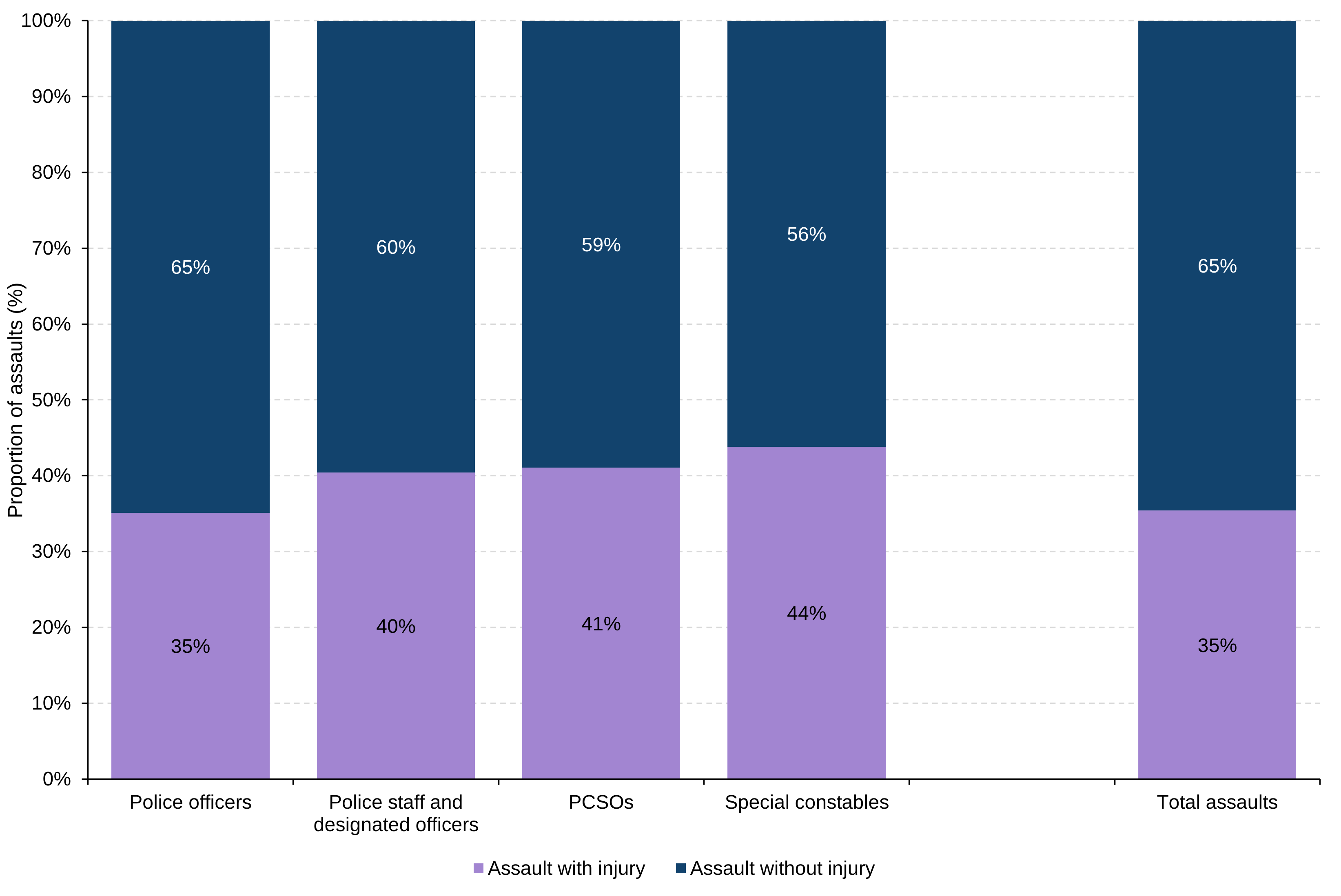
Figure A.1 shows the proportion of assaults with and without injury, by worker type, for the year ending 31 March 2025, based on the subset of 37 forces. The chart shows similar proportions of assaults with and without injury within each worker type. Assaulted police officers experienced the smallest proportion of assaults resulting in injury (35.1%) whilst assaulted special constables experienced the highest proportion of assaults resulting in injury (43.8%).
Figure A.1: Assaults on police employees, by assault type and worker type, year ending 31 March 2025, subset of 37 police forces in England and Wales
Source: Home Office, ‘Police workforce, England and Wales, 30 September 2025: data tables’, Table A2
Notes:
- Includes BTP.
- Excludes 7 forces that were unable to provide data on assaults without injury.
- Excludes 95 assaults where the assault type was unknown.
- Total assaults include 506 assaults where the worker type was unknown.
- Total assaults includes PSVs which are not shown separately as only one assault (with injury) was recorded against a PSV.
- Sussex were unable to separate police staff and PCSOs, so all assaults on PCSOs in Sussex have been counted in the police staff and designated officers’ category.
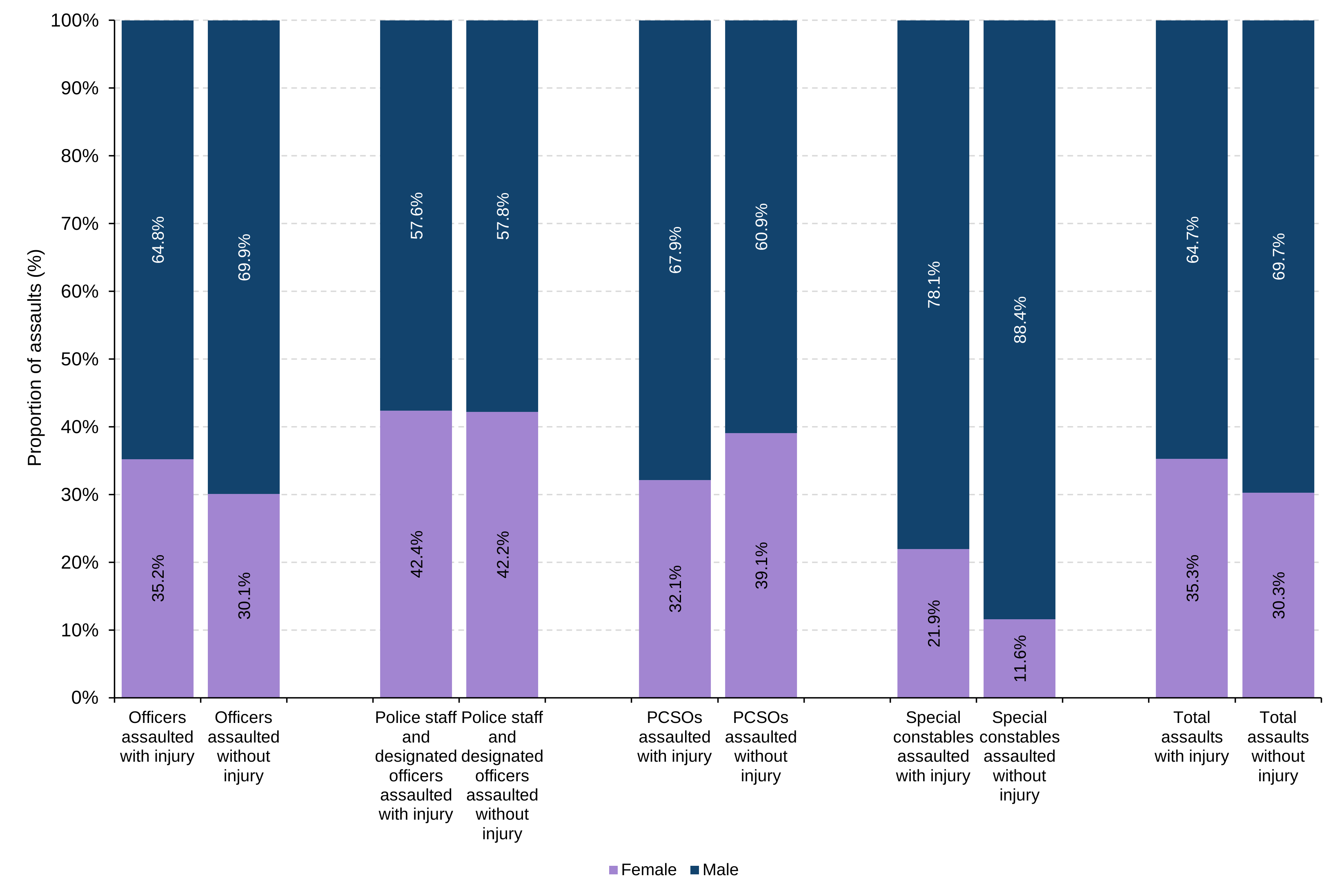
Figure A.2 shows the proportion of assaults with and without injury, by worker type and sex, for the year ending 31 March 2025, based on the subset of 37 forces. Of all police employees that experienced an assault with injury, 35.3% of them were female and of all police employees that experienced an assault without injury 30.3% of them were female (where the sex was known). These proportions are below the proportion of female police employees in the police workforce (47.6% based on the subset of 37 forces).
Based on the subset of 37 forces, of police officers that experienced an assault, with and without injury, the proportion that were female (35.2% and 30.1% respectively) is similar to the proportion of female police officers in the workforce (37.4% as at 31 March 2025). Similarly, of special constables that experienced an assault with injury, the proportion that were female (21.9%) is similar to the proportion of female special constables in the workforce (24.4% as at 31 March 2025). However, of special constables that experienced an assault without injury, the proportion that were female (11.6%) is lower than the proportion of female special constables in the workforce (24.4%). Of police staff and designated officers that experienced an assault, with and without injury, the proportion that were female (42.4% and 42.2% respectively) is considerably lower than the proportion of female police staff and designated officers in the workforce (64.1%). Similarly, of PSCOs that were assaulted with and without injury, the proportion which were female (32.1% and 39.1% respectively) is considerably lower than the proportion of female PCSOs in the workforce (50.0% as at 31 March 2025).
Figure A.2: Assaults on police employees, by assault type, worker type and sex, year ending 31 March 2025, subset of 37 police forces in England and Wales
Source: Home Office, ‘Police workforce, England and Wales, 30 September 2025: data tables’, Table A2
Notes:
- Includes BTP.
- Excludes 7 forces that were unable to provide data on assaults without injury.
- Excludes 95 assaults where the assault type was unknown.
- Total assaults includes 506 assaults where the worker type was unknown.
- Total assaults includes PSVs which are not shown separately as only one assault (with injury) was recorded against a PSV.
A.3 Rates of assaults per 1,000 police employees
Excluding data from the 7 forces that were unable to provide assaults without injury data, there were 28,606 assaults. Of those (excluding the 508 assaults where the worker type was not known) the majority (95.1%) were against police officers (26,717). This is equivalent to 272 assaults per 1,000 police officers as at 31 March 2025.
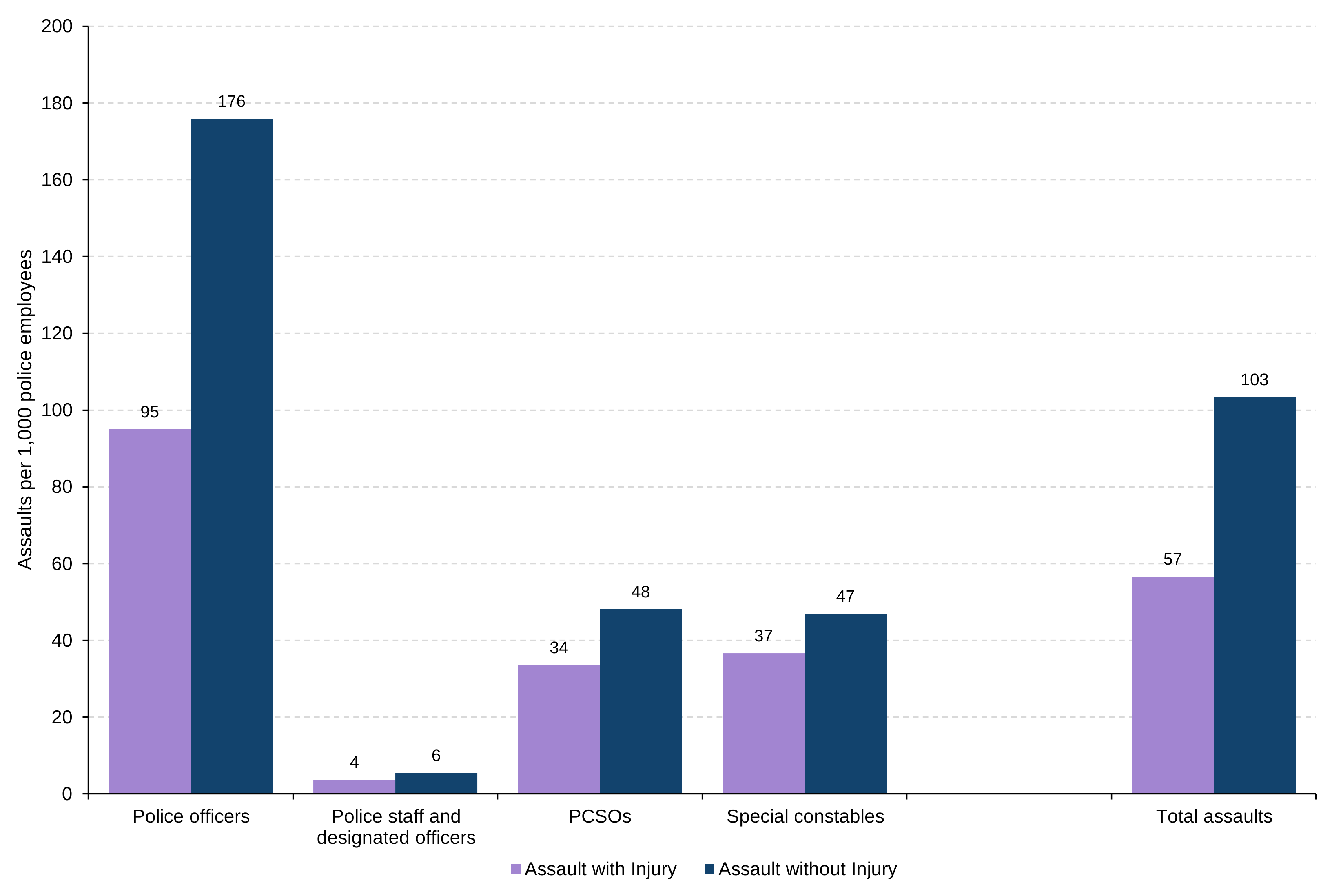
Figure A.3 shows the rate of assaults per 1,000 police employees for each worker type, broken down by assault type, in the year ending 31 March 2025 based on the subset of 37 police forces. Of the worker types, police officers had the highest rate of assaults, with 95 assaults with injury per 1,000 officers and 176 assaults without injury per 1,000 officers. This likely reflects that the majority (90.4%) of police officers, as at 31 March 2025, are in frontline roles[footnote 7]. Police staff and designated officers, who typically have less interaction with the public, had the lowest assault rates at 4 assaults with injury and 6 assaults without injury per 1,000 police staff and designated officers.
Figure A.3: Assaults per 1,000 police employees, by assault type and worker type, year ending 31 March 2025, subset of 37 police forces in England and Wales
Source: Home Office, ‘Police workforce, England and Wales, 30 September 2025: data tables’, Table A3
Notes:
- Includes BTP.
- Excludes 7 forces that were unable to provide data on assaults without injury.
- Excludes 95 assaults where the assault type was not known.
- Total assaults includes 506 assaults where the worker type was not known.
- Total assaults includes PSVs which are not shown separately as only one assault (with injury) was recorded against a PSV.
- Sussex were unable to separate police staff and PCSOs, so all assaults on PCSOs in Sussex have been counted in the police staff and designated officers’ category.
- Rates have been calculated using the ‘Police workforce, England and Wales’ as at 31 March 2025 workforce open data table, excluding 7 forces that were unable to provide data on assaults without injury.
Excluding data from the 7 forces that were unable to provide assaults without injury data, there were 28,606 assaults. Of those (excluding the 2,445 assaults where the sex was not known) in 17,759 (67.9%) of assaults the victim was male and in 8,402 (32.1%) assaults the victim was female.
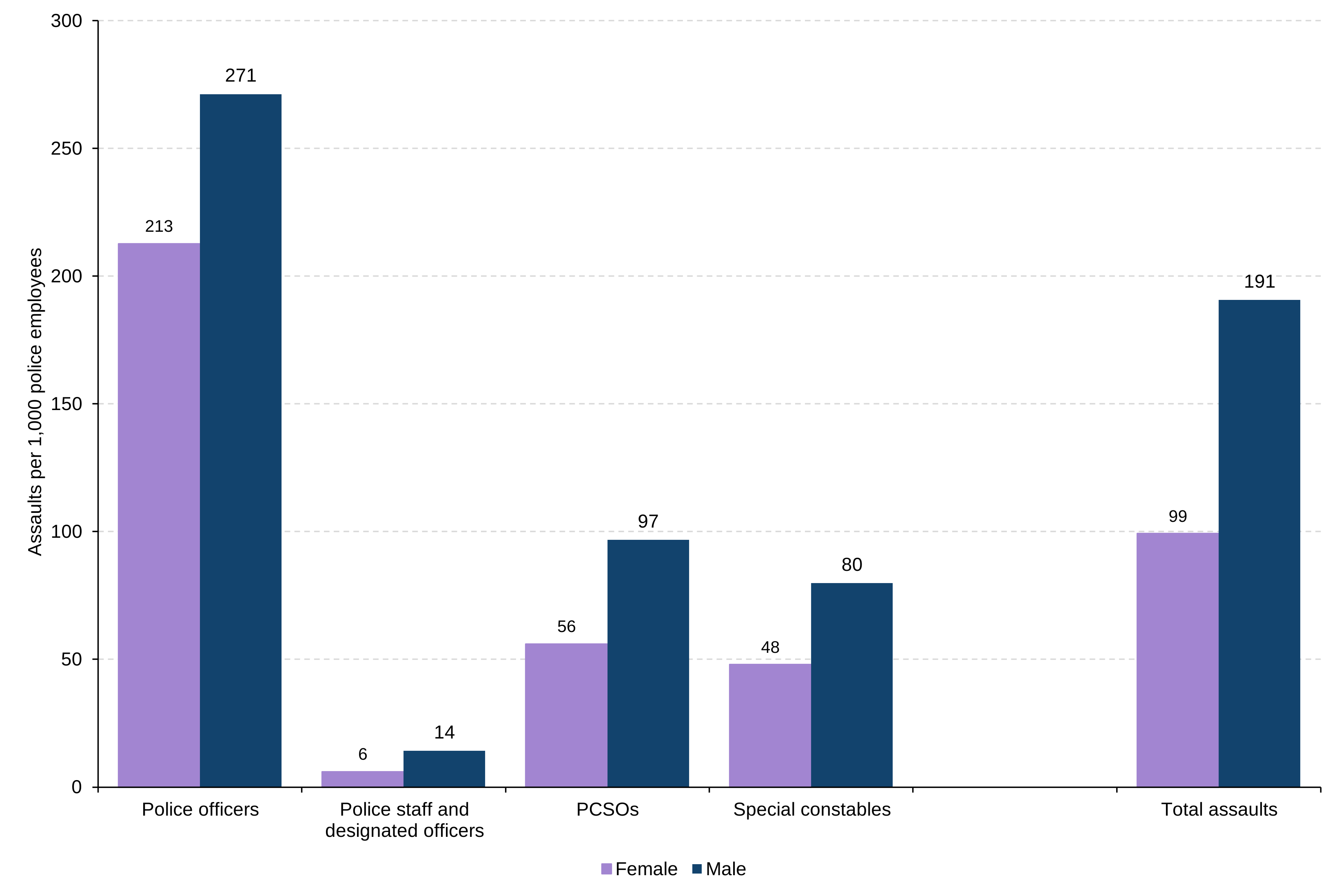
Figure A.4 shows the rate of assaults per 1,000 police employees for each worker type, broken down by sex, in the year ending 31 March 2025, based on the subset of 37 police forces. The chart shows, within each worker type, male police employees had a higher rate of assaults per 1,000 employees compared to their respective female police employees.
Of all worker types, police officers had the highest level of female assault victims per 1,000 police officers at 213 assaults per 1,000 female police officers (headcount). Whereas police staff and designated officers had the lowest level of female assault victims per 1,000 at 6 assaults per 1,000 female police staff and designated officers (headcount).
Figure A.4: Assaults per 1,000 police employees, by sex and worker type, year ending 31 March 2025, subset of 37 forces in England and Wales
Source: Home Office, ‘Police workforce, England and Wales, 30 September 2025: data tables’, Table A4
Notes:
- Includes BTP.
- Excludes 7 forces that were unable to provide data on assaults without injury.
- Total assaults include PSVs which are not shown separately as only one assault (with injury) was recorded against a PSV.
- Total assaults includes 376 assaults where the worker type was not known.
- Excludes 2,445 police employees where their sex is not stated.
From April 2024 the Home Office began collecting row-level data on assaults against police employees, this annex is the first publication of such data. The data presented in this annex is labelled as ‘official statistics in development’. There are a number of data quality issues summarised in the ‘data quality’ section of this annex that should be taken into account when interpreting the data. To ensure that these statistics are beneficial to our users, the Home Office intends to improve the completeness and quality of the data and aims to provide more detailed published statistics in the future. The Home Office continues to engage with key users of these statistics to ensure they are developed to meet user needs (the ‘development and user engagement’ section of this annex contains further information).
-
Police personnel in neighbourhood policing refers to police officers and PCSOs only. This does not include police staff or designated officers in neighbourhood policing roles. ↩
-
Designated officers are police staff (who are not police officers) employed to exercise specific powers that would otherwise only be available to police officers. ↩
-
Individuals who by choice put their time, experience, knowledge and skills at the disposal of the force without expectation of compensation or financial rewards, except for the payment of pre-determined out of pocket expenses. ↩
-
Calculated using Office for National Statistics’ 2024 mid-year population estimates for England and Wales. ↩
-
Secondments to central services are secondments to central government, for example, the Home Office, His Majesty’s Inspectorate of Constabulary and Fire & Rescue Services (HMICFRS), or the NCA. ↩
-
Individuals who by choice put their time, experience, knowledge and skills at the disposal of the force without expectation of compensation or financial rewards, except for the payment of pre-determined out of pocket expenses. ↩
-
The proportion of officers in frontline roles is calculated using the ‘Police workforce, England and Wales’ as at 31 March 2025 functions open data table, excluding the 7 forces and the BTP. ↩