Why do people come to the UK? Work
Published 26 November 2026

© Crown copyright 2026
This publication is licensed under the terms of the Open Government Licence v3.0 except where otherwise stated. To view this licence, visit nationalarchives.gov.uk/doc/open-government-licence/version/3 or write to the Information Policy Team, The National Archives, Kew, London TW9 4DU, or email: psi@nationalarchives.gov.uk.
Where we have identified any third party copyright information you will need to obtain permission from the copyright holders concerned.
This publication is available at https://www.gov.uk/government/statistics/immigration-system-statistics-year-ending-september-2026/why-do-people-come-to-the-uk-work
Back to ‘Immigration system statistics, year ending September 2026’ contents page
This release goes up to the year ending (YE) September 2026. The “year ending” period includes the 12 months up to and including the YE month. For example, YE September 2026 includes the 12 months between 1 October 2025 and 30 September 2026.
Additional information is provided in the ‘About the statistics’ section and in the user guide.
1. Work-related visas
Work-related visa grants have decreased over the last 3 years, largely due to a decline in Health and Care Worker visas.
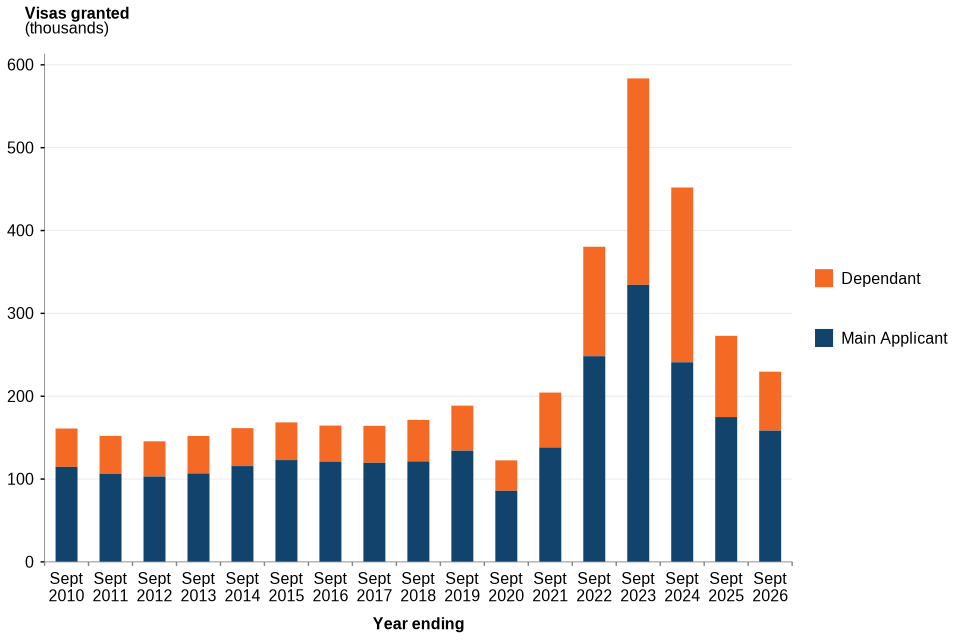
There were 229,637 Work visas granted (including dependants) in the YE September 2026, a fall of 16% compared to the previous year and 63% fewer than the YE December 2023 when the number of work visas peaked. The fall over the last 3 years has been driven largely by fewer grants to dependants, although grants to main applicants have also decreased over this period.
Figure 1: Work visas granted by applicant type between the YE September 2010 and the YE September 2026
Source: Entry clearance visa applications and outcomes – Vis_D02
Figure 1 shows between the YE September 2010 and YE September 2020 there were less than 200,000 work visas granted each year, of which over two-thirds were to main applicants. During this time the UK was a member of the European Union (EU) and, as such, EU nationals did not require a visa to work in the UK due to freedom of movement. Between 2021 and 2023, there was an increase in the number of work visas granted. Visas on the Health and Care Worker route, in particular, grew sharply following the expansion of the route in February 2022 to boost the social care workforce – with large volumes of dependant visas granted on the route. Skilled Worker visas also contributed to the increase over this period, although to a lesser extent. The growth in the number of grants of these visas led to work visa grants peaking in the YE December 2023 at 613,627. Skilled Worker and Health and Care Worker visas together accounted for 76% of all work visas granted in this period.
The number of work visas granted began to fall at the beginning of 2024, driven by a decrease in Health and Care Worker visas, due to more scrutiny applied by the Home Office to employers in the health and social care sector, and compliance activity taken against employers who did not fulfil their obligations as employers of migrant workers.
In December 2023, the Home Office announced policy changes for work visas, which came into effect at various points in 2024. Health and Care Worker visas had fallen prior to the changes and continued to fall steadily following the change. Numbers on the Skilled Worker route have also fallen steadily following the changes. Additional policy changes targeting the Skilled Worker and Health and Care Worker visa routes were announced in the Immigration white paper and the first changes were implemented on 22 July 2025, following which there has been a further decline in numbers.
Alongside these policy changes, there has also been an increase in sponsor license revocations. In the year ending September 2026, 5,194 Skilled Worker sponsor licences were revoked, compared with 1,856 in the year ending September 2025. Data on sponsor license revocations can be found in table SC_01 in the Sponsorship transparency data.
The Home Office has published monthly updates on applications for key work visa types - see ‘Monthly statistical releases on migration’ for further information.
1.1 Worker visas
The ‘Worker’ visa category includes sponsored work visas for longer stays which typically offer a direct pathway to settlement, and includes Skilled Worker and Health and Care Worker visas.
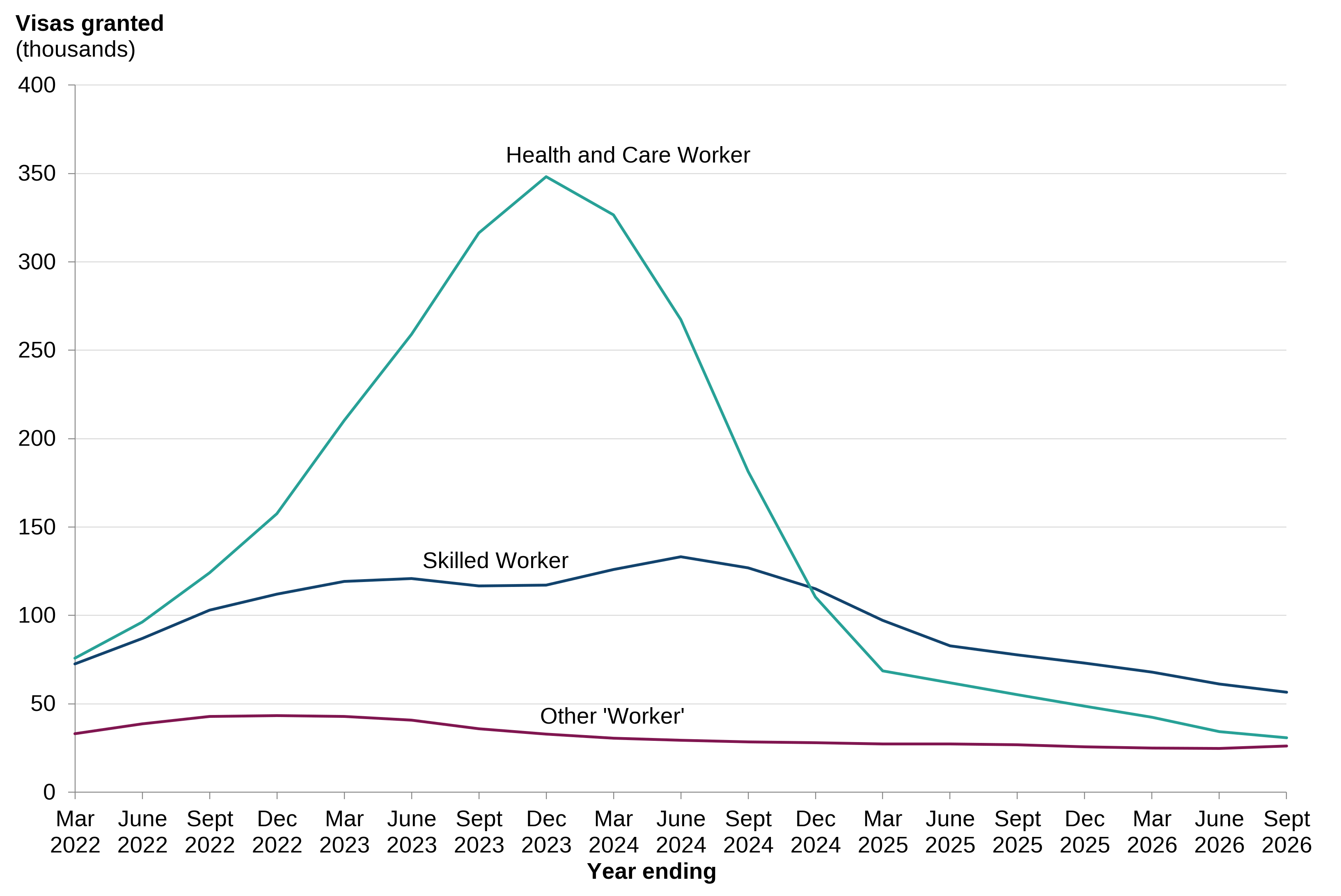
The number of ‘Worker’ visas granted has continued to decrease in the latest year, with the largest falls coming from those on a Health and Care Worker visa in Caring Personal Service and Nursing Professional occupations.
In the YE September 2026 there were 113,429 visas granted (including dependants) for ‘Worker’ visas. This was 29% fewer grants compared to the previous year, and 77% fewer compared to the YE December 2023. The fall in ‘Worker’ visa grants has been primarily driven by the Health and Care Worker and Skilled Worker routes. In the latest year, 58% of ‘Worker’ visas were granted to dependants and 42% to main applicants.
The fall in ‘Worker’ visa grants has followed a fall in the volume of applications received (127,538 in the YE September 2026 down 76% since the YE December 2023). There has also been an increase in the proportion of decisions that are refusals (13% in the YE September 2026 compared with 7% in the YE December 2023).
Figure 2: Worker visas granted (including dependants) between the YE December 2021 and the YE September 2026
Source: Entry clearance visa applications and outcomes – Vis_D02
The number of Health and Care Worker visas granted has fallen by 44% to 30,773 in the YE September 2026, of which main applicants fell 59% to 6,725 and dependants fell 38% to 24,048.
Dependants accounted for 78% of Health and Care Worker visas granted in the YE September 2026. The higher number of dependants compared to main applicants may be partly due to dependants joining migrants that are already in the UK, some of whom will be those who were sponsored on Health and Care visas prior to the changes in July 2025 (restricting dependants for medium skilled occupations) and continue to be eligible to bring family members from abroad.
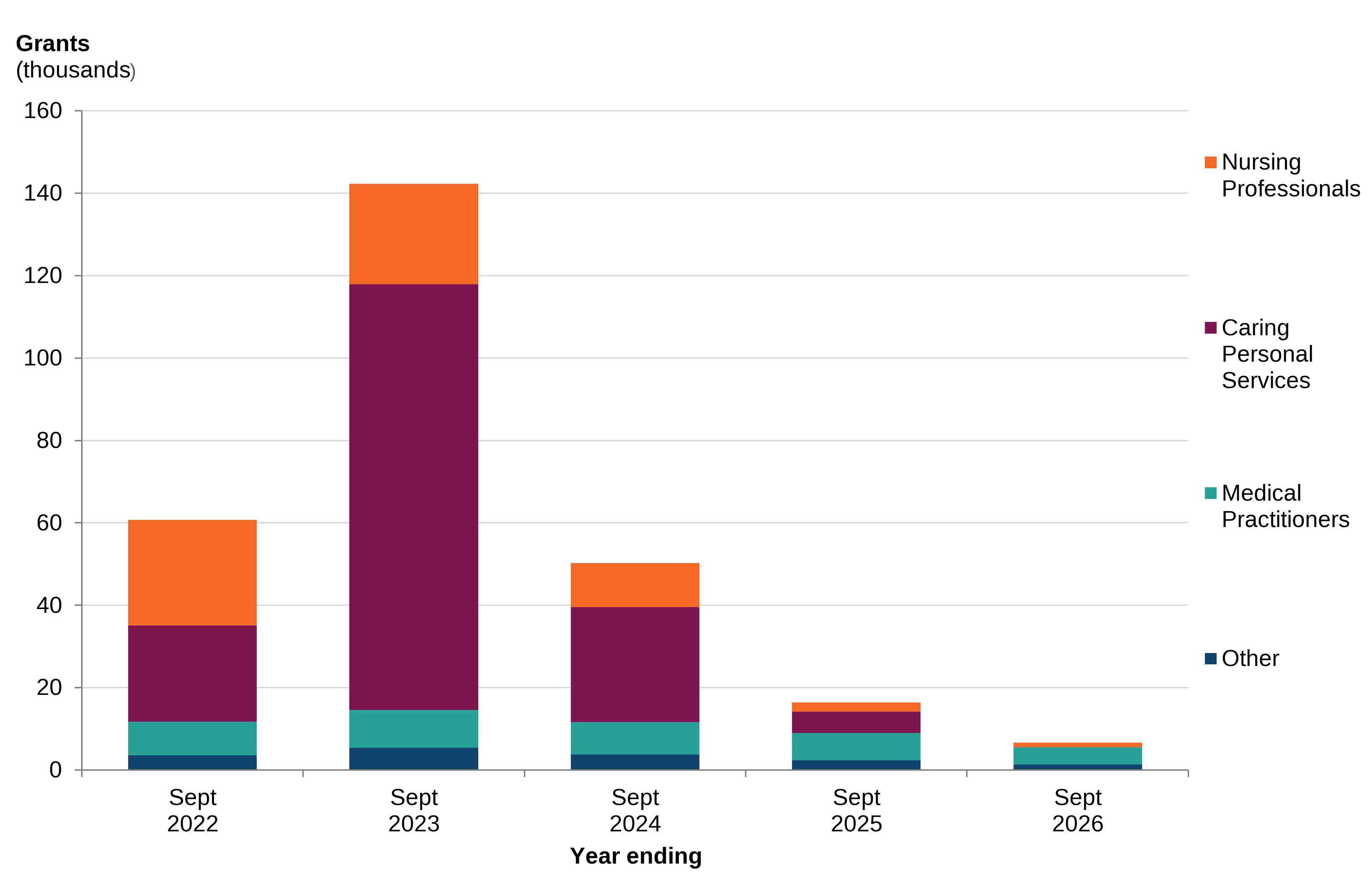
Visas granted to Health and Care Worker main applicants increased from 31,800 in the YE December 2021 to a peak of 145,823 in the YE December 2023, largely driven by increased recruitment of care workers. Since then, the number of Health and Care Worker visas granted to migrant workers in a Caring Personal Service occupation fell by over 99% (107,772 to 54) in YE September 2026 when compared with the YE December 2023, following the closure of the route to new overseas recruitment of care workers in July 2025.
The number of Health and Care Worker visas granted to nursing professionals fell by 95% (22,858 to 1,058) in the YE September 2026, when compared with the YE December 2023. Medical practitioners account for the majority (62%) of Health and Care Worker visas granted in the YE September 2026, though numbers have decreased by 38% in the latest year.
According to the Department for Health and Social Care, the decline in international recruitment of nurses may partly reflect the end of the centrally supported nurse international recruitment programme and changes in demand for international staff.
Figure 3: Health and Care Worker visas granted to main applicants by occupation, between the YE September 2022 and the YE September 2026
Source: Sponsored work visas by occupation and industry (SOC 2020) – Occ_D02
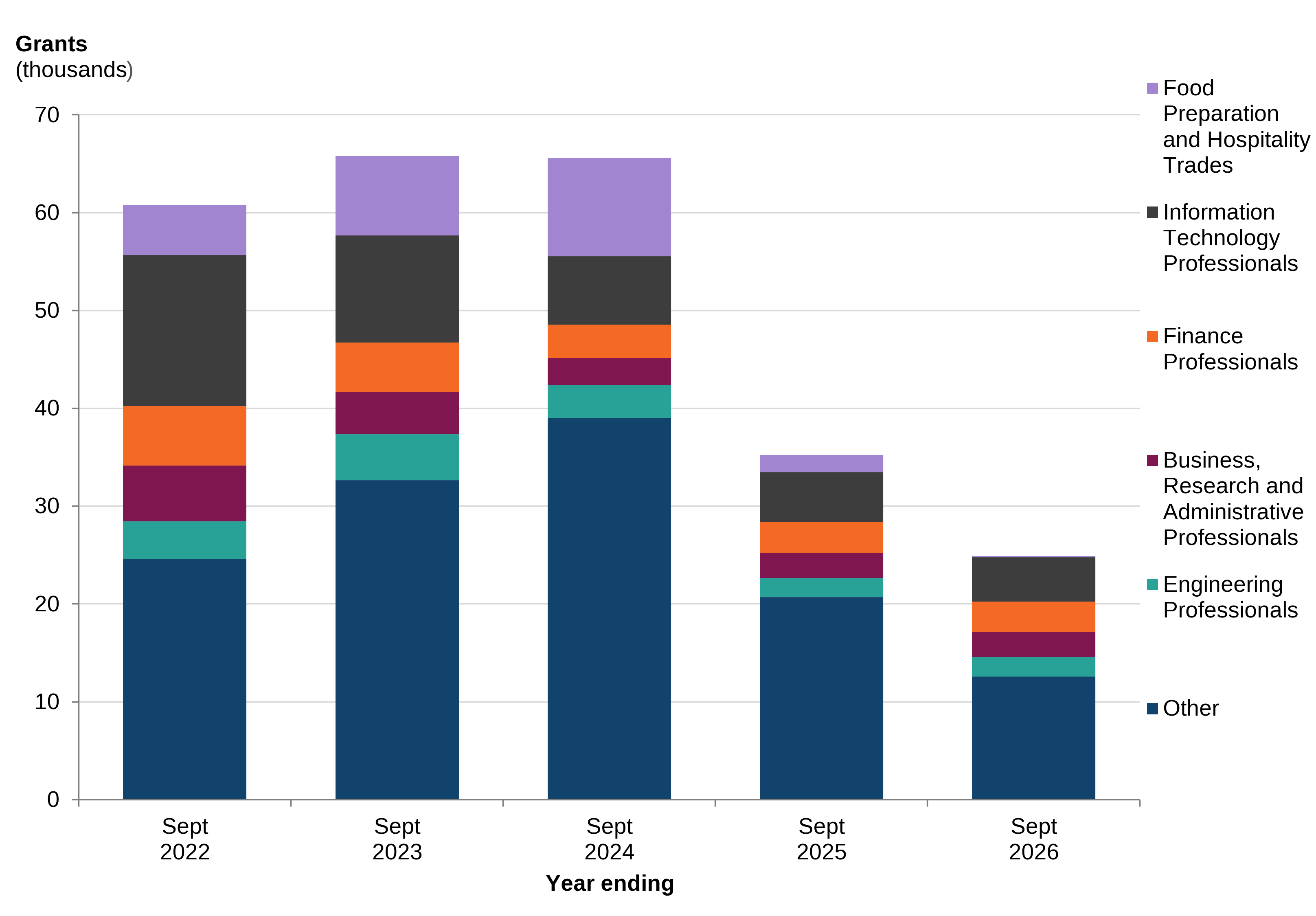
Compared to the previous year, visas granted for the Skilled Worker route decreased by 27% to 56,521 in the YE September 2026, of which main applicants and dependants fell to 25,046 (-29%) and 31,475 (-26%) respectively.
Decreases can be seen across a range of occupations, but the majority of the fall to main applicants in the latest year is accounted for by fewer grants for food preparation and hospitality trades - down 93% to 128. Visas granted for IT professionals decreased by 10% to 4,557 in the YE September 2026 compared to the previous year, which follows a longer-term decrease since the YE December 2022. However, IT professional remains the most common occupation for Skilled Worker main applicants.
Following increases to the skill level requirements, over 100 occupations are no longer eligible for the Skilled Worker visa route. Affected roles could no longer be sponsored on this route from 22 July 2025, leading to a reduced number of Skilled Worker applications and grants in the latest year.
Figure 4: Skilled Worker visas granted to main applicants by occupation, between the YE September 2022 and the YE September 2026
Source: Sponsored work visas by occupation and industry (SOC 2020) – Occ_D02
Notes:
- The occupations shown are those that have been among the main occupations in recent years
1.2 Temporary workers
The number of ‘Temporary Worker’ visas granted to main applicants has remained broadly stable over the last 3 years, with Seasonal Worker the most common route.
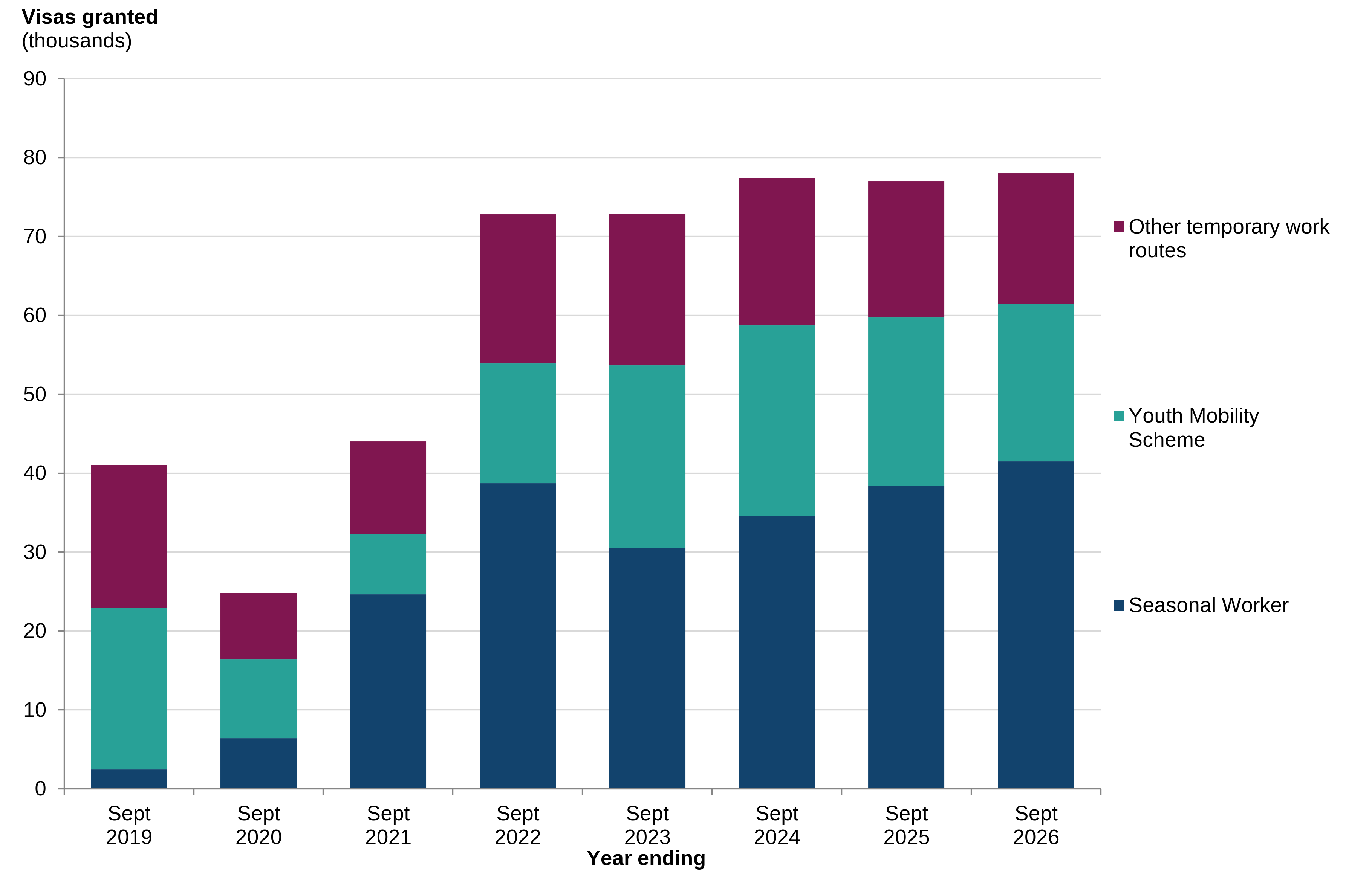
In the YE September 2026 there were 79,773 visas granted for ‘Temporary Workers’, similar to the previous year. Over half of ‘Temporary Worker’ visas granted (53%) were Seasonal Worker visas, 26% were Youth Mobility Scheme visas, and the remaining 21% were for other temporary work routes.
Figure 5: ‘Temporary Worker’ visas granted to main applicants, between the YE September 2019 and the YE September 2026
Source: Entry clearance visa applications and outcomes – Vis_D02
Figure 5 shows that there were 41,484 grants of Seasonal Worker visas in the YE September 2026, 8% higher than the previous year, continuing a year-on-year increase since YE September 2023. The Seasonal Worker route was launched in March 2019 with the number of visas that could be granted limited to 2,500 that year. The annual quota has since increased to 42,900 for 2026; of which 41,000 were for the horticulture sector and 1,900 were for the poultry production sector.
Central Asian nationalities (such as Kyrgyzstan, Tajikistan, Uzbekistan and Kazakhstan) together represent nearly four-fifths (79%) of Seasonal Worker visas granted in the YE September 2026. Ukrainian nationals were the largest recipients of Seasonal Worker visas prior to the start of the war in Ukraine and the launch of the Ukraine visa schemes in 2022, with 19,894 visas issued to Ukrainians in YE December 2021. Following the start of the war in the Ukraine, visas issued to Ukrainians have fallen, with 414 Seasonal Worker visas granted to Ukrainians in the YE September 2026.
There were 19,973 Youth Mobility Scheme visas granted in the YE September 2026 – 6% lower than the previous year. Australia was the most common nationality to be granted Youth Mobility Scheme visas, accounting for 39% of grants (7,738) in the latest year. Numbers also include the India Young Professionals Scheme, which held its first ballot in February 2023.
2. Work-related extensions
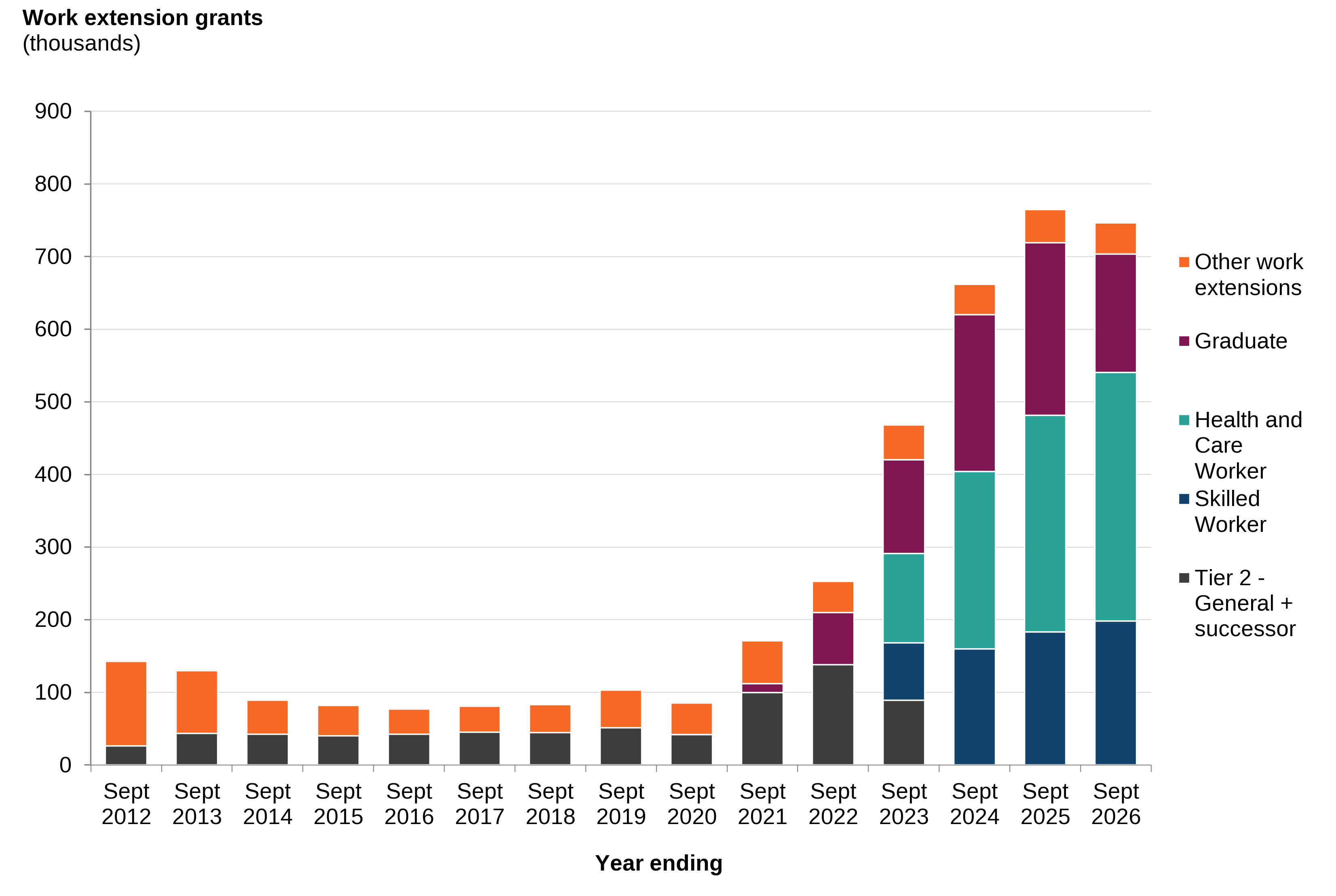
Work-related extension grants remained broadly stable in the YE September 2026, as increases in Skilled Worker and Health and Care Worker extensions largely offset a fall in Graduate route extensions.
Those extending onto a Work route include people who were previously on a work route extending their stay, as well as people on other routes (such as study) moving into the work route. In 2025, over half (57%) of individuals who were granted an extension of stay on a work route had previously held leave on a work route. A further 40% of individuals granted an extension of stay on a Work route in 2025 had previously held leave on a Study route. Most of these individuals transitioned from a Study visa to the Graduate route.
Figure 6: Work-related extension grants, by main subcategories of leave, between the YE September 2012 and the YE September 2026
Source: Extensions detailed tables – Exe_D01
Notes:
- The ‘Tier 2 - General and early points-based system successor’ subcategory includes Tier 2 (General) extension grants made before 2023, and Skilled Worker and Health and Care Worker extension grants made up to 2022, when these routes could not be separately identified in the administrative data.
- ‘Other work visa extensions’ represents the remaining work extension subcategories which are not shown separately in the chart.
The number of extensions of stay granted for work routes (including dependants) fell by 2% to 746,125 in the YE September 2026. While grants continued to increase on the Skilled Worker and Health and Care Worker routes, the slight decrease in work-related extensions largely reflected a 31% fall in Graduate route grants, to 162,881. This was primarily attributable to an 82% decrease in Graduate route grants to dependants from 67,670 to 12,371, while grants to main applicants also fell by 11% to 150,510.
The fall in Graduate route extension grants should be considered in the context of declining Student visa grants to both main applicants and dependants in recent years, alongside the January 2024 policy changes that restricted most students from bringing dependants to the UK. Indian (66,552), Pakistani (24,768) and Nigerian (20,478) nationals received the highest numbers of Graduate route extension grants in the YE September 2026. Together, these 3 nationalities accounted for 69% of all Graduate route grants.
In contrast to the Graduate route, Health and Care Worker extension grants rose by 15% in the YE September 2026, to 342,126. Skilled Worker extension grants also increased over the same period, by 8% to 198,442. These increases reflect the high numbers of entry clearance grants granted in 2022 and 2023, with many individuals who arrived during that period now seeking to extend their stay and continue working in the UK. Many of those extending their stay in the latest year are likely to have entered the UK before policy changes introduced from 2024 onwards that aimed to reduce migration through these routes.
Additional insights from the Migrant journey: 2025 report
Analysis from the Migrant journey: 2025 report shows that, in 2025, 30% of the work cohort that arrived in the UK 5 years earlier had been granted indefinite leave to remain. While this continues an upward trend, which can be observed since the 2015 cohort, it suggests that most workers do not remain in the UK on a permanent basis. Recent changes in work-related UK arrivals, including more skilled workers and changing demographics of those arriving, are likely to affect how many permanently stay in future years.
The proportion who remain, and are granted indefinite leave, varies by route, and is considerably higher for migrant workers coming on a ‘Tier 2 – General’ visa where, in 2025, 83% of individuals that arrived 5 years earlier held valid leave to remain or indefinite leave to remain. Temporary workers by the nature of their visa are less likely to stay long term, needing to obtain a new type of visa to do so. In 2025, 21% who arrived in 2020 on a ‘Temporary Worker’ visa still held leave 5 years later.
3. Other related data
The Home Office publishes the number of Skilled Worker and Health and Care Worker visa applications by month in the Monthly entry clearance visa applications publication.
The Home Office also publishes data on sponsors and sponsorship licensing on a quarterly basis as part of the Migration transparency data series.
The Office for National Statistics (ONS) publish long-term international migration estimates. These are statistics under development that estimate the number of people immigrating to and emigrating from the UK for 12 months or more.
4. About the statistics
The statistics in this section provide an indication of the number of people who have an intention to enter the UK for work reasons. Further information and definitions can be found in the user guide.
Entry clearance visas allow an individual to enter and stay in the UK within the period for which the visa is valid. Data in this section refers to the number of Entry clearance visas granted for work reasons within the period. If an individual was granted a visa more than once in a given period, this has been counted as multiple grants in the statistics.
Year-on-year comparisons of the number of decisions can be affected by quarterly fluctuations in the data. These fluctuations can be examined in the quarterly data in the published tables.
Extensions of temporary stay in the UK relate to individuals inside the UK extending or changing the status of their right to stay in the UK. An individual is required to apply for an extension or change in status before their existing permission to enter or stay in the UK expires.
The statistics on extensions in this chapter show the number of grants of applications, with data on refusals also available as part of the published extensions data tables. One individual may have made multiple applications for an extension, so may account for multiple decisions. Data in this section includes dependants and takes account of the outcomes of reconsiderations and appeals.
Before 2023, extensions granted under the Skilled Worker route were published as a single combined category, ‘Skilled Worker/ Health and Care Worker’. Since 2023, they have been reported separately as ‘Skilled Worker’ and ‘Health and Care Worker’ extensions.
5. Data tables
Data on immigration for work can be found in the following tables:
- Detailed occupation datasets
- Entry clearance visas summary tables
- Detailed entry clearance visas datasets
- Extensions summary tables
- Detailed extensions datasets
- Migrant journey: 2025 report
We welcome your feedback
If you have any comments or suggestions for the development of this report, please provide feedback by emailing MigrationStatsEnquiries@homeoffice.gov.uk. Please include the words ‘PUBLICATION FEEDBACK’ in the subject of your email.
We’re always looking to improve the accessibility of our documents. If you find any problems or have any feedback relating to accessibility, please email us.
See Section 6 of the ‘About this release’ section for more details.