Why do people come to the UK? Study
Published 26 November 2026

© Crown copyright 2026
This publication is licensed under the terms of the Open Government Licence v3.0 except where otherwise stated. To view this licence, visit nationalarchives.gov.uk/doc/open-government-licence/version/3 or write to the Information Policy Team, The National Archives, Kew, London TW9 4DU, or email: psi@nationalarchives.gov.uk.
Where we have identified any third party copyright information you will need to obtain permission from the copyright holders concerned.
This publication is available at https://www.gov.uk/government/statistics/immigration-system-statistics-year-ending-september-2026/why-do-people-come-to-the-uk-study
Back to ‘Immigration system statistics, year ending September 2026’ contents page
This release goes up to the year ending (YE) September 2026. The “year ending” period includes the 12 months up to and including the YE month. For example, YE September 2026 includes the 12 months between 1 October 2025 and 30 September 2026.
The study category refers to visas granting entry or extending permission to stay in the UK for reasons relating to study, including sponsored study, where a Confirmation of Acceptance of Studies (CAS) is required, and short-term students who are granted permission to come to the UK to study English for 6 to 11 months. Sponsored study visas make up the vast majority of all study permission granted, and are the primary focus of this topic.
Additional information is provided in the ‘About the statistics’ section and in the user guide.
1. Sponsored study visas
Sponsored study visa grants have continued to decrease over the last 3 years.
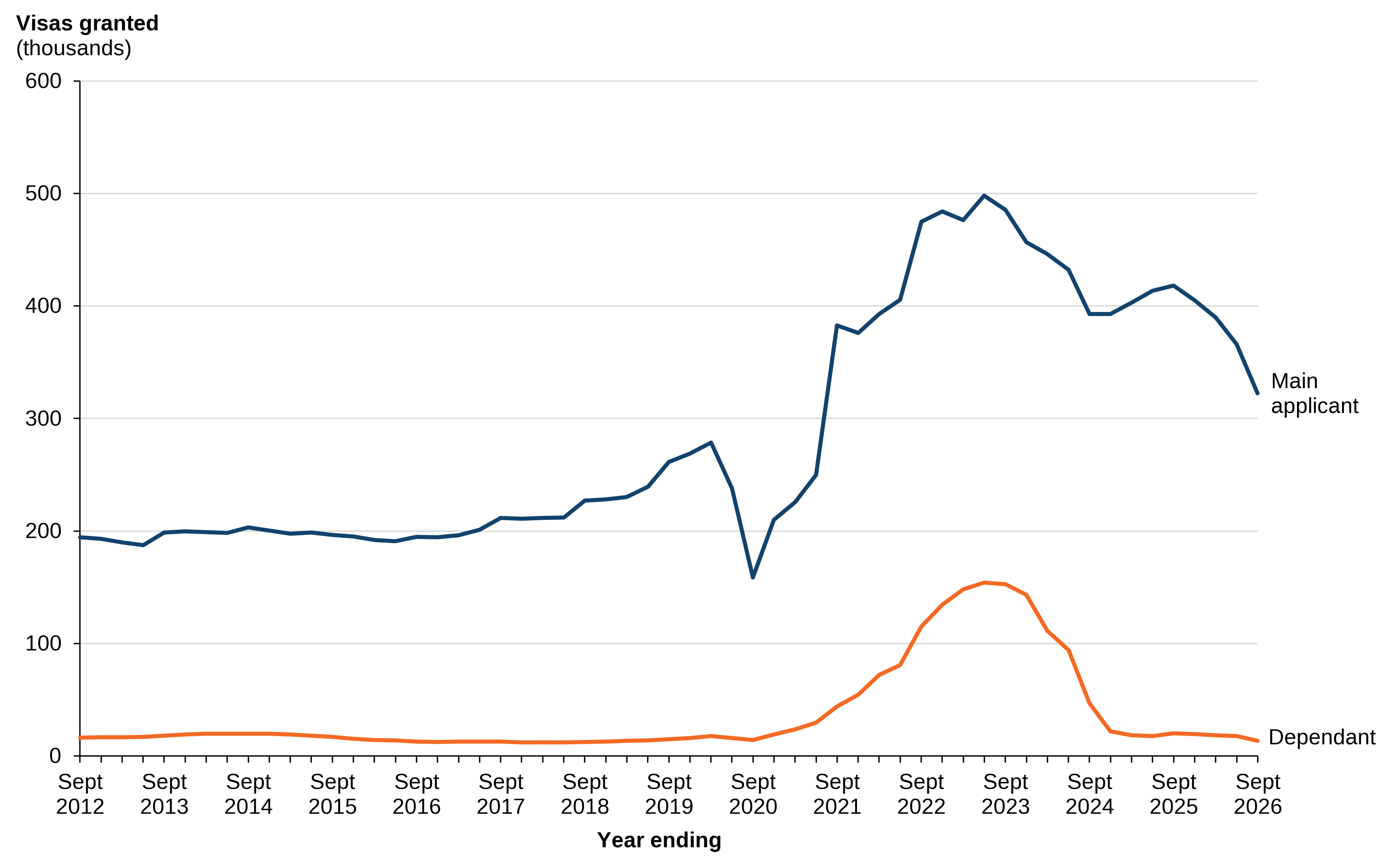
In the YE September 2026, there were 335,801 sponsored study visas grants, 23% less than the previous year, and 49% fewer than the peak in YE June 2023. The decrease in the latest year is predominantly due to fewer grants to main applicants, which fell 23% to 322,287. Grants to dependants have been relatively low since 2024, but have further decreased 33% in the latest year to 13,514.
Figure 1: Sponsored study visas granted by applicant type, YE September 2012 to YE September 2026
Source: Entry clearance visa applications and outcomes – Vis_D02
In January 2024, policy changes were made restricting most international students from bringing dependants. Sponsored study visa grants declined following this change, with falls observed to both main applicant and dependant visas. Grants to dependants dropped immediately following the policy changes and have since stabilised at a much lower level (YE September 2026 was 91% lower than the peak in the YE June 2023).
Since then, the UK government issued updated guidance, which came into effect in June 2026, introducing stricter sponsorship duties of UK higher education institutions. The Basic Compliance Assessment metrics have been tightened to make sure that the institution has a visa refusal rate of less than 5%, a course enrolment rate of at least 95% and a course completion rate of at least 85%, increasing to 90% in June 2027. The combination of the continued credibility checks and the higher onus on the institutions to accept only genuine applications has caused some higher education authorities to reduce their sponsorship in certain countries.
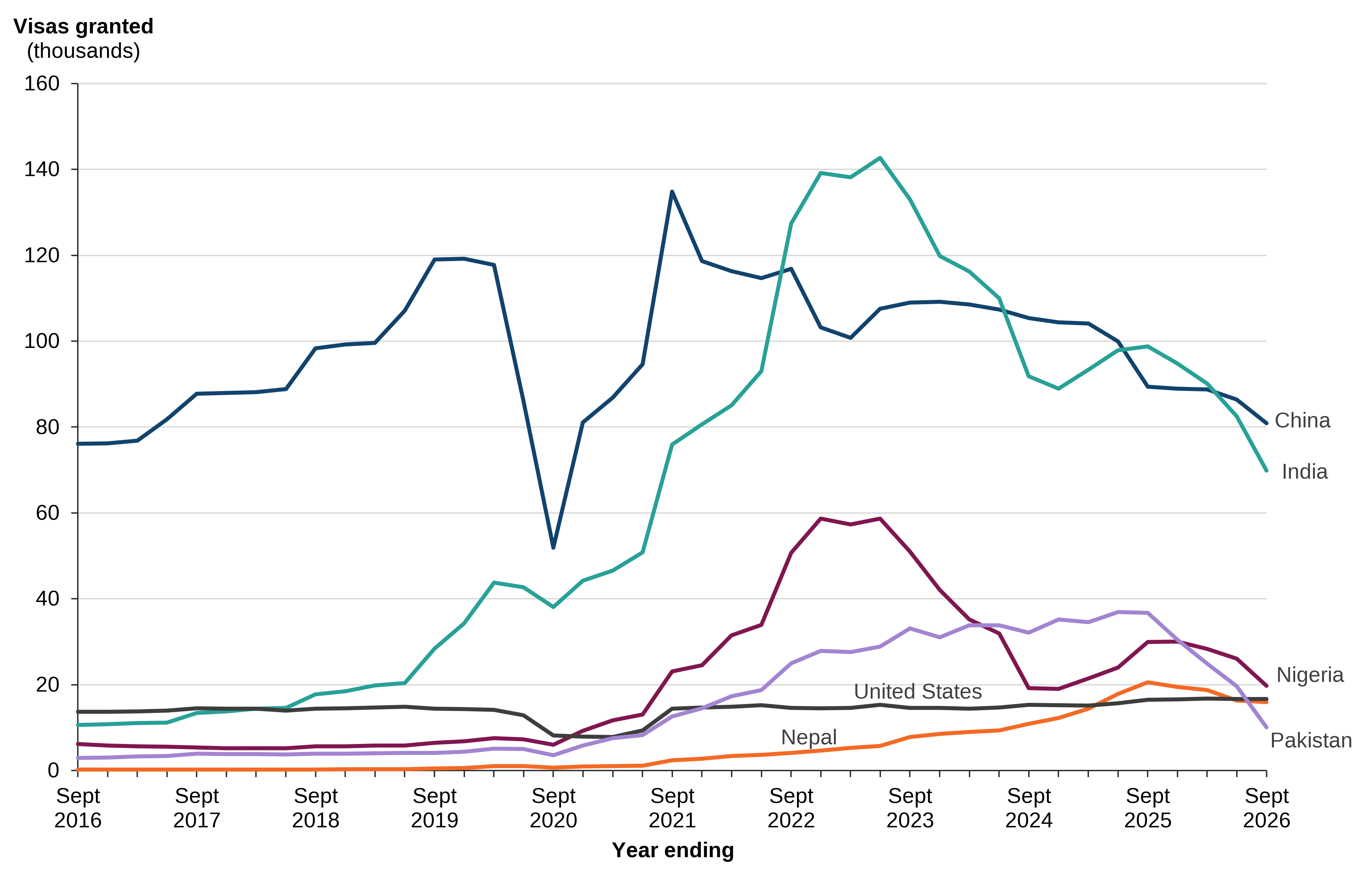
Figure 2: Sponsored study visas granted to the top 6 nationalities (main applicants), YE September 2016 to YE September 2026
Source: Entry clearance visa applications and outcomes – Vis_D02
Figure 2 shows Chinese students were the most common nationality being granted sponsored study visas in the YE September 2026, with 80,932 visas issued to main applicants (25% of the total). Indian students were the next most common nationality with 69,855 visas granted (22% of the total). The third most common nationality was Nigeria with 19,734 visas granted (6% of the total).
Notable year-on-year changes for individual nationalities in the latest year include decreases for Pakistani (down 72%), Nigerian (down 34%), Indian (down 29%) and Nepalese students (down 22%).
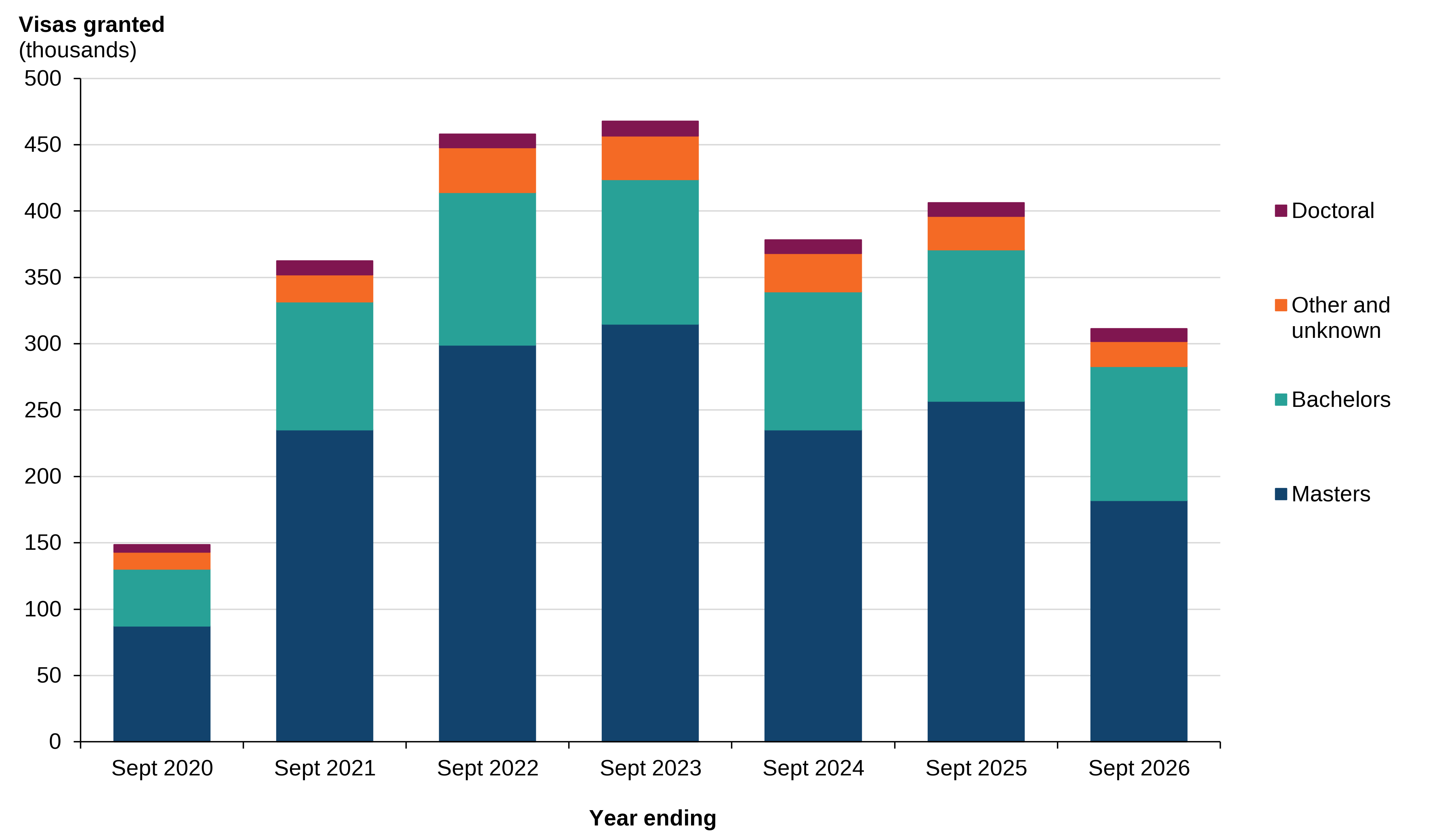
Figure 3: Student visas granted to main applicants by course level, YE September 2020 to YE September 2026
Source: Sponsored study visas by course level - Edu_D02
Notes:
- The legend is presented in the same order and orientation as the stacks in each bar.
- ‘Other and unknown’ includes visas issued to courses below bachelors level, pre-sessional English courses and courses not able to be identified.
- Does not include child student routes.
Figure 3 shows that the proportion of visas granted for masters level courses has dropped from 63% in the YE September 2025, to 58% in the YE September 2026. There were 181,920 visas granted for masters level, 29% fewer compared to the previous year. The number of grants to students coming to study at masters level increased each year following the pandemic and the UK leaving the EU, but subsequently fell between YE September 2023 and YE September 2026 - down 42% from 314,929. Visas for masters level study largely account for the rise and fall in sponsored study.
2. Study-related extensions
Sponsored study extension grants have continued to fall since YE March 2023, reflecting the decline in students granted entry clearance in recent years.
In the YE September 2026, there were 37,909 grants of extensions of stay in the UK to study, enabling individuals to continue their studies or, for those not previously studying, to switch onto a sponsored study route. This represented a 6% decrease from the YE September 2025. Data for YE December 2025 shows that 84% of study extensions were issued to people already on a study route, with 16% moving from other routes, predominantly work.
Chinese (9,144), Indian (5,346), and Nigerian (3,746) nationals were the most common nationalities extending their stay on the student route in the latest year. Together, these 3 nationalities accounted for nearly half (48%) of all sponsored study extensions, reflecting the higher numbers of these nationals granted study visas in recent years.
The Graduate route allows eligible international students who have successfully completed an eligible UK degree to remain in the UK for up to 2 years (3 years for PhD graduates) to work or look for work. It is categorised as a ‘work’ route within these statistics. Grants of extensions onto the Graduate route fell by 31% to 162,881 in the YE September 2026. The fall in Graduate route extension grants should be considered in the context of declining Student visa grants to both main applicants and dependants in recent years, alongside the January 2024 policy changes that restricted most students from bringing dependants to the UK.
Indian (66,552), Pakistani (24,768) and Nigerian (20,478) nationals were granted the highest numbers of Graduate route extensions in the YE September 2026. In line with the overall trend, extension grants for all 3 nationalities declined compared with the previous year.
2.1 Additional insights from the Migrant journey: 2025 report
The Migrant journey: 2025 report shows that amongst the 179,161 people whose journey started on a sponsored study visa in 2020, 41% still held valid or indefinite leave to remain at the end of 2025 (5 years later).
The recent increase in the proportion of students remaining in the UK 5 years after arrival largely reflects higher rates of transition from the Study route into Work routes. For cohorts arriving between 2011 and 2015, only 3% to 4% of students had moved into a Work route within 5 years. This proportion rose to 10% for the 2018 cohort, increased further to 14% for the 2019 cohort, and reached 26% for the 2020 cohort, the majority of whom were on the Skilled Worker route.
Historically, most students’ journeys finished at the end of their studies. Of those starting their studies between 2011 and 2018, around a third continued to hold valid leave after 3 years (decreasing to around 20% after 5 years). However, more recent student arrivals appear to be more likely to remain in the UK beyond their studies - with nearly 60% of students starting their studies in 2020 and 2021 holding valid leave after 3 years. This increased to 64% for the 2022 cohort.
3. About the statistics
The statistics in this section provide an indication of the number of people who have an intention to enter the UK for study reasons. Further information on the statistics in this section can be found in the user guide. Before 2021, due to freedom of movement for European Union (EU) nationals, most UK immigration control statistics related to non-European Economic Area (EEA) nationals. From 2021, unless otherwise stated, the statistics in this release relate to both EEA and non-EEA nationals.
Entry clearance visas allow an individual to enter and stay in the UK within the period for which the visa is valid. Data in this section refers to the number of Entry clearance visas granted for study reasons within the period. If an individual was granted a visa more than once in a given period, this has been counted as multiple grants in the statistics.
Year-on-year comparisons of the number of decisions can be affected by quarterly fluctuations in the data. These fluctuations can be examined in the quarterly data in the published tables.
3.1 Confirmation of Acceptance for Studies
In order to be granted a sponsored study visa, a main applicant must get a ‘Confirmation of Acceptance for Studies’ (CAS) from their educational provider as evidence of an unconditional offer to study a course with a licensed student sponsor. Around 9 in 10 sponsored study visa applications are for the Higher Education Sector (such as universities), which has accounted for most of the growth in students in recent years.
3.2 Extension of temporary stay in the UK
Extensions of temporary stay in the UK relate to individuals inside the UK extending or changing the status of their right to stay in the UK. An individual is required to apply for an extension or change in status before their existing permission to enter or stay in the UK expires.
The statistics in this section show the number of grants on applications for extension of temporary stay in the UK. One individual may have made multiple applications for an extension, so may account for multiple decisions. Data in this section accounts for the outcomes of reconsiderations and appeals. The statistics do not show the number of people applying to extend their temporary stay in the UK, nor do they show how long an individual stayed in the UK following their extension.
3.3 Other sources
The Home Office also publishes monthly updates on study applications, from 2022 onwards - see ‘Monthly statistical releases on migration’ for further information.
The Office for National Statistics (ONS) publish long-term international migration estimates. These are statistics under development that estimate the number of people immigrating to and emigrating from the UK for 12 months or more.
In January 2026, HESA published its latest ‘Higher Education Student Statistics UK’ for the academic year 2024 to 2025. HESA publishes data on new entrants to UK higher education providers for both EEA and non-EEA nationals.
In December 2025, the Migration Advisory Committee (MAC) published their sixth annual report. This report includes analysis of how the immigration system is being used within and across the nations of the UK.
4. Data tables
Data on student immigration can be found in the following tables:
- Entry clearance visas summary tables
- Detailed Entry clearance visa datasets
- Sponsorship summary tables
- Detailed sponsorship datasets
- Detailed education datasets
- Admissions summary tables
- Extensions summary tables
- Detailed extensions datasets
- Migrant journey summary tables
- Migrant journey: 2025 dataset
We welcome your feedback
If you have any comments or suggestions for the development of this report, please provide feedback by emailing MigrationStatsEnquiries@homeoffice.gov.uk. Please include the words ‘PUBLICATION FEEDBACK’ in the subject of your email.
We’re always looking to improve the accessibility of our documents. If you find any problems or have any feedback relating to accessibility, please email us.
See Section 6 of the ‘About this release’ section for more details.