Why do people come to the UK? Family
Published 27 August 2026

© Crown copyright 2026
This publication is licensed under the terms of the Open Government Licence v3.0 except where otherwise stated. To view this licence, visit nationalarchives.gov.uk/doc/open-government-licence/version/3 or write to the Information Policy Team, The National Archives, Kew, London TW9 4DU, or email: psi@nationalarchives.gov.uk.
Where we have identified any third party copyright information you will need to obtain permission from the copyright holders concerned.
This publication is available at https://www.gov.uk/government/statistics/immigration-system-statistics-year-ending-june-2026/why-do-people-come-to-the-uk-family
Back to ‘Immigration system statistics, year ending June 2026’ contents page
This release goes up to the year ending (YE) June 2026. The “year ending” period includes the 12 months up to and including the YE month. For example, YE June 2026 includes the 12 months between 1 July 2025 and 30 June 2026.
Statistics on dependants travelling with or joining family members on work and study visas are not included in this section and can be found in the relevant ‘Why do people come to the UK - Work?’, and ‘Why do people come to the UK - Study?’ topics.
1. Family-related visas
Family-related visas may be granted to persons wishing to live with family members, who are British citizens or non-British settled migrants in the UK, as part of their family. This will include people coming to marry or live with their partner or relative, and people wishing to join a relative with refugee status or humanitarian protection in the UK.
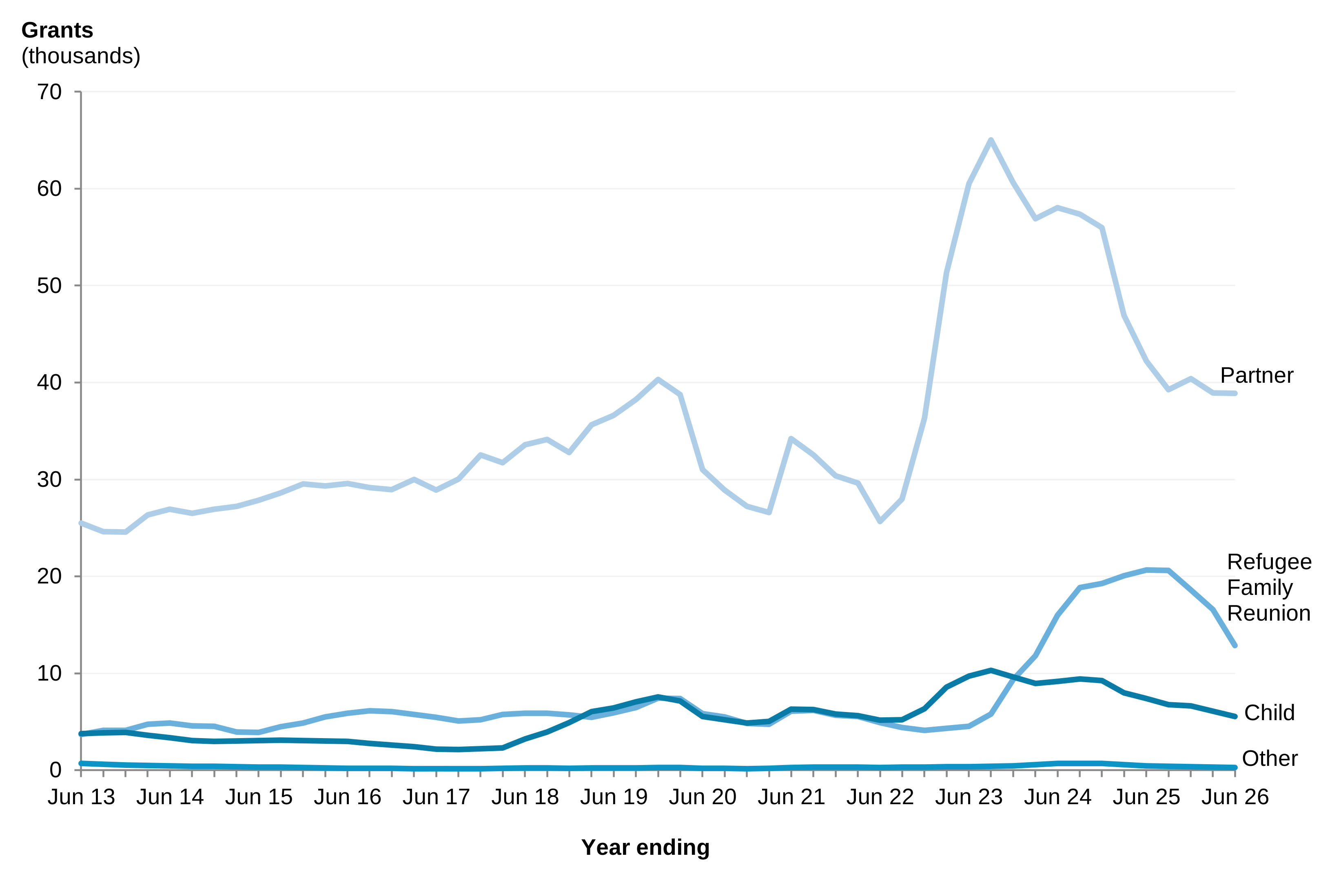
Family visa grants declined in the YE June 2026, largely due to a fall in Refugee Family Reunion grants, following the temporary suspension of new applications from September 2025.
Figure 1: Family-related visa grants by visa type, YE June 2013 to YE June 2026
Source: Entry clearance visa grants: Vis_D02
In the YE June 2026, 57,590 Family visas were granted, a 19% decrease compared with the YE June 2025. Although grants fell across all Family visa routes over the latest year, the overall decline was largely driven by a 38% decrease in Refugee Family Reunion grants, which fell from 20,643 in the previous year to 12,888 in the latest year.
Between late 2023 and early September 2025, Refugee Family Reunion grants increased relative to historic levels. The increase followed a high number of individuals granted refugee status over this period, who became eligible to sponsor partners and children to join them in the UK under the Refugee Family Reunion route.
In September 2025, the UK Government announced an immediate temporary suspension of new applications to the route, see Appendix Family Reunion (Sponsors with Protection). Following the suspension, Refugee Family Reunion grants have declined. The grants issued since the suspension primarily relate to applications submitted beforehand, alongside cases concluded following the appeals process. For further details on the Refugee Family Reunion route, see Section 3: About these statistics - Refugee Family Reunion and How many people come to the UK via safe and legal (humanitarian) routes?
In addition to the decline in Refugee Family Reunion grants, Partner visa grants also fell by 8% in the YE June 2026, to 38,902. As the largest Family visa route for grants, the latest year fall has also contributed to the overall decline in Family visa grants.
Partner visa grants increased between 2021 and 2024, contributing to higher overall volumes of Family visa grants. The increase in Partner visas between 2022 and 2023 reflected efforts to reduce casework backlogs after resources that had been reallocated to support the Ukraine schemes in early 2022 returned to Family casework. Following the announcement that the minimum income requirement for UK-based sponsors would increase from £18,600 to £29,000 from April 2024, there was a temporary increase in applications and subsequent grants between 2023 and early 2024. Grants then declined following the introduction of the higher income threshold, before stabilising in recent quarters (see Figure 1).
Since the temporary suspension of new applications under Appendix Family Reunion (Sponsors with Protection) in September 2025, eligible applicants who would otherwise have applied under the Refugee Family Reunion route, may instead be able to apply under Appendix FM: family members, including the Partner route.
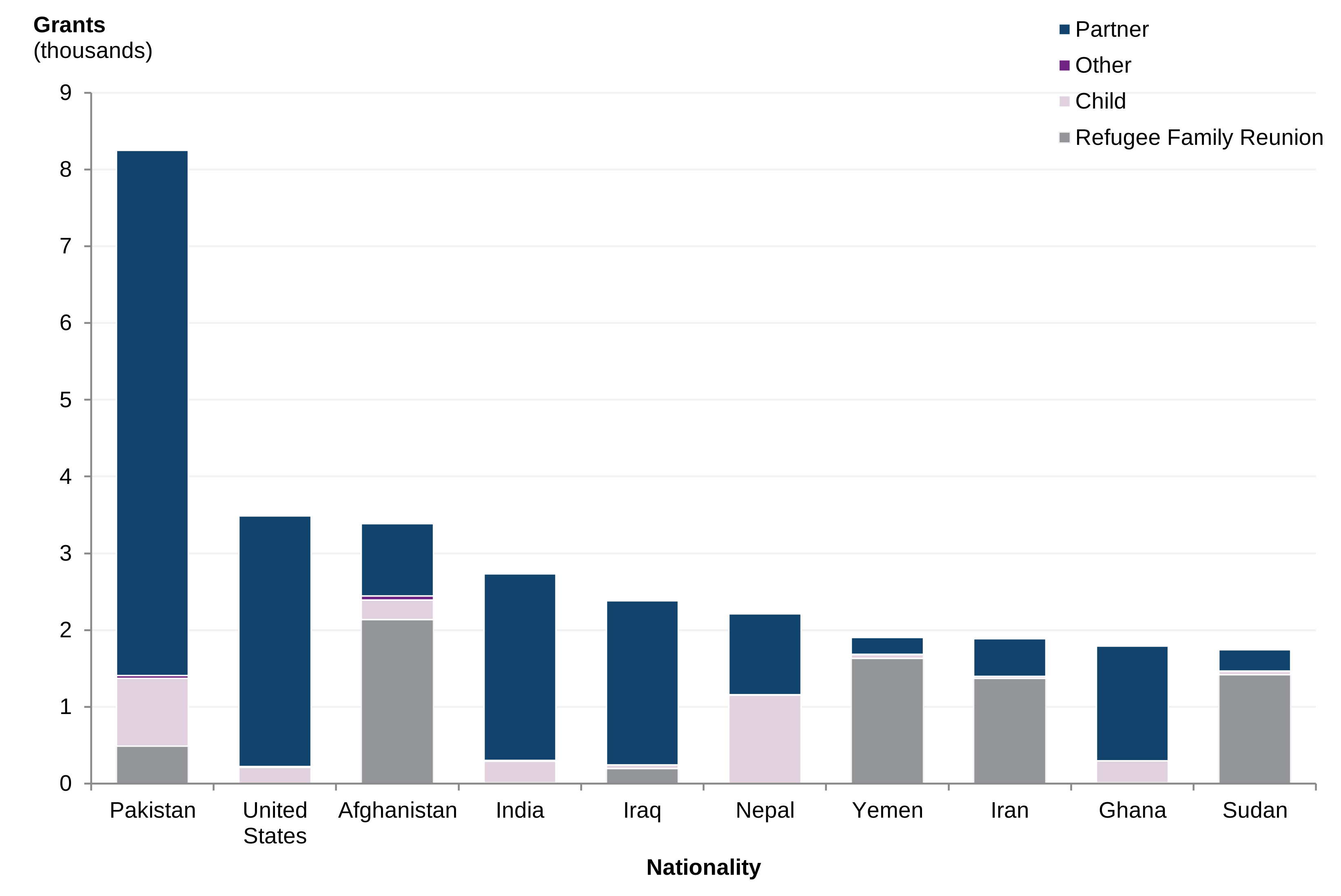
Pakistani nationals remained the largest nationality group granted a Family visa in the YE June 2026, despite a 14% fall in the latest year.
Figure 2: Top 10 nationalities for family-related visas granted, by family visa type, YE June 2026
Source: Entry clearance visa outcomes: Vis_D02
Pakistani nationals were granted the highest number of Family visas in the YE June 2026 (8,251), despite grants falling by 14% compared with the previous year. Over 80% of Family visas granted to Pakistani nationals were issued under the Partner route.
United States nationals were the second largest nationality group for Family visa grants, with 94% of grants issued under the Partner route. Unlike most of the largest nationality groups, United States nationals saw an increase (up 16%) in Family visa grants in the latest year.
Nepali nationals continued to account for a high proportion of Child visa grants, reflecting the Gurkha Settlement policy provisions, that extend settlement eligibility to pre-1997 Gurkha and Hong Kong military unit veterans and their families, in recognition of their historic service to the UK.
EU Settlement Scheme (EUSS) Family Permits
In the YE June 2026, 7,012 EUSS Family Permits were granted, 22% fewer than in the YE June 2025. This continued the downward trend observed since 2021. These permits allow eligible family members of an EEA or qualifying British citizen (if applied for by 8 August 2023) to join or accompany them in the UK. For further information on EUSS Family Permits, see Section 3: About these statistics - EU/EEA nationals and ‘How many Indefinite Leave (Settlement and EUSS settled status) grants have been issued in the UK?’
2. Extensions for family reasons
Extensions of stay for family-related reasons relate to extensions where an individual is applying based on their relationship to a person settled in the UK or a British citizen. An individual is required to apply for an extension before their existing permission to enter or stay expires and may make more than one application in any given year.
Family-related extensions increased in the YE June 2026, driven by an increase in Partner extensions, although Family and Private Life route grants decreased.
2.1 Family-related extensions
There were 82,400 Family-related extensions granted in the YE June 2026, an increase of 46% compared with the YE June 2025. Nearly all Family visa extension grants were under the Partner route, with the increase likely reflecting the higher volume of people granted a Partner visa from late 2021 onwards who have gone on to extend their stay in the UK. While many of these grants relate to Partner visa holders extending their stay, the total also includes children granted further leave as dependants of a parent on the Partner route.
The latest previous category of leave data (Table Ext_D02) shows that over three-quarters of individuals (76%) extending their stay on a Family visa in 2025, previously held leave under a Family route. Work was the second most common previous category of leave, accounting for 16% of Family visa extensions.
2.2 Family and Private Life (Article 8)
There were 57,293 Family and Private Life grants in the YE June 2026, a fall of over a quarter compared with the YE June 2025. Nigerian, Indian and Pakistani nationals were issued the highest numbers of grants, together accounting for 42% of all Family and Private Life grants.
The Family and Private Life routes apply to individuals granted leave to remain, based on an established family or private life in the UK, where refusal would constitute a breach of their rights under Article 8 of the European Convention on Human Rights. Leave under both routes is typically granted for 30 months at a time, with individuals generally required to make multiple successful applications before becoming eligible for indefinite leave to remain, usually after around 10 years’ continuous residence. Extension statistics therefore include both an individual’s first grant of leave under these routes (where granted in-country) and subsequent applications to extend that permission.
Indefinite leave to remain: Migrant journey
Those arriving on Family routes are historically more likely to seek to remain permanently in the UK, and acquire indefinite leave to remain (ILR), compared with those arriving on Work and Study visas. Analysis from the Migrant journey: 2025 report shows that since 2008, of those whose first leave to enter the UK was on the Family route, 58% had ILR after 5 years, increasing to 81% after 10 years. This is much higher than individuals who started their journey on Work and Study routes, where 20% and 7% respectively held ILR after 10 years.
3. About these statistics
The statistics in this section provide an indication of the number of people who entered the UK for family-related reasons, together with the number granted an extension of stay on a family-related route. Year-on-year comparisons of decision volumes can be affected by quarterly fluctuations in the data. These fluctuations can be examined using the quarterly breakdowns in the published tables.
EU/EEA nationals
Before the end of the transition period following the UK’s exit from the EU on 31 December 2020, EU nationals were able to come to the UK under freedom of movement and did not typically require separate permission (such as a visa). As a result, most UK immigration control prior to 2021 was related to non-EEA nationals. From 2021, EEA nationals have become subject to immigration controls and are now more likely to obtain permission to travel to the UK. For many this will be under the EU Settlement Scheme (see ‘How many Indefinite Leave (Settlement and EUSS settled status) grants have been issued in the UK?’), while others will require a visa.
Entry clearance visas allow an individual to enter and stay in the UK within the period for which the visa is valid. From 2021, EEA nationals generally require a visa to enter the UK for family reasons, unless they are eligible for the EU Settlement Scheme or an EU Settlement Scheme family permit.
The EUSS Family Permit is a free travel document for non-EU family members of EU, EEA, or Swiss citizens who want to join them in the UK. It allows entry to the UK for up to 6 months, during which you must apply to the EU Settlement Scheme for longer-term status.
For figures on family-related grants of settlement, as well as the residence documentation issued to EEA nationals and their family members, see ‘How many Indefinite Leave (Settlement and EUSS settled status) grants have been issued in the UK?’
Refugee Family Reunion
The UK government has announced a temporary suspension of new applications for Family Reunion under Appendix Family Reunion (Sponsors with Protection), effective from 4 September 2025. Existing applications and outstanding appeal cases submitted before the suspension continue to progress. This decision is part of a broader review of family migration policy to ensure fairness and manageability. Families can still apply through other routes, such as the Appendix FM, Appendix Child Relative, and Adult Dependant Relative routes.
Applications submitted before 4 September 2025 may still appear in the data in the following months. This is because applicants have up to 240 days to attend a Visa Application Centre and provide their biometrics. An application is only counted in the statistics once biometrics have been taken.
More information about the statistics can be found in the user guide.
3.1 Extension of temporary stay in the UK
Extensions of temporary stay in the UK relate to individuals inside the UK extending or changing the status of their right to stay in the UK. An individual is required to apply for an extension or change in status before their existing permission to enter or stay in the UK expires.
The statistics do not show the number of people applying to extend their temporary stay in the UK, nor do they show how long an individual stayed in the UK following their extension.
Family and Private Life cases
From quarter 2 2025 (April to June) onwards, all case decisions categorised as either a Family Life or Private Life route have been aggregated in the extensions dataset and are now reported under a new combined leave group, ‘Family and Private Life’.
Further information on the statistics in this section can be found in the extension section of the user guide.
3.2 Other sources
The Home Office also publishes monthly updates on applications for family visas, from 2022 onwards - see ‘Monthly statistical releases on migration’ for further information.
The Office for National Statistics (ONS) publish long-term international migration estimates. These are statistics under development that estimate the number of people immigrating to and emigrating from the UK for 12 months or more.
4. Data tables
Data on family immigration can be found in the following tables:
- Entry clearance visa summary tables
- Detailed entry clearance visa datasets
- Extensions summary tables
- Detailed Extensions datasets
We welcome your feedback
If you have any comments or suggestions for the development of this report, please provide feedback by emailing MigrationStatsEnquiries@homeoffice.gov.uk. Please include the words ‘PUBLICATION FEEDBACK’ in the subject of your email.
We’re always looking to improve the accessibility of our documents. If you find any problems or have any feedback relating to accessibility, please email us.
See Section 6 of the ‘About this release’ section for more details.