How many people are in the UK asylum system?
Published 27 August 2026

© Crown copyright 2026
This publication is licensed under the terms of the Open Government Licence v3.0 except where otherwise stated. To view this licence, visit nationalarchives.gov.uk/doc/open-government-licence/version/3 or write to the Information Policy Team, The National Archives, Kew, London TW9 4DU, or email: psi@nationalarchives.gov.uk.
Where we have identified any third party copyright information you will need to obtain permission from the copyright holders concerned.
This publication is available at https://www.gov.uk/government/statistics/immigration-system-statistics-year-ending-june-2026/how-many-people-are-in-the-uk-asylum-system
Back to ‘Immigration system statistics, year ending June 2026’ contents page
This release goes up to the year ending (YE) June 2026. The “year ending” period includes the 12 months up to and including the YE month. For example, YE June 2026 includes the 12 months between 1 July 2025 and 30 June 2026.
An asylum claim marks an individual’s entry into the UK asylum system. Following a claim, people may spend time in the system awaiting an initial decision and, where eligible, may receive accommodation or financial support. Outcomes on a claim may include a grant of protection or other leave, a refusal, or other outcomes such as a withdrawal or an administrative outcome, with some claimants able to appeal following a decision.
An asylum claim may relate to more than one person, if the main applicant has family members (dependants) who are included in the same claim.
These statistics focus on the number of people (main applicants and dependants) claiming asylum. The number of main applicants (excluding dependants) represents the total number of asylum cases that require consideration by the Home Office.
Statistics on other parts of the asylum system are available in other chapters of this report - ‘How many people claim asylum in the UK?’ and ‘How many people are granted asylum in the UK?’.
1. How many people are awaiting an initial decision?
The number of people awaiting an initial decision has more than halved in the past year.
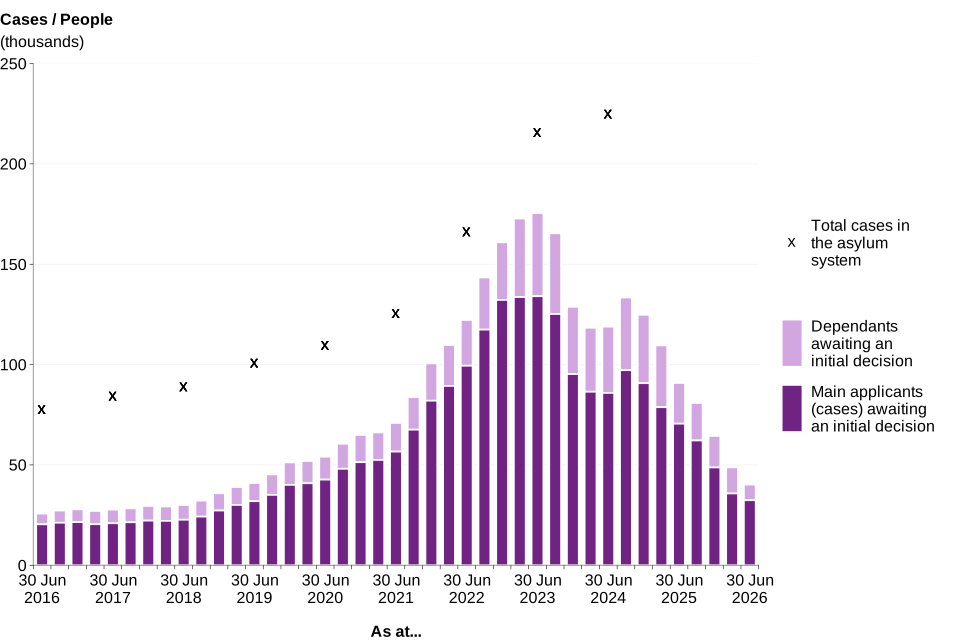
At the end of June 2026 there were 40,168 people (relating to 32,401 cases) awaiting an initial decision, 56% less than at the end of June 2025 and the lowest level since June 2019.
The fall in people awaiting an initial decision, despite the number of people entering the system (that is, claiming asylum) being higher than levels seen in the decade to 2021, corresponds to a notable and sustained increase in initial decisions in recent years.
Figure 1: Number of people and cases awaiting an initial decision and number of cases in the asylum system, as at 30 June 2016 to as at 30 June 20261, 2
Source: Asylum claims awaiting a decision – Asy_D03 and Migration Transparency Data collection – ASY_03
Notes:
- The total number of cases in the asylum system (WIP – work in progress) relates to both those awaiting an initial decision and those who have appealed and are waiting for a further outcome. Statistics on the full asylum WIP are published in table ASY_03 of the Immigration and Protection transparency data and relates to main applicants only.
- Figures relate to the number of cases or people awaiting a decision at the end of the period, rather than the total throughout the period.
Figure 1 shows that the number of people awaiting an initial decision is at the lowest level since June 2019, falling by 77% from the June 2023 peak of 175,457. However, this remains higher than between 2010 and 2018, where the number of people waiting for a decision grew from 7,240 in December 2010 to 35,855 in December 2018.
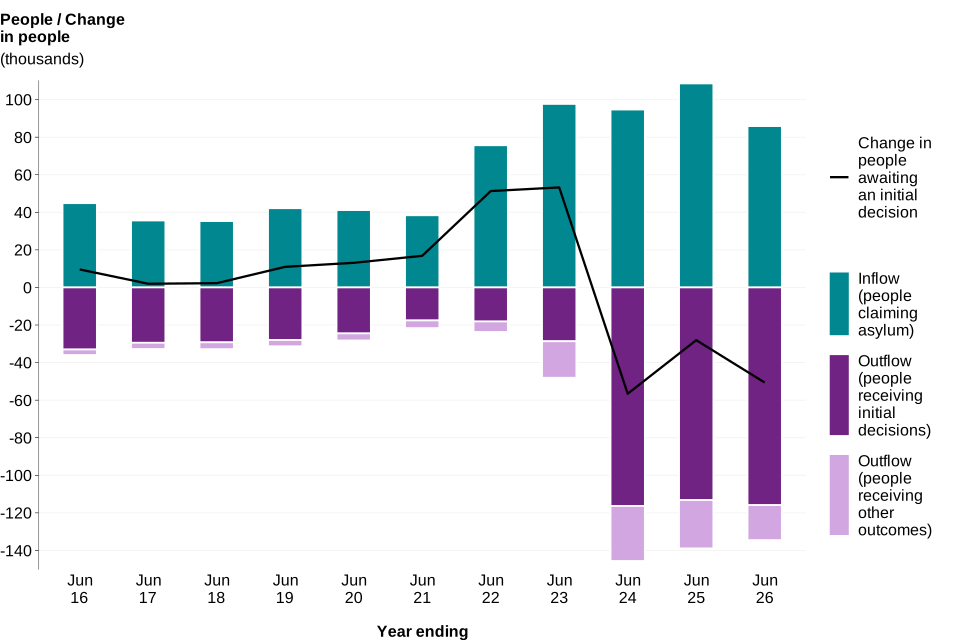
Figure 2: People claiming asylum, receiving initial decisions, receiving other outcomes, and changes in the number of people awaiting an initial decision, YE June 2016 to YE June 20261
Notes:
- Claims, initial decisions (grants and refusals) and other outcomes (withdrawals and administrative outcomes) are based on the year they occurred in, while the change in the number of people awaiting an initial decision is calculated as the difference between the year-end total and the total at the end of the previous year.
Figure 2 shows annual inflows (people claiming asylum) and outflows (people receiving initial decisions or other outcomes) in the UK asylum system. The black line on the chart plots the net change in the number of people awaiting an initial decision each year.
The number of people claiming asylum increased between the YE June 2021 and the YE June 2023. This led to an increase in the number of people awaiting an initial decision because there was a comparatively low number of initial decisions until the YE June 2024. The increase in the number of decisions from the YE June 2024 was due to a combination of factors, including an increase in the number of asylum decision makers, and improvements in decision maker productivity.
Initial decisions could not be made for many asylum claims made on or after 7 March 2023 because they were put on hold under the terms of the Illegal Migration Act. The Home Secretary laid a statutory instrument to remove the retrospective application of the Act on 22 July 2024. Since decision making fully resumed in October to December 2024, the number of people awaiting an initial decision has decreased each quarter.
2. How many asylum cases are in the overall asylum casework system?
In addition to those awaiting an initial decision, the asylum casework system includes cases who have appealed their initial decision and are awaiting a further outcome, as well as failed asylum seekers who are subject to removal from the UK.
The latest available figures from June 2024 show a record high number of cases in the asylum system, with over half of cases having received an initial decision but awaiting further action (such as an appeal).
The number of cases in the asylum system increased more than fourfold over the decade to June 2024, from 55,814 at the end of June 2014 to 224,742 at the end of June 2024 (as shown in Figure 1). Of these, 40% of cases were awaiting an initial decision, whilst the remaining cases will be those awaiting an appeal outcome or removal from the UK. The total number of cases is published in table ASY_03 of Immigration and protection data, as part of the ‘Migration transparency data’.
For further information on appeals, see the latest tribunal statistics from HM Courts and Tribunal Service (HMCTS), and for asylum-related returns see the ‘Returns summary tables’. HMCTS-published data shows that the open Asylum/Protection/Revocation of Protection caseload in the First-tier Tribunal (Immigration and Asylum Chamber) has increased from 6,319 at the end of June 2022 to 87,450 at the end of March 2026 (latest available data at time of publication).
A breakdown on the number of cases awaiting an appeal outcome and awaiting removal is not currently available beyond June 2024 due to work on the transition to a new caseworking system, though work is ongoing to reinstate the data and figures. Once reporting resumes, future publications should be able to provide disaggregated figures.
3. How many asylum seekers are receiving housing and financial support?
People in the asylum system who are destitute can receive support from the UK Government. This support could be the provision of accommodation, subsistence (cash support) or both, and is overseen by the Home Office. More information on asylum support is published on GOV.UK.
At the end of June 2026, the number of individuals in receipt of asylum support was lower than a year prior and there were also fewer people in hotels than a year prior.
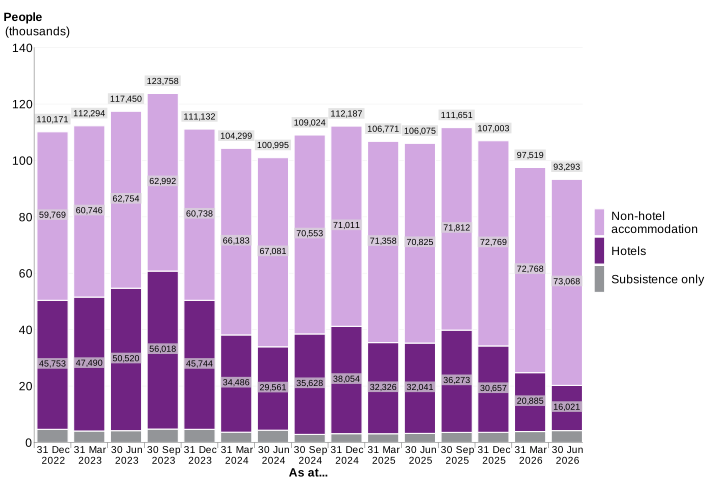
At the end of June 2026, there were 93,293 individuals in receipt of asylum support. This was 12% lower than the end of June 2025 and 25% fewer than at the end of September 2023, when the number of supported asylum seekers peaked at 123,758 people.
Figure 3: Number of people in receipt of asylum support, by the type of support, as at 31 December 2022 to as at 30 June 20261
Source: Asylum seekers in receipt of support – Asy_D09
Notes:
- ‘Non-hotel accommodation’ includes initial, other contingency, dispersal and other accommodation.
Of the individuals receiving asylum support at the end of June 2026:
- 16,021 (17%) were in hotel accommodation, 50% lower than at the end of June 2025, and 71% lower than the peak of 56,018 at the end of September 2023
- 73,068 (78%) were in non-hotel accommodation, such as dispersal, 3% higher than at the end of June 2025
- 4,204 (5%) were in receipt of subsistence support only, 31% higher than at the end of June 2025
A decade prior on 30 June 2016, there were less than half as many supported asylum seekers (42,651) compared to 30 June 2026. The number of supported asylum seekers rose to 50,898 at the end of June 2020 before rising to a peak of 123,758 at the end of September 2023 following an increase in the number of people in the asylum system.
At the end of June 2026, 40,168 people were awaiting an initial decision and 93,293 people were receiving asylum support. This indicates that most people receiving asylum support are in other parts of the asylum system, such as awaiting the outcome of appeals or failed asylum seekers.
At the end of June 2026, 5% (4,987) of people receiving asylum support were doing so under Section 4 of the Immigration and Asylum Act 1999. This is available when an asylum application has been finally determined as refused, or declared inadmissible, but the applicant is destitute and there are reasons that temporarily prevent them from leaving the UK. The remaining 95% (88,306) of people receiving asylum support were doing so under either Section 95 or Section 98 of the same Act, where the vast majority are awaiting the outcome of an asylum claim or an appeal.
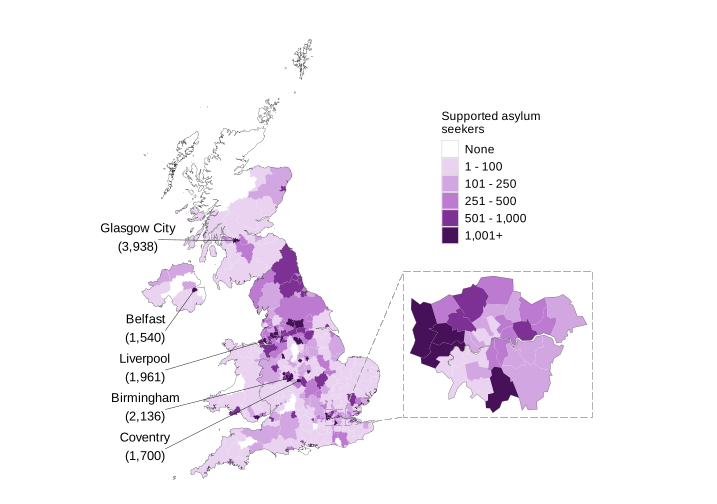
There were 13 supported asylum seekers per 10,000 residents of the UK at the end of June 2026. The regions with the most supported asylum seekers as a proportion of their overall population were the North East and North West of England, with 26 and 24 supported people per 10,000 residents respectively.
The local authorities with the highest numbers of supported asylum seekers within them were Glasgow City (3,938), Birmingham (2,136), Liverpool (1,961), Coventry (1,700) and Belfast (1,540). Of 361 local authorities, approximately half (182) had fewer than 100 supported asylum seekers.
The Home Office uses former military sites as part of the government’s commitment to stop using hotels. At the end of June 2026, 744 people were in Wethersfield, Braintree, and 418 people were in Crowborough Training Camp, Wealden. Factsheets on asylum accommodation at military sites are published on GOV.UK.
Figure 4: Supported asylum seekers, by local authority as at 30 June 20261, 2, 3
Source: Asy_D11 – Asylum seekers in receipt of support by local authority and Office for National Statistics licensed under the Open Government Licence v.3.0
Contains OS data © Crown copyright and database right 2026.
Notes:
- Includes main applicants and dependants.
- Figures show the number of supported asylum seekers for the 5 local authorities with the highest number of supported asylum seekers.
- Local authority data is based on the registered address of the asylum seeker. This is not necessarily the location at which the individual regularly resides.
The number of asylum seekers in receipt of support exclude unaccompanied asylum-seeking children (UASC), who are supported by local authorities.
In addition to supported asylum seekers, some of the people who have come to the UK on safe and legal (humanitarian) routes will be accommodated in local authorities (for example, resettled individuals). More detail is available in table Res_D01 of the Resettlement data tables and table Reg_02 of the Regional and local authority data on immigration groups.
4. Data tables and further links
Data referred to here can be found in the following tables:
- Asylum summary tables
- Detailed asylum datasets
- Detailed resettlement datasets
- Migration transparency data
- Regional and local authority data on immigration groups
We welcome your feedback
If you have any comments or suggestions for the development of this report, please provide feedback by emailing ‘MigrationStatsEnquiries@homeoffice.gov.uk’. Please include the words ‘PUBLICATION FEEDBACK’ in the subject of your email.
We’re always looking to improve the accessibility of our documents. If you find any problems or have any feedback relating to accessibility, please email us.
See Section 6 of the ‘About this release’ section for more details.