Affordable housing supply in England: 2024 to 2025
Published 20 November 2025
Applies to England

© Crown copyright 2025
This publication is licensed under the terms of the Open Government Licence v3.0 except where otherwise stated. To view this licence, visit nationalarchives.gov.uk/doc/open-government-licence/version/3 or write to the Information Policy Team, The National Archives, Kew, London TW9 4DU, or email: psi@nationalarchives.gov.uk.
Where we have identified any third party copyright information you will need to obtain permission from the copyright holders concerned.
This publication is available at https://www.gov.uk/government/statistics/affordable-housing-supply-in-england-2024-to-2025/affordable-housing-supply-in-england-2024-to-2025
1. Key statistics
64,762 affordable homes delivered (completions) in England in 2024-25, an increase of 1% compared to the previous year and the highest delivery since 2014-15
12,198 of all new affordable housing completions were for social rent, the highest value since 2013-14
66% of all new affordable housing completions were for rent (including social, affordable and intermediate rent), similar to the previous 6 years
92% of affordable homes delivered in England were new build (excluding unknowns), similar to the previous three years
10,480 or 16% of all new affordable housing completions were delivered by local authorities, the highest recorded value in the available period (since 1991-92)
45,418 starts on site in England in 2024-25, a 3% increase compared to the previous year but the second lowest value on record for comparable years (2016-17 onwards)
4,522 starts on site in London in 2024-25, a 51% increase compared to the previous year but considerably lower than the 26,386 starts on site in the region reported in 2022-23
Release date: 20 November 2025
Lead Statistician: Miguel Marques dos Santos
Statistical queries: housing.statistics@communities.gov.uk
Media enquiries: 0303 444 1209 or NewsDesk@communities.gov.uk
The November 2025 Affordable Housing Supply statistical release does not include the 2024-25 data from the Traveller Caravan Count (TCC) due to delays in the quality assurance process. We expect to include that data in the scheduled revisions in June 2026. Between 2019-20 and 2023-24, the TCC recorded a total 52 new affordable housing pitches, an average of 10 new pitches per year.
2. Introduction
This release presents statistics on additional affordable housing supply in England. The estimates include new build and affordable housing providers’ acquisitions of private housing. Losses such as demolitions, sales to tenants and other sales are not included so the statistics included in this release show only new additions (or gross additions) to the affordable housing stock.
New affordable housing supply is defined as housing units (or bed spaces) provided to specified eligible households, whose needs are not met by the market, in addition to existing stock of affordable housing. Further details on the coverage of this release are given in the technical notes published alongside this bulletin. Affordable housing is defined in Annex 2 of of the National Planning Policy Framework.
Homes England (previously the Homes and Communities Agency) is responsible for the delivery of affordable housing in England, except London. They are responsible for increasing the number of new homes that are built in England, including affordable homes. The responsibility for affordable housing in London transferred to the Mayor of London in April 2012. This means that, since then, Homes England no longer administer or report on most affordable housing delivery in London, which is now the responsibility of the Greater London Authority.
Figures are presented for financial years ending 31 March and are presented unrounded, unless otherwise noted. They represent our best estimate at the time of publication and may be subject to revisions.
The live tables and open data will always represent the latest iteration of the data, including scheduled revisions.
2.1 Affordable housing and social housing
Data on new supply is collected on the basis of new affordable housing. The definitions of affordable and social housing overlap for the vast majority of properties, although there are a few differences. First Homes, an affordable housing tenure, does not count as social housing (tenure being the type of housing, such as social rent, affordable rent or shared ownership). There are also some other instances where social housing and affordable housing differ, particularly in intermediate rent and affordable home ownership tenures, but it is not possible to identify these instances in the underlying data.
Additionally, affordable housing owned by non-registered providers is not counted as social housing in the department’s statistical releases. The vast majority of social housing providers are registered with the Regulator of Social Housing and only these providers can apply for grant funding to provide low cost rental accommodation, such as social rent and affordable rent.
Because the data on new supply is collected for affordable housing only, for statistical purposes, an estimate of new social housing can be considered a subset of new affordable housing provided by local authorities, private registered providers and where there is no provider information (provider unknown) for all tenures excluding First Homes, but including units where the tenure is unknown.
Sections I and J of the Local Authority Housing Statistics (LAHS) are released along with this publication.
Section I covers data on the new supply of affordable housing, including delivery not reported by Homes England or the Greater London Authority, delivery in populations of less than 3,000 and financial information regarding section 106 contributions.
Section J covers starts on site not reported by Homes England or the Greater London Authority.
3. National trends in affordable housing supply
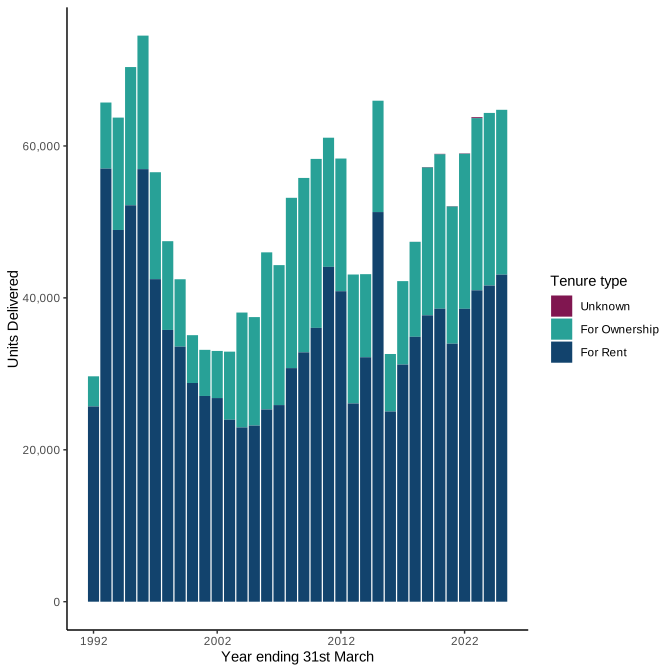
There were 64,762 affordable homes delivered in England in 2024-25, an increase of 1% compared with the previous year[footnote 1]. However, this is the highest number of completions since 2014-15, which was the end of the 2011-15 Affordable Homes Programme. This increase in completions follows the large number of starts at the end of the 2016-23 Affordable Homes Programme. These programmes provide government grant funding to housing providers in England to support the costs of delivering affordable homes. They are the government’s main programme of investment in affordable housing and they are delivered by Homes England and the Greater London Authority.
Chart 1: Affordable housing completions, England, 1991-92 to 2024-25
The data for this chart are available in Live Table 1000.
The number of affordable homes delivered can vary considerably from year to year. The supply of affordable housing is partly dependent on funding programmes, and as part of a house building cycle, delivery is normally lower in the first years of any new programme and increases to a peak around the end of a programme. The peak in 2014-15 is explained by the end of the 2011-15 Affordable Homes Programme and the increase in the number of completions since 2015-16 reflects the transition to the 2016-23 Affordable Homes Programme and later, the 2021-26 one.
Every year between 2015-16 and 2019-20 saw an increase in the delivery of affordable homes. The decrease in 2020-21 may be due, in large part, to the restrictions introduced during spring 2020 in response to the COVID-19 pandemic. The number of completions in 2021-22 was similar to completions in 2019-20, prior to the COVID-19 pandemic.
The relatively high level of completions since 2022-23 is likely due to the large number of starts at the end of the 2016-23 programme, as well as delivery under the current 2021-26 Affordable Homes Programme.
In 2024-25, there were 43,058 new affordable homes for rent [footnote 2], 3% higher than the 41,623 in the previous year and the highest value since 2014-15. The share of new affordable homes that are for rent was 66%, similar to the previous 6 years but lower than between 2013-14 to 2017-18 when it varied between 74% and 78%.
3.1 Delivery of new affordable housing by tenure
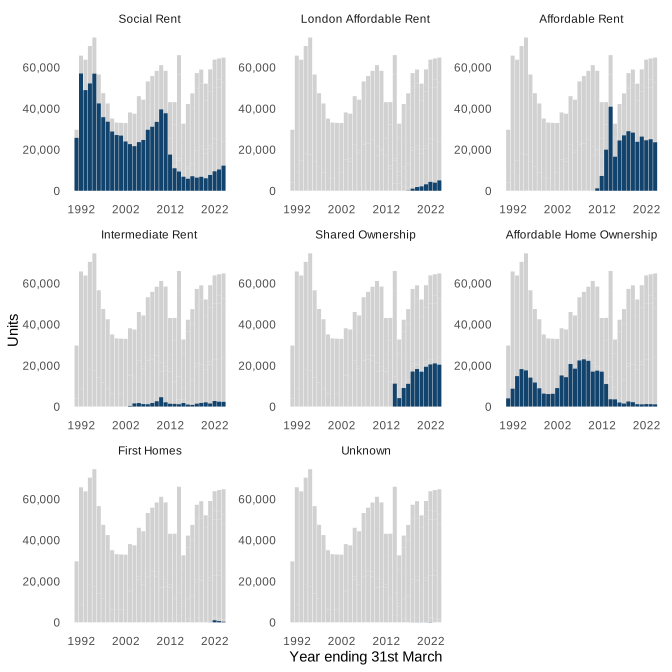
As shown in Chart 2 below, there have been changes in the mix of different tenures of affordable housing. Up to 2011-12, social rent was the most common affordable housing tenure for new supply, but affordable rent has become the most common since 2023-14, following its introduction in 2011-12. This change was driven in part by the 2011-15 Affordable Homes Programme, as well as subsequent affordable homes programmes, which funded affordable rent as a tenure.
Chart 2: Affordable housing completions by tenure, England, 1991-92 to 2024-25
The data for this chart is available in Live Table 1000.
There were 12,198 new social rent homes delivered in 2024-25, the highest number since 2012-13. Additionally, there were 5,019 London affordable rent homes that the Greater London Authority funds at a similar rent level to social rent. This was the highest delivery since this tenure was introduced in 2017-18. However, it is expected its numbers will decline in future years, as it was funded through the 2016-23 Affordable Homes Programme which has since ended.
While affordable rent homes still represent the majority of new affordable housing, the new 23,563 affordable rent homes delivered are the lowest delivery for this tenure since 2015-16.
Recent programmes have also funded shared ownership, which contributed to an increase in these properties, from 4,084 in 2015-16 to 20,353 in the latest year. Prior to 2014-15, all shared ownership units were counted as affordable home ownership and cannot be separately identified. Shared ownership figures for 2014-15 and 2015-16 are based on Homes England and the Greater London Authority figures only, and shared ownership units funded by other means are counted as affordable home ownership.
3.2 Delivery of new affordable housing by provider
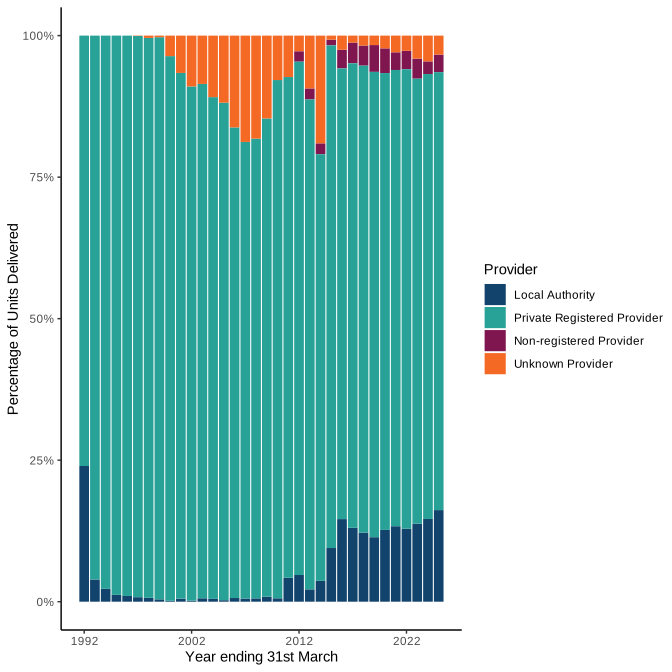
In 2024-25, 77% of all affordable housing were delivered by private registered providers, with local authorities delivering 16% and non-registered providers 3% [footnote 3]. There is no provider information on the remaining 3% of all units. These percentages have been broadly stable since 2015-16, accounting for small fluctuations year-on-year. Despite this relative stability, the proportion of delivery by local authorities has increased from 11% in 2018-19 to 16% in current year, while that of private registered providers decreased from 82% to 77% in the same period.
Chart 3: Percentage of affordable housing completions by provider, England, 1991-92 to 2024-25
The data for this chart is available in Live Table 1013.
While most delivery is still by private registered providers, historically they had a higher share as they delivered nearly all affordable housing delivery throughout the 1990s. The 10,480 affordable homes delivered by local authorities (representing 16% of the overall affordable housing delivery) are the highest recorded number of local authority completions for the years this data is available (this data series began in 1991-92); however, this comparison should be interpreted with care because the number of units with unknown provider was higher prior to 2014-15 than it is currently.
The delivery profile of local authorities and private registered providers differs considerably. Local authority delivery is mostly of affordable housing for rent, while in recent years it represented just under two thirds of private registered providers’ delivery. In 2024-25, affordable housing for rent represented 96% of local authority delivery and 62% of private registered providers. By contrast, affordable housing for rent represented 38% of non-registered providers delivery.
Chart 4: Affordable housing completions by type and selected providers, England, 1991-92 to 2024-25
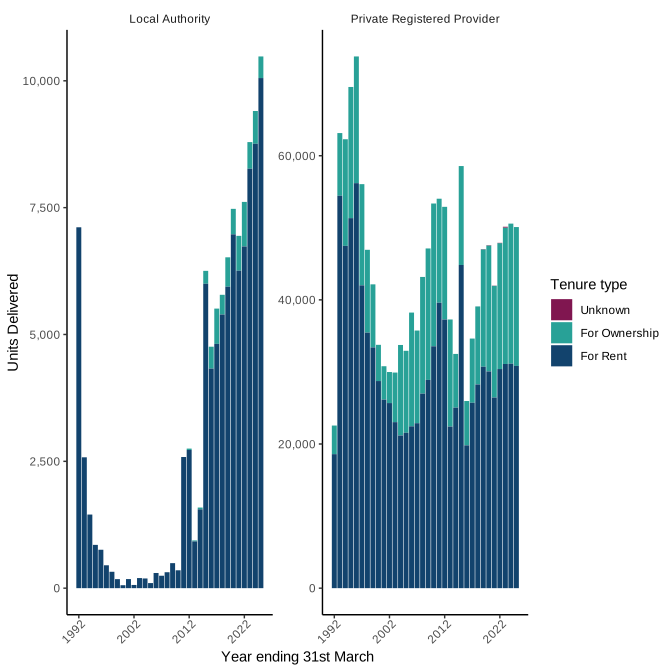
Note that the vertical axes’ scale isn’t the same on both graphs in Chart 4.
The data for this chart is available in the affordable housing supply open data.
In 2024-25, 49% of local authority delivery was in London. This is in part due to the fact that all but four London boroughs have a Housing Revenue Account. While this is higher than most recent years, London boroughs have represented around 40% or more of all local authority delivery in each year since 2021-22. By contrast, in 2024-25, private registered providers delivered similar numbers of units across London and the South East with the East of England and North West not far behind. In 2024-25, London represented 16% of all private registered provider delivery, similar to the South East.
Chart 5: Regional affordable housing completions by local authority providers, England, 1991-92 to 2024-25
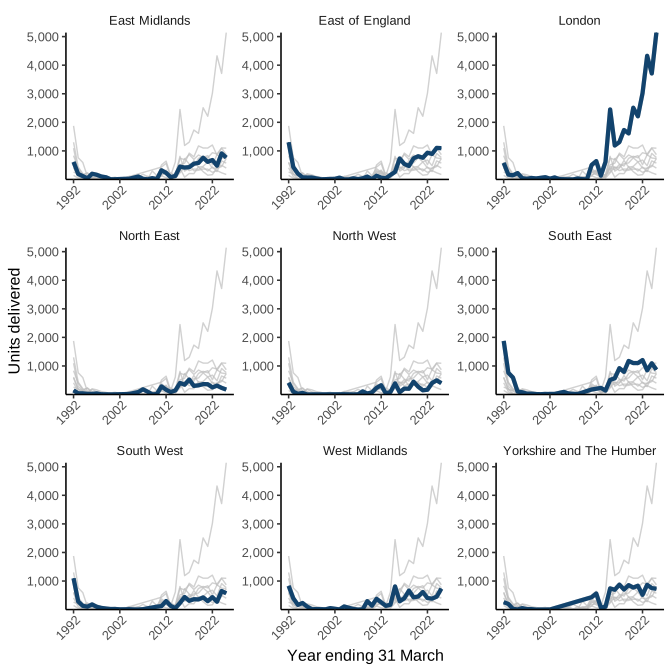
Chart 6: Regional affordable housing completions by private registered providers, England, 1991-92 to 2024-25
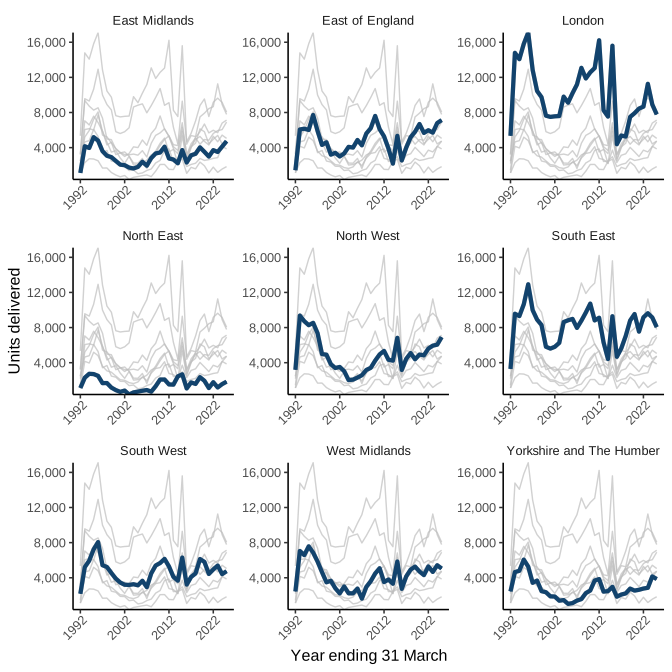
The data for these charts is available in the affordable housing supply open data.
3.3 Funding of new affordable housing completions
Delivery of affordable homes funded through s106 nil grant agreements with developers[footnote 4] [footnote 5] [footnote 6] (completions for which no government grant funding is provided) accounted for 36% of all affordable homes delivered in 2024-25, compared to 45% in the previous year. This is the lowest proportion since 2014-15. However, as explained in footnotes, the number and proportion of units funded through s106 nil grant (as well as s106 partial grant units) should be seen as our best estimate due to limitations in source data[footnote 5] and current methodology[footnote 6]. Please see the technical notes for further details.
Historically, the first completions of s106 nil grant were recorded in 2000-01 and nearly all homes funded through this process are new build properties. Prior to 2014-15, s106 partial grant units (i.e. those who have some grant contribution) were not separately identified in the data and are captured within the numbers of grant funded units. Partial grant funding used to be much more prevalent, but recently the vast majority of s106 funded units are nil grant.
Chart 7: Affordable housing completions by funding, England, 1991-92 to 2024-25
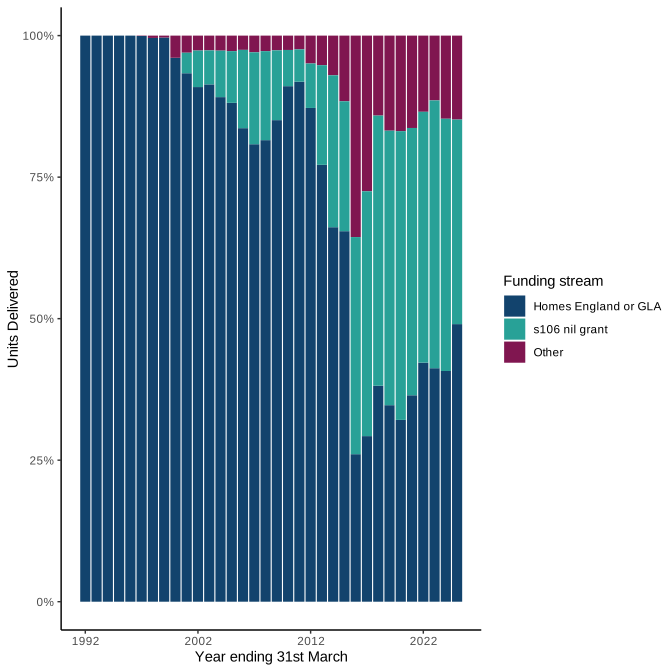
The data for this chart is available in Live Table 1000C.
The ‘other’ category includes all other sources of funding, including among others, the use of Right to Buy receipts by local authorities and the Affordable Homes Guarantees scheme.
4. Regional delivery of new affordable housing
In 2024-25, London was the region with the highest delivery of new affordable housing, followed by the South East. London and the South East have been consistently the main drivers of new affordable housing supply. While London usually has the highest regional delivery, between 2017-18 and 2019-20 delivery was higher in the South East.
Chart 8: Affordable housing completions by region, England, 1991-92 to 2024-25
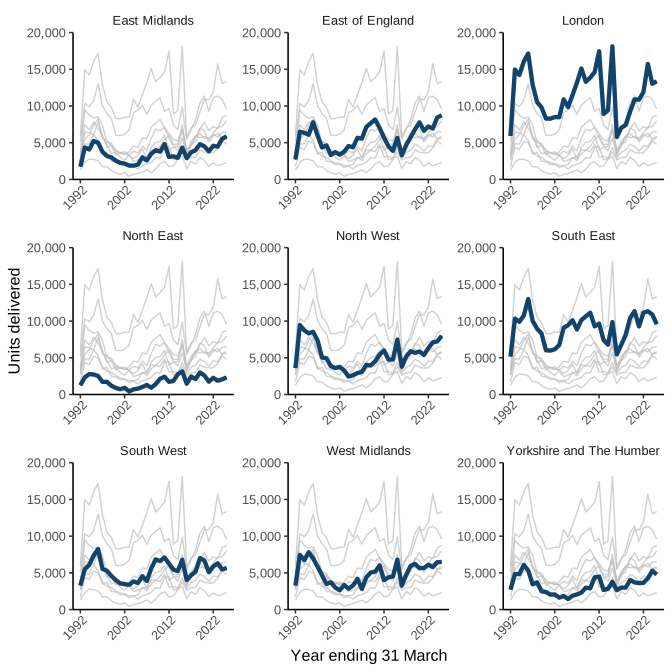
The data for this chart is available in Live Table 1008C.
Trends by tenure present a more complex picture. On social rent, most of the social rent delivery was in London for the first time since 2016-17, with an increase of 76% compared to 2023-24. The South East is the only region that showed a decrease in their social rent delivery compared to 2023-24. The change in London mirrors the increase of the Greater London Authority’s tenure of London affordable rent since 2017-18 but with a negligible number of starts since the end of the 2016-23 Affordable Homes Programme in 2022-23, which funded this tenure.
On affordable rent, both the South East and the East of England have delivered the most homes (combined they represented just over a third of all affordable rent delivery in 2024-25).
Figures for regional and local authority completions of homes by tenure can be found in Live Tables 1006C to 1007dC.
5. Delivery of affordable housing in rural-urban areas
This section now uses the 2021 rural-urban classification for England and therefore its results are not directly comparable to previous releases.
As the classification was developed using the 2021 Census data, care needs to be taken when looking at older years, as the current classification may be less accurate the further back in time the series goes.
Using ONS’s 2021 rural-urban classification for the 2024 geography in England, it is possible to present sub-national trends in rural and urban areas.
In 2024-25, 17,506 units were delivered in local authorities classified as rural [footnote 7] and 47,256 in those classified as urban [footnote 7], representing a 2% decrease in rural delivery and a 2% increase in urban delivery compared to 2023-24.
Chart 9: Affordable housing completions by 2021 rural-urban classification, England, 1991-92 to 2024-25
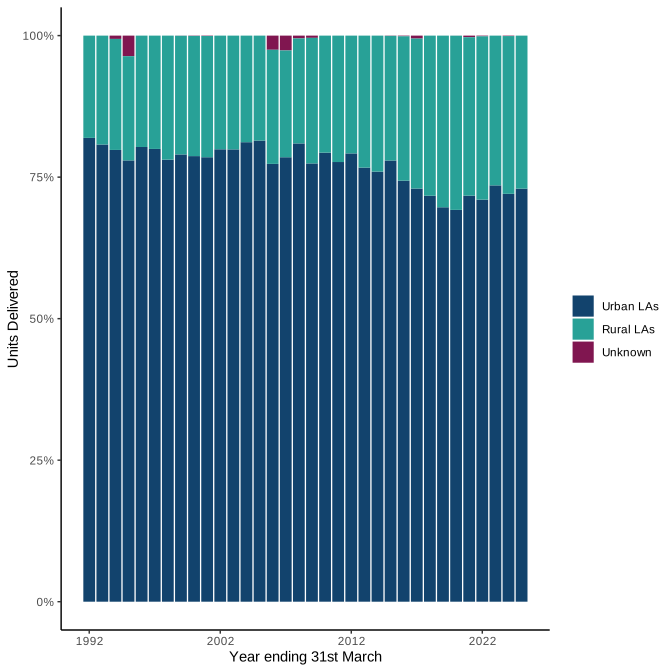
In 2024-25, rural local authorities represented 27% of all completions. The proportion of completions in rural local authorities (based on the current classification) has varied between 26% and 31% of all completions since 2015-16.
5.1 Affordable housing delivery in populations of less than 3,000
The Local Authority Housing Statistics [footnote 8] also collects the number of new build and acquisitions in populations of less than 3,000.
In 2024-25, there were 4,501 new affordable homes in these areas, which accounted for 7% of all new affordable housing. This is a decrease of 17% compared to the previous year and the second lowest since 2016-17, the lowest being 2020-21, which was impacted by the COVID-19 pandemic. As a percentage, delivery in populations of less than 3,000 was previously 8% between 2020-21 and 2023-24, lower than a peak of 12% in 2015-16.
6. New build homes and acquisitions
There were 58,958 new build affordable homes completed in 2024-25. These were supplemented by 4,781 acquisitions of existing homes not previously used for affordable housing and 1,023 homes where there is currently no information on whether they are new build or acquisitions.
The 58,958 new build affordable homes represent an increase of 0.23% on the existing stock of all 25.6 million homes in England at 31 March 2024 [footnote 9]. This is similar to recent years, with the proportion varying between 0.10% and 0.25% throughout the available period (since 1991-92).
Proportionally, of the 64,762 affordable homes delivered in 2024-25, 92% were new build and 8% were acquisitions (excluding unknowns). These proportions have changed considerably since the early 1990s, particularly after 2003-04. In 1992-93, 6 out of 10 new affordable homes were new build compared to more than 9 out of 10 in recent years.
Chart 10: Percentage of affordable housing completions by new build and acquisitions, England, 1991-92 to 2024-25
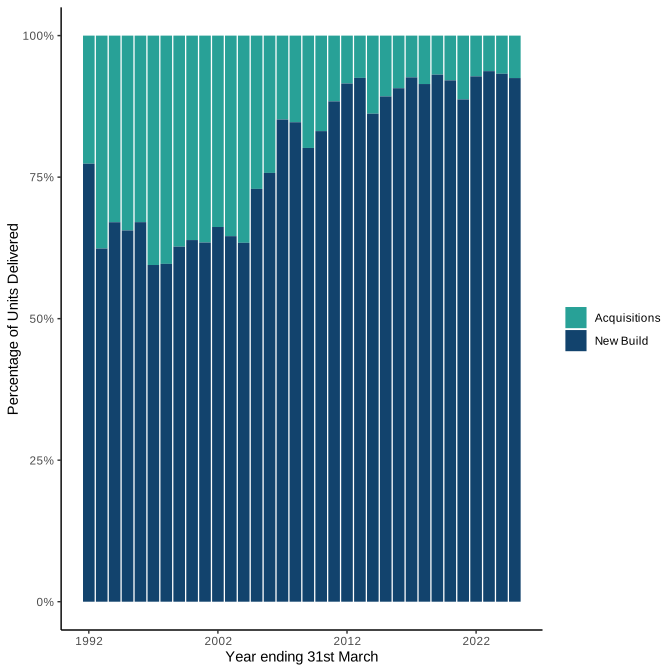
Note: The chart excludes completed affordable units where build type was unknown.
The data for this graph is available in Live Table 1009.
7. Starts on site
Since 2015-16, the department has published live tables with starts on site [footnote 10] of affordable housing to provide a leading indicator of affordable supply. However, the number of starts funded directly by local authorities or by planning agreements not reported via Homes England or the Greater London Authority only started being collected in 2016-17 and is collected on a voluntary basis. This means information for 2015-16 does not include this data and that subsequent years may still be underreporting it.
In 2021-22, First Homes [footnote 11] were introduced as a tenure and are reported either via Homes England or local authorities (through the Local Authority Housing Statistics data return)[footnote 12]. However, Homes England cannot provide information on starts of First Homes. Their delivery programme has now finished and no further starts funded by Homes England are currently expected. First Homes starts remain undercounted in this release and accompanying tables as data collected via Section J of the Local Authority Housing Statistics is collected on a voluntary basis.
There were 45,418 starts on site in England in 2024-25, compared to 44,027 in the previous year, a 3% increase. However, this is considerably lower than the average 62,000 starts per year between 2017-18 and 2022-23. This decrease is in part explained by fewer starts on site in London. The number of starts in London is 82% lower in 2024-25 when compared to 2022-23.
Chart 11: Affordable housing starts on site by tenure, England, 2016-17 to 2024-25
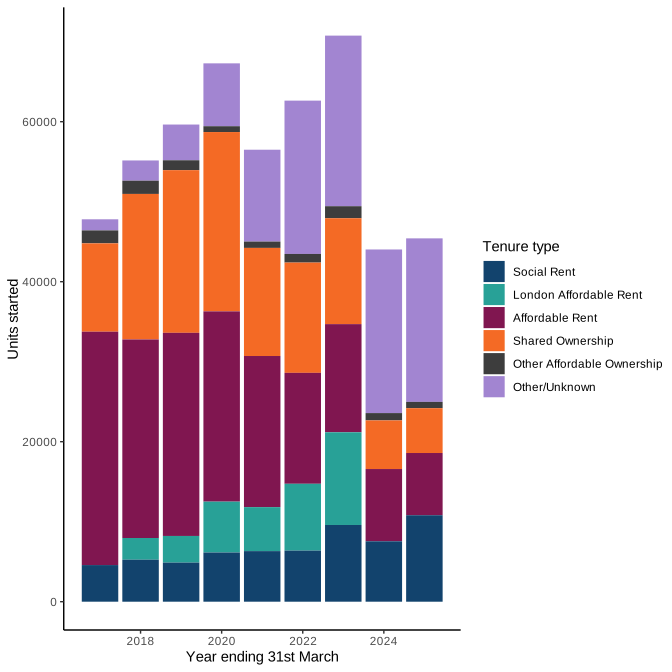
The data for this chart is available in Live Table 1000, in tab 1000S.
There were 10,810 social rent starts, the highest on record. Social rent has the highest number of starts where the tenure is known. The number of London affordable rent starts was below ten units for the second year in a row, following the end of the 2016-23 Affordable Homes programme that was the main funding source for this tenure.
The increase in the number of starts where tenure is unknown since 2019-20 is due to the introduction of units delivered via Strategic Partnerships [footnote 13]. These units will have their tenure confirmed at a later stage. In 2024-25, starts with unknown tenure accounted for 44% of all starts. This lack of information limits how much can be interpreted from the starts data.
8. Changes to this release
The commentary on affordable housing and overall housing gross supply will be included in the Housing supply: net additional dwellings statistical release. This is scheduled to be published alongside this release on 20 November 2025.
8.1 Summary of revisions
This release includes the following revisions since the data were last published in June 2025, with further details included in the technical notes:
-
The Affordable Homes Guarantees (AHG) data for 2023-24 now includes completions under 2013 AHG scheme due to improvements in data quality. Homes England had not provide this data for the November 2024 release.
-
Revisions to the 2020-21 to 2023-24 completions data due to local authorities reviewing their submitted LAHS data as part of the new data submission for 2024-25 and/or subsequent data quality checks.
As the result of these revisions, figures for 2023-24 have been revised upwards and are now 64,351 compared to a figure of 62,289 published in November 2024.
9. Tables and open data
See the live tables accompanying this release.
See the open data accompanying this release.
10. Technical notes
Please see the accompanying technical notes for further details.
11. Next release
The date of the next release is pre-announced on GOV.UK.
-
Since the November 2024 release, figures for 2023-24 have been revised upwards and are now 64,351 compared to a figure of 62,289 published at the time. ↩
-
Affordable homes for rent includes the following tenures: social rent, London affordable rent, affordable rent and intermediate rent. ↩
-
Non-registered providers can only receive Homes England funding for shared ownership units, and only since 2018-19. However, a small proportion of social rent and affordable rent units funded by Homes England have a non-registered provider as lead organisation, which at a later date will be handed over to either a local authority or a private registered provider. These units have been classified as “unknown” provider and with “other” funding in Live Tables 1000S, 1000C, 1011S and 1011C. In 2024-25, this impacted around 250 starts and 270 completions of both social rent and affordable rent. ↩
-
Please see the Housing statistics and English Housing Survey glossary for a definition. ↩
-
Since 2017-18, details of s106 units for London reported by the Greater London Authority (GLA) are estimates based on the total number of nil grant homes recorded on projects within the GLAOps. ↩ ↩2
-
From 2024-25, there is data collected allowing to separate acquisitions reported in the Local Authority Housing Statistics between those with and without s106 contributions. However, it was not possible to include them in this release, so the number of acquisitions made with s106 is an undercount. We hope to include this information for the next release of the data. ↩ ↩2
-
For the purpose of this bulletin, the Rural Urban flag in Table 1E of the ONS’s release was used. This flag divides local authorities into rural and urban. ↩ ↩2
-
Variables i1a (new build) and i6a (acquisitions) in Section I of the LAHS data return. For years prior to 2011-12, this was collected combined in a variable that is named i1z in the LAHS historical open data. ↩
-
MHCLG Live Table 104. ↩
-
It should be noted that starts on site are not planning applications. For further details, please see definition in the Housing statistics and English Housing Survey glossary. ↩
-
Homes England started recording First Homes completions in 2021-22. However, these are reported as market units in the accompanying tables to their release, but are counted as affordable housing in this release. These units are part of a small phase 1 pilot being delivered by the Single Land Programme, the starts on site for which are also reported as market units. A phase 2 grant funded pilot is delivering 1,500 First Homes units via the First Homes Early Delivery Programme 2021-23. Both pilots are in advance of the delivery of First Homes via Planning Policy. Homes England cannot separately identify starts on site that are First Homes. ↩
-
It is possible that some local authorities provided information on Homes England funded First Homes starts via LAHS. As there was no risk of double counting, and the information helps better understand the bigger picture, we have left these in. ↩
-
Strategic partnerships were introduced in 2018 and work as long-term agreements between one or more housing associations and Homes England. Homes England’s funding of these units is based on a whole development programme rather than scheme-by-scheme. ↩