An end to the suffering in Sudan will only come through an humanitarian truce, a permanent ceasefire and an inclusive civilian-led political process: UK statement at the UN Security Council
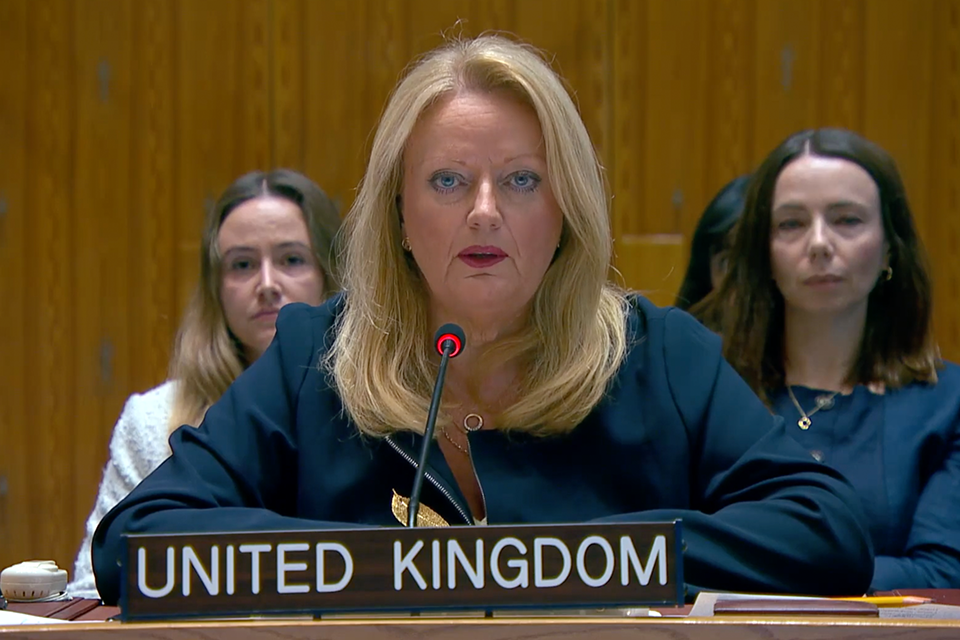
Statement by Ambassador Sarah MacIntosh, UK Permanent Representative to the UN, at the UN Security Council meeting on Sudan.
The war in Sudan has created the world’s worst humanitarian crisis.
Fighting has spread throughout Sudan, fuelled by arms supplies from within and beyond the region, funded, at least in part, by abduction for ransom and abuse of Sudan’s natural resources including gold, and exacerbated by massive use of drones
With 33 million people needing humanitarian assistance; gross violations of human rights; civilians targeted with attacks, torture and arbitrary detention; horrifying sexual violence; and deprivation of essential services.
An end to this suffering will only come through an humanitarian truce, a permanent ceasefire and an inclusive civilian-led political process to secure a sustainable peace.
Three issues need our support.
First, the choices of peace.
The United Kingdom welcomes and supports work to broker a humanitarian truce led by the US, Egypt, Saudi Arabia, and UAE; work towards confidence-building measures by Envoy Haavisto; and work to build an inclusive inter-Sudanese dialogue as a foundation for a peaceful political transition led by the Quintet of international organisations.
But the choices needed to make peace in Sudan lie with the leaders, fighters, funders and fuellers of the war.
So we also urge Sudan’s warring parties to choose to engage with peace processes; those supplying, funding and fuelling the war to choose to stop; leaders and fighting forces to choose to meet their obligations to act in accordance with the laws of war, to enable humanitarian access, and to protect civilians - not attack, torture, maim and deprive them; and all those with influence, to choose to use it to press for peace.
Second, until the parties choose peace, we can help to protect civilians, to limit the flows of arms that fuel conflict, and to raise the cost to perpetrators of their actions.
By extending the sanctions regime to respond to the war as it is being fought, covering the areas where fighting is; drones; sexual violence; mercenaries.
And by reminding leaders of fighting forces and militias that new technology and new tactics do not change their fundamental obligations to comply with international humanitarian law.
Sudan has become a battlefield where restrictions are too often ignored and protections too often fail.
Our action to change that could mitigate the human suffering of the people trapped in these wars.
And these measures should form part of a broader strategy to use the tools we have to protect civilians, constrain conflict, and support mediation efforts towards peace.
Third, by supporting the humanitarian agencies working with people trapped in this war, and led by OCHA, thank you.
Humanitarian access continues to be obstructed by all parties to the conflict. With costs measured in lives: families starving, communities cut off from the support they need to survive, and humanitarian workers under fire.
We call on the parties to facilitate rapid and unimpeded humanitarian access to those in need.
The United Kingdom is supporting the people of Sudan with humanitarian assistance: $200m this year, to reach over 1.8 million people with food, nutrition, healthcare, clean water, and protection services.
And increasing support to Sudanese-led responders, who can reach communities that others cannot.
Pushing for protection, using our diplomacy to press for humanitarian access, an immediate truce, and a permanent ceasefire.
Backing peace: supporting mediation efforts and an inclusive, Sudanese-led political process.
Raising the cost of failing to protect civilians with UK sanctions on those committing atrocities, recruiting mercenaries, and conflict financing networks.
And pursuing accountability: targeting those responsible for atrocities and those who sustain this war; through work to document, verify and preserve evidence of attacks on civilians and civilian infrastructure; through the Coalition on Atrocity Prevention and Justice; and by supporting the UN Fact-Finding Mission, the Panel of Experts, and the International Criminal Court.
Mr President, the things that Sudanese civilians want: an end to war; safety for their families; access to food, healthcare and education; the chance to live free from violence; to see their children grow up into safety and prosperity.
These are the things that almost every human being wants.
They, and the people of Sudan, need to remain in international attention, and with international support to achieve them.
And the leaders, fighters, funders, and fuellers of this war need to choose peace.