Country policy and information note: Hoa Hao Buddhism, Vietnam, March 2026 (accessible)
Updated 12 March 2026

© Crown copyright 2026
This publication is licensed under the terms of the Open Government Licence v3.0 except where otherwise stated. To view this licence, visit nationalarchives.gov.uk/doc/open-government-licence/version/3 or write to the Information Policy Team, The National Archives, Kew, London TW9 4DU, or email: psi@nationalarchives.gov.uk.
Where we have identified any third party copyright information you will need to obtain permission from the copyright holders concerned.
This publication is available at https://www.gov.uk/government/publications/vietnam-country-policy-and-information-notes/country-policy-and-information-note-hoa-hao-buddhism-vietnam-march-2026-accessible
Version 3.0, March 2026
Executive summary
The Constitution of the Socialist Republic of Vietnam allows for freedom of religion, but in practice this is restricted.
Religious groups need to register in order to operate and undertake religious activities. The state recognises 16 different religions, including Hoa Hao Buddhism, with the Hoa Hao Buddhist Church the state approved group.
The Committee for Religious Affairs claims there are 1.5 million followers of the state-approved Hoa Hao Buddhist Church. There are no estimates on those belonging to unregistered groups.
Hoa Hao Buddhism is practised at home or while tending land. Those who practise their faith in this way are unlikely to attract adverse attention from the authorities.
Hoa Hao Buddhists who openly criticise the government or who participate in activities that are, or may be perceived to be, against the state may face harassment, arrest or detention. Whether a Hoa Hao Buddhist activist is at risk of persecution or serious harm will depend on their profile and activities.
Where the person has a well-founded fear of persecution from the state they will not, in general, be able to obtain protection from the authorities or internally relocate.
Where a claim is refused, it is unlikely to be certifiable as ‘clearly unfounded’ under section 94 of the Nationality, Immigration and Asylum Act 2002.
All cases must be considered on their individual facts, with the onus on the person to demonstrate they face persecution or serious harm.
Assessment
Section updated: 9 March 2026
About the assessment
This section considers the evidence relevant to this note – that is the country information, refugee/human rights laws and policies, and applicable caselaw – and provides an assessment of whether, in general:
- a person faces a real risk of persecution/serious harm by the state due to being a Hoa Hao Buddhist
- the state (or quasi state bodies) can provide effective protection
- internal relocation is possible to avoid persecution/serious harm
- a claim, if refused, is likely or not to be certified as ‘clearly unfounded’ under section 94 of the Nationality, Immigration and Asylum Act 2002.
Decision makers must, however, consider all claims on an individual basis, taking into account each case’s specific facts.
1. Material fats, credibility and other checks/referrals
1.1 Credibility
1.1.1 For information on assessing credibility, see the instruction on Assessing Credibility and Refugee Status.
1.1.2 Decision makers must also check if there has been a previous application for a UK visa or another form of leave. Asylum applications matched to visas should be investigated prior to the asylum interview (see the Asylum Instruction on Visa Matches, Asylum Claims from UK Visa Applicants).
1.1.3 Decision makers must also consider making an international biometric data-sharing check, when one has not already been undertaken (see Biometric data-sharing process (Migration 5 biometric data-sharing process)).
1.1.4 In cases where there are doubts surrounding a person’s claimed place of origin, decision makers should also consider language analysis testing, where available (see the Asylum Instruction on Language Analysis).
Official – sensitive: Not for disclosure – Start of section
The information in this section has been removed as it is restricted for internal Home Office use.
Official – sensitive: Not for disclosure – End of section
1.2 Exclusion
1.2.1 Decision makers must consider whether there are serious reasons to apply one (or more) of the exclusion clauses. Each case must be considered on its individual facts.
1.2.2 If the person is excluded from the Refugee Convention, they will also be excluded from a grant of humanitarian protection (which has a wider range of exclusions than refugee status).
1.2.3 For guidance on exclusion and restricted leave, see the Asylum Instruction on Exclusion under Articles 1F and 33(2) of the Refugee Convention, Humanitarian Protection and the instruction on Restricted Leave.
Official – sensitive: Not for disclosure – Start of section
The information in this section has been removed as it is restricted for internal Home Office use.
Official – sensitive: Not for disclosure – End of section
2. Convention reason(s)
2.1.1 Actual or imputed religion and/or imputed political opinion.
2.1.2 Establishing a convention reason is not sufficient to be recognised as a refugee. The question is whether the person has a well-founded fear of persecution on account of an actual or imputed Refugee Convention reason.
2.1.3 For further guidance on the 5 Refugee Convention grounds, see the Asylum Instruction, Assessing Credibility and Refugee Status.
3. Risk
3.1.1 A person who belongs to the state-registered Hoa Hao Buddhist Church is unlikely to face a real risk of persecution or serious harm from the state for that reason alone.
3.1.2 A Hoa Hao Buddhist who is a member of an unregistered group, practising their faith at home or in a small group cooperating with local authorities is unlikely to face adverse attention from the authorities. Some may face difficulties, such as police harassment, disruption of religious activities, confiscation of property, pressure to join the registered Church and arrest but in general such treatment is not sufficiently serious by its nature and/or repetition to amount to persecution. The onus is on the person to demonstrate otherwise.
3.1.3 Hoa Hao Buddhist activists or leaders who openly criticise the government or participate in activities that are, or may be perceived to be, political in nature are likely to attract adverse attention including harassment, monitoring, arrest, interrogation and detention which may amount to persecution. Whether a person is at risk of persecution will depend on their profile and the nature of their activities, not solely due to their faith.
3.1.4 The Constitution allows for freedom of religion and states that freedom of religion and belief must be protected. In practice, those freedoms are restricted. However, not all those restrictions necessarily meet the very high threshold necessary to constitute persecution (see Legal framework).
3.1.5 Under the law a religious organisation is defined as such if it has received legal recognition from the government. Religious groups are required to seek approval from and register with the government in order to operate and conduct activities. The process to register can be lengthy with many requirements to fulfil and applications are sometimes ignored or refused without explanation (see Legal framework).
3.1.6 The government recognises Hoa Hao Buddhism through the state‑approved Hoa Hao Buddhist Church. Other Hoa Hao groups operate without official registration. Followers are mainly located in the Mekong Delta region. The total number of adherents is unclear, although available sources indicate that around 1.5 million people belong to the state‑recognised organisation. There is no reliable information on the number of followers of unregistered Hoa Hao groups (see Demography and Legal status of religious groups).
3.1.7 Hoa Hao Buddhism is normally practised at home or while tending the land. Although harassment and disruption to activities occurs, the extent to which this is experienced depends on the area and the relationship with the authorities. Registered religious organisations that comply with the 2016 Law on Belief and Religion generally practise their religion without significant interference and tend to maintain cooperative relations with the authorities. In contrast, unregistered religious groups may experience varying levels of state scrutiny, including monitoring, questioning, pressure to join state‑approved organisations, disruption of activities, property damage, or arrest. The level of scrutiny often depends on whether the group is perceived as having a political or foreign-linked agenda. Available sources indicate that incidents involving physical violence are uncommon (see Restrictions on practice and/or activities).
3.1.8 Registered Hoa Hao groups generally carry out their religious activities with limited interference from the authorities. Unregistered groups, such as the Pure Sect Hoa Hao or the PGHHTT Church, are more likely to face official scrutiny, including monitoring, intimidation, and restrictions on gathering for major religious events. Some leaders of unregistered groups have been arrested under national security provisions (see Restrictions on practice and/or activities).
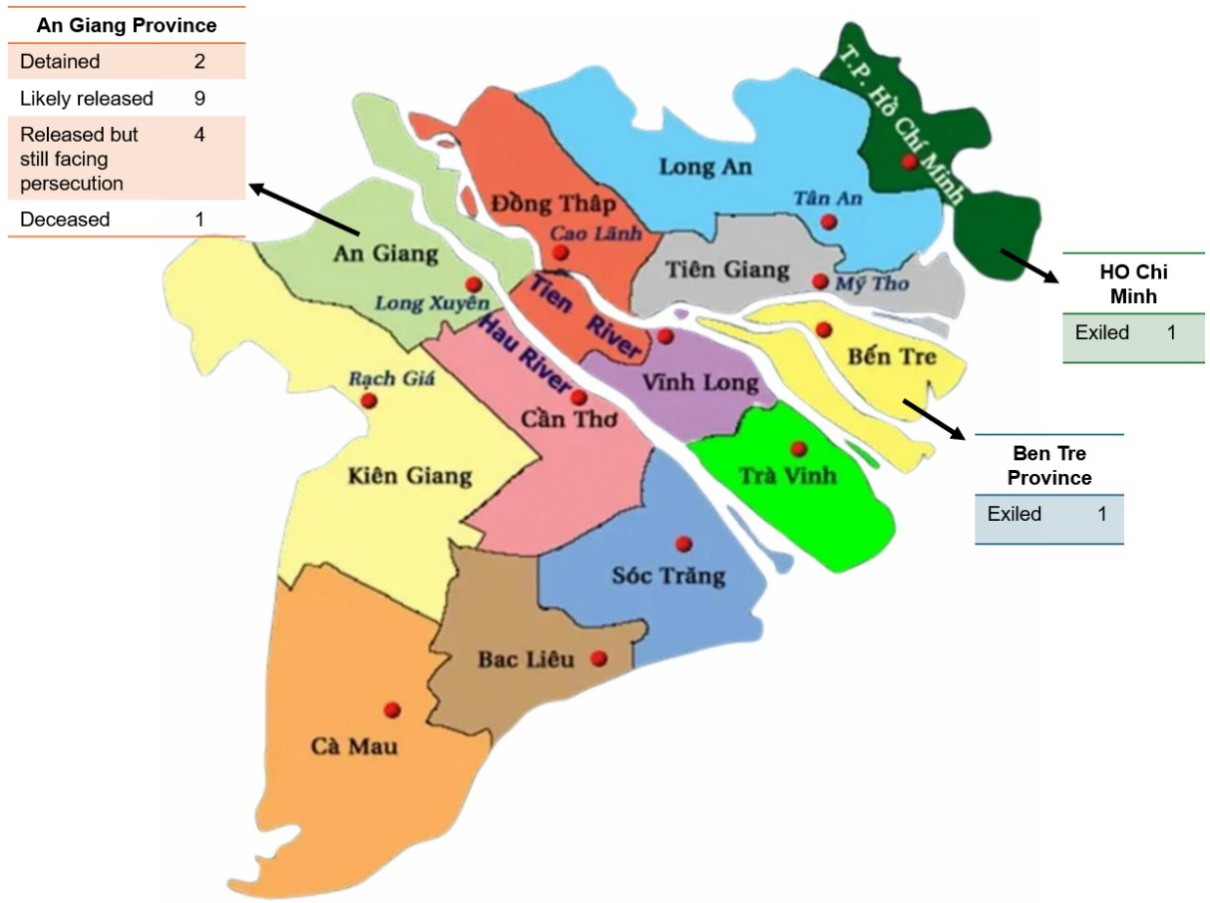
3.1.9 There is limited information on the arrest and detention of Hoa Hao Buddhists. However, available sources indicate that there are very few recorded instances of people recently arrested. Project88 (which records detention or other forms of harm against ‘activists’ and ‘dissidents’) reported 18 Hoa Hao Buddhists arrested or detained in the last 8 years, 2 of which are recorded as detained at the time of writing, however it is not clear how many were arrested solely due to their religious activities. The US Commission on International Religious Freedom (USCIRF) recorded a further person, Ho Trong Phuc who was sentenced to a year in prison in July 2025. All of the 19 people referred to above are from the Mekong Delta region with 17 of those from the An Giang province (see Arrests and detentions for details, including names and dates of arrests for those included on both databases).
3.1.10 For further guidance on assessing risk, see the Asylum Instruction on Assessing Credibility and Refugee Status.
4. Protection
4.1.1 Where the person has a well-founded fear of persecution or serious harm from the state, they are unlikely to be able to obtain protection.
4.1.2 For further guidance on assessing state protection, see the Asylum Instruction on Assessing Credibility and Refugee Status.
5. Internal relocation
5.1.1 Where the person has a well-founded fear of persecution or serious harm from the state, they are unlikely to be able to internally relocate to escape that risk.
5.1.2 For further guidance on internal relocation and factors to consider, see the Asylum Instruction on Assessing Credibility and Refugee Status.
6. Certification
6.1.1 Where a claim is refused, it is unlikely to be certifiable as ‘clearly unfounded’ under section 94 of the Nationality, Immigration and Asylum Act 2002.
6.1.2 For further guidance on certification, see Certification of Protection and Human Rights claims under section 94 of the Nationality, Immigration and Asylum Act 2002 (clearly unfounded claims).
Country information
This section contains publicly available or disclosable country of origin information (COI) which has been gathered, collated and analysed in line with the research methodology. It provides the evidence base for the assessment which, as stated in the About the assessment, is the guide to the current objective conditions.
The structure and content follow a terms of reference which sets out the general and specific topics relevant to the scope of this note.
This document is intended to be comprehensive but not exhaustive. If a particular event, person or organisation is not mentioned this does not mean that the event did or did not take place or that the person or organisation does or does not exist.
The COI included was published or made publicly available on or before 9 March 2026. Any event taking place or report published after this date will not be included.
Decision makers must use relevant COI as the evidential basis for decisions.
7. Religion
7.1 Demography
NOTE: The maps in this section are not intended to reflect the UK Government’s views of any boundaries.
7.1.1 GeoGnos, an open-source reference engine[footnote 1], CIA World Factbook noted that according to estimates for 2019, 5.8% of the population were Buddhist (including the Hoa Hao), 6.1% Catholic, 1% Protestant, 0.8% are other and 86.3% had no religion.[footnote 2]
7.1.2 Open Development Vietnam, a coalition of organisations who examine development trends in the Mekong region at country and regional levels[footnote 3], produced the below map.[footnote 4] The map shows the number of religious followers in each province using data from the General Statistic Office of Vietnam’s Vietnam Housing Population Census 2019.
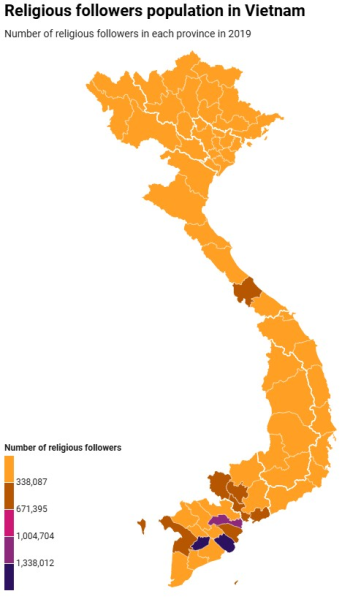
7.1.3 Statistics for the number of Hoa Hao Buddhists vary. The 2019 census on population and housing published in March 2020 reported that there was 983,079 Hoa Hao Buddhists, with 228,329 living in urban areas and 754,750 in rural areas.[footnote 5] Several other sources noted that the number of Hoa Hao Buddhists was 1.5 million although this number only takes into account those who belong to the state sanctioned Hoa Hao Buddhist groups. [footnote 6] [footnote 7] [footnote 8] [footnote 9]
7.1.4 The Government Committee for Religious Affairs published ‘Religions and religious Policy in Vietnam’ noted that: ‘As of December 2021, the Hoa Hao Buddhist Church [the officially recognised sect] had more than 1.5 million followers, 4,000 officials, and 50 State-recognized places of worship.’[footnote 10]
7.1.5 In June 2025 VietnamPlus, a subsidiary of the Vietnam News Agency (VNA), noted that: ‘Currently, Hoa Hao Buddhism [state-recognized Hoa Hao Buddhist Church] operates 406 grassroots executive boards across 17 provinces and cities nationwide.’[footnote 11]
7.1.6 CPIT could find no current information on the estimated number of unregistered Hoa Hao Buddhists in the sources consulted (see Bibliography).
8. Legal framework
8.1 Constitution
8.1.1 Article 24 of the Constitution states:
‘1. Everyone shall enjoy freedom of belief and religion; he or she can follow any religion or follow none. All religions are equal before the law.
-
The State respects and protects freedom of belief and of religion.
-
No one has the right to infringe on the freedom of belief and religion or to take advantage of belief and religion to violate the laws.’[footnote 12]
8.1.2 The US State Departments 2023 Report on International Religious Freedom (USSD 2023 IRF report), published on 26 June 2024, the last available version noted:
‘The constitution states that all individuals have the right to freedom of belief and religion, including the freedom to follow no religion. The constitution acknowledges the right to freedom of religion or belief of those whose rights are limited, including inmates or foreigners and stateless persons. It states all religions are equal before the law and the state must respect and protect freedom of belief and religion. The constitution prohibits citizens from violating the freedom of belief and religion or taking advantage of a belief or religion to violate the law.’[footnote 13]
8.1.3 The US Commission on International Religious Freedom (USCIRF)’s, a US independent public body, in its 2025 report (covering events in 2024 and published in March 2025) noted that: ‘Vietnam’s constitution acknowledges that all religions are equal before the law and that the state must respect and protect [Freedom of Religious Belief] FoRB. In practice, however, the government widely restricts religious freedom—especially for members of independent religious groups— through the 2018 [Law on Belief and Religion] LBR, its implementing decrees, and other laws.’[footnote 14]
See also Law on religion and belief
8.2 Law on religion and belief
8.2.1 The Law on Religion and Belief 2016 (effective from 2018) requires religious groups and clergy members to register and join a party-controlled supervisory body in order to obtain permission for religious activities.[footnote 15] Article 5 of the 2016 Law prohibits acts which ‘infringe upon national defense, security and sovereignty, social order and safety…’[footnote 16]
8.2.2 Christian Solidarity Worldwide (CSW), a UK based freedom of religion or belief organisation, noted in its report titled Freedom of Religion or Belief since the January 2018 Law on Belief and Religion, published in June 2022, that:
‘The law imposes several restrictive requirements upon religious groups. All religious groups are required to register with the government for recognition as a legal organisation and for authorisation for a range of activities. In practice, this registration process is open to abuse by state officials, with some applications ignored or rejected without explanation.
‘… The registration process under the 2018 Law on Belief and Religion is lengthy, complex and open to abuse. …Religious groups must have operated for at least five years with a religious activity registration certificate in order to start the registration process.
‘The application process for state recognition as a religious organisation (Article 22) requires religious groups to provide a detailed and extensive level of information to the authorities, including “the name of the requesting organization, […] number of believers and geographical area of its operation at the time of request; its organizational structure and head office; a written summary of its operation since the organization is [sic] granted a religious activity registration certificate; a list, resumes, judicial record cards, summaries of religious activities of its expected representative and leaders’ and ‘a summary of its tenets, canon laws and rites’, as well as ‘a written declaration of its lawful property”, and “papers proving the possession of a lawful head office location.”[footnote 17]
8.2.3 The Australian Government’s Department for Foreign Affairs and Trade’s (DFAT) Country Report for 2025, based on a range of public and non-public information including on-the-ground knowledge and discussions with a range of sources, (DFAT report 2025) noted that:
‘The Law on Belief and Religion (2016) prohibits discrimination and stigmatisation on religious grounds and forcing or hindering others in following or not following a religion or belief, including forcing somebody to renounce their faith.
‘Religious activity is regulated by the Law on Belief and Religion (passed in November 2016, effective from January 2018) and its implementing decree (Decree 95, which superseded Decree 162 in March 2024). The Law on Belief and Religion (2016) requires collective religious activity – including routine worship, festivals, conferences and training – to be registered with the state and to take place in a registered location. Collective religious activity not registered with the state – including online and in the home (e.g. prayer sessions, gatherings) – is prohibited, although occurs in practice and, according to in-country sources, was tolerated to a degree, depending on the attitudes of local authorities, as of October 2023. It is a criminal offence to abuse freedom of religion in such a way that infringes upon the interests of the state and undermines national unity and social order, and the state can prohibit religious activity on national security or morality grounds. Decree 95 (issued in December 2023 and effective from March 2024) empowers authorities to suspend the activities of religious organisations or groups for up to two years if they are found to have violated national security, national unity or social morality. Decree 95 (effective from March 2024) also includes a new requirement for religious organisations or groups to report, within 20 days of receipt, financial aid (in kind or in cash) from foreign sources.’[footnote 18]
8.2.4 The USCIRF Vietnam country update published in December 2025 noted:
‘Vietnam’s 2018 Law on Belief and Religion (LBR) continues to serve as the primary legal instrument in managing religious affairs and includes regulations mandating those practicing religion, such as attending religious gatherings, to do so under a government-registered religious organization, which is inconsistent with international legal standards. The LBR’s robustly bureaucratic and broadly interpreted provisions continue to pose complications for religious groups that have been attempting to legally register for several years, particularly at the local level. Decree 95, which went into effect in March 2024 to replace the former Decree 162, attempts to curb local authorities’ discretionary implementation of the LBR but also provides the central government the authority to suspend religious groups for vaguely defined “serious infractions.’[footnote 19]
8.3 Legal status of religious groups
8.3.1 The USSD 2023 IRF report noted: ‘Under the law, a religious organization is defined as “a religious group that has received legal recognition” by authorities. The law provides a separate process for unregistered, unrecognized religious groups to receive permission for specific religious activities by applying to the commune-level people’s committee.’[footnote 20]
8.3.2 The DFAT report 2025 noted: ‘Vietnam recognises the legal status of 43 religious organisations belonging to 16 religious denominations. Recognised religions include … Hoa Hao Buddhism … Distinct denominations within recognised religions must individually register with the state. According to the Government of Vietnam, in addition to legally recognised religious organisations, there were more than 3,700 registered, non-recognised religious groups operating in Vietnam in February 2024…’[footnote 21]
See also Law on religion and belief
9. State treatment
9.1 Registered/unregistered group
9.1.1 The Vietnamese, ‘an independent and non-profit online magazine that focuses on Vietnam politics’[footnote 22], noted in 2021 that:
‘In 1999, Hoa Hao Buddhism fundamentally split into two sects. One sect, the Hoa Hao Buddhist Church, was permitted by the government to operate and is headquartered at An Hoa Temple in Phu My Town, Phu Tan Suburban District, An Giang Province.
‘Many Hoa Hao Buddhists do not participate in this sect, stating that the management committee is controlled by the government and does not operate according to the proper religious principles.
‘The remaining other sect is not recognized by the government as “official” and is headquartered at the Hoa Hao Buddhist Family Group no more than 3 km from the An Hoa Temple. The activities of the independent Hoa Hao Buddhists are forbidden.
‘In August 1999, the overseas newspaper Viet Bao Online reported a conflict between the two sects in An Giang Province involving the Hoa Hao Buddhist Church being the only sect recognized by the state. The “official” church was able to organize public festivals and events but did not organize a holiday around “the Day of Virtuous Master’s Longevity Calamity,” nor did it read sermons during any holidays.’[footnote 23]
9.1.2 The 2025 DFAT report, commenting on registered religious groups generally, noted:
‘Recognised religious organisations can, inter alia, organise religious practice; publish religious books; produce, import and export religious cultural products and articles; construct new religious establishments and renovate or upgrade existing ones; appoint religious officers; establish religious training institutions; receive lawful donations from domestic and foreign sources; and undertake healthcare, social protection, charity and humanitarian activities. Recognised religious organisations are encouraged by the state to provide charitable and healthcare services, and they do so in practice (for example, they supported the Government of Vietnam’s COVID-19 response, and some provide social services, including drug rehabilitation). In-country sources reported in October 2023 that the state was sensitive to the political views of religious leaders and monitored their activities closely.’[footnote 24]
9.1.3 The same source, commenting on Hoa Hao Buddhist groups, noted: ‘The state recognised Hoa Hao Buddhism as a religion in 1999, although many practitioners refused to join the state-approved Hoa Hao Buddhist Church.’[footnote 25]
9.1.4 In relation to religious practise in general Human Rights Watch (HRW) noted in their World Report 2025 that: ‘The government restricts religious practice through legislation, registration requirements, and surveillance. Religious groups must get approval from, and register with, the government and operate under government-controlled management boards. Religious groups not recognized by the government are labeled “evil religions” (ta dao).’[footnote 26]
9.2 Restrictions on practice and/or activities
9.2.1 CPIT found limited information about the specific treatment of Hoa Hao Buddhists, so this section also includes information about the general treatment of religious groups.
9.2.2 Radio Free Asia (RFA), a private non-profit organisation reporting on news in Asia[footnote 27], noted:
‘Vietnam’s government officially recognizes the Hoa Hao religion, which has some 2 million followers across the country, but imposes harsh controls on dissenting Hoa Hao groups – including the sect in An Giang – that do not follow the state-sanctioned branch.
‘Rights groups say that An Giang authorities routinely harass followers of the unapproved groups, prohibiting public readings of the Hoa Hao founder’s writings and discouraging worshipers from visiting Hoa Hao pagodas in An Giang and other provinces.’[footnote 28]
9.2.3 RFA reported in December 2023:
‘In addition to prohibiting pure Hoa Hao Buddhists from attending the birthday ceremony of Patriarch Huynh, the police of An Giang province this year also asked believers not to erect flags to celebrate this day… In recent years, although the local government has not allowed pure Hoa Hao believers from other places to attend the ceremony at the temporary headquarters [at a house in Long Hoa hamlet, Long Giang commune, Cho Moi district, An Giang province], it has not prohibited the erection of the altar at this site.’[footnote 29]
9.2.4 RFA reported in June 2024 that:
‘While the state-recognized Hoa Hao Buddhist Church has been allowed to celebrate its 85th anniversary, followers of two independent Hoa Hao Buddhist groups say police in An Giang province stopped them gathering.
‘On Sunday [23 June 2024], the Central Executive Committee of the Hoa Hao Buddhist Church held a ceremony in An Giang to commemorate the religion’s founding by Huynh Phu So, the Tuoi Tre online newspaper reported. It said Nguyen Anh Chuc, deputy head of the government Committee for Religious Affairs, attended along with community leaders.
‘However, at the Quang Minh Tu temple, about 20 km (12.4 miles) away, only a few followers made it past police surrounding the pagoda for a ceremony.’[footnote 30]
9.2.5 RFA reported on 26 December 2024:
‘Hoa Hao Buddhist followers in the Southwestern provinces who do not follow the organization registered with the State are prohibited from gathering to celebrate the 105th anniversary of the birth of Huynh Phu Chu on 25/11 of the lunar calendar (25/12 of the solar calendar).
From December 23 [2024], the police of Cho Moi district, An Giang province set up checkpoints on both sides of the road leading to the temporary headquarters of the Central Board of Directors of the Hoa Hao Pure Buddhist Church (PGHHT) in Long Giang commune, to control and restrict passers-by. Earlier, the police came and asked …not to hold a birthday ceremony, a long ceremony, and [imposed] a ban on hanging banners with the words “Pure Hoa Hao Buddhist Church.”’
‘…Mr. Ha Van Duy Ho, president of An Giang Provincial Religious Association… said that this year Cho Moi district implemented a stricter ban than before. He said the government put plainclothes security guards near the homes of church dignitaries a few days before the holidays, closely monitoring them whenever they left their homes, and preventing them when they tried to go to the headquarters of the Central Administrative Board. He himself was heavily guarded from December 15, much earlier than in previous years…’[footnote 31]
9.2.6 The 2025 DFAT report, commenting on religious groups generally, noted:
‘Recognised religious organisations and non-recognised but registered religious groups – that is, organisations and groups that act in accordance with the Law on Belief and Religion (2016) – are free to practise their faith. Religions of this profile tend to be well established and maintain positive and transparent relations with the authorities. This is particularly true of religious organisations and groups that do not engage in perceived activism (e.g. in relation to human rights, land or the environment).
‘Members and leaders of unregistered religious groups that operate outside of state auspices are most likely to experience harassment, including but not limited to: surveillance and police questioning of leaders and members; pressure to renounce their religion or join a registered, state-sanctioned group; disruption of activities; destruction of property and religious artefacts; and arrest and imprisonment. Harassment of unregistered groups can vary due to the attitudes of local authorities; however, overall, unregistered religious groups and their leaders who are perceived by the state to have political and/or foreign agendas generally face greater harassment. In this context, harassment of people of faith, where it occurs, may not be solely on the basis of their religious beliefs but for broader reasons. In-country sources reported in October 2023 that leaders and members of unregistered religious groups did not generally experience violence because of unsanctioned religious activities.’[footnote 32]
9.2.7 The 2025 DFAT report observed on Hoa Hao Buddhists specifically:
‘As with other religions in Vietnam, there is a distinction between the treatment of registered and unregistered Hoa Hao groups, as well as between groups that engage in perceived political activism and those that do not. Adherents of registered Hoa Hao groups can generally worship freely, with few restrictions. In contrast, adherents of unregistered, non-state sanctioned Hoa Hao religious groups, such as Pure Sect Hoa Hao, reported official harassment in the form of surveillance, intimidation and being prevented from gathering for important religious events (e.g. the founding day of the religion and the birth and death anniversaries of Huynh Phu So)….’[footnote 33]
9.2.8 The USCIRF noted in their 2025 Annual report that: ‘In April [2024], An Giang provincial authorities banned independent Hoa Hao Buddhists from commemorating the death of their founder.’[footnote 34]
9.2.9 The Committee to Unite Cao Dai Disciples, Advocates for Faith and Justice in Vietnam (AFJV), Montagnards Stand for Justice (MSFJ), Buddhist Solidarity Association (BSA), The Friends of Thien Am Monastery at The Edge of The Universe in Vietnam’s ‘Alternative Report to the Human Rights Committee (CCPR) In response to the List of Issues relating to the fourth periodic report of Vietnam: Suppression of the freedoms of movement, conscience, and religious belief, expression, and peaceful assembly’ published in May 2025 noted:
‘The state-controlled Hoa Hao Buddhist Church continues to forbid Hoa Hao Buddhists from observing one of their most important religious days - Day Commemorating the Founder’s Disappearance. The founder, Master Huynh Phu So, vanished in 1947 when returning from a meeting with the Vietnamese communist leadership.
‘After 1975, the regime banned Hoa Hao Buddhism. In 1999, Vietnam established the Central Executive Committee of the Hoa Hao Buddhist Church, a tool for the regime to control Hoa Hao Buddhists, and particularly, to persecute unregistered ones. This committee transmitted to all the official Hoa Hao Buddhist Church members the government’s ban on observing the above-mentioned religious day. Unregistered Hoa Hao Buddhist groups which observe it are interrogated and threatened by the police, at times beforehand to stop their observance.
‘The congregation of Quang Minh Tu Temple, an unregistered Hoa Hao temple in An Giang Province, has paid dearly for not joining the official church. … believers have been watched, interrogated, and prevented from entering or practicing their religion at the temple many times over the years. The police of nearby provinces have monitored unregistered groups to prevent them from going to this temple on important religious days.’[footnote 35]
9.2.10 The USCIRF country update for Vietnam published in December 2025, in relation to freedom of religion in general noted:
‘Although Vietnam’s constitution provides for ensuring that all individuals have the right to “freedom of religion and belief,” Vietnam’s security apparatus maintains tight control on universally enshrined rights through its national security provisions in the 2015 Criminal Code. This includes authorities’ broad overapplication of Articles 116 (“undermining national solidarity”), 117 (“disseminating anti-state propaganda”), and 331 (“abusing democratic freedoms”) to target human rights defenders, religious freedom advocates, and adherents of independent religious groups who refuse to register under the state-recognized religious organizations. Notably, Article 164 of Vietnam’s Criminal Code prohibits obstruction of one’s ability to exercise their religious freedom and forcing others to not follow a religion or to follow a specific religion. Nonetheless, local authorities frequently use threats to coerce individuals following independent religious groups to renounce their faith or join state-sanctioned religious organizations.’[footnote 36]
‘… With Vietnam’s legal structure mandating registration of religious groups, local authorities continue to enforce punitive measures against groups that do not wish to register as well as to arbitrarily deny or ignore applications of registration from certain groups that do attempt to register via official channels. Those practicing their faith unregistered continue to face repeated harassment from authorities who threaten them with arrest or abuse if they do not leave their religious group or instead join a state-sanctioned religious organization. Authorities continue to provide preferential treatment to state-approved religious organizations and openly discriminate against independent groups.’[footnote 37]
9.2.11 In relation to the use of the 2018 Law on Cybersecurity to target online dissent the same source noted: ‘Provisions of these legal instruments are frequently used to target members of independent or minority religious communities such as [independent] Hoa Hao Buddhist Ho Trong Phuc…’[footnote 38]
9.3 Arrests and detentions
9.3.1 Voice of America (VOA) reported in its article published 7 August 2023:
‘Former prisoner of conscience Nguyen Hoang Nam, a Hoa Hao Buddhist who served years in prison for “disturbing public order,” has just been arrested by An Giang police for allegedly “using social networks to oppose the state.” Police in An Giang province were quoted by the People as saying on Aug. 4 that they arrested Mr. Nam, 42, who lives in Chau Doc city, for investigation of “disseminating and propagating information and documents against the State of the Socialist Republic of Vietnam,”… Mr. Nam’s wife, told VOA on Aug. 7 that her husband was abducted by six plainclothes police officers who came to his home… According to Ms. Trinh, more than 100 police officers and mobile forces came to search her house… The results of the police investigation were quoted by the People’s Daily as saying that Mr. Nam was “a reactionary subject, taking advantage of religion to carry out activities against the Party and the State in recent times.”’[footnote 39]
9.3.2 The DFAT report noted ‘Hoa Hao leaders of unregistered groups have been arrested and imprisoned in the past, including for violating national security provisions of the Criminal Code (2015).’[footnote 40]
9.3.3 The May 2025 alternative report to the CCPR by the Committee to Unite Cao Dai Disciples and others noted that the leader of the Quang Minh Tu Temple, an unregistered Hoa Hao temple in An Giang, has been: ‘…incarcerated multiple times for a total of nearly 20 years…’[footnote 41]
9.3.4 The USCIRF Vietnam country update, published in December 2025 noted:
‘Authorities continue to provide preferential treatment to state-approved religious organizations and openly discriminate against independent groups. In January 2025, An Giang authorities arrested—and in July convicted and sentenced—17-year-old independent Hoa Hao Buddhist Ho Trong Phuc to one year in prison. According to media reports, Phuc had made social media posts about independent Hoa Hao Buddhism and against the state-sanctioned Hoa Hao Buddhist Temple.’[footnote 42]
9.3.5 Vietnam People’s Army, a state-run media outlet reported on the trial of Ho Trong Phuc in July 2025 and noted in addition to posts on social media Phuc was also prosecuted for offences committed ‘…on 24-12-2024 and 29-12-2024, [when] the defendant continued to write slogans and use a loudspeaker to broadcast words with slander, fabrication, and insult content to the Party and local authorities.’[footnote 43] To note, the article was published in Vietnamese and has been translated by CPIT using an online translation tool, therefore 100% accuracy cannot be guaranteed.
9.3.6 Project88 maintains a database of individuals it describes as “persecuted activists” in Vietnam. The database covers two main groups: human rights activists and dissidents. Project88 defines human rights activists as people who carry out activities to support the rights of others. Dissidents are individuals who face persecution for political expression, peaceful protest, or involvement in groups that are unsanctioned or opposed by the government. Project88 notes that “all human rights activists are dissidents, but not all dissidents are human rights activists.” Individuals in either group are considered political prisoners when they are imprisoned for peaceful activities that challenge the government. The database also records activists who are not detained but experience other forms of harm. According to their website the list is produced using first-hand accounts, official/state-controlled sources, independent sources inside Vietnam and international sources.[footnote 44]
9.3.7 At the time of writing on 4 February 2026, Project88 listed the details of 18 Hoa Hao Buddhists. Of the 18 listed, 2 were detained, 9 were ‘likely’ released, 4 were released but according to Project88 were still facing ‘persecution’, 2 were exiled and 1 was deceased.[footnote 45]
9.3.8 The US Commission on International Religious Freedom (USCIRF) produce the ‘Frank R Wolf Freedom of Religion or belief Victims List’, which records victims targeted due to their religion or belief and includes those currently detained, those released, those who have died in custody and those whose whereabouts are unknown. According to their website the list is compiled using USCIRF ongoing monitoring, communication with those affected and organisations that focus on religious freedom. USCIRF note however that: ‘… due to the policies of foreign governments and the lack of independent news and human rights organizations in the countries represented in this database, it is difficult to obtain, confirm, and verify comprehensive information about all victims.’[footnote 46]
9.3.9 At the time of writing the USCIRF list recorded the details of 6 Hoa Hao Buddhists. One Hoa Hao Buddhist was recorded as detained, one Hoa Hao Buddhists status was unknown, and 4 Hoa Hao Buddhists were recorded as released.[footnote 47]
9.3.10 CPIT has used the data from Project88[footnote 48] and the USCIRF[footnote 49] database to compile the below table which shows the details of those arrested and their status. It is not clear how often the Project88 database is updated, and the ‘updated’ date varies by person profile (see corresponding footnote). Hoa Hao Buddhists listed may not have been arrested in relation to the direct practise of their Hoa Hao Buddhism. Where the information differs between the Project88 and USCIRF databases, a note has been made. The Project88 list began in 2018 and may not detail people arrested and released before then[footnote 50] The USCIRF list began in 2019.[footnote 51]
| Name | Arrest dates | Status | Details |
|---|---|---|---|
| Nguyen Bac Truyen | Nov 2006 | Released May 2010 | First detention: Charged under Article 88 (1999) and sentenced to 3 years 6 months in prison[footnote 52] |
| Jul 2017 | Released September 2023 (expected release July 2028) and then exiled[footnote 53] USCIRF recorded he was released 8 September 2023[footnote 54]. |
Second detention: Arrested along with 3 other pro-democracy activists associated with the Brotherhood of Democracy. Arrested under Article 79 of the 1999 Criminal Code for activities deemed to be subversive. Sentenced to 11 years in prison[footnote 55] [footnote 56] | |
| Tran Thi Thuy | Aug 2010 | Released August 2018 and then exiled | Arrested for alleged ties to a peaceful overseas pro-democracy group. Charged under Art. 79 (1999 Code) Sentenced to 8 years in prison.[footnote 57] |
| Vuong Van Tha | Oct 2012 | Released October 2015 | First detention: Charged Under Art. 258 (1999 Code) with abusing democratic freedoms and sentenced to 3 years in prison.[footnote 58] |
| May 2017 | Died in prison | Second detention: In 2017 he was arrested for making and flying the flag of the former Republic of Vietnam. Charged under Art 88 (1999) and sentenced to 12 years in prison. Family informed in September 2025 that he allegedly committed suicide whilst in prison.[footnote 59] | |
| Bui Van Trung | Oct 2012 | Released October 2016 | First detention: Sentenced to 4 years in prison after his 2012 arrest[footnote 60] under Article 245 (1999 Code).[footnote 61] |
| Jun 2017 | Released June 2023-reported as ‘still facing persecution’[footnote 62] USCIRF recorded him as released[footnote 63] |
Second detention: Arrested and charged under Art. 245 (1999 Code) with disrupting public order after gathering to commemorate the passing of a relative. Sentenced to 6 years in prison.[footnote 64] [footnote 65] | |
| Bui Van Tham | Jul 2012 | Released Jan 2015 | First detention: Charged under Article 245 and sentenced to 2 years and 6 months in prison.[footnote 66] |
| Jun 2017 | Released June 2023 reported as ‘still facing persecution’.[footnote 67] USCIRF recorded him as released[footnote 68] |
Second detention: Arrested and charged with disrupting public order after gathering to commemorate the passing of a relative. Sentenced to 6 years in prison.[footnote 69] [footnote 70] | |
| Nguyen Tan An | Apr 2017 | Likely released (expected release April 2022) | Arrested along with 4 others for hanging flags of the former government of South Vietnam. His Facebook page contained many photos of activities organised by religious groups and photos of the Hoa Hao Buddhist founder. Sentenced to 5 years in prison.[footnote 71] |
| Huỳnh Thị Kim Quyên | Apr 2017 | Likely released (expected release April 2021) | Arrested along with 4 others for hanging flags of the former government of South Vietnam. Sentenced to 4 years in prison.[footnote 72] |
| Nguyen Ngoc Qui | Apr 2017 | Likely released (expected release April 2021) | Arrested along with 4 others for hanging flags of the former government of South Vietnam. Sentenced to 4 years in prison.[footnote 73] |
| Pham Van Trong | Apr 2017 | Released April 2020- ‘still facing persecution’[footnote 74] | Accused of hanging flags of the former government of South Vietnam. Sentenced to 3 years in prison.[footnote 75] |
| Nguyen Thanh Binh | Apr 2017 | Released April 2020- ‘still facing persecution’[footnote 76] | Accused of hanging flags of the former government of South Vietnam. Sentenced to 3 years in prison.[footnote 77] |
| Vuong Van Thuan | May 2017 | Likely released (expected release May 2024) | Arrested for making and flying the flag of the former Republic of Vietnam. Sentenced to 7 years in prison under Article 88.[footnote 78] |
| Nguyen Nhat Truong | May 2017 | Likely released (expected release May 2023) | Arrested for making and flying the flag of the former Republic of Vietnam. Sentenced to 6 years in prison.[footnote 79] |
| Nguyen Nhat Thuong | May 2017 | Likely released (expected release May 2023) | Arrested for making and flying the flag of the former Republic of Vietnam. Sentenced to 6 years in prison.[footnote 80] |
| Le Thi Hen | Jun 2017 | Likely released | Arrested and charged with disrupting public order after gathering to commemorate the passing of a relative. Sentenced to 2 years probation expected release June 2019.[footnote 81] |
| Bui Thi Bich Tuyen | Jun 2017 | Likely released (expected release February 2021) | Arrested and charged with disrupting public order after gathering to commemorate the passing of a relative. Sentenced to 3 years in prison.[footnote 82] |
| Nguyen Hoang Nam | Jun 2017 | Released June 2021 | First detention: Arrested and charged with disrupting public order after gathering to commemorate the passing of a relative. Sentenced to 4 years in prison[footnote 83] [footnote 84] |
| Jul 2023 | Detained | Second detention: According to Radio Free Asia: ‘accused of posting documents, images, videos and live broadcasts that oppose authorities and undermine the policy of religious and national unity.’[footnote 85] Sentenced to 8 years in prison.[footnote 86] [footnote 87] | |
| Le Thi Hong Hanh | Nov 2017 | Likely released (expected release November 2020).[footnote 88] USCIRF recorded she was released.[footnote 89] |
Arrested and charged with disrupting public order after gathering to commemorate the passing of a relative. Sentenced to 3 years in prison.[footnote 90] [footnote 91] |
| Tran Thanh Giang | Apr 2019 | Detained | Accused of using a Facebook account to post and share over 3,100 articles and images and 99 video clips intending to falsify and defame the reputation of Vietnamese Communist Party. Sentenced to 8 years in prison.[footnote 92] |
| Ho Trong Phuc | January 2025[footnote 93] | Not recorded[footnote 94] | Government officials repeatedly pressured Phuc to abandon his Hoa Hao Buddhist beliefs and embrace state-approved worship. On July 9, 2025 he was sentenced to 1 year in prison for “abusing democratic freedoms to infringe upon the interests of the State, the legitimate rights and interests of organizations” (Art. 331 VCC).[footnote 95] |
9.3.11 The only person on the USCIRF list who is not on the Project88 database is Ho Trong Phuc, and no area of residence is recorded[footnote 96] however, Vietnamese media (translated using an online translation tool) reported he was living in An Giang Province at the time of his July 2025 trial.[footnote 97] The details of the other 18 Hoa Hao Buddhists recorded on the 2 lists show that most people are from the An Giang province (16 people) and all of those listed are from the Mekong Delta region. CPIT have modified a map[footnote 98] to show the 18 people from the province detailed in the databases and their reported status.
9.3.12 HRW noted in their World Report 2026 that: ‘In March and June [2025], local authorities in An Giang province blocked roads and placed several Hoa Hao Buddhist followers under house arrest to prevent them from carrying out religious ceremonies.’[footnote 99]
10. Returnees
10.1.1 The 2025 DFAT report noted:
‘Returnees, including failed asylum seekers, who departed Vietnam through legal means are not subjected to special treatment or questioning by authorities on their return unless wanted for an outstanding criminal matter in Vietnam; the fact they sought and failed to obtain asylum might not be known and, in any case, seeking asylum abroad is not a criminal offence. According to in-country sources, speaking in October 2023, people of this profile were processed by immigration authorities like anybody else.
‘… Returnees – including failed asylum seekers, labour migrants and trafficking victims – may experience reintegration difficulties, although these are not state-imposed. Difficulties may include unemployment or underemployment, [and] challenges accessing government services…The experiences described in this paragraph are not uniform: some returnees, including failed asylum applicants, report making smooth transitions. In-country sources reported in October 2024 that, should they need it, returnees could seek support from Migrant Resource Centres managed by the Department of Labour, Invalids and Social Affairs, although the scope of these services was opaque.
‘In-country sources reported in October 2023 that failing to secure asylum abroad did not carry stigma. Remittances allowed families to build new homes and stimulated local economies. Emigration was very common, culturally accepted and encouraged, including by the Government of Vietnam (on account of the remittances that would flow back to Vietnam). According to in-country sources, failed asylum applicants would not typically encounter official discrimination for failing to secure asylum abroad. DFAT understands from in-country sources that, like anybody else, returnees – including failed asylum seekers – who have spent an extended period of time abroad and may have had their household registration revoked can apply to register their residence at a local residence registration authority (usually the police) or through online government systems to receive government services in that location (Government of Vietnam Circular 56/2021/TT-BCA, adopted in May 2021 pursuant to the Law on Residence (2020), includes a specific application form for Vietnamese nationals returning to Vietnam after residing abroad). Revocation of household registration should not be assumed.
‘Returnees, as Vietnamese citizens, are eligible for health insurance, and may receive free or subsidised coverage (as well as other forms of social assistance) depending on their financial particulars. Returnees are also eligible to participate in the public social insurance scheme, which is typically contingent on finding employment in the formal sector. To access these and other government services, returnees, like anybody else, require a valid identity card and household registration. DFAT is not aware of returnees having citizenship revoked or being denied access to rights available to other Vietnamese citizens.
‘Children born abroad to parents seeking asylum whose births are registered and are Vietnamese nationals can access government services like any other citizen of Vietnam. Like their parents, they would generally not encounter official or societal discrimination, including with respect to their ability to obtain household registration (which would be linked to their parents) and access government services.’[footnote 100]
10.1.2 In sources consulted (see Bibliography) no specific information on the experiences of, or treatment of Hoa Hao Buddhists returning to Vietnam could be found.
Official – sensitive: Not for disclosure – Start of section
The information in this section has been removed as it is restricted for internal Home Office use.
Official – sensitive: Not for disclosure – End of section
Research methodology
The country of origin information (COI) in this note has been carefully selected in accordance with the general principles of COI research as set out in the Common EU [European Union] Guidelines for Processing Country of Origin Information (COI), April 2008, and the Austrian Centre for Country of Origin and Asylum Research and Documentation’s (ACCORD), Researching Country Origin Information – Training Manual, 2024. Namely, taking into account the COI’s relevance, reliability, accuracy, balance, currency, transparency and traceability.
Sources and the information they provide are carefully considered before inclusion. Factors relevant to the assessment of the reliability of sources and information include:
- the motivation, purpose, knowledge and experience of the source
- how the information was obtained, including specific methodologies used
- the currency and detail of information
- whether the COI is consistent with and/or corroborated by other sources
Commentary may be provided on source(s) and information to help readers understand the meaning and limits of the COI.
Wherever possible, multiple sourcing is used and the COI compared to ensure that it is accurate and balanced, and provides a comprehensive and up-to-date picture of the issues relevant to this note at the time of publication.
The inclusion of a source is not, however, an endorsement of it or any view(s) expressed.
Each piece of information is referenced in a footnote.
Full details of all sources cited and consulted in compiling the note are listed alphabetically in the bibliography.
Terms of reference
The ‘Terms of Reference’ (ToR) provides a broad outline of the issues relevant to the scope of this note and forms the basis for the country information.
The following topics were identified prior to drafting as relevant and on which research was undertaken:
- Religion
- Demography
- Legal framework
- Constitution
- Law on religion and belief
- Legal status of religious belief
- State treatment
- Registered/unregistered groups
- Restrictions on practice and/pr activities
- Arrests and detentions
- Returnees
Bibliography
Sources cited
Amo Travel Team, Map of Regions of Vietnam, 10 October 2018. Accessed: 27 January 2026
The Association of Religion Data Archives (ARDA), National Profiles, no date. Accessed: 2 February 2026
Australian Department of Foreign Affairs and Trade (DFAT), Country Information Report Vietnam, 19 February 2025. Accessed: 2 December 2025
Britannica, Gregorian Calendar, 15 December 2025. Accessed: 4 February 2026
Christian Solidarity Worldwide (CSW), Freedom of Religion or Belief since the 2018 Law on Belief and Religion, June 2022. Accessed: 4 February 2026
Committee to Unite Cao Dai Disciples, Advocates for Faith and Justice in Vietnam (AFJV), Montagnards Stand for Justice (MSFJ), Buddhist Solidarity Association (BSA), The Friends of Thien Am Monastery at The Edge of The Universe in Vietnam, Alternative Report to the Human Rights Committee (CCPR) In response to the List of Issues relating to the fourth periodic report of Vietnam: Suppression of the freedoms of movement, conscience, and religious belief, expression, and peaceful assembly, 26 May 2025. Accessed: 21 January 2026
Democratic Voice of Vietnam, (DVOV), Position Paper on Hoa Hao Buddhism, 4 March 2015. Accessed: 2 December 2025
GeoGnos:
-
About GeoGnos, no date. Accessed: 9 March 2026
-
Vietnam, no date. Accessed: 9 March 2026
Human Rights Watch (HRW), World Report 2026: Vietnam, 4 February 2026. Accessed: 9 March 2026
Immigration and Refugee Board of Canada (IRB), VNM201068.E Viet Nam: Hoa Hao Buddhism [Phật Giáo Hòa Hảo], including principles, beliefs, traditions, and ritual practices; situation of followers and treatment by society and authorities; regional distribution of followers- Responses to Information Requests, 13 June 2022. Accessed: 2 December 2025
IZI Tour, The Ultimate Guide to Visit the Mekong Delta 2026, 14 January 2026. Accessed: 27 January 2026
Office for Interreligious and Ecumenical Relations, Hoa Hao Buddhism, 7 December 2020. Accessed: 2 December 2025
Open Development Vietnam:
-
About us, no date. Accessed: 28 January 2026
-
Overview of Religions in Vietnam, 27 August 2023. Accessed: 28 January 2026
Patheos:
-
About Patheos, no date. Accessed: 2 February 2026
-
Vietnam, no date. Accessed: 2 February 2026
Phat Gian Hoa Hao:
-
Front Page, no date. Accessed: 2 December 2025
-
Characteristics of Hoa Hao Buddhism, 28 February 2005. Accessed: 9 March 2026
-
How a Buddhist disciple take vows and behaves, 5 August 2002. Accessed: 28 January 2026
Project88:
-
Methodology, no date. Accessed: 26 January 2026
-
Database, no date. Accessed: 26 January 2026
Radio Free Asia (RFA):
-
An Giang completely prohibits pure Hoa Hao Buddhists from erecting a monument to commemorate the birth of Huynh Patriarch, 27 December 2023. Accessed: 4 February 2026
-
Believers of Pure Religion were prevented from gathering to celebrate the 105th anniversary of the birth of Father Huynh, 26 December 2024. Accessed: 4 February 2026
-
Mission, no date. Accessed: 2 December 2025
-
Two years after prison release, Hoa Hao follower arrested again in Vietnam, 4 August 2023. Accessed: 28 January 2026
-
Independent Hoa Hao Buddhists report police harassment in Vietnam, 25 June 2024. Accessed: 2 December 2025
The Socialist Republic of Vietnam:
-
Constitution, 28 November 2013. Accessed: 1 December 2025
-
Law on Religion and Belief, 18 November 2016. Accessed: 28 January 2026
-
Religions and religious policy in Vietnam, 2022. Accessed: 2 December 2025
Stanford University, Frank R. Wolf freedom of religion or belief victims list in SearchWorks catalog, no date. Accessed: 4 February 2026
United Kingdom (UK) Home Office, Report of a Home Office fact-finding mission to Vietnam Conducted between 23 February and 1st March 2019, September 2019. Last accessed: 28 January 2026
United Nations Population Fund (UNFPA) & General Statistics Office of Vietnam (GSO), Results of the 2019 Census on Population and Housing in Viet Nam, March 2020. Accessed: 2 December 2025
US Commission on International Religious Freedom (USCIRF):
-
2025 Annual Report, 28 March 2025. Accessed: 2 December 2025
-
Country Update: Vietnam, December 2025. Accessed: 21 January 2026
-
About USCIRF’s Frank R. Wolf Freedom of Religion or Belief Victims List, no date. Accessed: 26 January 2026
-
Frank R. Wolf Freedom of Religion or Belief Victims List, no date. Accessed: 26 January 2026
US State Department (USSD), 2023 Report on International Religious Freedom, 26 June 2024. Accessed: 3 December 2025
The Vietnamese:
-
About Us, no date. Accessed: 9 March 2026
-
The Tumultuous And Tragic History Of Hoa Hao Buddhism, 1 September 2021. Accessed: 27 January 2026
Vietnam net, Vietnam’s religious diversity: 17 faiths granted legal status, 27 July 2025. Accessed: 3 December 2025
Vietnam People’s Army, Strict penalties for those who abuse democratic freedoms to infringe upon the interests of the State, 9 July 2025. Accessed: 3 December 2025
VietnamPlus:
-
Hoa Hao Buddhism convenes sixth national congress, 19 December 2024. Accessed: 2 December 2025
-
Hoa Hao Buddhism celebrates 86th founding anniversary, 13 June 2025. Accessed: 27 January 2026
Voice of America (VOA), Hoa Hao Buddhist Believer Arrested for ‘Propaganda Against the State’ After Completing Two Years in Prison, 7 August 2023. Accessed: 4 February 2026
Sources consulted but not cited
Amnesty International, The State of the World’s Human Rights 2025, 28 April 2025. Accessed: 2 February 2026
Asia Society, Religion in Vietnam, no date. Accessed: 28 January 2026
Bertelsmann Stiftung, Transformation Index (BTI), Vietnam Country report 2024, 19 March 2024. Accessed: 2 December 2025
Christian Solidarity Worldwide, General Briefing: Vietnam, 22 March 2022. Accessed: 3 February 2026
Cultural Atlas, Vietnamese – Religion, 2016. Accessed: 2 February 2026
Democratic Voice of Vietnam, (DVOV), Hoa Hao Buddhism A Religion Deeply Rooted in the Culture of the Peasantry of Mekong Delta, 31 October 2013. Accessed: 27 January 2026
Electronic Immigration Network, UK and Vietnam agree new migration partnership to accelerate returns of migrants without legal status, 29 October 2025. Accessed: 2 February 2026
IOM Vietnam, Assisted Voluntary Return, no date. Accessed: 2 February 2026
Living+ Nomads, map of the Mekong Delta, no date. Accessed: 27 January 2026
Radio Free Asia, Hoa Hao Buddhists Under House Arrest Amid Religious Anniversary, 12 June 2017. Accessed: 28 January 2026
Sky News, Vietnamese migrants to be returned under new deal with UK, 29 October 2025. Accessed: 2 February 2026
Socialist Republic of Vietnam, Embassy in the United States, Beliefs & Religions, undated. Accessed: 28 January 2026
United Kingdom (UK) Home Office, Returning to Vietnam, no date. Accessed: 3 February 2026
Vietnam Drive, Where is Mekong Delta, Vietnam?, undated. Accessed: 27 January 2026
Vietnam Human Rights Network, Report on Human Rights in Vietnam 2022-2023, 15 October 2023. Accessed: 2 February 2026
Vietnamnet VN, Vietnam’s religious diversity: 17 faiths granted legal status, 27 July 2025. Accessed: 26 January 2026
Vietnam VN, Hoa Hao Buddhist followers build their homeland, 15 January 2026. Accessed: 28 January 2026
Version control and feedback
Clearance
Below is information on when this note was cleared:
- version 3.0
- valid from 10 March 2026
Official – sensitive: Not for disclosure – Start of section
The information in this section has been removed as it is restricted for internal Home Office use.
Official – sensitive: Not for disclosure – End of section
Changes from last version of this note
Updated Country Information.
Feedback to the Home Office
Our goal is to provide accurate, reliable and up-to-date COI and clear guidance. We welcome feedback on how to improve our products. If you would like to comment on this note, please email the Country Policy and Information Team.
Independent Advisory Group on Country Information
The Independent Advisory Group on Country Information (IAGCI) was set up in March 2009 by the Independent Chief Inspector of Borders and Immigration to support them in reviewing the efficiency, effectiveness and consistency of approach of COI produced by the Home Office.
The IAGCI welcomes feedback on the Home Office’s COI material. It is not the function of the IAGCI to endorse any Home Office material, procedures or policy. The IAGCI may be contacted at:
Independent Advisory Group on Country Information
Independent Chief Inspector of Borders and Immigration
3rd Floor
28 Kirby Street
London
EC1N 8TE
Email: chiefinspector@icibi.gov.uk
Information about the IAGCI’s work and a list of the documents which have been reviewed by the IAGCI can be found on the Independent Chief Inspector’s pages of the GOV.UK website.
-
GeoGnos, About GeoGnos, no date ↩
-
Open Development Vietnam, Overview of Religions in Vietnam, 27 August 2023 ↩
-
UNFPA & GSO, Results of the 2019 Census on Population and Housing in Viet Nam, March 2020 ↩
-
DVOV, Position Paper on Hoa Hao Buddhism, 4 March 2015 ↩
-
VietnamPlus, Hoa Hao Buddhism convenes sixth national congress, 19 December 2024 ↩
-
Vietnam net, Vietnam’s religious diversity: 17 faiths granted legal status, 27 July 2025 ↩
-
ARDA, National Profiles, no date ↩
-
Socialist Republic of Vietnam, Religions and religious policy in Vietnam, 2022 ↩
-
VietnamPlus, Hoa Hao Buddhism celebrates 86th founding anniversary, 13 June 2025 ↩
-
The Socialist Republic of Vietnam, Constitution, 28 November 2013 ↩
-
USSD, 2023 Report on International Religious Freedom, 26 June 2024 ↩
-
USCIRF, 2025 Annual Report, 28 March 2025 ↩
-
The Socialist Republic of Vietnam, Law on Religion and Belief, 18 November 2016 ↩
-
The Socialist Republic of Vietnam, Law on Religion and Belief, 18 November 2016 ↩
-
CSW, Freedom of Religion or Belief since the 2018 Law on Belief and Religion, June 2022 ↩
-
DFAT, Country Information Report Vietnam, (paragraphs 3.29-3.30), 19 February 2025 ↩
-
USCIRF, Country Update: Vietnam, December 2025 ↩
-
USSD, 2023 Report on International Religious Freedom, 26 June 2024 ↩
-
DFAT, Country Information Report Vietnam, (paragraphs 3.31), 19 February 2025 ↩
-
The Vietnamese, The Tumultuous And Tragic History Of Hoa Hao Buddhism, 1 September 2021 ↩
-
DFAT, Country Information Report Vietnam, (paragraphs 3.32), 19 February 2025 ↩
-
DFAT, Country Information Report Vietnam, (paragraphs 3.44), 19 February 2025 ↩
-
HRW, World Report 2026: Vietnam, 4 February 2026 ↩
-
RFA, Two years after prison release, Hoa Hao follower arrested again in Vietnam, 4 August 2023 ↩
-
RFA, An Giang completely prohibits pure… 27 December 2023 ↩
-
RFA, Independent Hoa Hao Buddhists report police harassment in Vietnam, 25 June 2024 ↩
-
RFA, Believers of Pure Religion were prevented from gathering… 26 December 2024 ↩
-
DFAT, Country Information Report Vietnam, (paragraphs 3.32 and 3.37- 3.38), 19 February 2025 ↩
-
DFAT, Country Information Report Vietnam, (paragraphs 3.45), 19 February 2025 ↩
-
USCIRF, 2025 Annual Report, 28 March 2025 ↩
-
Committee to Unite Cao Dai Disciples & others, Alternative Report to the CCPR…, 26 May 2025 ↩
-
USCIRF, Country Update: Vietnam, December 2025 ↩
-
USCIRF, Country Update: Vietnam, December 2025 ↩
-
USCIRF, Country Update: Vietnam, December 2025 ↩
-
VOA, Hoa Hao Buddhist Believer Arrested for ‘Propaganda Against the State’…7 August 2023 ↩
-
DFAT, Country Information Report Vietnam, (paragraphs 3.45), 19 February 2025 ↩
-
Committee to Unite Cao Dai Disciples & others, Alternative Report to the CCPR…, 26 May 2025 ↩
-
USCIRF, Country Update: Vietnam, December 2025 ↩
-
Vietnam People’s Army, Strict penalties for those who abuse democratic freedoms, 9 July 2025 ↩
-
Project88, Methodology, no date ↩
-
USCIRF, About USCIRF’s Frank R. Wolf Freedom of Religion or Belief Victims List, no date ↩
-
USCIRF, Frank R. Wolf Freedom of Religion or Belief Victims List, no date ↩
-
USCIRF, Frank R. Wolf Freedom of Religion or Belief Victims List, no date ↩
-
Project88, Methodology, no date ↩
-
Stanford University, Frank R. Wolf freedom of religion … list in SearchWorks catalog, no date ↩
-
Project88, Database (Nguyen Bac Truyen), updated 13 June 2024 ↩
-
USCIRF, Frank R. Wolf Freedom of Religion or Belief Victims List, no date ↩
-
USCIRF, Frank R. Wolf Freedom of Religion or Belief Victims List, no date ↩
-
USCIRF, Frank R. Wolf Freedom of Religion or Belief Victims List, no date ↩
-
Project88, Database (Nguyen Bac Truyen), updated 13 June 2024 ↩
-
Project88, Database (Vuong Van Tha), updated 23 September 2025 ↩
-
Project88, Database (Vuong Van Tha), updated 23 September 2025 ↩
-
USCIRF, Frank R. Wolf Freedom of Religion or Belief Victims List, no date ↩
-
USCIRF, Frank R. Wolf Freedom of Religion or Belief Victims List, no date ↩
-
USCIRF, Frank R. Wolf Freedom of Religion or Belief Victims List, no date ↩
-
USCIRF, Frank R. Wolf Freedom of Religion or Belief Victims List, no date ↩
-
USCIRF, Frank R. Wolf Freedom of Religion or Belief Victims List, no date ↩
-
Project88, Database (Huỳnh Thị Kim Quyên), updated 13 June 2024 ↩
-
Project88, Database (Nguyễn Ngọc Quí), updated 13 June 2024 ↩
-
Project88, Database (Phạm Văn Trọng), updated 13 June 2024 ↩
-
Project88, Database (Phạm Văn Trọng), updated 13 June 2024 ↩
-
Project88, Database (Nguyễn Thanh Bình), updated 13 June 2024 ↩
-
Project88, Database (Nguyễn Thanh Bình), updated 13 June 2024 ↩
-
Project88, Database (Vương Văn Thuận), updated 13 June 2024 ↩
-
Project88, Database (Nguyễn Nhật Trường), updated 13 June 2024 ↩
-
Project88, Database (Nguyễn Nhật Thượng) updated 13 June 2024 ↩
-
Project88, Database (Bùi Thị Bích Tuyền), updated 13 June 2024 ↩
-
Project88, Database (Nguyễn Hoàng Nam), updated 29 June 2024 ↩
-
USCIRF, Frank R. Wolf Freedom of Religion or Belief Victims List, no date ↩
-
RFA, Two years after prison release, Hoa Hao follower arrested again in Vietnam, 4 August 2023 ↩
-
Project88, Database (Nguyễn Hoàng Nam), updated 29 June 2024 ↩
-
USCIRF, Frank R. Wolf Freedom of Religion or Belief Victims List, no date ↩
-
Project88, Database (Lê Thị Hồng Hạnh), updated 29 June 2024 ↩
-
USCIRF, Frank R. Wolf Freedom of Religion or Belief Victims List, no date ↩
-
Project88, Database (Lê Thị Hồng Hạnh), updated 29 June 2024 ↩
-
USCIRF, Frank R. Wolf Freedom of Religion or Belief Victims List, no date ↩
-
Project88, Database (Trần Thanh Giang), updated 13 June 2024 ↩
-
USCIRF, Country Update: Vietnam, December 2025 ↩
-
USCIRF, Frank R. Wolf Freedom of Religion or Belief Victims List , no date ↩
-
USCIRF, Frank R. Wolf Freedom of Religion or Belief Victims List , no date ↩
-
USCIRF, Frank R. Wolf Freedom of Religion or Belief Victims List , no date ↩
-
Vietnam People’s Army, Strict penalties for those who abuse democratic freedoms, 9 July 2025 ↩
-
IZI Tour, The Ultimate Guide to Visit the Mekong Delta 2026, 14 January 2026 ↩
-
HRW, World Report 2026, 4 February 2026 ↩
-
DFAT, Country Information Report Vietnam, (paragraphs 5.50, 5.52-5.55), 19 February 2025 ↩