Country policy and information note: gangs, Trinidad and Tobago, June 2026 (accessible)
Published 5 June 2026

© Crown copyright 2026
This publication is licensed under the terms of the Open Government Licence v3.0 except where otherwise stated. To view this licence, visit nationalarchives.gov.uk/doc/open-government-licence/version/3 or write to the Information Policy Team, The National Archives, Kew, London TW9 4DU, or email: psi@nationalarchives.gov.uk.
Where we have identified any third party copyright information you will need to obtain permission from the copyright holders concerned.
This publication is available at https://www.gov.uk/government/publications/trinidad-and-tobago-country-policy-and-information-notes/country-policy-and-information-note-gangs-trinidad-and-tobago-june-2026-accessible
Version 1.0, June 2026
Executive summary
More than 180 gangs with various sizes and reaches operate throughout Trinidad and Tobago, the most prominent of which are the Muslims and Rasta City. Gangs are mainly present in marginalised urban areas, particularly in and around the capital, Port of Spain, and the East-West corridor in Trinidad. As of 2025, gangs are responsible for around one-third of homicides in the country.
A person who fears a gang is not likely to be able to demonstrate a link to the Refugee Convention on grounds of political opinion. However, those who make a public or visible stand against the gangs are likely to form a particular social group.
In general, a person who is living in an area controlled by a gang and is (perceived to be):
-
Someone who has not complied with a gang’s rules or demands, or otherwise openly opposes the gang or disrespects a gang leader
-
A family member of a targeted person
is likely to face persecution or serious harm in that area.
Whether a person is at risk from a criminal group will depend on:
-
Their profile, actions and reason(s) for the group’s interest
-
The area the person usually resides in and the place of proposed return
-
The group’s intent, size, reach and capability.
A person who has a well-founded fear of persecution or serious harm from a rogue state actor and/or a non-state actor is, in general, likely to obtain protection from the state. However, protection may not be sufficient in every case. Each case must be considered on its merits.
Where a person has a well‑founded fear of persecution or serious harm from a gang, they may be able to internally relocate to escape that risk. Decision makers must consider the person’s profile, their previous experiences, the reasons the gang has an interest in them, and the size, reach, capability and intent of the gang concerned.
Where a claim is refused, it is unlikely to be certifiable as ‘clearly unfounded’ under section 94 of the Nationality, Immigration and Asylum Act 2002.
All cases must be considered on their individual facts, with the onus on the person to demonstrate they face persecution or serious harm.
Assessment
Section updated: 2 June 2026
About the assessment
This section considers the evidence relevant to this note – that is the country information, refugee/human rights laws and policies, and applicable caselaw – and provides an assessment of whether, in general:
-
a person faces a real risk of persecution/serious harm by gangs in Trinidad and Tobago
-
the state (or quasi state bodies) can provide effective protection
-
internal relocation is possible to avoid persecution/serious harm
-
a claim, if refused, is likely or not to be certified as ‘clearly unfounded’ under section 94 of the Nationality, Immigration and Asylum Act 2002.
Decision makers must, however, consider all claims on an individual basis, taking into account each case’s specific facts.
1. Material facts, credibility and other checks/referrals
1.1 Credibility
1.1.1 For information on assessing credibility, see the instruction on Assessing Credibility and Refugee Status.
1.1.2 Decision makers must also check if there has been a previous application for a UK visa or another form of leave. Asylum applications matched to visas should be investigated prior to the asylum interview (see the Asylum Instruction on Visa Matches, Asylum Claims from UK Visa Applicants).
1.1.3 Decision makers must also consider making an international biometric data-sharing check, when one has not already been undertaken (see Biometric data-sharing process (Migration 5 biometric data-sharing process)).
1.1.4 In cases where there are doubts surrounding a person’s claimed place of origin, decision makers should also consider language analysis testing, where available (see the Asylum Instruction on Language Analysis).
Official – sensitive: Not for disclosure – Start of section
The information on this page has been removed as it is restricted for internal Home Office use.
Official – sensitive: Not for disclosure – End of section
1.2 Exclusion
1.2.1 Decision makers must consider whether there are serious reasons to apply one (or more) of the exclusion clauses. Each case must be considered on its individual facts.
1.2.2 If the person is excluded from the Refugee Convention, they will also be excluded from a grant of humanitarian protection (which has a wider range of exclusions than refugee status).
1.2.3 For guidance on exclusion and restricted leave, see the Asylum Instruction on Exclusion under Articles 1F and 33(2) of the Refugee Convention, Humanitarian Protection and the instruction on Restricted Leave.
Official – sensitive: Not for disclosure – Start of section
The information on this page has been removed as it is restricted for internal Home Office use.
Official – sensitive: Not for disclosure – End of section
2. Convention reason(s)
2.1.1 A person who fears a gang is not likely to be able to demonstrate a link to the Refugee Convention on grounds of political opinion. This is because, while gangs maintain (and vie for) pockets of territorial control, and carry out some state-like functions in areas they control, the presence and capacity of individual gangs are not so pervasive to be considered ‘political’ in nature.
2.1.2 In the country guidance case of MJB (Inability to provide protection - JAM) Trinidad and Tobago, heard on 3 November 2010 and promulgated on 20 December 2010, the Upper Tribunal held that the appellant had a well-founded fear of persecution for reasons of political opinion, arising from his opposition to the Jamaat al Muslimeen gang (JAM) and his pro-government activity (para 18). This was in the context of JAM’s involvement in an attempted coup against the Trinidadian government in 1990, which placed it within a political and ideological context at the time.
2.1.3 The country information in this note indicates that there are ‘very strong grounds supported by cogent evidence’ to justify a departure from the political and ideological context identified in MJB.
2.1.4 In the years since the promulgation of MJB, particularly after the death of JAM’s leader, Yasin Abu Bakr, in 2021, available information indicates that JAM has become more diffuse, less politically engaged, and more focused on religious and community activities. Sources stated that:
-
‘Since the coup attempt, Jamaat al Muslimeen has exerted control over some of Trinidad and Tobago’s criminal enterprises by taxing illicit businesses and street gangs’
-
‘By the mid-2010s, Jamaat al Muslimeen was more diffuse; several splinter groups emerged from its original iteration’
-
‘No significant continuance’ of the ideology associated with the 1990 attempted coup ‘appears in the contemporary gang context’
-
‘After the death of Abu Bakr in 2021, the organization has not been publicly accused of engaging in criminal activity’
-
JAM’s new imam has stated that the group would not ‘dabble in politics’
-
‘Over the years, the JAM has focused on hosting community events that promote Islamic education, while also fulfilling the basic responsibilities of a mosque, such as conducting prayers, burials, and providing charity … the mosque runs a school and maintains an active presence on Facebook, using the platform to share photos and videos of their community service activities.’ (Main gangs)
2.1.5 In the country guidance case of EMAP (Gang violence, Convention Reason), heard on 27 April and 9 June 2022 and promulgated on 16 November 2022, the Upper Tribunal (UT) considered whether persons who fear a gang in El Salvador fell within the scope of the Refugee Convention on the grounds of political opinion.
2.1.6 The UT in EMAP held that the main gangs operating in El Salvador, MS-13 and Barrio 18, are ‘political actors’ and that:
‘… (ii) Individuals who hold an opinion, thought or belief relating to the gangs, their policies or methods hold a political opinion about them.
‘(iii) Whether such an individual faces persecution for reasons of that political opinion will always be a question of fact. In the context of El Salvador it is an enquiry that should be informed by the following:
‘(a) The major gangs of El Salvador must now be regarded as political actors;
(b) Their criminal and political activities heavily overlap;
(c) The less immediately financial in nature the action, the more likely it is to be for reasons of the victim’s perceived opposition to the gangs.’ (Headnote, paragraphs (ii) and (iii))
2.1.7 The UT in EMAP provided further analysis of the applicability of political opinion in paragraphs 112 to 122 of the determination. It considered that there are a range of reasons why a gang (or gangs) target a person, not all of which will fall within the Refugee Convention.
2.1.8 The UT’s findings in EMAP were specific to the situation in El Salvador at the time of the judgement but the then situation in El Salvador and the current situation in Trinidad and Tobago merit comparison. Both have high levels of crime dominated by gangs which have de facto control over certain communities and have sought to influence the state (see Risk, Protection).
2.1.9 However, there are significant differences between the 2 countries:
-
Trinidad and Tobago has a more diverse criminal landscape with over 180 criminal gangs operating across the country, some of whom confine their control and operations to a single street. As a result, gangs in Trinidad and Tobago are not as dominant as the MS-13 and Barrio 18 were in El Salvador (see EMAP, Risk).
-
Gangs in Trinidad and Tobago are reported to be absolutely and relatively smaller (approximately 1,750 members, ~0.1% of the total population) than the MS-13 and Barrio 18 were in El Salvador (60,000 members, 1% of the total population) (see EMAP, Risk).
-
In El Salvador, gangs sought to influence the state. Whilst there is limited detailed information about the areas that gangs exert influence over in Trinidad and Tobago, sources indicated that they are mainly present in marginalised urban areas. Although there have been reports of government contracts being given to gang leaders in these areas, evidence does not suggest that this influence extends outside of the areas under their control or that it is widespread or systematic (see EMAP, Risk).
2.1.10 On the available evidence, the situations are sufficiently different to conclude that gangs in Trinidad and Tobago are not ‘political actors’ and that the UT’s findings in EMAP in relation to political opinion do not apply to a fear of such groups in Trinidad and Tobago.
2.1.11 However, a person who fears a gang may belong to a particular social group (PSG) under the Refugee Convention where they have:
-
an innate characteristic or a common background that cannot be changed, or share a characteristic or belief that is so fundamental to identity or conscience that a person should not be forced to renounce it and
-
a distinct identity in Trinidad and Tobago because the group is perceived as being different by the surrounding society.
2.1.12 The following are likely to form a PSG:
- those who make a public or visible stand against the gangs, including those who have not complied with a gang’s rules or demands, or otherwise openly oppose the gang or disrespects a gang leader
2.1.13 Although the above form a PSG, establishing such membership is not sufficient to be recognised as a refugee. The question to be addressed is whether the person has a well-founded fear of persecution on account of their membership of such a group.
2.1.14 For further guidance on the 5 Refugee Convention grounds, see the Asylum Instruction, Assessing Credibility and Refugee Status.
3. Risk
3.1.1 In general, a person is not likely to face treatment amounting to persecution or serious harm solely by virtue of living in a gang-controlled community.
3.1.2 However, available information indicates that in some gang-controlled areas, levels of violence are sometimes such that residents may face a heightened risk of harm, including where movement within and between communities is restricted and where a person may be exposed to indiscriminate or collateral violence. Whether this amounts to persecution or serious harm will depend on the individual circumstances of the person, including their profile.
3.1.3 In general, a person who is living in an area controlled by a gang and is (perceived to be) someone who has not complied with a gang’s rules or demands, or otherwise openly opposes the gang or disrespects a gang leader or a family member of a targeted person is likely to face persecution or serious harm in that area.
3.1.4 Whether a person is at risk from a criminal group will depend on:
-
Their profile, actions and reason(s) for the group’s interest
-
The area the person usually resides in and the place of proposed return
-
The group’s intent, size, reach and capability.
3.1.5 As of 2023, sources estimated that approximately 186 gangs operate in Trinidad and Tobago, with around 1,750 members altogether (approximately 0.1% of the population). Among the most prominent gangs are the Muslims and Rasta City, with whom smaller gangs frequently align. Whilst fewer gangs operate on the island of Tobago than on the island of Trinidad, sources indicated that the number of gangs in Tobago increased from 3 in 2009 to 28 in 2022. Venezuelan gangs were also reported to have a presence in Trinidad and Tobago (see Number of gangs and gang members, Population and demography, Main gangs).
3.1.6 There is limited detailed information about the areas that individual gangs exert influence over. Whilst sources indicate that gangs are present nationwide, their activities are highly concentrated in impoverished urban areas in Trinidad, particularly in the capital city, Port of Spain, and its surroundings. Sources reported that gangs also operate along the East‑West Corridor, where they compete with more established gangs. Some small gangs were described as highly localised, with operations limited to individual streets (see Location and reach of gangs).
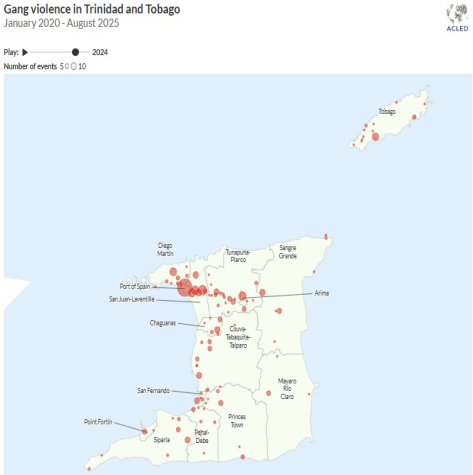
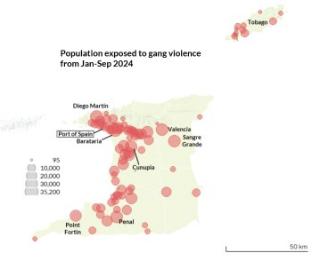
3.1.7 Data from 2024 indicated that gang violence in Trinidad was primarily concentrated in and around Port of Spain and Diego Martin, along the East‑West Corridor, and southwest towards Chaguanas and San Fernando. In Tobago, the western part of the island was more affected by gang violence than the eastern part. Between January 2024 and September 2024, approximately 57% of the population was exposed to gang violence, reflecting the concentration in the same geographic areas outlined above (see Location and reach of gangs).
3.1.8 Gangs were considered to be significant perpetrators of violent crimes, including homicide, kidnapping, human trafficking and armed robbery, as well as the extortion of small business owners (see Overview of activities). In 2024, Trinidad and Tobago’s homicide rate was approximately 45.7 per 100,000 of the population. Approximately 43.7% of these homicides were gang-related. In 2025, the homicide rate fell to 27 per 100,000, with approximately 33% reported to be gang-related (see Gang violence and homicides, Population and demography).
3.1.9 In some impoverished communities under gang control, gang leaders are regarded as community leaders and exercise informal social control over residents and activities in the area, including by mediating disputes and providing food and financial assistance (see Territorial control). Sources also reported that some gang leaders had been awarded government contracts, enabling them to exercise control over job allocations and service provision in areas under their control. While this may reinforce their existing influence within their communities, reporting does not indicate that they are recognised as state agents, nor that these contracts provide them with access to broader state resources which would enable them to track potential targets. In October 2025, it was reported that the government suspended several public contracts in gang-controlled areas in order to combat corruption and criminal infiltration (see Public contracts).
3.1.10 Most gang members are young males, primarily from impoverished urban areas, with troubled family backgrounds and little formal education or previous employment. Half of all gang members are reportedly aged between 19 and 25, with the other half older than 25. Some sources reported recruitment of youths between 12 and 16 years old, and recruitment taking place in schools. Gangs also operate and recruit in prisons. Women are permitted to be gang members and to attain all levels of seniority within their gang, and one source reported that women are increasingly joining gangs. While sources described young people joining gangs voluntarily, there were also reports of young men being shot after refusing to join and attempting to distance themselves from gangs; however, due to limited reporting, the prevalence of such incidents is unclear (see Recruitment and leaving gangs). In the sources consulted, CPIT could not find specific figures on how many people are recruited by gangs, on gang-specific recruitment practices, or on whether it is permitted to leave a gang.
3.1.11 Sources reported that gang violence in Trinidad and Tobago is mainly driven by inter-gang rivalries and disputes over territory, access to government contracts, perceived disrespect and revenge, and that conflicts may escalate rapidly from minor grievances. Young men perceived as gang‑affiliated were the primary participants and victims of gang violence (see Gang violence and homicides, Targets of gang violence).
3.1.12 Gang violence is sometimes indiscriminate, with sources noting that when intended targets cannot be reached, attacks may be directed at anyone in the area. Workers such as postal workers and sanitation workers who move through rival gang communities in the course of their employment have also faced threats and violence, although available information does not indicate that this was due to their employment or any specific characteristic (see Targets of gang violence).
3.1.13 Gangs threaten and use violence, including murder, against persons who they consider to be a threat or who do not comply with their demands. Persons reportedly targeted include:
-
Rival gang members, those who disrespect gang leaders, those who steal from gangs (see Targets of gang violence, Gang violence and homicides).
-
Those who refuse to join gangs or attempt to distance themselves from gangs (see Refusal to join gangs and leaving gangs).
-
Some small business owners in gang-controlled areas and those perceived to be affluent were reported to face kidnap and extortion, and the threat of violence if they refused to pay (see Targets of gang violence, Gang violence and homicides).
-
Family members of gang‑affiliated persons (see Targets of gang violence).
-
Police officers, prison officers, members of the judiciary, prosecutors and other state officials who (are perceived to have) impacted gangs’ operations (see Targets of gang violence).
3.1.14 Each case must be considered on its facts, with the onus on the person to demonstrate a risk of persecution or serious harm.
3.1.15 For further guidance on assessing risk, see the Asylum Instruction on Assessing Credibility and Refugee Status.
4. Protection
4.1.1 A person who has a well-founded fear of persecution or serious harm from a rogue state actor and/or a non-state actor is, in general, likely to obtain protection from the state. Trinidad and Tobago takes reasonable steps to operate an effective legal system for the detection, prosecution and punishment of acts constituting persecution and a person is generally able to access protection. However, protection may not be sufficient in every case. Each case must be considered on its merits.
4.1.2 In the country guidance case of MJB (Inability to provide protection - JAM), heard on 3 November 2010 and promulgated on 20 December 2010, the Upper Tribunal held that, although the authorities in Trinidad and Tobago were willing to operate an effective system for the detection, prosecution and punishment of serious crime, there was at that time a crisis in the policing and criminal justice system such that (potential) witnesses in serious organised crime cases would not generally receive effective protection, whether or not they were admitted to a witness protection programme. The country information in this note indicates that there are ‘very strong grounds supported by cogent evidence’ to depart from these findings.
4.1.3 Trinidad and Tobago has a domestic legal framework addressing gangs and is party to various international conventions and cooperation initiatives on organised crime. The impact of its domestic legislation has been reported to be limited, although the media regularly reports on weapons seizures and anti-gang operations taking place (see Anti-gang law and policy, Police).
4.1.4 Although the Trinidad and Tobago Police Service has specialised anti-gang units and has invested in improving its resources, it reportedly remains under-equipped relative to its workload. In 2024, the UN Office on Drugs and Crime reported that senior police officials confirmed that they were often overwhelmed by the scale of the challenge, and struggled to identify, detain and arrest suspects. It additionally noted that the closed and proximate nature of communities affected police willingness to prosecute gangs, due to gang members knowing where police and their families live. Some people are reluctant to file complaints for fear of reprisal or retaliation from gangs, and lack confidence in security forces, though a reluctance to seek protection does not in itself indicate that protection is unavailable. The police force has engaged in community initiatives to improve public trust (see Police).
4.1.5 On 30 December 2024, Trinidad and Tobago imposed a state of emergency to combat gang violence. After being lifted and reinstated twice, it remained in force as of May 2026. The emergency measures cover the entirety of Trinidad and Tobago, granting authorities broad powers of arrest and search. Sources reported that the state of emergency had produced notable results: in September 2025 it was reported that, between January 2025 and August 2025, there was a 44% decrease in clashes between criminal groups and their targeting of civilians compared to the same period in 2024. Additionally, in April 2025 it was reported that over 4,000 people had been arrested during the state of emergency, of which 1,600 had been charged. The homicide rate also fell significantly, from approximately 45.7 per 100,000 of the population in 2024 (of which 43.7% were gang‑related), to 27 per 100,000 in 2025, of which approximately 33% were gang-related (see State of emergency, Gang violence and homicides).
4.1.6 Trinidad and Tobago’s judiciary is reportedly under-resourced and inefficient, resulting in delayed trials. Whilst there have been some reports of corruption and intimidation, available information did not indicate the extent or frequency of this, and other sources reported that the judiciary is generally independent. In the sources consulted, CPIT could not find reports of gang-related arrests leading to convictions, although this does not mean that none have taken place. There have been reports of gang-related cases reaching the court system (see Judiciary).
4.1.7 A witness protection programme exists, which provides support to witnesses and their families including relocation, police protection, financial assistance and identity protection. The then Police Commissioner stated in 2021 that the programme had achieved a 100% success rate in protecting those under its care, noting the difference between a state witness and a person in the programme. Whilst some sources reported that the programme is under-resourced, between 2019 and 2022 over £13 million had been invested into the programme, which was protecting around 400 participants (see Witness and victim protection).
4.1.8 Although there are no measurements to indicate scale and extent, corruption has been reported in the Trinidad and Tobago Police Service and in the prison service, with some officers accused of collaborating with gangs. Corruption has also been reported at some levels of government, particularly relating to the provision of public contracts to gang leaders in impoverished communities. Laws, including the Anti-Gang Act, provide criminal penalties for corruption but enforcement is reportedly ineffective and infrequent. However, in October 2025 it was reported that the government suspended several public contracts in gang-controlled areas following allegations of corruption, and some corrupt officers have been arrested (see Public contracts, Corruption). Corruption, sympathy or weakness of some individuals in the system of justice does not mean that the state is unwilling to afford protection. There may be various legitimate reasons why criminals may not be brought to justice.
4.1.9 The Ombudsman of Trinidad and Tobago investigates administrative complaints against state agencies. Its function is advisory, with investigations resulting in recommendations and reports. Citizens can make complaints online or in person. The Police Complaints Authority (PCA) is a separate, independent civilian oversight body established by Parliament to investigate criminal offences, corruption, and serious misconduct involving police officers. The PCA also receives complaints from citizens online or in person. It conducts its own investigations and can recommend prosecution or disciplinary action, though final outcomes rest with prosecutorial and disciplinary authorities (see Oversight bodies).
4.1.10 Trinidad and Tobago has an active civil society, with numerous local and international NGOs supporting vulnerable populations, including assistance to victims of violence and support for at-risk youth (see NGO support).
4.1.11 For further guidance on assessing state protection, see the Asylum Instruction on Assessing Credibility and Refugee Status.
5. Internal relocation
5.1.1 Where a person has a well‑founded fear of persecution or serious harm from a gang, they may be able to internally relocate to escape that risk, to areas experiencing lower levels of gang violence such as the central and eastern regions of both Trinidad and Tobago (including north‑east and south‑eastern Trinidad, but with the exception of the East‑West Corridor).
5.1.2 Population in Trinidad and Tobago is concentrated in the parts of the country where higher levels of gang violence are reported. Although available information on access to healthcare, employment and education in different areas of Trinidad and Tobago is limited, healthcare and education facilities were said to be fairly dispersed across the country. Decision makers must consider whether internal relocation is reasonable (or not unduly harsh) having regard to the individual circumstances of the person (see Geography and population, Location and reach of gangs).
5.1.3 There is limited reporting on which gangs would seek to track a person, the distances over which individuals would be pursued, and who would be pursued and why. However, sources reported instances of gangs identifying and pursuing individuals who attempted to relocate to avoid them, through monitoring social media, relying on informal criminal networks, and with assistance from corrupt police officers. Where reported, reasons for gangs tracking a person were noted as: refusing to return stolen goods or money; the robbery of businesspeople who pay the gangs protection money; and a person refusing to align with a gang. Reporting does not always include the name of the gang involved. However, the Resistance gang were stated to use social media and corrupt police officers to track those who have committed robberies in their territory (see Targets of gang violence, Police, Corruption, Refusal to join gangs and leaving gangs). Decision makers must therefore consider the person’s profile, their previous experiences, the reasons the gang has an interest in them, and the size, reach, capability and intent of the gang concerned.
5.1.4 Trinidad and Tobago is a two-island state. Trinidad is 16 times bigger than Tobago, and the country as a whole is around 47.5 times smaller than the UK. Approximately 53% of its around 1.3 million population live in urban areas, with the Trinidad cities of Port of Spain, San Fernando and Chaguanas being the most populated (see Geography and population).
5.1.5 While there is limited detailed information about the areas that individual gangs are present in and exert influence over, sources indicated that they are highly concentrated in impoverished urban areas in Trinidad, particularly in the capital, Port of Spain, and its surroundings. Sources reported that gangs also operate along the East-West Corridor of Trinidad (a less than 20-mile stretch from Port of Spain to Arima), and some small gangs were described as highly localised, with operations limited to individual streets. Small gangs reportedly often align with larger gangs, although CPIT could not find information detailing these alliances. In a 2023 public opinion survey of 1,660 people (approximately 0.12% of the population), 24% of respondents stated that gangs were present in their neighbourhoods (see Location and reach of gangs, Risk).
5.1.6 Data from 2024 indicated that gang violence generally followed the above geographic patterns and was concentrated in specific areas of Trinidad: in and around Port of Spain and Diego Martin, along the East-West Corridor, and southwest towards Chaguanas and San Fernando. In Tobago, the western part of the island was more affected by gang violence than the eastern part. Excepting the East-West corridor, central and eastern regions of both Trinidad and Tobago (including north-east and south-eastern Trinidad) generally experienced significantly less gang violence than elsewhere in the country. Areas experiencing less gang violence are reportedly also less populated (see Location and reach of gangs, Geography and population).
5.1.7 Freedom of movement in Trinidad and Tobago is generally possible. However, residents of gang-controlled communities may be unable to safely move through or enter communities controlled by rival gangs, including for work and school. When rival gangs are engaged in a dispute, residents of the communities they control may be required to stay at home to avoid being caught in the crossfire, and residents may generally self-impose curfews to avoid being exposed to violence. Public workers such as postal workers and sanitation workers have been required to change or suspend their routes through some gang-controlled communities due to gangs prohibiting their entry or assaulting them, and some reportedly enter certain communities with police escorts. Taxi drivers are also unable to freely operate due to the threat of violence (see Freedom of movement).
5.1.8 While the onus is on the person to establish a well-founded fear of persecution or real risk of serious harm, decision makers must demonstrate that internal relocation is reasonable (or not unduly harsh) having regard to the individual circumstances of the person.
5.1.9 For further guidance on internal relocation and factors to consider, see the Asylum Instruction on Assessing Credibility and Refugee Status.
6. Certification
6.1.1 Where a claim is refused, it is unlikely to be certifiable as ‘clearly unfounded’ under section 94 of the Nationality, Immigration and Asylum Act 2002.
6.1.2 For further guidance on certification, see Certification of Protection and Human Rights claims under section 94 of the Nationality, Immigration and Asylum Act 2002 (clearly unfounded claims).
Country information
About the country information
This section contains publicly available or disclosable country of origin information (COI) which has been gathered, collated and analysed in line with the research methodology. It provides the evidence base for the assessment which, as stated in the About the assessment, is the guide to the current objective conditions.
The structure and content follow a terms of reference which sets out the general and specific topics relevant to the scope of this note.
This document is intended to be comprehensive but not exhaustive. If a particular event, person or organisation is not mentioned this does not mean that the event did or did not take place or that the person or organisation does or does not exist.
The COI included was published or made publicly available on or before 10 May 2026. Any event taking place or report published after this date will not be included.
Decision makers must use relevant COI as the evidential basis for decisions.
This CPIN has been developed with assistance from Artificial Intelligence (AI). Where AI has been used, it has been reviewed by a human editor.
NOTE: The maps in this CPIN are not intended to reflect the UK Government’s views of any boundaries.
7. Geography and population
7.1 Geography and map
7.1.1 Minority Rights Group a ‘human rights organization working with ethnic, religious and linguistic minorities, and indigenous peoples worldwide’[footnote 1], noted: ‘The Republic of Trinidad and Tobago is a two-island state located at the bottom of the Antillean chain, in the southern Caribbean Sea. Trinidad lies just 10 kilometres away from the Venezuelan coast. Tobago is situated 32 kilometres to the northeast of Trinidad.’[footnote 2]
7.1.2 Encyclopaedia Britannica noted: ‘Trinidad, by far the larger of the two main islands, has an area of about … 4,800 square km … Tobago, [is] much smaller … [and has] an area of about 300 square km …’[footnote 3] This makes Trinidad and Tobago approximately 47.5 times smaller than the UK[footnote 4].
7.1.3 Trinidad and Tobago’s Central Statistical Office noted that Trinidad’s administrative divisions consist of:
-
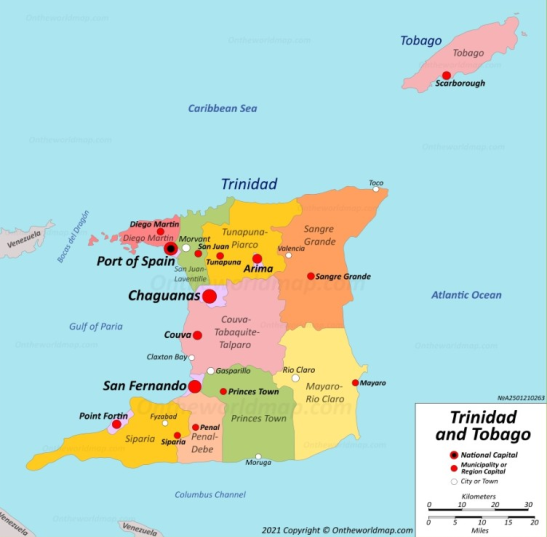
9 regions (Couva/Tabaquite/Talparo, Diego Martin, Mayaro/Rio Claro, Penal/Debe, Princes Town, Sangre Grande, San Juan/Laventille, Siparia and Tunapuna/Piarco)
-
3 boroughs (Arima, Chaguanas and Point Fortin)
-
2 cities (Port of Spain and San Fernando) [footnote 5].
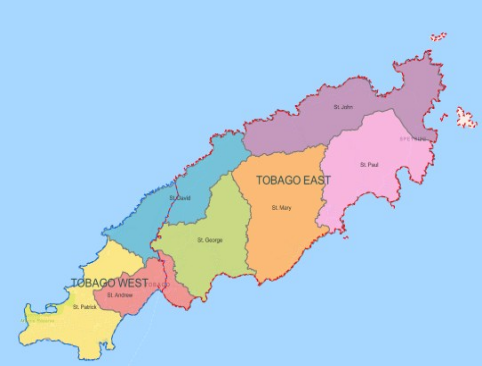
7.1.4 The same source noted that Tobago is divided into 7 parishes: St Andrew, St David, St John, St Mary, St George, St Paul and St Patrick [footnote 6].
7.1.5 The capital of Trinidad and Tobago is the Port of Spain, which is on the island of Trinidad[footnote 7].
7.1.6 The below map by Ontheworldmap, a collection of maps created by cartographers[footnote 8], shows the regions, boroughs and cities of Trinidad, as well as the regional capitals[footnote 9]:
7.1.7 The below map of Tobago, published on geospatial data platform ArcGIS[footnote 10] by Darion Mahadeo, a geoinformatics student at the University of the West Indies[footnote 11], shows Tobago’s parishes[footnote 12]:
7.1.8 For further maps of Trinidad and Tobago, see Trinidad and Tobago Central Statistical Office - Census Maps.
7.1.9 The Bertelsmann Stiftung’s Transformation Index (BTI) assesses movements toward democracy and inclusive market economy around the world[footnote 13]. Its 2026 iteration (BTI 2026), covering 1 February 2023 to 31 January 2025[footnote 14], stated, regarding the geographic distribution of education and healthcare facilities ‘With respect to the delivery of basic services such as health care and education, locations are fairly dispersed across the country.’[footnote 15]
7.1.10 In the sources consulted (see Bibliography), CPIT was unable to find further information on access to healthcare, employment and education in different geographic areas of Trinidad and Tobago.
7.2 Population and demography
7.2.1 Trinidad and Tobago’s central statistical office estimated the population to be 1,367,764 as of 30 June 2025[footnote 16].
7.2.2 UN Data estimated that 544,300 people lived in Port of Spain as of 2025, and that 53.2% of the population lived in urban areas as of 2020[footnote 17]. While sources differ as to their total populations, Port of Spain, San Fernando and Chaguanas (all on the island of Trinidad) are the 3 most populous cities in the country[footnote 18] [footnote 19] [footnote 20].
7.2.3 For populations by municipality, see Citypopulation.de: Trinidad and Tobago.
7.2.4 Minority Rights Group stated, regarding the ethnic composition of Trinidad and Tobago, that ‘East Indian and people of African descent make up the majority of the population. Afro-Trinidadians represent approximately 39 per cent and Indo-Trinidadians, 40 per cent (1990 Census). The remainder of the population is mostly of mixed ethnicity drawn from European, Chinese and Syrian-Lebanese minorities. Tobago’s population is almost entirely of African origin.’[footnote 21]
7.2.5 The Factbook Archive is an online collection of previous editions of the now-discontinued US CIA World Factbook, created by a research analyst with no affiliation to the US CIA or wider US government[footnote 22]. The 2025 edition of the CIA World Factbook, accessed through this collection, stated that ‘population on Trinidad is concentrated in the western half of the island, on Tobago in the southern half’[footnote 23]
8. Gangs in Trinidad and Tobago
8.1 Number of gangs and gang members
8.1.1 In December 2024, Al Jazeera reported that ‘Analysts say there are more than 100 gangs in the islands …’[footnote 24]
8.1.2 A July 2024 report on Caribbean gangs by the United Nations Office on Drugs and Crime (UNODC 2024 report) stated that: ‘According to the Trinidad and Tobago police, the number of gangs dropped from 211 to 129 between 2018 and 2020, and the number of gang members fell from 2,400 to 1,044.’[footnote 25] However, the same source noted that ‘In 2023 … 186 gangs were reported with approximately 1,700 suspected gang members countrywide …’[footnote 26]
8.1.3 A December 2024 article originally published in the New York Times but accessed through Florida-based media enterprise WLRN Public Radio and Television[footnote 27] (NYT 2024 article) also noted: ‘Experts estimate that there are 186 gangs with more than 1,750 members in Trinidad and Tobago.’[footnote 28]
8.1.4 A March 2025 article by Dialogo Americas, ‘a digital military magazine published by the U.S. Southern Command’[footnote 29], stated:
‘According to a report cited by the Chief Secretary of Tobago, the island’s head of government, Farley Chavez Augustine … the number of gangs on the island [Tobago] skyrocketed from just three in 2009 to 28 in 2022. The growth rate surpasses that of Port of Spain, in Trinidad, which decreased its number of gangs in the same period.
‘“When we had 24 registered gangs, Port of Spain had 41,” Augustine said. “But by 2022, when we had 28 gangs, it was reported that Port of Spain only had 21 …”’[footnote 30]
8.1.5 The Strategic Services Agency (SSA) of Trinidad and Tobago’s Ministry of National Security, an intelligence agency that aims ‘to guide the formulation and implementation of national policies on illicit trafficking of dangerous drugs and related criminal activities’[footnote 31], stated in its 2023 Annual Report, covering its operations in 2023 (SSA 2023 report), that: ‘… Trinidad and Tobago’s major gangs are increasing in size and influence; also increasing in quantity are smaller unaligned hybrid gangs, which are technologically savvy and engage in diverse criminal enterprises simultaneously.’[footnote 32]
8.1.6 The Global Organized Crime Index is a ‘multi-dimensional tool that assesses the level of criminality and resilience to organized crime for 193 countries.’[footnote 33] Its 2025 iteration (Global Organized Crime Index 2025), covering events of 2024[footnote 34], stated that: ‘While gang membership decreased during the COVID-19 pandemic, it has rebounded in recent years, with gangs fragmenting and experiencing heightened internal rivalries.’[footnote 35]
8.1.7 In September 2025, Armed Conflict Location & Event Data (ACLED), an ‘impartial global monitor that collects, analyses, and maps data on conflict and protest’[footnote 36], shared the below information on the main active gangs per year in Trinidad and Tobago (table compiled by CPIT). The source did not distinguish between gangs active in Trinidad and those active in Tobago, nor did it specify the number of members in each gang or their specific areas of operation. The source did not indicate that the list was an exhaustive overview of gangs operating within the country[footnote 37]:
| Year | Number of active gangs | Name of active gangs |
|---|---|---|
| 2022 | 4 | · Sixx · Seven · Resistance · Rasta City |
| 2023 | 8 | · 666 · Anybody Gets It (ABG) · Gorilla Strike Force · Sixx · Seven · Resistance · Rasta City · The Muslims |
| 2024 | 5 | · Sixx · Seven · Resistance · Rasta City · The Muslims |
| 2025 (1 January to 2 September) | 3 | · Sixx · Rasta City · Tren de Aragua |
8.1.8 For more information on the main gangs active in Trinidad and Tobago, see Main gangs.
8.2 Main gangs
8.2.1 A March 2024 article in the International Relations Review (IRR 2024 article), a ‘preeminent journal of international affairs written, edited, and published by undergraduate students at Boston University’[footnote 38], written by student Victoria Beharry, stated: ‘There are over 100 different gangs in Trinidad and Tobago, but research shows that they tend to fall under the umbrella of two “supergangs” - The Muslims and Rasta City … there was a split within Rasta City into the gangs Sixx and Seven - the latter faction claiming the name Rasta City for itself.’[footnote 39]
8.2.2 The UNODC 2024 report similarly stated that ‘Nearly all street gangs align themselves with an umbrella gang.’[footnote 40] The report explained that ‘An umbrella gang is a top-level gang that can set the terms of engagement in various settings, including on the street and within prisons. An umbrella gang can also set the terms of informal protection arrangements and illicit markets.’[footnote 41]
8.2.3 However, a December 2023 article by news site Trinidad Express[footnote 42] stated:
‘Criminologist Darius Figuera … noted … the rise of smaller gangs in recent times …
‘“What we are seeing is that the system we had in place prior, in which the main gangs were conducting operations, that was disrupted due to the pandemic … persons who were accustomed to getting money and handouts for their roles in these operations were no longer receiving funding or such opportunities. So much so that they decided to break off and go into business for themselves, and the main gangs ended up splintering …” he told the Express. “Gone are the days when it was only Rasta City and Muslim gangs. Now you have several slivers of operations. Gangs with names that most people don’t even know because some are just operating on their blocks …” …
‘Of [the total number of gangs operating in the country] there are about eight “main-ones” and these include Tyson, Muslim, Rasta City, EBG (Everybody Gets It), SIXX(6), Seven, Boombay Gang and “Police”. …
‘However, there are several smaller gangs in operation throughout the country, with names such as Bat, Ztekk, and Big Fish.
‘One group even called themselves “Batman”, officials said.
‘Other smaller gangs just go by the name of the area they operate in, such as Ninth Street, St Paul, Maloney and La Horquetta.’[footnote 43]
8.2.4 Regarding the main gangs operating in Trinidad and Tobago, the UNODC 2024 report stated: ‘Notable gang factions in Trinidad include: Muslim (aka Muslim City and 9) … Rasta City (aka Seven), which is a collective that was initially defined largely in opposition to the Muslim identity of the former group; Sixx (aka 6 and 6ixx), which is a group that splintered from Rasta City; and EBG (aka 8). Other notable gangs include Boombay Gang, Police, and Tyson.’[footnote 44]
8.2.5 In September 2025, ACLED shared the below table, reproduced by CPIT, describing the main active gangs in Trinidad and Tobago[footnote 45]:
| Gang | Location | Description |
|---|---|---|
| The Muslims | Laventille, Port of Spain | One of Trinidad and Tobago’s oldest gangs, with roots in Jamaat-al-Muslimeen, the Islamist group behind the 1990 coup attempt. The group is the longtime rival of Rasta City, and its influence persists despite leadership struggles. |
| Rasta City | Port of Spain | A major rival of the Muslim gang that formed in the 2000s. It fragmented in the 2010s, giving rise to splinter groups including Sixx and Seven. |
| Sixx | Port of Spain | An offshoot of Rasta City. It entered a truce with rival Seven gang in 2022, but violence resumed in 2023 amid turf wars. |
| Seven | Port of Spain | An offshoot of Rasta City. It maintains a rivalry with Sixx, and is involved in disputes in Port of Spain and over the control of logistics hubs around the capital. |
| Anybody Gets It (ABG) | East Port of Spain | It originated in East Port of Spain and is currently locked in a rivalry with Rasta City while reportedly allied with Sixx. |
8.2.6 A May 2023 article in daily newspaper the Trinidad and Tobago Newsday[footnote 46] noted: ‘“Sixx,” is used to identify a gang that reportedly broke away from the larger Rasta City gang, which went on to refer to itself as “Seven” in response.’[footnote 47]
8.2.7 In a November 2023 article, quoting local contractor Kenny Dopwell[footnote 48], the Trinidad and Tobago Guardian newspaper[footnote 49] similarly reported that ‘“The Rasta City and the Seven gangs are the same …”’[footnote 50]
8.2.8 In May 2022, InSight Crime, a think tank and media organization focused on organised crime in the Americas[footnote 51], described the Muslims as ‘a union of gangs with some 600 members.’[footnote 52]
8.2.9 The IRR 2024 article stated that ‘… gang members vary in religious beliefs. However, the Muslims are affiliated with an extremist international Muslim militant group known as Jamaat al Muslimeen. Members of the group orchestrated a failed coup against the Trinidadian government in 1990 …’[footnote 53]
8.2.10 The UNODC 2024 report stated that: ‘Present gang culture and alignments do not indicate an ideological affiliation. For instance, though Muslim has its roots in Jamaat al Muslimeen’s ideology, its current leadership does not appear to promote this ideology and is willing to collaborate with organizations that are neither Muslim nor Black …’[footnote 54]
8.2.11 The UNODC 2024 report further noted regarding Jamaat al Muslimeen that:
‘The most significant Islamist organization in Trinidad and Tobago is Jamaat al Muslimeen, which was founded by the late Imam Yasin Abu Bakr in 1969. By the mid-2010s, Jamaat al Muslimeen was more diffuse; several splinter groups emerged from its original iteration. Jamaat al Muslimeen has a complex past: it has operated as an Islamist organization, engaged as a civil society actor, acted as a political broker, and, in 1990, attempted a coup d’état.
‘Since the coup attempt, Jamaat al Muslimeen has exerted control over some of Trinidad and Tobago’s criminal enterprises by taxing illicit businesses and street gangs … One umbrella gang, Muslim, historically has been “an informal federation of disaffected groups of mostly Afro-Trinidadian Muslim men loosely affiliated with the ideology of the 1990 coup;” however, no significant continuance of this ideology appears in the contemporary gang context.
‘… After the death of Abu Bakr in 2021, the organization [Jamaat al Muslimeen] has not been publicly accused of engaging in criminal activity.’[footnote 55]
8.2.12 A December 2022 article by the Modern Insurgent, a media organisation focussing on ‘insurgencies, rebel organisations, and political movements’[footnote 56], reported on Jamaat al Muslimeen (JAM):
‘The [1990] coup attempt was ultimately unsuccessful, and the group’s leaders were arrested and charged with treason. However … the organization has continued to be a controversial and somewhat influential force in the country.
‘In 2021, the JAM appointed Sadiq Al Razi as their new imam, following the death of founder Yasin Abu Bakr … The following year, Imam Al Razi announced that the group would not “dabble in politics” on the anniversary of the attempted coup and would instead use the day to pray, fast, and feed the poor. Over the years, the JAM has focused on hosting community events that promote Islamic education, while also fulfilling the basic responsibilities of a mosque, such as conducting prayers, burials, and providing charity. Additionally, the mosque runs a school and maintains an active presence on Facebook, using the platform to share photos and videos of their community service activities. This reform highlights the ideological transition of the JAM, as it seems to have become more apolitical and focused on social work.’[footnote 57]
8.2.13 A July 2024 article in the Trinidad Express reported that the Resistance gang has ‘200-plus members.’[footnote 58]
8.2.14 An October 2024 article in the Trinidad and Tobago Newsday reported:
‘Powerful new gangs include ABG – an acronym for “Anybody Gets It.”
‘“It is said that they formed from inside of prison and spread outward,” said [a prison officer]. “They have no relationship or affiliation with anyone. I call them the independent contractors. They are fighting everyone.” …
“Resistance is one of the latest gangs. They had a stronghold in Caroni and spread to Sangre Grande, Toco, Tunapuna and St Augustine. They are islandwide now,” said the officer.’[footnote 59]
8.2.15 Sources reported that Venezuelan gangs also operate in Trinidad and Tobago, including Tren de Aragua[footnote 60] and Evander (described as ‘a comparatively large gang’ which ‘has embedded members with local gangs’[footnote 61]) as well as smaller Venezuelan gangs[footnote 62].
8.2.16 In the sources consulted (see Bibliography), CPIT could not find further information on the size and structure of the main gangs operating in Trinidad and Tobago. For further information on the locations of gangs, see Location and reach of gangs.
8.3 Location and reach of gangs
8.3.1 Describing the presence of gangs at the national level, in November 2023, the Trinidad and Tobago Guardian reported that ‘… small pockets of lawless gangs … are now scattered in almost every community.’[footnote 63]
8.3.2 The 2023 AmericasBarometer survey was carried out in Trinidad and Tobago through 1,660 face-to-face household surveys between 10 March 2023 and 28 April 2023, designed to provide a representative sample of voting-age adults throughout the country[footnote 64]. 24% of respondents to the survey reported having criminal gangs present in their neighbourhoods (up from 14% in the last iteration of the survey, carried out in 2014)[footnote 65].
8.3.3 The SSA 2023 report stated: ‘The gang culture in Trinidad and Tobago is escalating and becoming more entrenched across several communities, posing a severe threat throughout the country.’[footnote 66]
8.3.4 The IRR 2024 article stated: ‘There is a high concentration of gang violence in Port of Spain, although it is widespread throughout both islands, predominantly in impoverished areas.’[footnote 67]
8.3.5 In a September 2024 article, the Trinidad and Tobago Newsday interviewed a former gang member referred to as Ellen: ‘Gangs are not restricted to areas any more. They have tentacles in many communities. So Ellen had no trouble keeping her gang affiliation after her family moved to four different places …’[footnote 68]
8.3.6 Describing the presence of gangs at a location-specific level, the UNODC 2024 report stated: ‘Although most of the country’s street gangs operate in Port-of-Spain, they are allegedly spreading across the country to secondary cities and towns. The country’s dominant gangs and gang federations reportedly face growing competition from smaller street gangs along the country’s East-West Corridor [a less than 20-mile stretch from Port of Spain to Arima[footnote 69]].’[footnote 70]
8.3.7 In September 2022, InSight Crime reported: ‘Tunapuna, a district less than 20 kilometers from Port of Spain, is now largely controlled by gangs, the Trinidad and Tobago Guardian recently claimed.’[footnote 71]
8.3.8 The SSA 2023 report similarly noted that ‘… there is a growing threat from smaller gangs whose activities focus along the East-West Corridor, as well as communities in the Northern, Central, Southern and Eastern divisions.’[footnote 72]
8.3.9 A May 2023 article in the Trinidad and Tobago Guardian reported, referring to Port of Spain suburbs and neighbourhoods:
‘While [gang] “hot spots” previously referred to select areas such as Beetham, Sea Lots, Laventille and Morvant, [Postal Workers Union president Shellon Trim[footnote 73]] said this was no longer the case, as any and all areas were now experiencing “explosions” of crime …
‘Police yesterday revealed that the Sixx gang territory was St Paul Street, Laventille Road, Lower Gonzales Belmont areas; Seven [gang territory] was Duncan Street, Beetham, Sea Lots, Lower Nelson Street and Belle Eau Road, Belmont; and Upper Nelson and George Streets were the Muslim gang region but also featured some Sixx elements as well …’[footnote 74]
8.3.10 In a November 2023 article, quoting local contractor Kenny Dopwell[footnote 75] and referring to neighbourhoods within, and suburbs of, the Port of Spain, the Trinidad and Tobago Guardian reported: ‘In Sea Lots, Dopwell said, the Rasta City gang has a presence. “…The Laventille area is dominated by the Sixx and Muslims,” he said …’[footnote 76]
8.3.11 A December 2023 article in the Trinidad Express noted that ‘The smaller groups, police said, tend to run illegal activities within certain communities, with some operations limited only to certain streets.’[footnote 77]
8.3.12 A July 2024 article in the Trinidad Express reported that: ‘… there are areas where gang violence is more common. In particular, the Northern and Port of Spain police divisions are known to have a high rate of violence and a well-established gang presence.
‘… Murders connected to gangs have been reported more frequently in Tunapuna, Arima, and other surrounding regions …’[footnote 78]
8.3.13 The same source reported that the Resistance gang: ‘… [use] the hills near Mount St Benedict as a base after committing crimes …’[footnote 79]
8.3.14 The same source reported that the Resistance gang: ‘… also stretched their control into the Five Rivers area, Maracas, St Joseph, and later St Helena in Piarco.
‘“… in the Five Rivers area … there is another gang … known as J-12 …”’[footnote 80]
8.3.15 The same source also reported, citing a police intelligence report, that the Resistance gang took over the St Augustine area in January 2023[footnote 81].
8.3.16 The Global Organized Crime Index 2025 noted: ‘Limited links to transnational organizations suggest that most activities remain locally focused. Small, loosely structured criminal networks – primarily concentrated in Port of Spain and other impoverished urban areas … wield significant influence …’[footnote 82]
8.3.17 Regarding the areas of the country that are most commonly affected by gang violence, the UNODC 2024 report stated: ‘Most gang-related murders occur in Trinidad and Tobago’s population centers in the northwestern part of the country.’[footnote 83]
8.3.18 In September 2025, ACLED shared an interactive map showing yearly locations of gang violence in Trinidad and Tobago between January 2020 and August 2025. The below map shows the locations of gang violence in 2024 (the most recent complete year indicated by the map)[footnote 84]:
8.3.19 In an October 2024 report, ACLED produced the below graphic showing where and how much of the population of Trinidad and Tobago was exposed to gang violence between January 2024 and September 2024[footnote 85]. The report noted that 57% of the population had been exposed to violence[footnote 86]. Describing how it measures exposure to conflict, ACLED noted that ‘Conflict exposure is a measure of the number of people living within 1, 2, and 5 km of each conflict incident or demonstration.’[footnote 87]:
8.3.20 Regarding the transnational reach of gangs in Trinidad and Tobago, the UNODC 2024 report stated that ‘A relatively small number of Caribbean gangs exhibit transnational capabilities …’[footnote 88]. However, the same report noted that ‘… some gangs from … Trinidad and Tobago are … reportedly linking up some operations with smaller groups in neighboring islands such as Barbados, Saint Lucia, and Saint Vincent and the Grenadines.’[footnote 89]
8.3.21 A December 2025 article on news website the Stabroek News[footnote 90] noted that the ‘… spread of the “Sixx” and “Seven” gangs from T&T [Trinidad and Tobago] to neighbouring islands … has been cited by international and regional crime analysts as a factor in rising violence in the other Lesser Antilles islands.’[footnote 91]
8.3.22 A March 2026 article on news website Saint Martin News Network[footnote 92] noted ‘The Sixx and Seven gangs, originating in Trinidad, have expanded their influence across the Caribbean, including Jamaica, Grenada, and Sint Maarten … The gangs’ leaders and financiers, some based as far as the United Kingdom and North America, use their resources to orchestrate hits and expand their operations.’[footnote 93]
8.3.23 For more information on the nature and operations of gangs, see Gang activities.
9. Gang activities
9.1 Overview of activities
9.1.1 In July 2025, The Telegraph reported: ‘… the gang problem … has roots in the steel-pan music scene …
‘Bands … would attract their own groups of rival followers – nicknamed “badjohns” – who would fight with cutlasses and cudgels. They soon morphed into mini-mafias, with businesses paying them protection money and politicians using them as street muscle and vote mobilisers.’[footnote 94]
9.1.2 The SSA 2023 report noted: ‘Incarcerated gang leaders continued to sanction criminal activities, including targeted killings, narcotics ventures and extortion from prisons, which contributed to the worsening crime landscape in 2023.’[footnote 95]
9.1.3 A December 2023 article in the Trinidad Express noted:
‘… gangs conduct main operations such as drug trade, firearm trade, and armed robberies, national security officials said.
‘They are also the main perpetrators of incidents that include shooting, arson, extortion, kidnapping and murder.
‘Their reaches also include white-collar crimes which include human trafficking, and illegal quarrying …
‘The smaller groups, police said, tend to run illegal activities within certain communities, with some operations limited only to certain streets.
‘They will conduct robberies, larcenies, and even minor drug trade and sales.
‘Despite their size, they are still considered dangerous as many of these groups are armed.’[footnote 96]
9.1.4 A May 2024 article in the Trinidad and Tobago Newsday reported: ‘Police said the Resistance gang is suspected of having been responsible for several murders over the years … It is also involved in kidnappings and extorting business owners in Central Trinidad …’[footnote 97]
9.1.5 The UNODC 2024 report stated: ‘… a relatively small number of larger gangs are heavily involved in the drugs and firearms trade, and have also diversified into criminal activities such as human trafficking from Venezuela, contract killings (in Trinidad and Tobago, and abroad, including neighboring countries and as far away as Angola), kidnapping, extortion, illegal quarrying, ATM fraud, and racketeering.’[footnote 98]
9.1.6 The same report noted that ‘… the coastal region, including Icacos, Cedros, and Moruga, are sites of extensive trafficking of drugs, guns and migrants.’[footnote 99]
9.1.7 Regarding the activities of Venezuelan gangs in Trinidad and Tobago, the UNODC 2024 report stated:
‘… the Evander gang [also known as Deltano Liberation Front[footnote 100]] … is involved in both extortion of boats carrying Venezuelan migrants as well as ferrying drugs and arms …
‘… Gang members reportedly transit the country illegally, seeking construction jobs while also engaging in drug and arms selling …
‘According to police and immigration officials, Evander has embedded members with local gangs. There are also concerns that some former gang members provide services to various gangs, including Muslim in Port-of-Spain, as well as gangs in Port Fortin and Chaguanas. Gangs may be involved in drugs and weapons, but also prostitution …’[footnote 101]
9.1.8 A January 2025 article in Trinidad and Tobago Newsday reported: ‘Police … say gangs have been responsible for extorting small-business owners throughout the country.’[footnote 102]
9.1.9 The Global Organized Crime Index 2025 noted: ‘Extortion and racketeering remain notable issues. They typically occur in prisons, where seasoned inmates manipulate new prisoners into facilitating payments from their families, and in businesses, where gangs impose a “tax” on contractors and small- to medium-sized enterprises. Reports indicate a steady rise in the country’s extortion cases.’[footnote 103]
9.1.10 The same source noted:
‘Gangs continue to engage in activities such as extortion, murder for hire and turf wars, often driven by identity conflicts and competition for control of drug trafficking territories …
‘These gangs collaborate with Venezuelan criminal networks and increasingly profit from engaging in kidnapping and extortion alongside drug and arms trafficking. Historical divisions … contribute to tensions …
‘Many [gangs] operate with relative impunity, bolstered by successful extortion schemes and control over drug territories …
‘Small, loosely structured criminal networks … also wield significant influence, involving themselves in local and regional drug trafficking. These networks are diversifying into arms trafficking, fraud and corruption.
‘Transnational organized crime groups, often connected with local gangs, are increasingly involved in smuggling drugs, firearms and people across Trinidad and Tobago, leveraging the country’s strategic location to access North America and Europe. These groups, such as Venezuela’s Tren de Aragua, often collaborate with local gangs and exploit the country’s porous borders for smuggling operations … Chinese syndicates also have some influence, particularly in the trafficking of drugs and metals, and have ties to Venezuelan gangs.’[footnote 104]
9.2 Gang violence and homicides
9.2.1 A September 2024 article in the Trinidad and Tobago Newsday reported: ‘Newsday requested statistics from the police service’s Crime and Problem Analysis Branch on gang-related murders between 2000 and 2023, separated by gender and district/division.
‘All gang-related murders for that period totalled 3,253 – 104 women and 3,149 men.
‘The largest figure, 1,172, came from the Port of Spain division.’[footnote 105]
9.2.1 In November 2024, Trinidad and Tobago broadcaster CNC3[footnote 106] reported that:
‘As of October 24 [2024], there were 78 murders in the Port-of-Spain Division. The figure has been attributed to an intensified war between Sixx and Seven gangs and is noticeably higher than the 2023 figure of 33 for the same period.
‘The Eastern Division recorded the second-highest spike in murders for the year with 46, compared to 26 for the corresponding period last year.
‘… The murders are believed to be a spillover of the Port-of-Spain gang war.
‘The Tobago Division had the third-highest increase in murders with 25 reported compared to nine for the same period last year [2023]. Police in the Criminal Gang Intelligence Unit attributed the increase to the migration of criminals from Trinidad, particularly from Maloney.’[footnote 107]
9.2.2 Freedom House’s 2025 Freedom in the World report, covering events of 2024 (Freedom House 2025 report), stated: ‘… the smaller and typically safer island of Tobago registered its own record high of 26 murders [in 2024].’[footnote 108]
9.2.3 However, a January 2026 article by the Trinidad and Tobago Guardian noted that ‘After recording 26 murders in 2024, Tobago ended 2025 with just 10 murders — the lowest figure seen in years.’[footnote 109]
9.2.4 The below table, created by CPIT using information from various sources, shows the total number of recorded homicides per year from 2022 to 2025, and the percentage of these homicides reported to be gang-related:
| Year | Number of homicides | Gang-related |
|---|---|---|
| 2022 | 605[footnote 110] | 40%[footnote 111] |
| 2023 | 576[footnote 112] | 40.5% (between January and September, by which point there had been 454 murders with 184 classed as gang-related)[footnote 113] |
| 2024 | 625[footnote 114] | 43.68%[footnote 115] |
| 2025 | 369[footnote 116] | 33.1%[footnote 117] |
9.2.5 In January 2026, the Trinidad and Tobago Newsday reported that the number of homicides in 2025 was the lowest since 2014[footnote 118].
9.2.6 On 3 March 2026, The Independent reported that ‘The twin-island nation has already recorded 63 killings so far this year [2026], just one killing shy of the count for the same period last year.’[footnote 119]
9.2.7 The 2023 AmericasBarometer survey report stated: ‘Experts have suggested that gangs in Trinidad & Tobago have become more violent in recent years because of three main reasons: gang splintering is leading to violence between rival gangs, gang leaders who are acting as community leaders at the local level are profiting from a variety of activities and winning public works contracts, and gangs have had increasing access to guns.’[footnote 120]
9.2.8 The SSA 2023 report noted:
‘Trinidad and Tobago experienced an increase in violent crimes attributed to increasingly vicious gangs, fighting over a range of criminal markets, particularly - drug blocks, geographic spheres of influence for robberies and extortion, and social media influence associated with the music industry and the rapidly growing and popular “Trinibad” genre …
‘In 2023 … gang territorial disputes, resulted in the use and application of extreme violence, along with an alarming trend of extorting businesses for protection money …’[footnote 121]
9.2.9 In March 2023, the then Her Majesty’s Inspectorate of Constabulary and Fire and Rescue Services (HMICFRS) commissioned a review of existing research on gang‑related homicide and police corruption in Trinidad and Tobago. The review examined the nature and prevalence of these issues, and its findings were intended to support the design of an HMICFRS assessment of policing in the country. This review reported:
‘Research on homicide in Trinidad and Tobago confirms that the problem is fuelled largely by criminal street gangs …
‘… the violence appears to be linked with a street culture, which normalises violence to defend social status and resolve perceived acts of “disrespect” …
‘One study … concluded that it was not the mere presence of street gangs that fuelled the violence, since there were dramatic differences in the extent of violence perpetrated by and against the nation’s different gangs. Instead, the major issue appears to be “the degree to which these gangs are immersed in conflict with other gangs and are willing to use violence to resolve disputes or defend their boundaries” …’[footnote 122]
9.2.10 The NYT 2024 article reported: ‘… the past decade has seen a surge in the escalation of violence by street gangs, said Alex Papadovassilakis, an investigator for Insight Crime …
‘“We’re not talking sophisticated gangs; we’re talking small and deeply territorial street gangs …” Papadovassilakis said in a telephone interview. “They are extremely violent.”
‘Tit-for-tat killings have also contributed to the death toll, he said.’[footnote 123]
9.2.11 A July 2024 article in the Trinidad Express reported that: ‘According to [an] intelligence officer, there has been a continuous battle for drug turf in the Five Rivers area for the past few years, with several people from both gangs [Resistance and J-12] having lost their lives in the conflict …
‘“Rifle attacks are one of their [the Resistance gang’s] signatures …” the officer said.’[footnote 124]
9.2.12 The UNODC 2024 report stated:
‘Roughly a third of murders committed in Trinidad and Tobago are deemed to be gang-related; most of these murders are committed with a firearm. Most gang-related murders occur in Trinidad and Tobago’s population centers in the northwestern part of the country …
‘According to Trinidad and Tobago’s Strategic Services Agency (SSA), gangs have also started splintering and becoming more violent. As gang leaders are imprisoned or killed, younger cohorts emerge with less discipline and a higher level of aggression … Frustrated younger members use more extreme violence to supplant leadership and to be noticed.’[footnote 125]
9.2.13 In December 2024, Al Jazeera reported: ‘The bitter war between the … [Sixx and Seven gangs] has continued for years and caused dozens of murders. The two have strongholds in different parts of Port of Spain and are now parlaying with smaller groups to wipe one another out.’[footnote 126]
9.2.14 The United States State Department Overseas Security Advisory Council’s Trinidad and Tobago Country Security Report, updated in March 2025 (USSD OSAC 2025 report), stated:
‘Trinidad & Tobago Police Service (TTPS) 2024 statistics show an increase in all areas of crime as the country is experiencing a violent gang war … The homicide rate … made Trinidad and Tobago the sixth most dangerous nation in the world …
‘Roughly 95% of the homicides in 2024 occurred on the island of Trinidad in part due to it being the population center. However, murders and violent crime is also on the rise on the island of Tobago. Gang and drug activity motivates most violent crime such as homicide, kidnapping, assault, robbery, and sexual assault. The most populated metropolitan areas of Port of Spain and San Fernando continue to contribute heavily to the crime statistics.
‘… Loss in confidence of the justice system and TTPS’s ability to address crime has led to a significant depreciation in available statistics on criminal acts as most crimes go unreported …’[footnote 127]
9.2.15 The Global Organized Crime Index 2025 noted: ‘Gang-on-gang violence involving high-powered weapons has escalated, particularly in urban areas …’[footnote 128]
9.2.16 In July 2025, The Telegraph reported: ‘… shootings in broad daylight in downtown Trinidad locations are commonplace …’[footnote 129]
9.2.17 An October 2025 article by InSight Crime stated: ‘Criminal gangs remain Trinidad and Tobago’s main security threat … Easy access to firearms, social isolation in poor communities, and turf wars among increasingly fragmented gangs have all fueled the violence.’[footnote 130]
9.2.18 Regarding access to firearms, a May 2025 article in the St Lucia Times[footnote 131] noted:
‘The 2023 Weapons Compass: The Caribbean Firearms Study, an in-depth Caribbean firearms assessment jointly produced by CARICOM IMPACS and international partners … found that more than 70 per cent of firearm-related crimes in the region involved illegal weapons, the majority of which entered through porous borders, poorly regulated ports or corrupt networks …
‘Importantly, the study emphasises that Caribbean states lack the technical capacity and institutional coordination to effectively trace weapons, enforce licensing laws, and manage firearm inventories.’[footnote 132]
9.2.19 The UNODC 2024 report stated: ‘While Venezuela is reportedly a source of firearms in Trinidad and Tobago, the vast majority of weapons used by criminal groups and gangs are reportedly sourced from the US …
‘Weapons, components and parts typically enter through the county’s two largest legal seaports in Port-of-Spain and Point Lisas as well as the Piarco international airport.’[footnote 133]
9.2.20 In March 2024, the Trinidad and Tobago Newsday noted:
‘The current crime spate is being fuelled by a thriving, multimillion dollar firearms trade …
‘So said a report on illegal firearms and gun violence by the Joint Select Committee (JSC) on National Security laid in the House of Representatives on March 1 [2024] …
‘The report … listed the profits made by importing illegal guns to TT, with mark-ups typically ranging from three-fold to ten-fold …
‘The report said, “Based on SSA [Strategic Services Agency] analysis in 2021, the statistical estimate of illegal firearms in circulation within TT for 2021 was 11,043. This represented a 17 per cent increase from the initial 2019 estimate of 9,389.” …
‘“A reasonable estimate is that every year, 1,000 more illegal firearms are available for criminals in the streets and homes of Trinidad and Tobago,” the report said, “and that during the same time, the total efforts of law enforcement manage to only intercept 50 firearms (five per cent).” …
‘The report cited criminologist Darius Figuera, “While the simple method of bringing in guns is through personal cargo, professional smugglers have been dismantling the guns and hiding them in engine blocks, automobiles, appliances, coffee cans, and even cartons.”’[footnote 134]
9.2.21 For more information on locations of gang violence, see Location and reach of gangs.
9.3 Territorial control
9.3.1 The 2023 AmericasBarometer survey report noted that 59% of urban respondents stated that gangs affected their neighbourhood and 45% of rural respondents stated that gangs affected their neighbourhood[footnote 135]. When asked to what extent their neighbourhood was affected by gangs, 44% of [the total 1,600] respondents said none, 28% said a little, 17% said somewhat and 11% said a lot. In the previous iteration of the survey, carried out in 2014, 24% of respondents stated that there was at least a little gang presence in their neighbourhood[footnote 136].
9.3.2 The same report noted:
‘Over half of Trinbagonians believe that gangs affect their neighborhood at least a little … Among those who live in neighborhoods that are affected at least a little by gangs, 40% say at least one person was murdered in their neighborhood in the last year …
‘Only around one in five of those who live in neighborhoods with a little or some gang violence say that gangs enforce laws or provide services for the neighborhood. However … those who say that gangs affect their neighborhood a lot are far more likely to say that gangs enforce the laws and provide services to the neighborhood … While gangs in the country are hardly viewed as benevolent, it is notable that those who perceive more gang activity also believe gangs are doing more good than bad …’[footnote 137]
9.3.3 The report also noted that ‘only 27% of Trinbagonians feel somewhat or very unsafe in their neighborhood. Urban residents are more likely to feel unsafe in their neighborhoods compared to rural residents.’[footnote 138]
9.3.4 In March 2023, HMICFRS reported: ‘In the absence of a reliable and effective police presence in many high needs communities, gang leaders are legitimised and regarded as “community leaders” who exert their own form of informal social control over residents and activities in the area …’[footnote 139]
9.3.5 The Global Organized Crime Index 2025 similarly stated: ‘… some communities rely on gang leaders to mediate crime.’[footnote 140]
9.3.6 The SSA 2023 report noted: ‘The control of the gangs, their access to resources and their displays of wealth and influence contribute to their persistence in impoverished areas …’[footnote 141]
9.3.7 In a July 2024 article, the Trinidad and Tobago Newsday reported:
‘St Paul Street, Port of Spain, may be associated with gangs, but residents say gangs actually keep them safe …
‘The area has … become synonymous with a gang known as 6ixx …
‘A shop owner in the area said while delivery vans were reluctant to come into the area, there was little chance they would be robbed if they did, as there was an “order” to be maintained.
‘“I think sometimes the (gang) leader is better than the police. Because they stipulate nobody [is] supposed to break into anybody[’s] place. So sometimes you could forget your place open, and nobody ain’t coming in. And if anybody come and steal, they have to go and answer to the boss.” …
‘Another woman … said … the gangs helped ensure law and order in the area …
‘[A] man, who gave his name only as Akame, said … the gang members and gangleaders played an invaluable role in the community …
‘“If it wasn’t for these men, half of the people in this community will starve and die … It’s these same gang members and gangleaders feeding people, paying rent for people, helping out people …”
‘He said the gangs were doing what the politicians were not doing.
‘“… when they get their money, they help the community …”’[footnote 142]
9.3.8 A July 2024 article in the Trinidad Express reported that: ‘Government officials face an uphill task in tackling the gang problem because many communities rely on gangs for both protection and financial support.’[footnote 143]
9.3.9 A September 2024 article in the Trinidad and Tobago Newsday quoted psychologist and behaviour specialist Kezia Guy[footnote 144] as saying:
‘“Certain neighbourhoods reap the benefits of gang members, because where the government fails, they pick up the slack by paying for schoolbooks or shoes or tuition fees to children.
‘“These are things that are supplied by gang leaders in certain communities. They see a need and give what is needed in the community, which makes it very hard to infiltrate that community and make a change in the process of gangs being formed.”’[footnote 145]
9.3.10 See Location and reach of gangs for information on the location of gangs.
9.3.11 See Freedom of movement for information on restrictions to the movement of residents of areas under gang control.
9.4 Public contracts
9.4.1 In May 2022, InSight Crime reported: ‘Given their power in many poorer neighborhoods, gang bosses … have been awarded numerous contracts to execute public works.’[footnote 146]
9.4.2 The SSA 2023 report noted: ‘In 2023, the continued nexus between gangs and the issuing of legitimate contracts … resulted in the use and application of extreme violence … Gangs continue to control access to state resources in the community; this includes social services and employment.’[footnote 147]
9.4.3 In March 2023, HMICFRS reported:
‘A related issue that fuelled the [gang] violence has been linked to competition for lucrative government contracts …
‘Trinidad and Tobago has a long history of issuing contracts to community leaders to carry out public works projects. These contracts function as a public welfare program that provide short term employment to people who are otherwise unemployed. Unfortunately, these programs, particularly the Unemployment Relief Programme (URP), have historically been infiltrated by criminal gangs … Battles over URP contracts have often turned deadly … The URP is just one example of a government program being infiltrated by criminal gangs … Given the long history of criminal groups taking over government programs, some criminologists have referred to the nation’s government as a “principal source of funding for gangs in Trinidad and Tobago” …’[footnote 148]
9.4.4 In its November 2023 profile on the Caribbean, InSight Crime noted: ‘Trinidad and Tobago’s gangs … perform key social functions, with gang leaders dubbing themselves “community leaders” and controlling job allocation through public works contracts.’[footnote 149]
9.4.5 The IRR 2024 article stated:
‘Gang leaders are recognized by the government as “community leaders” due to their providing security and social services to those within their territory. One of the major sources of income for the gangs … is through government contracts. This allows them to expand their influence and further their legitimacy. Examples of contracts funded by the government include the Unemployment Relief Program (URP) and construction-related contracts that pay unemployed citizens for public service such as fixing drains, construction projects, building repair, and the like. Such contracts are undertaken by the gangs with jobs delegated to their members.’[footnote 150]
9.4.6 The Global Organized Crime Index 2025 stated: ‘Gangs often act as de facto service providers in impoverished communities, increasing corruption and violence. Gang leaders in Trinidad and Tobago are often portrayed in the media as “community leaders” and frequently interact with members of Parliament. This creates a duality where gangs, despite being responsible for violence in their communities, also provide resources and employment, thereby enhancing their legitimacy …’[footnote 151]
9.4.7 In July 2025, The Telegraph reported:
‘What really consolidated their [gangs’] power … was when governments began giving gang leaders contracts for public works in their neighbourhoods. Officially, this was to create employment by building community facilities and roads. In practice, it was to buy peace in gang neighbourhoods, allowing leaders to line their pockets through “jobs for the boys” rackets.
‘This started … in 2006 … The bloodshed simply increased as gangs squabbled over the contracts, and factionalised further to get signed up for more …
‘Another complicating effect of the contracts was to blur the line between criminal and “community leader”. Many listed as gangsters in police files simply regard themselves like old-school neighbourhood headmen, who help run parts of town where the police writ runs thin …’[footnote 152]
9.4.8 An October 2025 article by InSight Crime stated:
‘According to official investigations, gangs received contracts to carry out public works and provide services through both programs [the Unemployment Relief Programme (URP) and the Community-based Environmental Protection and Enhancement Programme (CEPEP)[footnote 153]], and even registered fake employees, known as “ghost workers,” to siphon off funds.
‘Decades ago, the need to implement these programs, which remain a lifeline for thousands of families in gang-controlled areas, led authorities to recognize certain gang leaders as “community leaders” responsible for managing and executing projects on the ground.
‘According to [criminologist Randy Seepersad from the University of the West Indies[footnote 154]], this created “an uncomfortable kind of relationship that has developed over the years between gangs and governments that have been in power.” Multimillion-dollar public contracts thus became a source of income for criminal organizations, which used part of the proceeds to acquire weapons and drugs.
‘In areas of the capital, Port of Spain, gangs such as Rasta City and The Muslims, which are the country’s most powerful criminal groups, have consolidated control through public contracts worth more than $100,000 [approx. £75,287[footnote 155]] granted via the URP, CEPEP, and other construction programs, according to academic research.
‘Competition for access to these contracts has also fueled gang violence in Port of Spain and other municipalities, including Chaguanas and Gonzales …’[footnote 156]
9.4.9 For further information on interactions between gangs and state agencies, and on action taken by the state in response, see Corruption.
10. Targets of gang violence
10.1.1 In November 2022, the Trinidad and Tobago Guardian interviewed various residents of Laventille and its surroundings about gang violence in their communities. The resulting article stated:
‘They said fighting for turf or territory, guns and drugs and other illicit items to “bad blood” over who gets government contracts, plain jealousy or even a fallout over a female could trigger the [gang] “war”. Police sources also confirmed this …
‘None of the residents from the area where the rival gangs are located is safe from a bullet.
‘“If they cannot get to who they want, somebody from the area will have to feel it …” said [a] man who is familiar with the Basilon Street gang …
‘“… There are times certain contracts are given in specific areas and if someone does not get a piece of the action it is quite likely someone is going to end up dead. If you try to take something that is not yours you can also end up dead …
‘“Now is a combination of things they are killing for: to take over somebody’s turf or jealousy and all kinds of things,” said [an] ex-convict [who was previously involved in gang life] …
‘“… Historically, it was about who killed someone’s brother or leader or father … it has evolved where the only means to resolve conflict among them is through violence.” …
‘“Sometimes the war is also about turf in the community. One community might have a high volume of persons coming to buy drugs and that means a lot of money coming in and whichever gang controls that community it goes into their pockets. There are fights for drug turf or historically one gang has been against the other or one community has been in rivalry against the other …” [quoting Gary Grant, supervisor of a government project[footnote 157]]’[footnote 158]
10.1.2 In March 2023, HMICFRS reported:
‘… One study concluded that the spatial concentrations of violence it examined were “due largely to gang violence carried out by and against young men, primarily of African descent, using guns” …
‘… Much of [the gang violence] is based on more mundane issues such as disrespect, territoriality, and mistrust … Researchers asked a gang leader why so many young people in Trinidad are shot and killed. He responded by saying “it’s a ranking thing”. He explained that for the young men in his community, respect is a serious issue and disrespecting the wrong person can get you shot. A second gang leader told the researchers that a deadly gang war had started over “small talk”, a term he used to describe petty disputes. A third gang leader told the researchers that a gang war started because he heard a member of another gang saying disrespectful things about him … These dynamics are consistent with the notion that a dangerous street culture has arisen in Trinidad and Tobago; one in which young men are highly sensitive to their own social status and resolve perceived acts of disrespect using violence …
‘“While we were visiting a health fair in one distressed community, an enemy gang … rained gunshots over the roof of the building … The police explained that the shooters were unable to shoot accurately from that distance; their only aim was to fire indiscriminately into the enemy gang territory … Not long before this incident, a mother was gunned down in front of her children across the street. She was not gang involved – she was simply standing in the wrong place at the wrong time. These are neighbourhoods where street culture has taken a dangerous turn and young men are willing to use lethal violence to resolve the pettiest of disputes …” [quoting Professor Ed Maguire, who researched crime and the criminal justice system in Trinidad and Tobago[footnote 159]] …’[footnote 160]
10.1.3 In a September 2024 article, the Trinidad and Tobago Newsday reported: ‘… in October 2021, 32-year-old garbage collector Nizam Ali Cadette was killed on Laventille Road while working. He was in the “wrong zone” during an ongoing gang war, as he was from Bath Street, East Port of Spain. After this, the Port of Spain City Council proposed police officers escort sanitation workers when they go to East Port of Spain.’[footnote 161]
10.1.4 A May 2023 article in the Trinidad and Tobago Guardian reported:
‘The T&T Postal Corporation (TTPost) yesterday ordered employees to desist from wearing clothing with any form of numbering which could be associated with or linked to criminal gangs across the country, fearing this could lead to them becoming targets as they move around …
‘Guardian Media was told of a recent incident in which one postal officer was walking with an umbrella with the number six on it. She was reportedly told, “Yuh lucky we not pelting shots behind yuh because we know yuh is TTPost…but Six is a gang area.” …
‘[Postal Workers Union president Shellon Trim[footnote 162]] estimated that between 250-300 [gang-related] incidents had been recorded against TTPost workers during the last ten years.’[footnote 163]
10.1.5 In February 2024, the Trinidad and Tobago Guardian reported that in 2023, out of 54 women in total who were murdered, 13 (24%) were murdered due to gang violence[footnote 164].
10.1.6 A May 2024 article in the Trinidad and Tobago Newsday reported:
‘The leader of the violent Resistance gang, who is incarcerated … has declared war on the police after four of its alleged members were killed …
‘A post circulating on social media, which has been verified by national security sources as a message from the gang leader … threatened the lives of the officers and their family members.
‘The post said its members would stop killing members of rival gangs and train their guns on the police instead …
‘This is not the first time the Resistance gang leader has threatened the police.
‘On October 2, 2023, the gang leader issued threats to officers on social media after his members … were shot dead by police that same day …
‘Police are also investigating a video shared on social media which appeared to threaten the life of deputy commissioner of prisons Carlos Corraspe.
‘In a video post, three rifles could be seen on a table and on top of them a single sheet of paper with “Carlos Corraspe. 25.05.2024. Don’t Play” handwritten in pencil.’[footnote 165]
10.1.7 A July 2024 article in the Trinidad Express reported that the Resistance gang:
‘… expanded its crime tentacles into the extortion of business people stretching from Curepe to St Helena, Piarco.
‘“They threatened and demanded money from small business people from the doubles man to the fruit vendors from Caroni to St Helena. If you did not pay you would suffer the fate of either a wounding by shooting or you would have been fatally shot,” [an] intelligence officer said.
‘“All the vendors even along the Southern Main Road in Curepe have to pay what is called coward tax. The people pay this coward tax of [Trinidadian Dollars] $3,000-$6,000 [approx. £333[footnote 166] to £666[footnote 167]] weekly or monthly as the case may be. The police went to many of these people hoping to get statements but only one person came forward and just one person was charged by the Caroni police. Most are just afraid of the repercussions,” the officer said …
‘When people who entered the Resistance Gang territory without permission are identified, they are initially asked to return any stolen goods or money; if they refuse, harsh retaliation will follow. “They would usually have women patrolling Instagram to see who has been spending money. They even put up a lot of social media videos of the robbery if it is captured on CCTV and in some cases there are people in the underworld who could tell who these people are even if they are masked,” said the officer …
‘The report also stated that the Resistance Gang has targeted affluent people or those who work for them in managing money and other personal matters.
‘Sometimes the gang obtains information on these individuals and uses that information to either attack or rob these gullible people on their way to and from the bank. It also occasionally turns out to be an inside job, said the officer.’[footnote 168]
10.1.8 A September 2024 article in the Trinidad and Tobago Newsday discussed family members being targeted as ‘collateral damage’ for their gang-affiliated relatives. The article stated:
‘A woman from East Trinidad recalled several years of living in fear that she would be targeted because of her brother’s gang affiliation …
‘… the 23-year-old [gang-affiliated brother]’s world came “tumbling down” after their other brother was killed, for which he blamed himself.
‘That brother was not in a gang, but instead, “collateral damage” for the other – the very scenario she was terrified of …
‘“Although we were relatively close, I never invited or encouraged him to come to my home, because we all know how gang members operate – they come for their target and will slaughter everyone in the house if they have to.”’ …
‘A man who wished not to be named recalled the varying emotions he felt when his 35-year-old cousin, a known gang member, was killed …
‘They had minimal interactions in public, as his cousin sought to prevent his family from being targeted owing to his lifestyle.
‘“If I was out and I saw him, he wouldn’t stop and talk to me. He didn’t want people to know we were related.”’[footnote 169]
10.1.9 In November 2024, CNC3 reported: ‘[Senior Superintendent Raymond Thom, of the Port-of-Spain Division[footnote 170]] said … “… drive-by shootings are indiscriminate in that the rival gangs when looking for the opportune time to attack their intended target … are not concerned with collateral damage to others, hence a number of innocent persons have lost their lives.” …’[footnote 171]
10.1.10 On 31 December 2024, Al Jazeera reported: ‘… at least five people were killed in the city’s poor Laventille neighbourhood by gunmen in what authorities believe was in retaliation for [a] gang boss’s murder. Residents of Laventille told Newsday they believe only one of the men killed on Sunday [29 December 2024] was a gang member, and that others were likely innocent bystanders.’[footnote 172]
10.1.11 In a July 2025 article discussing the imposition of the State of emergency, Associated Press reported that:
‘… authorities accused a criminal network operating in prisons across the country of plotting to kill key government officials and attack public institutions …
‘… Months of intelligence gathering led investigators to believe the targets included senior police officers, members of the judiciary and employees at the state prosecution office, police said. There were no particular threats to any politicians, police said …
‘“They were planning, actively so, to carry out assassinations, robberies, and kidnappings.” Police Commissioner Allister Guevarro said at a news conference.’[footnote 173]
10.1.12 A 9 August 2025 article in the Stabroek News reported:
‘Minister of Homeland Security Roger Alexander has issued a detention order for a woman who they say was at the centre of a plot to kill state officials, police and prison officers …
‘“She has been identified as a trusted member of the [Resistance] gang … wherein she has … provided instructions from the gang leader to engage in acts of kidnapping against the business community and to kill State officials including members of the TTPS [Trinidad and Tobago Police Service], Prison’s Service and the Judiciary,” the detention order stated.
‘The detention order adds: “She has been implicated in the kidnapping of a doubles vendor’s daughter for ransom, the killing of a coconut vendor on more than one occasion and the extortion of several businesses in her area. She has been receiving instructions from the incarcerated Gang Leader to plan and execute criminal enterprises, specifically, to kidnap members of the business community to fund the Gang Leader’s bail application.”’[footnote 174]
10.1.13 An October 2025 article by InSight Crime reported:
‘Amid … efforts to clean up public contracting, in mid-August [2025], Trinidadian intelligence agencies detected a collective bounty of 2.8 million Trinidad and Tobago dollars (about $420,000) [approx. £311,882[footnote 175]] for the assassination of Defense Minister Wayne Sturge, Local Government Minister Khadijah Ameen, Public Utilities Minister Barry Padarth, and Feroze Khan, head of the URP [Unemployment Relief Programme].
‘It is unclear whether the threats were directly linked to the review of public contracts …’[footnote 176]
10.1.14 For further information on gang violence and gang activities, see Gang activities.
10.1.15 For information on people being targeted for refusing to join a gang, see Refusal to join gangs and leaving gangs.
11. Recruitment and leaving gangs
11.1 Membership profile
11.1.1 A February 2021 article in the Trinidad and Tobago Newsday noted that ‘Criminal gangs in Trinidad and Tobago are recruiting members as young as 14, 15 and 16-years-old into their ranks.’[footnote 177]
11.1.2 Referring to gangs in Jamaica, Saint Lucia, Guyana and Trinidad and Tobago, the UNODC 2024 report stated: ‘The composition of gangs is overwhelmingly of younger males, often lacking educational and employment opportunities and deeply suspicious of public authorities.’[footnote 178]
11.1.3 The same report stated, referring to gangs in Trinidad and Tobago:
‘About half of all gang members are between 19 and 25 years of age; the other half are over 25 years of age …
‘The average age of the leadership in Trinidad and Tobago’s street gangs is likewise falling, and this decrease in age has been associated with an increased use of violence between gangs. No reporting of gang association and membership variance exists; intra-gang movement, from street gangs to umbrella gangs, and their leadership structures are also unknown, along with the nuances of intra-gang cooperation arrangements and leadership structures.’[footnote 179]
11.1.4 The Global Organized Crime Index 2025 similarly noted: ‘A shift in gang leadership has been observed, with younger, more violent figures replacing previous leaders who have been incarcerated or killed.’[footnote 180]
11.1.5 In February 2024, the Trinidad and Tobago Guardian reported:
‘… criminologist Dr Randy Seepersad says … there has been an increase in women and girls joining criminal gangs.
‘… Seepersad said gang intelligence data showed women and girls playing advisory roles in the gangs. He said information suggested that T&T can soon have female-dominated or predominant gangs …
‘“What we are seeing in adult gangs is that women are playing a more significant role, whereas they would have played a very peripheral role in the past. Now, you are seeing women coming up as advisors, women being used in transhipping drugs and hiding weapons, but playing a more advisory or senior capacity in gangs,” Seepersad said.’[footnote 181]
11.1.6 An August 2024 article in the Stabroek News noted:
‘Regional security expert Garvin Heerah told the Sunday Express he was currently researching the issue [of women in gangs] and, from the data provided, some women were even assuming leadership positions in gangs …
‘He noted some women in T&T have been identified as key figures in gang operations. They have taken on roles traditionally dominated by men, such as controlling drug blocks and overseeing the illegal narcotics trade. These women are not merely supporting players, but are directing significant aspects of gang activities.
‘Their involvement extends to operational leadership.
‘He also raised an alarm about young girls and the allure of gang culture in the country. “An increasing number of young girls are being drawn into the world of gangsterism. Lured by the perceived glamour and power associated with gang life, these girls are being recruited at an alarming rate.
‘“They are not just members; they are being groomed to take on active and sometimes violent roles within these criminal networks, including positions as drivers and shooters. This trend indicates a disturbing shift in the dynamics of gang recruitment and involvement,” Heerah said …
‘“Research has shown that a significant percentage of women within the migrant population are involved in gang activities …” Heerah said.’[footnote 182]
11.1.7 In a September 2024 article, the Trinidad and Tobago Newsday interviewed a female former gang member: ‘Girls in gangs are not unusual, she said: she estimates about eight in 100 gang members are girls.’[footnote 183]
11.1.8 A January 2025 article in Jamaican newspaper the Jamaica Observer[footnote 184] reported that ‘Criminal gangs in Trinidad are moving to Tobago and recruiting young people, some as young as 12-years, to engage in criminal activities, a senior police officer said on Friday [10 January 2025].’[footnote 185]
11.2 Recruitment
11.2.1 In a March 2021 article, the Trinidad and Tobago Newsday noted:
‘Criminal gangs are recruiting young people in primary and secondary schools …
‘This was disclosed by Eye On Dependency[footnote 186] director Garth St Clair during a virtual public inquiry … with members of the National Security Joint Select Committee (JSC) on organised criminal gangs …
‘… he said criminal gangs often see children from single-parent homes as targets for recruitment.
‘“… some of them get recruited even at school level …” He explained, “What happens is that some of them cannot afford a lot of the things that they see some of their friends have, and they do know where they got it.”
‘… St Clair also said gang leaders give these young people choices to join their gangs.
‘“Either they have drugs to take to school and sell or … you can be a lookout or you can keep … (drugs) for us.” …
‘… St Clair added that the covid19 pandemic caused a lot of young people who prefer to sit in the back of the class to drop out of school and “go to the guy running the show on the block.”’[footnote 187]
11.2.2 A November 2022 article in the Trinidad and Tobago Guardian reported, quoting various residents of Laventille and its surroundings who were interviewed about gang violence in their communities:
‘[A] man from Trou Macaque, Laventille … admitted the youths who have very little to look forward to in the area and with no access to jobs have been gravitating to gangs and illegal activities …
‘“Some of these youths who belong to gangs came from broken homes and some were bullied and taken advantage of and some, because of the family they come from having to get involved …” …
“It may be a rival community or where they have to pass, maybe the area of a rival gang and they have no choice then but to remain home or end up in a gang for their protection …” [quoting Gary Grant, supervisor of a government project[footnote 188]]’[footnote 189]
11.2.3 A September 2024 article in the Trinidad and Tobago Newsday discussed the reasons for young people joining gangs:
‘… psychological factors included a sense of connection, belonging, community and identity, especially for those who felt isolated or disconnected from their families …
‘Social factors included the desire for protection, believing being part of a gang would shield them from crime and violence, family, economic incentives and peers …
‘… if another family member was already involved in gangs, the younger person may want to model themselves after that person …
‘Counselling psychologist and behaviour specialist Kezia Guy listed several other contributing factors, including escape from a difficult home or school life …
‘She added that gang membership could give members a feeling of power, status, protection and control … other gang members giving them money or the opportunity to make money, and having a kind of freedom, were a big motivating factor to being in a gang …
‘She saw that youths with a higher recidivism rate were put back into the environment from which they came. Some returned to find they had been put out of their homes and had no one but the gangs to turn to …
‘She said when they came out of prison, they may have to face discrimination, and the stigma against former gang members or former inmates made it difficult for them to reintegrate into society. Such treatment could push people back into the gangs, where they felt accepted and valued and where things were familiar.’[footnote 190]
11.2.4 In an October 2024 article, the Trinidad and Tobago Newsday reported, quoting a prison officer:
‘“If you’re not in a gang when you come to prison, you will likely join one inside. There is aggressive recruitment in prisons. Joining a gang is seen as self-preservation. Then there’s no turning back …” …
‘Outside and in prison, gangs target impoverished areas.
‘“The children who leave schools, doing nothing and are unemployable, sell drugs, steal vehicles, rob people, shoot and extort businesses. Gangs target girls as recruits for sex, to hold weapons for them or lure their victims to places.” …
‘… Inside prison, they operate just like outside, with foot soldiers, middle, senior, executive management and the head of the organisation.’[footnote 191]
11.2.5 In a September 2024 article, the Trinidad and Tobago Newsday interviewed a female former gang member referred to as Ellen:
‘Ellen said gangs use teenage girls to lure people – often rich businessmen – into their traps to rob them …
‘Girls join gangs for the same reason boys do.
‘“You want to belong to something; you want someone to care about you.” …
‘… “It’s hard for girls in gangs. Everyone in the gang wants to sleep with them.
‘“The only way to get around that is to have a boyfriend …”’[footnote 192]
11.3 Refusal to join gangs and leaving gangs
11.3.1 In a March 2024 article, the Trinidad and Tobago Newsday reported:
‘The mother of Mosi Ross ,[sic] who was shot dead … on March 2 [2024], believes he was killed because he didn’t want to join a gang …
‘Ross’ mother … said the pressure of joining a gang is a problem facing many young men.
‘She said there were some who were not interested in that lifestyle and if they resisted that negative influence, they could end up paying with their lives …
‘On January 1, 2024, Adundi “Stems” Telemaque was shot and killed and his mother Deborah Williams also alleged it was because he refused to join a neighbourhood gang.
‘Williams said the 41-year-old … had been shot twice before …
‘She said when he still refused to join the gang, they began to “tax” him.
‘“The latest thing was that he had to pay them $1,000 [Trinidad and Tobago dollars] [approx. £111[footnote 193]] every time he got paid. He told them no …”’[footnote 194]
11.3.2 An April 2024 article in the Trinidad and Tobago Newsday reported:
‘The relatives of Kerry Baird, 34, who was killed … on April 13 [2024], said he was murdered after he refused to choose sides in an ongoing gang war in the area [Upper Laventille] …
‘“They wanted to get rid of him because he cut them off…Since he separated himself from them, they see him as an enemy …”
‘The relative said his determination to stay on the straight and narrow was what led to his death.
‘After the attempt on his life Baird moved out of the area, but the relative believed the same people tracked him down and shot him near his workplace …
‘A senior police source told Newsday Baird’s story is the reality for some people in certain communities throughout the country.
‘The source said, “Murders in which the probable cause is listed as gang-related also includes, from time to time, persons who refuse to join or create affiliations with gangs.”’[footnote 195]
11.3.3 In a May 2026 article discussing rehabilitation programmes in prisons, the Trinidad and Tobago Guardian reported that:
‘… [Chaplain of the Trinidad and Tobago Defence Force, Kwame Clarke] said some inmates entering rehabilitation express a genuine desire to change but struggle against deep psychological conditioning. “The problem is when they are released and sent back into the same environment, muscle memory kicks in. The people inside that environment draw them back in,” he said …
‘“We have had students leave with promise and die within a month because of gang retaliation or internal loyalty codes …” Clarke added …
‘“Violence is often performative,” [Former president of the Prison Service Association, Rajkumar Ramroop] explained. “It … deters betrayal …” He said gang initiation practices and loyalty tests can lock inmates into cycles of violence that continue long after incarceration.
‘“Some inmates join gangs for protection, but that comes with obligations. Once you are in, leaving becomes dangerous,” he said …
“Once they are released, many face stigma, unemployment, and weak social support. That increases the likelihood of reoffending,” Ramroop said.’[footnote 196]
11.3.4 In the sources consulted (see Bibliography) CPIT could not find information on leaving gangs.
12. State protection
12.1 Anti-gang law and policy
12.1.1 The UNODC 2024 report stated: ‘Trinidad and Tobago … established an Anti-Gang Act, first passed in 2011; the latest iteration was updated in 2021’[footnote 197]
12.1.2 The BTI 2026 stated: ‘Growing challenges from gang-related activities led to the passage of the Anti-Gang Act in 2021, but this has neither curbed these activities nor reduced homicide rates.’[footnote 198]
12.1.3 In a July 2024 article, the Trinidad and Tobago Newsday reported: ‘According to the anti-gang law, a gang is defined as “a combination of two or more people, whether formally or informally organised, who engage in gang-related activity.” Gang-related activity, as defined by the act, refers to almost 50 illegal acts including kidnapping, larceny, drug possession, prostitution, murder, manslaughter and assault.’[footnote 199]
12.1.4 In March 2021, the Trinidad and Tobago Newsday reported on the contents of the Anti-Gang Act:
‘Criminal gang leaders can be sent to jail for 25 years. People who join a gang for the first time can face ten years in prison …
‘There is also a penalty for members of law-enforcement agencies or people involved in intelligence-gathering if they breach the Anti-Gang Act … They are also liable to imprisonment for 25 years on conviction on indictment.
‘… Coercing someone to be either a gang leader or gang member carries a penalty of 25 years’ imprisonment on conviction on indictment.’[footnote 200]
12.1.5 Freedom House’s 2024 Freedom in the World report, published in 2024 and covering events of 2023 (Freedom House 2024 report), stated: ‘Parliament passed a law meant to combat criminal gang activity in 2021, but its impact has been limited.’[footnote 201]
12.1.6 The USSD OSAC 2025 report stated: ‘The Government of Trinidad & Tobago … continues to face numerous challenges in its effort to reduce crime. This includes an overburdened legal system with antiquated laws …’[footnote 202]
12.1.7 The Global Organized Crime Index 2025 stated: ‘Domestically, Trinidad and Tobago has developed a strong legal framework addressing organized crime, including by passing laws on firearms, trafficking, drugs and gangs. However, weaknesses in policy implementation continue to hinder effective enforcement … While steps are being taken to improve enforcement, the country’s slow legislative process continues to hamper the fight against organized crime.’[footnote 203]
12.1.8 The same source stated:
‘Trinidad and Tobago has actively engaged in international cooperation to combat organized crime, participating in various conventions and treaties related to drug trafficking, transnational organized crime and mutual legal assistance …
‘The country collaborates with local, regional and international partners, including agencies like the Transnational Organized Crime Unit within the Ministry of National Security; INTERPOL’s National Central Bureau in the capital, Port of Spain; and the Trinidad and Tobago Police Service, including its Criminal Investigation Department and Criminal Records Office. Bilateral ties with countries like the UK, US, France and Canada have strengthened operational efforts, especially in drug and serious crime investigations. Programmes such as the Seaport Cooperation Project and the Gang Reduction and Community Empowerment programme have supported law enforcement, intelligence gathering and community policing efforts.’[footnote 204]
12.1.9 In September 2024, InSight Crime reported: ‘While the government has rolled out several community-based anti-gang initiatives since 2015 to tackle violence, the programs were not continued, limiting their effectiveness.’[footnote 205]
12.2 State of emergency
12.2.1 On 31 December 2024, Al Jazeera reported:
‘Authorities in … Trinidad and Tobago imposed a nationwide state of emergency on Monday [30 December 2024] …
‘The move followed what a local official dubbed an “outbreak of gang violence” over the weekend that saw multiple people shot dead in public areas. Authorities believe the brazen tit-for-tat shootings are between rival gangs seeking to expand territory in the capital city, Port of Spain …
‘Authorities say there won’t be a curfew, but the new law will mean a much heavier police and military presence deployed on the capital’s streets and across the two islands.
‘Law enforcement agencies will also be able to conduct searches or arrests in public and private premises, as well as detain suspects for up to 48 hours without an arrest warrant.’[footnote 206]
12.2.2 In January 2025, InSight Crime reported: ‘Authorities … extended the state of emergency on January 13 [2025] …
‘… Despite the measure, there have been additional murders …
‘Chief secretary of the Tobago House of Assembly, Farley Augustine, expressed skepticism to the press about the effectiveness of the state of emergency. “We are not very confident that this will result in any meaningful change in direction or change in what will happen [in terms of crime].”’[footnote 207]
12.2.3 The NYT 2024 article stated: ‘Derek Ramsarooj, a political analyst in Port of Spain, said while residents might welcome the state of emergency if it results in a drop in crime, the results were not likely to last unless the government addressed the societal causes for gang violence.’[footnote 208]
12.2.4 In January 2025, quoting a professor at the University of the West Indies, The Dialogue, ‘a hemispheric organization’ aiming to ‘advance democratic resilience … and sustainable development across the Americas’[footnote 209], reported: ‘“… The state of emergency is a limited one to deal specifically with arms seizures in gang-infested areas. It does not provide for curfews or restrictions on movement for the public. As of Jan. 16 [2025], there has been a 44 percent reduction in homicides compared to 2024 …”’[footnote 210]
12.2.5 A January 2025 article by the BBC reported: ‘Minister of National Security Fitzgerald Hinds said the state of emergency had already led to a reduction in murders, shootings, robberies and car thefts.
‘Police say they have arrested over 650 people.’[footnote 211]
12.2.6 A January 2025 article in Trinidad and Tobago Newsday reported:
‘Police have arrested more than 200 gang members since the state of emergency (SoE) began on December 30 [2024] …
‘[Assistant Commissioner of Police North West and Special Operations Richard Smith[footnote 212]] said 204 people “from gangs or involved in gang activity” have been arrested, with the majority held in the Port of Spain division, while none have been held in Tobago …
‘[Deputy Commissioner of Police Junior Benjamin[footnote 213]] said there had been a reduction in murders in every single station district, except for the Eastern and South Eastern districts …
‘Benjamin said the statistics also showed a decrease compared to last year in other, related crimes including robberies and kidnappings …
‘Smith said six people had been arrested for extortion in the past week, of whom two had been charged and one remained in custody ….
‘He said of the 61 reports of extortion being investigated, 27 had been solved, giving them a 44 per cent detection rate …
‘[Benjamin] said since the SoE started on December 30 [2024], the [police] service had done 1,201 operations and targeted 1,193 priority offenders. It had carried out 7,051 searches and as a result of these, 929 people were arrested.’[footnote 214]
12.2.7 In February 2025, CNC3 reported: ‘Police have arrested 84 people in Tobago as part of ongoing operations under the state of emergency (SoE) …
‘Among the 84 arrested, is high-ranking Tobago gang member said to be a key figure in the Tobago faction of the Rasta City or 7 Gang.’[footnote 215]
12.2.8 An 8 February 2025 article in the Stabroek News reported that: ‘Two women are among nine alleged gangsters who were ordered to be detained by National Security Minister Fitzgerald Hinds on Thursday [6 February 2025].
‘… [They] are suspected of being members of a gang plotting to murder prison officers at the behest of an incarcerated gang leader …’[footnote 216]
12.2.9 The USSD OSAC 2025 report stated: ‘Despite multiple States of Emergency … crime has continued to increase across the islands.’[footnote 217]
12.2.10 In April 2025, the Trinidad and Tobago Newsday asked members of the public in the Port of Spain for their opinions on the effectiveness of the state of emergency (SoE):
‘“Honestly, the effectiveness is at a point where I completely forgot we even had a SoE,” said Christopher Roxborough.
“I don’t see any kind of effect from it …” …
‘Also speaking to Newsday on April 14 [2025], Sean Balfour said he never thought the SoE made any sense in the first place.
‘“The SoE did nothing … Killings keep on going the same way, robberies going the same way.” …
‘Josephine also lamented what she saw as a lack of results …
‘“They still have one set of killing all over the place. They still robbing you, they still breaking and entering your place, all kind of thing. It wasn’t effective at all.”
‘Newsday also posed the question of the SoE’s effectiveness to social media users who gave mixed opinions.
‘One user simply called the SoE “a pappy show” …
‘Vall-Lories Lewis offered a different perspective, saying the SoE was somewhat effective in decreasing the murder rate. But as the general crime rate remained high, he said the SoE was not an effective crime-fighting solution.’[footnote 218]
12.2.11 The same article noted that: ‘On April 15 [2025], police announced that more than 4,000 people had been arrested with 1,600 of them being charged during the SoE.
‘In addition, 50 people were held under the Preventive Detention Order (PDO) provisions of the SoE. Of those, 11 were charged as the SoE ended on April 13 [2025] while the remaining 39 were released …’[footnote 219]
12.2.12 In April 2025, the Trinidad and Tobago Newsday reported: ‘Alleged Sixx Gang leader Carlvin Lee, also called Tyson, has been remanded to prison after he was denied bail on April 15 [2025] …
‘Lee was one of 50 people detained under ministerial orders.
‘The emergency powers regulations allowed the authorities to detain individuals without charge if they were deemed a threat to public safety, order, or national security.’[footnote 220]
12.2.13 In July 2025, The Telegraph reported: ‘The state of emergency, which gave police increased search and arrest powers, ended in April [2025], with murders already down …’[footnote 221]
12.2.14 On 18 July 2025, The Guardian reported:
‘Trinidad and Tobago has declared its second state of emergency this year [2025] amid “grave concerns” about a coordinated threat from organised crime gangs inside and outside the country’s prisons.
‘Announcing the decision on Friday [18 July 2025], the commissioner of police, Allister Guevarro, said his force had received intelligence the day before that the gangs had “formed themselves into … an organised crime syndicate” and were intent on … planning assassinations, robberies and kidnappings.
‘He confirmed that authorities had started relocating certain gang leaders from the prison system to another facility to manage the threat …
‘He would not confirm whether any member of the protective services were involved in the syndicate.
‘… Guevarro insisted there had been no recent surge in crime, calling the pre-emptive action part of a broader strategy …’[footnote 222]
12.2.15 In July 2025, International Crisis Group reported: ‘Legislators 28 July [2025] extended emergency measures for three months as Attorney General warned that some prison guards could be implicated in criminal activities. Emergency measures mirror those enacted in Dec 2024 and extended in Jan 2025 …’[footnote 223]
12.2.16 In July 2025, Associated Press reported, discussing the state of emergency: ‘Government officials noted that police have arrested more than 340 people and launched over 800 operations so far.’[footnote 224]
12.2.17 In August 2025, ACLED reported: ‘During the 105 days of the first state of emergency, Trinidad and Tobago experienced a notable decrease in violence, with 33% fewer gang violence events than during the 105 days prior. Still, observers and politicians have cautioned that the measure often delivers short-term effects and must come with a more comprehensive approach to meaningfully curb crime and violence.’[footnote 225]
12.2.18 In September 2025, ACLED reported that Trinidad and Tobago experienced a 44% decrease in clashes between criminal groups and their targeting of civilians between January 2025 and August 2025, compared to the same period in 2024[footnote 226].
12.2.19 The same source reported that:
‘SoEs have produced noticeable declines in violence in Port of Spain and San Juan-Laventille thus far in 2025. Still, the levels of violence in other regions, such as Couva-Tabaquite-Talparo, Penal-Debe, Diego Martin, and Arima, have remained similar … suggesting that SoEs could contribute to displacing crime rather than eradicating it … Major gangs have preserved ties with local affiliates, which have sustained themselves through local criminal economies that include protection rackets or extortion — activities that are likely to run uninterrupted despite the implementation of SoEs in December 2024 and July 2025 …
‘… criminal structures … appear generally unaltered. SoE crackdowns have pushed gang leaders to flee abroad, notably in the United Kingdom, without, however, disrupting their operational reach. For example, the leader of Seven gang allegedly met with some of its members in December 2024 to plot the killing of rival Sixx gang members as a preemptive strike against retaliatory killings of his relatives.
‘… The July [2025] SoE — which was declared because imprisoned members of a criminal syndicate were planning targeted attacks on law enforcement officials, members of the judiciary, and state prosecutors — is indicative of how criminal groups continue to pose challenges to security from within detention facilities.’[footnote 227]
12.2.20 On 3 March 2026, The Independent reported:
‘Trinidad and Tobago declared a new state of emergency Tuesday [3 March 2026], only about a month after the end of the previous one, as authorities in the Caribbean nation continue to grapple with high levels of violent crime.
‘Prime Minister Kamla Persad-Bissessar cited credible reports of attacks planned against law enforcement officers in reimposing the emergency …
‘Trinidad and Tobago has spent roughly 10 of the last 14 months under an emergency, with the last one ending Jan. 31 [2026] …
‘The state of emergency has an initial duration of up to 15 days, but the government can extend it if needed.’[footnote 228]
12.2.21 In March 2026, the US Embassy in Trinidad and Tobago reported:
‘The [March 2026] SOE was declared due to a spike in violent criminal activity, mainly carried out by members of organized criminal gangs …
‘During the SOE, the GOTT [Government of Trinidad and Tobago] will impose the following measures:
‘The Trinidad and Tobago Police Service (TTPS) will have the authority to:
-
Arrest individuals on suspicion of involvement in illegal activities; and
-
Search and enter public and private premises as necessary.
-
Bail provisions are suspended for those suspected of committing a crime.
-
Members of the Defense Force will operate under similar regulations to the TTPS.
-
At this time, no curfew or restrictions on public assemblies are in effect.
‘The Government of Trinidad and Tobago will monitor the SOE daily, and restrictions may change.’[footnote 229]
12.2.22 A 3 March 2026 article in the Trinidad Guardian, discussing the renewal of the state of emergency, reported that:
‘According to the Prime Minister, security briefings presented to the National Security Council on Monday [2 March 2026] revealed a troubling increase in violent crime across the country, much of it linked to organized criminal gangs. Officials reported multiple deaths from mass shootings and warned of escalating reprisal attacks that threaten public safety.
‘The Council was also told of credible intelligence indicating planned attacks on police officers, prison officers, and members of the legal services.’[footnote 230]
12.2.23 On 14 March 2026, Al Jazeera reported that: ‘The … House of Representatives voted on Saturday [14 March 2026] to extend the emergency measures for another three months …
‘Members of the opposition say that, despite the emergency state, the government has failed to bring violent crime under control …
‘… Prime Minister Kamla Persad-Bissessar recently told the legislature that 373 people have been detained under the state of emergency.’[footnote 231]
12.2.24 For information on gang violence and homicides, see Gang violence and homicides.
12.3 Police
12.3.1 The USSD OSAC 2025 report stated:
‘TTPS [Trinidad and Tobago Police Service] … [has] almost 8,000 police officers … Civilian authorities maintain effective control over the security forces. There have been credible reports that members of the security forces committed some abuses. In recent years and in response to citizen concerns, the government of T&T has bought additional police cruisers, constructed and renovated police stations, recruited new officers, and made efforts to improve police customer service. Several TTPS units use dashboard cameras, which support the TTPS goal of continuing to earn the trust of members of the public through honesty, transparency, and accountability. TTPS plans on purchasing and distributing body cameras for frontline officers.’[footnote 232]
12.3.2 The Global Organized Crime Index 2025 stated:
‘The country has several specialized law enforcement units to address organized crime, including the Transnational Organized Crime Unit and the Special Investigations Unit. However, the police and other law enforcement agencies face notable challenges, including accusations of excessive force, corruption and links to criminal activities such as drug trafficking …
‘The country’s border security is managed by various agencies, including the Customs Enforcement Unit, the Coast Guard and the Police Coastal & Air Support Unit. However, resource shortages, corruption and inefficient coordination between agencies undermine their effectiveness.’[footnote 233]
12.3.3 In March 2023, HMICFRS reported:
‘The criminal justice system in Trinidad and Tobago found it very difficult to respond in a timely manner to the rapidly escalating levels of gang violence. Homicide clearance rates quickly plummeted as the escalating violence overwhelmed the investigative capacity of the TTPS [Trinidad and Tobago Police Service] …
‘These types of capacity issues continue to constrain the ability of the criminal justice system in Trinidad and Tobago to prevent and deter violence and hold offenders accountable.’[footnote 234]
12.3.4 The same source reported:
‘A number of research studies have been conducted with members of the public in Trinidad and Tobago in recent years … all of which point to a pervasive level of distrust of police … The lack of trust in police legitimacy amongst citizens in Trinidad and Tobago spans a continuum from perceptions that police are discourteous in their interactions with civilians, that they are incompetent and that they use excessive force, through to the most serious perceptions that police in Trinidad and Tobago are corrupt.’[footnote 235]
12.3.5 In November 2023, the Trinidad and Tobago Guardian reported: ‘[Then-acting police commissioner Mc Donald Jacob[footnote 236]] said to successfully hold gang members accountable for their crimes, police officers needed more training …’[footnote 237]
12.3.6 The UNODC 2024 report stated:
‘Trinidad and Tobago has invested billions of Trinidadian dollars in crime control, though results are mixed. The principal policing intervention involved the Trinidad and Tobago Police Service’s establishment of a Criminal Gang and Intelligence Unit in 2012, which continues to operate …
‘In Trinidad and Tobago … uneven police capacity and high impunity empowers gangs and fuels violence. Senior police officials confirmed that they were often overwhelmed by the scale of the challenge, and struggled to identify, detain and arrest suspects. Arrests and prosecutions of higherlevel [sic] gang members are rare, with low-level rank and file often convicted instead. Police claim to struggle with investigating murders and a backlog of cases, further undermining trust and support from neighborhood residents. In some cases, the police even need to request support from gang leadership to identify suspects, accumulate evidence, and undertake operations. According to an informant that works on gang violence reduction, this has the unintended side-effect of amplifying gang leadership legitimacy and credibility. Moreover, high levels of police corruption not only reinforce latent power structures of gangs, but also reinforce community reluctance to cooperate. Finally, the closed and proximate nature of communities also affect police willingness to prosecute gangs, not least because gangsters know where police and their families live.’[footnote 238]
12.3.7 In September 2022, InSight Crime reported: ‘… research has found that police are largely considered “untrustworthy” and that people are unwilling to cooperate with them “out of fear that local officers are corrupt and the offenders will retaliate.”’[footnote 239]
12.3.8 The SSA 2023 report noted: ‘Another challenge has been the reports of collusion between a recalcitrant minority of military and law enforcement personnel and the gamut of organised criminal groups and criminal gangs …’[footnote 240]
12.3.9 In March 2023, HMICFRS reported: ‘Trust in the police in many of these [gang controlled] communities is low, though certain community policing initiatives … have been successful in cultivating trust.’[footnote 241]
12.3.10 In January 2024, Global Voices, ‘an international, multilingual community of writers, translators, and human rights activists’[footnote 242], reported: ‘… the prime minister … encouraged citizens to report any illegal activities they witnessed to the police. However, most people live in small communities where everyone knows one another, and many fear being victimised if they report wrongdoing. There is also very little confidence in the police service, especially among residents of impoverished and marginalised communities.’[footnote 243]
12.3.11 A July 2024 article in the Trinidad Express reported that:
‘Dishonest police officers have facilitated the bloody reign of the Resistance Gang along the East-West Corridor …
‘An intelligence report seen by the Sunday Express prepared by the Trinidad and Tobago Police Service (TTPS) has pinned this gang’s capacity to prosper criminally on the complicity of dishonest police officers …
‘The report pointed to … the fact that he [R-man, the leader of the Resistance gang[footnote 244]] seeks the help of police officers on his payroll when something occurs in these areas without his knowledge.
‘According to [an intelligence officer], “… If a robbery goes down in R-man’s area and that business person is paying him, he does his investigation with the assistance of key police officers. What usually happens based on our information is that police officers would access the Versadex system (a software application where information related to crimes is recorded) which can be accessed by any police officer. So when that crime and the information goes into the Versadex system in, let us say, Central, he may have a police officer in the North who accesses the information and passes it on to the gang so they can figure out who exactly put down the robbery.” …
‘The Trinidad and Tobago Police Service received a report from the Strategic Services Agency (SSA) last year on a corporal in the Northern Division who had been aiding the Resistance Gang …
‘… the Sunday Express asked why the police have not been able to effectively suppress [the Resistance gang’s] activities.
‘In response, the officer said the TTPS needed to get its act together.
‘“There needs to be a level of cohesiveness and data sharing in order to clamp down on this situation, but it will never happen because of trust issues,” he said.’[footnote 245]
12.3.12 In a September 2024 article, the Trinidad and Tobago Newsday reported on the experiences of 3 former gang members. The article stated that one of them ‘… alluded to the involvement of the protective services as he remembered when a high-ranking official of the Defence Force asked him to “start up a drug block” for him and that he (the official) would provide the cocaine …’[footnote 246] The article also referenced another former gang member who ‘… said he got help from the police, who would inform him in advance of upcoming raids so he could hide his stash …’[footnote 247]
12.3.13 In November 2024, CNC3 reported:
‘[Senior Superintendent Raymond Thom, of the Port of Spain Police Division[footnote 248]] said that police have introduced targeted operations aimed at suppressing gang violence using the Task Force, Investigation and Operational Units [IOU] …
‘“The collaboration … has resulted in a number of persons affiliated or associated with gangs being arrested and charged for larceny, robbery and related offences,” he said.
‘Thom said the enhanced collaborations have produced results in deterring other serious crimes, including assaults and woundings, but gang-related murders remain a challenge …
‘[Head of the Eastern Police Division, Senior Superintendent Christopher Paponette[footnote 249]] said: “An increase in criminal mobility through isolated back roads has enabled gangs to evade police patrols, spreading violence into previously lower-crime areas. We’re enhancing patrols, especially along rural routes, and intensifying intelligence-driven operations with support from specialised units.”
‘… criminologist Dr Randy Seepersad warned that the rapid increase in murders could cause burnout among police officers.
‘Noting that the number of homicides far outpaces the number of homicide investigators, he said: “That means they are overwhelmed by the number of cases, in terms of the lack of resources and support to do their job properly.”
‘A homicide officer later confirmed that he and his colleagues are “swamped” by the sheer volume of killings. He said on every shift there are six officers at most divided into two teams of three officers each.’[footnote 250]
12.3.14 In February 2024, InSight Crime reported:
‘Over the last 18 months, at least three Trinibad singers have been prosecuted for involvement in crime. The Trinibad genre is a form of Jamaican dancehall local to … Trinidad and Tobago, and often features lyrics and imagery alluding to gangs and guns.
‘Most recently, on February 2 [2024], police charged singer Kashif Sankar, also known as “Kman 6ixx,” with possession of ammunition, as well as professing to being a gang member, both offenses under the country’s Anti-Gang Act 4, 2021 …
‘In April 2023, Trinidad and Tobago authorities arrested singer Prince Swanny for alleged gang links …
‘And, in November 2022, Trinidad and Tobago police charged singer Shakeem Griffith, also known as “Zoom Boss,” with murder. He also faces weapons-related charges.’[footnote 251]
12.3.15 The IRR 2024 article stated: ‘On February 2, 2024, “Kman 6ixx” was arrested for professing to be a gang member, “singing and using expressive gestures in videos that seemingly incited violence and promoted the Sixx gang” which was found to violate the 2021 Anti-Gang Act. Despite this, he was granted … bail and continues to make music to this day, albeit with alleged disclaimers that the artist does not promote gang violence, followed by gun imagery.’[footnote 252]
12.3.16 A July 2024 article in the Trinidad Express reported that: ‘In May of this year [2024], Sauce Doubles vendor Anisha Hosein was kidnapped from outside her business in El Dorado …
‘Hours after Hosein’s captors freed her on May 24 [2024], police shot and killed four individuals they believed were part of the Resistance Gang and may have been involved in her kidnapping.’[footnote 253]
12.3.17 The UNODC 2024 report stated: ‘… According to the Crime and Problem Analysis (CAPA) unit, 4,376 firearms were seized in the country between 2017-2021. However, reports periodically emerge of firearms seized from criminal groups returning to the streets …
‘The Trinidad and Tobago police recently reported the largest gun seizure in its history in 2023 …’[footnote 254]
12.3.18 In January 2025, quoting a professor of social anthropology at the University of the West Indies, The Dialogue reported:
‘“… Seizures of illicit goods including drugs and weapons, at the ports and on private properties, are regularly reported on in the media. While this interception demonstrates the police at work, these are likely only a small fraction of the illicit goods passing through and circulating in the country. State responses to these challenges primarily focus on enhanced surveillance, interstate security cooperation, particularly with the United States, and the militarization of the police …”’[footnote 255]
12.3.19 A June 2025 article in the Trinidad and Tobago Newsday reported that: ‘A police statement issued on June 22 [2025] said an “intensive investigation” led by the Port-of-Spain Gang Intelligence Unit and Task Force resulted in the arrest of four key members of a known gang …
‘Authorities are also seeking further advice from the Office of the Director of Public Prosecutions regarding possible charges under the Anti-Gang Act.’[footnote 256]
12.3.20 A May 2026 article published by the Caribbean National Weekly, a Florida-based ‘online & print news source for Caribbean Americans’[footnote 257], reported on a police operation to disrupt a group known as the ‘Tall Boots Crew’:
‘A coordinated multi-agency police operation in Trinidad and Tobago has disrupted a group known informally as the “Tall Boots Crew,” which authorities say is linked to a string of home invasion incidents across Central Trinidad.
‘The Trinidad and Tobago Police Service (TTPS) said the group is believed to have operated in areas including Cunupia, Las Lomas, Chaguanas, Freeport, and Longdenville over the past several weeks. Investigators estimate the suspects are connected to approximately 24 reported home invasions across the Central Division and nearby communities.
‘The operation was carried out on May 2, 2026, involving units from the Home Invasion Team (HIT), Central Division Criminal Investigations Department, Central Division Task Force, Guard and Emergency Branch, Canine Unit, and the Inter Agency Task Force.
‘Police said the exercise resulted in the arrest of two suspects. Four other individuals were fatally wounded during separate confrontations with responding officers.’[footnote 258]
12.3.21 For details of arrests and detentions made since the imposition of the state of emergency in December 2024, see State of emergency.
12.3.22 For information on corruption within the police force, see Corruption.
12.4 Judiciary
12.4.1 The USSD’s ‘2023 Country Report on Human Rights Practices: Trinidad and Tobago’ (USSD 2023 report), published in 2024 and covering events of 2023, stated: ‘The law provided for an independent judiciary, and the government generally respected judicial independence and impartiality.’[footnote 259]
12.4.2 In March 2023, HMICFRS reported: ‘An overwhelmed and under-resourced criminal justice system has resulted in failures to prevent and deter violence and hold offenders accountable.’[footnote 260]
12.4.3 The Freedom House 2024 report stated: ‘The judicial branch is generally independent but is subject to some political pressure and corruption.’[footnote 261]
12.4.4 The same source stated: ‘Rising crime rates and institutional weakness have produced a severe backlog in the court system … and inefficiencies have resulted in the dismissal of some criminal cases … Intimidation of witnesses and jurors has been reported by judicial officials.’[footnote 262]
12.4.5 The BTI 2026 stated:
‘The public’s view of the judiciary’s autonomy has prompted debate, especially following findings like those of Transparency International’s Corruption Perceptions Index (CPI) … the 2023 CPI … suggested that the judiciary was frequently susceptible to bribery and political interference.
‘The judiciary faces obstacles that could affect its autonomy and effectiveness. Concerns persist about slow case processing. Some civil and criminal cases remain unresolved even after several years …’[footnote 263]
12.4.6 The Global Organized Crime Index 2025 stated: ‘Trinidad and Tobago’s judicial system is considered weak and inefficient, hindered by corruption, political pressure and resource shortages. Delays, witness intimidation and slow trials exacerbate this issue, with many cases delayed for years. Recent reforms have sought to expedite cases by eliminating preliminary inquiries and increasing judicial capacity …’[footnote 264]
12.4.7 In June 2024, the Trinidad and Tobago Guardian reported: ‘Seven people arrested recently in police operations have appeared in court, after being charged with various offences under the Anti-Gang Act No. 4 of 2021. Of the seven accused, two were denied bail.’[footnote 265]
12.4.8 On 6 January 2026, the Trinidad and Tobago Newsday reported that ‘Three men who were separately detained under two states of emergency in 2025 and later re-charged in relation to a 2024 attempted murder have, for a second time, been discharged by the High Court after police again failed to comply with court orders.’[footnote 266]
12.4.9 In the sources consulted (see Bibliography), CPIT could not find information on convictions and prosecutions of gang members in Trinidad and Tobago.
12.5 Witness and victim protection
12.5.1 The Global Organized Crime Index 2025 stated:
‘Trinidad and Tobago has various victim and witness support programmes, managed by both government entities and NGOs … The Trinidad and Tobago Police Service operates units like the Victim and Witness Support Unit and the Justice Protection Unit, which offer protection and psycho-social support. Victims of human trafficking benefit from legal assistance, relocation and shelter, with the government opening its first trafficking-specific shelters in 2023. However, issues including lengthy judicial processes and inadequate living conditions persist.’[footnote 267]
12.5.2 In 2015, the Trinidad and Tobago Guardian reported:
‘… what can we say about our witness protection programme in T&T? Well, it is actually called the Justice Protection Programme that is available to witnesses, jurors, judicial officers, legal officers, law enforcement personnel, associates of such people …
‘Three agencies are created to deal with this type of protection. They are an Administrative Centre, an Investigative Agency, and a Protective Agency. The Administrative Centre develops, manages and maintains the Justice Protection Programme. The Investigative Agency investigates all applications to the Justice Protection Programme in terms of threats, risks, etc. The Protective Agency, in addition to conducting some investigations themselves, also protects participants and relevant people. The Director of Public Prosecutions … can make an application for a person to enter the programme once he is satisfied that such protection is needed.
‘… what are some of the offences which may give rise to protection … Some are: murder, manslaughter, possession or use of firearms and ammunition, robbery, any sexual offence, any drug trafficking offence, kidnapping, money laundering, domestic violence, etc.’[footnote 268]
12.5.3 The same source noted, regarding the conditions of participation in the programme:
‘Before a person is placed in the Justice Protection Programme, an application form must be completed. Once selected to be in the programme a person must also sign a Memorandum of Agreement to which they adhere. If this is breached while in the programme, the person can be removed. There are several other criteria for removing people from the programme. They can also leave on their own … there are safe houses, aliases, relocations, creation of new identities created for people etc, in T&T.
‘A Justice Protection Programme … include[s] housing but also income, living expenses, protection personnel etc, and for people, families and associates. This can be for many years …
‘… there are penalties (fines and imprisonment) for people who unlawfully discloses information about the identity or location of people in the programme, for people who compromise the safety and security of participants or the programme, for former participants in the programme who unlawfully discloses information, for people who offer bribes for those employed in the programme to get information, for staff who unlawfully provide information, etc’[footnote 269]
12.5.4 In May 2019, the Trinidad and Tobago Newsday reported:
‘The Justice Protection Programme was formalised in 2003 to provide protection for state witnesses giving testimony in court matters that may put their lives in danger.
‘It was regulated and updated by the Justice Protection Act 2000, and the programme is supposed to provide protection, new identities, new homes, meet living expenses and provide financial assistance for participants.
‘According to the act, the State may provide protection for a witness of murder, sedition, any money laundering offences, offences under the Prevention of Corruption Act and any sexual offence, among others …
‘Speaking during a Joint Select Committee (JSC) meeting on National Security on January 10, 2018, former justice minister Prakash Ramadhar said there were witnesses who had been in the programme for over ten years …
‘He said the programme at that time was “useful but not efficient”. Asked about the cost of the programme, Ramadhar said he estimated the cost would have run into “tens of millions of dollars”.
‘“All the upkeep was borne by the State, in some cases it meant moving entire families abroad, paying for accommodations, meals, everything they would have needed.” …
‘When the Justice Ministry was dissolved in 2015, the programme was moved to the National Security Ministry …
‘… state witnesses have complained that they live in trauma and fear since their lives are constantly at risk.’[footnote 270]
12.5.5 In February 2021, the Trinidad and Tobago Newsday reported:
‘Commissioner of Police Gary Griffith said Trinidad and Tobago is one of the few countries in the world that has a 100 per cent success rate in witness protection …
‘“Not one witness under the witness protection programme has ever been harmed…and not even been injured,” said Griffith.
‘He said there is a difference between a state witness and those in the witness protection programme …
‘… easy access to bail is one of his concerns in protecting state witnesses.
‘He said when a perpetrator is charged and goes to court and receives $5,000 [approx. £557[footnote 271]] bail, witnesses become unwilling to testify, and sometimes disappear, when their attacker comes back to silence them.’[footnote 272]
12.5.6 In October 2023, news agency AZP News[footnote 273] reported:
‘One hundred and twenty million dollars ($120m [approx. £13.3 million[footnote 274]]) was allocated to the Witness Protection Programme between 2019 to 2022, Prime Minister Dr Keith Rowley has said …
‘Dr Rowley said, “We are engaged in something called the Justice Protection Programme … it’s international and it’s not a small programme and it’s not cheap. Between 2020 and 2023 … we are engaged in managing 401 persons in that programme.”
‘He said 401 persons in the Justice Protection Programme included 145 witnesses and 256 family members.’[footnote 275]
12.5.7 In November 2022, Trinidad and Tobago Newsday reported, quoting United National Congress [one of Trinidad and Tobago’s two main political parties[footnote 276]] policy and strategy officer Sean Sobers[footnote 277]:
‘“… witness protection is a quasi-arrangement between the National Security Ministry and the police service.
‘“… you don’t want the police 100 per cent involved because there are one or two bad eggs, so to ensure there is protection for these witnesses, the arrangement is that the police don’t fully engage them.
‘“There are two offices in Port of Spain and San Fernando, and the north office … [is] not operating out of a police station because you want to keep the activities there clandestine, safe, secure for the witnesses.
‘“But in San Fernando the place was too dilapidated, and … you have them operating out of a police station, so everyone who passes through that police station knows those people belong to witness protection, and if one illicit individual has a hook into a police officer, he can get that information and kill that witness.”
‘Sobers said he had been reliably informed that the witness protection programme was under-resourced. He claimed being told that the equipment being used was outdated, the officers had insufficient training, and the vehicles used to transport the witnesses were 12 to15 years old.
‘“The houses people are kept are not properly provided for, not well-resourced …
‘“… They don’t have tea, water, toilet paper, the witnesses are provided with a stipend and have to buy these things for the house, and if the stipend runs out, the police officers have to buy things for the house out of their salaries.”…
‘Asked if the programme was under-resourced, [Acting Commissioner of Police Mc Donald Jacob[footnote 278]] said he would prefer not to respond …
‘“I don’t comment on how our witness programme is, that is confidential …
‘“… we have people who are in the programme and things are working fairly well,” Jacob said.’[footnote 279]
12.5.8 In July 2024, the Trinidad and Tobago Newsday reported:
‘A 62-year-old woman who has spent over 14 years living in a safe house in the Justice Protection Programme says she is being evicted by July 31 [2024] …
‘The person she gave evidence against is now dead but she claims friends of his co-accused are sending threats to end her life.
‘The woman entered the programme in 2010 after being robbed at gunpoint. She said she was relocated to a safe house with her two sons, and given a stipend …
‘However, since the suspect was killed some years later, she said there has been a total lack of communication from those associated with the programme.
‘She claimed she stopped getting a stipend in 2015 and only learnt of the suspect’s death via the news sometime later …
‘Under the programme, she and her family are not supposed to leave the safe house without permission. But because of the lack of funding, she said they have had no choice.
‘“And I still get threats, because even though the person died, they were part of a gang. People would see me or my sons and say, ‘You think it done? It ain’t done …”’[footnote 280]
12.6 Oversight bodies
12.6.1 On an undated webpage describing the functioning of the Ombudsman, the Parliament of Trinidad and Tobago noted:
‘The principal function of the Ombudsman is to investigate complaints of administrative injustice in respect to decisions made or acts done or omitted by a Minister or department or authority of Government … However, the role of the Ombudsman is an advisory one and the consequence of any investigation he makes can only lead to recommendations and the submission of reports by him to relevant persons, authorities or to Parliament.
‘The Ombudsman is responsible only to Parliament, to which he makes annual reports on the performance of his functions including statistics of the complaints received and the results of his investigations. The office is non-political.’[footnote 281]
12.6.2 The website of the office of the Ombudsman noted:
‘The Ombudsman can be described as a ‘grievance person’ to whom persons can submit a complaint about maladministration in the public sector. Situations in which maladministration may arise involving a government ministry, department or state agency may include:
‘Failure to provide client with a response or advice
‘Delays in addressing an issue or complaint, or a failure to act
‘Decision or advice not in accordance with established policy, recognised procedures or the law’[footnote 282]
12.6.3 The same website described the Ombudsman’s complaints procedure:
‘1. Complaint Submission
‘Complaint is received and reviewed by the Office of the Ombudsman. If found to be outside of the Ombudsman’s mandate, the complainant is referred to the relevant institution or appropriately advised.
‘2. Investigation
‘The Ombudsman reviews the complaint and initiates the investigative process. Facts are gathered from documents and relevant persons. Where institutions fail to provide sufficient responses in a timely manner, the Ombudsman may exercise the power to summon witnesses to appear before her and compel them to give evidence on oath and to produce documents relevant to the proceedings before her.
‘3. Findings
‘If investigations confirm the merit of the complaint, the Ombudsman determines how the matter should be resolved. Alternatively … the matter is discontinued.
‘4. Recommendations
‘The Ombudsman makes recommendations to the government department or agency, advising how the institution can provide redress to the complainant and improve its operations to mitigate repeated instances of maladministration.’[footnote 283]
12.6.4 The same website noted that ‘An official complaint must first be lodged with the government or state agency where the alleged injustice occurred’[footnote 284] and that ‘The department should be given approximately 4 to 8 weeks to adequately respond regarding the matter before the complaint is brought to the Ombudsman.’[footnote 285]
12.6.5 The same website also noted that complaints can be submitted online or in person[footnote 286].
12.6.6 On its website, the Police Complaints Authority (PCA) described itself as ‘Trinidad and Tobago’s only Civilian Oversight body. It is an independent body set up by Parliament to keep watch over the Police.’[footnote 287]
12.6.7 The same website stated that ‘We [the PCA] are independent by law and we investigate criminal offences involving police officers, police corruption and serious police misconduct and other related matters.’[footnote 288]
12.6.8 Complaints to the PCA can be made online or in person. It has an office in Port of Spain, Trinidad, and an office in Scarborough, Tobago[footnote 289].
12.6.9 The Police Complaints Authority Act stated that:
‘26. The Authority [PCA] may conduct an investigation on its own initiative or on the basis of a complaint made by a member of the public, a police officer, a public body or authority, or the appropriate unit or a disciplinary tribunal of the Police Service.
‘27. (1) A complaint shall not be entertained under this Act unless it is made to the Authority not later than one year from the day on which the person making the complaint first had notice of the matter alleged in the complaint …
‘44. (1) Upon the conclusion of an investigation, the Authority shall make an assessment and form an opinion as to whether or not the subject matter of a complaint—
‘(a) has or may have occurred;
‘(b) is or may be occurring;
‘(c) is or may be about to occur; or
‘(d) is likely to occur.
‘(2) The Authority may … recommend whether consideration should be given to prosecute any person for a criminal offence or invoke disciplinary proceedings against any person, and make recommendations for the taking of any other action that the Authority considers appropriate.’[footnote 290]
12.6.10 The Global Organized Crime Index 2025 stated: ‘Oversight bodies like the Police Complaints Authority exist, but their effectiveness is limited due to slow disciplinary processes.’[footnote 291]
12.6.11 In the sources consulted (see Bibliography), CPIT could not find further information on the effectiveness of the Ombudsman or the PCA.
13. Corruption
13.1.1 In May 2022, InSight Crime reported: ‘Corrupt customs and port staff have … been implicated in weapons smuggling.
‘Police corruption also appears to lead to guns being returned to the streets.’[footnote 292]
13.1.2 The USSD 2023 report stated: ‘The law provided criminal penalties for corruption by officials, but the government did not effectively implement the law. There were numerous credible reports of government corruption during the year …
‘NGOs reported widespread corruption by immigration, police, customs, and Coast Guard officials. Government officials acknowledged cases of corrupt officials with direct involvement in human trafficking.’[footnote 293]
13.1.3 In March 2023, HMICFRS reported:
‘Political corruption is … reported to be endemic throughout the public sector, including within the Trinidad and Tobago Police Service (TTPS) …
‘A systematic measure of police corruption does not exist in the country. However, a small body of research indicates incidences of corruption within the Trinidad and Tobago police, with links to excessive use of force, the illicit drug trade and gang involvement. Public opinion surveys reveal a widespread perception of police corruption …
‘A range of measures exist within Trinidad and Tobago to prevent and reduce corruption within the government and public sector bodies, however, implementation and adherence to these measures appears to be lacking …
‘… Not only have police been implicated in the theft of illicit drugs taken as seizure and held as evidence, they have also been suspected of being involved in the illicit drug trade … and of acting as informants to gangs …
‘Regarding [police corruption] … various researchers have confirmed citizens’ beliefs that police officers are complicit in criminal activities and disclose witnesses’ identification to suspected offenders, leading to retaliatory violence … Indeed, at a time when public opinion surveys indicated confidence in the police was low and homicides were rising at an unprecedented rate, the police themselves suspected high-ranking police officials of corrupt practices, a view reinforced by the press.’[footnote 294]
13.1.4 In its December 2023 Concluding Observations on the fifth periodic report of Trinidad and Tobago, the UN Human Rights Committee (UN HRC) stated:
‘… while noting the measures taken to identify police officers involved in transnational gangs in the trafficking of drugs, weapons and persons, the Committee is concerned about the lack of information on the specific measures taken by the State party to identify, prevent and punish police officers who are involved in those activities. The Committee regrets the lack of information provided on the State party’s progress towards the adoption of the whistle-blower protection bill…’[footnote 295]
13.1.5 The Freedom House 2024 report stated: ‘Corruption in the police force, which is often linked to the illegal drugs trade, is endemic.’[footnote 296]
13.1.6 The same source stated: ‘Several pieces of anticorruption legislation exist but are generally poorly enforced.’[footnote 297]
13.1.7 The Freedom House 2025 report stated: ‘… corruption among public officials remains a challenge.’[footnote 298]
13.1.8 The IRR 2024 article stated: ‘The gangs themselves are deeply institutionalized into Trinidadian society, even serving functions of government, thus making them exceptionally difficult to remove.’[footnote 299]
13.1.9 The UNODC 2024 report stated: ‘A 2020 Joint Select Committee on National Security determined that “links between politicians and gang leaders have proven to be the catalyst towards homicides in this country”. …
‘Interviews with senior police, customs, and revenue officials indicate that there is a high level of reported complicity among political and business elite in facilitating drug and weapons trafficking.’[footnote 300]
13.1.10 In March 2024, the Trinidad and Tobago Newsday noted, quoting a report on illegal firearms and gun violence by the Joint Select Committee on National Security which was laid in the Trinidad and Tobago House of Representatives on 1 March 2024:
‘“Certainly [weapons] traffickers are also aided by corrupt personnel who facilitate activities. According to the SSA [Strategic Services Agency] assessment, corrupt law-enforcement personnel have been uncovered at all law-enforcement organisations.”
‘The report listed 190 corrupt officials, including 109 in the police, 52 in the Prison Service, seven in the Immigration Division, seven in the regiment, five in the Coast Guard, and four in the Customs and Excise Division. Of these, six had been dismissed, with 184 deemed active personnel.’[footnote 301]
13.1.11 In January 2025, quoting Marla Dukharan, a Caribbean-based economist and advisor, The Dialogue reported: ‘“… Governments from the region, including … Trinidad and Tobago … have been known to “work with” gangs in their own countries … the state is part of the problem, channeling … funds to the gangs through various “initiatives” that have evidently failed …”’[footnote 302]
13.1.12 The BTI 2026 stated: ‘Legislative instruments that aim to combat corruption include the Integrity in Public Life Act, the Freedom of Information Act, the Police Complaints Authority Act and the Prevention of Corruption Act … Corruption cases are seldom pursued …’[footnote 303]
13.1.13 The USSD OSAC 2025 report stated: ‘Despite many positive steps in combating the high crime rate, TTPS [Trinidad and Tobago Police Service] continues to struggle with corruption among its ranks.’[footnote 304]
13.1.14 The same source stated:
‘Corruption is a problem at many levels of government. Opaque public procurement processes are a concern. There are allegations that some politicians and ministers have close relationships with gang leaders and facilitate procurement and contracting of road, bridge, and construction projects to companies owned and operated by criminal enterprises. The law provides criminal penalties for corruption by officials, but the government does not enforce the law effectively, and officials sometimes engage in corrupt practices with impunity.’[footnote 305]
13.1.15 In April 2025, the Trinidad and Tobago Newsday quoted a member of the public in the Port of Spain as stating: ‘“… the [police] officers themselves know who is doing what because some of them are the ones doing the crime …”’[footnote 306]
13.1.16 In a July 2025 article discussing the extension of the state of emergency, Associated Press reported that:
‘… the attorney general said the … prison system has been compromised. He blamed prison officers and even attorneys of helping inmates accused of plotting to kill high-ranking officials …
‘Attorney General John Jeremie revealed to Parliament on Monday [28 July 2025] that some prison guards could openly be heard warning inmates when specialized police agents showed up to conduct prison raids, and he also accused some attorneys of illegally helping those behind bars.
‘“The system has been compromised, and it has been serving inmates as a protected criminal command center,” Jeremie said.’[footnote 307]
13.1.17 An October 2025 article by InSight Crime reported that ‘[r]ecent measures to root out corruption in public contracts linked to gangs in Trinidad and Tobago’ have been taken[footnote 308]. The article stated:
‘The government has suspended several public contracts awarded through local development initiatives, including the Unemployment Relief Programme (URP) and the Community-based Environmental Protection and Enhancement Programme (CEPEP). Those contracts are now being restructured following allegations of corruption and criminal infiltration …
‘The review of public contracts aims to cut off gang profits in some of the country’s poorest communities.’[footnote 309]
13.1.18 The same article noted that ‘A prison officer was … arrested and accused of collaborating with the Radical Islamic Criminal Gang, according to an arrest warrant issued by the National Security Ministry on August 18 [2025] …’[footnote 310]
13.1.19 The Global Organized Crime Index 2025 stated: ‘… the country’s prison system struggles with … corruption and staff misconduct, with reports of drug trafficking by prison officers. Local gang leaders also exert influence within prisons …’[footnote 311]
13.1.20 The same source noted:
‘Corruption is pervasive, with state-embedded actors often facilitating organized crime activities. Gangs profit from government contracts, particularly in public works programmes, with competition for these contracts leading to violence and corruption. There have been multiple instances of police and immigration officials involved in extortion, bribery and money laundering, sometimes in connection with transnational criminal organizations. There are ongoing investigations and charges against public officials for various misconducts, including alleged ties to human trafficking and criminal syndicates.’[footnote 312]
13.1.21 The same source also stated: ‘The country … faces significant challenges in addressing corruption, despite legal frameworks and public commitments to reform …’[footnote 313]
13.1.22 For further information on gangs and public contracts, see Public contracts.
14. Freedom of movement
14.1.1 The Freedom House 2024 report stated: ‘Trinidadians do not face significant constraints on freedom of movement or on their ability to change their place of residence, employment, or education.’[footnote 314]
14.1.2 The USSD 2023 report stated: ‘The law provided for freedom of internal movement, foreign travel, emigration, and repatriation, and the government generally respected these rights.’[footnote 315]
14.1.3 In March 2023, HMICFRS reported: ‘In certain communities, residents have difficulty leaving the community to go to work or school because doing so means crossing through enemy gang territory.’[footnote 316]
14.1.4 The IRR 2024 article stated: ‘… citizens living in gang territories are unable to move outside of their homes for fear of being gunned down by enemy gangs. Issues concerning gang borders have literally and figuratively divided individuals, with family members and friends being unable to visit each other in different gang territories due to the risk of violence; as protection from one gang means being the target of rivals.’[footnote 317]
14.1.5 A November 2022 article in the Trinidad and Tobago Guardian reported, quoting residents of Laventille and its surroundings who were interviewed about gang violence in their communities:
‘“… We want to be able to come and go as we like but these days we cannot do that. They shoot at us any chance they get …” …
‘… not even taxi drivers who work in the East Port-of-Spain area are immune to collateral damage. “They telling taxi drivers who work in this area don’t pick up anyone and drop them in this area because they will kill them,” …
‘“Children cannot even come out and play on the streets because gunmen are always looking to shoot somebody with who they warring …” …
‘“… there are some [youths who belong to gangs] that cannot go to school because of the area where the school is located …
‘“In talking to many of them, they have dreams and aspirations but in order to do that they may have to leave the community and this, in essence, could be a death sentence.”’[footnote 318]
14.1.6 A May 2023 article in the Trinidad and Tobago Guardian reported:
‘… [Postal Workers Union president Shellon Trim[footnote 319]] cited … situations where delivery officers had been forced to change their routes due to shootings, assaults and robberies.
‘Trim said workers had also been warned by residents in some areas to avoid communities on certain days due to planned criminal activities …
‘… Warren Street, St Augustine … “… is a part where postmen can no longer go and can no longer serve …” …
‘He pointed to Laventille, where male postal workers could no longer operate, as he said gang leaders only allow women to enter the community…
‘Meanwhile, senior Port-of-Spain Division officers admitted a similar pattern was observed among vendors and hustlers on the streets of the capital.
‘An officer said many of the young men are unable to go into certain geographic locations due to ongoing gang warfare …’[footnote 320]
14.1.7 A May 2023 article in the Trinidad and Tobago Newsday reported: ‘Utility workers now only enter certain areas with police escorts.’[footnote 321]
14.1.8 In a July 2024 article, the Trinidad and Tobago Newsday reported, quoting Councillor for St Ann’s River Central, Esther Sylvester[footnote 322]: ‘“There are others [constituents] who will complain to me, ‘My family cannot visit me. My children have a self-curfew coming from school and are living like prisoners’ …”’[footnote 323]
14.1.9 In July 2025, The Telegraph reported: ‘“… you can’t stay out beyond 9pm because you’re worried about a stick-up or getting robbed,” says Rajesh Ali, 22, whose own home was raided by robbers dressed as police two years ago. “Crime affects everyone’s daily lives.”’[footnote 324]
15. NGO support
15.1.1 The Freedom House 2024 report stated that ‘Civil society is robust, with a range of domestic and international groups operating freely.’[footnote 325]
15.1.2 The Global Organized Crime Index 2025 stated: ‘Non-state actors, including various NGOs, play a critical role in addressing organized crime by supplementing government efforts and supporting vulnerable populations.’[footnote 326]
15.1.3 Some NGOs working in Trinidad and Tobago are:
-
Vision on Mission, an NGO that works with young people through, for example, visiting schools and encouraging youths to follow non-violent lifestyles. The organisation also works with returnees and former prison inmates to ease their reintegration[footnote 327].
-
The Heroes Foundation, which provides development opportunities and mentorship to young people[footnote 328].
-
Trinidad Youth Council, which aims to provide training and participation opportunities for young people[footnote 329].
-
The Caribbean Centre for Human Rights, an advocacy organisation offering, among other things, legal assistance and support for victims of violence[footnote 330].
Research methodology
The country of origin information (COI) in this note has been carefully selected in accordance with the general principles of COI research as set out in the Common EU [European Union] Guidelines for Processing Country of Origin Information (COI), April 2008, and the Austrian Centre for Country of Origin and Asylum Research and Documentation’s (ACCORD), Researching Country Origin Information – Training Manual, 2024. Namely, taking into account the COI’s relevance, reliability, accuracy, balance, currency, transparency and traceability.
Sources and the information they provide are carefully considered before inclusion. Factors relevant to the assessment of the reliability of sources and information include:
-
the motivation, purpose, knowledge and experience of the source
-
how the information was obtained, including specific methodologies used
-
the currency and detail of information
-
whether the COI is consistent with and/or corroborated by other sources
Commentary may be provided on source(s) and information to help readers understand the meaning and limits of the COI.
Wherever possible, multiple sourcing is used and the COI compared to ensure that it is accurate and balanced, and provides a comprehensive and up-to-date picture of the issues relevant to this note at the time of publication.
The inclusion of a source is not, however, an endorsement of it or any view(s) expressed.
Each piece of information is referenced in a footnote.
Full details of all sources cited and consulted in compiling the note are listed alphabetically in the bibliography.
Terms of Reference
The ‘Terms of Reference’ (ToR) provides a broad outline of the issues relevant to the scope of this note and forms the basis for the country information.
The following topics were identified prior to drafting as relevant and on which research was undertaken:
-
Gangs
-
Types, number, location of gangs
-
Main gangs
-
Gang activities
-
Gang recruitment, leaving gangs, membership profile
-
-
Targets of gang violence
-
State of emergency
-
State protection
-
Laws and policies
-
Police
-
Judiciary
-
Witness protection
-
-
Corruption
-
Freedom of movement
Bibliography
Sources cited
Al Jazeera,
-
Trinidad and Tobago extends state of emergency for another three months, 14 March 2026. Accessed: 7 April 2026
-
Trinidad and Tobago imposes state of emergency over gang wars. What to know, 31 December 2024. Accessed: 7 April 2026
Armed Conflict Location & Event Data (ACLED),
-
About ACLED, no date. Accessed: 7 April 2026
-
Do states of emergency in the Caribbean suppress gang violence or spread it? The cases of Jamaica and Trinidad and Tobago, 24 September 2025. Accessed: 7 April 2026
-
Gang violence in the Caribbean reaches farther than Haiti, 23 October 2024. Accessed: 7 April 2026
-
Latin America and the Caribbean Overview: August 2025, 8 August 2025. Accessed: 7 April 2026
-
Conflict Exposure Calculator, no date. Accessed: 29 April 2026
Associated Press,
-
Trinidad and Tobago imposes another state of emergency after uncovering plot to kill key officials, 18 July 2025. Accessed: 7 April 2026
-
Trinidad and Tobago extends state of emergency as threats hatched in prison persist, 29 July 2025. Accessed: 7 April 2026
AZP News,
-
$120M Spent on Witness Protection says Rowley, 13 October 2023. Accessed: 7 April 2026
-
Homepage, no date. Accessed: 7 April 2026
BBC News, Trouble in Paradise: Battling crime wave in Trinidad & Tobago, 26 January 2025. Accessed: 7 April 2026
Bertelsmann Stiftung’s Transformation Index (BTI),
-
Trinidad and Tobago Country Report 2026, 2026. Accessed: 7 April 2026
-
Who we are, no date. Accessed: 7 April 2026
Caribbean Centre for Human Rights, About us, no date. Accessed: 7 April 2026
Caribbean National Weekly,
-
About Us, no date. Accessed: 28 May 2026
-
Trinidad and Tobago police disrupt alleged home invasion gang in multi-agency operation, 5 May 2026. Accessed: 28 May 2026
Central Statistical Office of Trinidad and Tobago,
-
Census Maps, no date. Accessed: 7 April 2026
-
Population Statistics, 30 June 2025. Accessed: 7 April 2026
Citypopulation.de, Trinidad and Tobago, 24 January 2021. Accessed: 7 April 2026
CNC3,
-
84 SoE arrests in Tobago thus far, 18 February 2025. Accessed: 7 April 2026
-
Gangs blamed for murder, 2 November 2024. Accessed: 7 April 2026
-
Homepage, no date. Accessed: 7 April 2026
-
State witnesses worry about safety, 24 February 2021. Accessed: 7 April 2026
-
Darion David Mahadeo, DMahadeo_EBC_Tobago_Constituencies&Parishes, 23 April 2019. Accessed: 7 April 2026
Dialogo Americas,
-
Editorial Guidelines, no date. Accessed: 7 April 2026
-
Trinidad and Tobago Declares War on Gangs, 18 March 2025. Accessed: 7 April 2026
Discover Trinidad and Tobago, Trinidad & Tobago: the lay of both lands, 26 December 2018. Accessed: 8 April 2018
Encyclopaedia Britannica,
-
People’s National Movement, no date. Accessed: 7 April 2026
-
Trinidad and Tobago, updated 8 March 2026. Accessed: 7 April 2026
Esri, ArcGIS Online, no date. Accessed: 7 April 2026
Eye on Dependency, Who we are, no date. Accessed: 29 April 2026
Factbook Archive,
-
About, no date. Accessed: 27 May 2026
-
Trinidad and Tobago, 2025. Accessed: 27 May 2026
Freedom House,
-
Freedom in the World 2024: Trinidad and Tobago, 2024. Accessed: 7 April 2026
-
Freedom in the World 2025: Trinidad and Tobago, 2025. Accessed: 7 April 2026
Global Organized Crime Index,
-
About, no date. Accessed: 7 April 2026
-
Trinidad and Tobago, 2025. Accessed: 7 April 2026
Global Voices,
-
In Trinidad & Tobago, a violent start to the new year, 5 January 2024. Accessed: 7 April 2026
-
What is Global Voices?, no date. Accessed: 7 April 2026
Her Majesty’s Inspectorate of Constabulary and Fire & Rescue Services (HMICFRS), Gang-related homicide and police corruption in Trinidad and Tobago: A Rapid Evidence Assessment, 15 March 2023. Accessed: 7 April 2026
InSight Crime,
-
Trinidad and Tobago Struggling to Put Brakes on Rising Homicide Rate, 21 September 2022. Accessed: 7 April 2026
-
About Us, no date. Accessed: 7 April 2026
-
Can Trinidad and Tobago’s New Government Tackle Gang Corruption?, 10 October 2025. Accessed: 7 April 2026
-
Caribbean Profile, November 2023. Accessed: 7 April 2026
-
Do Gang Truces Prevent Violence in Trinidad and Tobago?, 24 November 2023. Accessed: 7 April 2026
-
Does Music Drive Crime in Trinidad and Tobago?, 16 February 2024. Accessed: 7 April 2026
-
Emergency Measures Fall Short in Trinidad and Tobago, 23 January 2025. Accessed: 7 April 2026
-
InSight Crime’s 2024 Homicide Round-Up, 26 February 2025. Accessed: 7 April 2026
-
InSight Crime’s 2025 Homicide Round-Up, 11 March 2026. Accessed: 7 April 2026
-
Prediction: Rising Homicides in Trinidad & Tobago Amid Gang Violence, 12 September 2024. Accessed: 7 April 2026
-
Why Are Trinidad and Tobago’s Gangs Becoming More Violent?, 31 May 2022. Accessed: 7 April 2026
International Crisis Group, CrisisWatch, July 2025. Accessed: 7 April 2026
International Relations Review, About the International Relations Review, no date. Accessed: 7 April 2026
Jamaica Observer,
-
Homepage, no date. Accessed: 8 April 2026
-
Criminal gangs moving to Tobago, recruiting young people – T&T police, 10 January 2025. Accessed: 8 April 2026
Ministry of the Attorney General and Legal Affairs, Police Complaints Authority Act, updated to 31 December 2016. Accessed: 29 April 2026
Minority Rights Group,
-
About us, no date. Accessed: 7 April 2026
-
Trinidad and Tobago, no date. Accessed: 7 April 2026
New York Times (NYT), Trinidad and Tobago declares state of emergency over rising crime, 31 December 2024. Accessed: 7 April 2026
Office of the Ombudsman, Make a Complaint, no date. Accessed: 29 April 2026
OnTheWorldMap,
-
About, no date. Accessed: 7 April 2026
-
Trinidad and Tobago Map, 2021. Accessed: 7 April 2026
Parliament of Trinidad and Tobago, The Ombudsman, no date. Accessed: 29 April 2026
Police Complaints Authority,
-
Police Complaints Authority, no date. Accessed: 29 April 2026
-
Contact Us, no date. Accessed: 29 April 2026
Saint Martin News Network,
-
Caribbean Islands Under Siege: Gang Wars, Drug Trafficking, and the Deadly Fallout., 15 March 2026. Accessed: 7 April 2026
-
Homepage, no date. Accessed: 7 April 2026
St Lucia Times,
-
Homepage, no date. Accessed: 29 April 2026
-
THE OBSERVER: A Caribbean Turning Point? Evaluating Kamla Persad-Bissessar’s New Gun Policy, 10 May 2025. Accessed: 29 April 2026
Stabroek News,
-
Homepage, no date. Accessed: 7 April 2026
-
Nine held in Trinidad over plot to kill prison officers, 8 February 2025. Accessed: 7 April 2026
-
T&T’s Sixx and Seven gangs causing rising violence up the islands – Crime analyst at regional symposium, 8 December 2025. Accessed: 7 April 2026
-
Trinidad woman sought in plot to kill state officials, cops, judicial & prison officers, 9 August 2025. Accessed: 7 April 2026
-
In Trinidad: From lookouts to leaders, 19 August 2024. Accessed: 8 April 2026
Strategic Services Agency of Trinidad and Tobago (SSA), Annual Report 2023, 12 September 2025. Accessed: 7 April 2026
The Dialogue,
-
About, no date. Accessed: 7 April 2026
-
Why Is Trinidad and Tobago Facing a Surge in Crime?, 30 January 2025. Accessed: 7 April 2026
The Guardian, Trinidad and Tobago declares second state of emergency, citing gang threat, 18 July 2025. Accessed: 7 April 2026
The Heroes Foundation, Headquarters, no date. Accessed: 7 April 2026
The Independent, Trinidad and Tobago declares new state of emergency over persistent violent crime, 3 March 2026. Accessed: 7 April 2026
The Modern Insurgent,
-
About Us, no date. Accessed: 19 May 2026
-
Jamaat Al Muslimeen (JAM), 23 December 2022. Accessed: 19 May 2026
The Telegraph, From tourism to terror: The Caribbean island torn apart by gangs and guns, 16 July 2025. Accessed: 7 April 2026
Trinidad and Tobago Guardian,
-
$500M spent on protection programme from 2010-15, 9 May 2019. Accessed: 7 April 2026
-
7 suspected gang members charged, 5 out on bail, 21 June 2024. Accessed: 7 April 2026
-
About Us, no date. Accessed: 7 April 2026
-
Gangs have TTPost workers running scared, 17 May 2023. Accessed: 7 April 2026
-
Red and Yellow the 2 biggest ‘gangs’ in T&T–’Big Man’, 26 November 2023. Accessed: 7 April 2026
-
Rise in murders of women due to gang violence in 2023, 19 February 2024. Accessed: 7 April 2026
-
‘Sixx’ and ‘Seven’ gangs create turmoil in Laventille, residents crying out for help, 13 November 2022. Accessed: 7 April 2026
-
T&T back under State of Emergency amid spike in gang violence, 3 March 2026. Accessed: 7 April 2026
-
The changing face of T&T’s gang culture, 26 November 2023. Accessed: 7 April 2026
-
Tobago’s 2025 low murder rate is sustainable—retiring senior cop, 5 January 2026. Accessed: 7 April 2026
-
Witness protection in T&T and Caribbean, 16 April 2015. Accessed: 7 April 2026
-
Stakeholders: Gangs, poor reintegration weaken rehabilitation efforts in T&T prisons, 10 May 2026. Accessed: 28 May 2026
Trinidad and Tobago Newsday,
-
UPDATED Relatives: Laventille man killed for not choosing sides in gang war, 15 April 2024. Accessed: 7 April 2026
-
PM, TTPS celebrate success ‘restoring peace’: Murders fall to 10-year low, 2 January 2026. Accessed: 7 April 2026
-
UPDATED Charlotte St murder victim’s mother: They wanted him in their gang, 4 March 2024. Accessed: 7 April 2026
-
4 gang suspects arrested for assault on Venezuelan, 23 June 2025. Accessed: 7 April 2026
-
About Us, no date. Accessed: 7 April 2026
-
Attempted murder charges against 3 SoE detainees dismissed, 6 January 2026. Accessed: 7 April 2026
-
Collateral damage of gang violence, 15 September 2024. Accessed: 7 April 2026
-
CoP: Witness protection programme 100% successful, 19 February 2021. Accessed: 7 April 2026
-
Dealing with rival gangs behind bars, 6 October 2024. Accessed: 7 April 2026
-
Ex-gang members: ‘Spare the innocents’, 1 September 2024. Accessed: 7 April 2026
-
Gangs by name and number, 19 May 2023. Accessed: 7 April 2026
-
Girl who joined gang at 14: ‘You want to belong to something’, 28 September 2024. Accessed: 7 April 2026
-
Murder Rate Worsens, 6 October 2023. Accessed: 7 April 2026
-
New bill proposes 25 years’ jail for gang leaders, 4 March 2021. Accessed: 7 April 2026
-
No bail for alleged Sixx gang leader ‘Tyson’, 15 April 2025. Accessed: 7 April 2026
-
Police: Over 200 gang members arrested since start of SoE, 21 January 2025. Accessed: 7 April 2026
-
Port of Spain commuters: State of emergency made no difference, 16 April 2025. Accessed: 7 April 2026
-
Residents: Gangs keep St Paul Street safe, 15 July 2024. Accessed: 7 April 2026
-
Resistance gang threatens to kill cops after 4 members slain in raid, 26 May 2024. Accessed: 7 April 2026
-
State witness faces eviction after 14 years in safe house, 21 July 2024. Accessed: 7 April 2026
-
UNC: Is witness protection programme working?, 21 November 2022. Accessed: 7 April 2026
-
Why do youths join and stay in gangs?, 22 September 2024. Accessed: 7 April 2026
-
CoP: Gangs recruiting 14-year-old boys, 16 February 2021. Accessed: 8 April 2026
-
Parliament committee told – Gangs recruiting school students, 30 March 2021. Accessed: 8 April 2026
-
JSC report: Big $ in illegal gun trade – profits range from US$1,000 - US$5,500 on black market, 2 March 2024. Accessed: 29 April 2026
-
Prime Minister’s statement to Parliament on SSA, 4 July 2024. Accessed: 29 April 2026
Trinidad Express,
-
About Us, no date. Accessed: 7 April 2026
-
Gang culture ‘escalating’ in T&T, 4 December 2023. Accessed: 7 April 2026
-
Rise of the Resistance Gang, 7 July 2024. Accessed: 7 April 2026
Trinidad Youth Council, Trinidad Youth Council, no date. Accessed: 7 April 2026
United National Congress, About UNC, no date. Accessed: 7 April 2026
United Nations (UN) Data,
-
Trinidad and Tobago, no date. Accessed: 7 April 2026
-
United Kingdom, no date. Accessed: 7 April 2026
United Nations Human Rights Committee, Concluding observations on the fifth periodic report of Trinidad and Tobago, 1 December 2023. Accessed: 28 May 2026
United Nations Office on Drugs and Crime (UNODC), Caribbean gangs; Drugs, firearms and gangs networks in Jamaica, Saint Lucia, Guyana and Trinidad and Tobago, July 2024. Accessed: 7 April 2026
United States (US) Embassy in Trinidad & Tobago, Security Alert: State of Emergency in Effect for Trinidad and Tobago, 4 March 2026. Accessed: 7 April 2026
United States State Department (USSD), 2023 Country Reports on Human Rights Practices: Trinidad and Tobago, 22 April 2024. Accessed: 7 April 2026
United States State Department Overseas Security Advisory Council (USSD OSAC), Trinidad & Tobago Country Security Report, 7 March 2025. Accessed: 7 April 2026
Vanderbilt University,
-
2023 Americas Barometer Technical Information, 2023. Accessed: 7 April 2026
-
Pulse of Democracy in Trinidad & Tobago 2023, 2024. Accessed: 7 April 2026
Victoria Beharry, The Institutionalization of Gang Violence in Trinidad & Tobago, 27 March 2024. Accessed: 7 April 2026
Vision on Mission, What We Do, no date. Accessed: 7 April 2026
WLRN Public Radio and Television, About, no date. Accessed: 7 April 2026
WorldAtlas, Biggest Cities Of Trinidad And Tobago, 25 April 2017. Accessed: 7 April 2026
Worldometer, Largest Cities by Population in Trinidad and Tobago (2025), 2025. Accessed: 7 April 2026
Xe.com,
-
1,000 TTD to GBP, 30 March 2026. Accessed: 30 March 2026
-
100,000 USD to GBP, 27 March 2026. Accessed: 27 March 2026
-
120,000,000 TTD to GBP, 2 April 2026. Accessed: 2 April 2026
-
2,800,000 TTD to GBP, 2 April 2026. Accessed: 2 April 2026
-
5,000 TTD to GBP, 2 April 2026. Accessed: 2 April 2026
-
3,000 TTD to GBP, 7 April 2026. Accessed: 7 April 2026
-
6,000 TTD to GBP, 7 April 2026. Accessed: 7 April 2026
Sources consulted but not cited
BBC News, Trinidad and Tobago declares emergency as murders soar, 30 December 2024. Accessed: 7 April 2026
Global Voices, Eight Trinidad & Tobago Police Service officers detained in connection with fatal shooting incident, 17 July 2022. Accessed: 7 April 2026
Small Arms Survey, Weapons Compass: The Caribbean Firearms Study, April 2023. Accessed: 7 April 2026
The Daily Herald, St. Maarten and Trinidad police cooperate in investigation of ‘Plumpy Boss’ shooting, 31 July 2024. Accessed: 7 April 2026
The Guardian,
-
Trinidad and Tobago declares state of emergency after weekend of violence, 30 December 2024. Accessed: 7 April 2026
-
Trinidad and Tobago extends state of emergency amid escalating violence, 14 January 2025. Accessed: 7 April 2026
The Week, Trinidad and Tobago’s murder emergency, 5 January 2025. Accessed: 7 April 2026
Trinidad and Tobago Guardian,
-
SSA expected gangs to spread since 2019, 20 May 2022. Accessed: 7 April 2026
-
TTPS promises to dismantle gangs, 19 May 2023. Accessed: 7 April 2026
-
Too early to claim anti-gang success, 18 November 2023. Accessed: 7 April 2026
Trinidad and Tobago Newsday,
-
Gang leader, cousin and ‘love interest’ among latest SoE detainees, 20 August 2025. Accessed: 7 April 2026
-
Cops charge two prisoners under Anti-Gang Act, 14 August 2024. Accessed: 7 April 2026
-
CoP: Gangs becoming desperate, 15 July 2024. Accessed: 7 April 2026
-
The influence, challenges of Trinibad music, 8 September 2024. Accessed: 7 April 2026
United States Library of Congress, Trinidad and Tobago: Emergency Regulations Issued in Response to Rise in Violent Crime, 24 February 2025. Accessed: 7 April 2026
United States State Department, 2024 Country Reports on Human Rights Practices: Trinidad and Tobago, 2025. Accessed: 7 April 2026
Version control and feedback
Clearance
Below is information on when this note was cleared:
-
version 1.0
-
valid from 3 June 2026
Official – sensitive: Not for disclosure – Start of section
The information on this page has been removed as it is restricted for internal Home Office use.
Official – sensitive: Not for disclosure – End of section
Changes from last version of this note
First version.
Feedback to the Home Office
Our goal is to provide accurate, reliable and up-to-date COI and clear guidance. We welcome feedback on how to improve our products. If you would like to comment on this note, please email the cipu@homeoffice.gov.uk.
Independent Advisory Group on Country Information
The Independent Advisory Group on Country Information (IAGCI) was set up in March 2009 by the Independent Chief Inspector of Borders and Immigration to support them in reviewing the efficiency, effectiveness and consistency of approach of COI produced by the Home Office.
The IAGCI welcomes feedback on the Home Office’s COI material. It is not the function of the IAGCI to endorse any Home Office material, procedures or policy. The IAGCI may be contacted at:
Independent Advisory Group on Country Information
Independent Chief Inspector of Borders and Immigration
3rd Floor
28 Kirby Street
London
EC1N 8TE
Email: chiefinspector@icibi.gov.uk
Information about the IAGCI’s work and a list of the documents which have been reviewed by the IAGCI can be found on the Independent Chief Inspector’s pages of the gov.uk website.
-
Minority Rights Group, Trinidad and Tobago (Background), no date ↩
-
Encyclopaedia Britannica, Trinidad and Tobago (Introduction & Quick Facts), updated 8 March 2026 ↩
-
UN Data, United Kingdom, no date ↩
-
Central Statistical Office, Census Maps, no date ↩
-
Central Statistical Office, Census Maps, no date ↩
-
Encyclopaedia Britannica, Trinidad and Tobago (Introduction & Quick Facts), updated 8 March 2026 ↩
-
Ontheworldmap, Trinidad and Tobago Map, 2021 ↩
-
Esri, ArcGIS Online, no date ↩
-
D Mahadeo, DMahadeo_EBC_Tobago_Constituencies&Parishes, 23 April 2019 ↩
-
D Mahadeo, DMahadeo_EBC_Tobago_Constituencies&Parishes, 23 April 2019 ↩
-
BTI, Who we are, no date ↩
-
BTI, Trinidad and Tobago Country Report 2026, 2026 ↩
-
BTI, Trinidad and Tobago Country Report 2026 (Stateness), 2026 ↩
-
Central Statistical Office, Population Statistics, 30 June 2025 ↩
-
UN Data, Trinidad and Tobago, no date ↩
-
Citypopulation.de, Trinidad and Tobago, 24 January 2021 ↩
-
WorldAtlas, Biggest Cities Of Trinidad And Tobago, 25 April 2017 ↩
-
Worldometer, Largest Cities by Population in Trinidad and Tobago (2025), 2025 ↩
-
Minority Rights Group, Trinidad and Tobago (Communities), no date ↩
-
Factbook Archive, Trinidad and Tobago (Geography), 2025 ↩
-
Al Jazeera, Trinidad and Tobago imposes state of emergency…, 31 December 2024 ↩
-
UNODC, Caribbean gangs; Drugs, firearms and gangs networks… (footnote 49, page 21), July 2024 ↩
-
UNODC, Caribbean gangs; Drugs, firearms and gangs networks… (page 39), July 2024 ↩
-
New York Times, Trinidad and Tobago declares state of emergency…, 31 December 2024 ↩
-
Dialogo Americas, Editorial Guidelines, no date ↩
-
Dialogo Americas, Trinidad and Tobago Declares War on Gangs, 18 March 2025 ↩
-
Trinidad and Tobago Newsday, Prime Minister’s statement to Parliament on SSA, 4 July 2024 ↩
-
Strategic Services Agency, Annual Report 2023 (page 29), 12 September 2025 ↩
-
Global Organized Crime Index, Trinidad and Tobago (Criminal actors), 2025 ↩
-
ACLED, About ACLED, no date ↩
-
ACLED, Do states of emergency in the Caribbean suppress gang violence…, 24 September 2025 ↩
-
International Relations Review, About the International Relations Review, no date ↩
-
Victoria Beharry, The Institutionalization of Gang Violence in Trinidad & Tobago, 27 March 2024 ↩
-
UNODC, Caribbean gangs; Drugs, firearms and gangs networks… (page 39), July 2024 ↩
-
UNODC, Caribbean gangs; Drugs, firearms and gangs networks… (footnote 162 page 39), July 2024 ↩
-
Trinidad Express, Gang culture ‘escalating’ in T&T, 4 December 2023 ↩
-
UNODC, Caribbean gangs; Drugs, firearms and gangs networks… (pages 39-40), July 2024 ↩
-
ACLED, Do states of emergency in the Caribbean suppress gang violence…, 24 September 2025 ↩
-
Trinidad and Tobago Newsday, Gangs by name and number, 19 May 2023 ↩
-
Trinidad and Tobago Guardian, Red and Yellow the 2 biggest ‘gangs’ in T&T…, 26 November 2023 ↩
-
Trinidad and Tobago Guardian, Red and Yellow the 2 biggest ‘gangs’ in T&T…, 26 November 2023 ↩
-
InSight Crime, Why Are Trinidad and Tobago’s Gangs Becoming More Violent?, 31 May 2022 ↩
-
Victoria Beharry, The Institutionalization of Gang Violence in Trinidad & Tobago, 27 March 2024 ↩
-
UNODC, Caribbean gangs; Drugs, firearms and gangs networks… (page 40), July 2024 ↩
-
UNODC, Caribbean gangs; Drugs, firearms and gangs networks… (page 42), July 2024 ↩
-
The Modern Insurgent, Jamaat Al Muslimeen (JAM), 23 December 2022 ↩
-
Trinidad Express, Rise of the Resistance Gang, 7 July 2024 ↩
-
Trinidad and Tobago Newsday, Dealing with rival gangs behind bars, 6 October 2024 ↩
-
ACLED, Do states of emergency in the Caribbean suppress gang violence…, 24 September 2025 ↩
-
UNODC, Caribbean gangs; Drugs, firearms and gangs networks… (page 39), July 2024 ↩
-
UNODC, Caribbean gangs; Drugs, firearms and gangs networks… (page 39), July 2024 ↩
-
Trinidad and Tobago Guardian, The changing face of T&T’s gang culture, 26 November 2023 ↩
-
Vanderbilt University, 2023 Americas Barometer Technical Information (pages 1-3, 6), 2023 ↩
-
Vanderbilt University, Pulse of Democracy in Trinidad & Tobago 2023 (page 15), 2024 ↩
-
Strategic Services Agency, Annual Report 2023 (page 29), 12 September 2025 ↩
-
Victoria Beharry, The Institutionalization of Gang Violence in Trinidad & Tobago, 27 March 2024 ↩
-
Trinidad and Tobago Newsday, Girl who joined gang at 14…, 28 September 2024 ↩
-
Discover Trinidad and Tobago, Trinidad & Tobago: the lay of both lands, 26 December 2018 ↩
-
UNODC, Caribbean gangs; Drugs, firearms and gangs networks… (page 40), July 2024 ↩
-
InSight Crime, …Struggling to Put Brakes on Rising Homicide Rate, 21 September 2022 ↩
-
Strategic Services Agency, Annual Report 2023 (page 29), 12 September 2025 ↩
-
Trinidad and Tobago Guardian, Gangs have TTPost workers running scared, 17 May 2023 ↩
-
Trinidad and Tobago Guardian, Gangs have TTPost workers running scared, 17 May 2023 ↩
-
Trinidad and Tobago Guardian, Red and Yellow the 2 biggest ‘gangs’ in T&T…, 26 November 2023 ↩
-
Trinidad and Tobago Guardian, Red and Yellow the 2 biggest ‘gangs’ in T&T…, 26 November 2023 ↩
-
Trinidad Express, Gang culture ‘escalating’ in T&T, 4 December 2023 ↩
-
Trinidad Express, Rise of the Resistance Gang, 7 July 2024 ↩
-
Trinidad Express, Rise of the Resistance Gang, 7 July 2024 ↩
-
Trinidad Express, Rise of the Resistance Gang, 7 July 2024 ↩
-
Trinidad Express, Rise of the Resistance Gang, 7 July 2024 ↩
-
Global Organized Crime Index, Trinidad and Tobago (Criminal actors), 2025 ↩
-
UNODC, Caribbean gangs; Drugs, firearms and gangs networks… (page 40), July 2024 ↩
-
ACLED, Do states of emergency in the Caribbean suppress gang violence…, 24 September 2025 ↩
-
ACLED, Gang violence in the Caribbean reaches farther than Haiti, 23 October 2024 ↩
-
ACLED, Gang violence in the Caribbean reaches farther than Haiti, 23 October 2024 ↩
-
ACLED, Conflict Exposure Calculator, no date ↩
-
UNODC, Caribbean gangs; Drugs, firearms and gangs networks… (page 24), July 2024 ↩
-
UNODC, Caribbean gangs; Drugs, firearms and gangs networks… (page 24), July 2024 ↩
-
Stabroek News, T&T’s Sixx and Seven gangs causing rising violence…, 8 December 2025 ↩
-
Saint Martin News Network, Caribbean Islands Under Siege: Gang Wars…, 15 March 2026 ↩
-
The Telegraph, From tourism to terror: The Caribbean island torn apart by gangs…, 16 July 2025 ↩
-
Strategic Services Agency, Annual Report 2023 (page 29), 12 September 2025 ↩
-
Trinidad Express, Gang culture ‘escalating’ in T&T, 4 December 2023 ↩
-
Trinidad and Tobago Newsday, Resistance gang threatens to kill cops…, 26 May 2024 ↩
-
UNODC, Caribbean gangs; Drugs, firearms and gangs networks… (page 40), July 2024 ↩
-
UNODC, Caribbean gangs; Drugs, firearms and gangs networks… (page 35), July 2024 ↩
-
UNODC, Caribbean gangs; Drugs, firearms and gangs networks… (page 39), July 2024 ↩
-
UNODC, Caribbean gangs; Drugs, firearms and gangs networks… (page 39), July 2024 ↩
-
Trinidad and Tobago Newsday, Police: Over 200 gang members arrested…, 21 January 2025 ↩
-
Global Organized Crime Index, Trinidad and Tobago (People), 2025 ↩
-
Global Organized Crime Index, Trinidad and Tobago (Criminal actors), 2025 ↩
-
Trinidad and Tobago Newsday, Ex-gang members: ‘Spare the innocents’, 1 September 2024 ↩
-
CNC3, Gangs blamed for murder - CNC3, 2 November 2024 ↩
-
Freedom House, Freedom in the World 2025: Trinidad and Tobago (Overview), 2025 ↩
-
Trinidad and Tobago Guardian, Tobago’s 2025 low murder rate is sustainable…, 5 January 2026 ↩
-
InSight Crime, Do Gang Truces Prevent Violence in Trinidad and Tobago?, 24 November 2023 ↩
-
InSight Crime, Do Gang Truces Prevent Violence in Trinidad and Tobago?, 24 November 2023 ↩
-
Freedom House, Freedom in the World 2024: Trinidad and Tobago (F3), 2024 ↩
-
Trinidad and Tobago Newsday, Murder Rate Worsens, 6 October 2023 ↩
-
InSight Crime, InSight Crime’s 2024 Homicide Round-Up, 26 February 2025 ↩
-
InSight Crime, InSight Crime’s 2024 Homicide Round-Up, 26 February 2025 ↩
-
Trinidad and Tobago Newsday, …Murders fall to 10-year low, 2 January 2026 ↩
-
InSight Crime, InSight Crime’s 2025 Homicide Round-Up, 11 March 2026 ↩
-
Trinidad and Tobago Newsday, …Murders fall to 10-year low, 2 January 2026 ↩
-
The Independent, Trinidad and Tobago declares new state of emergency…, 3 March 2026 ↩
-
Vanderbilt University, Pulse of Democracy in Trinidad & Tobago 2023 (page 14), 2024 ↩
-
Strategic Services Agency, Annual Report 2023 (pages 9, 29), 12 September 2025 ↩
-
HMICFRS, Gang-related homicide and police corruption in Trinidad and Tobago…, 15 March 2023 ↩
-
New York Times, Trinidad and Tobago declares state of emergency…, 31 December 2024 ↩
-
Trinidad Express, Rise of the Resistance Gang, 7 July 2024 ↩
-
UNODC, Caribbean gangs; Drugs, firearms and gangs networks… (pages 40, 41), July 2024 ↩
-
Al Jazeera, Trinidad and Tobago imposes state of emergency…, 31 December 2024 ↩
-
USSD OSAC, Trinidad & Tobago Country Security Report, 7 March 2025 ↩
-
Global Organized Crime Index, Trinidad and Tobago (Trade), 2025 ↩
-
The Telegraph, From tourism to terror: The Caribbean island torn apart by gangs…, 16 July 2025 ↩
-
InSight Crime, Can Trinidad and Tobago’s New Government Tackle Gang…, 10 October 2025 ↩
-
St Lucia Times, …Evaluating Kamla Persad-Bissessar’s New Gun Policy, 10 May 2025 ↩
-
UNODC, Caribbean gangs; Drugs, firearms and gangs networks… (pages 37, 38, July 2024 ↩
-
Trinidad and Tobago Newsday, JSC report: Big $ in illegal gun trade…, 2 March 2024 ↩
-
Vanderbilt University, Pulse of Democracy in Trinidad & Tobago 2023 (page 17), 2024 ↩
-
Vanderbilt University, Pulse of Democracy in Trinidad & Tobago 2023 (pages 14, 15), 2024 ↩
-
Vanderbilt University, Pulse of Democracy in Trinidad & Tobago 2023 (pages 8, 18), 2024 ↩
-
Vanderbilt University, Pulse of Democracy in Trinidad & Tobago 2023 (page 8), 2024 ↩
-
HMICFRS, Gang-related homicide and police corruption in Trinidad and Tobago…, 15 March 2023 ↩
-
Global Organized Crime Index, Trinidad and Tobago (Criminal justice and security), 2025 ↩
-
Strategic Services Agency, Annual Report 2023 (page 29), 12 September 2025 ↩
-
Trinidad and Tobago Newsday, Residents: Gangs keep St Paul Street safe, 15 July 2024 ↩
-
Trinidad Express, Rise of the Resistance Gang, 7 July 2024 ↩
-
Trinidad and Tobago Newsday, Why do youths join and stay in gangs?, 22 September 2024 ↩
-
Trinidad and Tobago Newsday, Why do youths join and stay in gangs?, 22 September 2024 ↩
-
InSight Crime, Why Are Trinidad and Tobago’s Gangs Becoming More Violent?, 31 May 2022 ↩
-
Strategic Services Agency, Annual Report 2023 (page 29), 12 September 2025 ↩
-
HMICFRS, Gang-related homicide and police corruption in Trinidad and Tobago…, 15 March 2023 ↩
-
InSight Crime, Caribbean Profile, November 2023 ↩
-
Victoria Beharry, The Institutionalization of Gang Violence in Trinidad & Tobago, 27 March 2024 ↩
-
Global Organized Crime Index, Trinidad and Tobago (Leadership and governance), 2025 ↩
-
The Telegraph, From tourism to terror: The Caribbean island torn apart by gangs…, 16 July 2025 ↩
-
InSight Crime, Can Trinidad and Tobago’s New Government Tackle Gang…, 10 October 2025 ↩
-
InSight Crime, Can Trinidad and Tobago’s New Government Tackle Gang…, 10 October 2025 ↩
-
Xe.com, 100,000 USD to GBP, 27 March 2026 ↩
-
InSight Crime, Can Trinidad and Tobago’s New Government Tackle Gang…, 10 October 2025 ↩
-
Trinidad and Tobago Guardian, ‘Sixx’ and ‘Seven’ gangs create turmoil…, 13 November 2022 ↩
-
Trinidad and Tobago Guardian, ‘Sixx’ and ‘Seven’ gangs create turmoil…, 13 November 2022 ↩
-
HMICFRS, Gang-related homicide and police corruption in Trinidad and Tobago…, 15 March 2023 ↩
-
HMICFRS, Gang-related homicide and police corruption in Trinidad and Tobago…, 15 March 2023 ↩
-
Trinidad and Tobago Newsday. Ex-gang members: ‘Spare the innocents’, 1 September 2024 ↩
-
Trinidad and Tobago Guardian, Gangs have TTPost workers running scared, 17 May 2023 ↩
-
Trinidad and Tobago Guardian, Gangs have TTPost workers running scared, 17 May 2023 ↩
-
Trinidad and Tobago Guardian, Rise in murders of women due to gang…, 19 February 2024 ↩
-
Trinidad and Tobago Newsday, Resistance gang threatens to kill cops…, 26 May 2024 ↩
-
Xe.com, 3,000 TTD to GBP, 7 April 2026 ↩
-
Xe.com, 6,000 TTD to GBP, 7 April 2026 ↩
-
Trinidad Express, Rise of the Resistance Gang, 7 July 2024 ↩
-
Trinidad and Tobago Newsday, Collateral damage of gang violence, 15 September 2024 ↩
-
CNC3, Gangs blamed for murder, 2 November 2024 ↩
-
CNC3, Gangs blamed for murder, 2 November 2024 ↩
-
Al Jazeera, Trinidad and Tobago imposes state of emergency…, 31 December 2024 ↩
-
Associated Press, Trinidad and Tobago imposes another state of emergency…, 18 July 2025 ↩
-
Stabroek News, Trinidad woman sought in plot to kill state officials, cops…, 9 August 2025 ↩
-
Xe.com, 2,800,000 TTD to GBP, 2 April 2026 ↩
-
InSight Crime, Can Trinidad and Tobago’s New Government Tackle Gang…, 10 October 2025 ↩
-
Trinidad and Tobago Newsday, CoP: Gangs recruiting 14-year-old boys, 16 February 2021 ↩
-
UNODC, Caribbean gangs; Drugs, firearms and gangs networks… (page 24), July 2024 ↩
-
UNODC, Caribbean gangs; Drugs, firearms and gangs networks… (pages 40, 41), July 2024 ↩
-
Global Organized Crime Index, Trinidad and Tobago (Criminal actors), 2025 ↩
-
Trinidad and Tobago Guardian, Rise in murders of women due to gang…, 19 February 2024 ↩
-
Stabroek News, In Trinidad: From lookouts to leaders, 19 August 2024 ↩
-
Trinidad and Tobago Newsday, Girl who joined gang at 14…, 28 September 2024 ↩
-
Jamaica Observer, Criminal gangs moving to Tobago, recruiting young people…, 10 January 2025 ↩
-
Eye on Dependency, Who we are, no date ↩
-
Trinidad and Tobago Newsday, …Gangs recruiting school students, 30 March 2021 ↩
-
Trinidad and Tobago Guardian, ‘Sixx’ and ‘Seven’ gangs create turmoil…, 13 November 2022 ↩
-
Trinidad and Tobago Guardian, ‘Sixx’ and ‘Seven’ gangs create turmoil…, 13 November 2022 ↩
-
Trinidad and Tobago Newsday, Why do youths join and stay in gangs?, 22 September 2024 ↩
-
Trinidad and Tobago Newsday, Dealing with rival gangs behind bars, 6 October 2024 ↩
-
Trinidad and Tobago Newsday, Girl who joined gang at 14…, 28 September 2024 ↩
-
Xe.com, 1,000 TTD to GBP, 30 March 2026 ↩
-
Trinidad and Tobago Newsday, …They wanted him in their gang, 4 March 2024 ↩
-
Trinidad and Tobago Newsday, …killed for not choosing sides in gang war, 15 April 2024 ↩
-
Trinidad and Tobago Guardian, …Gangs… weaken rehabilitation efforts…, 10 May 2026 ↩
-
UNODC, Caribbean gangs; Drugs, firearms and gangs networks… (page 43), July 2024 ↩
-
BTI, Trinidad and Tobago Country Report 2026 (Stateness), 2026 ↩
-
Trinidad and Tobago Newsday, Residents: Gangs keep St Paul Street safe, 15 July 2024 ↩
-
Trinidad and Tobago Newsday, New bill proposes 25 years’ jail for gang leaders, 4 March 2021 ↩
-
Freedom House, Freedom in the World 2024: Trinidad and Tobago (F3), 2024 ↩
-
USSD OSAC, Trinidad & Tobago Country Security Report, 7 March 2025 ↩
-
Global Organized Crime Index, Trinidad and Tobago (Leadership and governance), 2025 ↩
-
Global Organized Crime Index, Trinidad and Tobago (Leadership and governance), 2025 ↩
-
InSight Crime, Prediction: Rising Homicides in Trinidad & Tobago…, 12 September 2024 ↩
-
Al Jazeera, Trinidad and Tobago imposes state of emergency…, 31 December 2024 ↩
-
InSight Crime, Emergency Measures Fall Short in Trinidad and Tobago, 23 January 2025 ↩
-
New York Times, Trinidad and Tobago declares state of emergency…, 31 December 2024 ↩
-
The Dialogue, Why Is Trinidad and Tobago Facing a Surge in Crime?, 30 January 2025 ↩
-
BBC News, Trouble in Paradise: Battling crime wave in Trinidad & Tobago, 26 January 2025 ↩
-
Trinidad and Tobago Newsday, Police: Over 200 gang members arrested…, 21 January 2025 ↩
-
Trinidad and Tobago Newsday, Police: Over 200 gang members arrested…, 21 January 2025 ↩
-
Trinidad and Tobago Newsday, Police: Over 200 gang members arrested…, 21 January 2025 ↩
-
CNC3, 84 SoE arrests in Tobago thus far, 18 February 2025 ↩
-
Stabroek News, Nine held in Trinidad over plot to kill prison officers, 8 February 2025 ↩
-
USSD OSAC, Trinidad & Tobago Country Security Report, 7 March 2025 ↩
-
Trinidad and Tobago Newsday, Port of Spain commuters: State of emergency…, 16 April 2025 ↩
-
Trinidad and Tobago Newsday, Port of Spain commuters: State of emergency…, 16 April 2025 ↩
-
Trinidad and Tobago Newsday, No bail for alleged Sixx gang leader ‘Tyson’, 15 April 2025 ↩
-
The Telegraph, From tourism to terror: The Caribbean island torn apart by gangs…, 16 July 2025 ↩
-
The Guardian, Trinidad and Tobago declares second state of emergency…, 18 July 2025 ↩
-
International Crisis Group, CrisisWatch, July 2025 ↩
-
Associated Press, Trinidad extends state of emergency as threats hatched…, 29 July 2025 ↩
-
ACLED, Latin America and the Caribbean Overview: August 2025, 8 August 2025 ↩
-
ACLED, Do states of emergency in the Caribbean suppress gang violence…, 24 September 2025 ↩
-
ACLED, Do states of emergency in the Caribbean suppress gang violence…, 24 September 2025 ↩
-
The Independent, Trinidad and Tobago declares new state of emergency…, 3 March 2026 ↩
-
US Embassy in Trinidad & Tobago, Security Alert: State of Emergency in Effect…, 4 March 2026 ↩
-
Trinidad and Tobago Guardian, T&T back under State of Emergency…, 3 March 2026 ↩
-
Al Jazeera, Trinidad and Tobago extends state of emergency…, 14 March 2026 ↩
-
USSD OSAC, Trinidad & Tobago Country Security Report, 7 March 2025 ↩
-
Global Organized Crime Index, Trinidad and Tobago (Criminal justice and security), 2025 ↩
-
HMICFRS, Gang-related homicide and police corruption in Trinidad and Tobago…, 15 March 2023 ↩
-
HMICFRS, Gang-related homicide and police corruption in Trinidad and Tobago…, 15 March 2023 ↩
-
Trinidad and Tobago Guardian, The changing face of T&T’s gang culture, 26 November 2023 ↩
-
Trinidad and Tobago Guardian, The changing face of T&T’s gang culture, 26 November 2023 ↩
-
UNODC, Caribbean gangs; Drugs, firearms and gangs networks… (page 43), July 2024 ↩
-
InSight Crime, …Struggling to Put Brakes on Rising Homicide Rate, 21 September 2022 ↩
-
Strategic Services Agency, Annual Report 2023 (page 9), 12 September 2025 ↩
-
HMICFRS, Gang-related homicide and police corruption in Trinidad and Tobago…, 15 March 2023 ↩
-
Global Voices, What is Global Voices?, no date ↩
-
Global Voices, In Trinidad & Tobago, a violent start to the new year, 5 January 2024 ↩
-
Trinidad Express, Rise of the Resistance Gang, 7 July 2024 ↩
-
Trinidad Express, Rise of the Resistance Gang, 7 July 2024 ↩
-
Trinidad and Tobago Newsday, Ex-gang members: ‘Spare the innocents’, 1 September 2024 ↩
-
Trinidad and Tobago Newsday, Ex-gang members: ‘Spare the innocents’, 1 September 2024 ↩
-
CNC3, Gangs blamed for murder - CNC3, 2 November 2024 ↩
-
CNC3, Gangs blamed for murder - CNC3, 2 November 2024 ↩
-
CNC3, Gangs blamed for murder - CNC3, 2 November 2024 ↩
-
InSight Crime, Does Music Drive Crime in Trinidad and Tobago?, 16 February 2024 ↩
-
Victoria Beharry, The Institutionalization of Gang Violence in Trinidad & Tobago, 27 March 2024 ↩
-
Trinidad Express, Rise of the Resistance Gang, 7 July 2024 ↩
-
UNODC, Caribbean gangs; Drugs, firearms and gangs networks… (page 38), July 2024 ↩
-
The Dialogue, Why Is Trinidad and Tobago Facing a Surge in Crime?, 30 January 2025 ↩
-
Trinidad and Tobago Newsday, 4 gang suspects arrested for assault…, 23 June 2025 ↩
-
Caribbean National Weekly, Trinidad and Tobago police disrupt alleged… gang…, 5 May 2026 ↩
-
USSD, Country Reports on Human Rights Practices… (Section 1), 22 April 2024 ↩
-
HMICFRS, Gang-related homicide and police corruption in Trinidad and Tobago…, 15 March 2023 ↩
-
Freedom House, Freedom in the World 2024: Trinidad and Tobago (F1), 2024 ↩
-
Freedom House, Freedom in the World 2024: Trinidad and Tobago (F2), 2024 ↩
-
BTI, Trinidad and Tobago Country Report 2026 (Rule of law), 2026 ↩
-
Global Organized Crime Index, Trinidad and Tobago (Criminal justice and security), 2025 ↩
-
Trinidad and Tobago Guardian, 7 suspected gang members charged, 5 out on bail, 21 June 2024 ↩
-
Trinidad and Tobago Newsday, Attempted murder charges against 3…, 6 January 2026 ↩
-
Global Organized Crime Index, Trinidad and Tobago (Civil society and social protection), 2025 ↩
-
Trinidad and Tobago Guardian, Witness protection in T&T and Caribbean, 16 April 2015 ↩
-
Trinidad and Tobago Guardian, Witness protection in T&T and Caribbean, 16 April 2015 ↩
-
Trinidad and Tobago Guardian, $500M spent on protection programme from 2010-15, 9 May 2019 ↩
-
Xe.com, 5,000 TTD to GBP, 2 April 2026 ↩
-
Trinidad and Tobago Newsday, CoP: Witness protection programme…, 19 February 2021 ↩
-
Xe.com, 120,000,000 TTD to GBP, 2 April 2026 ↩
-
AZP News, $120M Spent on Witness Protection says Rowley, 13 October 2023 ↩
-
Trinidad and Tobago Newsday, UNC: Is witness protection…, 21 November 2022 ↩
-
Trinidad and Tobago Newsday, UNC: Is witness protection…, 21 November 2022 ↩
-
Trinidad and Tobago Newsday, UNC: Is witness protection…, 21 November 2022 ↩
-
Trinidad and Tobago Newsday, State witness faces eviction after 14 years…, 21 July 2024 ↩
-
Parliament of Trinidad and Tobago, The Ombudsman, no date ↩
-
Office of the Ombudsman, Make a Complaint, no date ↩
-
Office of the Ombudsman, Make a Complaint, no date ↩
-
Office of the Ombudsman, Make a Complaint, no date ↩
-
Office of the Ombudsman, Make a Complaint, no date ↩
-
Office of the Ombudsman, Make a Complaint, no date ↩
-
Police Complaints Authority, Police Complaints Authority, no date ↩
-
Police Complaints Authority, Police Complaints Authority, no date ↩
-
Police Complaints Authority, Contact Us, no date ↩
-
Ministry of the Attorney General…, PCA Act (Articles 26, 27, 44), updated to 31 December 2016 ↩
-
Global Organized Crime Index, Trinidad and Tobago (Criminal justice and security), 2025 ↩
-
InSight Crime, Why Are Trinidad and Tobago’s Gangs Becoming More Violent?, 31 May 2022 ↩
-
USSD, Country Reports on Human Rights Practices… (Section 4), 22 April 2024 ↩
-
HMICFRS, Gang-related homicide and police corruption in Trinidad and Tobago…, 15 March 2023 ↩
-
UN HRC, Concluding observations on the fifth periodic report… (page 3), 1 December 2023 ↩
-
Freedom House, Freedom in the World 2024: Trinidad and Tobago (F2), 2024 ↩
-
Freedom House, Freedom in the World 2024: Trinidad and Tobago (C2), 2024 ↩
-
Freedom House, Freedom in the World 2025: Trinidad and Tobago (Overview), 2025 ↩
-
Victoria Beharry, The Institutionalization of Gang Violence in Trinidad & Tobago, 27 March 2024 ↩
-
UNODC, Caribbean gangs; Drugs, firearms and gangs networks… (pages 42, 43), July 2024 ↩
-
Trinidad and Tobago Newsday, JSC report: Big $ in illegal gun trade…, 2 March 2024 ↩
-
The Dialogue, Why Is Trinidad and Tobago Facing a Surge in Crime?, 30 January 2025 ↩
-
BTI, Trinidad and Tobago Country Report 2026 (Resource efficiency), 2026 ↩
-
USSD OSAC, Trinidad & Tobago Country Security Report, 7 March 2025 ↩
-
USSD OSAC, Trinidad & Tobago Country Security Report, 7 March 2025 ↩
-
Trinidad and Tobago Newsday, Port of Spain commuters: State of emergency…, 16 April 2025 ↩
-
Associated Press, Trinidad extends state of emergency as threats hatched…, 29 July 2025 ↩
-
InSight Crime, Can Trinidad and Tobago’s New Government Tackle Gang…, 10 October 2025 ↩
-
InSight Crime, Can Trinidad and Tobago’s New Government Tackle Gang…, 10 October 2025 ↩
-
InSight Crime, Can Trinidad and Tobago’s New Government Tackle Gang…, 10 October 2025 ↩
-
Global Organized Crime Index, Trinidad and Tobago (Criminal justice and security), 2025 ↩
-
Global Organized Crime Index, Trinidad and Tobago (Criminal actors), 2025 ↩
-
Global Organized Crime Index, Trinidad and Tobago (Leadership and governance), 2025 ↩
-
Freedom House, Freedom in the World 2024: Trinidad and Tobago (G1), 2024 ↩
-
USSD, Country Reports on Human Rights Practices… (Section 2), 22 April 2024 ↩
-
HMICFRS, Gang-related homicide and police corruption in Trinidad and Tobago…, 15 March 2023 ↩
-
Victoria Beharry, The Institutionalization of Gang Violence in Trinidad & Tobago, 27 March 2024 ↩
-
Trinidad and Tobago Guardian, ‘Sixx’ and ‘Seven’ gangs create turmoil…, 13 November 2022 ↩
-
Trinidad and Tobago Guardian, Gangs have TTPost workers running scared, 17 May 2023 ↩
-
Trinidad and Tobago Guardian, Gangs have TTPost workers running scared, 17 May 2023 ↩
-
Trinidad and Tobago Newsday, Gangs by name and number, 19 May 2023 ↩
-
Trinidad and Tobago Newsday, Residents: Gangs keep St Paul Street safe, 15 July 2024 ↩
-
Trinidad and Tobago Newsday, Residents: Gangs keep St Paul Street safe, 15 July 2024 ↩
-
The Telegraph, From tourism to terror: The Caribbean island torn apart by gangs…, 16 July 2025 ↩
-
Freedom House, Freedom in the World 2024: Trinidad and Tobago (E2), 2024 ↩
-
Global Organized Crime Index, Trinidad and Tobago (Civil society and social protection), 2025 ↩
-
Vision on Mission, What We Do, no date ↩
-
The Heroes Foundation, Headquarters, no date ↩
-
Trinidad Youth Council, Trinidad Youth Council, no date ↩