The Green Book (2026)
Updated 5 February 2026

© Crown copyright 2026
This publication is licensed under the terms of the Open Government Licence v3.0 except where otherwise stated. To view this licence, visit nationalarchives.gov.uk/doc/open-government-licence/version/3 or write to the Information Policy Team, The National Archives, Kew, London TW9 4DU, or email: psi@nationalarchives.gov.uk.
Where we have identified any third party copyright information you will need to obtain permission from the copyright holders concerned.
This publication is available at https://www.gov.uk/government/publications/the-green-book--2/the-green-book-2026
1. Introduction
What is the Green Book?
The Green Book is the UK government’s guidance on appraisal, the process of assessing the costs, benefits and risks of different options for achieving government objectives. The Green Book does not set these objectives or make policy decisions. It provides a structured framework for developing evidence-based, objective and impartial advice for decision makers on the best way of achieving their objectives. It is supported by detailed guidance on developing business cases, based on the Five Case Model, as well as supplementary guidance on specific appraisal topics.
Following the Green Book and the business case guidance is essential for ensuring the efficient and effective use of public resources. It helps public servants to advise decision makers on all the options available for achieving their objectives, including the option that represents best value for money. It also ensures that material considerations, such as commercial arrangements with potential suppliers, are accounted for during a proposal’s lifecycle. In doing so, the Green Book helps to set up initiatives for successful delivery from the outset.
Who is the Green Book for?
The Green Book is intended for anyone involved in developing, reviewing or approving proposals that use public money. It is mandatory for UK government departments and arm’s length bodies to follow the Green Book and its accompanying business case guidance when developing proposals that involve significant public spending.
The Green Book should also be used for the appraisal of regulations, which is required in regulatory impact assessments (RIAs). The rules for the scrutiny and clearance of regulations in England are set out in the Better Regulation Framework guidance. The principles of the Green Book can also be used to appraise other government interventions, such as tax.
The Green Book has been adopted by the devolved governments in Scotland, Wales and Northern Ireland. Many local authorities in England stipulate in their local assurance frameworks that appraisal must be conducted in line with the Green Book. Non-government organisations, such as charities, may be required to adhere to the Green Book when bidding for central government funding.
The Green Book is not just for economists but for all those involved in spending proposals. This includes those working in policy, analysis, procurement, finance and project delivery. All those in the UK government who are engaged in developing, reviewing or approving spending proposals must receive training and accreditation through the Better Business Cases programme.
The Green Book refers to ‘practitioners’ throughout. This is a generic term referring to all those involved in developing, reviewing and approving spending proposals. The Green Book also refers to ‘proposals’. This term refers generically to a developing plan for a project, programme, portfolio, policy or other potential application of the Green Book.
Proportionality
Green Book guidance should be used proportionately. Business cases should contain sufficient detail to support sound decision making, but they should not take up more time and resources than is necessary. The effort involved in developing a proposal should correlate to its scale, cost, complexity and risk.
Supplementary guidance
Many of the appraisal topics in the Green Book are discussed in more detail in supplementary guidance, a full list of which is available on GOV.UK. UK government departments and arm’s length bodies may develop supplementary guidance, in consultation with HM Treasury, on topics that are relevant to their responsibilities. This guidance must be peer-reviewed by the cross-government Chief Economist Appraisal Group.
Appraisal and evaluation
Appraisal is distinct from evaluation. Appraisal is concerned with assessing a proposal as it is developed, before it is approved and implemented. Evaluation involves assessing an intervention after it has been approved and implemented. The Magenta Book sets out government guidance on evaluation. Practitioners should develop their appraisals by drawing on evidence from previous evaluations. They should also consider from the outset how the proposal will be evaluated and what resources will be required to do this.
2. Overview of appraisal
Chapter 2 provides an executive summary of the appraisal process. It can be used as a stand-alone, high-level guide to the principles of the Green Book.
Principles of appraisal
Appraisal is the process of assessing the costs, benefits and risks of different options for achieving government objectives. Its purpose is to help decision makers understand the potential impacts and trade-offs of different options, based on robust evidence and analysis. Practitioners have a duty to provide objective, honest and impartial advice to decision makers.
Appraisal is just one stage in the development of a proposal. Typically, a proposal progresses through six stages: rationale, objectives, appraisal, monitoring, evaluation and feedback. These stages are together known as the ROAMEF cycle, which is explained further in Figure 1.
Figure 1. The ROAMEF cycle

The Green Book primarily focuses on the first three stages of the ROAMEF cycle: rationale, objectives and appraisal. These stages help to identify a preferred option. This preferred option is then taken forward to delivery, in line with the principles of the Teal Book. The latter three steps of the cycle – monitoring, evaluation and feedback – are covered more fully in the Magenta Book. Chapter 10 of the Green Book discusses monitoring and evaluation in the context of appraisal.
Appraisal involves estimating the social value of different options and selecting the option that represents best value for money. This concept of social value is based on the principles of welfare economics.
The social value of a proposal is the value it brings to residents of the United Kingdom. This is not limited simply to financial returns, but all the benefits, costs and risks that affect people’s wellbeing. Social value includes economic prosperity, justice, security, the climate, the environment, people’s health and wellbeing, as well as distributional effects. It relates to the whole population served by the UK government, not just the interests of the government itself or taxpayers alone. The term ‘social value’ is sometimes referred to as ‘public value’.
The value for money of a proposal is the extent to which it optimises social value within a constrained budget. Box 1 provides the Green Book definition of value for money.
Box 1. Definition of value for money
Value for money is the balanced judgement about the optimal use of public resources to achieve the objectives of a proposal. This judgement is based on consideration of the following factors:
- The performance of a proposal against its objectives and critical success factors. Options that do not deliver a proposal’s objectives cannot represent value for money.
- The costs and benefits to society that are ‘monetisable’, and which can be expressed in monetary terms.
- The costs and benefits to society that are ‘unmonetisable’, and which cannot be expressed in monetary terms.
- The public sector financial impact of the proposal.
- How costs and benefits are distributed among different social groups and different places, where relevant.
- The risk and uncertainty inherent in the proposal: the chances of different degrees of success or failure in achieving the government’s objectives, and the possibility that costs, benefits and distributional impacts will differ from those anticipated.
The appraisal process
Chapter 3 sets out the overarching policy framework in which an appraisal takes place. As illustrated by the ROAMEF cycle, appraisal is typically preceded by a preparatory phase in which practitioners establish the rationale and objectives of a proposal. Practitioners will need to engage with decision makers in order to understand their goals and ensure that these are reflected in the proposal. Practitioners may need to support decision makers with research and analysis to help them form their objectives.
An appraisal should have four steps, which are described in Table 1.
Table 1. The appraisal process
| Stage of appraisal | Description |
|---|---|
| 1. Rationale and objectives | Practitioners set out why the government needs to act, what is needed to bring about its desired outcomes, and what would happen if the government does not act. Practitioners should establish the specific objectives that define the exact change the government wants to achieve. |
| 2. Generating options and longlist appraisal | Practitioners should generate and assess a wide range of possible options for achieving the objectives. The most compelling options are taken forward as a shortlist. |
| 3. Shortlist appraisal | Practitioners undertake a detailed analysis of the shortlisted options identified in the previous stage. This may involve either social cost-benefit analysis or social cost-effectiveness analysis. |
| 4. Identifying the preferred option | Practitioners identify a single preferred option that optimises value for money. The preferred option, and details of the appraisal process, are presented in advice to politicians or other decision makers. |
All four stages of appraisal must be informed by evidence. This can come from existing research or from new research that is commissioned specifically for the appraisal. Practitioners should consider whether similar interventions have previously been evaluated and should use this evaluation evidence where relevant.
The evidence that supports appraisal is often incomplete or inconclusive. Appraisal also involves assumptions about the future, which may or may not materialise in reality. This means that practitioners are unlikely to be certain about whether a proposal will successfully meet its objectives or realise the expected social costs and social benefits. Practitioners should clearly communicate the sources of this uncertainty.
Rationale and objectives
Chapter 4 provides guidance on developing a rationale and objectives. These elements drive the rest of the appraisal process, and the wider business case process. Practitioners should develop five elements for the proposal:
- Case for change: This explains why the government needs to act.
- Theory of change: This explains how the proposal will produce the intended outcomes.
- Business as usual (BAU): This is the outcome that is expected if current arrangements continue and the proposal is not implemented.
- Objectives: These define the outcomes or outputs that the government wants to achieve. They must be specific, measurable, achievable, realistic and time-limited (SMART).
- Strategic fit: This explains how the proposal aligns with the wider objectives of the originating organisation and the objectives of other UK public bodies.
Generating options and longlist appraisal
Chapter 5 provides guidance on generating options and conducting longlist appraisal. The Green Book recommends, but does not mandate, conducting longlist appraisal using the options framework filter.
Practitioners should generate a wide variety of different options for achieving the proposal’s objectives. A sufficiently broad longlist helps to avoid thinking too narrowly and reduces the risk of overlooking better options for achieving those objectives.
Practitioners should identify the critical success factors of a proposal. These are the attributes that any potential option must have in order to deliver the objectives successfully. Critical success factors typically include achieving the objectives of the proposal, optimising social value, and being affordable within public sector budgets.
Practitioners then assess the longlist of options. The primary goal of longlist appraisal is to narrow down this longlist into a shortlist of viable options. Options in the longlist should be assessed against the objectives of the proposal and its critical success factors.
Practitioners conclude longlist appraisal by identifying a shortlist of viable options. One of these shortlisted options is labelled the ‘preferred way forward’, the option expected to achieve the best value for money. An option must not be taken forward to shortlist appraisal if it does not achieve the proposal’s objectives. The exception is the ‘business as usual’, which must always be taken forward to shortlist appraisal. It acts as a benchmark against which other options are compared.
Shortlist appraisal
Chapter 6 covers the process of shortlist appraisal. This involves analysing the shortlist of viable options identified at the longlist appraisal stage. Shortlist appraisal focuses on the trade-offs between different options: how they differ in their social costs, social benefits and risks.
Many social costs and social benefits are monetisable. This means that they can be valued in pounds sterling and aggregated together. Other social costs and social benefits are unmonetisable. They can only be described in quantitative or qualitative terms, and cannot be expressed in monetary terms. Practitioners should monetise social costs and social benefits where possible, to provide a common pound sterling estimate of social value. Chapter 8 contains a range of non-market valuation techniques to support this.
Shortlist appraisal is conducted using one of two methods:
- Social cost-benefit analysis (CBA): This involves estimating the main social costs and social benefits of different options in monetary terms. It is the recommended approach for detailed comparison of shortlisted options.
- Social cost-effectiveness analysis (CEA): This method is used when the social benefits of a proposal are unmonetisable. It involves estimating only the social costs of different options in monetary terms.
Social costs and social benefits are viewed from the perspective of UK society as a whole. Practitioners should look beyond impacts on the originating organisation. They should also consider significant costs, benefits and risks for other public bodies, businesses, households and charities. Even if a proposal is focused on a single geographical area, practitioners should consider whether the proposal might have significant impacts elsewhere.
Social costs and social benefits should be calculated over the lifetime of the proposal, from initial construction or development, through to termination or decommissioning.
Practitioners should adjust their estimates of monetisable social costs and social benefits to remove the effect of general price inflation. Monetisable costs and benefits should also be discounted using the Social Time Preference Rate (STPR). Discounting reflects the principle of time preference: people generally prefer to receive benefits sooner and incur costs later.
Practitioners should consider the risks and uncertainties around different options. They should assess the chances of different degrees of success or failure in achieving the proposal’s objectives, and the possibility that costs, benefits and distributional impacts will differ from those anticipated in appraisal. Practitioners should include risk costs in appraisal. These are the costs that arise when risks materialise, and the costs of avoiding, sharing or mitigating those risks.
Practitioners should pay particular attention to fraud risk where public money is distributed through grants, loans or other payments. The Government Fraud Risk Assessment Standard can help to provide an initial assessment of how fraud may occur and its potential impacts.
Practitioners should explicitly adjust their appraisals for optimism bias. This is the proven tendency for appraisals to be over-optimistic about key assumptions. Practitioners should account for optimism bias by increasing their estimates of social costs and project durations, and decreasing their estimates of social benefits.
Shortlist appraisal enables practitioners to calculate summary metrics of social value, according to the method chosen:
- Social cost-benefit analysis: For each option, the real discounted social costs are subtracted from the real discounted social benefits to give the net present social value (NPSV). Practitioners will also calculate the benefit-cost ratio (BCR) and return on public sector cost (RPSC). These describe the return of the proposal for society as a whole, and for the public sector specifically.
- Social cost-effectiveness analysis: For each option, the real discounted social costs of the proposal are considered against the unmonetisable benefits. In some proposals, the different options will have identical benefits and so practitioners will only need to compare social costs. Practitioners might calculate net present unit cost (NPUC), which expresses quantifiable benefits relative to their real discounted social cost.
Practitioners should conduct sensitivity analysis to examine how changes in key assumptions, like costs, might affect the summary metrics of the appraisal. This helps practitioners to test how outcomes might change if things do not go exactly as expected. Practitioners should also calculate switching values. These are the values that a key assumption would need to change to, in order to make an option no longer value for money.
Chapter 7 discusses distributional analysis and place-based analysis. Practitioners should assess how different groups or places are affected by a proposal. In particular, distributional analysis should be used to illustrate the effects of a proposal on those groups with the protected characteristics defined in the Equality Act 2010.
Identifying the preferred option
Practitioners should use the results of shortlist appraisal to identify the preferred option. This is the shortlisted option that optimises value for money.
The first step is to rank options by their summary metrics of social value. However, this initial ranking by itself is not sufficient to make a decision. The UK government does not choose projects solely on the basis of which have the highest benefit-cost ratios. As Box 1 makes clear, practitioners must consider several factors to make a balanced judgement about value for money. This includes not just monetisable costs and benefits, but also unmonetisable costs and benefits, risks and uncertainties, public sector cost, and distributional effects.
An option can only be value for money if it meets the proposal’s objectives. Any option that does not meet the objectives should have been ruled out at the longlist appraisal stage and will therefore not be considered at the shortlist appraisal stage.
Chapter 9 provides guidance on how to present shortlist appraisal results. The Green Book recommends doing this in an appraisal summary table (AST). This table should include details of the different options that were considered in the shortlist. For each option, the AST sets out the monetisable costs and benefits, the unmonetisable costs and benefits, the risks and uncertainties, the public sector financial impact, and the distributional impact.
Box 2 provides a summary of the appraisal framework.
Box 2. Summary of the appraisal framework
Rationale
- Explain the case for change.
- Explain the theory of change.
- Describe the business as usual (BAU).
- Define the SMART objectives.
- Describe the strategic fit.
Longlist appraisal
- Define critical success factors.
- Generate a longlist of the options that might feasibly achieve the objectives and critical success factors.
- Assess the longlist to identify which options best meet the objectives and critical success factors.
- Identify a shortlist of options and label one of those as the preferred way forward.
Shortlist appraisal
- Select the right method for detailed analysis of the shortlist: either social cost-benefit analysis or social cost-effectiveness analysis.
- Identify social costs and social benefits of all shortlisted options. In doing so, estimate the public sector financial impact of each option.
- Adjust monetisable benefits and costs to remove the effects of general inflation and apply discounting.
- Apply appropriate adjustments for optimism bias.
- Calculate relevant summary metrics of social value: NPSV, BCR and RPSC for social cost-benefit analysis, NPUC for social cost-effectiveness analysis.
- Assess unmonetisable costs and benefits.
- Assess distributional impacts of each proposal.
- Assess the risks and uncertainties.
Identification of the preferred option
- Identify the preferred option that optimises value for money.
- Conduct sensitivity analysis and calculate switching values.
- Advise decision makers on the preferred option using an appraisal summary table.
3. The overarching policy framework
Chapter 3 helps practitioners to understand how their proposal fits into the policy hierarchy and the business case process.
The policy hierarchy
Appraisal involves assessing different options for achieving government objectives. These objectives vary in their scope. Some objectives are about visionary changes to UK society. Other objectives involve targeted changes to particular services or systems. Practitioners should understand how their proposal fits into this hierarchy.
The Green Book refers to four main levels of the policy hierarchy: policies, portfolios, programmes and projects. It defines policy as:
- Policy: A statement of intent that is implemented through a procedure or protocol and a deliberate system of principles to guide decisions and achieve rational outcomes. A policy provides the enduring parameters for directing and controlling change.
The Teal Book provides guidance on managing portfolios, programmes and projects. The Government Functional Standard for Project Delivery sets out mandated standards for these delivery vehicles. These are defined as:
- Portfolio: Comprises part or all of an organisation’s investment required to achieve its objectives. A portfolio comprises work components, such as other portfolios, programmes, projects and other related work.
- Programme: A unique, temporary, flexible organisation created to co-ordinate, direct and oversee the implementation of a set of projects (or related activities) to deliver outcomes and benefits related to a set of objectives. Programmes can be undertaken in one or more tranches (phases).
- Project: A unique, temporary management environment, undertaken in stages, created for the purpose of delivering one or more business products or outcomes. A project can be standalone within a portfolio or part of a programme.
A key principle is that each level of the policy hierarchy sets its objectives with reference to the preceding higher level. This is described in the bullets below:
- Policies establish broad long-term objectives. Achieving these objectives will likely involve delivering changes through a wide range of teams or public bodies.
- The changes identified at the policy level are implemented by one or more portfolios. Each portfolio establishes objectives with reference to the changes stipulated at the policy level. Portfolios consist of a group of programmes and projects required to achieve these portfolio objectives.
- Shorter-term objectives are delivered via projects. Longer-term and more complex objectives are delivered via programmes, which oversee a series of underlying projects. These programmes and projects have objectives that are established with reference to the changes set out at the portfolio level.
- At each level of the hierarchy, practitioners should consider different options for achieving that level’s objectives.
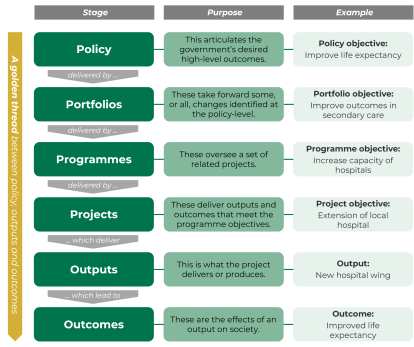
The alignment between the objectives set at the policy level down through to portfolios, programmes and projects is known as the ‘golden thread’. Figure 2 provides an illustration and example of the policy hierarchy and the golden thread.
Figure 2. From policies to outcomes
Appraisal across projects and programmes
The policy hierarchy means that the objectives of a particular proposal are set by the higher-level proposals that rank above it. In other words, the objectives of a project are established with reference to its governing programme or portfolio. The appraisal of the project does not need to justify the overarching programme. Similarly, the objectives of a programme are established with reference to its governing portfolio. The appraisal of the programme does not need to justify the overarching portfolio.
This point is best illustrated with an example. Consider a programme that involves extending a railway to a new town that has poor transport connectivity. Suppose the railway programme has three underlying projects: station refurbishment, track construction and signalling system installation. There may be different options for installing the signal system, with different costs and benefits.
The appraisal of the signalling system should not include the benefits of the overall railway programme. This is not helpful in identifying the option for installing the signalling system that optimises value for money. The appraisal of the signalling system does not need to justify the objective of the railway programme by analysing the transport needs of the town. The need for the signalling system has already been established by the overall railway programme.
Practitioners should consider the value of projects and programmes in aggregate. A project may not have measurable social benefits by itself, but it may be critical to deliver a programme that does have measurable social benefits. If practitioners are considering a project of unclear value for money, they might give context to it by highlighting the social value of the overarching programme.
To return to the previous example, there is no need to imagine that the railway signals, on their own, have some social value in isolation from the wider rail programme. Nor is it credible or useful to apportion some amount of the overall programme benefits to the signalling system. The social value of the railway is that its different components – stations, track and signals – all function together to deliver the outcome of better transport connectivity.
Business cases and regulatory impact assessments
An appraisal typically makes up one part of developing a proposal. A proposal is usually one of the following:
- Business case: This is the information needed to make a decision on a public sector spending proposal. HM Treasury publishes guidance for practitioners on how to develop business cases. That guidance is based around the Five Case Model.
- Regulatory impact assessment (RIA): This is the information that supports the appraisal of new legislation. An RIA should be published alongside relevant legislation when it is laid before Parliament. The Better Regulation Framework provides guidance on developing RIAs, which builds on the appraisal principles set out in the Green Book. An RIA sets out the rationale for intervention, shows the range of regulatory and non-regulatory options that practitioners have considered, and identifies the main costs and benefits.
The Five Case Model
The Five Case Model is a framework for developing business cases. It sets out five ‘cases’, or ‘dimensions’, that are distinct but closely linked perspectives on the same proposal. Table 2 sets out further details on each of these cases, which are:
- The strategic case
- The economic case
- The commercial case
- The financial case
- The management case
The primary purpose of the Green Book is to provide guidance on developing the strategic case and the economic case. However, meaningful options appraisal is generally not possible without some understanding of the commercial case, financial case and management case.
Collaboration across the public sector is essential for developing good business cases. The policy, analytical, commercial, financial and project delivery professions within the public sector should work together on proposals from the outset. Early and sustained collaboration builds a shared understanding of the proposal, avoids duplication of effort, and helps to identify potential wider or unintended impacts before they occur.
The five dimensions cannot be developed or viewed in isolation. They are not five separate business cases, but closely interconnected perspectives on the same proposal. Practitioners should develop the five cases together through an iterative process, refining each in light of the others. This must be done in a way that is proportionate to the costs, complexity and risks of the proposal.
The Five Case Model provides a universal thinking framework that can accommodate the wide variety of features found in any proposal. There is no need to invent an additional case to accommodate a special feature of a proposal, such as environmental, security, legal, regulatory or ethical considerations. These can be expressed as objectives to be achieved, as critical success factors that a proposal has to meet, or as social costs or social benefits within appraisal. For example, greenhouse gas emissions can be expressed as:
- An objective: A project might have an objective of building a new road, in order to support the successful development of a solar farm.
- A critical success factor: A building refurbishment might seek to achieve a 25% reduction in emissions compared with the business as usual.
- A social cost or social benefit: A new industry initiative meets the government’s growth objectives, but generates new greenhouse gas emissions. The value of these emissions can be estimated in monetary terms, using the guidance on valuing emissions in Chapter 8.
Table 2. The Five Case Model
| Case | Contents | Sources of guidance |
|
Strategic case This sets out the rationale and objectives for the intervention. |
• Case for change • Theory of change • SMART objectives • Business as usual • Strategic fit |
• The business case guidance • Chapter 4 of the Green Book |
|
Economic case This sets out the longlist and shortlist of options for achieving the objectives set out in the strategic case. It identifies the preferred option that delivers the best value for money. |
• Critical success factors • Longlist appraisal • Shortlist appraisal |
• The business case guidance • Chapters 5-8 of the Green Book |
|
Commercial case This describes how the government will source the inputs required for delivering the preferred option. It sets out who will manage the risks associated with delivery and operation. |
• Procurement strategy • Service requirements and outputs • Risk allocation • Charging mechanism • Key contractual arrangements • Personnel implications |
• The business case guidance • The Commercial Standard and the Sourcing Playbook set out best practice for sourcing activity • The Cabinet Office Central Commercial Teams can provide further support during appraisal |
|
Financial case This is concerned with the affordability of the proposal for the public bodies involved. |
• Public sector costs in RDEL, CDEL or AME • Impact on income, expenditure, and balance sheet of public bodies • Overall affordability and funding |
• The business case guidance • The consolidated budgeting guidance sets out the principles for the budgeting system in central government • Departmental finance teams can provide further support |
|
Management case This sets out the practical arrangements for implementation. It demonstrates that the preferred option can be delivered successfully. |
• Governance arrangements (i.e. roles, responsibilities, plans, etc.) • Change management, benefits realisation and risk management arrangements • Monitoring and evaluation plan • Contingency arrangements and plans |
• The business case guidance • The Teal Book contains guidance on project delivery • The Orange Book contains guidance on risk management • The Magenta Book contains guidance on producing a monitoring and evaluation plan |
The business case guidance sets out the three stages of developing a project business case. Table 3 shows how the stages of appraisal align in this project business case process.
Table 3. Appraisal across the project business case process
| Stage | Purpose | Stages of appraisal |
| Strategic Outline Case (SOC) | The first stage in the development of a project business case. It makes the case for change, identifies SMART objectives and sets out an initial longlist and shortlist of options to identify a preferred way forward. | • Rationale and objectives • Options generation and longlist appraisal • Identification of preferred way forward |
| Outline Business Case (OBC) | The second stage in the development of a project business case. It revisits the options in the SOC to identify the preferred option following more detailed analysis. It also outlines commercial, financial and management arrangements for the project. | • Shortlist appraisal • Identification of preferred option |
| Full Business Case (FBC) | The third stage in the development of a project business case. It sets out the full details of the commercial, financial and management arrangements required to deliver the project successfully, following the procurement process. | • Review and iterate the appraisal following the procurement process |
Statutory duties on practitioners
There are three statutory duties that must be explicitly reflected in appraisals at both the longlist and shortlist stages. These are as follows:
- Duty to have due regard to the environmental principles policy statement (EPPS): The Environment Act 2021 places a duty on Ministers of the Crown to have due regard to the EPPS when making policies. The EPPS sets out five environmental principles that ministers need to consider when making policy. Practitioners need to identify the potential environmental effects, either positive or negative, of options and apply the five principles as appropriate to inform the design of the proposal. The EPPS should be considered throughout the appraisal process, as the duty extends to making, developing, adopting, revising or repealing policy. Chapter 8 of the Green Book contains more information on assessing impacts on nature and greenhouse gas emissions.
- Biodiversity duty: The biodiversity duty requires public authorities in England to consider what they can do to conserve and enhance biodiversity. Defra has produced guidance on complying with the biodiversity duty.
- Public sector equality duty (PSED): The PSED requires decision makers to have due regard to the need to eliminate conduct prohibited by the Equality Act 2010, advance equality of opportunity and foster good relations for those sharing protected characteristics. The general duty ensures that public authorities consider how their functions will affect people with different protected characteristics. Practitioners should assess whether those sharing such characteristics would be expected to be differentially impacted compared to the general population by different options and whether the identified impacts would make a difference to the assessment of those options. Where there are negative impacts, practitioners should consider whether there is scope for mitigating those impacts.
Devolved governments may have their own statutory duties, which should also be reflected in appraisals where relevant.
4. Rationale and objectives
Chapter 4 describes the first stage of appraisal: developing the rationale and the objectives for a proposal. The rationale and objectives drive the rest of the appraisal process, and the wider business case process.
Introduction
The first step of appraisal is to identify the rationale and objectives of the proposal. This typically involves five components, which are:
- Case for change: This explains why the government needs to act.
- Theory of change: This explains how a proposal will produce the intended outcomes.
- Business as usual (BAU): This is the outcome that is expected if current arrangements continue and the proposal is not implemented.
- Objectives: These define the outcomes or outputs that the government is hoping to achieve. They must be specific, measurable, achievable, realistic and time-limited (SMART).
- Strategic fit: This explains how the proposal aligns with the wider objectives of the originating organisation, and the objectives of other UK public bodies.
Case for change
A case for change explains why the government needs to act. It describes why the intended outcomes are worth pursuing, and why the government is best placed to achieve those objectives.
A case for change is typically shaped by the priorities of politicians. This means ministers in the UK government and in the devolved governments in Scotland, Wales and Northern Ireland, and mayors and councillors in local government. Practitioners should work with politicians to understand their priorities and support them, as needed, with research and analysis.
In many instances, a proposal’s case for change may be defined by a non-political decision maker. The same principles apply: practitioners should work with those individuals to understand their priorities and support them with additional information.
It is not always necessary or desirable for the public sector to act. The case for change should explain why businesses, households and charities cannot achieve the intended outcomes themselves.
Economists often consider market failures to be an important rationale for government intervention. A market failure is a situation where the free market, left to its own devices, is unable to achieve optimal economic efficiency. Market failures include:
- Failure to provide public goods: Public goods are goods and services that are non-excludable and non-rivalrous. Non-excludability means that the use of public goods cannot be restricted, and so it is not possible to charge people for using them. Non-rivalry means that the consumption of public goods by one person does not affect another person’s ability to consume them. These characteristics mean that public goods are under-provided by the free market. National security and flood defences are generally considered examples of public goods.
- Externalities: These occur when market transactions have impacts, either positive or negative, on parties other than the buyer and seller. Pollution is typically considered to be an example of a negative externality. Education is typically considered to have positive externalities.
- Market power: If there are too few buyers or sellers in an industry, then this can lead to businesses pursuing maximum profits at the expense of overall social value.
- Imperfect information: Households and organisations are often able to find, or buy, the information that they need to make good decisions. In some cases, however, the public sector must act to provide this information. Credit constraints are an example of imperfect information. Lenders sometimes do not have perfect information about which households and businesses are creditworthy and therefore under-supply loans.
- Co-ordination failure: Households and businesses are sometimes unable to co-ordinate their efforts to achieve desirable outcomes. In these cases, the government should use its scale, powers and information to direct resources to achieve the optimal outcome.
Another rationale for government intervention is equity. Some proposals have objectives to ensure equality between different groups or different places. These proposals are often assessed using distributional analysis.
Practitioners should understand the wider context within which change will be delivered. One method for doing this is PESTLE analysis. This involves thinking through six factors that may influence the case for change: political, economic, social, technological, legal and environmental factors.
Theory of change
A theory of change explains how the inputs and outputs that are defined in the proposal will lead to the desired outcomes. It is the logical chain of cause and effect that shows how outcomes will be achieved. It shows the assumptions under which a proposal will work. Figure 3 provides a graphical illustration of a theory of change.
A theory of change considers the relationship between the inputs, outputs and outcomes of a proposal. These terms are defined below:
- Input: A resource needed to make a product. Workers, materials, equipment, buildings and land are examples of inputs.
- Output: A product that is produced, constructed or created through actions using inputs. An output can be a physical asset, such as a road, a railway, or an airport. An output can also be a service, such as the provision of social care.
- Outcome: The result of change. A road, a railway and an airport all bring about a similar outcome of increased transport connectivity. This itself achieves further medium-term and long-term outcomes, such as higher economic prosperity from increased commuting and freight.
Figure 3. From inputs to outcomes: a theory of change

A theory of change should not simply assert that the specified inputs will lead to the intended outcomes. Practitioners should ensure that their theory of change is based on good evidence and careful explanation.
A theory of change is typically uncertain and involves assumptions. Practitioners should state their assumptions to make sure that these are transparent and that they are agreed by decision makers. Practitioners should reflect on the strength of the underlying evidence and the likelihood that the intended outcomes do indeed come about.
A theory of change may be based on evidence from a range of possible sources. These include evaluation of previous interventions, academic research, specially commissioned research and international comparisons. This research should take place before detailed business case development begins.
Business as usual
The business as usual (BAU) is the outcome that is expected if current arrangements continue and the proposal under consideration is not implemented. It provides a benchmark against which practitioners can compare proposals. If possible, practitioners should express BAU outcomes in monetary terms. Where this is not feasible, it may be described quantitatively or qualitatively.
BAU does not mean doing nothing. It considers how individuals and organisations will act to try to achieve their objectives in the absence of new government intervention, and how public bodies will use their existing budgets to achieve those objectives. The BAU reflects the fact that continuing with current arrangements carries its own costs, benefits and risks.
For some proposals, the BAU may be completely unacceptable and unviable. For others, however, the BAU may remain a viable but sub-optimal way of meeting the government’s objectives.
Fully understanding the BAU helps practitioners to distinguish between deadweight and additionality. These terms are defined as follows:
- Deadweight: Outcomes that would have taken place without any intervention. For example, a proposal to achieve growth in a particular industry should consider the market trends that would occur regardless of government intervention.
- Additionality: Outcomes that take place as a result of the intervention. For example, a proposal to achieve growth in a particular industry should consider how it is genuinely raising productivity over and above market trends.
Practitioners should ensure that their description of BAU is fair and reasonable. Overestimating the costs and risks of BAU will make government action appear unduly attractive. Underestimating them will make government action appear unduly unattractive.
The social costs and social benefits associated with different options should usually be presented in absolute terms, rather than as incremental differences from BAU. Practitioners should avoid normalising BAU to zero. This enables a more intuitive understanding of the BAU, and more straightforward comparisons between options.
Objectives
An objective defines the exact outcomes or outputs that the government is hoping to achieve.
The objectives of a proposal must be SMART. A SMART objective is one which is specific, measurable, achievable, realistic, and time-limited. Making objectives SMART ensures that they can be robustly monitored and evaluated.
In making objectives SMART, practitioners should consider:
- Who is intended to benefit from the outcomes of the proposal?
- How many beneficiaries are there?
- Where are those beneficiaries located?
- At what point in time should those outcomes be realised?
A proposal should ideally have as few objectives as possible. A small set of objectives ensures that the proposal is focused.
Objectives can be expressed in terms of either outcomes or outputs. These are defined as follows:
- Outcome-based objectives: This might include, for instance, achieving economic growth in a particular place, improving the health of a target population or increasing national security.
- Output-based objectives: This might include building a piece of infrastructure, improving the quality of a public service or replacing a piece of technology.
Objectives should ideally be expressed in terms of outcomes, rather than outputs. There is often more than one type of output that can be used to deliver an outcome, and so the use of outcome-based objectives encourages practitioners to think through different potential outputs that might achieve their goals.
Some proposals will, however, have objectives that are expressed in terms of outputs. This might be because the need for that output has already been established by a higher-level programme or portfolio. When appraising an output, practitioners should think about the different options for designing and delivering the output.
Strategic fit
The strategic fit of a proposal is the extent to which it aligns with the wider objectives of the originating organisation and the objectives of other UK public bodies. Public bodies must work together to ensure that their combined efforts produce optimal outcomes for the public. Practitioners should consider the alignment of the proposal with:
- The programme, portfolio or policy that sits above the proposal. This is described in Chapter 3.
- The other proposals and interventions of the originating organisation.
- Any other relevant proposals and interventions of central government, local government and other public bodies.
Transformational change
Some proposals have the objective of bringing about transformational change. A proposal brings about transformational change if it causes a radical, permanent and qualitative change in a particular subject, such that the subject has very different properties and behaves in a different way.
Transformational change is rarely brought about by individual projects or programmes. It often requires a portfolio of programmes and projects, that are collectively focused on achieving transformational objectives. The social value of such a group of projects and programmes is often greater than the sum of its parts. It is therefore not meaningful to divide the social value of the whole portfolio into its constituent projects and programmes.
Transformational change typically involves tipping points, in which a small change in a variable is able to cause a system to change. Transformational change therefore typically involves feedback effects in which the effects of a proposal are self-sustaining and self-reinforcing. If practitioners anticipate that their proposal will bring about transformational change, then they must transparently explain these assumptions and support them with evidence and analysis.
5. Generating options and longlist appraisal
Chapter 5 explains how to generate options and conduct longlist appraisal. The Green Book recommends doing this using the options framework filter, and this method is explained later in this chapter.
Introduction
A longlist is a wide range of potential options for achieving the objectives of the proposal. The purpose of generating a longlist is to help practitioners to think broadly and creatively about the right way of achieving the proposal’s objectives. A sufficiently broad longlist helps to avoid thinking too narrowly and reduces the risk of overlooking better options for achieving those objectives.
The longlist stage involves two steps:
- Options generation: The process of generating a wide range of potential options that might feasibly meet the proposal’s objectives.
- Longlist appraisal: The process of assessing a longlist of options, in order to narrow those options down into a shortlist. Longlist appraisal involves assessing which options best meet the objectives and critical success factors of the proposal.
Options generation and longlist appraisal are important, but are often overlooked in appraisals. Practitioners are often tempted to skip these stages and progress straight to shortlist appraisal and to the detailed analysis of costs, benefits and risks. However, options generation and longlist appraisal are vital for effective decision making and achieving value for money. Practitioners reviewing proposals should make sure that these steps are conducted in a thorough but proportionate manner.
The process of options generation and longlist appraisal should be clearly documented in the business case or impact assessment. Practitioners should explain transparently what options have been considered as well as the reasons they have or have not been progressed to shortlist appraisal. This provides a clear sequence of reasoning for reviewers and decision makers, and supports future evaluation.
Critical success factors
Critical success factors (CSFs) are the attributes that an option must have in order to achieve the proposal’s objectives successfully. Table 4 sets out five basic critical success factors that apply to all proposals. They broadly correspond to the five dimensions of the Five Case Model.
Table 4. Examples of critical success factors
| Critical success factor | Description |
| 1. Objectives and strategic fit | • The proposal meets its SMART objectives. • The proposal has strategic fit with other policies, portfolios, programmes and projects being undertaken in the public sector. |
| 2. Value for money | • The proposal represents the optimal use of public resources to achieve its objectives. |
| 3. Supplier capacity and capability | • Potential suppliers can feasibly provide the inputs that are required for the proposal. • The government and suppliers can reach a mutually acceptable agreement on payments and risk transfers. |
| 4. Affordability | • The proposal is affordable for all of the public bodies involved. |
| 5. Achievability | • There are robust arrangements in place to deliver, monitor and evaluate the proposal. |
A proposal’s critical success factors might also include constraints. These are external considerations that set limits on the viability of different options. Examples of constraints might include legal requirements, ethical standards, social acceptability and timing. A proposal might also be constrained by the need to comply with government policies on greenhouse gas emissions and the environment.
Options generation
Practitioners might generate options through research and analysis. They might get ideas from stakeholders and experts. They might look at solutions that have been adopted elsewhere in the public sector, the private sector or internationally. Practitioners might consider the following examples of options:
- An asset might be built, leased or purchased, or an existing asset could be refurbished.
- A piece of equipment might be designed for a particular purpose or bought ‘off the shelf’ from a supplier.
- The public body might provide a service itself, or the service might be contracted out to a private sector organisation.
Practitioners might consider potential options to deliver the proposal through a private finance model. Annex A provides further guidance on this.
Longlist appraisal
After generating a longlist of options, practitioners should conduct longlist appraisal to narrow these down into a shortlist. This involves assessing different options to identify those which best meet the objectives and critical success factors of the proposal. Any option that does not meet the objectives or the critical success factors should not proceed to shortlist appraisal.
Practitioners should use longlist appraisal to start identifying those options that represent optimal value for money. This does not necessarily require extensive research and analysis of costs, benefits and risks just yet. That takes place at the shortlist appraisal stage. Longlist appraisal instead typically uses indicative estimates and ranges, which should support an informed judgement about what options are viable for shortlisting, but are not necessarily precise enough to identify the final preferred option at this stage.
Practitioners should consider dependencies. These are external factors on which an option is reliant to be successful but which are beyond its direct control. For example:
- A particular project might be dependent on the availability of a piece of infrastructure or an IT system.
- A programme might involve a series of interdependent projects. A delay in one of those projects may have knock-on implications for the delivery of others.
- Housing or commercial development might be dependent on an improvement in transport. The Department for Transport provides further guidance on dependent developments.
Practitioners should consider the potential unintended consequences of each option. These may arise, for example, if the option features incentive schemes – such as performance targets or payment-by-results – that might encourage unintended behaviours. Practitioners should examine whether the option could create incentives for individuals to ‘game the system’ for their own benefit.
Methods of longlist appraisal
The Green Book recommends conducting options generation and longlist appraisal using the options framework filter (OFF). However, this method is not mandatory. The options framework filter involves breaking viable options into their basic components and recombining these components in different ways to create and test different options. The options framework filter is explained in more detail later in this chapter.
Another potential approach to longlist appraisal is multi-criteria decision analysis (MCDA). This method is used to inform complex technical trade-offs at the longlist stage. It makes use of swing weighting to objectively weigh the balance of informed expert and stakeholder opinion. There is Green Book supplementary guidance on MCDA. Practitioners looking to use MCDA should make sure that they are supported by an expert facilitator.
The Green Book recommends against the use of multi-criteria analysis (MCA) in decision making. MCA, which is distinct from MCDA, involves simple ‘weighting and scoring’ that lacks an objective basis and can reduce transparency.
Practitioners may also consider conducting longlist appraisal using SWOT analysis. This is where practitioners assess different options against the objectives and critical success factors of the proposal. Each option can then be described and compared based on its respective strengths, weaknesses, opportunities and threats.
Selecting a shortlist of options
A shortlist should generally include around five options. This helps ensure that a good range of options is brought forward for more detailed consideration. It means that decision makers are presented with genuine choices rather than a single pre-determined outcome.
The five options on the shortlist should typically include:
- The business as usual (BAU): This is the outcome that is expected if current arrangements continue and the proposal is not implemented. The BAU provides a benchmark against which proposals can be compared. The BAU should be taken through to shortlist appraisal regardless of whether or not it meets the objectives and critical success factors.
- A do minimum: This is the option that just achieves the proposal’s objectives and goes no further in generating additional benefits. The do minimum option helps to show whether alternative options deliver genuinely worthwhile improvements or simply add unnecessary features. This is known as ‘gold plating’.
- A preferred way forward: This is the option that appears to best meet the objectives and critical success factors, offering the best combination of social costs and social benefits. This may or may not be the same as the do minimum.
- A more ambitious preferred way forward: This is a version of the preferred way forward that delivers more social benefits, but either at higher social costs or with increased risks.
- A less ambitious preferred way forward: This is a version of the preferred way forward that delivers lower social benefits, but with either lower social costs or lower risks. This may be excluded if the preferred way forward is also the do minimum.
Practitioners may choose to include other options in the shortlist. Rather than just varying in ambition, these options may involve different outputs or different design choices for outputs. These options must still meet the objectives and the critical success factors of the proposal.
Longlist appraisal identifies a preferred way forward. Shortlist appraisal then identifies a preferred option. The preferred way forward identified at the longlist appraisal stage may not be the same as the preferred option identified at the end of shortlist appraisal. Shortlist appraisal may reveal, for instance, that the preferred option is actually one of the other shortlisted options.
The options framework filter
Introduction
The Green Book recommends using the options framework filter to generate options and conduct longlist appraisal. It involves the steps illustrated in Figure 4, which are set out below:
- Practitioners identify a set of categories that capture the different ways that the proposal might be achieved. They then identify different option choices for the different possibilities within each category.
- Each option choice is considered and rated against the critical success factors. Those option choices that do not meet the critical success factors are rated “red” and discarded from the process. The remaining option choices are assessed to identify which best meets the critical success factors. This is rated “green”. The remaining options are rated “amber”.
- Options can then be generated by combining the amber-rated and green-rated option choices in different combinations.
An essential feature of the options framework filter is structured facilitated workshops. These workshops are important to elicit communication and collaboration between different professions, key stakeholders and experts. Participants in these workshops go through the options framework filter method together. They work jointly to generate options, assess the longlist, and decide which options should progress to shortlist appraisal. As with all Green Book guidance, these workshops must be carried out in a way that is proportionate to the proposal’s likely costs and risks.
Another essential feature of the options framework filter is explicit deliberation. Participants must explain the evidence, research and assumptions that underpin their views. This captures the rationale behind the judgments being made, and helps participants avoid falling into the trap of making unconscious, implicit and unconsidered assumptions.
Options, categories and option choices
The options framework filter involves distinguishing between options, categories and option choices:
- Option: This is a potential way of meeting the objectives of the proposal. For example, there might be two different options for building a school.
- Category: This is a particular attribute that varies between different options. For example, the different options for building a school might differ in the building material used. One category in this appraisal is therefore ‘building material’.
- Option choice: The different possibilities for a particular category. For example, one option choice for ‘building materials’ might be to use timber frames. Another option choice might be to use steel frames.
Practitioners start by identifying a set of categories and the potential option choices within each category. The Green Book recommends the following five categories:
- Scope: What is the coverage of the service to be delivered? Option choices might include varying the service by geography, demographic characteristics, quality or duration.
- Solution: How can the outcomes be delivered? Option choices might include developing new infrastructure, refurbishing existing facilities, regulations, taxes, grants, subsidies or public information campaigns.
- Delivery: Which organisation will deliver the scope and solution? Option choices might be direct public sector provision, public-private partnerships, not-for-profit providers or private sector providers.
- Implementation: How will the proposal be delivered? Option choices might include an initial pilot, a phased rollout or a rapid implementation approach. A phased rollout might vary depending on geography, age or expiry of existing arrangements.
- Funding: How will the proposal be funded? This requires an initial indicative cost estimate, in light of the preferences for scope, solution, delivery and implementation.
Rating option choices
The options framework filter is an iterative process. Practitioners should consider each of the five categories of option choices in turn, taking into account the decisions made in earlier stages each time. Practitioners give each of the potential option choices a rating: green, amber or red. These are defined as follows:
- Green: The option choice in its category that best meets the critical success factors. Green option choices are taken forward to generate options.
- Amber: An option choice that meets the critical success factors, but not as well as the green-rated option choice. Amber option choices are taken forward to generate options.
- Red: An option choice that does not meet the critical success factors. Red option choices are rejected and not given further consideration.
Practitioners must record the reason for each rating in a brief paragraph, explaining the underlying evidence, assumptions and sources.
The options framework filter process begins with an initial consideration of scope. Participants discuss and identify different option choices for scope, ranging from maximum to minimum. The minimum is the scope that just meets the objectives. The maximum is a much more ambitious scope. Participants should consider the different option choices that fall between the minimum and the maximum. All of these option choices are then rated green, amber or red.
The next choice concerns the solution. Practitioners should begin by taking the green option choice for scope that was identified in the previous stage. They should identify the minimum solution required to meet the scope. They should also identify a much more ambitious maximum solution. Practitioners then consider a range of option choices between these two extremes. They rate these option choices green, amber or red.
The next stage concerns delivery. This uses the green-rated option choices for scope and solution that were identified in the two previous stages. Participants should consider the option choices for delivery and rate each green, amber or red.
The next stage concerns implementation. This is considered in relation to the green-rated option choices for scope, solution and delivery that were identified in the previous three stages. The option choices for implementation are again rated green, amber or red.
The next set of choices concerns funding. This is considered in relation to the green-rated option choices for scope, solution, delivery and implementation that were identified in the previous four stages. The option choices for funding are again rated green, amber or red.
Figure 4. Overview of longlist appraisal with the options framework filter

Presenting the results
Practitioners can present the results of the options framework filter in an options summary matrix. This matrix provides an overview of the decisions made and option choices considered during the options framework filter process. It must be accompanied by a record of the workshop decisions and the rationale for them.
Table 5 contains an example options summary matrix for a road construction programme between five cities labelled A to E. The summary matrix is used as follows:
- List all categories requiring a decision in the first column.
- Use the second column to describe the BAU position for each category, where applicable.
- Use subsequent columns to list the potential option choices for each category.
- Assess the option choices for each category and rate them either green, amber or red.
- Combine the green and amber option choices in different ways to create a variety of complete options.
- This produces a shortlist of potential options, which can then be appraised in greater depth.
Table 5. Example options summary matrix
| Category | BAU | Potential option choices | |||
|---|---|---|---|---|---|
| 1. Scope | 1.0 No links | 1.1 Linking cities A and B (minimum) | 1.2 Linking cities A, B and C (intermediate option) | 1.3 Linking cities A, B, C and D (intermediate option) | 1.4 Linking cities A, B, C, D and E (maximum) |
| Carry forward | Carry forward | Preferred | Carry forward | Drop | |
| 2. Solution | 2.0 Current services for road maintenance etc | 2.1 Refurbish existing highways (minimum) | 2.2 Combination of refurbish and new highway (intermediate option) | 2.3 Completely new highway (intermediate option) | 2.4 New highway and facilities (maximum) |
| Carry forward | Carry forward | Preferred | Carry forward | Drop | |
| 3. Delivery | 3.0 Current arrangements | 3.1 Local contractor | 3.2 National contractor | 3.3 International contractor | |
| Carry forward | Drop | Carry forward | Preferred | ||
| 4. Implementation | 4.1 Phased over 3 years | 4.2 Phased over 2 years | 4.3 Big bang over 1 year | ||
| Carry forward | Preferred | Drop | |||
| 5. Funding | 5.1 Public funding | 5.2 Mixed public and private funding | 5.3 Private finance – service charge | 5.4 Private finance – toll | |
| Drop | Preferred | Drop | Drop |
Generating options
The options framework filter yields a set of option choices that are rated either amber or green. These option choices can be combined in different permutations to assemble a set of shortlisted options. Participants should aim to generate the following five options:
- Business as usual: The five option choices that would prevail under business as usual.
- Do minimum: The five option choices, either amber or green, that involve the lowest cost.
- Preferred way forward: The five option choices that are rated green.
- More ambitious preferred way forward: A variant of the preferred way forward that replaces some of the green option choices with amber ones. These replacements mean that this option has higher benefits and higher costs or risks than the preferred way forward.
- Less ambitious preferred way forward: A variant of the preferred way forward that replaces some of the green option choices with amber ones. These replacements mean that this option has lower benefits and lower costs or risks than the preferred way forward.
6. Shortlist appraisal
Chapter 6 explains how to compare the different options that have been brought forward to shortlist appraisal, and to subsequently reach a balanced judgement on value for money.
Introduction
Shortlist appraisal is the process of assessing the costs, benefits and risks of a shortlist of options. It takes as its starting point the shortlist of options that is identified following longlist appraisal. Figure 5 summarises the key stages involved in shortlist appraisal.
Figure 5. Navigating shortlist appraisal

No option should be brought forward from longlist appraisal to shortlist appraisal unless it meets the objectives of the proposal. It is possible that new evidence arises during shortlist appraisal, which indicates that one or more options are unlikely to meet the proposal’s objectives or critical success factors. If so, practitioners may need to return to longlist appraisal and revise the options included in the shortlist.
As a proposal is developed, practitioners will begin to engage suppliers, and this engagement might yield new information relevant to the appraisal. This may affect estimates of social costs, social benefits or risks. Where such information is significant, practitioners may need to revisit the shortlist appraisal and reassess the preferred option.
Methods of analysis
There are two main methods of analysis for shortlist appraisal:
- Social cost-benefit analysis (CBA): This involves estimating the social costs and social benefits of different options in monetary terms. It is the recommended approach for detailed comparison of the shortlist of options.
- Social cost-effectiveness analysis (CEA): This is a method in which only social costs are measured and estimated in monetary terms. It is used when the main social benefits of a proposal are unmonetisable. Social cost-effectiveness analysis is also appropriate where different options involve different means of delivering the same output.
Scope
The scope of all appraisals is UK society. This is defined as all residents of the United Kingdom. It does not include potential residents or visitors. However, it may sometimes be reasonable to include people living outside the United Kingdom, such as service personnel posted overseas.
Practitioners should consider proportionately the social costs, social benefits and risks that a proposal might bring about for UK society. They should not just focus on impacts on their own organisation, or on the target population of the proposal. They should also consider impacts on other public bodies in the United Kingdom, as well as households, businesses and charities.
Some proposals are focused on a particular place in the United Kingdom. This is especially true for proposals in local government or devolved government. Practitioners responsible for these proposals should still nonetheless consider, in a proportionate way, whether there are effects on other places in the United Kingdom. They then have discretion to decide how to treat these wider effects in shortlist appraisal. For example:
- Practitioners may judge that their proposal does not have significant effects on other parts of the United Kingdom. These effects will therefore not be included in shortlist appraisal.
- Practitioners may judge that their proposal does have significant effects on other parts of the United Kingdom. These effects should be described, estimated and included in the analysis. Practitioners can use place-based analysis to distinguish between the effects of a proposal on their area of responsibility, and the effects on other parts of the United Kingdom. This is discussed further in Chapter 7 of the Green Book and in the MHCLG Appraisal Guide.
A proposal might have the objective of providing Official Development Assistance (ODA) to a foreign country. The appraisal of these proposals should include the social costs and social benefits for the recipient countries, as well as any relevant social costs and social benefits for the United Kingdom. The public sector financial cost of ODA should be assessed in the same way as other public spending. Practitioners should contact the Foreign, Commonwealth and Development Office (FCDO) for further guidance.
Time horizon
The time horizon of an appraisal is the length of time over which costs, benefits and risks are assessed. It should cover the whole lifetime of the proposal. This extends from construction or development, through to operation or delivery, and then winding-down or decommissioning. This approach helps practitioners to avoid short-termism and to properly consider long-term costs and benefits.
The first year of an appraisal is known as year 0. This is generally the first year in which there are either social costs or social benefits. When looking across a range of different options, which start in different years, year 0 may be standardised to a particular calendar year or financial year.
Practitioners should use the following time horizons, which are additional to year 0:
- 60 years for infrastructure, such as roads, railways and new buildings
- 30 years for refurbishment of existing buildings
- 10 years for regulations
- 10 years as a standard measure for all other proposals
Some proposals may have significant costs or benefits beyond 60 years. These include vaccination programmes, nuclear waste storage, research and development projects, and measures to reduce climate change risks. For these, and other relevant proposals, practitioners should discuss and agree a suitable appraisal period with HM Treasury.
Some proposals may cover a relatively short and defined period. One example might be a proposal to provide an organisation with IT services over a five-year period. The appraisal of such proposals should be sure to consider the end of the contract, and the costs that might be involved in transferring to another system.
Practitioners should take climate change impacts into account in appraisal. They should consult the Green Book supplementary guidance on accounting for the effects of climate change. This guidance advises that:
- Proposals with a time horizon that ends before 2040 should be appraised against a climate scenario in which global temperatures rise by 2°C.
- Proposals with a time horizon that ends in 2040 or later should consider at least two climate scenarios: one of 2°C warming and one of 4°C warming.
Social costs and social benefits
Social costs and social benefits are defined as follows:
- Social cost: The value, or other negative impact, resulting from an outcome, which is perceived as a disadvantage by one or more stakeholders.
- Social benefit: The value, or other positive impact, resulting from an outcome, which is perceived as an advantage by one or more stakeholders.
Table 6 contains some typical examples of social benefits and social costs. Chapter 8 of the Green Book contains a more comprehensive taxonomy.
Table 6. Examples of social costs and social benefits that may be considered in shortlist appraisal
| Social benefits | Social costs |
|---|---|
| • Improved efficiency of a public service | • Construction costs |
| • Higher labour productivity | • Maintenance costs |
| • Better health, life expectancy and personal wellbeing | • Greenhouse gas emissions and environmental damage |
| • Reduced crime and improved national security |
Practitioners will need to forecast the value of social costs and social benefits over many years. These forecasts might be expressed in monetary, quantitative, or qualitative terms. They will usually depend on a set of assumptions about quantities and prices. This forecasting process should involve input from accountants, economists and other relevant stakeholders.
Practitioners should think widely about the possible social costs and social benefits that might arise from a proposal. For example, a proposal to build a piece of infrastructure might have wider effects on economic activity, health, the environment and other public services.
Practitioners should think carefully about which social costs and social benefits are most likely to be significant in determining the differences between alternative options. It is often proportionate to focus attention and resources on these significant costs and benefits.
Practitioners should distinguish between social costs and public sector financial costs. Social costs are sometimes borne by the public sector, but this is not always the case. For example, the construction costs of a piece of infrastructure will typically be borne by the public sector. However, the construction works may cause disruption to local businesses and households, as well as generating greenhouse gas emissions. These are examples of social costs, but not public sector financial costs.
The National Infrastructure and Service Transformation Authority (NISTA) has published Cost Estimating Guidance. This sets out a best practice approach to the development of cost estimates for infrastructure projects and programmes.
The management dimension of a business case should set out plans for monitoring the social costs and realising the social benefits of a proposal. There is guidance on doing this in the Teal Book.
Classifying social costs and social benefits
Practitioners should consider who receives the social benefits of a proposal and who bears the social costs. Each social benefit or social cost can typically be attributed to one of the following five groups:
- The public body that is developing the proposal, known as the originating organisation
- Other public bodies
- Households and individuals
- Businesses
- Other non-government organisations, such as charities
Practitioners may wish to sub-divide these groups even further. For example, they might distinguish between the social benefits of a proposal for small businesses and large businesses.
Figure 6 illustrates how different social costs and social benefits are classified.
Figure 6. A decision tree for classifying social costs and social benefits

Social costs and social benefits are either monetisable or unmonetisable:
- Monetisable: A social cost or social benefit is monetisable if it can be expressed in monetary terms. For example, impacts on wages and greenhouse gas emissions are generally monetisable.
- Unmonetisable: A social cost or social benefit is unmonetisable if it cannot be expressed in monetary terms. For example, impacts on national security are generally unmonetisable.
Social costs and social benefits that are unmonetisable can either be quantifiable or qualitative:
- Quantifiable: A social cost or social benefit is quantifiable if it can be expressed in numerical terms, but not in monetary terms. An example would be the number of species negatively affected by a proposal.
- Qualitative: A social cost or social benefit is qualitative if it cannot be feasibly expressed in numerical terms and can only be understood using words.
Practitioners should aim to monetise social costs and social benefits where possible. If a social cost or social benefit cannot be monetised, then practitioners should aim to quantify it and express it in numerical terms. If there is insufficient evidence to provide reliable estimates of a social cost or social benefit, in either monetary terms or quantitative terms, then practitioners should describe it qualitatively.
Practitioners should use time and resources proportionately when estimating social costs and social benefits. It may be disproportionate to monetise or quantify every impact. Practitioners should focus on monetising those social costs and social benefits that are likely to be most decisive in distinguishing between options.
Monetisable social benefits and social costs may be either cash or non-cash:
- Cash-releasing benefit: A monetisable social benefit that affects the income or expenditure of a public body. An example would be efficiency savings that reduce labour costs.
- Cash cost: A monetisable social cost that affects the income or expenditure of a public body. An example would be rental charges for a building.
- Non-cash-releasing benefit: A monetisable social benefit that does not affect the income or expenditure of a public sector organisation. An example would be a reduction in greenhouse gas emissions.
- Non-cash cost: A monetisable social cost that does not affect the income or expenditure of a public sector organisation. An example would be an increase in greenhouse gas emissions.
Practitioners should distinguish between capital costs, operational costs and maintenance costs. These are defined as:
- Capital costs: The social costs that are incurred early in the implementation of a proposal. These might include, for example, the wages of construction workers involved in building a piece of infrastructure.
- Operating costs: The social costs that are incurred when an output becomes operational. These might include, for example, the wages of workers involved in running a service.
- Maintenance costs: The social costs that are incurred to ensure that an output continues to operate, generate benefits and avoid other costs. Practitioners must make sure that appraisals reflect the appropriate maintenance costs needed to sustain social benefits over time.
Sunk costs
Sunk costs are costs that have already been incurred and cannot be changed. They should not affect decisions about what to do next. An appraisal should be concerned only with the social costs and social benefits of decisions that are still to be made. Practitioners must therefore not include sunk costs in appraisal. However, practitioners should consider the opportunity costs of continuing to use resources that have already been paid for. The next best alternative for these resources might be to sell them or use them for some other purpose.
Economic transfers
An economic transfer is a transfer of money from one person or organisation to another, without a good or service being received in return. Economic transfers may typically include tax revenues, grants, subsidies, social security payments, penalties and fines.
Economic transfers incur a cost to the payer and an equal benefit to the recipient. They therefore do not, in themselves, make society as a whole either better off or worse off. However, they usually produce effects that bring about social benefits or social costs.
Consider, for example, a government loan to a business. When the loan is made, there is an economic transfer from the government to the business. There is then a subsequent economic transfer when the business repays the loan.
The loan enables the business to stay operational and produce goods and services for the economy. The value of these goods and services represents the social benefit of the loan. However, the business hires workers and uses premises that may have otherwise been used by other firms, perhaps with higher productivity. This is the social cost of the government loan.
Practitioners must consider economic transfers in distributional analysis. They should quantify and show the effects of economic transfers, and thus which groups in society end up better off or worse off.
Practitioners may choose between two approaches when handling economic transfers. Practitioners should clearly explain the approach that they take and whether it makes a significant difference to their appraisal results. These two approaches are as follows:
- Include economic transfers in cost-benefit analysis as offsetting social costs and social benefits. In this approach, transfers appear as both a cost (to the payer) and a benefit (to the recipient), so they cancel out in calculations of net present social value. However, because transfers appear on both sides of the benefit-cost ratio, this can push that ratio artificially towards one.
- Exclude economic transfers from analysis altogether. In this approach, transfers are left out of calculations of net present social value. They are not counted as either social costs or social benefits. This can sometimes make it harder to reconcile this cost-benefit analysis with distributional analysis, where economic transfers must be included.
Practitioners should consider economic transfers when estimating the public sector financial impact of a proposal. Economic transfers may count as either public sector financial benefits or public sector financial costs.
Practitioners should contact HM Treasury if they are uncertain about whether social costs or social benefits in appraisal may represent an economic transfer.
Macroeconomic effects
Appraisal is concerned with the welfare and wellbeing impacts of spending at a microeconomic level. Practitioners should not consider changes to gross domestic product (GDP), gross value-added (GVA) or other macroeconomic variables when assessing different options. Most government proposals are not, by themselves, large enough to have a perceptible impact on the UK economy as a whole. Nor is it generally possible to estimate objective, credible and statistically significant differences in macroeconomic variables between options.
However, impacts on GDP and GVA may well form part of higher-level analytical research that shapes wider policy development, and they may feature in the rationale and objectives for a proposal. Chapter 8 contains more details on how economic output and employment should be reflected in appraisal.
Government spending generally brings about successive positive demand effects. Higher public spending leads to higher household incomes, which increases consumer spending, which then raises the incomes of other households. These effects are known as Keynesian multipliers. They arise from almost any public spending, regardless of its social value, and therefore do not help distinguish between options for a specific proposal. Practitioners should therefore not count Keynesian multiplier effects as social benefits when comparing options.
Costs of raising public funds
There are costs associated with raising public funds: taxes create distortions in the economy, and the government typically pays interest on its borrowing. Practitioners should not generally include these costs in appraisal. This is because most government proposals are funded from pre-determined departmental budgets. Decisions about the overall level of public spending are made separately from, and in advance of, individual spending decisions. The costs of raising public funds are therefore not relevant for the appraisal of different options. The one exception to this standard guidance is when assessing private finance model options, as discussed in Annex A.
Inflation
The prices of goods and services change over time. These price changes are due to two factors:
- General price inflation: This is inflation that affects the prices of all goods and services in the economy.
- Relative price effects: This is inflation that affects different goods and services in different ways. For example, computers have become relatively less expensive over time, and so the price of computers has generally seen increases that are ‘below inflation’. By contrast, land has become relatively more expensive over time, and so the price of land has generally seen increases that are ‘above inflation’.
Practitioners should distinguish between nominal prices and real prices:
- Nominal prices: The price of a good or service in a particular year.
- Real prices: The price of a good or service after adjusting for general price inflation.
Social costs and social benefits should be estimated in real prices. This means that nominal prices and real prices should be the same in year 0 of the proposal. Practitioners should forecast nominal prices and then convert these to real prices. They should make sure that the nominal price forecast appropriately reflects general price inflation. The effect of general price inflation is then removed using the GDP deflator.
The effects of converting values from nominal to real terms are shown in Table 7. It shows a social cost that increases in value in line with general price inflation of 2% each year. There is no relative price effect. This means that, when the GDP deflator is applied, and general price inflation is removed, the cost is ‘flat’ in real prices.
Table 7. Removing the effects of general price inflation
| Year | 0 | 1 | 2 | 3 | 4 | 5 |
|---|---|---|---|---|---|---|
| Social cost in nominal terms (A) | £1,000 | £1,020 | £1,040 | £1,061 | £1,082 | £1,104 |
| GDP deflator (B) | 2% | 2% | 2% | 2% | 2% | 2% |
| GDP deflator factor (C) | 1.000 | 0.9804 | 0.9612 | 0.9423 | 0.9238 | 0.9057 |
| Social cost in real terms (A x C) | £1,000 | £1,000 | £1,000 | £1,000 | £1,000 | £1,000 |
Practitioners can find forecasts of the GDP deflator for the next five years in the most recent Economic and Fiscal Outlook published by the Office for Budget Responsibility (OBR). They can find forecasts of the GDP deflator for the next fifty years in the Long-term economic determinants published by the OBR.
Practitioners should use historical evidence and appropriate forecasts to determine whether the movement of prices in a particular industry (e.g. construction) differs significantly from general inflation. Practitioners should consider whether these relative price effects are significant for the results of the appraisal. If so, they should be included in cost-benefit analysis.
Price indices do not account for the changes in the quality of a good or service over time. For example, mobile phones have become more expensive over time, but these price increases reflect improvements in functionality over time rather than demand pressures or supply pressures. Practitioners may reflect changes in the quality of a good or service in the real price.
Discounting
The Green Book recommends using discounting to compare social costs and social benefits occurring over different time periods on a consistent basis. Discounting enables profiles of benefits and costs stretching over many years to be expressed in ‘present value’ terms.
Discounting is based on the concept of social time preference: people generally prefer to receive benefits sooner and incur costs later. This means that social costs and social benefits, which occur later in time, are given less weight than costs or benefits that occur sooner.
The discount rate used in the Green Book is known as the social time preference rate (STPR). It is set at 3.50% in real terms for years 1 to 30 of an appraisal. It is 3.00% for years 31 to 75, and then 2.50% for year 76 onwards. Practitioners can find more detail on the derivation of the STPR in the Green Book supplementary guidance on discounting.
To adjust for discounting, practitioners should multiply social benefits and social costs in future years by the discount factor corresponding to that year. The Green Book supplementary guidance on discounting includes a table of pre-calculated discount factors.
Discounting is distinct from adjusting for inflation. The STPR is a real discount rate and must be applied only to values expressed in real terms, meaning that the effects of general inflation have already been removed. Practitioners should first convert social costs or social benefits into real terms and then discount them using the STPR. The inflation rate and discount rate should not be added together and applied to social costs and social benefits because this will produce a mathematically incorrect result.
Table 8 shows how to apply STPR discount factors to a proposal. Suppose the proposal delivers social benefits of £1,000 in nominal terms in year 0, rising by 2% per year in nominal terms. Assume the GDP deflator is 2% each year. The social benefits are therefore constant in real terms. Applying the discount factor for each year to the social benefits in each year shows that the £1,000 of social benefits in year 5 is only worth £842 in present value terms.
Table 8. Discounting and present values
| Year | 0 | 1 | 2 | 3 | 4 | 5 |
|---|---|---|---|---|---|---|
| Social benefits in nominal terms | £1,000 | £1,020 | £1,040 | £1,061 | £1,082 | £1,104 |
| GDP deflator factor | 1.000 | 0.9804 | 0.9612 | 0.9423 | 0.9238 | 0.9057 |
| Social benefits in real terms | £1,000 | £1,000 | £1,000 | £1,000 | £1,000 | £1,000 |
| Discount factor | 1.000 | 0.9662 | 0.9335 | 0.9019 | 0.8714 | 0.8420 |
| Present values | £1,000 | £966 | £934 | £902 | £871 | £842 |
The social benefits and social costs of a proposal may include effects on the health or life of individuals. These health and life effects should be discounted at a lower rate of 1.5%, rather than the standard STPR. This is because the ‘wealth effect’ component of the discount rate is excluded: the diminishing marginal utility associated with higher incomes does not apply, as the welfare or utility from additional years of life will not decline as real incomes rise. The health discount rate applies in every year of the appraisal. All other social costs and social benefits of that proposal, which do not concern life or health, should be discounted at the standard rate.
Discounting should not be applied retrospectively to costs and benefits that have already occurred. The values of social costs and social benefits do not increase simply because activities took place in the past.
Risk and uncertainty
The Green Book explains how to estimate and take account of risk and uncertainty in appraisal. This guidance is consistent with the Orange Book, the UK government guidance on the management of risk.
Practitioners must consider risk and uncertainty as part of their balanced judgement on value for money:
- Uncertainty: The assumptions that are made in an appraisal that are not fully known.
- Risk: The effect of uncertainty on objectives.
Risk and uncertainty can affect value for money in different ways. There may be chances of different degrees of success or failure in achieving the proposal’s objectives. The social costs and social benefits of an option may end up being significantly different than was anticipated in appraisal. There might also be uncertainty around the public sector financial impact and distributional effects of an option.
Appraisal involves forecasts of the future. This means that there is often inherent uncertainty associated with estimates of social costs and social benefits. But an appraisal might be uncertain because of a lack of supporting evidence to justify the assumptions made in the rationale. This uncertainty can be reduced by research, evaluations of previous interventions and pilot studies. These efforts help practitioners understand ‘what works’ and improve the reliability of their estimates.
Practitioners should think through the different types of risk that might affect a particular proposal. Annex 4 of the Orange Book contains a detailed list of different types or ‘categories’ of risks, but some examples might include:
- Commercial risks: The inputs required for a proposal might be more expensive than originally assumed.
- Legal risks: The proposal might face additional costs due to litigation.
- Fraud risks: The proposal might lose public money to fraudsters.
The existence of risk in an appraisal brings about different types of costs:
- Impact costs: The costs that occur when a risk materialises (for example, costs associated with the loss of service during a system outage).
- Correction costs: The costs of corrective actions that need to be taken if a risk materialises (for example, costs incurred to bring the system back online).
- Prevention costs: The costs associated with measures to prevent, reduce, transfer or avoid risks in a proposal (for example, investment to increase a system’s resilience and lower the likelihood of an outage).
Practitioners should consider how to reduce the risk associated with their proposals through, for example:
- Risk mitigations: These are measures that attempt to reduce the likelihood of a risk materialising or the subsequent impact if that risk does materialise. Risk mitigations typically involve incurring prevention costs. They provide a benefit in terms of lower impact costs and correction costs. Practitioners should weigh these benefits and costs to judge whether it is value for money to include risk mitigations and to what degree.
- Transferring risk: A proposal might include measures to transfer risk from a public body to a private organisation. These measures typically involve costs. Practitioners should weigh the benefits of risk transfer against the associated costs in order to judge whether those measures represent value for money. The purpose of transferring risk is not to transfer every risk to the private sector, but ensure that specific risks are allocated to the organisation best able to manage them. Practitioners should refer to Annex A if they are considering using a private finance model to transfer certain risks associated with a proposal.
Contingent liabilities
Contingent liabilities are potential future costs that arise if certain events occur. An example would be the cancellation costs if a public body terminates a contract prematurely. Contingent liabilities should be appraised and included as part of the expected social cost of risk. HM Treasury has published a contingent liability approval framework that provides further guidance on this topic.
Expressing uncertainty in quantitative terms
Practitioners should try to give an indication of the uncertainty associated with social costs and social benefits. The simplest way to do this is with a central estimate and a range around that estimate. Practitioners should explain the assumptions that underpin the central estimate and range:
- Central estimate: The most likely value that a social cost or social benefit may take.
- Range: The lowest and highest values that an impact might reasonably take.
Practitioners may sometimes use an expected value as a central estimate of a social cost or social benefit. To calculate this, practitioners should first set out the different values that a particular social cost or social benefit might take. For each of those different values, practitioners should assign a probability of that value materialising. Each value is then multiplied by its associated probability, and those resulting figures are then summed together.
The calculation of expected values means estimating probabilities. This is often challenging and subjective. One option is to inform probabilities using objective evidence. The probability of a particular daily number of service users, for instance, could be predicted by looking at historical data. It may not be possible or practical to robustly calculate expected values or confidence intervals for every proposal.
Practitioners may express the uncertainty around a central estimate using a confidence interval. This is the range within which a given value has a particular probability of occurring. Suppose, for example, that the number of patients visiting a clinic on a given day is represented by the 90% confidence interval of [100, 140]. This means that there is a 90% chance that the number of patients visiting the clinic on a given day is between 100 and 140.
Practitioners may express the uncertainty around a central estimate using a P90 value. This is the value below which 90% of the observations of a particular data point will typically fall. Suppose, for instance, that a practitioner wanted to estimate the P90 estimate for the cost of a road. The practitioner would identify a set of comparable roads and arrange them in order from lowest cost to highest cost. The practitioner would then choose the road that is at the 90th percentile of roads on that list. This is the P90 value of the road in question: an upper cost estimate for the project which is exceeded only by one in ten similar such projects.
Practitioners should consider tail risks proportionately. These are rare outcomes that result in extreme and disproportionate costs (for example, a potential pandemic). Confidence intervals and P90 values often do not adequately capture these risks.
Advanced methods for analysing risk and uncertainty
Scenario analysis is a method of analysing uncertainty. Practitioners examine a range of plausible future outcomes, and then consider the value for money of the proposal under those different outcomes. For low-cost and low-risk proposals, practitioners may consider simple what-if questions about the assumptions that underpin the appraisal.
Decision trees can be used to illustrate more complex alternative options and risks over time, especially when decisions are sequential. They can be used to illustrate alternative scenarios where key external risks are likely. They can also be used to clarify alternatives where decisions taken are either irrevocable or expensive to reverse.
Real options analysis (ROA) is a technique used to assess whether flexibility can be incorporated during the design of a proposal, with that flexibility being exercised later as new information emerges. ROA can increase the resilience of a proposal, by ensuring that a proposal performs well across a range of future scenarios. It is a useful technique for projects that exhibit significant uncertainty, or are difficult to reverse following initial investment. However, real options analysis typically requires estimating probabilities of different scenarios. This can sometimes introduce spurious accuracy into the analysis.
Proposals that involve high costs and high risks may require more advanced risk assessment techniques. An example of such a technique is Monte Carlo analysis. This is simulation-based risk modelling that can be used when there are multiple variables with significant uncertainty.
Optimism bias
Optimism bias is the demonstrated systematic tendency for practitioners to be over-optimistic about key assumptions in appraisal, such as social costs, social benefits or project duration. Optimism bias means that:
- The capital costs and operating costs of interventions are typically higher in reality than practitioners originally anticipated.
- The social benefits of an intervention are typically lower in reality than practitioners originally anticipated.
- The time taken to deliver an intervention is typically longer in reality than practitioners originally anticipated.
Practitioners must account for optimism bias by making explicit adjustments at the outset of an appraisal. This means increasing estimated costs and timeframes, and decreasing estimated benefits, to provide a more realistic view of how much the proposal will cost, how long it will take, and what benefits it will deliver.
The size of these percentage adjustments should be informed by the evidence base of the originating organisation. Practitioners should measure average historical forecast errors: the difference between the values that were anticipated in appraisal, and the actual outturn of those values. Practitioners should consider the forecast errors associated with other similar proposals, either those undertaken by the public body or by similar public bodies.
If a public body does not have evidence on their historical optimism bias, then practitioners can use the generic values in the Green Book supplementary guidance on optimism bias. An example of adjusting benefits for optimism bias at a local level can be found in the Green Book supplementary guidance for local partnerships. Some government departments have published supplementary guidance on optimism bias, including the Department for Transport.
As the appraisal develops, practitioners should estimate the specific risks of the proposal in more detail. They may then incorporate prevention costs to prevent, reduce, transfer, or avoid these risks, provided such prevention costs are lower than the cost of the risks being prevented. Practitioners should then reduce the optimism bias adjustment in proportion to the level of risk prevented.
Contingency
Contingency is an allowance in the financial dimension of the business case to cover residual risks. It consists of:
- The remaining optimism bias adjustment (that is, the original optimism bias adjustment minus the risks that have been prevented).
- The value of any remaining risk that has not been prevented.
In the financial case, practitioners convert this residual sum into nominal prices and use it to estimate how much money the approving authority may need to cover potential risks. However, they should typically not allocate this contingency sum directly to the programme or project, because government self-insures. Instead, the organisation should use it to estimate its potential risk liabilities and the level of reserves it may need. By contrast, practitioners must include any prevention costs incurred to prevent, reduce, transfer, or avoid risks within the core costs of the proposal.
Public sector financial impact
Appraisal assesses the costs and benefits of a proposal for UK society as a whole. However, decision makers are often interested in the specific impact of a proposal on the public finances.
Public sector financial impact refers to the estimated costs and receipts of a spending proposal over its lifetime, and excludes wider social costs. It is comprised of the following:
- Public sector financial costs: An increase in public spending or a reduction in receipts.
- Public sector financial benefits: A reduction in public spending or an increase in receipts.
Practitioners should consider financial impacts on all public bodies, not just the originating organisation. A proposal does not represent good value for money if it simply transfers costs from one part of the public sector to another.
Public sector costs and benefits appear differently in the economic and financial dimensions of the business case, as set out in Table 9.
Table 9. Main differences between treatment of costs and benefits in the economic case and financial case
| Economic case | Financial case |
|---|---|
| Costs and benefits are presented in real terms (i.e. excluding inflation) | Costs and benefits are presented in nominal terms (i.e. including inflation) |
| Costs and benefits are discounted using the STPR | Costs and benefits are not discounted |
| Economic transfers can be included or excluded | Always includes economic transfers |
| Includes wider social costs and benefits, such as impacts on the environment | Excludes wider social costs and benefits |
In the financial dimension, the public sector financial costs and benefits of a proposal can be further sub-divided into capital and revenue components. Spending by central government can be further divided into Delegated Expenditure Limit (DEL) spending and Annual Managed Expenditure (AME) spending.
Public sector financial costs and benefits should be recorded in the financial dimension in line with public sector accounting rules, as per the Consolidated Budgeting Guidance.
The public sector financial impact of different options should be presented to decision makers in an appraisal summary table (AST). This is covered in more detail in Chapter 9.
Depreciation
Depreciation is used in accounting to spread an allowance for loss in value of a fixed asset over its useful life. This, however, is not a concept that matters in appraisal. Social costs are not spread over time, but occur when resources are consumed. Depreciation should, however, be included in the financial dimension of the proposal.
Summary metrics of social value
Practitioners can use the steps so far to calculate four different variables. These can then be combined to calculate different summary metrics of social value for each option, as shown in Table 10. The four variables are:
- Present value of monetisable social benefits (PVB): The sum of the monetisable social benefits of a particular option, which have been converted into real terms and present value terms.
- Present value of monetisable social costs (PVC): The sum of the monetisable social costs of a particular option, which have been converted into real terms and present value terms.
- Present value of public sector financial costs (PVCpublic): The sum of the public sector financial costs of a particular option, which have been converted into real terms and present value terms.
- Present value of costs outside the public sector (PVCnon-public): The sum of the costs of a particular option that are not borne by the public sector. These costs have been converted into real terms and present value terms.
Table 10. Summary metrics of social value
| Metric | Formula | Explanation |
|---|---|---|
| Net present social value (NPSV) | PVB – PVC | The net present social value captures the difference between the total monetisable social benefits and total monetisable social costs. |
| Benefit-cost ratio (BCR) | PVB ÷ PVC | The benefit-cost ratio is the social return of a proposal. It captures the monetisable social benefits that are generated for each pound sterling of monetisable social costs. |
| Return on public sector cost (RPSC) | (PVB-PVCnon-public) ÷ PVCpublic | The goal of the public sector is generally to achieve its objectives in a way that maximises social benefits, and minimises social costs, subject to a public sector budget constraint. Return on public sector cost is helpful to compare different options on the basis of how effectively they optimise social value relative to their cost to the public sector. |
| Net present unit cost (NPUC) | Quantifiable social benfits ÷ PVC | There is no estimation of monetisable social benefits in cost-effectiveness analysis. This means that practitioners will not be able to calculate PVB. In these instances, different options may still differ in their quantifiable (but non-monetisable) social benefits and monetisable social costs. Practitioners should compare options in terms of whether their different levels of social benefit are worth the associated social costs, using net present unit cost. |
Public bodies should try to use a consistent approach to formulating summary metrics of social value, for similar types of decision, and for similar decisions across time.
Practitioners should take care when looking at impacts that are ‘positive’ in some options but ‘negative’ in others. For example, some options may increase carbon emissions, while others may reduce them. One approach would be to define ‘reduced emissions’ as a benefit and include them in the numerator of the BCR. An alternative would be to define ‘increased emissions’ as a cost and include them in the denominator. This choice affects the BCR, but not the NPSV or RPSC. Practitioners should clearly explain this ambiguity in appraisals and how it affects the subsequent BCRs.
Identifying the preferred option
Practitioners should use summary metrics of social value to produce an initial ranking of the different options in a proposal. This will typically capture a reasonable amount of information about the different options – but it is not sufficient on its own.
A single summary metric of social value is not enough to make a balanced judgement about the value for money of an option. Box 1 of the Green Book makes clear that value for money depends on various different factors, not simply what can be monetised.
Practitioners should not make judgements on value for money using BCR thresholds. In other words, practitioners should not reject a proposal simply because it has a BCR less than a particular value (e.g. below two). This practice incorrectly assumes that a BCR on its own can provide a comprehensive assessment of value for money.
A proposal with a BCR of less than one may still represent value for money. It may have a low BCR but significant unmonetisable benefits. Proposals with relatively low BCRs should be subject to rigorous scrutiny to ensure that they do indeed represent value for money.
Summary metrics of social value should only be used for comparing different options to meet the same objectives. They should not be used to compare different proposals with different objectives.
In line with Box 1, decision makers will draw on a range of information when making decisions, not just summary metrics of social value. It is their responsibility to decide how to balance the different considerations of value for money in each case. For example:
- Public sector financial impact: For some proposals, the primary objective is about maximising public sector financial benefits. For example, the government will often consider different efficiency options to provide public services at lower cost to taxpayers.
- Distributional effects: For some proposals, the primary objective is to achieve benefits for a particular place, sector or group. Distributional analysis is helpful here and will be an important part of the value for money judgement. Chapter 7 covers this in more detail.
- Risk and uncertainty: Decision makers should consider their risk appetite around a particular proposal. A high-reward but high-risk option may not offer the best value for money if decision makers are particularly risk-averse.
Sensitivity analysis and switching values
Sensitivity analysis tests how changes in key assumptions might affect the results of a proposal. It might examine, for instance, how different estimates of input costs, or service demand change the social value of different options. It helps to test how outcomes might vary if things do not turn out as expected. Practitioners should stress-test assumptions that are uncertain or susceptible to change. Sensitivity analysis is an important part of assessing value for money.
A switching value is the value that a key variable would need to change to such that an option stops representing value for money. Practitioners might use switching values to answer questions such as:
- What switching value would make the preferred option less attractive than another shortlisted option?
- What switching value would make the preferred option’s NPSV negative?
Practitioners should, at a minimum, conduct sensitivity analysis and calculate switching values for the preferred option. These results should be included in the presentation of shortlist appraisal results.
Switching values can also help assess unmonetisable benefits. Practitioners might estimate the monetary value that an unmonetisable benefit would need to be for the proposal’s NPSV to be greater than zero. They should then explain whether this value is likely or unlikely, based on past evidence.
7. Distributional analysis and place-based analysis
Chapter 7 explains the principles of distributional analysis and place-based analysis. These can be an important part of forming a balanced judgement on the value for money of a proposal.
Distributional analysis
Distributional analysis assesses how the benefits, costs and risks of a proposal are distributed between different groups in the population. These groups may be different types of people, households or businesses.
Many proposals have an explicit objective to achieve particular distributional effects. Even where they do not, proposals may still have distributional effects. Practitioners should consider these effects in appraisal and take them into account as part of the balanced judgement on value for money set out in Box 1.
It may not be proportionate to calculate all distributional effects. The effort and resources spent on distributional analysis should be proportionate to the scale of the distributional impacts of the proposal. This means that:
- If a proposal has insignificant distributional effects, practitioners should still ensure decision makers are aware of these effects and their likely scale. Small distributional impacts can be described qualitatively or in quantitative, rather than monetary, terms.
- If a proposal has significant distributional effects, practitioners should conduct distributional analysis to assess the benefits and costs borne by different groups. This might be done in simple monetary terms.
- If redistribution is an objective, or the proposal has highly significant distributional effects, practitioners should present clear analysis showing the different impacts on these groups and estimating the effects on their welfare.
The public sector equality duty requires public sector bodies to have due regard to advancing equality for groups of individuals with protected characteristics identified in the Equality Act 2010. The Equality and Human Rights Commission has published guidance on the Public Sector Equality Duty. Practitioners should also consider the impacts of their proposals on families, in line with the Family Test.
Equivalisation
Households differ in their characteristics, such as the number of people they contain and the number of adults and children. These characteristics are known as composition factors.
Composition factors matter for distributional assessments. If a single person and a family of four both have the same household income, the single person is likely to enjoy a higher standard of living.
Equivalisation adjusts household incomes to adjust for differences in composition factors. This allows a consistent comparison in welfare terms between households of different structures. Some examples of equivalisation are set out in Figure 7.
Figure 7. Methodology for income equivalisation

Distributional weighting
An additional £1,000 of income is more valuable to a low-income household than to a high-income household. In other words, the ‘value’ of additional financial benefits for a recipient will fall as their income rises. This principle is known in economics as the diminishing marginal utility of income.
This principle means that analysts may ‘weight’ costs and benefits depending on the groups in society that bear them. Distributional weighting gives a higher social value to monetisable benefits for lower‑income households than to equivalent benefits for higher‑income households.
Calculating a welfare weight for a particular group requires two pieces of data: the median income of the specific group at hand and the median income of the national population. Practitioners should equivalise household incomes before applying weights.
The welfare weight for a particular group can be estimated as follows:
Welfare weight of group = (median equivalised income of national population÷ median equivalised income of group)1.3
The weighted impact of any redistribution is then:
Impact on society = (change in income for group) × welfare weight of group
Practitioners must present weighted estimates alongside unweighted estimates so that decision makers can see the effect of applying welfare weights.
There is likely to be uncertainty around the true median equivalised household income of the group. This will translate into a range of possible welfare weights. Practitioners may wish to apply sensitivity analysis to examine how this uncertainty affects the monetised social value of a proposal.
The “1.3” in the welfare weights formula is an estimate of the elasticity of marginal utility of income, based on a review of international evidence.
Place-based analysis
Place-based analysis assesses how the benefits, costs and risks of a proposal are distributed between different places in the United Kingdom. Practitioners might consider impacts on different home countries, regions, cities, towns or villages, and on rural versus urban areas.
Place-based analysis involves considering the different characteristics of different places and understanding how these affect the achievement of objectives, as well as social costs and social benefits. For example, the price of buildings and land is typically higher in urban than in rural areas.
Practitioners undertaking place-based analysis should think carefully about additionality and deadweight, and assess the potential for displacement, substitution and leakage, using credible, objective evidence. These terms are defined as follows:
- Substitution: The extent to which firms substitute one type of labour for another to benefit from an intervention, without increasing employment or output.
- Leakage: The extent to which effects ‘leak out’ of a target area into others. For example, an increase in police spending in one area may reduce crime in nearby areas.
- Displacement: The extent to which improved outcomes in one place are offset by reduced outcomes in nearby areas. For example, a subsidy for businesses in one area may encourage businesses to relocate into the area from neighbouring places.
Summary measures of social value are typically calculated at the level of UK society. Practitioners may also calculate summary measures for particular places to show how they are affected by a proposal. These sub-national summary metrics should always be presented alongside UK-wide values, to make local effects clear.
Scotland, Wales and Northern Ireland have devolved governments with distinct policies and institutions. Practitioners appraising UK-wide proposals should consider how these differences affect the objectives, costs and benefits of a proposal.
Distributing money to local authorities
A proposal that gives money to local authorities should comply with the funding simplification doctrine. The doctrine encourages policymakers to deliver new funding to local authorities through existing programmes, where practicable.
If a new funding programme for local authorities is the best method of delivering a particular proposal, there are generally two options for delivering this funding. The method should be chosen based on consideration of the strategic objectives of the programme. The two methods are:
- Allocation: Central government gives money to local authorities, based on clear and transparent justification.
- Competition: Local authorities submit bids to central government, and funding is awarded to the bids judged to represent highest value for money.
Competition can be effective in driving value for money and identifying the best projects. However, it often involves substantial costs and risks to local authorities, who must spend time and money putting together bids that may eventually prove unsuccessful. These costs and risks can deter local authorities from submitting bids and the uncertainty around whether bids will be successful can impede long-term financial planning. Practitioners should therefore balance the benefits of competitions with the cumulative impact on local authorities’ time, resources and capacity.
If practitioners judge competitive bidding to be the preferred method of delivering a particular proposal, practitioners should design a process that optimises the social efficiency of the final allocation of funding to local authorities. That process should be as follows:
- The allocating authority should define, in consultation with potential bidders, the overarching SMART objectives of the proposal.
- Bidding organisations should prepare proposals based on these objectives and complete bids up to Outline Business Case stage.
- The allocating authority should make a provisional allocation of funds to bidding organisations, based on the value for money of these proposals, and how they meet the agreed objectives of the proposal.
- Final allocation of funds should be conditional on a satisfactory Full Business Case in which costs are tied down. Practitioners should agree a margin of error at the outset, beyond which further funding is not supported.
8. Valuation of social costs and social benefits
Chapter 8 begins by outlining the various techniques for valuing social costs and social benefits. It then sets out the main types of social costs and social benefits and offers guidance on how these can be estimated.
Market prices and non-market valuation
Practitioners should assess the value of goods and services in terms of their opportunity cost. This is defined as the value of the next best alternative use that those goods or services could be put to.
The starting point for estimating social costs and social benefits is market prices:
- Social costs: To estimate the social costs of a proposal, practitioners should start from the market prices of the goods and services used as inputs. For an energy generation project, for example, practitioners might start by taking the market price of the necessary land and the market wages of engineers.
- Social benefits: To estimate the social benefits of a proposal, practitioners should start from the market prices of the goods and services produced as outputs. For an energy generation project, for example, they might use the market price of electricity.
Some goods and services do not have readily available market prices, and for others market prices do not accurately reflect their social value. Practitioners should use non-market valuation techniques in these circumstances.
Practitioners should exclude taxes and subsidies when using market prices in appraisal. This is because taxes and subsidies are economic transfers: they simply reallocate money between the government and the rest of society. They do not represent the consumption or production of goods and services.
Market prices may fail to represent social costs and social benefits when markets do not function efficiently. These are known as market failures. Examples include:
- Market power: If suppliers have market power, they can charge prices for their goods and services that are far above their input costs.
- Externalities: If a particular good has negative externalities, the price of that good will be too low from a social value perspective and there will be over-consumption of that good, compared to the optimal economic outcome.
- Imperfect information: A particular good may be worse for consumers’ wellbeing than they realise, and in a manner which is not captured in market prices. If so, the price of that good will be too low from a social value perspective.
There are various different valuation techniques. These should be considered as a hierarchy, from most reliable to least reliable, as is seen in Figure 8.
Figure 8. Valuation methods and their relative reliability
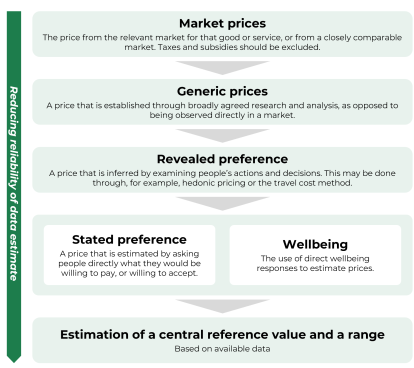
Practitioners may need to commission bespoke research to understand the values of goods and services for which there are no reliable market prices or generic prices. This research should be proportionate to the costs, benefits and risks of the proposal.
Non-market prices are often uncertain. Practitioners may therefore need to consider a range of estimates for those prices and use sensitivity analysis to assess how variation in these prices affects the social value of a proposal.
Generic prices
A generic price is a price established through broadly agreed research and analysis, rather than observed directly in a market. Generic prices for inputs are sometimes known as unit costs.
The Green Book and its supplementary guidance provide numerous generic prices that can be used in appraisals. One example of a generic price is the social cost of carbon, set out in supplementary guidance published by the Department for Energy Security and Net Zero (DESNZ).
The Greater Manchester Combined Authority has published a unit cost database that brings together more than 1,100 cost estimates into a single place.
If practitioners use generic prices in their appraisal, they should carefully review the studies underpinning the estimates of those prices. Generic prices may have been calculated in contexts that are significantly different from the context of the proposal at hand.
Revealed preference
Revealed preference valuation is a method of non-market valuation that infers prices by examining people’s actions and decisions.
One method of revealed preference valuation is hedonic pricing. This examines the different market and non-market factors that affect the price of a particular good or service. For example, practitioners can estimate a monetary value for green space by examining how average house prices vary with the amount of green space in different areas. The resulting correlation shows the additional monetary value that nearby green space adds to a property.
Another method of revealed preference valuation is the travel cost method. This involves estimating the costs that people incur in order to consume a non-market good or service. It is difficult to assess the “price” of a recreational site, for instance, if that site has free admission. The price might be established by examining the time and expense that people will spend to visit that site.
Stated preference
Stated preference valuation is a method of non-market valuation that estimates prices by asking people directly what they would be willing to pay for a good or service.
One example of stated preference valuation in the UK government is the value of the quality-adjusted life year. The Department of Health and Social Care (DHSC) uses surveys to understand the value that people place on different health outcomes. This is set out in Green Book supplementary guidance on health.
Stated preference valuation can be unreliable. Survey responses are often biased or inconsistent, and may not reflect people’s true preferences. Therefore, stated preference should only be used if robust revealed preference data is not available.
Wellbeing valuation
Stated preference valuation asks people “how much are you willing to pay?”. By contrast, wellbeing valuation asks people “how satisfied are you with your life?” and then estimates how different factors affect that life satisfaction. This information can then be used to estimate the impact of a proposal. There is Green Book supplementary guidance on wellbeing valuation.
Wellbeing valuation does not involve directly asking people how much a particular thing has impacted their life satisfaction. Instead, it looks at statistical relationships between life satisfaction and different factors. Wellbeing values are based on evidence from previous experiences, not predictions.
Wellbeing studies, for instance, find that people who are unemployed are unhappier than those in work, holding everything else constant. This is in addition to the lower wellbeing that stems from a lower income. The Green Book supplementary guidance on wellbeing sets out evidence on the wellbeing benefits of volunteering and green space.
Wellbeing analysis can be extended by estimating a generic price for life satisfaction, known as a wellbeing year (WELLBY). A WELLBY is the value of a one-point change in life satisfaction on a 0-10 scale per person per year. The latest WELLBY value can be found in the supplementary guidance on wellbeing.
Types of social costs and social benefits
The Green Book provides generic guidance on assessing the social costs, social benefits and risks of a proposal. It is supported by supplementary guidance, which provides more detailed advice on assessing particular social costs and social benefits. All supplementary guidance can be found on the Green Book webpage on GOV.UK.
The remainder of Chapter 8 provides further detail on how to appraise particular social costs and social benefits. These are summarised in Table 11. These social costs and social benefits may not be relevant to all proposals. Practitioners should contact relevant departments when assessing social costs and benefits as necessary.
Table 11. Types of social costs and social benefits
| Category | Social cost or social benefit |
| Inputs | Labour |
| Equipment and materials | |
| Assets | |
| Maintenance | |
| Economy | Economic output and labour productivity |
| Employment | |
| Competition | |
| Residential and commercial development | |
| Transport | |
| Society | Crime and fire |
| Life and health | |
| National security | |
| Climate and environment | Energy use and greenhouse gas emissions |
| Natural environment | |
| Climate change resilience | |
| Government | Public sector efficiency savings |
| Public sector fraud and error |
Input costs
This section sets out guidance on assessing different types of input costs: labour, equipment and materials, assets and maintenance.
Labour
Labour is an input into producing goods or services. The value of those goods or services might be monetisable or unmonetisable.
The social cost of labour is the cost of employees’ time, based on full-time equivalent (FTE) costs and includes pension costs, national insurance, allowances, benefits and basic salary (i.e. wages). Payments of tax and national insurance made from an employee’s gross earnings are part of the output or value produced by the workforce. They are therefore not an economic transfer and should be included where relevant in calculations of social value.
Redundancy payments are an economic transfer. Redundancy costs should be included in the calculation of the financial costs to the public sector. Practitioners should also assess the wider social effects of redundancy.
Equipment and materials
Practitioners should consult potential suppliers to estimate the market prices of equipment and materials.
Payments of tax on foreign procurements are included in market prices in social value calculations, in the same way as they are for UK purchases. Given that manufacturing and supply chains are generally global, most procurements are likely to have elements of foreign origin, manufacture and taxation applied to their production. It would not be proportionate, or likely to add value to the decision-making process, to attempt an analysis of each procurement’s degree of embedded foreign taxation, and then adjust for it.
For some proposals, it might be important that inputs are supplied by British businesses, rather than imported from abroad, or for inputs to be supplied by businesses from a particular area within the United Kingdom. These sorts of requirements can be expressed either as an objective or as a critical success factor.
Assets
A proposal may involve buying or selling assets. Annex C of the Balance Sheet Framework sets out guidance on valuing government assets and liabilities.
An asset’s residual value or liability at the end of the appraisal period should be included to reflect its opportunity cost. Residual values do not depend on the actual sale of an asset. The market price at the end of the asset’s lifetime – the best value obtainable from its sale, lease or alternative use – is part of the value created as a result of the cost to the public sector of creating the asset.
Knowledge assets are the intangible resources that support the delivery of public services, or are developed in the delivery of public services. They include software, know-how, data and intellectual property. These assets have considerable value and can have impact beyond their original purpose. The Rose Book provides guidance on how to identify, protect and exploit knowledge assets. The Intellectual Property Office provides detailed guidance on how to value intellectual property.
Maintenance
Practitioners should consider how infrastructure will degrade over time, leading to either lower social benefits or higher social costs. They should include the costs associated with maintaining a proposal over its lifetime in the appraisal. These maintenance costs may be substantial and occur over long periods, and estimates should be based on an organisation’s asset maintenance policies. In the absence of such policies, any assumption should be based on maintaining the initial service level and quality over the asset’s lifetime.
Costs and benefits for the economy
This section sets out guidance on assessing impacts on the economy, including economic output and labour productivity, employment and competition. It also covers two types of economic infrastructure: housing and commercial development, and transport.
Economic output and labour productivity
A proposal may affect economic output, employment or productivity:
- Economic output: The goods and services produced by a particular business, industry or country over a given period.
- Employment: The number of people aged 16 or over who have completed at least one hour of work in a given reference week, or are temporarily away from their job.
- Hours worked: The number of hours spent working in a main job over a given period.
- Labour productivity: The amount of economic output produced over a given period divided by the number of hours worked.
Growth in labour productivity is important for improving living standards in the United Kingdom. It is therefore typically considered a policy-level objective of the UK government. This objective flows down the policy hierarchy to inform portfolios, programmes and projects in sectors such as housing, transport, energy, skills, health, R&D and industrial strategy. Chapter 3 provides more detail on the policy hierarchy.
A proposal that affects demand, such as government procurement from a specific industry, should generally be assumed to have no impact on national labour productivity. A proposal might affect labour productivity through one of the following channels:
- Skills: A proposal might improve labour productivity if it increases the skills either of existing workers or new entrants to the labour market.
- Health: A proposal might improve labour productivity if it increases workers’ ability to work.
- Internal movement of labour: A proposal might improve labour productivity if it enables workers to move from less-productive to more-productive jobs.
- Innovation: A proposal might improve productivity if it increases the generation and diffusion of new ideas.
- Investment: A proposal might harm labour productivity if it reduces investment in new infrastructure, buildings and equipment. A government spending proposal has the potential either to ‘crowd out’ private investment or to ‘crowd in’ new private investment.
- Labour supply: A proposal might harm labour productivity if it impairs people’s ability to find or access jobs.
- Dynamic clustering and agglomeration: A proposal might harm productivity if it hinders the ability of households and businesses to co-locate near to each other.
The types of benefits that arise from an improvement in productivity, and who receives those benefits, will depend on the nature of the proposal. A proposal that raises productivity may bring positive effects to some groups and negative effects to other groups. Some potential parties affected by productivity improvements are listed below. Practitioners might use distributional analysis to show how these different parts of society stand to be affected by a proposal:
- Existing workers: A more productive business may pay higher wages to its existing workers or hire workers from other organisations, paying them higher wages than they previously earned.
- New workers: A more productive business may hire workers that are unemployed or economically inactive.
- Suppliers, through buyers of their inputs: A more productive business will buy more inputs from its suppliers, increasing its suppliers’ revenues.
- Consumers, through lower prices or better products: A more productive business that produces more output, at a lower cost, may be able to charge a lower price to consumers. A more productive business may also be able to raise the quality of its products, or provide a greater variety of products to consumers.
- Creditors and shareholders, through higher profit: A more productive business will have more profit after paying its workers and suppliers, which can then be distributed to creditors and shareholders.
- The public sector: The business will transfer money to central government and local government through different types of taxes.
The Green Book recommends assessing and comparing options based on their social value. This includes not just impacts on economic output and productivity, but also wider society and the environment. Decision makers may, however, wish to understand how a proposal affects economic output as a subset of its total social value. Practitioners should do this by looking at the social benefits and social costs of a proposal that involve final goods and services bought and sold in markets.
Some UK government proposals must be accompanied by a growth impact assessment. Practitioners should contact the Department for Business and Trade (DBT) for further guidance on this.
Employment
Practitioners should generally assume that proposals do not bring about an increase in national labour supply. This is known as the principle of full displacement of jobs. Practitioners should assume that every job created by the proposal will be filled by a worker who vacates a different job elsewhere in the economy. If a proposal involves hiring workers, practitioners should assume those workers are sourced from other firms, sectors or areas, rather than unemployment or inactivity.
There may, however, be exceptional circumstances where the assumption of full displacement of jobs does not hold in a local economy, and practitioners may credibly assume that their proposal will increase labour supply. For example, the Department for Transport has published guidance on the local employment effects of transport.
If practitioners assume that their proposal will increase labour supply, this must be accompanied by transparent reasoning and compelling evidence that has been signed off by the chief economist of the originating organisation (or equivalent). Decision makers should be alert to this assumption. Practitioners should make sure this social benefit is carefully monitored and evaluated to inform future decision-making.
Competition
A proposal may make a market more competitive or less competitive. Reductions in competition can have short-term and long-term impacts, including lower economic output, higher prices, less choice, reduced innovation and lower productivity. The Competition and Markets Authority has published supplementary guidance on competition.
Housing and commercial development
The Ministry of Housing, Communities and Local Government (MHCLG) has published an appraisal guide that sets out how to assess the costs and benefits of new developments. Homes England has published guidance on measuring the social value of housing and regeneration.
Two elements are relevant for determining the social value of new residential and commercial developments. These are:
- The direct impact of the new development.
- The external impacts that the new development has on the existing area and elsewhere in the United Kingdom.
The direct impact of the new development concerns how the economic value of the land will change as it is converted from one use to another. The price a residential occupant pays for a new building will depend on a range of factors, including the dwelling’s features and its access to green space, amenities and employment. For commercial occupants, the price they are prepared to pay reflects the level of profits earned by locating to the new building.
A proper economic valuation should also account for the value of land in its alternative use – its opportunity cost. It should also account for the costs of converting the land to its new use, such as labour, raw materials, fees and normal profits to developers. This is measured through land value uplift, which is discussed in more detail in Chapter 4 of the MHCLG Appraisal Guide.
Social housing is provided at sub-market values to lower income groups. The additional distributional benefits associated with this subsidy should be included in the social benefits of the proposal.
The external impact of a new development concerns a wide range of impacts, including environmental, health and transport impacts. Place-making impacts for areas in need of regeneration are also important. Homes England has published research on the place-making impacts of housing-led regeneration and commercial-led regeneration. The Department for Transport has published guidance on valuing developments that are dependent on new transport infrastructure.
All of these factors are important elements of development investment decisions, alongside land value uplift. These factors may change the investment decision, particularly in areas in need of regeneration.
Transport
A proposal might affect the demand for transport or the supply of transport. The Department for Transport has published Green Book supplementary guidance on transport, which includes a generic price known as the value of travel time (VTT). This is a value reflecting a person’s or business’ willingness to pay to reduce journey time, or conversely, the compensation they would require to accept a longer journey time.
Costs and benefits for society
This section sets out sources of guidance on valuing impacts on crime and fire, life and health, and national security.
Crime and fire
A proposal might affect crime. The Home Office has published Green Book supplementary guidance on the social costs of different offences.
A proposal might affect the likelihood and impact of fires. The Home Office has published Green Book supplementary guidance on the social costs of fire.
Life and health
A proposal might involve a risk to human life. This should be estimated using a generic price known as the Value of a Prevented Fatality (VPF). This measures the social value of small changes in fatality risks where levels of human safety vary between options. VPF is not the value of a life. It is the value of a small change in the risk or probability of losing a statistical life. Not to value this in appraisal would effectively treat human safety as having zero value. VPF allows alternative levels of fatality risk to be taken into account in option design. The latest estimate of VPF can be found in the TAG data book, published by the Department for Transport.
A proposal might change the life expectancy of certain people. This should be estimated using a generic price known either as the value of a Statistical Life-Year (SLY) or the Value of a Life Year (VOLY). This is the social value of a small change in the probability of losing or gaining a year of life expectancy. SLY is useful when appraising options that involve different changes to life expectancy.
A proposal might affect not just life expectancy, but also quality of life. These effects are measured using quality-adjusted life years (QALYs), which combine both longevity and level of health in a single measure. The latest estimate of a QALY can be found in Green Book supplementary guidance on health.
The VPF, QALY and SLY values are based on average values from representative samples of the population. They are not intended for use in emergency or rescue contexts.
A proposal might have an impact on family life and family relationships. Practitioners can find guidance on this as part of the Family Test.
National security
A proposal might affect the national security of the United Kingdom. This means that it affects the government’s ability to protect UK citizens and interests. A proposal may have national security implications if it affects defence, energy, food, cyber security or public safety.
Practitioners might be able to obtain objective and reliable measures of the social benefits of national security proposals. However, it is not always possible to meaningfully estimate the marginal contributions to national security. For example, defence creates social value by maintaining peace and security, which protects against foreign threats and enables the economy to grow. This contribution cannot easily be measured in monetary terms and so defence proposals are typically assessed using social cost-effectiveness analysis, rather than social cost-benefit analysis.
Practitioners should contact the Ministry of Defence for further guidance in assessing defence proposals.
Costs and benefits for climate and the environment
This section sets out sources of guidance on valuing the impacts of energy use and greenhouse gas emissions, changes to the natural environment, and climate change resilience.
Energy use and greenhouse gas emissions
The Climate Change Act 2008 established a series of legally binding targets to reduce the UK’s greenhouse gas (GHG) emissions to ‘net zero’ by 2050. Practitioners should therefore consider the impact of a proposal on GHG emissions. They should consult the Green Book supplementary guidance on energy use and GHG emissions, published by the Department for Energy Security and Net Zero (DESNZ).
A proposal may involve either an increase or decrease in GHG emissions. This change in emissions has a social value, which, in UK government appraisals, is based on the abatement costs of achieving the UK’s emissions reduction targets.
GHG emissions can come either from changes in:
- Energy use: A proposal may involve either an increase or decrease in energy consumption. A reduction in energy use has a direct social value, in addition to the value of a reduction in GHGs. This is because less energy consumption frees up resources that can be used elsewhere in the economy. Conversely, a proposal that increases energy use will lead to more resource consumption, which carries a social cost.
- Non-energy use: A proposal may involve a change in GHG emissions that does not derive from a change in energy use. For instance, a scheme promoting the restoration of peatland could result in the removal of GHGs from the atmosphere.
Practitioners should carefully identify the potential sources of emissions that arise from a proposal. They should consider the possibility of changes in energy use and fuel use, as well as non-energy emissions.
The social value of a change in energy use is found by multiplying together the quantity of fuel used or saved by a proposal, and the long run variable cost (LRVC) of that fuel.
Social value of change in energy use = Change in quantity of fuel used x LRVC of that fuel
For changes in energy use, the social cost of greenhouse gases is calculated using a two-step approach. The first step is to calculate the change in emissions. This involves multiplying together the change in the quantity of fuel used, and the emissions factor of that fuel. All GHGs should be converted into a standard unit of account: either equivalent tonnes (tCO2e) or kilograms (kgCO2e) of carbon dioxide.
The second step is to multiply together the monetised value of this quantity of GHG emissions and the social value of carbon. This produces a final figure for the social value of a change in emissions.
Change in emissions = Change in quantity of fuel used x Emissions factor
Social value of emissions change = Change in emissions x Social value of carbon
For changes in emissions arising from non-energy sources, practitioners should use relevant evidence to estimate the change in emissions in standardised units. This is then multiplied by the social value of carbon.
A proposal that improves energy efficiency will free up funds for households and businesses. Some of these savings will be spent on other goods and services, but some of these savings will be spent on additional energy consumption. This secondary effect can either partially, or wholly, offset the original energy savings. This response is known as the rebound effect. Practitioners should consider this effect when appraising proposals that involve energy efficiency.
Practitioners should consider whether a proposal might have a significant impact on emissions produced abroad. This is especially the case for goods or services that are imported to the United Kingdom from abroad, and for which the production involves the generation of considerable emissions in the source country. However, these ‘embedded emissions’ can be complex to estimate and may be disproportionate to include for many proposals. Practitioners should consult the supplementary guidance on energy use and GHG emissions for further advice.
Practitioners should consider the projected changes in emissions factors over time. For example, electricity emissions factors are expected to fall over time, as electricity in the United Kingdom is increasingly generated from renewable sources that have lower carbon intensity than fossil fuels.
Emissions analysis should separately include both the level of emissions impacts, and the monetised value of those emissions impacts. This is in line with the proportionality section of the EPPS. If practitioners have any doubt as to whether assessment is required, then they should lean towards conducting assessments.
The level of detail and complexity devoted to emissions analysis should be proportionate to the likely impact of greenhouse gas emissions. For example, a proposal will generally have a negligible impact on emissions if it involves emissions of below 0.1 megatonnes of carbon dioxide equivalent in every year of its appraisal time horizon. For such proposals, it may not be proportionate to comprehensively calculate emissions impacts. Practitioners should instead carry out basic analysis to satisfy themselves that the expected emissions impact is negligible and does not justify quantification.
Natural environment
The Environment Act 2021 sets legally binding targets for the government to improve the environment. Practitioners should take these targets into account when developing proposals. There is Green Book supplementary guidance on enabling a natural capital approach (ENCA). This provides a framework to integrate nature into policymaking, including appraising policy impacts on nature, and using nature investment to meet broader policy goals.
Practitioners should note the statutory duties around the environmental principles policy statement (EPPS) and biodiversity, described fully in Chapter 3. These duties ensure that the consideration of the natural environment is embedded in proposals from the outset.
Natural capital includes the living and non-living aspects of nature that provide value to people. These include forests, fisheries, rivers, biodiversity, land, minerals, and the atmosphere, amongst other natural assets. Natural assets provide services, called ecosystem services, according to their quantity, quality and location. These services deliver benefits to society and the economy. A proposal that directly or indirectly affects natural assets will have an effect on social value. It is thus important to include nature in appraisal.
Ecosystem services can broadly be categorised as:
- Provisioning services: These are goods that meet human needs, such as crops, timber and water.
- Cultural services: These are settings that support cultural interaction and activity, such as outdoor recreation, tourism and volunteering.
- Regulating services: These are processes that mitigate adverse effects on human society. For example, areas of vegetation will naturally remove air pollution and reduce flood risk.
Practitioners should consider the natural capital screening questions. This means considering, one by one, whether the option is likely to directly or indirectly affect the following list of natural capital assets. If the answer to any of these is ‘yes’, then practitioners should consider natural capital impacts in their appraisal. The relevant natural capital assets are:
- The use or management of land, or landscape.
- The atmosphere, including air quality, greenhouse gas emissions, noise levels or tranquility.
- An inland, coastal or marine water body.
- Wildlife and/or wild vegetation, which are indicators of biodiversity.
- The supply of natural raw materials, renewable and non-renewable, or the natural environment from which they are extracted.
- Opportunities for recreation in the natural environment, including in urban areas.
Once practitioners have identified whether proposals have an impact on the natural environment, they should follow a four-step approach to appraise the impacts, as set out in the ENCA guidance:
- Understand the environmental context to the proposal: its scale, location, outputs and geographic reach.
- Consider physical changes to natural assets that might be affected.
- Consider and value the social welfare implications of the changes to natural assets. How will changes in assets affect the benefits they provide to society?
- Consider uncertainties and implementation.
In addition to ecosystem services, a proposal may also increase or decrease the negative environmental pressures that can have significant social costs. Practitioners should consult the relevant guidance on appraising these effects:
- Air quality: Defra has published supplementary guidance on air quality.
- Noise pollution: Defra has published supplementary guidance on noise pollution.
- Waste: If a proposal affects the flow of materials or waste, it may be proportionate to demonstrate its impact using life cycle assessment (LCA) studies.
The United Kingdom has several legally binding limits on pollutants to manage risks to health and the environment. Practitioners should consider whether a proposal is likely to result in a breach of any of those legal limits and include mitigating actions to prevent this.
Practitioners should consider the effects of a proposal on the welfare of animals, including both wild and domesticated animals. The Animal Sentience Committee can examine any policy decision made by UK government ministers.
Climate change resilience
Climate change will affect the benefits, costs and risks associated with many government proposals. Building adaptation measures into policy options may represent value for money. Practitioners should compare options that include adaptation measures with those that do not.
Proposals which have a lifetime ending before 2040 should be appraised against a climate scenario in which global temperatures rise by 2°C. If a proposal has a longer time horizon (i.e. beyond 2040), practitioners should appraise it using at least two climate scenarios: one baseline consistent with 2°C warming and another consistent with 4°C warming. It is not possible to assign probabilities to climate change scenarios, as these represent plausible futures rather than quantifiable likelihoods.
The Green Book supplementary guidance on accounting for the effects of climate change (AECC) provides steps to determine how climate risks are relevant to a proposal. The Environment Agency has also published guidance on managing the risks associated with flooding and coastal erosion.
Costs and benefits for the government
This section sets out sources of guidance on valuing public sector efficiency savings and guidance on public sector fraud and error.
Public sector efficiency savings
A proposal might generate social benefits by reducing the resources used in the public sector. These are known as public sector efficiency savings. The Government Efficiency Framework helps officials in the UK public sector to report and track efficiency savings consistently.
An efficiency means either achieving an output with fewer inputs, or achieving higher outputs, while using the same amount of inputs. Reducing costs by reducing outputs would therefore not be considered an efficiency saving. As with all benefits, a public sector efficiency saving may either be monetisable or unmonetisable.
Public sector fraud
A proposal may have a specific objective of reducing public sector fraud. The intended outcome here is often to maximise the financial return for the public sector. Practitioners may therefore particularly focus on public sector financial impact in such appraisals. They should weigh the public money that is saved from fraud, as well as the benefit of avoiding policing and judicial costs, against the costs and risks of the proposal.
A proposal may not have specific objectives related to fraud, but still involve a risk of public money being lost to fraud. Practitioners should undertake a fraud risk assessment, in consultation with the Public Sector Fraud Authority, and consider different options for counter-fraud measures. They should weigh the public money saved from fraud, and the benefit of avoiding policing and judicial costs, against the costs and risks of those counter-fraud measures.
Fraud is associated with two types of social cost: money being lost to fraudsters, and wider social costs. Practitioners should include both of these in appraisals.
Fraud involves money being criminally acquired by fraudsters. These proceeds of crime meet the definition of a classic economic transfer: money is transferred between parties without either the consumption or production of goods and services. Treating the proceeds of fraud as a classic economic transfer risks understating the importance of preventing fraud in the public sector. Practitioners should therefore take one of the following approaches, and communicate this clearly in appraisal:
- Ideally, practitioners should treat the proceeds of crime as a one-sided economic transfer. This implies that fraud is transferred outside of the perimeters of UK society. The cost of the fraud to the public sector is not matched by a corresponding benefit to the fraudster. This one-sided economic transfer approach is in line with the wider guidance on appraising crime – including fraud and proceeds of crime – set out by the Home Office.
- However, treating the proceeds of fraud as a one-sided economic transfer can be confusing. Practitioners may find it simpler and more proportionate to simply treat the proceeds of fraud as a social cost.
Public sector fraud has wider social costs beyond the revenue lost to fraudsters. It means, for instance, the use of police and judicial resources to pursue and punish fraudsters. The Home Office provides guidance on the costs that arise in anticipation of crime, as a consequence of crime, and in response to crime.
Public sector error
The government occasionally makes erroneous payments to households or organisations, as over-payments or under-payments. This is distinct from forecasting error in appraisal, for example, where practitioners erroneously under-estimate the social cost of inputs.
A proposal may have a specific objective of reducing public sector errors, in order to reduce wasteful spending. The objective here is to maximise net benefits for the public sector: minimising public money lost to error, and the costs of subsequent measures needed to remediate errors, while also minimising the costs of the proposal itself.
Many proposals will not have specific objectives related to error, but will involve a risk of public money being lost to error. Practitioners should make an honest assessment of the likelihood and impact of error. They should consider different options for measures to avoid errors and weigh the public money saved from errors, as well as the benefit of avoiding remediation costs, against the costs and risks of the anti-error measures.
The Green Book makes the following distinctions:
- Public money lost to over-payment: Practitioners should treat the over-payment as an economic transfer from the government to the recipient. If a proposal has a high risk of erroneous payments, then this will increase the public sector financial cost of that proposal, and make it less likely to be affordable.
- Under-payments: Practitioners should treat the under-payment as an economic transfer from the recipient to the government.
- Social costs: Both over-payments and under-payments involve social costs beyond the public money directly involved. Public bodies must, for example, use staff and resources to remediate errors.
Practitioners should have strong evidence to support an assessment that error risk is not actually fraud risk. In other words, if there is any doubt about the nature of the error risk, then practitioners should assume that money is being deliberately defrauded by criminals, rather than being overpaid in error. They should therefore treat those proceeds as a one-sided economic transfer or social cost, in line with the previous section on public sector fraud.
9. Presentation of results
Chapter 9 explains how to present the results of shortlist appraisal so that decision makers can consider, in a balanced way, the monetisable and unmonetisable impacts of each option, along with their distributional effects and the associated risks and uncertainties.
Introduction
The purpose of appraisal is to help decision makers understand the costs, benefits and risks of different options for meeting government objectives. Practitioners should therefore present appraisal results clearly and transparently, showing the value for money of alternative options in a consistent way. They should also explain why the preferred option has been recommended over other potential options.
The presentation of appraisal results will depend on whether the appraisal relates to public spending or regulation:
- Public spending: Practitioners will typically present appraisal results within a business case, rather than on a standalone basis. That business case should begin with an executive summary, covering the five dimensions of the business case. This helps to give those reviewing and approving the business case a coherent view of the whole proposal, not just the appraisal results.
- Regulation: Regulatory decisions that have impacts on businesses are subject to the Better Regulation Framework. Specific presentational requirements may apply in some circumstances, such as the use of an impact assessment template. The appraisal summary table set out by the Green Book does not replace this template.
Appraisal summary tables
The Green Book recommends presenting the results of shortlist appraisal using an appraisal summary table (AST). An AST is intended to provide a high-level summary of the key aspects of each shortlisted option. It helps to avoid the tendency to reduce appraisal results to a simple comparison of benefit-cost ratios.
Table 12 shows a generic AST, which sets out the minimum core information that practitioners should present. This generic AST is intended as a template that practitioners can extend as necessary to highlight other points relevant to the appraisal. It is scaled to fit on one page of the Green Book, but practitioners may need to extend this. Practitioners can find a set of AST templates on GOV.UK.
The generic appraisal summary table covers:
- Description of the option: This should describe how the option differs from the business as usual or other options.
- Summary metrics of social value: For a social cost-benefit analysis, this will include net present social value (NPSV), the benefit-cost ratio (BCR) and return on public sector cost (RPSC). For a social cost-effectiveness analysis, this will be net present unit cost (NPUC). These measures are defined in Chapter 6.
- Unmonetisable social costs and social benefits: Practitioners should briefly describe social benefits and social costs that cannot be expressed in monetary terms. This is described in Chapter 6.
- Public sector financial impact: Practitioners should briefly describe the public sector income and expenditure associated with each option. Public sector financial impacts are expressed in monetary terms and nominal terms, but not present value terms. This is described in Chapter 6.
- How impacts are distributed among different groups and places: Practitioners should briefly describe the most significant conclusions of distributional analysis and place-based analysis. These two types of analysis are described in Chapter 7. Practitioners should indicate the uncertainty associated with each option. This can be expressed using descriptive text, approximate ranges, or confidence intervals, depending on what is most proportionate.
For each of the five elements of the appraisal summary table, practitioners should include a brief description of relevant risks and uncertainties. This helps decision makers to understand the chances of different degrees of success or failure in achieving the proposal’s objectives, and the possibility that costs, benefits and distributional impacts will differ from those anticipated in appraisal.
Table 12. Generic template for an appraisal summary table (AST)
| Description of option | Summary metrics of social value | Unmonetisable social costs and social benefits | Public sector financial impact | How impacts are distributed among different groups and places (where relevant) | |
|---|---|---|---|---|---|
| Why is this the preferred option, or inferior to the preferred option? | Expected values and key uncertainties | Expected values and key uncertainties | Expected values and key uncertainties | Expected effects on groups and places, and key uncertainties | |
| 1. Business as usual | |||||
| 2. Do minimum | |||||
| 3. Preferred option (if not do minimum) | |||||
| 4. More ambitious option | |||||
| 5. Less ambitious option (unless preferred option is do minimum) |
10. Monitoring and evaluation
Chapter 10 discusses the interaction between evaluation and appraisal. Practitioners should keep monitoring and evaluation in mind throughout the appraisal process.
Introduction
Appraisal takes place as a proposal is being developed, before it is approved and then delivered. This stands in contrast to monitoring and evaluation:
- Monitoring: The process of continuously tracking the progress and performance of an intervention, to provide data on whether it is being delivered as intended.
- Evaluation: The systematic assessment of the design, implementation and outcomes of an intervention. It helps to understand what works, why, and for whom, and to build the evidence base for future proposals.
The Magenta Book is the government guidance on conducting evaluations and recommended evaluation methods. Regulations may require post-implementation reviews (PIRs), which should draw on evidence and lessons learned from evaluations where available. The Better Regulation Framework guidance provides more information on conducting PIRs.
There are two goals of monitoring and evaluation:
- Learning: During implementation, the government will use monitoring data to identify whether progress is on track, and to decide whether the intervention needs to be adapted. Evidence from evaluation informs the development of future proposals.
- Accountability: Monitoring and evaluation provides assurance that public money is being used effectively.
The Magenta Book sets out three types of evaluation:
- Process evaluation: This assesses how an intervention was delivered. It considers what worked well and less well, and why. The results of historical process evaluations can help practitioners think through the different options for undertaking a new proposal.
- Impact evaluation: This assesses the difference that an intervention has made. Practitioners should use the results of impact evaluations to inform the first stage of appraisal: setting the rationale and objectives.
- Value for money evaluation: This assesses whether the intervention was a good use of resources. Practitioners should use value for money evaluations to inform their estimates of costs and benefits in longlist appraisal and shortlist appraisal.
Evaluation as an input into appraisal
Appraisals should be informed by evaluation evidence. Evaluation evidence should inform the rationale and objectives of the proposal, as well as the appraisal of different options. Practitioners should review whether there is applicable evaluation evidence from the previous history of the intervention, or from similar interventions. In particular, practitioners should use data from previous interventions to identify historical forecast errors and derive appropriate optimism bias adjustments.
Appraisal practitioners and evaluation experts should work closely together, both during the appraisal process itself, and later during monitoring and evaluation.
Planning for evaluation in the appraisal process
Practitioners should develop an evaluation plan as soon as they have identified a preferred option, and ensure a robust plan is in place before the proposal is submitted for final approval. The evaluation plan should draw heavily on the theory of change underpinning the strategic dimension of the business case. The management dimension of the business case should set out how delivery will be monitored and how the intervention will be evaluated. Evaluations should be planned and conducted either by internal analysts, or by external evaluation experts working in partnership with internal analysts.
Appraisals should include the costs of monitoring and evaluation. These costs should be reflected both in the economic dimension and in the financial dimension of the business case.
There is no fixed proportion of a proposal’s value that should be dedicated to evaluation. Required evaluation funding and resourcing should be assessed on a case-by-case basis and should be proportionate to the scale and ambition of the proposal. New and untested approaches will generally need to commit more funding to evaluation in order to generate evidence of impact and robustly assess summary metrics of social value.
When conducting an evaluation, practitioners should review the original appraisal. They should:
- Examine whether the objectives were met, and whether the theory of change did indeed materialise in reality.
- Assess whether social costs and social benefits did indeed materialise as expected. Practitioners should, where feasible, estimate summary metrics of social value.
- Use distributional analysis to assess whether different groups did indeed receive the anticipated benefits and bore the anticipated costs.
- Review how well risks were identified and managed. They should consider whether any unintended consequences arose that were not anticipated in the original appraisal.
UK government departments are required to register their planned, live and completed evaluations on the Government Evaluation Registry. Practitioners should use this registry as a source of evaluation evidence from previous similar interventions. They should make sure that a proposal’s evaluation plan involves eventual publication in the Government Evaluation Registry. Evaluation reports should be placed in the public domain, in line with government transparency standards and Government Social Research Publication Protocol.
UK government departments are required to publish business cases for projects and programmes that form part of the Government Major Projects Portfolio (GMPP). This business case may be a Summary Business Case, a Full Business Case or a Programme Business Case. The business case must be published within four months of the project or programme receiving HM Treasury approval. HM Treasury has published guidance to support departments to meet this requirement. Practitioners can draw on evidence from the collection of published business cases.
Annex A: Private finance models
Annex A provides further detail on how to appraise options for projects that involve the use of private finance models.
Introduction
The Balance Sheet Framework defines private finance models as delivery models that use or enable use of private sector capital to meet the full or partial costs of construction (and may also include operation or maintenance) of infrastructure assets, where the public sector is involved.
There are various types of private finance model, as set out in the Balance Sheet Framework. These include, but are not limited to, different types of Public Private Partnerships (PPPs), concessions, joint ventures, economic licence-based models and Contracts for Difference. This annex also applies to variations of these models and to new situations in which they might be applied.
Box 1 of the Green Book makes clear that value for money is a balanced judgement based on several factors. The Balance Sheet Framework sets out a key value for money principle specific to private finance models:
“Private financing might deliver higher value for money than a public sector option if benefits of risk transfer and efficiencies in delivery outweigh the higher cost of private capital. This should consider costs and benefits over the whole life of a project. Decision-makers should select the best value for money risk transfer setting from a range of options, regardless of balance sheet classification.”
Practitioners should refer to the Balance Sheet Framework alongside this annex when considering proposals involving the use of private finance models.
Characteristics of private finance models
The suitability of private finance will depend on the nature of the asset, the size and complexity of a project, the degree of contract flexibility required and risks involved. Any proposal to use private finance must be underpinned by a clear, evidenced rationale for how it will improve project design, delivery, or outcomes and practitioners must consider any obligations falling on the taxpayer.
The cost of private finance is usually higher than the government’s cost of borrowing. The overall project cost will depend on the extent to which private capital can provide efficiencies in delivery, appropriate risk transfer and effective risk management through a well-structured model. There is a fiscal trade-off when a private finance model creates a taxpayer obligation. Where a significant taxpayer obligation is created, the benefits brought from risk transfer and efficiencies should be traded-off against the higher costs of private financing.
The benefits of using private finance models will vary by project but can include transfer of risks and their management to the private sector, commercial incentives to drive project performance and maintenance of assets and investor scrutiny of decision-making. Practitioners should refer to the Balance Sheet Framework for guidance to support the identification and analysis of the project-specific risks that the public sector is seeking to transfer to the private sector via the private finance model.
Longlist appraisal
Practitioners can include private finance models as an option in longlist appraisal, alongside alternative delivery mechanisms such as direct public provision, not-for-profit solutions and grant giving. The choice about how an option is delivered should correlate with the nature of the intervention and some interventions will be more suited to use of private finance models than others.
At longlist appraisal stage, practitioners should use qualitative questions to help identify whether a private finance model should be the preferred way forward or form part of the wider shortlist. Table A.1 below sets out various issues to consider, alongside the critical success factors set out in chapter 5. Those organisations putting forward proposals that use private finance models must secure as much evidence as possible against these questions at longlist stage.
Table A.1. Qualitative issues to consider when appraising private finance model options
| Theme | Issues to consider |
| Type of private finance | • How has the responsible organisation considered the incentives, benefits and costs of different types of private finance model? |
| Ability of the public sector to define and measure objectives and outputs | • Is the responsible organisation satisfied that it can agree long-term contracts for projects in the sector and that any contractual outputs can be objectively measured and assessed? |
| Risk identification, allocation, transfer and management by the private sector | • Has the responsible organisation clearly identified which risks it can transfer to the private sector, and confirmed that the private sector is best placed to manage them? • Is the responsible organisation confident that a private finance model delivers optimal risk allocation and service delivery, including practical risk transfer to the private sector for better management? • Has the responsible organisation fully assessed service demand and income risks in relation to the proposed contract length for the private finance option? • Are there risks that the private sector is unwilling to bear, unwilling to bear at an efficient price, or where the public sector would remain the effective risk taker despite contractual allocation? If so, how is this reflected in the model design? • How will the responsible organisation manage reputational risks and risks of non-delivery of outcomes? |
| Revenue streams | • What potential revenue sources could cover payments for delivering the asset and any related services? • How much of the overall project cost will these revenue streams cover, how stable are they and who controls them? • Who will collect the revenues and how will they be managed? |
| Complexity, operational flexibility, and innovation | • Is the responsible organisation confident that there is an appropriate balance between the desired operational flexibility of the asset and the constraints of a long-term contract based on up-front capital investment? For example, how complex is the asset, how might its use change over its lifetime, and are significant changes in specification likely? • Has the responsible organisation assessed the likelihood, scale and nature of variations that may be required over the life of the contract? • Can the service be implemented without unacceptably constraining the responsible organisation’s ability to deliver value for money in future operational objectives? • Is there scope for innovation in the design of the solution or the provision of services, including where the public sector may need to remove constraints to enable innovation? |
| Legal powers | • Has the responsible organisation identified any legal powers required, sought legal advice, and considered the implications for project design, structure and timelines? |
| Classification | • Has the responsible organisation engaged HM Treasury (via their spending team) to advise regarding the project’s classification (for example, whether it will be treated as on or off the public sector balance sheet)? • Has the responsible organisation assessed the budgetary and fiscal impacts of the proposal? |
| Contract duration and residual value | • Is the responsible organisation confident that it understands the advantages and disadvantages of the proposed contract length? • Has the responsible organisation considered how far into the future it can reasonably predict service demand, the expected life of the assets, expected post-contract use of any asset or service, the residual value of assets, and the overall affordability of the contract? |
| Ownership and maintenance of the asset/transfer of assets | • Who will own the asset, and how will ownership change over the life of the asset? • How will assets be maintained under different options, and which party will be responsible for maintenance? • Where the private sector will maintain an asset that ultimately returns to the public sector, how will the parties manage the transfer back to the public sector? • Has the responsible organisation defined termination and dispute resolution processes at the outset? |
| Incentives and monitoring | • Can the responsible organisation draft contracts that avoid perverse incentives for the private sector and ensure that private partners can actively manage, and are held accountable for, the risks they hold? • Has the responsible organisation assessed whether the proposed payment mechanisms enhance incentives for delivery and service levels, and ensured that the service can be independently assessed against agreed standards? |
| Market capacity | • Does the private sector have capacity, capability and willingness to design and deliver the required solution? • Does a significant market with sufficient capacity for these services exist in the private sector? • Is there sufficient market appetite and have other similar projects been successfully tendered to market? • Do potential private partners have the financial and managerial resources to manage the risks they will take on? |
| Procurement | • Is the procurement feasible within the required timescale and is there enough time to resolve key procurement issues? |
| Skills and resources | • Has the responsible organisation brought in specialist commercial expertise, relevant to the asset and sector, early in the development of the private finance model? • Does the responsible organisation have the management expertise and capacity to define, procure, deliver and manage the service throughout the procurement and delivery period? |
Shortlist appraisal
If an option involving a private finance model is brought forward to shortlist appraisal, practitioners must meet two additional requirements during the shortlist appraisal process:
- The shortlist appraisal must typically include a public sector option, unless otherwise agreed with HM Treasury.
- The shortlist appraisal must include an additional sensitivity analysis, where the social costs of all shortlisted options are discounted at the risk-free gilt rate.
In the economic case, practitioners should model the social costs of the private finance option on the basis of the payments made by the public sector to the private sector over the lifetime of the contract as they occur. This treatment in appraisal is the same regardless of whether the private finance option is classified as ‘on-balance sheet’ or ‘off-balance sheet’ from a budgetary or fiscal perspective.
As with all proposals, the estimates of costs and risks associated with a proposal will evolve throughout the business case process. Practitioners should reflect these changes iteratively in the shortlist appraisal. This means the appraisal of the preferred option is as rigorous as it can be before the final contract is agreed.
The public sector option
At least one shortlisted option must be equivalent in quality to the private finance model option but financed and procured directly by the public sector. This is commonly known as the ‘public sector option’ but is also referred to as the ‘public sector comparator’. It provides a benchmark to test the value for money of the private finance model option.
The public sector option should be comparable to the private finance model option in terms of service quality and output, and in the level and quality of asset maintenance. Practitioners must also make explicit adjustments to the public sector option to remove distortions caused by differences in effective tax rates between the public and private sector. Any such adjustments should, as far as possible, reflect estimates of the effective tax rate based on tax actually paid rather than a theoretical maximum. Practitioners should apply any relevant adjustments for optimism bias to all shortlisted options in the usual way.
A decision involving private finance model options should not be reduced to a binary choice between public and private but should consider a range of different options. If a shortlist contains more than one private finance model option with different levels of service quality, output or asset maintenance, each option must have its own equivalent public sector option. A shortlist may also contain further public sector options that are not directly comparable to the private finance model options.
The only scenario where a public sector option is not required is where there is no public interest rationale for government control of a commercial entity delivering a capital asset, as defined in the Balance Sheet Framework. Practitioners should seek advice from HM Treasury if they feel their proposal meets this criterion and that the use of a public sector option is inappropriate. In such cases, practitioners should reject the public sector option at the longlist appraisal stage and clearly document their reasoning for doing so.
Additional sensitivity analysis
In addition to standard shortlist appraisal, when at least one shortlisted option is a private finance model option and another is a public sector option, practitioners must also undertake an additional sensitivity analysis of all shortlisted options. This sensitivity analysis is a supplementary financial analysis. It involves discounting only the costs of each shortlisted option using the risk-free, real-terms gilt rate, rather than the STPR, to assess and compare the present value of the costs only of each shortlisted option. The precise gilt rate to use should be the one that most closely matches the weighted average duration of the private finance model contract. Practitioners should consult with HM Treasury for further guidance on the gilt rate. They should adjust costs for inflation as per the guidance in Chapter 6.
This additional analysis effectively incorporates the government’s costs of borrowing within the assessment of shortlisted options, allowing practitioners to compare the total exchequer costs of traditional procurement options with the additional costs of private finance. It provides an additional input into the overall quantitative and qualitative judgement as to whether private finance options constitute value for money, based on a comparison of the total costs to government only, in addition to standard shortlist appraisal using the STPR.