
Methodology: The effect of school-based nurseries on childcare accessibility
Published 4 February 2026
Applies to England

© Crown copyright 2026
This publication is licensed under the terms of the Open Government Licence v3.0 except where otherwise stated. To view this licence, visit nationalarchives.gov.uk/doc/open-government-licence/version/3 or write to the Information Policy Team, The National Archives, Kew, London TW9 4DU, or email: psi@nationalarchives.gov.uk.
Where we have identified any third party copyright information you will need to obtain permission from the copyright holders concerned.
This publication is available at https://www.gov.uk/government/publications/the-effect-of-school-based-nurseries-on-childcare-accessibility/methodology-the-effect-of-school-based-nurseries-on-childcare-accessibility
This methodology describes how we have worked with the Department for Education (DfE) to update our methodology for calculating childcare accessibility to include places in school-based nurseries. The findings of this methodology can be read in our commentary on the effect of school-based nurseries on childcare accessibility.
Multi-modal 2-step floating catchment area method
This analysis uses the same 2-step floating catchment area methodology that we used in Childcare accessibility by neighbourhood, our previous study of childcare accessibility in collaboration with the Office for National Statistics.
This analysis is first produced at output area (OA) level. We have aggregated the results using a population-weighted average and analysed them further using middle layer super output area (MSOA) layers. For consistency with our previous publications, the accompanying data also contains childcare accessibility at lower layer super output areas (LSOAs).[footnote 1]
Supply of childcare: updated methodology
The difference between this analysis and our previous work is the way we have measured the supply of childcare. Previously, we only analysed childcare providers registered with Ofsted. This work had two caveats. Firstly, we only hold data on places offered by the providers registered on the Early Years Register (EYR). A high proportion of these providers are also registered on the compulsory part of the Childcare Register (CR). As a result, the data covered all places for children aged 0 to 7 (places on the EYR for children under 5 and places on the compulsory part of the CR for children aged 5 to 7). The second caveat is that childcare places in school-based nurseries (23% of all places) were not included.[footnote 2]
In this updated analysis, we have worked with the DfE to establish a method that can be used to estimate the total number of places available for children of early years age.
This new approach uses the school census to extract the number of children aged 3 to 4 on roll in a school-based nursery.[footnote 3] Schools that provide education or care for children of these ages are exempt from registration with Ofsted. The number of children aged 0 to 2 from the school census is not counted. These places have to be registered with Ofsted and are therefore included in the analysis in the Ofsted-registered places.[footnote 4]
To estimate the number of Ofsted-registered places taken by 0- to 4-year-olds, we have applied the following weightings: [footnote 5]
- 100% of EYR-only registered childminders, childcare on non-domestic premises and childcare on domestic premises
- 68% of EYR and CR registered childcare on non-domestic premises and childcare on domestic premises
- 50% of EYR and CR registered childminders
We obtained these percentages using the early years census and provider surveys. The analysis in this publication gives us flexibility to update these percentage weightings in the future.
In this analysis, we converted the number of places to hours per week, to allow for more compatible aggregation. A school-based nursery place is the equivalent of 30 hours of childcare per week, and an Ofsted-registered place is the equivalent of 35 hours per week.
Local indicators of spatial association
To understand whether childcare accessibility follows a geographical pattern or is randomly distributed, we used local indicators of spatial association (LISA) analysis. This statistical method identifies whether areas with similar access to childcare cluster together geographically, revealing patterns that would not be apparent from looking at accessibility measures alone.
LISA analysis classifies each neighbourhood into one of 5 spatial cluster types based on how its accessibility compares to neighbouring areas. High-high clusters (HH) represent neighbourhoods where high accessibility areas are surrounded by other high accessibility areas. Low-low clusters (LL) are low accessibility areas surrounded by other low accessibility areas. Low-high outliers (LH) are pockets of low accessibility surrounded by high accessibility areas, while high-low outliers (HL) are isolated high accessibility areas within predominantly low accessibility areas. The final cluster type is the non-significant clusters. These are areas where there is no statistically significant clustering.
We completed this LISA analysis at the MSOA level. The method looks at the childcare accessibility of each MSOA and compares it to the accessibility of its neighbouring areas. A local Moran’s I value is used at the core of the LISA method. This is shown full in equation 1 and the process is outlined in Figure 1. A high and positive local Moran’s I value suggests that an MSOA is surrounded by areas with similar levels of childcare accessibility. A negative value suggests the MSOA is an outlier and has a different level of childcare accessibility to its neighbouring areas.
Figure 1: The process for calculating local Moran’s I
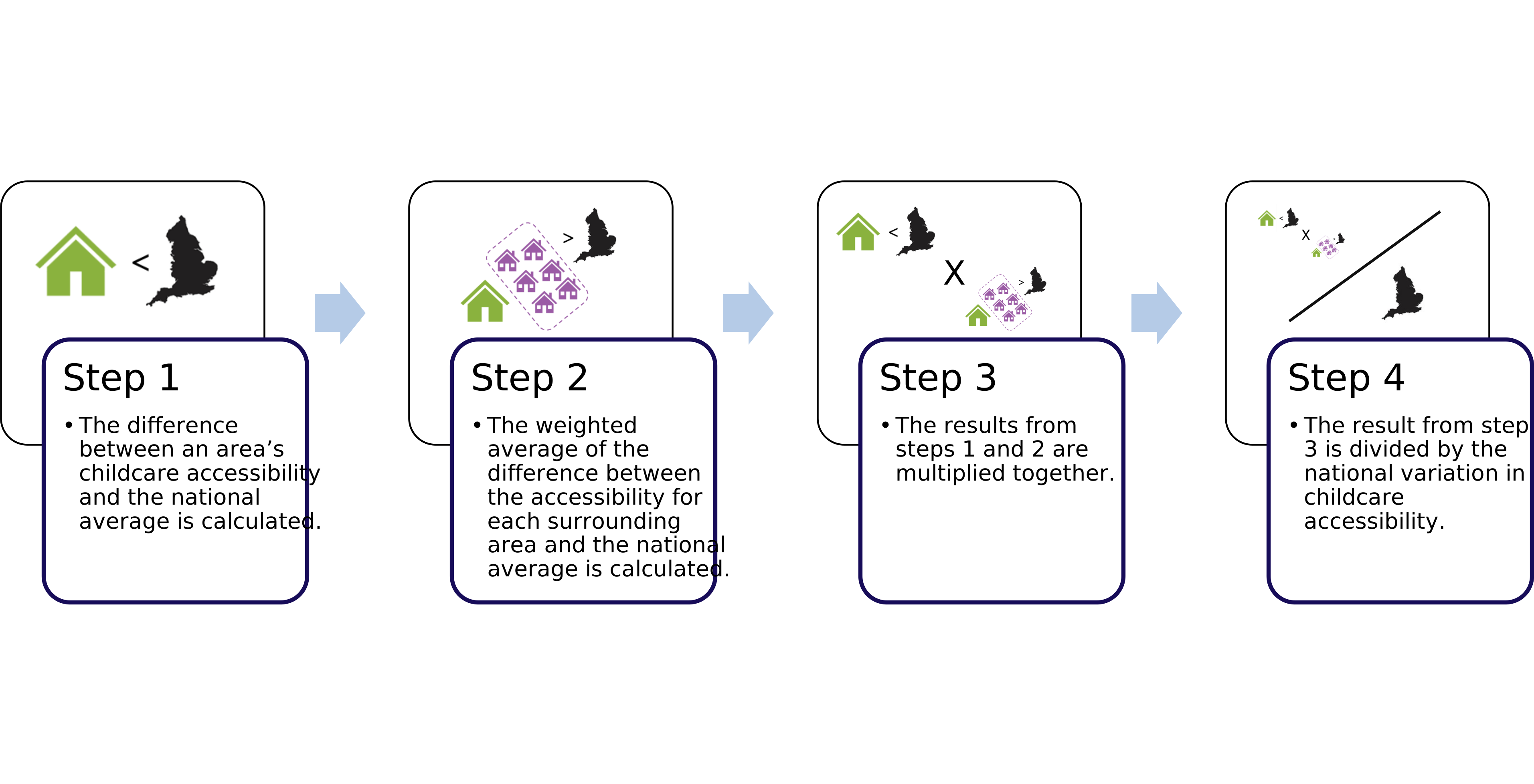
Figure 1 shows the process for calculating local Moran’s I. This is shown in 4 boxes, each showing one step of the method, and the image flows from left to right. In the first step, the difference between an area’s childcare accessibility and the national average is calculated. Then in the second step, the weighted average of the difference between the accessibility for each surrounding area and the national average is calculated. In the third step, the results from the first and second steps are multiplied together. Finally, in step 4, the result from step 3 is divided by the national variation in childcare accessibility.
Equation 1: how local Moran’s I is calculated

Equation 1 shows how local Moran’s I is calculated. It reads: local Moran’s I (Ii) equals the deviation of xi from x-bar, divided by the variance S-squared, multiplied by the sum of all j spatial weights wij, multiplied by the deviation of each xj value from x-bar.
Ii is local Moran’s I value for area i
xi is the childcare accessibility in area i
x̄ is the national average childcare accessibility
S2 is the national variation of childcare accessibility
wij is the spatial weight between area i and j
xj is the childcare accessibility in neighbouring area j
We then calculated spatial relationships based on a weighting of the 8 nearest neighbouring MSOAs, using geographical centroids to determine proximity.[footnote 6] We tested the calculation with multiple candidate values, and found that choosing 8 provided substantial statistical power to detect meaningful spatial patterns.[footnote 7] This captured genuine patterns while remaining sensitive to local variations in accessibility and minimising bias. We then used a permutation test. This randomly shuffled the accessibility values of MSOAs multiple times – each time recalculating the Moran’s I value. If the actual Moran’s value of an MSOA was more extreme than 95% of the values from the permutation test, then that MSOA was deemed to be statistically significant at the 5% level. Statistically significant MSOAs were then assigned into one of the HH, LL, LH or HL clusters based on their value.
Demand for childcare
To estimate the demand for childcare, we used aggregated GP registration data for children aged 0 to 4.[footnote 8] Demand for childcare is likely to be affected by several factors, including the employment status of parents, access to informal childcare, and the affordability and ease of access to childcare. This actual demand is hard to measure. Therefore, in this analysis, the demand for childcare is instead potential demand.
Limitations
As with our previous work, this analysis has several limitations.
Providers registered with Ofsted give details on the number of places they offer at the point of registration and thereafter at inspection. They must calculate this based on the legal requirements of the early years foundation stage. The number of places used in this analysis is therefore a proxy for the size and capacity of the early years sector. Additionally, the school census reports attendance rather than total places. These school-based places also tend to not be available out of term time, meaning a school-based place may not be directly equivalent to a place in Ofsted-registered provision.
There is also a misalignment in the time points for the places data used in this analysis. For the Ofsted-registered places, we used the most recent official statistics, which report the number of places as at 31 August 2025. For school-based nursery places, we used the most recently published school census. This covered the 2024/25 academic year, with data collected in January 2025.
For the Ofsted-registered places, this analysis only considers childcare places in providers registered on the EYR. It does not include:
- providers that are only registered on the CR
- parents who may be using informal childcare, such as care from grandparents
The percentages we have used to estimate the number of Ofsted-registered places taken by children aged 0 to 4 are averages taken from the early years census and provider surveys. It is highly likely that the proportion of places taken by children of these ages will vary between providers. The childcare accessibility metrics in this publication should therefore be treated as approximations rather than an exact measure of accessibility.
We also assume that parents are only willing to access childcare within their defined catchment area from the OA where they live. This enables us to create accessibility ratios, but it is also likely that some parents will not be using childcare close to their home. They may favour a nursery based at their workplace or one that is close to it. These scenarios are not included in this analysis.
We have used fixed catchment sizes for urban and rural areas. Travel to nurseries is likely to be different in rural areas, particularly for users of public transport, so varying the size of catchment areas may produce more accurate estimates.
When estimating the proportion of the population that travel by car to their childcare provider, we assume that children are evenly distributed across all households in an OA. Also, we assume that if a household does have access to at least one car, they are using this car to travel to their childcare provider. This is unlikely to always be the case.
The analysis only counts childcare places in England. It is likely that parents living on the borders between England and Wales and England and Scotland may use childcare from either country. Therefore, it is hard to estimate what the true potential capacity and demand for these services is.
We wanted to protect sensitive data about individual providers and to calculate accessibility scores more efficiently when new providers register. To do this, we used the nearest OA population weighted centroid to a childcare provider as a proxy for its location, instead of using its postcode. [footnote 9] As OAs are usually geographically small, this is a suitable assumption. However, in some geographically larger OAs, it may be less appropriate. This means that results may be less accurate for providers located in these larger OAs.
We sourced data on travel time from TravelTime, set for arrival on a weekday morning. The travel time data gives an estimate of actual travel time and is likely to vary by time of day. This means the analysis may not reflect access for parents who work shift patterns.
We advise caution when comparing estimates of childcare accessibility in small areas. With places aggregated to OA level, access to childcare may fluctuate in postcodes in large OAs in ways that are not evident in the data. Additionally, in a very small number of instances, data on local travel time may not reflect local connections; this may include areas with new residential developments or one-way roads.
-
Census 2021 geographies, Office for National Statistics. ↩
-
Childcare and early years provider survey: reporting year 2025, Department for Education, December 2025. These places were not included in our original analysis because some are exempt from registering with Ofsted and because places in these settings are recorded differently. See Registration exemptions, Ofsted, December 2023 (updated December 2024). ↩
-
This does not include governor-led settings, as these are recorded separately on the early years census and not published at provider level. This means approximately 800 school-based governor run nurseries are not included in this analysis. ↩
-
Registration exemptions, Ofsted, December 2023 (updated December 2024). ↩
-
We have assumed that the remaining places are taken by children aged 5 to 7 and therefore fall under the places registered on the compulsory part of the Childcare Register. ↩
-
Population weighted centroids were used. These represent the spatial distribution of the population in a given area. ↩
-
On average in England, an MSOA has 2 school-based nurseries, 2 primary schools and 6 Ofsted-registered early years settings. ↩
-
Patients registered at a GP practice, NHS England, January 2026. ↩
-
For each OA, a single fixed point is established that represents how the population is spatially distributed within the OA. ↩