
Commentary: The effect of school-based nurseries on childcare accessibility
Published 4 February 2026
Applies to England

© Crown copyright 2026
This publication is licensed under the terms of the Open Government Licence v3.0 except where otherwise stated. To view this licence, visit nationalarchives.gov.uk/doc/open-government-licence/version/3 or write to the Information Policy Team, The National Archives, Kew, London TW9 4DU, or email: psi@nationalarchives.gov.uk.
Where we have identified any third party copyright information you will need to obtain permission from the copyright holders concerned.
This publication is available at https://www.gov.uk/government/publications/the-effect-of-school-based-nurseries-on-childcare-accessibility/commentary-the-effect-of-school-based-nurseries-on-childcare-accessibility
On average, children in England can access 12 hours of childcare per week, but this varies widely across the country.
When school-based nurseries are included in calculations of childcare accessibility, the North East has the largest increase in its relative ranking. The region has the lowest accessibility with Ofsted-registered provision alone, but the third highest when school-based nurseries are included.
In more deprived areas, a higher proportion of childcare accessibility is from school-based nurseries than in more advantaged areas.
There is significant clustering of childcare in some parts of the country. Areas with high levels of accessibility are grouped together, and areas with low accessibility are similarly grouped.
High accessibility clusters are more likely to be in urban areas: 93% of high accessibility clusters are in these areas.
Compared to the average, low accessibility clusters have a statistically higher proportion of lone parent households.
Introduction
The introduction of the childcare reforms in the 2023 spring budget brought with it, at the time, the biggest investment in childcare by a UK government.[footnote 1] An increased entitlement to childcare for working parents was at the centre of these reforms. The rollout was phased to allow the sector time to prepare (Figure 1). These reforms were upheld during the change of government, with an additional commitment to open an extra 3,000 school-based nurseries.
Figure 1: Timeline of the rollout of the childcare reforms
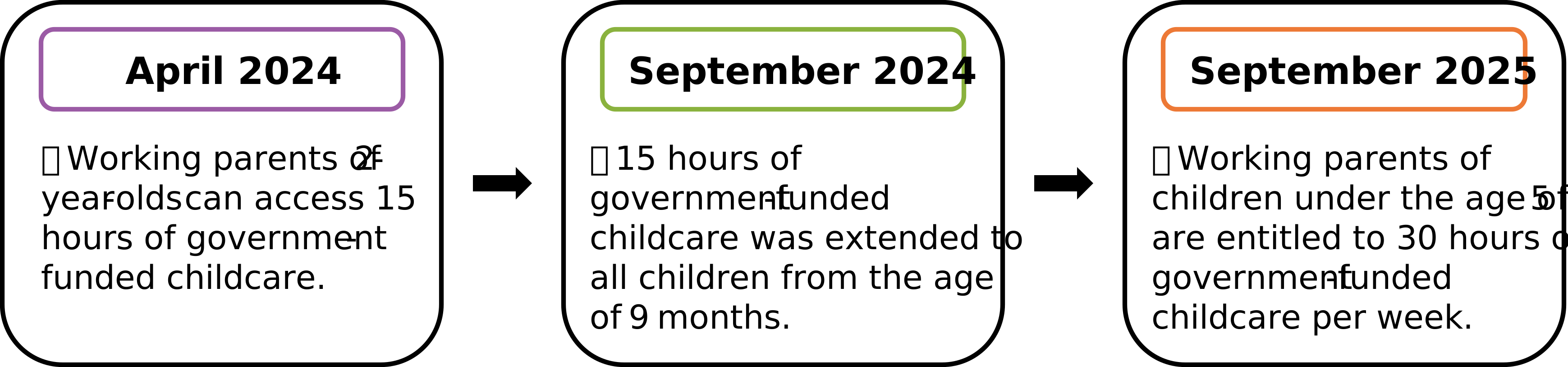
Figure 1 shows 3 boxes going from left to right across the screen. The box on the left is titled ‘April 2024’, the middle box ‘September 2024’ and the box on the right ‘September 2025’. Each box displays a description of the childcare entitlements which were rolled out at the corresponding time point. The box titled ‘April 2024’ reads ‘Working parents of two-year-olds can access 15 hours of government-funded childcare’, the box titled ‘September 2024’ reads ‘15 hours of government-funded childcare was extended to all children from the age of nine months’, and the box titled ‘September 2025’ contains the text ‘Working parents of children under the age of five are entitled to 30 hours of government-funded childcare per week’.
Accessible local childcare enables parents and carers to take up employment. We previously published work that measured childcare accessibility at a neighbourhood level and highlighted areas where it was low, and could make it difficult for parents to return to work.[footnote 2] We found that, in areas with lower levels of access to childcare, people were generally more likely to have lower disposable household incomes, and a higher proportion of children were likely to live in poverty.
Our work also showed that average access to childcare in England has declined in recent years, but the decline has not been evenly spread. Some areas have faced low access to childcare over time; we termed these areas ‘childcare deserts’. Conversely, other areas have benefited from consistently high access to childcare; we called these areas ‘childcare oases’.
School-based nurseries do not have to register with Ofsted if they meet certain legal exemptions, for example being on the school site and run by the school, and offering places for children over the age of 2. In total, school-based nurseries account for 23% of all childcare places.[footnote 3] We did not include these in our previous analysis because some are exempt from registering with Ofsted.[footnote 4] Places in these settings are also recorded differently, and we do not hold this information. Headcounts are reported on the annual school census, whereas places for Ofsted-registered providers are collected at registration and updated at inspection.
To better understand the early years sector, we have worked with the Department for Education (DfE) to establish a methodology for measuring childcare accessibility that accounts for both Ofsted-registered provision and school-based nurseries. This uses data from provider surveys to give an estimate for the proportion of Ofsted-registered places taken by children aged 0 to 4 years and combines the estimated figure with headcounts in school-based nurseries. We have converted the number of childcare places to a measure of the hours available per child per week to give us a more compatible combination of places. You can read more about this in our methodology report.
Due to the change in methodology, the childcare accessibility scores in this analysis cannot be compared with those from our previous analysis.
Childcare accessibility, including both Ofsted-registered provision and school-based nurseries
On average, parents and carers can access around 12 hours of childcare per child each week, but availability varies significantly across the country.
The proportion of childcare accessibility from school-based nurseries is higher in the most deprived communities than it is in more advantaged areas.
Average childcare accessibility in England is 12 hours per child per week. But in some neighbourhoods, parents can access less than an hour of childcare per child per week, and in others they can access 73 hours.[footnote 5] The large disparity in accessibility means some parents and carers have flexibility in choosing childcare, whereas others face longer journeys to providers, and competition for places.
At a regional level, accessibility is highest in London and lowest in the West Midlands (an average of 13 and 11 hours per child per week respectively). Outside London, accessibility is highest in the North West. It is most variable in the South East, and least variable in London.
Figure 2: Childcare accessibility, including Ofsted-registered provision and school-based nurseries, by region, 31 August 2025
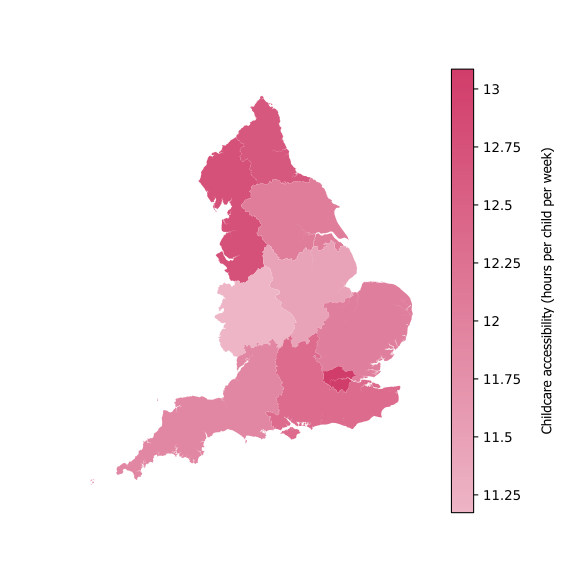
See data in an accessible table.
Childcare accessibility at a local authority level, including both Ofsted-registered provision and school-based nurseries, mirrors what we have seen in our previous analysis. Nearly all the local authorities (9 out of 10) with the highest accessibility have higher than average disposable household income per head. In contrast, but similar to our previous analysis, nearly all local authorities (9 out of 10) with the lowest accessibility have lower than average disposable household income per head. Unlike our previous analysis, none of the 10 areas with the lowest accessibility are in the lowest 10% of local authorities for disposable household income.
How does including school-based nurseries change childcare accessibility?
Including school-based nurseries in the analysis, rather than measuring Ofsted-registered provision only, does not change the relative ranking of accessibility across all areas. However, some areas have large differences in how their accessibility compares. This is most notable in the North East. This region has the lowest level of childcare accessibility when we measure only Ofsted-registered provision. When we include school-based nurseries, it has the third highest access to childcare. [footnote 6]
At the local authority level, the addition of school-based nurseries changes access to childcare substantially in some places. This is most evident in Hartlepool, where, if we measure Ofsted-registered provision alone, childcare accessibility ranks in the bottom 5% of local authorities. However, including school-based nurseries improves relative access, elevating the area into the top 25% of local authorities.
In some areas, the level of relative childcare accessibility falls when school-based nurseries are included. The areas with the largest decrease are Leicestershire and the Isle of Wight – both going from the top 30% of areas to the bottom 20%.
Figure 3: Top 10 local authorities with the largest increases in relative access to childcare when school-based nurseries are included, 31 August 2025 [footnote 7]

See data in an accessible table.
Figure 4: Top 10 local authorities with the largest decreases in relative access to childcare when school-based nurseries are included, 31 August 2025 [footnote 7]

See data in an accessible table.
The proportion of childcare accessibility provided by school-based settings is higher in more deprived areas than in more advantaged communities.[footnote 8] This proportion rises with increasing levels of deprivation. In the 10% most deprived areas, school-based provision accounts for an average of 35% of childcare accessibility, compared with just 16% in the 10% least deprived areas. This finding aligns with DfE’s guidance on school-based nurseries, which states that this type of provision is more common in deprived areas.[footnote 9] In addition, schools can find that having a nursery on site helps them to support disadvantaged children and to identify children with special educational needs and/or disabilities earlier.
Figure 5. Percentage of childcare accessibility from school-based provision by Index of Multiple Deprivation decile [footnote 8]

See data in an accessible table.
High and low childcare accessibility clusters
17% of England is made up of low accessibility clusters and 14% high accessibility clusters.[footnote 10]
The West Midlands has the highest proportion of local areas that are low accessibility clusters and London has the highest proportion of high accessibility clusters.
Local indicators of spatial association (LISA) is an analytical technique that gives us a better understanding of the geographical pattern within a dataset.[footnote 11] It compares a local area to other areas nearby and determines whether there is significant clustering of an attribute. When applied to childcare, the method allows us to see where high and low accessibility clusters are located in England. We can also identify neighbourhoods that are outliers. These exist where local residents have either low or high levels of access to childcare, but surrounding neighbourhoods have high or low access, respectively (referred to as low-high and high-low outliers).
We have completed this analysis using middle layer super output areas (MSOAs). Each MSOA contains between 2,000 and 6,000 households. They usually have a resident population of between 5,000 and 15,000 and up to 1,800 children aged 0 to 4.[footnote 12]
Nationally, 17% of MSOAs can be defined as low accessibility clusters. Parents and carers in these areas may have limited options when accessing early education and childcare. They will also be up against higher competition for places, likely resulting in having to travel further or make additional sacrifices. Conversely, 14% of MSOAs are classified as high accessibility clusters. Families in these areas will benefit from a greater choice of providers and will generally face fewer barriers to access. Approximately two thirds of MSOAs show no significant pattern of geographical clustering.
The remaining MSOAs are the outliers and are over-represented in rural areas. Of the low accessibility areas surrounded by high accessibility areas, 39% are rural. Of the high accessibility areas surrounded by low accessibility areas, 35% are rural. These are both higher than the proportionate representation of 16%. The existence of high-low outliers suggests that some areas have high accessibility despite being surrounded by poorly served neighbourhoods. This is perhaps due to specific local factors, such as the presence of a large primary school with nursery provision or long-standing establishment of registered childcare provision.
Figure 6: Geographical clustering of childcare accessibility by region
The 9 images in Figure 6 show the geographical clustering of childcare accessibility by region.
See Table 1 for the percentage of MSOAs that are high or low accessibility clusters by region, and the ODS file Data: Childcare accessibility including school-based nurseries for the underlying accessibility data used to calculate the clusters.
North West

North East

Yorkshire and The Humber

East Midlands

West Midlands

East of England

London

South East

South West

The concentration of low accessibility clusters varies across regions. The West Midlands has the highest proportion of its MSOAs that are categorised as low accessibility clusters, while London has the highest proportion of its MSOAs that are high accessibility clusters (36% and 37% respectively).
Table 1: Percentage of MSOAs that are high or low accessibility clusters by region
| Region | Percentage of MSOAs that are high accessibility clusters | Percentage of MSOAs that are low accessibility clusters |
|---|---|---|
| All England | 14 | 17 |
| North West | 15 | 5 |
| North East | 13 | 4 |
| Yorkshire and The Humber | 8 | 11 |
| East Midlands | 4 | 26 |
| West Midlands | 4 | 36 |
| East of England | 13 | 25 |
| London | 37 | 12 |
| South East | 15 | 19 |
| South West | 8 | 15 |
See Figure 6.
Characteristics of high and low accessibility clusters
A higher-than-average proportion of people in high accessibility clusters work full time. These areas also have higher economic performance than both the national average and low accessibility clusters.
Statistically, low accessibility clusters have a higher-than-average proportion of lone parent households where there is a dependent child aged 4 or under.
Urban and rural MSOAs are proportionally represented in the low accessibility clusters (83% and 17% respectively), which is in line with the whole of England (84% and 16% respectively). In contrast, rural areas are under-represented in high accessibility clusters, accounting for 7%. Urban areas correspondingly dominate high accessibility clusters, with 93% of these located in urban neighbourhoods. This pattern reflects the concentration of childcare provision in urban areas, where population density can be more attractive to prospective providers and transport connectivity makes multiple providers accessible. The under-representation of rural areas in high accessibility clusters indicates that families in these areas are likely to face challenges in accessing childcare.
Households in high accessibility clusters tend to have higher annual incomes than the national average, which may make childcare more affordable for some families in these areas. Areas in low accessibility clusters have significantly higher levels of deprivation compared with other areas. It is likely that families in these areas will not only face challenges with access to childcare, but also with affordability. However, the overall national relationship between deprivation and accessibility is weak, indicating that deprivation levels alone do not explain the geographic clustering of childcare accessibility.
A higher proportion of people living in high accessibility clusters work full time compared with the national average (36% and 33% respectively). Furthermore, MSOAs in high accessibility clusters have above average gross value added, while MSOAs in low accessibility clusters have below average (£190 million and £131 million respectively; the national median is £152 million).[footnote 13] This indicates that accessible childcare could contribute to an increase in the number of people entering the workforce and to better economic performance.
Compared with both high accessibility clusters and England as a whole, low accessibility clusters have a higher proportion of residents with no qualifications or whose highest level of qualification is level 2 or below. Conversely, a higher proportion of people whose highest qualification is level 4 or above live in high accessibility clusters than in the average local area in England (39% and 28% respectively).
Children aged 0 to 4 who grow up in couple family households are more likely to live in high accessibility clusters. Of all households in high accessibility clusters with a dependent child aged 4 or under, on average, 75% are couple family households. The average in low accessibility clusters is 68% and 71% nationally. MSOAs in low accessibility clusters have a statistically higher proportion of lone parent households than average in England (an average of 16% and 14% respectively of households with at least one child under 4).
Conclusion
Including school-based nurseries in childcare accessibility calculations changes the level of relative childcare accessibility in some areas. However, variation in accessibility remains, meaning parents and carers experience very different levels of access depending on where they live. Some parts of the country have significant levels of geographical clustering, leading to high and low accessibility clusters. These low accessibility clusters could be prioritised for interventions to improve access, either by increasing childcare provision or addressing socioeconomic factors where these differ from other areas.
Annex: data tables for figures
Data for Figure 2: Childcare accessibility, including Ofsted registered provision and school-based nurseries, by region, 31 August 2025
| Region | Childcare accessibility (hours per child per week) |
|---|---|
| All England | 12.2 |
| North West | 12.8 |
| North East | 12.6 |
| Yorkshire and The Humber | 12.1 |
| East Midlands | 11.5 |
| West Midlands | 11.2 |
| East of England | 12 |
| London | 13.1 |
| South East | 12.3 |
| South West | 11.9 |
See Figure 2.
Data for Figure 3: Top 10 local authorities with the largest increases in relative access to childcare when school-based nurseries are included, 31 August 2025
| Local authority | Accessibility ranking with Ofsted provision only | Accessibility ranking including both Ofsted-registered provision and school-based nurseries | Difference in rankings |
|---|---|---|---|
| Hartlepool | 3 | 116 | 113 |
| Redcar and Cleveland | 14 | 123 | 109 |
| Westmorland and Furness | 36 | 129 | 93 |
| Stockton-on-Tees | 25 | 105 | 80 |
| Middlesbrough | 4 | 79 | 75 |
| South Tyneside | 22 | 97 | 75 |
| North Tyneside | 60 | 120 | 60 |
| Sunderland | 2 | 62 | 60 |
| Northumberland | 63 | 121 | 58 |
| Cumberland | 15 | 64 | 49 |
See Figure 3.
Data for Figure 4: Top 10 local authorities with the largest decreases in relative access to childcare when school-based nurseries are included, 31 August 2025
| Local authority | Accessibility ranking with Ofsted provision only | Accessibility ranking including both Ofsted-registered provision and school-based nurseries | Difference in rankings |
|---|---|---|---|
| Leicestershire | 116 | 21 | -95 |
| Isle of Wight | 114 | 28 | -86 |
| Bournemouth, Christchurch and Poole | 112 | 32 | -80 |
| Gloucestershire | 115 | 38 | -77 |
| Kent | 81 | 13 | -68 |
| Peterborough | 93 | 25 | -68 |
| Portsmouth | 89 | 22 | -67 |
| West Sussex | 128 | 69 | -59 |
| Southampton | 100 | 46 | -54 |
| Staffordshire | 72 | 18 | -54 |
See Figure 4.
Data for Figure 5: Percentage of childcare accessibility from school-based nurseries by Index of Multiple Deprivation decile
| Index of Multiple Deprivation decile (where 1 is the most deprived 10% of LSOAs) | Percentage of childcare accessibility from school-based provision |
|---|---|
| 1 | 35 |
| 2 | 31 |
| 3 | 28 |
| 4 | 26 |
| 5 | 24 |
| 6 | 22 |
| 7 | 20 |
| 8 | 20 |
| 9 | 19 |
| 10 | 16 |
See Figure 5.
-
Budget 2023: Everything you need to know about childcare support, The Education Hub, Department for Education, 16 March 2023. ↩
-
Childcare accessibility by neighbourhood, England, Office for National Statistics, June 2024.
Changes in access to childcare in England, Ofsted, October 2024. ↩
-
Childcare and early years provider survey: reporting year 2025, Department for Education, December 2025. ↩
-
Registration exemptions, Ofsted, November 2024. ↩
-
This is at lower layer super output area level – see Census 2021 geographies, Office for National Statistics. Scenarios where a neighbourhood has a very high level of childcare accessibility arise when they have a provider with a large number of registered places close by, and where not many other neighbourhoods, or a low number of children aged 0 to 4, can access those places within our pre-defined travel catchments. ↩
-
When measuring access to Ofsted-registered places only, we use the same methodology of estimating the number of places taken by 0- to 4-year-olds. This should not be compared to our previous publications. ↩
-
City of London and Isles of Scilly have been removed from the analysis. ↩ ↩2
-
This proportion considers only the places in school-based nurseries for children aged 3 and 4 and not those aged 0 to 2. The places in school-based nurseries for children aged 0 to 2 are registered with Ofsted and cannot be separated from the overall measure of childcare accessibility. ↩ ↩2
-
Establishing school-based nursery provision, Department for Education, September 2025. ↩
-
High accessibility clusters are areas with high levels of access to childcare that are surrounded by other high accessibility areas. Low accessibility clusters are areas with low levels of access to childcare that are surrounded by other low accessibility areas. ↩
-
L Anselin, Local Indicators of Spatial Association—LISA, in Geographical Analysis, Volume 27(2), 1995, pages 93 to 115. ↩
-
Census 2021 geographies, Office for National Statistics. ↩
-
Gross value added is the value generated by any unit engaged in the production of goods and services. ↩