Country policy and information note: Kurds and Kurdish areas, Syria, November 2026 (accessible)
Updated 24 November 2026

© Crown copyright 2026
This publication is licensed under the terms of the Open Government Licence v3.0 except where otherwise stated. To view this licence, visit nationalarchives.gov.uk/doc/open-government-licence/version/3 or write to the Information Policy Team, The National Archives, Kew, London TW9 4DU, or email: psi@nationalarchives.gov.uk.
Where we have identified any third party copyright information you will need to obtain permission from the copyright holders concerned.
This publication is available at https://www.gov.uk/government/publications/syria-country-policy-and-information-notes/country-policy-and-information-note-kurds-and-kurdish-areas-syria-november-2026-accessible
Version 3.0, November 2026
Executive summary
Kurds are Syria’s largest non-Arab ethnic minority group, with an estimated population of 2 to 2.5 million. Kurdish communities are concentrated mainly in northern and eastern Syria, particularly in Afrin, Kobane and Al-Hasakah (Jazira). Significant Kurdish communities also live in parts of Aleppo and Damascus.
The 1962 Al-Hasakah census, also known as the exceptional census, classified many Kurds as Ajanib (‘foreigners’) or Maktoumeen (‘unregistered’), restricting their access to nationality, documentation and basic rights. Decree No. 13 of 2026 subsequently abolished measures arising from the census, recognised Kurdish cultural and linguistic rights, and established a route to Syrian nationality. By June 2026, stateless Kurds had submitted 2,892 family applications covering 10,516 people.
Kurds in Syria, including women and children, are unlikely to face a real risk of persecution or serious harm from either:
- the state,
- the Syrian Democratic Forces (SDF), including in relation to conscription by the SDF or connected actors; or
- the Syrian National Army (SNA).
Previously stateless and unregistered Kurds now have a route to obtain Syrian citizenship and, in general, are unlikely to face persecution or serious harm on account of their nationality status.
Although incidents of mistreatment and abuses have been reported, the evidence does not indicate that these are sufficiently serious, widespread or systematic to establish a generalised real risk of persecution or serious harm.
Where a person has a well-founded fear of persecution or serious harm from the state, they are unlikely to be able to obtain protection and are unlikely to be able to internally relocate to escape that risk.
Where the person has a well-founded fear of persecution or serious harm from a non-state or rogue state actor, they are unlikely to be able to obtain protection from the state but are likely to be able to internally relocate to escape that risk.
Where a claim is refused, it is unlikely to be certifiable as ‘clearly unfounded’ under section 94 of the Nationality, Immigration and Asylum Act 2002.
Each case must be considered on its individual facts. The onus is on the person to demonstrate they face persecution or serious harm.
Assessment
Section updated: 12 November 2026
About the assessment
This section considers relevant evidence – including country information, refugee and human rights law and policy, and case law – to assess whether, in general:
- a Kurdish person faces a real risk of persecution or serious harm by state or non-state actors because of their Kurdish ethnicity,
- the state (or quasi state bodies) can provide effective protection,
- internal relocation is possible to avoid persecution or serious harm,
- if refused, a claim is likely or not to be certified as ‘clearly unfounded’ under section 94 of the Nationality, Immigration and Asylum Act 2002.
Each case must be considered on its individual facts.
Sources cited in the country information may refer interchangeably to Hayat Tahrir Al-Sham (HTS), or the interim or de facto government or authorities. Within this assessment, we use the (new) Syrian government and, since 8 December 2024 they are considered the controlling party of the state or a substantial part of the territory of the State (for the purposes of Article 1(A)(2) of the Refugee Convention).
For details on how CPIT makes its assessments, gathers and presents country information, its research methodology and disclaimers and explainers on coverage, source selection, maps, translations and the use of Artificial Intelligence (AI) in developing CPIT products, see About country policy and information notes.
1. Material facts, credibility and other checks
1.1.1 Decision makers must:
- assess credibility (see the Asylum Instruction on Assessing Credibility and Refugee Status).
- check if there has been a previous application for a UK visa or another form of leave. Asylum applications matched to visas should be investigated prior to the asylum interview (see the Asylum Instruction on Visa Matches, Asylum Claims from UK Visa Applicants).
- consider making an international biometric data-sharing check, when one has not already been undertaken (see Biometric data-sharing process (Migration 5 biometric data-sharing process)).
- consider language analysis testing, where available, in cases where there are doubts surrounding a person’s claimed place of origin (see the Asylum Instruction on Language Analysis).
Official – sensitive: Not for disclosure – Start of section
The information in this section has been removed as it is restricted for internal Home Office use.
Official – sensitive: Not for disclosure – End of section
2. Exclusion
2.1.1 Decision makers must consider whether there are serious reasons to apply one (or more) of the exclusion clauses. Each case must be considered on its individual facts.
2.1.2 If the person is excluded from the Refugee Convention, they will also be excluded from a grant of humanitarian protection, which has a wider range of exclusions than refugee status.
2.1.3 For guidance on exclusion and restricted leave, see the Asylum Instruction on Exclusion under Articles 1F and 33(2) of the Refugee Convention, Humanitarian Protection and the instruction on Restricted Leave.
Official – sensitive: Not for disclosure – Start of section
The information in this section has been removed as it is restricted for internal Home Office use.
Official – sensitive: Not for disclosure – End of section
3. Convention reason(s)
3.1.1 Actual or imputed political opinion and/or race.
3.1.2 In general, people who evade, or desert from, military service do not fall within one of the 5 Refugee Convention grounds, including particular social group (PSG). This is because they:
- do not share an innate characteristic, or a common background that cannot be changed, or share a characteristic or belief that is so fundamental to identity or conscience that a person should not be forced to renounce it – and,
- do not have a distinct identity which is perceived as being different by the surrounding society.
3.1.3 Some people may claim that refusing to do military service, including as a conscientious objector, will be perceived by the state as an act of political opposition. The Asylum Instruction on Military Service and Conscientious Objection and paragraph 22 of the House of Lords judgement in the case of Sepet & Another v. SSHD [2003] UKHL 15 explain that it is necessary to carefully examine the reason in the mind of the persecutor rather than the reason which the victim believes is why they are being persecuted.
3.1.4 Establishing a convention reason is not sufficient to be recognised as a refugee. The question is whether the person has a well-founded fear of persecution on account of an actual or imputed Refugee Convention reason.
3.1.5 In the absence of a link to one of the 5 Refugee Convention reasons necessary for the grant of asylum, the question is whether the person will face a real risk of serious harm to qualify for Humanitarian Protection (HP).
3.1.6 For further guidance on the 5 Refugee Convention grounds, see the Asylum Instruction, Assessing Credibility and Refugee Status.
4. Risk
4.1 Risk from the state
4.1.1 Kurds in Syria are unlikely to face a real risk of persecution or serious harm from the state solely because of their ethnicity. The onus is on the person to demonstrate otherwise.
4.1.2 Previously stateless and unregistered Kurds now have a route to obtain Syrian citizenship and, in general, are unlikely to face persecution or serious harm on account of their nationality status. The onus is on the person to demonstrate otherwise.
4.1.3 Kurds are Syria’s largest non-Arab ethnic group, accounting for up to 10% of its pre-war population of 23 million. The current population is difficult to determine due to conflict-related displacement and a lack of reliable demographic data. Kurdish communities are concentrated mainly in northern and eastern Syria, particularly in Afrin, Kobane and Al-Hasakah (Jazira). Significant Kurdish communities also live in parts of Aleppo, including Sheikh Maqsoud, and Damascus, including Rukn al-Din. The majority of Kurds in Syria are Sunni Muslims and primarily speak the Kurmanji dialect of Kurdish, although most also speak Arabic. Many Kurds have assimilated into Arab society and, in long-established Kurdish-majority neighbourhoods, may not be readily identifiable by their ethnicity (see Kurds in Syria - Background, Number of Kurds in Syria and Location of Kurds in Syria).
4.1.4 The 1962 Al-Hasakah census, also known as the exceptional census, contributed to multigenerational statelessness among Syrian Kurds. Its arbitrary implementation sometimes resulted in members of the same family holding different citizenship statuses, with some retaining Syrian citizenship and others classified as Ajanib (‘foreigners’) or Maktoumeen (‘unregistered’). According to one source, the Civil Registry Directorate of Al-Hasakah stated that by 2011 there were an estimated 346,242 Ajanib and 171,300 Maktoumeen (see Stateless Kurds - Background, Ajanib Kurds, Maktoumeen Kurds).
4.1.5 Under the Assad government, stateless Kurds faced restrictions on their civil, political and socioeconomic rights, including in relation to property ownership, employment, education, healthcare, marriage and freedom of movement. Following the fall of the Assad government, the new Syrian authorities sought to reassure Kurds that they would not face discrimination and subsequently took steps towards integrating the Kurdish community and addressing longstanding restrictions on their rights (see State Treatment).
4.1.6 Decree No. 13 of 2026 was issued by President Ahmed Al-Sharaa in January 2026. The decree formally expanded the rights of Kurds in Syria, recognising Kurdish identity and language and providing for cultural and linguistic rights, including the teaching of Kurdish in schools and the designation of Nowruz (Kurdish new year) as an official holiday. It additionally abolished measures arising from the 1962 Al-Hasakah census and provides for Syrian nationality to be granted to Kurds residing in Syria, including those previously unregistered. In February 2026, the Ministry of Interior issued Decision No. 144/M to implement Decree No.13 of 2026, establishing the application procedures for granting Syrian citizenship to eligible Kurds, with provisions allowing family members to submit applications on behalf of those living abroad. Applicants who were abroad at the time of application would be required to attend an interview in Damascus upon returning to Syria. As of June 2026, 2,892 family applications, covering 10,516 individuals, had been submitted. Applications remained under assessment as of July 2026, with the issuing of documents expected to take several months. At the time of writing, CPIT was unable to identify figures regarding successful citizenship applications within the sources consulted (see also Stateless Kurds – Background, Decree No. 13 of 2026 and Decision No. 144/M of 2026 and Bibliography).
4.1.7 The 10 March 2025 agreement between the government and the Syrian Democratic Forces (SDF) provided for the integration of civilian and military institutions in northeast Syria into state structures and committed to guaranteeing the Kurdish community constitutional rights. Following delays and armed clashes between state forces and the SDF, SDF leader General Mazloum Abdi announced in August 2026 that the integration of the Democratic Autonomous Administration of North and East Syria (DAANES) and its security forces into state institutions was complete. SDF leaders were subsequently appointed to senior positions in the Syrian government and the state security apparatus. However, arrangements for the Women’s Protection Units (YPJ) remained unresolved in September 2026 (see State Treatment, Integration of the SDF into Syrian state apparatus).
4.1.8 Prior to the August 2026 announcement, sources reported incidents of mistreatment, arrest, detention and torture, particularly of Kurds perceived to have links to the SDF or travelling from Kurdish-controlled areas. Following the government takeover of Ashrafiyeh and Sheikh Maqsoud in Aleppo in January 2026, over 300 Kurds were reportedly arrested. Authorities stated that those detained were fighters, while some sources reported they were civilians. Nevertheless, available evidence indicates that in general, Kurds in government-controlled areas live without significant restrictions, harassment, discrimination or mistreatment by the Syrian state (see State treatment).
4.1.9 At the time of writing, relatively little time has passed since the integration of the SDF into Syrian state institutions was completed. CPIT found no information in the sources consulted indicating that Kurds, including those associated with the SDF, have experienced mistreatment since then (see Bibliography). However, given the limited period over which developments can be assessed, decision makers should consult the most up to date country information at the time of the decision.
4.1.10 Despite the incidents referred to above, the available evidence does not indicate that any mistreatment of Kurds by the Syrian government is sufficiently serious, widespread or systematic to establish a generalised real risk of persecution or serious harm. The onus is on the person to demonstrate otherwise.
4.1.11 For further guidance on assessing risk, see the Asylum Instruction on Assessing Credibility and Refugee Status.
4.2 Risk from non-state actors: Syrian Democratic Forces and connected actors
4.2.1 Kurds in Syria are unlikely to face a real risk of persecution or serious harm from the Syrian Democratic Forces (SDF). The onus is on the person to demonstrate otherwise.
4.2.2 For historic information on the SDF’s formation, purpose, composition, leadership and organisational structure, military strength and areas of control, see the relevant country of origin information in the CPIN Syria: Kurds and Kurdish areas, published in December 2025.
4.2.3 In March 2025, the SDF agreed to integrate all military and civilian institutions into the Syrian state apparatus. Throughout the remainder of 2025, the initial phase of implementation was marked by several challenges, many of which stemmed from ongoing Kurdish demands for greater autonomy and disagreements over the terms of the March 2025 integration agreement. Following a December 2025 deadline for SDF integration, fighting between the government and SDF-linked forces escalated in January 2026, resulting in government forces taking control of former SDF-held areas. Ceasefires were agreed from 18 January 2026, followed by a 30 January 2026 agreement providing for a full ceasefire and the phased integration of the SDF into Syrian state structures. On 20 August 2026, Mazloum Abdi, leader of the SDF, said the integration of Kurdish military and administrative institutions into the Syrian state was complete. On 25 August 2026, Abdi announced the SDF’s dissolution and the end of its independent operations (see Integration of the SDF into Syrian state apparatus, Delays in implementation, January 2026 Syrian government offensive against the SDF, Completion of the SDF’s integration into Syrian state apparatus).
4.2.4 In a report published in March 2026, covering events between 8 December 2024 and 31 January 2026, the UN Human Rights Council’s Independent International Commission of Inquiry on the Syrian Arab Republic documented reports of arbitrary and incommunicado detention by the SDF, including of people who celebrated the change in government, as well as enforced disappearances and deaths in custody. Some deaths were reportedly linked to torture or a lack of medical treatment, while families were in some cases unable to establish the fate or whereabouts of detainees. In January 2026, following the government takeover of former SDF-controlled areas, 126 children were reportedly released from Aqtan prison, while the Ministry of Justice subsequently began reviewing detainee cases to distinguish between political detainees, common criminals and Da’esh members (see Treatment by the SDF (including conscription)).
4.2.5 At the time of writing, relatively little time has passed since the announcement of the integration of the SDF into Syrian state institutions. Available information does not indicate that integrated SDF security personnel have been involved in violations against Kurds following the dissolution of the SDF. Additionally, a Syrian human rights organisation consulted by the Danish Immigration Service for a report covering events between 1 January 2026 and 31 May 2026 stated that they were unaware of any ordinary Syrian citizens being targeted by the SDF upon returning to Syria because of previous conflict with the group (see Treatment by the SDF (including conscription)).
4.2.6 The available evidence does not indicate that the treatment of Kurds by the now-dissolved SDF is sufficiently serious, widespread or systematic to establish a generalised real risk of persecution or serious harm. The onus is on the person to demonstrate otherwise.
4.2.7 For further guidance on assessing risk, see the Asylum Instruction on Assessing Credibility and Refugee Status.
4.3 Risk from non-state actors: Conscription by the SDF and connected actors
4.3.1 Kurds, including women and children, in Syria are unlikely to face a real risk of persecution or serious harm based on conscription by the SDF or connected actors. The onus is on the person to demonstrate otherwise.
4.3.2 For historic information on military recruitment in DAANES-controlled areas, including the Mandatory Self-Defence Duty, eligibility, length of service, exemptions and deferments, recruitment practices, draft evasion and desertion, penalties and treatment of evaders and deserters, and the role of Self-Defence Force conscripts, see the relevant country of origin information in the December 2025 CPIN Syria: Kurds and Kurdish areas.
4.3.3 The Mandatory Self-Defence Duty was a system of compulsory military service for eligible men in DAANES-controlled areas. Conscripts served for one year in the Self-Defence Forces (HXP). The evidence indicates that although the Mandatory Self-Defence Duty law has not been formally abolished, it has ceased to be enforced in practice. Following the January 2026 fighting and subsequent agreement between the SDF and Syrian government, as of July 2026, no new recruitment to the HXP had been reported, including in areas where the SDF retained a presence. Sources also indicate those previously serving under the duty have generally been demobilised or required to undergo reconciliation with the Syrian authorities. This reconciliation process involved the surrender of identification documents and equipment, including weapons, issued by the DAANES and/or the SDF. A Dutch journalist and analyst specialising in Kurdish affairs was unaware of any cases in which returnees who had evaded conscription were arrested or imprisoned on return to SDF-controlled areas prior to the SDF’s integration into Syrian state institutions (see Conscription).
4.3.4 Available evidence indicates that child recruitment by the SDF and associated groups has declined following the January 2026 agreements and the transfer of former SDF-held areas to government control. Although child recruitment was expected to have ceased in areas transferred to government control, reports indicate that the Revolutionary Youth Movement (RYM), a youth group ideologically aligned with the Kurdistan Workers’ Party (PKK), remained active in some Kurdish-influenced areas and continued to recruit some children, including through reported instances of forced recruitment. However, available evidence suggests that such recruitment was limited in scale and had declined compared with previous years (see Use of child soldiers).
4.3.5 Although the Mandatory Self-Defence Duty has not been formally abolished, it has ceased to be enforced in practice since January 2026. The available evidence therefore does not indicate a real risk of conscription by the SDF or connected actors. The onus is on the person to demonstrate otherwise.
4.3.6 Despite isolated reports of child recruitment by the RYM, the evidence does not indicate a generalised real risk of child recruitment by the SDF or connected actors. The onus is on the person to demonstrate otherwise.
4.3.7 For information regarding military service by the Syrian state, see the CPIN Syria: Military service.
4.3.8 For further guidance on assessing risk, see the Asylum Instruction on Assessing Credibility and Refugee Status.
4.4 Risk from non-state actors: Syrian National Army (SNA)
4.4.1 Kurds in Syria, in general, are unlikely to face a real risk of persecution or serious harm from the Syrian National Army (SNA). The onus is on the person to demonstrate otherwise.
4.4.2 For historic information on the SNA’s formation, composition and organisational structure, military strength, key factions, relationship with and support from Turkey, operations against the SDF and areas of control, see the relevant country of origin information in the CPIN Syria: Kurds and Kurdish areas, published in December 2025.
4.4.3 The SNA and its constituent factions were formally dissolved in January 2025 and subsequently incorporated into the Syrian armed forces, with former factions reorganised into new army divisions and some redeployed away from areas they previously controlled. Although the SNA no longer exists as a distinct, coherent organisation and its visible presence has substantially reduced, available evidence indicates that integration remains incomplete, with some former factions retaining their own commanders and networks and operating with a degree of autonomy. The government has also reportedly exercised limited control over some former SNA units, some of which have subsequently been implicated in abuses or mistreatment. Reports published in July 2026 indicated that abuses by SNA factions in Afrin had decreased only slightly since the Syrian government entered the area in 2025. Former SNA factions were reportedly responsible for looting olive harvests, occupying or seizing Kurdish-owned property and demanding payments from Kurdish returnees seeking to reclaim their homes or land. Former SNA fighters were also reportedly involved in the mistreatment of detained SDF members during the January 2026 Syrian government offensive against the SDF (see Integration of the SNA into Syrian state apparatus and Treatment by the SNA).
4.4.4 In general, Kurds are not at real risk of persecution or serious harm from former SNA factions solely because of their ethnicity. Although there are reports of looting and the occupation or seizure of Kurdish-owned property, such treatment would not, in itself, generally amount to persecution or serious harm. The onus is on the person to demonstrate that they would face a real risk of persecution or serious harm and that they could not reasonably relocate to another part of Syria to avoid that risk.
4.4.5 For further guidance on assessing risk, see the Asylum Instruction on Assessing Credibility and Refugee Status.
5. Protection
5.1.1 Where the person has a well-founded fear of persecution or serious harm from the state, they are unlikely to be able to obtain protection.
5.1.2 Where the person has a well-founded fear of persecution or serious harm from non-state or rogue state actors, they are unlikely to be able to obtain protection from the state.
5.1.3 For further guidance on assessing state protection, see the Asylum Instruction on Assessing Credibility and Refugee Status.
6.1.1 Internal relocation
6.1.1 In general, a person with a well-founded fear of persecution or serious harm from the state is unlikely to be able to internally relocate to escape that risk.
6.1.2 In general, a person with a well-founded fear of persecution or serious harm from a non-state or rogue state actor is likely to be able to internally relocate to escape that risk.
6.1.3 This is because in general, there are parts of Syria, such as Damascus and Aleppo, where it will be reasonable to expect Kurds to relocate to. See the CPIN Syria: Internal relocation for more information.
6.1.4 For further guidance on internal relocation and factors to consider, see the Asylum Instruction on Assessing Credibility and Refugee Status.
7. Certification
7.1.1 Where a claim based on a fear of the state is refused, it is unlikely to be certifiable as ‘clearly unfounded’ under section 94 of the Nationality, Immigration and Asylum Act 2002.
7.1.2 Where a claim based on a fear of non-state actors or rogue-state actors is refused, it is unlikely to be certifiable as ‘clearly unfounded’ under section 94 of the Nationality, Immigration and Asylum Act 2002.
7.1.3 Each case must be considered on its individual facts.
7.1.4 For further guidance on certification, see Certification of Protection and Human Rights claims under section 94 of the Nationality, Immigration and Asylum Act 2002 (clearly unfounded claims).
Country information
The COI provides the basis for the assessment and the executive summary. Decision makers must use relevant COI as the evidential basis for decisions.
The cut-off date for COI included in this note is 30 September 2026.
Some country information quoted in this CPIN was published in languages other than English and has been translated using free online translation tools. Sources originally published in other languages are clearly signposted throughout.
For details on how CPIT gathers and presents country information, its research methodology and disclaimers and explainers on coverage, source selection, maps, translations and the use of Artificial Intelligence (AI) in developing CPIT products, see About country policy and information notes.
8. Kurds in Syria
8.1 Background
8.1.1 In January 2026, Qatar-based independent news organisation Al Jazeera[footnote 1], reported that ‘The Kurds are a group of people indigenous to the Mesopotamian plains and nearby highlands, which today stretch across southeastern Türkiye, northeastern Syria, northern Iraq, northwestern Iran and southwestern Armenia. The Kurdish population is concentrated in these areas, which are collectively referred to as Kurdistan.’[footnote 2]
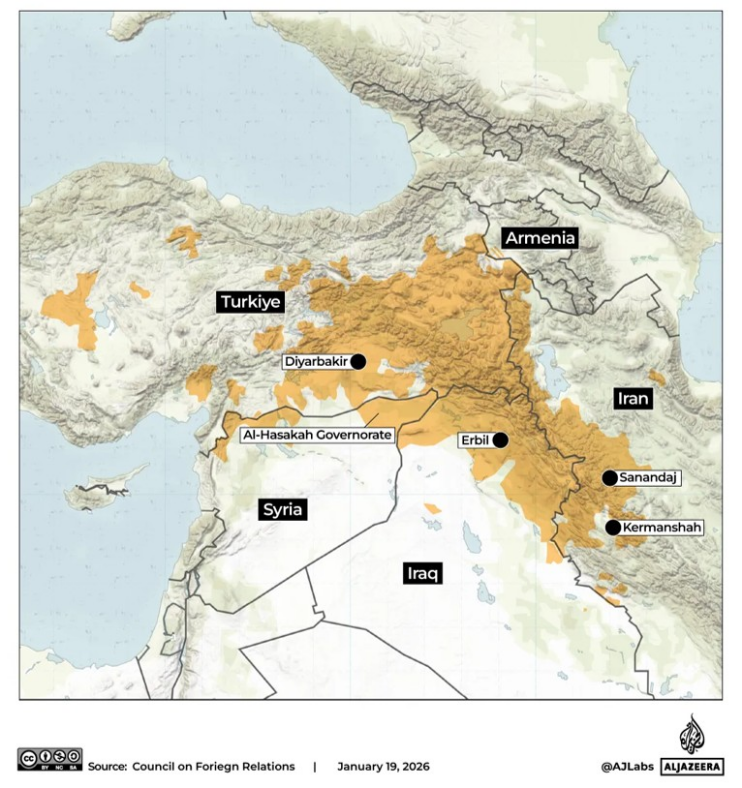
8.1.2 The below map was also published by Al Jazeera, using data sourced from the Council on Foreign Relations, an independent, nonpartisan US think tank and publisher.[footnote 3] It shows the main areas of Kurdish settlement in the Middle East, noting that ‘an estimated 30-40 million Kurds live mainly in Türkiye, Iraq, Iran and Syria, with many seeking independent states or autonomous regions for self-governance.’[footnote 4]
8.1.3 A December 2023 article written by a Kurdish journalist and published in New Lines Magazine, a US global affairs online magazine[footnote 5], stated:
‘The Kurdish people, estimated at 45 million by the Kurdish Institute of Paris, have never recognized what they consider the artificial boundaries that divide them across four nation-states – Syria, Iraq, Iran and Turkey – and have struggled to form an independent state of their own since the Sykes-Picot Agreement in 1916.
‘Under this agreement, western Kurdistan was definitively separated from northern Kurdistan and became part of the newly formed state of Syria. These changes made Kurds in Syria the largest non-Arab ethnicity.’[footnote 6]
8.1.4 Encyclopaedia Britannica’s entry entitled Kurds, updated in August 2026, further stated that ‘The Treaty of Sèvres, drawn up in 1920, provided for an autonomous Kurdistan but was never ratified; the Treaty of Lausanne (1923), which replaced the Treaty of Sèvres, made no mention of Kurdistan or the Kurds. Thus … Kurdistan after the war was more fragmented than before, and various separatist movements arose among Kurdish groups.’[footnote 7]
8.1.5 The same source stated that:
‘The traditional Kurdish way of life was nomadic, revolving around sheep and goat herding throughout the … highlands of Turkey and Iran … The enforcement of national boundaries beginning after World War I (1914–18) impeded the seasonal migrations of the flocks, forcing most of the Kurds to abandon their traditional ways for village life and settled farming; others entered nontraditional employment …
‘Most Kurds are Sunni Muslims, and among them are many who practice Sufism and other mystical sects.’[footnote 8]
8.1.6 The January 2026 Al Jazeera article stated ‘Kurdish, a northwestern Iranian language, has several distinct dialects that vary by region … While most Kurds are Sunni Muslims, there are also Kurdish communities that follow Shia Islam, Alevism, Yazidism, Christianity and other faiths.’[footnote 9]
8.1.7 Minority Rights Group (MRG)’s profile on Kurds in Syria, last updated in 2018, stated that Syria’s Kurds ‘ … speak Kurdish (the Kirimanji [Kurmanji] dialect), but most speak Arabic, too, and many Kurds have at least partially assimilated into Arab society.’[footnote 10]
8.1.8 On 13 December 2024, Deutsche Welle stated:
‘The Kurdish people are often described as one of the biggest ethnic groups in the world without a country of their own. If they did have a country, it would lie in the Kurdish-majority areas where Iraq, Iran, Syria and Turkey meet.
‘There is a Kurdish independence movement in each of those countries, whose members have lobbied and even fought for an independent state or Kurdish autonomy, with varying degrees of success. Kurdish independence movements in each of the countries have also been repressed by their respective governments — also with varying degrees of success. In Turkey, the Kurdistan Workers’ Party or PKK, turned to violence to try to achieve their aims.
‘In Syria, near the start of the civil war, around 2012, the forces of now-deposed dictator Assad, withdrew from Kurdish-majority areas in northeastern and eastern Syria without much of a fight …
‘Syrian Arab revolutionaries said they didn’t want the Kurds to be independent from Syria and that the country should remain united. There was also scurrilous talk about whether … in a bid to pursue their own goal of Kurdish independence, the Kurds would maintain neutrality in the civil war. The Kurds never really fought against Assad’s forces, and this alleged “betrayal” caused antipathy between Syrian Arabs and Syrian Kurds …
‘During the 13-year civil war, the US got involved with Syria’s Kurds, allying with them to combat the extremist group known as the “Islamic State” (IS) …
‘while fighting against the IS group, Syrian Kurds also expanded the terrain under their control, including Arab-majority areas like Raqqa and Deir al-Zour.’[footnote 11]
8.1.9 For further information on the history of the Kurdish people, see:
- BBC, Who are the Kurds?, 15 October 2019
- Council on Foreign Relations, The Kurds’ Long Struggle With Statelessness (1920-2022), no date
- Minority Rights Group, Kurds in Syria, updated March 2018
- Rojava Information Centre, Beyond the Frontlines: The building of the democratic system in North and East Syria, 19 December 2019
8.2 Number of Kurds in Syria
8.2.1 In an article published on 18 December 2024, Deutsche Welle reported that:
‘It is impossible to get accurate and current data on Syria’s varied population. This is due to a war that lasted over a decade and that observers believe may have ended with the recent toppling of the long-time dictator Assad after an offensive by the Islamist militia Hayat Tahrir al-Sham (HTS) …
‘[N]umbers … differ wildly according to the source. Syria’s Central Bureau of Statistics said 29.2 million people lived in the country as of December 10, 2019. The World Factbook produced by the CIA, the US’ foreign intelligence service, then estimates that by July 2021 around 20.4 million people were living in Syria. For its part, the World Bank put the population at around 23 million in 2023. Other estimates pin the number closer to 25 million.’[footnote 12]
8.2.2 Minority Rights Group’s profile on Kurds in Syria stated that ‘There are around 2.5 million Kurds in Syria.’[footnote 13]
8.2.3 The European Union Agency for Asylum (EUAA) noted in the report entitled ‘Syria: Country Focus’ (the July 2026 EUAA Country Focus report), published in July 2026 and citing various sources, that ‘Kurds constitute the largest ethnic minority in Syria, with an estimated population of 2 to 2.5 million, or up to 10% of the country’s pre-war population of 23 million.’[footnote 14]
8.3 Location of Kurds in Syria
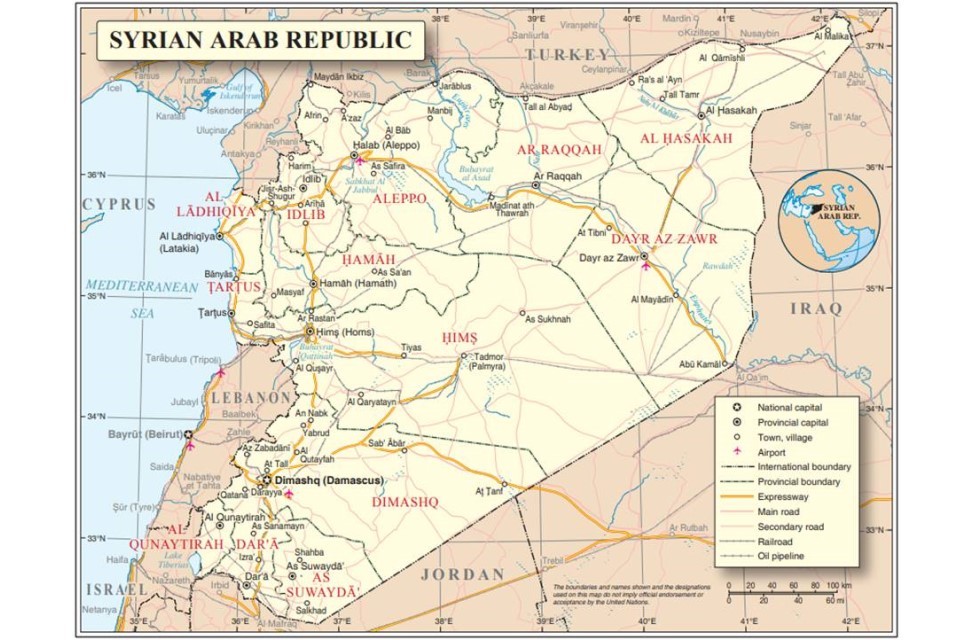
8.3.1 The UN shared the below map of Syria, dated August 2022, showing the main cities and governorates:[footnote 15]
Map of Syria
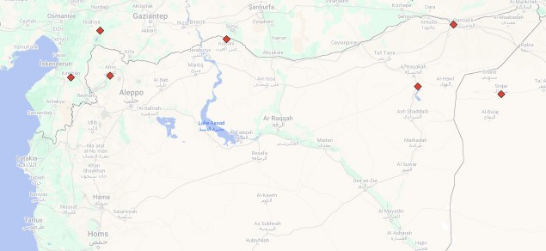
8.3.2 The Kurdish Project is a ‘nonprofit digital agency’ and ‘cultural-education initiative to raise awareness in Western culture of Kurdish people’.[footnote 16] It produced an interactive map, published in March 2018, which highlights cities that have historically been inhabited by large Kurdish populations. This map highlighted the main historical Kurdish areas in Syria as being Afrin, Kobane, Qamishli, and Al Hasakah, all located in the north and north-east of the country:[footnote 17]
8.3.3 The Kurdish Project stated on an undated webpage that ‘The Kurdish region of Syria is also known as Rojava. Rojava is broken into three cantons. Afrin Canton in the West, Kobane Canton in the center, and Cizre Canton in the East.’[footnote 18]
8.3.4 The Rojava Information Centre (RIC) is ‘an independent, volunteer-staffed [research and journalism] organisation based in Northeast Syria’.[footnote 19] In a July 2022 article entitled ‘The Rojava Revolution – A Decade On’, citing multiple sources, RIC stated:
‘The “Rojava Revolution” began … on July 19th 2012, when three predominantly Kurdish-inhabited areas of Syria declared their autonomy from the central government …
‘On March 17th 2016, an [Syrian Democratic Council] SDC assembly of Kurdish, Assyrian, Arab and Turkmen delegates proclaimed the establishment of a federal system of government as the “Democratic Federation of Rojava – Northern Syria”. In December 2016 … the name was changed once again to the “Democratic Federation of Northern Syria” – “Rojava” was officially dropped … ’[footnote 20]
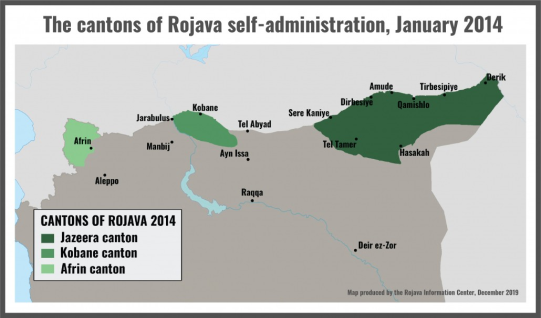
8.3.5 RIC published the below map of the Rojava, dated December 2019, showing the main cantons of then-named Rojava in 2014:[footnote 21]
8.3.6 The same source stated that:
‘As of September 6th 2018, the SDC adopted [an] … official name for the region, renaming it the “Autonomous Administration of North and East Syria” (AANES), sometimes translated as the “Self-Government of North and East Syria”. This encompasses the Euphrates (the former Kobane canton, including Tel Abyad, Sarrin, and Ayn Issa), and Cizîrê (Jazira) Regions, as well as the local civil councils of Raqqa, Manbij, Tabqa, and Deir ez-Zor Regions. The Afrin canton, on the other hand, remained under occupation by Turkish forces, though AANES institutions also exist in Shehba, southeast of Afrin, and in the majority-Kurdish neighborhoods of Sheikh Maqsoud and Ashrafiye in Aleppo … ’ [footnote 22]
8.3.7 In a May 2024 report, The Harmoon Center for Contemporary Studies, ‘an independent nonprofit research institution, focusing on the production of political, social and intellectual studies and research related particularly to the Syrian issue’,[footnote 23] stated:
‘Northern Syria is a mosaic of towns that are mainly Arab, towns that are mainly Kurdish, and everything in between. However, the majority are Arab … Syrian Kurds live mainly in three areas: Afrin, Kobani and Jezira near the Turkish border, and in quarters in Aleppo and Damascus … Syrian Kurds do not have one single geographically connected area that is mainly populated by Kurds. Various Syrian border areas in the north, formerly inhabited to a great extent by Kurds, have since the 1960s become more heavily populated by Arabs who have settled there as part of the Ba’thist policy to Arabize the northern Syrian border areas, the so-called “Arab belt” … ’[footnote 24]
8.3.8 Deutsche Welle’s article of 18 December 2024 stated that ‘The Kurdish-ruled Autonomous Administration of North and East Syria, also known as Rojava, is home to Syria’s largest minority, about 2.5 million Kurdish people. Some Kurds also live in and around Syria’s capital Damascus.’[footnote 25]
8.3.9 Private German foundation and think tank Bertelsmann Stiftung[footnote 26] , in its Transformation Index (BTI) 2026 report (the BTI 2026 report), published on 26 March 2026, stated that ‘The Kurdish areas of Syria, Hasakah and Qamishli, with the expanded control of the Kurdish-led Syrian Democratic Forces (SDF) over all areas east of the Euphrates, have been referring to themselves as the Democratic Autonomous Administration of North and East Syria (DAANES).’[footnote 27]
8.3.10 The July 2026 EUAA Country Focus report, citing multiple sources, noted:
‘Kurdish population is concentrated in the regions of Afrin, Kobane, and Jazira (Hasaka), neighbourhoods of Aleppo and Damascus cities, and, to a lesser extent, in several districts in Raqqa city. Kurds constitute approximately one third of the population in Damascus and are generally considered an integrated component of Syrian society. In long-established Kurdish-majority neighbourhoods of Damascus, such as Rukn al-Din and Wadi al-Mashari, Kurds reportedly do not visibly differ from other residents and are therefore not easily identifiable on the basis of ethnicity … ’ [footnote 28]
8.3.11 Middle East Eye (MEE), an independent digital news organisation[footnote 29], reported on 3 December 2024 that: ‘More than 100,000 Kurds live in the Aleppo neighbourhoods of Sheikh Maqsoud and Ashrafieh, with the towns of Tel Rifaat, Tel Aran and Tel Hassel also housing significant Kurdish communities.’[footnote 30]
8.3.12 For more information see Territorial Control.
9. Territorial control
9.1.1 In February 2026, the Institute for the Study of War (ISW), a non-partisan, non-profit organisation providing research and analysis on military affairs[footnote 31], published the below map, the most recent available at the time of writing, assessing the control of terrain in Syria.[footnote 32] It should be noted that this map was published prior to the Syrian Democratic Forces (SDF) being dissolved and merging with the Syrian military in August 2026[footnote 33] (see Integration of the SDF into Syrian state apparatus):
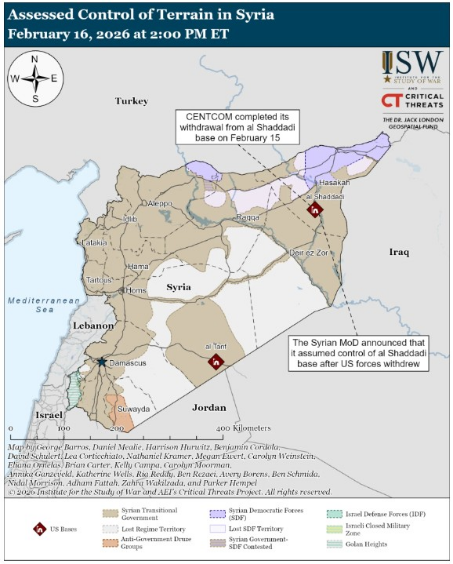
10. Syrian Democratic Forces (SDF) and connected actors
10.1.1 For information regarding the Syrian Democratic Forces (SDF) and connected actors, see section 10.1 of the CPIN Syria: Kurds and Kurdish areas, published in December 2025.
10.1.2 In March 2025, the SDF agreed to integrate all military and civilian institutions into the Syrian state.[footnote 34] Following delays in implementing the integration deal and armed clashes between the SDF and the Syrian army, a ceasefire was announced on 20 January 2026[footnote 35], before a new agreement was reached on 30 January 2026.[footnote 36] On 25 August 2026, SDF commander Mazloum Abdi announced the group’s dissolution following the completion of the merger with the Syrian military.[footnote 37]
10.1.3 For more information see Integration of the SDF into Syrian state apparatus.
11. Integration of the SDF into Syrian state apparatus
11.1 March 2025 Integration Agreement
11.1.1 Middle East Institute (MEI), a Washington D.C.-based non-partisan think tank[footnote 38], noted in an article dated 9 May 2025, that:
‘On March 10, 2025, Ahmed al-Sharaa, the president of Syria, and Mazloum Abdi, the commander-in-chief of the Syrian Democratic Forces (SDF), signed a historic agreement, ending a long-running divide between Damascus and the Democratic Autonomous Administration of North and East Syria (DAANES). The agreement stipulated the integration of SDF military and civilian structures into Syrian state institutions, constitutionally guaranteed rights for all groups, established a comprehensive cease-fire, and unified efforts to fight the remnants of Bashar al-Assad’s regime …
‘There were positive signs in the first weeks suggesting that both sides had begun to gradually implement some aspects of the deal … with both parties adhering to the agreed cease-fire, paving the way for confidence-building measures. The predominantly Kurdish neighborhoods of Sheikh Maqsoud and Ashrafieh in Aleppo, previously isolated and under the control of local SDF-affiliated forces, began to be reintegrated …
‘The joint central committees emerging from the March [2025] agreement have also begun their preparatory work, pending the formation of security and military committees to discuss how to integrate the SDF into the structure of the Syrian army and security services. Additionally, service committees are expected to be formed to manage local administrative affairs in the northeast.’[footnote 39]
11.1.2 On 1 April 2025, the ISW reported that the SDF:
‘… agreed to withdraw its forces and allow Syrian Interim Interior Ministry forces to deploy to Sheikh Maqsoud and Ashrafiyeh neighborhoods in Aleppo City on April 1 [2025] … The Syrian Interim Interior Ministry will take over security responsibilities in the two neighborhoods and set up two checkpoints in each neighborhood. Kurdish media reported that members of the SDF’s Internal Security Forces … from Sheikh Maqsoud and [al-] Ashrafiyeh will integrate into local police forces under the Interior Ministry …
‘The April 1 [2025] agreement allows Kurdish residents from Sheikh Maqsoud and Ashrafiyeh to move freely throughout Aleppo City and stipulates that Kurdish institutions cannot be discriminated against in municipal organizations.’[footnote 40]
11.1.3 On 4 April 2025, Rudaw, an Erbil-based independent media organisation[footnote 41], reported on the integration of the Kurdish neighbourhoods of Aleppo, stating that ‘The mukhtar (chieftan) of the Kurdish neighborhood, Bassam Ahmed, said that the agreement contributed to the return of normal life in the area.’[footnote 42]
11.1.4 A 10 April 2025 article in The National, an Abu Dhabi-based news agency[footnote 43], stated:
‘A Kurdish militia [the Kurdish People’s Protection Units (YPG)] withdrew another batch of fighters from northern parts of … Aleppo on Wednesday and Thursday [9 and 10 April 2025] …
‘HTS is seeking to disarm the country’s numerous factions and militias … by offering them a place in a new army and other security organisations …
‘A Kurdish administration official in Sheikh Maqsoud said he expected the YPG to complete the withdrawal of its 2,000 fighters from Aleppo in one week. He said three batches of fighters have left the city since last week …
‘But the Kurdish official told The National that YPG intelligence personnel, as well as a Kurdish police force called Al Ashayesh, would remain in Aleppo, especially in Sheikh Maqsoud and al-Ashrafiyeh. “The deal will be implemented, but slowly,” he said … ’ [footnote 44]
11.1.5 On 27 April 2025, Rudaw reported that:
‘The Damascus leadership on Sunday [27 April 2025] censured the Kurdish-led Syrian Democratic Forces’ (SDF) “calls for federalism,” saying they contradict the landmark agreement inked by Syria’s [then] interim President Ahmed al-Sharaa and SDF chief Mazloum Abdi in March [2025].
‘The Abdi-Sharaa agreement “marked a positive step towards de-escalation” and “a comprehensive national solution,” read a statement from the Syrian Presidency, adding, “However the latest maneuvers and statements by the SDF leadership, which call for federalism and entrench a separate reality on the ground, openly contradict the substance of the agreement and threaten the unity of the country and the integrity of its territory.” …
‘The Syrian leadership finally stressed that the SDF “cannot control the decision in northeast Syria [Rojava]” where “Arabs, Kurds, Christians and others coexist,” and urged the Kurdish-led force to “truly uphold” the Sharaa-Abdi agreement and “prioritize the higher national interest.”’[footnote 45]
11.2 Delays in implementation
11.2.1 During 2025, the initial phase of implementation was marked by several challenges, many of which stemmed from ongoing Kurdish demands for greater autonomy and disagreements over the terms of the integration agreement[footnote 46], [footnote 47].
11.2.2 The International Institute for Strategic Studies (IISS), a multinational security think-tank[footnote 48], stated in an 18 February 2026 article that:
‘Tensions between HTS and SDF preceded the former’s lightning victory against Bashar al-Assad’s regime. They differ over identity, ideology and project: the former is an Islamist Salafi Arab movement rooted in localised jihadism that positions itself as the protector of Sunni Islam and espouses Syrian nationalism; the latter is a Kurdish leftist, nationalist movement backed by the Kurdistan Workers’ Party (PKK), intent on achieving autonomy, if not statehood.’[footnote 49]
11.2.3 Al Majalla, a Saudi-owned current affairs magazine[footnote 50], noted in an 11 July 2025 article that:
‘As Syria’s transition stabilises and reintegrates into the world, however, one major structural domestic challenge remains: the Kurdish-led Syrian Democratic Forces (SDF) … Despite signing a framework agreement in March [2025], sporadic talks between the SDF and Damascus … made little if any meaningful progress.
‘On 19 June [2025], the SDF’s Autonomous Administration unexpectedly announced that it had established a “general administration” to run Qamishli Airport, angering the Syrian General Aviation Authority in Damascus that declared any such move would “violate international law.” Such antagonism and disputes … illustrate just how far away a comprehensive deal remains between the two parties.
‘In an effort to push things forward, a landmark summit was held in Damascus [in July 2025], bringing Syria’s government and the SDF together, alongside the American and French Special Envoys … But despite considerable effort, the summit also made no real progress.
‘According to sources involved, the SDF delegation insisted on maintaining its own independent military structure, adding that it would only integrate into Syria’s military if it remained permanently deployed in the north-east, under its own command, and still known as the SDF. The Autonomous Administration meanwhile demanded that its structures remain fully intact, with control over governance and local administration.
‘These conditions angered the government delegation and hugely frustrated the US and French mediators. Finally, the SDF’s request to extend the original deadline for a deal (the end of 2025) seemed to confirm that it had no real interest in an agreement.’[footnote 51]
11.3 January 2026 Syrian government offensive against the SDF
11.3.1 In July 2026, the EUAA published a report entitled ‘Syria: Security Situation’ (the July 2026 EUAA Security Situation report), citing various sources, which stated that ‘shortly after the deadline for the integration of the SDF expired in December 2025, government military forces took over Aleppo’s Sheikh Maqsoud and Ashrafiyeh neighbourhoods amid intense clashes (6 – 10 January 2026).’[footnote 52]
11.3.2 In the January 2026 article, MEI stated that:
‘As 2026 began … small-scale tit-for-tat clashes were becoming a frequent occurrence along government-SDF front lines. Then on … January 5 [2026], two SDF suicide drones were directed to strike government police vehicles in the countryside east of Aleppo city, leaving police and civilian casualties.
‘Despite the SDF’s best efforts to distance itself from the incident … heavy clashes swiftly erupted nearby, which then spread to Aleppo, where SDF-linked fighters remained in de facto control of two city districts: Sheikh Maqsoud and al-Ashrafiyeh …
‘From January 6 to 10, Sheikh Maqsoud and al-Ashrafiyeh became a new front line in Syria’s conflict … By the evening of January 8, as government special forces took control of al-Ashrafiyeh, US-mediated talks secured a cease-fire in exchange for an SDF agreement to withdraw its fighters from their positions in Sheikh Maqsoud to its region of control in northeastern Syria. Per the agreement signed off on by SDF leader Mazloum Abdi, the withdrawal was to take place between 3 am and 9 am on the morning of January 9 …
‘[T]he SDF’s militia fighters publicly rebuffed the deal and insisted they would continue their resistance … US-mediated negotiations swiftly resumed and a new evacuation deal was reached that afternoon – but it was once again rejected by the SDF’s fighters on the ground. That night, government special forces launched an offensive into Sheikh Maqsoud …
‘By 3 pm the next day, January 10 [2026], the government had taken control of Sheikh Maqsoud, and several hundred SDF-linked fighters were bussed out of the city and into SDF-held areas to the east … ’[footnote 53]
11.3.3 In January 2026, Crisis Analysis – Syria (CA-SYR), a humanitarian analysis and research organisation[footnote 54], published a report entitled ‘Dismantling the Status Quo: The 2026 Northeast Syria Offensive’. This report, citing multiple sources, stated that:
‘Following a retaliatory drone strike on the Aleppo Governorate Headquarters, on [January 10 2026], and the SDF’s reported cutting of the Babiri water station supply, Damascus expanded operations toward Dayr Hafir and Maskana, in eastern Aleppo … The Syrian Army offensive eventually captured the Tabqa and Al-Baath dams, seizing Ar-Raqqa city and the Tishrin Dam by 18 January [2026] …
‘On 18 January, a lightning defection, uprising, and mobilization of Arab tribal forces in Deir-ez-Zor, resulted in the seizure of a 150km stretch of territory along the eastern bank of the Euphrates. These forces captured vital strategic assets, including the Conoco gas field and the Al‑Omar and Tanak oil fields …
‘Following President al-Sharaa’s meeting with US Special Envoy to Syria … the Syrian government announced a comprehensive framework on 18 January to stabilize the frontlines and initiate the formal integration of the SDF into Syrian state structures. The agreement established an immediate ceasefire and mandated the withdrawal of SDF forces east of the Euphrates, coupled with the full administrative and military handover of Ar-Raqqa and Deir-ez-Zor governorates to the Syrian state …
‘However, the agreement collapsed … on 19 January. SDF Commander Mazloum Abdi reportedly withdrew his support for the deal, rejecting the government’s demands for an immediate handover of all administrative institutions, claiming it amounted to “total capitulation” …
‘Following one day of sustained fighting, on 20 January, the belligerents signed a new four‑day ceasefire agreement, for the SDF to consult on implementing the terms of the 18 January agreement. The ceasefire was extended for another 15 days on 24 January.’[footnote 55]
11.3.4 The Middle East Council on Global Affairs, an independent non-profit policy research institution based in Qatar[footnote 56], stated in an article published in its short-form analysis publication, Afkar, that:
‘[T]he two sides announced a comprehensive agreement on January 30 [2026] to stabilize the ceasefire and launch phased integration. The … deal halts hostilities, withdraws forces from frontlines, and deploys Interior Ministry security units to Hasakah and Qamishli, with local Asayish forces integrated into state structures. Militarily, select SDF units are reorganized under Syrian command, while heavy weapons, borders, crossings, oil fields and main roads transfer to state control. Administratively, autonomous institutions are to merge into state bodies, with civilian staff retained. The agreement also commits to settling Kurdish civil and educational rights, facilitating returns, and jointly managing crossings and airports.’[footnote 57]
11.4 Completion of the SDF’s integration into Syrian state apparatus
11.4.1 The July 2026 EUAA Country Focus report, citing various sources, stated:
‘Upon assuming power, the transitional government announced the dissolution of the former regime’s army and security agencies, including the police force. At the same time, it initiated the formation of a new unified Syrian army through the integration of former opposition factions …
‘On 30 January 2026, the transitional government and SDF agreed on the establishing of a new army division comprising three SDF brigades and a Kobane/Ayn al-Arab brigade within an unspecified division in Aleppo governorate, alongside additional brigades that would operate jointly across the northeast.’[footnote 58]
11.4.2 The same source additionally stated that ‘Developments include the appointment of an SDF-nominated Assistant Minister of Defense, the start of returns to areas affected by the conflict, and an exchange of around 600 detainees between the two sides. The transitional government has assumed control of civil administration in formerly SDF controlled areas and in early May [2026], four SDF brigades had officially been incorporated into the Ministry of Defence (MoD).’[footnote 59]
11.4.3 In a 5 June 2026 article, Enab Baladi, an independent Syrian nonprofit media organisation[footnote 60], stated that:
‘Al-Hasakah Deputy Governor and spokesperson for the presidential team overseeing the implementation of the agreement between the Syrian government and the Syrian Democratic Forces, Ahmed al-Hilali, said that over 9,000 members of the Asayish, the SDF-affiliated internal security forces, are candidates for integration into the Internal Security Directorate in al-Hasakah Governorate, under Syria’s Ministry of Interior, including around 1,000 women.
‘He noted that the figure is preliminary and does not necessarily mean the final results will match it.’[footnote 61]
11.4.4 On 16 July 2026, Etana Syria, a Damascus-based ‘independent civil and diplomatic organisation’[footnote 62], published a brief entitled ‘Recent developments in north-east Syria as of 20:00, 15 July 2026’, which noted that:
‘The gradual incorporation of the Syrian Democratic Forces (SDF) into national military structures continued to advance in recent weeks … June [2026] witnessed some of the clearest operational steps in the merger process to date, with the Syrian army’s 60th Division beginning to absorb former SDF personnel and the establishment of four new brigades composed of former SDF fighters. Hasakeh’s deputy governor, Ahmad al-Hilali, also indicated that a formal government announcement dissolving the SDF outright is expected before the year’s end …
‘Even so, negotiations surrounding the future status of the Women’s Protection Units (YPJ) remain among the most politically sensitive and ideologically contentious components of the broader merger process. The issue reflects the political and ideological gulf between interim authorities and the SDF over issues such as the involvement of women in security forces (and particularly military units). The process has proven particularly contentious for the YPJ: senior commander Rohlat Afrin publicly rejected proposals to confine female fighters to Asayish service … ’[footnote 63]
11.4.5 In a 16 August 2026 article, Enab Baladi stated that:
‘Barkhodan [commander of the Ayn al-Arab Brigade in the Syrian army and an official with the SDF in Ayn al-Arab, Aleppo Governate] said the integration process between the SDF and the Syrian army has … overcome more than 99% of the obstacles. He said the dissolution of the YPG and SDF would be announced within the “next few days,” alongside the dissolution of the Autonomous Administration’s structure.
‘He added that the next phase should be based on “one army, one state, one flag, and one common homeland,” stressing, “We are not demanding a separate state.”
‘Barkhodan’s remarks come as relations between the Syrian government and the SDF are moving rapidly toward implementing agreements signed by the two sides, particularly the Jan. 29 [2026] agreement, which includes steps to integrate the Autonomous Administration’s civilian and military institutions into Syrian state institutions …
‘Speaking about SDF personnel numbers, Barkhodan said around 10,000 fighters have so far been integrated into the Syrian army, estimating that the number could rise to around 12,000 once the process is completed.’[footnote 64]
11.4.6 Asharq Al-Awsat, a ‘leading Pan-Arab newspaper’[footnote 65], stated on 21 August 2026, that:
‘The integration of the Kurdish administration within Syria’s state institutions is now complete, Syrian Kurdish leader Mazloum Abdi said on Thursday [20 August 2026] …
‘“I want to say that the phase of integrating military, security and administrative institutions into national state institutions is complete and finished,” Abdi … said at an event in Qamishli in northeastern Syria.
‘“From now on, we begin a new phase,” he added.
‘“Our struggle will continue, to cement our people’s rights in the constitution.”’[footnote 66]
11.4.7 Al Jazeera, in a 25 August 2026 article, noted that:
‘The leader of the Kurdish-led Syrian Democratic Forces (SDF), which spearheaded the fight against ISIL (ISIS) in Syria, has announced the group’s dissolution as part of an integration plan agreed upon with President Ahmed al-Sharaa’s government.
‘Speaking at the presidential palace in Damascus on Tuesday [25 August 2026], Mazloum Abdi said the SDF has completed its merger with the Syrian military and will cease to operate as an independent force.’[footnote 67]
11.4.8 Al Jazeera, in a 26 August 2026 article, noted that:
‘Saban [Navvar Saban, a researcher in security and military affairs at the Arab Center for Contemporary Syrian Studies] said that SDF military fighters are being incorporated into the Syrian army under the command of the Defence Ministry, while the Asayish – the SDF’s affiliated security forces – and other local security bodies are being integrated into the Ministry of Interior. Civilian institutions and employees are also being transferred to relevant ministries.
‘“The formal merge has been completed, but creating a unified military culture and chain of command will take much longer,” he said…
‘Omar [Abdulkarim Omar, an SDF senior official] said that the YPJ had countered that it could join the Interior Ministry as a specialised counterterrorism unit.’[footnote 68]
11.4.9 Al-Monitor, a Middle East focused independent news and media organisation[footnote 69], reported in a 27 August 2026 article:
‘Mazloum Abdi, who has been appointed as adviser to Syria’s presidency, is shifting into politics after years as a Kurdish military leader heading internationally backed fighters who battled Islamic State group jihadists in Syria.
‘From joining the Kurdistan Workers’ Party (PKK) in 1990 through to announcing the dissolution of the Kurdish-led Syrian Democratic Forces (SDF) this week, Abdi has amassed significant influence among Syria’s Kurds.
‘For more than a decade, he headed the SDF, the de facto army of the Kurds’ semi-autonomous administration in the north and northeast which they carved out after seizing territory from IS during Syria’s civil war …
‘The appointment … marks a new phase for Abdi as Syria’s Kurds seek to play a role in building the country’s future.’[footnote 70]
11.4.10 Regarding the integration of the Women’s Protection Units (YPJ) into the state security forces, Reuters stated in a 2 September 2026 article that:
‘The SDF was formally dissolved [as of 25 August 2026[footnote 71]], with its commander Mazloum Abdi appointed as an adviser to President Ahmed al-Sharaa and other SDF members joining the defence ministry.
‘But there are no women in Syria’s new defence ministry, and the YPJ’s commander Nowruz Ahmed said she was told in meetings with Sharaa last week in Damascus that her fighters had no place in the military …
‘The YPJ is now in talks with Syria’s interior ministry as it seeks an alternative route to maintain an organised fighting force …
‘The interior ministry already includes female personnel through a tourism police force. Earlier this year, Syria’s central authorities proposed that YPJ fighters join that unit, according to sources briefed on the deliberations.
‘The proposal was rejected by the YPJ, the sources said. A YPJ spokesperson denied such an offer was ever made …
‘In a statement to Kurdish outlet Rudaw on Friday, interior ministry spokesperson Noureddine al-Baba said YPJ fighters would be welcomed into the ministry’s ranks, but gave no details on their potential role. Baba said units would be deployed all over Syria, and not be limited to one geographic zone.’[footnote 72]
11.4.11 For more information on the Women’s Protection Units (YPJ), see section 10.7 of the December 2025 CPIN Syria: Kurds and Kurdish areas.
12. Treatment by the SDF (including conscription)
12.1 Treatment by the SDF and connected actors
12.1.1 The July 2026 EUAA Country Focus report, citing multiple sources, stated:
‘Since the January 2026 loss of territorial control and agreement to integrate into state institutions, SDF and affiliated forces have carried out less arrests. According to SNHR [Syrian Network for Human Rights], during the first three months of 2026, the number of detainees released (417) by SDF significantly exceeded the number of arbitrary arrests (42) recorded during the same period. The large number of releases was attributed to the transitional government’s takeover of detention centres formerly under SDF control, release agreements between the two parties pursuant to the agreement of 29 January 2026 and popular discontent with forced conscription campaigns.
‘Prior to January 2026, SDF reportedly carried out arbitrary arrests against individuals accused of criticising its practices, supporting the transitional government, or on issues related to conscription. The SDF-led DAANES administration had also imposed restrictions on public gatherings commemorating the anniversary of the fall of the Assad regime. The enforcing of the ban on gatherings included the dispersal of assemblies with live fire, intensified checkpoint searches, restricted access to public spaces, and arrests linked to participation, filming, or expression of opinions. Cases of incommunicado detention and enforced disappearances at the hands of SDF were also reported in 2025, including against individuals who celebrated the transitional government’s assumption of power.
‘Deaths in SDF custody were reported throughout 2025, with allegations that torture and inadequate medical care contributed to fatalities among men and children. Several cases across Aleppo, Hasaka, Deir Ez-Zor, and Raqqa governorates, including deaths following arrest-related injuries and the deaths of children in detention, were documented, with investigations ongoing.
‘In the context of clashes between the transitional government and the SDF in early 2026, some residents claimed that SDF forces and Asayish (Kurdish internal security) restricted civilian movement by blocking access to humanitarian corridors in Aleppo. Additional reports indicated that civilians in Hasaka were shot at or arrested for violating curfews imposed by the SDF, including in instances where individuals gathered to welcome the arrival of transitional government forces. On 18 January 2026, Raqqa governorate experienced a major escalation marked by tribal and popular armed clashes with the SDF across several towns, villages, and parts of Raqqa city. Tribal fighters temporarily seized multiple areas, while the SDF destroyed key bridges and allegedly deployed snipers who targeted civilians, causing casualties amid a partial withdrawal of SDF personnel. According to SNHR, SDF fighters killed at least 22 civilians in the events, the majority by sniper fire.
‘Over the reference period [October 2025 – May 2026] there were also limited reports of journalists being detained by Kurdish-led authorities in northeast Syria allegedly for collaboration with the transitional government.’[footnote 73]
12.1.2 The UN Human Rights Council (UNHRC)’s Independent International Commission of Inquiry (IICI) on the Syrian Arab Republic is mandated ‘to investigate all alleged violations of international human rights law since March 2011 in the Syrian Arab Republic and to present public reports on its findings’.[footnote 74] The UNHRC IICI March 2026 report on the Syrian Arab Republic, covering the period 8 December 2024 to 31 January 2026, stated:
‘The Commission … investigated long-standing detention-related violations by the SDF … including arbitrary detention, incommunicado detention, deaths in custody and enforced disappearance. The SDF reportedly detained people on political grounds, including for celebrating the change in government, and families in several cases were unable to obtain information regarding the fate or whereabouts of detainees …
‘Throughout the period [8 December 2024 to 31 January 2026], the SDF continued to unlawfully deprive civilians of their liberty, with the Commission documenting cases of deaths in detention and disappearances. Arbitrarily held civilians included people reportedly detained, and in some cases enforcedly disappeared, after having been seen celebrating the fall of the former government and the entry into power of the current government …
‘In connection with the government takeover of some parts of the country formerly controlled by the SDF, detainees including children, were reportedly released. For example, a group of 126 children were reportedly released from Aqtan prison in January 2026 …
‘Deaths in detention of individuals in SDF custody were reported throughout 2025, allegedly due to torture and lack of medical treatment. For example, in April 2025, two men reportedly died just days after their arrests by the SDF in eastern Aleppo and Hasakah governorates. Similarly, two men reportedly died after being injured during their arrest in a raid by the SDF in Dayr al-Zawr governorate in early November [2025]. One man also reportedly died while detained by the SDF in eastern Raqqah in early December [2025]. Children are also reported to have died in detention …
‘Incommunicado detention and related disappearances were reported throughout 2025. For example, a man who celebrated the change in government was reportedly arrested in February 2025. The arresting forces were masked and did not provide any identification, but the man was subsequently reported by a former detainee held in SDF custody. As of 9 April 2025, his family remained without any news of his fate and whereabouts despite attempts to obtain information from the authorities.
‘In another example, in mid-2025, a man was invited for interrogation by the SDF intelligence and subsequently disappeared. His family remained without information as to his fate or whereabouts for months. He was reportedly subsequently released following the government’s takeover of the prison where he was being detained …
‘Arrests for celebrating the change in government occurred in December 2024 and 2025 and gatherings were banned on 7 and 8 December 2025. For example, in December 2024, a man was reportedly arrested during a house raid in Raqqah by SDF intelligence officers after he was seen celebrating the change in government. He was released after more than four months in detention, accused of terrorism. He was neither able to receive visits from his family nor appoint a lawyer.
‘The Ministry of Justice stated on 25 January 2026 that the cases of all detainees at Aqtan prison – Raqqah governorate’s main detention facility, previously controlled by SDF, are currently under review. The review aims to distinguish between three categories of prisoners: political detainees, common criminals and Da’esh members.’[footnote 75]
For more information on the treatment of those deemed critical of the Syrian government, see the CPIN Syria: Criticism of the government.
12.1.3 Syria Justice and Accountability Centre (SJAC), a ‘Syrian-led human rights organization’[footnote 76], in a 27 July 2026 article entitled ‘Human Rights Violations in Syria April-June 2026’, noted that:
‘In early April [2026], SDF intelligence arrested a journalist in Malikiyah countryside, a writer and actor at a checkpoint in Hasakah countryside, and a resident in Hasakah city’s al-Nashwa neighbourhood after he objected to a party flag being raised on his home. In mid-June, SDF intelligence arrested a media activist and a Kurdish National Council figure in Amuda, in what appears to be a continuing pattern of suppressing political opponents …
‘In northeast Syria, an SDF patrol reportedly opened fire on two boys under 15 in Suwaidiya village south of Qamishli. Both required transfer from Tal Hamis clinic to al-Shaddadi National Hospital and then to Deir Ezzor for urgent surgery given the severity of their injuries.’[footnote 77]
The source did not state when the incident in northeast Syria mentioned above took place.
12.1.4 In June 2026, the Danish Immigration Service (DIS) published a report entitled ‘Syria – An Update’ (the June 2026 DIS report). The report, covering events between 1 January 2026 and 31 May 2026 and citing multiple sources, stated that ‘Information concerning consequences for individuals with previous conflicts with the PKK, SDF (YPG/YPJ), or Kurdish authorities is limited. The consulted Syrian human rights organisation was not aware of cases in which ordinary Syrian citizens had been targeted by the PKK or the SDF (YPG/YPJ) upon return to Syria due to previous conflicts with these groups.’[footnote 78]
12.2 Conscription
12.2.1 For information regarding conscription practices by the SDF prior to January 2026, see:
- CPIN Syria: Kurds and Kurdish Areas (December 2025)
- DIS, Fact-Finding Mission Report: Military Recruitment in North East Syria (June 2024)
12.2.2 The June 2026 DIS report, citing various sources, stated that:
‘The Mandatory Self-Defence Duty has been a compulsory military service scheme for young men in areas under the control of the Democratic Autonomous Administration of North and East Syria (DAANES). Introduced in July 2014, the scheme was established in response to the need to expand military forces in the fight against IS [Islamic State]. Individuals performing the duty serve in the Self-Defence Forces (HXP). Under the Law on Mandatory Self-Defence Duty, men over the age of 18 from North and East Syria have been required to perform the duty, while the DAANES Defence Office in each administrative area determined the specific age groups subject to conscription. According to Article 2 of the Self-Defence Duty Law from June 2022, the duration of the duty is one year.
‘However, according to the consulted source, recruitment to the Mandatory Self-Defence Duty has been suspended and is no longer implemented in practice. No new conscription is therefore taking place, although the duty has not been formally abolished. Individuals already conscripted into the HXP must, however, complete their service.
‘Similarly, the Swedish Migration Agency reported in April 2026 that the duty was no longer enforced and that no recruitment to the HXP was taking place, despite the absence of an official announcement abolishing it.
‘The suspension reportedly occurred following the January [2026] agreement between the SDF and the Syrian government.
‘A Facebook page pertaining to DAANES authorities that had previously provided updates regarding the Self-Defence Duty has been inactive since 2024. This, according to Dutch journalist and analyst Wladimir van Wilgenburg, suggests that recruitment had already begun to decline during 2024.
‘… Similarly, Wladimir van Wilgenburg was not aware of cases in which returnees who had evaded self-defence duty were arrested or imprisoned upon returning to SDF-controlled areas. According to the source, this may be linked to the fact that self-defence duty is no longer being enforced.’[footnote 79]
12.2.3 For information on the dissolution of the DAANES, see Completion of the SDF’s integration into the Syrian state apparatus.
12.2.4 The July 2026 EUAA Country Focus report, citing multiple sources, stated:
‘The conscription under the Law on Mandatory Self-Defence Duty has ceased in practice … following the clashes of January 2026, although no official announcement abolishing conscription has been made. In the Arab-majority areas that came under transitional government control after the SDF’s territorial losses in January 2026, conscription reportedly ceased altogether. In other areas where the SDF remained present but no longer exercised full control, such as Hasaka and Kobane, there were likewise no reports of ongoing conscription under the Law on Mandatory Self-Defence Duty. SNHR noted that the integration agreement signed on 30 January 2026 did not alter the legal status of the Mandatory Self-Defense Duty. However, in practice, the “self-defence duty” became unenforceable in Raqqa and Deir Ez-Zor governorates following their transfer to transitional government control.
‘After January 2026 no recruitment campaigns for the “self-defence duty” have been reported. UNHCR assessed that following loss of territory and operating under state control, the SDF should no longer be in a position to continue the forced recruitment practices previously reported in those areas.
‘Likewise, after January 2026, conscripts serving under the Law on Mandatory Self-Defence Duty were demobilised or required to undergo reconciliation with the transitional government. The process required individuals who served in the civil and military structures of DAANES, including the SDF and Asayish members, to hand over identification documents and equipment issued by the former authorities including weapons and to receive a document allowing them to move freely without being stopped at checkpoints. According to SNHR, former member [sic] of SDF and those serving the Mandatory Self-Defense Duty (HXP) were reaching individual arrangements with the government forces or local commanders. These arrangements are regarded by SNHR as informal and inconsistent, and they do not constitute a systematic framework of general amnesty nor a formal demobilisation mechanism. Those who surrendered to the transitional government or defected before or during January 2026 were, in some cases, permitted to return to civilian life, while others faced detention for purposes of security vetting.’[footnote 80]
12.2.5 In July 2026, the Austrian Federal Office for Immigration and Asylum (BFA) published a research paper entitled ‘Syria: The Situation in Northeast Syria after the Agreement between the Syrian Government and DAANES’. The report, citing multiple sources, stated that ‘Although this law [Mandatory Self-Defence Duty] is still officially in effect and has never been repealed, there have been no new conscriptions for the HXP since the fighting ended in January 2026.’[footnote 81]
12.3 Use of child soldiers
12.3.1 For information regarding the use of child soldiers by the SDF and connected actors prior to January 2026, see:
- CPIN Syria: Kurds and Kurdish Areas (December 2025)
- DIS, Fact-Finding Mission Report: Military Recruitment in North East Syria (June 2024)
12.3.2 In the May 2026 report, ‘International Protection Considerations with Regard to Asylum-Seekers from the Syrian Arab Republic’, the UNHCR noted, citing various sources, that:
‘Following the assumption of control by Government forces over previously SDF-held areas in the Governorates of Aleppo, Deir ez-Zour, Raqqa, and Hassakeh, child recruitment in those areas is expected to have ceased. Furthermore, as part of the agreements reached in January 2026 between the Syrian Government and the SDF, the PKK and the Revolutionary Youth Movement have been required to leave Syrian territory. The situation of children formerly associated with these groups in areas now under Government control, including their prospects for rehabilitation and reintegration, remains unclear.’[footnote 82]
12.3.3 The June 2026 DIS report, citing various sources, stated that:
‘Recruitment to the Revolutionary Youth Movement is distinct from both ordinary SDF recruitment and the Mandatory Self-Defence Duty (HXP).
‘The Revolutionary Youth Movement (RYM) is a radical leftist youth group that is ideologically aligned with the PKK and promotes its views among young people in North and East Syria through cultural, social and political activities. These activities include demonstrations, meetings, language and music classes, and were viewed by several sources in the 2024 DIS report[footnote 83] as a gateway to the SDF, PKK, and other Kurdish-dominated armed groups. The group primarily recruits through ideological influence, persuasion and encouragement rather than physical force.
‘According to sources consulted for this report, the RYM continues to recruit young people, including minors, in areas under Kurdish influence or nominal Kurdish control, and there are reports of forced recruitment of both males and females by the RYM, although the consulted Syria expert stated that recruitment to the RYM occurred only in isolated cases. Based on past experience, the Syrian media organisation assessed that some of those recruited by the RYM would later join Kurdish armed groups, including the PKK, SDF and affiliated structures.
‘Two sources noted that whether recruitment to the RYM should be regarded as voluntary or forced depends partly on how such recruitment is perceived by the families concerned. If parents do not consent to their underage children joining the RYM, the recruitment is considered forced, even where the child appears to have joined the group voluntarily. The Syria expert described a recent case in which a 16-year-old girl was reported to have been abducted by the RYM but later released following pressure from her family. According to the source, the circumstances of the case suggested that the girl may have joined the RYM voluntarily and for ideological reasons.
‘Wladimir van Wilgenburg assessed that the RYM likely remains active and continues to maintain offices in some Kurdish-majority cities. The movement has not been included in ongoing negotiations concerning the integration of the SDF into state structures. The exact nature of the RYM remains unclear, and it is not always evident whether it primarily functions as a youth movement, a protest movement, or a military group.’[footnote 84]
12.3.4 The July 2026 EUAA Country Focus report, citing multiple sources, noted that the RYM’s ‘ … presence in Hasaka was still reported as of early May 2026 … ’[footnote 85]
12.3.5 Syria Direct, ‘an independent, nonprofit media and training organization’[footnote 86], provided the following anecdotal account in an article published on 17 June 2026:
‘[I]n the northeastern Syrian border city of Qamishli, Ahmad Aref Abdalo, 54 and Najwa Qamiha, 43, told the story of the day their teenage daughter, Naziha Abdalo, went missing.
‘It was March 20 [2026] … [when] Abdalo woke that morning to find Naziha missing from the room she shared with her parents …
‘Not an hour later, the family received a voice message on WhatsApp from a United States (US) phone number and immediately recognized Naziha’s voice. Naziha said she left willingly to join the Syrian Democratic Forces (SDF), and hoped to become a kadro …
‘A kadro, or cadre, is an official member of the PKK who has received military and ideological training at its stronghold in the Qandil Mountains of northern Iraq. Cadres typically take on organizational and military roles within the militant Kurdish political organization or its associated institutions.
‘… [This incident] notably came just under two months after an agreement was signed between the Syrian government and the SDF on January 30 [2026], stipulating the latter would integrate with state institutions. Such integration would imply the end of independent SDF recruitment, with any future enlistment under the Ministry of Defense, which bars recruits under the age of 18.’[footnote 87]
12.3.6 The same source, which included a number of other examples of children joining the SDF and connected actors (see the article for information), additionally stated:
‘“The Revolutionary Youth [Movement (Ciwanên Şoreşger)] plays a pivotal role in recruiting,” said Abdulrahman Kurjo, the general coordinator of the civil society organization Kurdish Spring (Buhara Kurdî). His organization, founded in 2020, is based in Europe and maintains a field network inside Syria that documents human rights violations.
‘The recruitment of children, described as “voluntary,” is often “the result of psychological pressure, ideological influences and exploitation of children’s circumstances - factors that negate the existence of free will among minors,” Kurjo told Syria Direct …
‘The continued recruitment of children in northeastern Syria is not only a deep concern for their families, but raises questions about why such practices persist during a period of integration that is meant to lay the groundwork for stability, not reproduce the tools of conflict.
‘Kurjo said his organization has documented numerous cases of child recruitment. While “limited in scale, they are concerning and clearly reflect that this phenomenon continues, despite its relative decline” from past years, he said.’[footnote 88]
13. Syrian National Army (SNA)
13.1.1 For information regarding the Syrian National Army (SNA), see section 11 of the the December 2025 CPIN Syria: Kurds and Kurdish areas.
13.1.2 For more information see Integration of the SNA into Syrian state apparatus.
14. Integration of the SNA into Syrian state apparatus
14.1.1 Syria in Transition is a ‘magazine on Syrian politics, society, economics and culture … [and is] produced by an experienced and diverse team of independent journalists, researchers, and linguists.’[footnote 89] In a December 2025 article entitled ‘What’s left of the SNA’, Syria in Transition stated that:
‘All insurgent factions – including those under the SNA umbrella – were formally dissolved at the “Victory Conference” in January [2025], where Ahmad al-Sharaa gathered dozens of rebel commanders to swear allegiance to him … The transitional government’s Ministry of Defence then began folding the SNA factions into newly minted army divisions …
‘Old faction insignia have largely disappeared from uniforms and signposts. In northern Aleppo most checkpoints that once belonged to SNA factions have disappeared, posters commemorating “martyrs” of SNA factions have largely been removed, and many former training camps and HQs sit empty. Maintaining order is Internal Security Forces, a new force run by the Interior Ministry that merges policing and gendarmerie roles, and that relies on a core of HTS personnel augmented by ex-SNA personnel and fresh recruits.
‘The reduced visibility of SNA factionalism in the areas it once controlled is the result of two overlapping dynamics. Firstly, some of these factions - especially the smaller ones - have been genuinely absorbed into the new military and security structures. The 80th Division in Afrin is commanded by the former leader of the reconstituted Nour al-Din al-Zinki faction, and brings together fighters from several now defunct SNA groups, including parts of a small Third Corps SNA coalition known as the Renaissance and Liberation Movement (RLM). Other RLM fighters, however, have been reassigned elsewhere. Some have been folded into the 72nd Division, also based in Aleppo province, Thair Maarouf, former head of the Samarkand Brigade (an RLM constituent), told Syria in Transition.
‘Secondly, some larger and better known SNA factions that entered the new army with their smuggling networks and rackets largely intact have been redeployed to home turfs where predatory habits are more difficult to sustain on one’s “own people.” The 62nd Division – what used to be called the Sultan Sulayman Shah division – now serves in Hama, where most of its fighters hail, rather than in Afrin. Similarly, the 86th Division, drawn largely from Ahrar al-Sharqiya and the other LCM [the Liberation and Construction Movement] groups that were based in northern Aleppo and Tal Abyad, has relocated to Deir Ezzor, where its commander is from. The Jaysh al-Islam faction has been folded into the 70th Division and largely returned to its native East Ghouta.
‘Some of the SNA factions that were known for prior tensions with HTS have been co-opted by the HTS network that leads the government and its military apparatus. In Azaz, the Northern Storm Brigade – once part of the Levant Front (Jabha Shamiya) and long known for resisting HTS encroachment - has been folded into the army’s 60th Division, which is led by a former HTS commander. The appointment of Mudar Najjar, a prominent Levant Front figure, as deputy commander (also with the rank of Brigadier-General) suggests a negotiated accommodation between the new masters and old foes. It doesn’t involve full integration so much as a carefully managed co-option that preserves key networks under the oversight of an HTS veteran.
‘Taken together, these shifts give some substance to the government’s claim that the SNA factions have been “dissolved,” and certainly the SNA no longer exists as a coherent bloc with its own distinct administrative realm. It remains an open question, however, whether the HTS-led government can genuinely integrate these groups.’[footnote 90]
14.1.2 The July 2026 EUAA Security Situation report, citing various sources, stated that:
‘On 29 January 2025, the HTS-led then Military Operations Command (MOC) dissolved the former Al-Assad regime’s armed forces and security agencies. The armed insurgent factions were likewise formally dissolved as HTS and dozens of other former opposition groups including the SNA pledged to integrate into a new army under the transitional government’s Ministry of Defence (MoD). Al-Sharaa and the former HTS took the helm of the new military apparatus which consisted of previous rebel militias ‘reflagged’ as divisions, brigades, or battalions …
‘[In November 2025], Al-Sharaa had only “relatively limited” control over certain units such as the former Hamza Division, Suleiman Shah Division, Sultan Murad Division, and Ahrar al Sharqiya, all previously affiliated with the former SNA. Such groups were implicated in the coastal mass-killings in March 2025, as well as in further extrajudicial killings and looting … ’[footnote 91]
14.1.3 Fikra Forum is an ‘initiative of the Washington Institute designed to provide on-the-ground perspectives and insight on the most pressing current events facing the Middle East.’[footnote 92] In a 15 January 2026 article, Fikra Forum stated that factions of the SNA ‘… are understood as still answering primarily to their own commanders, maintaining parallel chains of loyalty, and operating in practice as semi-autonomous brigades rather than fully integrated regular army divisions.’[footnote 93]
14.1.4 The National reported on 7 August 2026:
‘Syria’s government has removed three army commanders from their posts, in a shake-up to reduce the power of factions that were rivals during the civil war.
‘The three prominent commanders [Mohammed Al Jassem (Abu Amsha) of the 62nd Division, Ahmed Al Hayes (Abu Hatem Shaqra) of the 86th Division and Sayf Boulad Abu Bakr of the 76th Division] from the former rebel Syrian National Army have been reassigned to administrative positions outside their former areas of command. The move is part of efforts by Syria’s authorities to consolidate the armed forces under a centralised chain of command.’[footnote 94]
15. Treatment by the SNA
15.1.1 CPIT was only able to find limited recent information on the treatment of Kurds by the SNA following their integration into the Syrian state apparatus within the sources consulted (see Bibliography).
15.1.2 For information on the historical treatment of Kurds by the SNA, see section 16.5 of the December 2025 CPIN Syria: Kurds and Kurdish areas.
15.1.3 The December 2025 Syria in Transition article noted:
‘For critics, the SNA came to symbolise gang rule and the mutation of the once-celebrated “good FSA [Free Syrian Army[footnote 95]]” into a network of Turkish-backed proxies. The accusations were rooted in real events: the widespread seizure of Kurdish property after the 2018 Afrin offensive; the SNA’s role in operations against the SDF in Raqqa and Hasakah … In northern Syria, infighting over territory, checkpoints and smuggling rights was more the rule than the exception. At times HTS intervened directly on behalf of favoured partners … [such as] the Sultan Sulayman Shah faction headed by the sanctioned Mohammad al-Jasim, aka Abu Amsha, who is now also a Brigadier-General …
‘The “Damascus takeover” of security has largely been welcomed by locals, but it has not necessarily erased the SNA’s networks of power and profit. These still exist, albeit clandestinely. In Afrin, for instance, the government has introduced formal mechanisms for displaced Kurds to reclaim property confiscated under SNA rule. Yet multiple reports suggest that many of the same SNA-era networks – now wearing the uniforms of the new army and security bodies – are reluctant to surrender homes, farms and shops that provide accommodation and generate steady income for them and their associates. In some cases, the personnel of the supposed new army simply refuse to hand them back.’[footnote 96]
15.1.4 Regarding the January 2026 Syrian government offensive against the SDF, RIC noted in a May 2026 report entitled ‘The Assault on North & East Syria Violations During SAA’s January 2026 Offensive’:
‘In a Turkish-monitored detention facility where they were held (believed to be in Azaz), Ali Iso [an 18-year-old SDF detainee] witnessed a scene, recorded on video, in which captured SDF fighters were forced by SNA fighters to sing, in Arabic, a song glorifying SNA commander Mohammed al-Jassem, also known as Abu Amsha …
‘As civilian and SDF prisoners were released in March and April 2026, new stories of violence have been reported by local and international news outlets. Prisoners interviewed by RIC on April 11 [2026] … testified of “torture”, “lots of beating”, and bad conditions of detention …
‘So far, the Syrian Ministry of Defense has not addressed the specific issue of the SNA’s track record of criminality and have instead chosen to establish several of its leaders as commanders of whole divisions.’[footnote 97]
15.1.5 The July 2026 EUAA Country Focus report, citing multiple sources, noted:
‘In Afrin, following the entry of the transitional government in 2025, abuses by Turkish-aligned armed factions reportedly decreased only marginally. While some detainees were released and certain properties returned to their original owners, these measures are widely perceived as symbolic steps aimed at improving the government’s image rather than reflecting substantive human rights reforms. Armed factions, including the Hamzat and Amshat groups, reportedly remain influential and active in the area.
‘In rural areas of Afrin … former SNA factions, including the Sultan Suleiman Shah and Sultan Murad brigades, reportedly continue to engage in largely unchecked criminal practices. Allegations include the looting of olive harvests, occupation of farmland and private property, and demands for substantial payments from returnees seeking to reclaim their homes or land from Arab settlers and SNA-affiliated actors. Cases have also been reported in which Kurdish returnees were denied property restitution on the basis of alleged sympathy with SDF-aligned armed groups. According to researcher Aymenn Jawad Al-Tamimi, the number of checkpoints and visible SNA symbols in Afrin has significantly decreased, and factions previously accused of human rights violations against Kurds have been incorporated into newly formed army divisions and redeployed to other governorates. However, individual figures and commanders from former factions may still retain control over confiscated real estate in Afrin and continue to refuse its return to original owners, owing to lack of alternative accommodation, personal financial gain, and the persistence of patronage networks. The 80th Division of the army, which is led by a former Nour al-Din al-Zinki leader and includes fighters from former SNA groups, was reported to be present in Afrin.’[footnote 98]
15.1.6 Kurd Online, an independent Kurdish newspaper[footnote 99], reported on 1 July 2026 (translated using online translation tools):
‘The Afrin Human Rights Organization … stated that the Afrin region continues to witness the seizure of property belonging to Kurdish civilians and the imposition of levies by armed groups and factions operating under what is known as the “Economic Committee”, affiliated with certain factions, such as the Hamzat, Amshat and Ahrar al-Sharqiya factions [SNA factions], which have now been integrated into the structures of General Security and the new Syrian army. This is despite the official presence of the General Security apparatus and the military and civilian police in the region …
‘The statement added that the committee imposes financial payments ranging from 1,000 to 10,000 USD [753[footnote 100] and 7538[footnote 101] GBP] on residents and returnees as a condition for recovering their homes or ensuring that their olive groves and olive presses are not damaged, noting that the levies sometimes reach 50% of the value of the harvest …
‘Regarding the role of official institutions, the statement explained that the effectiveness of the security and legal authorities in the region appears weak for structural reasons, pointing to the inability of General Security and local judicial institutions to hold the leaders of the groups involved accountable because of the direct military influence of those factions.’[footnote 102]
16. Stateless Kurds
16.1 Background
16.1.1 Syrians for Truth and Justice (STJ), a non-profit human rights organisation[footnote 103], stated in a November 2025 report, citing multiple sources:
‘The exceptional census conducted in al-Hasaka Governorate in 1962 stands as one of the most consequential administrative actions in modern Syrian history. The census was carried out in a single day, without adequate prior notice or legal safeguards, and was overseen by joint field committees from the Ministry of Interior and the Civil Registry Directorate in al-Hasaka, with the participation of the governor, local police, and village mukhtars (local village heads). Available documents and witness accounts indicate no meaningful review mechanism or judicial oversight of the committees’ work or decisions, leaving those affected with no avenue for appeal at the time.
‘The census was implemented through direct field visits: census teams visited towns and villages to register only those residents physically present in their homes on that day. To retain their nationality, Kurdish families were required to provide proof of residence in Syria prior to 1945, such as property deeds or ration cards, requirements that were inaccessible to most rural residents due to weak formal registration systems, lack of information, and the extremely limited timeframe.
‘The committees also relied on statements from local mukhtars, who were granted broad discretionary authority to affirm or deny a family’s residency. These powers resulted in widespread arbitrariness and personal exploitation, as census outcomes were at times influenced by personal relations or political allegiances … By the end of that single census day, the population of al-Hasaka had been divided into three main categories:
‘1. Syrian citizens: Those who retained full Syrian nationality and whose names remained unchanged in the civil registry …
‘2. “Al-Hasaka Foreigners” (Ajanib) [see Ajanib Kurds] …
‘3. “Unregistered” (Maktumeen) [see Maktoumeen Kurds] …
‘This classification produced, in the span of a single day, a legal hierarchy within the Kurdish community in Syria’s Jazira region, rendering part of the population “citizens with diminished rights” and another part “citizens who do not exist.” Exclusive data obtained by STJ from official sources within the Civil Registry Directorate of al Hasaka indicate that, by 2011, more than 517,000 Kurds had been deprived of nationality: 346,242 (67%) classified as Ajanib and 171,300 (33%) as Maktumeen.’[footnote 104]
16.1.2 The European University Institute’s (EUI) Global Citizenship Observatory (GLOBALCIT), an online observatory and research network[footnote 105], in an April 2026 article, citing multiple sources, stated that:
‘The 1962 census was mandated by Legislative Decree No. 93, issued by the national authorities at a time of political volatility following Syria’s split from Egypt under the United Arab Republic and amid paranoia about Kurdish challenges against the fragile state. The motivations behind the census were clearly discriminatory, with the purpose to disenfranchise Kurds in this strategically important, resource-rich part of the country… [T]he census resulted in rendering some 120,000 Kurds stateless.
‘It is important to note that Syria’s Nationality Law (introduced by Legislative Decree 276 of 1969) … makes no note of the census, its resulting statelessness, nor the categories of ajanib and maktumeen. Significantly, the safeguard against childhood statelessness contained within Syria’s Nationality Law (Article 3d) has also never been applied to the children of stateless Kurds. Instead, the children of stateless Kurdish parents whose marriages could not be recognised also became maktumeen, resulting in situations of multi-generational Kurdish statelessness.’[footnote 106]
16.1.3 In a 20 December 2023 article, New Lines Magazine noted that:
‘The arbitrary nature of the census meant that, in some cases, one man would remain a Syrian citizen, but his brother would be classed as a “foreigner,” or “Ajanib” in Arabic. Someone who is classified as a “foreigner” does not have the right to vote, own property or land, or start or own a business. They cannot obtain a Syrian passport, legally marry or work for the government. They have limited or irregular access to education, healthcare and employment. They do not have the right to travel inside or outside the country.’[footnote 107]
16.2 Ajanib Kurds
16.2.1 The Danish Immigration Service (DIS) stated in an April 2024 report entitled ‘Syria: Ajanib and Maktoumeen Citizenship and Military Service’ (the April 2024 DIS report), citing multiple sources, that:
‘In relation to the 1962 census, persons who were unable to present all of the required documents, including proof of being a resident from before 1945, but who managed to register their names were categorized as ajanib. This group were thus considered foreigners in Syria. The majority of them were Kurds. Their status was registered in a separate register for foreigners in the Al-Hasakah registry. This registry is administered by the Civil Status Department … Similar to Syrian citizens, ajanib were registered according to family numbers.’[footnote 108]
16.2.2 The same source also noted:
‘Before year 2000, it was not possible for ajanib to register their marriage without bribing the responsible public employee. For this reason, many ajanib have not been able to register their children, as registration of marriage is a prerequisite for registering a child. In 2000, new regulations made registration of marriage between stateless persons possible. Thus, the children could also be registered … The registration status of the parents, whether they were registered as ajanib or maktoumeen, also affected the status of their children and the documents they were eligible to obtain. For instance, if both the husband and wife were ajanib, the authorities would register their marriage, and the status of their children would be ajanib.’[footnote 109]
16.2.3 In STJ’s November 2025 report, it is noted that ‘Syrian law does not allow mothers to confer nationality to their children on an equal basis with fathers, meaning that children of Syrian mothers married to Ajanib or Maktumeen remained stateless even if the mother held Syrian nationality.’[footnote 110]
16.2.4 The same source also noted that ‘Individuals whose names were removed from the citizen registry and transferred to a separate record. They were issued distinctive red identity cards bearing the phrase “Not listed among Syrian Arabs pursuant to the 1962 census.” These cards did not grant the right to travel, own property, or access public employment.’[footnote 111]
16.2.5 Synergy Hevdesti (Association for Victims) is a non-profit organisation that documents human rights violations in Syria, primarily in North and Northeast Syria, and advocates for victims’ rights.[footnote 112] In an October 2025 report entitled ‘Out of the Record: Victims of Statelessness in Al-Hasakah Since the 1962 Census’ (the October 2025 report), Synergy Hevdesti noted that ‘Children born to two «Ajanib» parents were generally registered in the “foreigners” records. However, many others became “Maktumeen al-Qayd” because their parents’ marriage was not officially recorded (even if both were “Ajanib”), due to mixed parental status (one Maktum, one Ajanib), or because documents were lost and proof could not be provided within the census period.’[footnote 113]
a. Red Card
12.2.6 The April 2024 DIS report stated:
‘After the 1962 census, a white paper was issued to ajanib where it was stated that “the person concerned is not in the register of Syrian Arabs in Al-Hasakah”.
‘In 1980, these papers were replaced by a new type of identity card, which ajanib have been using since then. This ID card is elongated and colored orange red. An ID photo is affixed to the left. Next to the photo, it is stated that the card is not valid outside the country or as travel document. Below the photo, personal information, i.e. name and birth date, is stated. Below personal information, or sometimes on the back of the card, it is stated that “the person concerned is not found in the register of Syrian Arabs in Al-Hasakah as a result of the 1962 census. On request, the person concerned was provided with the statement that he/she is registered in the ajanib registry of this province”.
‘To obtain an identity card, ajanib must contact the nearest civil status office in Al-Hasakah. However, the procedure to obtain an ID card is complicated and time-consuming both when applying for the ID card for the first time and when applying for duplicates of lost cards. Sometimes, obtaining the necessary permissions requires that several intelligence services are approached.’[footnote 114]
16.2.7 The Syria Nationality Toolkit (SNT), produced by the Institute on Statelessness and Inclusion (ISI), the Norwegian Refugee Council (NRC), and the Netherlands Organisation for Scientific Research (NWO)[footnote 115], is an ‘online toolkit … which includes a collection of information and resources that aim to aid practitioners to … find answers to questions about statelessness in the Syria Refugee context.’[footnote 116] The SNT provided the below image of a red card (Bitaqa Ajnabi:[footnote 117] [footnote 118]
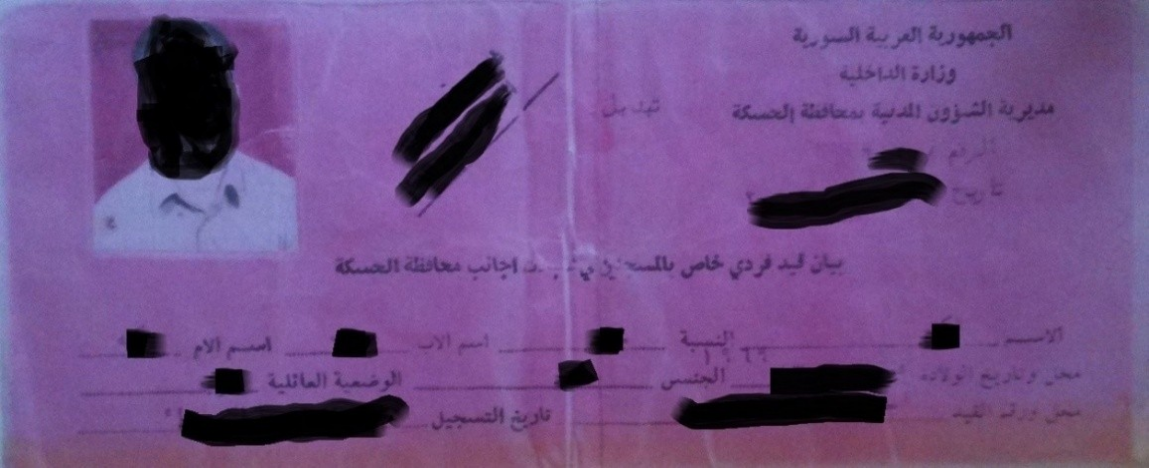
16.2.8 The SNT stated that the red card served as official proof of identity for both official and everyday purposes and recorded the holder as a registered foreigner. It was not valid for travel outside Syria. The document was issued by the Civil Registrar within the Ministry of Interior and could only be obtained or updated in Syria. Applicants were required to provide their parents’ red cards and four colour photographs.[footnote 119]
16.2.9 In the October 2025 report, Synergy Hevdesti provided the below image of a red card:[footnote 120]
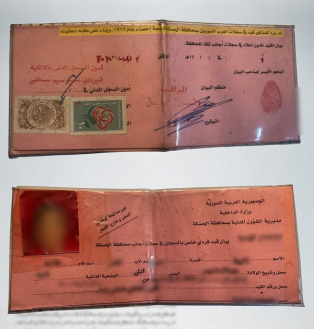
16.2.10 The same source noted that the red card was ‘Officially titled “Special Individual Registration Statement for those registered in the Registers of the Foreigners of Al-Hasakah Governorate”, it bore the notice: “Not valid as travel documents for travel outside the country”. The card also stated that no record of the holder was found in the Syrian Arab Registers of Al-Hasakah Governorate as a result of the 1962 Census.’[footnote 121]
b. Family Civil Extract
16.2.11 According to the SNT, the Family Civil Extract is the equivalent of a Family Booklet for registered foreigners and records all members of the family, including the mother, father and children. It is issued by the Civil Registrar within the Ministry of Interior and can only be obtained or updated in Syria. Applicants are required to provide their parents’ red cards and four colour photographs.[footnote 122]
16.2.12 The SNT provided the below image of a Family Civil Extract:[footnote 123]
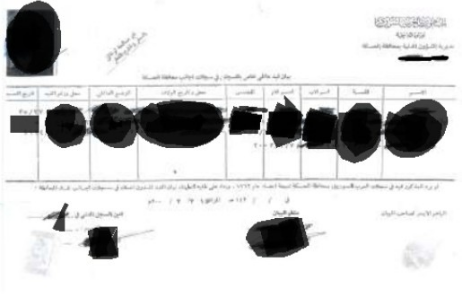
16.3 Maktoumeen Kurds
16.3.1 In STJ’s November 2025 report, it is noted that Maktoumeen are ‘Individuals whose names were not recorded in any registry and who received no official documents whatsoever. Legally, they were not considered even as “foreigners,” but rather as persons with no civil existence, lacking national numbers, birth certificates, or death certificates.’ [footnote 124]
a. Identification Notification
16.3.2 According to the SNT, an Identification Notification (Tareef[footnote 125]) is an informal form of identification that cannot be used for official purposes because it lacks validation from higher authorities. Applicants are required to provide two witnesses and make an oath confirming their identity or the identity of their children.[footnote 126]
16.3.3 The April 2024 DIS report stated:
‘Prior to 1999, Maktoumeen could not have any documents issued except for an unofficial identity document (in Arabic shihadat tareef) which was issued by the local mukhtar (or mayor). The Political Security Service of the GoS [Government of Syria] had to approve the identity document before it was issued to the applicant. The identity document contained an ID photo, personal information of the concerned person along with the signature of the mukthar and two witnesses.
‘In 1999, a decree was issued by the Governor of Al-Hasakah, which prohibited mukhtars in Al-Hasakah from issuing these identity documents. Reportedly, few mukhtars disobeyed the decree and kept issuing the certificates for years. Identity certificates issued after 1999 were therefore only issued by the mukhtars without the authorities’ approval.’[footnote 127]
16.3.4 The Netherlands MFA reported in March 2026 that the shehadat tarif (‘confirmation of identity’), a handwritten document obtained by maktoumeen from their mukhtar, did not confer any rights or legal status. The report stated that ‘No rights or status could be derived from this handwritten document, which contained no security characteristics and which appeared in several variants.’[footnote 128]
16.3.5 The SNT provided the below image of an Identification Notification:[footnote 129]
16.3.3 In the October 2025 report, Synergy Hevdesti provided the following image of an identification certificate issued to Maktoumeen:[footnote 130]
16.3.7 The same source provided the following caption for the above image: ‘Identification certificate issued to the victims in the Maktumeen al-Qayd (“unregistered”) Category, typically provided by the neighborhood mukhtar (local headman), under the title “Identification Certificate for Maktumeen al-Qayd”, with two witnesses attesting to the holder’s identity. It serves only as proof of identity and does not establish legal status, leaving the “unregistered” entirely outside the civil registry, without a civil ID number or official recognition.’[footnote 131]
b. Residency Notification
16.3.8 The SNT stated that the Residency Notification provides informal identification only, with no rights attached to the document, and is not valid for travel outside Syria. It is issued by the local Mukhtar, requires two witnesses, and can only be obtained or updated in Syria.[footnote 132]
16.3.9 CPIT was unable to find further information or an image of the Residency Notification within the sources consulted (see Bibliography).
17. Decree No. 49 of 2011
17.1 Background
17.1.1 The April 2024 DIS report stated ‘In April 2011, Presidential Decree No. 49 was issued, providing the authorities the power of granting citizenship to registered ajanib in the Al-Hasakah province.’[footnote 133]
17.1.2 It added ‘Persons who are registered as ajanib are automatically considered Syrian citizens in accordance with article 1 of Decree No. 49 of 2011. This means that ajanib do not have to apply for Syrian nationality, contrary to certain other categories of foreigners that must fulfil specific conditions in compliance with the rules of the Syrian nationality law issued by Legislative Decree No. 276 of 1969.’[footnote 134]
17.2 Implementation
17.2.1 The April 2024 DIS report outlined the process by which Ajanib could be naturalised following Decree No. 49 of 2011:
‘The procedural rules for ajanib to apply for registration in the Syrian civil registry are described in the decision of the Minister of Interior No. 461 issued on 21 April 2011.
‘The application can be submitted in all Syrian governorates, where sub-committees have been established, enabling ajanib to submit applications in their place of residence.
‘Only the person who heads the household can submit an application on behalf of the entire family. The person who heads the household is typically the father. However, if the father is deceased, disabled or living abroad, the application may be submitted by the spouse or the oldest adult child. Applications cannot be submitted individually. The application must contain the actual place of residence of the family, as well as the names of all family members and their actual place of residence.
‘Children born after the naturalisation of their parents automatically become Syrian citizens. The person who heads the household must attach an extract of his individual civil registration issued for persons registered as ajanib. Once the applicant has completed the application with the needed documentation, a subcommittee will verify the application before sending it to the civil registry of Al-Hasakah. In the event that the subcommittee rejects the application, the applicant, or any of the persons of concern, can appeal the decision to a Central Committee.
‘After the subcommittee approves the application, the applicant and the family members will be registered at the Syrian civil registry office of their place of residence. They will be granted an individual national Syrian number, a personal Syrian ID card, and a family book, similar to Syrian citizens. Each family member has to be present in person when applying for and receiving his/her ID card. As such, a person living abroad will not be able to obtain a Syrian ID card, which serves as proof of having become a Syrian citizen, unless he/she travels to Syria to process it.
‘According to the Syrian civil status department, 120,000 individuals were registered as ajanib. By 2015, the civil status department granted citizenship to 105,000 ajanib registered individuals. Recent information obtained in March 2024, stated that the majority of ajanib residing in Syria have moved their registration from Al-Hasakah to the Syrian civil registry and obtained Syrian citizenship …
‘Decree No. 49 of 2011 is issued for the purpose of granting Syrian nationality only to persons who are registered as ajanib. As such, the decree does not entitle [sic] maktoumeen to acquire citizenship.’[footnote 135]
18. Decree No. 13 of 2026 and Decision No. 144/M of 2026
18.1 Decree No. 13 of 2026
18.1.1 Arab News, a Saudi Arabia based English-language newspaper[footnote 136], noted on 18 January 2026 that:
‘A decree issued by President Ahmed Al-Sharaa on Friday [16 January 2026] marks a historic end to decades of marginalization of Syria’s Kurdish minority …
‘The presidential action, officially known as Decree No. 13, affirms that Syrian Kurds are an integral part of the national fabric and that their cultural and linguistic identity constitutes an inseparable element of Syria’s inclusive, diverse, and unified national identity …
‘The decree for the first time grants Kurdish Syrians rights including recognition of Kurdish identity as part of Syria’s national fabric …The decree commits the state to protecting cultural and linguistic diversity, guaranteeing Kurdish citizens the right to preserve their heritage, develop their arts, and promote their mother tongue within the framework of national sovereignty. It recognizes the Kurdish language as a national language and permits its teaching in public and private schools in areas with significant Kurdish populations, either as an elective subject or as part of cultural and educational activities.
‘It also abolishes all laws and exceptional measures resulting from the 1962 Hasakah census, grants Syrian nationality to citizens of Kurdish origin residing in Syria, including those previously unregistered, and guarantees full equality in rights and duties. In recognition of its national symbolism as a celebration of renewal and fraternity, the decree designates Nowruz Day (21 March) as a paid official holiday throughout the Syrian Arab Republic.’[footnote 137]
18.1.2 For an unofficial English translation of Decree No.13 see Decree No. 13 of 2026, as published by RefWorld.
18.2 Decision No. 144/M of 2026 and application process
18.2.1 Please note that the information set out in this section is not intended to be exhaustive. It reflects the information available to CPIT at the time of drafting and is provided for guidance purposes.
18.2.2 The EUAA, citing multiple sources, stated in the July 2026 report that:
‘In February 2026, the MoI [Ministry of Interior] issued Decision No. 144/M to implement Presidential Decree No. 13 of 2026, establishing procedures for granting Syrian citizenship to eligible Kurds. Applicants must submit a formal request at designated centres, either individually or as a family application filed by the head of household. Required documentation includes an identification certificate issued by a local mukhtar, proof of residence and presence in Syria, and supporting evidence such as utility bills, certified school enrolment documents, or other legally accepted records. Application centres were established in Damascus, Aleppo, Raqqa, Deir Ez-Zor, and Hasaka.
‘A review committee will be established at each application centre to assess citizenship requests. Each committee will be chaired by a judge of counsellor rank appointed by the Minister of Justice and will include a civil affairs representative serving as rapporteur, as well as a Syrian Kurdish community representative appointed by the governor. In May [2026], the authorities extended the deadline for receiving citizenship applications after a high number of submissions.’[footnote 138]
18.2.3 Syria is Home is ‘an information platform designed and developed by UNHCR to support Syrian refugees abroad and Internally Displaced Persons (IDPs) inside Syria.’[footnote 139] Syria is Home provided the following information regarding the naturalisation of stateless Kurds in Syria:
‘Who Is Eligible to Apply?
‘Any Syrian Kurdish person residing in Syria who does not hold citizenship or who is stateless.
‘Where can applications be submitted?
‘Applications may be submitted at designated official centers, as follows:
1. Al‑Hasakah Governorate (three centers):
- Al‑Hasakeh City: City Council
- Qamishli City: Local Council
- Al‑Jawadiyah: Local Council
2. Damascus Governorate: Civil Affairs Directorate
‘What documents are required?
‘You will need to submit documents proving your identity and residence in Syria, including the following:
- A Certificate of Identification for you and all your family members, issued by the relevant Mukhtar who is covering your area of residence and may have records for you and your family,
- A Certificate of Residence issued by the Mukhtar of the area where you reside
- Any available official documents proving your residency in Syria, such as:
- Utility bills (electricity, water, telephone)
- Documents confirming the enrolment of children in schools
- Any other relevant documents.
‘How can an application be submitted?
‘Applications may be submitted either individually or as a family application.
‘Family applications should be submitted by the head of household on behalf of their spouse, minor children, and unmarried adult children. Married adults must submit their own individual applications.
‘After submitting your application, you will receive a receipt that includes your application number, your name, contact number and the number of documents submitted. Please keep this receipt, as you may need to follow up on the status of your application at a later stage.
‘You should include all family members in the application, whether they reside inside Syria or abroad. This will facilitate applications for individuals who are currently abroad when they return to Syria.’[footnote 140]
18.2.4 Syria is Home further noted that:
‘Free legal assistance is available through UNHCR partner organisations, including:
- Syrian Arab Red Crescent (SARC)
- Syrian Development Organization
- Shafaq Organization
‘Legal assistance includes:
- Legal consultations regarding eligibility and procedures
- Guidance on required documentation
- Awareness-raising and information dissemination.
‘All legal services are provided free of charge. Applicants who are unsure how to initiate the process are encouraged to seek legal counseling.’[footnote 141]
18.2.5 UNHCR’s Syria Help Guide[footnote 142], on a page entitled ‘Key messages on the second stage of acquisition of nationality under Presidential Decree No 13 of 2026’, further stated that:
‘Following the registration of your application by the Civil Affairs Directorate, you and your family members included in the application will be called for an in-person interview. During the interview, the information you submitted will be verified, photographs and fingerprints of you and your family members will be taken …
‘You have two easy ways to check your interview date:
Option 1 — Use the Civil Affairs App:
- Download the app using this link shared on the Directorate’s Facebook page
- Open the app and tap “Nationalization Requests”
- Enter the receipt number you received during Stage 1
- If your interview appointment has already been scheduled, the date will appear when you enter your application number. While, if the appointment has not yet been scheduled, it will show (in the application status) that it is still pending scheduling.
You do not need to create an account to check your interview date. You can access this directly.
Option 2 — Check the Official Facebook Page:
- Visit the General Directorate of Civil Affairs Facebook page and look for the post listing interview dates.’[footnote 143]
18.2.6 The same source indicated that all family members included in an application for Syrian nationality, including children, are required to attend an interview in Damascus. Family members who are abroad may attend the interview after arriving in Syria.[footnote 144]
18.2.7 For more information see the UNHCR’s Syria Help Guide website.
18.2.8 Enab Baladi, reported in an article dated 24 May 2026 that:
‘With the end of the application reception phase, the competent authorities are preparing to move to the second stage of the process, which includes conducting interviews with applicants to verify and match their data.
‘Aziz al-Muhaimid, director of civil affairs in Hasakah governorate, told Enab Baladi that this stage will be carried out through committees that include a judicial counselor, a civil affairs employee, and a local notable from the area, to ensure the accuracy of the procedures.
‘The interview is based on holding a direct conversation with the applicant, during which the accuracy of the information entered into the system is verified, including the name, family lineage, and any other details that may require clarification or correction …
‘The citizenship-granting process goes through several stages, beginning with receiving applications and registering data, then moving to the interviews and verification stage, followed by submitting files to a specialized higher committee.
‘In the final stage, the official decision granting citizenship is issued, and the beneficiary is given a civil registration document, allowing them to enjoy full civil rights.’[footnote 145]
18.2.9 The same source also described the registration provisions for Syrians living abroad as follows:
‘The registration mechanism also includes citizens living outside Syria, as a first-degree family member, such as a father, mother, older brother, or older sister, who is allowed to submit the application on behalf of the expatriate.
‘In this case, the applicant’s data is registered as an “expatriate,” provided that the person later completes the procedures in Damascus through a permanent committee specialized in following up on the files of unregistered individuals.
‘This step comes in an attempt to expand the circle of those benefiting from the decree and ensure that no group is excluded because it is outside the country.’[footnote 146]
18.2.10 The Syrian Arab News Agency reported on 28 June 2026 that Abdullah Al-Abdullah, Director-General of the Civil Status Directorate, ‘stated that the interviews do not introduce additional eligibility requirements but are intended exclusively to verify the accuracy of the information provided and confirm the applicant’s personal attendance.’[footnote 147]
18.2.11 A joint monitoring report by Synergy Hevdesti and the Network of Statelessness Victims in al-Hasakah, with the MENA Statelessness Network (Hawiati), published on 23 June 2026 and based on interviews and field monitoring between 6 April and 22 May 2026, noted:
‘Several participants reported that current procedures require applicants to appear in person at registration centres in Syria, creating a substantial barrier for thousands of individuals residing [abroad] …
‘Interviewees highlighted how travel costs, difficulties entering Syria, and obligations related to employment or legal residency in host countries have limited the ability of many individuals to benefit from the current process …
‘Interviews documented cases in which applicants paid varying amounts to obtain required documents from local mukhtars. Participants also reported receiving offers from brokers or intermediaries claiming they could facilitate registration or complete procedures … in exchange for substantial fees. Although there is no indication that such practices are widespread, their continued occurrence raises concerns about integrity, equal access, and procedural fairness.’[footnote 148]
18.2.12 Decision No. 144/M of 2026 stated that ‘Every person who is aggrieved by the results of the Committee’s work may resort to the Administrative Judiciary in accordance with the applicable rules and procedures set forth in State Council Law No. 32/2019, as amended.’[footnote 149]
18.2.13 For an unofficial English translation of Decision No. 144/M see Decision No. 144/M, as published by RefWorld.
18.3 Citizenship applications under Decree No. 13 of 2026
18.3.1 Enab Baladi, in the article dated 24 May 2026, stated that:
‘According to the ministry, Hasakah (northeastern Syria) recorded the highest number of applications, with 2,772, followed by Aleppo with 75, then Damascus with 32, while the remaining applications were distributed between Raqqa and Deir Ezzor governorates …
‘Syria’s Director of Civil Status, Abdullah Abdullah, announced on May 7 [2026] the extension of the period for receiving citizenship applications from unregistered individuals, after the previous deadline expired on May 6. Abdullah said at the time that the extension covers civil status centers in Hasakah, Qamishli, and al-Jawadiyah.’[footnote 150]
18.3.2 An Arab News article dated 21 June 2026, entitled ‘Syrian authorities receive more than 10,000 citizenship applications from Kurds since May’, stated: ‘The ministry of interior released the first batch of names of hundreds of Syrian Kurds who applied for citizenship interviews in the Hasakah and Raqqa governorates, the Syrian Arab News Agency reported on Sunday [21 June 2026]. There were 2,892 family applications, representing 10,516 individuals, submitted for citizenship at centers in the cities of Damascus, Aleppo, Hasakah, Raqqa, and Deir Ezzor since May [2026].’[footnote 151]
18.3.3 At the time of writing, CPIT was unable to find figures regarding the number of successful citizenship applications using the sources consulted (see Bibliography). The July 2026 EUAA Country Focus report noted that ‘The process is ongoing as the evaluation of applications and subsequent issuance of documents takes a few months.’[footnote 152]
18.3.4 On 16 July 2026, however, Global Voices, ‘an international, multilingual community of writers, translators, and human rights activists’[footnote 153], published an article entitled ‘The “unregistered” in Syria: A life of lost opportunities’ which noted, via anecdotal accounts, that applicants had begun receiving Syrian citizenship as of July 2026.[footnote 154]
19. State treatment
19.1.1 The information included in this section was published prior to the announced completion of the SDF’s integration into the Syrian state apparatus in August 2026 (see Integration of the SDF into Syrian state apparatus). CPIT was unable to find any information relating to the state treatment of Kurds after the integration took place within the sources consulted (see Bibliography).
19.1.2 On 4 December 2024, an article in The Syria Report, an ‘English-language publication covering Syrian economic and political economy affairs’[footnote 155], stated: ‘After HTS took over Aleppo city, Abu Mohammad Al-Joulani reassured … minorities that they would be safe under his rule. A similar message was later addressed to the Kurds.’[footnote 156]
19.1.3 On 17 December 2024, BBC Monitoring reported:
‘Ahmed al-Sharaa has sought to reassure the Kurds that they will face a different future in Syria after the fall of Bashar al-Assad’s government, although his opaque promises and statements by the interim authority have offered a mixed picture.
‘Kurdish media on 14 December [2024] widely reported a video in which … Sharaa … said the Kurds would not be oppressed …
‘On 14 December [2024], Syria’s new interim government warned that it will stamp out Kurdish “separatism” and “liberate” Syria’s east.
‘On 16 December [2024], the HTS leader said he hoped the north-eastern provinces of Raqqa, Hasaka and Deir al-Zour could “gain freedom”, an apparent reference to potential moves to expel Kurdish-led forces.’[footnote 157]
19.1.4 The January 2026 Arab News article stated:
‘For more than half a century, Kurds in Syria were subjected to systematic discriminatory policies, most notably following the 1962 census in Hasakah Governorate, which stripped thousands of citizens of their nationality and deprived them of their most basic civil and political rights.
‘These policies intensified after the now-dissolved Baath Party seized power in 1963, particularly following the 1970 coup led by criminal Hafez al-Assad, entrenching a state of legal and cultural exclusion that persisted for 54 years.
‘With the outbreak of the Syrian revolution in March 2011, Syrian Kurds actively participated alongside other segments of society. However, the ousted regime exploited certain separatist parties, supplying them with weapons and support in an attempt to sow discord and fragment national unity.
‘Following victory and liberation, the state moved to correct this course by inviting the Kurdish community to fully integrate into state institutions. This approach was reflected in the signing of the “March 10 Agreement,” which marked an initial milestone on the path toward restoring rights and building a new Syria for all its citizens.’[footnote 158]
19.1.5 The June 2026 DIS report, citing multiple sources, noted:
‘Freedom of expression has improved compared to the Assad era, particularly regarding sectarian issues, minority rights, and the actions of the security.
‘[A Syrian human rights organisation] stated that, in Aleppo Governorate … Kurds living in the Sheikh Maqsoud and Ashrafiyah neighbourhoods who are perceived to be affiliated with the SDF face a risk of targeted attacks by government forces. However, while arrests of Kurds affiliated with the SDF had been reported in the past, no recent reports of such arrests had been received. In Aleppo city, Kurdish residents without links to armed Kurdish factions generally do not face direct security threats …
‘A Syria expert referred to isolated incidents affecting Kurdish individuals. During Newroz celebrations, harassment of Kurdish persons at a roadblock in Afrin was reported, although no similar incidents were subsequently identified.
‘The consulted Syrian human rights organisation expressed concerns regarding undisciplined or poorly trained security personnel, including some affiliated with former Turkish-backed armed groups who may perceive Kurds as linked to the SDF …
‘The consulted Syrian human rights organisation referred to a case in which three Kurdish men travelling by bus from Hasakah through Homs were detained at a checkpoint after photos related to the SDF were found on their phones; they were reportedly released only following negotiations and public pressure …
‘In another case, passengers on a bus travelling from Kurdish-controlled areas in Hasakah to Damascus were reportedly subjected to ill-treatment by government security personnel at a checkpoint.’[footnote 159]
19.1.6 The July 2026 EUAA Country Focus report, citing multiple sources, stated:
‘Kurds residing in transitional government-controlled areas generally continue their daily lives without significant restrictions, harassment, mistreatment, discriminatory treatment, or ethnically motivated attacks, provided they do not engage in political activity. According to a Syrian lawyer consulted by DIS, individuals perceived as politically active or critical of the authorities may face reprisals similar to those experienced by government critics irrespective of their ethnic background. In general there have been no attacks against Kurds living in government-held areas apart from isolated incidents reported of Kurds travelling from northeast Syria to Damascus who have been screened for alleged links to DAANES and in some cases detained. According to a Kurdish activist interviewed by DIS there have been arrests of Kurds travelling from SDF-controlled areas to Damascus for alleged links to the Democratic Union Party (PYD) with some of them reportedly being tortured. No other cases of mistreatment of Kurds have been reported …
‘In Aleppo governorate, some arrests and detentions carried out by government forces during the first half of 2025 reportedly targeted individuals of Kurdish background perceived to be affiliated with the SDF, including cases where images related to the SDF were found on their mobile phones. The sources did not provide further information on the cases.
‘After the transitional government took control over the Kurdish-neighbourhoods of Ashrafiyeh and Sheikh Maqsoud in Aleppo city in January 2026, reports indicated that government forces arrested over 300 Kurds that the authorities claimed were fighters, while some sources reported that those detained were civilians. A STJ report based on testimonies from witnesses and victims indicated that civilians attempting to leave Sheikh Maqsoud and Ashrafieh between 6-12 January 2026 were frequently arrested and detained, without being informed of the reasons for their arrest, particularly at checkpoints such as al-Awarid … Some civilians reported degrading treatment during arrest and initial detention, including beatings, verbal abuse, threats, and confiscation of personal belongings.’[footnote 160]
19.1.7 CPIT was unable to identify any further recent information on the Syrian state’s treatment of Kurds within the sources consulted (see Bibliography).
19.1.8 For more information on the treatment of those deemed critical of the Syrian government, see the CPIN Syria: Criticism of the government.
Terms of Reference
The ‘Terms of Reference’ are the main topics and issues relevant to the scope of this note and provides the framework for the country information. In this note, they were:
- Kurds in Syria
- History and Culture of Kurds in Syria
- Main Kurdish areas in Syria
- Number of Kurds in Syria
- Control over Kurdish areas in Syria
- How has this changed under the transitional government
- Ceasefire between Kurdish militias and transitional government
- Integration
- Treatment of Kurds in Syria
- By the main non-state armed actors controlling Kurdish areas, before and after the fall of the Assad regime
- By the government
- Attitude of the transitional government towards Kurds
- Access to basic rights
- Stateless Kurds
- Ajanib
- Makotum, Maktoumeen
- state apparatus
- Freedom of movement
- legal freedoms/restrictions, including documentation
- safety of movement
- vulnerabilities of different groups
- State protection
- accessibility to protection and justice
- enforcement - arrest and detentions, prosecutions and convictions
Bibliography
Unless otherwise stated, all sources were accessed between 10 August and 30 September 2026.
Sources cited
Al Jazeera:
-
About Us, no date
-
Kurdish-led SDF announces dissolution after merging with Syria’s military, 25 August 2026
-
Kurdish-led SDF has dissolved, but has Syria really unified its military?, 26 August 2026
-
Syrian government, SDF agree on a four-day ceasefire, 20 January 2026
-
What do we know about the Kurdish groups in the Middle East? , 19 January 2026
Al Majalla:
-
About Al Majalla, no date
-
Fading hopes that the SDF will agree to Syrian integration, 11 July 2025
Al-Monitor:
-
About, no date
-
Mazloum Abdi, from champion of Syria Kurdish autonomy to presidential adviser, 27 August 2026
Arab News:
-
About Us, no date
-
Historic decree seeks to end decades of marginalization of Syria’s Kurds, 18 January 2026
-
Syrian authorities receive more than 10,000 citizenship applications from Kurds since May, 21 June 2026
Austrian Federal Office for Immigration and Asylum (BFA), Syria: The situation in Northeast Syria after the agreement between the Syrian Government and the DAANES, 2 July 2026
Asharq Al-Awsat:
-
Abdi Announces Completion of SDF’s Civil, Military Integration with Damascus, 21 August 2026
-
About Us, no date
BBC:
-
Kurdish-led SDF agrees to integrate with Syrian government forces, 11 March 2025
-
Syrian government reaches deal with Kurdish forces, 30 January 2026
BBC Monitoring:
- Briefing: Syria’s HTS offers Kurds mixed messages, 17 December 2024
Bertelsmann Stiftung:
-
BTI 2026 Country Report: Syria, 26 March 2026
-
Who We Are, no date
Brookings, The Free Syrian Army: A decentralized insurgent brand, November 2016
Council on Foreign Relations, About CFR, no date
Crisis Analysis – Syria (CA-SYR):
-
Dismantling the Status Quo, January 2026
-
Home, no date
Danish Immigration Service (DIS):
-
Military recruitment in North and East Syria, June 2024
-
Syria: Ajanib and Maktoumeen Citizenship and Military Service, April 2024
-
Syria - An Update, June 2026
Deutsche Welle:
-
Fighting in Syrian Kurdish-held areas: What you need to know, 13 December 2024
-
Syria’s ethnic and religious groups explained, 18 December 2024
Enab Baladi:
-
About Us, no date
-
Citizenship Requests Cover Over 10,000 Syrian Kurds, 24 May 2026
-
9,000 Asayish Members Nominated for Integration, Including 1,000 Women, 5 June 2026
-
SDF Moves Toward Dissolution: “We Do Not Seek a Kurdish State”, 16 August 2026
Encyclopaedia Britannica, Kurd, 10 August 2026
Etana Syria:
-
About Us, no date
-
Brief: Recent developments in north-east Syria as of 15 July 2026, 20:00 local time, 16 July 2026
European Union Agency for Asylum (EUAA):
-
Syria: Country Focus, July 2026
-
Syria: Security Situation, July 2026
Global Voices:
-
About, no date
-
The ‘unregistered’ in Syria: A life of lost opportunities, 16 July 2026
GLOBALCIT:
-
About, no date
-
Interim Syrian Government and the Legacy of Kurdish Statelessness - Finally Resolution and Justice?, 13 April 2026
Harmoon Centre:
-
About Us, no date
-
Child Abductions in PYD Areas, 30 May 2024
Institute for the Study of War (ISW):
-
About ISW, no date
-
Assessed Control of Terrain in Syria, February 16, 2026, 16 February 2026
-
Iran Update, 1 April 2025
Institute on Statelessness and Inclusion (ISI) and Norwegian Refugee Council (NRC), Understanding statelessness in the Syria refugee context, 2016
International Institute for Strategic Studies (IISS):
-
About Us, no date
-
Ceasefire in Syria: a challenging outlook, 18 February 2026
Kurd Online:
-
About, no date
Middle East Council on Global Affairs:
-
About Us, no date
-
How Damascus Reclaimed Syria’s Northeast, and What Integration Now Means, 4 February 2026
Middle East Eye (MEE):
-
About, no date
-
Syria: Aleppo’s Kurds fear displacement as thousands flee rebels in Tel Rifaat, 3 December 2024
Middle East Institute (MEI):
-
About Us, no date
-
How Damascus and the SDF came to blows in Aleppo - and what might come next, 13 January 2026
-
The Damascus-SDF agreement two months on: Fragile progress or delayed collapse?, 9 May 2025
Minority Rights Group (MRG), Kurds in Syria, updated March 2018
Netherlands Ministry of Foreign Affairs, Thematic Country of Origin Information Report on Syria, Documents, 9 March 2026
Netherlands Organisation for Scientific Research (NWO), Addressing Statelessness in the Syria crisis context, no date
New Lines Magazine:
-
About, no date
-
Revisiting the Erasure of Kurdish Identity in Syria, 20 December 2023
RefWorld:
-
Decision No. 144/M Issued by the Minister of Interior, 18 February 2026
-
Syrian Arab Republic (the): Decree No. 13 of 2026, 16 January 2026
Reuters:
-
Once symbols of war on Islamic State, Kurdish women fighters seek role in new Syria, 2 September 2026
-
Syria’s Kurdish-led SDF dissolves as part of integration with Damascus, 25 August 2026
-
Syria’s Sharaa rejects Kurdish demands for decentralisation, 27 April 2025
Rojava Information Centre (RIC):
-
About, no date
-
The Assault on North & East Syria – Violations during SAA’s January 2026 Offensive, May 2026
-
The Rojava Revolution - A Decade On, 19 July 2022
Rudaw:
-
About Us, no date
-
Damascus censures SDF ‘calls for federalism’ following Kurdish unity conference, 27 April 2025
-
Kurds in Damascus cautiously hopeful about Aleppo deal, 4 April 2025
-
Kurds unite behind vision for decentralized Syria, 26 April 2025
Syria Direct:
-
About Us, no date
-
Child recruitment persists despite SDF-Damascus integration agreement, 17 June 2026
Syrian Arab News Agency, Interior Ministry launches next stage of citizenship process for Kurdish applicants, 28 June 2026
Synergy Hevdesti:
-
About Us, no date
-
Out of the Record: Victims of Statelessness in al-Hasakah, October 2025
-
Between Hope and Challenges: Restoring Nationality to Stateless Kurds in Syria, 23 June 2026
Syria is Home:
-
Documentation and legal matters, no date
-
Purpose and scope, no date
Syria Justice and Accountability Centre (SJAC):
-
About SJAC, no date
-
Human Rights Violations in Syria April-June 2026, 27 July 2026
Syria Nationality Toolkit (SNT):
-
Syrian Documents, no date
-
Syria Nationality Toolkit, no date
Syria in Transition:
-
Home, no date
-
What’s left of the SNA, December 2025
Syrians for Truth and Justice (STJ):
-
History, no date
-
“Strangers in Their Own Homeland”: The 1962 al-Hasaka, November 2025
The Kurdish Project:
-
Our mission, no date
-
Kurdish Populated Cities, March 2018
-
Syria (Rojava or Western Kurdistan), no date
The National:
-
Kurdish militia withdraws slowly from Aleppo amid fear of more sectarian killings in Syria, 10 April 2025
-
Syria removes three civil war-era commanders in army shake-up, 7 August 2026
-
Who we are, no date
The Syria Report:
-
About Us, no date
-
A Radiography of HTS Military and Governance Capabilities, 4 December 2024
United Nations (UN):
- Syrian Arab Republic, August 2022
United Nations High Commissioner for Refugees (UNHCR):
-
Help Syria, no date
-
International Protection Considerations with Regard to Asylum-Seekers from the Syrian Arab Republic, May 2026
United Nations Human Rights Council (UNHRC):
-
Independent International Commission of Inquiry on the Syrian Arab Republic, no date
-
Report of the Independent International Commission of Inquiry on the Syrian Arab Republic, 12 March 2026
Washington Institute:
-
Fikra Forum - About, no date
-
The SDF’s Approach to Integration Talks in Syria and the Risk of Expanded Conflict, 15 January 2026
Xe.com:
-
1,000 USD to GBP - US Dollars to British Pounds Exchange Rate, 12 November 2026
-
10,000 USD to GBP - US Dollars to British Pounds Exchange Rate, 12 November 2026
Sources consulted but not cited
Al Sharq Forum, The Transformation Struggle of the PYD: Localization Tendency as a Method of Gaining Legitimacy?, 28 October 2020
Arab Centre Washington DC:
-
Kurdish Dilemmas in Syria, 13 January 2021
-
Syria’s Kurds Facing Dangerous Headwinds, 18 December 2024
-
Syrian Kurds in an Increasingly Precarious Position, 18 October 2023
-
Refugees Return to Syria: Challenges and Uncertainties, 1 August 2025
Enab Baladi, ‘Ciwanên Şoreşger’… what fate after the dissolution of the ‘SDF’, 26 August 2026
FDD’s Long War Journal, Kurdish-led Syrian Democratic Forces announce its dissolution, 25 August 2026
German Institute for Global and Area Studies:
-
The GIGA, no date
-
“The Right to Have Rights”: Legal Identity Documentation in the Syrian Civil War, 2021
Hawar News Agency, From establishment to building Syria: Journey of SDF since 2015, 26 August 2026
Institute on Statelessness and Inclusion (ISI), Syria – Stateless Hub, no date
Italian Institute for International Political Studies (ISPI), From Autonomy to Integration: Northeastern Syria after Assad, 12 June 2026
New Lines Magazine, Syria’s New Rulers Are Working To Unify Military Power, 25 February 2025
Oxford Political Review, Censor the Language, Curtail the People: An Analysis of Kurdish Linguistic Erasure Across the Nation-states on Kurdish Land, 5 September 2024
Rudaw:
- Hundreds of displaced families set to return to Afrin as SDF-Damascus agreement progresses, 15 April 2026
Sky News, Who are the different rebel groups in Syria – and what territory do they control?, 9 December 2024
Synergy Hevdesti:
-
“Five Years of Injustice are Enough!”, 13 November 2023
-
Northern Syria: Arbitrary Detention and Torture as Systematic Policy in SNA-Held Areas, 25 February 2024
-
Northern Syria: Escalation of Violations Against Kurdish Civilians by Syrian National Army Factions, 19 December 2024
-
We Will Kill You Wherever You Go: Violations Committed during SNA-led Operation Dawn of Freedom, 9 May 2025
Syrian Network for Human Rights (SNHR), Child Recruitment in SDF-Controlled Areas: Legal Framework and Documented Practices, 14 January 2026
The Amargi, Syria’s parliament is ready, but power remains centralized, 2 July 2026
The New Region, Syria selects parliament representatives of Kurdish-majority areas amid Kurdish objections, 24 May 2026
UK Parliament, Syria in 2026: Interim government and Kurdish integration, 2 September 2026
UN OCHA, Syrian Arab Republic: Flash Update No. 1, 19 January 2026
Version control and feedback
Clearance
Below is information on when this note was cleared:
- version 3.0
- valid from 17 November 2026
Official – sensitive: Not for disclosure – Start of section
The information in this section has been removed as it is restricted for internal Home Office use.
Official – sensitive: Not for disclosure – End of section
Changes from last version of this note
Updated COI and assessment.
Feedback to the Home Office
We welcome feedback on how to improve our products. If you would like to comment on this note, please email the Country Policy and Information Team.
Independent Advisory Group on Country Information
The Independent Advisory Group on Country Information (IAGCI) was set up in March 2009 by the Independent Chief Inspector of Borders and Immigration to support them in reviewing the efficiency, effectiveness and consistency of approach of COI produced by the Home Office.
The IAGCI welcomes feedback on the Home Office’s COI material. It is not the function of the IAGCI to endorse any Home Office material, procedures or policy. The IAGCI may be contacted at:
Independent Advisory Group on Country Information
Independent Chief Inspector of Borders and Immigration
3rd Floor
28 Kirby Street
London
EC1N 8TE
Email: chiefinspector@icibi.gov.uk
Information about the IAGCI’s work and a list of the documents which have been reviewed by the IAGCI can be found on the Independent Chief Inspector’s pages of the gov.uk website.
-
Al Jazeera, What do we know about the Kurdish groups …, 19 January 2026 ↩
-
Al Jazeera, What do we know about the Kurdish groups …, 19 January 2026 ↩
-
New Lines Magazine, Revisiting the Erasure of Kurdish Identity in Syria, 20 December 2023 ↩
-
Al Jazeera, What do we know about the Kurdish groups …, 19 January 2026 ↩
-
Minority Rights Group, Kurds in Syria, updated March 2018 ↩
-
Deutsche Welle, Fighting in Syrian Kurdish-held areas …, 13 December 2024 ↩
-
Deutsche Welle, Syria’s ethnic and religious groups explained, 18 December 2024 ↩
-
Minority Rights Group, Kurds in Syria, updated March 2018 ↩
-
EUAA, Syria: Country Focus (page 58), July 2026 ↩
-
UN, Syrian Arab Republic, August 2022 ↩
-
The Kurdish Project, Our mission, no date ↩
-
The Kurdish Project, Kurdish Populated Cities, March 2018 ↩
-
The Kurdish Project, Syria (Rojava or Western Kurdistan), no date ↩
-
Rojava Information Centre, The Rojava Revolution - A Decade On, 19 July 2022 ↩
-
Rojava Information Centre, The Rojava Revolution - A Decade On, 19 July 2022 ↩
-
Rojava Information Centre, The Rojava Revolution - A Decade On, 19 July 2022 ↩
-
Harmoon Center, Child Abductions in PYD Areas (pages 15-16), 30 May 2024 ↩
-
Deutsche Welle, Syria’s ethnic and religious groups explained, 18 December 2024 ↩
-
Bertelsmann Stiftung, Who We Are, no date ↩
-
Bertelsmann Stiftung, BTI 2026 Country Report: Syria (page 8), 26 March 2026 ↩
-
EUAA, Syria: Country Focus (page 58), July 2026 ↩
-
Middle East Eye, Syria: Aleppo’s Kurds fear displacement as thousands flee…, 3 December 2024 ↩
-
SW, About ISW, no date ↩
-
ISW, Assessed Control of Terrain in Syria, February 16, 2026, 16 February 2026 ↩
-
Reuters, Syria’s Kurdish-led SDF dissolves as part of integration with Damascus, 25 August 2026 ↩
-
BBC, Kurdish-led SDF agrees to integrate with Syrian government forces, 11 March 2025 ↩
-
Al Jazeera, Syrian government, SDF agree on a four-day ceasefire, 20 January 2026 ↩
-
BBC, Syrian government reaches deal with Kurdish forces, 30 January 2026 ↩
-
MEI, The Damascus-SDF agreement two months on …, 9 May 2025 ↩
-
ISW, Iran Update, 1 April 2025 ↩
-
ISW, Iran Update, 1 April 2025 ↩
-
Rudaw, Kurds in Damascus cautiously hopeful about Aleppo deal, 4 April 2025 ↩
-
The National, Who we are, no date ↩
-
The National, Kurdish militia withdraws slowly from Aleppo amid fear…, 10 April 2025 ↩
-
Rudaw, Damascus censures SDF ‘calls for federalism’ …, 27 April 2025 ↩
-
Rudaw, Kurds unite behind vision for decentralized Syria, 26 April 2025 ↩
-
Reuters, Syria’s Sharaa rejects Kurdish demands for decentralisation, 27 April 2025 ↩
-
IISS, Ceasefire in Syria: a challenging outlook, 18 February 2026 ↩
-
Al Majalla, About Al Majalla, no date ↩
-
Al Majalla, Fading hopes that the SDF will agree to Syrian integration, 11 July 2025 ↩
-
EUAA, Syria: Security Situation (pages 16-17), July 2026 ↩
-
MEI, How Damascus and the SDF came to blows in Aleppo …, 13 January 2026 ↩
-
CA-SYR, Dismantling the Status Quo (pages 5-8), January 2026 ↩
-
Middle East Council on Global Affairs, How Damascus Reclaimed …, 4 February 2026 ↩
-
EUAA, Syria: Country Focus (page 16), July 2026 ↩
-
Enab Baladi, 9,000 Asayish Members Nominated for Integration…, 5 June 2026 ↩
-
Etana Syria, Brief: Recent developments in north-east Syria …, 16 July 2026 ↩
-
Enab Baladi, SDF Moves Toward Dissolution: “We Do Not Seek a Kurdish State”, 16 August 2026 ↩
-
Asharq Al-Awsat, Abdi Announces Completion of the SDF’s Civil …, 21 August 2026 ↩
-
Al Jazeera, Kurdish-led SDF announces dissolution after merging with Syria’s…, 25 August 2026 ↩
-
Al Jazeera, Kurdish-led SDF has dissolved, but has Syria really unified its military?, 26 August 2026 ↩
-
Al-Monitor, Mazloum Abdi, from champion of Syria Kurdish autonomy …, 27 August 2026 ↩
-
Reuters, Syria’s Kurdish-led SDF dissolves as part of integration with Damascus, 25 August 2026 ↩
-
Reuters, Once symbols of war on Islamic State, Kurdish women fighters …, 2 September 2026 ↩
-
EUAA, Syria: Country Focus (pages 45-46), July 2026 ↩
-
UNHRC, Independent International Commission of Inquiry on the Syrian Arab Republic, no date ↩
-
UNHRC, Report of the Independent International …, (pages 14, 38-44), 12 March 2026 ↩
-
SJAC, About SJAC, no date ↩
-
SJAC, Human Rights Violations in Syria April-June 2026, 27 July 2026 ↩
-
DIS, Syria – An Update (page 32), June 2026 ↩
-
DIS, Syria – An Update (pages 28-29, 32), June 2026 ↩
-
EUAA, Syria: Country Focus (pages 50-51), July 2026 ↩
-
BFA, Syria: The situation in Northeast Syria after the agreement …, 2 July 2026 ↩
-
UNHCR, International Protection Considerations … (pages 79-80), May 2026 ↩
-
DIS, Military recruitment in North and East Syria, June 2024 ↩
-
DIS, Syria – An Update (pages 30-31), June 2026 ↩
-
EUAA, Syria: Country Focus (pages 51-52), July 2026 ↩
-
Syria Direct, Child recruitment persists despite …, 17 June 2026 ↩
-
Syria Direct, Child recruitment persists despite …, 17 June 2026 ↩
-
Syria in Transition, What’s left of the SNA, December 2025 ↩
-
EUAA, Syria: Security Situation (pages 22-24), July 2026 ↩
-
Washington Institute, Fikra Forum - About, no date ↩
-
Washington Institute, The SDF’s Approach to Integration Talks …, 15 January 2026 ↩
-
The National, Syria removes three civil war-era commanders in army shake-up, 7 August 2026 ↩
-
Brookings, The Free Syrian Army: A decentralized insurgent brand, November 2016 ↩
-
Syria in Transition, What’s left of the SNA, December 2025 ↩
-
RIC, The Assault on North & East Syria … (pages 27-35, 45), May 2026 ↩
-
EUAA, Syria: Country Focus (page 58-61), July 2026 ↩
-
Xe.com, 1,000 USD to GBP - US Dollars to British Pounds Exchange Rate, 12 November 2026 ↩
-
Xe.com, 10,000 USD to GBP - US Dollars to British Pounds Exchange Rate, 12 November 2026 ↩
-
Kurd Online, Afrin Human Rights Organisation: Continued seizure of civilian …, 1 July 2026 ↩
-
STJ, “Strangers in Their Own Homeland” … (pages 6-7), November 2025 ↩
-
GLOBALCIT, Interim Syrian Government and the Legacy …, 13 April 2026 ↩
-
New Lines Magazine, Revisiting the Erasure of Kurdish Identity in Syria, 20 December 2023 ↩
-
DIS, Syria: Ajanib and Maktoumeen Citizenship … (page 5), April 2024 ↩
-
DIS, Syria: Ajanib and Maktoumeen Citizenship … (pages 7 and 8), April 2024 ↩
-
STJ, “Strangers in Their Own Homeland” … (page 14), November 2025 ↩
-
STJ, “Strangers in Their Own Homeland” … (page 6), November 2025 ↩
-
Synergy Hevdesti, Out of the Record: Victims of Statelessness in al-Hasakah…, October 2025 ↩
-
DIS, Syria: Ajanib and Maktoumeen Citizenship … (page 6), April 2024 ↩
-
SNT, Syria Nationality Toolkit, no date ↩
-
NWO, Addressing Statelessness in the Syria crisis context, no date ↩
-
ISI & NRC, Understanding Statelessness in the Syria Refugee Context, 2016 ↩
-
SNT, Syrian Documents, no date ↩
-
SNT, Syrian Documents, no date ↩
-
Synergy Hevdesti, Out of the Record: Victims of Statelessness …, (page 10), October 2025 ↩
-
Synergy Hevdesti, Out of the Record: Victims of Statelessness … (page 10), October 2025 ↩
-
SNT, Syrian Documents, no date ↩
-
SNT, Syrian Documents, no date ↩
-
STJ, “Strangers in Their Own Homeland” … (page 6), November 2025 ↩
-
ISI & NRC, Understanding Statelessness in the Syria Refugee Context, 2016 ↩
-
SNT, Syrian Documents, no date ↩
-
DIS, Syria: Ajanib and Maktoumeen Citizenship … (page 6), April 2024 ↩
-
Netherlands MFA, Thematic Country of Origin Information Report on…, (page 16), 9 March 2026 ↩
-
SNT, Syrian Documents, no date ↩
-
Synergy Hevdesti, Out of the Record: Victims of Statelessness … (page 11), October 2025 ↩
-
Synergy Hevdesti, Out of the Record: Victims of Statelessness … (page 11), October 2025 ↩
-
SNT, Syrian Documents, no date ↩
-
DIS, Syria: Ajanib and Maktoumeen Citizenship … (page 8), April 2024 ↩
-
DIS, Syria: Ajanib and Maktoumeen Citizenship … (page 8), April 2024 ↩
-
DIS, Syria: Ajanib and Maktoumeen Citizenship … (page 9-10), April 2024 ↩
-
Arab News, Historic decree seeks to end …, 18 January 2026 ↩
-
EUAA, Syria: Country Focus (pages 58-59), July 2026 ↩
-
Syria is Home, Purpose and scope, no date ↩
-
Syria is Home, Documentation and legal matters, no date ↩
-
Syria is Home, Documentation and legal matters, no date ↩
-
UNHCR, Help Syria, no date ↩
-
UNHCR, Key messages on the second stage of acquisition …, no date ↩
-
UNHCR, Key messages on the second stage of acquisition …, no date ↩
-
Enab Baladi, Citizenship equests Cover Over 10,000 Syrian Kurds, 24 May 2026 ↩
-
Enab Baladi, Citizenship Requests Cover Over 10,000 Syrian Kurds, 24 May 2026 ↩
-
SANA, Interior Ministry launches next stage of citizenship process for Kurdish…, 28 June 2026 ↩
-
Synergy Hevdesti, Between Hope and Challenges: Restoring Nationality…, 23 June 2026 ↩
-
RefWorld, Decision No. 144/M Issued by the Minister of Interior, 18 February 2026 ↩
-
Enab Baladi, Citizenship Requests Cover Over 10,000 Syrian Kurds, 24 May 2026 ↩
-
Arab News, Syrian authorities receive more than 10,000 …, 21 June 2026 ↩
-
EUAA, Syria: Country Focus (page 63), July 2026 ↩
-
Global Voices, The ‘unregistered’ in Syria: A life of lost opportunities, 16 July 2026 ↩
-
The Syria Report, A Radiography of HTS Military and Governance Capabilities, 4 December 2024 ↩
-
BBC Monitoring, Briefing: Syria’s HTS offers Kurds mixed messages, 17 December 2024 ↩
-
Arab News, Historic decree seeks to end …, 18 January 2026 ↩
-
DIS, Syria – An Update (pages 2, 12, 15, 19, 28), June 2026 ↩
-
EUAA, Syria: Country Focus (page 59-60), July 2026 ↩