Public procurement in the national interest: Reflections from the CMA
Published 8 September 2026

© Crown copyright 2026
This publication is licensed under the terms of the Open Government Licence v3.0 except where otherwise stated. To view this licence, visit nationalarchives.gov.uk/doc/open-government-licence/version/3 or write to the Information Policy Team, The National Archives, Kew, London TW9 4DU, or email: psi@nationalarchives.gov.uk.
Where we have identified any third party copyright information you will need to obtain permission from the copyright holders concerned.
This publication is available at https://www.gov.uk/government/publications/procurement-in-the-national-interest/public-procurement-in-the-national-interest-reflections-from-the-cma
Foreword
Doug Gurr, Chair and Sarah Cardell, Chief Executive.
Competition policy is about more than just addressing problems once they arise. It can also help policymakers use the levers available to them in ways that support dynamic, innovative and resilient markets from the outset. Part of the CMA’s strategy is to use our expertise and resources to advise government on pro-competition policies that support growth, innovation and investment.
Over the last 2 years, this has included work on scale-ups, cloud services, defence, civil engineering and bid rigging in public procurement. Across these diverse areas and in every stakeholder discussion we have held, our work has repeatedly pointed to a common conclusion: there is significant scope for the public sector to use public procurement more strategically to shape markets and improve outcomes for citizens, businesses and taxpayers alike.
Every year, hundreds of billions of pounds of public spending help determine which firms grow, which technologies are adopted, how supply chains develop, how markets evolve and where the UK develops strategic capabilities. Public procurement shapes outcomes ranging from local growth and jobs to national resilience, sovereignty and the UK’s long-term economic competitiveness.
This report brings together insights gathered during our work. We see effective procurement depending on clarity about the outcomes the public sector is seeking to achieve, willingness to make trade-offs between objectives at a strategic level, and the capacity and incentives to focus on long-term strategic outcomes in individual decisions. We see an important role for stronger coordination across public bodies (national, regional and devolved), when different parts of the public sector are buying from the same markets and supply chains. Finally, it is critical that procurement processes encourage entry and expansion, and that the public sector has the means to use procurement to stimulate innovation and develop new technological capabilities. These features enable an active state to use its purchasing power strategically in support of economic growth, innovation, resilience, business dynamism and long-term public value.
We recognise that public procurement is a dynamic policy space and that the UK government has already begun to take decisive, positive steps to adopt a more coherent strategic approach, most recently through streamlining priorities under the Social Value Model[footnote 1]. Our work has identified that, with further focused action, public procurement can be used even more deliberately and effectively as a tool to deliver industrial strategy and social value. We have developed 5 recommendations for national, regional and local government to consider as part of ongoing reforms.
Alongside these, we set out a summary of a further CMA paper, also published today - ‘Rigged Bids, Real Costs: a case for urgent action to tackle bid rigging in UK public procurement’. Public procurement only delivers value for money if competition is genuine, however much of the £400 billion in taxpayer funds spent annually occurs in markets with recognised risk factors for collusion. Even a relatively low incidence could impose significant costs on the public purse at a time when public finances are under enormous pressure. Adopting what is likely to be a conservative assumption that 2% of UK public procurement is affected by bid rigging, the CMA estimates that taxpayers could be overpaying suppliers by £1 billion annually - although this figure could rise as high as £3.5 billion while still using conservative prevalence estimates.
Technology advances mean the challenge is no longer whether proactive detection is possible. Other jurisdictions have moved further and faster in establishing the data infrastructure and legal frameworks needed for systematic screening, and the CMA has developed cutting-edge tools it stands ready to deploy at scale. The question is whether the UK chooses to do so. The CMA believes the time to act is now and recommends urgent steps to deliver a more coordinated and systematic approach.
We are grateful to members of the CMA’s Growth and Investment Council, whose challenge, expertise and practical experience have helped shape our thinking throughout this work. We also thank the many businesses, investors, academics, trade associations, think tanks and public sector partners who have contributed through roundtables, bilateral engagement and case studies. Their insights have strengthened both our analysis and our recommendations.
Joint statement from the CMA Growth and Investment Council
The Growth and Investment Council warmly welcomes the CMA’s work on public procurement, which reflects real experiences and feedback from businesses across the economy over a sustained period. The evidence gathered, and the recommendations offered, represent a valuable opportunity to put billions of pounds of public procurement funding to work at a vital moment for the UK - generating growth, innovation, strategic advantage and long-term economic resilience.
Summary of CMA recommendations
Recommendation 1: Stronger system leadership and clear prioritisation
Public authorities should have clearer direction on how and where public procurement should serve wider strategic objectives. Taking a more strategic approach means narrowing down priorities to a meaningful number, as well as being more explicit that trade-offs exist, and empowering public authorities to recognise, prioritise and manage them.
Recommendation 2: Informed devolution
Different parts of the public sector are often buying from the same markets and supply chains. Effective market management will involve choices on where purchasing decisions are taken, and how they are coordinated. Stronger system leadership can play an important role in deciding when purchasing should be aggregated for strategic reasons, and where local purchasing can be empowered by better coordination and clearer strategic direction.
Recommendation 3: Build data infrastructure as an enabler for a more strategic approach to public procurement
Using public procurement as a more deliberate lever of economic policy will depend on procuring authorities having the capability, confidence and incentives to embed market-shaping objectives into their purchasing decisions. A data-driven approach can help translate ambitions for public procurement to foster healthier market structures into measurable outcomes, which can influence day-to-day purchasing decisions.
Recommendation 4: Tackle the barriers to entry and expansion
Burdensome requirements to bid can raise the ‘fixed costs’ of participating in tenders, creating a relatively stronger disincentive to participate for smaller firms versus larger firms. Government should systematically review major procurement requirements and processes for their impact on entry, scale-up growth and competition - especially where requirements introduce higher fixed costs.
Recommendation 5: Create an innovation public procurement framework for frontier technologies
Government should review whether existing public procurement policies are well suited to the procurement of frontier and strategically important technologies. The objective should be to ensure public authorities can confidently use public procurement as a tool for innovation and capability building, while preserving competition and maintaining appropriate safeguards for public value.
The CMA has made the following recommendations in the accompanying paper: ‘Rigged Bids, Real Costs: A Case for Urgent Action on Bid Rigging in UK Public Procurement’ CMA, 2026
Recommendation 1: Make tackling bid rigging an explicit public procurement priority
Include a clear commitment to preventing, detecting and deterring bid rigging in the National Procurement Policy Statement and related procurement guidance.
Recommendation 2: Scale cross-public sector bid-rigging screening capability
Build on the CMA’s departmental pilots and establish a route for screening data across central government and the wider public sector. This includes mandating collection and retention of all bid-level information in a machine-readable format that can be analysed at scale.
Recommendation 3: Evaluate implementation transparently
Monitor coverage, analytical leads, referrals, investigations and demonstrable savings (while avoiding sharing methods or other evaluation data that could help firms evade screening).
Introduction
Over the past 2 years, the CMA has prioritised work on how competitive market dynamics can support delivery of the UK government’s priorities to drive economic growth and household prosperity, including through its industrial strategy. We consider this to be a core part of the CMA’s broader role as not just an enforcer, but also an enabler of competition, as reflected in our 2026 to 2029 Strategy.[footnote 2]
We have undertaken work on the UK’s scale-up challenge, civil engineering, defence, cloud services and bid rigging in public procurement. These workstreams are different in scope, but they raise a common question: how can government use its policy tools to shape markets in ways that support growth, innovation, resilience, competition and long-term value?
A central emerging focus has been the role of public procurement which - in many areas of the UK economy, industrial strategy and beyond - affects how firms grow, how suppliers compete, and how markets develop over time.
Around £400 billion of tax income is spent every year on public procurement. [footnote 3] Deployed as a market shaping lever, this money can support a wide range of policy objectives - from growth, innovation and business dynamism to strategic autonomy, resilience, and social value. It is for government to decide which of these it wishes to prioritise. Whatever those priorities, however, realising them requires clear objectives, effective co-ordination and well-designed processes. Where these are lacking, this can serve to entrench incumbents, fragment demand, raise barriers for smaller or growing firms and weaken competition. Over time, the outcomes can include higher prices, less innovation and missed opportunities to build and strengthen regional or national advantage.
We have carried out our work in this area aware of the complex and dynamic policy and statutory context, key aspects of which are summarised in Annex A. The new UK administration has prioritised making significant reforms to procurement policy in its first few weeks, including a substantial simplification of the objectives which should be pursued as part of the Social Value Model. These changes build on substantial reforms introduced under the Procurement Act 2023. The overall direction of reform on procurement policy reflects many of the issues we raise in this paper, and those which have been raised to us by stakeholders.
Our work has also taken place in the context of intensifying political and policy focus on public procurement. A recurring theme in recent contributions from policy groups and expert institutions across the political spectrum is that the UK is missing an opportunity to treat public procurement as a strategic policy tool, rather than a purely administrative function. While perspectives differ on the objectives public procurement should pursue and the appropriate role of the state, contributors highlight concerns around excessive focus on short-term cost, fragmented decision-making, weak capability, risk aversion and processes that can frustrate wider policy goals, including innovation, strategic capability and economic growth.
Disruptions to global supply chains, alongside heightened geopolitical tensions, have intensified this debate in relation to economic resilience and security of supply. With frontier technologies, international competitiveness and national security now intertwined, concerns about sovereignty and strategic dependency have become more prominent across Parliament, government, civil society and the media. In cloud computing, AI and other critical digital technologies, policymakers and Parliamentarians[footnote 4] have increasingly questioned the risks associated with long-term reliance on a small number of global suppliers.
The resulting debate extends across not only immediate value for money, but also contestability, innovation, security, bargaining power and the UK’s ability to maintain strategic control over critical capabilities. The US government’s recent export control directive to suspend all access to frontier AI models Fable 5 and Mythos 5 by any foreign national, whether inside or outside the United States, is a particularly acute example.
In this context, public discussion has also increasingly focused on the importance of transparency, accountability and trust in public procurement decisions - especially where contracts involve sensitive public data or critical public services. In such cases, value for money, innovation and delivery capability may need to be balanced alongside broader considerations relating to public confidence and legitimacy.[footnote 5]
Further examples of the broader debate are provided in Annex B.
In this paper we:
- provide an update on the CMA’s work to support the government’s growth and prosperity agenda, including through its industrial strategy, with a particular focus on the common theme of public procurement
- share high-level reflections from our discussion of public procurement with the CMA’s Growth and Investment Council Members
- draw lessons from this work on how public procurement could be used to shape markets more effectively
- make recommendations to government and public bodies on implementing a more strategic approach to public procurement
- summarise the case for urgent action to tackle bid rigging in public procurement, as covered in our separate paper ‘Rigged Bids, Real Costs’
CMA industrial strategy work
In this section, we summarise 4 key areas where the CMA has been working to support the government’s growth and prosperity agenda, including through its Industrial Strategy:
- scale-ups: Where we have engaged with industry groups, policy organisations and businesses in multiple sectors around the UK’s scale-up challenge - notably, how public procurement can support business dynamism and opportunities for innovative firms to scale in the UK
- civil engineering: Where we have carried out an in-depth examination of the market for road and rail infrastructure highlighting the cost of historic approaches, and the scale of opportunity for reform
- defence: Where we are working with the Ministry of Defence (MOD) on ways to leverage competition in order to achieve the greatest economic returns from higher defence spending
- cloud computing services: Where we are leveraging our sector knowledge and related casework to support government, as it considers options to drive greater choice and stronger tech sovereignty through public procurement
Scale-ups
Scale-ups play a disproportionate role in driving innovation, productivity growth and job creation, and are therefore an important source of business dynamism.
The UK’s challenge is often not generating new firms or new ideas, but helping promising businesses to grow, scale and remain anchored in the UK.
This matters because many of the wider benefits associated with innovation, including investment, skilled jobs, capability development and supply-chain activity, depend on where firms scale, not simply where they start. As the CMA’s 2025 discussion paper Scale-ups and Competition Policy highlighted, successful scale-ups can help ensure that the value created by innovation is captured in the UK, strengthen capabilities in strategically important sectors and build globally competitive businesses with the potential to succeed in international markets.
Supporting innovative firms to scale successfully in the UK is important not only for productivity and economic growth, but also for creating high-quality jobs, building domestic capabilities, strengthening regional economies and, increasingly in technology sectors, supporting strategic resilience and sovereignty.
Last year, we carried out a programme of engagement and policy development around how competition policy interacts with scale-ups in the UK. Through extensive discussions with businesses, investors and other ecosystem participants, we considered how competition, regulation and public policy can either support or impede the transition from startup to scale-up. Recent research by the CMA’s Microeconomics Unit also examined the characteristics and growth patterns of UK scale-ups.[footnote 6]
Many of the obstacles UK firms face in scaling fall outside the CMA’s remit, such as access to talent and taxation policy. However, a recurring theme we heard was the importance of early access to anchor customers (who in many cases will be government and public sector agencies) to secure future demand. Firms repeatedly emphasised that credible customers are often critical to unlocking further investment and sustaining growth.
Several founders and investors told us that securing a major anchor customer, particularly alongside visibility of future demand, could have a transformative effect on investment prospects. This was seen as particularly important in the UK, where investors were often perceived to be more risk-averse than their US counterparts. Public procurement can therefore play a particularly important role, providing not only important non-dilutive funding for growing firms, but also validation of future commercial potential.
However, we also heard that current processes often favour larger incumbents. Pre-qualification tests based on past delivery, alongside limited scope to weigh market-shaping objectives, can make it harder for growing firms to win and deliver public contracts. The procedural burden of bidding for public contracts was also cited as a significant impediment. Larger firms engaging more frequently in public tenders tend to employ specialists familiar with procurement procedures, requirements and vernacular. This includes supplying the information on the wide range of criteria against which bids will be assessed. They often also employ relationship managers, whose role it is to build and maintain contact with a broad range of current and potential buyers. Smaller, credit-constrained firms are not in the position to employ specialists, raising the burden of bidding for public contracts, and even some larger innovative firms may find the bidding process too onerous to justify the effort. The complexity of the procurement process can therefore deter entrants and protect incumbents, constraining competition.
A recurring challenge for policymakers is determining which procurement approaches genuinely support business dynamism and scale-up growth. Successive governments have introduced a range of initiatives intended to increase SME participation in public procurement, reflecting a legitimate desire to broaden access to public sector contracts. However, it is less clear how far procurement systems are currently designed to support firms with the potential to become larger, more productive and internationally competitive businesses. In other words, a system optimised to increase the number of SMEs participating is not necessarily the same as a system optimised to support future high-growth, innovative firms.
In its Annual Review from November 2025, the ScaleUp Institute has set out various well-considered recommendations aimed at supporting the growth of UK scale-ups. These include simplifying and increasing scale-up access to public procurement; making procurement processes simpler and speedier; implementation of the Procurement Act in a way that ensures the public sector increases its buying and strategic partnerships with scaling companies; and procurement champions within Government departments given clear objectives to increase buying and strategic partnership with scale-up companies.
Lessons: Public procurement can play an important role in supporting innovative firms to secure the customers, credibility and commercial traction needed to grow. However, the potential for public procurement to support scale-ups will not be realised if procedural burdens create barriers to entry. Recognising the strategic importance of scale-ups in public procurement can also require making trade-offs between shorter-term price and quality assessments, and the use of public procurement to support younger, innovative firms.
Civil engineering
Reliable, high-quality road and railway infrastructure is critical to driving economic growth across the country, and to improving the connectivity of people throughout the UK. However, our study found that this market is not working as well as it could be and is not delivering effective outcomes.
Public procurement sits at the heart of this market. Around £19 billion is spent each year on public road and rail infrastructure, with the public sector acting as the principal source of demand and therefore playing a significant role in shaping market outcomes. Procurement choices influence not only the cost and delivery of individual projects, but also incentives for firms to invest in skills, capacity and innovation, the ability of smaller firms to enter and expand and the long-term dynamism and productivity of the wider sector.
Over 11 months, the CMA carried out in-depth analysis of the supply of road and rail infrastructure, where the public sector is the dominant purchaser. The market study included extensive engagement with governments, procuring authorities and industry to understand how the market works, how well it performs and how the public sector and industry could work together to deliver infrastructure projects more effectively.
The study found that poor outcomes were not primarily the result of insufficient suppliers, but of a wider system that weakened incentives to invest, innovate and expand. Fragmented accountability, uncertain project pipelines, inconsistent procurement practices and capability constraints combined to impede competition, productivity and long-term value creation. Short-term funding structures and changing government priorities also undermined planning by both procurers and suppliers, with weakened incentives for public authorities to bid for long-term, transformative contracts and weaker industry confidence to invest in future skills, capacity and innovation.
A recurring theme was that fragmentation reduced the public sector’s ability to shape the market effectively. Many authorities were purchasing from the same suppliers and supply chains with limited coordination of demand, capability or market intelligence. The CMA found opportunities for greater coordination through the sharing of expertise, procurement and delivery data, common standards and, where appropriate, more aligned approaches to public procurement. This need not require procurement to be centralised - in many cases, coordinated purchasing, shared capability and clearer strategic direction may offer a way to combine local decision-making with more effective market management. The formation of new strategic authorities represents an opportunity for devolution to facilitate strategic joint purchasing and capability sharing, and to strengthen local labour markets and supply chains at local or regional levels.
Based on our findings, we recommended a package of measures intended to ensure that the system as a whole produces better market outcomes.[footnote 7] These included:
-
driving the system-wide changes needed to actively shape the market: Recognising the fragmented accountability we found, we recommended that His Majesty’s Treasury (HMT) takes strategic ownership for overseeing the necessary system-wide changes. We also recommended the publication of a long-term sector-specific plan with regular reporting
-
giving industry greater certainty over future demand through multi-year funding settlements, longer-term contracting approaches, and a more transparent infrastructure pipeline that provides clearer incentives for firms to invest in capacity and innovation
-
sustained capability building: strengthen public sector capability and coordination by building commercial and delivery expertise, sharing specialist resources across authorities, and improving the collection and sharing of performance data
-
adopting more consistent procurement best practice, for example more widespread use of better procurement frameworks, an improved approach to risk allocation, simpler and more standardised processes and better use of earlier supplier engagement
-
standardisation of designs: determine and mandate for national procuring authorities the use of a limited set of standard designs for certain road and rail infrastructure outputs.
-
reducing unnecessary regulatory barriers to investment and innovation by streamlining approvals, rationalising accreditation requirements and making it easier for new technologies and products to enter the market
Lessons: Simplifying procurement processes can reduce barriers to entry, growth and scaling. But improving and streamlining process design is only part of the answer. Better overall outcomes also require a system-wide approach. That includes appropriate strategic direction, visibility of future demand, funding certainty for suppliers, stronger capability within procuring authorities, and a more coordinated approach from the public sector. It is also important to manage trade-offs. Procurement approaches that prioritise minimising short-term risk for individual authorities can create barriers to entry, favour incumbents, reduce incentives to innovate and discourage investment in capability. Conversely, approaches that place greater weight on long-term value, competition and innovation require authorities to take a broader view of risk and success.
Defence
The MOD is the largest single central government spender on procurement in the UK and one of the biggest public procurement organisations in Europe. Defence spending is also one of the largest sources of public investment in UK innovation, sitting at the intersection of national security, technological innovation and economic growth.
Procurement choices here have implications well beyond the acquisition of military capability. They can influence investment in research and development, the growth of innovative firms, the resilience of critical supply chains, the development of strategic capabilities (notably AI) and the UK’s ability to capture economic benefits from new technologies.
In the context of defence being a priority sector within the Industrial Strategy, the CMA was asked by the Department for Business, Innovation, Science and Trade to bring a competition perspective to defence procurement. As the government increases spending on defence, taking account of how competition will shape the outcomes of this spending is essential, not just from the perspective of military capability, but also from the perspective of maximising the wider economic benefits from defence spending.
The CMA has been providing advice to MOD in the following areas.
High-growth firms
The defence industrial strategy committed to helping SMEs and startups grow into ‘national powerhouses then global leaders’. The CMA has been working with MOD on how procurement can help encourage larger, more productive and internationally competitive defence suppliers. The CMA has recommended 3 stages for considering this issue.
Procurement may attempt to ‘target’ particular SMEs, based on an assessment of their potential to grow rapidly. A firm’s growth potential is inherently hard to assess; this is reflected in the portfolio strategies of venture capitalists. MOD should think in the same way, accepting the inherent uncertainties, seeing individual procurements as part of a portfolio and investing time to track the growth trajectories of firms through the defence supply chain.
If using procurement to encourage entrepreneurship in the sector, MOD should consider where the value generated through procurement is located. This means not just a static assessment, but where the value will accrue if a firm scales. This assessment should be multi-dimensional, looking beyond just ownership and location to include employment, financing, investment and supply chains, to understand likely continuing value to the UK.
Any more targeted approach will need to be disciplined and dynamic. MOD should assess the competition implications of supporting particular firms, including the intended duration of support, when it should be scaled back or withdrawn, and whether it is likely to create new competition or entrench existing market structures. Robust data and monitoring will be essential to maintain discipline, evaluate impacts and inform future policy design. Where possible, targeted public procurement should preserve rivalry, including by supporting multiple credible challengers rather than creating dependence on a single preferred supplier. In the defence sector, a particular complexity is that past growth may tell MOD as much about its own historic purchasing decisions as about the firm’s underlying competitiveness. A focus on export growth, non-MOD sales, supply-chain sales or sales outside defence may help avoid this circularity.
Monitoring competition in defence supply chains
The dynamic monitoring of market health, including through the supply chain, is key to understanding and evaluating the impact of MOD’s procurement choices and how they are working as instruments of industrial policy. Closer monitoring of market health should help to empower MOD to use public procurement to strengthen markets, and tailor MOD’s approach to public procurement to fix fragilities before they become disruptions.
The CMA has advised MOD on some of the key metrics that can provide insight into market health and is keen to continue to support the MOD to deliver this objective as this work progresses.
Bid rigging and anticompetitive conduct
Collusive conduct has been detected by other international competition authorities in defence supply chains around the world. From hand grenades across the EU, to vehicle maintenance contracts in Spain, military base maintenance contracts in the USA, and uniform materials in Japan, enforcement partners overseas have taken action to defend the integrity of defence supply chains. We are progressing work with the MOD on measures to reduce its exposure to bid rigging by applying data science techniques. The case for this is set out in our paper on bid rigging.
Lessons: In defence, where government purchasing is the dominant force in shaping markets, there is a clear case for the use of data to understand how procurement shapes supplier growth, competition and resilience over time. As part of this, the use of procurement in efforts to encourage internationally competitive defence suppliers should look beyond headline SME participation and track where and how smaller firms are scaling through the defence supply chain. The dynamic monitoring of the effect of procurement choices on market health will help realise the potential for increased defence spending to support wider economic growth.
Cloud
Cloud has become critical national infrastructure, underpinning much of the modern economy and the technologies which are rapidly shaping its future. As AI becomes increasingly central to economic and geopolitical dynamics, decisions about cloud procurement have implications for strategic autonomy, operational resilience, security, innovation and growth.
Government procurement accounts for around 5% of demand in the UK cloud infrastructure services markets.[footnote 8] This is currently a highly concentrated market, with US hyperscalers, with Microsoft and AWS each holding 30 to 40% share in infrastructure as a service (IaaS). Google holds 5 to 10%.[footnote 9] The government has a unique position as a buyer; not just in terms of absolute scale, but in the aggregation of many diverse and potentially divisible packages of demand across various entities and departments, themselves of varying scale.
Strategic use of public procurement is in line with the Industrial Strategy Digital and Technologies sector plan, which highlights the use of public procurement to support early-stage digital and technology businesses, particularly in markets where the Government is the largest customer, like cloud computing and cyber security services.
The CMA has been advising the UK government on how national cloud procurement can be used as a market-shaping lever, rather than solely a mechanism for securing the lowest short-term price. Our advice has focused on how pro-competitive public procurement approaches could help advance a set of wider strategic objectives. These might include greater technological sovereignty, resilience and security; economic growth; and more effective competition in cloud services markets, leading to lower prices for public and private sector customers over the long term.
With a clear set of potential objectives, different approaches to procurement - and the market structures they encourage - can be assessed based on their likely efficacy in delivering those objectives.
Potential objectives in the context of cloud
We identified a range of objectives government could seek to achieve through its procurement of cloud, which are broadly applicable to other key strategic markets, particularly digital markets. These included:
-
strategic autonomy - the degree of choice, influence and control the UK has over access to critical digital (cloud) infrastructure and services, including the ability to act in the UK’s wider economic, social and national security interests
-
security - the level of protection for systems, storage and networks against domestic and external threats (including cybersecurity and terrorism)
-
operational resilience - the capability of cloud infrastructure, applications and systems to be resilient and continue operating effectively in response to challenges such as failures and outages, and security issues discussed above
-
UK growth - the impact on UK economic growth including that created by investment and UK cloud innovation activity as drivers of longer-term UK productivity and economic value
-
cross economy value for money - the extent that the market provides high-quality innovative services at fair prices to UK customers across the economy. This includes the extent to which an approach efficiently delivers on the other objectives set out here.
Different objectives, different strategies
Cloud procurement demonstrates why public authorities need greater clarity on which of multiple strategic objectives to prioritise. The relationship between these objectives is not always straightforward and, in some cases, there can be trade-offs, while in others they may be mutually reinforcing.
To deliver on its various objectives for cloud procurement, government has strategic choices to make across a spectrum:
-
open vs closed: The choice between purchasing services produced offshore (or from suppliers predominantly based outside of the UK), versus purchasing cloud services produced in the UK with greater control and/or ownership interests
-
concentrated vs diverse: The choice between concentrating government purchases on one or 2 suppliers, versus structuring public procurement so that government supports and purchases from a more diverse range of firms.
These 2 dimensions interact and produce a range of potential strategies for government. These choices can also work alongside targeted industrial strategy levers in support of these wider policy goals, such as the UK government’s goal of nurturing UK digital and technology businesses.[footnote 10]
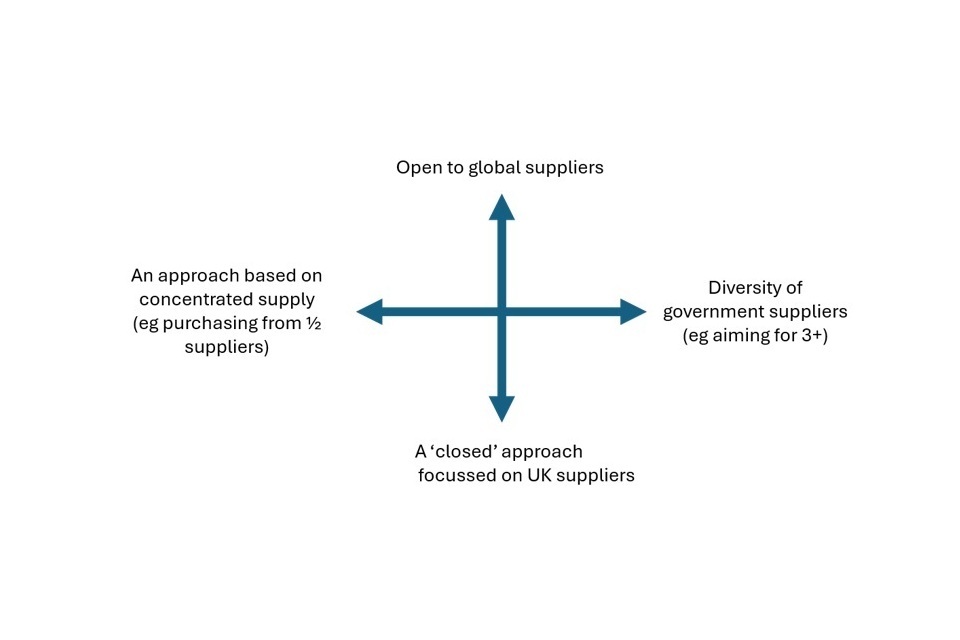
Image description: The image shows choices on 2 perpendicular axes. On a vertical axis, the government has choices in procurement between being open to buying from global supplier (at the top of the axis), or taking a closed approach and focussing on UK suppliers. On a horizontal axis, the government has choices between - on the left of the axis - purchasing from a concentrated set of suppliers such as one or 2, and - on the right of the axis - purchasing from a diverse range of suppliers, such as aiming for 3 or more.
Even this relatively crude, 2 dimensional set of choices reveals the importance of clarity on the underlying objectives. For example, a government seeking greater strategic autonomy could use procurement to help create the conditions for new domestic capabilities to emerge over time. In contrast, a government seeking primarily to strengthen resilience may place greater weight on procurement approaches that encourage supplier diversity and reduce dependence on a small number of providers. Different objectives may therefore lead policymakers towards different procurement strategies[footnote 11] and different market structures, even where each remains focused on delivering value for money over the long term.
Cloud is an example where we can look for opportunities to use public procurement to improve competitive conditions in the market (for example through diversifying suppliers and prioritising contracts that reduce barriers to switching and multi-cloud) and to enable and strengthen UK domestic provision. We believe there is value in considering how public procurement could be used not only to secure better value for money over time, but also to support greater choice, resilience and innovation in cloud markets. By shaping the conditions for more effective competition, these benefits could extend beyond the public sector to the many UK businesses that increasingly rely on cloud services as a critical input into their operations.
Variants of these approaches are being pursued in many jurisdictions around the world including France, Canada, South Korea and Japan (amongst others), as well as at EU level. Several jurisdictions have introduced dedicated cloud sovereignty and certification frameworks that classify certain digital infrastructures and services as strategically important.[footnote 12] These frameworks allow procurement decisions to take greater account of factors such as sovereignty, control, localisation, security and supply-chain independence, alongside competition and price. The result is a broader range of public procurement options for governments seeking to strengthen sovereignty and reduce reliance on a small number of foreign providers.
It is notable that in the UK, government has designated physical data centre infrastructure as Critical National Infrastructure, reflecting their importance to public services, economic activity and national security.[footnote 13] Yet the cloud services, platforms and data ecosystems hosted within them (the actual value drivers) are not classified as strategic assets in their own right. This distinction may matter in practice. Recent public procurement policy has recognised that where capabilities are considered strategically important to national security and resilience, public authorities may require greater flexibility in how they procure them.[footnote 14] As cloud becomes increasingly integral to the operation of government and the wider economy, there is a question as to whether the current framework should be extended beyond physical buildings to encompass the critical digital capabilities it enables.
Lessons: Cloud services are a complex example, given the highly concentrated nature of UK supply, the absence of a UK hyperscaler competitor today and the importance of cloud to the UK - meaning the decision to market shape, or not, could be impactful for competition in cloud. The case demonstrates why strategic public procurement must begin with clarity about the outcomes government is seeking. Greater strategic autonomy, security, resilience, growth or long-term value for money can be advanced with public procurement in the CMA’s view. But they require different public procurement strategies for government and involve making explicit trade-offs.
In the case of strategically critical assets, especially those with a high degree of foreign dependency today, procurement frameworks should afford government maximum optionality of design and process to shape the market over time. This could include aggregating public demand; applying proportionate requirements relating to control, security or localisation; and creating credible routes for alternative or domestic suppliers to develop, test and scale. Several jurisdictions have created dedicated frameworks for strategically important digital capabilities (including cloud services) that provide this flexibility. There is a question as to whether the UK’s current strategic asset and public procurement frameworks provide equivalent scope to support these objectives.
Reflections from discussions with the CMA’s Growth and Investment Council
Business and investor perspectives
The themes identified through the CMA’s work on public procurement and industrial strategy have been reinforced through our engagement with businesses and investors.
In particular, public procurement has been a repeated topic in discussions with the CMA’s Growth and Investment Council. The Growth and Investment Council is a group made up of the Competition and Markets Authority (CMA) and major UK business and investor groups. [footnote 15]
Much of their feedback over the past 18 months, summarised below, aligns with and reinforces our own findings.
Strategic use of public procurement: Council Members expressed the importance of public procurement in supporting growth and investment, particularly in sectors where government is a significant purchaser. Members suggested that procurement has often been treated as an administrative function rather than a strategic policy tool and argued that greater focus should be placed on how public procurement can support innovation, competition and long-term economic outcomes. Discussion also covered the extent to which fragmented responsibilities and limited accountability can make it difficult to translate policy objectives into procurement outcomes.
The role of public procurement in helping SMEs and scale-ups access markets and grow. Members noted that public procurement decisions genuinely influence investment incentives and market dynamics and can either support or constrain the development of competitive domestic markets. Members highlighted concerns that procurement systems can favour incumbents, place disproportionate burdens on smaller firms and prioritise short-term cost considerations over longer-term value and innovation.[footnote 16], [footnote 17]
Public procurement and innovation: A recurring theme was whether current public procurement approaches are sufficiently supportive of innovative businesses and emerging technologies. Members discussed the importance of creating clearer demand signals for innovative firms and enabling public procurement to support scale-up growth more effectively.[footnote 18] Healthcare, defence and technology markets were frequent examples of where public sector demand could be transformative. Council Members noted that an anchor or pipeline of public contracts can be an important factor in supporting scale-up growth and investment. Several Members suggested that many of the relevant policy levers already exist to drive innovation through public procurement but are applied inconsistently, with limited risk appetite.
Behaviour, incentives and public procurement culture: Council Members agreed that many procurement challenges are behavioural and cultural as well as structural. Members highlighted risk aversion, capability gaps and incentive structures within public procurement systems as barriers to change. Several participants argued that reforms should focus not only on processes and rules but also on how decision-makers are incentivised and supported to pursue innovation, competition and longer-term value.[footnote 19]
Public procurement, sovereignty and strategic autonomy: The Council discussed the increasing prominence of public procurement within wider debates about resilience, sovereignty and economic security. Members noted the importance of supporting domestic capability and international competitiveness, while remaining open to best-in-class global solutions. The discussion highlighted the need to balance competition, resilience and growth objectives, and the importance of being clear about the trade-offs involved.
Public procurement reform: There was broad support for further practical and achievable public procurement reforms, recognising that the direction of travel was positive. Council Members strongly supported opportunities to improve transparency, accountability, coordination and the use of public procurement data. Members also highlighted the importance of simplifying procurement processes and reducing barriers that can deter firms from participating in public sector markets. Several Council Members identified action on bid rigging as a clear short-term priority and encouraged continued efforts to support implementation and build wider backing across government and industry.
Several members have published directly relevant work on public procurement. The British Chambers of Commerce published ‘A Smarter Way to Deliver Infrastructure: The Great British Supply Chain’,[footnote 20] urging government to transform public procurement and infrastructure delivery to unlock growth and analysing how fragmented public procurement systems are holding back UK economic potential. The Federation of Small Businesses published ‘Signed, sealed, delivered’,[footnote 21] examining how the system continues to disadvantage smaller firms competing for contracts. techUK published a report on local government procurement based on a survey which found evidence that there were gaps in the visibility of opportunities, and that suppliers can be put off from bidding where they perceive an incumbent will be preferred.[footnote 22] As referenced above, the ScaleUp Institute’s Annual Report for 2025 provides a range of insights on how scaleups interact with the procurement system, and the challenges they can face.[footnote 23] The Startup Coalition has published ‘Buying British Innovation,’ laying out the barriers early-stage firms face navigating procurement processes.[footnote 24]
Council Members have also provided case studies which are illustrative of the broader points they raise.
Procedural burden as a barrier to entry
Case study 1: A British software development business expressed concern that the cumulative cost, complexity and uncertainty of public procurement is reaching the point where capable SMEs will become more selective about which opportunities they pursue - or stop bidding altogether because they simply can’t justify the commercial investment required. The business proposed that greater reuse of supplier information, requesting detailed methodologies later in the process once capability has been established, clearer feedback for unsuccessful bidders and ensuring specialist expertise receives appropriate weighting would all help reduce unnecessary barriers without compromising governance. (Case study provided by British Chambers of Commerce.)
Case study 2: A medical equipment supplier reported that under NHS England requirements, all suppliers must publish a current Carbon Reduction Plan, undertake an Evergreen supplier assessment, complete a Modern Slavery Assessment, and undertake Cyber Essentials certification. The business said it understood the reasons behind these requirements, but the requirements presented a disproportionate burden on SMEs. If a firm only has 5 employees, and given there is no guarantee of any income from the procurement frameworks in question, the cost of employees carrying out these types of activities can’t be offset against a known level of income. Exemptions for SMEs from some of these requirements can themselves be relatively burdensome to complete. (Case study provided by British Chambers of Commerce.)
Case study 3: A small consultancy in the West Midlands reported that investing time in making a dozen bids was an ‘unacceptable gamble’ given the likelihood of winning and the degree of process involved. It consciously avoids formal tendering as it cannot commercially justify the administrative effort, compared to the guarantee of work it can secure through other channels. (Case study provided by FSB.)
Case study 4: A medium-sized AI and analytics business explained to one of our Council Members that current routes to innovation funding and public procurement opportunities are fragmented, complex and administratively burdensome, with suppliers facing many different purchasing systems and onboarding routes, which create a practical disadvantage for firms without dedicated procurement administration teams. These barriers raised the cost of participation before a firm has any certainty of winning work, which can deter innovative businesses from engaging with the public sector at all. Simplifying routes into public procurement, improving signposting, and using common onboarding standards would create clearer pathways between innovation funding and procurement opportunities. (Case study provided by CBI.)
Procurement targets and policy objectives
Case study 5: A UK defence technology SME reported that it scored very low on the social value section of a recent MOD procurement submission because it did not have many UK SMEs in its supply chain, despite being a UK-based SME itself. It said that it understood the successful bidder, a US multinational, scored more highly on this section, which it considered penalised a smaller firm for having a simpler supplier network. (Case study provided by CBI.)
Transitioning from pilot to contract
Case study 6: An AI startup described being engaged by a government department to use GenAI to audit the accuracy of documents. To prove feasibility, the startup agreed to a small contract under £10k - despite regarding the work as having a higher value. The pilot was a success, following which the policy lead for the programme secured £100k of budget for a full rollout. The startup said the contract would have resulted in 20% growth for the business, an opportunity to recruit new regional jobs, as well as an opportunity to review documents faster and more cheaply. However, the startup said that (i) the government department’s procurement team required the contract to be tendered competitively, but that the procurement team lacked the resources to run it, and that (ii) internal stakeholders suggested the requirement be folded into the existing multi-million-pound contract of a global consultancy firm. (Case study provided by Startup Coalition.)
Case study 7: Technology suppliers reported that successful pilots and free trials can stall because government departments lack clear routes to move from proof of concept to formal adoption. In one example, a business was told the purchasing department needed to wait for other suppliers to enter the market before running a competitive tender. If pilots do not lead to adoption, businesses receive a weak demand signal and may be less willing to invest upfront to prove new solutions for public sector customers, particularly where they bear the cost of the trial. Government procurement teams need clearer guidance on how to turn successful pilots and trials into scalable contracts, while maintaining fair competition, transparent market engagement and outcome-based approaches. (Case study provided by CBI.)
Pre-qualification requirements
Case study 8: A digital technology startup said it was rejected from the G-Cloud 15 framework, the government’s key digital marketplace, due to the use of a Simple Agreement for Future Equity (SAFE) contract, which it said was a common financing instrument used by early-stage startups. Government was the startup’s primary customer and rejection from the framework would materially damage the company’s likelihood of winning government contracts. Following further enquiries, government said that the rejection was the result of a policy oversight, with SAFEs contracts incorrectly being viewed as a form of debt that would not meet the financial requirements of the framework. It was also identified that over fifty other suppliers had been rejected for the same reason. (Case study provided by Startup Coalition.)
Case study 9: A venture capital-backed SME reported that it was excluded from a government procurement opportunity, despite reporting that it had the technical capability and delivery experience required, because it could not meet a turnover threshold used in the financial assessment process. It said it offered additional financial assurances, including bank guarantees, but these were not accepted as an alternative way to manage perceived financial risk. (Case study provided by CBI.)
Funding delays
Case study 10: A British technology solutions provider reported that delays in government procurement funding caused by changing political priorities resulted in them being unable to extend contracts with SME partners and having to give them formal notice to stand down. Of the 3 SMEs, 2 have placed their staff ‘at risk’, with the third committing their small workforce to other tasks. This means if and when funding aligns, there is likely to be a gap in knowledge and possible skills shortages. (Case study provided by techUK.)
Coordination
Case study 11: An AI driven medical diagnostic company founded in the UK reported its challenges with a fragmented NHS procurement system. The company reported being able to secure contracts in one NHS Trust, but that it would take multiple years to be able to replicate that across the UK, whilst in Europe a single nation-wide procurement was achieved in a much simpler manner and shorter timeframe.
The ScaleUp Institute noted that centralised databases, and passporting within UK structures can alleviate substantial costs and efforts to realise quicker benefits in rolling out innovative solutions for the benefit of the nation. It noted the NHS Innovator Passport now in place via MedTech Compass can be leveraged to full effect in NHS procurement and said that similar ‘passport’ models should be considered for replication in other sectors. (Case study provided by ScaleUp Institute.)
Issues underpinning a more strategic approach to public procurement
The CMA’s recent work and engagement points to 5 cross-cutting issues, each highlighting a different aspect of a more strategic approach to procurement:
- objectives and trade-offs
- coordination and fragmentation
- capacity and incentives
- entry and expansion
- procuring innovation
Issue 1: Objectives and trade-offs
Across different markets and sectors, it is essential that decision-makers are clear about the priority policy outcomes for procurement to deliver - and what trade-offs procurement teams should be empowered to make to achieve them. These will naturally vary:
-
wider objectives vs procedural burden: Introducing additional criteria into public procurement assessments can expand the set of policy outcomes. At the same time, it can add procedural burdens into bidding processes. For instance, where social value criteria are added on top of price and quality, suppliers may need to provide more information, increasing the costs of competing and often favouring large incumbents with well-oiled and well-funded ‘social impact’ operations. It may also increase delivery costs for all parties, with suppliers having to meet extra commitments and contracting authorities having to monitor delivery against them. Recognising these factors, the new government announced a significant simplification of social value requirements, with the aim of helping smaller businesses to access procurement. The threshold for social value assessments was raised to contracts worth more than £1m, and the criteria refocussed clearly on jobs and skills.[footnote 25]
-
dynamism vs risk and cost: Purchasing from larger, established suppliers (or ‘known entities’) can reduce perceived delivery risks for public services, but also reduces opportunities for suppliers of innovative products, newer entrants or smaller suppliers. For example, pre-qualification criteria based on turnover, or previous contracts won are used to manage certain risks but raise barriers to entry for younger firms - especially the dynamic, innovation-led, VC-backed firms the UK wishes to see scale here. Where the UK public sector is unwilling to take a chance on innovative UK firms without long-term delivery records, they may be forced to seek customers, investment and growth opportunities in other markets that are prepared to back their products and technologies on spec. [footnote 26]
-
competition vs scale economies: Purchasing larger quantities from a smaller number of firms can reduce costs, where there are economies of scale. At the same time, it can reduce competition, which may lead to increased costs and lower quality (both through mark-ups and X-inefficiency). There is likely to be a temporal dimension to this: concentrating supply may lower costs today, but a less competitive market structure can inflate them, leading to higher future costs (as well as reducing future quality and creating fragility in supply)
-
measurement vs bureaucratic burden: Collecting high-quality data and information about public procurement can provide valuable insights. It also involves some investment in new systems and action by procurement officials. It can also involve costs for firms, if it adds to the information they need to provide in order to compete
These trade-offs are made through all levels of public procurement. It is critical that they are managed through active choices, with clear political authority and signalling.
Buying British
As part of the renewed interest in industrial policy in advanced economies, there is a reassessment of the extent to which public procurement should be used to develop domestic industries, with some element of ‘home preference’ introduced into public procurement decisions.[footnote 27]
Several policy objectives might motivate a ‘home preference’.
-
sovereignty, security and resilience: Onshoring production can reduce dependence on overseas supply that may be interrupted or leveraged in a way which reduces the UK’s strategic autonomy (for example by conflict, coercion, or supply-chain disruption). Which aspect of production needs to be ‘British’ varies with the nature of the risk. These objectives might be best served by:
- domestic production capability: The ability to make the product here, in which case the location of inputs (including workers and production facilities), and the security of critical inputs are what matter; or
- domestic autonomy and control: Assurance over how the product is supplied and used, in which case ownership of the supplier, and control of its outputs and intellectual property, may matter more than where production physically takes place
-
supporting domestic industry: Public sector demand can be used to change the industrial make-up of the economy. 2 scenarios are worth distinguishing:
- infant industries. Temporary protection from import competition (at least in respect of government contracts) may help a new industry develop and scale. The case is strongest where there are significant economies of scale, ‘learning by doing’ externalities or coordination failures that prevent private investment from getting off the ground, and where there is a credible route to the industry eventually competing globally without support. Where there are significant ‘first mover’ advantages, perhaps due to strong network effects or increasing returns to scale, the case for targeted support may seem more compelling
- levelling the playing field for mature industries. Preference may be justified where overseas rivals benefit from subsidies, laxer regulatory standards or closed procurement markets at home. Here the rationale is corrective rather than developmental, and the appropriate remedy should be calibrated to the distortion (and weighed against alternatives such as trade remedies).
- supporting domestic jobs and skills: Public sector demand can be made conditional on creating domestic employment, apprenticeships or other contributions to skills and the labour market, where the creation of these benefits relies on carrying out activities onshore
Guardrails for effective design
It is for government to decide how public procurement policy supports security and industrial objectives - including how to manage the trade-off between a focus on domestic suppliers and, for example, the reciprocal access UK firms enjoy to overseas government contracts, as well as any trade agreement implications. But competition policy can provide useful guardrails in policy design.
These guardrails matter because import competition is itself a driver of domestic productivity:
- within firms - rivalry sharpens incentives for efficiency and innovation.
- between firms - competition reallocates capital and labour from less productive firms to more productive ones
In principle, softening import competition can carry a real cost, over and above any price premium paid by the taxpayer. The purpose of the guardrails is to secure the intended policy benefits while preserving as much of this competitive discipline as possible. While heavily dependent on the market context, the CMA would recommend 3 key guardrails:
-
maintain or create domestic rivalry: If domestic suppliers will be treated more favourably in public procurement than suppliers from overseas, the risks of allowing (or encouraging) a concentrated domestic industry are greater. Firms are usually incentivised to be efficient and innovative in part by the threat of losing business to other providers. This impetus is lost if rivalry is weak or even non-existent. In practice this means running genuinely competitive tenders among eligible domestic suppliers; designing contracts (size, duration, lotting) so that entrants and smaller firms can compete; and, where scale economies genuinely support only one supplier, preserving contestability through periodic re-tendering, benchmarking or competition for the market rather than in it
-
condition support on performance: Where preferential treatment is granted to develop a domestic industry, this can be politically difficult to withdraw, even when it is not achieving its objectives. The losses from ending a policy fall on a concentrated, vocal group; the gains are spread thinly across taxpayers and users. Unconditional support therefore both weakens performance incentives and entrenches ineffective policy. These risks can be mitigated by:
- objective, published metrics of success, for example costs converging on international benchmarks, export performance, innovation outputs
- pre-committed review points and sunsetting, so that continuation is an active decision
- a credible exit path, communicated in advance
-
target the right outcomes: A firm being ‘British’ is not one thing. A supplier’s workforce, production facilities, headquarters and management, R&D activity, intellectual property and know-how, profits, and ownership can each sit in different places. The dimension that should attract preference depends on the objective. For example, we can distinguish between:
- resilience through capability, which should imply a focus on the location of production and security of critical inputs
- strategic autonomy through control, which should imply a focus on ownership, intellectual property, and control of outputs
- industrial development, which should imply a focus on where the R&D, know-how, and scale-up activity occur
- jobs and skills, which should imply a focus on domestic employment and training content
Any more blanket ‘British’ requirements that are broader than the objective demands raise costs and shrink the pool of eligible bidders without policy benefit.
In summary, the central issue for ‘home preference’ in public procurement is therefore not whether public procurement should ever favour domestic supply, but how any preference is designed. A well-designed policy should identify the specific capability or outcome government wants to secure, target support no more broadly than necessary, preserve rivalry wherever possible, and test whether support is delivering results. This would allow public procurement to contribute to resilience and industrial development without unnecessarily weakening competition, raising costs or creating permanent protection for incumbents.
Issue 2: Coordination and fragmentation
Our work on civil engineering illustrated the risk of an overly fragmented approach to procurement, which hampered the ability of the public sector to shape markets for the long-term. This reflects earlier CMA findings in respect of children’s social care, where we found that individual local authorities were buying relatively few placements and experienced significant variation in the care needed.[footnote 28] This presented inherent difficulties when trying to develop accurate forecasting of demand. Where different parts of the public sector are buying from the same markets and supply chains, it is important to be clear on when coordination would be valuable and, if so, whether this should be achieved by aggregating purchasing at a central point, or through cooperation between buyers.
Issue 3: Capacity and incentives
Across our work on public procurement, we see that government procurement teams (notwithstanding the commitment and professionalism of those involved) can lack the capacity to focus on the long-term strategic outcomes of public procurement decisions. This is compounded when incentives are geared towards cutting costs, minimising legal risk and ensuring procedural compliance. These factors can lead to a focus on process rather than outcomes, and to a focus on price rather than market shaping. Our work with MOD illustrates the point: if public procurement teams are expected to support greater dynamism in the defence industrial base, they need the tools, the data and the incentives to measure whether procurement is helping smaller and non-traditional suppliers grow. Better measurement of supplier growth trajectories would help align procurement decisions with MOD’s wider objective of developing a more dynamic and resilient supply base.
Issue 4: Entry and expansion
By encouraging entry and enabling new entrants to expand, public procurement practices can play a significant role in spurring business dynamism and supporting the development of scaled UK suppliers.[footnote 29] An approach which encourages firms to scale-up and remain anchored in the UK will help ensure that the resulting growth, innovation, jobs and productivity gains are captured here rather than elsewhere. Where these firms operate in strategically important sectors, helping them scale domestically can also strengthen the UK’s resilience, reduce dependency on overseas suppliers and build capabilities that support long-term competitiveness and global influence.
Public procurement design can help or hinder these outcomes. For example, clear and credible demand signals can help de-risk investments, crowd in further funding, and support entry by new firms where barriers are high. On the other hand, burdensome or complex requirements to bid can raise the ‘fixed costs’ of participating in public procurement, disincentivising smaller firms from participating.
Across our scale-up and defence engagement, businesses told us that the cumulative cost, complexity and uncertainty of public procurement can make bidding commercially unattractive, particularly for innovative firms without large bid teams or long public sector track records. For example, suppliers of technology with dual-use capabilities looking to the defence sector told us that the need to comply with security requirements could act as a disincentive and even make it harder to continue to operate in the civilian sphere. This risks narrowing the supplier base, entrenching incumbents and reducing the public sector’s access to new technologies.
Issue 5: Procurement and innovation
Governments increasingly seek to use public procurement to stimulate innovation and develop strategically important capabilities, particularly in emerging and advanced technologies. This is especially relevant where early demand can accelerate product development, help innovative young firms demonstrate capabilities and attract private investment.
This is the approach adopted by Sovereign AI (SOVAI), a recently established sovereign venture fund focused on strengthening UK domestic AI capability and reducing dependence on a small number of overseas technology providers. James Wise, CEO of SOV AI has said ‘The historical approach to procurement has often discriminated against innovative young British companies. Sovereign AI has set out to change that’. SOV AI launched a ‘rapid procurement scheme’[footnote 30], with £100 million of contracts for British AI companies to help bring down costs and support efficiency in public services. Companies work directly with public sector users to build against real challenges, prove their technology and create a pathway to commercial scale. The scheme is designed around the realities of building a startup - no turnover minimums, departmental champions from day one, upfront payments, streamlined applications and companies retain their IP. Wise said: ‘While it will be a drop in the ocean of Government spend initially, I hope it forms the foundation of a much bigger change in Government’s approach to buying frontier-technologies.’[footnote 31]
Government is also establishing a new ‘Innovation Marketplace’ to provide a place for buyers to access suppliers who specialise in innovation.[footnote 32] In the marketplace, suppliers and buyers will be able to experiment with solutions before launching a formal procurement.
These creative uses of public procurement illustrate several wider points. Firstly, the venture capital (VC) portfolio approach may well surface greater innovation for government as a customer of cutting-edge technologies than contracting with more established entities (as well as potentially contributing to strategic domestic capacity). Secondly, procuring these technologies requires accepting a degree of uncertainty and flexibility which UK public procurement processes are not currently designed to accommodate.
The standard model assumes a known specification, one or more competitive bids against it, and a single award. This approach is ill-suited to a landscape where the winning solution, or even the winning approach, is not yet known. In the case of frontier technologies, development can be highly unpredictable: the desired outcome may be clear, but the product that will eventually deliver it may not yet exist. This was famously the case with the UK Vaccine Taskforce in 2020 but applies equally across many frontier technologies – from AI and quantum computing (where the winning architecture or approach is often not yet settled), to engineering biology and novel energy technologies (where the underlying science itself is still maturing). In each case, government may need to commit funding, demand signals or infrastructure well before it is clear which specific solution - or supplier - will ultimately deliver the outcome it needs.
Traditionally, grant or research funding has been used in the UK in lieu of public procurement where high degrees of risk or uncertainty have been present. However, in a world of exponential technology development and geopolitical uncertainty, public procurement has qualities as an innovation tool that distinguish it from others in the toolkit. It creates a customer relationship and a national anchor, tests performance in real-world conditions, helps firms move from pilot to deployment and is often a stronger signal to drive private investment than a grant. There are significant dividends from finding ways to manage the uncertainty of innovation within a procurement paradigm - particularly given the importance of these technologies to economic success and security, as well as the ‘winner-takes-all-or-most’ dynamic in many of these markets.
There is an opportunity to adapt public procurement processes to more consistently treat the uncertainty of advanced or emerging technology investment as ‘business as usual’, rather than ‘only in the case of emergency’. Several dimensions of public procurement design can help achieve this, many of which already exist and have been used and advocated for by practitioners with deep experience. The challenge is the difficulty of using them where existing incentives are often oriented towards compliance, value-for-money assurance and risk reduction at the level of individual procurements, rather than portfolio management of frontier innovation:[footnote 33]
- open: More open, technology-neutral requirements, defined by outcomes rather than fixed specifications, can help reveal to the public sector which technologies can meet a public need
-
staged processes: Moving from specification, to testing, to scaling – rather than one-shot selection. As part of a staged process, competition can be more easily integrated, with multiple solutions developed in parallel and evaluated against milestones. Several instruments already exist within UK procurement law to support this:
- multi-supplier commitments without final selection, which keep several candidate solutions in play
- structured options, which allow commitment to a development pathway without committing to a final outcome
- direct award with parallel development, the model used for vaccine manufacturing in 2020 [footnote 34]
-
demand-pull commitments: Rather than funding development directly, government can commit to purchase a defined output once it meets a pre-agreed technical bar, leaving the innovator to determine how to get there. Advance market commitments are the clearest current example: government is piloting this for AI hardware, committing up to £100 million to buy UK startups’ products for public supercomputers once they clear a performance benchmark, and through InnovateUK, for low-carbon concrete. Instruments like this de-risk private investment without requiring government to hold the technical expertise to manage a staged development process itself - a useful complement where in-house capability (see (d) below) is the binding constraint
-
access to data and testing environments: In many frontier technology markets, access to high-quality data, representative testing environments and opportunities for real-world deployment can be as important as direct funding. Where appropriate, public authorities can consider facilitating secure, proportionate and privacy-preserving access to the data, infrastructure and operational environments to support development, testing and validation of new solutions. This can help innovative firms demonstrate capability, improve products through real-world learning, attract private investment and progress from pilot projects to scalable deployment, while maintaining appropriate safeguards for security, privacy and competition.
- expertise and culture: empowering technical expertise in the procurement process, so that a top-down mission can be met through bottom-up technical discovery, with uncertainty treated as inherent to the process rather than a defect to be designed away. It is notable that by international standards, a relatively small proportion of the UK Civil Service has STEM degrees.[footnote 35] Greater investment in this capability, along with private-sector collaboration of the kind powering SOV.AI, would be highly beneficial.[footnote 36]
Recommendations
Taken together, the findings set out above suggest that public procurement has the potential to play a more substantial role in supporting the government’s objectives. The CMA’s work points to 5 changes that would help government use procurement more deliberately and effectively as a strategic economic lever.
Recommendation 1: Stronger system leadership and clear prioritisation
Public authorities should have clearer direction on how and where public procurement should serve wider strategic objectives. The new Office for the Prime Minister and Cabinet is designed to play a system-leadership role in supporting these changes across a complex public procurement landscape.
Taking a more strategic approach means narrowing down priorities to a meaningful number, as well as being more explicit that trade-offs exist, and empowering public authorities to recognise, prioritise and manage them. These might include, for example between short-term cost and long-term value; between managing risk and supporting innovative UK scale-ups; between leveraging global markets and building greater resilience or sovereignty; or between different aspects of social value. The aim should be for the economic outcomes from public procurement to have greater weight alongside the need for procedural compliance and short-term cost-savings.
Recommendation 2: Informed devolution
Stronger system leadership can also inform how the public sector should collectively manage common markets, particularly in a context where more public procurement spend is devolved locally. The CMA does not see the issue as a simple binary:
- in some cases, aggregating public purchasing at a national level may be the right approach. Where strategically important markets are supplied by a small number of large firms, consolidating demand can help government act as a more effective counterweight to supplier market power and negotiate from a position of greater strength
- in other cases, local authorities can pool certain public procurement activities at a regional level. In our market study into children’s social care, the CMA recommended the establishment of sub-national commissioning bodies in England
-
in many cases, it is coordination between purchasers, rather than centralising public procurement, which can work to empower local decision-making. This can include:
- the pooling of knowledge, market intelligence and expertise. For example, coordination between individual local authorities can support more accurate forecasting of future demands[footnote 37]
- coordination of pipelines to stage demand so it can be met efficiently by supply.
- benchmarking of supplier performance, to reduce asymmetries of information between the public buyer and private provider
- standardising requirements where this will reduce costs
Stronger system leadership can play a key role in making informed choices across the dimensions described above, as well as providing an overall strategic direction in which individual purchasing bodies can take decisions.
Recommendation 3: Build data infrastructure as an enabler for a more strategic approach to public procurement
Using public procurement as a more deliberate lever of economic policy will depend on procuring authorities having the capability, confidence and incentives to embed market-shaping objectives into their purchasing decisions. Across our work on public procurement, the use of data and the ability to plan for the long term are 2 key enablers.
In respect of data, closer monitoring of key metrics of market health can help public authorities tailor their approach to procurement before problems emerge, rather than responding once markets have become fragile. By aggregating and analysing longitudinal data from across the public sector, we can also strengthen our understanding of how public procurement policy and practice influences competition, firm growth and innovation, and how public procurement policy is working in concert with wider industrial policies like the work of UK Research and Innovation (UKRI) and the British Business Bank.
A data-driven approach can help translate ambitions for public procurement to foster healthier market structures into measurable outcomes, which can influence day-to-day purchasing decisions. Policy can’t effectively target outcomes that it can’t measure. Leveraging data in this way could be prioritised in the sectors which are the focus of the industrial strategy. For example, within the defence sector, in addition to tracking SMEs in the supply chain, MOD could track the growth trajectory of smaller firms to strengthen its understanding of where public procurement is helping to drive more dynamic markets.
A more strategic approach also requires giving public authorities the means to plan for the long term. The CMA’s civil engineering market study showed that uncertainty over budgets, annualised spending controls and weak visibility of future work can make it harder for suppliers to invest in innovation, workforce capability and long-term productivity improvements. Better demand forecasting, stronger pipeline information and, where appropriate, multi-year funding commitments would give suppliers greater confidence to invest in the capabilities government needs.
Recommendation 4: Tackle the barriers to entry and expansion
Public procurement practices can play a significant role in business dynamism by encouraging entry and enabling new entrants to expand. Burdensome requirements to bid can raise the ‘fixed costs’ of participating in tenders, creating a relatively stronger disincentive to participate for smaller firms versus larger firms.
The issue here is proportionality. Public sector purchasers need to manage a range of risks and policy objectives, and this will involve requirements being placed on firms bidding for contracts. However, it is key that the benefits of any given requirement should justify both the burden placed on bidders and any reduction in the prospect of entry which results.
When designing new regulation, it is routine for any new measure to be assessed by its costs and benefits, including the impact a new regulatory obligation will have on the ability and incentives for firms to compete. The CMA produces guidance to public authorities on assessing the potential impact of new regulatory measures on competition.[footnote 38] Policymakers can use this guidance to form a view on how a regulatory measure will impact on competition. For example, does it impose a large fixed cost on suppliers, raising a barrier to entry? Having carried out this assessment, policymakers can then consider whether any adverse impacts are proportionate to the objective being pursued.
Although not ‘regulation’ in the legal sense, introducing requirements into the public procurement process can have similar economic effects.
Government should systematically review major procurement requirements for their impact on entry, scale-up growth and competition - especially where requirements introduce higher fixed costs. The analytical framework for assessing the impact of regulation on competition could be transposed to assess more rigorously the impact on competition from different requirements introduced via the procurement process that can have effects on competition analogous to regulation.
Recommendation 5: Create an innovation public procurement framework for frontier technologies
Government should move more consistently from buying known technologies at the lowest risk to using public procurement as a strategic tool for discovering, scaling and commercialising frontier technologies, while preserving competition through portfolio-based and staged approaches.
Government should review whether existing public procurement guidance, capability, assurance processes and accountability arrangements are well suited to the procurement of frontier and strategically important technologies, where uncertainty means the best solution, supplier or delivery pathway cannot be identified in advance.
The objective should be to ensure public authorities can confidently use public procurement as a tool for innovation and capability building, while preserving competition and maintaining appropriate safeguards for public value. This should include consideration of how greater use of existing procurement flexibilities can be encouraged to support demand-side innovation instruments, such as advance market commitments, staged procurement pathways, framework agreements, structured options and other mechanisms that can provide credible future demand while preserving competition between alternative solutions.
Access to high-quality data, representative testing environments and opportunities for real-world deployment can be as important as direct funding. Where appropriate, public authorities should consider how procurement processes can facilitate secure, proportionate and privacy-preserving access to the data, infrastructure and operational environments needed to develop, test and validate new solutions. This can help innovative firms demonstrate capability, improve products through real-world learning, attract private investment and progress from pilot projects to scalable deployment, while maintaining appropriate safeguards for security, privacy and competition.
Government should consider whether government procurement teams have the expertise, incentives and confidence to use these approaches in practice, and whether current accountability arrangements appropriately balance the management of public money with the need to support innovation in strategically important sectors. This should be supported by an appropriate accountability framework which empowers procurement teams to manage uncertainty and pursue long-term value.
The case for tackling bid rigging in public procurement
Summarising evidence and analysis in ‘Rigged Bids, Real Costs: A Case for Urgent Action on Bid Rigging in UK Public Procurement’, CMA, 2026
Bid rigging causes significant harm
Public procurement only delivers value for money if competition is genuine. Bid rigging occurs when suppliers collude during a procurement process, making procurements appear competitive while producing outcomes that are not. It allows suppliers to inflate prices, reduce quality and weaken incentives to innovate. Ultimately, this illegal activity diverts taxpayer funds for vital public services into the pockets of colluding firms, and undermines the existence of a level playing field.
Research cited by the OECD indicates that bid rigging can increase public procurement prices by 20% or more, at the taxpayer’s expense. It can also have wider harmful impacts on quality, innovation and choice.[footnote 39] At the same time, bid rigging is becoming a larger focus of competition enforcement internationally.[footnote 40] OECD data shows that the share of cartel decisions involving bid rigging rose from 34% to 47% between 2021 and 2024.[footnote 41]
The precise scale of bid rigging in public procurement is difficult to quantify because cartels operate secretly - only a subset (fewer than one fifth, research suggests) are ever detected by competition authorities.[footnote 42] A recent academic study, which used machine learning to analyse millions of contracts from across 7 European countries, found patterns consistent with collusive behaviour in around one third of contracts.[footnote 43]
Much of the £400 billion in taxpayer funds spent annually on public procurement[footnote 44] from the private sector occurs in markets with recognised risk factors for collusion, including repeated interactions between suppliers, predictable demand, barriers to entry and recurring competitions. Even a relatively low incidence could impose significant costs on the public purse at a time when public finances are under enormous pressure.
Because bid rigging happens in secret, hidden from buyers, it is difficult to provide a precise figure for the prevalence of bid rigging. However, a substantial body of evidence from the UK and abroad - including the CMA’s recent enforcement record - supports serious concern. Adopting what is likely to be a conservative assumption that 2% of UK public procurement is affected by bid rigging, the CMA estimates that taxpayers could be overpaying suppliers by £1 billion annually[footnote 45] - although this figure could rise as high as £3.5 billion while still using conservative prevalence estimates.[footnote 46]
The CMA’s own enforcement experience demonstrates that the risks are not theoretical. Since 2014, we have completed 7 bid-rigging cases, imposing more than £129 million in fines on 31 companies, alongside director disqualifications and criminal sanctions. More than half of these cases involved public procurement. This figure is comparable with similar data from developed countries globally.
Recent cases illustrate how bid rigging operates in practice and some of the consequences it can have for public procurement outcomes. In 2023, ten construction firms were fined more than £60 million for bid rigging in demolition and asbestos removal contracts (both public and private sector) worth more than £150 million. 4 individuals were disqualified from acting as company directors for nearly 25 years in total. The firms submitted deliberately engineered losing bids to create the appearance of competition (so-called “cover bids”), when a designated winner had been agreed amongst them. Internal communications showed firms directing rivals to price 8 to 12% above intended winning bids and to offer less attractive delivery terms.
5 of the firms were involved in arrangements by which the designated ‘losers’ were set to be compensated by the winner. The value of this compensation, and how it was implemented, varied but was higher than £500,000 in one instance - an indication of how valuable the cover bid was to the winning firm. Some firms produced false invoices to hide this part of the illegal behaviour.
The benefits of tackling bid rigging extend beyond the cases that are ultimately detected. Substantial deterrent effects flow from competition enforcement, with research suggesting that good cartel enforcement might deter more than 50% of the potential harm from cartels.[footnote 47] Strengthening detection capabilities can therefore protect public funds through both direct enforcement action, and by increasing the perceived risk of detection for firms considering collusive conduct.
Historic challenges, new solutions
Bid rigging has historically been difficult to detect. Individual public procurement exercises can appear ordinary, with professionally prepared cover bids often indistinguishable from genuine competition to the naked eye. In the past, competition authorities therefore relied heavily on whistleblowers, complaints, informants and leniency applications to uncover collusion.
Data analytics and AI are rapidly changing this position in cases where sufficient procurement data is made available to analyse. Suspicious patterns can become much more visible when data are brought together at scale and screened systematically - searching for statistical clues (“red flags”) across multiple tenders, suppliers, buyers and years. A growing body of research demonstrates that the data can contain identifiable patterns associated with collusive behaviour - it is hard to collude without leaving some trace. As described above, a recent study applied machine-learning screening methods to approximately 3.3 million procurement contracts across 7 European countries. It found that an estimated one third of public contracts show patterns consistent with collusive behaviour.[footnote 48]
Screening tools now allow competition authorities to analyse large public procurement datasets and identify procurements, sectors or suppliers that warrant closer investigation. Recognising this opportunity, governments around the world are investing in public procurement intelligence infrastructure and competition authorities are developing bid-rigging screening tools.
Spain requires specified information about participating bidders and assessments to be collected for scrutiny and has developed its own Bid Rigging Algorithm for Vigilance in Antitrust tool (BRAVA). Korea’s Bid Rigging Indicator Analysis System (BRIAS) is connected to more than one thousand awarding authorities and screens public procurement data at national scale. Portugal provides its competition authority with direct access to centrally held procurement datasets. The Brazilian competition authority is provided with public procurement data directly by public bodies, allowing it to apply AI screens to detect cartels. Germany and Ireland are introducing new legislative frameworks specifically to enable competition authorities to screen public procurement data.
The OECD has increasingly emphasised data-driven detection as a core component of best practice. Its updated Recommendation on Fighting Bid Rigging encourages governments to collect and retain successful and (importantly) unsuccessful bids, contract information, amendments, subcontracting arrangements and consistent supplier identifiers. The recommendations also include guidance for competition authorities and officials responsible for public procurement to assist public authorities to prevent, identify and punish bid rigging.
The Guidelines set out that competition agencies should ‘provide or offer support to set up training’ on bid rigging and ‘establish a continuing relationship’ with procurement and other public authorities through formal and informal co-operation mechanisms.[footnote 49] For example, The US Department of Justice’s interagency Procurement Collusion Strike Force has reported training more than 39,000 people, opening more than 145 criminal investigations and securing more than 60 guilty pleas and convictions involving contracts worth more than $575 million. [footnote 50]
The UK position
The UK has begun to build some of the necessary capabilities and foundations.
The CMA’s cartel enforcement specialists, together with our compliance communications team, run regular outreach and training sessions to educate procurement officials and other public sector workers about the risks of bid rigging.
Advice includes key red flags to look out for and how to report suspicious activity. The CMA also regularly creates and updates free online resources to help procurement officials prevent, detect and report wrongdoing such as for example our “Cheating or Competing” campaign.[footnote 51] These activities have reached an estimated 80,500 public sector officials over the last 6 years. In 2025 alone, the CMA delivered 35 presentations and teach-ins, supported by an e-learning module with 1,673 sign-ups.
In parallel, the CMA has invested substantially in building out a new capability for data-driven detection of bid rigging, combining deep cartel enforcement expertise with advanced data science. Our in-house Bid Rigging Intelligence Tool (BRIT) is at the cutting edge of best practice. We are deploying BRIT in a series of departmental pilots, including work with government departments which have begun to generate live enforcement leads.
However, progress is necessarily slow and partial because the data needed for systematic screening across the public sector are not routinely collected in a consistent, centralised and shareable form. In particular, losing bid data, which is critical to bid rigging detection, is not routinely collected or available in a consistent, machine-readable format.[footnote 52] This severely limits the UK’s ability to undertake systematic screening and means potentially valuable intelligence remains fragmented across departments and contracting authorities. In the meantime, departments strain to find savings and deliver critical policy priorities - from public infrastructure and services to national security.
Additionally, although government departments have individually indicated a willingness to work with the CMA and draw the benefit of our expertise and digital capability, there has not been centralised cross-government commitment to underpin this - in contrast to the experience in many other jurisdictions internationally.
The opportunity
The challenge is no longer whether proactive detection is possible, but whether the UK chooses to deploy these capabilities at scale. Other jurisdictions have moved further and faster in establishing the data infrastructure and legal frameworks needed for systematic screening. There will necessarily be some costs in transitioning from today’s procurement data landscape to data infrastructure of the sort used in jurisdictions which conduct bid rigging screening today. Any such costs would be more than justified by the total expected benefits from this investment, given the scale and recurring nature of expected savings. This transition could be designed to leverage other initiatives and investments underway, or planned, to create more visibility and intelligence around public procurement data, such that any additional costs may be modest.
We have engaged widely across government and encountered much support for these proposals. However, while several government departments have individually indicated a willingness to work with the CMA and draw the benefit of this digital capability, there has not been centralised cross-government commitment to underpin achieving the scale required to deliver real impact. This is in contrast to the experience in many other jurisdictions internationally.
The CMA believes the time to act is now and recommends urgent steps to deliver a more coordinated and systematic approach.
Recommendations for policymakers
The CMA recommends the following actions:
-
make tackling bid rigging an explicit public procurement priority. Include a clear commitment to preventing, detecting and deterring bid rigging in the National Procurement Policy Statement and related procurement guidance
-
scale cross-public sector bid-rigging screening capability. Build on the CMA’s departmental pilots and establish a route for screening data across central government and the wider public sector. This includes mandating collection and retention of all bid-level information in a machine-readable format that can be analysed at scale
-
evaluate implementation transparently. Monitor coverage, analytical leads, referrals, investigations and demonstrable savings (while avoiding sharing methods or other evaluation data that could help firms evade screening).
Annex A: Brief overview of procurement in the UK
Across the UK public sector, public procurement represents around a third of government expenditure.[footnote 53] Central government spending (including devolved administrations and arm’s length bodies) has been estimated to represent 2 thirds of procurement spending, with local government spending the remaining third.[footnote 54]
Public procurement takes place across hundreds of public bodies, from NHS trusts, ministerial departments like MOD or the Home Office, local councils or schools.
Some areas of public procurement are more centralised, either because there is a single central customer (for example the Navy), or because it is deemed more efficient for a single purchaser to buy in aggregate on behalf of a larger number of public bodies. For example, if NHS Supply Chain is purchasing for multiple NHS trusts, or for purchasing organisations operating across multiple local government bodies.
A hybrid arrangement exists for many products, where individual public authorities can purchase (or ‘call off’) via central frameworks. In a framework, there is an initial competition through which suppliers gain access. There is then a much shorter process for purchasers to buy from suppliers on the framework, although the process, including the degree of additional competition it involves, varies from case to case.
In contrast to a private sector purchaser, the public sector must adhere to statutory rules governing its procurement decisions. Through these rules, its purchasing decisions can be legally challenged, allowing unsuccessful bidders to dispute a contracting authority’s decision due to perceived breaches of transparency, equal treatment, or scoring errors.
This statutory regime was overhauled by the Procurement Act 2023, which defines a simpler and more flexible framework for how competition can be used within procurement:
- competitive open procedure: A single-stage procedure whereby any interested party can submit a tender and the authority will decide whom to award the contract to on the basis of that tender
- competitive flexible procedure: Any other competitive tendering procedure the contracting authority considers appropriate. For example, a public authority may wish to use a multi-stage process which limits the number of suppliers eligible to participate in the competition, or it may wish to introduce negotiation, dialogue or testing into the competitive process
- direct award: Awarding a contract without a competitive tender, to the supplier of the authority’s choosing. The use of direct awards is constrained by the legislation and requires certain specific justifications. These include contracts for prototyping, contracts dependent on intellectual property held by a single supplier, situations where a single supplier holds exclusive rights to supply a particular product or where technical reasons mean there are no reasonable alternatives to a particular supplier
Coordination
Although procurement is carried out across a very wide range of public bodies, various mechanisms exist to coordinate this activity.
The legislative requirements drive consistency in the overall approach. Under the Procurement Act, public bodies must have regard to a National Procurement Policy Statement, issued by the Cabinet Office. The overarching National Procurement Policy Statement is operationalised through various Procurement Policy Notes (PPNs). These may apply to a narrower set of contracting authorities (although others may choose to follow them), and are followed as a matter of policy, rather than due to a statutory requirement.
A significant example of a PPN is the ‘Social Value Model’, which specifies the types of issues which contracting authorities can regard as social value, and specifies the minimum weight which must be given to social value in how contracting authorities assess competing bids. The government recently revised the Model, so that it:
- focused on jobs and skills (it previously included issues such as supply chain resilience and sustainability)
- removed the requirement for a minimum social value weighting for contracts below £1 million
- increased the minimum weighting from 10% to 20% for contracts larger than £5 million
The Government Commercial Function was formed in 2015 as a cross-government network of officials engaged in procurement. It incorporates around 6,000 people working in commercial roles, predominantly within central government departments and some arm’s-length bodies.
Following the Procurement Act 2023, a new digital platform - ‘Find a Tender’ - collates in one place procurement opportunities from across the public sector, including information such as the type of procedure used, the number of bidders and the winning bidder.[footnote 55] The data is stored in a machine-readable format, enabling more systematic analysis across the public sector. It remains relatively early in the implementation of these changes, with Find a Tender launched in February 2025.
Annex B: Wider public debate on procurement
Our work on public procurement has also taken place in the context of intensifying political and policy focus. For example:
-
The Labour Growth Group has argued that procurement should play a key role in rebuilding Britain’s productive and strategic capabilities. Using the defence industrial base and critical technologies as examples, a recent paper argues that the defence industrial sector has been ‘allowed to decay through decades of procurement optimised for short‐term cost and long‐term dependency’, and that ‘critical technologies are being shaped elsewhere while Britain accepts the position of taker’.[footnote 56]
-
The think tank Re:State has argued that ‘Procurement is treated as a technical process, but it is a strategic function’, and that while recent reforms mark progress, ‘the procurement system remains hampered by a deeply ingrained culture of excessive caution, rigid process, and a one-size-fits-all approach.’ Its recommendations included a new Cabinet Office Procurement Policy Note to encourage larger public bodies to establish Advanced Procurement Units, and for smaller public bodies to pool resources and ideas in shared Advanced Procurement Agencies.[footnote 57]
-
A recent debate concerns whether the public sector relies on procurement too much, including where it reduces domestic productive capacity. A paper by a Labour policy network ‘Mainstream’ argues the state should be ‘an active investor, owner, and provider’ of the ‘essentials required for a dignified life.’[footnote 58]
-
The Institute for Government has argued that effective procurement and market shaping will be held back, amongst other things, by:
- unclear priorities
- risk aversion
- low-quality procurement data (while noting the potential for this to improve following legislative change)
- weak cross-departmental collaboration
- a lack of commercial capability[footnote 59]
-
The Federation of Small Businesses identified ‘complex processes, oversized contracts, and burdensome requirements’ that ‘continue to shut out talented small firms.’ It acknowledged the new Procurement Act as a major step forward and called on central government ‘to be more accountable, breaking contracts into manageable lots that attract SME participation and simplify access for all.’ It called for the delivery of practical reforms, transparency, enforcement of accountability in government departments and unlocking the value that small businesses bring to the public sector.[footnote 60]
-
In reflecting on how procurement is becoming ‘the real engine behind digital delivery’, it has also been argued that ‘The next phase of reform must focus on smarter, data-driven procurement. Public sector organisations hold vast amounts of supplier and spend data, much of it siloed. Unlocking this is key to delivering on the Act’s promise’ and that ‘Procurement is no longer just a function. It is the mechanism through which digital ambition is delivered. Organisations that invest in the right tools, data and ways of working will be best placed to scale AI-enabled services and deliver lasting public value.’[footnote 61]
-
In looking into Britain’s opportunity to drive economic growth and better public services through buying from UK startups, the Startup Coalition has talked about the need ‘to fix public procurement’. Recognising that recent reforms to social value mark a positive step in simplifying elements of the procurement process for startups, it states that ‘signals from the top of government alone will not be enough to turn what has become a cumbersome, bureaucratic and fundamentally broken process.’ The report identifies challenges, including: reducing barriers to access important frameworks; issuing guidance on direct awards; and driving better pre-market engagement activity with high-growth companies through more data capture and accountability.[footnote 62]
-
The National Audit Office has recognised that ‘improving government’s use of competition requires the centre of government to understand how competition is working in practice, using this understanding to advise and support departments.’ It made recommendations for actions to be taken by those working in policy and at the centre of government, including: setting out how procurement information is used and exploring how it can use the range of data collected on individual contracts to analyse competitive trends in markets and use this to support its work; working with departments to understand the barriers to early market engagement and take steps to address them; expanding its guidance on frameworks, alongside working to ensure that where frameworks are used it is for compatible requirements and uses competitive pressure; and considering how to make improvements in the supporting elements of the commercial lifecycle to support improvements in the effectiveness of competition.[footnote 63]
-
The House of Lords Science and Technology Committee report ‘Bleeding to death: the science and technology growth emergency’, argued that ‘Government must build capacity if procurement is to be an innovation engine, supporting UK-based supply chains: outcome-based, swift, flexible, rather than bureaucratic and risk-averse processes that favour large incumbents.’[footnote 64]
-
Cabinet Office (2026) PPN 026: The social value model. ↩
-
CMA (2026) CMA Strategy 2026 to 2029. ↩
-
House of Commons Library (2026) Procurement statistics: a short guide. ↩
-
See Dame Chi Onwurah’s remarks on technology sovereignty, Lord Clement Jones remarks on the use of AI in society, and Lord Holmes’ remarks on technology policy and National Sovereignty. ↩
-
UK Parliament (2026) MPs warn that Palantir’s increasing presence in the UK public sector is an ‘unacceptable point of weakness’. ↩
-
CMA (2026), Microeconomics Unit research on high-growth firms. ↩
-
We anticipate the UK government will respond to these recommendations in the Autumn. ↩
-
CMA (2025) Cloud Infrastructure Services Final decision report, p.248. ↩
-
CMA (2025) Cloud Infrastructure Services Final decision report, p.2-3. ↩
-
The UK’s Modern Industrial Strategy, Digital and Technologies Sector Plan. ↩
-
For example, in some areas government has begun prioritising sustainable multi-cloud options, as part of the recently launched ‘Green Compute Runway’ for UK SMEs. Applicants will compete, with the winner placed into a structured matching process with the hyperscalers bidding for main contracts. To win the overall tender, the hyperscalers must demonstrate how they will utilise the challenge winner to meet the UK’s Social Value Model, which accounts for up to 20% of overall bid scoring. Startup Coalition (2026) Pitch in Parliament. ↩
-
For example, in France, certification is required for cloud providers handling government data with national security relevance, personal data at scale (for example health) or critical infrastructure. In Korea, for access to the public sector cloud market, providers require accreditation administered by the Ministry for Science and ICT and must pass a security verification administered by the National Intelligence Service. In Italy, the government centralised cloud imposes defined tiers of data classification with qualification rules for each, meaning strong state control of the most sensitive ‘strategic’ classification. ↩
-
Department for Science, Innovation and Technology (2024) Data centres to be given massive boost and protections from cyber criminals and IT blackouts. ↩
-
Read for instance: Cabinet Office (2026) Guidance to Procurement Policy Note 025 Protecting the UK’s national security through public procurement. ↩
-
Read more: CMA Growth and Investment Council - GOV.UK. ↩
-
Federation of Small Businesses (2025) Policy Report - Signed, Sealed, Delivered. ↩
-
Startup Coalition (2026), Buying British Innovation. ↩
-
CBI (2025), Innovation Investment: Firm Foundations for Growth. ScaleUp Institute ScaleUp Report 2014; Annual Review 2025. ↩
-
ScaleUp Institute (2025), Annual Review 2025. ↩
-
BCC (2026) A Smarter Way to Deliver Infrastructure: The Great British Supply Chain. ↩
-
FSB (2025) Signed, sealed, delivered. ↩
-
techUK (2025) Public Sector Procurement Landscape 2025. ↩
-
ScaleUp Institute (2025) ScaleUp Annual-Review 2025. ↩
-
Startup Coalition (2026) Buying British Innovation ↩
-
Government orders that public spending must back British jobs and skills in every postcode. ↩
-
For example, T2/T3 participants in the CMA’s market research into civil engineering in road and rail, reported that bidding processes often require extensive evidence of previous experience, including previous public infrastructure projects rather than similar private sector projects. Respondents reported that this was a challenge for smaller suppliers and was seen to favour incumbents, p.11, 62. ↩
-
In Europe, these debates are currently centred on the Industrial Accelerator Act, and the role for ‘Buy European’ mandates in public procurement. Read also the introduction of ‘sovereignty’ as part of the EU’s policy on cloud procurement: Read European Commission (2026) Sovereign Cloud Framework explained. ↩
-
CMA (2022) Children’s Social Care Final report. ↩
-
For a discussion of the use of procurement policy – supported by the advocacy of competition agencies – in encouraging new competition in a concentrated industry, read the discussion of NASA’s procurement policy in respect of SpaceX in Kovacic (2020): Competition Policy Retrospective: the Formation of the United Launch Alliance and the Ascent of SpaceX. ↩
-
Sovereign AI (2026) Making procurement work for Britain’s AI startups (LinkedIn), and UK Sovereign AI, (2026) Compute, Strategic Assets & Procurement. ↩
-
Sovereign AI (2026) Making procurement work for Britain’s AI startups (LinkedIn). ↩
-
Government Commercial Agency (2026) Innovation Marketplace. ↩
-
Read, for example, the contributions of Dame Kate Bingham and Gerald Mullally in Hegazi, Amir (2026), The UK Innovation Blueprint. ↩
-
Hegazi, Amir (2026), The UK Innovation Blueprint. Dame Kate Bingham, Chair of the UK government’s Vaccine Taskforce, has said: ‘The standard framework for public expenditure requires a defined specification before commitment. You describe what you want, you invite bids, you select the best offer against your specification. This is a reasonable framework for purchasing known goods. It is structurally incompatible with frontier technology investment. The alternative is staged commitment: an initial commitment to develop and compare candidates, with decision points at defined milestones, authority to cut underperformers and increase allocation to leaders, and a final commitment that is made when, and only when, sufficient evidence has been generated. This is how VC works. It is how the [vaccine taskforce] VTF worked. It is not how standard government procurement works’ p.190. ↩
-
University of Cambridge Policy Links Unit (2021) STEM professionals in the UK civil service - an international comparative study. ↩
-
Competition Policy International (2025) Competition Friendly Industrial Policy. Philippe Aghion described these dynamics at DARPA: ‘The attractive feature of systems such as DARPA […] is that they blend a top-down policy whereby the government selects particular missions in which to invest public funds and picks project managers – typically top scientists or entrepreneurs – with a bottom-up and competition-friendly approach whereby the project managers elicit several competing projects and approach several competing firms and labs to fulfil the missions.’ ↩
-
This could also include sharing technical experience and expertise cross-government to lower the hurdle for local authorities to use technologies from a range of different providers, enabling diversification of supply. ↩
-
CMA (2023) Competition assessment: guidelines for policymakers. ↩
-
OECD Secretariat (2022), Director Disqualification and Bidder Exclusion in Competition Enforcement – Background Note, paragraph 4. ↩
-
Bid-rigging occurs all over the globe and in all kinds of markets. Recent high-profile international action against bid rigging cartels includes (i) Germany’s competition authority fining 7 road repair companies a combined €10.5 million in May 2025 for extensive bid rigging and customer allocation; (ii) a 2023 case in which the French competition authority fined 6 companies a combined €31.2 million for rigging bids, sharing contracts, and exchanging sensitive data regarding nuclear maintenance and construction work; (iii) a 2026 US Department of Justice investigation which secured multiple guilty pleas targeting systemic bid rigging on military contracts; (iv) a Japan Fair Trade Commission investigation into massive collusion in test-events and planning contracts for the Tokyo 2020 Olympic Games which in 2025 resulted in guilty verdicts, heavy corporate fines and suspended prison sentences for executives; and (v) the Spanish competition authority imposing a €203.6 million fine in 2022 against 6 of Spain’s largest construction conglomerates, as well as debarment from taking on public sector contracts. ↩
-
OECD (2025) Competition Trends 2025. ↩
-
Ormosi, P L (2014) ‘A Tip of the Iceberg? The Probability of Catching Cartels Journal of Applied Econometrics, Vol. 29(4)’, pp.549–566. ↩
-
Fazekas, M, Tóth, B, Wachs, J and Abdou, A (2026), ‘Public procurement cartels: A large-sample testing of screens using machine learning’, International Journal of Industrial Organization, volume 104, article 103228. ↩
-
House of Commons Library (2026) Procurement statistics: a short guide. ↩
-
This calculation is based on an estimated public procurement spend from the private sector of £400 billion, a conservative prevalence estimate of 2% and an estimated overcharge of 20%. Different aspects of public spend will carry different risks and vulnerabilities for bid rigging, with risk and impact likely to be higher in some areas than in others. In addition, not all public spend will be competed and therefore vulnerable to collusion. ↩
-
Calculated using the same assumptions as above but using a higher – albeit still conservative – prevalence rate of 5%. ↩
-
Read: CMA (2017) The deterrent effect of competition authorities’ work: a brief summary, paragraph 9, and CMA (2017) The deterrent effect of competition authorities’ work: literature review, paragraphs 4.20–4.24. ↩
-
Fazekas, M, Tóth, B, Wachs, J and Abdou, A (2026), ‘Public procurement cartels: A large-sample testing of screens using machine learning’, International Journal of Industrial Organization, volume 104, article 103228. ↩
-
OECD Legal Instruments (2025), Recommendation of the Council on Fighting Bid Rigging in Public Procurement, p5. ↩
-
US Department of Justice (2024), Justice Department’s Procurement Collusion Strike Force Commemorates Fifth Anniversary with Law Enforcement Partners, Press Release. ↩
-
Read https://cheatingorcompeting.campaign.gov.uk/advice-for-public-procurers/. ↩
-
The Central Digital Platform is the online system referenced in the Procurement Act 2023. It enables contracting authorities to publish notices and suppliers to submit and store certain core organisational information to participate in a procurement. The platform also allows anyone to view the notices and access related public procurement data, but does not include data on losing bids. ↩
-
35% in 2024 to 2025 – Read House of Commons Library (2026) Procurement statistics: a short guide. ↩
-
Institute for Government (2024) Improving accountability in government procurement. ↩
-
Labour Growth Group (2026), An Honest Day. ↩
-
Re:State (2026), Procure and simple: a proportionate approach to public procurement. ↩
-
Mainstream Labour Group (2026) The Productive State. ↩
-
Institute for Government (2025) The role of procurement in delivering mission-led government. ↩
-
Federation of Small Businesses (2025), Signed, sealed, delivered. How public procurement can unlock small business growth. ↩
-
Emma James, Guest blog, techUK (2026), Procurement as the engine of digital delivery: turning policy into practice. ↩
-
Startup Coalition (2026) Buying British Innovation: Public Procurement’s Crossroads Moment. ↩
-
The National Audit Office (2023) Lessons learned: competition in public procurement. ↩
-
House of Lords Science and Technology Committee (2026) Bleeding to death: the science and technology growth emergency. ↩