Protecting lives, building hope: a plan to halve knife crime (accessible)
Updated 22 June 2026

© Crown copyright 2026
This publication is licensed under the terms of the Open Government Licence v3.0 except where otherwise stated. To view this licence, visit nationalarchives.gov.uk/doc/open-government-licence/version/3 or write to the Information Policy Team, The National Archives, Kew, London TW9 4DU, or email: psi@nationalarchives.gov.uk.
Where we have identified any third party copyright information you will need to obtain permission from the copyright holders concerned.
This publication is available at https://www.gov.uk/government/publications/protecting-lives-building-hope-a-plan-to-halve-knife-crime/protecting-lives-building-hope-a-plan-to-halve-knife-crime-accessible
Presented to Parliament by the Secretary of State for the Home Department by Command of His Majesty, April 2026
Prime Minister’s Foreword
When I became Prime Minister, I pledged to halve knife crime within a decade. I know that commitment is hugely ambitious – but it’s driven by the heartbreak I’ve witnessed in the mums and dads who’ve lost children to this senseless violence – parents like Pooja Kanda, whose son Ronan was fatally stabbed.
Behind every stabbing, every death, every visit to hospital are families left traumatised. And it’s a crime that ripples beyond them into communities.
To halve it, I believe we need to do things differently. That’s why, in 2024, we launched the Coalition to Tackle Knife Crime, bringing together campaign groups, bereaved families, community leaders and survivors. We were clear we need a whole-of-society response that draws on the expertise of all sectors and professions, including education, health, technology, sport and law enforcement.
Since then, we have taken tens of thousands of dangerous weapons off the streets. We’ve strengthened the law to prevent access in the first place, further restricting online knife sales. The Neighbourhood Policing Guarantee is putting an end to the postcode lottery, prioritising prevention by ensuring the police are back on the streets rather than sat behind desks.
In two years, we have seen the green shoots of progress. Knife crime, knife homicides and hospital admissions for stabbings are all down. That means fewer communities and families being torn apart by the scourge of violence we have lived with for too long.
But there is so much more to do. That’s why we are launching this Plan: to further strengthen our response and help end this devastating crime. At its core is prevention and supporting young people to have a better start in life. We are providing safe spaces in communities and supporting schools and families to address root causes. This includes launching 50 Young Futures Hubs in areas impacted by knife crime across the country by the end of this Parliament, with the first wave of eight already being delivered. Everything we do will be targeted to the people and places that need it most.
We are reforming the police, so they are better equipped to disrupt perpetrators and bring them to justice. New crime mapping and data analysis is enabling forces to target enforcement more precisely, including through effective tactics such as Stop and Search. We are bearing down on cruel and exploitative drug gangs, stopping the criminal exploitation of children, protecting victims and preventing the knife violence driven by the county lines trade. We are changing how the police and Youth Justice Services work together to ensure every young person found carrying a knife receives a meaningful intervention, offering them an alternative path.
Our ambition to halve knife crime within a decade will not be easy. But it is necessary. We simply cannot allow more young lives to be lost, more families to be left devastated, and more communities damaged by this crime. As we work towards our goal, I want to pay tribute to the bravery of all those parents who have lost children and who are now heroically campaigning for change, so that we can ensure a better future for other children.
In the words of the remarkable and inspirational Pooja Kanda, who continues to campaign for change, “every child deserves to grow up safely”. And that is exactly what we are working towards.
The Rt Hon Sir Keir Starmer MP, Prime Minister
Home Secretary and Minister for Policing and Crime Joint Foreword
Knife crime is a dangerous and all too often deadly scourge. But for too long, the national response has lacked the scale and cohesion that this threat demands. The task of putting that right fell to this Government.
Since the General Election, we have taken important strides forward. Knife crime is down by 8% since the start of this Parliament; knife homicides have fallen by 27%, which has contributed to all homicides being at their lowest levels for nearly 50 years. More than 63,000 knives have been taken off the streets of England and Wales. These are not abstract developments. They are real, and we should never minimise their impact. The violence prevented, the heartache avoided, the futures protected. Our society is safer as a result.
We have not got here on our own. While Government must lead from the front, and is; this issue demands input from every part of the system. We are therefore grateful to everyone involved in the Coalition to Tackle Knife Crime for their ongoing commitment and invaluable insight, which we will continue to draw on as this Plan is delivered.
Together, we are making progress. But there can be no let-up. By implementing the measures set out in this Plan, we will go further than any government ever has in our mission to halve knife crime in a decade.
Effective, visible policing is central to this effort. We are restoring neighbourhood policing, so officers are embedded in the communities, able to intervene early and prevent violence before it escalates. Alongside this, we are modernising policing through the most significant reforms in nearly 200 years - using data, technology and intelligence to focus relentlessly on the offending that causes the greatest harm, including knife crime. Work at the local level will be allied with national activity to dismantle county lines gangs and staunch the flow of weapons onto our streets.
Enforcement alone is not enough. Prevention, whether through early intervention that steers the vulnerable onto a better path or intelligence-led Stop and Search, remains the most powerful tool we have. Our approach is evidence-based, and we are investing in what works by continuing to fund Violence Reduction Units in the 20 areas where the majority of knife crime occurs.
In publishing this Plan, we think of the families that are smaller than they should be, and of the mothers, fathers, sisters and brothers whose lives have been forever changed. While nothing any of us does or says will ever undo their shattering loss, we can and must prevent others suffering as they have. It will not be easy. But in our mission to protect lives and build hope, we will be unrelenting.
The Rt Hon Shabana Mahmood MP, Home Secretary
Sarah Jones MP, Minister of State for Policing and Crime
Introduction
Knives and violence have no place on our streets. Every incident inflicts profound trauma on victims, on families, on communities, and on the professionals who respond. The harm, the grief and the cost of a life not lived are incalculable.
Knife crime is one of the most commonly raised concerns among young people.[footnote 1] Preventing further tragedies and building a society where children are not only free to live without knife violence, but free from the fear that knife violence will affect them, is the driving force behind this Government’s unprecedented manifesto commitment to halve knife crime in a decade.
Knife crime rose by 4% in the year before this Parliament and saw a 4% rise the year before that.[footnote 2] This means that England and Wales saw 54,659 knife-enabled offences recorded by the police in the year to June 2024, over 80% of which were knife-enabled robbery and knife-enabled assault.[footnote 3]
Halving knife crime in the next decade is an ambitious but achievable goal. To succeed, we must treat violence not as an inevitable feature of life but as a preventable outcome shaped by the environments, relationships and choices that surround us.
This Plan takes a balanced approach across enforcement and prevention. It combines early support, targeted interventions, modern policing rooted in this Government’s wider programme of police reform, targeting the full suite of policing tactics against offenders and specialised help for those already involved in knife violence. Each layer strengthens the next. Together, this forms a long-term, evidence-based strategy that tackles the root causes of knife crime, prevents escalation, targets offenders when it occurs and stops repeat harm.
James Brindley
On the evening of 23 June 2017, James Brindley left his home to meet friends in Aldridge. An hour and a half later as he walked home alone, chatting to his girlfriend on the phone, he fell victim to an unprovoked knife attack. James’s family were called to the scene by his girlfriend, where they witnessed paramedics performing open heart surgery at the side of the road, which tragically failed to save his life. The impact of the events of that night have reached into every aspect of their lives. They continue to be life changing and are truly lifelong. The James Brindley Foundation was set up by James’s family, in collaboration with teaching, health and social care professionals, with the aim of tackling the root causes of serious youth violence, to save other families from the devastation of having to face life without their precious children.
Joe Dix
On 28 January 2022, 18-year-old Joe Dix was fatally stabbed in Norwich – a victim of child criminal exploitation. Manipulated by adults who promised money and status, Joe was drawn into a cycle of exploitation that ended in violence. The heartbreak of losing Joe led his family to establish the Joe Dix Foundation in his name. The Foundation now works to raise awareness of child criminal exploitation and campaigns for change. Joe’s story is a powerful reminder of the human cost of knife crime – and the strength of a family determined to protect others from the same fate.
Ronan Kanda
On 29 June 2022, 16-year-old Ronan Kanda was fatally stabbed in a devastating case of mistaken identity. Just minutes from his home in Wolverhampton, he was ambushed by two 16-year-olds carrying a ninja sword and a jungle machete purchased illegally online. Ronan was friendly, caring and loving. He had just passed his GCSEs with flying colours and was excited about the future ahead of him. But on that day, Ronan’s life was senselessly ended. His mother, Pooja Kanda, his sister, Nikita and their community were left heartbroken. Tragically, Ronan’s is one of many young lives lost to knife crime, each a devastating reminder of the urgent need for change. Pooja and Nikita campaign tirelessly through Justice for Ronan for stricter knife laws and greater accountability in online weapon sales, turning their grief into action.
What does knife crime look like today?
The latest police recorded crime data shows that 50,430 knife-enabled crimes were recorded in the year to September 2025, 4,229 offences fewer than in the year to June 2024.[footnote 4]
All police recorded knife-enabled offences (12 month rolling totals)
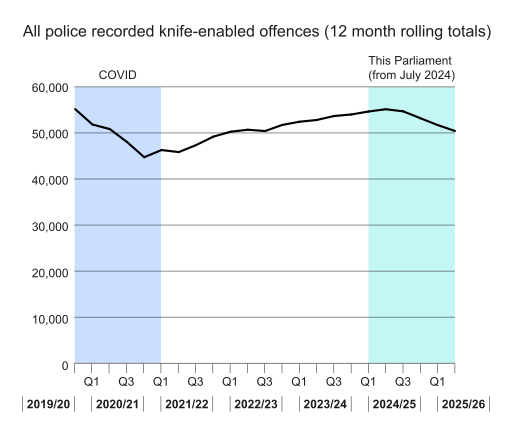
(This is a line chart showing the trend in all police recorded knife-enabled offences as 12-month rolling totals. It starts from the year ending March 2020, and shows a drop from 55,170 offences to 44,728 offences by the year ending March 2021. It shows that this period was affected by Covid-19 lockdown restrictions. It then shows a gradual increase from this point, rising to 55,149 by the year ending September 2024. This then shows a further decrease from this point to the latest data, 50,430 in the year ending September 2025. The period of this Parliament is also highlighted in the graph, from July 2024 onwards.)
The vast majority of these offences (84%) consisted of either assaults involving a knife (43%) or knife-enabled robberies (41%).
Knife-enabled offences by offence type, year to September 2025
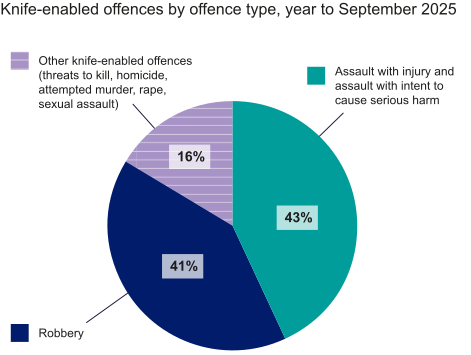
| Assault with injury and assault with intent to cause serious harm | 43% |
| Robbery | 41% |
| Other knife-enabled offences (threats to kill, homicide, attempted murder, rape, sexual assaunt) | 16% |
The remaining offences included knife homicides, threats to kill made with a knife, and sexual assault and rape where a knife was involved.[footnote 5]
We have already turned the rising tide on knife crime into a decline, and we will not stop until serious violence is driven out of our communities and every young person has the chance of a safer future. Since the start of this Parliament overall knife crime has dropped by 8%,[footnote 6] knife homicides are down 27%[footnote 7] and hospital admissions for stabbings are down by 11%.[footnote 8]
Number of homicides involving a sharp instrument (12 month rolling totals)
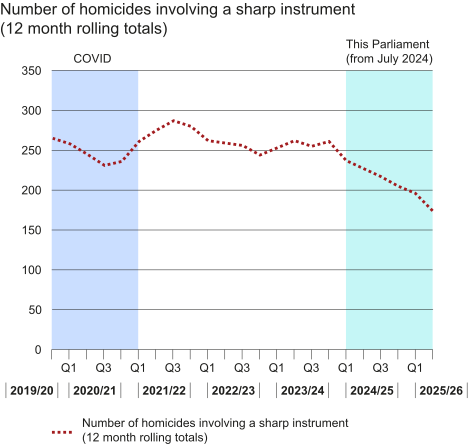
(This is a line chart showing the trend in homicides involving a sharp instrument as 12-month rolling totals. It starts from the year ending March 2020, and shows a drop from 265 offences to 231 offences by the year ending December 2020. It shows that this period was affected by Covid-19 lockdown restrictions. It then shows an increase from this point, rising to 287 by the year ending December 2021. This then shows an overall decrease with fluctuations over the period, from this point to the latest data, 174 in the year ending September 2025. The period of this Parliament is also highlighted in the graph, from July 2024 onwards.)
Annual number of NHS hospital admissions for assault with a sharp object, by age
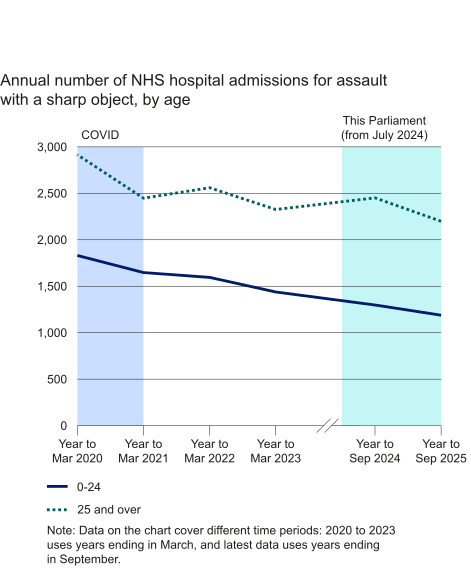
(This is a line chart showing the trend in NHS hospital admissions for assault with a sharp object by age, as annual totals. It starts from the year ending March 2020. For those aged 25 and over, the volume of admissions starts from 2,915, and drops to 2,448 by the year ending March 2021. It shows that this period was affected by Covid-19 lockdown restrictions. It then shows a slight increase to 2,560 by the year ending March 2022, and an overall downwards trend with fluctuations to the latest data point, 2,199 in the year ending September 2025. For those aged under 25, the volume of admissions starts from 1,831 in the year ending March 2020, and shows a continued decrease across all data points to the latest data point, 1,188 in the year ending September 2025. The period of this Parliament is also highlighted in the graph, from July 2024 onwards.)
Knife-enabled assaults have fallen by 9% and knife-enabled robberies by 10%.[footnote 9] In real life terms, this means over 2,100 fewer victims of knife-enabled assaults and 2,300 fewer people have experienced the fear of being robbed under the threat of a knife.[footnote 10]
Police recorded knife-enabled offences (12 month rolling totals)
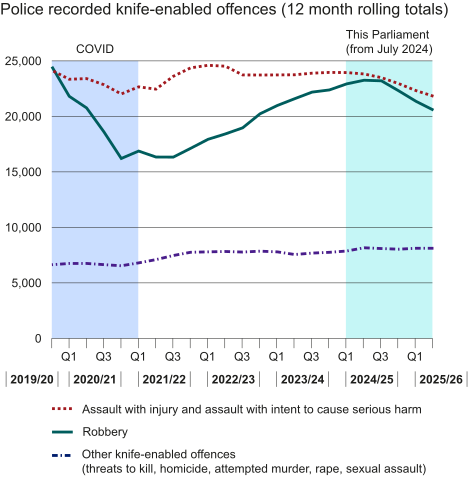
(This is a line chart showing the trend in police recorded knife enabled offences as 12-month rolling totals. It splits out knife-enabled assault and assault with intent to cause serious harm, knife-enabled robbery, and grouped other knife-enabled offences (threats to kill, homicide, attempted murder, rape, and sexual assault). It starts from the year ending March 2020. For knife-enabled assault, the trend decreases from 24,088 to 22,609 offences by the end of June 2021 (the end of COVID-19 restrictions) before rising again to 23,890 by the start of this Parliament. Since this Parliament, the figure has decreased to 21,768 offences in the year to September 2025. For knife robbery, the trend decreased sharply from 24,419 to 16,852 in the year ending June 2021 (the end of Covid-19 restrictions) before rising again to reach 22,877 by the start of this Parliament. Since this Parliament it has decreased to 20,523 offences in the year to September 2025. For other knife-enabled offences these have gradually increased over the whole time period, from 6,663 offences in the year to March 2020 to 8,139 in the year to September 2025.)
Knife crime must be prevented wherever it takes place. Every offence, every injury and every life lost is one too many. To do this, we need to understand the different nature and drivers of knife crime – because knife crime does not look the same everywhere. Evidence shows us that while knife crime is a national issue, it mainly occurs in highly concentrated areas in major metropolitan centres, shaped by distinct local conditions and pressures. In some of these locations, robbery linked to the night-time economy is often a significant driver of knife crime. In other areas, child criminal exploitation (CCE), gang activity and youth violence are key factors. Recognising these differences enables us to design interventions that respond to the specific local dynamics of knife crime.
Just three police force areas account for nearly half of all knife-enabled crime in England and Wales, each of which are seeing significant falls in offending since the start of this Parliament.
| Police Force | % of all Police Recorded Crime knife-enabled offences (England and Wales) | % change YE Sep 25 compared to YE June 24 baseline |
|---|---|---|
| Metropolitan Police | 29% | -7% |
| West Midlands | 8% | -20% |
| Greater Manchester | 6% | -8% |
Knife carrying
Knife carrying is not included in overall knife crime statistics, but understanding it matters, because if someone is carrying a knife, a conflict is more likely to result in serious threat or injury. In the year to September 2025, the incidents of knife possession[footnote 11] encountered by the police increased by 1% to a total of 28,596.[footnote 12] Over that year, 3,598 children aged 10 to 17 were cautioned or convicted for knife and offensive weapon possession offences – a 7.8% increase compared to ten years ago.[footnote 13] The majority of people prosecuted for carrying knives are adults, with over-18-year-olds making up 88% of those sentenced for possession of an article with a blade or point.[footnote 14] Knife carrying is often driven by previous victimisation and a need for protection.[footnote 15],[footnote 16]
Evidence box A: What does the Youth Endowment Fund (YEF) say?
-
In 2025, the YEF surveyed nearly 11,000 13-17-year-olds across England and Wales about their experiences over the past 12 months. This study found that most teens who carry weapons have been victims of violence.
-
40% of weapons carriers had been victims of serious violence, compared to 3.3% of those who had never carried weapons.
-
32% of weapons carriers had been victims of weapon-related violence, compared to 2.9% of those who had never carried weapons.
-
Those who carried weapons were five times more likely than their peers to be a victim of violence and 14 times more likely to have been a victim of repeated incidents of violence.
-
These findings suggest that cycles of violence may drive some children to arm themselves for defence, retaliation or other reasons.
-
Of the 2.1% of those who said they had carried a weapon in the past 12 months, 68% reported carrying any kind of knife, equivalent to 1.4% of 13-17-year-olds in England and Wales. (i)
Knife Crime Today: Key Data[footnote 17]
- 75% of knife crime offenders are estimated to be 18 and over (i)
- 95% are estimated to be male (i)
- Males consistently make up nearly three-quarters of sharp instrument homicide victims (ii)
- 69% of cautions and sentences for knife and offensive weapons offences in the year to September 2025 were for first time knife or offensive weapon offenders (iii)
- 31% were given to repeat offenders (iii)
- 91 % of sharp instrument homicide victims are over the age of 18 (iv)
- Each year around 90% of those seriously injured by sharp object assaults are male (v)
- Almost 65% of assault with sharp object victims needing hospital treatment in England and Wales in the year to September 2025 were 25 and over (vi)
- 4 or more adverse childhood experiences sees a child or young person 7x more likely to have been a victim of violence and 8X more likely to have committed a violent act (vii)
- 16 is the peak age for an offender’s first serious violence offence in England (viii)
- An estimated 15,500 children were identified as at risk or involved in child criminal exploitation in the year ending March 2025 (ix)
- 71 % of sentenced children who were assessed by Youth Offending Teams had mental health concerns (x)
- A study found 54% of children cautioned or sentenced for a serious violence offence had ever been known to children’s social care in England (xi)
- Pupils who have been suspended have approximately 4X greater odds of ever being cautioned or sentenced for a serious violence offence than children who had not been suspended (xii)
Who is involved in knife crime?
Knife crime does not affect all communities equally. While most victims and offenders are White, young Black men are disproportionately represented as victims and offenders. In the year to September 2025, 17% of children and 9% of adults sentenced for knife possession offences were Black,[footnote 18] despite making up 4% of the general population.[footnote 19] Black individuals are also admitted to hospital for assault by sharp object at a rate over four times higher than the White population,[footnote 20] and 22% of victims killed with a knife were Black in the year to March 2025 – over half of whom were under-25-years-old.[footnote 21] This disproportionality is driven by a complex mix of factors (see Annex A). Some groups are more likely to grow up to experience multiple disadvantages that increase the risk of violence, both as victims and perpetrators, and have worse access to services and support.[footnote 22]
We will be working across the system to build trust with those affected by knife crime, avoid bias and embed fair and proportionate approaches. This will help reduce knife crime while responding to disproportionality in a fair and proportionate way. For example, data shows children from Black backgrounds are more likely to attend youth clubs and therefore they are likely to benefit from the Government’s investment into youth facilities.[footnote 23]
Girls and women are far less likely to perpetrate knife crime than boys and men. Fewer than one in ten offenders sentenced for knife possession offences are female.[footnote 24] However, women and girls are more likely to be victims of knife-related harm in domestic abuse-related offences and knife-enabled sexual assault and rape offences.[footnote 25] In the year to September 2025, there were over 1,300 police recorded knife-enabled sexual assaults and rapes – the majority of these victims were female.[footnote 26]
We know that many sexual offences are not reported to the police, meaning that police recorded sexual offences are not a good measure of the volume of these offences, or a good indicator of trends over time. Increases in knife-enabled sexual offences recorded by the police can reflect improvement in people’s willingness to report to the police and improved crime recording, as well as a potential genuine increase in crime levels.
The landmark Freedom from Violence and Abuse: a cross-government strategy to build a safer society for women and girls sets out clear action to halve violence against women and girls (VAWG) in a decade. The strategy sets out a number of commitments that will drive down knife-enabled VAWG offending. Our commitment to embed specialist rape and sexual offences teams in every police force in England and Wales will ensure force has the right specialist capability to properly investigate rape and sexual offences. We will also introduce a package of legislative measures to improve the experience of giving evidence for victims and survivors of sexual violence. The Freedom from Violence and Abuse Strategy will work together with this Plan, with shared priorities and interventions that address both forms of serious violence.
The Coalition to Tackle Knife Crime
We are taking a whole of society approach. Halving knife crime has never been achieved before, and we cannot do it alone. This is not a new challenge, but historically, responses have been fragmented. Every sector has something important to contribute, whether that is recognising early warning signs, providing safe spaces or offering guidance.
That is why the Prime Minister launched The Coalition to Tackle Knife Crime in 2024. This brings together families with personal experience, community leaders, front-line practitioners, ‘what works’ centres and academics to ensure national policy is grounded in real-world insights that help us design stronger, more practical policies.
Over the last year, the Coalition has shaped national policy and driven real-world change:
-
In August 2025, the Coalition, community partners and the police were the driving force behind the success of our knife surrender schemes, which has contributed to more than 63,000 dangerous knives taken off the streets.[footnote 27] Their insights saw the introduction of anonymous drop-off points and a mobile surrender van, now run by Coalition Member, FazAmnesty.
-
The Coalition helped shape the design of the Government’s response to CCE, including the creation of a new CCE offence, which will protect young lives and see those cruelly exploiting children into criminality brought to justice.
We have never had more data, more insight, or more determination to stop knife crime as a whole community. Alongside the Coalition, we are working with the National Police Chiefs Council (NPCC), the College of Policing and a range of experts to test and implement innovative ideas. This builds on the tireless efforts made by communities across the country to reduce harm by offering trusted adults, safe spaces and informal support that helps people cope with fear, trauma, or bereavement linked to knife crime.
We are working closely with Coalition members, including the Centre for Young Lives and the Youth Endowment Fund (YEF) to pursue the best evidenced interventions to reduce serious violence. The YEF, backed by a £200 million Home Office endowment, is the ‘What Works’ Centre for preventing violence affecting children and young people.
The YEF’s research into the most effective things we can do to prevent serious violence is behind much of this Plan and guides which interventions are becoming standard practice nationwide, through tools such as its ‘Violence Prevention Toolkit’.[footnote 28] That is why insights from the YEF’s research and Toolkit are shared throughout the Plan. Further explanation of the YEF’s Toolkit, and the evidence underpinning it, can be found at Annex C.
Knife crime, unlike humans, fails to discriminate. No matter what age, race, gender you are, no matter your innocence, none of us can be 100% certain, that we, or anybody that we know or love, will be safe from its clutches.
It is imperative that we work as one larger community, it is imperative that we don’t let useful young minds waste away, when they could be providing valuable input to this crisis, and it is imperative, that we keep supporting organisations who give young people such as myself, the resources to have a voice, the resources to attempt to make a change.
We must strive to fight against this problem. Unity, is an extremely powerful thing. We must continue to work together. Together, we can create change.
Fabio Ferreira Lourenco, Youth Ambassador for the Ben Kinsella Trust (a member of the Coalition)
Quote taken from Fabio’s speech at the Knife Crime Awareness Week event at the House of Commons in May 2025.
Our Plan
This Plan sets out cross-government activity and investment that will deliver four outcomes to drive a sustained reduction in knife crime to reach our goal to halve it in a decade. Everything we do will be targeted to the people and places that need it most. The actions in the Plan have been chosen because evidence, including from the YEF, tells us they are most likely to have a positive impact on those who may be at greatest risk of going on to commit knife crime and serious violence.
We will:
-
Support young people so they get a better start in life;
-
Stop those at risk from turning to knife crime;
-
Police our streets to punish perpetrators and stop offending, and;
-
End the cycle of knife crime.
Each is important on its own. But it is by combining early support, targeted intervention, targeted policing and specialist rehabilitation, that we will drive lasting change. By reducing the number of young people drawn into risk, acting early when signs appear, relentlessly enforcing the law and supporting those already involved in violence to find a safer path, this Plan will build a safer, more hopeful future for our communities.
Support young people so they get a better start in life
‘Support’ addresses the root causes of knife crime, acting early to prevent the childhood harms and traumas that can increase the risk of knife violence offending later in life. It aims to ensure that fewer young people reach the point where carrying a knife seems like a reasonable option.
The vast majority of children who suffer adverse and traumatic experiences in childhood do not go on to commit knife crime or serious violence, but children who do are at greater risk of being drawn into knife crime. [footnote 29], [footnote 30], [footnote 31] Many young people are dealing with pressures in their everyday lives such as unstable housing, family stress, financial hardship, bullying and constant exposure to violence or harmful content online, which can make them feel unsafe, unsupported and more likely to be drawn into risky situations.[footnote 32], [footnote 33]
Exactly how the relationship between this and involvement in knife crime works is complex. For example, people who have adverse experiences in childhood may go on to develop mental health challenges, substance misuse and dis-engage from school because of those early experiences. These in turn can increase someone’s vulnerability to being drawn into knife crime. Likewise, experience of knife crime itself increases the risk of further involvement in violence, but it also may lead to mental health concerns.
It is crucial that vulnerable children and young people who experience multiple adverse experiences are not stigmatised; the need for positive support that does not re-traumatise them is critical for the intervention to succeed and for positive outcomes for that child.
Crucial foundations for this approach are set out in the Youth Matters: Your National Youth Strategy and the Children’s Wellbeing and Schools Bill. Both tackle these risks head-on, creating stronger foundations for children and young people to feel safe, supported and connected.
The National Youth Strategy is taking a national-to-local approach, recognising that factors in young people’s lives which can be associated with increased risk of knife crime involvement, such as mental health challenges and social isolation, are not the same everywhere.[footnote 34],[footnote 35] It will rebuild the role, capability and leadership of local authorities in the youth sector and take a place-based approach to funding to empower local communities in delivering local youth offers that meet the needs of residents.
The Children’s Wellbeing and Schools Bill will improve child safeguarding and ensure better welfare support to create consistent, protective environments for our children.
Calm, caring and predictable environments are inclusive environments for all children. High expectations of behaviour and early intervention to understand root causes should enable children to engage and participate at school, reducing disruptive behaviour.
Violence has no place in our schools, and we trust headteachers to use sanctions appropriately, in line with guidance and their professional judgement and recognising the circumstances of individual pupils when deciding on exclusion.
By raising aspirations in schools, strengthening support for excluded children and expanding youth provision, we will create opportunities to steer young people away from harm. Mentoring, accessible mental health support and safe spaces will give teenagers alternatives to unsafe streets and feeling like they have to mix with the ‘wrong crowd’. When young people feel a sense of belonging and trust the people around them, the likelihood of conflict and weapon carrying drops sharply.[footnote 36] Over time, this approach will reduce the social, emotional and practical drivers of knife crime.
We will support young people so they get a better start in life by:
- Putting trained youth workers, trusted adults and safe spaces in the heart of communities to support young people;
- Tackling the root causes of knife crime in schools;
- Supporting families and carers to address the root causes;
- Reducing access to violent material online;
- Delivering new behaviour-change communications campaigns.
Putting trained youth workers, trusted adults and safe spaces in the heart of communities to support young people
50 Young Futures Hubs launched in areas impacted by knife crime across the country by the end of this Parliament. The first wave of eight hubs, backed with £4.2 million of investment, are already being delivered in local authority areas with high knife crime and anti-social behaviour. The subsequent 42 hubs will be rolled out by March 2029.
This Government is committed to ensuring that success is not determined by background. These hubs will bring wellbeing support, careers guidance and positive activities into one place. This will help young people access job opportunities, ensure their safety by reducing vulnerability to being drawn into crime, including knife crime, and improve their mental health and wellbeing.
They will build on the success of existing infrastructure and provision, ensuring that local services can be brought together to support young people. Their specific location will be determined by local expertise and recognition of local need.
It is essential that children and young people can access support without fear of stigma. That is why one of the key principles of the hubs is that they will be open access as well as targeted. They will be welcoming places offering all young people a positive experience, alongside providing additional support to the young people who need it. This is about providing the right support at the right time. Where Young Futures Panels and Hubs are located in the same local authority, the Hubs and Panels will work together to ensure children at risk of knife crime are provided with the support they need.
£500 million invested through the Better Futures Fund to support up to 200,000 children, young people and their families over the next ten years. It will do this by bringing together government, local communities, charities, social enterprises, investors and philanthropists to deliver place-based solutions to complex social problems. The funding will primarily be for commissioning Social Outcomes Partnerships,[footnote 37] with payments tied to the achievement of measurable improvements, such as school attainment, improved youth employment or reduced youth reoffending. The fund will aim to raise another £500 million from local government, social investors and philanthropists on top of the government’s funding, creating total funding of up to £1 billion.
The Youth Guarantee is supporting 16–24-year-olds across England, Scotland and Wales into work, education and training through early, tailored employment support, expanded Youth Hubs and access to high-quality opportunities, including guaranteed jobs. This gives young people the skills they need to succeed and clear, positive pathways into employment.
Refurbish and build up to 250 youth clubs and facilities in areas that need it most. Over the next four years, the Better Youth Spaces Programme will invest £350 million to create safe, welcoming spaces to reach more young people and offer a wider variety of activities, in the places that most need it. Spaces like these give young people a safe option with access to responsible adults, opening opportunities away from violent crime.
Train a new generation of youth workers, volunteers, and other trusted adults through an initial £15 million of investment over the next three years. The National Youth Strategy sets out our ambition for half a million more young people to have access to a trusted adult outside of their home by 2035. This means more adults able to reach more vulnerable young people with the right understanding and skills needed to make a difference. We know that children most at risk of involvement in knife crime are more likely than their peers to seek this support.
Improve training for youth workers so they can identify indicators of exploitation and violence. All national youth worker qualifications and safeguarding training will ensure practitioners can identify indicators of CCE and community violence. This training equips youth workers to safeguard young people through appropriate referral pathways while providing direct support appropriate to their role. We will review Level 4 qualifications on exploitation and violence and introduce specialist training for those working in high-risk environments.
Evidence box B: What does the Youth Endowment Fund say?
-
Improving access to youth clubs in underserved areas and increasing funding for existing youth clubs can play a role in preventing violence. The research suggests that, on average, having access to a youth club may reduce children’s offending by 13%.
-
Long-term, trusting relationships with safe, trained adults can protect children from becoming involved in violence. Mentoring programmes, which match children with a mentor who provides regular support and guidance, can reduce violence by 21% on average.
-
A 2024 YEF survey of 10,000 teenage children across England and Wales found that those who are involved in violence or face greater risk of violence – such as those who carry weapons, identify as part of a gang, or have been excluded from school – are more likely than others to turn to adults outside of school settings, such as sports coaches, mentors, doctors, or youth workers.
-
Adults who support children at risk of or involved in violence should receive regular supervision and specialist training in violence prevention, relationship abuse and child criminal exploitation.
[Since] I’ve been doing sessions with [my mentor], I’ve had encounters where a fight could have happened …. [The techniques my mentor showed me have] helped me in actual scenarios, and it’s helped me stay calm … if I didn’t have a trusted adult, I reckon I could have gone down a very, very bad path of violence.
Young person interviewed by the Youth Endowment Fund, YEF Fund’s Peer Action Collective (2025) (and featured in the YEF’s Youth Sector Practice Guidance, 2026).
Tackling the root causes of knife crime in schools
The ‘Every Child Achieving and Thriving’ White Paper sets out how schools will provide better support for children to remain engaged in our education system. Subject to public consultation, this includes:
-
Schools will be supported with clarity on when internal suspensions are appropriate and how to structure them effectively, with a new national framework. Internal suspension can serve as a valuable opportunity for a behaviour reset. It also allows pupils to remain in school, safeguards them and maintains access to learning, rather than being sent home where they could disengage.
-
Schools will set schoolwork for the first five days of a child being excluded. This will stop pupils missing out on learning and save time catching up on missed work.
-
Ensuring parents are engaged when their child has been suspended, through ‘Reintegration Support Partnerships’. When a child has been suspended, schools will set up a meeting between parents and the school to agree a plan for the pupil to return to school. This will ensure parents are playing their part and help their child back to school.
93 Attendance and Behaviour Hubs across the country are helping children back to school. These Hubs, backed by the Department for Education, are run by high achieving schools to support schools in their areas to improve attendance and behaviour early. They support violence prevention, including knife crime, by reducing persistent absence and strengthening the protective role of schools. This helps identify problems early, engage families and keep children safely in education, reducing the risks linked to disengagement.
Evidence box C: What does the Youth Endowment Fund say?
-
Being suspended or excluded from school places children at greater risk of later involvement in violence. Even when accounting for a range of contextual factors (including behaviour), suspended or excluded children are more than twice as likely to perpetrate violence and almost five times as likely to offend. (i)
-
A YEF and Teacher Tapp survey in 2025 of nearly 3,000 headteachers and senior leaders in England found that less than half (49%) provide a reintegration strategy for children suspended for two to five days, less than a quarter (24%) provide a pastoral member of staff to check in with the suspended child daily, and only 7% provide a mentor upon the child’s return. In addition, only 30% reported setting and marking schoolwork for suspended children. (ii)
-
Schools, colleges and Alternative Provision settings deliver a range of evidence-based interventions (like mentoring, targeted sports provision and social and emotional skill development) that can keep children safe from violence. (iii)
Support for 10,000 pupils through a new attendance mentoring programme backed by £15 million investment. This project involves individual persistently absent children receiving support from trained attendance mentors to help address specific barriers to them attending school. Alongside this, we will also ensure that attendance is prioritised when children are considered for support through youth programmes like the Young Futures Programme.
Severe Absence Pilots will deploy specialist practitioners to work directly with Local Authorities and partners to develop effective approaches to severe absence. Sustainably improving school attendance is a complex challenge, without simple solutions. We will therefore strengthen expert support to local authorities to audit their practices for addressing severe absence from school (children who are absent more than 50% of the time) and identify areas for improvement. The pilots will build an evidence-based toolkit for use everywhere.
Guidance will be published for children’s social care professionals, including social workers, on expectations for effective multi-agency working to support attendance amongst pupils who are children in need, looked-after children, and children with a protection plan to ensure these vulnerable cohorts are consistently identified, supported and reached.
Best practice identified in the Alternative Provision Specialist Taskforces (APST) pilots is now being widely recommended to education settings to support children who have been excluded or are at risk of exclusion from mainstream school. This is set out in the Every Child Achieving and Thriving White Paper. The pilots co-locate multi-disciplinary specialist teams (including youth workers, family workers, speech and language therapists) within Alternative Provision (AP) schools and do preventive outreach in mainstream schools for children at risk of exclusion. This builds on the successful pilots that improved attendance and delivered ‘rapid, integrated and comprehensive support and improved safeguarding’[footnote 38], reducing children’s vulnerability to involvement in knife violence.
Evidence box D: What does the Youth Endowment Fund say?
- Approximately 14% of Key Stage 4 children in Alternative Provision (AP) in England have been (or will go on to be) cautioned or sentenced for a serious violence offence (compared to only 1% of all children). (i)
- Therefore, it is critical that children in AP are provided with high quality, evidence-based support to reduce their risk of later involvement in violence. Alternative Provision Specialist Taskforces (APST) provides a model of co-location that aims to deliver this support.
- YEF has robustly evaluated APST and the evaluation shows that this support improves critical outcomes such as children’s attendance. (ii)
Introducing an updated Relationships Sex and Health Education (RSHE) curriculum will support pupils to increase their safety from violence in September this year. This curriculum will begin with teaching skills for healthy relationships and asking for help in primary school. In secondary school it will teach key social and emotional skills, the law about knives, tackle misconceptions about weapon carrying and how to seek help when pupils are seeing signs of knife violence.
Review how National Professional Qualifications for teachers and leaders can improve teacher knowledge and confidence in reducing the root causes of knife crime in schools by improving school culture, pupil wellbeing, motivation and sense of belonging.
We are making it easier for school leaders to invest in programmes to reduce the risk of serious violence this year, by making it clear that pupil premium funding is also available to use for funding violence-reduction programmes. The pupil premium grant, which totals £3.2 billion this year, is provided to state schools to improve educational outcomes for disadvantaged children. Most school leaders are already investing some of this grant in interventions to support pupils’ social, emotional and behavioural needs, which is an evidenced way to reduce the risk of serious violence, including knife crime.
Evidence box E: What does the Youth Endowment Fund say?
- A 2025 YEF and Teacher Tapp survey of almost 10,000 teachers in England found that 70% of teachers are ‘not confident’ or ‘not at all confident’ in identifying and delivering evidence-based interventions for preventing children’s involvement in violence.
- In a December 2024 YEF and Teacher Tapp survey answered by over 7,000 teachers in England, 82% of teachers, 72% of Designated Safeguarding Leads (DSLs) and 77% of deputy DSLs in England reported receiving no training on serious violence in the previous two years.
- Almost a third of teachers in England (30%) who were surveyed in December 2024, report that they are ‘not confident’ or ‘not at all confident’ in identifying a child who is involved in or at risk of becoming involved in serious violent crime. (i)
Accelerate the rollout of Mental Health Support Teams (MHSTs) for all schools and colleges by 2029. This means children can get help early before mental health challenges escalate.[footnote 39] MHSTs ensure that children and young people have a clear and trusted route to mental health support. Working directly with pupils and alongside teachers, pastoral staff and school leaders, MHSTs will make mental health support a visible and everyday part of school life.
Invest an additional £13 million to pilot enhanced training so MHST staff are better equipped to support young people with trauma, neurodivergence and disordered eating, helping more children stay engaged in education and thrive.
Overhauling how mental health support is delivered in England, through our 10 Year Health Plan. This will see wait times reduced, improved quality and a shift to community based, preventative care. People will access high quality support sooner, with more individuals recovering or living well with mental illness.
Evidence box F: What does the Youth Endowment Fund say?
-
The vast majority of children who experience mental health difficulties will not go on to commit serious violence. However, children who are affected by violence experience high rates of mental health difficulties and mental health difficulties are associated with later involvement in violence. (i)
-
A YEF survey of 11,000 teenage children across England and Wales (ii) found that nearly three-quarters (73%) of teenage victims of serious violence said they had either a mental health condition, neurodevelopmental condition, or learning, speech, or communication difficulty, or a combination of these diagnosed by a doctor, therapist, or psychologist. (iii)
-
Perpetrators were even more likely to report these diagnoses (81%) (iv) – more than four times the rate of children who were not victims or perpetrators (19%). (v)
-
Behavioural and emotional problems have also been found to have possible associations with involvement in violence. (vi) This includes disorders like attention deficit hyperactivity disorder (ADHD) and conduct disorder, depression and post-traumatic stress disorder.
-
Prompt access to evidence-based psychological therapy can reduce children’s involvement in violence. Behavioural and cognitive behavioural therapy has been shown to be effective at reducing reoffending in young offenders and can also be effective in reducing externalising symptoms (including ADHD, conduct disorder, oppositional defiant disorder) in children and young people. (viii) Further information about the evidence that underpins Cognitive Behavioural Therapy (CBT) can be found in the YEF toolkit. (ix)
-
Children vulnerable to involvement in violence are not always receiving the support they need. The same YEF survey also explored access to treatment among this cohort of children (x) and found that only 37% of perpetrators of serious violence who reported having a condition (xi) diagnosed by a doctor, psychologist, or therapist said they were receiving treatment or support. (xii)
-
A review of mental health support for children at risk of or involved in violence found that risks linked to violence or exploitation were often overlooked by mental health services, and children whose distress presented as violent or disruptive behaviour – including neurodiverse children and those with complex needs – were more frequently treated as disciplinary or social care concerns.
Supporting families and carers to address the root causes
Invest £2.4 billion to the Families First Partnership (FFP) programme over the next two years, which focuses on multi-agency, system-wide reform to children’s social care.
Loving, enduring family relationships are among the most important factors in keeping children safe and helping them to thrive. When families face challenges, this can increase the risk of high levels of conflict, limited parental attention or warmth, or emotional or physical abuse. These experiences can have a lasting impact on children and young people’s development, welfare, health and behaviour, and can increase the risk of later involvement in knife crime and violence.[footnote 40],[footnote 41],[footnote 42],[footnote 43]
Establish new expert-led multi-agency child protection teams (MACPTs) in every local authority in England – to bring a clear, fresh focus to child protection practice and lead and oversee child protection activity. These teams will bring skilled and experienced social workers known as Lead Child Protection Practitioners, police, health, education and other relevant practitioners and agencies together to act quickly and decisively to protect children from significant harm – inside and outside the home, and online. Some Families First for Children pathfinder areas have developed MACPTs with a specific focus on harm outside the home.
FFP will include best practice from the Supporting Families programme, which was evaluated as having led to a 35% reduction in juvenile custodial sentences and a 15% reduction in juvenile convictions over a two-year period.[footnote 44]
‘Vanguards’[footnote 45] are bringing together health, education, social care and youth justice together around children with complex needs, so families and carers get the right support earlier and do not have to navigate multiple systems alone. Through the Framework for Integrated Care, evidence shows that many of these children have complex needs that are not helped by standard approaches at first. What makes the difference is trust, time and stable relationships, which can unlock progress for children, families and the services around them. Working in this joined‑up way is already improving outcomes for children and supporting staff in difficult roles. Building on this foundation, a proposal for an enhanced vanguard model has been developed.
Together, these reforms build a more compassionate, coordinated system that wraps around the most vulnerable children and their families – giving them earlier support, stronger relationships and a clearer path to safety, stability and hope.
Reducing access to violent material online
Limiting young people’s exposure to knife crime and violence requires a robust approach to tackling the harmful content they can access online and through social media.
We have heard directly from young people that exposure to violent content online is widespread. This has real-world consequences. Seeing content that glamourises, normalises and amplifies violence online makes young people feel unsafe, more likely to carry a weapon themselves and escalates tensions offline[footnote 46].
It’s so easy to see this real-life crime, and it’s so easy to see without even trying to search for it. You see it every day. And yeah, social media plays a massive part in promoting this violence…I saw violence at home. I saw violence at school, and I saw violence on social media… so it was pretty much just everywhere I looked was violence. So, there’s kind of only one way I can go.
Tommy (name has been changed to protect anonymity), a Youth Endowment Fund Youth Advisory Board member, featured in YEF, Children, violence and vulnerability: What role does social media play in violence affecting young people?, 2024.
Through the Online Safety Act 2023 (OSA), online providers have legal duties to put proportionate systems and processes in place to prevent users from encountering illegal content and to remove such content swiftly once they become aware of it. This includes content relating to violence, weapons and drugs, and also content that incites violence or otherwise facilitates criminal activity, including the sale of illegal knives, weapons and drugs. These duties are enforced by Ofcom, the OSA’s independent regulator, with the aim to create a safer online environment and require platforms to take proactive steps to find, remove and limit exposure to illegal content.
We will continue to work closely with Ofcom to make online spaces safer, reviewing and strengthening our powers where necessary to respond to online threats. As part of this, the Government has launched a consultation on children’s wellbeing online alongside a national conversation, on further measures to ensure children’s experiences online are safe and enriching. The consultation covers further measures for keeping children safe online and to prepare them for the future in an age of rapid technological change. This includes potential age restrictions on social media and other services such as gaming sites and artificial intelligence chatbots, and restrictions on addictive design features and risky functionalities.
Evidence box G: What does the Youth Endowment Fund say?
- A 2024 YEF survey of 10,000 13–17-year-olds across England and Wales found that 70% of teenage children encounter real-world violence online. Few who encounter it are seeking it out (25% said social media promoted it to them).
- The vast majority (80%) of teenage children who encounter weapons related content on social media say it makes them feel less safe in their local communities. This perceived threat has tangible consequences – 68% of teenagers who have seen weapons on social media say it makes them less likely to venture outside, and 39% admit that it makes them more likely to carry a weapon themselves.
- Nearly two thirds (64%) of teenagers who report perpetrating violence in the previous 12 months say that social media has played a role in their behaviour. Factors like online arguments and the escalation of existing conflicts are commonly cited as catalysts for real-world violence. (i)
Delivering new behaviour-change communications campaigns
Launch a series of targeted pilots later this year to understand how communications can help reduce the behaviours that lead to knife crime. These pilots will test different approaches at key points in the knife crime pathway, from prevention to intervention. We will work with young people, police forces and other organisations with front line experience in the development of these plans to ensure we are having the best impact we can. We will look at how we can reach young people who could be at risk of being drawn into knife crime while also focusing on how to change the ‘in the moment’ action of committing an act of knife crime in hotspot areas. As well as helping us identify where communications can make the biggest difference now, the findings will inform future behaviour change campaigns and shape a stronger, evidence-based model for how we communicate risk and safety in the years ahead.
Stop those at risk from turning to knife crime
We will prevent knife crime by intervening earlier with individuals most at risk of engaging in violent offending, and by focusing on high-risk places to reduce exposure to harm, exploitation, and coercion.
The activities set out here will drive earlier, more effective intervention with the people who are showing signs of being drawn into knife crime and serious violence, as an offender, a victim, or both. It focuses on identifying those at highest risk and ensuring they get targeted, preventative support while we simultaneously disrupt the criminality and exploitation that pulls people into serious violence, including county lines and other drug-related harm.
The rise in knife crime in recent years has not been driven by one single factor. For some young people, criminal exploitation and coercion play a powerful role. Approximately 15,500 children were identified as at risk or involved in child criminal exploitation in the year to March 2025.[footnote 47] Organised crime groups and county lines gangs can manipulate, threaten, or groom young people into carrying weapons, often under the false promise of protection or belonging. For example, one in eight teenagers (12%) said that in the past 12 months they had been asked to either sell drugs, transport drugs, or store drugs, weapons or money.[footnote 48]
Through partnership working, we will be able to identify young people in danger of criminal involvement and intervene before it is too late. We will work with, through and in schools to keep children safe when they are there, as well as reduce the risk they are drawn into knife crime outside the classroom. For this to be effective we also recognise the value of working with whole families; parents, carers and siblings. By reaching those who might otherwise remain unseen and unsupported, fewer people will be drawn into knife crime.
We will stop those at risk from turning to knife crime by:
- Strengthening early intervention with children at risk of being drawn into violence;
- Tackling county lines violence and exploitation;
- Stopping young people carrying knives;
- Making schools safer from knife crime.
Strengthening early intervention with children at risk of being drawn into violence
Invest over £66 million this year in Violence Reduction Units (VRUs), the delivery of the Serious Violence Duty and continued piloting of Young Futures Panels.
VRUs have prevented thousands of young people from being admitted to hospital for violent injuries in the 20 police force areas in England and Wales that account for 80% of knife crime across England and Wales.[footnote 49] Since 2019, VRUs, in combination with hotspot police patrols, have prevented an estimated 550 sharp object hospital admissions and around 3,750 admissions for all types of violence among under-25-year-olds.[footnote 50]
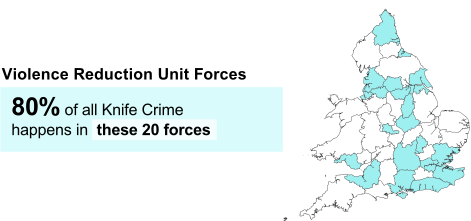
(This is a map of England and Wales showing which forces have Violence Reduction Units (forces are coloured in blue, and are detailed in Footnote 47). The infographic says that 80% of all knife crime happens in these 20 forces.)
In one year alone, VRUs reached over 300,000 people.[footnote 51] They fulfil a unique role by bringing local services together so communities can prevent serious violence before it happens. They link up the police, schools, health partners, councils and community groups to understand why violence is happening locally and take action together. This approach is based on a model first used in Glasgow, which helped drive down violent crime across Scotland.
VRUs provide a wide-ranging programme of support, rooted in their local communities. These are tailored to the needs in their local area and can include:
-
Getting young people involved in sports programmes that help build confidence, manage conflict and reduce aggression.
-
Placing trained youth workers in A&E departments and police custody, so when a young person is stabbed or arrested, they can get immediate support, mentoring and help into services.
-
Trialling intensive focussed deterrence programmes for those most at risk of offending, combining strong support to change behaviour with clear consequences if violence continues.
-
Working closely with education partners to ensure they have the tools they need to deliver preventative education programmes which cover a range of areas including knife crime, VAWG, anti-social behaviour and healthy relationships.
-
Providing parents with the knowledge and support they need to prevent their children from being drawn into violence, through education programmes and networks.
Case study: Northumbria Violence Reduction Unit – Strengthening the school to-service pathway
Northumbria VRU was able to bridge the gap between education and other services, ensuring that early indications of risk triggered early support and referral decisions. The VRU targeted interventions to schools within violence hotspot areas, commissioning Student Support Champions to work with a caseload of young people within secondary schools. This included preventative one-to-one and group work within schools, as well as signposting to other statutory or community sector services. The VRU also developed a Transitions Project to work with identified children prior to them moving to secondary school, particularly where data suggested could be at risk of involvement in violence. This was supported by a universal knife protocol across schools in all local authorities in the area, which equipped schools with information and defined referral routes into services for pupils who carried knives. As the central coordinating function, the VRU worked to ensure that support was embedded within schools to prevent an escalation in risk. Interventions also ensured that schools were not isolated when risk did escalate, and that there were options in place to stop young people falling out of school without a coordinated handover into support services.
[school champions] identify cohorts of young people to do some very targeted case work with to hopefully reduce their risk of being excluded from school – to support them to stay in school – but [also] identify any other vulnerabilities and risks that might need to be addressed beyond the school gate as well
VRU Director
Equipping the police, local government, Youth Justice Services, fire, health and probation services to work more effectively together to tackle serious violence in every local area across England and Wales. The Serious Violence Duty places a legal requirement on the police, local government, Youth Justice Services, fire, health and probation services to work together to understand serious violence in their area and put in place a shared strategy to prevent and reduce it. These strategies also consider how they will tackle domestic abuse and sexual offences where this is more prevalent in a local area, and where any preventative activity is directed at risk factors which are shared between these crimes and public space youth violence.
The Serious Violence Duty is central to the effort to halve knife crime. We will set clearer responsibilities and strengthen national oversight, so local action is effective and accountable. This should lead to a more effective and joined-up response at a local level, and a stronger focus on preventing violence before it happens.
Roll out over 50 Young Futures Panel pilots across England and Wales to identify thousands of children at high risk of knife crime who were falling through the gaps, surpassing the target of 20 pilots we set in July 2025. These multi-agency Panels are established by VRUs and Serious Violence Duty partnerships. They bring together statutory and voluntary sector partners to identify children in knife crime hotspot areas who were suspects in multiple crimes but had received no intervention or follow up, and refer them to tailored support including mentoring, social skills training and community-based sport and music. Each Panel takes a ‘whole family’ approach to support, addressing the needs of parents, carers and siblings where required including through parenting programmes and wider wraparound support. In the first full three months of delivery, Panels discussed over 1,300 children resulting in over 700 referrals to support through early intervention, for example mentoring and sports interventions, and over 150 referrals to statutory services.[footnote 52]
We know that the youth early intervention and crime prevention landscape across England and Wales is fragmented. To complement the Young Futures Panels, a review of that landscape (including relevant parts of the safeguarding and youth justice systems) is being undertaken to review all the statutory duties, partnerships and programmes which it consists of, with the aim of identifying opportunities to drive efficiency and improve accountability to keep children safe.
Tackling county lines violence and exploitation
‘County lines’ refers to drug dealing which involves drug gangs, running ‘deal lines’ from one area of the UK (usually metropolitan cities) to another (often into smaller towns), exploiting children and vulnerable people to help them. County lines is the most violent model of drug supply and a harmful form of child criminal exploitation. We know that county lines gangs drive violence and knife crime in our communities and tackling the gangs that lure children into violence and exploitation is crucial to achieving our ambition to halve knife crime.
Invest a further £34.5 million into the County Lines Programme in 2026/2027 which is supporting police and wider law enforcement activity to disrupt the county lines business model, going after the gangs that lure children into violence and exploitation, arresting and charging the line holders and ensuring children and vulnerable people caught up in county lines exploitation are identified and protected. We are also disrupting the transport networks used by county lines gangs through funding for a British Transport Police County Lines Taskforce.
Since July 2024, the County Lines Programme has resulted in more than 3,700 violent drug dealing lines being closed, over 10,100 arrests, and 1,200 knives seized.[footnote 53] This has led to a 25% reduction in hospital admissions for stabbings (assault with a sharp object) in exporter areas.[footnote 54],[footnote 55] We estimate the Programme is preventing more than 800 stabbings per year,[footnote 56] equivalent to 26% of the national total.
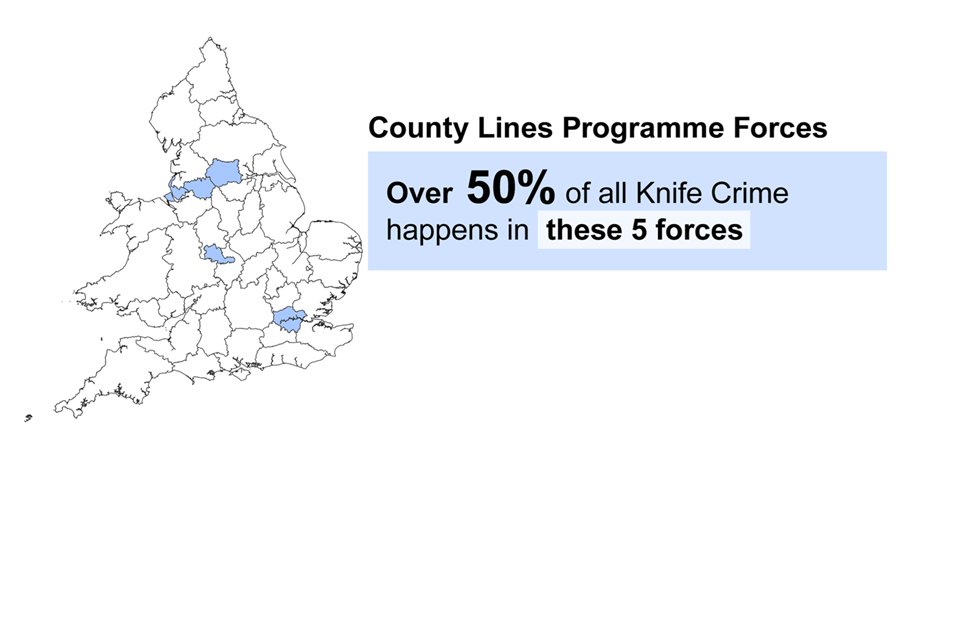
(This is a map of England and Wales showing which forces have County Lines Programme Forces (forces are coloured in blue and are detailed in Footnote 52). The infographic says that over 50% of all knife crime happens in these 5 forces.)
The County Lines Programme also includes the National County Lines Coordination Centre (NCLCC) which provides national leadership to police forces in tackling the complex cross-border county lines threat. The From Local to National: A New Model for Policing White Paper announced the creation of a new National Police Service (NPS) that will lead on cross-border threats. By bringing together national police operational functions such as Counter-Terrorism Policing, the National Crime Agency and NCLCC, the NPS will draw them into closer strategic alignment.
Embedding NCLCC into the NPS will sustain NCLCC’s role in developing the national intelligence picture and strengthening and coordinating the police response to county lines over the long term. It will also mean that our approach to county lines will benefit from the coordination and efficiencies that the NPS brings, including shared technology, data and intelligence, providing policing with greater agility to keep pace with county lines threats. County lines measures are also included in the new Police Performance Framework to ensure forces are tackling this threat locally.
Dedicated one-to-one specialist support in county lines exporter areas to help children and young people escape exploitation, provided by the Catch22 National County Lines Support service, has helped more than 740 young people between July 2024 and December 2025.[footnote 57] We fund Missing People’s SafeCall service, an anonymous helpline and support service which provides expert advice and support for young people, parents and families affected by county lines drug dealing and exploitation.
Introducing tough new laws through the Crime and Policing Bill to stop individuals exploiting children into crime and violence. A new offence of CCE will target adults who groom and exploit children, while new civil preventative orders will be used to disrupt this harm before it escalates or happens again. These orders can be placed on individuals identified as posing a risk of criminally exploiting a child and could, for example, restrict their movements, contacts and activities, helping the police to intervene and protect children. We are also creating new offences to tackle ‘cuckooing’ to target the practice where criminals take over someone’s home to store drugs or weapons, and internal concealment, where people are forced to hide items inside their bodies for a criminal purpose. Together, these measures are designed to break the cycle of exploitation used by criminal gangs.
Case study: Catch22 – Child supported through exploitation and knife possession
Taylor had been exposed to criminal exploitation from the age of 11, including involvement in county lines activity, knife possession and concealment, and substance misuse. Being a looked after child in care with an ADHD diagnosis increased Taylor’s vulnerability, particularly around impulsivity, coercion, and susceptibility to negative peer influence.
In January 2025, his residential support worker referred Taylor to the Catch22 County Lines Support and Rescue Service, funded by the Home Office, due to escalating risks at home and in the community. Concerns centred on Taylor’s safety, as well as the potential harm posed to others.
During home-based sessions, the Catch22 caseworker used a trauma-informed approach to build trust with Taylor while working closely with the residential team. Ahead of a visit, Taylor threatened a peer with a knife. The residential staff requested support to remove the weapon safely. After risk assessment and using careful negotiation skills, the caseworker was able to persuade Taylor to surrender the knife. This involved explaining the legal and personal consequences of carrying a weapon, while also emphasising the benefits of giving it up – particularly the impact on his safety and relationships. Taylor voluntarily handed over the knife, which was safely stored in a knife tube and handed into a local police station.
At the point of referral, Taylor was not in education. Following sustained engagement and advocacy from his Catch22 caseworker, Taylor has now re entered full-time education – an important protective factor against further exploitation and knife related harm.
Ongoing support focuses on knife awareness education, consequential thinking and strengthening Taylor’s engagement with his wider support network. The aim is to reduce risk, build emotional regulation and decision-making skills, and help Taylor sustain safer behaviours in the long term.
(Names have been changed to protect anonymity.)
Case study: SafeCall support to a parent
Maxine contacted SafeCall, the Home Office funded national helpline for those affected by county lines, regarding their child, Jamie.
Jamie was regularly going missing, drinking heavily, using cannabis, breaching bail conditions and had been arrested for robbery. Jamie had been found carrying knives and told their mother it was “too late” for help.
Jamie’s intense loyalty to exploiters and growing hopelessness about their future, placed them at significant risk of harm linked to exploitation, knife carrying and escalating offending.
Maxine initially feared that raising concerns would lead to Jamie being criminalised rather than protected.
Maxine had previously found accessing statutory services challenging, and SafeCall supported Maxine to navigate these systems while providing advocacy support.
For over two years, SafeCall provided regular emotional support, helped Maxine understand local authority responsibilities, and enabled them to develop new ways of engaging Jamie. Maxine attended monthly peer support groups and accessed non-violent resistance support, which strengthened their ability to support Jamie. SafeCall gave Maxine a confidential space to explore Jamie’s needs.
Eventually, Jamie moved to live with a relative, away from the area of exploitation. Jamie’s offending and abusive behaviour reduced significantly, and Jamie now has a job and no longer associates with those involved in crime.
Maxine reported improved confidence and improved relationships with Jamie and their other child.
(Names have been changed to protect anonymity.)
Stopping young people carrying knives
Youth knife possession has become all too normalised in recent years. For too long, children found in possession of knives have not faced swift and sufficiently robust consequences to prevent reoffending. Our estimates suggest around 1,000 children who are currently caught in possession of a knife, face no meaningful consequences or intervention.[footnote 58] These are inadequate responses to child knife possession offences, which do not result in a meaningful intervention to address the offending behaviour, or a penalty.
Children who break the law by carrying a knife will now receive a swift, robust, and effective response by Youth Justice Services. This Government has published new guidance for child knife possession offences, applying to all police forces and Youth Justice Services throughout England and Wales.
Police will swiftly refer every youth knife possession case to Youth Justice Services which are multi-agency local authority-based teams working with children at risk of offending, who will then design a targeted action plan for each child.
Specialised plans will address the root causes of the child’s offence, such as exploitation by criminal gangs or childhood trauma. Targeted action could include mentoring schemes or support to remain in education, giving children the foundations they need to turn their back on crime and keep our streets safe. Youth Justice Services will intensively monitor the child’s progress and repeat offending or refusal to engage with a mandatory plan will be met with robust action, including criminal charges. HM Inspectorate of Constabulary, Fire & Rescue Services (HMICFRS) and HM Inspectorate of Probation will assess how the guidance is put into practice.
Evidence box H: What does the Youth Endowment Fund say?
-
Carrying a knife places a child at significantly greater risk of involvement in violence. A 2025 YEF survey of 11,000 teenage children across England and Wales found that 78% of children who carried a weapon in the past year had perpetrated violence, and 79% had been a victim of violence. Compared with children who did not carry weapons, children who carried a weapon were eight times more likely to have perpetrated violence and five times more likely to have been a victim of violence. (i)
-
Many children who carry knives do so because they are scared. In a 2024 YEF survey of 10,000 teenage children, nearly half (47%) of children who reported carrying a weapon said they did so for self-protection. (ii)
-
Youth Justice Services are well-placed to deliver a range of evidence-based interventions (like mentoring, targeted sports provision and social and emotional skill development) that can keep children who carry knives safe from violence. (iii) However, the majority (55.1%) of services report that the support they deliver to children is only ‘somewhat aligned’ with the evidence base. (iv)
-
Providing evidence-based support quickly following the original offence can make it more effective. A 2025 YEF survey found that over a third of Youth Justice Services identified lengthy referral times as a key challenge in children receiving the support they need. iv Referral processes between police and Youth Justice Services should be as simple and straightforward as possible, and children should receive support within four weeks of referral. (v)
Making schools safer from knife crime
Launch the Safety In & Around Schools Partnership, delivering targeted support to around 250 schools in the areas most affected by knife crime involving young people. This is being delivered by the YEF with support from the Department for Education, the Ministry of Justice and the Home Office. The Partnership aims to strengthen children’s sense of safety by reducing their vulnerability to violence, supporting schools identified through innovative hyper-local mapping of knife crime. Tragically, and in very rare circumstances, school children are harmed at or on their way to and from school, sometimes by their classmates. As well as support to all 250 schools, this new project will channel intensive, tailored support to a subset of up to 50 schools, aiming to increase school awareness of the risks related to knife crime, how to implement best practice approaches to preventing violence, and increasing access to local support services. Adapted to local need, evidence-based activity could include targeting the times and places school children are unsafe and ensuring there are trusted adults they can turn to.
All schools will be asked to review their violence risk assessment and response and make changes where there are gaps. We are encouraging all schools to use YEF’s Education Practice Insight Creator self-assessment tool,[footnote 59] which helps school leaders take stock of what they already do well and spot where extra support is needed. This means schools can better identify children at risk and put the right help in place earlier. Best practice will be shared across the system through national webinars for safeguarding leads and school leaders, so good practice spreads more quickly across the system.
As of November 2025, Ofsted has made clearer that school leaders are expected to have effective arrangements in place to prevent and respond to child-on-child violence. Ofsted inspectors will consider whether school leaders identify risks early, act promptly to safeguard pupils, and demonstrate a secure understanding of evidence-based approaches to prevention. These expectations are reflected within Ofsted judgements on leadership and management, behaviour and attitudes, and safeguarding – and poor practice can limit a school’s overall rating.
Embedding the expectation that the principles of Support, Attend, Fulfil, Exceed (SAFE) Taskforces will become standard in local responses to serious violence. SAFE Taskforces was a three‑year pilot programme funded by the Department for Education and set up in areas with the highest levels of serious youth violence. They were run locally and brought together schools, local authorities, police, health services and youth support to work as a single team around children at risk. The taskforces were school‑led. Schools played a central role in identifying concerns early and coordinating support, with partners working together to plan and deliver help tailored to each child. Through the pilot, more than 9,600 pupils were supported in Phase One and over 2,300 in Phase Two, demonstrating the vital role that schools play in reducing vulnerability and keeping young people safe.
Strengthened the content on preventing and responding to violence and knife crime in Keeping Children Safe in Education (KCSIE) 2026 and launched a 10-week consultation seeking views on these proposed updates on 12 February 2026.[footnote 60] KCSIE is the statutory guidance which sets out how schools and colleges must keep children safe. It recognises the vital role schools and colleges play in spotting concerns early, responding quickly, and linking children to specialist support when needed. All schools and colleges must have regard to this guidance.
Launch a new guidance hub for schools on violence prevention and response to bring together all the relevant information they need to protect their pupils and staff. The aim is to give schools clearer, more consistent advice that is easy to find and use to keep pupils and staff safe.
A new information sharing duty in the Children’s Wellbeing and Schools Bill makes it clearer when organisations like schools, social care and the police can share information to keep children safe and stop them falling through the cracks. This includes children affected by serious violence and knife crime and reinforces the importance of local agencies sharing information so children at risk of crime are supported.
Police our streets to punish perpetrators and stop offending
Victims of knife crime deserve justice, and dangerous criminals must be met with the full force of the law. This Plan will back our police to catch and deter offenders and prevent crime, whilst removing and keeping knives out of the hands who seek to do harm.
We are putting 13,000 additional police personnel in neighbourhood roles, strengthening police powers, targeting police activity where knife crime happens and investing in technology to catch more knife offenders. All underpinned by radical reform of the policing system.
Knife crime clusters in small areas over multiple years. Precise, intelligence-led policing focused on the small number of individuals and locations linked to the greatest knife harm is critical to our approach. This means targeted operations, short, frequent patrols, problem-solving in high knife crime areas and partnerships with youth workers, community groups and local services to prevent violence. It means identifying the areas most impacted by knife crime and ensuring well-lit streets, better CCTV and secure routes between school and home.
We will support police forces in maximising the use of intelligence‑led Stop and Search so officers can prevent knife crime before it occurs, bringing offenders to justice.
It is appalling that children and young people are still able to buy knives online, including other illegal offensive weapons. We know that threatening others with dangerous knives has a particular appeal for those who want to intimidate and inflict violence. We are therefore taking steps to ensure that the controls on access to knives and offensive weapons are as robust as possible through a set of new legal measures designed to stop children and young people from accessing knives, (particularly through online sales), and to close loopholes that allowed dangerous weapons to be bought too easily. This is known as ‘Ronan’s Law’, in memory of Ronan Kanda.
We will police our streets to punish perpetrators and stop offending by:
- Increasing the number of neighbourhood policing personnel;
- Cracking down on knife robberies;
- Enhancing Stop and Search fairly to prevent knife crime;
- Mapping every knife offence to enforce and prevent knife crime where it’s most likely to happen;
- Stopping knives getting onto our streets;
- Investing in the latest technology to better prevent and detect knife crime.
What does Police Reform mean for knife crime?
Knife crime is one of several areas that highlights the fragmented and complex nature of the current policing system in England and Wales. Any frontline officer will tell you that the outdated structures and technology do not support them to prevent and respond to modern day crime. We have initiated the most radical programme of police reform in 200 years that will ensure we have the right policing for communities to protect the public across England and Wales.
We will give police leaders greater direction and clarity by introducing new ‘National Strategic Policing Priorities’ (NSPP) which will bring together strategic priorities for policing, national threats and the capabilities forces need to respond to these in one place. We will look to introduce a duty to comply with the NSPP which will be reinforced by embedding measurable priority outcomes within the Police Performance Framework. The Framework will ensure consistent reporting and analysis of police performance and enable greater oversight of performance to ensure that all forces are delivering the standards that victims and the wider public expect of them. Where forces are falling short of expectations, the Home Office will help forces to get appropriate support early. The Government will also legislate to ensure there are appropriate powers to take robust action where necessary, including a power for the Home Secretary to dismiss Chief Constables and introduce a local intervention model to policing.
Adoption of improved tools and technology will allow police forces to tackle knife crime more effectively. We are investing £115 million over three years to make the responsible use of artificial intelligence in policing more widely available so the police can speed up investigations, catch more criminals and reduce the amount of time officers need to spend on bureaucracy and form filling. We will also fund 40 additional live facial recognition vans, (taking the total up to 50), to help the police detect more violent and sexual offenders across the country.
New regional police forces will strengthen the local response to major knife crime by ensuring that specialist capabilities are available on a more consistent basis. The NPS will mean a more coherent and better coordinated national police leadership in tackling knife crime. The NPS will first set standards and free up local forces by taking responsibility for administrative tasks. In time it will draw in all national crime-fighting responsibilities including the National County Lines Coordination Centre and National Knife Crime Centre. Putting these national knife crime capabilities alongside the ability to set standards will allow policing to take a more holistic approach to improving knife crime response.
There is already considerable knowledge, expertise and best practice on tackling knife crime across England and Wales. Through these reforms, we want to ensure that these capabilities and skills are available in all forces so that no matter where you live your local force can effectively drive down knife crime.
Increasing the number of neighbourhood police personnel
Deliver 13,000 additional police personnel in neighbourhood roles across England and Wales by the end of this Parliament, with a target of 3,000 neighbourhood officers to be in place by March 2026. The Government is committed to reversing the decline in Neighbourhood Policing in England and Wales and has established a four-year programme to deliver a step change in the service the public receives.
The Neighbourhood Policing Guarantee means that every community in England and Wales already has named, contactable neighbourhood officers dedicated to tackling local issues. Neighbourhood policing areas consist of a team of officers and Police Community Support Officers dedicated to covering that area and who spend most of their time providing a visible policing presence. We estimate that around 20% of all knife crime takes place in town centres,[footnote 61] and forces are already increasing their patrols in town centres giving the enhanced visibility and presence that our high streets have been crying out for. Their local knowledge and the relationships they build with communities mean they are uniquely placed to help intervene early so crime and anti-social behaviour does not escalate into more serious offending such as knife crime.
Neighbourhood policing teams are being better equipped to meet local demand, through national training for all neighbourhood policing personnel. This training ensures every community in England and Wales benefits from neighbourhood officers who are equipped with the necessary skills to problem-solve, engage with communities and tackle crime and anti-social behaviour. It focuses on how effective partnership working with local partners such as VRUs, local authorities and social services is vital in preventing and reducing crime. By problem-solving with partners, neighbourhood officers can help bridge local efforts to enforce and restrict the knife crime, criminality and anti-social behaviour that blights too many of our communities.
Cracking down on knife robberies
Our Knife-Enabled Robbery Taskforce has already halted steep rises in knife robbery. In the year before the general election, these terrifying crimes surged. In just seven police forces, knife robberies rose by 14%.[footnote 62] In response, we brought together Chief Constables and policing partners from these seven areas which collectively accounted for 70% of the national problem.[footnote 63]
Knife Enabled Robbery Group Forces
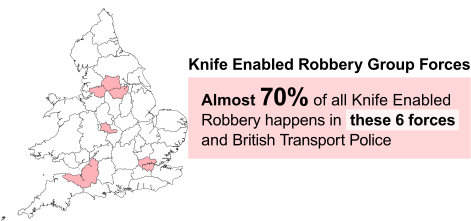
Almost 70% of all Knife Enabled Robbery happens in these 6 forces and British Transport Police.
(This is a map of England and Wales showing which forces have Knife Enabled Robbery Groups (forces are coloured in red and are: Metropolitan Police, West Midlands, Greater Manchester, West Yorkshire, Avon and Somerset, and South Yorkshire. The Group also includes British Transport Police, but this is a non-territorial police force and therefore is not shown on the map).)
The Taskforce scrutinised police performance in real time and identified common solutions to shared operational challenges. Forces agreed the most effective tactics to tackle knife robberies in knife crime hotspots, including high-profile, visible and “plain clothes” patrols in knife crime hotspots to maximise opportunities to recover knives and make arrests before a crime takes place. The Taskforce halted these steep rises in just five months and in the process built a new evidence base and tactical playbook to support policing to drive down knife robberies everywhere.
The Knife-Enabled Robbery Group now continues this relentless effort, achieving groundbreaking results, with knife robberies now down by 15% across these seven areas.
Knife-enabled robbery trends in the 7 Knife-Enabled Robbery (KER) Taskforce areas

(This is a bar chart showing the increases in five of the seven Knife Enabled Robbery taskforce police forces in their recorded knife-enabled robbery offences in the year up to the baseline (year to June 2023 compared with June 2024), with an overall increase of 14%. The graph also shows the decreases seen in all of the of the seven forces since the baseline using data from the year to October 2025 compared with the baseline year to June 2024, resulting in an overall decrease of 15%.)
That means 2,434 fewer of these crimes in these seven forces than in the year before the general election, contributing substantially to the 10% drop in knife-enabled robbery nationally.[footnote 64]
Data from the Metropolitan Police shows that use of a knife to injure a victim only occurs in a relatively small proportion of knife-enabled robbery offences.[footnote 65]

Metropolitan Police knife-enabled robbery offences, by how the knife was used (year to February 2026)
| Knife used to injure | 6% |
| Knife used to threaten, and seen | 63% |
| Knife used to threaten but not seen | 31% |
Collaborative problem solving between these seven forces is identifying how technology can improve the identification of knife robbers. Currently, suspects are not identified in c.50% of all knife-enabled robbery offences nationally.[footnote 66] Close, regular scrutiny of policing data, blended with frontline expertise is identifying ways to improve how CCTV can be used to improve the detection rates and bring more offenders to justice. Successful methods will be shared nationally.
We are also assessing how to improve charging rates for knife crime. The Crown Prosecution Service has already made key updates to its guidance (on Real Time Case Conversations) for complex knife robbery cases to deliver more timely outcomes for victims of knife crime. To better support case management and the identifying of the right evidential requirements to secure a conviction, the Crown Prosecution Service and the NPCC are developing a single national evidential checklist for all forces. These actions support the Crown Prosecution Service’s focus on building close collaboration and early investigative practices with forces to help to ensure that cases are built on strong, admissible evidence from the outset and ensure swifter punishment for perpetrators.
Enhancing Stop and Search to prevent knife crime whilst improving fairness
Stop and Search will be better targeted to knife crime hotspots with better intelligence and analysis of search outcomes, with the aim of reducing knife crime while mitigating potential harmful effects. Stop and Search is an operational tool that allows police to search individuals they suspect are carrying stolen or prohibited items, including knives, drugs or stolen property. Evidence suggests Stop and Search is most effective when it is intelligence-led, focused on crime hotspots, supported by high-quality officer training, and subject to regular monitoring to ensure it is used fairly.[footnote 67] When Stop and Search is used well, and in conjunction with wider measures, it can help protect communities from knife crime – but it must be deployed appropriately to maintain public trust and confidence. Police forces will be encouraged to embed Stop and Search within hotspot policing responses in areas with high levels of knife crime. Stop and Search levels will be monitored in the highest-concentration knife crime areas through the new Knife Crime Concentration Fund (p.61). Continued advances in technology and innovation will help improve the effectiveness of these approaches. This work is being undertaken alongside forces, the NPCC and local partners.
Updated codes of practice, better data collection and strengthened accountability measures will improve officer confidence and the quality of Stop and Search encounters while minimising harm, tackling disparities and maintaining legitimacy. The College of Policing is updating its Authorised Professional Practice (APP) on Stop and Search and piloting interactive video-based training to support consistent and appropriate use of these powers. This will ensure officers have the confidence to use Stop and Search powers when they are required, as well as in a just, procedural way that provides a better-quality encounter that causes the least harm possible.
Improving data collection to support better analysis of disparities in the use of Stop and Search. Although Stop and Search commands broad public support in principle, concerns about practical use remain. Black individuals are still 3.8 times more likely to be searched than White individuals, demonstrating the need to redress stark disparities in how Stop and Search is used.[footnote 68] We are working to improve the collection of self-defined ethnicity data and continue to explore how this priority is reflected in Codes of Practice, the APP and frontline training. We are also considering the role of the Police Performance Framework and working with HMICFRS to ensure inspection frameworks capture performance around key Stop and Search data collection. We are working directly with forces to understand their practical use of Stop and Search. This includes comparing locations of searches with their outcomes as well as comparing stated grounds for search with outcomes of searches (to measure the effectiveness and fairness).
Strengthen accountability through measures such as body-worn video and community scrutiny panels. Understanding community impacts of Stop and Search must remain a central consideration alongside effectiveness. The College of Policing is updating its APP to reflect lessons from recent reviews, reports and super-complaints, with a formal consultation due this year.
What do children and young people think about the use of Stop and Search?
Research undertaken in London by the Mayor’s Office for Policing and Crime suggests most children and young people are generally supportive of the use of Stop and Search to reduce knife crime. Of 11,874 children and young people, 53% believe that Stop and Search will help to prevent people from carrying knives; 14% disagreed; and 34% were neutral or did not know.
Black and mixed ethnicity children are less likely to think the police should use Stop and Search, and less likely to think that Stop and Search is delivered fairly. Though across all ethnicities in London more children are in favour of there being some Stop and Search rather than none.[footnote 69]
Children who have experienced Stop and Search raise concerns about how it is done. A national survey found that out of 101 children that had experienced Stop and Search, half said that as a result of this experience, they trusted the police less, had felt humiliated and embarrassed, and found the experience traumatic.[footnote 70]
Mapping every knife offence to enforce and prevent knife crime where it is most likely to happen
We have mapped every knife-enabled offence in England and Wales to identify the specific times and places where knife crime is most likely to happen. This tool is already changing the way we work. Our national mapping tool divides the country into nearly 1.5 million hexagons, (or ‘hexes’), with areas of about 0.1km² each (around the size of 10 football pitches). When we look at knife crime through this lens, the pattern is stark. Analysis of knife crime between 2024 and 2025 shows that all recorded knife crime occurs within less than 2.5% of these hexes.[footnote 71] By seeing knife crime at this micro-geography, local partners can pinpoint the specific streets, times and drivers of crime and direct the right mix of policing, prevention and services to those places.
£15 million is provisionally allocated over the next three years to enhance our crime mapping by improving data visualisation and analysis capability, integrating new data, and strengthening pattern recognition and data sharing – including through the better use of artificial intelligence. This investment from the Department for Science, Innovation and Technology will be delivered by UK Research and Innovation through the Research and Development Missions Accelerator Programme and will help us target interventions more precisely, pilot innovative policing and prevention approaches in the areas of greatest need, and monitor impact more effectively.
Examples of hyperlocal knife crime concentrations identified through hex mapping: Soho, Westminster and Birmingham City Centre.[footnote 72]
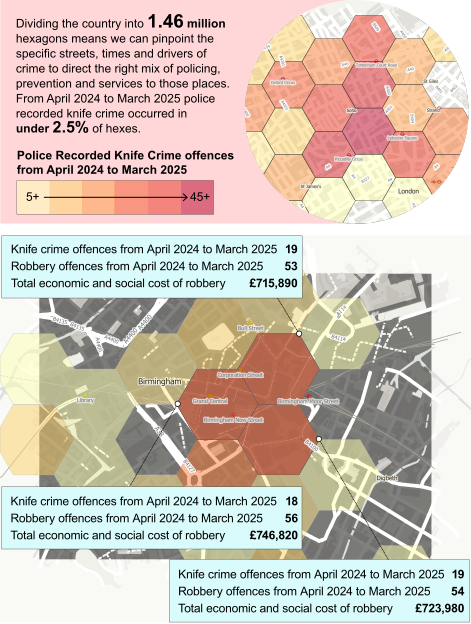
(This visualisation has text that reads “Dividing the country into 1.46 million hexagons means we can pinpoint the specific streets, time and drivers of crime to direct the right mix of policing, prevention, and services to those places. From April 2024 to March 2025 police recorded knife crime occurred in under 2.5% of hexes.” There is a map showing hexagons colour-coded from light yellow (5+ offences) to dark red (45+ offences) which are overlaid on a map of Central London (Soho and surrounding areas), indicating the number of police recorded knife crime offences in various hexes/areas. A further map shows hexagons of different colours overlaid on a map of Birmingham indicating the number of knife crime offences and robbery offences in each hexagon, along with the social and economic cost of robbery in each area. Three of these have information showing the numbers of specific knife crime offences (19, 18 and 19), total robbery offences (53, 56 and 54) and total economic and social cost of robbery (£715,890, £746,820 and £723,980).)
We invested £5 million last year to develop and trial the best methods to tackle knife crime across 11 areas with the highest knife crime ‘hexes’. These areas sit within the police force areas of West Midlands, Merseyside, Greater Manchester, West Yorkshire, Avon and Somerset, Cambridgeshire and five Boroughs within the Metropolitan Police. This programme sees us working with local police forces, local authorities and Police and Crime Commissioners to tackle the key drivers of the knife crime problem in each area. Interventions include visible police patrols targeted to the time and place that knife crime happens; upgrading CCTV coverage to minimise blind spots and improve the use of retrospective facial recognition; increased use of detached youth workers to reach out to younger people at higher risk; enhanced use of knife wands and knife arches to improve detection. Tactics proven to work will be scaled up and deployed to other higher risk areas across England and Wales.
Our new Knife Crime Concentrations Fund will target £26.25 million this year into improving enforcement and prevention where the highest levels of knife crime occur. Building on last year’s hyperlocal knife crime pilots we are expanding the approach in 27 police force areas, which together experience 90% of total knife crime across England and Wales.[footnote 73] In each of these police force areas we will work with local partners to identify the hyperlocal locations which have the highest concentrations of knife crime, and implement evidence-led problem solving. We will then target the drivers of the specific knife crime problem in these tightly defined locations. This will allow police officers and local partners to intervene in the right areas at the right times – using both enforcement and prevention to significantly reduce knife crime levels. Investing like this will see more harm prevented and fewer knife offenders on the streets.
Case study: Targeted knife crime intervention in Brixton
In Lambeth, the mapping tool highlighted two high-volume knife crime hexes. The police and local authorities worked together to identify the specific issues driving knife crime – above all robberies of mobile phones – as well as the specific streets and junctions where this was happening. They also identified where knives were being stashed, as well as the individuals behind much of the problem.
To tackle this, a coordinated multi-agency response was put in place involving police, Lambeth Council and local businesses. Key interventions include the Brixton Safe Hub mobile intervention unit, targeted youth outreach to those at higher risk, strengthened neighbourhood policing, improved CCTV and redesign of key sites to prevent weapon storage and drug dealing.
The Minister of State for Policing and Crime visited Brixton on 26 February, accompanied by Cllr Claire Holland, Cllr Mahamad Hashi, Bell Ribeiro-Addy MP and Pastor Lorraine Jones-Burrell to launch the Brixton Safe Hub and see the other local interventions in place.
Since we’ve come out of lockdown, [knife crime has] affected so many people’s mental health, the cost-of-living crisis and people have literally broken. We’ve lost lives, we may lose more, but what we’re doing here, it’s mending hearts, building communities, strengthening the safety that is needed.
Pastor Lorraine Jones-Burrell, BBC Radio London
Stopping knives getting onto our streets
We have implemented bans of zombie‑style knives, zombie‑style machetes and ninja swords. It is now illegal to possess, sell, manufacture or import these weapons. They have no place on our streets.
More than 63,000 knives and offensive weapons have been removed from circulation since July 2024 through surrender schemes. This effort included one of the largest knife surrender schemes to date, in July 2025, that gave people straightforward routes to hand in weapons.
We have also commissioned an independent end-to-end review of the online sale of knives led by Commander Stephen Clayman, the NPCC lead for knife crime, which was published in February 2025. His key recommendations highlighted areas which needed to be strengthened to reduce weapons being sold to young people online.
In the memory of Ronan Kanda, ‘Ronan’s Law’ is the toughest crackdown yet on knife sales online. Retailers will need to report bulk purchases of knives on their platforms to the police, with tougher sentences for selling knives to under 18-year-olds. Stricter rules for online retailers selling knives will be introduced by the Government, along with tougher penalties for failing to enforce them, as we pursue every avenue to protect young people from knife crime:
-
Following tragedies where the unlicensed sale of these weapons online has led to young people being killed, retailers will be required to report any bulk or suspicious-looking purchases of knives on their platforms to police to prevent illegal resales happening across social media accounts.
-
Underlining our commitment to stop these weapons from reaching young people, we will increase the sentence for selling weapons to under 18-year-olds from six months to up to two years prison time, which could apply to an individual who has processed the sale or a CEO of the company.
-
This increased penalty will also apply to the sale or supply of prohibited offensive weapons such as recently banned zombie-style knives, following police evidence outlined by Commander Stephen Clayman, where he identified a discrepancy in current legislation which means there is more leniency for illegally selling weapons than possessing one.
-
And in recognition of the broad array of knives – legal or banned – that are involved in knife attacks, a new offence of possessing an offensive weapon with intent for violence will be introduced in the Crime and Policing Bill. This means that no matter if the weapon in possession is legal or not, if there is intent to cause violence, it is a crime.
-
The Government will also explore through a consultation whether a licensing scheme should be put in place for all online retailers selling knives so that only responsible sellers are able to sell knives.
We have introduced major new sanctions, including fines of up to £60,000 to hold tech companies and their senior executives personally responsible for sites and content selling and marketing knives and weapons online. Online marketplaces, social media companies and search engines and their senior executives must now act or face severe sanction. Failure to remove sites and content illegally selling and marketing knives and prohibited offensive weapons could result in both the company and a designated senior executive facing significant penalties. The police will also have the power to require them to swiftly take down of or remove access to illegal content. These measures are included in the Crime and Policing Bill, as well as a measure for a stricter two-step age verification check for online sales and delivery of knives to prevent under 18-year-olds obtaining knives.
A new police unit, the National Knife Crime Centre, will deploy specialist police officers to find illegal online content selling and marketing knives. The Home Office is providing £1.75 million in funding this year to crack down on online sites and content illegally selling or marketing knives. In future, this Centre will be embedded within the NPS, putting the right policing at the right level to keep knives out of the hands of those seeking to do harm.
Case study: Coalition collaboration in action – extended knife surrender arrangements
We consulted and listened to the views of the Coalition to Tackle Knife Crime and used their expertise and experience to help shape the operation of extended knife surrender arrangements using a mobile surrender van and surrender bins to allow people to surrender weapons anonymously. This included funding of 37 new surrender bins and a custom-built mobile surrender van, with both initiatives run by charities with expertise in knife crime. The scheme also saw a surrender bin in Wolverhampton being dedicated to the memory of Ronan Kanda. Over 3,500 weapons were surrendered during the month-long scheme in July 2025. We also ran a Surrender and Compensation Scheme for ninja swords alongside these extended surrender arrangements which saw over 3,900 weapons handed in.
The Coalition also helped shape the month-long communications campaign on the arrangements and used their networks to help promote the scheme to communities and particularly young people. FazAmnesty and Word 4 Weapons were critical in the delivery of the extended surrender arrangements and worked closely with local partners on the operation of the surrender van and installation of surrender bins.
The success of the mobile surrender van was such that FazAmnesty operated the van at Notting Hill Carnival with the agreement of the Metropolitan Police and Carnival organisers.
I think knife crime awareness has definitely increased in recent years, however I think it has taken more knife crime incidents for this to have happened. It is great to see the changes that are being put in place, for example the banning of zombie knives last year, although this is just a small step in the right direction of a much bigger picture.
Hannah Pritchett (Survivor of a knife crime attack)
In 2022, just four days before her 19th birthday, Hannah was stabbed by her boss in an unprovoked attack that left her with life changing injuries. After discovering the Ben Kinsella Trust, she committed herself to fundraising and awareness raising, completing multiple charity events.
Investing in the latest technology to better prevent and detect knife crime
A new £5.5 million investment in Research and Development to detect knife crime and prevent knife crime before it happens. At present, it is hard to identify people who may be carrying a knife, especially if they are not already known to police or local services. Detection often depends on what staff or witnesses notice in the moment. This can mean that high-risk individuals carrying knives are not identified and stopped until they present an urgent and immediate threat, for example when a knife is drawn with the intention of causing harm. Funded by the Department for Science, Innovation and Technology, and delivered by UK Research and Innovation, through the Research and Development Missions Accelerator Programme, this investment is aimed at improving our capability to detect high-risk knife carriers, including by improving our understanding of behaviours exhibited by people intending to commit knife violence. This could provide staff in places like shopping centres, train stations and late-night venues with clearer guidance on what to look for and could also help ensure Stop and Search powers are deployed more accurately. Alongside this, investment will support the police to intervene with those known to carry knives ‘habitually’ in their area – who pose a disproportionate risk to public safety. This intelligence could also enable staff in transport hubs and other locations to be vigilant and responsive to those already known to pose a heightened threat.
Police investigations of knife crime taking place across the railway network will be accelerated, with nearly £17 million of investment over the next three years to improve CCTV connectivity and keep passengers safe. As announced in the ‘Freedom from Violence and Abuse Strategy’, the Department for Transport are providing British Transport Police access to the latest technology to identify offenders rapidly and make the railway a safer place for all passengers. CCTV connectivity across the network will be improved, with Network Rail connecting train station CCTV images directly to the police and the wider rail industry. Current connectivity means criminal investigations can be delayed by days or even weeks while police and rail staff physically collect images from stations across the network. Our investment will end this inefficiency. British Transport Police’s budget, as set by the British Transport Authority, will also increase by £63 million to £481.5 million by 2028/2029 – enabling the creation of over 200 new officer roles to keep passengers safe.
End the cycle of knife crime
To halve knife crime, we must end the cycle of repeat harm. This Plan also focuses on reducing reoffending and revictimisation by strengthening rehabilitation, supervision and support for those already involved in crime, so that fewer people return to knife crime and fewer communities face repeat violence.
We know carrying a knife is a risk factor for going on to commit knife crime. That is why we are also targeting possession offences. There were 28,596 ‘possession of an article with a blade or point’ offences in the year to September 2025.[footnote 74] The latest sentencing data showed that 9,168 people were sentenced for possession of an article with a blade or point in the same period. Nearly 90% of those sentenced were aged over 18, and nearly 90% were male.[footnote 75]
Whilst the majority of drug users do not commit knife crime, drug use and drug markets are associated with knife crime and serious violence.[footnote 76] Evidence also shows drug use to be a risk factor for knife carrying among young people.[footnote 77],[footnote 78],[footnote 79],[footnote 80] Police data further shows that around a third (34%) of homicide suspects were recorded by the police to have been under the influence of alcohol and/or drugs at the time of the homicide.[footnote 81] This underscores the extent to which unmet substance misuse and wider health needs can entrench cycles of violence and reoffending, and the importance of addressing these needs.
Though it is difficult to draw an explicit relationship between homelessness or rough sleeping and knife-related reoffending specifically, the proven reoffending rate for all types of offending for those who were homeless or rough sleeping on release from custody was more than double the rate for those in settled accommodation on release (76% vs 36.4%).[footnote 82]
Experiencing combinations of homelessness, contact with the criminal justice system, substance misuse, mental ill health and domestic abuse is defined as experiencing ‘multiple disadvantage.’ These complex, interconnected issues and unmet needs have a devastating impact on individuals, families and communities, leaving people highly vulnerable and with significantly lower life expectancy. While not all those experiencing multiple disadvantage will be involved in violence, evidence shows that these overlapping risks can increase vulnerability to exploitation and heighten the risk of involvement in serious violence[footnote 83], including knife crime, with the likelihood increasing as individuals experience a greater number of risk factors.[footnote 84]
That is why our Plan strengthens rehabilitation and reintegration – backed by meaningful consequences – to reduce reoffending and prevent repeat harm.
We will end the cycle of knife crime by:
- Reforming the Youth Justice System;
- Preventing repeat youth crime through early, consistent diversion and support;
- Identifying and managing the highest-risk knife offenders effectively;
- Supporting prison leavers away from reoffending.
Reforming the Youth Justice System
Reform our Youth Justice System so it more effectively reduces crime, as well as punishes the perpetrators. On average, almost 70% of children in youth custody have committed violence against the person against the person offences.[footnote 85] Data suggests that nearly two-thirds of children released from youth custody will go on to reoffend.[footnote 86]
Reform the Youth Justice Board to drive the improvement of Youth Justice Services, with comprehensive data collection on the outcomes of young people supported through diversion. Better oversight, control of funding and monitoring performance from the Ministry of Justice will build greater consistency and more effective support for those on the cusp of offending, including knife crime.
Preventing repeat youth crime through early, consistent diversion and support
Investing over £15 million this year in the ‘Turnaround Programme’, providing bespoke interventions we know work to turn thousands of children who are on the cusp of the youth justice system away from further crime and violence, including knife crime.
Set a clear national standard for Youth Out of Court Resolutions so children get the right support early, wherever they live. When used well, out‑of‑court resolutions can stop vulnerable children being drawn unnecessarily into the criminal justice system and help prevent further offending and violence. But the quality of support currently varies widely, meaning too many children face a postcode lottery. This standard will set out what works, so diversion is delivered fairly and consistently across the country, raising standards and improving outcomes for young people at risk.
Evidence box I: What does the Youth Endowment Fund say?
-
On average, diverting children from the criminal justice system reduces reoffending and violence. Informal pre-court diversion (which avoids a formal conviction and criminal record at point of delivery) is likely to have a high impact on violence (reducing reoffending by 30%); (i) formal pre-court diversion (which can result in a criminal record) may reduce violence by 25% and reduce reoffending by 14%. (ii)
-
To deliver diversion effectively and equitably, there should be clearly defined aims, eligibility criteria and referral procedures between partners. Strong multi-agency working is important for developing a robust decision-making process, transparent decision-making and maintaining high standards of delivery. (iii)
-
Evidence-based interventions which are tailored to children’s underlying needs, (like mentoring, targeted sports provision and social and emotional skill development) can keep children safe from violence. These should be delivered quickly to children who are diverted. (iii)
-
It is important to focus on tackling racial disparities in diversion practice. (iii) Research on the use of diversion for children in London found that Black children were diverted less often than White children, even when controlling for the seriousness and frequency of offending. (iv)
Identifying and managing the highest-risk knife offenders effectively
Develop and embed a new national approach to identify, prioritise and manage habitual knife offenders who pose the greatest risk to public safety and often have complex needs. Working closely with police forces, we are enabling the better use of data and evidence so officers can make stronger risk assessments and ensure prevention, enforcement and support is focused on the right people, where it will have the greatest impact on reducing knife crime.
Deliver a range of accredited Offending Behaviour Programmes that target key behavioural factors to reduce an individual’s risk of reoffending. These programmes support participants to improve their decision-making and problem-solving skills, teaching them how to self-manage and regulate their emotions.
Fund Incentivised Substance Free Living Units in 85 prisons, where prisoners sign a behaviour compact, agree to be regularly drug tested and can access enhanced opportunities compared to a standard wing. Health and Justice partners are also working together to improve the effectiveness of Drug Rehabilitation Requirements and Alcohol Treatment Requirements, as part of community sentences. There is a strong link between crime reduction, including violent offences, and drug and alcohol treatment with the level of reoffending falling by 44% and recorded offences falling by 33% in the two years after starting addiction treatment.[footnote 87]
This work forms part of a wider cross-Government investment of £3.4 billion over the next three years in drug and alcohol prevention, treatment and recovery services. This helps those in need access the help and support they require to achieve long-term recovery.
Supporting prison leavers away from reoffending
Supporting prisoners into skilled work through vocational courses, providing relevant skills training and the expansion of the prisoner apprenticeship programme which can now be accessed by prisoners in both the open and closed estates. We have also launched regional Employment Councils, which bring together businesses with prisons, probation and the Department for Work and Pensions to support offenders leaving prison.
Expanding our community accommodation service to support prison leavers at risk of homelessness by offering up to 12 weeks of temporary accommodation for those under probation supervision. Reducing homelessness is a shared responsibility across Government and through the recently published National Plan to End Homelessness, the Government has set a commitment to reduce the proportion of people released from prison becoming homeless by 50% by the end of this Parliament.
Implementing the plan
Accountability
This Government is determined to meet its goal of halving knife crime. This will require relentless focus, mobilising investment and intervention from across Government and wider society. We will drive and track progress in this ambition through clear governance, transparency and measurable outcomes.
Measuring success
Progress towards halving knife crime will be measured using the headline measure of annual volume of police recorded knife-enabled offences, as captured in PRC.[footnote 88] PRC provides the best available measure of knife crime in England and Wales.
This ambition is baselined against the number of police recorded knife-enabled offences in the year preceding the start of this Parliament in June 2024. Over that year there were 54,569 knife-enabled offences in England and Wales. This figure includes the following offences (defined in Annex D):
-
Knife-enabled assault with injury/intent to cause serious harm
-
Knife-enabled robbery
-
Knife-enabled homicide
-
Knife-enabled threats to kill
-
Knife-enabled attempted murder
-
Knife-enabled rape
-
Knife-enabled sexual assault
Each of these offences is complex, affecting different cohorts of victims, in different places and with distinct underlying drivers. To understand and effectively respond to the challenge we face, we are therefore tracking a suite of supporting metrics beneath this headline measure. This includes NHS data on the volume of admissions to hospital for assault with sharp object injuries, separately for those under-25-years-old and 25-years-old and over.
Headline Outcome and Metric: Halving Knife Crime by 2034
There were 50,430 Police Recorded Crime (PRC) Knife Crime Offences in the year to September 2025. This represents an 8% decrease from the baseline of 54,659 in the year to June 2024.
| Supporting Metrics and latest data | Year to September 2025 (and % change vs baseline) |
|---|---|
| Knife enabled robbery PRC) | 20,523 (-10% vs baseline) |
| Knife-enabled assault with injury and intent to cause serious harm (PRC) | 21,768 (-9% vs baseline) |
| Knife enabled homicide (PRC Homicide Index) | 174 (-27% vs baseline) |
| NHS Hospital admissions for assault with a sharp object, England and Wales: Under 25s | 1,188 (-11% vs baseline) |
| NHS Hospital admissions for assault with a sharp object, England and Wales: Over 25s | 2,199 (-11% vs baseline) |
| NHS Hospital admissions for assault with a sharp object, England and Wales: Total | 3,427 (-11% vs baseline) |
Knife possession is purposefully excluded from our headline measure. This is because, more so than other types of knife-enabled offending, trends in possession offences are likely to be influenced by police activity and operations, particularly Stop and Search. As a result, these statistics provide a skewed perspective on overall volumes. Whilst we monitor these figures, they are not appropriate as a measure of progress in halving knife crime.
As is the case with all PRC data, the year to June 2024 baselines figure is liable to minor revisions as cases are reclassified as more information becomes available or as the police audit their data.
The previous largest decrease in total knife-enabled crime was seen from 2020 to 2021; the year ending March 2021 (covid-affected year) was 19% lower than the year before covid (year ending March 2020). This coincided with national lockdowns and the highest levels of restrictions on social contact. The decreases show the suppressant effect of the public health restrictions in place during the COVID 19 pandemic on crime.
Police recorded crime figures, including those that are knife-enabled offences, have been affected by recording changes, including improved police recording of violent and sexual offences following critical audits of crime recording by HMICFRS. Additionally, in 2019, a new method was implemented for the collection of knife-enabled offences, the National Data Quality Improvement Service, which means data are not comparable prior to 2019.
Governance
Implementation of this Plan, and progress towards our target will be informed, driven and assured through these structures:
Coalition to Tackle Knife Crime
Chair: Minister for Crime and Policing / Home Office Crime Director
Attendees: See Annex B
Advising, shaping and challenging Government knife crime policy and delivery.
Halving Knife Crime Delivery Board
Chair: Minister for Crime and Policing / Home Office Crime Director
Attendees: Ministers from across Government alongside representation from Policing and local delivery partners.
Responsible for direction setting, oversight and implementation.
Violence Reduction Units and Serious Violence Duty Partnerships (at police force area level)
Members: Core members of serious violence reduction partnerships (as set out in grant requirements), including Police and Crime Commissioner/Mayor, and senior representatives from policing, local authorities, health, education, probation services, youth justice, community representatives and the voluntary sector.
In line with existing Serious Violence Duty legislation, responsible for ensuring effective collaboration of partners to implement the action plan at a local (police force area) level.
Feeding in practical insights from local delivery to shape national policy.
Knife-Enabled Robbery Group
Chair: Minister for Crime and Policing / Home Office Crime Director
Attendees: Chief Constables from 7 priority forces, Police and Crime Commissioners/Mayors in same 7 areas, College of Policing, NPCC and Crown Prosecution Service.
Temporary structure to rapidly drive down knife robberies by building, sharing and applying best evidence of what works, scrutinising latest force data to drive performance, and agreeing targeted actions to enhance policing’s operational approach.
Devolved Governments
This Plan sets out action in areas under UK Government responsibility. Commitments on crime, policing, and justice apply to England and Wales, while those on health, social care, safeguarding, transport, and education apply to England only, as these are devolved matters. Reserved areas, such as online safety, apply across the UK.
Knife crime is a national crisis, and we will continue working with the Welsh Government, Scottish Government and Northern Ireland Executive to ensure a coordinated UK-wide response.
Annex A: Tackling knife crime across all communities fairly and without stigma
Knife crime does not affect all communities equally. While most victims and offenders are White, young Black men are disproportionately represented as victims and offenders (statistics captured on pp.17-18).
This disproportionality is driven by a complex mix of factors. Over-represented groups are more likely to grow up in poverty, experience racism and have worse access to services and support. Some groups are more likely to grow up to experience multiple disadvantages that increase the risk of violence, both as victims and perpetrators. They are also less likely to receive early help or be diverted away from the criminal justice system. Evidence from HM Inspectorate inspections and public reviews shows that bias and racism continue to affect how systems operate, and while many differences in outcomes may be explained by background and offence‑related factors, Black children remain more likely to receive custodial sentences even when these are taken into account.[footnote 89]
This must be at the forefront of minds as part of the Government’s effort to tackle knife crime. Using the best available data, blended with the expertise of local partners who understand their communities and the persistent racial disparities in this area best, we will be more precise in how we intervene and support authorities to avoid bias. This is how we will reduce knife crime while addressing disproportionality in a fair and proportionate way.
Following publication of this Plan we will engage the Race Equality Engagement Group, chaired by Baroness Lawrence, to ensure lived experience voices are informing the Plan’s implementation.
Annex B: Membership of the Coalition to Tackle Knife Crime
Ben Kinsella Trust
Prevents knife crime through education, campaigning, and collaboration, guided by its mission to build a society free of knife crime. Its impact goes far beyond young people, supporting educators, parents and professionals, with resources, training to keep young people safe.
Catch22
Designs and delivers services across the UK that build resilience, aspiration and life chances for people of all ages, with a strong focus on communities facing disadvantage.
Centre for Young Lives
The Centre for Young Lives is an independent think tank and delivery unit working to improve the lives of children, young people, and families across the UK – with a particular focus on those facing the greatest challenges.
Charlie’s Promise
Parents of Charlie Cosser: Set up in memory of Charlie Cosser who was murdered aged 17 in July 2023, after being stabbed at a party in West Sussex. Following his death, Martin and Tara started a charity, Charlie’s Promise, which campaigns for additional measures and a greater focus on prevention through broadening the school curriculum.
Dr Amrit Kaur Purba
Dr Amrit Kaur Purba is a public health researcher and social epidemiologist. She is an Assistant Professor and Wellcome Fellow at the London School of Hygiene & Tropical Medicine, where she leads the Digital Determinants of Health Hub, which examines how digital environments influence adolescent health, violence and inequality.
Dwaynamics
A community boxing club offering structured training and mentoring to steer young people away from gang culture, knife crime and gun violence. The original boxing club was set up by Dwayne Simpson, who lost his life to knife crime.
Don’t Stop Your Future
Don’t Stop Your Future (DSYF) is the flagship UK campaign of the Elba Hope Foundation, founded by Idris Elba, committed to ending serious youth violence in the UK. DSYF operates at the intersection of advocacy, opportunity and access - empowering young people to believe in and build a better future.
Empire Fighting Chance
Empire Fighting Chance uses a powerful combination of non-contact boxing and psychology informed mentoring to challenge and inspire young people aged 8 to 25 to realise their potential.
They also offer likeminded organisations the opportunity to be trained in delivering programmes within their own communities. Through their partnership with Matchroom, they have already trained over 140 organisations, enabling them to reach more than 25,000 young people.
FAZAMNESTY
Runs weapons amnesty campaigns encouraging young people to hand in knives and other weapons in exchange for compensation, working in partnership with the police.
Hope Collective
Cross sector alliance of organisations working towards change for vulnerable communities across the UK.
Justice for Ronan Kanda
Family members of murdered Wolverhampton schoolboy Ronan Kanda: Justice for Ronan Kanda is an award-winning UK law-making campaign working to prevent youth violence before it happens. The campaign works directly with schools, parents, police, youth services, retailers and Government to educate communities about knife crime and exploitation, support early intervention and safeguarding, improve how dangerous weapons are sold and controlled, and turn tragedy into lasting national change.
The King’s Trust
Supports young people from disadvantaged backgrounds to build the confidence, skills and opportunities they need to live, learn and earn.
Let’s Be Blunt
Founded by Leanne Lucas, a teacher and survivor of the 2024 Southport attack. Let’s Be Blunt is a prevention-focused initiative promoting the adoption of safer kitchen knife alternatives without pointed tips in homes, education settings, shared accommodation and public spaces. The campaign encourages simple, practical changes to reduce the risk of serious injury and support a wider public health approach to preventing knife harm.
Lives not Knives
Lives Not Knives is a Pan-London charity working to prevent knife crime, serious youth violence and school exclusions.
Their programmes Engage, Educate & Empower encompass mentoring, youth hubs, workshops, holiday programmes and educational roadshows. Lives Not Knives offer guidance and support for young people most at risk.
Synergy Network
The Synergy Network is a coalition of churches, para-church groups, Christian agencies and organisations working to end ‘Violence Against Young People’ in Britain and Ireland. The Synergy network was established in 2017. Since that time, it has hosted many events with a view of collaborating, partnering and bringing awareness to the public health issue of knife crime and violence against young people. Among other things, Synergy Network convenes an annual Standing Together weekend of events annually. The network chairman is Bishop Lenford Rowe.
Shanine Williams: Bereaved family member of Darian Williams
Bereaved sister of Darrian Williams, who was killed in February 2024. Shanine brings lived experience of the impact of knife crime on families and has been actively involved in awareness, prevention and youth engagement work, including delivering talks, workshops and community initiatives focused on tackling serious youth violence.
The Daniel Baird Foundation
Set up in memory of Daniel Baird, the foundation campaigns for the widespread availability of public bleed kits and greater public awareness of emergency response.
The James Brindley Foundation
Set up by the Brindley family, in collaboration with education health and social care professionals, following the murder of James Brindley in an unprovoked knife attack in 2017. The foundation tackles the root causes of serious youth violence, through the accredited ‘Full Circle’ programme, supporting children, young people and families to shape safer communities across the UK.
The Joe Dix Foundation
Parents of Joe Dix: Joe Dix was fatally stabbed in 2022 after being exploited by county lines drug dealers. The foundation focuses on raising awareness of signs, dangers and consequences of child criminal exploitation and knife crime through targeted education, outreach youth engagement and catastrophic bleed first aid workshops.
Word 4 Weapons
Word 4 Weapons is one of the UK’s leading weapons surrender charity, operating since 2007. They manage secure knife and weapon surrender bins nationwide in partnership with local authorities, police services, community and faith groups. Alongside this frontline operational work, Word 4 Weapons previously delivered a well-established education and preventative programme prior to the Covid19 pandemic, and are now actively rebuilding and expanding this provision as part of a wider strategy to support communities and reduce knife violence, this includes violence against women and girls.
Yemi Hughes: Bereaved mother of Andre Aderemi
Mother of Andre Aderemi who was fatally stabbed in 2016. Since then, she has shared her experience to support vulnerable young people and contribute to efforts aimed at preventing youth violence.
Youth Endowment Fund
The Youth Endowment Fund believes that no child should be affected by violence. Established in 2019 as a charity with a £200m endowment from the Home Office, the Youth Endowment Fund researches violence to understand it; finds, funds and tests what works to prevent it; and is building a movement to end it.
Annex C: The Youth Endowment Fund and its Violence Reduction Toolkit
The Youth Endowment Fund’s (YEF) Violence Prevention Toolkit is referenced throughout this Plan because it summarises the best available research on youth violence prevention programmes, drawing on systematic reviews and meta-analyses of causal violence prevention studies. For each approach, it describes the intervention, explains how effective it is likely to be, the strength of the underlying research, how confident readers can be in the impact and indicative costs. Syntheses of implementation and process evaluations for each intervention are also included.
The Toolkit presents research in a way that is easy to access and easy to understand. It is there to complement policy makers, service commissioners and front-line practitioners’ own expertise and local knowledge, rather than replace it. It highlights evidence-informed ‘best bets’ and approaches that have been shown to work well in similar contexts.
Knife crime and serious violence are relatively low volume offences, and the vast majority of children will never be directly involved in either. This can make it difficult to draw a direct line between preventative interventions and reductions in knife crime and serious violence specifically. It is imperative that we build the best available evidence base to support reductions in this harm. The YEF Toolkit therefore draws conclusions from strategies shown to reduce violence and offending more broadly, which the YEF expect will also help prevent knife crime. This is supported by the research showing that most offenders do not specialise in one type of crime - most show a pattern of varied offending.
For full detail on the methodology underpinning the Toolkit, see here: https://youthendowmentfund.org.uk/wp-content/uploads/2025/07/YEF-Toolkit-Technical-Guide-January-2026.pdf
The Children’s Violence and Vulnerability Survey
The Children, Violence and Vulnerability (CVV) survey is a large-scale annual survey of 13-17-year-olds across England and Wales commissioned by the YEF. For the 2025 survey, quotas were set using Census 2021 data across age, gender, ethnicity, region and socio-economic groups. Fieldwork was extended to improve representation among specific under-represented groups. After quality controls and exclusions, the survey received a final sample of 10,835 completed responses, and poststratification weights were applied to make the results as close to representative as possible.
For full detail on the approach taken to the CVV, see here: https://youthendowmentfund.org.uk/wp-content/uploads/2025/11/CVV25_TechnicalReport.pdf
Annex D: Home Office knife crime definitions
Knife-enabled Robbery
Refers to robberies where a knife or sharp instrument has been involved during the act of committing the offence. This includes robbery offences where the knife or sharp instrument has been physically used (whether it has made contact with the victim or not) as well as offences where the victim is threatened and believes a knife or sharp instrument is present and might be used.
Knife-enabled Assault
Refers to an assault offence where a knife or other sharp instrument is involved. These are offences where the knife itself is used to cause injury, including as a blunt instrument, or present as part of an assault even if not used. It does require injury to have been caused.
Knife homicide and attempted murder
Homicides where the method of killing was by sharp instrument, including knives. Homicide covers murder, manslaughter, corporate manslaughter and infanticide. Attempted murder is where the intent of the offender was to kill and the offence involved a knife or a sharp instrument.
Knife-enabled threats to kill
A threat to kill is when a person who without lawful excuse makes to another a threat, intending that that other would fear it would be carried out, to kill that other or a third person. For an offence to be knife-enabled, a knife or sharp instrument must be present or believed to be present, and the threat must be in-person, unlike for non-knife-enabled threats to kill.
Knife-enabled rape and sexual offences
Rapes or sexual assaults where the offence involved a knife or sharp instrument, either to injure or to threaten to injure to enable the offence to take place. Rape is the non-consensual penetration of a person’s vagina, anus, or mouth with a penis. Sexual assault is the intentional touching of another person sexually without their consent.
Annex E: References for Knife Crime Today: Key Data
i) Analysis of Police National Computer data for a proxy of knife-enabled offenders. Available at: https://www.gov.uk/government/publications/police-national-computer-proxy-for-knife-enabled-offenders
ii) Homicide in England and Wales Year ending March 2025 - Office for National Statistics
iii) Knife and Offensive Weapon Sentencing Statistics: July to September 2025 - GOV.UK
iv) Homicide in England and Wales Year ending March 2025 - Office for National Statistics
v) Hospital admissions for assault by sharp object from 2012-13 to March 2023
vi) NHS hospital admissions for assault with a sharp object; Crime in England and Wales: Appendix tables (Year ending September 2025) - Office for National Statistics
vii) Adverse Childhood Experiences (ACEs) are stressful or traumatic experiences that occur in childhood, that can substantially impact children and young people throughout their lives. ACEs include abuse (physical, emotional, sexual), neglect (physical, emotional), and growing up with experience of household dysfunction (a household where there is/are: adults with substance abuse problems, adults with mental health problems, adults who have spent time in prison, domestic abuse, a lost parent through divorce, death or abandonment). National household survey of adverse childhood experiences and their relationship with resilience to health-harming behaviors in England - PMC
ix) County Lines Programme data - GOV.UK
x) Based on 2018/19 data: Youth measures in the Police, Crime, Sentencing and Courts Bill: Equalities Impact Assessment - GOV.UK
xi) Department for Education study (2023) covering the percentage of children cautioned or sentenced for a serious violence offence and known to children’s social care in England, for all pupils matched to key stage academic year 2012/13 - 2017/18. Available at: Percentage of children cautioned or sentenced for a serious violence offence and known to children’s social care in England, Data set from Education, children’s social care and offending: local authority level dashboard - Explore education statistics - GOV.UK
xii) Using a multi-level model that controls for individual, household and education factors. The model only considers characteristics that were identified or experienced before a child’s first serious violence offence Education, children’s social care and offending: multi-level modelling
Annex F: References for Youth Endowment Fund Evidence boxes
For the full YEF Toolkit and underpinning evidence, see here: https://youthendowmentfund.org.uk/toolkit/
Evidence box A
i) Youth Endowment Fund (2025) Children, violence and vulnerability 2025: The scale of violence affecting children. Available at: Youth Endowment Fund - Children, violence and vulnerability 2025: The scale of violence affecting children
Evidence box B
i) Youth Endowment Fund Violence Prevention Toolkit. Available at: YEF Toolkit
ii) Youth Endowment Fund (2024) Children, violence and vulnerability 2024: Who has access to positive activities, youth clubs and trusted adults? Available at: Positive activities, youth clubs and trusted adults | Youth Endowment Fund
iii) Youth Endowment Fund (2026) Youth work and violence prevention. Available at: Youth work and violence prevention
Evidence box C
i) Rollings et al (2025) Association between school exclusion, suspension, absence and violent crime. Available at: Association between school exclusion, suspension, absence, and violent crime
ii) Youth Endowment Fund and Teacher Tapp (2025) Survey answered by 2,678 headteachers and members of the senior leadership team on 14 February 2025 and reported in YEF. Available at: Education Policy, Children and Violence
iii) Youth Endowment Fund Violence Prevention Toolkit. Available at: YEF Toolkit
Evidence box D
i) Department for Education and Ministry of Justice (2022) Education, children’s social care and offending. Available at: Education, children’s social care and offending: Descriptive Statistics,
ii) Picken et al (Youth Endowment Fund) (2025) Alternative Provision Specialist Taskforce. Available at: Alternative Provision Specialist Taskforce
Evidence box E
i) Youth Endowment Fund and Teacher Tapp (2025) Surveys answered by between 7,298 and 9,886 teachers in England from December 2024 - January 2025, and reported in YEF. Available at: Education Policy, Children and Violence
Evidence box F
i) Villadsen and Fitzsimons (2021) Carrying or using a weapon at age 17. Available at:
CLS-briefing-paper-Carrying-or-using-a-weapon-at-age-17-MCS-Web.pdf
ii) Youth Endowment Fund (2025) Children, violence and vulnerability 2025: Mental health and experiences of violence. Available at: Children, violence and vulnerability:
Mental health and experiences of violence
iii) Neurodevelopmental conditions, and learning, speech, or communication difficulties, as captured in YEF’s survey: Specifically, anxiety disorder (including post-traumatic stress disorder, regular panic attacks, or severe phobias), depression or another mood disorder (including bipolar disorder), oppositional defiant disorder (ODD), conduct disorder, attention deficit hyperactivity disorder (ADHD), autism spectrum disorder (ASD), speech or communication difficulties (such as stammering or unclear speech), language difficulties or developmental language disorder, an eating disorder (such as anorexia or bulimia), a substance use disorder (such as drug addiction or alcohol use disorder), and any other mental health, neurodevelopmental conditions, or learning difficulties.
iv) See above
v) Youth Endowment Fund (2025) Children, violence and vulnerability 2025: Mental Health and experience of violence. Available at: Mental health and experiences of violence | Youth Endowment Fund
vi) An umbrella review of risk and protective factors (Ullman et al, 2024) found that behavioural and emotional problems had possible associations with involvement in violence. This includes externalising disorders like attention-deficit hyperactivity disorder and conduct disorder, and internalising disorders like depression and post-traumatic stress disorder. Steeg et al (2023) and Yu et al (2017), examined the relationship between depression and violence by drawing on the Avon Longitudinal Study of Parents and Children. The two studies reported associations between depression and later involvement in violence.
Ullman et al (2024) Available at: Constructs associated with youth crime and violence amongst 6-18 year olds: A systematic review of systematic reviews
Steeg, S et al (2023) Psychological medicine, 53(15). Available at: Childhood predictors of self-harm, externalised violence and transitioning to dual harm in a cohort of adolescents and young adults
Yu, R et al (2017) Journal of the American Academy of Child and Adolescent Psychiatry, 56(8). Available at: Depression and Violence in Adolescence and Young Adults: Findings from Three Longitudinal Cohorts
vii) Koehler et al found that behavioural and Cognitive Behavioural Therapy (CBT) was effective at reducing reoffending in young offenders. Koehler, J. A., Lösel, F., Akoensi, T. D., & Humphreys, D. K. (2013) Journal of Experimental Criminology, 9, 19 – 43. Available at: A systematic review and meta-analysis on the effects of young offender treatment programs in Europe
viii) There is also evidence (Riise et al, 2021) that CBT can be effective in reducing externalising symptoms (including ADHD, conduct disorder, ODD) in children and young people. There is evidence that these conditions have possible associations with involvement in violence (see above - (Ullman et al, 2024)).
Riise, E. N., Wergeland, G. J. H., Njardvik, U., & Öst, L-G. (2021) Cognitive behavior therapy for externalizing disorders in children and adolescents in routine clinical care: A systematic review and meta-analysis. Clinical Psychology Review, 83. Available at: Cognitive behavior therapy for externalizing disorders in children and adolescents in routine clinical care: A systematic review and meta-analysis - PubMed
ix) YEF’s estimate of impact for CBT is based on a systematic review of 11 studies. A further systematic review of 51 studies shows that CBT also reduces children’s externalising behaviours which associated with a greater chance of being involved with violence. The YEF Toolkit determines a ‘moderate’ confidence (3/5 magnifying glass rating), for the impact estimate of CBT on children and young people’s involvement in crime. This quality rating reflects a number of factors relating to the quality of the underpinning studies. The YEF toolkit Technical Report also explains that the impact estimate of CBT on externalising behaviours specifically is rated ‘High’ (4/5 magnifying glass rating). Youth Endowment Fund Violence Prevention Toolkit. Available at: YEF Toolkit
x) Children who reported having a suspected or professionally diagnosed mental health condition, neurodevelopmental condition (see definition above), or learning, speech, or communication difficulty.
xi) See above (iii) for a definition of Neurodevelopmental conditions, and learning, speech, or communication difficulties, as captured in YEF’s survey.
xii) Youth Endowment Fund (2025) Children, violence and vulnerability 2025: Mental Health and experience of violence. Available at: Mental health and experiences of violence | Youth Endowment Fund
xiii) Bentley et al’s study Reflects the findings of an ‘a rapid narrative review, secondary data analysis of publicly available administrative datasets, and interviews and focus groups with 100 participants including service providers, parents/caregivers, and 15–18-year-olds with lived experiences of services.’
Bentley et al (Youth Endowment Fund) (2025) Access to mental health support for children and young people involved in or at-risk of serious youth violence across England and Wales. Available at: Access to mental health support for children and young people involved in or at-risk of serious youth violence across England and Wales
Evidence box G
i) Youth Endowment Fund (2024) Children, violence and vulnerability 2024: What role does social media play in violence affecting young people?. Available at: Children, violence and vulnerability: What role does social media play in violence affecting young people?
Evidence box H
i) Youth Endowment Fund (2025) Children, Violence and Vulnerability: The scale of violence affecting children. Available at: Children, Violence and Vulnerability (CVV): The scale of violence affecting children
ii) Youth Endowment Fund (2024) Children, Violence and Vulnerability: Who is affected by violence? Available at: CVV: Who is affected by violence?
iii) Youth Endowment Fund Violence Prevention Toolkit. Available at: YEF Toolkit
iv) Farrell et al (2025) Understanding referral pathways and diversionary support for children within the criminal justice system in England and Wales. Available at: Understanding referral pathways and diversionary support for children within the criminal justice system in England and Wales
v) Youth Endowment Fund (2025) Diversion Practice Guidance. Available at: Diversion Practice Guidance
Evidence box I
i) Youth Endowment Fund Violence Prevention Toolkit. Available at: Informal pre-court diversion
ii) Youth Endowment Fund Violence Prevention Toolkit. Available at: Formal pre-court diversion
iii) Youth Endowment Fund (2025) Diversion Practice Guidance. Available at: Diversion Practice Guidance
iv) Rahal et al (2025) Diversions from the criminal justice system in London. Available at: Secondary Data Analysis of Youth Diversion in London
Annex G: Glossary
ADHD
Attention deficit hyperactivity disorder
AP
Alternative Provision
APP
Authorised Professional Practice
APST
Alternative Provision Specialist Taskforce
CBT
Cognitive Behavioural Therapy
CCE
Child Criminal Exploitation
FFP
Families First Programme
HMICFRS
HM Inspectorates of Constabulary, Fire & Rescue Services
MACPT
Multi-agency child protection teams
MHST
Mental Health Support Team
NCLCC
National County Lines Coordination Centre
NPCC
National Police Chiefs Council
NPS
National Police Service
NSPP
National Strategic Policing Priorities
OSA
Online Safety Act 2023
PRC
Police recorded crime
RSHE
Relationships Sex and Health Education
SAFE
Support, Attend, Fulfil, Exceed
VAWG
Violence against women and girls
VRUs
Violence Reduction Units
YEF
Youth Endowment Fund
-
Year before Parliament is the year ending June 2024; 4% rise year-on-year between year ending June 2024 and year ending June 2023, and also between year ending June 2023 and year ending June 2022: Police recorded crime and outcomes open data tables - GOV.UK ↩
-
Police recorded crime and outcomes open data tables - GOV.UK ↩
-
Police recorded crime and outcomes open data tables - GOV.UK ↩
-
Police recorded crime and outcomes open data tables - GOV.UK ↩
-
Year ending June 2024 vs year ending September 2025: Police recorded crime and outcomes open data tables - GOV.UK ↩
-
Year ending June 2024 vs year ending September 2025: Police recorded crime and outcomes open data tables - GOV.UK ↩
-
NHS hospital admissions for assault with a sharp object, year ending June 2024 vs year ending September 2025: Crime in England and Wales: Appendix tables - Office for National Statistics ↩
-
Year ending June 2024 vs year ending September 2025: Police recorded crime and outcomes open data tables - GOV.UK ↩
-
Crime in England and Wales - Office for National Statistics ↩
-
Police recorded possession of article with a blade or point offences. As laid out at on pp.73-74 these statistics are not included in our overall measure of police recorded knife offences. This is because trends in possession offences are more likely than other types of knife-related offending to be influenced by police activity and operations, particularly Stop and Search, so can provide a skewed perspective on overall volumes. ↩
-
Compared with YE September 2024 (28,197 offences): Police recorded crime and outcomes open data tables - GOV.UK. ↩
-
Knife and Offensive Weapon Sentencing Statistics: July to September 2025 - GOV.UK ↩
-
Criminal Justice Statistics Quarterly: September 2025 - GOV.UK ↩
-
Young people and crime: findings from the 2006 Offending, Crime and Justice Survey ↩
-
Violence, worry and trust in the emergence of weapon-carrying ↩
-
Annex E: References for Knife Crime Today: Key Data ↩
-
Criminal Justice Statistics Quarterly: September 2025 - GOV.UK ↩
-
Ethnic group, England and Wales - Office for National Statistics ↩
-
Data from 2022/23: Equality Impact Assessment [EIA] – Crime and Policing Bill ↩
-
Homicide in England and Wales - Office for National Statistics ↩
-
Racial disproportionality in violence affecting children and young people ↩
-
Survey of 10,000 13-17-year-olds shows that children and young people from Black (64%), mixed (52%), and Asian (48%) backgrounds are more likely to attend youth clubs than White children and young people (36%): Children, Violence and Vulnerability 2024 ↩
-
Criminal Justice Statistics Quarterly: September 2025 - GOV.UK ↩
-
In the year ending March 2025, the victim was female in 55% of knife-enabled offences that were domestic abuse-related, and 83% of all rapes and sexual assaults (35 forces) according to analysis of Police Recorded Crime data held in the Home Office Data Hub. In the year to March 2025, over two-thirds of domestic homicide victims were women (Homicide in England and Wales - Office for National Statistics). Previous analysis has shown that half of female domestic homicide victims were killed by a sharp instrument (Domestic abuse prevalence and victim characteristics - Office for National Statistics), with three-quarters of these homicides involving kitchen knives (Homicide in England and Wales - Office for National Statistics). ↩
-
Police recorded crime and outcomes open data tables - GOV.UK ↩
-
Since July 2024, 9,931 knives and weapons were surrendered either through the ninja sword surrender and compensation scheme (3,942), handed in to the mobile surrender van (783) or dropped into surrender bins in the most recent surrender scheme (5,206); Written statements - Written questions, answers and statements - UK Parliament (Note: surrender bins scheme data updated to November 2025); 47,795 zombie-style knives and machetes surrendered in 2024; Written statements - Written questions, answers and statements - UK Parliament; 4,656 knives seized by Border Force; Migration transparency data - GOV.UK; 1,229 knives recovered through County Lines Programme operations; County Lines Programme data - GOV.UK ↩
-
Carrying or using a weapon at age 17: Evidence from the UK Millenium Cohort Study ↩
-
Children, Violence and Vulnerability: Who is affected by violence? ↩
-
Carrying or using a weapon at age 17: Evidence from the UK Millenium Cohort Study ↩
-
Constructs associated with youth crime and violence amongst 6-18 year olds: A systematic review of systematic reviews - ScienceDirect ↩
-
Social Outcomes Partnerships are outcome-based contracts that can use funding from a third party, such as a social investor, to cover the upfront costs required for a provider to set up and deliver a service. Investors are then repaid once specific, agreed-upon outcomes are achieved. ↩
-
As of Spring 2025, over 600 MHSTs are in place, reaching 52% of pupils across more than 10,000 schools and colleges. Around 700 teams are expected by Spring 2026, with full national coverage planned by 2029. ↩
-
Carrying or using a weapon at age 17: Evidence from the UK Millenium Cohort Study ↩
-
Serious youth violence and its relationship with adverse childhood experiences ↩
-
Risk factors associated with knife-crime in United Kingdom among young people aged 10-24 years: a systematic review ↩
-
Abuse during childhood in England and Wales - Office for National Statistics ↩
-
Supporting Families Programme evaluation 2015 to 2020 (HTML) - GOV.UK ↩
-
In the Integrated Care Framework, ‘Vanguards’ are formally defined pilot sites selected and funded by NHS England to test and implement the Framework for Integrated Care (Community) before wider national rollout. ↩
-
The 20 forces are: Metropolitan Police/ London, West Midlands, Greater Manchester, West Yorkshire, Essex, South Yorkshire, Avon & Somerset, Merseyside, Lancashire, Northumbria, Thames Valley, Sussex, Hampshire, Cleveland, Kent, Nottinghamshire, Humberside, Leicestershire, South Wales, Bedfordshire ↩
-
Violence Reduction Units year ending March 2025 evaluation report - GOV.UK ↩
-
Violence Reduction Units year ending March 2025 evaluation report - GOV.UK ↩
-
Based on HO monitoring data returned by 23 forces on 53 panels covering the reporting period October to December 2025. Please note that the figures regarding onward referrals are pending consent and are based on data from 51 Panels. ↩
-
The police forces receiving County Lines Programme funding are Greater Manchester Police, Merseyside Police, Metropolitan Police, West Midlands Police, and, since 25/26, West Yorkshire Police. West Yorkshire Police were not included in the evaluation, therefore these results are not applicable to West Yorkshire. ↩
-
Evaluation of the County Lines Programme (updated) (January 2020 to January 2025) - GOV.UK ↩
-
Calculated by extrapolating the evaluation findings on reduced sharp object hospitalisations in exporter areas to the new exporter force of West Yorkshire. ↩
-
This estimate is based on Home Office crime outcomes data on youth cautions, community resolutions and outcome 22 for the offence of possession of a bladed article. Numbers of community resolutions and outcome 22 for young people have been estimated on the basis of the proportion of cautions given to young people for this offence. It also includes fines, discharges and other disposals given to juveniles as included in MoJ’s knife and offensive weapons statistics ↩
-
Keeping children safe in education: proposed revisions 2026 - GOV.UK ↩
-
The town centre data is derived from the Geographic Data Service (GeoDS) Retail Centre Boundaries and Open Indicators dataset which identifies retail areas based on the clustering and connectivity of patterns of individual retail units over space. Location data should be handled with care as it has not been quality assured with individual forces. ↩
-
Year ending June 2023 to year ending June 2024: Police recorded knife-enabled robbery offences, to October 2025 - GOV.UK ↩
-
Police recorded crime and outcomes open data tables - GOV.UK ↩
-
Year ending June 2024 to year ending October 2025: Police recorded knife-enabled robbery offences, to October 2025 - GOV.UK ↩
-
Outcomes data, year ending March 2025: Police recorded crime and outcomes open data tables - GOV.UK ↩
-
Police powers and procedures: Stop and search, arrests and mental health detentions, England and Wales, year ending 31 March 2025 ↩
-
This statistic was derived from police recorded crime data. Location data has not been quality assured with individual police forces and this data should be treated with caution. ↩
-
Some hexes have been excluded for data protection reasons due to very low numbers of incidents. Missing hexes do not necessarily mean no knife crime was recorded from April 2024 to March 2025. The data range in the key does not represent fixed intervals. Location data should be handled with care as it has not been quality assured with individual forces. ↩
-
Offences involving knives or sharp instruments open data – GOV.UK ↩
-
Police recorded crime and outcomes open data tables - GOV.UK ↩
-
Criminal Justice Statistics Quarterly: September 2025 - GOV.UK ↩
-
Knife crime offender characteristics and interventions - A systematic review ↩
-
Knife crime offender characteristics and interventions - A systematic review ↩
-
Policing and drug market-related violence: competitive, internal and enforcement-related violence in UK county lines ↩
-
Gang Membership and Knife Carrying: Findings from the Edinburgh Study of Youth Transitions and Crime ↩
-
Carrying or using a weapon at age 17: Evidence from the UK Millenium Cohort Study ↩
-
Year to March 2025: Homicide in England and Wales - Office for National Statistics ↩
-
Proven reoffending statistics: January to March 2024 - GOV.UK ↩
-
Carrying or using a weapon at age 17: Evidence from the UK Millenium Cohort Study ↩
-
The impact of community-based drug and alcohol treatment on re-offending ↩
-
Police recorded crime and outcomes open data tables - GOV.UK ↩
-
Racial Disproportionality in violence affecting children and young people ↩