Planning Inspectorate Annual Report and Accounts 2025/26
Published 25 June 2026
Applies to England and Wales

© Crown copyright 2026
This publication is licensed under the terms of the Open Government Licence v3.0 except where otherwise stated. To view this licence, visit nationalarchives.gov.uk/doc/open-government-licence/version/3 or write to the Information Policy Team, The National Archives, Kew, London TW9 4DU, or email: psi@nationalarchives.gov.uk.
Where we have identified any third party copyright information you will need to obtain permission from the copyright holders concerned.
This publication is available at https://www.gov.uk/government/publications/planning-inspectorate-annual-report-and-accounts-202526/planning-inspectorate-annual-report-and-accounts-202526
Accounts presented to the House of Commons pursuant to Section 7 of the Government Resources and Accounts Act 2000
Report presented to the House of Commons by Command of His Majesty
Ordered by the House of Commons to be printed on 25 June 2026
HC 255
Any enquiries regarding this publication should be sent to us:
General Contact Us
Telephone: 0303 444 5000
Press enquiries: press.office@planninginspectorate.gov.uk
Telephone: 0303 444 5004
ISBN 978-1-5286-6412-7
E03579795 06/26
Preface
This report brings together operational performance information and financial results, supported by analysis, to provide a comprehensive view of our work during the financial year 1 April 2025 to 31 March 2026.
Use of Data
The data presented in this report were drawn from administrative systems and accurate at the point of extraction. As these systems support live operational activity, figures may be subject to change.
Updates to previously published data are made only where revisions would materially affect the interpretation of Planning Inspectorate performance, or where changes are expected to result in variations of more than 5%. Any identified calculation errors are corrected promptly.
This report also reflects a revised methodology for counting the number of homes allowed on appeal. These figures are now shown as estimates and rounded to the nearest thousand. Historical figures have been recalculated to ensure a consistent approach across the full data series.
Helpful to know
Planning Inspectorate, Inspectorate or PINS?
Our formal title is the Planning Inspectorate, but through this document we refer to ourselves as the Inspectorate. There are documents which use the term ‘PINS’, an abbreviation normally used internally.
What is a percentile?
Within this report we refer to percentiles. If you were to arrange a group of numbers from the smallest to the largest, a percentile is a way of expressing where a value falls within that range of values. For example, if we give the 25th percentile for decision wait times, you know that 25% of decisions are issued in less time (or the same time) as that.
Decision approaches
For some of our casework decisions are made through one of the following approaches.
Written exchange of evidence
Most appeals are decided by inspectors using written evidence and a site visit. Everyone involved sends in their comments in writing, and the inspector makes a decision after reviewing these.
Hearing
At a hearing, everyone involved sends in their comments in writing. The inspector chairs a structured discussion to check the evidence, usually in one day, and visits the site before making a decision.
Inquiry
Inquiries are used for the most complex appeals and some other cases. Comments can be made in writing or, if allowed by the inspector, spoken at the inquiry. Inquiries are more formal than hearings, and evidence is tested by cross-examination, usually by barristers. After visiting the site, the inspector gives their decision or recommendation.
Performance Report
This section opens with introductions from our Chief Executive and Chair of the Board. It provides an overview of our performance in 2025/26, including who we are, our performance against our ambitions, services, sustainability and finance.
Chief Executive’s Introduction
This report reflects back on the second year of our 2024–27 strategy, and the evidence of progress is tangible. What began as a plan is becoming a reality, in our numbers, in our services, and in the confidence that colleagues, stakeholders and customers are placing in us.
The government’s agenda is ambitious and clear: more homes, faster infrastructure, local plans that cover the whole country. Delivering against that agenda is not an abstract ambition for the Inspectorate, it is our daily work. I am proud of how much we have achieved this year, and of how well we have risen to the challenge.
Our casework performance has continued to strengthen. The open appeals caseload has fallen again, by 18%, from about 11,400 in April 2025 to 9,400 in March 2026, and across our services we are making decisions faster without compromising quality. In our planning and environmental applications service, decision times are now consistently hitting target. In local plans, examination times have reduced from 31 months to 19 months. These are not marginal gains, they represent a step-change in our capacity to serve the public and support the planning system.
Productivity is up, and our investment in digital and data is paying off. New and improved online services are making it easier for our customers to find what they need, submit appeals, comment on infrastructure planning and understand what we do. Every local planning authority (LPA) now has access to our digital appeals service, and new case types, including enforcement appeals, are now submitted and managed through this improved platform. We also stood up a new Crown development application service and decided the first application in December 2025, a significant milestone that speaks to the breadth of work now entrusted to us.
One of this year’s highlights has been the growth of our engagement with the wider planning sector. We developed a programme of free public webinars, covering topics from green belt policy to planning conditions and local plan examinations, attracting hundreds of live attendees per session and accumulating thousands of views online. These sessions, presented by inspectors and colleagues with deep expertise, are helping to demystify the planning system and improve the quality of engagement between the Inspectorate and those who use our services.
New and improved online services are making it easier for our customers to find what they need.
Inside the organisation, our people survey results have improved again. Our learning and development theme now sits 14 percentage points above the Civil Service benchmark, a reflection of the investment we have made in our people through the launch of a bespoke line management development programme and core and professional capability frameworks.
None of this happens by chance. It takes dedicated people, strong partnerships, and a clear sense of what we are here to do. At the Inspectorate we fully understand the importance of what we are striving to achieve, and the effect we can have on the government’s ambitions. In 2026/27, we will build on the progress we have made by continuing to improve the timeliness of our decisions while maintaining quality, investing in our people, supporting the wider system to thrive, and using digital innovation to strengthen each of the five services we run.
As we head into the final year of this strategy, we are well placed to finish what we set out to accomplish back in 2024.
Graham Stallwood
Interim Chief Executive, Planning Inspectorate
Board Chair’s Introduction
Looking back on the Inspectorate’s journey in recent years, I am genuinely struck by the progress we have made. The change is evident in our performance, our culture, and the way we are regarded across the planning system. Today, we are recognised as the collaborative, open, high performing organisation envisioned in our strategy.
This year has seen that trajectory continue. Casework performance is stronger, backlogs are 18% lower than 2024/25, and our services are faster and more responsive, with local plan examinations reducing from 31 months in 2024/25 to 19 months in 2025/26. The user experience is improving, and that is no accident, it reflects a deliberate and sustained commitment to putting the needs of those who depend on us at the centre of every decision we make.
Casework performance is stronger, backlogs are down, and our services are faster.
That same focus will continue into 2026/27. We have made considerable progress, but there is more to do. Each of our services will undertake additional work to improve performance, strengthen delivery, and ensure we continue to respond to the people and places we serve.
Our financial stewardship has been sound. We have delivered more, managed within budget while delivering more, and we have secured the resources needed to meet the increasing responsibility the government is placing upon us. The working relationship between the Inspectorate and Ministry of Housing, Communities and Local Government has never been stronger, and I am grateful for the quality of engagement and support we receive from our sponsor department.
I’d like to extend my thanks to Ministers for their interest and support in the Inspectorate’s work and efforts to deliver the Government’s ambitions.
The Board itself has had a strong year. Our non-executive directors have brought rigorous challenge and thoughtful support to the Executive Team, and our Audit and Risk Assurance Committee has continued to provide the robust oversight that underpins confidence in our governance. As with all effective Boards, each member utilises their individual expertise and experience to provide new perspectives and questions which help us to thrive as an organisation. I am proud of how effectively we have functioned as a collective.
I want to record my sincere appreciation for Paul Morrison, who left the Inspectorate in January 2026 after three years as Chief Executive. Paul played an important role in shaping the direction and culture of the organisation, and the progress described in this report builds directly on work he championed. We wish him well and know planning has a place in his heart as he embarks on a new role in another part of the Civil Service.
I am grateful to Graham Stallwood and the wider Executive Team for the way in which they have stepped up since January, demonstrating exactly the kind of deep expertise, steady leadership and commitment to delivery that this organisation needs as it enters the final year of its strategy. The Inspectorate is in capable hands, and I leave with real confidence in what comes next. As my tenure as Chair draws to a close, I will hand over to my successor an organisation in good health - purposeful, improving, and valued.
Trudi Elliott
Board Chair, Planning Inspectorate
Organisational overview
For over a century we have upheld and promoted quality, assuring the checks and balances of the planning system. Our decisions and recommendations have made a profound difference to the nation.
Who we are and what we do
The Planning Inspectorate (also referred to as ‘the Inspectorate’) is an executive agency, sponsored by the Ministry of Housing, Communities and Local Government (MHCLG). We are responsible for making decisions and providing recommendations on a range of planning-related issues across England (and a limited number in Wales). Through our work we are contributing to the Government achieving its priorities of 1.5 million homes being built in England, fast-tracking decisions on at least 150 major economic infrastructure projects and securing home-grown energy towards the pathway to net zero. To achieve this, the Inspectorate works in collaboration with other government departments by considering evidence to support decisions to be made by the Secretaries of State (SoS) of MHCLG, Department of Environment, Food and Rural Affairs (Defra), Department of Transport (DfT) and Department for Energy Security and Net Zero (DESNZ).
Our work is governed by several Acts of Parliament, secondary legislation and statutory duties, ensuring we support the delivery of carefully considered developments, infrastructure the country needs, the right homes are constructed in the right places, and that green spaces are protected. Table 1 set out each of our five services and the legislation that governs them.
Table 1 - Our services and their governing legislation
| Service | Legislation |
|---|---|
| Infrastructure decision and application service | Planning Act 2008 Planning and Infrastructure Act 2025 |
| Plans examination service | Planning and Compulsory Purchase Act 2004 |
| Planning and environmental appeal decision service | Town and Country Planning Act 1990 Planning (Listed Buildings and Conservation Areas) Act 1990 |
| Planning and environmental application decision service | Town and Country Planning Act 1990 Planning and Infrastructure Act 2025 Communications Act 2003 - Schedule 3A The Electronic Communications Code Planning (Listed Building and Conservation Area) Act 1990 Acquisition of Land Act 1981 Water Resources Act 1991 |
| Rights of way and commons decision service | Schedule 14 of the Wildlife and Countryside Act 1981 Commons Act 2006 |
We are led by our Executive Team, chaired by the Inspectorate’s Chief Executive Officer and includes our chief officers, who are specialists in finance, human resources, operations, planning, and data and digital. Further information on the work of our Executive Team can be found in the Governance Statement. The Executive Team is supported by our Board, which is advisory. The Board aims to provide assurance to our sponsor that we are supporting the delivery of government priorities and delivering our strategy through insight, challenge and support.
Our purpose is to maintain a fair planning system, support significant infrastructure development and help communities shape where they live. Our Strategic Plan 2024-27 sets out how we will achieve this through our three ambitions.
Our purpose
To maintain a fair planning system, support significant infrastructure development and help communities shape where they live
Our Mission
To provide consistently timely, high-quality and cost-effective decisions, recommendations and advice
Ambition 1
A more efficient, proportionate and streamlined approach
Ambition 2
A leader in bringing the planning system together
Ambition 3
An even better place to work, that values and builds the expertise of its workforce
Overview of our risks
Risk management facilitates us realising our Strategic Plan by identifying risks and issues, and understanding their materiality to inform decision making in pursuit of our ambitions. Our risk profile is brought to life by the backdrop of our ever-evolving environment, as we strive to both mitigate risks posing a threat and harness opportunities to act in our best interests. Further detail on our risk profile and how we manage risks are set out in the risk report.
2025/26 at a glance
- over the past year, 19,600 decisions were made by the Inspectorate
- Open appeals fell from around 11,400 in April 2025 to 9,400 in March 2026, an 18% reduction
- 198 Rights of way cases decided, 23% more than 2024/25
- 45% more tree preservation, high hedge and hedgerow appeals decided compared to 2024/25
- 85% Year on year increase in the use of ultra-low emission vehicles for official business
- Local plan examination time reduced from 31 to 19 months
- GOV.UK appeals service now open to all councils
- Received first Crown Development application, decided within 6 months
- 94% of correspondence requests returned on time
- 23,000 homes granted planning permission on appeal in 2025/26
- Nationally Significant Infrastructure Projects: 20 recommendations to the Secretary of State, 18% increase on 2024/25
Achievements against our ambitions
We continue to make progress against our three ambitions whilst upholding our mission and values and delivering against the Government’s ‘Plan for Change’.
Introduction
2025/26 saw progress against the second year of our three-year Strategic Plan. Its purpose is to set a clear mission for the work of the Inspectorate between 2024 and 2027, underpinned by three clear ambitions.
- A more efficient, proportionate and streamlined approach - develop our scheduling, casework and other digital systems and processes to increase our productivity, reduce our environmental impact and lay the foundation for future sustainable improvements.
- A leader in bringing the planning system together - use our unique, highly connected position to influence the system and its actors to support both our service delivery and the design and implementation of planning policy.
- An even better place to work, that values and builds the expertise of its workforce - strengthen our offer as a modern and inclusive employer with a focus on professional standards to upskill, engage and motivate our staff to deliver.
In April 2025, to further strengthen our performance and support for the Government’s Plan for Change, we aligned our resources to our five public facing services. This means that colleagues throughout the organisation prioritise and focus on the activities that would make the strongest contribution, such as:
- leading the delivery of up-to-date local plan coverage
- implementing the proposals set out in the Planning and Infrastructure Act, accelerating the speed at which Development Consent Orders for nationally significant infrastructure projects can be determined contributing to the construction of 1.5 million new homes across England and fast tracking decisions on at least 150 major economic infrastructure projects
At the Inspectorate, we are responsible for the permission to build 1 in every 10 homes in England. To meet these challenges, and to position ourselves effectively as a leader in bringing the planning system together, we increased our recruitment of inspectors. To address capacity challenges, we have worked with professional bodies to broaden recruitment paths, attracting talent from across the built environment professions.
We worked collaboratively with MHCLG and other government departments to provide insight and feedback on changes to planning policy and legislation including the draft updated National Planning Policy Framework. Our work with MHCLG also helped shape a better planning system for users and stakeholders such as changes introduced via the Planning and Infrastructure Act (PIA) and to the local plans examination process.
Our third ambition is to ensure the Inspectorate becomes an even better place to work, valuing and building the expertise of our workforce. Our 2025 People Survey results show that we continue to make good progress to achieve this ambition, and our achievements are set out in Ambition 3.
Ambition 1 – A more efficient, proportionate and streamlined approach
Our ambition is to develop our scheduling, casework and other digital systems and processes to increase our productivity, reduce our environmental impact and lay the foundations for future sustainable improvements.
Our three-year strategy to 2027 sets our ambition to eradicate backlogs and consistently hit our public timeliness targets without reducing our quality standards. Backlog reduction has remained a focus for us throughout 2025/26. We have again reduced the volume of open cases, this year by 1,800 which represents an 18% decrease on 2024/25. This has primarily been driven by improved productivity in written representations appeals.
Alongside reducing our backlog, we have become quicker at making decisions. For example, in our planning and environmental applications service, decision times are now consistently on target and in our plans examination service, the median examination times are down from 31 months to 19 months. Additionally, we continue to process nationally significant infrastructure project applications more quickly than the statutory timeframes for acceptance, examination and recommendation stages.
In 2025 we launched a new chargeable pre-application service for national infrastructure applicants. We supported 82 requests for this service in 2025/26. The improved pre-application service provides applicants with clearer, more targeted advice, greater certainty on timescales, and stronger project outcomes. By enabling coordinated engagement with statutory bodies, local authorities, and other stakeholders, it supports smoother and potentially faster post-application processing. Together, these improvements help accelerate the delivery of nationally significant infrastructure, strengthening economic growth and supporting the nation’s long-term development.
Our inspectors continue to make fair, impartial and high-quality decisions. In 2025/26 we received a total of 1,059 complaints which represents just 5.40% of our work. Additionally, 49.50% of customers were satisfied with the service we provide. Further details on external complaints are in the external complaints section.
We continue to focus on improving our output. We made a total of 19,600 decisions, which is 6% higher than in 2024/25. We will continue to focus on this as we move into 2026/27, and we have an exciting programme of activity designed to drive further digital and cultural transformation.
As we enter the final year of our strategy, the substantial progress made over the past calendar year in particular, places us in a strong position to achieve Ambition 1.
Our performance section sets out the analysis of our performance in each of our five public-facing services throughout 2025/26.
Ambition 2 – A leader in bringing the planning system together
We use our unique, highly-connected position to influence the system and its actors to support both our service delivery and the design and implementation of planning policy.
The success of our purpose depends on a trusted, transparent and evidence-led relationship with MHCLG and other government departments. Where we can provide early insight into policy impacts, support legislative development, or identify delivery barriers, we will be better positioned to support the Government’s objectives on delivering 1.5 million new homes and accelerating planning decisions for at least 150 major economic infrastructure projects.
Our insights draw on the Inspectorate’s unique position at the heart of the planning system, informed by the thousands of cases we handle each year and our close engagement with communities, practitioners and government partners. This breadth of experience enables us to provide early, impartial and evidence-based intelligence on how policies operate in practice and where system pressures or opportunities are emerging. We use our insight and position to continue to engage with MHCLG and other government departments to:
- align our delivery approach with the updated National Planning Policy Framework and the PIA
- provide impartial advice on where system barriers remain
- strengthen cross-government collaboration and others on nationally significant and emerging casework
- build on our outreach programme with the wider planning and development sector as well as professional bodies representing the built environment professions and universities
In 2025/26 we introduced a new Crown development application service, a service for nationally important developments made on Crown land. This new service allows applications directly to the SoS rather than the LPA. The first application of this kind was successfully decided in December 2025.
We also continued our efforts which began in 2024/25 to increase our public-facing engagement with the wider planning and development sector - including local planning authorities, developers, agents, professional groups and member organisations. We ensure the information we provide through speaking engagements and other events is widely available to citizens via our GOV.UK platform. This included a regular series of free webinars aimed at our customers to help them understand the planning system. These webinars covered subjects including green belt, conditions and enforcement. These live sessions are presented by experts from the Inspectorate with the aim to demystify elements of the planning system and making it accessible to all.
By introducing these sessions, we hope to improve the quality of interactions between us and customers. Table 2 shows which webinars were launched in 2025/26 and the number of live views and YouTube views each received. We will continue these sessions into 2026/27.
Table 2 - Number of live and YouTube views of webinars launched in 2025/26
| April 2025 | Public rights of way: best practice |
|---|---|
| Live attendees (at peak) 335 | YouTube views 407 |
| June 2025 | What is meant by sustainable location? |
|---|---|
| Live attendees (at peak) 699 | YouTube views 1,708 |
| July 2025 | Best practice in enforcement appeals |
|---|---|
| Live attendees (at peak) 570 | YouTube views 653 |
| September 2025 | Preparing your local plan for successful examination |
|---|---|
| Live attendees (at peak) 424 | YouTube views 489 |
| January 2026 | Planning conditions: practice guidance from inspectors |
|---|---|
| Live attendees (at peak) 640 | YouTube views 526 |
In addition, we increased the number of advisory visits offered to local planning authorities developing their local plans and continued to offer advice on nationally significant infrastructure projects. These initiatives, along with our presentations at major sector events, helped build wider understanding of our processes, the rationale for our advice and strengthened system-wide confidence in our knowledge and impartiality.
Ambition 3 - An even better place to work, that values and builds the expertise of its workforce
We are fortunate to attract and retain highly engaged colleagues who are key to our success. Our ambition is that we continue to strengthen our offer as a modern and inclusive employer, focusing on professional standards to upskill, engage and motivate our staff to deliver.
People strategy
Throughout 2025/26 we continued to progress our three-year Strategic People Plan to deliver our ambition that, by March 2027, the Inspectorate will be ‘an even better place to work, that values and builds the expertise of its workforce’. Our Strategic People Plan aligns with the same five themes (shown below) of the Civil Service People Plan.
Highlights this year include:
- continuing to see our engagement scores rise in our annual people survey, including a 6 percentage point increase in the pay and reward theme, putting us above the Civil Service benchmark for the first time
- launching our Line Management Development Programme
- growing our workforce by 9%, welcoming many highly talented colleagues
- launching and embedding our Core and Professional Capability Frameworks, further equipping colleagues with opportunities to develop with us
Learning, skills and capabilities
We embedded and expanded our suite of capability frameworks to set out clearly how everyone, across all professions, can grow their careers with us. The frameworks are aligned to our values and Civil Service professions. They provide line managers and individuals clarity to support development, performance discussions and wider workforce planning.
Recognising the opportunities of artificial intelligence (AI), in 2025/26 we encouraged all colleagues to ‘spark curiosity’ and take part in both Learning at Work Week which was focused on AI and the Civil Service One Big Thing: AI for All initiative. Over 82% of colleagues embraced the opportunity.
In April 2025 we were proud to launch our PINS Line Manager Development Programme. The programme, which is aligned to the Civil Service Line Management Standards and The PINS Way (our values and expected behaviour), clearly sets the expectations of managers, and brings colleagues together for learning and support. As of 31 March 2026, 86% of our line managers have either completed or are completing the Line Manager Development Programme.
Our people survey results continue to show engagement rising across our learning and development theme, placing us 14 percentage points higher than the Civil Service benchmark.
Pay and reward
This year we applied the full flexibilities offered by the Civil Service Pay Remit. We targeted our award towards lower paid colleagues and progressed people through the pay ranges, a desire that we heard clearly from colleagues in recent years. Our people survey results saw the pay and reward theme increase by 6 percentage points, putting us above the Civil Service benchmark for the first time.
We published our 2025 Gender Pay Gap statistics showing a mean gap of 14.2% and a median gap of 23.2%. These figures reflect a modest increase from 2024, and while the reasons are complex, they highlight that there are challenges we must continue to address.
Our Gender Pay Gap Taskforce, chaired by our Chief People Officer and with representatives from across the organisation as well as our Chair, is leading a suite of activities to address the issue. Activities already completed include ensuring gender neutral language in job adverts, promoting an even wider variety of working patterns and advertising fixed starting salaries in all recruitment activities.
We have improved how we align reward to delivery, productivity and behaviour. Our new approach to celebrating success provides a suite of options to ensure people are recognised for their achievements, along with their ability to bring The PINS Way to life.
Employee experience
We continue to move on an upward trend in our 2025 People Survey results, which is an important indicator that we are making progress in being an even better place to work.
Ensuring we have a suite of modern and inclusive employment policies is important to us.
We continued to develop our offers to provide support to colleagues throughout a range of life events, including improved menopause guidance, and better support for colleagues experiencing miscarriage, baby and child loss and neonatal care. This is in addition to the enhanced human resources (HR) policies to improve experiences across the full employee lifecycle.
To aid the early resolution of issues and facilitate a better employee experience, we launched the Early Resolution Helpline; a confidential service to help colleagues resolve workplace issues informally. We also enhanced the information available to support colleagues involved in formal disputes and investigations, ensuring issues continue to be handled confidently and consistently.
We work closely with our three Trade Unions – FDA, PCS and Prospect – on a wide range of people issues, ensuring the employee voice is heard, and helping shape initiatives that are right for us. We also made improvements to our Health, Safety and Wellbeing Committee, to provide better representation across the organisation.
Recruitment, retention and talent
This year saw us grow at a rate unseen in previous years, with our headcount increasing by 9% between April 2025 and March 2026. We enhanced our recruitment approaches, including streamlining many campaigns and targeted outreach events including promoting the Inspectorate at nine talent fairs this year.
We are attracting highly talented colleagues to our organisation. To get them off to a great start we launched a refreshed corporate induction programme and new Welcome Day events. These special events introduce new colleagues to our values and the unique spirit of The PINS Way, whilst giving them a chance to form connections with fellow new joiners alongside longer serving colleagues.
Our retention remains at a steady state of 91% which compares well with the wider Civil Service.
High performing HR function
This year more colleagues from our HR function achieved recognition from CIPD, the HR Professional Body, for their professionalism and impact.
Future plans
Our 2026/27 Business Plan covers the final year of our Strategic Plan. The plan describes how the Inspectorate will be building on the progress that we have made so far in maintaining our focus on our mission to provide consistently timely, high-quality and cost-effective decisions, recommendations and advice. This plan also sets out how we will support the delivery of the Government’s milestones set out in the ‘Plan for Change’, namely the delivery of 1.5 million houses, 150 Development Consent Orders and up-to-date local plan coverage.
We have also commenced work to develop the new strategy that will set the path for our future direction post-2027. We will continue to work closely with MHCLG and other stakeholders in the system to test our thinking and to ensure that our plan is robust and equips the Inspectorate to ensure that planning policies are applied fairly and consistently, helping to deliver the homes, infrastructure and economic growth the country needs.
Our performance
On average, we make 75 to 80 decisions and recommendations every working day, approaching 20,000 every year, each of them made with the highest level of professionalism.
We know that communities, developers and investors need our decisions and recommendations to be timely and predictable. In the past, we have not met the timeliness expectation consistently.
Over the last few years, we have made significant progress in improving timeliness and reducing backlogs. We made accelerated progress in 2025/26, where we reduced open cases by 1,800 (18%), closed 21,800 cases, (an increase of 6% compared to 2024/25) and made quicker decisions, without compromising quality.
While we still have work to do to meet our casework targets by the end of our strategic plan period, the improvements in 2025/26 were noticeable to our customers and marked a turning point in our performance.
Infrastructure decision and application service
Ensuring that the planning and consenting process is robustly handled, transparent, and efficient, enabling nationally significant infrastructure to progress at pace while maintaining fairness for communities and stakeholders.
What the service is
Our infrastructure decisions and applications service sits at the heart of the Inspectorate’s work on nationally significant infrastructure. It is responsible for guiding some of the country’s most complex and strategically important projects through the Development Consent Order (DCO) process, from early engagement and pre-application advice, through acceptance and examination, to final recommendations for ministerial decision.
These projects span the full breadth of the country’s infrastructure needs: major energy generation and transmission schemes, nationally important transport corridors, water resource and wastewater projects, and other important infrastructure developments. Such projects are central to the government’s ambitions for economic growth, clean energy security, and the delivery of new homes. We play a critical enabling role by ensuring that the planning and consenting process is robustly handled, transparent, and efficient, allowing nationally significant infrastructure to progress at pace while maintaining fairness for communities and stakeholders.
Over the past year, we have continued to strengthen the service’s capability and capacity in response to rising demand and increasing project complexity. The service has worked closely with government departments to anticipate future casework, align with wider reforms to the national infrastructure regime, and ensure that the system is equipped to handle the volume of applications expected in the coming years. This proactive approach has helped maintain momentum across the pipeline and supported applicants in preparing high-quality submissions.
How the service delivers against the Government’s mission
The Government has committed to deciding at least 150 major infrastructure projects by the end of this Parliament. Delivering on this ambition depends on a high performing Nationally Significant Infrastructure Projects (NSIP) system, including the processes delivered by the infrastructure decisions and applications service. We are working closely with colleagues in MHCLG to trial and implement targeted improvements across each stage of the NSIP process, ensuring the system is ready to support faster and more predictable decision making. These planned enhancements will be introduced alongside established procedures, strengthening our reputation for efficient, timely and consistent handling of NSIP casework.
Case Study: Morecambe Offshore Wind Assets project - resolving complex issues through a focused examination
The application was for an offshore wind farm in the eastern Irish Sea, around 29km off Blackpool, comprising up to 35 turbines and two substation platforms, with the grid connection to be brought forward separately. Key issues included proximity to internationally important bird sites to the east and oil and gas operations to the west, constraints that significantly limited the developable area.
Despite this complexity, the Examining Authority ran an efficient and tightly managed process, balancing the national need for low-carbon energy with competing interests. With parties unable to reach compromise, the Authority proposed a solution prioritising protection of bird sites and used Planning Act powers to extend navigational-lighting legislation beyond 12 nautical miles to address aviation safety.
The application was submitted in May 2024, the examination ran from October 2024 to April 2025, and the report was delivered on time in July 2025. Following submission, the applicant and the oil and gas industry reached agreement, and the Secretary of State granted consent that secured necessary requirements.
Performance in 2025/26:
- supported 82 projects through the pre-application service, providing early advice and helping applicants shape their proposals
- accepted 18 applications for examination
- commenced the examination of 21 cases, ensuring that issues were explored thoroughly and transparently
- completed the examination of 18 cases within statutory timescale
- issued 20 recommendations to the SoS
- saw 22 decisions made by the relevant SoS
During 2025/26 we also improved the digital service we provide to our users by:
- completing the full migration of all cases to our new digital service, reducing reliance on individual licences and, more importantly, creating a seamless, consistent experience for everyone who interacts with the system. This provides a strong foundation for the further improvements we are continuing to deliver
- streamlining key digital processes so information is delivered faster and more clearly. Bulk actions, improved sorting and filtering, smoother pagination and higher upload limits all help users navigate, submit and access material with far less friction, with more enhancements planned as we refine these journeys
- improving transparency by publishing more data than ever before. This reduces duplication of effort, enables deeper analysis through tools such as CSV downloads, and provides inspectors, applicants and the public with a clearer baseline for understanding representations and timescales, setting the stage for even richer data insights in future releases
- developing new tools giving users faster, more reliable access to information. The Projects Map minimum viable product (MVP) supports intuitive exploration of project locations, while AI-enabled redaction tools improve accuracy, speed up processing and reduce the risk of data breaches. These MVPs mark the beginning of a broader programme of AI-supported capabilities
- strengthening the submission journey and overall platform stability. A new DCO portal soon to go live offers a more streamlined process with automatic metadata handling, and caching improvements ensuring quicker load times and greater resilience during periods of high demand. These upgrades are part of an ongoing effort to continually improve performance and reduce administrative burden for staff and applicants
Table 3 - IDAS comparison over the last five years1
| Number of… | 2025/26 | 2024/25 | 2023/24 | 2022/23 | 2021/22 |
|---|---|---|---|---|---|
| projects supported at pre-application2 | 82 | - | - | - | - |
| projects accepted for examination | 18 | 21 | 14 | 19 | 14 |
| examinations commenced in reporting year | 21 | 20 | 16 | 13 | 14 |
| examinations completed within the statutory timescales | 18 | 16 | 19 | 10 | 15 |
| recommendations issued to the Secretary of State | 20 | 17 | 16 | 13 | 12 |
| decisions made by the relevant Secretary of State | 22 | 16 | 14 | 17 | 6 |
-
The numbers provided for (a) projects accepted for examination and (b) recommendations issued to the SoS are taken from our Official Statistics and are inclusive of any subsequently withdrawn projects. Due to our data retention policy, details of projects whose applications have been accepted are removed from our website 1 year after the date of their withdrawal. Therefore, there will be minor discrepancies in some years between the number of projects reported in the Official Statistics (and here) and numbers totalled using the live table on our website (available here: Find a National Infrastructure Project.).
-
The chargeable pre-application service was fully introduced in April 2025, when a consistent process for recording active cases was established. Pre-April 2025 data does not reliably identify genuinely active cases and is not comparable with post-implementation records, so it has been excluded to maintain accuracy and consistency going forward.
These achievements contribute to our efficient handling of complex casework and reflect the full lifecycle of the national infrastructure process demonstrating our commitment to timely, high-quality decision making. We continue to uphold the principles of openness, impartiality, and public participation, ensuring that communities, local authorities, and interested parties can meaningfully engage at every stage.
As the UK’s infrastructure ambitions grow, we remain focused on delivering a planning system that is responsive, resilient, and capable of supporting the country’s long term economic and environmental goals.
Case Study: A46 Coventry (Walsgrave) Junction - accelerating delivery through a streamlined examination
The A46 Walsgrave scheme addresses the last at-grade junction on Coventry’s eastern bypass, removing a major bottleneck on this key national trade route. Extensive pre-application engagement by National Highways secured broad stakeholder support, with only limited issues raised at examination, though the scheme does affect the Grade II* Coombe Abbey Registered Park and Garden and the Coombe Pool site of special scientific interest (SSSI). The Examining Authority ran a tightly managed written process and focused hearings, ensuring attention stayed on the key issues and enabling rapid resolution of outstanding matters. This approach shortened the examination by almost two months, with a clear and concise recommendation report completed in under two months and submitted to the Secretary of State exactly six months after the examination began.
Plans examination service
Supporting communities to plan for their future.
What the service is
Local planning authorities produce local plans and other plans with their communities to identify how they will prepare for the future, setting out their vision and strategy for the area. The plans examination service plays a central role in making sure local planning policies are legally sound and capable of guiding future development in a way that balances local needs with national planning requirements. Having full coverage of up-to-date local plans will help support the Government’s ambition of building 1.5 million homes within the current Parliament.
In most cases, our local plan examination reports recommended changes to achieve a sound plan and to pass the legal tests. Sometimes this meant recommending removing policies or introducing new ones, amending the wording of a policy or changing a housing requirement. To achieve the Government’s ambition for universal plan coverage across England, inspectors have been given greater flexibility to work pragmatically with local planning authorities.
The service also undertake advisory visits for LPAs prior to starting the examination. This gives LPAs an opportunity to discuss the development of their plan. Demand on this service has grown over the last year with 84 advisory visits being undertaken.
How the service delivers against the Government’s mission
The Government’s mission is to deliver 1.5 million new homes and achieve universal plan coverage across England within the current Parliament. To support this ambition, Local Plans Reform has been introduced to establish a faster (with a six-month examination target), clearer, and more efficient plan-making system. The plans examination service plays a central role in operationalising this reform, ensuring it is properly resourced and effectively delivered.
Graphic 1 - Map of local plan status
| Plan status in 2025/26 | Number |
|---|---|
| Found sound | 28 |
| Plan withdrawn | 4 |
| Under examination | 55 |
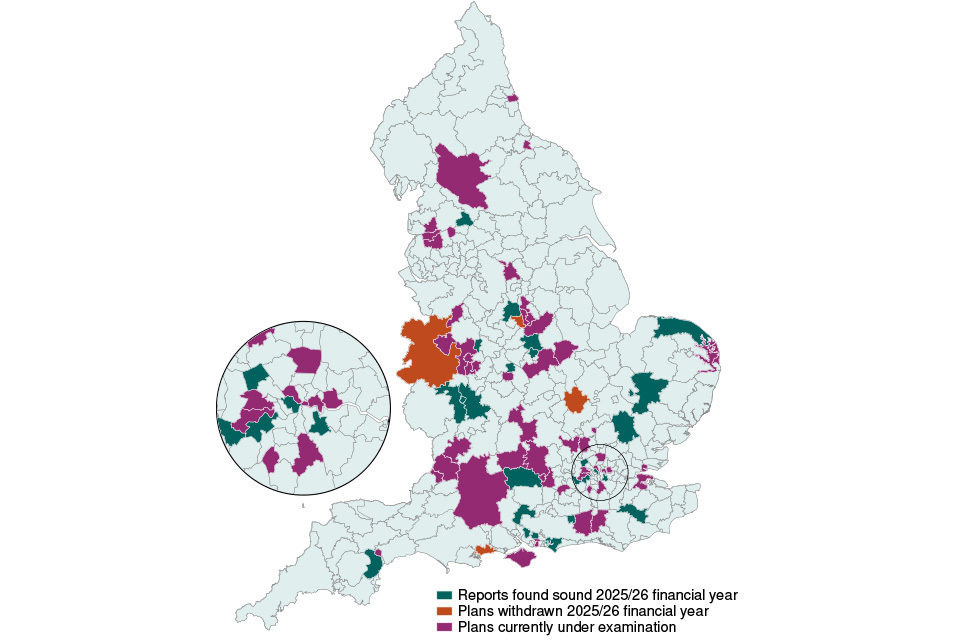
Performance in 2025/26
In 2025/26, 25 local plans were submitted (compared to 44 in 2024/25) representing a decrease compared with the previous year, and 28 reports issued (compared to 22 in 2024/25). This reduction reflects local authorities’ decisions to postpone submissions until later in 2026, ahead of the December 2026 deadline for submissions under the current Regulations. During this transition period, inspector attention has been focused on design and development of the new local plans system processes to ensure swift implementation. Significant local authority engagement has also taken place through advisory visits and also developing targeting communications to ensure readiness to submit by the December 2026 deadline.
The table below shows plans examined this financial year, and plans expected to be submitted by 31st December 2026 in England.
Table 4 - Headline metrics
| Metric | Number |
|---|---|
| Plans submitted | 25 |
| Reports issued | 28 |
| Plans found sound | 28 |
| Plans found unsound | 0 |
| Median inspector days per plan (all plans) | 72 |
| Median inspector days per plan (strategic plans only) | 99 |
| Median duration (submission to report) in months (all plans) | 16 |
| Median duration (submission to report) in months (strategic only) | 19 |
| Advisory visits held | 84 |
| Plans in examination | 55 |
| Pre-examination checklist received | 9 |
| Pre-examination checklist responses issued | 8 |
| Plans withdrawn by LPA | 4 |
Table 5 - Yearly performance
| 2025/26 | 2024/25 | 2023/24 | |
|---|---|---|---|
| Plans submitted | 25 | 44 | 18 |
| Reports issued | 28 | 22 | 23 |
| Advisory visits | 84 | 72 | 36 |
Graph 1 - Median plan examination durations
| Strategic plans | Non strategic plans | |
|---|---|---|
| 2021/22 | 23.6 | 24.2 |
| 2022/23 | 16.9 | 19.8 |
| 2023/24 | 26.1 | 28.1 |
| 2024/25 | 31.5 | 16.4 |
| 2025/26 | 19.4 | 15.1 |
During 2025/26 we also improved the service we provide to our users by:
- implementing digital tools and data reporting, including research into LPA intentions, to support us in planning and managing in forecasted increase in examinations, ensuring a more timely service
- working collaboratively with MHCLG to develop and implement reforms to the local plan system by inputting into the policy regulations and guidance that underpin the local plans service
- rolling out a programme of learning and development to fully embed the local plan reform changes and ensure inspectors and the wider service team are briefed on the new approach
- undertaking a comprehensive programme of engagement with local planning authorities and stakeholders to support the transition to Local Plans Reform, and ensure our advice is responsive to LPAs needs and requirements to assist them to be examination ready
- delivering popular webinars (up to 600 attendees plus 470 views on YouTube) providing opportunities for direct engagement with the Inspectorate leadership and live Q&A sessions
- producing regular newsletters communicating key deadlines, guidance updates and reform milestones and ensuring our GOV.UK pages are updated ensuring timely and accessible information
- undertaking 84 advisory visits across 77 councils to provide LPAs with the opportunity to test their approach and evidence base prior to submission
- broadening recruitment advertising across planning, surveying, architecture, legal and environmental professional bodies to attract a diverse range of professions and backgrounds into inspector roles to support Local Plans Reform
Case Study: The Chichester Local Plan 2021-2039
Chichester District Council submitted the Chichester Local Plan for examination in May 2024. The plan area is bisected by the South Downs National Park, and the plan relates to parts of the district outside of the National Park. The A27 road, part of the strategic road network, runs east to west, through the southern part of the Plan area, and around the southern edge of the city of Chichester, the main settlement in the district. Further significant settlement is found to the east and west of Chichester and on the coast in the Manhood Peninsula, where Selsey can be found at its tip.
As submitted, the plan sought to make provision for at least 10,350 dwellings, based on a requirement of 575 dwellings per annum. Whilst this was around 90% of the local housing need derived using the standard method, it represented a significant uplift on the dwelling requirement of the plan in place at that time. The Council had sought a housing requirement lower than local housing need due to concerns about the effects on the transport network of the area. Most new development would be provided at Chichester and the settlements in the A27 east-west corridor.
The Inspectors found that with transport mitigation and providing for a monitor and manage approach to traffic issues relating to the A27, the transport evidence justified a housing requirement at the local housing need level. They recommended that the housing requirement should be 11,484 dwellings to ensure housing need would be met in full. A stepped trajectory was also recommended of 575 dwellings per annum until 2029/30 and 701 dwellings per annum thereafter for the rest of the plan period, given the increase in the level of housing completions anticipated in the latter part of the plan period.
The district has a significant horticultural industry and the Council included in the plan policies to allow for ongoing development of the industry in the area. To be effective, the plan was amended to make clear the types of development which would be allowed in the identified horticultural development areas, to support the development of this part of the economy.
Following consultation on the Main Modifications in spring 2025, and the receipt of the Inspectors’ Report in July 2025, the plan was subsequently adopted by the Council in August 2025.
Planning and environmental appeal service
Our appeals service is critical to a fair planning system. Our inspectors are independent of councils, applicants and communities. They consider the available evidence with openness, fairness and impartiality.
What the service is
Councils and some other organisations like National Park Authorities and Mayoral Development Corporations make decisions on a variety of matters in their area. You can find the relevant organisation for your area. The matters they decide include:
- applications for planning permission, prior approval, to display advertisements, works to listed buildings, works to protected trees, applications to remove hedgerows in the countryside, and complaints about anti-social high hedges
- whether to serve legal notices (called “enforcement notices”) where they think harmful unauthorised development has taken place
The Inspectorate is here if you want someone independent to re-consider these decisions, or to decide the case where the LPA have taken too long. Our inspectors independently review the information and evidence and, in most cases, visit the site and nearby area before making their decision.
We are accountable to Parliament through the Secretary of State for Housing, Communities and Local Government, who monitors our appeals service performance through ministerial measures seeking us to:
- make our decision-making times faster and make decisions in a more consistent time range
- increase the proportion of appeals that are valid when submitted
- publish information about the number of cases we quality assure
How the service delivers against the Government’s mission
Economic growth is the Government’s number one mission. Decisions made on planning and environmental appeals directly support both the ambition to deliver 1.5 million homes and the wider mission to drive economic growth. As the Government has set out in its Plan for Growth, “growth will fund our public services, enable investment in our hospitals and schools, and, most importantly, raise living standards for everyone.”.
Development arising from appeal decisions accounted for around 1 in every 10 of new homes consented across England this year. With consistently faster decision making, developers benefit from greater certainty when planning, financing and building out their schemes.
Our close engagement and collaboration with the Minister and the Department led to the successful introduction of new Regulations expanding the scope of the expedited written representations route. This change will support more decisions being made locally by providing the complete picture at application stage and further reduce the time it takes to determine an appeal.
Performance in 2025/26
Incoming work
We received 19,444 appeals, compared to 18,758 in 2024/25. A break down by appeal type can be found in table 6.
Table 6 - Appeals received by type
| Appeal type | Sub type | 2024/25 | 2025/26 |
|---|---|---|---|
| Planning appeal | 14,679 | 15,085 | |
| Householder appeals | 4,334 | 4,101 | |
| Section 20 | 447 | 458 | |
| Section 78 | 9,148 | 9,476 | |
| Enforcement appeal | 3,332 | 3,486 | |
| Specialist | 747 | 873 | |
| Tree Preservation Orders, Tree Replacement Notices, High Hedges or Hedgerow Notices | 518 | 650 |
Appeals received
Throughout 2025/26 we have increased the range of casework types and LPA areas that can submit appeals using our new digital tools. Appeals can no longer be submitted via our legacy ‘Appeals Casework Portal’ and must now be submitted via our new GOV.UK service. As a result, more appeals are now submitted ‘right first time’, with the rate increasing from 50% in 2024/25 to 54% in 2025/26. This means that consideration of the appeal is not delayed whilst we wait for that information or evidence to be provided. As we continue to improve our digital services following user-feedback we anticipate this to increase.
Allowed appeals
The overall proportion of appeals our inspectors allowed remained comparable with previous years. In each year, approximately three out of every ten appeals were allowed, meaning that the inspector’s decision permitted a development where the original decision did not.
Across England in 2025/26, around 23,0001 homes were granted planning permission on appeal.
- A new methodology has been implemented to address inaccuracies and gaps in the ‘Number of residences’ data field. This is applied only to major and minor dwelling cases with a ‘Number of Residences’ field that is blank or recorded as zero. In these cases, the residence count is instead extracted from the ‘Development or Allegation’ text. Due to this change in methodology, the 2025/26 figures are not directly comparable with those published in previous Annual Reports and Accounts.
Table 7 - Number of appeals allowed
| Financial year | Percentage of cases allowed |
|---|---|
| 2020/21 | 27% |
| 2021/22 | 31% |
| 2022/23 | 29% |
| 2023/24 | 29% |
| 2024/25 | 30% |
| 2025/26 | 31% |
How long we took to decide appeals in 2025/26
Over time our ministers expect us to make decisions faster and in a more consistent time range. This helps provide certainty to our customers.
As in previous years, in 2025/26 our decision times varied between different types of appeal. This was because the process to reach the decision is different. It was also because some appeal types (such as enforcement) currently have a queue of appeals waiting for an inspector to be allocated to decide them.
Planning appeals decided after a hearing or inquiry are now generally much faster than they were a few years ago. Since 2022/23 we have focused more of our inspectors on these more strategic case types to make these decisions faster. We also implemented a faster timetable for planning appeals to be decided by hearing which reflects the timetable used for inquiries and then also applied that timetable to enforcement appeals by inquiry from early 2024 and to enforcement appeals by hearing from winter 2024. Since 2023/24, we have focused more inspectors onto planning appeals by written exchange of evidence to reduce the number of appeals waiting for a decision.
For planning appeals decided after an inquiry, we:
- decided 163 appeals, 17% fewer than in 2024/25
- received 21% fewer appeals requiring an inquiry
- continued progress to be more consistent in our decision times
- continued progress to decide more appeals within 26 weeks
- improved average decision times over the last ten years
Graph 2 - Median decision time for planning appeal cases decided by inquiry
| Median decision time in weeks - 50th Percentile | Median decision time in weeks - 90th Percentile | |
|---|---|---|
| 2020/21 | 40 | 66 |
| 2021/22 | 33 | 76 |
| 2022/23 | 31 | 63 |
| 2023/24 | 30 | 65 |
| 2024/25 | 27 | 48 |
| 2025/26 | 29 | 62 |
For planning appeals decided after a hearing, we:
- decided 436 appeals, 23% less than 2024/25
- received 25% less appeals than in 2024/25
- continued the progress from 2024/25 with speeding up these decisions and becoming more consistent in decision times
- decided 68% of these appeals within 26 weeks, compared to 63% in 2024/25
Graph 3 - Median decision time for planning appeal cases decided by hearing
| Median decision time in weeks - 50th Percentile | Median decision time in weeks - 90th Percentile | |
|---|---|---|
| 2020/21 | 41 | 64 |
| 2021/22 | 46 | 80 |
| 2022/23 | 43 | 103 |
| 2023/24 | 26 | 93 |
| 2024/25 | 24 | 48 |
| 2025/26 | 23 | 41 |
For planning appeals decided after written exchange of evidence, we:
- decided more than we received as we continued to focus on improving our performance for these appeals. The number of open appeals of this type has reduced by about 20%
- decided on average across the year 59% of cases within Ministerial Measure, with performance improving to 75% in March
- on average, the median decision time was 8 weeks faster than in 2024/25
- became more consistent in our decision times. The quickest 10% of decisions took 10 weeks or less, 4 weeks faster than in the 2 previous years. The slowest 10% of decisions took 35 weeks or more, compared to 40 weeks or more in 2024/25. The continued focus on reducing older cases puts us in a good position to improve our decision time consistency further in 2026/27
Graph 4 - Median decision time for planning appeal cases decided by written representations
| Median decision time in weeks - 50th Percentile | Median decision time in weeks - 90th Percentile | |
|---|---|---|
| 2020/21 | 22 | 37 |
| 2021/22 | 23 | 40 |
| 2022/23 | 26 | 49 |
| 2023/24 | 29 | 52 |
| 2024/25 | 26 | 40 |
| 2025/26 | 18 | 35 |
For enforcement appeals decided after a hearing or inquiry, we:
- decided 309 appeals, around 47% less than 2024/25, as we focused on reducing the number of both open cases and older cases
- reduced the number of enforcement appeals awaiting an inquiry from a high of over 600 in 2020/21 to 78 in 2025/26
- reduced the number of enforcement appeals awaiting a hearing from 116 in 2024/25 to 45 in 2025/26
- became more consistent in our decision times
Graph 5 - median decision time for enforcement appeal cases decided by hearing
| Median decision time in weeks - 50th Percentile | Median decision time in weeks - 90th Percentile | |
|---|---|---|
| 2020/21 | 78 | 108 |
| 2021/22 | 62 | 106 |
| 2022/23 | 87 | 184 |
| 2023/24 | 66 | 121 |
| 2024/25 | 57 | 111 |
| 2025/25 | 25 | 75 |
Graph 6 - Median decision time for enforcement appeal cases decided by inquiry
| Median decision time in weeks - 50th Percentile | Median decision time in weeks - 90th Percentile | |
|---|---|---|
| 2020/21 | 87 | 125 |
| 2021/22 | 90 | 136 |
| 2022/23 | 82 | 224 |
| 2023/24 | 81 | 133 |
| 2024/25 | 47 | 100 |
| 2025/26 | 26 | 85 |
For enforcement appeals decided after written exchange of evidence, we:
- decided 2,620 appeals. This was 55% more than 2024/25
- took longer on average to decide appeals than 2024/25. For 2025/26 the median decision time was 69 weeks, the highest it has been since 2010. With performance improving across other casework areas, we are now implementing approaches that allow us to flex inspector resource and deploy capacity more dynamically across the service, helping us to reduce decision times in this casework
- became slightly less consistent in our decision times as we focused on other casework. The quickest 10% of decisions took 26 weeks, whilst the slowest 10% took 115 weeks
Graph 7 - Median decision time for enforcement appeal cases decided by written representations
| Median decision time in weeks - 50th Percentile | Median decision time in weeks - 90th Percentile | |
|---|---|---|
| 2020/21 | 32 | 60 |
| 2021/22 | 31 | 74 |
| 2022/23 | 46 | 88 |
| 2023/24 | 52 | 81 |
| 2024/25 | 54 | 96 |
| 2025/26 | 69 | 115 |
For tree preservation orders, tree replacement order, high hedge and hedgerow appeals, we:
- decided 45% more appeals than 2024/25 and closed as many as we received. Improvements in our front end processes have strengthened workflow and supported the increase in decisions made this year
- took slightly longer on average to make a decision than in 2024/25 as we focused on other casework
Graph 8 - Median decision time for cases decided by tree preservation order, tree replacement orders, high hedge and hedgerow appeals
| Median decision time in weeks - 50th Percentile | Median decision time in weeks - 90th Percentile | |
|---|---|---|
| 2020/21 | 44 | 79 |
| 2021/22 | 21 | 90 |
| 2022/23 | 29 | 82 |
| 2023/24 | 37 | 80 |
| 2024/25 | 67 | 110 |
| 2025/26 | 69 | 117 |
During 2025/26 we also improved the service we provide to our users by:
- rolling out Manage Appeals to all LPAs across England for submission of both planning and enforcement appeals, representing a major step in our strategy to transition all casework onto a single, modern digital system
- adopting an area-based approach to planning appeal casework which strengthens organisational delivery by ensuring end-to-end ownership of appeals and empowering inspectors to actively shape and manage their programmes to maximise performance and productivity
- establishing a Planning Performance Board and introducing a unified dashboard that, for the first time, brings together volume, performance, and resourcing data in a single place
- routinely quality-assuring our casework to ensure it meets the standards we expect, using the insights gained to refine and plan training and to update our guidance
- maintaining regular recruitment cycles for Band 1 inspectors to ensure we have the capacity needed to meet current and future operational demand
Case Study: appeals service
Delivering a more efficient, proportionate and streamlined digital appeals service
In 2025/26 we delivered major improvements to the appeals service through the rollout of a new national digital platform. The service is now fully operational across all local planning authorities (LPAs), enabling all planning and enforcement appeals to be submitted and managed digitally. This modernises the appeals process and provides a clearer, faster and more reliable experience for all users.
The new platform replaces the legacy Appeals Casework Portal, reducing technical risk and removing reliance on outdated systems. It provides a secure, resilient and standards compliant service aligned with Government Digital and Data requirements. All internal operational teams have now been onboarded and trained, and the service has begun transitioning into its long term live support model.
Why this matters for customers
The new system delivers tangible benefits for appellants, agents, LPAs and interested parties. Appellants and agents gain a simpler, more intuitive journey with clearer steps, faster form completion and improved document upload. LPAs benefit from more consistent submissions, reduced formatting issues and clearer instructions that minimise errors and rework. Interested parties can engage more easily through straightforward guidance, the ability to save progress and a stable, accessible design. Across all groups, the platform increases confidence through improved security, reliability and transparency.
Planning appeals service
Following a successful pilot with five LPAs, national rollout began in December 2025 using a phased approach to minimise risk and refine the service before onboarding the largest authorities. Delivery of all remaining planning appeal types was completed, including listed building, conservation, advertisement and commercial appeals, alongside support for hearing and inquiry procedures. During 2025/26, 7,084 planning appeals were submitted, with continuous user engagement informing improvements.
Enforcement appeals service
A pilot for enforcement notice appeals launched in January 2026 with Cornwall, Brent and Havering. After successful testing, the full enforcement journey was delivered and rolled out nationally. Between January and March 2026, 408 enforcement appeals were submitted. The service was expanded to include listed building enforcement and lawful development certificate appeals, improving consistency across appeal types.
Looking ahead
With national rollout complete, work now focuses on enhancing functionality such as the manually processed appeal types and continuing to respond to user feedback. This provides a strong foundation as we begin exploring appeals as data with pilot LPAs.
Planning and environmental application service
Enabling the successful delivery of government priorities across key policy areas whilst ensuring alignment with national and local planning policy.
What the service is
The planning and environmental applications service handles a range of applications on behalf of SoS. These include:
- applications submitted under Section 62A of the Town and Country Planning Act 1990, where applications for planning permission can be made directly to us where the LPA for the area has been designated as ‘poorly performing’ by the SoS
- called-in planning applications, where the SoS takes over the decision-making authority from LPAs for specific planning applications, often due to national significance or public interest
- Crown development applications, where non-urgent, nationally important developments can be made directly to us by government departments
- compulsory purchase orders (CPOs), where some organisations can purchase land even if the owner does not want to sell. This is normally because the land is needed for an important project such as a road, railway or a development important for the area. We independently assess whether the compulsory purchase order should go ahead
- purchase notice referrals, where a landowner asks for their land to be purchased by the LPA because planning decisions mean the land no longer has a beneficial use
- electricity wayleaves, where electricity licence holders seek to secure permissions from owners and/or occupiers of land to legally install, repair and maintain an electric line. We make a recommendation for the Secretary of State of DESNZ
- drought orders and permits in water shortage months, on behalf of Secretary of State of Defra
How it delivers against the Government’s mission
By delivering essential services on behalf of MHCLG and other government departments including Defra and DESNZ, we play a critical role in enabling the successful delivery of government priorities across key policy areas.
This includes, but is not limited to, the Government’s ambitions for housing delivery that are focused on increasing the supply of homes, accelerating decision-making, and ensuring development supports sustainable growth and national priorities. The Service is central to delivering government ambitions for enabling nationally important public sector projects on Crown land to be delivered quickly, efficiently, and proportionately, while maintaining proper planning scrutiny, public engagement, and alignment with national and local planning policy.
Case Study: Inland Border Facility and Border Control Post at Sevington, Ashford, Kent.
DfT, Defra and HMRC submitted an application to build an Inland Border Facility on Crown land. This site lets Defra and Port Health check food and plants to make sure they are safe to enter the UK. There is also a Border Control Post, run by HMRC, where customs checks are done and paperwork is approved for bringing goods in and out of the country.
Whilst this facility had temporary planning permission granted by means of a ‘Special Development Order’, this was due to expire by the end of December 2025. This meant that after this date, the site would no longer have planning permission and could have been subject to enforcement action by the local council.
The Secretary of State for MHCLG recognised the new application as being vital for the country and submitted it to us at the end of June 2025. We quickly checked all the details and appointed an Inspector straight away. A decision whether to approve or reject the plans was made within eight weeks, comfortably ahead of schedule. Planning permission for Crown development was granted. This case shows how we worked hard to achieve the government’s goals, kept the system running smoothly, and met the needs of everyone involved. We made sure evidence was properly considered, gave applicants a fair hearing, and made sure local people and other interested groups had a genuine chance to have their say.
Performance in 2025/26
A breakdown of the expected timelines across the different casework types can be found in table 8.
Table 8 - Timeframes for casework under the planning and environmental application service
| Casework | Receipt to appointment of inspector | Receipt to site visit, hearing, or inquiry | Receipt to submission of inspector report/ decision | Receipt to issue |
|---|---|---|---|---|
| CPOs - housing and planning, other CPO casework | 2-4 weeks (depending on size of case) | Statutory timeframe of 15 weeks from receipt for site visits, 22 weeks from receipt for inquiry | Statutory timeframe of 4 weeks from site visit, 8 weeks of the inquiry closing for 80% of case with the other 20% within 12 weeks | n/a (as SoS issues decision) |
| S62a | 1 week | 4-5 weeks (written representations/ site visit), 9 weeks (hearing) | 6-7 weeks (written representations/site visit), 10-13 weeks (hearing) | Non-major 8 weeks Major 13 weeks (if EIA 16 weeks) |
| Crown development | 1 week | 4-5 weeks (written representations/ site visit), 9 weeks (hearing), 13 weeks (inquiry) | 6-7 weeks (written representations/site visit), 10-13 weeks (hearing), 22-28 weeks (inquiry) | 8-9 weeks (written representations/ site visit) 12-15 weeks (hearing), 24-30 weeks (inquiry) |
| Called-in planning applications | 1-2 weeks | 22 weeks statutory, however usually aim to start inquiry 13-16 weeks from the start letter | 30 weeks | 43 weeks |
| Drought order & permits | Usually assigned before case is officially received | Hearing must be held within 20 days of permit/ order application | 6-8 days from end of hearing | n/a (as SoS issues decision) |
| Wayleaves (WR only) | From receipt to submission of report - 5 days | n/a (as SoS issues decision) | ||
| Wayleaves (hearing) | 1 month | 5 month (site visit) 6-7 months |
n/a (as SoS issues decision) | |
| Purchase notice referrals | 2 months | 3-6 months (hearing) 7-8 months |
n/a (as SoS issues decision) |
Table 9 shows a breakdown of the forecast demand across the different casework types in Applications:
Table 9 - Forecast demand vs output expectation in weeks
| Casework | Forecast demand (new cases received) 2025/26 | Output expectation (casework issued) 2025/26 |
|---|---|---|
| Called in planning applications | 8-14 | 8-14 |
| CPOs - Housing and planning, other SoS CPO casework | 25-30 | 25-30 |
| S62a | 20-40 | 20-40 |
| Crown development | 2-7 | 2-7 |
| Environmental application (water abstraction, SSSI, ad hoc Defra casework (no drought orders/ permits anticipated) | 2-5 | 2-5 |
| Electricity wayleaves | 30-40 | 30-40 |
| Purchase notice referrals | 0-7 | 0-7 |
Our decision timeliness has improved, and we have been in target for the past 6 months consecutively, and above the requirement (the past 6 months have been at 100% against the 80% target).
During 2025/26 we also improved the service we provide to our users by:
- standing up a brand new service, providing dedicated resource to focus on the timely and effective delivery of applications
- developing a new digital platform for Crown development case management, providing users with easily accessible documentation, clear case timelines, and an overall more transparent and efficient end to end process
- working collaboratively with MHCLG to develop and implement the Crown development regime by inputting into processes and guidance that underpin the casework delivery service
- significantly reduced the wayleaves backlog, targeting programmes focused on clearing aged cases, improving timeliness and minimising delays so that users receive decisions more quickly
- handling section 62A applications within expected timescales, ensuring timely and efficient decision making for users
Graph 9 - Number of cases appointed to inspectors each month
| Monthly Actual | YTD Moving Average | |
|---|---|---|
| Apr-25 | 11 | 7 |
| May-25 | 6 | 9 |
| Jun-25 | 7 | 8 |
| Jul-25 | 8 | 8 |
| Aug-25 | 14 | 9 |
| Sep-25 | 8 | 9 |
| Oct-25 | 10 | 9 |
| Nov-25 | 8 | 9 |
| Dec-25 | 8 | 9 |
| Jan-26 | 12 | 9 |
| Feb-26 | 8 | 9 |
| Mar-26 | 9 | 9 |
Rights of way and commons decision service
Protecting and improving public access to the countryside while balancing environmental conservation with the rights and interests of landowners and others.
What the service is
The rights of way and commons decision service decides on proposed changes to public rights of way and commons assets on behalf of the SoS for Defra. The types of cases includes:
- public rights of way, such as changing access rights to the network or making new public rights of way
- commons applications and referrals to amend the registers of common land or town/village greens
- coastal access cases for parts of the proposed stretch of the English coast path when objections are made
Rights of way and commons applications play a vital role in making sure everyone can enjoy our footpaths and bridleways, and that shared land is looked after for all. These applications help keep our countryside open and welcoming. By safeguarding local routes and green spaces, we help to protect the areas that supports the health and wellbeing of communities and maintain the cultural and historic character of places that people rely on and care deeply for.
How it delivers against the Government’s mission
The Government’s aim for rights of way and common land casework is to protect and improve public access to the countryside while balancing environmental conservation with the rights and interests of landowners and others. This is delivered by the Inspectorate through independent, evidence-based and timely decisions. This work protects public access, safeguards important environmental and historic land, and gives clarity and certainty to users, landowners and local authorities. The Inspectorate does this by keeping the Definitive Map and Statement accurate, and by deciding objections and applications in line with the law. In doing so, we balance public interest, environmental protection and legal rights. Our focus is on making high-quality, transparent and proportionate decisions, while reducing backlogs, improving timeliness and maintaining public confidence in the system.
Case Study: King Charles III coastal path
The Lyme Regis to Rufus Castle stretch of the King Charles III England Coast Path (ECP) concerns 40 miles of coastline in Dorset. Natural England submitted a report to the Secretary of State for Defra in July 2015 setting out proposals for improved public access between Lyme Regis and Rufus Castle, Portland. Following the receipt of objections and representations, the Inspectorate produced a recommendation report for Defra in December 2016. Four sections of this stretch have now been approved by Defra, with eight yet to be determined. More information can be found here: King Charles III England Coast Path: Lyme Regis to Rufus Castle - GOV.UK.
In June 2025 Defra requested that the Inspectorate prioritise consideration of an updated habitats regulations assessment for this stretch of the ECP, in light of the April 2018 People over Wind European Court judgment. This update would then be appended to the 2016 recommendation report. This involved appointing an experienced inspector at short notice, consulting all parties involved in the 2015-2016 process, and clarifying various points of detail with Defra (such as the extent of the National Landscapes impacted by the proposals). The Inspectorate shared its recommendation with Defra in November 2025. The work was completed quickly, creating a robust and efficient process for Defra and Natural England, particularly in light of the ECP’s official opening in 2026.
Performance in 2025/26
For rights of way cases decided through written exchange, hearing or inquiry, we:
- decided 258 cases, a 6% increase from 2024/25
- became no less consistent in our decision times
- the number of undecided inquiry cases decreased from 338 at the end of 2024/25 to 310 at the end of 2025/26
Graph 10 - Rights of way: number of cases received vs forecast
| Months | Received | Closed | Calculated open cases |
|---|---|---|---|
| Jan-25 | 29 | 26 | 364 |
| Feb-25 | 19 | 21 | 362 |
| Mar-25 | 20 | 26 | 356 |
| Apr-25 | 26 | 39 | 343 |
| May-25 | 17 | 22 | 338 |
| Jun-25 | 22 | 29 | 331 |
| Jul-25 | 32 | 19 | 344 |
| Aug-25 | 15 | 11 | 348 |
| Sep-25 | 18 | 16 | 350 |
| Oct-25 | 11 | 25 | 336 |
| Nov-25 | 23 | 21 | 338 |
| Dec-25 | 23 | 31 | 330 |
| Jan-26 | 24 | 17 | 337 |
| Feb-26 | 28 | 24 | 341 |
| Mar-26 | 9 | 36 | 314 |
| 316 | 363 | 5132 |
Graph 11 - Commons: number of cases received vs forecast
| Months | Received | Closed | Calculated open cases |
|---|---|---|---|
| Jan-25 | 4 | 6 | 72 |
| Feb-25 | 5 | 5 | 72 |
| Mar-25 | 4 | 7 | 69 |
| Apr-25 | 11 | 4 | 76 |
| May-25 | 4 | 8 | 72 |
| Jun-25 | 7 | 7 | 72 |
| Jul-25 | 2 | 4 | 70 |
| Aug-25 | 7 | 4 | 73 |
| Sep-25 | 4 | 2 | 75 |
| Oct-25 | 6 | 9 | 72 |
| Nov-25 | 6 | 6 | 72 |
| Dec-25 | 3 | 6 | 69 |
| Jan-26 | 10 | 3 | 76 |
| Feb-26 | 11 | 5 | 82 |
| Mar-26 | 6 | 3 | 85 |
| Total | 90 | 79 | 1107 |
Table 10 - Timeframes for rights of way, commons and coastal access casework
| Casework | Receipt to appointment of inspector | Receipt to site visit, hearing or inquiry | Receipt to submission of inspector report/decision | Receipt to issue |
|---|---|---|---|---|
| Rights of way | 12 months | 18-20 months | 20-23 months | 23-24 months |
| Commons | 1-2 months (if needed) | 9 months | 10 months | 10-11 months |
| Coastal access | 1-3 weeks | ASV: 6-8 months: Hearing/inquiry: 12-24 months | 12-28 months | n/a (we do no issue decisions, this the responsibility of Defra/Natural England) |
Graph 12 illustrates number of cases appointed to inspectors each month (actual and year-to-date moving average)
Graph 12 - Number of cases appointed to inspectors each month
| Monthly Actual | YTD Moving Average | |
|---|---|---|
| Apr-25 | 28 | 28 |
| May-25 | 18 | 23 |
| Jun-25 | 17 | 21 |
| Jul-25 | 19 | 21 |
| Aug-25 | 24 | 21 |
| Sep-25 | 15 | 20 |
| Oct-25 | 22 | 20 |
| Nov-25 | 28 | 21 |
| Dec-25 | 20 | 21 |
| Jan-26 | 28 | 22 |
| Feb-26 | 20 | 22 |
| Mar-26 | 40 | 23 |
During 2025/26 we also improved the service we provide to our users by:
- progressed casework backlog reduction, issuing more decisions than this time last year
- improving efficiencies by streamlining casework processes introducing the grouping of cases geographically to enable inspectors to undertake multiple site visits within the same area, improving efficiency, reducing overall timelines, and supporting the quicker issue of decisions
-
proactively engaged with users, seeking feedback through customer surveys as well as with stakeholders across the wider Defra group, including key statutory bodies and other organisations that play an essential role in the rights of way and commons network, welcoming our efforts to engage proactively and support improvements to the service and wider industry
- worked closely with our communications and customer teams to build on this progress and further strengthen how we collaborate, share information, and respond to user needs
Graph 13 - Number of customer complaints raised and closed
| Months | Created tickets % | No of tickets solved % | SLA% | Target % |
|---|---|---|---|---|
| Apr-25 | 0 | 1 | 0% | 80% |
| May-25 | 4 | 1 | 75% | 80% |
| Jun-25 | 3 | 5 | 60% | 80% |
| Jul-25 | 6 | 7 | 75% | 80% |
| Aug-25 | 8 | 8 | 78% | 80% |
| Sep-25 | 0 | 1 | 100% | 80% |
| Oct-25 | 1 | 4 | 67% | 80% |
| Nov-25 | 1 | 3 | 100% | 80% |
| Dec-25 | 4 | 2 | 80% | 80% |
| Jan-26 | 6 | 6 | 88.9% | 80% |
| Feb-26 | 5 | 3 | 75.0% | 80% |
| Mar-26 | 4 | 6 | 50.0% | 80% |
Sustainability performance
The government aims for the UK to be net zero by 2050; we are playing our part not just through the decisions we make, but in the way we conduct our work.
The impact of our organisation
Part of the Inspectorate’s role is to make recommendations to various SoS on infrastructure for renewable energy, such as solar farms, wind turbines and nuclear power stations. Since July 2024, with our contribution, the government has consented enough wind and solar applications to power the equivalent of over 7.5 million homes, unlocking the benefits of the clean energy.
However, it’s not just the decisions we make and recommendations we issue that have an impact on our environment, but the way in which we conduct our work that contributes towards the government’s aim of being net zero. In 2025/26 we were in the middle of our three-year 2024-27 Environment Plan. The plan is aligned to our Environment Policy, which sets our four priorities:
- reducing our emissions
- effectively managing our waste
- applying environmentally responsible aware procurement methods
- being open and transparent about our environmental performance
To reduce our emissions, we updated travel booking guidance and issued targeted communications aimed at improving sustainability. This resulted in an increase in the use of ultra-low emission vehicles being hired for official business by 85% on last year. To effectively manage our waste, especially that generated from printing, our office printers now inform colleagues how much each print costs, helping them decide if the print is really required.
We have an established environmental sustainability staff network. They promote sustainability practices and awareness across the Inspectorate at welcome days for new employees, internal communications, and contribute to our environmental policy and plan.
Through our procurement policy we ensure that all current and future contracts meet sustainability requirements. Our car hire company has ultra-low emission vehicles available to our inspectors, we use the government system for booking travel and accommodation to ensure the most sustainable options are available, and our office is a Certified B Corporation™.
Case study: Volunteering at the Birch Collective
As part of our commitment to supporting local communities and encouraging meaningful social impact, colleagues across the Inspectorate can request time away to take part in volunteering activities that contribute to environmental, social, and community wellbeing.
In September 2025, a small team of Planning Inspectorate staff volunteered for 1 day to support the Strawberry Lane Community Garden. Together, they:
- Marked trees that had not survived, enabling their removal and making way for future tree-planning
- Cleared a substantial area of bramble where light broke through the canopy, creating space for a new coppice
Emma Smith, one of the volunteers, reflected on the experience:
The experience was so rewarding. The most satisfying part was seeing the immediate results of our efforts. Getting outside, working up a sweat, and knowing we were making a real difference to our local community felt brilliant. Knowing that our efforts would help maintain community spaces for everyone to enjoy made the day feel genuinely worthwhile.
Approximately 595 of our people are contracted to work from our office located in central Bristol. The office provides a professional environment that supports effective teamwork, knowledge exchange, and the kind of informal collaboration that is challenging to replicate through remote working. Increased office attendance strengthens working relationships, enhances communication, and supports more efficient and coordinated ways of working.
Office-based activity also plays an important role in supporting colleagues at earlier stages of their careers. Being physically present enables them to observe experienced professionals, access ad hoc guidance, and develop skills within a collaborative and supportive setting.
Our office provider is a Certified B Corporation™ – verified as meeting standards for social and environmental performance, transparency, and accountability.
Our travel
Our inspectors are home-based, but their role requires them to visit sites around the country to ensure they fully understand the relevant economic, social, and environmental impact of the proposal they are considering. Staff also travel for other official work purposes such as attending training events and meeting with external bodies.
Table 11 shows our travel impact in kilometres via the corporate travel contracts, broken down by mode of transport. It does not show travel in personal vehicles, and we do not have a vehicle fleet. There were 122 domestic flights taken in 2025/26, compared to 118 in 2024/25. There were no international flights taken in 2025/26. Further information on our scope 3 emissions can be found in table 14.
Table 11 - Travel information via corporate travel contracts
| Mode of transport | Car | Train | Flight | Boat |
|---|---|---|---|---|
| Number of bookings (2024/25) |
3,507 (3,432) |
8,001 (4,252) |
122 (118) |
9 (20) |
| Kilometres travelled (2024/25) |
1,511,882 (1,395,687) |
1,652,518 (1,604,036) |
84,362 (70,982) |
- (-) |
| Comparison to 2024/25 | Up | Up | Up | Down |
Supplies
Whilst good progress has been made to reduce the amount of supplies we buy each year, our people still require essential supplies to complete work that can’t be managed electronically.
In 2025/26, we purchased 6,544 single use plastic items, which represents a reduction from 13,825 in 2024/25. In the same period, we purchased 2,021 reams of A4 paper, which is a reduction from 2,090 in 2024/25.
Graph 14 - Progress made on reducing paper
| 2017/18 | 2018/19 | 2019/20 | 2020/21 | 2021/22 | 2022/23 | 2023/24 | 2024/25 | 2025/26 | |
|---|---|---|---|---|---|---|---|---|---|
| Paper Reams | 5,500 | 4,220 | 3,470 | 600 | 2,030 | 1,805 | 3,552 | 2,090 | 2,021 |
Delivering social value through our procurement activity
We are committed to delivering social value through our commercial activities and supply chains, based around the following themes from the Government’s ‘Plan for Change’:
- kickstart economic growth
- build an NHS fit for the future
- safer streets
- break down barriers to opportunity
- make Britain a clean energy superpower
See the procurement policy note for more information on taking account of social value in the award of central government contracts.
ICT and digital waste
We have a contract with a third-party provider to collect all our IT assets that are no longer required. These assets are either re-used, donated or recycled and none of these assets are sent to landfill. Our third-party provider is unable to provide us with details of mass in tonnes or value returned for ICT and digital waste.
Details of the IT assets disposal are set out in graph 15.
Graph 15 - ICT and digital waste by destination
| Number of units | |
|---|---|
| Items for Reuse | 165 |
| Items for Recycling | 471 |
| Items for landfill | 0 |
| Items to incineration (energy recovery) | 0 |
| Items to incineration (without energy recovery) | 0 |
Task Force on Climate-Related Financial Disclosures Report
The Financial Stability Board (FSB), founded by the G20 economies, established the Task Force on Climate-Related Financial Disclosures (TCFD) in 2015 to bring greater transparency on the financial implications of climate change. HM Treasury has taken up their recommendations on the types of information that companies should disclose in relation to climate change and directed government departments to undertake a phased approach to reporting.
TCFD reporting focuses on the four thematic areas, with a series of recommended disclosures for each:
- Governance
- Strategy
- Risk Management
- Metrics and Targets
Compliance statement
The Inspectorate has reported on climate-related financial disclosures consistent with HM Treasury’s TCFD-aligned disclosure application guidance, which interprets and adapts the framework for the UK public sector.
Based on a review of the Inspectorate’s risk landscape through the lens of the risks’ proximity, likelihood and impact on the department’s strategic objectives, the Inspectorate considers sustainability (including climate change) to not be a principal risk category in its own right, and has therefore complied with the TCFD recommendations and recommendations disclosures around:
- Governance – recommended disclosures (a) and (b)
- Strategy
- Risk Management – recommended disclosures (a) to (c)
- Metrics and Targets – recommended disclosures (b)
Climate risk is considered at strategic level and included as an entry within the Strategic Risk Register, currently listed within the Operational Delivery risk category. This risk was identified in early 2025 as part of the Inspectorate’s need and interest to articulate climate risk. Further details are set out in the Risk Report.
The Inspectorate recognises the real-world impacts of rising global temperatures, and our role and responsibilities to support effective climate change adaptation – from our work to support on-the-ground community response and resilience to severe weather events, to supporting energy efficiency and mitigating the impacts on our built environment and infrastructure.
TCFD Governance: Disclosures (a) and (b)
Under the Inspectorate’s Board model and governance framework, primary governance and oversight is managed at a portfolio level and chiefs are responsible for ensuring effective governance arrangements are in place for their areas in the discharge of their delegated authority and responsibilities. The Board and the Audit and Risk Assurance Committee (ARAC) provide high-level oversight of climate-related risks, issues and commitments within their scope. This includes consideration of issues raised through risk escalation processes, as well as standing items and/or deep dives on issues of particular relevance, as required.
Overall assurance and oversight – including escalation of core risks and decisions – is managed at an executive level by the Executive Team. Specific climate related risks and opportunities may be escalated to the executive level for discussion or awareness, where appropriate. Updates are provided to the Board and the ARAC as required. ARAC receive updates on our environmental reporting quarterly within their dashboard. ARAC also plays a role in assuring the final metrics-based reporting on climate and sustainability issues, as part of the annual reporting cycle.
Further detail on the Inspectorate’s overall governance is included in the Governance Statement.
TCFD Strategy
While the Inspectorate has not identified climate as a principal risk, we still consider it as a risk to our operations in the medium to long term within our strategic risk register, details of which are set out in the risk report. We also have a wider responsibility in considering sustainability when determining casework or when making recommendations to SoS.
We recognise that climate change will affect our ability to deliver our services now and into the future. In the short term, we will review and update our Environmental Plan to consider reducing our travel and building emissions, encouraging the further use of ultra-low emission vehicles, the effective reduction of single use plastics, applying environmentally responsible procurement methods and being open and transparent about our environmental performance. We will also ensure that our operational delivery is resilient towards the increasing prevalence of extreme weather conditions. In the medium term we will continue to procure goods and services, taking account of social value, government’s National Procurement Policy Statement and buying standards.
Looking forwards into the longer-term, physical risks such as extreme weather, heat and flooding could disrupt our ability to deliver key services, especially when we need to conduct site visits across the country. We will consider how these risks are mitigated and responded to as part of the Inspectorate’s new strategy development. This will include testing the resilience of the strategy, taking into consideration different climate-related scenarios.
TCFD Risk Management: Disclosures (a) to (c)
The Inspectorate’s process for identifying, assessing and managing climate related risks is fully integrated into the overall risk management approach, described more fully in the Risk Management section.
ARAC meets on a quarterly basis to discuss and monitor risks to the Inspectorate and provides oversight and assurance on resilience risk planning.
The Inspectorate’s risk escalation policy ensures that significant risks, including those related to climate change, are considered at the appropriate governance level according to the scale and likelihood of the risk. As part of the risk management process, the senior responsible owners review the existing and emerging regulatory requirements and use this information in assessing risks. The approaches to decision-making regarding the management of risks and the process of escalation of key risks is described in the Risk Management section.
TCFD Metrics and Targets: Disclosures (b)
HM Treasury published the 2024-25 Sustainability Reporting Guidance which gives minimum reporting requirements for central reporting against the Greening Government Commitments (GGC). HM Treasury asks for reporting against three ‘scopes’. The Inspectorate’s sustainability reporting is aligned with the GGC framework.
The Inspectorate discloses where possible our emissions for Scope 1 (emissions from sources owned or controlled by the Inspectorate), 2 (emissions resulting from energy consumed which is supplied by another party such as electricity supply and purchased heat, steam and cooling) and 3 (emissions resulting from business travel) greenhouse gas emissions under the GGCs. We do not hold or use carbon offsets. Additionally, we are unable to fully report all metrics because our current temporary serviced office provider is unable to meet our request for granular information. The elements of reporting that we are unable to comply with are:
- gross expenditure on reported areas of energy related to Scopes 1 and 2 sources
- absolute values and associated financial costs for all waste generated in our office
- total use and expenditure on the purchase of water
The ability for the provision of this data has been included in our requirements moving forward for our longer term office solution.
As we have stated earlier in this section under Our Travel, the Inspectorate does not hold its own fleet of vehicles. Instead, we have a contract in place for the hiring of cars for events, although our employees are encouraged to use public transport, ideally train travel. A full break down of journeys and mileage by mode of transport is in table 11.
The following tables set out our GGC reporting comparing the baseline of 2017/18 to 2025/26.
Please see the sustainability report for disclosures on single use items.
Table 12 - Scope 1 emissions against the GGC framework
| Scope | Temple Quay House 2017/18 Baseline | Current premises 2024/25 | Current premises 2025/26 |
|---|---|---|---|
| Energy (kWh) | 0 | 0 | 0 |
| Gas | 0 | 0 | 0 |
| Gross emissions in tCO2e | 0 | 0 | 0 |
Table 13 - Scope 2 emissions against the GGC framework
| Scope | Temple Quay House 2017/18 Baseline | Current premises 2024/25 | Current premises 2025/26 |
|---|---|---|---|
| Energy (kWh) | 623,087 | 47,599 | 34,225 |
| Gas | 271,294 | 471 | Not available |
| Gross emissions in tCO2e | 289.51 | 86.3 | 76.18 |
Table 14 - Scope 3 emissions against the GGC framework
| Scope | 2017/18 Baseline | 2024/25 | 2025/26 |
|---|---|---|---|
| Gross emissions in tCO2e for official business travel | 467 | 58.27 | 234.73 |
| Total expenditure on business travel | £1,644,035 |
Financial performance
In financial year 2025/26 the Planning Inspectorate incurred net expenditure of £78.2m delivering services to customers and supporting the objectives of the Strategic Plan.
This spend comprised £94.5m Resource Expenditure including depreciation, and £9.7m of Capital Expenditure. Minimal costs were charged to Annually Managed Expenditure. The Planning Inspectorate generated £26.0m of income from nationally significant infrastructure projects, local plans and other casework. The remaining £78.2m was funded by MHCLG.
Resource Departmental Expenditure Limit (DEL)
Total revenue expenditure for financial year 2025/26 was £94.5m, an increase of £15.9m compared with the previous year.
Of this increase £2.5m of this was driven by inflation. £2.2m was incurred on additional inspectors to address casework backlogs and support new casework, in line with the priorities set out in the Strategic Plan. A further £4.8m was spent on additional support staff, primarily in Digital to develop and maintain our digital services.
Graph 16 - Resource expenditure over the last five years (£m)
| 2021/22 | 2022/23 | 2023/24 | 2024/25 | 2025/26 | |
|---|---|---|---|---|---|
| Staff Costs | £45,446,000.00 | £49,510,000.00 | £58,641,000.00 | £63,480,436.81 | £72,764,408.13 |
| Non-pay running costs | £15,270,000.00 | £14,397,000.00 | £15,350,000.00 | £15,211,471.80 | £21,796,563.17 |
During the year, £1.4m was spent on consultancy services to identify efficiencies across the organisation and support increased casework output. £1.3m was invested to assess the feasibility of digital systems for new casework types as part of the wider planning system digitisation programme. Associated operating costs arising from increased staffing and project delivery activity have rose by £1.1m, including additional expenditure on software licences, IT support, and other operational requirements.
Elsewhere, legal and ex gratia costs have increased in year by £0.7m following a small number of high value cases. Depreciation increased by £0.8m as major digital assets were brought into service during the year, including the Appeals Portal, Appeals Case Management System and the Operational Data Warehouse.
In comparing year-on-year performance, it should be noted that 2024/25 included a £1.1m one off receipt from the Government Property Agency following departure from Temple Quay, contributing to the variance observed in 2025/26.
Income
Income for financial year 2025/26 totalled £26.0m, an increase of £3.7m compared with the previous year. Key movements included:
- £5.1m increase from the NSIP Pre-Application service, reflecting its first full year of operation since its launch in October 2024
- £0.8m received from Defra following the introduction of charging for opposed orders
- £0.8m increased volume of local development plans processed in year
This was offset by a reduction of £3.1m in NSIP casework. Income from other casework types remained unchanged.
Graph 17 - Income received over the last 5 years (£m)
| 2021/22 | 2022/23 | 2023/24 | 2024/25 | 2025/26 | |
| Income | £12,657,000.00 | £12,016,000.00 | £16,081,000.00 | £22,321,476.92 | £26,011,328.28 |
Capital DEL
Capital investment totalled £9.7m in financial year 2025/26, a decrease of £1.1m compared with the previous year. This reduction reflects the finalisation and transition into service of several key digital programmes.
Significant areas of capital investment included:
- core services £5.6m
- Operational Data Warehouse £2.1m
- Crown development £0.5m
- digital equipment for staff, including laptops, mobile devices and related technology
Graph 18 - Capital funding over the last five years (£m)
| 2021/22 | 2022/23 | 2023/24 | 2024/25 | 2025/26 | |
|---|---|---|---|---|---|
| Capital investment | £5,224,000.00 | £9,620,000.00 | £10,426,000.00 | £10,808,425.25 | £9,730,787.52 |
Taxpayers’ Equity
Taxpayers’ equity increased by £4.8m from £45.3m to £50.1m. This increase reflects the continued investment in our digital service assets.
Graham Stallwood, Interim Chief Executive
18 June 2026
Accountability report
This section covers our Chief Executive and Chief Officers’ responsibilities to Parliament; the arrangements we have in place to discharge our public duties and the controls we have in place to comply with all required regulations.
The remuneration and staff report sets out the pay and benefits received by the Chief Officers and Non-Executive Directors, disclosures on pay and pensions, policies and details of staff numbers and costs.
Statement of the Accounting Officer’s responsibilities
Under Section 7(2) of the Government Resources and Accounts Act 2000, HM Treasury has directed the Planning Inspectorate to prepare for each financial year a statement of accounts in the form and on the basis set out in the Accounts Direction. The accounts are prepared on an accruals basis and must give a true and fair view of the state of affairs of the Inspectorate and of its income and expenditure, Statement of Financial Position and cash flows for the financial year.
In preparing the accounts, the Accounting Officer is required to comply with the requirements of the Government Financial Reporting Manual and in particular to:
- observe the Accounts Direction issued by HM Treasury, including the relevant accounting and disclosure requirements, and apply suitable accounting policies on a consistent basis
- make judgements and estimates on a reasonable basis
- state whether applicable accounting standards as set out in the Government Financial Reporting Manual have been followed, and disclose and explain any material departures in the financial statements
- prepare the financial statements on a going concern basis
- confirm that the Annual Report and Accounts as a whole is fair, balanced and understandable and take personal responsibility for the Annual Report and Accounts and the judgements required for determining that it is fair, balanced and understandable
The Departmental Accounting Officer at the Ministry of Housing, Communities and Local Government has appointed the Chief Executive as Accounting Officer of the Planning Inspectorate. The responsibilities of an Accounting Officer, including responsibility for the propriety and regularity of the public finances for which the Accounting Officer is answerable, for keeping proper records and for safeguarding the Planning Inspectorate’s assets, are set out in Managing Public Money published by the HM Treasury.
As the Accounting Officer, I have taken all the steps that I ought to have taken to make myself aware of any relevant audit information and to establish that the Planning Inspectorate’s auditors are aware of that information. So far as I am aware, there is no relevant audit information of which the auditors are unaware.
I confirm that the Annual Report and Accounts as a whole is fair, balanced and understandable and I take personal responsibility for the annual report and accounts and the judgements required for determining that it is fair, balanced and understandable.
Graham Stallwood, Interim Chief Executive
18 June 2026
Directors’ report
The Planning Inspectorate is led by a group of Chief Officers and Non-Executive Directors. All profiles can be found on our GOV.UK site.
Trudi Elliott Chair of the Planning Inspectorate Board and Non-Executive Director
Appointed in April 2018 and reappointed (for 4 years) in April 2022
Trudi is a Charted Town Planner and was Chief Executive of the Royal Town Planning Institute until 2018.
Trudi attended six Boards, five Audit and Risk Assurance Committees and four Remuneration Committees in 2025/26.
Emir Feisal Chair of the Audit and Risk Assurance Committee and Non-Executive Director
Appointed in October 2023
Emir is a Chartered Accountant and a specialist in transformation change and essential resource planning, with the majority of his career spent at the Sunday Times as Associate Managing Editor.
Emir attended five Boards, five Audit and Risk Assurance Committees and three Remuneration Committees in 2025/26.
Oliver Munn Non-Executive Director
Appointed in October 2023
Oliver has been Chief Executive of the Rural Payments Agency since January 2026. He previously worked at Faculty AI, the UK Health Security Agency and the Cabinet Office.
Oliver attended six Boards, five Audit and Risk Assurance Committees and four Remuneration Committees in 2025/26
Adrian Penfold Chair of the Remuneration Committee and Non-Executive Director
Appointed in October 2023
Adrian has an extensive background in planning and was a member of the Office for Place Board until 2024.
Adrian attended six Boards, five Audit and Risk Assurance Committees and four Remuneration Committees in 2025/26.
Graham Stallwood Interim Chief Executive
Appointed in January 2026
Graham joined the Inspectorate as Chief Operations Officer and appointed to the Board in May 2019. Graham is a Chartered Planner with 20 years’ experience of planning in local government.
Graham attended six Boards, two Audit and Risk Assurance Committees and one Remuneration Committee in 2025/26.
Joanne Butcher Chief Finance Officer
Appointed in August 2023
Joanne is a member of the Chartered Institute of Public Finance and Accountancy with many years’ experience in finance and commercial.
Joanne attended four Boards and five Audit and Risk Assurance Committees in 2025/26.
Rachel Graham Chief Digital and Information Officer
Appointed in May 2022
Rachel is an experienced digital, data and analytical leader. Rachel has worked in Government for over 20 years.
Rachel attended six Board meetings in 2025/26.
Hayley Kelly Chief People Officer
Appointed in April 2024
Hayley is an experienced HR and transformation leader and has been working in the public sector for over 25 years.
Hayley attended five Boards and three Remuneration Committees in 2025/26.
Rebecca Phillips Chief Planning Inspector
Appointed in March 2026 (Since April 2025 Rebecca was Interim Chief Planning Inspector)
Rebecca is a Chartered Town Planner and the most senior planning inspector within the organisation. Rebecca has 20 years’ experience at the Inspectorate.
Rebecca attended six Board meetings in 2025/26.
Tom Warth Interim Chief Operating Officer
Appointed in January 2026
Tom has an MA in Town and Country Planning and over 12 years of experience at the Planning Inspectorate.
Tom attended two Board meetings in 2025/26.
Members of the Planning Inspectorate Board who left in 2025/26
Baljit Dhillon was appointed on 1 January 2025 through the Boardroom Apprentice scheme for one year. Her apprenticeship ended on 31 December 2025.
Sean Canavan - Chief Strategy Officer was appointed on 1 April 2022, and left the Inspectorate on 31 December 2025. Sean is a Chartered Town Planner with over 30 years’ experience of planning in local government.
Paul Morrison - Chief Executive Officer was appointed on 14 December 2022, and left the Inspectorate on 12 January 2026. Paul joined the Inspectorate having held a range of leadership, operational and policy roles across several government departments.
Richard Schofield - Chief Planning Inspector was appointed in May 2022 and left the Inspectorate in April 2025. Richard is a Chartered Town Planner and had over 10 years’ experience at the Inspectorate.
A register of the Board members’ interests is published on GOV.UK: Register of Board Member Interests.
Meeting attendance in 2025/26
Table 15 - Board meeting attendance
| Names | Notes | Board | Audit and Risk Assurance Committee | Remuneration Committee |
|---|---|---|---|---|
| Trudi Elliott | - | 6/6 | 5/5 | 4/4 |
| Emir Feisal | - | 5/6 | 5/5 | 3/4 |
| Oliver Munn | - | 6/6 | 5/5 | 4/4 |
| Adrian Penfold | - | 6/6 | 5/5 | 4/4 |
| Graham Stallwood | Interim CEO from January 2026 (Board member from 2018) | 6/6 | 1/1 | 2/2 |
| Joanne Butcher | - | 4/6 | 5/5 | - |
| Rachel Graham | - | 6/6 | - | - |
| Hayley Kelly | - | 5/6 | - | 3/3 |
| Rebecca Phillips | Joined the Board in March 2025 | 6/6 | - | - |
| Tom Warth | Joined Board in January 2026 | 2/2 | - | - |
| Baljit Dhillon | Left in December 2025 | 4/4 | 4/4 | 3/3 |
| Sean Canavan | Left in December 2025 | 4/4 | - | - |
| Paul Morrison | Left in January 2026 | 4/5 | 3/5 | 3/3 |
| Richard Schofield | Seconded to MHCLG April 2025 | - | - | - |
| Total Meetings | 6 | 5 | 4 |
Governance statement
The Planning Inspectorate is an arm’s length body sponsored by the Ministry of Housing, Communities and Local Government. Our governance arrangements are the controls we have in place to uphold our public duty with integrity.
This Governance Statement covers the period from 1 April 2025 to 31 March 2026. Our interim Chief Executive and designated Accounting Officer, Graham Stallwood, is accountable for ensuring the effectiveness of governance arrangements and of the management controls, including risk management and internal audits. Graham is personally responsible for the Inspectorate’s use of resources to carry out its functions and for managing the organisation in accordance with our Framework Document, with the Civil Service rules and best practice on propriety and value for money. He may be required to appear before the Public Accounts Committee in relation to his responsibilities as Accounting Officer.
Graham is satisfied that he has the necessary level of assurance through rigorous review of the controls, especially risk management and audit findings, advice from the Board and ARAC, and through recommendations taken to the Executive Team.
Accounting officer meetings
Accounting Officer meetings are called by MHCLG and are chaired by the Director of Planning. The meetings hold our Accounting Officer to account for operational and financial performance and for compliance with the Framework Document that formalises the relationship between the Inspectorate and MHCLG. The meetings typically focus on progress against the annual Business Plan and the priorities set for the year by MHCLG. In 2025/26 seven Accounting Officer meetings took place.
Executive team meetings
The Executive Team is composed of all the Chief Officers and is chaired by the Chief Executive. Following a change to our organisational structure, from January 2026 the new Chief of Staff attends the executive team meetings but is not a formal member. This group meets frequently to set out and deliver our strategy, monitor our financial and non-financial performance, mitigate and evaluate strategic risks and issues, manage our relationships with our people, key stakeholders and customers and gives direction to the Inspectorate.
In 2025/26 the Executive Team agendas primarily focused on the following topics: improving our performance, tracking of budgets, spending review submissions, strategic risk management, reporting structures and the Strategic and Business Plan. The remainder of the time focused on the following issues: our priorities to progress as an employer (with focus on HR specific policies, ways of working, office facilities and being an inclusive workplace), delivering through change (including preparation for additional casework and changes brought about by the implementation of the Planning and Infrastructure Act) and driving digitalisation through our services. As standard, the Executive Team regularly reviews our communication channels and customer and stakeholder interactions. A categorised breakdown of the Executive Team’s time in 2025/26 is in graph 19.
Graph 19 - Percentage of time spent on decision making at Executive Team
| Decision Theme | Percentage of time spent on decision making |
|---|---|
| Governance | 39% |
| Improving our performance | 23% |
| Progressing as an employer | 15% |
| Looking outwards | 10% |
| Delivering through change | 7% |
| Driving digitalisation | 6% |
| 100% |
In 2025/26 the Executive Team:
- agreed the 2025/26 pay offer for delegated grades, and a new approach to Celebrating Success to better link reward to performance, productivity and behaviour
- agreed for the Inspectorate’s office attendance to increase to 20% for those on Office based contracts
- approved the adoption of the Artificial Intelligence (AI) Strategy for the Inspectorate, with a commitment to upskill staff
- agreed the development of the risk assurance framework
- shaped and approved the Annual Report and Accounts
Board meetings
The Board is advisory. It aims to provide assurance to our sponsors about our progress in delivering our strategy through insight, challenge and support to the Executive Team.
Trudi Elliott is the independent Non-Executive Chair of the Board. Members include the other Non-Executive Directors, the Chief Executive and the Executive Team, and the Director of Planning from MHCLG.
The Board met six times in 2025/26. Attendance is shown in the Directors’ Report.
Every meeting included:
- an update from MHCLG on Ministerial priorities
- an update from the Inspectorate’s Chief Executive
- a review of the Board level balanced scorecard, which includes data about operational performance across our wide range of work, the health, safety and wellbeing of our people, and our financials
- a review of stakeholder engagement, customer interactions and performance against service level agreements (SLA)
- assurance over the quality and integrity of the data underpinning these reports. This includes assurances that data is drawn from established systems and controls, subject to appropriate validation, governance and internal review processes. The Board also considers consistency of trends over time, and any limitations or assumptions associated with the data. On this basis, and through challenge and scrutiny of management, the Board is satisfied that the data presented is sufficiently robust, reliable and appropriate to support effective decision-making.
A categorised breakdown of how the Board spent its time in 2025/26 is shown in graph 20
Graph 20 - Percentage of time spent on decision making at Board
| Decision Theme | Percentage of time spent on decision making |
|---|---|
| Governance | 39% |
| Looking outwards | 23% |
| Improving our performance | 15% |
| Progressing as an employer | 10% |
| Delivering through change | 7% |
| Driving digitalisation | 6% |
| 100% |
Throughout the year, the Board focused on:
- the development of our future strategy
- review of spending against budget
- 2026/27 business planning
- closing the gender pay gap
- stakeholder and customer engagement
- the Inspectorate’s AI Strategy
- the annual Board effectiveness review and subsequent action plan
- deep dive sessions with specialist Inspectorate colleagues on selected topics, such as productivity for the Service Areas
- reviewing and endorsing the Annual Report and Accounts
Remuneration committee meetings
The Remuneration Committee met four times in 2025/26. Attendance is shown in the Directors’ Report. The Chair of the Remuneration Committee is Adrian Penfold.
The purpose of the Remuneration Committee is to decide on all aspects of remuneration for the Planning Inspectorate’s Senior Civil Servants (SCS) in accordance with the annual Senior Civil Service Pay Guidance and with particular regard to equal opportunities and succession planning. The Remuneration Committee also provided a strategic steer on pay issues relating to the Inspectorate’s non-Senior Civil Servants.
The Committee:
- discussed SCS goal setting against the business plan and Ministerial objectives
- reviewed and discussed SCS pay proposals
- received information about fair pay, gender pay gap and pay equality within the Inspectorate
- reviewed and provided comments on 2025/26 Executive Team goals
- discussed 2025/26 Executive Team mid-year performance against goals
- received an update on the interim CEO goals
Audit and risk assurance committee meetings
ARAC is an advisory sub-committee of the Board. It aims to support the Board by providing insight, challenge and support on the effectiveness of the Inspectorate’s risk management framework, internal and external audit programmes, and management controls. This includes the integrity of financial reporting and the annual report and accounts.
The Chair of ARAC is Emir Feisal. The other two members are Non-Executive Directors Oliver Munn and Adrian Penfold. The meetings are attended by a range of executives and experts, representatives of MHCLG, the National Audit Office (NAO) and the Government Internal Audit Agency (GIAA).
The Committee met five times this year. Attendance is shown in the Directors’ Report.
During the year, the Committee:
- reviewed the risk assurance framework and internal controls, including the whistleblowing policy, complaint management, risk appetite, and fraud and bribery procedures
- assessed how we identify and manage risks, both at a strategic and unit level, and assessed the risk appetite of the organisation
- reviewed compliance with functional standards
- received counter fraud updates
- monitored the robustness of the internal audit programme and resulting management actions
- received updates and reviewed the Inspectorate’s accelerated recruitment progress
- provided insight and challenge on the production of the annual report and accounts
- reviewed the Accounting Officer’s assessment of the effectiveness of internal controls
- received updates and reviewed the Inspectorate’s Environmental Plan
- reviewed the Committee’s own effectiveness, including whether the Accounting Officer was content with the assurances provided
All of the discussions were supported by quality papers and presentations.
ARAC also considered the Inspectorate’s requirements under the recommendations set out by the Task Force for Climate Related Financial Disclosures and reviewed the recommendation that climate is not currently a principal risk for the Inspectorate (further information can be found in the sustainability performance section. A categorised breakdown of how ARAC spent its time in 2025/26 is shown in graph 21.
Graph 21 - Percentage of time spent on decision making at Audit and Risk Assurance Committee
| Decision Theme | Percentage of time spent on decision making |
|---|---|
| Governance | 39% |
| Looking outwards | 23% |
| Improving our performance | 15% |
| Progressing as an employer | 10% |
| Delivering through change | 7% |
| Driving digitalisation | 6% |
| 100% |
Effectiveness review
A Board Effectiveness Review is an independent assessment of how well the Board operates, how effectively it fulfils its statutory and governance responsibilities, and how it supports delivery of the organisation’s strategic objectives. In line with Cabinet Office guidance, the Inspectorate undertakes a Board Effectiveness Review annually to support continuous improvement and strong public sector governance.
The 2025/26 review cycle builds on the findings of the externally led Board Effectiveness Review presented to the Board in January 2025 and focuses on progress made during the year in addressing the recommendations agreed by the Board.
Key findings and progress in 2025/26
The independent review concluded that the Planning Inspectorate Board is effective, with strong leadership, a positive Board culture and constructive relationships between Non Executive Directors and the Executive Team. During 2025/26, the Board made good and measurable progress in responding to the review’s recommendations.
Key findings and outcomes for 2025/26 include:
- Strong leadership and Board culture
The Chair continued to be highly rated for effective leadership, openness and the promotion of constructive challenge. The Board was assessed as operating with a clear focus on strategic issues, supported by a positive and respectful culture.
- Progress against previous recommendations
The Board made good progress against the recommendations from the review. During 2025/26, several actions were fully completed, with the remaining recommendations actively in progress and subject to ongoing Board oversight through a formal action plan.
- Improved strategic focus and effectiveness
The Board continued to strengthen its focus on strategic priorities, supported by the use of deep dive sessions and clearer articulation of the matters reserved for Board consideration. New Non Executive Directors were embedded successfully, bringing additional skills and experience and supporting more effective strategic discussion.
- Performance oversight and reporting
Performance reporting arrangements were further strengthened during the year, including the introduction of an updated balanced scorecard and clearer performance measures. While improvements were made, the Board recognised the need for continued refinement of performance reporting, particularly to support trend analysis and forward looking assurance.
- Capability and capacity considerations
The review highlighted the importance of understanding the alignment between the organisation’s strategic ambitions and its capacity and capability, particularly in relation to workforce planning. During 2025/26, this was recognised as a key area for ongoing Board focus and was linked to the development of the organisation’s future strategy and workforce planning activity.
- Board composition, skills and succession
A Board skills audit was completed during the year to support effective succession planning and future recruitment. This work informed discussions on Chair and Non Executive Director succession and helped ensure the Board continues to have the right balance of skills and experience.
- Stakeholder and staff engagement
The Board acknowledged opportunities to strengthen direct engagement with stakeholders and staff. During 2025/26, work progressed to develop clearer and more structured approaches to Board level engagement, supporting improved insight, assurance and visibility.
- Support and governance arrangements
The Board and Committee terms of reference were reviewed and approved during the year, ensuring clarity of roles, responsibilities and governance arrangements. The effectiveness of the Secretariat continued to be recognised, with improvements made to the timeliness and management of Board papers.
The 2025/26 Board Effectiveness Review confirms that the Planning Inspectorate Board continues to operate effectively and in line with recognised standards of good governance. The Board has demonstrated a clear commitment to continuous improvement, with tangible progress made against review recommendations and robust arrangements in place to monitor and deliver further enhancements in 2026/27.
Compliance with the Corporate Governance Code
Our governance arrangements are compliant with HM Treasury’s Code of Good Practice for Central Government Departments, with a few exceptions explained below.
The Corporate Governance Code assumes that an organisation’s Board has a decision-making role, but our Board is advisory. Therefore, some of the responsibilities the Code assigns to the Board are carried out by our Executive Team. Additionally, our Board Chair is not a Minister but a lead Non-Executive Director, who reports to the Director of Planning at MHCLG.
Contrary to the Code we do not have a Nominations Committee for appointments. The Chair of the Board is involved in the recruitment process for Executive Directors, effectively carrying out the role of a committee. This is a proportionate arrangement given the size of our organisation and our Executive Team.
In June 2023 our Framework Document was formally approved by HM Treasury and in July 2023 was published by MHCLG on GOV.UK. The Document sets out the broad governance framework within which we and MHCLG operate. It defines:
- our core responsibilities
- the governance and accountability processes that apply between MHCLG and us
- how the relationship works in practice, especially in relation to governance and financial matters
Compliance with business appointment rules
The Business Appointment Rules (BAR) are part of the Civil Service Management Code and regulate the movement of civil servants and ministers into other business sectors. Civil servants must consider if the BAR require them to seek departmental permission before applying to, or accepting, a job outside of the service. While most moves do not require an application under the Rules, the guidance sets out the key principles and process where this is required. In some cases, approval of an application may be subject to conditions.
The aim of the BAR is to avoid any reasonable concerns that:
- a civil servant might be influenced in carrying out his or her official duties by the hope or expectation of future employment with a particular firm or organisation, or in a specific sector; or
- on leaving the civil service, a former civil servant might improperly exploit privileged access to contacts in government or sensitive information; or
-
a particular firm or organisation might gain an improper advantage by employing someone who, in the course of their official duties, has had access to:
- information relating to unannounced or proposed developments in government policy, knowledge of which may affect the prospective employer or any competitors; or
- commercially valuable or sensitive information about any competitors.
Before accepting any new appointment or employment which they intend to take up after they have left the Civil Service, individuals must consider whether an application under the Rules is required and, if necessary, complete the business appointment application form.
The application may be approved unconditionally, approved with conditions, or rejected. In 2025/26, we received and approved three Civil Service BAR applications.
In compliance with the BARs, the department is transparent in the advice given to individual applications for senior staff.
Conflict of interests
All of our people, contractors and Non-Executive Directors are required to declare any potential conflicts, in-line with the Nolan Principles of Public Life or the Franks Principles, on appointment and as they arise. It is a standing agenda item for the Board, ARAC and Executive Team Meetings.
In 2025/26 declarations were noted at the following meetings: one at Board, none at ARAC and five at Executive Team meetings. On each occurrence it was agreed that the member who made the declaration did not need to remove themselves from discussion. All Chief Officers check and update the declarations of interest register as part of the Annual Report and Accounts process.
These declarations can be found on GOV.UK Register of Board Members interest
The Inspectorate’s Conflict of Interest policy was refreshed to ensure we have consistent processes, including on how we record decisions, and to make it clearer to understand and act upon potential conflicts. The new policy is written in practical language and includes example case studies.
Whistleblowing
Our people can report misconduct anonymously via telephone, an online web report or email using the SeeHearSpeakUp confidential service. Reports are routed to our Nominated Officers who can also be approached by whistleblowers directly and whose responsibility it is to co-ordinate a response to any received reports.
One report was made, investigated and closed this year. During 2025/26, we updated the Raising a Concern and Dispute Resolution policies to simplify our approaches to handling complaints and concerns of all kinds, and continued to raise awareness within the Inspectorate of the importance of raising concerns.
Functional standards
The Government Functional Standards exist to create a coherent, effective and mutually understood way of doing business within government organisations and across organisational boundaries. This provides a stable basis for assurance, risk management and capability improvement. There are 14 functional standards covering areas including Finance, Commercial, HR, Project Delivery and Digital. Ongoing reviews of mandatory compliance have continued to be undertaken and reviewed since our initial assessment in 2021/22 and, where appropriate, included in work plans going forwards.
AI Governance Board
Artificial intelligence (AI) is the fastest growing technology in the world, with huge potential to boost productivity, drive economic growth and solve some of society’s most complex problems. Recognising this potential, the National AI Strategy, published in 2021, describes how HM Government will harness AI to boost productivity and improve service delivery across the public and private sectors.
The Inspectorate also recognises the potential of AI. Recent advances – particularly in generative AI – have created new opportunities for organisations like ours to speed-up and improve what they do. These opportunities include streamlining our internal processes; improving the quality and timeliness of our services; fostering a culture of innovation and continuous improvement; and modernising how we use technology to empower our people and work more effectively with others.
At the same time, AI adoption also brings with it certain risks, safety concerns and practical challenges. As the AI Playbook for the UK Government makes clear, good AI governance is critical to building trust, protecting the public and safeguarding the UK’s fundamental values. At the Inspectorate, ensuring that we use AI safely and responsibly, in line with relevant legislation, government guidance and best practice, is crucial. This crucial work will be led and overseen by the AI Governance Board.
The AI Governance Board will serve as a strategic body to guide and oversee PINS use of AI, acting as a focal point for decisions relating to AI adoption, policy and strategy. Senior leaders across the Inspectorate will be expected to work with the Board to ensure that all use of AI is consistent with the Inspectorate’s AI Strategy and relevant government guidance.
Risk report
Risk management facilitates us realising our Strategic Plan by identifying risks and issues, and understanding their materiality to inform decision making in pursuit of our ambitions. Our risk profile is brought to life by the backdrop of our ever-evolving environment, as we strive to both mitigate risks posing a threat and harness opportunities to act in our best interests.
The Risk Management Process underpins and visualises the approach implemented to support effective risk management. Risks are identified and assessed utilising the risk framework alongside supporting governance. Controls and mitigations are captured and discussed, with identification of new mitigating factors included and monitored to understand the impact on the risk. Governance from strategic to operational, include risk reporting to support effective decision making whilst ensuring any new risks to delivery are captured and ongoing management is undertaken.
Graphic 2 - Venn diagram of strategic risk placement across ambitions
| New | Full review | |||||
|---|---|---|---|---|---|---|
| Risk | Ambition 1 | Ambition 2 | Ambition 3 | Ambition 1 | Ambition 2 | Ambition 3 |
| S11 | Yes | Yes | ||||
| S16 | Yes | |||||
| S19 | Yes | Yes | Yes | |||
| S20 | Yes | Yes | Yes | |||
| S21 | Yes | Yes | Yes | |||
| S22 | Yes | Yes | Yes | |||
| S27 | Yes | Yes | ||||
| S28 | Yes | Yes | ||||
| S33 | Yes | |||||
| S35 | Yes | Yes | ||||
| S39 | Yes | Yes | Yes | |||
| S40 | Yes | |||||
| S41 | Yes | Yes | Yes | |||
| S42 | Yes | |||||
| S44 | Yes | |||||
| S45 | Yes | Yes | Yes | |||
| S46 | Yes | Yes | ||||
| S48 | Yes | Yes | Yes | |||
| S49 | Yes | Yes | Yes | |||
| S50 | Yes | Yes |
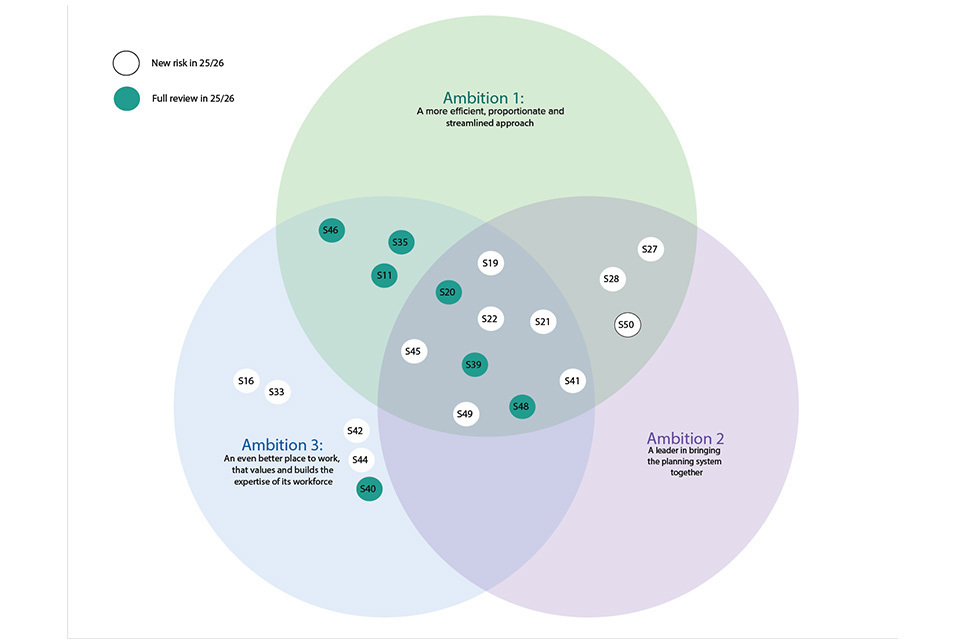
This can take the form of risk deep dives, or strategic reviews, which the Executive Team proactively encourage and engage, demonstrating a positive risk culture. Continual improvement of risk management and assurance can be demonstrated by what we did in 2025/26, with planned improvements for 2026/27 aiming to further embed, strengthen, and build upon the risk management process foundations in place.
Strategic risk management
We are proactive in the management of our strategic risks to fulfil our ambitions and meet our duty to achieve value for public money. Each strategic risk is owned by a member of the Executive Team and serves to facilitate the risk management process; identify, assess, monitor, review and report. All strategic risks have an agreed control environment and set of mitigating actions, to ensure our efforts move towards the direction of our desired outcome. Each risk is subject to assessment on a 5x5 likelihood and impact scale and assigned a risk appetite. The overall effectiveness of our risk management process and internal control is reviewed periodically by our Internal Audit service provided by the Government Internal Audit Agency.
For 2025/26, the Venn diagram (graphic 2) shows each of our strategic risks mapped across the three ambitions within our Strategic Plan. Where risks have potential to affect all three ambitions, they are placed in the centre, where the risk falls across of two ambitions, it will be placed in the triangle quadrant of those ambitions, and where a risk is exclusive to one ambition it is placed in the original/primary colour.
Graphic 3 - Summary of strategic risk profile for 2025/26
| Risk category | No movement | Deep dive review in 2025/26 | New risk in 2025/26 |
|---|---|---|---|
| Financial | 1 | - | - |
| Compliance, Legal and Regulatory | 3 | 4 | - |
| Operational Delivery | 2 | 2 | 1 |
| People | 3 | - | - |
| Reputation and credibility | 3 | 1 | - |
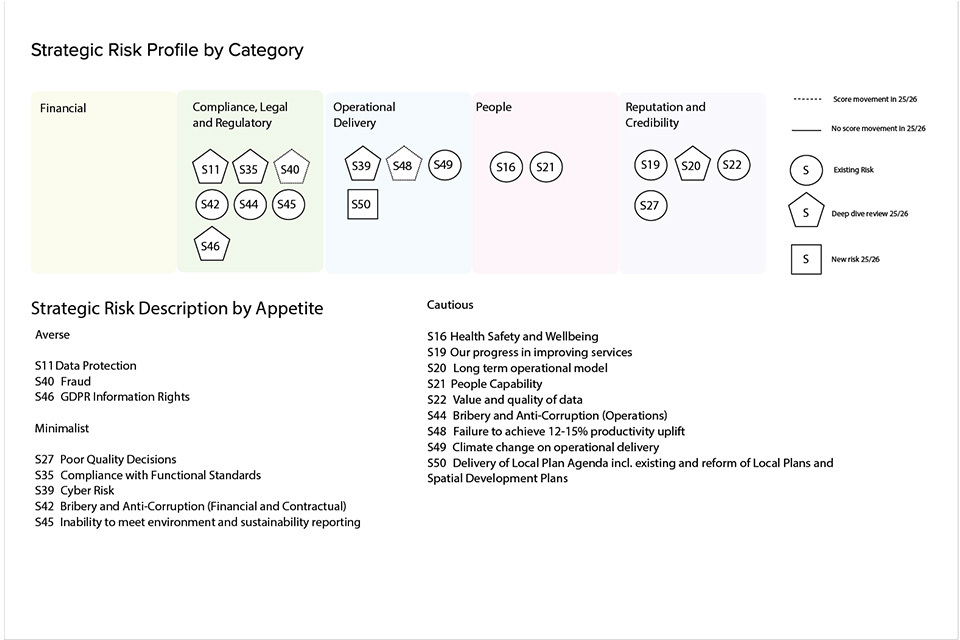
Our risk profile through 2025/26
Graphic 3 summarises the strategic risk profile for the Inspectorate and the changes over the past twelve months. This includes identification of political, economic, social, technological, legal and environmental factors. These factors may impact on our existing risks and help us identify and categorise new risks.
Our risk profile at the end of 2025/26 shows that the scores for all our strategic risks remain between 6 and 20. The strategic risk scores have changed throughout the year alongside our evolving threat landscape, to ensure they reflect an accurate picture of our risk exposure. Alongside our schedule of Deep Dive reviews approved by our Executive Team, there have been three instances of agreeing risks to close, in addition to one new risk. This reflects our ability to consistently and effectively respond to changes in our environment, but to also maintain focus on our existing risk materiality, proximity and velocity.
The risks subject to a full deep dive review in 2025/26 are highlighted as a pentagon on graphic 3. The process for these reviews includes risk identification, controls and mitigations recapture, assessment of the Inherent, Current and Target scores and an appetite and tolerance setting. We continue to express the importance of cross-functional working and regular reviews to consider the relevance of context and effectiveness of mitigations, for continual improvement to our risk response.
Evolving risk governance landscape
In a continued commitment to best practice, an initial draft of the Risk Assurance Framework was reviewed by the Executive Team and ARAC in spring 2026. This framework not only aligns directly to our existing Risk Management Framework, a new document suite from 2024/25, but follows the principles outlined within the HM Orange Book Risk Control Framework. This framework will be used as a tool to provide insight and visibility across risks, their associated key controls, and levels of assurance to be informed through future testing.
The framework includes first, second and third lines of defence. This helps us better understand the relationship between how we manage our strategic risks and inform risk-based decision making at the highest level of our organisation. Upon launching this new framework, we continue to both maintain and develop our model for effective risk management by ensuring this is aligned to Government best practice and principles of assurance, including the three lines of defence. By establishing a clearly defined yet proportionate approach, this supports the effective management of the risks we face and instils confidence in the decisions we take as an organisation.
Our Risk Management Framework referenced above includes Governance as outlined within the HM Treasury Orange Book and as required by Phase 2 of the TCFD for the 2024/25 year. Climate risk is considered at strategic level and included as an entry within the Strategic Risk Register, currently listed within the Operational Delivery risk category (S49, graphic 3 – Strategic Risk Profile by Category). This risk was identified in early 2025 as part of the Inspectorate’s need and interest to articulate climate risk, as per the inclusion within graphic 2 (Venn Diagram).
Risk management
Our risk management processes are aligned to The UK Government Orange Book: Management of Risk - Principles and Concepts. The Executive Team is responsible for setting our risk appetite, which is reviewed by the ARAC.
Risks are managed throughout the Inspectorate and escalated to the Executive Team when they are strategic in nature. The strategic risks detailed in the Risk report are owned by the Executive Team. We provide visibility of our strategic risks to the MHCLG risk management team who undertake a review on an annual basis.
What we did in 2025/26
- Developed a new Risk Assurance Framework to enhance our assurance metrics across the three lines of defence.
- Undertook a comprehensive review of the content of the Strategic Risk Register with the Executive Team, Board and ARAC, including detailed discussions with all risk owners.
- Undertook a series of deep-dive reviews of strategic risks, focusing on material detail and potential impacts to objectives, and establish a benchmark for the activities.
- Aligned risk management practices and required governance across our service model, and introduced a pilot for new documentation of risks across the Inspectorate, ensuring risks are managed in an effective, timely and trackable way.
- Reviewed our Risk Management Framework to ensure risks are appropriately managed through the relevant processes and escalation points.
- Engaged with staff to maintain the profile of risk management within the organisation, through regular meetings and updates via the intranet, including Risk Awareness Week (May 2025).
Plans for 2026/27
- Introduce a Risk Control Framework to better align strategic risks with their internal controls and level of assurance.
- Complete a Risk Maturity Assessment on a Comply or Explain basis, in line with the guidance set out by HM Treasury.
- Enhance our guidance and toolkits for stakeholders to be as equipped as possible to manage risks in their day-to-day work.
- Review requirements for a cohort of risk champions to support the work of the Risk, Fraud and Business Continuity team and embed across the Inspectorate.
- Host a series of workshops and webinars to enhance risk management awareness and culture.
Counter fraud and bribery
We continue to mitigate the risk of fraud within the Inspectorate. We work to prevent and identify fraud through increasing our organisational awareness and professional capability. By focussing on continual improvement, we are developing our maturity and providing insights through activities and exercises in collaboration with other government departments.
The Planning Inspectorate had two instances of fraud and bribery to report. Both cases were investigated and closed in 2025/26.
We review fraud risks regularly to re-assess materiality, controls and scoring on a set cadence and as and when processes change. We have reporting in place to disclose any fraud that we detect and prevent to MHCLG on a quarterly basis to inform their cross-department visibility.
To reduce the risk of errors and internal fraud, we complete a series of sample checks, subject to analysis, and review this with stakeholders as necessary. The Government Internal Audit Agency carries out an audit of our core financial controls as standard each year. In 2025/26 it gave an assurance of ‘Moderate’.
What we did in 2025/26
- Completed the Inspectorate’s Fraud Risk Assessment, including facilitating workshops and a regular review schedule.
- Conducted a full review of our Counter Fraud Policy and Response Plan, Strategy and Action Plan, in adherence to the Government Functional Standard for Counter Fraud.
- Completed the Continual Improvement Assessment Framework, to continually track, monitor and improve our performance against Counter Fraud.
- Completed an organisation-wide Fraud Awareness Session, in collaboration with the GIAA Counter Fraud and Investigation team.
- Launched a Counter Fraud Awareness survey to maximise on lessons learned and inform future requirements.
- Raised awareness across the Inspectorate, including blogs in collaboration with the People Team during Counter Fraud Awareness Week and the new Mandatory Learning schedule. This resulted in a 25% increase in Counter Fraud and Bribery required learning completion rates.
- Attended the Government Counter Fraud Conference and scoped lessons learned for application at the Planning Inspectorate.
Plans for 2026/27
- Introduce a Counter Fraud Framework to best support activities to detect and identify threats and instances of fraud.
- Complete a gap analysis against the Continual Improvement Assessment Framework, to provide further benefits and development against the ‘Good’ and ‘Better’ criteria.
- Continue to support internal investigations in allegations of fraud.
- Support colleagues in the team with further learning opportunities, including shadowing across the Counter Fraud Profession and taking formal learning routes and qualifications.
- Enhance counter fraud awareness and further improve culture, including during Counter Fraud Awareness Week.
Business continuity
The business continuity process aims to increase our resilience and minimise the risk of disruption to our services. Planning for business continuity ensures we can reinstate critical services as quickly as possible following a disrupting event. We review, update and test the process yearly to ensure continuous improvement.
What we did in 2025/26
- Completed a business continuity scenario with our Crisis Management Team, including a data capture to consider lessons learned from the exercise.
- Made a series of recommendations for improvement, agreed by the Executive Team.
- Instructed a review of Service Business Continuity Plans to best reflect and align with our Service Model.
Plans for 2026/27
- Undertake an organisation-wide business continuity scenario, considering the suitability of redesigned plans, capturing lessons learned from the exercise and implement improvements as required.
- Carry out a review of Service Business Continuity Plans to best reflect and align with our Service Model.
- Develop the Business Continuity and Disaster Recovery approach.
- Raise awareness of Business Continuity via a series of workshops and communication for Business Continuity and Resilience Week, to further improve culture.
External complaints
The Inspectorate provides a structured complaints process, encouraging informal resolution before progressing to formal review. In 2025/26, all complaints referred to the Parliamentary and Health Service Ombudsman were found not to be upheld.
If customers are dissatisfied with the service provided by the Inspectorate, they have the right to raise a complaint. Concerns may relate to issues such as administrative or factual mistakes, instances where service standards have not been met, failure to adhere to procedural requirements, or perceptions of inappropriate behaviour. Additionally, complaints may arise when customers feel that relevant planning policy, guidance, or legislation has not been properly followed.
The Inspectorate encourages customers to initially discuss their concerns informally with the appropriate team, in order to seek a swift resolution. If matters remain unresolved, customers may proceed through our formal complaints process, which comprises two internal stages. Each stage involves a thorough and impartial review. When a complaint is upheld, feedback is provided to the relevant team or inspector, and lessons learned are captured through our complaints analysis process to address the underlying causes and drive improvements.
Should customers remain dissatisfied after the completion of our internal procedure, they may refer their complaint to the Parliamentary and Health Service Ombudsman via their Member of Parliament. During 2025/26, the Inspectorate received 1,059 complaints, none of which were upheld by the Parliamentary and Health Service Ombudsman.
Graph 22 - Complaints to the Parliamentary and Health Service Ombudsman
| 2021/22 | 2022/23 | 2023/24 | 2024/25 | 2025/26 | |
|---|---|---|---|---|---|
| Complaints received by the Parliamentary and Health Service Ombudsman | 41 | 38 | 13 | 2 | 0 |
| Complaints partially or fully upheld by the Parliamentary and Health Service Ombudsman | 0 | 0 | 1 | 0 | 0 |
Remuneration report
The remuneration report summarises our remuneration policy and disclosures on Directors’ remuneration as required by Section 421 of the Companies Act 2006 adapted for the public sector context.
Directors’ remuneration policy
The remuneration of SCS is subject to an independent pay body review process. It is set centrally by the government based on the recommendations made by the Senior Salaries Review Body (SSRB). Bonuses are made as part of the SCS performance management process and recognise performance level attained. Bonuses reported for the year 2025/26 relate to performance in 2024/25, bonuses reported for 2024/25 relate to performance in 2023/24.
Directors’ notice period is a minimum of three months.
Remuneration and pension entitlements (including Cash Equivalent Transfer Values (CETV) disclosures) for Directors and Board members
This section of the document has been subject to audit.
The single total figures of remuneration for Directors, for the year ended 31 March 2026 are shown in table 15 with the comparative figures for the year ended 31 March 2025.
Table 16 - Single total figures
Accounting Officer
| Year | Salary and fees paid £k in bands of £5k |
Bonus £k in bands of £5k |
Taxable benefits £ to the nearest £100 |
Pension related benefits £ to the nearest £1,000 |
Total £k in bands of £5k |
|
|---|---|---|---|---|---|---|
| Graham Stallwood, Interim Chief Executive (from 12/01/2026) | 25/26 | 25–30 (full-time equivalent 125–130) |
48,000 | 75–80 | ||
| 24/25 | – | – | – | – | – | |
| Paul Morrison, Chief Executive (until 11/01/2026) | 25/26 | 110–115 (full-time equivalent 140–145) |
5–10 | – | 49,000 | 165–170 |
| 24/25 | 135–140 | 5–10 | – | 84,000 | 230–235 |
Executive Directors
| Year | Salary and fees paid £k in bands of £5k |
Bonus £k in bands of £5k |
Taxable benefits £ to the nearest £100 |
Pension related benefits £ to the nearest £1,000 |
Total £k in bands of £5k |
|
|---|---|---|---|---|---|---|
| Joanne Butcher, Chief Finance Officer | 25/26 | 85–90 | 5–10 | – | 36,000 | 130–135 |
| 24/25 | 85–90 | 5–10 | – | 33,000 | 120–125 | |
| Sean Canavan, Chief Strategy Officer (until 31/12/2025) | 25/26 | 65–70 (full-time equivalent 90–95) |
– | – | 27,000 | 95–100 |
| 24/25 | 85–90 | – | – | 35,000 | 120–125 | |
| Rachel Graham, Chief Digital and Information Officer | 25/26 | 75–80 (full-time equivalent 85–90) |
5–10 | – | 36,000 | 120–125 |
| 24/25 | 70–75 (full-time equivalent 80–85) |
5–10 | – | 43,000 | 120–125 | |
| Hayley Kelly, Chief People Officer | 25/26 | 90–95 | – | – | 38,000 | 125–130 |
| 24/25 | 85–90 | – | – | 31,000 | 115–120 | |
| Rebecca Phillips, Chief Planning Inspector (from 17/03/2025) | 25/26 | 90–95 | – | – | (5,000) | 85–90 |
| 24/25 | – | – | 85-90 | – | 0-5 | |
| Richard Schofield, Chief Planning Inspector (until 30/04/2025) | 25/26 | 5–10 (full-time equivalent 90–95) |
– | – | 25,000 | 30–35 |
| 24/25 | 90–95 | – | – | 35,000 | 125–130 | |
| Graham Stallwood, Chief Operating Officer (until 11/01/2026) | 25/26 | 90–95 (full-time equivalent 115–120) |
5–10 | – | – | 100–105 |
| 24/25 | 115–120 | 0–5 | – | 46,000 | 165–170 | |
| Tom Warth, Interim Chief Operating Officer (from 12/01/2026) | 25/26 | 15–20 (full-time equivalent 85–90) |
– | – | 3,000 | 20–25 |
| 24/25 | – | – | – | – | – |
Non-Executive Directors
| Year | Salary and fees paid v£k in bands of £5k |
Bonus £k in bands of £5k |
Taxable benefits £ to the nearest £100 |
Pension related benefits £ to the nearest £1,000 |
Total £k in bands of £5k |
|
|---|---|---|---|---|---|---|
| Trudi Elliott, Chair, Non-Executive | 25/26 | 20–25 | – | – | – | 20–25 |
| 24/25 | 20–25 | – | – | – | 20–25 | |
| Emir Feisal, Director, Non-Executive | 25/26 | 10–15 | – | – | – | 10–15 |
| 24/25 | 10–15 | – | – | – | 10–15 | |
| Oliver Munn, Director, Non-Executive | 25/26 | 10–15 | – | – | – | 10–15 |
| 24/25 | 10–15 | – | – | – | 10–15 | |
| Adrian Penfold, Director, Non-Executive | 25/26 | 10–15 | – | – | – | 10–15 |
| 24/25 | 10–15 | – | – | – | 10–15 |
Non-Executive Directors are typically appointed for a term of three to four years and are subject to a standard notice period of one month. The SoS has authority to terminate the appointment in defined circumstances.
Directors’ pension disclosure
This section of the document has been subject to audit.
The accrued pension benefits for financial year 2025/26 are provided below.
The figures as at 31/03/25 in Table 17 have been updated to reflect revised figures from Civil Service Pensions. Table 18 remains unchanged as the 2024/25 accounts did not include disclosure of director pension benefits due to the late provision of data by the Civil Service Pension scheme. Opening balances provided for 2025/26 represent information provided by Capita as scheme administrator for this year’s reporting.
Table 17 - Directors’ pension disclosure 2025/26
| Accrued pension at pension age as at 31/3/26 £'000 in bands of £5,000 |
Real increase in pension and related lump sum at pension age £'000 in bands of £2,500 |
Cash Equivalent Transfer Value (CETV) as at 31/03/26 br> £'000 to the nearest £1,000 |
Cash Equivalent Transfer Value (CETV) as at 31/03/25 £'000 to the nearest £1,000 |
Real increase in CETV £'000 to the nearest £1,000 |
|
|---|---|---|---|---|---|
| Graham Stallwood, Interim Chief Executive | 20–25 | 2.5–5 | 280 | 233 | 30 |
| Paul Morrison, Chief Executive (until 11/01/2026) | 50–55 plus a lump sum of 125–130 | 2.5–5 plus a lump sum of 0–2.5 | 1,169 | 1,078 | 34 |
| Joanne Butcher, Chief Finance Officer | 10–15 | 0–2.5 | 148 | 119 | 19 |
| Sean Canavan, Chief Strategy Officer (until 31/12/2025) | 25–40 | 0–2.5 | 673 | 624 | 22 |
| Rachel Graham, Chief Digital and Information Officer | 25–30 | 0–2.5 | 441 | 395 | 20 |
| Hayley Kelly, Chief People Officer | 25–30 plus a lump sum of 60–65 | 0–2.5 plus a lump sum of 0–2.5 | 515 | 462 | 22 |
| Rebecca Phillips, Chief Planning Inspector (from 17/03/2025) | 30–35 | 0–2.5 | 632 | 606 | (10) |
| Richard Schofield, Chief Planning Inspector (until 30/04/2025) | 20–25 | 0–2.5 | 329 | 311 | 17 |
| Tom Warth, Interim Chief Operating Officer (from 12/01/2026) | 25–30 | 0–2.5 | 458 | 453 | 1 |
Table 18 - Directors’ pension disclosure 2024/25
| Real increase in pension and related lump sum at pension age £'000 in bands of £2,500 |
Total accrued pension at pension age at 31/03/24 and related lump sum £'000 in bands of £5,000 |
Cash Equivalent Transfer Value (CETV) as at 31/03/24 £'000 to the nearest £1,000 |
Cash Equivalent Transfer Value (CETV) as at 31/03/25 £'000 to the nearest £1,000 |
Real increase in CETV £'000 to the nearest £1,000 |
|
|---|---|---|---|---|---|
| Paul Morrison, Chief Executive | 2.5–5 plus a lump sum of 2.5–5 | 50–55 plus a lump sum of 120–125 | 966 | 1,078 | 66 |
| Joanne Butcher, Chief Finance Officer | 0–2.5 | 10–15 | 88 | 119 | 17 |
| Sean Canavan, Chief Strategy Officer | 0–2.5 | 35–40 | 547 | 624 | 27 |
| Rachel Graham, Chief Digital and Information Officer | 0–2.5 | 20–25 | 348 | 395 | 28 |
| Hayley Kelly, Chief People Officer (from April 2025) | 0–2.5 plus a lump sum of 0 | 25–30 plus a lump sum of 70–75 | 523 | 559 | 13 |
| Richard Schofield, Chief Planning Inspector | 0–2.5 | 20–25 | 310 | 352 | 10 |
| Graham Stallwood, Chief Operating Officer | 2.5–5 | 15–20 | 181 | 233 | 29 |
Cash Equivalent Transfer Values
A Cash Equivalent Transfer Value (CETV) is the actuarially assessed capitalised value of the pension scheme benefits accrued by a member at a particular point in time. The benefits valued are the member’s accrued benefits and any contingent spouse’s pension payable from the scheme. A CETV is a payment made by a pension scheme or arrangement to secure pension benefits in another pension scheme or arrangement when the member leaves a scheme and chooses to transfer the benefits accrued in their former scheme. The pension figures shown relate to the benefits that the individual has accrued as a consequence of their total membership of the pension scheme, not just their service in a senior capacity to which disclosure applies. The figures include the value of any pension benefit in another scheme or arrangement, which the member has transferred to the Civil Service pension arrangements. They also include any additional pension benefit accrued to the member as a result of their buying additional pension benefits at their own cost. CETVs are worked out in accordance with The Occupational Pension Schemes (Transfer Values) (Amendment) Regulations 2008 and do not take account of any actual or potential reduction to benefits resulting from Lifetime Allowance Tax which may be due when pension benefits are taken. The rate of the Lifetime Allowance Tax was 0% for 2024/25 and was abolished completely from the 6th April 2025.
CETV figures are calculated using the guidance on discount rates for calculating unfunded public service pension contribution rates that was extant at 31 March 2026.
Real increase in Cash Equivalent Transfer Values
This reflects the increase in Cash Equivalent Transfer Values that is funded by the Exchequer. It does not include the increase in accrued pension due to inflation, contributions paid by the employee (including the value of any benefits transferred from another pension scheme or arrangement) and uses common market valuation factors for the start and end of the period.
Compensation on early retirement or loss of office
This section of the document has been subject to audit.
No payments were made in financial year 2025/26 (no payments in financial year 2024/25).
Payments to past Directors
This section of the document has been subject to audit.
Directors do not have any entitlements to pay after their departure date.
Fair pay disclosure
This section of the document has been subject to audit.
Table 19 - Fair pay disclosure
| 2025/26 | 2024/25 | |
|---|---|---|
| Change in highest paid Director’s total pay | -7% | 7% |
| Change in highest paid Director’s bonus | 1% | 84% |
| Average change in total pay of employees | 0% | 3% |
| Average change in bonuses of employees | 538% | -90% |
| Band of Highest Paid Director’s Total Remuneration (£’000) | 135-140 | 145-150 |
| Median Total – inspector | £67,414 | £65,558 |
| Remuneration Ratio - inspector | 2.06 | 2.25 |
| Median Total - Support | £37,579 | £31,193 |
| Remuneration Ratio - Support | 3.66 | 4.73 |
The only bonus entitlements in prior year were to SCS graded staff whose pay arrangements are set centrally as identified in the Directors’ remuneration policy of this report. The significant increase in bonus payments reflects the introduction of the Celebrating Success Reward and Recognition policy. This scheme expanded in year recognition through higher value vouchers and introduced the PINS Awards, a one-off end of year payment for eligible recipients. These payments are recorded as bonuses and account for the higher level of expenditure compared with the prior year.
Reporting bodies are required to disclose the relationship between the remuneration of the highest paid director in their organisation and the 25th percentile, median and 75th percentile of the organisation’s workforce.
Table 20 - Fair pay percentile ratios for the whole workforce
| 2025/26 | 2024/25 | |||||
|---|---|---|---|---|---|---|
| Pay ratio | Total pay | Salary | Pay ratio | Total pay | Salary | |
| 25th Percentile | 3.7 | £37,579 | £37,579 | 4.7 | £31,132 | £31,132 |
| 50th Percentile | 2.6 | £52,387 | £52,387 | 2.8 | £52,251 | £52,251 |
| 75th Percentile | 2.0 | £67,490 | £47,490 | 2.2 | £67,119 | £67,119 |
The 0% average change in total pay is reflective of: the annual pay rise agreed from the annual pay remit; a planned reduction in agency staff; and an increase in recruitment of support staff to support the operations of the organisation. The small shifts in the quartile distribution reflect the implementation of pay award rather than structural pay movement. The increase in women represented in the lower quartiles and the slight rise in men in the upper quartiles is mainly due to recruitment activity over the year, particularly the addition of more support roles at entry and mid-levels. These changes, combined with the distribution of performance-related payments made solely to SCS employees in 2024/25, have influenced both the mean and median bonus gender pay gaps, which now show higher bonus outcomes for women.
The banded remuneration of the highest paid Director in the financial year 2025/26 was £135,000- £140,000 (2024/25: 145,000-150,000). This was 2.04 times (inspectors); 3.66 times (support) (2024/25: 2.25 (inspectors); 4.73 (support)). The median remuneration of the workforce, was £67,414 (inspector); £37,579 (support) (2024/25: £65,558 (inspectors); £31,193 (support)). The remuneration ratio calculation is based on the full-time equivalent staff at the reporting period-end date on an annualised basis. For the purposes of the fair pay calculation, it is appropriate to allocate the in-year bonus, recognised earlier in the year, to the Highest Paid Director, so that it is comparable with the calculations for the remainder of the workforce.
The latest report shows our mean gender pay gap increased to 14.2% at the mean and to 23.2% at the median. Compared to 2024, the 2025 gender pay gap figures show a slight increase at the mean (0.5%) and a more notable increase at the median (7.8%). These changes are driven by structural differences in our workforce. A significant proportion of our workforce (51%) are members of the planning profession. Our senior planning roles remain disproportionately occupied by men, reflecting trends across the wider professions. The proportion of women increased in pay quartiles 2, 3 and 4, indicating positive pay movements for female colleagues. However, the concentration of men in senior planning inspector grades continues to impact the overall gender pay gap. Information on the gender pay gap for the Planning Inspectorate is published on GOV. UK.
In 2025/26 no employees received remuneration in excess of the highest paid Director (2024/25: nil). However, temporary staff, necessary to provide essential cover for vacant posts, received remuneration rates in excess of the highest paid Director. Of these temporary employees, eight remained in post at 31 March 2026. Remuneration ranged from £210,000 to £36,915 (2024/25 £182,000 to £10,500) including the highest paid Director. Note: Prior year included non-executive directors in this range which are no longer required to be reported. Total remuneration includes salary, non-consolidated performance-related pay and benefits-in-kind. It does not include severance payments, employer pension contributions and the cash equivalent transfer value of pensions.
Staff report
Staff numbers
For the financial year 2025/26, we employed (average, full-time equivalent) 973 staff (see Table 21). This total was made up of 48% women, and 52% men which included 4 women and 5 men at Senior Civil Service grades. Colleague numbers include a mixture of full and part-time employees, home-based salaried inspectors and office-based staff in our Bristol office.
The average number of full-time equivalent persons employed by us (including management) during the year to 31 March 2026 was as follows in Table 21. Turnover rate for all staff in 2025/26 was 8.6% (2024/25 7.3%).
Voluntary turnover rates, i.e. excluding non-voluntary (end of fixed contracts, dismissals, natural causes,) for all staff was 6.12%.
We used the services of two seconded-in staff during the year. These services were used at management level to support us with priority posts for periods exceeding six months. At 31 March 2026, 77 colleagues were on contracts for a fixed term duration.
Table 21 - Average number of full-time equivalent staff employed in year (This table has been subject to audit)
| Permanent | ||
|---|---|---|
| 2025/26 | 2024/25 | |
| Senior Civil Service Pay Band 2 | 1 | 1 |
| Senior Civil Service Pay Band 1 | 6 | 6 |
| Grade 6-7 (Senior Staff) | 72 | 58 |
| Salaried inspector | 438 | 421 |
| Support | 207 | 153 |
| Caseworkers | 244 | 251 |
| Total | 968 | 890 |
| Less Secondments | - | - |
| Add Agency | 5 | 4 |
| Total Employed | 973 | 894 |
Attendance management
The average working days lost through sickness absence in 2025/26 was 5.3 days compared to 5.2 days in 2024/25. The days absent are split approximately evenly across long-term and short-term absence cases with causes varying (the highest being mental health and respiratory conditions). We continue to work closely with line managers to ensure that appropriate support is provided to individuals through reasonable adjustments, return to work interviews and use of the Employee Assistance Programme.
Staff policies
Remuneration policy
The Remuneration Report summarises our remuneration policy and disclosures on Directors’ remuneration as required by Section 421 of the Companies Act 2006 adapted for the public sector context.
Recruitment
All recruitment is carried out on the basis of fair and open competition, and selection is made on merit. Recruitment processes are fair and are reviewed to take account of any changes to employment legislation.
Equality and diversity
The proportion of colleagues that consider themselves to have a disability in 2025/26 remained low at 8.24%, representing a slight decrease compared to 2024/25. When recruiting colleagues, we continue to guarantee an interview to disabled candidates who meet the core requirements of the job description and person specification under the Disability Confident scheme. We also continue to offer support to candidates through the provision of reasonable adjustments. Support and training remain available to all colleagues either: when they join the organisation; or during their employment, to help them manage and strive with a disability in the workplace. As part of our ongoing commitment to inclusive people management, we are progressing the development of a leadership capability programme, which will include line manager training on key elements of inclusion, including supporting those with disabilities. We are also continuing to review our workplace adjustments information to ensure the process is clear, accessible, and easy to understand.
Staff costs
This section of the document has been subject to audit.
Table 22 includes the total staff costs for the 2025/26 financial year, as shown in the Financial Statements.
Table 22 - Total staff costs
| 2025/26 | 2024/25 | |
|---|---|---|
| Wages and salaries | 50,663 | 45,085 |
| Social security costs | 7,179 | 5,189 |
| Other pension costs | 14,404 | 12,847 |
| Sub Total | 72,246 | 63,121 |
| Agency staff | 526 | 359 |
| Total net staff costs | 72,772 | 63,480 |
Pension benefits
Pension benefits are provided through the Civil Service pension arrangements. From 1 April 2015 a new pension scheme for civil servants was introduced – the Civil Servants and Others Pension Scheme or ‘Alpha’, which provides benefits on a career average basis with a normal pension age equal to the member’s State Pension Age (or 65 if higher). From that date all newly appointed civil servants and the majority of those already in service joined Alpha. Prior to that date, civil servants participated in the Principal Civil Service Pension Scheme (PCSPS). The PCSPS has four sections: three providing benefits on a final salary basis (Classic, Premium or Classic plus) with a normal pension age of 60; and one providing benefits on a whole career basis (Nuvos) with a normal pension age of 65.
These statutory arrangements are unfunded with the cost of benefits met by monies voted by Parliament each year. Pensions payable under Classic, Premium, Classic plus, Novos and Alpha are increased annually in line with Pensions Increase legislation. Existing members of the PCSPS who were within 10 years of their normal pension age on 1 April 2012 remained in the PCSPS after 1 April 2015. Those who were between 10 years and 13 years and 5 months from their normal pension age on 1 April 2012 switch into Alpha sometime between 1 June 2015 and 1 February 2022. Because the Government plans to remove discrimination identified by the courts in the way that the 2015 pension reforms were introduced for some members, eligible members with relevant service between 1 April 2015 and 31 March 2022 may be entitled to different pension benefits in relation to that period (and this may affect the Cash Equivalent Transfer Values shown in this report. All members who switch to Alpha have their PCSPS benefits ‘banked’, with those with earlier benefits in one of the final salary sections of the PCSPS having those benefits based on their final salary when they leave Alpha. Members joining from October 2002 may opt for either the appropriate defined benefit arrangement or a defined contribution (money purchase) pension with an employer contribution (partnership pension account). Further details about the Civil Service pension arrangements can be found at the website https://www.civilservicepensionscheme.org.uk.
For 2025/26, employers’ contributions of £14,281,793.27 were payable to the pension scheme (2024/25: £12,718,917) at 28.97% (2024/25: 28.97%) of pensionable pay based on salary bands. The Scheme Actuary reviews employer contributions usually every four years following a full scheme valuation. The contribution rates are set to meet the cost of the benefits accruing during 2025/26 to be paid when the member retires and not the benefits paid during this period to existing pensioners.
Employees can opt to open a partnership pension account, a stakeholder pension with an employer contribution. Employer contributions of £75,030 (2024/25: £64,825) were paid to one or more of the panel of three appointed stakeholder pension providers. Employer contributions are age-related and range from 8% to 14.75% of pensionable earnings. Employers also match employee contributions up to 3% of pensionable earnings. In addition, employer contributions of 0.5% (of pensionable pay for those employees) were payable to the pension Scheme to cover the cost of the future provision of lump-sum benefits on death in service or ill-health retirement of these employees (March 2026 monthly payment £287 (March 2025: £253)). Contributions due to the partnership pension providers at 31 March 2026 were £6,566 (March 2025: £5,895). Contributions prepaid at that date were £nil (2024/25: £nil). One person (2024/25: nil) retired early on ill-health grounds.
Expenditure on consultancy and contingent labour
In 2025/26, the Planning Inspectorate incurred £1,300,640 (2024/25: £21,600) on contracts which were categorised as consultancy. The two contracts were for expertise to provide strategic advice and recommendations on critical matters. One of the contracts was subject to additional internal spend controls.
Our total contingent labour spend for 2025/26 was £1,090,272 (2024/25: £6,828,732), across two main categories:
- Agency staff – used to temporarily fill vacancies whilst we recruit and provide additional resource if needed;
- Specialist technical support – providing technical skills and resource where the capability and/ or the capacity is not available in-house.
No contracts for contingent labour were in the scope of Cabinet Office spend controls.
In addition to the spend explained in this section, the Inspectorate contracted for specialist resources and expertise through several service-based contracts, including but not limited to our Digital and Data Partner and Planning Appeal Decision Services. Note that in previous years, we reported Planning Appeal Decision Services spend as contingent labour – for transparency, in 2025/26 spend was £1,352,730.
Off-payroll engagements
We engaged in off-payroll contracts (see the following tables for further analysis) across a range of professional disciplines including digital, data, finance, HR, communications and commercial. The engagements supported specific need in the organisation while transforming the organisation or backfilling vacancies in our establishment. This year, we have worked further towards reducing the use of contingent labour where possible and appropriate.
In May 2024, an audit on our IR35 decision making processes was completed by the GIAA and we received an overall substantive opinion that adequate and effective governance, risk management and control is in place.
Table 23 - Off-payroll engagements
| Highly paid off-payroll worker engagements as at 31 March 2026, earning £245 per day or greater | As at March 2026 |
|---|---|
| Number of existing engagements | 7 |
| Of which… | |
| Number that have existed for less than one year at time of reporting | 5 |
| Number that have existed for between one and two years at time of reporting | 2 |
| Number that have existed for between two and three years at time of reporting | - |
| Number that have existed for between three and four years at time of reporting | - |
| Number that have existed for four or more years at time of reporting | - |
All the existing off-payroll engagements outlined above have been subject to a risk based assessment to determine whether they are inside or outside the scope of the Inland Revenue legislation 35 (IR35) intermediaries.
Table 24 - Off-payroll workers engaged during the year
| All highly paid off-payroll workers engaged at any point during the year ended 31 March 2026, earning £245 per day or greater | As at March 2026 |
|---|---|
| Number of temporary off-payroll workers engaged during the year ended 31 March 2026 | 32 |
| Of which… | |
| Not subject to off-payroll legislation | - |
| Subject to off-payroll legislation and determined as in-scope of IR35 | 32 |
| Subject to off-payroll legislation and determined as out-of-scope of IR35 | - |
| Number of engagements reassessed for consistency/assurance purposes during the year | 22 |
| Of which: Number of engagements that saw a change to IR35 status following the consistency review | - |
Table 25 - Off-payroll engagements of Board members and senior officials
| Any off-payroll engagements of Board members, and/or, senior officials with significant financial responsibility, between 1 April 2025 and 31 March 2026 | As at March 2026 |
|---|---|
| Number of off-payroll engagements of Board members, and/or senior officials with significant financial responsibility, during the financial year. | - |
| Total number of individuals on payroll and off-payroll that have been deemed ‘board members, and/or senior officials with significant financial responsibility’, during the financial year. This figure should include both on-payroll and off-payroll engagements. | 13 |
Exit packages
This section of the document has been subject to audit.
Exit costs are accounted for in full either in the year of departure or, where a binding commitment is made to leave in the subsequent year, costs are accrued.
There were no exit costs incurred for staff departures in 2025/26 (2024/25: nil departures).
Redundancy and other departure costs are paid in accordance with the provisions of the Civil Service Compensation Scheme, a statutory scheme made under the Superannuation Act 1972. Exit costs are accounted for in full in the year of departure. Where the department has agreed early retirements, the additional costs are met by the department and not by the Civil Service pension scheme. Ill-health retirement costs are met by the pension scheme and are not included in the table.
Consultations
The organisation formally recognises three Unions: Public and Commercial Services, representing mostly office-based colleagues, FDA, representing senior managers and professions from HEO equivalents up to SCS and Prospect, representing inspectors. Formal consultation with the Unions takes place through Whitley meetings and separately on more detailed developments. We also work with the Unions and employees, both formally and informally, on management proposal that have a direct bearing on how colleagues work, ensuring that there is a common understanding of the impact on individuals.
In 2025/26 we conducted an extensive range of consultations to support improvements to the organisation and the delivery of its aims. We have consulted on:
- Miscarriage Guidance
- Baby and Child Loss Guidance
- Neonatal Care Leave Guidance
- Flexible Working Policy and Procedure
- Annual Leave Policy and Procedure
- Improving Performance Policy and Procedure
- Dispute Resolution Policy and Procedure
- Raising a Concern Policy and Procedure
Other
- Learning and Development Policy
- Market Forces Policy
- Higher Starting Salary Policy
- Core Capability Framework
- Celebrating Success Policy
Parliamentary accountability and audit report
This section sets out the disclosures required under the Corporate Governance in Central Departments: Code of Good Practice. This section is supported by the detailed information presented in the Financial Statements section of this Annual Report.
Budget Allocations and Outturn
The Planning Inspectorate is funded through the Ministry of Housing, Communities & Local Government. Indicative allocations are initially agreed through HM Treasury Spending Review exercises and are refined annually through the Ministry of Housing, Communities & Local Government business planning round.
Since 1st April 2020, we are fully funded from the Ministry of Housing, Communities & Local Government programme budgets. This classification is reviewed each year to ensure it remains appropriate. The detailed accounts for financial year 2025/26 are included in the ‘Financial Statements’ part of this publication.
During the year, financial performance was managed across four primary categories: staff and related costs; income and capital expenditure. A high-level summary of our financial performance against the agreed budget at the supplementary estimates is outlined in table 26.
Table 26 - 2025/26 Budget, outturn and underspend
| Original budget £’000 |
Revised budget £’000 |
Outturn £’000 |
Underspend £’000 |
|
|---|---|---|---|---|
| Staff & related costs | 73,638 | 73,132 | 72,772 | (360) |
| Non-pay running costs | 19,243 | 20,245 | 18,615 | (1,630) |
| Receipts | (18,000) | (23,938) | (26,023) | (2,085) |
| Net costs | 74,881 | 69,439 | 65,364 | (4,075) |
| Ring-fenced costs | 5,019 | 3,397 | 3,183 | (214) |
| Total programme costs | 79,900 | 72,836 | 68,547 | (4,289) |
| Non-cash costs (Annually Managed Expenditure - AME) | 200 | 183 | (31) | (214) |
| Total operating expenditure | 80,100 | 73,019 | 68,516 | (4,503) |
| Capital expenditure | 15,000 | 10,677 | 9,731 | (946) |
The revenue underspend was primarily attributable to lower than anticipated Programme activity £(0.5)m, a reduction in the use of contingency of £(0.9)m and lower depreciation charges of £(0.2)m. Income exceeded forecast due to the completion of a higher volume of casework than anticipated, notably in relation to Local Plans £(0.6)m and nationally significant infrastructure projects £(0.9)m. A more detailed analysis of financial performance is provided in the Financial Performance section of this document.
During 2025/26 the total value of adverse costs paid out was £0.6m with £0.9m of costs awarded to the Planning Inspectorate. This amounted to 127 cases in total including 44 refused, 21 won and 7 lost with 43 outstanding (18 of which relate to prior year cases).
The funding delegated to the Planning Inspectorate for financial year 2026/27 by MHCLG is set out in table 16 below. From 2026/27 depreciation, impairment and non-cash transactions will move from ring-fenced depreciation to resource Annually Managed Expenditure. The 2025/26 outturn has been restated for comparison.
Table 27 shows the funding delegated to the Planning Inspectorate for financial year 2025/26 by MHCLG. MHCLG are yet to confirm the funding for Annually Managed Expenditure.
Table 27 - Current provisional allocations
| 2026/27 Budget £’000 |
2025/26 Outturn £’000 |
|
|---|---|---|
| Gross Expenditure | 111,900 | 91,387 |
| Receipts | (23,600) | (26,023) |
| Total programme costs | 88,300 | 65,364 |
| Annually managed expenditure | To be confirmed | 3,152 |
| Total operating expenditure | 88,300 | 68,516 |
| Capital expenditure | 18,600 | 9,731 |
| Total budget | 106,900 | 78,247 |
Fees and charges
This section of the document has been subject to audit.
The Planning Inspectorate has complied with HM Treasury and Office of Public Sector Information guidance on cost allocation and charging requirements. Casework generating fee income exceeding £1m is summarised in table 28 (see Note 2 for further detail).
Table 28 - Income and costs for casework activity
| 2025/26 | 2024/25 | |||||
|---|---|---|---|---|---|---|
| Cost £’000 |
Income £’000 |
Net £’000 |
Cost £’000 |
Income £’000 |
Net £’000 |
|
| National infrastructure | 19,606 | (18,772) | 834 | 18,829 | (16,728) | 2,101 |
| Local plans | 6,270 | (3,777) | 2,493 | 3,864 | (2,943) | 921 |
| Rights of way | 1,787 | (1,324) | 463 | 1,663 | (446) | 1,217 |
| Other Major Specialist casework | 4,517 | (1,093) | 3,424 | 3,803 | (1,367) | 2,436 |
| Totals | 32,180 | (24,966) | 7,214 | 28,160 | (21,485) | 6,675 |
National infrastructure includes the pre-application service and work undertaken from the point of formal application through to the issue of a Development Consent Order. Due to the length of these cases, the related costs and associated income may be recognised across more than one financial year.
Other major casework relates to work undertaken on behalf of other government departments. These costs are partially recoverable through our income arrangements. The 2024/25 figures have been restated to include all income of this type.
In 2025/26, income generated from rights of way has been presented separately form Other Major casework, reflecting that such income exceed £1 million in the year.
Regularity of expenditure
This section of the document has been subject to audit.
Expenditure on losses and special payments, as defined in Managing Public Money guidance, is reported to HM Treasury through the parent Department.
Details of cases over £300,000: there were no reportable cases in 2025/26.
There were 63 losses and special payment cases: one case was between £10,000 and £299,999; all other cases were below £10,000. This included: Ex Gratia payments, damage to hire cars, other compensation payments, and overpayment write-offs.
Remote contingent liabilities
This section of the document has been subject to audit.
Ex Gratia costs are non-statutory payments made where an acknowledged error has resulted in unnecessary expenditure by a claimant. This can include cases upheld by the Parliamentary Ombudsman. A contingent liability is recognised to reflect:
- Claims received but not sufficiently developed for recognition in the accounts
- Potential claims relating to work completed prior to 31 March 2026 where no case has yet been raised.
Due to the nature of the Ex Gratia claims, there remains a remote possibility that claims arising from work completed before 31 March 2026 may exceed the contingent liability recorded. In such circumstances, the Planning Inspectorate would seek additional funding from MHCLG through the spending review process. No additional funding was requested in 2025/26.
Graham Stallwood, Interim Chief Executive
18 June 2026
Financial statements for the year ended 31 March 2026
The format and content of the financial statements in this section are in accordance with relevant HM Treasury guidance.
Statement of comprehensive net expenditure for the year ended 31 March 2026
| Note | 2025/26 £’000 |
2024/25 £’000 |
|
|---|---|---|---|
| Operating income | 4 | (26,023) | (22,321) |
| Staff costs | 3a | 72,772 | 63,480 |
| Depreciation charges | 3b | 3,183 | 2,358 |
| Right-of-use asset impairment | 3b | - | 459 |
| Right-of-use liability reinstatement | 3b | - | (907) |
| Finance Costs | 3b | 18 | 12 |
| Provision expense | (31) | (70) | |
| Other administrative costs | 3b | 18,597 | 13,786 |
| Total operating expenditure | 94,539 | 79,118 | |
| Net expenditure for the year | 68,516 | 56,797 | |
| Other comprehensive net expenditure | |||
| Net gain/loss on revaluation | - | - | |
| Comprehensive net expenditure for the year | 68,516 | 56,797 |
All the Planning Inspectorate’s income and expenditure for the year was derived from continuing activities.
The Notes form part of these accounts.
Statement of financial position for the year ended 31 March 2026
| Note | 31 March 2026 £’000 |
31 March 2025 £’000 |
|
|---|---|---|---|
| Non-current assets | |||
| Property, plant and equipment | 5 | 780 | 1,085 |
| Right-of-use assets | 10 | 243 | 269 |
| Intangible assets | 6 | 41,941 | 35,124 |
| Prepayments greater than one year | 7 | 25 | 40 |
| Total non-current assets | 42,989 | 36,518 | |
| Trade and other receivables | 7 | 6,885 | 6,028 |
| Cash and cash equivalents | 8 | 11,518 | 13,455 |
| Total current assets | 18,403 | 19,483 | |
| Total assets | 61,392 | 56,001 | |
| Trade and other payables | 9 | (11,097) | (9,339) |
| Lease liabilities | 10 | (224) | (1,356) |
| Provisions | 13 | - | (31) |
| Total current liabilities | (11,321) | (10,726) | |
| Lease liabilities | 10 | - | - |
| Total non-current liabilities | - | - | |
| Total liabilities | (11,321) | (10,726) | |
| Assets less liabilities | 50,071 | 45,275 | |
| General fund | 50,071 | 45,275 | |
| Total taxpayers’ equity | 50,071 | 45,275 |
The Notes form part of these accounts.
The accounts were approved by the Inspectorate’s Board on 11 June 2026 and signed on its behalf by:
Graham Stallwood, Interim Chief Executive
18 June 2026
Statement of cash flows for the year ended 31 March 2026
| Note | 2025/26 £’000 |
2024/25 £’000 |
|
|---|---|---|---|
| Cash flows from operating activities | |||
| Net operating expenditure | (68,516) | (56,797) | |
| Adjustments for non-cash transactions | 3b, 4 | 3,423 | 2,199 |
| Movement in trade and other receivables | 7 | (843) | (2,591) |
| Movement in bad debt provision | 3b | (6) | (35) |
| Movement in trade and other payables | 9 | 1,648 | 57 |
| Use of provisions | 13 | (18) | (55) |
| Interest paid | 10 | 18 | 12 |
| Net cash outflow from operating activities | (64,294) | (57,210) | |
| Cash flows from investing activities | |||
| Purchase of property, plant and equipment | 5 | (285) | (397) |
| Purchase of intangible assets | 6 | (9,012) | (9,752) |
| Sale of Property, Plant & Equipment | - | - | |
| Net cash outflow from investing activities | (9,297) | (10,149) | |
| Cash flows from financing activities | |||
| Funding from the Ministry of Housing, Communities and Local Government | 73,100 | 68,700 | |
| Payments to right-of-use buildings lease | (1,446) | (220) | |
| Net cashflow from financing activities | 71,654 | 68,480 | |
| Net (decrease)/increase in cash and cash equivalents in the period | 8 | (1,937) | 1,121 |
| Cash and cash equivalents at the beginning of the period | 8 | 13,455 | 12,334 |
| Cash and cash equivalents at the end of the period | 8 | 11,518 | 13,455 |
The Notes form part of these accounts.
Statement of changes in taxpayers’ equity for the year ended 31 March 2026
| Note | General fund £’000 | |
|---|---|---|
| Balance at 31 March 2024 | 33,173 | |
| Changes in Taxpayers’ Equity for 2024/25 | ||
| Total comprehensive expenditure | (56,797) | |
| Non-cash charges – auditor’s remuneration | 3b | 69 |
| Notional charges | 3b | 130 |
| Funding from the Ministry of Housing, Communities and Local Government | 68,700 | |
| Balance at 31 March 2025 | 45,275 | |
| Changes in Taxpayers’ Equity for 2025/26 | ||
| Total comprehensive expenditure | (68,516) | |
| Non-cash charges – auditor’s remuneration | 3b | 110 |
| Notional charges | 3b | 102 |
| Funding from the Ministry of Housing, Communities and Local Government | 73,100 | |
| Balance at 31 March 2026 | 50,071 |
The Notes form part of these accounts.
Notes to the accounts
Note 1. Statement of accounting policies and estimates
Note 1.1 Accounting policies
The Financial Statements have been prepared in accordance with the 2025/26 Government Financial Reporting Manual (FReM) issued by HM Treasury. The accounting policies contained in the FReM apply International Financial Reporting Standards (IFRS) as adapted or interpreted for the public sector context.
Where the FReM permits a choice of accounting policy, the policy considered most appropriate to the specific circumstances of the Inspectorate, so as to present a true and fair view, has been selected. The accounting policies adopted are set out below and have been applied consistently to all material items within these accounts.
Note 1.1a Accounting convention
These accounts have been prepared under the historical cost convention.
Note 1.1b Accounting estimates and judgements
The preparation of financial information in conformance with the International Financial Reporting Standards requires the use of certain accounting estimates and the exercise of management judgement in applying the accounting policies. The key areas involving significant estimates or judgements are accruals (see Note 9), right of use assets (see Note 10), contingent liabilities (see Note 11) and provisions (see Note 13).
Estimates are based on information known to the business, including operational data, historical experience and known trends.
Note 1.1c Value added tax
Most of the Planning Inspectorate’s activities fall outside the scope of VAT. As a result, output tax is generally not applicable and input tax on purchases is not recoverable, except where permitted under the terms of the HM Treasury direction under section 41(3) Value Added Tax Act 1994. Irrecoverable VAT is charged to the relevant expenditure category in the Statement of Comprehensive Net Expenditure or included in the capitalised cost of fixed assets.
Where output tax is chargeable, or input VAT is recoverable, amounts are presented net of VAT.
The Planning Inspectorate is not separately registered for VAT and operates under the VAT registration of MHCLG.
Note 1.1d Operating income
Operating income is recognised in accordance with IFRS15 Revenue from Contracts with Customers. Income is recognised when the Planning Inspectorate satisfies a performance obligation, which occurs when services are delivered to customers. There are no significant financing components within contracts, and payment terms are typically 30 days from the date of invoice.
The Planning Inspectorate uses several methods for calculating and recognising income, depending on the service provided. For all material income streams, income is recognised over time as the work is completed. The key methodologies for major casework areas are set out below.
| Income stream | Description of income stream | Performance obligation | Determination of transaction price | Payment terms |
|---|---|---|---|---|
| National infrastructure application service | Examination of nationally significant infrastructure projects and issue of Development Consent Order. | Delivery of the NSIP process, including independent inspection and examination culminating in recommendations to the SoS. | The fees are set out in legislation and are based on the number of relevant days completed by inspectors. | Four key payment milestones. |
| National infrastructure pre-application service | Preparation of nationally significant infrastructure projects in advance of formal submission for examination. | Provision of support services to NSIP projects up to formal application. | The monthly charge is set out in legislation based on the level of service provided. | Invoiced twice yearly in advance, released over the payment period. |
| Local plans | Examination of local planning authorities’ plans. | Examination of local plans to ensure they meet legal and procedural standards. | The daily rate is agreed in the SLA. The fee is based on the number of inspector days and expenses incurred. | Payment made every 4 months or when a specific amount has been reached as per the SLA. |
| Other major specialist casework | Work on behalf of other government departments such as Defra, DfT and DESNZ. | Determination of planning applications on behalf of the SoS. | The daily rate is agreed in the SLA. The fee is based on the number of inspector days and expenses incurred. | Payment at time work is completed on an accruals basis. Interim payments for some casework. |
| Crown developments | Review of nationally important Crown development cases. | Determination of Crown development applications on behalf of the SoS. | Crown development has a set fee per examination as set out in the regulations. | Payment in advance, released over the duration of the case. |
Further detail on the nature of services and associated income streams is provided in Note 2 - Segmental Analysis.
Note 1.1e Lease Accounting Policy & Right-of-use Assets
With effect from the 2022/23 financial year, leases meeting the definition of a right of use asset are accounted for under the standard IFRS16 Leases. In accordance with IFRS16, the lease of Temple Quay House, the Planning Inspectorate’s former headquarters, and the current office premises, have been assessed as a right of use assets. Specific details are provided in Note 10.
Where a lease falls within the scope of IFRS16, the Planning Inspectorate recognises both a right of use asset and a corresponding lease liability. Right of use assets are initially measured at cost, comprising the present value of unavoidable future lease payments, adjusted for any initial direct costs, lease prepayments, incentives received and estimated costs of restoring the asset. The right of use assets are depreciated on a straight-line basis over the shorter of the lease term and the asset’s useful life. Depreciation charges are recognised in the SOCNE.
Right of use assets are assessed for impairment in accordance with IAS36 Impairment of Assets.
Lease liabilities are measured at amortised cost using the effective interest method, with interest expenses recognised in the SOCNE under finance costs. The Government’s incremental borrowing rate, as issued by HM Treasury, is used to calculate the interest expense.
In accordance with the FReM, the Planning Inspectorate applies the low value and short-term lease exemptions permitted under IFRS16.
All new contracts are assessed against the standard before contract award.
Note 1.1f Notional costs
In accordance with the requirements of the FReM, notional costs are recognised in respect of audit fees and services provided by MHCLG. These notional charges are matched by equivalent credits in the Statement of changes in taxpayers’ equity.
In addition, notional costs are recognised in both income and expenditure to reflect the use of the apprenticeship levy.
Note 1.1g Property, plant and equipment
Property, plant and equipment are held at value in use. On initial recognition, assets are measured at cost, including any expenditure directly attributable to bringing the assets into working condition. Property, plant and equipment assets are not revalued, as applying the relevant indices published by the Office for National Statistics would result in changes in value that would be immaterial.
Assets that continue to be in use beyond their standard useful life may have their life extended or may remain in service at nil net book value where appropriate.
Assets are reviewed annually for indicators of impairment, or sooner if an impairment event occurs.
The capitalisation threshold for property, plant and equipment is £5,000 for both individual items and aggregated items. Expenditure below these thresholds is charged to the Statement of Comprehensive Net Expenditure.
Note 1.1h Depreciation
Property, plant and equipment are depreciated on a straight-line basis over their estimated useful lives. The depreciation rates applied are as follows:
- Information Technology (Strategic IT): 4 years to 5 years.
New IT hardware and associated peripherals purchased as a bundle are capitalised on acquisition. Any replacements of peripherals during the four-year lifespan are expensed to revenue expenditure to avoid double counting depreciation.
Note 1.1i Intangible assets
Intangible assets comprise the capitalised value of systems developed in-house or bought-in software, software licences and systems under development.
During the year, new in-house software projects were initiated relating to:
- the development of a casework programming system,
- portal for Development Consent Orders, and
- a casework system for Planning and Environmental Applications service.
These assets remain under development at year end.
The Planning Inspectorate considers intangible assets to be operational once they are in use and are working as management intended. In 2025/26, several assets relating to the Appeals service, Operational Data Warehouse and Crown development service were reclassified from Assets Under Development to Assets in Operation. These assets have been accounted for as follows:
- Assets Under Development – Additions: All capital costs incurred in 2025/26 to the point at which the asset was considered operational.
- Reclassification: Capital cost less impairment.
- Assets in Operation – Additions: Additional capital expenditure incurred during 2025/26 to enhance the asset after it has been brought into use.
Once brought into use, intangible assets are measured at cost less accumulated amortisation and impairment.
The Financial Reporting Manual (FReM) was updated in the current financial year to revise the treatment of asset revaluations. Under the updated guidance, intangible assets are no longer subject to revaluation, and the carrying values at the transition date of 1 April 2025 are deemed to represent historic cost. This change has had no impact on the valuation of the Planning Inspectorate’s intangible assets, as these assets have not been subject to revaluation historically.
Note 1.1j Amortisation and impairment
Intangible assets are amortised on a straight-line basis over their estimated useful lives. The amortisation rate applied is as follows:
- Internally generated software: 8 years.
Amortisation commences when the asset is brought into use. Amortisation charges are recognised as an expense in the Statement of Comprehensive Net Expenditure.
Note 1.1k Accrued income and trade receivables
Accrued income is included for services provided but not invoiced as at 31 March 2026. Trade receivables are recognised where services have been provided and invoiced but remain unpaid at the reporting date.
Revenue is recognised in accordance with IFRS 15 Revenue from contracts with customers as set out in Note 1.1d.
The Planning Inspectorate also recognises revenue arising from court cases that are determined in our favour. The organisation works closely with the Government Legal Department to pursue recovery of amounts due. However, not all claimants are able to settle the amounts owed. Accordingly, the financial statements include an allowance for these expected credit losses. The figure is calculated based on the value of outstanding debt and historic recovery rates.
Note 1.1l Cash and cash equivalents
Cash and cash equivalents solely comprise of balances held within the Government Banking Service. The Planning Inspectorate’s cash requirements are met through the HM Treasury Estimate process and MHCLG provide funding on a monthly basis to support operational activities. In addition, cash inflows arise from income generated through casework operations.
Note 1.1m Provisions
The Planning Inspectorate recognises provisions for legal or constructive obligations that exist at the Statement of Financial Position date, where the timing or amount of the obligation is uncertain. Provisions are measured at the best estimate of the expenditure required to settle the obligation.
After reviewing obligations no new costs have been provided for in financial year 2025/26 (no costs were provided for in 2024/25, the opening balance relates to prior years).
Note 1.1n Segmental reporting
For the purposes of internal management reporting, performance is monitored across the organisation’s principle casework areas. Accordingly, the segmental analysis presented in these financial statements is based on these major areas of casework, reflecting the internal reporting structure used by management (see Note 2).
In the MHCLG accounts, the Planning Inspectorate reports under a single operating segment: Building better homes.
Assets and liabilities are not allocated to individual segments, as they are deployed across the organisation.
Note 1.1o Financial instruments and risk
As the Planning Inspectorate’s cash requirements are funded through the HM Treasury Estimate process, financial instruments have a limited role in the creation and management of risk compared with non-public sector entities. The financial instruments primarily arise from contractual arrangements for the purchase of non-financial goods and services in support of operational activities. As a result, exposure to liquidity and market risk is considered minimal.
Exposure to credit risk is also limited. The majority of income is received from Nationally Significant Infrastructure Projects, for which, in accordance with legislation, work does not commence until payment has been received. This approach significantly reduces the risk of non-payment. Most of our other casework is conducted with other government departments and local authorities, where the risk of non-payment is considered low.
The greatest exposure to credit risk relates to income received from court cases, as set out in Note 1.1k. The Planning Inspectorate works closely with the Government Legal Department and its appointed debt recovery agents to pursue outstanding amounts where it is economically appropriate to do so.
Note 1.1p Accounting standards and interpretations not yet adopted
The following standards, amendments and interpretations have been issued but are not yet effective:
| Change published | Published by International Accounting Standards Board | Financial year for which the change first applies |
|---|---|---|
| IFRS 18 Presentation and Disclosure in Financial Instruments | - | IFRS 18 will replace IAS 1 Presentation of Financial Statements and is effective for annual reporting periods beginning on or after the 1 January 2027 in the private sector. The impact of IFRS 18 on the Public Sector is still being assessed, and a decision has not yet been taken on an implementation date. |
IFRS 17 Insurance Contracts was implemented across central government on 1 April 2025. The Planning Inspectorate has undertaken a detailed review of the requirements of the standard and has concluded that it does not hold or issue any contracts that meet the definition of an insurance contract under IFRS 17. Accordingly, the implementation of the standard has had no impact on these Financial Statements.
Note 1.1q Going concern
The Planning Inspectorate’s future financing is provided through resources approved annually by Parliament. Funding for 2026/27 has been confirmed through the delegation letter issued by the MHCLG, and additional budget provision has been sought through the Spending Review process to 2029/30.
In line with the FReM, management has assessed the organisation’s ability to continue as a going concern for a period of at least 12 months from the date of approval of these Financial Statements. The assessment considered:
- the statutory basis of the Inspectorate’s functions and continuing Government policy requirements in housing and national infrastructure;
- confirmed departmental funding for 2026/27 and provisionally secured funding to 2029/30;
- internal financial planning controls, demand forecasting and regular engagement with MHCLG on future business and strategic plans; and
- the low liquidity risk inherent to bodies financed through the Parliamentary Estimates process.
Based on this review, and after considering the principal risks facing the organisation, the Accounting Officer is satisfied that the Planning Inspectorate has adequate resources to continue provision of services for the foreseeable future. The Financial Statements have therefore been prepared on a going concern basis.
Note 1.1r Legislative authority for producing accounts
The statutory authority for the preparation of these accounts is the Government Resources and Accounts Act 2000.
The Planning Inspectorate operates as an executive agency of MHCLG.
As part of our public services, we examine the soundness of local plans, determine a wide range of appeals and applications, and make recommendations on nationally significant infrastructure projects.
The planning system within which we operate is plan-led and defined by a range of primary legislation. Table 1 in the performance report sets out the key pieces of legislation, which are particularly significant for our work.
In addition to the legislation set out in table 1, other acts and statutory instruments govern areas of our work such as rights of way, and environmental appeals.
Note 2. Statement of operating costs by segment
The Planning Inspectorate reports operating costs based on a segmental analysis of major areas of casework and other significant income and expenditure categories using the unit cost model.
Actual hours worked are recorded against all cases handled during the financial year.
| 2025/26 | 2024/25 | |||||
|---|---|---|---|---|---|---|
| Cost £’000 |
Income £’000 |
Net £’000 |
Cost £’000 |
Income £’000 |
Net £’000 |
|
| Planning appeals | 51,887 | - | 51,887 | 41,343 | - | 41,343 |
| National infrastructure | 19,606 | (18,772) | 834 | 18,829 | (16,728) | 2,101 |
| Local plans | 6,270 | (3,777) | 2,493 | 3,864 | (2,943) | 921 |
| Enforcement appeals | 7,988 | - | 7,988 | 7,035 | - | 7,035 |
| Rights of way | 1,787 | (1,324) | 463 | 1,663 | (446) | 1,663 |
| Other Major Specialist Casework | 4,517 | (1,093) | 3,424 | 3,803 | (1,367) | 2,436 |
| Other | 2,484 | (1,057) | 1,427 | 2,581 | (837) | 1,744 |
| Totals | 94,539 | (26,023) | 68,516 | 79,118 | (22,321) | 56,797 |
| Total net expenditure per the Statement of Comprehensive Net Expenditure | 68,516 | 56,797 |
Assets and liabilities are not included in the segmental analysis. These resources are used across the organisation, are not apportioned to individual casework areas, and are therefore not reported to senior leadership on a segmental basis.
The Planning Inspectorate receives the majority of its funding from the Ministry of Housing, Communities and Local Government. A proportion of its operating costs is recovered through charging arrangements with other central government departments, local authorities, private individuals and businesses. In 2025/26 approximately 28% of the costs were recovered in this way (28% 2024/25).
Description of segments
- Planning Appeals: Covers planning relating to householders, advertisements and minor commercial developments.
- National Infrastructure: Relates to work undertaken on large-scale proposals that support the economy, and vital public services; including railways, energy generation stations, harbours and airports.
- Local Plans: Covers examinations of local planning authorities’ local plans.
- Enforcement appeals: Relates to appeals lodged against enforcement notices where development has been undertaken without planning permission or not in accordance with an approved planning application.
- Rights of way: Involves the review and determination or orders concerning public rights of way. The income received from rights of way in 2024/25 has been reinstated and reclassified from Other Major Specialist Casework.
- Other major specialist casework: Covers specialist work undertaken on behalf of other government departments. This includes Compulsory Purchase Orders which were previously disclosed as a separate category but have been consolidated within the heading as the value is no longer considered material. Costs associated with this segment are only partially recovered.
- Other: Includes all casework not covered by the segments above, including decisions on costs awards, primarily arising from withdrawn appeals or enforcement notices, and determinations on purchase notices.
Note 3. Operating expenditure
Note 3a. Staff costs Remuneration for Directors
Remuneration for Directors is included in staff costs with further detail in the Remuneration Report.
Staff costs comprise:
| 2025/26 £’000 |
2024/25 £’000 |
|
|---|---|---|
| Wages and salaries | 50,663 | 45,085 |
| Social security costs | 7,179 | 5,189 |
| Other pension costs | 14,404 | 12,847 |
| Sub Total | 72,246 | 63,121 |
| Agency staff | 526 | 359 |
| Total net staff costs | 72,772 | 63,480 |
Note 3b. Other administrative costs
Auditor’s remuneration represents the notional audit fee in respect of the Comptroller and Auditor General’s annual certification of the Planning Inspectorate’s Financial Statements. There was no remuneration due for non-audit work.
MHCLG recharges are for the supply of accounting and human resources services.
Other administration costs include professional fees, publications, subscriptions, safety equipment, recruitment services and translation services.
| Note | 2025/26 £’000 |
2024/25 £’000 |
|
|---|---|---|---|
| Rentals: | |||
| Hire of plant and machinery | 485 | 430 | |
| Operating leases (note 1.1e) | 66 | 134 | |
| Total | 551 | 564 | |
| Interest charges | 10 | 18 | 12 |
| Non-cash items: | |||
| Depreciation | 5, 10 | 877 | 716 |
| Amortisation | 6 | 2,306 | 1,642 |
| Right of Use asset impairment | 10 | - | 459 |
| Right of Use liability impairment write up | 10 | - | (907) |
| Allowances for expected credit losses | 6 | 35 | |
| Loss on disposal of asset | 5 | 35 | 71 |
| Auditor’s remuneration | 110 | 69 | |
| Ministry of Housing, Communities and Local Government recharges | 102 | 130 | |
| Apprenticeship Levy Training Services | 151 | 161 | |
| In-year increase in provision | 13 | - | - |
| Write-back of provision | 13 | (13) | (15) |
| Total | 3,574 | 2,361 | |
| Other expenditure: | |||
| Planning Appeals Decision Services | 1,398 | 1,637 | |
| Travel, subsistence and hospitality | 2,399 | 2,319 | |
| Accommodation costs | 663 | 38 | |
| Legal and professional services | 2,694 | 2,363 | |
| Support Services | 2,788 | 1,334 | |
| Consultancy | 1,500 | 90 | |
| Information Technology | 3,090 | 2,612 | |
| Ex gratia costs | 589 | 234 | |
| Adverse costs | 645 | 529 | |
| Bad debts and write offs | - | (114) | |
| Telecoms | 102 | 110 | |
| Training and conferences | 445 | 376 | |
| Postal services | 165 | 168 | |
| Office supplies | 126 | 175 | |
| Other administration costs | 1,020 | 830 | |
| Total | 17,624 | 12,701 | |
| Total administrative costs | 21,767 | 15,638 |
Note 4. Operating income
| 2025/26 £’000 |
2024/25 £’000 |
|
|---|---|---|
| Fees and charges | ||
| Local plans | 3,777 | 2,943 |
| National infrastructure | 18,772 | 16,728 |
| Rights of way | 1,324 | 446 |
| Other major specialist casework | 1,093 | 1,367 |
| Total Fees and charges | 24,966 | 21,484 |
| Recovery of adverse costs | 851 | 634 |
| Other | 54 | 42 |
| Total Miscellaneous income | 905 | 676 |
| Total Miscellaneous notional income | 152 | 161 |
| Total Operating income | 26,023 | 22,321 |
The increase in operating income in financial year 2025/26 is predominantly due to income received from nationally significant infrastructure projects reflecting the first full year of the pre-application service. Further variances arose from a higher volume of local plans processed during the year.
Income received from rights of way has exceeded £1 in 2025/26 and has therefore been reclassified from Other Major Specialist.
Income received from Compulsory Purchase Orders has been consolidated within Other Major Specialist Casework as the value if no longer considered material. The increase in this category relates to the introduction of charging for Opposed Orders.
Note 5. Property, plant and equipment
The Property, Plant and Equipment at the Planning Inspectorate primarily comprises digital equipment purchased to support staff working in the office, from home, or while undertaking casework activities.
During 2025/26 the asset base was expanded to include office furniture acquired to enhance and equip meeting spaces.
Assets identified as right of use in accordance with IFRS 16 are not included within this note and are disclosed separately in Note 10.
| 2025/26 | Information Technology £’000 |
Furniture and Fittings £’000 |
Total PPE £’000 |
|---|---|---|---|
| Cost or valuation | |||
| At 1 April 2025 | 4,321 | - | 4,321 |
| Additions | 263 | 22 | 285 |
| Disposals | (2,166) | - | (2,166) |
| Revaluation | - | - | - |
| Impairment | - | - | - |
| At 31 March 2026 | 2,418 | 22 | 2,440 |
| Depreciation | |||
| At 1 April 2025 | 3,236 | - | 3,236 |
| Charged in year | 552 | 3 | 555 |
| Disposals | (2,131) | - | (2,131) |
| At 31 March 2026 | 1,657 | 3 | 1,660 |
| Net book value at 31 March 2026 | 761 | 19 | 780 |
| Net book value at 31 March 2025 | 1,085 | - | 1,085 |
| Asset financing | |||
| Owned at 31 March 2026 | 761 | 19 | 780 |
| 2024/25 | Information Technology £’000 |
Furniture and Fittings £’000 |
Total PPE £’000 |
|---|---|---|---|
| Cost or valuation | |||
| At 1 April 2024 | 4,392 | - | 4,392 |
| Additions | 379 | - | 379 |
| Disposals | (450) | - | (450) |
| Revaluation | - | - | - |
| Impairment | - | - | - |
| At 31 March 2025 | 4,321 | - | 4,321 |
| Depreciation | |||
| At 1 April 2024 | 3,125 | - | 3,125 |
| Charged in year | 491 | - | 491 |
| Disposals | (380) | - | (380) |
| At 31 March 2025 | 3,236 | - | 3,236 |
| Net book value at 31 March 2025 | 1,085 | - | 1,085 |
| Net book value at 31 March 2024 | 1,267 | - | 1,267 |
| Asset financing | |||
| Owned at 31 March 2025 | 1,085 | - | 1,085 |
Note 6. Intangible assets
In recent years the Planning Inspectorate has continued to invest significantly in its digital infrastructure to replace legacy casework management systems and associated citizen facing portals. The first of these digital assets, supporting Nationally Significant Infrastructure Projects (NSIPs) became operational in March 2024.
During the year ended 31 March 2026, the Planning Inspectorate successfully delivered further major components of its transformation programme. The new Appeals system became operational in January 2026, followed by the associated Operational Data Warehouse in February 2026.
The organisation is now focused on developing digital services for additional casework types and supporting government reform initiatives.
In 2023, the Ministry of Housing, Communities and Local Government (MHCLG) published the Nationally Significant Infrastructure Programme Reform Action Plan which aims to standardise data across the application process and improve processing times. In response, the Planning Inspectorate has commenced development of an NSIP applicant portal to enable applicants to submit their full application at the acceptance stage. This work is expected to be completed in the financial year 2026/27.
In Spring 2025, the government released the Town and Country Planning Crown Order 2025. To support the new casework, a dedicated portal for Crown development applications was developed and delivered in time to receive the first application in June 2025.
Intangible assets comprise of the capitalised value of systems developed in-house, purchased software, software licences and systems under development. Additions during the year reflect the total value of costs incurred in developing our internally generated digital public service portals, including directly attributable goods and services, for work completed during the year ended 31 March 2026. Once brought into use, intangible assets are measured at cost less accumulated amortisation and impairment.
Assets are reclassified from Assets under construction to Assets in operation at the point they are considered operational. The following assets were reclassified in year:
-
Crown Portal and casework management system: £0.3m. The Crown development portal and casework system became operational in June 2025, when the first Crown development application was received.
-
Appeals Portal: £13.8m. In January 2026, the legacy appeals portal was decommissioned, and the new Appeals portal became the sole system for receiving new appeals.
-
Appeals Casework Management System: £10.6m. The new casework management system, designed to manage the end-to-end appeals process, became operational concurrently with the Appeals Portal in January 2026.
-
Operational Data Warehouse £4.9m. The Operational Data Warehouse was delivered in February 2026, one month after the Appeals Portal and casework system became operational. This phasing allowed management to confirm that data was flowing correctly through the new systems as intended.
Internally Generated Information Technology
| 2025/26 | Asset under development £’000 |
In operation £’000 |
Total £’000 |
|---|---|---|---|
| Cost or valuation | |||
| At 1 April 2025 | 23,750 | 14,554 | 38,304 |
| Additions | 6,926 | 2,197 | 9,123 |
| Reclassifications | (29,636) | 29,636 | - |
| At 31 March 2026 | 1,040 | 46,387 | 47,427 |
| Amortisation | |||
| At 1 April 2025 | - | 3,180 | 3,180 |
| Charged in year | - | 2,306 | 2,306 |
| Disposals | - | - | - |
| At 31 March 2026 | - | 5,486 | 5,486 |
| Net book value at 31 March 2026 | 1,040 | 40,901 | 41,941 |
| Net book value at 31 March 2025 | 23,750 | 11,374 | 35,124 |
| Asset financing | |||
| Owned at 31 March 2026 | 1,040 | 40,901 | 41,941 |
| 2024/25 | Asset under development £’000 |
In operation £’000 |
Total £’000 |
|---|---|---|---|
| Cost or valuation | |||
| At 1 April 2024 | 16,110 | 12,259 | 28,369 |
| Additions | 7,640 | 2,295 | 9,935 |
| Reclassification | - | - | - |
| At 31 March 2025 | 23,750 | 14,554 | 38,304 |
| Amortisation | |||
| At 1 April 2024 | - | 1,538 | 1,538 |
| Charged in year | - | 1,642 | 1,642 |
| Disposals | - | - | - |
| At 31 March 2025 | - | 3,180 | 3,180 |
| Net book value at 31 March 2025 | 23,750 | 11,374 | 35,124 |
| Net book value at 31 March 2024 | 16,110 | 10,721 | 26,831 |
| Asset financing | |||
| Owned at 31 March 2025 | 23,750 | 11,374 | 35,124 |
Note 7. Trade receivables and other current assets
Other receivables include balances due from organisations and other government departments which are not in relation to regular fee-based work and various payroll advances and recoveries.
| Amounts falling due within one year | 2025/26 £’000 |
2024/25 £’000 |
|---|---|---|
| Trade receivables (Contract) | 3,332 | 2,138 |
| Other receivables - VAT | (35) | 91 |
| Other receivables - Other | 745 | 623 |
| Provision for expected credit losses | (418) | (412) |
| Prepayments | 1,815 | 1,346 |
| Accrued income | 1,447 | 2,242 |
| Total | 6,886 | 6,028 |
| Prepayments falling due after one year | 25 | 40 |
| Total | 6,911 | 6,068 |
The value of accrued income has reduced compared with 2024/25. The balance at 31 March 2025 was unusually high due to the upgrade of our financial systems. To facilitate system migration, the system was closed to users from mid-March 2025, which delayed the processing of invoices until April 2025. Consequently, a higher volume of manual accruals was recognised by the Finance team to record work completed prior to year end.
The allowance for expected credit losses remains broadly unchanged. Expected credit losses are determined by applying historical recovery trends to outstanding balances. While recovery rates have improved, an increased number of cases have been determined in our favour, resulting in a higher level of outstanding debt considered within the provision.
Note 8. Cash and cash equivalents
| 2025/26 £’000 |
2024/25 £’000 |
|
|---|---|---|
| Balance at 1 April | 13,455 | 12,334 |
| Net change in cash and cash equivalent balances | (1,937) | 1,121 |
| Balance at 31 March | 11,518 | 13,455 |
Note 9. Trade payables and other payables
| Amounts falling due within one year | 2025/26 £’000 |
2024/25 £’000 |
|---|---|---|
| Other payables - VAT, taxation and social security | 1,713 | 1,346 |
| Other payables - including payroll deductions | 1,792 | 1,652 |
| Accruals | 6,491 | 6,124 |
| Deferred Income | 1,101 | 217 |
| Trade payables and other payables | 11,097 | 9,339 |
Note 10. Right-of-use assets
In financial year 2025/26 the Planning Inspectorate reported two property arrangements that fell within the scope of IFRS16 leases:
- Temple Quay House,
- Current office premises.
The 2024/25 accounts included an additional operating lease for Engine Shed.
Temple Quay House
The lease of the Planning Inspectorate’s Bristol headquarters, Temple Quay House, met the definition of a lease under IFRS16. As such, the anticipated rental values for the period 1 April 2022 to 31 March 2026, representing the interval up to the first rent review, were capitalised on implementation of IFRS16.
During this period the property underwent refurbishment.
On 5 November 2024, the Government Property Agency informed the Planning Inspectorate that space would no longer be provided post-refurbishment, terminating the lease effective 31 December 2024. Consequently, the ROU asset was written off to Annually Managed Expenditure.
The lease continued to be recognised as the Planning Inspectorate remained contractually liable for rental charges throughout the refurbishment.
By June 2025, all amounts owed under the Temple Quay House had been settled, and the remaining lease liability was removed.
Engine Shed
In financial year 2023/24 the Planning Inspectorate entered a lease at Engine Shed, Bristol for temporary office space during the refurbishment of Temple Quay House from the 4th September 2023 to the 3rd September 2024. Due to the length of the lease period not exceeding 12 months, Engine Shed was not recognised as a lease under IFRS 16 and has been expensed in the accounts. The Planning Inspectorate left the premises at the end of August 2024.
Current office premises
In financial year 2024-25 the Planning Inspectorate entered a new lease for office accommodation in Bristol replacing former temporary space at Engine Shed. The new office premises provided increased office capacity to support the organisation’s hybrid working model and enabled a greater number of staff to return to the office. The Planning Inspectorate determined that this lease constituted a right of use asset under the accounting standard IFRS16. Accordingly, a right of use asset and corresponding lease liability were recognised from 15 July 2024, the lease commencement date, covering the initial fixed term through 31 January 2026.
The following material events have resulted in adjustments to the right of use asset and associated liability:
- Revaluation – October 2024: In October 2024, the office doors were automated to improve accessibility for all staff. This constituted a modification to the underlying asset. In line with IFRS16 requirements, the ROU asset was revalued to incorporate the cost of the modification.
- Addition – May 2025: Following the termination of the Temple Quay House agreement, the Planning Inspectorate extended the contract by 12 months to January 2027. Approval to extend the lease was granted by the Cabinet Office in April 2025 and the contract was signed in May 2025.
- Write Off – February 2026: In February 2026, our office provider notified the Planning Inspectorate that the landlord’s lease would not be extended into 2027. Consequently, the lease with the Planning Inspectorate could only be extended to 31 December 2026 shortening the previously agreed term.
This reduction in scope required a partial write off of the ROU asset and a corresponding reduction in the liability.
Each remeasurement resulted in an adjustment equal to the net change in future rental payments less implied interest, in the same month as the underlying event.
The PES (Public Expenditure System) requires that implied interest on IFR16 Right of Use assets is applied using the extant interest rate at the point of each event in the life of the asset. Accordingly, the rate of interest remained unchanged from the point of initial capitalisation until the lease was remeasured following changes to the lease term.
As PES discount rates are set on a calendar year basis, the following rates have been applied to the measurement of the lease:
- 15th July 2024 to 11th May 2025, 4.72%.
- 12th May 2025 to 15th February 2026, 4.81%.
- 16th February 2026 to 31st December 2026, 5.32%.
The leases have had the following impact on the Financial Statements:
- Timing differences will arise between the cash value of the rental payments and the sum of depreciation plus interest as interest will reduce as the value of the asset is depreciated.
Quantitative disclosures around right-of-use assets
| Buildings 2025/26 | Current Premises £’000 |
|---|---|
| Cost/Valuation | |
| At 1 April 2025 | 494 |
| Additions | 324 |
| Revaluation | - |
| Write-off | (27) |
| At 31 March 2026 | 791 |
| Depreciation | |
| At 1 April 2025 | 225 |
| Depreciation charge in year | 323 |
| Impairment | |
| At 31 March 2026 | 548 |
| Net Book value at 31 March 2025 | 269 |
| Net Book value at 31 March 2026 | 243 |
Quantitative disclosures around lease liabilities
Obligations under leases for the following periods comprise:
| 2025/26 £’000 |
2024/25 £’000 |
|
|---|---|---|
| Buildings | ||
| No later than one year | 228 | 1,361 |
| Later than one year and not later than five years | - | - |
| Later than five years | - | - |
| Less interest allocated to future periods | (4) | (5) |
| Present value of obligations | 224 | 1,356 |
| Current liability | 224 | 1,356 |
| Non-current liability | - | - |
Quantitative disclosures around elements in the Statement of Comprehensive Net Expenditure
| 2025/26 £’000 |
2024/25 £’000 |
|
|---|---|---|
| Depreciation on ROU assets | 322 | 225 |
| Interest on ROU liabilities | 18 | 12 |
| Variable lease payments not included in lease liabilities | - | - |
| Sub-leasing income | - | - |
| Expense related to short-term leases | - | 89 |
| Expense related to low-value asset leases (excluding short-term leases) | - | - |
| Total | 340 | 326 |
Depreciation and interest relate solely to our current office premises.
Cash payments for rent in relation to Head Office Buildings
| 2025/26 £’000 |
2024/25 £’000 |
|
|---|---|---|
| Temple Quay House | 1,121 | - |
| Engine Shed | - | 89 |
| Current Premises | 325 | 254 |
| Total cash outflow for leases | 1,446 | 343 |
Reconciliation of Lease Liabilities
| Finance lease liabilities | £’000 |
|---|---|
| As at 1 April 2025 | 1,284 |
| Cashflow (net of interest) | (1,356) |
| Extension of finance leases | 324 |
| Reduction of lease terms | (28) |
| As at 31 March 2026 | 224 |
Net Debt Reconciliation for Temple Quay House
| As at 1 April 2025 £’000 |
Cashflow (net of interest) £’000 |
Finance leases entered into £’000 |
Lease terminations £’000 |
As at 31 March 2026 £’000 |
|
|---|---|---|---|---|---|
| Temple Quay House Liabilities | 1,050 | (1,050) | - | - | - |
| Current Premises Liabilities | 235 | (307) | 324 | (28) | 224 |
| Finance Lease Liabilities | 1,285 | (1,357) | 324 | (28) | 224 |
Note 11. Contingent liabilities disclosed under IAS 37
There were three types of contingent liability which existed at 31 March 2026, and have not been provided for in the accounts. These were:
a. Ex gratia: payments
Ex gratia payments may be made to appellants or other parties to an appeal where an acknowledged error by the Inspectorate has resulted in unnecessary expenditure being incurred by the claimant. Inspector errors are rare and, in the event of an error, it remains uncertain whether the appellant will submit a claim for compensation.
Historical data relating to claims submitted and reviewed has been analysed to identify trends and to estimate the future value of claims for which the Planning Inspectorate may be liable. It should be noted that this estimate relates to potential obligations yet to be submitted rather than actual ex gratia claims received at the reporting date.
Based on the best information available, the estimated value of the contingent liability at the reporting date is £370,000 (2024/25: £393,805).
b. Litigation costs
Litigation costs may arise following unsuccessful attempts to defend a High Court challenge to an inspector’s decision. Awards of costs are inherently uncertain due to the unpredictability of judicial outcomes.
A review of historical data on successful challenges and associated costs awards has been undertaken, and this trend has been applied to the current year’s caseload to inform the estimate. This estimate relates to the potential future obligations relating to High Court challenges rather than specific cases in progress at the reporting date.
The contingent liability at the reporting date is estimated at £167,000 (2024/25: £134,000).
c. Employment tribunals
A number of employment tribunal cases remain outstanding as at the reporting date. Such cases are not unusual for an organisation of this size. The Inspectorate has obtained legal advice for each case, all of which indicate that the likelihood of claims being upheld is minimal.
Consequently, the estimated cost associated with this category of contingent liability is £0 (2024/25: £0)
Note 12. Other financial commitments
The Ministry of Housing, Communities and Local Government manages a significant technology services contract on our behalf, and the full value of this commitment is reflected in MHCLG’s Annual Report and Accounts.
The payments to which we are committed, mainly for technology and telephony services, are as follows:.
| 2025/26 £’000 |
2024/25 £’000 |
|
|---|---|---|
| Not later than one year | 2,297 | 1,426 |
| Later than one year and not more than five years | 219 | 387 |
Capital commitments
In addition to commitments outlined above, we are also committed to capital expenditure to support the continued digitisation of our processes. The commitment below relates to a new casework management system for the planning and environmental applications service.
| 2025/26 £’000 |
2024/25 £’000 |
|
|---|---|---|
| Not later than one year | 120 | 1,324 |
Note 13. Provisions
| Ex gratia £’000 |
Adverse costs £’000 |
Total £’000 |
|
|---|---|---|---|
| Balance at 1 April 2025 | - | 31 | 31 |
| Provided in the year | - | - | - |
| Utilised in the year | - | (18) | (18) |
| Written back in the year | - | (13) | (13) |
| Balance at 31 March 2026 | - | - | - |
| Balance at 1 April 2024 | 21 | 80 | 101 |
| Provided in the year | |||
| Utilised in the year | (21) | (34) | (55) |
| Written back in the year | - | (15) | (15) |
| Balance at 31 March 2025 | - | 31 | 31 |
Ex gratia payments are non-statutory payments made where an acknowledged error has resulted in unnecessary expenditure for the claimant. These payments may also arise from findings of maladministration by the Parliamentary Ombudsman. The provision represents the best estimate based on the information available and relates to items expected to be settled in the short term.
Adverse costs represent litigation costs that may arise following unsuccessful attempts to defend a High Court challenge to an inspector’s decision. In such cases, it is considered probable a liability exists and a provision is recognised. The provision is measured as the best estimate of the expenditure required to settle the obligation, based on the information available at the reporting date. Where a case remains undecided at the reporting date the case is disclosed as a contingent liability.
At 31 March 2026 the Planning Inspectorate held no provisions. In all cases, sufficient information was available to enable accruals to be recognised, or there was insufficient evidence to reliable estimate a potential obligation. Cases falling into the latter category have been disclosed as contingent liabilities.
Note 14. Related-party transactions
MHCLG is the Planning Inspectorate’s controlling related party and the ultimate controlling party.
The Planning Inspectorate has had a significant number of material transactions with other government departments, central government bodies and local authorities in the normal course of business. The Departments with which the Inspectorate has the most significant transactions include:
- the Department for Environment, Food and Rural Affairs;
- the Department for Transport;
- Highways England;
- the Government Legal Department; and
- the Government Property Agency.
Non-Executive and Executive board members are required to declare any personal or business interests which may, or may be perceived to, influence their judgement as Board members. During the year, no Board member, nor any other related parties, undertook any material transactions with the Planning Inspectorate.
Details of the remuneration of senior managers and Board members are disclosed in the Remuneration Report.
Note 15. Events after the reporting period
The Planning Inspectorate’s financial statements are laid before the House of Commons by the Secretary of State of the Ministry of Housing, Communities and Local Government.
There have not been any significant post year end events that have required disclosure in the accounts.
The financial statements are authorised for issue on the same date that the Comptroller and Auditor General signs the Certificate and Report of the Comptroller and Auditor General.