MHCLG's gender pay gap report 2025
Published 16 December 2025

© Crown copyright 2025
This publication is licensed under the terms of the Open Government Licence v3.0 except where otherwise stated. To view this licence, visit nationalarchives.gov.uk/doc/open-government-licence/version/3 or write to the Information Policy Team, The National Archives, Kew, London TW9 4DU, or email: psi@nationalarchives.gov.uk.
Where we have identified any third party copyright information you will need to obtain permission from the copyright holders concerned.
This publication is available at https://www.gov.uk/government/publications/mhclg-gender-pay-gap-report-and-data-2025/mhclgs-gender-pay-gap-report-2025
Executive summary
This report covers the submission for the Ministry of Housing, Communities and Local Government (MHCLG) Group, which includes the core department (formerly Department for Levelling Up, Housing and Communities), the Planning Inspectorate, and the Queen Elizabeth II Centre (the QEII Centre), with Gender Pay Gap data as of 31 March 2025. The MHCLG Group includes other Arm’s Length Bodies (ALBs) who are responsible for their own submissions.
In line with the legal requirements, this report includes reporting on gender pay gaps at the mean and median; the mean and median gender bonus gaps; and the proportion of men and women who received bonuses.
The MHCLG Group was greatly encouraged by the outcomes of the report last year and recognised the work that had been undertaken to improve gender pay gaps, particularly within the core department where pay gaps had closed at the mean and median.
We remain encouraged by the outcomes of the report this year, particularly the significant decrease in gender pay gaps at the median for the MHCLG Group, and the maintenance of a 0% pay gap at the median for the core department. The report explores the factors contributing to this improved position, as well as the factors contributing to the minor widening in the gender pay gap at the mean and increases to both mean and median bonus pay gaps.
MHCLG core and Group figures continue to compare positively to Civil Service averages across all gap figures, and we remain committed to taking steps to address gender pay gaps and this priority is articulated in our diversity and inclusion plan.
Introduction
In 2017, the Government introduced legislation that made it statutory for organisations with 250 or more employees to report annually on their gender pay gap. Government departments are covered by the Equality Act 2010 (Specific Duties and Public Authorities) Regulations 2017 which came into force on 31 March 2017. These regulations underpin the Public Sector Equality Duty and require the relevant organisations to publish their gender pay gap data by March annually, including mean and median gender pay gaps; the mean and median gender bonus gaps; the proportion of men and women who received bonuses; and the proportions of men and women in each pay quartile.
This report fulfils the gender pay gap reporting requirements, analyses the figures in more detail and sets out what MHCLG are doing to reach and maintain the position of last year’s reporting exercise, where in the core department data showed 0.0% at the mean and median for ordinary pay gap figures, and the continued work that is ongoing with our ALB’s to improve the overall Group position.
The reporting period is 1 April 2024 to 31 March 2025.
Organisational context
For the Ministry of Housing, Communities and Local Government (MHCLG), our overall gender pay gap figures incorporate data for the core department, as well as the Planning Inspectorate (PINS) and the Queen Elizabeth II (QEII) Centre.
For MHCLG core specifically, a total of 3871 staff members are in scope of gender pay gap reporting for March 31 2025; 53.9% of those in scope are women. Our dataset has changed between the two years as our workforce has naturally changed - when reviewing in scope employees, between March 2024 and March 2025 data sets there were 675 new staff to be included, and a further 502 staff no longer included in the data set.
Figures for PINS and the QEII Centre are submitted directly to Civil Service Statistics. Whilst the data for the QEII Centre is included in the MHCLG Group, the Cabinet Office suppresses this data in published GPG statistics because of the small number of employees, and we have done the same in this narrative report.
This is the ninth annual report on gender pay gaps in the MHCLG Group. We remain committed to analysing and investigating any gender pay gaps and ensuring that we put in place the correct action plans to address them.
Gender pay gap report
The gender pay gap is a measure of the difference between men’s and women’s average earnings across an organisation or the labour market. It is expressed as a percentage of men’s earnings. This means that where there is a positive percentage this represents a gender pay gap in favour of men; where there is a negative percentage this represents a gender pay gap in favour of women. If a workforce has a particularly high gender pay gap, this can indicate there may be a number of issues to deal with to balance this, and the individual calculations may help to identify what those issues are.
The gender pay gap is different to equal pay. Equal pay deals with the pay differences between men and women who carry out the same jobs, similar jobs, or work of equal value. It is unlawful to pay people unequally because they are a man or a woman. MHCLG supports the fair treatment and reward of all staff irrespective of gender.
Our gender pay gap data has been provided by the Annual Civil Service Employment Statistics (ACSES) based on our data supplied to the Cabinet Office for the period ending 31 March 2025. As part of this approach, each full-pay relevant employee’s hourly rate of pay was determined using full-time equivalent salaries and contracted weekly hours. Permanent and pensionable allowances, non-consolidated performance payments, and salary sacrifice deductions are all incorporated to ensure that the methodology is consistent with reports produced in previous years. The department is satisfied that this approach is wholly consistent with the actual salary, hours, and earnings (ASHE) approach applied in each of the last eight years.
The Planning Inspectorate and the QEII Centre supply their underlying, detailed workforce data directly to the Cabinet Office as part of the annual collection of civil service statistics. MHCLG retains a close working relationship with our Executive Agencies, but this report does not analyse and explain the data for these organisations in as much detail as for the core department. In Annex A, there is a summary of the changes in gender pay gaps at the Planning Inspectorate from 2024 to 2025. The statistics for the QEII Centre have been supressed because of the small number of employees in the organisation.
As shown in Figure 1, the Group (MHCLG core department and agencies) has a mean pay gap of 3.4% and a median gap of 0.5%. The mean gap has increased from the reporting exercise in 2024 when the mean gap was 2.5%, however the median gap has significantly decreased from 9.5%, as shown in Tables 1 and 2.
Figure 1: Mean and median gender pay gaps by organisation, 31 March 2025
| Organisation | % |
|---|---|
| Mean MHCLG | 0.7% |
| Median MHCLG | 0% |
| Mean Planning Inspectorate | 14.2% |
| Median Planning Inspectorate | 23.2% |
| Mean MHCLG Group | 3.4% |
| Median MHCLG Group | 0.5% |
Table 1: Gender pay gap results in different parts of the MHCLG group
| Organisation | Mean gender pay gap 2023 | Mean gender pay gap 2024 | Mean gender pay gap 2025 | Median gender pay gap 2023 | Median gender pay gap 2024 | Median gender pay gap 2025 |
|---|---|---|---|---|---|---|
| MHCLG Group | 4.9% | 2.5% | 3.4% | 10.1% | 9.5% | 0.5% |
| Core Department | 2.7% | 0.0% | 0.7% | 6.5% | 0.0% | 0.0% |
| Planning Inspectorate | 14.7% | 13.7% | 14.2% | 14.6% | 15.4% | 23.2% |
Last year the bonus gaps for the MHCLG Group recorded a negative gap, in favour of women, at both the mean and median. However, the Group data for 2024/25 shows a change to bonus gender pay gaps in favour of men, despite a higher proportion of women receiving a bonus. Despite this, MHCLG core and Group mean and median bonus gap figures still compare favourably to the Civil Service averages, at 22.5% and 14.3% respectively.
Table 2: 3-year comparison of gender pay gap figures for the MHCLG group
| Gender pay gap mandatory figures and comparison with previous years MHCLG Group | 2023 | 2024 | 2025 | ||
|---|---|---|---|---|---|
| Mean gender pay gap - Bonus pay in the 12 months ending 31 March | -2.6% | -0.3% | 9.1% | ||
| Median gender pay gap - Bonus pay in the 12 months ending 31 March | -11.1% | -22.9% | 10.0% | ||
| The proportion of men and women employees paid a bonus in the 12 months ending 31 March: | |||||
| Men | 67.8% | 63.2% | 47.0% | ||
| Women | 67.2% | 65.0% | 51.0% |
Pay quartiles have been calculated by splitting all MHCLG Group employees into four even groups according to their level of pay. Looking at the proportion of women in each quartile gives an indication of women’s representation at different levels of the Group. The overall representation of women for the Group was 52.7%, meaning women are overrepresented in the lower quartile, and underrepresented in the upper quartile. Representation in the middle quartiles is broadly comparative.
Figure 2: Proportion of men and women employees per quartile for the MHCLG group
| Quartile | Women | Men | Total |
|---|---|---|---|
| Upper quartile | 48.5% | 51.5% | 100% |
| Upper middle quartile | 53.2% | 46.8% | 100% |
| Lower middle quartile | 52.8% | 47.2% | 100% |
| Lower quartile | 56.4% | 43.6% | 100% |
Analysis of pay gap for the core department
The mean gender pay gap has increased from 0.0% to 0.7% against the same period last year. The median gender pay gap has remained at 0.0%. This is a result of a combination of the impact of the 2024 pay awards, changes in grade distribution, and joiners and leavers.
2024 pay award
The 2024 delegated grades award included MHCLG awarding 5% to all colleagues, and this in turn increased the length of our pay scales and increased the differential between the minimum pay and the maximum pay within each grade. Below SCS, there is a higher proportion of men (6%) than women (3%) on the maximum of their pay bands, which in turn can impact on MHCLG’s GPG. At SCS, the main award was also 5%, however this also included increasing pay band minimums, the consolidated increase of 5% was applied after the pay of SCS members has been uplifted to the revised pay band minimum.
Changes in Grade Distribution
Salaries are higher at more senior grades, and higher proportions of males receiving higher salaries contributes to a pay gap in favour of men. Whilst the proportion of both men and women at more senior grades (SEO and above) has increased between 2024 and 2025, the proportion of women in more senior grades has only increased by 4 percentage points (ppt), whereas the proportion of men at more senior grades has increased by 6 ppt. This higher increase for men could account for the slight shift in the pay gap in favour of men.
Table 3: Proportion of men and women in more junior and more senior grades
Proportion of all women
| Year | At SEO and above | At HEO and below |
|---|---|---|
| 2024 | 72% | 28% |
| 2025 | 76% | 24% |
| Change | Plus 4 ppt since 2024 | Minus 4 ppt since 2024 |
Proportion of all men
| Year | At SEO and above | At HEO and below |
|---|---|---|
| 2024 | 73% | 27% |
| 2025 | 79% | 21% |
| Change | Plus 6 ppt since 2024 | Minus 6 ppt since 2024 |
Analysis by grade - joiners and leavers
Table 4: Average (mean) gender pay gaps by grade for the core department
| Grade | 2024 | 2025 | Change | In favour of |
|---|---|---|---|---|
| Director | 0.0% | 1.0% | 1.0 ppt | Men |
| Deputy Director | -3.8% | -3.1% | 0.7 ppt | Men |
| Grade 6 | 1.5% | 1.2% | 0.4 ppt | Women |
| Grade 7 | 1.4% | 1.9% | 0.5 ppt | Men |
| Senior Executive Officers | 0.8% | 1.7% | 0.9 ppt | Men |
| Higher Executive Officers | 0.9% | 2.1% | 1.2 ppt | Men |
| Executive Officers | 0.5% | 1.1% | 0.5 ppt | Men |
| Administrative Officers | -1.9% | -1.3% | 0.7 ppt | Men |
Grades in the Civil Service progress in seniority from AA (Administrative Assistant) through to SCS (Senior Civil Servant). MHCLG does not employ any colleagues at AA grade. Gender pay gaps at all grades apart from Grade 6 have increased slightly in favour of males since the reporting exercise in 2024. Although the Permanent Secretary and Directors General are included in calculations, they are not displayed in the graph or discussed in detail due to the small number of individuals and therefore limited impact on overall figures.
Directors and Deputy Directors
The increase in the gender pay gap at Director level (SCS2) this year was impacted by the placement within the pay bands of the joiners and leavers. Despite the same number of men and women joining on the band minimum, and no male joiners above the minimum, the small number of women with salaries higher up the pay range that have left the department has decreased the female average, leading to an increased gap in favour of males.
There continues to be a gender pay gap in favour of women at Deputy Director (SCS1). This year’s shift in favour of men is a result of more female leavers (11) receiving salaries above the minimum of the pay band compared to male leavers (7), reducing the female average by more than the male average.
Grade 6 and 7
The change in the mean gender pay gap at Grade 6 level can be partially attributed to a higher number of women joiners (18) above the pay band minimum compared to men (9).
The small increase in the mean gender pay gap at Grade 7 level since last year’s reporting exercise can be attributed to a much higher number of women joiners (100) appointed at the minimum of the pay band compared to men (65).
SEO and HEO
The relatively significant change in the SEO (Senior Executive Officer) mean gender pay gap is partly a result of a higher number of women joiners (74) at the pay band minimum compared to men (47).
The HEO gender pay gap changed the most of all grades between 2024 and 2025. This is also a result of more women joiners (53) at the minimum of the pay range compared to men (32).
EO and AO
At EO (Executive Officer) level the gender pay gap has increased from 0.5% last year to 1.1% this year; this can be attributed to more appointments of women (27) at the pay band minima than men (17). There were also slightly more leavers who were men (17) being paid at the pay band minimum than women leavers (15).
Gender pay gap calculations do not differentiate on region, so gender pay gaps at AO level are impacted by the location of our AOs who receive either a National or London spot rate (a spot rate is a single rate of pay, our London spot rate is higher than our National spot rate). The department has 70 AOs in total who are in scope of gender pay gap reporting (28 women and 42 men ). As in previous years, there continues to be a higher proportion of AOs who are men on the National spot rate, with 25 based nationally compared to 18 women, meaning the gap is in favour of women. The slight reduction in favour of men this year is the result of the number of men joining on the London spot rate.
Quartiles
In 2024 there was a relatively even distribution of men and women in all quartiles, with the exception of the lower quartile which showed a higher proportion of women compared to men.
Figure 3: Proportion of male and female employees in each quartile for the core department
| Quartile | Female | Male | Total |
|---|---|---|---|
| Upper quartile | 53.2% | 46.8% | 100% |
| Upper middle quartile | 53.8% | 46.2% | 100% |
| Lower middle quartile | 52.5% | 47.5% | 100% |
| Lower quartile | 56.0% | 44.0% | 100% |
This pattern has continued for 2025 where there is a relatively equal proportion across the quartiles with the exception of more women in the lower quartile. This is broadly equivalent with the split within the department, 53.9% women, however, there continues to be an overrepresentation of women in lower quartile, and a very slight underrepresentation in the upper and upper middle quartiles. Despite this, there has also been a slight increase in women present in the upper pay quartile; in 2024 there were 52.6% of women in this quartile and this year that has increased to 53.2%.
Analysis of the bonus gap for MHCLG Core
Table 5: Bonus gender pay gaps across the last 3 years for MHCLG core
| Gender bonus pay gap mandatory figures and comparison with previous years | 2023 | 2024 | 2025 |
|---|---|---|---|
| Mean gender pay gap - Bonus pay in the 12 months ending 31 March | 2.4% | -2.5% | 0.9% |
| Median gender pay gap - Bonus pay in the 12 months ending 31 March | -9.1% | -16.7% | 5.5% |
The MHCLG core mean and median bonus gaps have changed in favour of men between 2024 and 2025. The bonus gender pay gap can change quite significantly from one year to the next, particularly at the median statistical measure, as there can be a variance between the bonus received by the woman in the median position compared to the man in the median position. Despite the increases, both MHCLG core mean and median bonus gap figures still compare favourably to the Civil Service averages, at 22.5% and 14.3% respectively.
Table 6: Bonus amounts per gender in 2024 and 2025 for MHCLG core
| Year | Median: men | Median: women | Mean: men | Mean: women |
|---|---|---|---|---|
| 2024 | £300 | £350 | £633.60 | £649.50 |
| 2025 | £275 | £260 | £589.20 | £583.90 |
For delegated grades in MHCLG core, the bonus scheme is funded from a non-consolidated performance pot of 0.65% of delegated paybill and included a mixture of voucher and cash awards. There have been no changes to the non-consolidated performance pot for delegated grades since 2016. The scheme is fully in-year and operates at directorate level. The terms of reference are clearly communicated, and local areas can award non-consolidated cash awards up to £1,000, as well as smaller scale instant reward vouchers up to £100 for exceptional performance.
When SCS are removed from the figures, the gap sizes change; more significantly at the median, and only 0.1ppt at the mean.
Table 7: Bonus amounts and gaps in 2025, Delegated Grades only, for MHCLG core
| Delegated grades only | Median: men | Median: women | Mean: men | Mean: women |
|---|---|---|---|---|
| Average award (£) | £250 | £250 | £304.40 | £301.30 |
| Gap | 0.0% | 0.0% | 1.0% | 1.0% |
For members of the Senior Civil Service (SCS), performance bonuses are funded from a performance allocation of 3.3% of paybill in line with Cabinet Office guidance. End of year bonuses are linked to performance ratings based on sustained performance across the performance year and are paid as set amounts for each performance rating and grade, whereas in-year awards can be paid at any time to recognise exceptional contributions.
In this reporting period, of the total of 62 SCS that received an end of year bonus (for performance across the 2023/24 performance year, but paid during the 24/25 financial year), women represented 56.5%. In the 23/24 performance year, a total 60 SCS received an in-year award, with women representing 61.7% of those recipients. This is broadly commensurate with the men and women split of SCS1-3 as at 31st March (c.58% female/c.42% male).
When delegated grades are removed, the gaps at SCS level are more pronounced.
Table 8: Bonus amounts and gaps in 2025, SCS only, for MHCLG core
| SCS grades only | Median: men | Median: women | Mean: men | Mean: women |
|---|---|---|---|---|
| Average award (£) | £6,750 | £5,000 | £7,224.70 | £6,452.50 |
| Gap | 25.9% | 25.9% | 10.7% | 10.7% |
End of year awards were pro-rated for part-time employees. Unlike the ordinary pay gap, in the calculation of the bonus pay gap, these pro-rated payments are not converted into full-time equivalents, in line with calculation requirements. Where there are a higher proportion of women part time employees, this can impact the bonus gap figures.
Proportion paid a bonus
For the core department, 62.6% of women received a bonus compared to 59.4% of men, as shown in Figure 4.
Figure 4: Proportion of men and women paid a bonus between 1 April 2024 and 31 March 2025 in the MHCLG core department
| Gender | % |
|---|---|
| Men | 59.4 |
| Women | 62.6 |
Targeted action to reduce and close the gender pay gap
Latest departmental context
- Throughout the reporting period we actioned work detailed in our 2023-2025 D&I Strategy and Action Plan including a specific commitment to “Continue to monitor and address our widening gender pay gap”. The gap at the beginning of this plan (March 2023) was 2.7% at the mean and 6.5% at the median so we have made good progress.
- Our representation ambitions focus on the Economically Active Population (EAP) weighted to the regions in which we work, and we report progress quarterly to our Diversity Board. This reporting includes an interactive dashboard (visible to all MHCLG staff and with suppression on small data sets) so all staff can filter by areas of the business and by gender and other characteristics. This tool is an important part of driving a culture of transparency and evidence-based action.
- Women continue to be strongly represented at the most senior levels in our department, including a female Permanent Secretary and two of our five Director Generals. Women also hold influential Director roles on the Executive Team, leading key functions such as HR, Finance and Strategy. Representation of women at MHCLG is good, with 54% of MHCLG and 58% of MHCLG SCS consisting of women. Their visibility supports an inclusive culture and provides inspiration to women across MHCLG aspiring to leadership.
Bring in actions
- Our external recruitment platform includes a job description analysis tool designed to support inclusive hiring practices. Hiring managers are encouraged to use this tool to help identify and refine language, ensuring job descriptions are more inclusive and accessible. This contributes to attracting a broader and more diverse range of candidates.
- Our practices include the continuation of anonymised recruitment to remove bias in early recruitment stages for both internal and external exercises at the delegated grades.
- Roles are advertised in line with MHCLG’s location strategy, through which MHCLG will continue to increase the proportion of roles based outside London and develop five larger out of London offices as part of its efforts to have a more representative workforce.
- Gender balanced panels are mandated for both internal and external recruitment at all grades, and we use diverse interview panels and apply gender-balanced recruitment principles at SCS level. For example, single-gender shortlists require prior approval to ensure fair consideration of all candidates. These measures support more inclusive and gender-balanced hiring outcomes.
- Flexible working remains a core part of our inclusive offer. All SCS roles are advertised with job share options as standard, and a range of flexible working patterns are supported internally. Around 16% of our SCS workforce works part-time, including more than 20 women in job share arrangements at Director and Deputy Director level. These arrangements support career progression and retention for women in MHCLG’s SCS.
Bring on actions
We supported staff through a wide range of development initiatives including:
- 40 women on Crossing Thresholds, an increase on the previous year. Crossing thresholds is a 12-month career mentoring programme for women to develop their career aimed at entry level to senior manager grades.
- 8 places on Beyond Boundaries and 7 internships through the Summer Internship Programme. Representation of women across these programmes was above our overall workforce representation.
- 125 women on apprenticeships in the reporting period who now make up 52% of our total apprenticeship headcount. Particular progress in representation of women has been made on specific courses: 60% of apprentices on L7 Digital and Technology specialist are now women, this course has historically been male dominated (this is a 60pp increase from zero women in 2023/24) and 80% of the apprentices onboarded to our Level 4 data analyst apprenticeships were women, compared to 66% in 2023/24.
Inclusion actions
- MHCLG’s People and Operations Committee (Executive Team subcommittee) holds delegated authority on our People Matters including responsibility for reviewing progress of our Diversity & Inclusion strategy and gender pay gap report actions. Our Equality, Diversity & Inclusion Board (People and Operations subcommittee) holds MHCLG to account through monitoring the delivery of and progress towards specific targets in the MHCLG Diversity & Inclusion Strategy 2023-25 including progress on our gender pay gap.
- We are committed to transparency and accountability to all staff, therefore we internally publish D&I data quarterly, D&I analysis of HR Process data as relevant and this gender pay gap report annually, including analysis of gender pay gaps on a grade-by-grade basis (AO to SCS2).
- Building on last year’s SCS culture review, we have continued to focus on driving fairness and inclusion in senior leadership. This year, we have taken forward actions to improve transparency in SCS performance outcomes, with analysis by gender and other characteristics. We are also promoting inclusive leadership behaviours through talent conversations, performance discussions and increased visibility of female role models across the SCS.
- During the reporting period we collected, analysed and presented to relevant boards our second year of data relating to menopause allowing us to better understand the experiences of staff experiencing menopause. The menopause strand within our Gender Equality Network has expanded, become an employee voice group working collaboratively across multiple staff networks, and met with our Permanent Secretary to raise awareness and to discuss staff concerns.
- The Gender Equality Network at MHCLG continues to play a vital role in promoting fairness and inclusion across the department. Their work has contributed meaningfully to maintaining the department’s 0% gender pay gap through initiatives that support flexible working, equitable pay, and inclusive career development. The network has hosted a range of events that bring these values to life such as showcasing senior women leaders at career panels. These activities not only raise awareness but also create space for honest conversations and practical support that help colleagues thrive.
These commitments are ongoing and will continue to be strengthened and built upon to both maintain our modest gap and to narrow the gap at specific grades in core MHCLG. They are set out in our Diversity & Inclusion strategy 2023-25 and will be considered when we update our strategy in 2026.
Declaration
We confirm that data reported by the Ministry of Housing, Communities and Local Government is accurate and has been calculated according to the requirements and methodology set out in the Equality Act 2010 (Specific Duties and Public Authorities) Regulations 2017.
Matt Thurstan, Chief Financial Officer, MHCLG
We confirm that data reported by the Planning Inspectorate is accurate and has been calculated according to the requirements and methodology set out in the Equality Act 2010 (Specific Duties and Public Authorities) Regulations 2017.
Paul Morrison, Chief Executive Officer, PINS
Annex A – The Planning Inspectorate
The Planning Inspectorate (PINS) is an Executive Agency of the Ministry of Housing, Communities and Local Government and their gender pay gap data is included in the data for the Group, as compiled by the Cabinet Office as part of the Annual Civil Service Employment Statistics (ACSES). On 31st March 2025, PINS employed 996 staff of which 49% were women .
Just over half (51%) of the workforce are members of the government planning inspector profession, who are directly engaged in the delivery of planning appeals, national infrastructure planning applications, examinations of local plans and other planning-related casework. These roles occur at Grade 7 equivalent and above and therefore, proportionally, there is a higher number of staff at these grades than most Civil Service comparators[footnote 1].
The structure of roles within PINS presents specific gender pay challenges, particularly as planning has historically been a male-dominated profession. The overall proportion of women in the planning profession is estimated at 40%[footnote 2]. This trend is also evident within the Planning Inspectorate at senior planning inspector grades Band 2 and Band 3, the proportion of women is significantly lower than it is at the lower planning inspector grade (Band 1); 31% and 38% compared with 53%. See figure 5.
Figure 5: Proportion of grade by gender
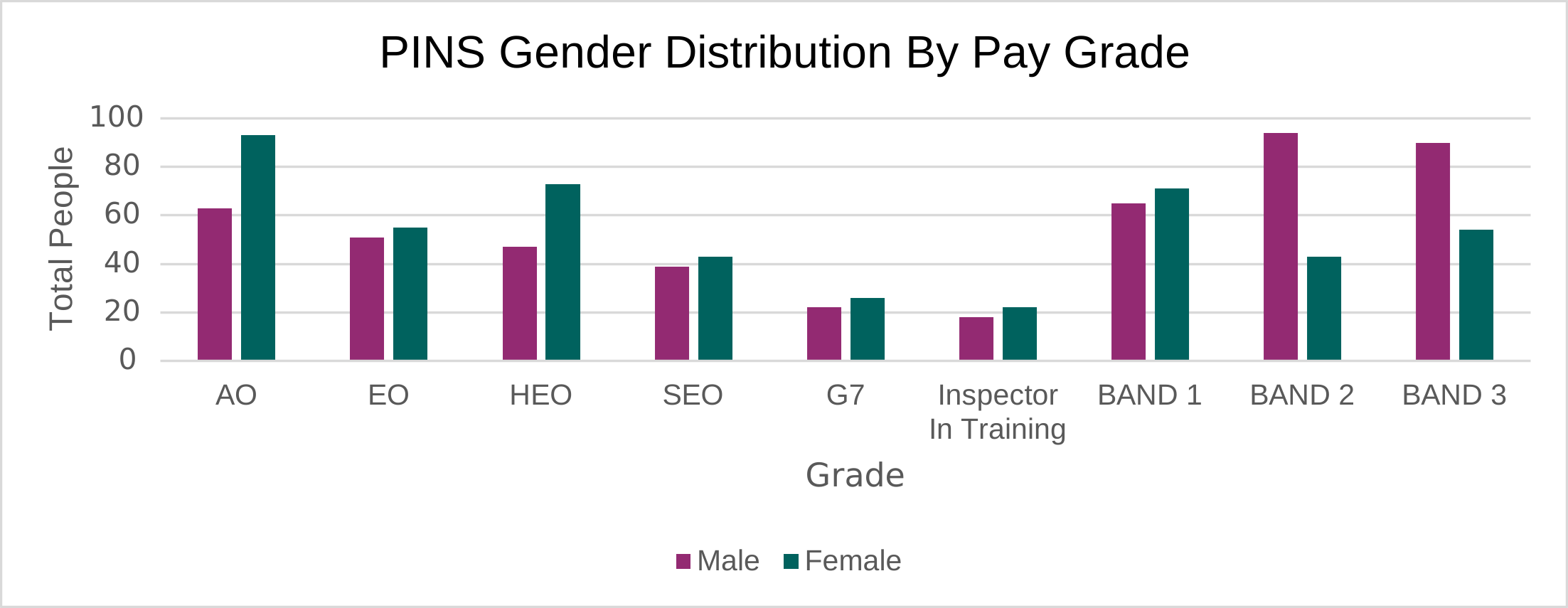
Progression from Band 1 to senior grades typically requires time and experience in the unique Planning Inspector role, which is expected to influence the gender distribution at higher levels over the coming years. This disparity is evident in our gender pay figures: planning inspectors show a median pay gap of 11.7%, compared to just 3.9% in other professions within PINS. In short, the demographic profile of the government planning inspector profession – particularly the higher proportion of men in senior, higher-paid roles – continues to drive our overall gender pay gap.
Overall, the 2025 gender pay gaps for the Planning Inspectorate are 14.2% at the mean and 23.2% at the median. Compared to 2024, the 2025 gender pay gap figures show a very modest increase at the mean (0.5%). This is primarily due to our structural pay gap, with more men in higher paying roles. More notably, the median gender pay gap has risen (7.8%). In the past 12 months; the median salary of men has increased by £2,355, and the median salary of women has increased by £1,794, resulting in a widened of the gap by £561.
The shift at the median is primarily driven by a modest increase in the representation of women across the lower middle, upper middle, and upper quartiles (see Table 9). This is largely due to the recruitment of a higher proportion of women into roles graded at SEO and above. However, in accordance with the Planning Inspectorate’s pay on appointment policy, these roles are typically appointed at the minimum The 2024 pay award focussed on progression for those already in grade, enabling a larger portion of men to move further through the pay range, thereby increasing the median gap. This was further compounded by higher male representation in higher-paid grades. Based on our workforce data, in our 2025 pay award we prioritised lower-paid grades and colleagues at the lower end of the pay ranges with a higher percentage pay increase.
Table 9: Comparison of male and female employees by quartile for 2025 and 2024 by headcount and proportion
2025 quartile
| Quartile | Headcount: men | Headcount: women | Percentage: men | Percentage: women |
|---|---|---|---|---|
| Q1 | 104 | 144 | 41.9% | 58.1% |
| Q2 | 107 | 141 | 43.1% | 56.9% |
| Q3 | 133 | 115 | 53.6% | 46.4% |
| Q4 | 161 | 86 | 65.2% | 34.8% |
2024 quartile
| Quartile | Headcount: men | Headcount: women | Percentage: men | Percentage: women |
|---|---|---|---|---|
| Q1 | 98 | 137 | 41.7% | 58.3% |
| Q2 | 106 | 129 | 45.1% | 54.9% |
| Q3 | 129 | 106 | 54.9% | 45.1% |
| Q4 | 158 | 77 | 67.2% | 32.8% |
Between 2024 and 2025, both the mean and median bonus gender pay gaps have increased significantly in favour of women; the mean bonus gap shifted from 4.7% to -16.7% and the median bonus gap moved from 0.0% to -16.7%.This change is primarily attributable to the fact that, in 2025, performance-related non-consolidated payments were made exclusively to employees at SCS grades. Within this cohort, three individuals received payments: one man and two women.
As part of our Strategic People Plan, we are currently developing a system to better link reward to delivery, productivity and behaviours for colleagues outside of the Executive Team. We will monitor the impact to gender pay.
We recognise our gender pay gap is ‘structural’ and PINS is actively addressing it through targeted strategic action. Our Strategic Plan 2024-27, sets out the clear aim to ensure the gender pay gap is trending downward from the 2023/24 benchmark of 14.6% by 2027.
This year we launched a Gender Pay Taskforce and developed an action plan, outlining further measures to help us meet our 2027 target. This includes building line management capabilities to better support all colleagues with their development and reviewing opportunities for recruitment and promotion.
-
Statistical bulletin - Civil Service Statistics: 2025 indicates the total proportion of staff at grade 7 and above to be 16.2%. ↩
-
RTPI: State of the profession 2023 indicates that the Planning profession is 40% women. ↩