Prenatal pertussis vaccination coverage in England from October to December 2025
Updated 30 July 2026
Applies to England

© Crown copyright 2026
This publication is licensed under the terms of the Open Government Licence v3.0 except where otherwise stated. To view this licence, visit nationalarchives.gov.uk/doc/open-government-licence/version/3 or write to the Information Policy Team, The National Archives, Kew, London TW9 4DU, or email: psi@nationalarchives.gov.uk.
Where we have identified any third party copyright information you will need to obtain permission from the copyright holders concerned.
This publication is available at https://www.gov.uk/government/publications/pertussis-immunisation-in-pregnancy-vaccine-coverage-estimates-in-england-october-2013-to-march-2014/prenatal-pertussis-vaccination-coverage-in-england-from-october-to-december-2025
This quarterly report evaluates prenatal pertussis vaccine coverage for women who delivered from October 2025 to December 2025, the third quarter of the 2025 to 2026 financial year.
The main findings were that:
-
coverage was 74.8% in October 2025, 75.3% in November 2025 and 75.1% in December 2025
-
coverage for quarter 3 was 75.0%, which was 7.5 percentage points higher than quarter 3 coverage in the previous financial year
-
coverage by Commissioning Region ranged from 67.1% in London to 82.4% in the South West
Note 1. A new point of care app developed by NHSE to record vaccination events was introduced in September 2024. The Record a Vaccination service (RAVs) has improved dataflows into general practice which may partially account for the increase in coverage reported in recent months
Introduction
This report presents pertussis vaccine coverage in pregnant women in England for the period October to December 2025.
The pertussis vaccine has been offered to pregnant women since 1 October 2012 following a period of increased pertussis activity in all age groups, including infants under 3 months of age, and the declaration of a national pertussis outbreak in April 2012.
In June 2014, the Joint Committee on Vaccination and Immunisation (JCVI) advised it should continue for a further 5 years. In February 2016, the JCVI considered new evidence demonstrating that vaccination earlier in pregnancy would increase opportunities during pregnancy for vaccination, without detrimentally affecting the protection afforded to the infant. Based on this, JCVI advised that vaccination could be offered from gestational week 16, although for operational reasons vaccination should ideally be offered from around 20 weeks, on or after the foetal anomaly scan.
This advice was implemented from April 2016 as was offering the vaccine through general practice as well as some maternity services. In 2019, following the JCVI recommendation, the prenatal pertussis vaccine became a routine programme in England.
The prenatal pertussis vaccination programme aims to minimise disease, hospitalisation and deaths in young infants, through the intra-uterine transfer of maternal antibodies, until they can be actively protected by the routine infant programme with the first dose of pertussis vaccine scheduled at 8 weeks of age.
Methods
General practice (GP) level pertussis vaccine coverage data is automatically uploaded via participating GP IT suppliers to the ImmForm website each month. ImmForm data is validated and analysed by the UK Health Security Agency (UKHSA) to check data completeness, identify, and query any anomalous data and describe epidemiological trends. Since April 2016 (implementation date varied by GP IT supplier) the following monthly data has been collected:
-
denominator: number of women who delivered in the survey month, excluding miscarriages and stillbirths, regardless of gestational age
-
numerator: number of women receiving pertussis vaccination between week 16 of pregnancy and delivery
For accurate denominators to be extracted from GP IT systems by the automated survey and precise coverage estimates to be calculated, it is important that the medical records of all women who have given birth have the following fields completed:
-
the date of delivery
-
the date of receipt of a pertussis-containing vaccine at or after week 16 of pregnancy, regardless of the setting where the vaccine was administered
-
where relevant, fields indicating stillbirth or miscarriage
Coverage by Commissioning Region (based on the 2019 NHS England configurations), local authority, ICB and Sub ICB are reported in the associated data tables.
Participation and data quality
All GP IT suppliers provided data for the third quarter of the 2025 to 2026 financial year. National GP practice participation was at 99.0% in October 2025, 99.0% in November 2025 and 99.1% in December 2025.
Results
Summary
For quarter 3 of the 2025 to 2026 financial year:
-
coverage was 75.0% which was 7.5 percentage points higher than quarter 3 coverage in the previous financial year
-
coverage was 74.8% in October 2025, 75.3% in November 2025 and 75.1% in December 2025
-
coverage by Commissioning Region varied by 15.4 percentage points, from 67.1% in London to 82.4% in the South West
-
coverage by Integrated Care Board (ICB) varied by 27.9 percentage points, from 58.5% in the Birmingham and Solihull ICB to 86.3% in the Shropshire, Telford and Wrekin ICB
-
coverage in the London Commissioning Region has gradually increased from 35.5% in September 2023 to 67.7% in December 2025
Data on coverage by Commissioning Region, ICB, Sub ICB and local authority is available in the data tables associated with this report.
Table 1. Pertussis vaccination coverage (%) in pregnant women by Commissioning Region, in quarter 3 of the 2025 to 2026 financial year
| Commissioning Region code | Commissioning Region name | Coverage in October 2025 | Coverage in November 2025 (%) | Coverage in December 2025 (%) | Coverage in Quarter 3 (%) |
|---|---|---|---|---|---|
| Y56 | London | 66.3 | 67.2 | 67.7 | 67.1 |
| Y58 | South West | 82.1 | 82.8 | 82.5 | 82.4 |
| Y59 | South East | 80.5 | 79.9 | 80.4 | 80.3 |
| Y60 | Midlands | 73.9 | 75.2 | 74.5 | 74.5 |
| Y61 | East of England | 75.3 | 75.0 | 75.4 | 75.2 |
| Y62 | North West | 73.0 | 73.5 | 71.9 | 72.8 |
| Y63 | North East and Yorkshire | 76.8 | 77.3 | 76.7 | 76.9 |
Figure 1. Monthly pertussis vaccination coverage (%) in pregnant women from April 2016 to December 2025 [Note 2]
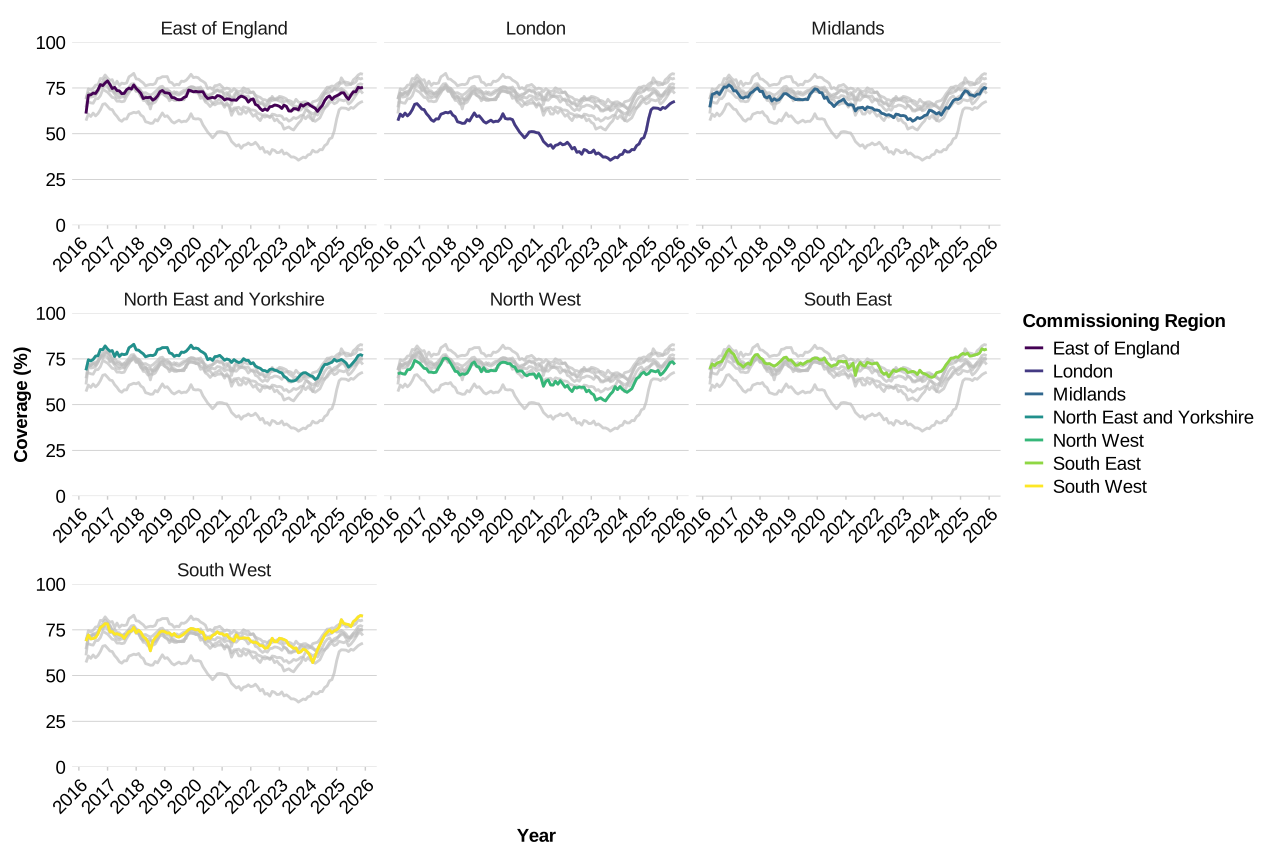
Note 2. Data from the smallest IT supplier was excluded between November to December 2019.
Figure 2. Monthly pertussis vaccination coverage (%) in pregnant women from April 2016 to December 2025 [Note 2]
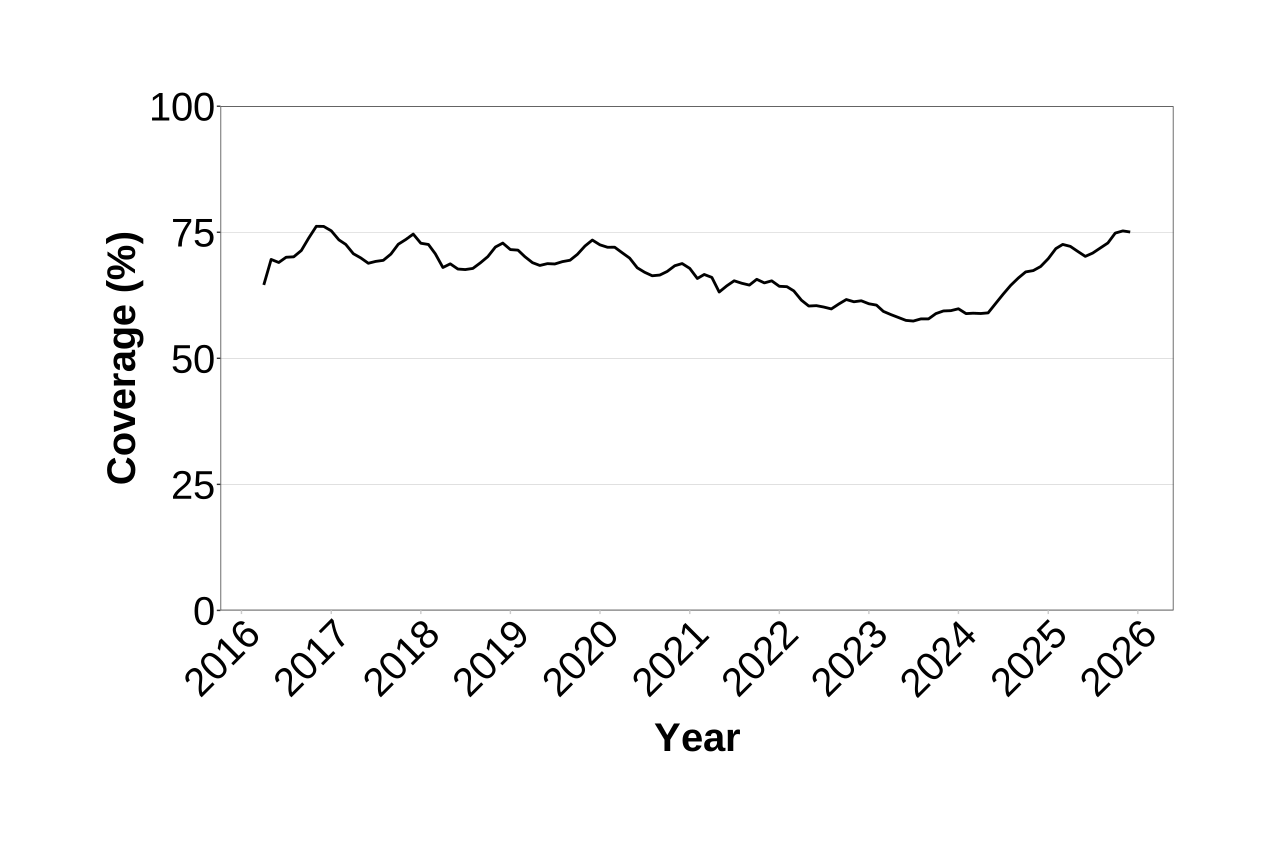
Note 2. Data from the smallest IT supplier was excluded between November to December 2019.
Figure 3. Map of pertussis vaccination coverage (%) in pregnant women by Sub ICB, in quarter 3 of the 2025 to 2026 financial year

Figure 4. Map of pertussis vaccination coverage (%) in pregnant women by local authority in England and London, in quarter 3 of the 2025 to 2026 financial year

Coverage by ethnicity
The main findings for coverage by ethnicity were that:
-
coverage varied by 37.7 percentage points between ethnic groups
-
coverage was the highest in Other Ethnic Group Chinese (84.8%) and lowest in Black or Black British Caribbean (47.1%) (Table 2)
Table 2. Pertussis vaccination coverage (%) in pregnant women by ethnicity, in quarter 3 of the 2025 to 2026 financial year
| Ethnicity | Coverage (%) |
|---|---|
| Asian or Asian British any other Asian Background | 76.4 |
| Asian or Asian British Bangladeshi | 69.7 |
| Asian or Asian British Indian | 81.9 |
| Asian or Asian British Pakistani | 61.0 |
| Black or Black British African | 64.6 |
| Black or Black British any other Black Background | 59.4 |
| Black or Black British Caribbean | 47.1 |
| Mixed any other Mixed Background | 67.8 |
| Mixed White And Black African | 67.3 |
| Mixed White Asian | 75.9 |
| Mixed White Black Caribbean | 58.1 |
| Not Stated | 71.3 |
| Other Ethnic Group any other Ethnic Group | 62.9 |
| Other Ethnic Group Chinese | 84.8 |
| Patients with any other | 76.7 |
| White any other Background | 62.1 |
| White British | 81.3 |
| White Irish | 76.8 |
Coverage by IMD Decile
The main findings for coverage by IMD decile [Note 3] were that:
-
coverage varied by 18.3 percentage points between IMD deciles
-
coverage was 83.9% in the least deprived decile and 65.6% in the most deprived decile (Table 3)
Note 3. Coverage by IMD decile is calculated based on 2025 IMD deciles and GP postcode.
Table 3. Pertussis vaccination coverage (%) in pregnant women by IMD decile, in quarter 3 of the 2025 to 2026 financial year
| IMD Decile | Coverage (%) |
|---|---|
| 1 | 65.6 |
| 2 | 70.0 |
| 3 | 73.2 |
| 4 | 75.2 |
| 5 | 77.9 |
| 6 | 79.3 |
| 7 | 79.6 |
| 8 | 81.6 |
| 9 | 82.5 |
| 10 | 83.9 |
Discussion
This is the third quarterly report of the 2025 to 2026 financial year and evaluates pertussis vaccine coverage for women who delivered from October 2025 to December 2025. During this quarter, monthly prenatal pertussis vaccine coverage was 74.8% in October 2025, 75.3% in November 2025 and 75.1% in December 2025. Coverage by Commissioning Region varied by 15.4 percentage points. Coverage was lowest in the London Commissioning Region, although has increased by 27.7 percentage points since April 2024.
A new point of care app developed by NHSE to record vaccination events was introduced in September 2024. The Record a Vaccination service (RAVs) has improved dataflows into general practice which may partially account for the increase in coverage reported in recent months.
Limitations to the data presented in this report may explain some of the observed variability in coverage at the local level and over time. First, completeness of data is reliant on the recording of delivery dates in the mother’s medical records and a recent study in England suggests that maternity notes regarding pregnancy and delivery are often scanned or archived, rather than coded in an extractable format. Furthermore, a comparison of these denominator data with national data on live births indicates that in 2022, this data represented about 73% of the population of pregnant women.
Continued support in the delivery of this important programme has been sought from service providers (GP practices and maternity units), Screening and Immunisation Teams, and Health Protection Teams. Screening and Immunisation Teams should continue to update service providers on the current epidemiology of the disease and the need to maintain and improve coverage achieved thus far.
If coverage, and ultimately the impact of the programme itself, is to be accurately monitored, GPs and practice nurses must continue to ensure that vaccination and date of delivery are recorded in the patient’s GP record. In areas that have commissioned maternity units to offer pertussis vaccines in pregnancy, providers must ensure doses of vaccines given to individual women are also communicated to the woman’s GP, where these are not captured in automated systems. Maternity units not offering pertussis vaccines to pregnant women should continue to discuss its importance, make use of available resources, and signpost the woman to her GP to receive the vaccine. GPs, practice nurses, obstetricians, and midwives should continue to encourage pregnant women to receive the pertussis vaccine, ideally, between weeks 20 and 32 of their pregnancy (but up to term) to optimise protection for their babies from birth.