Peer Mentoring Evaluation: A report on final research findings
Published 30 October 2025

© Crown copyright 2025
This publication is licensed under the terms of the Open Government Licence v3.0 except where otherwise stated. To view this licence, visit nationalarchives.gov.uk/doc/open-government-licence/version/3 or write to the Information Policy Team, The National Archives, Kew, London TW9 4DU, or email: psi@nationalarchives.gov.uk.
Where we have identified any third party copyright information you will need to obtain permission from the copyright holders concerned.
This publication is available at https://www.gov.uk/government/publications/peer-mentoring-evaluation-a-report-on-final-research-findings/peer-mentoring-evaluation-a-report-on-final-research-findings
DWP research report no. 1111
A report of research carried out by IFF Research on behalf of the Department for Work and Pensions.
Crown copyright 2025.
You may re-use this information (not including logos) free of charge in any format or medium, under the terms of the Open Government Licence. View the Open Government Licence or write to:
Information Policy Team
The National Archives
Kew
London
TW9 4DU
or email psi@nationalarchives.gov.uk
This publication is also available at DWP research reports - GOV.UK.
If you would like to know more about DWP research, email socialresearch@dwp.gov.uk.
First published October 2025.
ISBN 978-1-78659-888-2
Views expressed in this report are not necessarily those of the Department for Work and Pensions or any other government department.
Executive summary
This report details the findings of an evaluation of a test of Peer Mentoring, for individuals with a substance dependency.
The government is committed to reducing harms from substance misuse. Dame Carol Black’s independent reviews into the impact of employment outcomes on drug and alcohol addiction (2016 Review of drugs: phase one report and 2021 Review of drugs: phase two report) highlighted that, alongside treatment, meaningful activity such as employment makes an important contribution to sustaining recovery from a substance dependency. However, individuals with a substance dependency often have complex needs and require specialist intervention to overcome barriers to recovery and employment.
In this context, the Department for Work and Pensions (DWP) conducted a test of Peer Mentoring as a way of supporting these individuals to overcome barriers and make progress. Progress can mean different things for different mentees, for example around recovery from dependency, health, wellbeing or the labour market. These are referred to as ‘outcomes’ in this report. Peer Mentoring involves individuals with a dependency (mentees) receiving one-to-one support from a mentor with lived experience.
The evaluation was commissioned to assess this initiative and specifically, to:
-
understand how Peer Mentoring was implemented and delivered
-
examine mentee progression and outcomes
-
examine wider outcomes for Jobcentre Plus (JCP) staff, mentors and stakeholders
-
identify lessons learnt
It draws on evidence from:
- quantitative surveys of mentees
- qualitative in-depth interviews with mentees, mentors, DWP Single Points of Contact (SPOCs), delivery providers and other stakeholders
- data collected by mentors on individual mentees, in an Excel ‘tracker’
- qualitative analysis of a sample of Specific, Measurable, Achievable, Relevant and Time-bound (SMART) action plans devised by mentors and mentees, in the course of their working together
The research findings cover the following topics:
Mentee progression and the extent to which it can be attributed to Peer Mentoring (Chapter 2)
The DWP wished to explore the extent to which mentee progression can be attributed to peer mentoring (rather than other influences on mentees). The evaluation used contribution analysis to explain what contribution the programme made to any progression observed.
The evidence from this analysis suggests that, within the test of the Peer Mentoring programme, the main assumptions around how mentees would benefit from working with mentors largely held true. Mentors’ lived experience of dependency helped them to be empathetic and non-judgemental with their mentees, and this combination of lived experience with empathy and non-judgement in turn enabled their mentees to discuss their dependency and support needs openly. This openness about mentees’ needs, combined with the collaborative setting of and following up on SMART actions, often resulted in mentees accessing relevant support. It was relatively common for mentees to achieve positive outcomes, and where these occurred, it was usually the Peer Mentoring work (either in itself or in combination with other sources of support) that was responsible for this positive progression.
The diagnostic interview (an early session between the mentee and mentor in which the mentor seeks to identify mentee aspirations, needs and barriers) was an invaluable starting point for mentors, in allowing them to begin to develop a deep understanding of a mentee, although it could sometimes be very intense and long. As a result, mentors commonly also conducted an initial quick meeting or call before the diagnostic interview, to build rapport ahead of the more intense diagnostic interview session.
Mentees found it easy to keep working with their mentor because they had built a rapport with their mentor, appreciated the process of revisiting and being accountable for progressing their SMART actions, and had made progress in areas they needed support with. Those mentees who had disengaged (that is, they had stopped working with their mentor before completing the programme) and who had said why they had done so, in the first follow-up survey conducted for the evaluation, gave a range of reasons, that did not suggest any notable problems with the programme delivery approach.
Peer Mentoring implementation: referral and onboarding (Chapter 3)
Mentors, mentees, delivery providers, and DWP SPOCs generally felt well prepared to play their part in the Peer Mentoring programme – through the provision of timely information at the point of joining the programme and effective initial and ongoing on-the-job-training for mentors.
Feeling ready for the support was an important factor in mentees’ decisions to take part, as was mentors reassuring mentees that taking part would not affect their benefit entitlements.
The mentor onboarding process was well-received by mentors and programme delivery providers, though they noted the importance of practical elements of mentor training and allowing bedding-in time to build mentor confidence in the role.
DWP SPOCs felt the programme added value by providing support for a group of individuals for whom support had previously been missing, and by helping rebuild connections between JCP and drug and alcohol services which had weakened during the COVID-19 pandemic.
SPOCs, stakeholders involved in referrals to the programme and delivery providers felt the referral process was working well. An important ingredient in this was mentors building strong relationships with, and upskilling, JCP staff, which meant that JCP staff became better able to identify individuals who might be eligible for the programme and more confident in having conversations about the programme and substance dependency.
Peer Mentoring implementation: engagement with and experience of the programme (Chapter 4)
A total of 2,994 individuals have been referred to the programme to date. Just under 6 in 10 (58%) of those that were referred, started the programme. Of those who started on the programme, one-third (32%, representing 19% of all those referred) completed the programme within the timescales covered by the analysis. Two-fifths (41%) of mentees who started on the programme, had disengaged from it by December 2024.
Mentees who had completed the programme most commonly were on the programme for 3-4 months and had 7 sessions with their mentor. That said, the amount of time mentees had been on the programme varied considerably, with a substantial minority of those still engaged with the programme as at December 2024, having been on the programme for 11 months or more (11%).
At the beginning of the programme, mentees commonly reported, in the baseline survey conducted for the evaluation, that they ideally wanted support with finding a job, with overcoming dependency and with finding a sense of structure or stability.
Most mentees recalled setting SMART actions with their mentor and they were generally positive about the process of doing so. The collaborative approach between mentee and mentor was important in ensuring realistic actions were set.
Some mentees appreciated the flexibility their mentor offered around the timing, location and number of meetings between mentee and mentor. This flexibility allowed mentees to remain engaged with the programme.
While the programme worked well overall, there were some constraints on delivery. Personal circumstances, such as periods of sick leave, sometimes prevented mentors from delivering the programme as planned, and high mentor turnover meant some JCP sites had a limited number of mentors. A limited amount of physical space in some JCP sites meant that meetings between mentors and mentees could lack privacy. Work Coaches and Disability Employment Advisors’ (DEAs) high caseloads and targets sometimes meant the programme was not ‘top of mind’ for Work Coaches and DEAs when they spoke to potential mentees, which reduced the number of potential referrals.
The wider impacts of Peer Mentoring (Chapter 5)
Mentors were positive about their role, feeling that it had helped them develop a range of skills. Some also mentioned that the role had helped them with their own recovery journey. The support given by mentors had built JCP staff understanding of individuals with substance dependencies and enhanced their confidence in having effective conversations about dependency.
Lessons learned from Peer Mentoring implementation (Chapter 6)
A range of lessons were identified, such as the value of an introductory informal conversation between mentor and mentee to build rapport and introduce the programme, and the importance of practical support and learning from more experienced peer mentors in helping newer mentors to set appropriately tailored SMART actions with their mentees.
Conclusions
The conclusions that can be drawn from the research include the following:
- the evidence suggests that, within the test of the Peer Mentoring programme, the main assumptions around how mentees would benefit from working with mentors largely held true
- the rapport between mentor and mentee, and the process of revisiting and being accountable for progressing relevant SMART actions, tended to encourage mentees to stay engaged with the programme
-
it was relatively common for mentees to achieve positive outcomes, and where these occurred, it was usually the Peer Mentoring work (either in itself or in combination with other sources of support) that was responsible for this positive progression
- mentors, mentees, delivery providers, and DWP SPOCs generally felt well prepared to play their part in the Peer Mentoring programme
- informal knowledge sharing between mentors emerged as an important ingredient, in enabling mentors to set smaller, more realistic SMART actions with their mentees
- informal knowledge sharing by mentors also helped to build Work Coach and Disability Employment Adviser (DEA) knowledge and confidence, both to have effective conversations about substance dependency and the Peer Mentoring support offer, and to make appropriate referrals
-
the diagnostic interview was felt to be effective in enabling the mentor to build an initial understanding of the mentee’s circumstances, barriers and support needs. However, an important modification to the intended approach was made here, by mentors introducing an informal first conversation with their mentees prior to the diagnostic interview
- a further aspect which had worked well was mentors’ flexibility around when and where they met their mentees, and the number of sessions they convened with their mentees
- notable constraints on the effective delivery of the Peer Mentoring programme test included:
- mentor turnover and leave due to personal circumstances, such as sick leave, which sometimes resulted in some JCP sites having limited numbers of mentors
- a lack of physical space on JCP premises, which sometimes curtailed the ability of mentees to have private conversations with their mentors
- Work Coach and DEA caseloads and targets, which meant that Peer Mentoring was not always ‘top of mind’, likely reducing the number of referrals
- while a substantial minority of mentees who started on the programme had disengaged, the feedback available on reasons for disengaging does not point towards any notable problems with the delivery approach
Glossary of terms
| Term | Meaning |
|---|---|
| Baseline survey | IFF Research survey conducted with mentees during the first session with a mentor or as close to this first session as possible. |
| Contract Package Areas (CPAs) | The peer mentoring programme was delivered in 4 CPAs in England: North East England, North West England, Southern England and London and the Home Counties. It was also delivered in one CPA in Wales: North Wales. |
| Delivery provider | Delivery providers were responsible for recruiting and managing the peer mentors. Four delivery providers were part of the Peer Mentoring programme: Change Grow Live (CGL), The Growth Company, Inclusion and The Wallich. |
| Diagnostic Interview | If a mentee is eligible for the program, the peer mentor will deliver an initial Diagnostic Interview. A Diagnostic Interview was held to identify mentee aspirations, needs and barriers. The Diagnostic Interview would then be followed by regular engagement between the mentor and mentee. |
| Disability Employment Advisers (DEAs) | Jobcentre Plus (JCP) staff who help benefit claimants with disabilities or health conditions to prepare for, find and stay in work. |
| Disengaged mentees | Mentees who had stopped working with their mentor before they completed the programme. |
| Employment and Support Allowance (ESA) | Employment and Support Allowance (ESA) helps with living costs and getting individuals back to work if they have a disability or health condition that affects how much they can work. |
| First follow-up survey | IFF Research survey conducted with mentees when they complete or disengage from the programme, typically between 3 and 9 months after they have started on the programme. |
| Jobcentre Plus (JCP) | Jobcentre Plus (JCP) helps individuals claiming certain benefits to get back to work. |
| Lived experience | In this report, lived experience refers to an individual who has experience of substance dependency. |
| Mentee | An individual taking part in the Peer Mentoring programme and being provided with support by a mentor. |
| Mentor | An individual with lived experience of substance dependency, providing one-to-one support to mentees through the Peer Mentoring programme. |
| Peer Mentoring programme | An initiative developed by DWP for individuals with substance dependency. The initiative provides individuals with substance dependency with one-to-one support via a peer mentor with lived experience of substance dependency. |
| Personal Independence Payment (PIP) | Personal Independence Payment (PIP) can help with extra living costs if an individual has a long-term physical or mental health condition or disability and has difficulty doing certain everyday tasks or getting around because of the condition. |
| Performance Management Information (PMI) | Performance Management Information (PMI) collected by DWP as part of performance management with Peer Mentoring programme providers. |
| DWP Single Points of Contact (SPOCs) | DWP SPOCs act as a link between Jobcentre Plus (JCP) and peer mentors. |
| SMART action plan | A Specific Measurable Achievable Realistic Timebound (SMART) action plan, setting out goals to help the mentee to progress, was devised and regularly updated in meetings between the mentee and the mentor. |
| SMART actions | Specific Measurable Achievable Realistic Timebound (SMART) actions were set with the mentee to help them progress. |
| Stakeholder | An individual who has referred mentees onto the programme and/or has provided support to mentees during the programme. |
| Tracker data | Tracker data is populated by peer mentors to track mentees’ progress during their time receiving support. Delivery provider collated this information in Excel and provided it for analysis at monthly intervals. |
| Universal Credit (UC) | Universal Credit is a payment to help with your living costs. It’s paid monthly - or twice a month for some people in Scotland. |
| Work Coach | Jobcentre Plus (JCP) staff who help benefit claimants to prepare for, find and stay in work. |
| 12-month survey | IFF Research survey conducted with mentees between 9 and 12 months after they have started working with a mentor. |
Abbreviations
| Abbreviation | Meaning |
|---|---|
| CPA | Contract Package Area |
| DWP | Department for Work and Pensions |
| DEAs | Disability Employment Advisors |
| ESA | Employment and Support Allowance |
| JCP | Jobcentre Plus |
| PIP | Personal Independence Payment |
| PMI | Performance Management Information |
| SMART action plan | Specific Measurable Achievable Realistic Timebound (SMART) action plan |
| SMART action | Specific Measurable Achievable Realistic Timebound (SMART) actions |
| SPOC | Single Point of Contact |
| UC | Universal Credit |
Chapter 1: Background and methodology
Introduction
This chapter describes the background to the Peer Mentoring programme and sets out the aims and objectives of the research. The chapter also describes the methodology and sets out the report structure.
Background to the research
The government is committed to reducing harms from substance misuse. Dame Carol Black’s independent reviews into the impact of employment outcomes on drug and alcohol addiction (2016 report and 2021 report) highlighted that, alongside treatment, meaningful activity such as employment makes an important contribution to sustaining recovery from a substance dependency. However, individuals with a substance dependency often have the most complex needs and need specialist intervention to overcome barriers to recovery and employment.
In this context, the Department for Work and Pensions (DWP) conducted a test of Peer Mentoring, as a way of supporting individuals with substance dependency to overcome barriers, enabling them to progress and meet their potential. Progress can mean different things for different mentees, for example around recovery from dependency, health, wellbeing or the labour market and these are referred to as ‘outcomes’ in this report.
Peer Mentoring is where a peer mentor uses lived experience to support and inspire a mentee, working with them on an individual basis to offer tailored support, helping them to access appropriate services.
The DWP’s Peer Mentoring test was conducted in selected JCP sites in England and Wales. It was delivered through 4 providers:
- Change Grow Live
- The Growth Company
- Inclusion
- The Wallich
Mentee eligibility and customer journey
Mentees joined the programme after being referred by the JCP or other third parties. Mentees were eligible for referral if they met the following criteria:
-
they had a substance dependency that was a barrier to them obtaining sustained employment
-
they were 18 years old or older and lived in a Contract Package Area (CPA), that is, one of the locations in which the test was being conducted
-
they were claiming benefits, including Universal Credit (all regimes), Jobseekers Allowance, Income-related Employment and Support Allowance, Working Tax Credit, Income support or were not in receipt of benefits but were unemployed
From the point of referral, mentees were intended to follow a customer journey, described in Figure 1.1.
Figure 1.1. The mentee customer journey
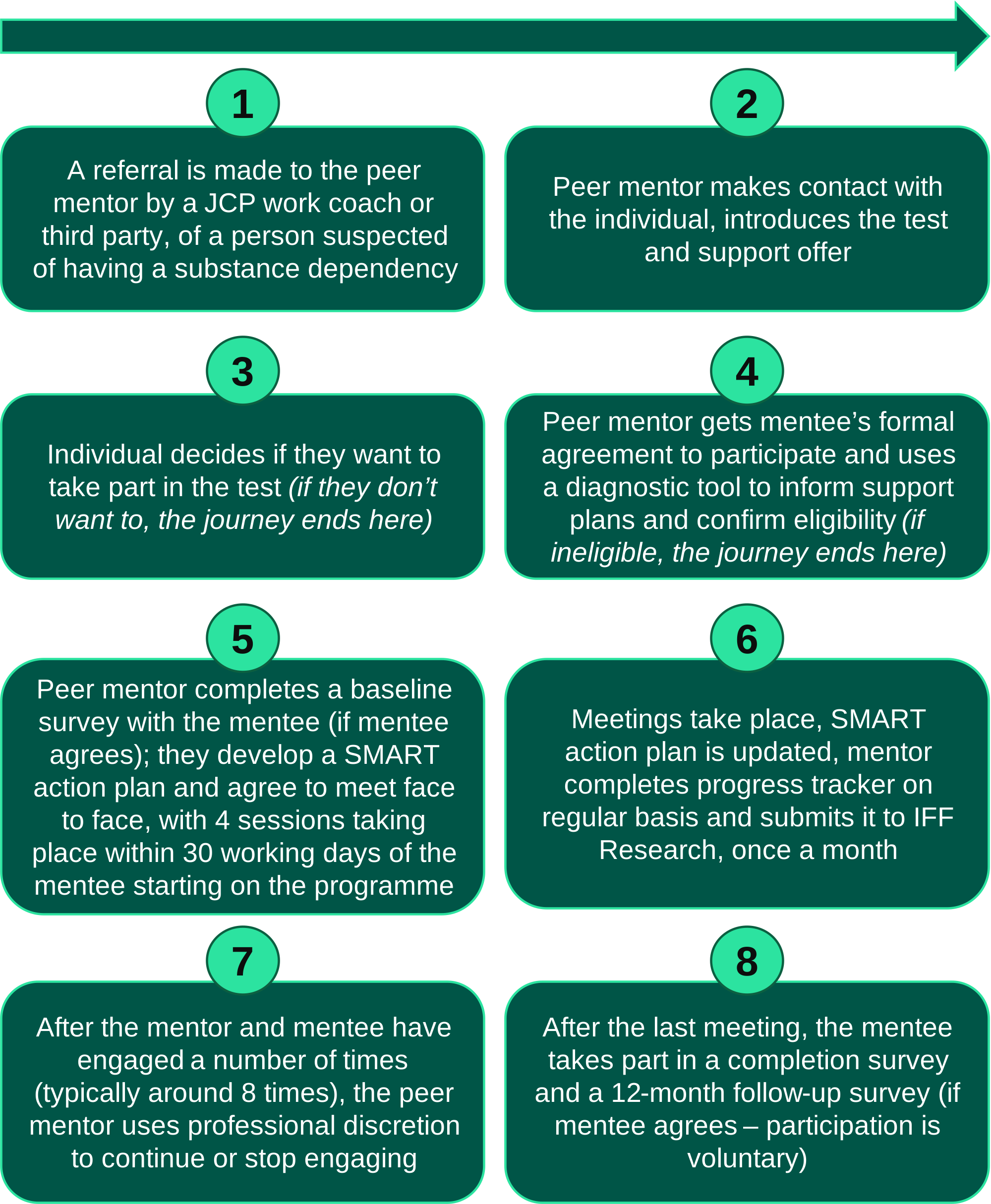
The SMART action plans are created by the peer mentor and the mentee in their face-to-face meetings. These set out the actions that the mentee will take to work towards their goals. The actions set are intended to be specific, measurable, achievable, relevant and timebound (hence the term, ‘SMART’).
While the initial intention was that each mentee would take part in the programme once, working with their mentor over the course of around 8 face-to-face meetings across a period of around 6 months, in practice some mentees worked with their mentor for longer than this and, in some instances, completed the programme and then rejoined for a further period of mentoring (sometimes with a different mentor).
The evaluation
DWP commissioned IFF Research to conduct an evaluation of the Peer Mentoring Programme. The aims of this evaluation were to:
-
understand how Peer Mentoring was implemented and delivered: This included:
- exploring recruitment, training and retention of peer mentors
- the roles of JCP Single Points of Contact (SPOCs)
- approaches to substance dependency disclosure and referral
- use of diagnostic tools and SMART action plans
- engagement with employment and other support
- upskilling of JCP Work Coaches
- examine mentee progression and outcomes: This involved exploring:
- the extent of mentee disclosure of substance dependency
- levels of referrals to Peer Mentoring, as well as starts and completes
- mentee wellbeing and health outcomes
- mentee distance travelled towards the labour market
- levels of mentees disengaging from the Peer Mentoring programme and reasons for this
- examine wider outcomes: This involved:
- exploring experiences of mentors, JCP staff and stakeholders
- the skills and confidence mentors, JCP staff and stakeholders in working with individuals with dependencies
- inter-agency relations and ways of working
- mentee engagement with broader support services
- identify lessons learnt: This involved:
- assessing the extent to which the test design enabled the policy intent to be realised, and why
- assessing what works for whom, in supporting individuals with substance dependencies
- identifying lessons learnt for potential wider rollout and future activity supporting individuals with substance dependencies
Methodology
This evaluation findings draw on 4 components. These are summarised in brief here, and described in more detail in Annex E:
-
quantitative surveys with mentees on 3 occasions: mentees completed a baseline survey online, with support from their mentor, as soon as possible after joining the programme. Those that gave recontact permission were approached to take part in a follow-up telephone interview, twice. Firstly, on completing work with their mentor or on disengaging from the programme,[footnote 1] and secondly, around 12 months after starting work with their mentor. By conducting surveys on 3 occasions, the intention was to be able to capture progression by mentees as they worked with their mentor. A total of 654 mentees took part in the baseline survey, with 80 responding to the first follow-up survey and 28 responding to the second follow-up survey
-
qualitative interviews: in-depth interviews were conducted with mentees, mentors, DWP SPOCs, stakeholders involved in the referral process, delivery providers and other stakeholders who were actively engaged with mentees who were on the programme. These interviews were conducted on 2 occasions, in winter 2023 to 2024 to capture early findings and lessons learned, and again in winter 2024 to 2025 to capture later reflections on the programme. A total of 119 in-depth interviews were completed – 44 with mentees, 32 with mentors, 23 with DWP SPOCs, and 20 with delivery providers and other stakeholders
-
mentee tracker data: This was individual data collected by delivery providers on every mentee who engaged with the programme since it began. It captured some information profiling the mentee in terms of demographics and situation on joining the programme, as well as capturing referral route to the programme, mentee status (in terms of continuing to work with a mentor, completed work with the mentor or disengaged), and some basic information on outcomes. Delivery providers submitted tracker data to IFF monthly. In total, 14,484 mentee tracker submissions, covering 1,735 individual mentees, were received for analysis
-
analysis of samples of SMART action plans: Delivery providers also submitted a random selection of anonymised SMART action plans each quarter, to enable analysis of plan content (the types of actions being agreed between the mentee and mentor) and quality (in terms of whether the plans were specific, measurable and timebound).[footnote 2] A total of 127 plans were analysed over the course of the evaluation
The evidence from these 4 components was used to conduct contribution analysis, to assess the extent to which progression was a result of the programme. A series of contribution statements were developed that, taken together, set out an intended chain of cause and effect, that captures some of the programme’s main assumptions around what is supposed to happen and why. The DWP’s programme Theory of Change was used as a starting point for this. The contribution analysis then tested the validity of the 5 contribution statements (the extent to which they had been met) using evidence from each of the elements of the evaluation described above. Analysis was conducted by breaking each contribution statement into its component parts and reviewing evidence for each part. The purpose of the analysis was to explain what contribution the Peer Mentoring programme made to any progression observed (in the context of other possible explanations for progression).
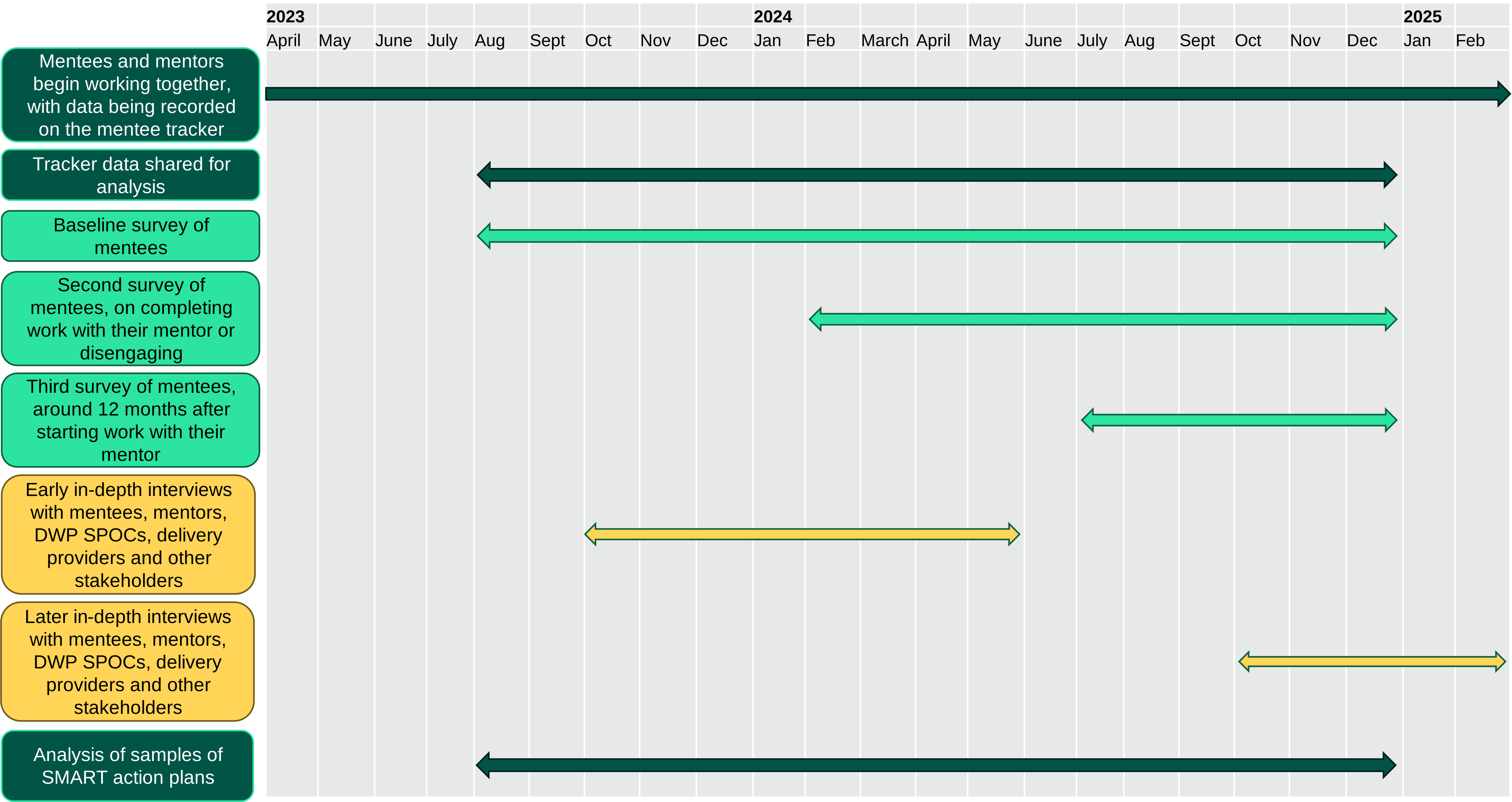
The timeline in Figure 1.2 gives an overview of when data collection and interviews took place.
Figure 1.2. Data collection and interviewing timeline
Reliability of the data
This report draws on a range of data sources, described above, each of which has some strengths and limitations:
-
findings from qualitative interviews give us in-depth, detailed feedback on experiences of delivering and participating in the programme. However these are small samples and cannot reliably be used to indicate prevalence of certain views or experiences. When recruiting qualitative interviews, detailed targets were used to ensure participants were a broadly representative mix, by characteristics such as location, support provider, type and level of dependency and demographic characteristics, However, given that programme participants are recovering from drug or alcohol dependency, there is a risk that mentees interviewed qualitatively may be those in relatively more positive situations (with those in less positive situations being less likely to respond), Similarly, the thematic analysis of the SMART action plan content is based on relatively small samples of plans, and so it can only give an indication of plan content and quality
-
findings from surveys capture mentees’ experiences, with sample sizes that give us a more reliable indication of the prevalence of certain views or experiences. However, as with the qualitative interviews with mentees, there is a risk that survey participants may be those in relatively more positive situations (with those in less positive situations being less likely to respond). This risk is heightened for the follow-up surveys, where only a subset of the baseline survey participants responded. The findings from the third of the 3 surveys, at 12 months, received too low a level of response and so are not used in this report, while the findings of the first follow-up survey are included, but should be treated as indicative
-
data from the mentee tracker collected by delivery providers covers all mentees, and so can be used to some extent to validate the findings of the mentee surveys. However, the tracker only captures basic data on mentee outcomes and, for some mentees, certain pieces of data are sometimes missing (for example, some cells within the ‘outcomes’ section were sometimes left blank rather than being populated with ‘not applicable’ and therefore it was unclear whether or not outcomes were missing). The tracker was also completed by numerous mentors working with 4 different programme providers: Whilst detailed written instructions and briefing sessions were provided on how to complete the tracker, there will have been variations in how the tracker was completed, between providers and individual mentors
Overall, the analysis in this report seeks to manage the limitations of these sources by drawing them together and, when possible, using the evidence drawn from one source to corroborate the findings of another.
Report structure
The report takes the following structure:
- Chapter 2 discusses the contribution analysis findings about mentee progression and the extent to which this can be attributed to Peer Mentoring
- Chapter 3 examines the implementation of the programme, specifically the referral and onboarding process
- Chapter 4 explores engagement with the programme, as well as experiences of the programme, from the perspective of mentees, mentors, SPOCs, delivery stakeholders, stakeholders involved in the referral process and other stakeholders who were actively engaged with mentees once they had joined the programme
- Chapter 5 explores the wider impacts of the Peer Mentoring programme on mentors, JCP Work Coaches, other JCP staff and other stakeholders
- Chapter 6 identifies lessons learned from the implementation of the programme
The report then closes with conclusions drawn from the research.
Chapter 2: Contribution analysis: Mentee progression and extent to which it can be attributed to Peer Mentoring
Introduction
The Department for Work and Pensions (DWP) wished to explore the extent to which mentee progression can be attributed to peer mentoring specifically (rather than to other influences on mentees). With no identifiable comparison group of similar individuals who had not been working with a peer mentor, the evaluation used contribution analysis to assess the extent to which progression was a result of the programme.
The purpose of contribution analysis was not to prove conclusively that progression was completely attributable to the Peer Mentoring programme, but instead to explain what contribution the Peer Mentoring programme made to any progression observed (in the context of other possible explanations for progression).
A series of contribution statements were developed that, taken together, set out an intended chain of cause and effect from inputs through to outcomes and impacts. The statements captured some of the programme’s main assumptions around what is supposed to happen and why. The DWP’s programme Theory of Change was used as a starting point for this. The contribution analysis tested the validity of the 5 contribution claims (the extent to which they had been met) using a range of evidence from different elements of the evaluation, including qualitative interviews with mentees, mentors, JCP Single Points of Contact (SPOCs) delivery partners and other stakeholders, tracker data and the mentee baseline and first follow-up surveys. Analysis was conducted by breaking each contribution statement into its component parts and reviewing evidence for each part.
The contribution analysis focused on the extent to which the design and delivery of the Peer Mentoring programme realised the policy intent. This analysis focused on assessing the extent to which, within the programme:
-
mentors with lived experience of substance dependency encouraged disclosure, by mentees, of their barriers to progression and support needs, with the shared lived experience also building mentee trust in the relevance of available support
-
appropriate, timely identification and referral of mentees, and an effective, sensitive diagnostic interview experience, led to sustained mentee engagement with the Peer Mentoring programme
-
mentors having the right skills, capability and support from delivery providers allowed them to set and follow-up on appropriately tailored SMART actions with mentees
-
mentees setting and following up on appropriately tailored SMART actions, led to mentees accessing appropriate support that met their needs
-
mentees accessing this appropriate support via the Peer Mentoring programme, led to positive outcomes relevant to the individual mentee
Table 2.1 presents the 5 contribution statements and our conclusions against each. For each statement, the evidence has been weighed up to arrive at a verdict, as follows:
- ‘claim met’, means there is sufficient evidence to indicate the intervention worked as intended, with no strong evidence to the contrary
- ‘claim partially met’ means there is some evidence to indicate the intervention worked as intended, but with significant gaps or some evidence to the contrary
- ‘claim not met’, means that most of the evidence points to the intervention not working as intended
The remainder of the section sets out the evidence collected to either support or challenge whether each claim has been met.
Table 2.1 Overview of contribution analysis statements and conclusions
| Contribution Statement | Claim conclusion | Whether claim met |
|---|---|---|
| Statement 1: Mentors with shared lived experience encourage disclosure of mentee barriers to progression and support needs, and build mentee trust in the relevance of available support (which helps mentees to engage with the Peer Mentoring programme). | Evidence indicates shared lived experience helps to encourage disclosure and build trust. However, the extent to which mentees were aware of their mentor’s lived experience varied and mentees said aspects other than lived experience were also important in them being open and honest with their mentor. | Claim met |
| Statement 2: Appropriate, timely identification and referral of mentees, and an effective, sensitive diagnostic interview experience, leads to sustained mentee engagement with the Peer Mentoring programme. | There is evidence that timely identification leads to sustained engagement, however not all mentees were ready for support at the point of referral. The diagnostic interview was considered effective. However, many mentors modified the delivery process and introduced a pre-diagnostic meeting or call. | Claim met |
| Statement 3: Mentors having the right skills, capability and support from delivery providers allows them to set and follow-up on appropriately tailored SMART actions with mentees. | There is sufficient evidence to demonstrate that mentors have the right skills, capability and support from delivery providers, which enables them to set and follow-up on appropriate SMART actions with mentees. | Claim met |
| Statement 4: Mentees setting and following up on appropriately tailored SMART actions, leads to mentees accessing appropriate support that meets their needs. | There is sufficient evidence to demonstrate that mentees setting and following up on appropriate SMART actions leads to them accessing appropriate support that meets their needs. | Claim met |
| Statement 5: Mentees accessing appropriate support via the Peer Mentoring programme that meets their needs, leads to positive outcomes relevant to the individual mentee. | There is sufficient evidence to demonstrate that mentees accessing appropriate support via the Peer Mentoring programme leads to positive, relevant outcomes for mentees. | Claim met |
Contribution Analysis findings
Claim 1: Mentors with shared lived experience encourage disclosure of mentee barriers to progression and support needs, and build mentee trust in the relevance of available support (which helps mentees to engage with the Peer Mentoring programme)
Claim met
Evidence indicates shared lived experience helps to encourage disclosure and build trust. However, the extent to which mentees were aware of their mentor’s lived experience varied and mentees said aspects other than lived experience were also important in them being open and honest with their mentor.
Overall, the evidence indicates shared lived experience helps to encourage disclosure and build trust. Although the extent to which mentees were aware of their mentor’s lived experience varied and some mentees mentioned other aspects, such as rapport, mentor empathy and the mentor being non-judgmental, as important factors in enabling them to be open and honest, mentors said their lived experience was an important ingredient in enabling themselves as mentors to be empathetic and non-judgemental. Mentees said being open and honest with their mentor was important in ensuring the support they accessed was relevant (rather than the mentor’s lived experience in itself reassuring them that the support would be relevant). On balance, then, the mentor’s lived experience was important in enabling mentors to be empathetic and engage their mentees, which in turn led to more mentee openness, and thus more relevant support.
Shared lived experience
While most mentees in the qualitative interviews reported being aware that their mentor had lived experience, the extent to which mentors shared details of their lived experience varied. Some mentors disclosed their experiences of substance dependency whilst others did not go into detail. A few mentees interviewed qualitatively said their mentor had not told them they had lived experience but they had suspected they had lived experience. Whilst most mentees said having someone with lived experience was important, as it meant their mentor had a deeper understanding of their substance dependency and the challenges they faced and were thus better able to relate to them. Those who were not fully aware of their mentor’s lived experience did not report this as an issue and said having someone willing to listen was more important. Similarly, mentees did not always have a mentor with the same lived experience as them but none of the mentees reported this as an issue as they noted it was the understanding of dependency that was important.
Mentors in the qualitative interviews confirmed they were supporting mentees with a variety of dependencies and circumstances and therefore a range of support needs. Most mentors did not think they needed exactly the same lived experience as their mentees. Having shared experience of substance dependency more broadly, accompanied by empathy and common language, were more important for demonstrating an understanding of dependency.
Encouraging disclosure of mentee barriers to progression and support needs
Lived experience was a factor in supporting disclosure and helping mentees feel comfortable to be open and honest, however, aspects other than lived experience also encouraged this openness.
Mentees interviewed qualitatively had mixed views on whether their mentor’s lived experience encouraged them to disclose their barriers and support needs. For some, having a mentor with lived experience made them feel comfortable to share as they felt mentors could relate and understand. However, many mentees said it was other aspects not specifically linked to lived experience which encouraged disclosure. The other aspects mentioned were rapport, trust, empathy and a non-judgemental approach. Having a mentor with these qualities led to mentees feeling comfortable enough to be open and honest about their barriers and support needs.
I knew I would not be judged and that made me feel safe … she created an environment where I felt safe enough to disclose personal things and struggles.
(Mentee, aged 55-64, Male, Drug dependency – Non-opioid)
Mentors in the qualitative interviews found mentees quickly became comfortable and open with them, which they felt was due to their lived experience. Mentors agreed that being non-judgemental and empathetic were important in encouraging disclosure and they felt their lived experience was an important ingredient in them being able to be non-judgemental and empathetic.
Delivery providers interviewed qualitatively supported this view, reporting that mentors’ lived experience allowed them to relate to mentees in a way other services are unable to, by fostering a non-judgmental, empathetic environment.
Building mentee trust in the relevance of available support
Many mentees interviewed qualitatively said trusting their mentor was crucial. Generally, mentees had positive relationships with their mentors and as a result, they trusted their mentor. Trusting their mentor enabled mentees to feel comfortable to be open and honest with their mentor which many considered the most important aspect in ensuring the support was relevant – since this openness ensured that the mentor properly understood their support needs.
At first you tend to hold back a little bit, but as you gain, as the peer mentor gains your trust, and you can see that you’re trusted, then you open up more.
(Mentee, aged 65 and over, Female, Alcohol and drug dependency)
Trust in the mentor was less important for how mentees viewed the available support. However, a couple of mentees interviewed qualitatively specifically noted they trusted the support being offered through their mentor, either because the mentor had used the same support, or they viewed the mentor as knowledgeable due to their lived experience.
Similarly, mentors in the qualitative interviews felt their lived experience helped to build trust with mentees, as they could demonstrate they understood what the mentee was going through, and this in turn led mentees to be open about their support needs – thus helping ensure the support being offered was more relevant. Some mentors agreed that mentees trusted in the support being offered, as the mentor had received similar support. Other mentors commented that the support offered was different to previous support through Jobcentre Plus (JCP) and they thought this helped mentees to feel more positive about the support, as it was felt to be more relevant to their situation.
SPOCs reported that the mentor’s independence from JCP and the mentor’s ability to relate to the mentee’s experiences were important in building trust and fostering a more open and honest conversation. This approach had a positive influence on the support offered to mentees, by helping ensure it was relevant to their needs.
Helping mentees to engage with the Peer Mentoring programme
Generally, mentees were engaged with the programme and cited their peer mentor’s approach as instrumental in this.
In the mentee qualitative interviews, the overall approach of the mentor was cited as critical to mentee engagement, rather than lived experience per se. Mentees noted that mentors listening to them and having empathy were the most important factors in them continuing to engage with the programme. That said, some of the mentees interviewed qualitatively found having a mentor with lived experience inspiring, in giving them hope and demonstrating it is possible to recover.
However, mentors interviewed qualitatively thought their lived experience was an important factor in mentee engagement. They said their lived experience helped mentees to feel comfortable more quickly and that it was also an ingredient in enabling themselves as mentors to be empathetic and non-judgemental. This empathy and non-judgmental approach in turn led to mentees being open and honest. Many mentors noted that sharing their lived experience directly, also had a positive impact on the mentee’s engagement.
The power in the room is completely dispelled and it’s a very trusted relationship from that point onwards, and I imagine that this is in their mind all the time, that this is a different conversation…In my experience you see their face change.
(Mentor)
Claim 2: Appropriate, timely identification and referral of mentees, and an effective, sensitive diagnostic interview experience, leads to sustained mentee engagement with the Peer Mentoring programme
Claim met
There is evidence that timely identification leads to sustained engagement, however not all mentees were ready for support at the point of referral. The diagnostic interview was considered effective. However, many mentors modified the delivery process and introduced a pre-diagnostic meeting or call.
Overall, the evidence indicates that a timely identification does lead to sustained engagement. However, not all mentees felt they were ready for support at the time of referral. Both mentees and mentors found the diagnostic interview effective in enabling mentees to start sharing their circumstances, progression barriers and support needs with their mentor and mentees said it was carried out sensitively. However, many of the mentors discussed modifying the programme delivery by carrying out a pre-diagnostic meeting, which they felt was important in building rapport and engagement ahead of the diagnostic interview.
Appropriate, timely identification and referral of mentees
Timely identification is important as those feeling most open to receiving support with their progression barriers were most likely to engage and complete the programme.
Most mentees interviewed qualitatively felt the referral came at the right time and they were open to the support. In a few cases, the mentee was already actively looking for support. Some mentees, however, commented that at the time of the referral, they did not feel ready for support as they had other issues they needed to prioritise (such as their health or housing). Or they were anxious about the idea of participating because they were not clear initially about what the programme entailed and how it would help them.
Mentors interviewed qualitatively felt that most mentees were being identified and referred at the right time. Mentors noted that mentees had varied circumstances and were in varying stages of recovery which meant readiness to engage varied, however on the whole, mentors said mentees were keen, or even relieved, to be accessing the support.
Following a referral, some mentees had an appointment to speak to a mentor within a week and for others, it took 2 to 3 weeks to speak to a mentor. None of the mentees interviewed qualitatively mentioned this was a barrier to engaging with the programme, meaning the referral tended to result in mentees attending their first session.
In qualitative interviews SPOCs and delivery partners were positive about the referral process and noted it had been refined over time to ensure it worked well. Changes included Work Coaches being able to refer clients directly to peer mentors as opposed to Disability Employment Advisors (DEAs), making for a simpler referral process and stronger relationships between Work Coaches and peer mentors. Mentors also started to attend meetings with DEAs and Work Coaches which improved the referral process by giving Work Coaches a better understanding of the mentee customer group and the challenges and barriers they may experience.
Effective, sensitive diagnostic interview experience
The majority of the mentees interviewed qualitatively recalled their first session with their mentor, although there were differing levels of recall of the exact content of first meeting. Most mentees discussed feeling positive and confident after their first session, with some noting it was the first time they had discussed their dependency and others commenting they felt the session was the start of their recovery journey.
Mentors were also positive about the diagnostic interview and commonly it was considered helpful in mentees’ starting to share their circumstances, progression barriers and support needs.
It gives a good idea of what the individual might be struggling with, and I do always ask what their expectations are and how best I can help them, so it’s a good idea of how we can work together.
(Mentor)
A few mentors, however, commented the diagnostic interview could sometimes be very intense and long, which some mentees found challenging and difficult.
Mentors interviewed qualitatively also commonly mentioned that they conducted an initial quick meeting or call before the diagnostic interview. This pre-diagnostic meeting enabled the mentor to provide the mentee with more detail on the programme and the mentor’s role, and it was helpful in starting to build an understanding of the mentee’s circumstances and support needs. Mentors felt this pre-meeting was a crucial first step, as it helped to make mentees feel more comfortable with their mentor, by building rapport ahead of the detailed diagnostic interview. Some mentors also reported that the pre-diagnostic call or meeting was an opportunity for both the mentor and the mentee to decide if the programme was right for the individual mentee.
Sustained mentee engagement with the Peer Mentoring programme
During the qualitative interviews, mentees reported the first session as important for building a rapport with their mentor and enabling their mentor to understand their situation. As a result, mentees felt comfortable with their mentor, which encouraged them to engage with the programme. There were no mentions of the diagnostic interview as a reason for disengaging, in either the mentee qualitative interviews or the mentee first follow-up survey.
While mentors interviewed qualitatively were positive about the diagnostic interview, they said that the initial step of a pre-diagnostic meeting was very important and, for some mentees, it was even more important than the diagnostic interview. Getting this initial conversation right made the diagnostic interview easier and quicker in some instances and helped to sustain engagement.
We found that if the mentors did that initial call it can break down the time that we spend doing the diagnostic, because we knew most of it before we got round to the assessment…It made it a lot easier for them [the mentees] to come in, they were already relaxed because they’d spoken to us on the phone, so it kind of took that barrier in itself out the way…I definitely saw an improvement when we started doing the initial calls.
(Mentor)
Overall, mentees were engaged with, and commonly completed the programme. As at December 2024, 58% had completed or were still engaged, according to the tracker data, while 41% of mentees were no longer engaged with the programme. While the base size is small, at the mentee first follow-up survey, meaning results are indicative, mentees who had disengaged gave a variety of reasons for disengagement, none of which related to the timing of the referral or the diagnostic interview.
Some mentees felt they had achieved enough from the programme, some thought they had reached the maximum number of sessions, one had their case taken on by social services and one left as their mentor went on maternity leave.
When asked what may have encouraged the mentee to continue with the programme, the following suggestions were made:
- more information on what the remaining sessions would achieve
- the mentor tailoring the sessions by asking the mentee what they would have liked to get out of them
- different locations and times
- the provision of online sessions
- support with practical issues that made it difficult to attend
Claim 3: Mentors having the right skills, capability and support from delivery providers allows them to set and follow-up on appropriately tailored SMART actions with mentees
Claim met
There is sufficient evidence to demonstrate that mentors have the right skills, capability and support from delivery providers, which enables them to set and follow-up on appropriate SMART actions with mentees.
There is sufficient evidence to demonstrate that mentors have the right skills, capability and support from delivery providers to enable them to set and follow-up on appropriate SMART actions with mentees. Mentors said the initial training they were provided with helped prepare them for the role, including setting SMART actions, and many acknowledged that on-the-job training and sharing of best practice between mentors had then helped them develop in their role, including refining their approach to SMART action-setting. Analysis of a sample of SMART action plans suggested that most were of a good standard, in terms of containing specific measurable and timebound actions.
Mentors having the right skills, capability and support from delivery providers
Mentors were positive about the training they had been provided with and felt they were supported to undertake their role as a mentor.
In the qualitative interviews, most mentors described a two-week extensive training course, which covered a variety of topics such as safeguarding, confidentiality, boundaries, substance awareness, understanding mentee needs, using lived experience, and trauma-informed training. This also addressed SMART action-setting specifically. Most mentors interviewed qualitatively mentioned ongoing support from their delivery provider through one-to-one meetings with their line manager, team meetings, liaison with Work Coaches and team leader support.
All mentors interviewed qualitatively reported having access to further training. The extent to which mentors accessed ongoing training varied, with some receiving regular training once or twice a month and others receiving ad-hoc training as required. Many mentors noted it was their responsibility to book additional training and found courses were readily available from their delivery provider, DWP or external organisations.
There was real support, there was real constant check ins, and awareness of the fact that I’m seeing vulnerable people and complex clients.
(Mentor)
Mentors also benefitted from informal support and many mentors discussed the importance of regular liaison with other mentors, to feel supported in the role and to share best practice.
We [mentors] see problems differently and we solve problems differently so between us as well we were, and still are an incredible support for each other.
(Mentor)
Mentees interviewed qualitatively confirmed their mentors had the right skills for the role. They regarded mentors as being confident and capable in their role and able to either provide the support needed or signpost the mentee to relevant services. Mentees viewed mentors as being particularly good at listening to them, showing an interest, and helping them achieve their goals by providing the right support including referring to other services where necessary. Overall, the evidence suggests that mentors were well prepared for, and supported in, their role, including the setting of SMART actions.
Mentors setting and following-up on appropriately tailored SMART actions with mentees
When asked about SMART actions, most mentors interviewed qualitatively described their current approach as setting small, tailored and achievable needs-focused SMART actions in collaboration with their mentee.
Mentees interviewed qualitatively generally found the SMART actions clear, manageable and realistic, and felt they were appropriate because they had agreed on them collaboratively with their mentor, through discussion. Mentees recalled a variety of different SMART actions they had set with their mentor, which ranged from changes to their daily routine, self-care, reducing substance use, booking health appointments, attending support groups, and working with other specialised services.
While the findings of the first follow-up survey are indicative, these appear to confirm the qualitative findings. There was a fairly high level of recall of setting SMART actions, with the majority of mentees (79%) recalling setting actions with their mentor. Those that remembered setting them generally said they were relevant (94%) and realistic (90%) and agreed they contributed to deciding the actions (92%) and their mentor gave them helpful ideas to come up with actions (94%).
Mentors interviewed qualitatively often described a learning curve with setting SMART actions. The training at the start of the programme had been helpful, but many noted that on-the-job training was the best approach for developing this skill given the varied and complex circumstances of their mentees. A few mentors commented that their initial approach to setting SMART actions didn’t work in practice as they had started by setting bigger, life-changing goals which weren’t manageable for the mentees. These mentors changed their approach, often after discussions with other mentors, and concentrated on setting smaller, achievable goals. They all considered this approach was more appropriate for mentees and it led to an improvement in the completion of mentee actions.
It’s the small things that build up and move onto big things… it is more achievable, and they get a sense of accomplishment.
(Mentor)
Thematic analysis of a sample of SMART action plans suggested that most were of a good standard. This found that most of the SMART actions within the 127 plans were specific (78%), measurable (55%) and timebound (54%). Again, while the findings of the first follow-up survey are indicative, these appear to corroborate this: 90% of mentees agreed they were clear what success from the actions looked like and 83% were clear about when each step would need to be taken.
The majority of mentors interviewed qualitatively followed up on SMART actions every week (or every session). A couple said they followed up less often as they felt it was a resource-intensive activity and would follow-up every other session.
Mentors said sustained mentee encouragement was an important factor in mentee success in completing an action, and how mentors approached following-up on actions was crucial. They felt it was important not to reprimand mentees if actions were not completed and chose to review why the action had not been completed, what further support and encouragement they could give, and where necessary, extend completion dates to the following week.
Claim 4: Mentees setting and following up on appropriately tailored SMART actions, leads to mentees accessing appropriate support that meets their needs
Claim met
There is sufficient evidence to demonstrate that mentees setting and following up on appropriate SMART actions leads to them accessing appropriate support that meets their needs.
There is sufficient evidence to demonstrate that mentees setting and following up on appropriate SMART actions leads to them accessing appropriate support that meets their needs. Generally, mentees found SMART actions relevant and appropriate and worked collaboratively with their mentor to set them. Actions were followed-up on appropriately at sessions and mentees felt positively about the help and support offered to them through the process of setting actions, and considered that the support met their needs.
Mentees setting and following up on appropriately tailored SMART actions
As discussed in relation to Claim 3, mentees in the qualitative interviews generally felt the SMART actions set were clear, manageable, realistic, and appropriate because they had agreed on them collaboratively with their mentor, through discussion. And, while indicative, the findings of the mentee first follow-up survey appear to corroborate this, with most mentees who recalled setting actions saying, for example, that the actions were relevant and realistic. Mentees in the qualitative interviews who recalled SMART actions said their mentor followed-up the actions in meetings. Mentees commonly described this as an informal ‘check-in’ and if actions were incomplete, they would review the action, and timescales would be extended where appropriate.
Mentees valued discussing actions with their mentor each session and in the qualitative interviews, some commented on how this made them feel accountable as they had a responsibility to report back about their progress. A few mentors interviewed qualitatively commented that SMART actions had a positive impact on the development of some of their mentees as being accountable, which had in turn led to increased mentee confidence.
I’m now not sat in the house all the time, I’ve got things to go and do…It’s a big mental health thing because once you’ve got objectives to do, and things to do, it takes your mind off other things, it takes your mind off going down the shops and buying a bottle of booze.
(Mentee, aged 55-64, Male, Alcohol dependency)
Mentees accessing appropriate support that meets their needs
The progress mentees made with their SMART actions varied. Some mentees interviewed qualitatively were able to complete all their actions, whilst others said there were some actions they were able to complete and others they were unable to complete. There were similarly mixed views from mentors interviewed qualitatively on whether mentees were able to complete their actions. Some felt their mentees were generally able to complete actions and for others, it varied depending on the mentee. It was noted that mentees who were engaged and motivated were most able to complete actions.
That said, where mentees had completed their SMART actions, mentors and mentees reported that this had often led to mentees accessing some appropriate support. Mentees interviewed qualitatively reported SMART actions leading to them accessing a range of support such as drug or alcohol support services, physical and mental health services, employment-based support (e.g. CV writing, CV reviews, job searching or applications), financial support services, or benefits maximisation and budgeting support through the JCP. In the tracker completed by mentors, 28% of mentees were referred to treatment, 28% accessed other practical or emotional support (including substance misuse services, mental health support and support groups), 13% entered treatment, 11% entered volunteering and 10% entered training.
Again, while the findings of the first follow-up survey are indicative, these appear to mirror the qualitative interview and tracker findings, with mentees tending to feel positively about the support offered to them and saying it met their needs. In the survey:
- 81% agreed that working with their mentor had given them sources of support that they intend to keep working with in the future
- 84% agreed the support was a good match for their needs
- 90% said the support was delivered by people who understood their needs
It was the guidance, helping me find direction, the mental and emotional support and signposting me … he has been able to recognise what an individual needs and has been able to relate.
(Mentee, aged 45-54, Female, Alcohol and drug dependency)
Claim 5: Mentees accessing appropriate support via the Peer Mentoring programme that meets their needs, leads to positive outcomes relevant to the individual mentee
Claim met
There is sufficient evidence to demonstrate that mentees accessing appropriate support via the Peer Mentoring programme leads to positive, relevant outcomes for mentees.
Overall, the evidence indicates that accessing appropriate support through the Peer Mentoring programme leads to positive outcomes relevant to individual mentees. Mentors and mentees interviewed qualitatively reported that, where mentees completed their SMART actions, this had often led to mentees accessing appropriate support. The tracker data suggested that the majority of mentees had achieved at least one positive outcome, while the qualitative interview findings suggest that most mentees that had experienced positive outcomes felt that working with a mentor had played a large role in achieving these outcomes.
Mentees accessing support via the Peer Mentoring programme meets their needs
As discussed in relation to Claim 4, mentees interviewed qualitatively reported SMART actions leading to them accessing a range of relevant support. And, while the findings of the first follow-up survey are indicative, these suggest that the majority of mentees agreed that the support they had received was a good match for their needs.
While the progress mentees made with their SMART actions varied, mentors and mentees interviewed qualitatively reported that, where mentees had completed their SMART actions, this had often led to mentees accessing some appropriate support.
Mentees have achieved positive outcomes which are relevant to them
There is evidence from the tracker data that 6 in 10 mentees (59%) had achieved at least one positive outcome. This increased to 8 in 10 (82%) for mentees who had completed the programme and 7 in 10 (70%) for mentees still engaged in the programme. Even 3 in 10 (33%) of mentees who had disengaged from the programme had achieved at least one positive outcome. Mentees interviewed qualitatively also commonly reported that they had made progress in areas they needed support with, including reducing or stopping alcohol or drug use, mental or physical health, self-confidence, social connections, financial or housing situation, volunteering and job-search activities or motivation.
While the findings of the first follow-up survey are indicative, these also suggest that mentees achieved a range of positive outcomes in relation to the following:
-
soft skills and feelings - All of the mentees had achieved at least one positive outcome in relation to their soft skills or feelings
-
work – Over 8 in 10 (86%) had achieved at least one positive outcome in relation to work
-
dependency – Over 8 in 10 (84%) had achieved at least one positive outcome in relation to their dependency
-
health – Over 8 in 10 (83%) had achieved at least on positive outcome in relation to their health
-
money, benefits and housing – Over 7 in 10 (75%) had achieved at least one outcome in relation to money, benefits or their housing situation
There were no statistically significant patterns in the types of mentees achieving any of these outcomes, in terms of mentee gender, age, ethnicity, dependency type, whether they were or had previously been in treatment at the time of joining the programme, whether they had disclosed their dependency to JCP, amount of time out of work, or whether they had participated in the Peer Mentoring programme once or more than once. This is likely due to the relatively small base sizes at the first follow-up survey.
Table 2.2 describes the specific examples of where there was evidence of significant positive changes in mentees between the baseline survey and the first follow-up survey. For example:
-
mentees feeling they were good at setting and achieving goals (up 28 points), and being confident in themselves (up 27 points)
-
mentees feeling confident in their ability to make a good list of job-related skills (up 21 points), and to make the best impression in a job interview (up 17 points)
-
mentees feeling motivated to find paid work (up 17 points)
All the differences between the baseline and first follow-up surveys shown in table 2.2, are statistically significant. Although it is worth again noting that the base size for the first follow-up survey was relatively small (80 mentees) and, given that only a subset of mentees who completed the baseline survey went on to complete the first follow-up survey, there is a risk that those who completed the first follow-up survey may have been those mentees in relatively better situations. These findings should therefore be treated as indicative.
Table 2.2 Overview of mentee progression between baseline and first follow-up surveys
| Mentees reporting… | Baseline survey response (%) | First follow-up survey response (%) | Percentage point change between surveys | |
|---|---|---|---|---|
| Mentee feelings about soft skills and confidence | Feeling good at setting and achieving goals | 35% | 63% | +28 |
| Mentee feelings about soft skills and confidence | Feeling confident in myself | 29% | 56% | +27 |
| Mentee feelings about soft skills and confidence | Good communication skills | 55% | 78% | +23 |
| Mentee feelings about soft skills and confidence | Being good at managing feelings when getting things done | 27% | 49% | +22 |
| Mentee feelings about soft skills and confidence | Being good at doing things with others | 56% | 71% | +15 |
| Mentee feelings about soft skills and confidence | Being reliable | 56% | 68% | +12 |
| Mentee confidence with employability-related skills | Confidence making a good list of all the skills you have to find a job | 30% | 51% | +21 |
| Mentee confidence with employability-related skills | Confidence making the best impression and getting your thoughts across in a job interview | 26% | 43% | +17 |
| Mentee confidence with employability-related skills | Confidence contacting and persuading potential employers to consider you for a job | 21% | 36% | +15 |
| Mentee confidence with employability-related skills | Confidence searching for jobs online | 31% | 44% | +13 |
| Mentee confidence with employability-related skills | Confidence completing a good job application and CV | 26% | 38% | +12 |
| Motivation to find paid work | Feeling motivated to find paid work | 30% | 47% | +17 |
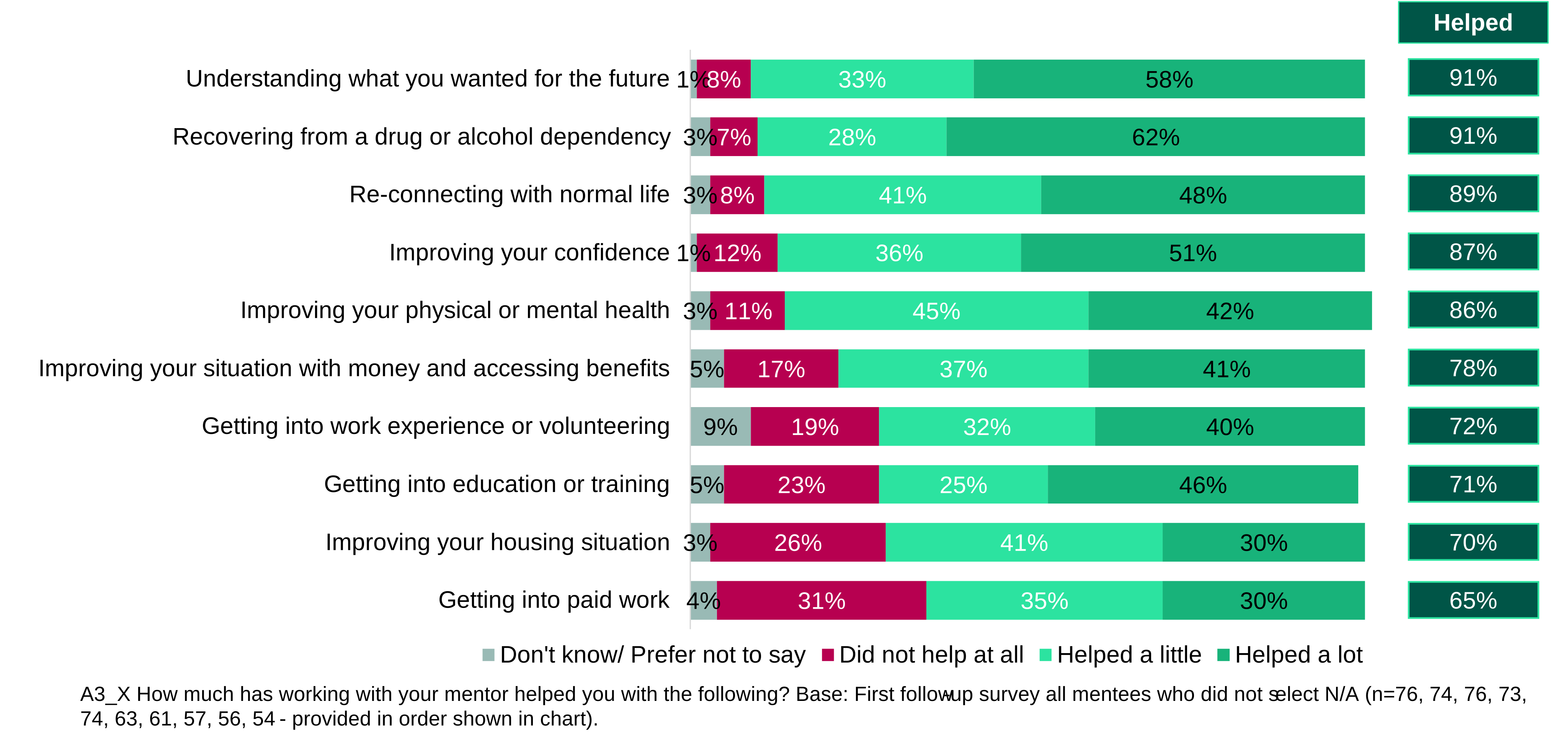
It was also common for mentees in the first follow-up survey to attribute positive outcomes to their work with their mentor specifically. The majority felt that working with their mentor had helped them in a variety of ways (Figure 2.1). For example, 9 in 10 mentees stated that working with a mentor had helped them to understand what they wanted for the future (91%), recover from drug or alcohol dependency (91%) and re-connect with normal life (89%), and nearly 9 in 10 felt that working with their mentor had helped to improve their confidence (87%) and their physical and mental health (86%). Again, findings should be treated as indicative.
Figure 2.1: How working with a mentor has helped mentees
There was also indicative evidence of outcomes for mentees, in terms of entering paid work, voluntary work or training or education. At the time of the first follow-up survey, one in 5 mentees (21%) reported they had entered paid work since working with a mentor and a similar proportion were either currently in paid work or were starting a job in the next month (18%). Just over one in 5 (23%) had entered unpaid work/ voluntary work or work experience since working with a mentor and one in 10 (11%) were doing this at the time of the first follow-up survey. Three in 10 mentees (29%) had entered training or education since working with a mentor and one in 10 (10%) were doing this at the time of the first follow-up survey.
The majority (7 in 10) of those who had done one of the above (i.e. entering paid work, voluntary work or training or education), felt working with their mentor had helped them find this opportunity (73%), prepare for it (75%) and keep going with the work, training or education (73%).
Mentees accessing appropriate support that meets their needs leads to relevant positive outcomes
As noted above, mentees interviewed qualitatively commonly reported that they had made progress in areas they needed support with, including reducing or stopping alcohol or drug use, mental or physical health, self-confidence, social connections, financial or housing situation, volunteering and job-search activities or motivation. When asked how they had made this progress, these outcomes were commonly attributed to their work with their mentor, and often this alone. Support and guidance around healthier habits (e.g. food and exercise), benefits, creating coping mechanisms and rituals to aid recovery (e.g. going for a walk, praying, re-starting hobbies or attending local activities/ groups) and emotional support all contributed to driving mentees towards positive change and progress. A few mentees, however, also mentioned receiving support from other services which equally contributed to their progress. They discussed support from local community groups, family and friends and their local GP.
For most of the mentees interviewed qualitatively, a mentor that understood their circumstances and was non-judgemental was regarded as crucial for mentees to achieve positive outcomes. Mentors interviewed agreed and felt the biggest contributor to positive change was their presence as a ‘safe space’, and a constant, trusted individual for them to turn to and rely on.
The first mentee follow-up survey, as well as establishing mentee progression, positive outcomes achieved by mentees, and mentees’ views about the extent to which their mentors helped them progress, also asks mentees whether other sources of support, outside of the Peer Mentoring programme, had helped them. While the findings of the first follow-up survey are indicative, these responses can be analysed to give some further evidence of the extent to which mentees had achieved positive outcomes that were likely only due to the support provided through the Peer Mentoring programme, or due only to outside support, or a combination of both.
In the first follow-up survey, just over a third of mentees (36%) had achieved positive outcomes which were likely due only to the support provided through the Peer Mentoring programme. Nearly two-thirds (60%) had achieved positive outcomes which were likely due to Peer Mentoring and other forms of support. Those that mentioned other types of support commonly mentioned substance misuse support (29%), support from friends and family (15%), counselling or therapy (12%) and support from third party organisations (9%).
This appears to corroborate the qualitative findings and suggests that nearly all of the progress made by mentees was due, in part, to the Peer Mentoring programme.
Chapter 3: Peer Mentoring implementation: Referral and onboarding
Introduction
This chapter describes mentee experiences of first being introduced to the Peer Mentoring programme, of deciding whether or not to take part, and of being referred to their mentor. It discusses mentor experiences of being recruited, onboarded, trained and supported to fulfil their role as mentors. Finally, it describes the experiences of DWP Single Points of Contact (SPOCs) and other stakeholders, including programme delivery providers, of being introduced to the programme, and their perspectives on mentee referral. Findings in this chapter are from qualitative interviews, unless otherwise stated.
Mentee introduction and referral process
Mentees were introduced to the programme through various sources, most commonly by Work Coaches, Disability Employment Advisors (DEAs), or Benefits Officers at Jobcentre Plus (JCP). Some also heard about it through GPs, social workers, social prescribers, or mentors present at support groups. A few mentees were introduced via drug and alcohol services they were already in contact with.
The programme was generally described to mentees as support for self-confidence, relationship-building, mental and physical health, plus return-to-work assistance, and support with general recovery. While some mentees received written information from their GP or Work Coach, many did not recall being given any. However, they generally felt well-informed enough to decide whether to participate. This aligns with mentee baseline survey findings, where 94% of mentees found the initial information they were given about the programme fairly or very useful.
Mentees chose to take part for various reasons, including improving confidence, and gaining employment. An important factor was feeling ready for this type of support.
According to tracker data, 59% of referrals came through JCP and 40% came from external agencies. According to the qualitative interviews with DWP SPOCs, delivery providers and referral stakeholders, referrals were most commonly made through Work Coaches and DEAs, specifically. However, they were also made through other organisations such as the delivery providers themselves, local drug and alcohol services, women’s centres, local churches, and Citizens Advice. Mentors also noted that referrals were sometimes generated through word-of-mouth.
Recalling the referral process was difficult for some mentees, but most remembered being contacted by phone or scheduled to meet a mentor at JCP by their Work Coach. A few mentees had their first meeting in a more informal setting, such as a coffee shop, which they found reassuring.
At the point of referral, mentees were often reluctant to disclose their dependency and were commonly concerned about the potential impact on their benefits of participating in the programme. Some Work Coaches or DEAs suspected individuals had dependency issues based on missed appointments, intoxication, or other signs, but mentees were often reluctant to disclose this information due to fears of sanctions. Mentors felt that once the programme was fully explained, however, mentees became more comfortable engaging, as they understood the programme was separate from benefits assessments.
I found a lot of people don’t want to say anything to their Work Coach because they feel their Work Coach can stop their money if they’re not looking for jobs.
(Mentor)
Mentors generally felt the referral process was working well as they had built strong relationships with Work Coaches, DEAs, and other local organisations. As discussed in Chapter 2, the close working relationships with Work Coaches and DEAs had enabled mentors to transfer knowledge to them, in turn helping Work Coaches and DEAs ensure the right people were referred onto the programme. For instance, one mentor said they informed Work Coaches at their JCP site that often people who struggle with substance dependency miss their appointments. They suggested that missed appointments might be a useful identifier of someone who might benefit from being told about the programme.
In some instances, this close working was as a result of mentors having a physical presence within the JCP site. Similarly, some DWP SPOCs reported that, because mentors were able to work closely with JCP staff, Work Coaches and DEAs developed a better understanding of the programme, which increased their confidence in their referrals and meant they referred the more suitable people to the programme.
I have a good relationship with our local Job Centre, so if they identify a [potential mentee], they will just direct them to me straight away, where I can have non-judgmental conversation with them [the mentee].
(Mentor)
A few mentors interviewed qualitatively said some Work Coaches and DEAs could have benefitted from more training on how to have conversations with mentees about substance dependency, and on how to introduce the programme to mentees. This could have helped Work Coaches and DEAs to not only reassure mentees about the risk of sanctions, but also improve the number and type of referrals received.
Mentees were in varied circumstances when they joined the programme. Some had complex needs requiring support with housing, benefits, and mental health, while others primarily sought support with dependency. They were also in varying stages of recovery, which influenced their readiness to engage. While mentors and mentees interviewed qualitatively generally felt referral had come at the right time, delivery providers reported that those mentees who seemed less ready to engage, were individuals with high levels of dependency who perhaps needed to be in structured treatment first.
They are not ready to make that commitment and to accept. Acceptance is a big thing … I have got a problem, but I am alright, that is not accepting … when you turn around and say I need help, that is when you are accepting … I had to hit rock bottom first.
(Mentor)
Overall then, mentees were introduced to the programme by a variety of individuals and commonly felt informed enough to make a decision on taking part. Initial hesitancy about disclosing dependency was overcome once the programme was explained.
Mentor recruitment, introductions, training, and ongoing support
Mentors learned about the programme through various channels, including word-of-mouth, previous colleagues, job advertisements, and services they had previously accessed as service users or volunteers. The recruitment process varied across different providers. Mentors from Change Grow Live were more likely to have learned about the programme through word-of-mouth, often from individuals they had encountered in services they had previously attended. In contrast, mentors from the Growth Company and The Wallich were more likely to have discovered the opportunity through job advertisements or volunteering connections. Inclusion mentors were most commonly introduced to the programme by former colleagues or services they had previously volunteered for.
Many mentors expressed excitement about the opportunity to use their lived experience to support others, with one mentor remarking,
I just thought, I can’t believe there’s actually a job out there, that’s for someone like me.
(Mentor)
The mentor onboarding process was generally well received, with mentors describing receiving training that was interactive and informative. However, some found it overly theoretical and suggested incorporating more practical, hands-on elements to better equip them for real-life mentoring situations. Programme delivery providers acknowledged some lessons learned from the onboarding phase, in particular the guidance and support required by new mentors. They emphasised the importance of allowing mentors time to adjust to their roles and build confidence, noting that many initially experienced ‘imposter syndrome’ before fully settling into their responsibilities.
Initial information and communications with SPOCs and stakeholders
DWP SPOCs and delivery providers reported positive experiences with the initial communication and information shared by the DWP at the beginning of the programme. Most SPOCs learned about the programme from their team/service heads or partnership managers, while programme delivery providers were introduced during the bidding process or through business development teams. Other stakeholders, such as those involved in the referral process, commonly heard about the programme through mentors. Initial communication with SPOCs was primarily via email, though some – particularly in the North-West – received full briefings from their team leaders.
A few also recalled receiving an information pack, though one SPOC mentioned finding the guidance subjective and would have preferred more discussions for clarification.
You can’t be prescriptive about these things and [I] felt like some conversations with JCP staff were needed to refine and understand the process a bit more clearly.
(SPOC)
Most stakeholders generally felt well-informed about the programme and their role, attributing this to previous experience with similar initiatives.
SPOCs, delivery providers and other stakeholders largely viewed the programme positively, recognising its role in bridging the gap between dependency recovery and employment by addressing important barriers such as housing, mental health, and healthcare access.
Really happy about the provision…the challenge is getting the support for that particular customer group. If you have someone with a living experience, then they are more likely to open up and have a better understanding of it.
(SPOC)
Most stakeholders had been involved since the pilot phase and found the introduction of the programme to be effective, with smooth communication and proactive support from the DWP. They also appreciated the visibility of the programme, with team leaders within JCPs actively promoting it and mentors engaging in group sessions, which enhanced the services available.
SPOC perceptions of Peer Mentoring and role within it
SPOCs generally viewed the programme positively and saw it as a valuable support mechanism for individuals with drug or alcohol dependencies, that had previously been missing. They believed that engaging mentors with lived experience was an innovative way to encourage mentees to open up about their challenges and engage with support services. Some SPOCs noted that relationships between JCP and drug and alcohol services had weakened during the COVID-19 pandemic, and they saw peer mentoring as an effective way to rebuild these connections. However, some SPOCs initially had reservations about the programme, particularly regarding being able to engage mentees effectively, though these concerns were largely resolved as the programme progressed.
A few expressed hesitancy due to previous negative experiences with new pilots, though they acknowledged the programme’s benefits once it was implemented. Most SPOCs described their role as supportive rather than hands-on, focusing on arranging initial meetings between mentors and mentees, providing logistical support, conducting eligibility checks, and acting as a point of contact between Work Coaches, mentors, and delivery providers.
The extent of SPOC involvement varied across JCP sites, with some taking an active role in promoting the programme and screening potential mentees, while others focused on supporting mentors and ensuring they had access to appropriate resources. Many engaged in district-level meetings and events such as job fairs to further raise awareness of the programme.
I work more in the capacity of colleague support than anything…Tend to liaise with mentors mostly and receive feedback periodically to ensure smooth running. While I’m available for conversations and support, I would broadly define my role as more supportive than anything.
(SPOC)
Regular communication with mentors was a key part of the SPOC role, primarily to coordinate mentor diaries and new mentee referrals, while some also provided mentors with practical support such as desk space and communication tools.
Overall, SPOCs felt they played an important role in facilitating the smooth operation of the programme, ensuring that mentors had the necessary resources, and maintaining strong relationships with stakeholders to maximise the programme’s impact.
What we do is we promote [the programme], we screen, we support and we have those appropriate conversations, so we do filter out those that are not appropriate for the programme. We also check for commitment to the programme and we also check for understanding and consent to refer to the programme.
(SPOC)
SPOC and stakeholder experiences of referral processes
SPOCs identified 2 common ways mentees were referred onto the programme. Many individuals were identified through the disclosure section for drug and alcohol abuse in the Universal Credit (UC) form, a method particularly common for the Growth Company. Others were referred following disclosures made during meetings with Work Coaches, and this was the more common route for other delivery providers. Once identified, SPOCs reported that individuals were introduced to the programme through various channels, including ‘Meet a Disability Employment Advisor’ sessions, UC journal messages, and direct referrals from Work Coaches. Some SPOCs suggested that strengthening links between JCP, GPs, and social prescribing link workers could improve outreach and ensure that the right individuals were being referred.
Although referral processes varied slightly across delivery providers, as discussed in Chapter 2, SPOCs and delivery providers felt these processes were generally effective. Some processes involved filling out a form that was emailed directly to a mentor, while others required Work Coaches to assess potential mentees before booking them into mentors’ diaries.
Dead easy. Work Coaches identify somebody and [the mentor] will come over and have a quick chat and they might say they want to be referred so they will go and sit [with the mentor] or the Work Coaches might take a piece of paper or a sticky over to [the mentor] and say here are the details can I refer it over, and she then does it all. It has been easy.
(SPOC)
Referral stakeholders appreciated the simplicity of the process, describing it as quick and straightforward. There was no formal pairing or matching process for mentors and mentees, and referrals were generally made to an available mentor.
However, delivery providers and referral stakeholders emphasised the importance of equipping mentors, Work Coaches, and DEAs with the skills needed to navigate difficult conversations about substance dependency. One delivery provider addressed this by conducting one-on-one sessions with Work Coaches to build their confidence in discussing these topics.
In the qualitative interviews, SPOCs and delivery providers reported that, initially, there had been some challenges with the referral process, including mentees being referred without proper screening. However, mentors acknowledged that initial difficulties stemmed from the programme being new and that some upskilling was needed to help JCP staff understand the programme’s purpose and ensure appropriate referrals. Mentors worked closely with Work Coaches and DEAs to clarify the programme’s target audience and refine the referral criteria.
The mentors give the Work Coaches the help that they need in addressing those barriers, so it is an ongoing (sharing) process.
(SPOC)
Building strong relationships with JCP staff took time, but mentors felt that these connections had significantly improved, leading to a more effective referral process.
Chapter 4: Peer Mentoring implementation: Engagement with and experience of the programme
Introduction
This chapter describes mentee engagement with the programme, including:
- volumes of those referred, starting and completing
- numbers of sessions attended and duration of time on the programme.
It describes mentees’ initial aspirations when taking part in the programme, as well as mentee and mentor reflections on mentee activities and support, including the use of SMART actions. The chapter then covers mentee reflections on working with a mentor, mentor relationships with third parties and aspects of programme delivery that are working well and not so well.
Volumes of individuals referred, starting the programme and completing
A total of 2,994 individuals have been referred to the programme to date (Table 4.1). Just under 6 in 10 (58%) of those that were referred, started the programme. A fifth of all those referred (19%) completed the programme. A breakdown of mentee volumes by provider, is included in Annex B, as context.
Table 4.1: Volumes of individuals referred, starting the programme, still engaged, disengaged and completed
| – | All referrals to date from latest MI (December 2024) | Total number of mentees on the programme since inception from tracker data (i.e. all programme ‘starts’) | Number of mentees currently active from tracker data | Number of mentees no longer engaged with the programme from tracker data | Number of mentees who have completed the programme from tracker data |
|---|---|---|---|---|---|
| Total individuals | 2994 | 1,735 | 453 | 719 | 563 |
| % of all referrals | 100% | 58% | 15% | 24% | 19% |
| % of all starts | - | 100% | 26% | 41% | 32% |
Based on Management Information (MI) and mentee tracker data up to December 2024
Mentees’ initial aspirations
In the baseline survey, mentees were asked what they were initially hoping to get out of working with their mentor. Responses were given in a free text box, to capture mentees’ aspirations in their own words. Finding a job, support with dependency and finding a sense of structure or stability were most commonly mentioned as initial aspirations for the programme (Figure 4.1).
Figure 4.1: Top 10 initial aspirations from mentees
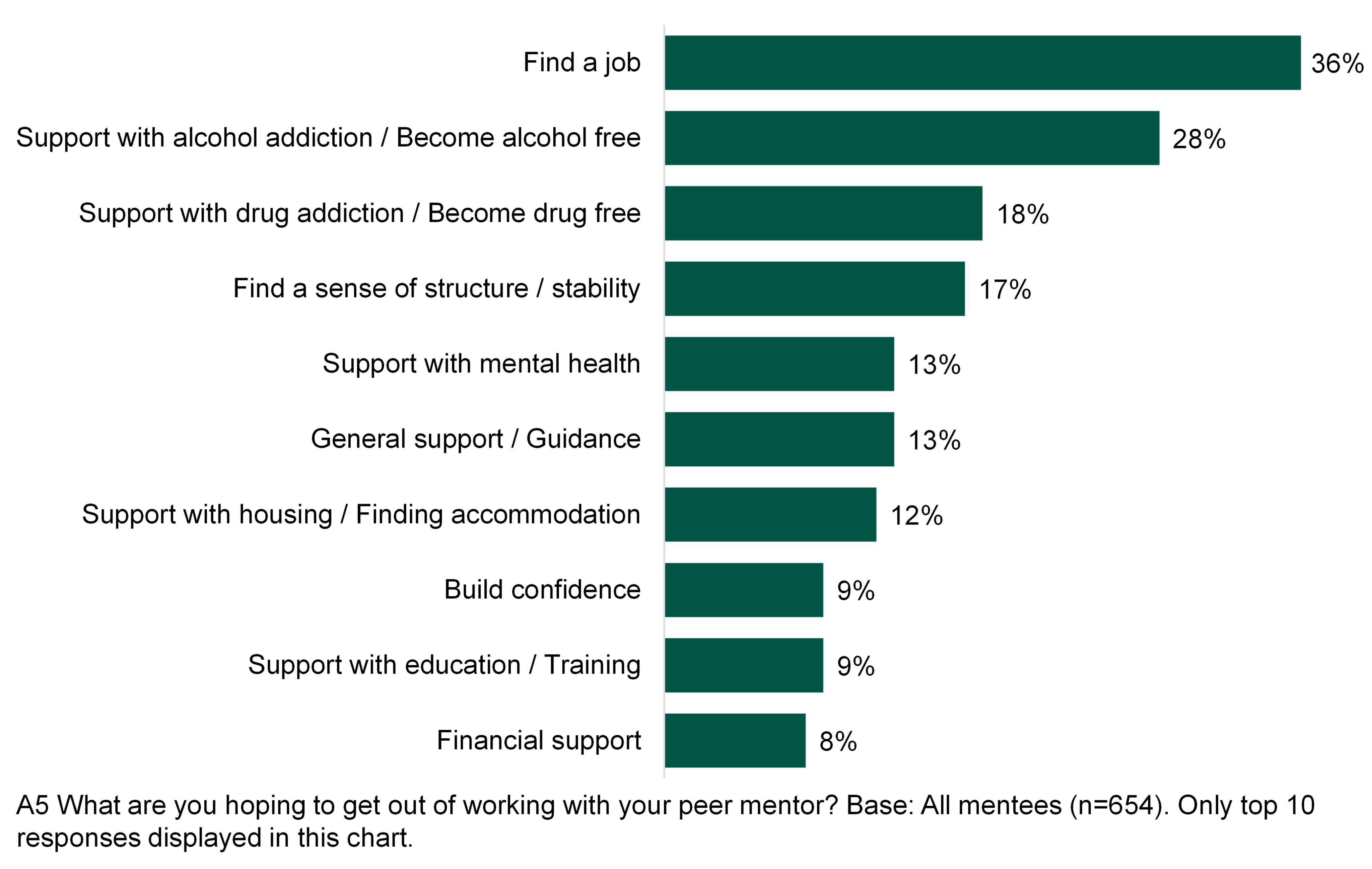
There were some notable differences by gender and ethnicity:
-
males more commonly wanted support with housing or to find accommodation (14% of males compared to 7% females), while females more commonly wanted to build confidence (15% of females compared to 7% of males) and find volunteering opportunities (10% of females compared to 5% of males)
-
those from an ethnic minority background were more likely to report wanting general support (18% compared with 11% of those from a white background) and financial support (14% compared with 7% of those from a white background)
Some mentee responses to this question in the baseline survey are included to illustrate mentees’ specific aspirations:
Probably get a job before the end of the year, try to move on from my current accommodation, and control my drinking.
(Mentee, aged 35-44, Male, Alcohol dependency)
Reduce alcohol, become abstinent in the future, I know this is going to be a long process. Gain tools and life skills to remain abstinent. Build self-confidence and get back into part or full-time work.
(Mentee, aged 35-44, Female, Alcohol dependency)
I am hoping that I can start applying myself in a more positive way, through the help of my mentor that of lowering my drug and alcohol usage. I am also hoping to get a better understanding of the benefits that I may not be getting that I am entitled to.
(Mentee, aged 25-34, Male, Alcohol dependency)
I use cocaine to cope with my mental health and although I’ve cut down a lot I’d really like to stop. I am also struggling financially so I need to return to work as the benefits I am receiving just isn’t enough. I find that because I am a prison leaver it makes returning to work difficult.
(Mentee, aged 45-54, Male, Opioid dependency)
Mentee engagement with the programme
According to the tracker data, by December 2024, two-fifths of mentees who started on the Peer Mentoring programme were no longer engaged with the programme (41%), one-third (32%) had completed and around one-quarter (26%) of mentees were still engaged.
Those who’d completed, had most commonly done so within 7 sessions (49%), and were most commonly on the programme for 3 to 4 months (45%).
Those still engaged had most commonly been with the programme for 1 to 2 months so far (38%), although this varied considerably, with a substantial minority of those still engaged with the programme as at December 2024, having been on the programme for 11 months or more (11%). Further detail on number of sessions attended and length of time spent on the programme, is given in Annex C.
Mentee activities and support
Use of SMART action setting
Mentees’ reflections on SMART action setting
As discussed in Chapter 2, mentees interviewed qualitatively generally felt the SMART actions set were appropriate because they had agreed on them with their mentor, through discussion. As a result, SMART actions felt manageable and realistic and most mentees did not struggle with any specific SMART actions.
I didn’t feel anxious about doing them or too unmanageable – just the right pace for me.
(Mentee, aged 55-64, Male, Alcohol dependency)
Mentees who did struggle with some of their SMART actions, usually found SMART actions that involved reducing their alcohol or drug consumption hard. Progress with SMART actions also varied, depending on perceived urgency.
Depended how important they were to my life at the time. If it was [the] Doctor’s and that, it would be very important, but if it was maybe calling about council tax I might leave it out, it could wait for another day.
(Mentee, aged 45-54, Female, Opioid dependency)
In some instances, completing an action led mentees to access support from other services. This included support to reduce drug or alcohol consumption, to obtain food bank vouchers, with writing a CV and applying for jobs through Individual Placement Support, and via bereavement counselling. Mentors also offered support that would encourage mentees to reconnect with other people and find new hobbies. One mentee said their mentor suggested for them to visit the cinema, whilst another said their mentor suggested a mental health service to improve their confidence when meeting other people. In some instances, however, it was more challenging for mentees to complete these kinds of actions, due to delays experienced from other support services. Overall, all mentees felt positively about the help and support offered to them because they felt it met their needs.
Mentors’ reflections on SMART action setting
Mentors interviewed qualitatively said that they worked with their mentees to set actions, often setting the action at the end of an appointment and basing it on what had been discussed. In the qualitative interviews, mentors said they were clear about how to set SMART actions and no mentors mentioned any issues with setting SMART actions. As discussed in Chapter 2, mentors reported finding their training in SMART action setting useful and noted that learning from other mentors, through shadowing or being able to access and review other mentors’ work, was a useful aid in ensuring that they set SMART actions that were realistic and would make a difference to the individual mentee, rather than setting big, unachievable actions which would lead to the mentee feeling overwhelmed.
A few mentors mentioned that some mentees felt pressured to complete actions. To try to reduce this feeling of pressure, a few mentors said they did not use the term ‘SMART actions’ and instead referred to the actions as ‘goals’.
A few mentors noted that SMART actions had a positive impact on the development of their mentees, as being accountable in turn led to increased mentee confidence.
Really, really appropriate in terms of being clear and focussed, but also prioritising, perhaps for the first time, and really being held to account.
(Mentor)
Mentors felt that their mentees were better able to work with simple actions which involved changing their routine (such as going for a walk) or actions that didn’t have a stigma attached to them such as booking a GP appointment. The actions that mentees struggled with more often involved third parties, such as housing, where there was less control over the outcome, or actions relating to areas in which mentees had less experience or confidence, such employment. A few mentioned actions relating to the mentee’s dependency as being more challenging, as either mentees were not open about the severity of their dependency or were not ready to stop using drugs or drinking alcohol.
A couple of mentors mentioned the timescale of the programme made it more challenging when working with actions as there was limited time to review and refine approaches to action setting. Some said that it took a few sessions to understand the mentee, their needs and the support they required and therefore it was harder to set relevant SMART actions at the first few sessions. One mentioned that the actions during the first week were just to attend the next session.
Qualitative analysis of the content and quality of a sample of SMART action plans
The 4 Peer Mentoring providers shared a randomly selected SMART action plan for each mentor, every quarter. A qualitative thematic analysis was then conducted on the plans, to identify recurring themes emerging from the sample of plans. The numbers of plans have been used throughout this section to provide a sense of the proportions of plans which contained certain types of actions and of whether the actions within the plans were ‘specific’, ‘measurable’ and ‘timebound’. The figures outlined in this section should be treated with caution, as the analysis that has been conducted is qualitative in nature.
When looking across all of the 127 plans received, approximately 592 actions[footnote 3] were contained within the plans. The plans commonly contained actions around drug and alcohol use (61 plans), mental health and wellbeing (52 plans), employment (50 plans), physical health and fitness (46 plans) and money and finance (43 plans).
When thematic analysis of the plans also included an assessment of whether the SMART actions within the 127 plans were specific, measurable and timebound. As noted in Chapter 2, most of the plans had specific actions (91%) and the majority of the plans had measurable (88%) and timebound actions (74%).
All themes can be seen in Figure 4.2.
Figure 4.2: SMART action plan themes and whether actions are specific, measurable and timebound.
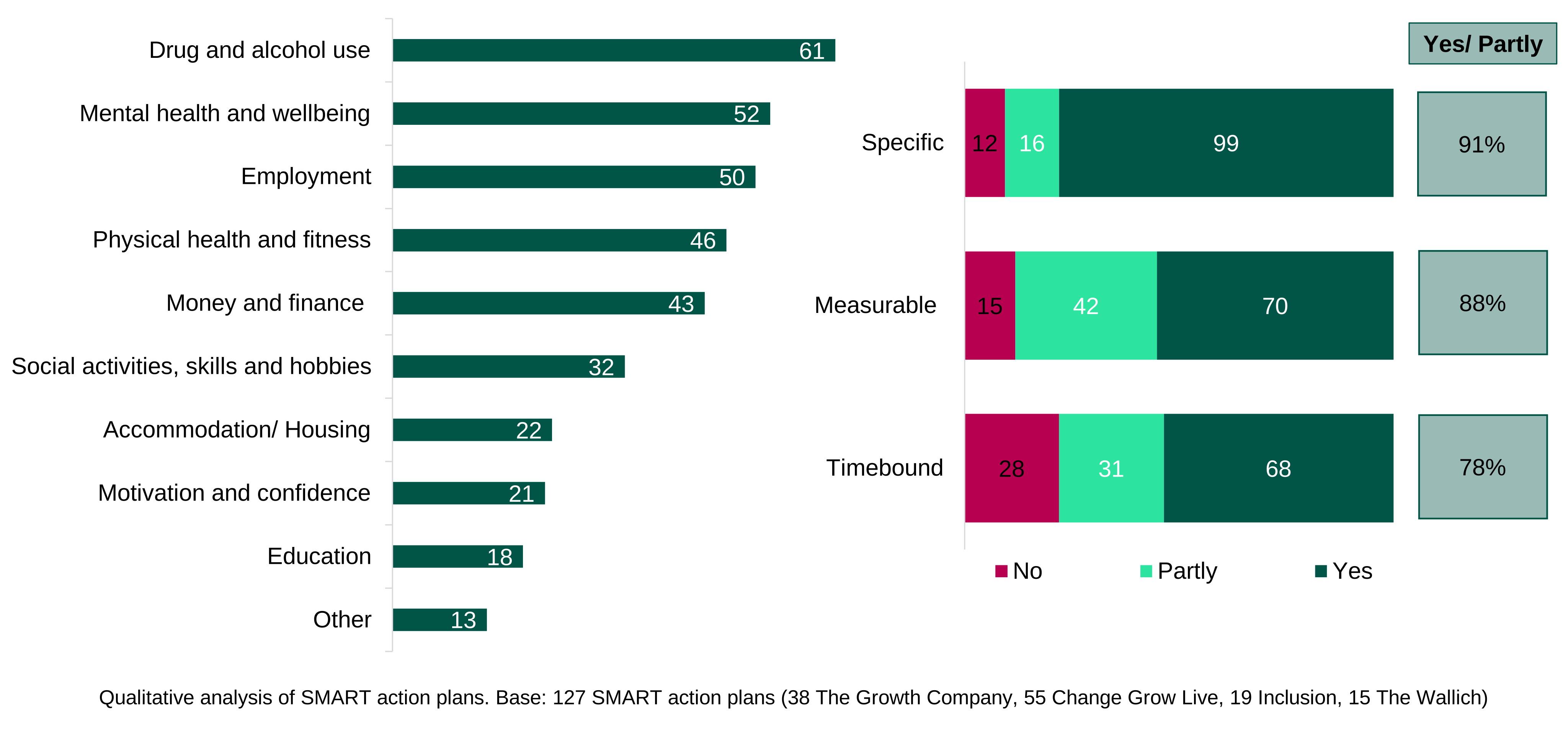
Dependency-based actions most commonly related to engaging with a support service either through attending assessment appointments, attending group sessions or speaking with a keyworker.
Mental health and wellbeing actions tended to also focus on engagement with support services and GPs. However, other actions related to creating daily coping mechanisms, such as calling someone, going for a walk or listening to music.
Employment actions commonly included searches for voluntary work, engagement with employment support agencies, searching and applying for paid work opportunities and updating CVs.
Physical health and fitness actions were mainly related to committing to weekly exercise and registering with a gym.
Money and finance actions were commonly focused on engaging with DWP about benefits such as Universal Credit, Personal Independence Payment, Employment and Support Allowance or Carer’s Allowance, attending appointments such as a benefits review, budgeting session or a discussion on their financial situation.
Mentor approaches to encouraging mentees to access support
In the qualitative interviews, mentors reported various approaches to encouraging mentees to access support. Some said they dealt with substance dependency at the start whilst others dealt with other aspects – such as helping with benefit claims, sourcing basic amenities like food, finding suitable housing and assisting with financial difficulties – before focusing on dependency. A few commented that initially concentrating on issues other than substance dependency, helped mentees to resolve immediate issues, which then gave them more space to concentrate on their substance dependency.
They get referred, they get supported, they see an actual change…A combination of having a solid place to live, sorting out their finances and everything like that takes away a lot of the worries, and then they can concentrate on what they need to get done in terms of their usage and health.
(Mentor)
Many of the mentors viewed themselves as an introductory or referral service for mentees and felt their role was to encourage mentees to engage with other support. The way in which mentors were involved in doing this varied. Some just signposted mentees to support, others made direct referrals and, in some cases, mentors attended appointments with mentees, particularly GP appointments and first sessions for treatment or support groups. A few mentors mentioned that getting mentees to take some ownership of accessing and contacting support, helped build the mentee’s confidence. Generally, at the start of their engagement with the programme, mentees were unaware either of what support was available to them or of how to go about accessing it.
Signposting absolutely, because they might have known that an organisation was there, but they wouldn’t have known how to get into that organisation, or how to get a referral.
(Mentor)
Some mentors noted that, in the early sessions, mentees held negative views on the support they could access but, as the mentees progressed and the relationship with their mentor developed, they became more open to accessing support.
I think once we start helping them move forward with…areas of their life, they’re more likely to…accept support from other services and work with a range of services, rather than just getting that support from us.
(Mentor)
Location of activities with mentee and impact of this
In the qualitative interviews, mentees reported that having sessions in a private room at the JCP or delivery provider allowed them to open up without feeling judged or listened in on.
I felt in a safe space with that person and felt I could talk about things that troubled me without being judged. It was a really safe space and took place at the CGL [Change Grow Live] premises, which I am familiar with.
(Mentee, aged 55-64, Male, Non-opioid dependency)
While the findings of the first follow-up survey are indicative, this appears to corroborate the qualitative findings, as the majority agreed that the support received through their mentor was in a location they felt comfortable talking in (94%), and that they could travel to (93%).
There was, however, one mentee interviewed qualitatively that felt uncomfortable sharing experiences with their mentor, as their sessions were not in a private location. They reported that it “made me feel uncomfortable”, as they felt that they could be overheard.
Mentee reflections on working with a mentor
Overall reflections
In the qualitative interviews with mentees, most said they found the experience of working with a mentor a positive one. As discussed in relation to the contribution analysis in Chapter 2, many mentees said the regular one-to-one sessions allowed them to build trust with their mentor, which, together with their mentor’s non-judgmental attitude, created a safe space for mentees to comfortably disclose information. Mentees’ regular sessions with their mentor generally took place in person, although on occasion they would talk to their mentor over the phone. Whilst these discussions were informal, mentees said the sessions had a clear focus, which helped ensure that their discussions dealt with barriers and support needs.
Mentees interviewed qualitatively felt there was nothing their mentors struggled with. Elements that mentees felt their mentors handled particularly well were:
-
referring mentees to other services e.g. art therapy, creative writing, mental health services e.g. MIND and Talking Therapies
-
listening to the mentee
-
searching for jobs on the mentee’s behalf
-
showing a genuine interest in the mentee
-
helping the mentee achieve their goals by either providing them with support or signposting them to it e.g. debt management, finding employment, CV writing support, pension support
Mentee reflections on sustaining their working relationship with their mentor
Mentees interviewed qualitatively found it easy to keep working with their mentor because they had made progress in areas they needed support with. This included support that improved their living situation, finding job opportunities, and sending their CV to potential employers. Mentees said seeing this progress helped them to continue to feel motivated. Other reasons mentees found it was easy to continue to work with their mentor were more practical. This included the flexibility in the appointments, which mentees noted could be scheduled around their needs, and meeting in a location that was convenient to them, e.g. a local café.
Mentor relationships with third parties
Mentors had connections with other third-party support organisations such as local drug and alcohol services, women’s support centres and mental health and wellbeing services. Often, mentors used these connections and signposted mentees in need of support directly to them. For instance:
-
one mentor said they had a good working relationship with Cocaine Anonymous (CA), who they had signposted mentees to for support. Mentees who were signposted to CA, received support with issues including housing, debt management, and how to handle bailiffs
-
another mentor said they had connections with an organisation that supported men’s mental health, which they had signposted mentees to, as well as specialist drug and alcohol support. This mentor found the connections they had made were valuable, as they improved the quality of the mentee’s experience, through signposting to more specialised support
Aspects of delivery working well
This section summarises the aspects of delivery that were working well and less well. To give a complete picture, this involves mentioning elements of programme delivery previously highlighted as being effective, in the contribution analysis in Chapter 2.
The lived experience of mentors
In the qualitative interviews, the importance of a mentor with lived experience was highlighted by mentees, mentors, delivery partners and other stakeholders as an important part of delivery. As previously mentioned, mentees felt their mentors understood their experiences and were non-judgmental. Mentors felt their own lived experience was an important ingredient in being able to do this. This allowed mentees to be open about their substance dependency and the areas they needed support with. Some mentors said they also leveraged their lived experience to serve as role models, which illustrated to mentees the potential paths they could follow.
They’ve got an understanding…they’ve experienced what I’ve experienced, the vomiting, the not washing, the not eating, the isolation that you put yourself through and facing your past, really, because everybody’s got a past.
(Mentee, aged 65 and over, Female, Drug and alcohol dependency)
We can speak to them on a level without any judgement. They can confide in us. We don’t want to wag our fingers. We understand how difficult it is.
(Mentor)
If a peer mentor has been there and done it, you know the mentee can then … feel safe, that they can…have this conversation with someone, because they may not have [spoken about it] before.
(Delivery provider)
While the findings of the first follow-up survey are indicative, these echo the qualitative findings, as 40% of mentees said the best thing about working with their mentor was that their mentor was kind or empathetic and 19% said their mentor’s lived experience helped them to relate.
Training and support offered to mentors
Mentors commended the training that was offered to them. This included intensive training that was completed before they started their mentor role, as well as regular training and support on the job. Mentors said the training was a rewarding and insightful experience that allowed them to feel well-prepared to take on their role. Some of the training that mentors found particularly useful was:
-
what to expect when working as a mentor with a caseload
-
how to actively listen to mentees
-
how to best understand mentees’ needs
-
safeguarding practices
-
mental health and suicide awareness
-
the consequences of drug and alcohol use
-
trauma informed practices, including the power of trauma and different types of trauma
Some mentors also said they had regular face-to-face meetings with their line manager which were particularly useful when it came to asking ad-hoc questions about their role.
It’s helped me to develop how I work with my mentees. I had some experience from my own personal life of one type of recovery, but I’ve learnt about other types of recovery. That’s given me resources to put forward to other people.
(Mentor)
There was real support, there was…constant check-ins, and awareness of the fact that I’m seeing vulnerable people and complex clients.
(Mentor)
The usefulness of diagnostic interviews
Mentors and delivery providers interviewed qualitatively found diagnostic interviews an invaluable starting point. For mentors, these allowed them to begin to develop a deep understanding of a mentee, which allowed mentors to develop an initial plan. For delivery providers, they allowed for a baseline measure to be set so progress could be tracked over time.
I think [the initial interviews] are quite crucial actually because as soon as we have that information, we have it in our head where we need to maybe signpost them.
(Mentor)
These [the diagnostic interviews] have been a useful way for mentees to collate their thoughts and feelings and it’s a good way to set a baseline for the mentees to track progress.
(Delivery provider)
The JCP staff referral approach
Mentors and SPOCs both noted JCP staff became more confident over time when it came to referring mentees onto the programme, largely because they had accumulated experience, which had allowed them to better understand what a suitable referral looked like. SPOCs felt that the programme had helped Work Coaches and DEAs to feel more confident and knowledgeable in identifying individuals with dependency issues and in supporting them effectively. SPOCs also felt that close working relationships between the Work Coaches, DEAs and mentors, had supported this.
Overall, the referral process has been positive, easy to do, very straightforward. The peer mentor has always been available for informal chats and advice.
(SPOC)
It’s a quite a big thing to be able to sit in front of someone and have that conversation, but as the time’s gone on through the programme… [JCP staff] have gained experience and I think they feel far more comfortable now.
(SPOC)
Flexibility of mentee and mentor meetings
Some mentees said they appreciated the flexibility their mentor offered, in accommodating their needs and scheduling meetings so that these worked around their other commitments. Some mentees said the location of their meetings with their mentor changed based on their needs and sometimes they would meet with their mentor at a local café instead of at the JCP site. This flexibility allowed mentees to remain engaged with the programme. Delivery providers also noted the flexibility mentors offered, specifically in terms of the length of the sessions. One mentioned that they knew some mentors offered additional sessions to mentees who felt they needed it, which mentees found helpful.
Sometimes they work on Monday evening or Tuesday morning, and every week it changed when I could do it, and she could do it. We always made an arrangement.
(Mentee, aged 55-64, Male, Alcohol dependency)
People wish to work longer but I know that they [mentors] are very flexible, and they’re able to offer additional sessions. So if I was to highlight one thing, it’s probably around the number of session’s being offered…there’s been so many situations where I know they’ve offered additional sessions, or they will work with someone until something is resolved.
(Delivery provider)
While the findings of the first follow-up survey are indicative, these echo the qualitative findings, with the majority of mentees in the follow-up survey agreeing that the support received through their mentor was in a location they felt comfortable talking in (94%), and that they could travel to (93%), and that the support fitted in around other drug and alcohol support they may be receiving (80%) and other important commitments (79%). Amongst mentees with caring responsibilities, 83% said the support fitted in around these responsibilities.
Aspects of delivery working less well
Staff absenteeism and staff continuity
SPOCs and delivery providers both mentioned there had been some instances where mentors had been unable to deliver the programme as planned because of personal circumstances, e.g. sick leave due to a long-term health condition. One stakeholder said it was important mentors had the right support in place such as counselling and regular check-ins with their managers, so any areas mentors struggle with could be identified. Some delivery providers reported that mentor turnover was high, which often impacted programme delivery, as it meant that some JCP sites had a limited number of mentors.
Physical space in the JCP site
Some SPOCs said the limited amount of physical space in their JCP site was an issue, particularly when mentors had meetings with mentees. SPOCs said these meetings often lacked privacy due to the small number of private spaces available. SPOCs also noted that the lack of private spaces meant they were concerned about data protection, due to mentees disclosing personal information to their mentor in spaces where they might be overheard.
The main thing that holds us back on anything, is data protection.
(SPOC)
JCP staff caseloads
Some delivery providers said Work Coaches and DEAs had high caseloads and targets they needed to achieve. This sometimes meant the programme was not ‘top of mind’ for Work Coaches and DEAs when they spoke to potential mentees, which reduced the number of potential referrals.
I think going forward, I’m not saying it needs to be targeted, but I think it should be a priority.
(Delivery provider)
It has to be spoke about every day, as it gets forgotten about, because it’s not a targeted program for them.
(Delivery provider)
Length of the programme
Mentees, mentors and stakeholders all felt the programme was short, which often meant mentees did not have enough time to make the changes they needed to make in order to progress towards their goals. Some mentors also said the wait times for mentees to access external services, e.g. mental health providers or employment services, was too long and this too often hindered mentee’s progress in the time available. This meant that, by the end of the programme, some mentees had not achieved some of their SMART actions because they were still waiting to be seen by external services. Delivery providers felt that 8 sessions (the suggested length of engagement between mentee and mentor) was not enough for mentees to make progress. They believed a more flexible approach would be more appropriate and that mentees would benefit from aftercare.
I think it is very short. I think, especially when you’re working with people with multiple barriers, that the programme is targeted to 8 sessions. You could be literally just getting to know someone and getting their barriers down.
(Delivery provider)
Most [mentees] will open up, …but deep trauma can take 3-4 sessions.
(Mentor)
Chapter 5: Wider impacts of Peer Mentoring
Introduction
This chapter explores whether the peer mentoring programme has had any wider impacts on mentors, and on staff at Jobcentre Plus (JCP). The findings in this chapter were drawn from the qualitative interviews.
Impacts on mentors
Overall, mentors were positive about their role and found it rewarding. They described seeing the changes in mentees as the best part of the role and many mentioned gaining job satisfaction from this.
Amazing… this is a heartfelt job where you’re actually really seeing somebody’s life change.
(Mentor)
Many mentors felt the role had helped them develop a range of skills. Mentors noted their approach to peer mentoring had evolved over time as they learnt how to fulfil the role, while many felt they were also constantly learning and evolving to cater for the varied needs of their mentees. Specific skills that mentors reported having developed, included setting SMART actions, being able to better identify mentees who were engaged and motivated at referral, as well as general transferable skills such as listening and communication.
I’m changing all the time, as I learn and talk to people.
(Mentor)
Reflecting on their time in the role, many mentors felt the biggest change they had noticed overall, was an increased confidence in their ability to do the role. This was a result of learning the role whilst on the job and also building knowledge of, and relationships with, the organisations offering support, so that they could signpost mentees appropriately.
It’s a new-found confidence, knowing my craft and knowing the people, so I can safely point them [the mentee] in the right direction.
(Mentor)
Some mentors also commented that their role as a mentor had helped support them with their own recovery journey, both in terms of being able to talk openly about and reflect on their own experiences of substance dependency and in being responsible for helping other people on their recovery journey.
It is all about, you know, that giving back, supporting somebody, helping somebody in the situation that I was in, so yeah. I find it very valuable… it keeps me sober.
(Mentor)
The increase in the confidence of mentors and impact on the mentor’s own recovery journey was confirmed during one of the delivery partner interviews:
I think they’ve [mentors] been able to see how far they’ve sort of come from their recovery journey, to actually them supporting [mentees] onto their recovery journey. It’s been really nice to see them growing in confidence, feeling like, they’re part of something that’s important and also getting a better understanding as to how systems work.
(Delivery partner)
Some mentors commented that the mentor role can be challenging, but saw this as a positive aspect of the job. A couple of mentors commented the role had triggered personal issues but still viewed the role positively overall.
I didn’t think certain things would affect me, and they do, and it’s made me realise that I’m not as tough as I thought I was. I’ve still got things that I have to deal with, and it [being a mentor] brings it out.
(Mentor)
Many mentors commented that ongoing training was an important part of the role to ensure they continued to develop their peer mentoring skills. One mentor, as a result of their role, had enrolled on a counselling course which they felt would complement the skills they have developed whilst working as a peer mentor.
Impacts on Jobcentre Plus Work Coaches and other Jobcentre Plus staff
Overall, the Single Points of Contact (SPOCs) working with mentors at JCP offices were positive about the peer mentoring programme and the impact it has had on JCP staff.
All SPOCs reported that JCP staff and mentors had worked together collaboratively. As discussed in Chapter 2, this had enabled mentors to share knowledge with JCP staff, such as Work Coaches and Disability Employment Advisors (DEAs). SPOCs, some of whom were Work Coaches or DEAs themselves, felt that the support given by peer mentors had helped JCP staff feel more confident, in encouraging disclosure of substance dependency issues, in promoting and discussing the Peer Mentoring programme, and in making referrals to the programme.
It’s a difficult subject and difficult to approach, but the with help of the peer mentor, this has improved over time.
(Work Coach)
One SPOC mentioned that their team had arranged a series of formal training sessions led by peer mentors, which covered topics such as encouraging disclosure and addressing the barriers mentees face with employment. Another SPOC mentioned training provided by the delivery provider which had led to an increase in staff confidence in encouraging disclosure.
The mentors give the Work Coaches the help that they need in addressing those barriers, so it is an ongoing sharing process.
(SPOC)
A few SPOCs highlighted the value of meetings in which Work Coaches, DEAs and mentors which helped Work Coaches gain a better understanding of the mentee customer group and the challenges and barriers they may experience. These meetings had improved JCP staff’s understanding of the mentee population and their specific needs, which in turn has improved the ability of JCP staff to make effective referrals to the programme.
Many SPOCs felt that the presence of a mentor in the JPC office made it easier for JCP staff to address substance dependency issues, both because the mentor’s presence encouraged knowledge sharing, and because simply having someone knowledgeable and approachable who was on-hand, had increased staff confidence in engaging with substance dependency as an issue. Staff would often liaise with the mentor if they suspected a client had substance use issues and would either ask the mentor for advice and support or ask them to speak directly to the client. SPOCs noted that staff who were less comfortable addressing substance dependency tended to rely more on peer mentors for direct support, in terms of the mentor having these conversations with clients on their behalf.
Chapter 6: Lessons learned from Peer Mentoring implementation
Introduction
This chapter summarises the lessons learned from the implementation of the Peer Mentoring programme. It encompasses both lessons learned for potential wider roll-out of Peer Mentoring and for future work with individuals with substance dependency. To give a complete picture, this involves mentioning elements of programme delivery discussed in previous chapters.
Lessons learned for potential wider roll-out of the Peer Mentoring programme
The following lessons were identified for the potential wider roll-out of the Peer Mentoring programme:
-
mentors built in an additional introductory informal conversation before the diagnostic interview to help build rapport with their mentees, introduce the programme and alleviate any concerns around potential benefit implications for taking part or not. Mentors felt this was a crucial step in helping to reassure and engage mentees before they conducted the in-depth and sometimes emotive diagnostic interview
-
mentors discussed how practical support and learning from other more experienced peer mentors was crucial in helping them to set appropriately tailored SMART actions
-
mentors and DWP SPOCs noted that mentors working closely with Work Coaches and DEAs helped Work Coaches and DEAs to identify individuals for whom the programme might be relevant, have open discussions with potential mentees and encourage substance dependency disclosure. This in turn helped to ensure the smooth running of the referrals process, as Work Coaches and DEAs felt confident in their ability to identify potential mentees
-
programme delivery providers acknowledged the importance of guidance and support for new mentors. They emphasised the importance of allowing mentors time to adjust to their roles and build confidence, noting that many initially experienced ‘imposter syndrome’ before fully settling into their roles
-
SPOCs suggested there was limited physical space in JCP sites for mentors to have private and personal conversations with mentees. Ensuring there is enough private space in JCP sites to hold sessions with mentees will help to ensure mentees feel comfortable having open and honest conversations with their mentor
Lessons learned for future work with individuals with substance dependency
The following lessons were learned for future work with individuals with substance dependency:
-
upskilling Work Coaches through training and on the job support from individuals with lived experience of substance dependency, will help support Work Coaches to identify individuals who may have substance dependency issues, have open discussions and encourage substance dependency disclosure
-
co-location of these individuals with lived experience, alongside Work Coaches and DEAs on JCP premises, is likely to support knowledge sharing
-
it’s important to be clear to individuals with substance dependency that taking part in any initiatives to support their recovery will not impact their benefit entitlements in any way (if this is the case)
-
individuals with lived experience can effectively engage other individuals with substance dependency issues, with the lived experience both helping in adopting an empathetic and non-judgmental attitude, and demonstrating that positive progression is possible. An empathetic and non-judgmental attitude can in turn successfully encourage individuals with substance dependency issues to be more open about their barriers and support needs, creating opportunities to offer more relevant support to these individuals. This relevant support, when combined with ‘supportively holding the individual to account’, can lead to individuals with substance dependency achieving positive outcomes
-
given that not all mentees on the programme were fully aware of their mentors’ lived experience, it may be worth exploring whether mentors can more consistently share their lived experience with mentees, in future work of this type, if mentors are comfortable doing so
-
whilst none of the reasons given for disengagement suggested any notable problems with the programme delivery approach, the following suggestions were made that could aid retention:
- more information on what the remaining sessions would achieve
- the mentor tailoring the sessions by asking the mentee what they would have liked to get out of them
- different locations and times, the provision of online sessions and support with practical issues that made it difficult to attend
Conclusions
The evidence suggests that, within the test of the Peer Mentoring programme, the main assumptions around how mentees would benefit from working with mentors largely held true. Mentors’ lived experience of substance dependency helped them to be empathetic and non-judgemental with their mentees, and this combination of lived experience with empathy and non-judgement in turn enabled their mentees to discuss their dependency and support needs openly. This openness about mentees’ needs, combined with the collaborative setting of and following up on SMART actions, often resulted in mentees accessing relevant support. The rapport between mentor and mentee, and the process of revisiting and being accountable for progressing relevant SMART actions, tended to encourage mentees to stay engaged with the programme. It was relatively common for mentees to achieve positive outcomes, and where these occurred, it was usually the Peer Mentoring work (either in itself or in combination with other sources of support) that was responsible for this positive progression.
Mentors, mentees, delivery providers, and DWP SPOCs generally felt well prepared to play their part in the Peer Mentoring programme, through the provision of sufficient, timely information at the point of joining the programme and through the provision of effective initial and ongoing on-the-job-training for mentors. Informal knowledge sharing between mentors, and from mentors to JCP Work Coaches and Disability Employment Advisors (DEAs), has emerged as an important ingredient, in enabling mentors to set smaller, more realistic (and thus more effective) SMART actions with their mentees. Additionally, it is important in building Work Coach and DEA knowledge and confidence, both to have effective conversations about substance dependency and the Peer Mentoring support offer, and to make appropriate referrals. Co-location of mentors alongside Work Coaches and DEAs on JCP premises sometimes aided this knowledge sharing.
The diagnostic interview was felt to be effective in enabling the mentor to build an initial understanding of the mentee’s circumstances, barriers and support needs. However, an important modification to the intended approach was made here, by mentors introducing an informal first conversation with their mentees prior to the diagnostic interview. This added value by allowing the mentee and mentor to begin to build a rapport, and providing an opportunity for the mentor to clarify the programme purpose and what it involves, before the mentee engages in the diagnostic interview itself, which could sometimes be quite an intense and long conversation.
A further aspect which had worked well was mentors’ flexibility around when and where they met their mentees, and the number of sessions they convened with their mentees (and, in addition, some mentees had taken part in the programme more than once). This flexibility had helped mentees stay engaged with their mentor and had also enabled mentors to work effectively within the parameters of a programme that mentees, mentors and delivery providers tended to feel was too short, given the complexity of mentees’ needs and barriers.
Notable constraints on the effective delivery of the Peer Mentoring programme test included:
- mentor turnover and leave due to personal circumstances, such as sick leave, which sometimes resulted in some JCP sites having limited numbers of mentors
- a lack of physical space on JCP premises, which sometimes curtailed the ability of mentees to have private conversations with their mentors
- Work Coach and DEA caseloads and targets, which meant that Peer Mentoring was not always ‘top of mind’, likely reducing the number of referrals
While a substantial minority of mentees who started on the programme had disengaged without completing it, the feedback available on reasons for disengaging does not point towards any notable problems with the delivery approach. However, more discussion between the mentor and mentee about what further mentee-mentor sessions might cover, and / or additional flexibility around when and how these further sessions would be convened, may have encouraged some disengaged mentees to continue with the programme.
Annexes
Annex A: Profile of mentees’ demographics and barriers when starting on programme
Mentee demographic profile
According to the tracker data, mentees were more likely to be male (74%), white (79%), have a health condition (65%) and be aged between 35 and 44 (29%) or 45 and 54 (28%). Full profile information is shown in Figure 1.
The national profile of harmful drinking, mild or probable dependence peaks between ages 25 to 44 in men and 16 to 24 in women while drug dependence peaks amongst those aged 16 to 24 for men and women (suggesting programme participants are skewing older). But being in treatment peaks between ages 35 and 54, in line with the participant profile.[footnote 4]
Harmful drinking, mild or probable dependence skews white for women but is roughly equal white/ethnic minority for men while drug dependence skews ethnic minority for men and women (suggesting the programme is less successful in reaching ethnic minorities).
Figure 1: Gender, ethnicity, health condition and age data from mentee tracker
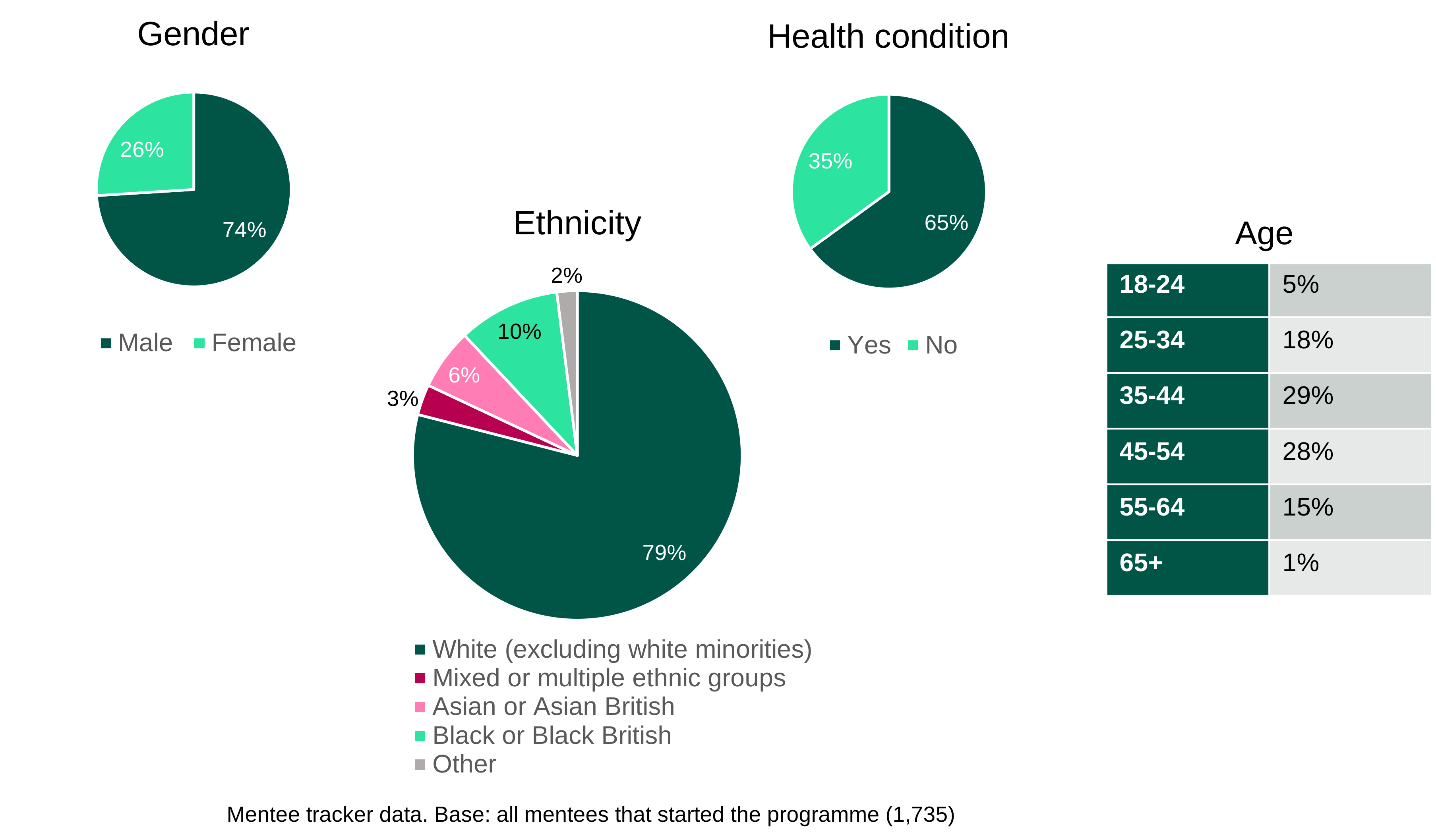
Barriers to moving into or closer to employment (outside of dependency)
The tracker completed by mentors captured some information on mentee barriers to progression, on joining the Peer Mentoring programme.
Alongside their dependency, the majority of mentees were experiencing a range of other difficulties which might impact their ability to progress, such as health issues, housing and accommodation needs and having an offending history. As at December 2024, most mentees reported experiencing at least one other barrier outside of their dependency (93% of those engaged, 68% of those disengaged, 91% of those completed, Table 1).
Table 1: Mentee barriers to progression recorded by mentors, by proportion of those still engaged, no longer engaged and completed
| Barriers: | Number still engaged | Percentage still engaged | Number no longer engaged | Percentage no longer engaged | Number completed | Percentage completed | Number of overall Starts | Percentage of overall starts |
|---|---|---|---|---|---|---|---|---|
| Have heath issues | 342 | 75% | 371 | 52% | 418 | 74% | 1131 | 65% |
| Have housing or accommodation needs | 167 | 37% | 235 | 33% | 229 | 41% | 631 | 36% |
| Have an offending history | 202 | 45% | 250 | 35% | 201 | 36% | 653 | 38% |
| Other barriers | 185 | 41% | 223 | 31% | 241 | 43% | 649 | 37% |
| No barriers reported | 24 | 5% | 48 | 7% | 46 | 8% | 118 | 7% |
| At least one barrier reported | 421 | 93% | 490 | 68% | 515 | 91% | 1,426 | 82% |
| Totals | 453 | 100% | 719 | 100% | 563 | 100% | 1,735 | 100% |
Health issues were the most common barrier experienced by mentees (75% of those engaged, 52% of those disengaged, 74% of those completed). Health issues were also the most common employment barrier reported in the baseline survey, aside from the dependency itself (46% of mentees in the baseline survey reported health issues and 59% of mentees in the baseline survey reported alcohol dependency).
A higher proportion of those still engaged were identified as having a history of offending as a progression barrier (45% of those engaged, 35% of those disengaged, 36% of those completed). A higher proportion of those completed were identified as having housing or accommodation needs as a progression barrier (41% of those who’d completed, 37% of those engaged, 33% of those disengaged).
Annex B: Volumes of individuals referred, starting the programme and completing, by provider
A total of 2,994 individuals have been referred to the programme to date. Just under 6 in 10 (58%) of those that were referred, started the programme. A fifth of all those referred (19%) completed the programme. Table 2 shows how this breaks down by provider, as context.
Table 2: Volumes of individuals referred, starting the programme, still engaged, disengaged and completed
| Provider | All referrals to date from latest MI (December 2024) | Total number of mentees on the programme since inception from tracker data (i.e. all programme ‘starts’) | Number of mentees currently active from tracker data 4 | Number of mentees no longer engaged with the programme | Number of mentees who have completed the programme from tracker data |
|---|---|---|---|---|---|
| Change Grow Live | 1,540 | 902 | 185 | 335 | 382 |
| The Growth Company | 1035 | 428 | 193 | 114 | 121 |
| Inclusion | 312 | 298 | 49 | 222 | 27 |
| The Wallich | 107 | 107 | 26 | 48 | 33 |
| Totals | 2994 | 1,735 | 453 | 719 | 563 |
| % of all referrals | 100% | 58% | 15% | 24% | 19% |
Based on Management Information (MI) and mentee tracker data up to December 2024
Please note that, in the ‘percentage of all referrals’ figures in the table above, the total number of referrals that the percentages are based on, is from a different data source to the percentages in the right-hand 4 columns.
Annex C: Mentee engagement with the programme, in detail
According to the tracker data, by December 2024, two-fifths of mentees who started on the Peer Mentoring programme were no longer engaged with the programme (41%), one-third (32%) had completed and around one-quarter (26%) of mentees were still engaged.
Regarding the number of sessions attended on the programme, both those still engaged and those no longer engaged had most commonly completed between one and 4 sessions (54% of those still engaged, 62% of those no longer engaged, Table 3). Those who’d completed, had most commonly done so within 7 sessions (49%), although 8 sessions (18%), 9 sessions (10%) and 10+ sessions (23%) were also relatively common. Missing at least one session was relatively common too: 57% of mentees still engaged had done so, rising to 66% amongst those no longer engaged and 73% amongst those who’d completed.
Table 3: Number of sessions attended, by proportion of those still engaged, no longer engaged and completed
| Number of sessions | Still engaged (n=453) | No longer engaged (n=719) | Completed (n=563) |
|---|---|---|---|
| 0 sessions | 0% | 1% | 0% |
| 1-4 sessions | 54% | 62% | 2% |
| 5-7 sessions | 22% | 10% | 47% |
| 8 sessions | 6% | 1% | 18% |
| 9 sessions | 5% | 1% | 10% |
| 10+ sessions | 12% | 1% | 23% |
| No information provided | 1% | 24% | 0% |
| Missed at least one session | 57% | 66% | 73% |
In terms of the total duration of engagement with the programme, tracker data shows that mentees no longer engaged were most commonly on the programme for 2 months or less (39%, Table 4). Those who completed the programme most commonly did so within 3 to 4 months (45%). Those still engaged had most commonly been with the programme for 1 to 2 months, so far (38%). That said, the amount of time mentees had been on the programme varied considerably, with a substantial minority of those still engaged with the programme as at December 2024, having been on the programme for 11 months or more (11%).
Table 4: Duration of time spent on the programme, by proportion of those still engaged, no longer engaged and completed
| Months of engagement | Still engaged (n=453) | No longer engaged (n=719) | Completed (n=563) |
|---|---|---|---|
| Less than a month | 6% | 6% | 0% |
| 1 to 2 months | 38% | 33% | 22% |
| 3 to 4 months | 19% | 18% | 45% |
| 5 to 6 months | 12% | 7% | 16% |
| 7 to 8 months | 7% | 3% | 7% |
| 9 months | 2% | 0% | 2% |
| 10 months | 3% | 1% | 1% |
| 11 months + | 11% | 1% | 5% |
| No information provided | 3% | 31% | 2% |
Annex D: Types of support accessed by mentees, in detail
The tracker completed by mentors captured some information on mentee outcomes, including the types of support that mentees were accessing as a result of their work with their mentor.
The most common outcomes recorded by mentors, were mentees entering other practical or emotional support, being referred to treatment, entering treatment, and entering volunteering (Table 5).
Table 5: Outcomes recorded by mentors, including support accessed by mentees, by proportion of those still engaged, no longer engaged and completed
| Outcomes | Number still engaged | Percentage still engaged | Number no longer engaged | Percentage no longer engaged | Number completed | Percentage completed | Number of overall Starts | Percentage of overall starts |
|---|---|---|---|---|---|---|---|---|
| Other practical or emotional support | 133 | 29% | 96 | 13% | 257 | 46% | 486 | 28% |
| Referred to treatment | 169 | 37% | 128 | 18% | 186 | 33% | 483 | 28% |
| Entered treatment | 98 | 22% | 58 | 8% | 69 | 12% | 225 | 13% |
| Entered volunteering | 53 | 12% | 24 | 3% | 121 | 21% | 198 | 11% |
| Entered training | 53 | 12% | 31 | 4% | 93 | 17% | 177 | 10% |
| Entered DWP employment support | 39 | 9% | 31 | 4% | 93 | 17% | 163 | 9% |
| Entered employment | 26 | 6% | 25 | 3% | 58 | 10% | 109 | 6% |
| Entered education | 19 | 4% | 9 | 1% | 48 | 9% | 76 | 4% |
| Entered non-DWP employment support | 12 | 3% | 4 | 1% | 31 | 6% | 47 | 3% |
| No outcomes reported | 99 | 22% | 370 | 51% | 93 | 17% | 562 | 32% |
| At least one outcome reported | 316 | 70% | 236 | 33% | 463 | 82% | 1,015 | 59% |
| Totals | 453 | 100% | 719 | 100% | 563 | 100% | 1,735 | 100% |
Just under one-third (28%) of all mentees had entered other practical or emotional support (29% of those engaged, 13% of those disengaged, 46% of those that completed). Among those that reported receiving other practical or emotional support, the most common specific sources of support were substance misuse services (50%), mental health support (43%), and support groups (unspecified) (36%).
Over one-quarter (28%) of mentees had been referred to treatment. This rose to over a third when focusing on those who were still engaged or had completed the programme (37% of those still engaged, 33% of those completed).
Just over one in 10 (13%) of all mentees had entered treatment, although this was higher amongst those still engaged (22%), compared to those that disengaged and completed (8% and 12% respectively).
One in 10 (11%) mentees had entered volunteering. This was also much higher amongst those still engaged and completed (12% and 21% respectively), compared to those that disengaged (3%).
It was less common for mentees to have entered employment (6%) or education (4%). However, for employment this rose to one in 10 (10%) for those that had completed the programme.
In the qualitative interviews, while mentors discussed that their approach to each mentee was tailored to their circumstances, there were commonalities in the support provided. Mentees and mentors discussed the following 4 recurring areas of support:
-
general dependency and recovery support: this included encouraging mentees to discuss their dependency and attend support groups such as Narcotics Anonymous (NA) and Alcoholics Anonymous (AA)
-
encouraging mentees to create healthy habits: this included encouraging mentees to reignite old passions. For example, exercising, joining gardening clubs and martial arts classes
-
practical support: for example, help with benefit claims, sourcing basic amenities like food, finding suitable housing and assistance with financial difficulties e.g. managing debt
The first few sessions were sorting out issues, such as paying bills, and debt management.
(Mentee, aged 35-54, Male, Opioid dependency)
- employment and training support: once mentees were in a stable position, support around CV development, and searching for paid work, volunteering opportunities and training, was discussed
I’ve just been sorting my CV out… He [my mentor] was talking about me volunteering for now.
(Mentee, aged 55-64, Male, Alcohol dependency)
Annex E: Methodology additional detail
This evaluation findings draw on 4 components.
Quantitative surveys with mentees on 3 occasions: The breakdown of survey completes, for each survey, by provider, is shown in Table 6.
Table 6: Number of survey interviews achieved, by provider
| Provider | Total number of mentees on the programme since inception from tracker data | Number of baseline survey completes | Response rate at baseline | Number of first follow-up survey completes | Number of second follow-up survey completes |
|---|---|---|---|---|---|
| Change Grow Live | 902 | 429 | 48% | 59 | 20 |
| The Growth Company | 428 | 136 | 32% | 14 | 6 |
| Inclusion | 298 | 59 | 20% | 3 | 2 |
| The Wallich | 107 | 30 | 28% | 4 | 0 |
| Totals | 1,735 | 654 | 38% | 80 | 28 |
Qualitative interviews: in-depth interviews were conducted with mentees, mentors, DWP SPOCs, stakeholders involved in the referral process, delivery providers and other stakeholders who were actively engaged with mentees who were on the programme. The total interviews achieved, by provider are shown in Tables 7 to 10.
Table 7: Number of mentee in-depth interviews completed, by provider
| Provider | Wave 1 | Wave 2 | Total |
|---|---|---|---|
| Change Grow Live | 9 | 11 | 20 |
| The Growth Company | 9 | 5 | 14 |
| Inclusion | 3 | 6 | 9 |
| The Wallich | 1 | 0 | 1 |
| Total | 22 | 22 | 44 |
Table 8: Number of mentor in-depth interviews completed, by provider
| Provider | Wave 1 | Wave 2 | Total |
|---|---|---|---|
| Change Grow Live | 5 | 6 | 11 |
| The Growth Company | 6 | 4 | 10 |
| Inclusion | 3 | 4 | 7 |
| The Wallich | 2 | 2 | 4 |
| Total | 16 | 16 | 32 |
Table 9: Number of SPOC in-depth interviews completed, by provider
| Provider | Wave 1 | Wave 2 | Total |
|---|---|---|---|
| Change Grow Live | 4 | 2 | 6 |
| The Growth Company | 5 | 5 | 10 |
| Inclusion | 4 | 1 | 5 |
| The Wallich | 1 | 1 | 2 |
| Total | 14 | 9 | 23 |
Table 10: Number of stakeholder in-depth interviews completed, by provider
| Provider | Wave 1 | Wave 2 | Total |
|---|---|---|---|
| Change Grow Live | 3 | 6 | 9 |
| The Growth Company | 1 | 2 | 3 |
| Inclusion | 2 | 1 | 3 |
| The Wallich | 3 | 2 | 5 |
| Total | 9 | 11 | 20 |
Mentee tracker data: This was individual data collected by delivery providers on every mentee who engaged with the programme since it began. Delivery providers submitted tracker data to IFF monthly. In total, 14,484 mentee tracker submissions, covering 1,735 individual mentees, were received for analysis. It is important to note that we only report on the information that was included. Occasionally it was unclear if information was missing, or if it was not applicable at the time of completion. The number of tracker submissions, by provider, is shown in Table 11.
Table 11: Number of Tracker submissions received, by provider
| Provider | Number of Tracker submissions received for analysis |
|---|---|
| Change Grow Live | 7,928 |
| The Growth Company | 4,295 |
| Inclusion | 1,355 |
| The Wallich | 906 |
| Total | 14,484 |
Analysis of samples of SMART action plans: Delivery providers also submitted a random selection of anonymised SMART action plans each quarter, to enable analysis of plan content and quality. Table 12 shows the number of SMART action plans that were analysed, by provider.
Table 12: Number of SMART action plan submissions, by provider
| Provider | Number of SMART plans received for analysis |
|---|---|
| Change Grow Live | 38 |
| The Growth Company | 55 |
| Inclusion | 19 |
| The Wallich | 15 |
| Total | 127 |
-
However, due to individuals being part of the programme for longer than anticipated (including, in some instances, going through the programme more than once), individuals whose participation in the programme was ongoing were contacted from September 2024 to take part if they had been involved in the programme for at least 4 months and, if so, were invited to take part in this follow-up survey. ↩
-
It was not possible to assess whether SMART action plans were achievable or relevant, without having direct knowledge of the individual mentee. ↩
-
If SMART action plans contain more than 10 actions this is counted as 10+ actions within the framework and therefore there are at least 592 actions. ↩
-
Comparisons made with the Adult Psychiatric Morbidity Survey 2014, and National Drug Treatment Monitoring System statistics on adults 18+ receiving help in England for problems with drugs and alcohol (in the year between 1 April 2021 and 31 March 2022). ↩